EP0346547B1 - Verfahren zur Behandlung von kalt gewalztem rostfreiem Stahlblech und Stahlband - Google Patents
Verfahren zur Behandlung von kalt gewalztem rostfreiem Stahlblech und Stahlband Download PDFInfo
- Publication number
- EP0346547B1 EP0346547B1 EP88311177A EP88311177A EP0346547B1 EP 0346547 B1 EP0346547 B1 EP 0346547B1 EP 88311177 A EP88311177 A EP 88311177A EP 88311177 A EP88311177 A EP 88311177A EP 0346547 B1 EP0346547 B1 EP 0346547B1
- Authority
- EP
- European Patent Office
- Prior art keywords
- steel
- degrees centigrade
- strip
- degrees fahrenheit
- degrees
- Prior art date
- Legal status (The legal status is an assumption and is not a legal conclusion. Google has not performed a legal analysis and makes no representation as to the accuracy of the status listed.)
- Expired - Lifetime
Links
- 229910001220 stainless steel Inorganic materials 0.000 title claims abstract description 32
- 238000000034 method Methods 0.000 title claims abstract description 31
- 239000010935 stainless steel Substances 0.000 title claims abstract description 30
- 238000000137 annealing Methods 0.000 claims abstract description 26
- PMZURENOXWZQFD-UHFFFAOYSA-L Sodium Sulfate Chemical compound [Na+].[Na+].[O-]S([O-])(=O)=O PMZURENOXWZQFD-UHFFFAOYSA-L 0.000 claims abstract description 9
- 229910052938 sodium sulfate Inorganic materials 0.000 claims abstract description 9
- 235000011152 sodium sulphate Nutrition 0.000 claims abstract description 9
- 229910000831 Steel Inorganic materials 0.000 claims description 24
- 239000010959 steel Substances 0.000 claims description 24
- 238000010438 heat treatment Methods 0.000 claims description 14
- 238000005554 pickling Methods 0.000 claims description 8
- XLYOFNOQVPJJNP-UHFFFAOYSA-N water Substances O XLYOFNOQVPJJNP-UHFFFAOYSA-N 0.000 claims description 4
- 238000001035 drying Methods 0.000 claims description 3
- 238000005201 scrubbing Methods 0.000 claims description 3
- 239000010963 304 stainless steel Substances 0.000 claims description 2
- 229910000589 SAE 304 stainless steel Inorganic materials 0.000 claims description 2
- 229910000963 austenitic stainless steel Inorganic materials 0.000 claims description 2
- 239000010965 430 stainless steel Substances 0.000 claims 1
- 230000006698 induction Effects 0.000 abstract description 8
- 239000007864 aqueous solution Substances 0.000 abstract description 3
- 230000015572 biosynthetic process Effects 0.000 abstract description 3
- 239000002253 acid Substances 0.000 description 6
- 150000007513 acids Chemical class 0.000 description 3
- 239000000203 mixture Substances 0.000 description 3
- 230000001590 oxidative effect Effects 0.000 description 3
- 230000004907 flux Effects 0.000 description 2
- 238000004519 manufacturing process Methods 0.000 description 2
- 239000000463 material Substances 0.000 description 2
- 239000000126 substance Substances 0.000 description 2
- 230000033228 biological regulation Effects 0.000 description 1
- 238000005422 blasting Methods 0.000 description 1
- 238000005097 cold rolling Methods 0.000 description 1
- 230000003750 conditioning effect Effects 0.000 description 1
- 230000003247 decreasing effect Effects 0.000 description 1
- 238000010586 diagram Methods 0.000 description 1
- 230000005674 electromagnetic induction Effects 0.000 description 1
- 230000007613 environmental effect Effects 0.000 description 1
- 239000000383 hazardous chemical Substances 0.000 description 1
- 229910052751 metal Inorganic materials 0.000 description 1
- 239000002184 metal Substances 0.000 description 1
- 230000007935 neutral effect Effects 0.000 description 1
- 235000021110 pickles Nutrition 0.000 description 1
- 150000003839 salts Chemical class 0.000 description 1
- 238000007493 shaping process Methods 0.000 description 1
- 239000000243 solution Substances 0.000 description 1
- 239000007858 starting material Substances 0.000 description 1
- 238000006467 substitution reaction Methods 0.000 description 1
- 239000002699 waste material Substances 0.000 description 1
Images
Classifications
-
- C—CHEMISTRY; METALLURGY
- C25—ELECTROLYTIC OR ELECTROPHORETIC PROCESSES; APPARATUS THEREFOR
- C25F—PROCESSES FOR THE ELECTROLYTIC REMOVAL OF MATERIALS FROM OBJECTS; APPARATUS THEREFOR
- C25F1/00—Electrolytic cleaning, degreasing, pickling or descaling
- C25F1/02—Pickling; Descaling
- C25F1/04—Pickling; Descaling in solution
- C25F1/06—Iron or steel
-
- C—CHEMISTRY; METALLURGY
- C21—METALLURGY OF IRON
- C21D—MODIFYING THE PHYSICAL STRUCTURE OF FERROUS METALS; GENERAL DEVICES FOR HEAT TREATMENT OF FERROUS OR NON-FERROUS METALS OR ALLOYS; MAKING METAL MALLEABLE, e.g. BY DECARBURISATION OR TEMPERING
- C21D6/00—Heat treatment of ferrous alloys
- C21D6/002—Heat treatment of ferrous alloys containing Cr
-
- C—CHEMISTRY; METALLURGY
- C21—METALLURGY OF IRON
- C21D—MODIFYING THE PHYSICAL STRUCTURE OF FERROUS METALS; GENERAL DEVICES FOR HEAT TREATMENT OF FERROUS OR NON-FERROUS METALS OR ALLOYS; MAKING METAL MALLEABLE, e.g. BY DECARBURISATION OR TEMPERING
- C21D9/00—Heat treatment, e.g. annealing, hardening, quenching or tempering, adapted for particular articles; Furnaces therefor
- C21D9/52—Heat treatment, e.g. annealing, hardening, quenching or tempering, adapted for particular articles; Furnaces therefor for wires; for strips ; for rods of unlimited length
- C21D9/54—Furnaces for treating strips or wire
- C21D9/56—Continuous furnaces for strip or wire
- C21D9/60—Continuous furnaces for strip or wire with induction heating
-
- Y—GENERAL TAGGING OF NEW TECHNOLOGICAL DEVELOPMENTS; GENERAL TAGGING OF CROSS-SECTIONAL TECHNOLOGIES SPANNING OVER SEVERAL SECTIONS OF THE IPC; TECHNICAL SUBJECTS COVERED BY FORMER USPC CROSS-REFERENCE ART COLLECTIONS [XRACs] AND DIGESTS
- Y02—TECHNOLOGIES OR APPLICATIONS FOR MITIGATION OR ADAPTATION AGAINST CLIMATE CHANGE
- Y02P—CLIMATE CHANGE MITIGATION TECHNOLOGIES IN THE PRODUCTION OR PROCESSING OF GOODS
- Y02P10/00—Technologies related to metal processing
- Y02P10/25—Process efficiency
Definitions
- This invention relates to the processing of cold-rolled stainless-steel sheet or strip, and in particular, to a method of annealing and then descaling that product.
- annealing practice involves heating the steel in an oxidizing furnace atmosphere to a temperature at which oxide surface scale readily forms. Such heating, to a temperature typically in the range of 450 degrees Fahrenheit to 2150 degrees Fahrenheit (788 degrees Centigrade to 1177 degrees Centigrade), depending upon the chemical composition of the steel being processed, is commonly done in a refractory-lined, gas-fired furnace containing an oxidizing atmosphere, and such treatment typically results in the formation on the stainless steel of an oxide scale having a thickness in the range of 4000 Angstroms to several microns.
- any of several different descaling processes may be used, alone or in combination, and among these known processes there are (1) shot blasting followed by acid pickling, (2) conditioning the scale by immersing the product in molten salt or subjecting it to an electrolytic treatment, followed by acid pickling, and (3) straight acid pickling.
- the acids commonly used in the pickling operation include sulfuric, nitric, and nitric-hydrofluoric combinations.
- U.S. Patent No. 4,363,709 discloses the removal of oxide scale from the surface of a metallic body of stainless steel, with the use of a high-current-density electrolytic descaling process in a bath consisting of an aqueous solution containing about 15 to 25 weight percent of sodium sulfate, maintained at a temperature of at least 150 degrees Fahrenheit (65.6 degrees Centigrade).
- the stainless steel is subjected as the anode to the action of a direct electric current for at least 10 seconds at a current density of at least 3 amperes per square inch (46.5 Amps/dm2).
- the prior art contains, moreover, a group of patents which are concerned with the problem of providing heat to metal strip or sheet material by means of electrical induction.
- This prior art includes, for example, the following U.S. Patents: 4,054,770; 4,585,916; 3,444,346; 2,902,572; and 4,678 ,883. These patents may be considered as relating to such an electromagnetic induction process called "transverse flux induction heating".
- the known gas-fired processes are capable of handling stainless-steel strip in a variety of strip widths without it being necessary to make any other important adjustments in the process parameters.
- the induction heating a change from one known commercial width to another, and a change in the composition in the stainless steel being processed, requires further experimentation to determine another satisfactory set of operating conditions.
- Cold-rolled stainless-steel sheet or strip is further processed by being induction-heated to an annealing temperature in the range of up to 2300 degrees Fahrenheit (1260 degrees Centigrade), with the formation thereon of a scale having thickness of 2000 angstroms or less, followed by electrolytic descaling at high current density in an aqueous solution of 15 to 25 weight percent of sodium sulfate, maintained at a temperature of at least 150 degrees Fahrenheit (66 degrees Centigrade) for a time sufficient to substantially entirely descale the steel.
- an annealing temperature in the range of up to 2300 degrees Fahrenheit (1260 degrees Centigrade)
- electrolytic descaling at high current density in an aqueous solution of 15 to 25 weight percent of sodium sulfate, maintained at a temperature of at least 150 degrees Fahrenheit (66 degrees Centigrade) for a time sufficient to substantially entirely descale the steel.
- the starting material preferably cold-rolled stainless steel in the form of strip or sheet.
- Such stainless steel may be of either austenitic nature (e.g., AISI Type 304) or ferritic nature (e.g., AISI Type 430).
- Such sheet or strip typically has a thickness of from 0.008 to 0.02 inch (.2032 to .508mm), and preferably of the order of 0.012 inch (.3048mm), and comes in various sheet widths of the order of 24 to 40 inches (61 to 101.6 cm).
- the cold-rolled stainless steel needs to be annealed and descaled, in order to produce commercially salable stainless steel in sheet or strip form.
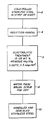
- the above-mentioned stainless sheet or strip is subjected to an induction-annealing operation, as indicated in the box 4 of the drawing.
- this step involves heating the steel to a suitable annealing temperature, such as 1450 degrees Fahrenheit to 2300 degrees Fahrenheit (788 to 1260 degrees Centigrade), depending upon the chemical composition of the steel being treated, by means of a process of transverse-flux induction heating of a kind indicated as being known to those skilled in the art from the above-mentioned U.S. Patents, Nos. 4,054,770; 4,585,916; 3,444,346; 2,902,572; and 4,678,883.
- the induction-anneal treatment of the box 4 results in a stainless-steel product having thereon an oxide scale having a thickness of less than 2000 angstroms, particularly of the order of 700 to 1400 angstroms, which is approximately one-third the oxide-scale thickness obtained when similar steel is heated for annealing in a typical gas-fired refractory-lined furnace.
- oxide scale having a thickness of less than 2000 angstroms, particularly of the order of 700 to 1400 angstroms, which is approximately one-third the oxide-scale thickness obtained when similar steel is heated for annealing in a typical gas-fired refractory-lined furnace.
- the stainless-steel strip is subjected to electrolytic treatment in a bath of 15 to 25 weight percent of aqueous sodium sulfate maintained at a temperature above 150 degrees Fahrenheit (66 degrees Centigrade) and with the use of a current density above 3 amperes per square inch (46.5 amperes/dm2), Preferably the strip is subjected as an anode to a D.C. (direct current) for at least 10 seconds.
- aqueous sodium sulfate maintained at a temperature above 150 degrees Fahrenheit (66 degrees Centigrade) and with the use of a current density above 3 amperes per square inch (46.5 amperes/dm2)
- the combination of treatment conditions used may be modified somewhat in the direction of being less severe, and still it will be possible to obtain, without resort to any subsequent acid-pickling step, a product from which the scale has been adequately, i.e., substantially totally, removed.
- the stainless steel is subjected further to a rinsing with water, brush-scrubbing, and drying, as indicated in the box 8, resulting in the production of suitably annealed and descaled stainless-steel, as indicated in box 10.
- AISI Type 304 stainless-steel strip 0.012 inches (.3048 mm) thick, was induction-heated for annealing to a temperature of 1850 degrees Fahrenheit (1010 degrees Centigrade) and then air-cooled. It was subsequently subjected to an electrolytic descaling treatment at 3 amperes per square inch (46.5 amps/dm2) for a time of 15 seconds in an aqueous bath containing 20 weight percent of sodium sulfate maintained at 160 degrees Fahrenheit (71 degrees Centigrade). The oxide thickness, as annealed, was 700 angstroms, and after the electrolytic descaling treatment the oxide thickness was determined to be 35 angstroms. After being water rinsed, brush-scrubbed and dried, the product comprised satisfactorily annealed and descaled stainless-steel strip.
- Example 1 was repeated, except that in the electrolytic descaling treatment, the current density was 3.5 amperes per square inch (54.3 A/dm2). The results were the same as Example 1, i.e. satisfactorily descaled.
- Example 1 was repeated, except that the steel was AISI Type 430, and the annealing temperature was 1508 degrees Fahrenheit (820 degrees Centigrade), following which the stainless-steel strip was water-quenched instead of air-cooled.
- the results were substantially the same; the oxide thickness of the scale, after annealing, was 900 angstroms, and after the electrolytic descaling it was 52.5 angstroms.
- Example 3 was repeated, except that a current density of 3.5 amperes per square inch (54.3 amps/dm2) was used in the descaling treatment, and the results were substantially the same, except that the oxide thickness after electrolytic descaling was 35 angstroms.
- the oxide thicknesses of scale were obtained when different induction-annealing temperatures were used. For example, using an annealing temperature of 2057 degrees Fahrenheit (1125 degrees Centigrade) on AISI Type 304 austenitic stainless-steel strip having a thickness of 0.012 inch (.03 cm), oxide thicknesses in the range of 1200 to 1400 angstroms were observed, whether the steel was air-cooled or water-quenched. With the same steel, but at an annealing temperature of 2021 degrees Fahrenheit (1105 degrees Centigrade), the oxide-scale thickness was observed to be 1200 to 1300 angstroms.
Landscapes
- Chemical & Material Sciences (AREA)
- Engineering & Computer Science (AREA)
- Materials Engineering (AREA)
- Metallurgy (AREA)
- Organic Chemistry (AREA)
- Thermal Sciences (AREA)
- Crystallography & Structural Chemistry (AREA)
- Mechanical Engineering (AREA)
- Physics & Mathematics (AREA)
- Chemical Kinetics & Catalysis (AREA)
- Electrochemistry (AREA)
- Heat Treatment Of Sheet Steel (AREA)
- Heat Treatment Of Strip Materials And Filament Materials (AREA)
Claims (11)
- Verfahren zur Behandlung von kaltgewalztem rostfreiem Stahlband und Stahlblech, wobei das Verfahren umfaßt:
Unterziehen des Stahls einer elektrischen Querfluß-Induktionswärmebehandlung, die über ihre Breite im wesentlichen gleichförmig ist mit einer Glühtemperatur von bis zu 2300° Fahrenheit (1260°C), wodurch auf dem Stahl eine Zunderdicke von bis zu 2000 Angström erzeugt wird,
elektrolytisches Entzundern des Stahls durch Unterziehen desselben der Wirkung eines Bades, das aus einem besonderen Wasser mit 15 bis 25 Gew.-% Natriumsulfat besteht, wobei das Bad mit einer Temperatur von mehr als 150° Fahrenheit (66°C) bei Verwendung einer Stromdichte von mindestens 3,0 A/dm² (46,5 A/dm²) für eine Zeitdauer gehalten wird, die ausreicht, um den Stahl im wesentlichen vollständig zu entzundern, und
daran anschließendes Bearbeiten des Stahls mittels Bürstenreinigen, Wasserspülen und Trocknen ohne die Verwendung einer Säureheizbehandlung, um ein geglühtes und entzundertes rostfreies Stahlprodukt zu erzeugen. - Verfahren nach Anspruch 1, wobei die Glühtemperatur in einem Bereich von 1450 bis 2300° Fahrenheit (788 bis 1260°C) liegt.
- Verfahren nach Anspruch 1 oder 2, wobei die erzeugte Zunderdicke in einem Bereich von 700 bis 1400 Angström liegt.
- Verfahren nach Anspruch 1, 2 oder 3, wobei die Stahlblech- bzw. Stahlbanddicke in einem Bereich zwischen 0,008 bis 0,002 Zoll (0,2032 bis 0,508 mm) liegt.
- Verfahren nach einem der vorherigen Ansprüche, wobei der Stahl ein austenitischer rostfreier Stahl ist, und wobei die verwendete Glühtemperatur in einem Bereich von 1800 bis 2100° Fahrenheit (982 bis 1149°C) liegt.
- Verfahren nach Anspruch 5, wobei die Glühtemperatur in einem Bereich von 1800 bis 1900° Fahrenheit (982 bis 1038°C) liegt.
- Verfahren nach Anspruch 5 oder 6, wobei der Stahl ein AISI Typ 304 rostfreier Stahl ist.
- Verfahren nach einem der Ansprüche 1 bis 5, wobei der Stahl ein ferritischer rostfreier Stahl ist und die verwendete Glühtemperatur in einem Bereich von 1450 bis 1700° Fahrenheit (788 bis 927°C) liegt.
- Verfahren nach Anspruch 8, wobei die Glühtemperatur in einem Bereich von 1500 bis 1550° Fahrenheit (815 bis 843°C) liegt.
- Verfahren nach Anspruch 8 oder 9, wobei der Stahl ein AISI Typ 430 rostfreier Stahl ist.
- Verfahren zur Behandlung von kaltgewalztem rostfreiem Stahlband und Stahlblech, das eine Dicke von 0,008 bis 0,02 Zoll (0,2032 bis 0,508 mm) hat, wobei das Verfahren umfaßt:
Unterziehen des Stahls einer elektrischen Querfluß-Induktionswärmebehandlung, die über ihre Breite im wesentlichen gleiförmig ist mit einer Glühtemperatur in einem Bereich von 1450 bis 2300° Fahrenheit (788 bis 1260°C), wodurch auf dem Stahl eine Zunderdicke von 700 bis 1400 Angström) erzeugt wird,
elektrolytisches Entzundern des Stahls durch Unterziehen desselben der Wirkung eines Bades, das aus einem besonderen Wasser mit 15 bis 25 Gew.-% Natriumsulfat besteht und daß bei einer Temperatur von mehr als 150° Fahrenheit (65,5°C) gehalten wird unter Verwendung einer Stromdichte über 3,0 A/dm² (46,5 A/dm²) für eine Zeit, die ausreicht, den Stahl im wesentlichen vollständig zu entzundern, und
daran anschließendes Bearbeiten des Stahls mittels Bürstenreinigen, Wasserspülen und Trocknen ohne die Verwendung einer Säureabbeizbehandlung, um ein geglühtes und entzundertes rostfreies Stahlprodukt herzustellen.
Priority Applications (1)
| Application Number | Priority Date | Filing Date | Title |
|---|---|---|---|
| AT88311177T ATE75786T1 (de) | 1988-06-15 | 1988-11-25 | Verfahren zur behandlung von kalt gewalztem rostfreiem stahlblech und stahlband. |
Applications Claiming Priority (2)
| Application Number | Priority Date | Filing Date | Title |
|---|---|---|---|
| US207083 | 1988-06-15 | ||
| US07/207,083 US4824536A (en) | 1988-06-15 | 1988-06-15 | Method for processing cold-rolled stainless-steel sheet and strip |
Publications (2)
| Publication Number | Publication Date |
|---|---|
| EP0346547A1 EP0346547A1 (de) | 1989-12-20 |
| EP0346547B1 true EP0346547B1 (de) | 1992-05-06 |
Family
ID=22769138
Family Applications (1)
| Application Number | Title | Priority Date | Filing Date |
|---|---|---|---|
| EP88311177A Expired - Lifetime EP0346547B1 (de) | 1988-06-15 | 1988-11-25 | Verfahren zur Behandlung von kalt gewalztem rostfreiem Stahlblech und Stahlband |
Country Status (11)
| Country | Link |
|---|---|
| US (1) | US4824536A (de) |
| EP (1) | EP0346547B1 (de) |
| JP (1) | JPH0696800B2 (de) |
| KR (1) | KR960015231B1 (de) |
| AT (1) | ATE75786T1 (de) |
| AU (1) | AU2515688A (de) |
| BR (1) | BR8806325A (de) |
| CA (1) | CA1325998C (de) |
| DE (1) | DE3870869D1 (de) |
| ES (1) | ES2031246T3 (de) |
| MX (1) | MX165346B (de) |
Families Citing this family (9)
| Publication number | Priority date | Publication date | Assignee | Title |
|---|---|---|---|---|
| JPH0368799A (ja) * | 1989-08-08 | 1991-03-25 | Kawasaki Steel Corp | ステンレス冷延鋼帯の脱スケール方法 |
| CA2139522C (en) * | 1994-01-11 | 2008-03-18 | Michael F. Mcguire | Continuous method for producing final gauge stainless steel product |
| US5490908A (en) * | 1994-07-11 | 1996-02-13 | Allegheny Ludlum Corporation | Annealing and descaling method for stainless steel |
| US5843246A (en) * | 1996-01-16 | 1998-12-01 | Allegheny Ludlum Corporation | Process for producing dual phase ferritic stainless steel strip |
| AU5904098A (en) * | 1996-12-26 | 1998-07-31 | J&L Speciality Steel, Inc. | Brushing process for corrosion and oxidation resistance |
| BR112012016028B1 (pt) * | 2009-12-14 | 2020-10-27 | Nippon Steel Corporation | sistema de aquecimento por indução que permite que um campo magnético alternado cruze uma superfície de lâmina e método para controle do mesmo |
| KR101428311B1 (ko) * | 2012-12-21 | 2014-08-07 | 주식회사 포스코 | 열연 강대의 스케일 제거 방법 및 장치 |
| CN104032123B (zh) * | 2014-06-16 | 2016-03-30 | 中冶南方工程技术有限公司 | 一种冷轧430铁素体不锈钢带钢退火酸洗生产方法 |
| CN104032318B (zh) * | 2014-06-16 | 2016-06-01 | 中冶南方工程技术有限公司 | 一种409l冷轧带钢退火酸洗生产方法 |
Family Cites Families (9)
| Publication number | Priority date | Publication date | Assignee | Title |
|---|---|---|---|---|
| US2902572A (en) * | 1957-03-05 | 1959-09-01 | Penn Induction Company | Induction heating of metal strip |
| US3444346A (en) * | 1966-12-19 | 1969-05-13 | Texas Instruments Inc | Inductive heating of strip material |
| JPS4981213A (de) * | 1972-12-12 | 1974-08-06 | ||
| GB1546367A (en) * | 1975-03-10 | 1979-05-23 | Electricity Council | Induction heating of strip and other elongate metal workpieces |
| JPS5710200A (en) * | 1980-06-20 | 1982-01-19 | Matsushita Electric Industrial Co Ltd | Voice synthesizer |
| US4363709A (en) * | 1981-02-27 | 1982-12-14 | Allegheny Ludlum Steel Corporation | High current density, acid-free electrolytic descaling process |
| US4585916A (en) * | 1982-06-02 | 1986-04-29 | Davy Mckee (Poole) Limited | Transverse flux induction heating of metal strip |
| JPS61253400A (ja) * | 1985-05-02 | 1986-11-11 | Mitsubishi Heavy Ind Ltd | オ−ステナイト系ステンレス鋼の脱スケ−ル方法 |
| JPS6235490A (ja) * | 1985-08-09 | 1987-02-16 | 住友重機械工業株式会社 | 電磁誘導加熱装置 |
-
1988
- 1988-06-15 US US07/207,083 patent/US4824536A/en not_active Expired - Lifetime
- 1988-11-15 AU AU25156/88A patent/AU2515688A/en not_active Abandoned
- 1988-11-21 KR KR1019880015306A patent/KR960015231B1/ko not_active Expired - Fee Related
- 1988-11-25 EP EP88311177A patent/EP0346547B1/de not_active Expired - Lifetime
- 1988-11-25 DE DE8888311177T patent/DE3870869D1/de not_active Expired - Fee Related
- 1988-11-25 ES ES198888311177T patent/ES2031246T3/es not_active Expired - Lifetime
- 1988-11-25 AT AT88311177T patent/ATE75786T1/de not_active IP Right Cessation
- 1988-12-01 BR BR888806325A patent/BR8806325A/pt not_active IP Right Cessation
- 1988-12-13 CA CA000585803A patent/CA1325998C/en not_active Expired - Fee Related
- 1988-12-27 JP JP63330740A patent/JPH0696800B2/ja not_active Expired - Lifetime
-
1989
- 1989-01-24 MX MX014645A patent/MX165346B/es unknown
Also Published As
| Publication number | Publication date |
|---|---|
| ES2031246T3 (es) | 1992-12-01 |
| KR960015231B1 (ko) | 1996-11-04 |
| JPH0696800B2 (ja) | 1994-11-30 |
| KR900000135A (ko) | 1990-01-30 |
| JPH01319700A (ja) | 1989-12-25 |
| AU2515688A (en) | 1989-12-21 |
| EP0346547A1 (de) | 1989-12-20 |
| US4824536A (en) | 1989-04-25 |
| CA1325998C (en) | 1994-01-11 |
| BR8806325A (pt) | 1990-07-31 |
| DE3870869D1 (de) | 1992-06-11 |
| MX165346B (es) | 1992-11-05 |
| ATE75786T1 (de) | 1992-05-15 |
Similar Documents
| Publication | Publication Date | Title |
|---|---|---|
| US5490908A (en) | Annealing and descaling method for stainless steel | |
| US5759307A (en) | Method of producing a cold-rolled strip in one pass | |
| EP0367112B1 (de) | Verfahren zum Entzundern von rostfreiem Stahl und Vorrichtung dafür | |
| US4824536A (en) | Method for processing cold-rolled stainless-steel sheet and strip | |
| EP0059527B1 (de) | Verfahren zum elektrolytischen, säurefreien Beizen mit hoher Stromdichte | |
| US4415415A (en) | Method of controlling oxide scale formation and descaling thereof from metal articles | |
| US2037633A (en) | Method of and apparatus for cleaning stainless steel | |
| US3254011A (en) | Electrolytic potassium hydroxide descaling | |
| JP4348464B2 (ja) | 金属製品を処理する方法 | |
| RU2085616C1 (ru) | Способ травления высококачественной стали | |
| JP2640565B2 (ja) | ステンレス鋼板の連続製造装置 | |
| US4066521A (en) | Metallic descaling system | |
| JPH01162786A (ja) | 高強度オーステナイト系ステンレス鋼の酸洗方法 | |
| JPS63130800A (ja) | オ−ステナイト系ステンレス冷延鋼帯の脱スケ−ル方法 | |
| US1824608A (en) | Method of making polished annealed stainless steels | |
| JPH0534439B2 (de) | ||
| TH21988A (th) | วิธีการแอนนีลและขจัดสะเก็ดสำหรับเหล็กกล้าปลอด?สนิม (Annealing and descaling method for stainless steel) | |
| JPS61245912A (ja) | オ−ステナイト系ステンレス鋼板または鋼帯の脱スケ−ル方法 |
Legal Events
| Date | Code | Title | Description |
|---|---|---|---|
| PUAI | Public reference made under article 153(3) epc to a published international application that has entered the european phase |
Free format text: ORIGINAL CODE: 0009012 |
|
| AK | Designated contracting states |
Kind code of ref document: A1 Designated state(s): AT BE DE ES FR GB IT SE |
|
| 17P | Request for examination filed |
Effective date: 19900601 |
|
| 17Q | First examination report despatched |
Effective date: 19910717 |
|
| ITF | It: translation for a ep patent filed | ||
| GRAA | (expected) grant |
Free format text: ORIGINAL CODE: 0009210 |
|
| AK | Designated contracting states |
Kind code of ref document: B1 Designated state(s): AT BE DE ES FR GB IT SE |
|
| REF | Corresponds to: |
Ref document number: 75786 Country of ref document: AT Date of ref document: 19920515 Kind code of ref document: T |
|
| ET | Fr: translation filed | ||
| REF | Corresponds to: |
Ref document number: 3870869 Country of ref document: DE Date of ref document: 19920611 |
|
| REG | Reference to a national code |
Ref country code: ES Ref legal event code: FG2A Ref document number: 2031246 Country of ref document: ES Kind code of ref document: T3 |
|
| PLBE | No opposition filed within time limit |
Free format text: ORIGINAL CODE: 0009261 |
|
| STAA | Information on the status of an ep patent application or granted ep patent |
Free format text: STATUS: NO OPPOSITION FILED WITHIN TIME LIMIT |
|
| 26N | No opposition filed | ||
| EAL | Se: european patent in force in sweden |
Ref document number: 88311177.5 |
|
| REG | Reference to a national code |
Ref country code: GB Ref legal event code: IF02 |
|
| PGFP | Annual fee paid to national office [announced via postgrant information from national office to epo] |
Ref country code: AT Payment date: 20051102 Year of fee payment: 18 |
|
| PGFP | Annual fee paid to national office [announced via postgrant information from national office to epo] |
Ref country code: GB Payment date: 20051116 Year of fee payment: 18 |
|
| PGFP | Annual fee paid to national office [announced via postgrant information from national office to epo] |
Ref country code: FR Payment date: 20051117 Year of fee payment: 18 |
|
| PGFP | Annual fee paid to national office [announced via postgrant information from national office to epo] |
Ref country code: ES Payment date: 20051124 Year of fee payment: 18 |
|
| PGFP | Annual fee paid to national office [announced via postgrant information from national office to epo] |
Ref country code: SE Payment date: 20051125 Year of fee payment: 18 |
|
| PGFP | Annual fee paid to national office [announced via postgrant information from national office to epo] |
Ref country code: BE Payment date: 20051208 Year of fee payment: 18 |
|
| PGFP | Annual fee paid to national office [announced via postgrant information from national office to epo] |
Ref country code: DE Payment date: 20060102 Year of fee payment: 18 |
|
| PG25 | Lapsed in a contracting state [announced via postgrant information from national office to epo] |
Ref country code: AT Free format text: LAPSE BECAUSE OF NON-PAYMENT OF DUE FEES Effective date: 20061125 |
|
| PG25 | Lapsed in a contracting state [announced via postgrant information from national office to epo] |
Ref country code: SE Free format text: LAPSE BECAUSE OF NON-PAYMENT OF DUE FEES Effective date: 20061126 |
|
| PG25 | Lapsed in a contracting state [announced via postgrant information from national office to epo] |
Ref country code: BE Free format text: LAPSE BECAUSE OF NON-PAYMENT OF DUE FEES Effective date: 20061130 |
|
| PGFP | Annual fee paid to national office [announced via postgrant information from national office to epo] |
Ref country code: IT Payment date: 20061130 Year of fee payment: 19 |
|
| PG25 | Lapsed in a contracting state [announced via postgrant information from national office to epo] |
Ref country code: DE Free format text: LAPSE BECAUSE OF NON-PAYMENT OF DUE FEES Effective date: 20070601 |
|
| EUG | Se: european patent has lapsed | ||
| GBPC | Gb: european patent ceased through non-payment of renewal fee |
Effective date: 20061125 |
|
| REG | Reference to a national code |
Ref country code: FR Ref legal event code: ST Effective date: 20070731 |
|
| PG25 | Lapsed in a contracting state [announced via postgrant information from national office to epo] |
Ref country code: GB Free format text: LAPSE BECAUSE OF NON-PAYMENT OF DUE FEES Effective date: 20061125 |
|
| BERE | Be: lapsed |
Owner name: *ALLEGHENY LUDLUM CORP. Effective date: 20061130 |
|
| REG | Reference to a national code |
Ref country code: ES Ref legal event code: FD2A Effective date: 20061127 |
|
| PG25 | Lapsed in a contracting state [announced via postgrant information from national office to epo] |
Ref country code: FR Free format text: LAPSE BECAUSE OF NON-PAYMENT OF DUE FEES Effective date: 20061130 Ref country code: ES Free format text: LAPSE BECAUSE OF NON-PAYMENT OF DUE FEES Effective date: 20061127 |
|
| PG25 | Lapsed in a contracting state [announced via postgrant information from national office to epo] |
Ref country code: IT Free format text: LAPSE BECAUSE OF NON-PAYMENT OF DUE FEES Effective date: 20071125 |