EP0346443B1 - Verfahren zur herstellung von aminen, hydroxyaminen und aziridinen - Google Patents
Verfahren zur herstellung von aminen, hydroxyaminen und aziridinen Download PDFInfo
- Publication number
- EP0346443B1 EP0346443B1 EP89901223A EP89901223A EP0346443B1 EP 0346443 B1 EP0346443 B1 EP 0346443B1 EP 89901223 A EP89901223 A EP 89901223A EP 89901223 A EP89901223 A EP 89901223A EP 0346443 B1 EP0346443 B1 EP 0346443B1
- Authority
- EP
- European Patent Office
- Prior art keywords
- points
- aluminum
- value
- molecular sieve
- process according
- Prior art date
- Legal status (The legal status is an assumption and is not a legal conclusion. Google has not performed a legal analysis and makes no representation as to the accuracy of the status listed.)
- Expired - Lifetime
Links
- 238000000034 method Methods 0.000 title claims description 221
- 230000008569 process Effects 0.000 title claims description 124
- 150000001412 amines Chemical class 0.000 title claims description 14
- 150000001541 aziridines Chemical class 0.000 title abstract description 5
- 238000004519 manufacturing process Methods 0.000 title description 11
- AVXURJPOCDRRFD-UHFFFAOYSA-N Hydroxylamine Chemical class ON AVXURJPOCDRRFD-UHFFFAOYSA-N 0.000 title description 2
- URGAHOPLAPQHLN-UHFFFAOYSA-N sodium aluminosilicate Chemical compound [Na+].[Al+3].[O-][Si]([O-])=O.[O-][Si]([O-])=O URGAHOPLAPQHLN-UHFFFAOYSA-N 0.000 claims abstract description 311
- 239000002808 molecular sieve Substances 0.000 claims abstract description 310
- 229910052782 aluminium Inorganic materials 0.000 claims abstract description 219
- XAGFODPZIPBFFR-UHFFFAOYSA-N aluminium Chemical compound [Al] XAGFODPZIPBFFR-UHFFFAOYSA-N 0.000 claims abstract description 211
- -1 acyclic alkylamines Chemical class 0.000 claims abstract description 101
- 229910052710 silicon Inorganic materials 0.000 claims abstract description 94
- 239000010703 silicon Substances 0.000 claims abstract description 94
- 239000007858 starting material Substances 0.000 claims abstract description 33
- 125000004122 cyclic group Chemical group 0.000 claims abstract description 12
- 125000002015 acyclic group Chemical group 0.000 claims abstract description 6
- 239000000203 mixture Substances 0.000 claims description 438
- 239000003795 chemical substances by application Substances 0.000 claims description 267
- 229910052698 phosphorus Inorganic materials 0.000 claims description 212
- OAICVXFJPJFONN-UHFFFAOYSA-N Phosphorus Chemical group [P] OAICVXFJPJFONN-UHFFFAOYSA-N 0.000 claims description 210
- 239000011574 phosphorus Chemical group 0.000 claims description 210
- 239000000047 product Substances 0.000 claims description 124
- VYPSYNLAJGMNEJ-UHFFFAOYSA-N silicon dioxide Inorganic materials O=[Si]=O VYPSYNLAJGMNEJ-UHFFFAOYSA-N 0.000 claims description 99
- XUIMIQQOPSSXEZ-UHFFFAOYSA-N Silicon Chemical group [Si] XUIMIQQOPSSXEZ-UHFFFAOYSA-N 0.000 claims description 93
- 239000011148 porous material Substances 0.000 claims description 90
- 238000006243 chemical reaction Methods 0.000 claims description 87
- XEEYBQQBJWHFJM-UHFFFAOYSA-N Iron Chemical compound [Fe] XEEYBQQBJWHFJM-UHFFFAOYSA-N 0.000 claims description 79
- 239000000126 substance Substances 0.000 claims description 79
- 229910052906 cristobalite Inorganic materials 0.000 claims description 56
- 229910052905 tridymite Inorganic materials 0.000 claims description 56
- 239000010936 titanium Substances 0.000 claims description 55
- 229910052719 titanium Inorganic materials 0.000 claims description 51
- RTAQQCXQSZGOHL-UHFFFAOYSA-N Titanium Chemical compound [Ti] RTAQQCXQSZGOHL-UHFFFAOYSA-N 0.000 claims description 50
- IJGRMHOSHXDMSA-UHFFFAOYSA-N Atomic nitrogen Chemical compound N#N IJGRMHOSHXDMSA-UHFFFAOYSA-N 0.000 claims description 42
- 239000011777 magnesium Substances 0.000 claims description 42
- 239000011651 chromium Substances 0.000 claims description 39
- 229910017052 cobalt Inorganic materials 0.000 claims description 38
- 239000010941 cobalt Substances 0.000 claims description 38
- GUTLYIVDDKVIGB-UHFFFAOYSA-N cobalt atom Chemical compound [Co] GUTLYIVDDKVIGB-UHFFFAOYSA-N 0.000 claims description 38
- 229910052742 iron Inorganic materials 0.000 claims description 37
- 229910052749 magnesium Inorganic materials 0.000 claims description 37
- FYYHWMGAXLPEAU-UHFFFAOYSA-N Magnesium Chemical compound [Mg] FYYHWMGAXLPEAU-UHFFFAOYSA-N 0.000 claims description 36
- VYZAMTAEIAYCRO-UHFFFAOYSA-N Chromium Chemical compound [Cr] VYZAMTAEIAYCRO-UHFFFAOYSA-N 0.000 claims description 34
- 150000001768 cations Chemical class 0.000 claims description 34
- 229910052804 chromium Inorganic materials 0.000 claims description 34
- 229910052732 germanium Inorganic materials 0.000 claims description 34
- GNPVGFCGXDBREM-UHFFFAOYSA-N germanium atom Chemical compound [Ge] GNPVGFCGXDBREM-UHFFFAOYSA-N 0.000 claims description 34
- 239000011701 zinc Substances 0.000 claims description 34
- ZOXJGFHDIHLPTG-UHFFFAOYSA-N Boron Chemical compound [B] ZOXJGFHDIHLPTG-UHFFFAOYSA-N 0.000 claims description 32
- 229910052785 arsenic Inorganic materials 0.000 claims description 32
- RQNWIZPPADIBDY-UHFFFAOYSA-N arsenic atom Chemical compound [As] RQNWIZPPADIBDY-UHFFFAOYSA-N 0.000 claims description 32
- 229910052796 boron Inorganic materials 0.000 claims description 32
- 229910052725 zinc Inorganic materials 0.000 claims description 31
- WHXSMMKQMYFTQS-UHFFFAOYSA-N Lithium Chemical compound [Li] WHXSMMKQMYFTQS-UHFFFAOYSA-N 0.000 claims description 30
- HCHKCACWOHOZIP-UHFFFAOYSA-N Zinc Chemical compound [Zn] HCHKCACWOHOZIP-UHFFFAOYSA-N 0.000 claims description 30
- 229910052744 lithium Inorganic materials 0.000 claims description 30
- NOWKCMXCCJGMRR-UHFFFAOYSA-N Aziridine Chemical compound C1CN1 NOWKCMXCCJGMRR-UHFFFAOYSA-N 0.000 claims description 27
- 229910052757 nitrogen Inorganic materials 0.000 claims description 27
- GYHNNYVSQQEPJS-UHFFFAOYSA-N Gallium Chemical compound [Ga] GYHNNYVSQQEPJS-UHFFFAOYSA-N 0.000 claims description 26
- 229910052733 gallium Inorganic materials 0.000 claims description 26
- 229910052790 beryllium Inorganic materials 0.000 claims description 25
- ATBAMAFKBVZNFJ-UHFFFAOYSA-N beryllium atom Chemical compound [Be] ATBAMAFKBVZNFJ-UHFFFAOYSA-N 0.000 claims description 25
- WPBNNNQJVZRUHP-UHFFFAOYSA-L manganese(2+);methyl n-[[2-(methoxycarbonylcarbamothioylamino)phenyl]carbamothioyl]carbamate;n-[2-(sulfidocarbothioylamino)ethyl]carbamodithioate Chemical compound [Mn+2].[S-]C(=S)NCCNC([S-])=S.COC(=O)NC(=S)NC1=CC=CC=C1NC(=S)NC(=O)OC WPBNNNQJVZRUHP-UHFFFAOYSA-L 0.000 claims description 25
- HZAXFHJVJLSVMW-UHFFFAOYSA-N 2-Aminoethan-1-ol Chemical compound NCCO HZAXFHJVJLSVMW-UHFFFAOYSA-N 0.000 claims description 20
- 239000011572 manganese Substances 0.000 claims description 16
- GLUUGHFHXGJENI-UHFFFAOYSA-N Piperazine Chemical compound C1CNCCN1 GLUUGHFHXGJENI-UHFFFAOYSA-N 0.000 claims description 13
- 239000012159 carrier gas Substances 0.000 claims description 13
- 239000000470 constituent Substances 0.000 claims description 13
- 229910052748 manganese Inorganic materials 0.000 claims description 11
- GWEVSGVZZGPLCZ-UHFFFAOYSA-N titanium dioxide Inorganic materials O=[Ti]=O GWEVSGVZZGPLCZ-UHFFFAOYSA-N 0.000 claims description 11
- QGZKDVFQNNGYKY-UHFFFAOYSA-N Ammonia Chemical compound N QGZKDVFQNNGYKY-UHFFFAOYSA-N 0.000 claims description 10
- PWHULOQIROXLJO-UHFFFAOYSA-N Manganese Chemical compound [Mn] PWHULOQIROXLJO-UHFFFAOYSA-N 0.000 claims description 10
- YBMRDBCBODYGJE-UHFFFAOYSA-N germanium oxide Inorganic materials O=[Ge]=O YBMRDBCBODYGJE-UHFFFAOYSA-N 0.000 claims description 9
- YNAVUWVOSKDBBP-UHFFFAOYSA-N Morpholine Chemical class C1COCCN1 YNAVUWVOSKDBBP-UHFFFAOYSA-N 0.000 claims description 8
- 229910052720 vanadium Inorganic materials 0.000 claims description 8
- WEVYAHXRMPXWCK-UHFFFAOYSA-N Acetonitrile Chemical class CC#N WEVYAHXRMPXWCK-UHFFFAOYSA-N 0.000 claims description 6
- KYQCOXFCLRTKLS-UHFFFAOYSA-N Pyrazine Chemical class C1=CN=CC=N1 KYQCOXFCLRTKLS-UHFFFAOYSA-N 0.000 claims description 6
- OZDGMOYKSFPLSE-UHFFFAOYSA-N 2-Methylaziridine Chemical compound CC1CN1 OZDGMOYKSFPLSE-UHFFFAOYSA-N 0.000 claims description 4
- 229910021529 ammonia Inorganic materials 0.000 claims description 4
- PCNDJXKNXGMECE-UHFFFAOYSA-N Phenazine Chemical class C1=CC=CC2=NC3=CC=CC=C3N=C21 PCNDJXKNXGMECE-UHFFFAOYSA-N 0.000 claims description 3
- ZBCBWPMODOFKDW-UHFFFAOYSA-N diethanolamine Chemical class OCCNCCO ZBCBWPMODOFKDW-UHFFFAOYSA-N 0.000 claims description 3
- XXMBEHIWODXDTR-UHFFFAOYSA-N 1,2-diaminoethanol Chemical class NCC(N)O XXMBEHIWODXDTR-UHFFFAOYSA-N 0.000 claims description 2
- 229910013504 M-O-M Inorganic materials 0.000 claims description 2
- WUGQZFFCHPXWKQ-UHFFFAOYSA-N Propanolamine Chemical compound NCCCO WUGQZFFCHPXWKQ-UHFFFAOYSA-N 0.000 claims description 2
- 239000010036 aswal Substances 0.000 claims description 2
- 238000010494 dissociation reaction Methods 0.000 claims description 2
- 230000005593 dissociations Effects 0.000 claims description 2
- 239000007792 gaseous phase Substances 0.000 claims description 2
- 150000004885 piperazines Chemical class 0.000 claims description 2
- LEONUFNNVUYDNQ-UHFFFAOYSA-N vanadium atom Chemical compound [V] LEONUFNNVUYDNQ-UHFFFAOYSA-N 0.000 claims 4
- 239000010457 zeolite Substances 0.000 abstract description 17
- 239000011541 reaction mixture Substances 0.000 description 211
- NBIIXXVUZAFLBC-UHFFFAOYSA-N Phosphoric acid Chemical compound OP(O)(O)=O NBIIXXVUZAFLBC-UHFFFAOYSA-N 0.000 description 139
- WGTYBPLFGIVFAS-UHFFFAOYSA-M tetramethylammonium hydroxide Chemical compound [OH-].C[N+](C)(C)C WGTYBPLFGIVFAS-UHFFFAOYSA-M 0.000 description 80
- 230000000670 limiting effect Effects 0.000 description 78
- 229910001868 water Inorganic materials 0.000 description 76
- 235000011007 phosphoric acid Nutrition 0.000 description 75
- 239000003153 chemical reaction reagent Substances 0.000 description 74
- XLYOFNOQVPJJNP-UHFFFAOYSA-N water Substances O XLYOFNOQVPJJNP-UHFFFAOYSA-N 0.000 description 74
- 239000007864 aqueous solution Substances 0.000 description 64
- 239000008240 homogeneous mixture Substances 0.000 description 63
- 239000000463 material Substances 0.000 description 63
- 229940058401 polytetrafluoroethylene Drugs 0.000 description 57
- 229920001343 polytetrafluoroethylene Polymers 0.000 description 57
- 239000004810 polytetrafluoroethylene Substances 0.000 description 57
- 229910052751 metal Inorganic materials 0.000 description 55
- 239000002184 metal Substances 0.000 description 55
- 239000013078 crystal Substances 0.000 description 54
- 241000894007 species Species 0.000 description 54
- PAFZNILMFXTMIY-UHFFFAOYSA-N cyclohexylamine Chemical compound NC1CCCCC1 PAFZNILMFXTMIY-UHFFFAOYSA-N 0.000 description 52
- 229910000147 aluminium phosphate Inorganic materials 0.000 description 50
- 150000001875 compounds Chemical class 0.000 description 48
- 230000029087 digestion Effects 0.000 description 44
- VDZOOKBUILJEDG-UHFFFAOYSA-M tetrabutylammonium hydroxide Chemical compound [OH-].CCCC[N+](CCCC)(CCCC)CCCC VDZOOKBUILJEDG-UHFFFAOYSA-M 0.000 description 44
- FYAMXEPQQLNQDM-UHFFFAOYSA-N Tris(1-aziridinyl)phosphine oxide Chemical compound C1CN1P(N1CC1)(=O)N1CC1 FYAMXEPQQLNQDM-UHFFFAOYSA-N 0.000 description 43
- SMZOGRDCAXLAAR-UHFFFAOYSA-N aluminium isopropoxide Chemical compound [Al+3].CC(C)[O-].CC(C)[O-].CC(C)[O-] SMZOGRDCAXLAAR-UHFFFAOYSA-N 0.000 description 43
- 239000000243 solution Substances 0.000 description 43
- BFSVOASYOCHEOV-UHFFFAOYSA-N 2-diethylaminoethanol Chemical compound CCN(CC)CCO BFSVOASYOCHEOV-UHFFFAOYSA-N 0.000 description 42
- LPSKDVINWQNWFE-UHFFFAOYSA-M tetrapropylazanium;hydroxide Chemical compound [OH-].CCC[N+](CCC)(CCC)CCC LPSKDVINWQNWFE-UHFFFAOYSA-M 0.000 description 42
- 238000005216 hydrothermal crystallization Methods 0.000 description 37
- 230000015572 biosynthetic process Effects 0.000 description 36
- 239000003054 catalyst Substances 0.000 description 35
- 230000000737 periodic effect Effects 0.000 description 32
- 238000001914 filtration Methods 0.000 description 31
- 230000002194 synthesizing effect Effects 0.000 description 31
- 239000003513 alkali Substances 0.000 description 30
- 238000005119 centrifugation Methods 0.000 description 30
- WEHWNAOGRSTTBQ-UHFFFAOYSA-N dipropylamine Chemical compound CCCNCCC WEHWNAOGRSTTBQ-UHFFFAOYSA-N 0.000 description 30
- 239000004033 plastic Substances 0.000 description 30
- 229920003023 plastic Polymers 0.000 description 30
- 239000000376 reactant Substances 0.000 description 30
- SBYHFKPVCBCYGV-UHFFFAOYSA-N quinuclidine Chemical compound C1CC2CCN1CC2 SBYHFKPVCBCYGV-UHFFFAOYSA-N 0.000 description 29
- 229910001220 stainless steel Inorganic materials 0.000 description 29
- 239000010935 stainless steel Substances 0.000 description 29
- YFTHZRPMJXBUME-UHFFFAOYSA-N tripropylamine Chemical compound CCCN(CCC)CCC YFTHZRPMJXBUME-UHFFFAOYSA-N 0.000 description 27
- VXAUWWUXCIMFIM-UHFFFAOYSA-M aluminum;oxygen(2-);hydroxide Chemical compound [OH-].[O-2].[Al+3] VXAUWWUXCIMFIM-UHFFFAOYSA-M 0.000 description 26
- TWNQGVIAIRXVLR-UHFFFAOYSA-N oxo(oxoalumanyloxy)alumane Chemical compound O=[Al]O[Al]=O TWNQGVIAIRXVLR-UHFFFAOYSA-N 0.000 description 26
- 238000003786 synthesis reaction Methods 0.000 description 25
- 229940073455 tetraethylammonium hydroxide Drugs 0.000 description 25
- LRGJRHZIDJQFCL-UHFFFAOYSA-M tetraethylazanium;hydroxide Chemical compound [OH-].CC[N+](CC)(CC)CC LRGJRHZIDJQFCL-UHFFFAOYSA-M 0.000 description 25
- XIMAAVOQRXLRMW-UHFFFAOYSA-N 2-methyl-1-azabicyclo[2.2.2]octane hydrate Chemical compound O.C1CN2C(C)CC1CC2 XIMAAVOQRXLRMW-UHFFFAOYSA-N 0.000 description 22
- DYJJOXPTDCNLEF-UHFFFAOYSA-N bicyclo[4.1.0]heptan-7-amine Chemical compound C1CCCC2C(N)C21 DYJJOXPTDCNLEF-UHFFFAOYSA-N 0.000 description 21
- FAHBNUUHRFUEAI-UHFFFAOYSA-M hydroxidooxidoaluminium Chemical compound O[Al]=O FAHBNUUHRFUEAI-UHFFFAOYSA-M 0.000 description 19
- 229940013085 2-diethylaminoethanol Drugs 0.000 description 18
- 238000002425 crystallisation Methods 0.000 description 18
- 230000008025 crystallization Effects 0.000 description 18
- 239000000377 silicon dioxide Substances 0.000 description 18
- PNEYBMLMFCGWSK-UHFFFAOYSA-N aluminium oxide Inorganic materials [O-2].[O-2].[O-2].[Al+3].[Al+3] PNEYBMLMFCGWSK-UHFFFAOYSA-N 0.000 description 17
- 229910052783 alkali metal Inorganic materials 0.000 description 16
- HNPSIPDUKPIQMN-UHFFFAOYSA-N dioxosilane;oxo(oxoalumanyloxy)alumane Chemical compound O=[Si]=O.O=[Al]O[Al]=O HNPSIPDUKPIQMN-UHFFFAOYSA-N 0.000 description 15
- 238000002156 mixing Methods 0.000 description 14
- INEWUCPYEUEQTN-UHFFFAOYSA-N 3-(cyclohexylamino)-2-hydroxy-1-propanesulfonic acid Chemical compound OS(=O)(=O)CC(O)CNC1CCCCC1 INEWUCPYEUEQTN-UHFFFAOYSA-N 0.000 description 13
- 229910000323 aluminium silicate Inorganic materials 0.000 description 13
- 230000018044 dehydration Effects 0.000 description 13
- 238000006297 dehydration reaction Methods 0.000 description 13
- RWRDLPDLKQPQOW-UHFFFAOYSA-N Pyrrolidine Chemical compound C1CCNC1 RWRDLPDLKQPQOW-UHFFFAOYSA-N 0.000 description 12
- ZMANZCXQSJIPKH-UHFFFAOYSA-N Triethylamine Chemical compound CCN(CC)CC ZMANZCXQSJIPKH-UHFFFAOYSA-N 0.000 description 12
- 241000640882 Condea Species 0.000 description 11
- 238000001354 calcination Methods 0.000 description 11
- DLYUQMMRRRQYAE-UHFFFAOYSA-N phosphorus pentoxide Inorganic materials O1P(O2)(=O)OP3(=O)OP1(=O)OP2(=O)O3 DLYUQMMRRRQYAE-UHFFFAOYSA-N 0.000 description 11
- 239000011369 resultant mixture Substances 0.000 description 11
- PAMIQIKDUOTOBW-UHFFFAOYSA-N 1-methylpiperidine Chemical compound CN1CCCCC1 PAMIQIKDUOTOBW-UHFFFAOYSA-N 0.000 description 10
- NQRYJNQNLNOLGT-UHFFFAOYSA-N Piperidine Chemical compound C1CCNCC1 NQRYJNQNLNOLGT-UHFFFAOYSA-N 0.000 description 10
- BOTDANWDWHJENH-UHFFFAOYSA-N Tetraethyl orthosilicate Chemical compound CCO[Si](OCC)(OCC)OCC BOTDANWDWHJENH-UHFFFAOYSA-N 0.000 description 10
- 125000000217 alkyl group Chemical group 0.000 description 10
- 125000004432 carbon atom Chemical group C* 0.000 description 10
- WYYQVWLEPYFFLP-UHFFFAOYSA-K chromium(3+);triacetate Chemical compound [Cr+3].CC([O-])=O.CC([O-])=O.CC([O-])=O WYYQVWLEPYFFLP-UHFFFAOYSA-K 0.000 description 10
- 125000003118 aryl group Chemical group 0.000 description 9
- KQHXBDOEECKORE-UHFFFAOYSA-L beryllium sulfate Chemical compound [Be+2].[O-]S([O-])(=O)=O KQHXBDOEECKORE-UHFFFAOYSA-L 0.000 description 9
- 239000007788 liquid Substances 0.000 description 9
- 239000012071 phase Substances 0.000 description 9
- 238000002360 preparation method Methods 0.000 description 9
- 150000003839 salts Chemical class 0.000 description 9
- BSKHPKMHTQYZBB-UHFFFAOYSA-N 2-methylpyridine Chemical compound CC1=CC=CC=N1 BSKHPKMHTQYZBB-UHFFFAOYSA-N 0.000 description 8
- 229910019142 PO4 Inorganic materials 0.000 description 8
- 229910021536 Zeolite Inorganic materials 0.000 description 8
- COHDHYZHOPQOFD-UHFFFAOYSA-N arsenic pentoxide Chemical compound O=[As](=O)O[As](=O)=O COHDHYZHOPQOFD-UHFFFAOYSA-N 0.000 description 8
- JQVDAXLFBXTEQA-UHFFFAOYSA-N dibutylamine Chemical compound CCCCNCCCC JQVDAXLFBXTEQA-UHFFFAOYSA-N 0.000 description 8
- 230000000694 effects Effects 0.000 description 8
- 150000002739 metals Chemical class 0.000 description 8
- 235000021317 phosphate Nutrition 0.000 description 8
- 150000003856 quaternary ammonium compounds Chemical class 0.000 description 8
- PIICEJLVQHRZGT-UHFFFAOYSA-N Ethylenediamine Chemical compound NCCN PIICEJLVQHRZGT-UHFFFAOYSA-N 0.000 description 7
- 238000007792 addition Methods 0.000 description 7
- 150000001298 alcohols Chemical class 0.000 description 7
- 150000001340 alkali metals Chemical class 0.000 description 7
- 150000004703 alkoxides Chemical class 0.000 description 7
- 239000007789 gas Substances 0.000 description 7
- 230000003993 interaction Effects 0.000 description 7
- 150000002500 ions Chemical class 0.000 description 7
- UEGPKNKPLBYCNK-UHFFFAOYSA-L magnesium acetate Chemical compound [Mg+2].CC([O-])=O.CC([O-])=O UEGPKNKPLBYCNK-UHFFFAOYSA-L 0.000 description 7
- 239000011654 magnesium acetate Substances 0.000 description 7
- 229940069446 magnesium acetate Drugs 0.000 description 7
- 235000011285 magnesium acetate Nutrition 0.000 description 7
- UOGMEBQRZBEZQT-UHFFFAOYSA-L manganese(2+);diacetate Chemical compound [Mn+2].CC([O-])=O.CC([O-])=O UOGMEBQRZBEZQT-UHFFFAOYSA-L 0.000 description 7
- 229910052760 oxygen Inorganic materials 0.000 description 7
- IMNIMPAHZVJRPE-UHFFFAOYSA-N triethylenediamine Chemical compound C1CN2CCN1CC2 IMNIMPAHZVJRPE-UHFFFAOYSA-N 0.000 description 7
- TWQULNDIKKJZPH-UHFFFAOYSA-K trilithium;phosphate Chemical compound [Li+].[Li+].[Li+].[O-]P([O-])([O-])=O TWQULNDIKKJZPH-UHFFFAOYSA-K 0.000 description 7
- RXYPXQSKLGGKOL-UHFFFAOYSA-N 1,4-dimethylpiperazine Chemical compound CN1CCN(C)CC1 RXYPXQSKLGGKOL-UHFFFAOYSA-N 0.000 description 6
- QVGXLLKOCUKJST-UHFFFAOYSA-N atomic oxygen Chemical compound [O] QVGXLLKOCUKJST-UHFFFAOYSA-N 0.000 description 6
- 229940011182 cobalt acetate Drugs 0.000 description 6
- QAHREYKOYSIQPH-UHFFFAOYSA-L cobalt(II) acetate Chemical compound [Co+2].CC([O-])=O.CC([O-])=O QAHREYKOYSIQPH-UHFFFAOYSA-L 0.000 description 6
- 229910021513 gallium hydroxide Inorganic materials 0.000 description 6
- 229910000373 gallium sulfate Inorganic materials 0.000 description 6
- 229940071125 manganese acetate Drugs 0.000 description 6
- 150000002892 organic cations Chemical class 0.000 description 6
- 239000001301 oxygen Substances 0.000 description 6
- OGHBATFHNDZKSO-UHFFFAOYSA-N propan-2-olate Chemical compound CC(C)[O-] OGHBATFHNDZKSO-UHFFFAOYSA-N 0.000 description 6
- 239000007787 solid Substances 0.000 description 6
- 238000003756 stirring Methods 0.000 description 6
- GXMNGLIMQIPFEB-UHFFFAOYSA-N tetraethoxygermane Chemical compound CCO[Ge](OCC)(OCC)OCC GXMNGLIMQIPFEB-UHFFFAOYSA-N 0.000 description 6
- LFQSCWFLJHTTHZ-UHFFFAOYSA-N Ethanol Chemical compound CCO LFQSCWFLJHTTHZ-UHFFFAOYSA-N 0.000 description 5
- 229910052787 antimony Inorganic materials 0.000 description 5
- WATWJIUSRGPENY-UHFFFAOYSA-N antimony atom Chemical compound [Sb] WATWJIUSRGPENY-UHFFFAOYSA-N 0.000 description 5
- 238000003795 desorption Methods 0.000 description 5
- 238000009826 distribution Methods 0.000 description 5
- DNUARHPNFXVKEI-UHFFFAOYSA-K gallium(iii) hydroxide Chemical compound [OH-].[OH-].[OH-].[Ga+3] DNUARHPNFXVKEI-UHFFFAOYSA-K 0.000 description 5
- SBDRYJMIQMDXRH-UHFFFAOYSA-N gallium;sulfuric acid Chemical compound [Ga].OS(O)(=O)=O SBDRYJMIQMDXRH-UHFFFAOYSA-N 0.000 description 5
- 238000011065 in-situ storage Methods 0.000 description 5
- 229910001386 lithium phosphate Inorganic materials 0.000 description 5
- 150000002903 organophosphorus compounds Chemical class 0.000 description 5
- 230000036961 partial effect Effects 0.000 description 5
- 150000003013 phosphoric acid derivatives Chemical class 0.000 description 5
- 150000003242 quaternary ammonium salts Chemical class 0.000 description 5
- XDIAMRVROCPPBK-UHFFFAOYSA-N 2,2-dimethylpropan-1-amine Chemical compound CC(C)(C)CN XDIAMRVROCPPBK-UHFFFAOYSA-N 0.000 description 4
- SVSQGEGDCXDOOC-UHFFFAOYSA-N 3-methylpyridine;4-methylpyridine Chemical compound CC1=CC=NC=C1.CC1=CC=CN=C1 SVSQGEGDCXDOOC-UHFFFAOYSA-N 0.000 description 4
- MOMKYJPSVWEWPM-UHFFFAOYSA-N 4-(chloromethyl)-2-(4-methylphenyl)-1,3-thiazole Chemical compound C1=CC(C)=CC=C1C1=NC(CCl)=CS1 MOMKYJPSVWEWPM-UHFFFAOYSA-N 0.000 description 4
- QUSNBJAOOMFDIB-UHFFFAOYSA-N Ethylamine Chemical compound CCN QUSNBJAOOMFDIB-UHFFFAOYSA-N 0.000 description 4
- CWYNVVGOOAEACU-UHFFFAOYSA-N Fe2+ Chemical compound [Fe+2] CWYNVVGOOAEACU-UHFFFAOYSA-N 0.000 description 4
- 229910003944 H3 PO4 Inorganic materials 0.000 description 4
- UQSXHKLRYXJYBZ-UHFFFAOYSA-N Iron oxide Chemical compound [Fe]=O UQSXHKLRYXJYBZ-UHFFFAOYSA-N 0.000 description 4
- XTUVJUMINZSXGF-UHFFFAOYSA-N N-methylcyclohexylamine Chemical compound CNC1CCCCC1 XTUVJUMINZSXGF-UHFFFAOYSA-N 0.000 description 4
- OPKOKAMJFNKNAS-UHFFFAOYSA-N N-methylethanolamine Chemical compound CNCCO OPKOKAMJFNKNAS-UHFFFAOYSA-N 0.000 description 4
- GSEJCLTVZPLZKY-UHFFFAOYSA-N Triethanolamine Chemical compound OCCN(CCO)CCO GSEJCLTVZPLZKY-UHFFFAOYSA-N 0.000 description 4
- 238000013019 agitation Methods 0.000 description 4
- VSCWAEJMTAWNJL-UHFFFAOYSA-K aluminium trichloride Chemical compound Cl[Al](Cl)Cl VSCWAEJMTAWNJL-UHFFFAOYSA-K 0.000 description 4
- ANBBXQWFNXMHLD-UHFFFAOYSA-N aluminum;sodium;oxygen(2-) Chemical compound [O-2].[O-2].[Na+].[Al+3] ANBBXQWFNXMHLD-UHFFFAOYSA-N 0.000 description 4
- 238000004458 analytical method Methods 0.000 description 4
- KGBXLFKZBHKPEV-UHFFFAOYSA-N boric acid Chemical compound OB(O)O KGBXLFKZBHKPEV-UHFFFAOYSA-N 0.000 description 4
- 229910052593 corundum Inorganic materials 0.000 description 4
- 238000006481 deamination reaction Methods 0.000 description 4
- 238000000151 deposition Methods 0.000 description 4
- XXBDWLFCJWSEKW-UHFFFAOYSA-N dimethylbenzylamine Chemical compound CN(C)CC1=CC=CC=C1 XXBDWLFCJWSEKW-UHFFFAOYSA-N 0.000 description 4
- 238000002474 experimental method Methods 0.000 description 4
- 229910001679 gibbsite Inorganic materials 0.000 description 4
- 238000010438 heat treatment Methods 0.000 description 4
- 230000007062 hydrolysis Effects 0.000 description 4
- 238000006460 hydrolysis reaction Methods 0.000 description 4
- 150000004679 hydroxides Chemical class 0.000 description 4
- YAMHXTCMCPHKLN-UHFFFAOYSA-N imidazolidin-2-one Chemical compound O=C1NCCN1 YAMHXTCMCPHKLN-UHFFFAOYSA-N 0.000 description 4
- 238000005470 impregnation Methods 0.000 description 4
- JJWLVOIRVHMVIS-UHFFFAOYSA-N isopropylamine Chemical compound CC(C)N JJWLVOIRVHMVIS-UHFFFAOYSA-N 0.000 description 4
- INHCSSUBVCNVSK-UHFFFAOYSA-L lithium sulfate Inorganic materials [Li+].[Li+].[O-]S([O-])(=O)=O INHCSSUBVCNVSK-UHFFFAOYSA-L 0.000 description 4
- CRVGTESFCCXCTH-UHFFFAOYSA-N methyl diethanolamine Chemical compound OCCN(C)CCO CRVGTESFCCXCTH-UHFFFAOYSA-N 0.000 description 4
- JACMPVXHEARCBO-UHFFFAOYSA-N n-pentylpentan-1-amine Chemical compound CCCCCNCCCCC JACMPVXHEARCBO-UHFFFAOYSA-N 0.000 description 4
- 229910052758 niobium Inorganic materials 0.000 description 4
- 239000010955 niobium Substances 0.000 description 4
- GUCVJGMIXFAOAE-UHFFFAOYSA-N niobium atom Chemical compound [Nb] GUCVJGMIXFAOAE-UHFFFAOYSA-N 0.000 description 4
- QJGQUHMNIGDVPM-UHFFFAOYSA-N nitrogen group Chemical group [N] QJGQUHMNIGDVPM-UHFFFAOYSA-N 0.000 description 4
- 238000010899 nucleation Methods 0.000 description 4
- 150000003017 phosphorus Chemical class 0.000 description 4
- 150000003384 small molecules Chemical group 0.000 description 4
- 229910001388 sodium aluminate Inorganic materials 0.000 description 4
- 235000019983 sodium metaphosphate Nutrition 0.000 description 4
- 238000001179 sorption measurement Methods 0.000 description 4
- 229910052715 tantalum Inorganic materials 0.000 description 4
- GUVRBAGPIYLISA-UHFFFAOYSA-N tantalum atom Chemical compound [Ta] GUVRBAGPIYLISA-UHFFFAOYSA-N 0.000 description 4
- YBRBMKDOPFTVDT-UHFFFAOYSA-N tert-butylamine Chemical compound CC(C)(C)N YBRBMKDOPFTVDT-UHFFFAOYSA-N 0.000 description 4
- RKHXQBLJXBGEKF-UHFFFAOYSA-M tetrabutylphosphanium;bromide Chemical compound [Br-].CCCC[P+](CCCC)(CCCC)CCCC RKHXQBLJXBGEKF-UHFFFAOYSA-M 0.000 description 4
- IEXRMSFAVATTJX-UHFFFAOYSA-N tetrachlorogermane Chemical compound Cl[Ge](Cl)(Cl)Cl IEXRMSFAVATTJX-UHFFFAOYSA-N 0.000 description 4
- CBXCPBUEXACCNR-UHFFFAOYSA-N tetraethylammonium Chemical compound CC[N+](CC)(CC)CC CBXCPBUEXACCNR-UHFFFAOYSA-N 0.000 description 4
- QEMXHQIAXOOASZ-UHFFFAOYSA-N tetramethylammonium Chemical compound C[N+](C)(C)C QEMXHQIAXOOASZ-UHFFFAOYSA-N 0.000 description 4
- OSBSFAARYOCBHB-UHFFFAOYSA-N tetrapropylammonium Chemical compound CCC[N+](CCC)(CCC)CCC OSBSFAARYOCBHB-UHFFFAOYSA-N 0.000 description 4
- VXUYXOFXAQZZMF-UHFFFAOYSA-N titanium(IV) isopropoxide Chemical compound CC(C)O[Ti](OC(C)C)(OC(C)C)OC(C)C VXUYXOFXAQZZMF-UHFFFAOYSA-N 0.000 description 4
- DQWPFSLDHJDLRL-UHFFFAOYSA-N triethyl phosphate Chemical compound CCOP(=O)(OCC)OCC DQWPFSLDHJDLRL-UHFFFAOYSA-N 0.000 description 4
- GPPXJZIENCGNKB-UHFFFAOYSA-N vanadium Chemical compound [V]#[V] GPPXJZIENCGNKB-UHFFFAOYSA-N 0.000 description 4
- 239000011800 void material Substances 0.000 description 4
- 229910001845 yogo sapphire Inorganic materials 0.000 description 4
- JEGMWWXJUXDNJN-UHFFFAOYSA-N 3-methylpiperidine Chemical compound CC1CCCNC1 JEGMWWXJUXDNJN-UHFFFAOYSA-N 0.000 description 3
- VHUUQVKOLVNVRT-UHFFFAOYSA-N Ammonium hydroxide Chemical compound [NH4+].[OH-] VHUUQVKOLVNVRT-UHFFFAOYSA-N 0.000 description 3
- LYCAIKOWRPUZTN-UHFFFAOYSA-N Ethylene glycol Chemical compound OCCO LYCAIKOWRPUZTN-UHFFFAOYSA-N 0.000 description 3
- OKKJLVBELUTLKV-UHFFFAOYSA-N Methanol Chemical compound OC OKKJLVBELUTLKV-UHFFFAOYSA-N 0.000 description 3
- KWYUFKZDYYNOTN-UHFFFAOYSA-M Potassium hydroxide Chemical compound [OH-].[K+] KWYUFKZDYYNOTN-UHFFFAOYSA-M 0.000 description 3
- DNIAPMSPPWPWGF-UHFFFAOYSA-N Propylene glycol Chemical compound CC(O)CO DNIAPMSPPWPWGF-UHFFFAOYSA-N 0.000 description 3
- QAOWNCQODCNURD-UHFFFAOYSA-L Sulfate Chemical compound [O-]S([O-])(=O)=O QAOWNCQODCNURD-UHFFFAOYSA-L 0.000 description 3
- ZOIORXHNWRGPMV-UHFFFAOYSA-N acetic acid;zinc Chemical compound [Zn].CC(O)=O.CC(O)=O ZOIORXHNWRGPMV-UHFFFAOYSA-N 0.000 description 3
- 239000002253 acid Substances 0.000 description 3
- 235000019647 acidic taste Nutrition 0.000 description 3
- 229910052784 alkaline earth metal Inorganic materials 0.000 description 3
- 239000000908 ammonium hydroxide Substances 0.000 description 3
- 150000001450 anions Chemical class 0.000 description 3
- 239000004327 boric acid Substances 0.000 description 3
- 230000008859 change Effects 0.000 description 3
- OEYIOHPDSNJKLS-UHFFFAOYSA-N choline Chemical compound C[N+](C)(C)CCO OEYIOHPDSNJKLS-UHFFFAOYSA-N 0.000 description 3
- 229960001231 choline Drugs 0.000 description 3
- 239000011248 coating agent Substances 0.000 description 3
- 238000000576 coating method Methods 0.000 description 3
- KTVIXTQDYHMGHF-UHFFFAOYSA-L cobalt(2+) sulfate Chemical compound [Co+2].[O-]S([O-])(=O)=O KTVIXTQDYHMGHF-UHFFFAOYSA-L 0.000 description 3
- 238000005336 cracking Methods 0.000 description 3
- 230000008021 deposition Effects 0.000 description 3
- 239000012973 diazabicyclooctane Substances 0.000 description 3
- 229910001448 ferrous ion Inorganic materials 0.000 description 3
- 150000004820 halides Chemical class 0.000 description 3
- 238000005342 ion exchange Methods 0.000 description 3
- 239000010452 phosphate Substances 0.000 description 3
- NBIIXXVUZAFLBC-UHFFFAOYSA-K phosphate Chemical compound [O-]P([O-])([O-])=O NBIIXXVUZAFLBC-UHFFFAOYSA-K 0.000 description 3
- 239000010453 quartz Substances 0.000 description 3
- 230000002829 reductive effect Effects 0.000 description 3
- 239000002904 solvent Substances 0.000 description 3
- WFKWXMTUELFFGS-UHFFFAOYSA-N tungsten Chemical compound [W] WFKWXMTUELFFGS-UHFFFAOYSA-N 0.000 description 3
- 229910052721 tungsten Inorganic materials 0.000 description 3
- 239000010937 tungsten Substances 0.000 description 3
- 239000004246 zinc acetate Substances 0.000 description 3
- KFZMGEQAYNKOFK-UHFFFAOYSA-N Isopropanol Chemical compound CC(C)O KFZMGEQAYNKOFK-UHFFFAOYSA-N 0.000 description 2
- TWRXJAOTZQYOKJ-UHFFFAOYSA-L Magnesium chloride Chemical compound [Mg+2].[Cl-].[Cl-] TWRXJAOTZQYOKJ-UHFFFAOYSA-L 0.000 description 2
- CSNNHWWHGAXBCP-UHFFFAOYSA-L Magnesium sulfate Chemical compound [Mg+2].[O-][S+2]([O-])([O-])[O-] CSNNHWWHGAXBCP-UHFFFAOYSA-L 0.000 description 2
- 101100006982 Mus musculus Ppcdc gene Proteins 0.000 description 2
- UEEJHVSXFDXPFK-UHFFFAOYSA-N N-dimethylaminoethanol Chemical compound CN(C)CCO UEEJHVSXFDXPFK-UHFFFAOYSA-N 0.000 description 2
- WQDUMFSSJAZKTM-UHFFFAOYSA-N Sodium methoxide Chemical compound [Na+].[O-]C WQDUMFSSJAZKTM-UHFFFAOYSA-N 0.000 description 2
- AVUYXHYHTTVPRX-UHFFFAOYSA-N Tris(2-methyl-1-aziridinyl)phosphine oxide Chemical compound CC1CN1P(=O)(N1C(C1)C)N1C(C)C1 AVUYXHYHTTVPRX-UHFFFAOYSA-N 0.000 description 2
- MCMNRKCIXSYSNV-UHFFFAOYSA-N ZrO2 Inorganic materials O=[Zr]=O MCMNRKCIXSYSNV-UHFFFAOYSA-N 0.000 description 2
- 150000007513 acids Chemical class 0.000 description 2
- 150000001342 alkaline earth metals Chemical class 0.000 description 2
- 150000003973 alkyl amines Chemical class 0.000 description 2
- 125000002877 alkyl aryl group Chemical group 0.000 description 2
- 125000003710 aryl alkyl group Chemical group 0.000 description 2
- 150000007942 carboxylates Chemical class 0.000 description 2
- 238000006555 catalytic reaction Methods 0.000 description 2
- 239000007795 chemical reaction product Substances 0.000 description 2
- IKZBVTPSNGOVRJ-UHFFFAOYSA-K chromium(iii) phosphate Chemical compound [Cr+3].[O-]P([O-])([O-])=O IKZBVTPSNGOVRJ-UHFFFAOYSA-K 0.000 description 2
- UAOMVDZJSHZZME-UHFFFAOYSA-N diisopropylamine Chemical compound CC(C)NC(C)C UAOMVDZJSHZZME-UHFFFAOYSA-N 0.000 description 2
- 238000010790 dilution Methods 0.000 description 2
- 239000012895 dilution Substances 0.000 description 2
- 239000006185 dispersion Substances 0.000 description 2
- 150000002169 ethanolamines Chemical class 0.000 description 2
- UYMKPFRHYYNDTL-UHFFFAOYSA-N ethenamine Chemical compound NC=C UYMKPFRHYYNDTL-UHFFFAOYSA-N 0.000 description 2
- 238000004817 gas chromatography Methods 0.000 description 2
- 229940119177 germanium dioxide Drugs 0.000 description 2
- 238000000227 grinding Methods 0.000 description 2
- 238000004128 high performance liquid chromatography Methods 0.000 description 2
- 239000001257 hydrogen Substances 0.000 description 2
- 229910052739 hydrogen Inorganic materials 0.000 description 2
- 230000003301 hydrolyzing effect Effects 0.000 description 2
- 238000010348 incorporation Methods 0.000 description 2
- 239000011261 inert gas Substances 0.000 description 2
- PVFSDGKDKFSOTB-UHFFFAOYSA-K iron(3+);triacetate Chemical compound [Fe+3].CC([O-])=O.CC([O-])=O.CC([O-])=O PVFSDGKDKFSOTB-UHFFFAOYSA-K 0.000 description 2
- LNOZJRCUHSPCDZ-UHFFFAOYSA-L iron(ii) acetate Chemical compound [Fe+2].CC([O-])=O.CC([O-])=O LNOZJRCUHSPCDZ-UHFFFAOYSA-L 0.000 description 2
- 239000007791 liquid phase Substances 0.000 description 2
- VTHJTEIRLNZDEV-UHFFFAOYSA-L magnesium dihydroxide Chemical compound [OH-].[OH-].[Mg+2] VTHJTEIRLNZDEV-UHFFFAOYSA-L 0.000 description 2
- 239000000347 magnesium hydroxide Substances 0.000 description 2
- 229910001862 magnesium hydroxide Inorganic materials 0.000 description 2
- YIXJRHPUWRPCBB-UHFFFAOYSA-N magnesium nitrate Chemical compound [Mg+2].[O-][N+]([O-])=O.[O-][N+]([O-])=O YIXJRHPUWRPCBB-UHFFFAOYSA-N 0.000 description 2
- 229910044991 metal oxide Inorganic materials 0.000 description 2
- 150000004706 metal oxides Chemical class 0.000 description 2
- IJDNQMDRQITEOD-UHFFFAOYSA-N n-butane Chemical compound CCCC IJDNQMDRQITEOD-UHFFFAOYSA-N 0.000 description 2
- 150000002823 nitrates Chemical class 0.000 description 2
- 230000003647 oxidation Effects 0.000 description 2
- 238000007254 oxidation reaction Methods 0.000 description 2
- 125000004430 oxygen atom Chemical group O* 0.000 description 2
- 239000000843 powder Substances 0.000 description 2
- 239000002244 precipitate Substances 0.000 description 2
- 230000002441 reversible effect Effects 0.000 description 2
- 239000002002 slurry Substances 0.000 description 2
- FVEFRICMTUKAML-UHFFFAOYSA-M sodium tetradecyl sulfate Chemical compound [Na+].CCCCC(CC)CCC(CC(C)C)OS([O-])(=O)=O FVEFRICMTUKAML-UHFFFAOYSA-M 0.000 description 2
- 150000003467 sulfuric acid derivatives Chemical class 0.000 description 2
- RBTVSNLYYIMMKS-UHFFFAOYSA-N tert-butyl 3-aminoazetidine-1-carboxylate;hydrochloride Chemical compound Cl.CC(C)(C)OC(=O)N1CC(N)C1 RBTVSNLYYIMMKS-UHFFFAOYSA-N 0.000 description 2
- MYXKPFMQWULLOH-UHFFFAOYSA-M tetramethylazanium;hydroxide;pentahydrate Chemical compound O.O.O.O.O.[OH-].C[N+](C)(C)C MYXKPFMQWULLOH-UHFFFAOYSA-M 0.000 description 2
- 229910052723 transition metal Inorganic materials 0.000 description 2
- 150000003624 transition metals Chemical class 0.000 description 2
- WOZZOSDBXABUFO-UHFFFAOYSA-N tri(butan-2-yloxy)alumane Chemical compound [Al+3].CCC(C)[O-].CCC(C)[O-].CCC(C)[O-] WOZZOSDBXABUFO-UHFFFAOYSA-N 0.000 description 2
- VNDYJBBGRKZCSX-UHFFFAOYSA-L zinc bromide Chemical compound Br[Zn]Br VNDYJBBGRKZCSX-UHFFFAOYSA-L 0.000 description 2
- UAYWVJHJZHQCIE-UHFFFAOYSA-L zinc iodide Chemical compound I[Zn]I UAYWVJHJZHQCIE-UHFFFAOYSA-L 0.000 description 2
- FTTATHOUSOIFOQ-UHFFFAOYSA-N 1,2,3,4,6,7,8,8a-octahydropyrrolo[1,2-a]pyrazine Chemical compound C1NCCN2CCCC21 FTTATHOUSOIFOQ-UHFFFAOYSA-N 0.000 description 1
- WSLDOOZREJYCGB-UHFFFAOYSA-N 1,2-Dichloroethane Chemical compound ClCCCl WSLDOOZREJYCGB-UHFFFAOYSA-N 0.000 description 1
- HXKKHQJGJAFBHI-UHFFFAOYSA-N 1-aminopropan-2-ol Chemical compound CC(O)CN HXKKHQJGJAFBHI-UHFFFAOYSA-N 0.000 description 1
- AWGBWLXGUPTXHF-UHFFFAOYSA-N 2,2,2-trifluoro-n-methyl-n-(2,2,2-trifluoroacetyl)acetamide Chemical compound FC(F)(F)C(=O)N(C)C(=O)C(F)(F)F AWGBWLXGUPTXHF-UHFFFAOYSA-N 0.000 description 1
- WFCSWCVEJLETKA-UHFFFAOYSA-N 2-piperazin-1-ylethanol Chemical compound OCCN1CCNCC1 WFCSWCVEJLETKA-UHFFFAOYSA-N 0.000 description 1
- QXKMWFFBWDHDCB-UHFFFAOYSA-N 3-methyl-1,4-diazabicyclo[2.2.2]octane Chemical compound C1CN2C(C)CN1CC2 QXKMWFFBWDHDCB-UHFFFAOYSA-N 0.000 description 1
- 241000269350 Anura Species 0.000 description 1
- BTBUEUYNUDRHOZ-UHFFFAOYSA-N Borate Chemical compound [O-]B([O-])[O-] BTBUEUYNUDRHOZ-UHFFFAOYSA-N 0.000 description 1
- 239000007848 Bronsted acid Substances 0.000 description 1
- 239000004215 Carbon black (E152) Substances 0.000 description 1
- 206010007269 Carcinogenicity Diseases 0.000 description 1
- 229910021584 Cobalt(II) iodide Inorganic materials 0.000 description 1
- XBPCUCUWBYBCDP-UHFFFAOYSA-N Dicyclohexylamine Chemical compound C1CCCCC1NC1CCCCC1 XBPCUCUWBYBCDP-UHFFFAOYSA-N 0.000 description 1
- VGGSQFUCUMXWEO-UHFFFAOYSA-N Ethene Chemical compound C=C VGGSQFUCUMXWEO-UHFFFAOYSA-N 0.000 description 1
- 239000005977 Ethylene Substances 0.000 description 1
- VTLYFUHAOXGGBS-UHFFFAOYSA-N Fe3+ Chemical compound [Fe+3] VTLYFUHAOXGGBS-UHFFFAOYSA-N 0.000 description 1
- 229910002588 FeOOH Inorganic materials 0.000 description 1
- MXRIRQGCELJRSN-UHFFFAOYSA-N O.O.O.[Al] Chemical compound O.O.O.[Al] MXRIRQGCELJRSN-UHFFFAOYSA-N 0.000 description 1
- 239000004698 Polyethylene Substances 0.000 description 1
- 239000004721 Polyphenylene oxide Substances 0.000 description 1
- 238000005299 abrasion Methods 0.000 description 1
- 150000001242 acetic acid derivatives Chemical class 0.000 description 1
- 238000007171 acid catalysis Methods 0.000 description 1
- 229910000287 alkaline earth metal oxide Inorganic materials 0.000 description 1
- WNROFYMDJYEPJX-UHFFFAOYSA-K aluminium hydroxide Chemical compound [OH-].[OH-].[OH-].[Al+3] WNROFYMDJYEPJX-UHFFFAOYSA-K 0.000 description 1
- ILRRQNADMUWWFW-UHFFFAOYSA-K aluminium phosphate Chemical compound O1[Al]2OP1(=O)O2 ILRRQNADMUWWFW-UHFFFAOYSA-K 0.000 description 1
- IMUDHTPIFIBORV-UHFFFAOYSA-N aminoethylpiperazine Chemical compound NCCN1CCNCC1 IMUDHTPIFIBORV-UHFFFAOYSA-N 0.000 description 1
- 229940045713 antineoplastic alkylating drug ethylene imines Drugs 0.000 description 1
- 230000009286 beneficial effect Effects 0.000 description 1
- PPYIVKOTTQCYIV-UHFFFAOYSA-L beryllium;selenate Chemical compound [Be+2].[O-][Se]([O-])(=O)=O PPYIVKOTTQCYIV-UHFFFAOYSA-L 0.000 description 1
- 239000011230 binding agent Substances 0.000 description 1
- 150000001642 boronic acid derivatives Chemical class 0.000 description 1
- 150000001649 bromium compounds Chemical class 0.000 description 1
- 239000006227 byproduct Substances 0.000 description 1
- 125000002057 carboxymethyl group Chemical group [H]OC(=O)C([H])([H])[*] 0.000 description 1
- 230000007670 carcinogenicity Effects 0.000 description 1
- 231100000260 carcinogenicity Toxicity 0.000 description 1
- 230000003197 catalytic effect Effects 0.000 description 1
- 150000001805 chlorine compounds Chemical class 0.000 description 1
- 238000004587 chromatography analysis Methods 0.000 description 1
- 229910000151 chromium(III) phosphate Inorganic materials 0.000 description 1
- GFHNAMRJFCEERV-UHFFFAOYSA-L cobalt chloride hexahydrate Chemical compound O.O.O.O.O.O.[Cl-].[Cl-].[Co+2] GFHNAMRJFCEERV-UHFFFAOYSA-L 0.000 description 1
- GVPFVAHMJGGAJG-UHFFFAOYSA-L cobalt dichloride Chemical compound [Cl-].[Cl-].[Co+2] GVPFVAHMJGGAJG-UHFFFAOYSA-L 0.000 description 1
- 229910000361 cobalt sulfate Inorganic materials 0.000 description 1
- 229940044175 cobalt sulfate Drugs 0.000 description 1
- AVWLPUQJODERGA-UHFFFAOYSA-L cobalt(2+);diiodide Chemical compound [Co+2].[I-].[I-] AVWLPUQJODERGA-UHFFFAOYSA-L 0.000 description 1
- BZRRQSJJPUGBAA-UHFFFAOYSA-L cobalt(ii) bromide Chemical compound Br[Co]Br BZRRQSJJPUGBAA-UHFFFAOYSA-L 0.000 description 1
- 229940097267 cobaltous chloride Drugs 0.000 description 1
- 238000004939 coking Methods 0.000 description 1
- 239000002131 composite material Substances 0.000 description 1
- 238000001816 cooling Methods 0.000 description 1
- RKTYLMNFRDHKIL-UHFFFAOYSA-N copper;5,10,15,20-tetraphenylporphyrin-22,24-diide Chemical compound [Cu+2].C1=CC(C(=C2C=CC([N-]2)=C(C=2C=CC=CC=2)C=2C=CC(N=2)=C(C=2C=CC=CC=2)C2=CC=C3[N-]2)C=2C=CC=CC=2)=NC1=C3C1=CC=CC=C1 RKTYLMNFRDHKIL-UHFFFAOYSA-N 0.000 description 1
- 230000009615 deamination Effects 0.000 description 1
- 230000007423 decrease Effects 0.000 description 1
- 238000001212 derivatisation Methods 0.000 description 1
- MNNHAPBLZZVQHP-UHFFFAOYSA-N diammonium hydrogen phosphate Chemical compound [NH4+].[NH4+].OP([O-])([O-])=O MNNHAPBLZZVQHP-UHFFFAOYSA-N 0.000 description 1
- 229910000388 diammonium phosphate Inorganic materials 0.000 description 1
- 235000019838 diammonium phosphate Nutrition 0.000 description 1
- RJYMRRJVDRJMJW-UHFFFAOYSA-L dibromomanganese Chemical compound Br[Mn]Br RJYMRRJVDRJMJW-UHFFFAOYSA-L 0.000 description 1
- 229910001873 dinitrogen Inorganic materials 0.000 description 1
- 238000001035 drying Methods 0.000 description 1
- 239000000839 emulsion Substances 0.000 description 1
- 150000002148 esters Chemical class 0.000 description 1
- 229910001447 ferric ion Inorganic materials 0.000 description 1
- 150000004675 formic acid derivatives Chemical class 0.000 description 1
- 238000010574 gas phase reaction Methods 0.000 description 1
- 239000002638 heterogeneous catalyst Substances 0.000 description 1
- 239000012456 homogeneous solution Substances 0.000 description 1
- 229930195733 hydrocarbon Natural products 0.000 description 1
- 150000002430 hydrocarbons Chemical class 0.000 description 1
- 125000004435 hydrogen atom Chemical class [H]* 0.000 description 1
- XLYOFNOQVPJJNP-UHFFFAOYSA-M hydroxide Chemical compound [OH-] XLYOFNOQVPJJNP-UHFFFAOYSA-M 0.000 description 1
- 125000002887 hydroxy group Chemical group [H]O* 0.000 description 1
- 239000012535 impurity Substances 0.000 description 1
- 239000003701 inert diluent Substances 0.000 description 1
- 229910010272 inorganic material Inorganic materials 0.000 description 1
- 239000011147 inorganic material Substances 0.000 description 1
- 150000004694 iodide salts Chemical class 0.000 description 1
- 159000000014 iron salts Chemical class 0.000 description 1
- 229910000358 iron sulfate Inorganic materials 0.000 description 1
- BAUYGSIQEAFULO-UHFFFAOYSA-L iron(2+) sulfate (anhydrous) Chemical compound [Fe+2].[O-]S([O-])(=O)=O BAUYGSIQEAFULO-UHFFFAOYSA-L 0.000 description 1
- MVFCKEFYUDZOCX-UHFFFAOYSA-N iron(2+);dinitrate Chemical compound [Fe+2].[O-][N+]([O-])=O.[O-][N+]([O-])=O MVFCKEFYUDZOCX-UHFFFAOYSA-N 0.000 description 1
- WVLDCUJMGWFHGE-UHFFFAOYSA-L iron(2+);sulfate;hexahydrate Chemical compound O.O.O.O.O.O.[Fe+2].[O-]S([O-])(=O)=O WVLDCUJMGWFHGE-UHFFFAOYSA-L 0.000 description 1
- 229910000359 iron(II) sulfate Inorganic materials 0.000 description 1
- 238000002955 isolation Methods 0.000 description 1
- 229940102253 isopropanolamine Drugs 0.000 description 1
- 238000004898 kneading Methods 0.000 description 1
- 229940097364 magnesium acetate tetrahydrate Drugs 0.000 description 1
- OTCKOJUMXQWKQG-UHFFFAOYSA-L magnesium bromide Chemical compound [Mg+2].[Br-].[Br-] OTCKOJUMXQWKQG-UHFFFAOYSA-L 0.000 description 1
- 229910001623 magnesium bromide Inorganic materials 0.000 description 1
- 229910001629 magnesium chloride Inorganic materials 0.000 description 1
- BLQJIBCZHWBKSL-UHFFFAOYSA-L magnesium iodide Chemical compound [Mg+2].[I-].[I-] BLQJIBCZHWBKSL-UHFFFAOYSA-L 0.000 description 1
- 229910001641 magnesium iodide Inorganic materials 0.000 description 1
- 239000000395 magnesium oxide Substances 0.000 description 1
- CPLXHLVBOLITMK-UHFFFAOYSA-N magnesium oxide Inorganic materials [Mg]=O CPLXHLVBOLITMK-UHFFFAOYSA-N 0.000 description 1
- 229910052943 magnesium sulfate Inorganic materials 0.000 description 1
- 235000019341 magnesium sulphate Nutrition 0.000 description 1
- XKPKPGCRSHFTKM-UHFFFAOYSA-L magnesium;diacetate;tetrahydrate Chemical compound O.O.O.O.[Mg+2].CC([O-])=O.CC([O-])=O XKPKPGCRSHFTKM-UHFFFAOYSA-L 0.000 description 1
- 230000014759 maintenance of location Effects 0.000 description 1
- SQQMAOCOWKFBNP-UHFFFAOYSA-L manganese(II) sulfate Chemical compound [Mn+2].[O-]S([O-])(=O)=O SQQMAOCOWKFBNP-UHFFFAOYSA-L 0.000 description 1
- 230000007246 mechanism Effects 0.000 description 1
- 125000002496 methyl group Chemical group [H]C([H])([H])* 0.000 description 1
- 239000011259 mixed solution Substances 0.000 description 1
- 125000002950 monocyclic group Chemical group 0.000 description 1
- QGLKJKCYBOYXKC-UHFFFAOYSA-N nonaoxidotritungsten Chemical compound O=[W]1(=O)O[W](=O)(=O)O[W](=O)(=O)O1 QGLKJKCYBOYXKC-UHFFFAOYSA-N 0.000 description 1
- NOUWNNABOUGTDQ-UHFFFAOYSA-N octane Chemical compound CCCCCCC[CH2+] NOUWNNABOUGTDQ-UHFFFAOYSA-N 0.000 description 1
- 238000010587 phase diagram Methods 0.000 description 1
- 229920000768 polyamine Polymers 0.000 description 1
- 229920000570 polyether Polymers 0.000 description 1
- 229920000573 polyethylene Polymers 0.000 description 1
- 229920000642 polymer Polymers 0.000 description 1
- 238000001556 precipitation Methods 0.000 description 1
- BDERNNFJNOPAEC-UHFFFAOYSA-N propan-1-ol Chemical class CCCO BDERNNFJNOPAEC-UHFFFAOYSA-N 0.000 description 1
- 238000005086 pumping Methods 0.000 description 1
- 238000004445 quantitative analysis Methods 0.000 description 1
- 150000004023 quaternary phosphonium compounds Chemical class 0.000 description 1
- 239000012066 reaction slurry Substances 0.000 description 1
- 230000007420 reactivation Effects 0.000 description 1
- 230000000717 retained effect Effects 0.000 description 1
- 238000005070 sampling Methods 0.000 description 1
- 239000004576 sand Substances 0.000 description 1
- 238000000926 separation method Methods 0.000 description 1
- HBMJWWWQQXIZIP-UHFFFAOYSA-N silicon carbide Chemical compound [Si+]#[C-] HBMJWWWQQXIZIP-UHFFFAOYSA-N 0.000 description 1
- 229910010271 silicon carbide Inorganic materials 0.000 description 1
- 150000003377 silicon compounds Chemical class 0.000 description 1
- 238000000638 solvent extraction Methods 0.000 description 1
- 238000003860 storage Methods 0.000 description 1
- 125000001424 substituent group Chemical group 0.000 description 1
- 239000000725 suspension Substances 0.000 description 1
- HWCKGOZZJDHMNC-UHFFFAOYSA-M tetraethylammonium bromide Chemical compound [Br-].CC[N+](CC)(CC)CC HWCKGOZZJDHMNC-UHFFFAOYSA-M 0.000 description 1
- GJSGYPDDPQRWPK-UHFFFAOYSA-N tetrapentylammonium Chemical compound CCCCC[N+](CCCCC)(CCCCC)CCCCC GJSGYPDDPQRWPK-UHFFFAOYSA-N 0.000 description 1
- 230000001988 toxicity Effects 0.000 description 1
- 231100000419 toxicity Toxicity 0.000 description 1
- WRECIMRULFAWHA-UHFFFAOYSA-N trimethyl borate Chemical compound COB(OC)OC WRECIMRULFAWHA-UHFFFAOYSA-N 0.000 description 1
- 150000003657 tungsten Chemical class 0.000 description 1
- 229910001930 tungsten oxide Inorganic materials 0.000 description 1
- 239000012808 vapor phase Substances 0.000 description 1
- 238000005406 washing Methods 0.000 description 1
- 229960000314 zinc acetate Drugs 0.000 description 1
- 229940102001 zinc bromide Drugs 0.000 description 1
- SRWMQSFFRFWREA-UHFFFAOYSA-M zinc formate Chemical compound [Zn+2].[O-]C=O SRWMQSFFRFWREA-UHFFFAOYSA-M 0.000 description 1
- RZLVQBNCHSJZPX-UHFFFAOYSA-L zinc sulfate heptahydrate Chemical compound O.O.O.O.O.O.O.[Zn+2].[O-]S([O-])(=O)=O RZLVQBNCHSJZPX-UHFFFAOYSA-L 0.000 description 1
- GFQYVLUOOAAOGM-UHFFFAOYSA-N zirconium(iv) silicate Chemical compound [Zr+4].[O-][Si]([O-])([O-])[O-] GFQYVLUOOAAOGM-UHFFFAOYSA-N 0.000 description 1
Classifications
-
- C—CHEMISTRY; METALLURGY
- C07—ORGANIC CHEMISTRY
- C07D—HETEROCYCLIC COMPOUNDS
- C07D295/00—Heterocyclic compounds containing polymethylene-imine rings with at least five ring members, 3-azabicyclo [3.2.2] nonane, piperazine, morpholine or thiomorpholine rings, having only hydrogen atoms directly attached to the ring carbon atoms
- C07D295/02—Heterocyclic compounds containing polymethylene-imine rings with at least five ring members, 3-azabicyclo [3.2.2] nonane, piperazine, morpholine or thiomorpholine rings, having only hydrogen atoms directly attached to the ring carbon atoms containing only hydrogen and carbon atoms in addition to the ring hetero elements
- C07D295/023—Preparation; Separation; Stabilisation; Use of additives
-
- C—CHEMISTRY; METALLURGY
- C07—ORGANIC CHEMISTRY
- C07C—ACYCLIC OR CARBOCYCLIC COMPOUNDS
- C07C209/00—Preparation of compounds containing amino groups bound to a carbon skeleton
- C07C209/64—Preparation of compounds containing amino groups bound to a carbon skeleton by disproportionation
-
- C—CHEMISTRY; METALLURGY
- C07—ORGANIC CHEMISTRY
- C07D—HETEROCYCLIC COMPOUNDS
- C07D203/00—Heterocyclic compounds containing three-membered rings with one nitrogen atom as the only ring hetero atom
- C07D203/02—Preparation by ring-closure
-
- C—CHEMISTRY; METALLURGY
- C07—ORGANIC CHEMISTRY
- C07D—HETEROCYCLIC COMPOUNDS
- C07D205/00—Heterocyclic compounds containing four-membered rings with one nitrogen atom as the only ring hetero atom
- C07D205/02—Heterocyclic compounds containing four-membered rings with one nitrogen atom as the only ring hetero atom not condensed with other rings
-
- C—CHEMISTRY; METALLURGY
- C07—ORGANIC CHEMISTRY
- C07D—HETEROCYCLIC COMPOUNDS
- C07D295/00—Heterocyclic compounds containing polymethylene-imine rings with at least five ring members, 3-azabicyclo [3.2.2] nonane, piperazine, morpholine or thiomorpholine rings, having only hydrogen atoms directly attached to the ring carbon atoms
- C07D295/04—Heterocyclic compounds containing polymethylene-imine rings with at least five ring members, 3-azabicyclo [3.2.2] nonane, piperazine, morpholine or thiomorpholine rings, having only hydrogen atoms directly attached to the ring carbon atoms with substituted hydrocarbon radicals attached to ring nitrogen atoms
- C07D295/12—Heterocyclic compounds containing polymethylene-imine rings with at least five ring members, 3-azabicyclo [3.2.2] nonane, piperazine, morpholine or thiomorpholine rings, having only hydrogen atoms directly attached to the ring carbon atoms with substituted hydrocarbon radicals attached to ring nitrogen atoms substituted by singly or doubly bound nitrogen atoms
- C07D295/125—Heterocyclic compounds containing polymethylene-imine rings with at least five ring members, 3-azabicyclo [3.2.2] nonane, piperazine, morpholine or thiomorpholine rings, having only hydrogen atoms directly attached to the ring carbon atoms with substituted hydrocarbon radicals attached to ring nitrogen atoms substituted by singly or doubly bound nitrogen atoms with the ring nitrogen atoms and the substituent nitrogen atoms attached to the same carbon chain, which is not interrupted by carbocyclic rings
- C07D295/13—Heterocyclic compounds containing polymethylene-imine rings with at least five ring members, 3-azabicyclo [3.2.2] nonane, piperazine, morpholine or thiomorpholine rings, having only hydrogen atoms directly attached to the ring carbon atoms with substituted hydrocarbon radicals attached to ring nitrogen atoms substituted by singly or doubly bound nitrogen atoms with the ring nitrogen atoms and the substituent nitrogen atoms attached to the same carbon chain, which is not interrupted by carbocyclic rings to an acyclic saturated chain
Definitions
- This invention relates to a process for the production of amines, hydroxyamines and aziridines. More specifically, this invention relates to a process for converting an alkanolamine to one or more cyclic or acyclic alkylamines, alkanolamines and aziridines by contacting the alkanolamine with a selected molecular sieve.
- the process of the invention can be varied to alter its selectivity to a number of differing and useful products, including ethylenimine.
- Ethylenimine is a potential chemical intermediate for the production of linear ethyleneamine polymers and for the production of various other amines.
- this material poses severe handling difficulties, which make it highly undesirable to store or transport the ethylenimine, so that desirably a process for the production of ethylenimine should begin from inexpensive starting materials, and should provide the ethylenimine in a form which permits its direct feed to the ethyleneamine production unit without intervening isolation or storage of the ethylenimine.
- ethylenimine may be produced by the reaction of ethylene dichloride with anhydrous ammonia.
- this method suffers from the disadvantages of involving halide use and producing a salt by-product.
- One commercially attractive process for the production of ethylenimine is the catalytic dehydration/deamination of monoethanolamine.
- Monoethanolamine is known to convert to a mixture of various alkanolamines, alkylamines and aziridines when contacted with various heterogeneous catalysts. Similar mixtures are obtained from other alkanolamines using the same catalysts. However, typically such reactions produce a complex mixture of products.
- catalysts for these dehydration/deamination reactions of alkanolamines are oxides of tungsten, tantalum or niobium, in some cases promoted with transition metals such as iron or chromium, the metal oxides usually being disposed upon a support, for example silica or alumina.
- M is tantalum or niobium.
- This dehydration catalyst is prepared by applying a solution of a tungsten salt on to a low surface area support (usually silicon carbide), calcining the salt to tungsten oxide, and thereafter applying silica to the tungsten-coated support so as to form a coating of silica over the tungsten.
- This dehydration catalyst consists essentially of an oxide of tantalum or niobium with an alkaline earth metal oxide as a promoter on an inert support, for example a low surface area, high purity alumina.
- US-A-4 448 997 describes a method of preparing predominantly linear polyethylene polyamines from EDA and MEA reactants with an aluminum phosphate catalyst prepared from alumina, phosphoric acid, ammonium hydroxide and water.
- the catalyst is prepared by mixing and reacting alumina with phosphoric acid, adding water to the reaction mixture, adding ammonium hydroxide to form a precipitate, continuing the addition of ammonium hydroxide until precipitation ceases and separating the precipitated catalyst from the reaction mixture.
- EP-A-228 898 describes the vapor phase dehydration of an alkanolamine using a catalyst with the empirical formula X a P b Y c O d where X is an alkali and/or alkaline earth metal, Y is various elements and P is phosphorus.
- the catalysts are prepared by co-mixing several compounds (as suspensions in water, as dry solids followed by kneading with water or as solutions from which the material is precipitated), drying and finally calcining.
- molecular sieves offer the possibility of modifying the product distribution obtained in the aforementioned dehydration/deamination reactions of alkanolamines.
- the present inventors are aware of only one patent (U.S. Patent No. 3,956,329) describing the use of molecular sieves in these reactions, and in this patent the molecular sieves used are conventional zeolite aluminosilicates produced by direct synthesis and having silicon:aluminum ratios less then 6.
- This invention provides a process for the conversion of a hydroxyalkylamine starting material to at least one of an amine, a different hydroxyalkylamine and an aziridine, which process comprises contacting the starting material with a non-zeolitic molecular, the contacting of the starting material with the molecular sieve being effected under conditions effective to convert the starting material into at least one of a cyclic or acyclic amine, a different cyclic or acyclic hydroxyalkylamine and an aziridine.
- the molecular sieves used in the process of the present invention are non-zeolitic molecular sieves.
- non-zeolitic molecular sieve is used herein to mean non-zeolitic molecular sieves of the aluminophosphate and silicoaluminophosphate types.
- Such non-zeolitic molecular sieves comprise a large number of aluminophosphates and silicoaluminophosphates having a variety of crystal structures, which may include one or more other elements in addition to aluminum, phosphorus and silicon. Since many of the non-zeolitic molecular sieves are not described in U.S.
- an alkanolamine starting material is contacted with a selected molecular sieve to produce at least one of a cyclic or acyclic amine, a different cyclic or acyclic hydroxyalkylamine and an aziridine.
- the process of the present invention is especially useful for the conversion of monoethanolamine to at least one of ethylenimine, piperazine, substituted piperazines, pyrazine, aminoethanolamine, diethanolamine, ethylenediamine, substituted ethyleneimines, ethylamine, acetonitrile and morpholine, but may also be used for the conversion of other alkanolamines, for example the conversion of propanolamine (Q-hydroxypropylamine) to propylenimine (2-methylaziridine) and other products.
- the products of the process of the present invention may include both acyclic and cyclic amines and hydroxyalkylamines.
- the cyclic products may include both monocyclic materials, for example piperazine, pyrazine and morpholine, and products containing more than one ring.
- monoethanolamine, piperazine, ethylene glycol, aminoethylpiperazine, hydroxyethylpiperazine, ethylenediamine and other ethyleneamines and ethanolamines (or certain other starting materials) are subjected to the process of the present invention the products selectively include 1,4-diazabicyclo[2,2,2]octane (DABCO).
- DABCO 1,4-diazabicyclo[2,2,2]octane
- the products selectively include a mixture of 2-methyl-1,4-diazabicyclo-[2,2,2]octane (methyl DABCO) and 1,4-diazabicyclo[2,2,2]octane (DABCO).
- the preferred catalysts for the above conversions include Silicalite, a microporous form of silica described in U.S. Patent No. 4,061,724 issued December 6, 1977 to R.W. Grose et al., and Silicalite treated with phosphoric acid or phosphoric acid equivalents such as diammonium hydrogen phosphate.
- aluminophosphate or silicoaluminophosphate non-zeolitic molecular sieves useful in the process of the present invention are described in detail below.
- non-zeolitic molecular sieves which may be used in the present invention include:
- the activity of the catalysts in the process of the present invention is not simply a function of pore size, since significant activities have been achieved with molecular sieves having pore sizes ranging from 4.3 to 8 ⁇ .
- One factor which does appear to affect the selectivity of the catalyst to particular products is the ability of the catalyst to adsorb these products.
- the ability of the catalyst to adsorb these products is the ability of the catalyst to adsorb these products.
- molecular sieves which strongly adsorb ethylenimine do not produce significant amounts of ethylenimine, even though they are active in the conversion of monoethanolamine to other products. Similar results may be expected in, for example, the conversion of monopropanolamine to propylenimine.
- the non-zeolitic molecular sieves contain within their internal pore systems at least one form of the organic templating agents used in their synthesis.
- the organic moiety is present, at least in part, as a charge-balancing cation, and indeed this is generally the case with as-synthesized aluminosilicate zeolites prepared from organic-containing reaction systems. It is possible, however, that some or all of the organic moiety is an occluded molecular species in a particular species of molecular sieve.
- the templating agent and hence the occluded organic species, is too large to move freely through the pore system of the molecular sieve and must be removed by calcining the molecular sieve in air at temperatures of 200 ° to 700 ° C, preferably about 350 ° to about 600 ° C, to thermally degrade the organic species.
- the pores of the molecular sieve are sufficiently large to permit transport of the templating agent, particularly if the latter is a small molecule, and accordingly complete or partial removal thereof can be accomplished by conventional desorption procedures, such as hydrotreating or chemical treatment such as solvent extraction, which will be familiar to those skilled in the molecular sieve art.
- the organic templating agent may be removed in situ by placing the molecular sieve still containing the organic templating agent in the reactor, so that the organic templating agent is removed under reaction conditions.
- the process of the present invention may be conducted with the alkanolamine starting material in the liquid phase.
- the starting material may be mixed with a carrier gas (such as nitrogen or ammonia), while being contacted with the molecular sieve; the carrier gas should of course be chosen so that it does not prevent the preparation of the desired products.
- a carrier gas such as nitrogen or ammonia
- the use of such a carrier gas is not essential in the process of the present invention, which can be operated using pure alkanolamine starting material as the gaseous feed.
- the degree of dilution of the starting material with such an inert carrier gas may vary considerably depending upon any process constraints restricting the use of inert diluents.
- the process of the present invention is to be carried out using an inert gas, in general it is recommended that the alkanolamine starting material constitute from about 1 to about 95, and preferably about 9 to about 30, mole percent of the starting material/inert gas feed. Increasing the dilution of the starting material tends to increase the selectivity of the reaction to the particular products desired, but is otherwise disadvantageous.
- Selection of the temperature at which the process of the present invention is to be conducted involves a compromise between selectivity to the desired product(s) and conversion of the alkanolamine starting material. It is recommended that the process of the present invention be conducted at a temperature in the range of about 250 °C to about 500 °C; below this temperature range, the reaction tends to proceed too slowly, while at very high temperatures, the selectivity to the desired products decreases dramatically. At least for monoethanolamine conversion, the preferred temperature range is from about 350 °C to about 425 ° C.
- the process of the present invention can be run over a wide range of pressures ranging from atmospheric or sub-atmospheric pressures to 1000 psig. (6.9 MPa.) or more. However, since the use of very high pressures has not been observed to confer any significant advantages but increases equipment costs, it is recommended that the process of the present invention be carried out at a pressure of from about atmospheric pressure to about 1000 psig. (about 7 MPa.).
- the process of the present invention can also be carried out over a wide range of weight hourly space velocities of the alkanolamine starting material.
- weight hourly space velocities of from about 0.1 to about 50 may be employed, with the preferred range of weight hourly space velocity being from about 0.5 to about 10, based on the starting material.
- the molecular sieve catalysts used in the process of the present invention enable the reaction to be carried out at high conversions. As illustrated in the Examples below, the process of the present invention can be carried out at a conversion of at least about 30%.
- the conversion achieved in the process of the present invention may tend to fall as the time for which the molecular sieve catalyst has been used in the process increases. If the molecular sieve catalysts become deactivated, then the deactivated catalyst can readily be regenerated by heating in air at an appropriate temperature (typically about 500 ° C) and for an appropriate period (typically one hour). It is one of the advantages of the process of the present invention that at least some of the instant catalysts can be run for at least 40 hours of operation without the need for reactivation, whereas some of the prior art catalysts used for the same conversions rapidly deactivate.
- the molecular sieve may be modified by depositing or impregnating the molecular sieve with cations, anions or salts so as to improve its efficacy as a catalyst in the process of the present invention.
- Techniques which may be employed to effect the deposition or impregnation of a molecular sieve are generally known in the art. Such techniques may involve such procedures as (1) impregnating the molecular sieve with a solution comprising a solvent or solubilizing agent of one or more such modifying materials in an amount sufficient to deposit the desired weight of such materials in the molecular sieve and/or (2) exchanging the molecular sieve with a solution containing the modifying material.
- the impregnation or deposition of the modifying materials may generally be accomplished by heating the molecular sieve at an elevated temperature to evaporate any liquid present to effect deposition or impregnation of the modifying material on to the interior and/or exterior surface of the molecular sieve, or by the exchange of cations present in the molecular sieve with cations that provide for the desired properties (provided of course that the molecular sieve is one having a significant ion-exchange capacity).
- the modifying material may be formed on the molecular sieve from a solution, an emulsion or a slurry containing the modifying material.
- Impregnation or exchange procedures are generally the preferred techniques because they utilize and introduce the modifying material more efficiently than other procedures such as coating procedures since a coating procedure is generally not able to effect substantial introduction of the modifying material on to the interior surfaces of the molecular sieve.
- coated materials are more generally susceptible to the loss of the modifying materials by abrasion.
- Suitable modifying materials include alkali metals, alkaline earth metals, transition metals and the salts thereof including inorganic and organic salts such as nitrates, halides, hydroxides, sulfates and carboxylates. Other modifying materials generally employed in the art are also believed to be employable in the molecular sieves.
- the molecular sieves may be admixed (blended) or provided sequentially to other materials which may provide some property which is beneficial under process conditions, such as improved temperature resistance or improved catalyst life by minimization of coking, or which are simply inert under the process conditions used.
- materials may include synthetic or naturally-occurring substances as well as inorganic materials such as clays, silicas, aluminas, metal oxides and mixtures thereof.
- the molecular sieves may be formed with materials such as silica, alumina, silica-alumina, silica-magnesia, silica-zirconia, silica-thoria, silica-berylia, and silica-titania, as well as ternary compositions, such as silica-alumina-thoria, silica-alumina-zirconia and clays present as binders.
- the relative proportions of the above materials and the molecular sieves may vary widely with the molecular sieve content ranging between about 1 and about 99 percent by weight of the composite.
- the characteristic X-ray tables for AIP0 4 -5, AIP0 4 -11, AIP0 4 -14, and AIP04.-17 are given in U.S. Patent No. 4,310,440 at Table 2 in column 8, Table 8 in column 15, Table 12 in column 21, and Table 15 in column 26 respectively.
- the ALP0 4 -31 was produced as described in U.S. Patent No. 4,310,440, Example 54.
- the characteristic X-ray tables for CoAPO-34, MgAPO-11, MgAPO-34 and MgAPO-35 are given in U.S. Patent No. 4,567,029 at Table XLI in column 91, Table III in column 17, Table X in column 31 and Table XI in column 33 respectively.
- the characteristic X-ray table for FeAPO-34 is given in U.S. Patent No. 4,554,143 at Table XI in column 29.
- the characteristic X-ray tables for SAPO-5 and SAPO-34 are given in U.S. Patent No. 4,440,871 at Table I in column 20 and Table XI in column 44 respectively.
- the characteristic X-ray tables for CoAPSO-34 and MgAPSO-34 are given below:
- the various molecular sieve catalysts were prepared as described below, calcined in air following synthesis to remove the organic templating agent, and then calcined for one hour under nitrogen at the reaction temperature prior to use. Between each run, the catalysts were regenerated by calcination at 500 ° C in air for 1 to 12 hours.
- the first micro reactor consisted of a 1/4 inch (6 mm.) diameter stainless steel U-tube heated in a fluidized sand bath. Approximately 1 gram of catalyst as the powder was dispersed among several grams of 20-30 U. S. mesh quartz chips and placed in the heated zone of the reactor. Connected to the inlet of the reactor were a source of nitrogen or ammonia carrier gas and a liquid feed line containing monoethanolamine connected to a high pressure liquid chromatography (HPLC) type solvent pump. To the outlet of the U-tube was connected a room temperature liquids trap, followed by a heated port for gas sampling. It was determined that ethylenimine was not being collected in the liquids trap to any appreciable extent.
- HPLC high pressure liquid chromatography
- the gases from the heated port were analyzed by gas chromatography on a 6 foot by 1/8 inch (1829 by 3 mm.) column containing Chromosorb 101.
- the liquid samples from the liquids trap were analyzed by amine derivatization with N-methylbistrifluoroacetamide.
- the first microreactor described above was charged with 1.0 g. of AIP0 4 -14 and heated to 400 °C. Nitrogen carrier gas was passed through the reactor at a rate of 40 ml/min. at atmospheric pressure, and liquid monoethanolamine was fed into the nitrogen stream at a rate of 1.6 ml/hour. Analysis of the products of the reaction showed a conversion of approximately 70 percent, with a product distribution (based on converted monoethanolamine) as follows: together with minor amounts of other amines and alkanolamines.
- the first microreactor described above was charged with 1.0 g. of SAPO-5 and heated to 400 °C. Nitrogen carrier gas was passed through the reactor at a rate of 40 ml/min. at atmospheric pressure, and liquid monoethanolamine was fed into the nitrogen stream at a rate of 0.4 ml/hour. Analysis of the products of the reaction showed a conversion of approximately 30 percent, with a product distribution (based on converted monoethanolamine) as follows: together with minor amounts of other alkylamines and alkanolamines.
- the first microreactor described above was charged with 1.0 g. of AIP0 4 -11 and heated to 350 °C. Nitrogen carrier gas was passed through the reactor at a rate of 40 ml/min. at atmospheric pressure, and liquid monoethanolamine was fed into the nitrogen stream at a rate of 0.5 ml/hour. Analysis of the products of the reaction showed a conversion of approximately 5 percent, with ethylenimine constituting about 40 percent of the products, the other products being piperidine, piperazine, ethylamine, morpholine and other nitrogen and/or oxygen-containing products.
- non-zeolitic molecular sieves or "NZMS” is defined in the instant invention to include the "SAPO" molecular sieves of U.S. Patent No. 4,440,871, "ELAPSO” molecular sieves as disclosed in U.S. Patent No. 4,793,984 and certain "AIP0 4 ", "MeAPO”, “FeAPO”, “TAPO” and “ELAPO” molecular sieves, as hereinafter described. Crystalline “AIP04.” aluminophosphates are disclosed in U.S. Patent No.
- NZMSs The nomenclature employed herein to refer to the members of the aforementioned NZMSs is consistent with that employed in the aforementioned applications or patents.
- a particular member of a class is generally referred to as a "-n" species wherein "n” is an integer, e.g., SAPO-11, MeAPO-11 and ELAPSO-31.
- n an integer
- e.g., SAPO-11, MeAPO-11 and ELAPSO-31 the mole fraction of the NZMSs are defined as compositional values which are plotted in phase diagrams in each of the identified patents, published applications or copending applications.
- ELAPSO molecular sieves are described in U.S. Patent No. 4,793,984 as crystalline molecular sieves having three-dimensional microporous framework structures of EL0 2 , A10 2 , P0 2 , Si0 2 oxide units and having an empirical chemical composition on an anhydrous basis expressed by the formula:
- R represents at least one organic templating agent present in the intracrystalline pore system
- m represents the molar amount of "R” present per mole of (EL w Al x P y Si z )O 2 and has a value of from zero to about 0.3
- EL represents at least one element capable of forming a three dimensional oxide framework, "EL” being characterized as an element having a mean "T-O" distance in tetrahedral oxide structures between about 1.51 Angstroms and about 2.06 Angstroms, "EL” having a cation electronegativity between about 125 kcal/g-atom to about 310 kcal/gm-atom and "EL” being capable of forming stable M-O-P, M-O-AI or M-O-M bonds in crystalline three dimensional oxide structures having a "M-O” bond dissociation energy greater than about 59 kcal/g-atom at 298 ° K; and "w", "x", "y” and "z” represent the
- the "ELAPSO” molecular sieves are also described as crystalline molecular sieves having three-dimensional microporous framework structures of EL0 2 , A10 2 , Si0 2 and P0 2 tetrahedral oxide units and having an empirical chemical composition on an anhydrous basis expressed by the formula: wherein "R” represents at least one organic templating agent present in the intracrystalline pore system; “m” represents the molar amount of "R” present per mole of (EL w Al x P y Si z )O 2 and has a value of from zero to about 0.3; "EL” represents at least one element capable of forming a framework tetrahedral oxide and is selected from the group consisting of arsenic, beryllium, boron, chromium, cobalt, gallium, germanium, iron, lithium, magnesium, manganese, titanium and zinc; and "w", "x", “y” and “z” represent the mole fractions of "EL", aluminum, phosphorus
- ELAPSO molecular sieves include numerous species which are intended herein to be within the scope of the term “non-zeolitic molecular sieves” such being disclosed in the following commonly assigned patents or applications.
- the TiAPSO molecular sieves of U.S. Patent No. 4,684,617 and U.S. Patent No. 4,801,309 have three-dimensional microporous framework structures of Ti0 2 , A10 2 -, P0 2 + and Si0 2 tetrahedral oxide units and have an empirical chemical composition on an anhydrous basis expressed by the formula: wherein "R” represents at least one organic templating agent present in the intracrystalline pore system; "m” represents the molar amount of "R” present per mole of (Ti w Al x P y Si z )O 2 and has a value from zero to about 0.3; and “w", "x", “y” and “z” represent the mole fractions of titanium, aluminum, phosphorus and silicon, respectively, present as tetrahedral oxides and each has a value of at least 0.01.
- the mole fractions "w”, "x”, “y” and “z” are generally defined as being within the limiting compositional values or points as follows
- TiAPSO compositions are generally synthesized by hydrothermal crystallization from a reaction mixture containing active sources of titanium, silicon, aluminum and phosphorus, and preferably an organic templating, i.e., structure-directing, agent, preferably a compound of an element of Group VA of the Periodic Table, and/or optionally an alkali or other metal.
- the reaction mixture is generally placed in a sealed pressure vessel, preferably lined with an inert plastic material such as polytetrafluoroethylene and heated, preferably under autogenous pressure at a temperature between 50 ° C and 250 ° C, and preferably between 100° C and 200 ° C until crystals of the TiAPSO product are obtained, usually a period of from hours to several weeks.
- the crystallization time is from about 2 hours to about 30 days and typically from about 4 hours to about 20 days.
- the product is recovered by any convenient method such as centrifugation or filtration.
- reaction mixture composition expressed in terms of the molar ratios as follows: wherein "R” is an organic templating agent; “a” is the amount of organic templating agent “R” and has a value of from zero to about 6 and is preferably an effective amount within the range of greater than zero (0) to about 6; “b” has a value of from zero (0) to about 500, preferably between about 2 and about 300; and "w", "x", “y” and “z” represent the mole fractions of titanium, aluminum, phosphorus and silicon, respectively, and each has a value of at least 0.01.
- reaction mixture is selected such that the mole fractions "w”, "x", “y” and “z” are generally defined as being within the limiting compositional values or points as follows:
- TiAPSO compositions are typically prepared using numerous regents.
- Typical reagents which may be employed and abbreviations employed in U.S. Serial No. 600,179 for such reagents are as follows:
- TiAPSOs may be prepared by forming a starting reaction mixture by adding the H 3 PO 4 and the water. This mixture is mixed and to this mixture aluminum isopropoxide is added. This mixture is then blended until a homogeneous mixture is observed. To this mixture the LUDOX-LS is added and the resulting mixture blended (about 2 minutes) until a homogeneous mixture is observed.
- the titanium isopropoxide is added to the above mixture and the resulting mixture blended until a homogeneous mixture is observed.
- the organic templating agent is then added to the resulting mixture and the resulting mixture blended until a homogeneous mixture is observed, i.e., about 2 to 4 minutes.
- the organic templating agent is quinuclidine the procedure is modified such that the quinuclidine is dissolved in about one half the water and accordingly the H 3 PO 4 is mixed with about one half the water. (The pH of the mixture is measured and adjusted for temperature).
- the mixture is then placed in a lined (polytetrafluoroethylene) lined stainless steel pressure vessel and digested at a temperature (150° C or 200 °C) for a time or placed in lined screw top bottles for digestion at 100° C. Digestions are typically carried out under autogenous pressure.
- the products are removed from the reaction vessel and cooled.
- the MgAPSO molecular sieves of U.S. Patent No. 4,758,419 have three-dimensional microporous framework structures of Mg0 2 2 -, AlO 2 -, P0 2 + and Si0 2 tetrahedral oxide units and have an empirical chemical composition on an anhydrous basis expressed by the formula: wherein "R” represents at least one organic templating agent present in the intracrystalline pore system; “m” represents the molar amount of "R” present per mole of (Mg w Al x P y Si z )O 2 and has a value from zero (0) to about 0.3; and “w", "x", “y” and “z” represent the mole fractions of magnesium, aluminum, phosphorus and silicon, respectively, present as tetrahedral oxides and each preferably has a value of at least 0.01.
- the mole fractions "w”, "x”, “y” and “z” are generally defined as being within the limiting compositional values or points as follows:
- MgAPSO compositions are generally synthesized by hydrothermal crystallization for an effective time at effective pressures and temperatures from a reaction mixture containing reactive sources of magnesium, silicon, aluminum and phosphorus, an organic templating, i.e., structure-directing, agent, preferably a compound of an element of Group VA of the Periodic Table, and may be an alkali or other metal.
- the reaction mixture is generally placed in a sealed pressure vessel, preferably lined with an inert plastic material such as polytetrafluoroethylene and heated, preferably under autogenous pressure at a temperature between 50° C and 250 °C, and preferably between 100 ° C and 200 °C until crystals of the MgAPSO product are obtained, usually a period of from several hours to several weeks.
- the crystallization period will be from about 2 hours to about 30 days with it typically being from about 4 hours to about 20 days for obtaining MgAPSO crystals.
- the product is recovered by any convenient method such as centrifugation or filtration.
- reaction mixture compositions expressed in terms of the molar ratios as follows: wherein "R” is an organic templating agent; “a” is the amount of organic templating agent “R” and can have a value within the range of from zero (0) to about 6 and is more preferably an effective amount greater than zero to about 6; “b” has a value of from zero (0) to about 500, preferably between about 2 and about 300; and “w", "x", “y” and “z” represent the mole fractions of magnesium, aluminum, phosphorus and silicon, respectively, and each has a value of at least 0.01.
- reaction mixture is selected such that the mole fractions "w”, "x", “y” and “z” are generally defined as being within the limiting compositional values or points as follows:
- MgAPSO compositions are prepared using numerous reagents. Typical reagents which may be employed to prepare MgAPSOs include:
- the MgAPSO compositions may be prepared by preparing reaction mixtures having a molar composition expressed as: wherein e, f, g, h, i and j represent the moles of template R, magnesium (expressed as the oxide), Si0 2 , A1 2 0 3 , P 2 0 5 (H 3 P0 4 expressed as P 2 0s) and H 2 0, respectively.
- reaction mixtures may be prepared by the following representative procedures, designated hereinafter as Methods A, B and C.
- the reaction mixture is prepared by mixing the ground aluminum source (Alipro or CATAPAL) with the H3 PO4 and water on a gradual basis with occasional cooling with an ice bath. The resulting mixture is blended until a homogeneous mixture is observed.
- the aluminum source is CATAPAL
- the water and H 3 PO 4 are first mixed with the CATAPAL added thereto.
- the magnesium acetate is dissolved in a portion of the water and is then added followed by addition of the LUDOX-LS.
- the combined mixture is blended until a homogeneous mixture is observed.
- the organic templating agent is added to this mixture and blended until a homogeneous mixture is observed.
- the resulting mixture (final reaction mixture) is placed in a lined (polytetrafluoroethylene) stainless steel pressure vessel and digested at a temperature (150° C or 200 ° C) for an effective time. Alternatively, if the digestion temperature is 100° C the final reaction mixture is placed in a lined (polytetrafluoroethylene) screw top bottle for a time. Digestions are typically carried out under autogenous pressure. The products are removed from the reaction vessel, cooled and evaluated as set forth hereinafter.
- the organic templating agent is di-n-propylamine.
- the aluminum source, silicon source and one-half of the water are first mixed and blended until a homogeneous mixture is observed.
- a second solution was prepared by mixing the remaining water, the H 3 PO 4 and the magnesium acetate. This solution is then added to the above mixture.
- the magnesium acetate and H 3 PO 4 solution is then added to the above mixture and blended until a homogeneous mixture is observed.
- the organic templating agent(s) is/are then added and the resulting reaction mixture digested and product recovered as in Method A.
- Method C is carried out by mixing aluminum isopropoxide, LUDOX LS and water in a blender or by mixing water and aluminum iso-propoxide in a blender followed by addition of the LUDOX LS.
- H 3 P0 4 and magnesium acetate are then added to the resulting mixture.
- the organic templating agent is then added to the resulting mixture and digested and product recovered as in Method A.
- the MnAPSO molecular sieves of U.S. Patent No. 4,686,092 have a framework structures of Mn0 2 - 2 , A10 2 -, P0 2 and Si0 2 tetrahedral units and have an empirical chemical composition on an anhydrous basis expressed by the formula: wherein "R” represents at least one organic templating agent present in the intracrystalline pore system; “m” represents the molar amount of "R” present per mole of (Mn w Al x P y Si z )O 2 and has a value of zero to about 0.3; and “w", "x", “y” and “z” represent the mole fractions of the elements manganese, aluminum, phosphorus and silicon, respectively, present as tetrahedral oxides.
- the mole fractions "w”, "x”, “y” and “z” are generally defined, as being within the limiting compositional values or points as follows: The values of w, x, y and z may be as follows:
- MnAPSO compositions are generally synthesized by hydrothermal crystallization from a reaction mixture containing reactive sources of manganese, silicon, aluminum and phosphorus, preferably an organic templating, i.e., structure-directing, agent, preferably a compound of an element of Group VA of the Periodic Table, and/or optionally an alkali or other metal.
- the reaction mixture is generally placed in a sealed pressure vessel, preferably lined with an inert plastic material such as polytetrafluoroethylene and heated, preferably under autogenous pressure at a temperature between about 50 ° C and about 250 ° C, and preferably between about 100 ° C and about 200 ° C until crystals of the MnAPSO product are obtained, usually a period of from several hours to several weeks. Typical effective times of from 2 hours to about 30 days, generally from about 4 hours to about 20 days, have been observed.
- the product is recovered by any convenient method such as centrifugation or filtration.
- reaction mixture composition expressed in terms of the molar ratios as follows: wherein "R” is an organic templating agent; “a” is the amount of organic templating agent “R” and has a value of from zero to about 6 and is preferably an effective amount within the range of greater than zero (0) to about 6; “b” has a value of from zero (0) to about 500, preferably between about 2 and about 300; and "w", "x", “y” and “z” represent the mole fractions of manganese, aluminum, phosphorus and silicon, respectively, and each has a value of at least 0.01.
- reaction mixture is selected such that the mole fractions "w”, "x", “y” and “z” are generally defined as being within the limiting compositional values or points as follows:
- MnAPSO compositions may be prepared by using numerous reagents.
- Reagents which may be employed to prepare MnAPSOs include:
- MnAPSOs are prepared by forming a starting reaction mixture by adding the H 3 PO 4 to one half of the quantity of water. This mixture is mixed and to this mixture the aluminum isopropoxide or CATAPAL is added. This mixture is then blended until a homogeneous mixture is observed. To this mixture the LUDOX LS is added and the resulting mixture blended (about 2 minutes) until a homogeneous mixture is observed. A second mixture is prepared using the manganese acetate and the remainder (about 50%) of the water. The two mixtures are admixed and the resulting mixture blended until a homogeneous mixture is observed.
- the organic templating agent is then added to the resulting mixture and the resulting mixture blended until a homogeneous mixture is observed, i.e., about 2 to 4 minutes. (The pH of the mixture is measured and adjusted for temperature).
- the mixture is then placed in a lined (polytetrafluoroethylene) stainless steel pressure vessel and digested at a temperature (150 ° C or 200 °C) for a time or placed in lined screw top bottles for digestion at 100 ° C. Digestions are typically carried out at the autogenous pressure.
- the CoAPSO molecular sieves of U.S. Patent No. 4,744,970 have three-dimensional microporous framework structures of CoO 2 - 2 , A10 2 -, P0 2 + and Si0 2 tetrahedral units having an empirical chemical composition on an anhydrous basis expressed by the formula: wherein "R” represents at least one organic templating agent present in the intracrystalline pore system; “m” represents the molar amount of "R” present per mole of (Co w Al x P y Si z )O 2 and has a value of zero to about 0.3; and “w", "x", "y” and “z” represent the mole fractions of cobalt, aluminum, phosphorus and silicon, respectively, present as tetrahedral oxides, where the mole fractions "w", "x", “y” and “z” are each at least 0.01 and are generally defined, as being within the limiting compositional values or points as follows:
- CoAPSO compositions are generally synthesized by hydrothermal crystallization from a reaction mixture containing reactive sources of cobalt, silicon, aluminum and phosphorus, an organic templating, i.e., structure-directing, agent, preferably a compound of an element of Group VA of the Periodic Table, and optionally an alkali metal.
- the reaction mixture is generally placed in a sealed pressure vessel, preferably lined with an inert plastic material such as polytetrafluoroethylene and heated, preferably under autogenous pressure at an effective temperature which is generally between 50 ° C and 250 ° C and preferably between 100 ° C and 200 °C until crystals of the CoAPSO product are obtained, usually for an effective time of from several hours to several weeks.
- the effective crystallization time will be from about 2 hours to about 30 days and typically from about 4 hours to about 20 days.
- the product is recovered by any convenient method such as centrifugation or filtration.
- reaction mixture composition expressed in terms of the molar ratios as follows: wherein "R” is an organic templating agent; “a” is the amount of organic templating agent “R” and has a value of from zero to about 6 and is preferably an effective amount within the range of greater than zero (0) to about 6; “b” has a value of from zero (0) to about 500, preferably between about 2 and 300; and “w", "x", “y” and “z” represent the mole fractions of cobalt, aluminum, phosphorus and silicon, respectively, and each has a value of at least 0.01.
- the reaction mixture is selected such that the mole fractions "w”, “x”, “y” and “z” are generally defined as being within the limiting compositional values or points as follows:
- CoAPSO compositions may be prepared using numerous reagents.
- Reagents which may be employed to prepared CoAPSOs include:
- CoAPSO compositions may be prepared by preparing reaction mixtures having a molar composition expressed as: wherein e, f, h, i, g and j represent the moles of template R, cobalt (expressed as the oxide), A1 2 0 3 , P 2 O 5 - (H 3 P0 4 expressed as P 2 0s), Si0 2 and H 2 0, respectively.
- the reaction mixtures are prepared by forming a starting reaction mixture comprising the H 3 PO 4 and one half of the water. This mixture is stirred and the aluminum source (Alipro or CATAPAL) added. The resulting mixture is blended until a homogeneous mixture is observed. The LUDOX-LS is then added to the resulting mixture and the new mixture blended until a homogeneous mixture is observed. The cobalt source (e.g., Co(Ac) 2 , Co(SO 4 ) or mixtures thereof) is dissolved in the remaining water and combined with the first mixture. The combined mixture is blended until a homogeneous mixture is observed. The organic templating agent is added to this mixture and blended for about two to four minutes until a homogeneous mixture is observed.
- Alipro or CATAPAL aluminum source
- the resulting mixture (final reaction mixture) is placed in a lined (polytetrafluoroethylene) stainless steel pressure vessel and digested at a temperature (150 ° C, 200 ° C or 225 °C) for a time. Digestions are typically carried out at the autogenous pressure. The products are removed from the reaction vessel and cooled.
- the ZnAPSO molecular sieves of Canadian Patent No. 1248079 comprise framework structures of Zn0 2 - 2 , A10 2 - , P0 2 + and Si0 2 tetrahedral units having an empirical chemical composition on an anhydrous basis expressed by the formula: wherein "R” represents at least one organic templating agent present in the intracrystalline pore system; “m” represents the molar amount of "R” present per mole of (Zn w Al x P y Si z )O 2 and has a value of zero to about 0.3; and “w”, "x”, “y” and “z” represent the mole fractions of zinc, aluminum, phosphorus and silicon, respectively, present as tetrahedral oxides and each has a value of at least 0.01.
- the mole fractions "w”, "x”, “y” and “z” are generally defined being within the limiting compositional values or points as follows:
- ZnAPSO compositions are generally synthesized by hydrothermal crystallization at effective process conditions from a reaction mixture containing active sources of zinc, silicon, aluminum and phosphorus, preferably an organic templating, i.e., structure-directing, agent, preferably a compound of an element or Group VA of the Periodic Table, and/or optionally an alkali of other metal.
- the reaction mixture is generally placed in a sealed pressure vessel, preferably lined with an inert plastic material such as polytetrafluoroethylene and heated, preferably under autogenous pressure, at a temperature between 50 ° C and 250 °C, and preferably between 100 ° C and 200 °C until crystals of the ZnAPSO product are obtained, usually a period of from several hours to several weeks.
- the effective crystallization period is from about 2 hours to about 30 days with typical periods of from about 4 hours to about 20 days being employed to obtain ZnAPSO products.
- the product is recovered by any convenient method such as centrifugation or filtration.
- reaction mixture composition expressed in terms of the molar ratios as follows: wherein "R” is an organic templating agent; “a” is the amount of organic templating agent “R” and has a value of from zero to about 6 and is preferably an effective amount within the range of greater than zero (0) to about 6; “b” has a value of from zero (0) to about 500, more preferably between about 2 and about 300; and “w", "x", “y” and “z” represent the mole fractions of zinc, aluminum, phosphorus and silicon, respectively, and each has a value of at least 0.01.
- the reaction mixture is selected such that the mole fractions "w”, “x”, “y” and “z” are generally defined as being within the limiting compositional values or points as follows:
- ZnAPSO compositions are typically prepared using numerous reagents.
- Reagents which may be employed to prepare ZnAPSOs include:
- ZnAPSO compositions are typically prepared by forming reaction mixtures having a molar composition expressed as: wherein e, f, g, h, i and j represent the moles of template R, zinc (expressed as the oxide), Al 2 O 3 , P 2 0s - (H 3 P0 4 expressed as P 2 0s), Si0 2 and H 2 0, respectively.
- the reaction mixtures are generally prepared by forming a starting reaction mixture comprising the H 3 PO 4 and a portion of the water. This mixture is stirred and the aluminum source added. The resulting mixture is blended until a homogeneous mixture is observed. The LUDOX LS is then added to the resulting mixture and the new mixture blended until a homogeneous mixture is observed. The zinc source (zinc acetate) is dissolved in the remaining water and combined with the first mixture. The combined mixture is blended until a homogeneous mixture is observed. The organic templating agent is added to this mixture and blended for about two to four minutes until a homogeneous mixture is observed.
- the resulting mixture (final reaction mixture) is placed in a lined (polytetrafluoroethylene) stainless steel pressure vessel and digested at an effective temperature for an effective time. Digestions are typically carried out under autogenous pressure. The products are removed from the reaction vessel and cooled.
- the FeAPSO molecular sieves of U.S. Patent No. 4,683,217 have three-dimensional microporous crystal framework structures of Fe0 2 - 2 , (and/or Fe0 2 -), A10 2 - , P0 2 + and Si0 2 tetrahedral units, and having a unit empirical formula, on an anhydrous basis, of: wherein "R” represents at least one organic templating agent present in the intracrystalline pore system; “m” represents the moles of "R” present per mole of (Fe w Al x P y Si z )O 2 and has a value of from zero (0) to about 0.3; the maximum value of "m” in each case depends upon the molecular dimensions of the templating agent and the available void volume of the pore system of the particular molecular sieve involved; and "w", "x", “y” and “z” represent the mole fractions of iron, aluminum, phosphorus and silicon, respectively, present as tetrahedral oxides
- the FeAPSOs of the instant invention are generally synthesized by hydrothermal crystallization from a reaction mixture comprising reactive sources of iron, aluminum, phosphorus and silicon, and preferably one or more organic templating agents.
- alkali or other metal(s) may be present in the reaction mixture and may act as templating agents.
- the reaction mixture is generally placed in a pressure vessel, preferably lined with an inert plastic material, such as polytetrafluoroethylene, and heated, preferably under autogenous pressure, at an effective temperature which is generally between about 50 ° C and about 250 ° C, and preferably between about 100 ° C and 200 °C, until crystals of the FeAPSO product are obtained, usually a period of from several hours to several weeks.
- Molecular sieves containing iron, aluminum, phosphorus and silicon as framework tetrahedral oxide units are typically prepared as follows:
- FeAPSO compositions may be prepared using numerous reagents.
- Reagents which may employed to prepare FeAPSOs include:
- Reaction mixtures to prepare FeAPSOs are typically prepared by grinding an aluminum isopropoxide in a blender followed by slowly adding a H 3 P0 4 solution with mixing. A solution/dispersion of iron acetate in water is added and then a silica (e.g., LUDOX-LS) is added. The organic templating agent is then added to this mixture, or in some cases one-half of this mixture, and the mixture blended to form a homogeneous mixture.
- the number of moles of each component in the reaction mixture is as follows:
- the reaction mixture is sealed in a stainless steel pressure vessel lined with polytetrafluoroethylene and heated in an oven at a temperature, time and under autogenous pressure.
- the solid reaction product is recovered by filtration, washed with water and dried at room temperature.
- reaction mixtures are prepared by grinding the aluminum isopropoxide in a blender followed by addition of a solution/dispersion of iron(II) acetate.
- H3PO4 is added to this mixture and the resulting mixture blended to form a homogeneous mixture.
- a silica e.g., LUDOX-LS
- the resulting mixtures were blended until a homogeneous mixture is observed.
- Organic templating agent is added to each mixture and the resulting mixtures placed in a stainless steel pressure vessel lined with polytetrafluoroethylene and heated, washed and the product recovered.
- the number of moles of each component in the reaction mixture is as follows:
- the QuinAPSO quinary molecular sieves of Canadian Patent No. 1248080 and U.S. Patent No. 4,741,892 have three-dimensional microporous framework structures of M0 2 n , A10 2 -, P0 2 + and Si0 2 tetrahedral units having an empirical chemical composition on an anhydrous basis expressed by the formula: wherein "R” represents at least one organic templating agent present in the intracrystalline pore system; "m” represents the molar amount of "R” present per mole of (M w Al x P y Si z )O 2 and has a value of from zero (0) to about 0.3; M represents at least two elements selected from the group consisting of arsenic, beryllium, boron, chromium, cobalt, gallium, germanium, iron, lithium, magnesium, manganese, titanium, vanadium and zinc; and "w", "x", “y” and “z” represent the mole fractions of M, aluminum, phosphorus and silicon,
- the mole fractions w, x, y and z will fall within the limiting compositional values or points as follows:
- QuinAPSO compositions are generally synthesized by hydrothermal crystallization from a reaction mixture containing reactive sources of the elements M, aluminum, phosphorus and silicon and preferably an organic templating agent, i.e., structure-directing, agent.
- the structure-directing agents are preferably a compound of an element of Group VA of the Periodic Table, and may be an alkali or other metal.
- the reaction mixture is generally placed in a sealed pressure vessel, preferably lined with an inert plastic material such as polytetrafluoroethylene and heated, preferably under autogenous pressure and at typical effective temperatures between 50 ° C and 250 °C, preferably between 100 ° C and 200 °C, until crystals of the QuinAPSO product are obtained, usually over a period of from several hours to several weeks.
- Typical effective crystallization times are from about 2 hours to 30 days with from about 4 hours to about 20 days being generally employed to obtain QuinAPSO products.
- the product is recovered by any convenient method such as centrifugation or filtration.
- reaction mixture composition expressed in terms of the molar ratios as follows: wherein "R” is an organic templating agent; “a” is the amount of organic templating agent “R” and has a value of from zero to about 6 and is preferably an effective amount within the range of greater than zero (0) to about 6; “b” has a value of from zero (0) to about 500, preferably between about 2 and about 300; and "w", "x", “y”, and “z” represent the mole fractions of elements M, aluminum, phosphorus and silicon, respectively, and each has a value of at least 0.01.
- reaction mixture is selected such that the mole fractions "w”, "x", “y” and “z” are generally defined as being within the limiting compositional values or points as follows:
- Reagents which may be employed to prepare QuinAPSOs include:
- QuinAPSOs may be prepared by forming a starting reaction mixture by adding H 3 PO 4 and one half of the quantity of water. To this mixture an aluminum isopropoxide is added. This mixture is then blended until a homogeneous mixture is observed. To this mixture a silica (e.g., LUDOX-LS) is added and the resulting mixture blended (about 2 minutes) until a homogeneous mixture is observed. A second mixture is prepared using manganese acetate (or a appropriate source of another element M) and one half of the remaining water. A third mixture is prepared using cobalt acetate (or a appropriate source of another element M) and one half of the remaining water.
- LUDOX-LS silica
- the three mixtures are admixed and the resulting mixture blended until a homogeneous mixture is observed.
- the organic templating agent is then added to the resulting mixture and the resulting mixture blended until a homogeneous mixture is observed, i . e., about 2 to 4 minutes.
- the pH of the mixture is measured and adjusted for temperature.
- the mixture is then placed in a lined (polytetrafluoroethylene) stainless steel pressure vessel and digested at an effective temperature for an effective time. Digestions are typically carried out under autogenous pressure.
- the CoMnMgAPSO senary molecular sieves have three-dimensional microporous framework structures of C 0 0 2 - 2 , Mn0 2 - 2 , Mg0 2 - 2 , A10 2 , P0 2 and Si0 2 tetrahedral oxide units having an empirical chemical composition on an anhydrous basis expressed by the formula: wherein "R” represents at least one organic templating agent present in the intracrystalline pore system; "m” represents the molar amount of "R” present per mole of (Co t Mn u Mg v Al x P y Si z )O 2 and has a value of from zero (0) to about 0.3; “t", "u”, and “v”, "x”, “y” and “z” represent the mole fractions of cobalt, manganese, magnesium, aluminum, phosphorus and silicon, respectively, present as tetrahedral oxides and each has a value of at least 0.01.
- CoMnMgAPSO compositions are generally synthesized by hydrothermal crystallization from a reaction mixture containing reactive sources of cobalt, manganese, magnesium, aluminum, phosphorus and silicon, and preferably an organic templating agent, i.e., structure-directing, agent.
- the structure-directing agents are preferably a compound of an element of Group VA of the Periodic Table, and/or optionally an alkali or other metal.
- the reaction mixture is generally placed in a sealed pressure vessel, preferably lined with an inert plastic material such as polytetrafluoroethylene and heated, preferably under autogenous pressure at a temperature between 50 ° C and 250 °C, and preferably between 100 ° C and 200 °C, until crystals of the CoMnMgAPSO product are obtained, usually over a period of from several hours to several weeks. Typical crystallization times are from about 2 hours to about 30 days with from about 4 hours to about 20 days generally being employed to obtain CoMnMgAPSO products.
- the product is recovered by any convenient method such as centrifugation or filtration.
- reaction mixture composition expressed in terms of the molar ratios as follows: wherein "R” is an organic templating agent; “a” is the amount of organic templating agent “R” and has a value of from zero to about 6 and is preferably an effective amount within the range of greater than zero (0) to about 6 and more preferably from greater than zero to about 2; “b” has a value of from zero (0) to about 500, preferably between about 2 and about 300; and "t", “u”, “v”, “x”, “y”, and “z” represent the mole fractions of cobalt, manganese, magnesium, aluminum, phosphorus and silicon, respectively, and each has a value of at least 0.01.
- reaction mixture is selected such that the mole fractions "w”, "x", “y” and “z”, where "w” is the sum of "t” + “u” + “v”, are generally defined as being within the limiting compositional values or points as follows:
- CoMnMgAPSO compositions may be prepared by using numerous reagents.
- Reagents which may be employed to prepare CoMnAPSOs include:
- CoMnMgAPSOs may be prepared by forming a starting reaction mixture by adding H 3 PO 4 and one half of the quantity of water. To this mixture an aluminum isopropoxide is added. This mixture is then blended until a homogeneous mixture is observed. To this mixture a silica (e.g., LUDOX-LS) is added and the resulting mixture blended (about 2 minutes) until a homogeneous mixture is observed.
- silica e.g., LUDOX-LS
- Three additional mixtures are prepared using cobalt acetate, magnesium acetate and manganese acetate using one third of the remainder of the water for each mixture.
- the four mixtures are then admixed and the resulting mixture blended until a homogeneous mixture is observed.
- An organic templating agent is then added to the resulting mixture and the resulting mixture blended until a homogeneous mixture is observed, i.e., about 2 to 4 minutes.
- the mixture is then placed in a lined (polytetrafluoroethylene) stainless steel pressure vessel and digested at a temperature for a time. Digestions are typically carried out under autogenous pressure.
- the SenAPSO molecular sieves have three-dimensional microporous framework structures of Mo 2 ", A10 2 -, P0 2 + and Si0 2 tetrahedral oxide units, where "n” is -3, -2, -1, 0 or +1, and have an empirical chemical composition on an anhydrous basis expressed by the formula: wherein "R” represents at least one organic templating agent present in the intracrystalline pore system; “m” represents the molar amount of "R” present per mole of (M w Al x P y Si z )O 2 , and has a value of from zero to about 0.3; “M” represents three elements selected from the group consisting of arsenic, beryllium, boron, chromium, cobalt, gallium, germanium, iron, lithium, magnesium, manganese, titanium, vanadium and zinc; "n” may have the aforementioned values depending upon the oxidation state of "M”; and "w”, "x", "y” and "z
- SenAPSO compositions are generally synthesized by hydrothermal crystallization from a reaction mixture containing reactive sources of elements "M", aluminum, phosphorus and silicon, and preferably an organic templating, i.e., structure-directing, agent.
- the structure-directing agents are preferably a compound of an element of Group VA of the Periodic Table, and/or optionally an alkali or other metal.
- the reaction mixture is generally placed in a sealed pressure vessel, preferably lined with an inert plastic material such as polytetrafluoroethylene and heated, preferably under autogenous pressure at a temperature between 50 ° C and 250 °C, and preferably between 100 ° C and 200 °C, until crystals of the SenAPSO product are obtained, usually over a period of from several hours to several weeks. Typical crystallization times are from about 2 hours to about 30 days with from about 4 hours to about 20 days generally being employed to obtain SenAPSO products.
- the product is recovered by any convenient method such as centrifugation or filtration.
- reaction mixture composition expressed in terms of the molar ratios as follows: wherein "R” is an organic templating agent; “a” is the amount of organic templating agent “R” and has a value of from zero to about 6 and is preferably an effective amount within the range of greater than zero (0) to about 6 and more preferably from greater than zero to about 2; “b” has a value of from zero (0) to about 500, preferably between about 2 and about 300; and "w", "x", “y”, and “z” represent the mole fractions of elements "M", aluminum, phosphorus and silicon, respectively, and each has a value of at least 0.01, with the proviso that each "M” is present in a mole fraction of at least 0.01.
- reaction mixture is selected such that the mole fractions "w”, "x", “y” and “z” are generally defined as being within the limiting compositional values or points as follows:
- the SenAPSO molecular sieves are prepared by preparative techniques, and using sources of the elements "M” similar to those described for the other APSO molecular sieves described above and below.
- the AsAPSO molecular sieves of U.S. Serial No. 599,808, filed April 13, 1984, and U.S. Serial No. 845,484 filed March 31, 1986 have a framework structure of As0 2 n , AlO 2 - , P0 2 + and Si0 2 tetrahedral units having an empirical chemical composition on an anhydrous basis expressed by the formula: wherein "R” represents at least one organic templating agent present in the intracrystalline pore system; "m” represents the molar amount of "R” present per mole of (As w Al x P y Si z )O 2 and has a value of zero to about 0.3, but is preferably not greater than 0.15; and "w", "x", "y” and “z” represent the mole fractions of the elements arsenic, aluminum, phosphorus and silicon, respectively, present as tetrahedral oxides.
- the mole fractions "w”, "x”, “y” and “z” are generally defined as being within the limiting compositional values or points as follows: In a preferred subclass of the AsAPSO molecular sieves, the values of w, x, y and z are as follows:
- the values of w, x, y and z are as follows:
- AsAPSO compositions are generally synthesized by hydrothermal crystallization from a reaction mixture containing reactive sources of arsenic, silicon, aluminum and phosphorus, preferably an organic templating, i.e., structure-directing, agent, preferably a compound of an element of Group VA of the Periodic Table, and/or optionally an alkali or other metal.
- the reaction mixture is generally placed in a sealed pressure vessel, preferably lined with an inert plastic material such as polytetrafluoroethylene and heated, preferably under autogenous pressure at a temperature between about 50 ° C and about 250 ° C, and preferably between about 100°C and about 200 ° C until crystals of the AsAPSO product are obtained, usually a period of from several hours to several weeks. Typical effective times of from 2 hours to about 30 days, generally from about 12 hours to about 10 days, have been observed.
- the product is recovered by any convenient method such as centrifugation or filtration.
- reaction mixture composition expressed in terms of the molar ratios as follows: wherein "R” is an organic templating agent; “a” is the amount of organic templating agent “R” and has a value of from zero to about 6 and is preferably an effective amount within the range of greater than zero (0) to about 6, and most preferably not more than about 1.0; “b” has a value of from zero (0) to about 500, preferably between about 2 and about 300, most preferably not greater than about 60; and "w", "x”, “y” and “z” represent the mole fractions of arsenic, aluminum, phosphorus and silicon, respectively, and each has a value of at least 0.01.
- reaction mixture is selected such that the mole fractions "w”, "x", “y” and “z” are generally defined as being within the limiting compositional values or points as follows:
- reaction mixtures are those containing from about 1 to about 2 total moles of silicon and arsenic, and from about 1 to about 2 moles of aluminum, per mole of phosphorus.
- AsAPSO compositions may be prepared by using numerous reagents.
- Reagents which may be employed to prepare AsAPSOs include:
- AsAPSOs may be prepared by forming a starting reaction mixture by dissolving the arsenic(V) oxide and the H3PO4 in at least part of the water. To this solution the aluminum isopropoxide or CATAPAL is added. This mixture is then blended until a homogeneous mixture is Observed. To this mixture the templating agent and then the silica is added and the resulting mixture blended until a homogeneous mixture is observed. The mixture is then placed in a lined (polytetrafluoro-ethylene) stainless steel pressure vessel and digested at a temperature (150°C or 200 ° C) for a time or placed in lined screw top bottles for digestion at 100°C. Digestions are typically carried out under autogenous pressure.
- the BAPSO molecular sieves have a framework structure of B0 2 -, AlO 2 - , P0 2 + and Si0 2 tetrahedral units having an empirical chemical composition on an anhydrous basis expressed by the formula: wherein "R” represents at least one organic templating agent present in the intracrystalline pore system; “m” represents the molar amount of "R” present per mole of (B w Al x P y Si z )O 2 and has a value of zero to about 0.3, but is preferably not greater than 0.15; and “w", "x", “y” and “z” represent the mole fractions of the elements boron, aluminum, phosphorus and silicon, respectively, present as tetrahedral oxides.
- the mole fractions "w”, "x”, “y” and “z” are generally defined as being within the limiting compositional values or points as follows: In a preferred subclass of the BAPSO molecular sieves, the values of w, x, y and z are as follows:
- the values of w, x, y and z are as follows:
- BAPSO compositions are generally synthesized by hydrothermal crystallization from a reaction mixture containing reactive sources of boron, silicon, aluminum and phosphorus, preferably an organic templating, i.e., structure-directing, agent, preferably a compound of an element of Group VA of the Periodic Table, and/or optionally an alkali or other metal.
- the reaction mixture is generally placed in a sealed pressure vessel, preferably lined with an inert plastic material such as polytetrafluoroethylene and heated, preferably under autogenous pressure at a temperature between about 50 ° C and about 250 °C, and preferably between about 100 ° C and about 200 ° C until crystals of the BAPSO product are obtained, usually a period of from several hours to several weeks. Typical effective times of from 2 hours to about 30 days, generally from about 4 hours to about 20 days, have been observed.
- the product is recovered by any convenient method such as centrifugation or filtration.
- reaction mixture composition expressed in terms of the molar ratios as follows: wherein "R” is an organic templating agent; “a” is the amount of organic templating agent “R” and has a value of from zero to about 6 and is preferably an effective amount within the range of greater than zero (0) to about 6, and most preferably not more than about 0.5; “b” has a value of from zero (0) to about 500, preferably between about 2 and about 300, most preferably not greater than about 20; and “w", "x”, “y” and “z” represent the mole fractions of boron, aluminum, phosphorus and silicon, respectively, and each has a value of at least 0.01.
- reaction mixture is selected such that the mole fractions "w”, "x", “y” and “z” are generally defined as being within the limiting compositional values or points as follows:
- reaction mixtures are those containing from about 1.0 to about 2 total moles of silicon and boron, and from about 0.75 to about 1.25 moles of aluminum, per mole of phosphorus.
- BAPSO compositions may be prepared by using numerous reagents.
- Reagents which may be employed to prepare BAPSOs include:
- BAPSOs may be prepared by forming a starting reaction mixture by dissolving aluminum isopropoxide in an alcohol such as isopropanol, adding the H 3 PO 4 . and recovering the solid which precipitates. This solid is then added to water, and trialkylborate (for example trimethyi borate added, followed by silica and the templating agent. This mixture is then blended until a homogeneous mixture is observed. The mixture is then placed in a lined (polytetrafluoroethylene) stainless steel pressure vessel and digested at a temperature (150°C or 200 ° C) for a time or placed in lined screw top bottles for digestion at 100°C. Digestions are typically carried out under autogenous pressure.
- the BeAPSO molecular sieves of U.S. Patent No. 4,737,353 have a framework structure of Be0 2 - 2 , AlO 2 - ,AlO 2 - , P0 2 1 and Si0 2 tetrahedral units having an empirical chemical composition on an anhydrous basis expressed by the formula: wherein "R” represents at least one organic templating agent present in the intracrystalline pore system; “m” represents the molar amount of "R” present per mole of (Be w Al x P y Si z )O 2 and has a value of zero to about 0.3, but is preferably not greater than 0.15; and "w", "x", “y” and “z” represent the mole fractions of the elements beryllium, aluminum, phosphorus and silicon, respectively, present as tetrahedral oxides.
- the mole fractions "w”, "x”, “y” and “z” are generally defined as being within the limiting compositional values or points as follows: In a preferred subclass of the BeAPSO molecular sieves, the values of w, x, y and z are as follows:
- BeAPSO compositions are generally synthesized by hydrothermal crystallization from a reaction mixture containing reactive sources of beryllium, silicon, aluminum and phosphorus, preferably an organic templating, i.e., structure-directing, agent, preferably a compound of an element of Group VA of the Periodic Table, and/or optionally an alkali or other metal.
- the reaction mixture is generally placed in a sealed pressure vessel, preferably lined with an inert plastic material such as polytetrafluoroethylene and heated, preferably under autogenous pressure at a temperature between about 50 ° C and about 250 ° C, and preferably between about 100 ° C and about 200 ° C, until crystals of the BeAPSO product are obtained, usually a period of from several hours to several weeks.
- the product is recovered by any convenient method such as centrifugation or filtration.
- reaction mixture composition expressed in terms of the molar ratios as follows: wherein "R” is an organic templating agent; “a” is the amount of organic templating agent “R” and has a value of from zero to about 6 and is preferably an effective amount within the range of greater than zero (0) to about 6, and most preferably not more than about 0.5; “b” has a value of from zero (0) to about 500, preferably between about 2 and about 300, most preferably not greater than about 20; and “w", "x”, “y” and “z” represent the mole fractions of beryllium, aluminum, phosphorus and silicon, respectively, and each has a value of at least 0.01.
- reaction mixture is selected such that the mole fractions "w”, "x", “y” and “z” are generally defined as being within the limiting compositional values or points as follows:
- BeAPSO compositions may be prepared by using numerous reagents.
- Reagents which may be employed to prepare BeAPSOs include:
- BeAPsos may be prepared by forming a starting solution by mixing H 3 PO 4 in at least part of-the water. To this solution is added beryllium sulfate (or another beryllium salt) and the resultant mixture stirred until a homogeneous solution is obtained. To this solution may be added successively the aluminum oxidel the silica and the templating agent, with the mixture being stirred between each addition until it is homogeneous. The mixture is then placed in a lined (polytetrafluoroethylene) stainless steel pressure vessel and digested at a temperature (150 ° C or 200 ° C) for a time or placed in lined screw top bottles for digestion at 100°C. Digestions are typically carried out under autogenous pressure.
- the CAPSO molecular sieves of and U.S. Patent No. 4,738,837 have a framework structure of Cr0 2 n , AlO 2 - , P0 2 -, P0 2 + and Si0 2 tetrahedral units (where "n” is -1, 0 or + 1) having an empirical chemical composition on an anhydrous basis expressed by the formula: wherein "R” represents at least one organic templating agent present in the intracrystalline pore system; "m” represents the molar amount of "R” present per mole of (Cr w Al x PySi z )O 2 and has a value of zero to about 0.3, but is preferably not greater than 0.15; and "w", "x", “y” and “z” represent the mole fractions of the elements chromium, aluminum, phosphorus and silicon, respectively, present as tetrahedral oxides.
- the mole fractions "w”, "x”, “y” and “z” are generally defined as being within the limiting compositional values or points as follows: In a preferred subclass of the CAPSO molecular sieves, the values of w, x, y and z are as follows:
- the values of x and y in the above formula are each within the range of about 0.4 to 0.5 and (z + w) is in the range of about 0.02 to 0.15.
- CAPSO molecular sieves Since the exact nature of the CAPSO molecular sieves is not clearly understood at present, although all are believed to contain Cr0 2 tetrahedra in the three-dimensional microporous crystal framework structure, it is advantageous to characterize the CAPSO molecular sieves by means of their chemical composition. This is due to the low level of chromium present in certain of the CAPSO molecular sieves prepared to date which makes it difficult to ascertain the exact nature of the interaction between chromium, aluminum, phosphorus and silicon.
- CAPSO compositions are generally synthesized by hydrothermal crystallization from a reaction mixture containing reactive sources of chromium, silicon, aluminum and phosphorus, preferably an organic templating, i.e., structure-directing, agent, preferably a compound of an element of Group VA of the Periodic Table, and/or optionally an alkali or other metal.
- the reaction mixture is generally placed in a sealed pressure vessel, preferably lined with an inert plastic material such as polytetrafluoroethylene and heated, preferably under autogenous pressure at a temperature between about 50 ° C and about 250 ° C, and preferably between about 100 ° C and about 200 ° C, until crystals of the CAPSO product are obtained, usually a period of from several hours to several weeks.
- the product is recovered by any convenient method such as centrifugation or filtration.
- reaction mixture composition expressed in terms of the molar ratios as follows: wherein "R” is an organic templating agent; “a” is the amount of organic templating agent “R” and has a value of from zero to about 6 and is preferably an effective amount within the range of greater than zero (0) to about 6, and most preferably not more than about 0.5; “b” has a value of from zero (0) to about 500, preferably between about 2 and about 300, most preferably not greater than about 20; and “w", "x”, “y” and “z” represent the mole fractions of chromium, aluminum, phosphorus and silicon, respectively, and each has a value of at least 0.01.
- reaction mixture is selected such that the mole fractions "w”, "x", “y” and “z” are generally defined as being within the limiting compositional values or points as follows:
- reaction mixtures are those containing from about 0.3 to about 0.5 total moles of silicon and chromium, and from about 0.75 to about 1.25 moles of aluminum, per mole of phosphorus.
- CAPSO compositions may be prepared by using numerous reagents.
- Reagents which may be employed to prepare MnAPSOs include:
- CAPSOs may be prepared by forming a starting solution by dissolving H3PO4 in at least part of the water. To this solution the aluminum isopropoxide is added. This mixture is then blended until a homogeneous mixture is observed. To this mixture the silica, the chromium acetate or chromium acetate hydroxide and the templating agent are successively added and at each step the resulting mixture is blended until a homogeneous mixture is observed.
- the water and aluminum isopropoxide may first be mixed, and then the silica, the chromium acetate or chromium acetate hydroxide, the phosphoric acid and the templating agent added, and again at each step the resulting mixture is blended until a homogeneous mixture is observed.
- the mixture is then placed in a lined (polytetrafluoroethylene) stainless steel pressure vessel and digested at a temperature (150°C or 200 ° C) for a time or placed in lined screw top bottles for digestion at 100 ° C. Digestions are typically carried out under autogenous pressure.
- the GaAPSO molecular sieves of U.S. Patent No. 4,735,806 have a framework structure of Ga0 2 -, AlO 2 - , P0 2 1 and Si0 2 tetrahedral units having an empirical chemical composition on an anhydrous basis expressed by the formula: wherein "R” represents at least one organic templating agent present in the intracrystalline pore system; “m” represents the molar amount of "R” present per mole of (Ga w Al x PySi z )O 2 and has a value of zero to about 0.3, but is preferably not greater than 0.2; and "w", "x", “y” and “z” represent the mole fractions of the elements gallium, aluminum, phosphorus and silicon, respectively, present as tetrahedral oxides.
- the mole fractions "w”, "x”, “y” and “z” are generally defined as being within the limiting compositional values or points as follows: In a preferred subclass of the GaAPSO molecular sieves, the values of w, x, y and z are as follows:
- the values of w, x, y and z are as follows:
- GaAPSO compositions are generally synthesized by hydrothermal crystallization from a reaction mixture containing reactive sources of gallium, silicon, aluminum and phosphorus, preferably an organic templating, i.e., structure-directing, agent, preferably a compound of an element of Group VA of the Periodic Table, and/or optionally an alkali or other metal.
- the reaction mixture is generally placed in a sealed pressure vessel, preferably lined with an inert plastic material such as polytetrafluoroethylene and heated, preferably under autogenous pressure at a temperature between about 50 ° C and about 250 ° C, and preferably between about 100 ° C and about 200 ° C, until crystals of the GaAPSO product are obtained, usually a period of from several hours to several weeks.
- the product is recovered by any convenient method such as centrifugation or filtration.
- reaction mixture composition expressed in terms of the molar ratios as follows: wherein "R” is an organic templating agent; “a” is the amount of organic templating agent “R” and has a value of from zero to about 6 and is preferably an effective amount within the range of greater than zero (0) to about 6, and most preferably not more than about 1.0; “b” has a value of from zero (0) to about 500, preferably between about 2 and about 300, most preferably not greater than about 20; and “w", "x”, “y” and “z” represent the mole fractions of gallium, aluminum, phosphorus and silicon, respectively, and each has a value of at least 0.01.
- reaction mixture is selected such that the mole fractions "w”, "x", “y” and “z” are generally defined as being within the limiting compositional values or points as follows:
- Especially preferred reaction mixtures are those containing from about 0.5 to about 1.0 total moles of silicon and gallium, and from about 0.75 about 1.25 moles of aluminum, per mole of phosphorus.
- GaAPSO compositions may be prepared by using numerous reagents.
- Reagents which may be employed to prepare GaAPSOs include:
- GaAPSOs may be prepared by forming a starting solution by dissolving the H 3 PO 4 in at least part of the water. To this solution the aluminum hydroxide or isopropoxide is added. This mixture is then blended until a homogeneous mixture is observed. To this mixture is added a second solution prepared by adding silica to a solution containing the gallium hydroxide and the templating agent and then the combined mixture is blended until a homogeneous mixture is observed.
- the templating agent may be added to the solution containing the phosphoric acid and water, and a solution of gallium sulfate in water added, followed by successive additions of silica and aluminum oxide and then the combined mixture is blended until a homogeneous mixture is observed.
- the mixture is then placed in a lined (polytetrafluoroethylene) stainless steel pressure vessel and digested at a temperature (150°C or 200 ° C) for a time or placed in lined screw top bottles for digestion at ° 100 ° C. Digestions are typically carried out under autogenous pressure.
- the GeAPSO molecular sieves have a framework structure of Ge0 2 , AlO 2 - , P0 2 1 and Si0 2 tetrahedral units having an empirical chemical composition on an anhydrous basis expressed by the formula: wherein "R” represents at least one organic templating agent present in the intracrystalline pore system; “m” represents the molar amount of “R” present per mole of (Ge w Al x PySi z )O 2 and has a value of zero to about 0.3, but is preferably not greater than 0.15; and “w", "x", “y” and “z” represent the mole fractions of the elements germanium, aluminum, phosphorus and silicon, respectively, present as tetrahedral oxides.
- the mole fractions "w”, "x”, “y” and “z” are generally defined as being within the limiting compositional values or points as follows: In a preferred subclass of the GeAPSO molecular sieves, the values of w, x, y and z are as follows:
- the values of w, x, y and z are as follows:
- GeAPSO compositions are generally synthesized by hydrothermal crystallization from a reaction mixture containing reactive sources of germanium, silicon, aluminum and phosphorus, preferably an organic templating, i.e., structure-directing, agent, preferably a compound of an element of Group VA of the Periodic Table, and/or optionally an alkali or other metal.
- the reaction mixture is generally placed in a sealed pressure vessel, preferably lined with an inert plastic material such as polytetrafluoroethylene and heated, preferably under autogenous pressure at a temperature between about 50 ° C and about 250 ° C, and preferably between about 100 ° C and about 200 ° C until crystals of the GeAPSO product are obtained, usually a period of from several hours to several weeks.
- Typical effective times of from 2 hours to about 30 days, generally from about 4 hours to about 20 days, and preferably about 12 hours to about 7 days have been observed.
- the product is recovered by any convenient method such as centrifugation or filtration.
- reaction mixture composition expressed in terms of the molar ratios as follows: wherein "R” is an organic templating agent; “a” is the amount of organic templating agent “R” and has a value of from zero to about 6 and is preferably an effective amount within the range of greater than zero (0) to about 6, and most preferably not more than about 0.5; “b” has a value of from zero (0) to about 500, preferably between about 2 and about 300, most preferably not greater than about 20, and desirably not greater than about 10; and “w”, “x”, “y” and “z” represent the mole fractions of germanium, aluminum, phosphorus and silicon, respectively, and each has a value of at least 0.01.
- reaction mixture is selected such that the mole fractions "w”, "x", “y” and “z” are generally defined as being within the limiting compositional values or points as follows:
- reaction mixtures are those containing from about 0.2 to about 0.3 total moles of silicon and germanium, and from about 0.75 to about 1.25 moles of aluminum, per mole of phosphorus.
- GeAPSO compositions may be prepared by using numerous reagents.
- Reagents which may be employed to prepare GeAPSOs include:
- germanium and aluminum or of germanium, aluminum and silicon
- a mixed germanium/aluminum or germanium/aluminum/silicon compound this compound being typically a mixed oxide
- Such mixed oxides may be prepared for example by hydrolyzing aqueous solutions containing germanium tetrachloride and aluminum chlorhydrol, or germanium ethoxide, tetraethylorthosilicate, and aluminum tri-sec-butoxide.
- GeAPSOs may be prepared by forming a starting solution by dissolving the H 3 P0 4 in at least part of the water. To this solution the aluminum isopropoxide or CATAPAL is added. This mixture is then blended until a homogeneous mixture is observed. To this mixture the templating agent and then a solution containing tetraethylorthosilicate and germanium ethoxide, and the resulting mixture blended until a homogeneous mixture is observed.
- the phosphoric acid may first be mixed with the templating agent, and then a solution containing tetraethylorthosilicate and germanium ethoxide combined with the phosphoric acid/templating agent solution. Then the aluminum' oxide is added and the resultant mixture blended until homogeneous.
- the phosphorlc acid may first be mixed with the templating agent and water, and to the resultant solution is added the solid aluminum/silicon/germanium mixed oxide prepared as described above. The resultant mixture is then blended until homogeneous.
- the final mixture is then placed in a lined (polytetrafluoroethylene) stainless steel pressure vessel and digested at a temperature (150°C or 200 ° C) for a time or placed in lined screw top bottles for digestion at 100 ° C. Digestions are typically carried out under autogenous pressure.
- the LiAPSO molecular sieves have a framework structure of Li0 2 - 3 , A10 2 -, P0 2 + and Si0 2 tetrahedral units having an empirical chemical composition on an anhydrous basis expressed by the formula: wherein "R” represents at least one organic templating agent present in the intracrystalline pore system; “m” represents the molar amount of “R” present per mole of (Li w Al x PySi z )O 2 and has a value of zero to about 0.3, but is preferably not greater than 0.15; and “w”, "x", “y” and “z” represent the mole fractions of the elements lithium, aluminum, phosphorus and silicon, respectively, present as tetrahedral oxides.
- the mole fractions "w”, "x”, “y” and “z” are generally defined as being within the limiting compositional values or points as follows: In a preferred subclass of the LiAPSO molecular sieves, the values of w, x, y and z are as follows:
- the value of w+z is not greater than about 0.20.
- LiAPSO molecular sieves Since the exact nature of the LiAPSO molecular sieves is not clearly understood at present, although all are believed to contain Li0 2 tetrahedra in the three-dimensional microporous crystal framework structure, it is advantageous to characterize the LiAPSO molecular sieves by means of their chemical composition. This is due to the low level of lithium present in certain of the LiAPO molecular sieves prepared to date which makes it difficult to ascertain the exact nature of the interaction between lithium, aluminum, phosphorus and silicon.
- Li0 2 tetrahedra are substituted isomorphously for A10 2 , P0 2 or Si0 2 tetrahedra, it is appropriate to characterize certain LiAPSO compositions by reference to their chemical composition in terms of the mole ratios of oxides.
- LiAPSO compositions are generally synthesized by hydrothermal crystallization from a reaction mixture containing reactive sources of lithium, silicon, aluminum and phosphorus, preferably an organic templating, i.e., structure-directing, agent, preferably a compound of an element of Group VA of the Periodic Table, and/or optionally an alkali or other metal.
- the reaction mixture is generally placed in a sealed pressure vessel, preferably lined with an inert plastic material such as polytetrafluoroethylene and heated, preferably under autogenous pressure at a temperature between about 50 ° C and about 250 ° C, and preferably between about 100°C and about 200 ° C until crystals of the LiAPSO product are obtained, usually a period of from several hours to several weeks.
- the product is recovered by any convenient method such as centrifugation or filtration.
- reaction mixture composition expressed in terms of the molar ratios as follows: wherein "R” is an organic templating agent; “a” is the amount of organic templating agent “R” and has a value of from zero to about 6 and is preferably an effective amount within the range of greater than zero (0) to about 6, and most preferably not more than about 0.5; “b” has a value of from zero (0) to about 500, preferably between about 2 and about 300, most preferably not greater than about 20, and most desirably not greater than about 10; and “w”, “x”, “y” and “z” represent the mole fractions of lithium, aluminum, phosphorus and silicon, respectively, and each has a value of at least 0.01.
- reaction mixture is selected such that the mole fractions "w”, "x", “y” and “z” are generally defined as being within the limiting compositional values or points as follows:
- LiAPSO compositions may be prepared by using numerous reagents.
- Reagents which may be employed to prepare LiAPSOs include:
- LiAPSOs may be prepared by forming a starting reaction mixture mixing lithium phosphate and aluminum oxide, then adding the resultant mixture to the H 3 PO 4 . To the resultant mixture is added silica and the templating agent and the resulting mixture is blended 5until a homogeneous mixture is observed. The mixture is then placed in a lined (polytetrafluoroethylene) stainless steel pressure vessel and digested at a temperature (150 ° C or 200 ° C) for a time or placed in lined screw top bottles for digestion at 100 ° C. Digestions are typically carried out under autogenous pressure.
- the AIP0 4 aluminophosphate molecular sieves of U.S. Patent No. 4,310,440 are disclosed as microporous crystalline aluminophosphates having an essential crystal line framework structure whose chemical composition, expressed in terms of molar ratios of oxides, is:
- the pores of the framework structure are uniform and in each species have nominal diameters of from 3 to 10 Angstroms;
- the aluminophosphates have an intracrystalline adsorption capacity for water at 4.6 Torr and 24 ° C of at least 3.5 weight percent, the adsorption of water being completely reversible while retaining the same essential framework topology in both the hydrated and dehydrated state.
- essential framework topology is meant the spatial arrangement of the primary AI-O and P-O bond linkages. No change in the framework topology indicates that there is no disruption of these primary bond linkages.
- the aluminophosphates are prepared by hydrothermal crystallization of a reaction mixture prepared by combining a reactive source of phosphate, alumina and water and at least one structure-directing or templating agent which can include an organic amine and a quaternary ammonium salt.
- the structure-directing agent is contained within the framework structure of the aluminophosphate in amounts which vary from species to species but usually do not exceed one mole per mole of Al 2 O 3 thereof.
- This structure-directing agent is readily removed by water washing or calcination and does not appear to be an essential constituent of the aluminophosphate, as evidenced by essentially complete absence of ion-exchangeability of the as-synthesized compositions and also the complete absence of any internally-contained organic molecules in the as-synthesized form of at least one species of the generic class.
- the AIP0 4 aluminophosphates are prepared by forming a reaction mixture which contains, in terms of molar ratios of oxides: and contains from about 0.2 to 2.0 moles of templating agent per mole of A1 2 0 3 .
- the reaction mixture is placed in a reaction vessel inert toward the reaction system and heated at a temperature of at least about 100 ° C, preferably between 100 ° C and 300 ° C, until crystallized, usually a period from 2 hours to 2 weeks.
- the solid crystalline reaction product is then recovered by any convenient method, such as filtration or centrifugation, washed with water and dried at a temperature between ambient and 110 ° C, preferably in air.
- MeAPO molecular sieves are crystalline microporous aluminophosphates in which the substituent metal is one of a mixture of two or more divalent metals of the group magnesium, manganese, zinc and cobalt and are disclosed in U.S. Patent No. 4,567,029.
- compositions have a three-dimensional microporous crystal framework structure of M0 2 - 2 , AIO- 2 and PO + 2 tetrahedral units and have an essential empirical chemical composition, on an anhydrous basis, of: wherein "R” represents at least one organic templating agent present in the intracrystalline pore system; “m” represents the moles of “R” present per mole of (MxAlyPz)02 and has a value of from zero to 0.3, the maximum value in each case depending upon the molecular dimensions of the templating agent and the available void volume of the pore system of the particular metal aluminophosphate involved; "x", "y”, and “z” represent the mole fractions off the metal "M", (i.e., magnesium, manganese, zinc and cobalt), aluminum and phosphorus, respectively, present as tetrahedral oxides, said mole fractions being such that they are representing the following values for "x", "y", and “z”: When synthe
- the as-synthesized compositions are capable of withstanding 350 ° C calcination in air for extended periods, i.e., at least 2 hours, without becoming amorphous. While it is believed that the M, AI and P framework constituents are present in tetrahedral coordination with oxygen, it is theoretically possible that some minor fraction of these framework constituents are present in coordination with five or six oxygen atoms. It is not, moreover, necessarily the case that all of the M, AI and/or P content of any given synthesized product is a part of the framework in the aforesaid types of coordination with oxygen. Some of each constituent may be merely occluded or in some as yet undetermined form and may or may not be structurally significant.
- essential empirical chemical composition is meant to include the crystal framework and can include any organic templating agent present in the pore system, but does not include alkali metal or other ions which can be present by virtue of being contained in the reaction mixture or as a result of post-synthesis ion-exchange.
- Such ionic species when present, function primarily as charge-balancing ions for A10 2 - and/or M0 2 - 2 tetrahedra not associated with P0 2 + tetrahedra or an organic ion derived from the organic templating agent.
- the metal aluminophosphates (“MeAPOs”) are synthesized by hydrothermal crystallization from a reaction mixture containing reactive sources of the metal "M", alumina and phosphate, an organic templating, i.e., structure-directing, agent, preferably a compound of an element of Group VA of the Periodic Table, and optionally an alkali metal.
- the reaction mixture is placed in a sealed pressure vessel, preferably lined with an inert plastic material such as polytetrafluoroethylene and heated, preferably under autogenous pressure at a temperature between 100 ° C and 225 ° C, and preferably between 100 ° C and 200 ° C, until crystals of the metal aluminophosphate product are obtained, usually a period of from 4 hours to 2 weeks.
- the product is recovered by any convenient method such as centrifugation or filtration.
- the organic templating agent can be any of those heretofore proposed for use in the synthesis of conventional zeolite aluminosilicates and microporous aluminophosphates.
- these compounds contain elements of Group VA of the Periodic Table of Elements, particularly nitrogen, phosphorus, arsenic and antimony, preferably N or P and most preferably N, which compounds also contain at least one alkyl or aryl group having from 1 to 8 carbon atoms.
- nitrogen-containing compounds for use as templating agents are the amines and quaternary ammonium compounds, the latter being represented generally by the formula R 4 N + wherein each R is an alkyl or aryl group containing from 1 to 8 carbon atoms.
- Polymeric quaternary ammonium salts such as [(C14H32N2)(OH)2]x wherein "x" has a value of at least 2 are also suitably employed. Both mono-, di- and triamines are advantageously utilized, either alone or in combination with a quaternary ammonium compound or other templating compound.
- Mixtures of two or more templating agents can either produce mixtures of the desired metal aluminophosphates or the more strongly directing templating species may control the course of the reaction with the other templating species serving primarily to establish the pH conditions of the reaction gel.
- templating agents include tetramethylammonium, tetraethylammonium, tetrapropylammonium or tetrabutylammonium ions; di-n-propylamine; tripropylamine; triethylamine; triethanolamine; piperidine; cyclohexylamine; 2-methyl- pyridine; N,N-dimethylbenzylamine; N-N-dimethylethanolamine; choline; N,N'-dimethylpiperazine; 1,4-diazabicyclo (2,2,2) octane; N-methyldiethanolamine; N-methylethanolamine; N-methylpiperidine; 3-methylpiperidine; N-methylcyclohexylamine; 3-methylpyridine; 4-methylpyridine; quinuclidine; N,N'-dimethyl-1,4-diazabicyclo (2,2,2) octane ion; di-n-butylamine, neopen
- MeAPO metal aluminophosphate
- the preferred phosphorus source is phosphoric acid, but organic phosphates such as triethylphosphate have been found satisfactory, and so also have crystalline or amorphous aluminophosphates such as the AIP0 4 composition of U.S. Patent No. 4,310,440.
- Organo-phosphorus compounds such as tetrabutyl- phosphonium bromide do not, apparently serve as reactive sources of phosphorus, but these compounds do function as templating agents.
- Conventional phosphorus salts such as sodium metaphosphate, may be used, at least in part, as the phosphorus source, but are not preferred.
- the aluminum source is preferably either an aluminum alkoxide, such as aluminum isopropoxide, or pseudoboehmite.
- the crystalline or amorphous aluminophosphates which are a suitable source of phosphorus are, of course, also suitable sources of aluminum.
- the metals zinc, cobalt, magnesium and manganese can be introduced into the reaction system in any form which permits the formation in situ of reactive divalent ions of the respective metals.
- Advantageously salts, oxides or hydroxides of the metals are employed such as cobalt chloride hexahydrate, alpha cobaltous iodide, cobaltous sulfate, cobalt acetate, cobaltous bromide, cobaltous chloride, zinc acetate, zinc bromide, zinc formate, zinc iodide, zinc sulfate heptahydrate, magnesium acetate, magnesium bromide, magnesium chloride, magnesium iodide, magnesium nitrate, magnesium sulfate, manganous acetate, manganous bromide, manganous sulfate, and the like.
- the as-synthesized MeAPO contains within its internal pore system at least one form of the templating agent employed in its formation.
- the organic moiety is present, at least in part, as a charge-balancing cation as is generally the case with as-synthesized aluminosilicate zeolites prepared from organic-containing reaction systems. It is possible, however, that some or all of the organic moiety is an occluded molecular species in a particular MeAPO species.
- the templating agent and hence the occluded organic species, is too large to move freely through the pore system of the MeAPO product and must be removed by calcining the MeAPO at temperatures of 200 ° C to 700 ° C to thermally degrade the organic species.
- the pores of the MeAPO product are sufficiently large to permit transport of the templating agent, particularly if the latter is a small molecule, and accordingly complete or partial removal thereof can be accomplished by conventional desorption procedures such as carried out in the case of zeolites.
- the term "as-synthesized” as used herein does not include the condition of the MeAPO phase wherein the organic moiety occupying the intracrystalline pore system as a result of the hydrothermal crystallization process has been reduced by post-synthesis treatment such that the value of "m” in the composition formula: has a value of less than 0.02.
- the other symbols of the formula are as defined hereinabove.
- the corresponding alcohol is necessarily present in the reaction mixture since it is a hydrolysis product of the alkoxide. It has not been determined whether this alcohol participates in the synthesis process as a templating agent. For the purposes of this application, however, this alcohol is arbitrarily omitted from the class of templating agents, even if it is present in the as-synthesized MeAPO material.
- MeAPO compositions are formed from A10 2 , P0 2 , and M0 2 tetrahedral units which, respectively, have a net charge of -1, + 1, and -2, the matter of cation exchangeability is considerably more complicated than in the case of zeolitic molecular sieves in which, ideally, there is a stoichiometric relationship between A10 2 tetrahedra and charge-balancing cations.
- an A10 2 - tetrahedron can be balanced electrically either by association with a P0 2 + tetrahedron or a simple cation such as an alkali metal cation, a cation of the metal "M” present in the reaction mixture, or an organic cation derived from the templating agent.
- an M0 2 - 2 tetrahedron can be balanced electrically by association with P0 2 + tetrahedra, a cation of the metal "M", organic cations derived from the templating agent, or other divalent or polyvalent metal cations introduced from an extraneous source.
- Ferroaluminophosphates are disclosed in U.S. Patent No. 4,554,143, incorporated herein by reference, and have a three-dimensional microporous crystal framework structure of Fe0 2 n , A10 2 - and P0 2 + tetrahedral units and have an essential empirical chemical composition, on an anhydrous basis, of: wherein "R” represents at least one organic templating agent present in the intracrystalline pore system; “m” represents the moles of "R” present per mole of (FexAlyPz)02 and has a value of from zero to 0.3, the maximum value in each case depending upon the molecular dimensions of the templating agent and the available void volume of the pore system of the particular ferroaluminophosphate involved; “x", "y”, and “z” represent the mole fractions of iron, aluminum and phosphorus, respectively, present as tetrahedral oxides, representing the following values for "x", "y", and “z”: When synthesized the minimum value
- the iron of the Fe0 2 structural units can be in either the ferric or ferrous valence state, depending largely upon the source of the iron in the synthesis gel.
- an Fe0 2 tetrahedron in the structure can have a net charge of either -1 or -2. While it is believed that the Fe, AI and P framework constituents are present in tetrahedral coordination with oxygen (and are referred to herein as such), it is theoretically possible that some minor fraction of these framework constituents are present in coordination with five or six oxygen atoms. It is not, moreover, necessarily the case that all of the Fe, AI and/or P content of any given synthesized product is a part of the framework in the aforesaid types of coordination with oxygen. Some of each constituent may be merely occluded or in some as yet undetermined form, and may or may not be structurally significant.
- ferroaluminophosphates For convenience in describing the ferroaluminophosphates, the "short-hand” acronym “FAPO” is sometimes employed hereinafter.
- FAPO the "short-hand” acronym "FAPO" is sometimes employed hereinafter.
- each species is assigned a number and is identified, for example, as FAPO-11, FAPO-31 and so forth.
- essential empirical chemical composition is meant to include the crystal framework and can include any organic templating agent present in the pore system, but does not include alkali metal or other ions which can be present by virtue of being contained in the reaction mixture or as a result of post-synthesis ion-exchange.
- Such ionic species when present, function primarily as charge-balancing ions for Fe0 2 - and/or AlO 2 -2 tetrahedra, Fe0 2 - 2 tetrahedra associated with P0 2 + tetrahedra or not associated with P0 2 + tetrahedra or an organic ion derived from the organic templating agent.
- the aforesaid ferroaluminophosphates are synthesized by hydrothermal crystallization from a reaction mixture containing reactive sources of iron oxide, alumina and phosphate, an organic templating, i.e., structure-directing, agent, preferably a compound of an element of Group VA of the Periodic Table, and optionally an alkali metal.
- the reaction mixture is placed in a sealed pressure vessel, preferably lined with an inert plastic material such as polytetrafluoroethylene and heated, preferably under autogenous pressure at a temperature of at least 100 ° C, and preferably between 100 ° C and 250 ° C, until crystals of the metal aluminophosphate product are obtained, usually a period of from 2 hours to 2 weeks.
- the product is recovered by any convenient method such as centrifugation or filtration.
- reaction mixture composition expressed in terms of molar ratios as follows: wherein "R” is an organic templating agent; “a” has a value great enough to constitute an effective concentration of “R” and is within the range of >0 to 6; “b” has a value of from zero to 500, preferably 2 to 80; “x", “y” and “z” represent the mole fractions, respectively, of iron, aluminum and phosphorus in the (Fe x AlyP z )0 2 constituent, and each has a value of at least 0.01, and representing the following values for "x", "y” and "z”:
- the organic templating agent can be any of those heretofore proposed for use in the synthesis of conventional zeolite aluminosilicates and microporous aluminophosphates.
- these compounds contain elements of Group VA of the Periodic Table of Elements, particularly nitrogen, phosphorus, arsenic and antimony, preferably N or P and most preferably N, which compounds also contain at least one alkyl or aryl group having from 1 to 8 carbon atoms.
- nitrogen-containing compounds for use as templating agents are the amines and quaternary ammonium compounds, the latter being represented generally by the formula R 4 N + wherein each R is an alkyl or aryl group containing from 1 to 8 carbon atoms.
- Polymeric quaternary ammonium salts such as [(C14H32N2)(OH)2]x wherein "x" has a value of at least 2 are also suitably employed.
- Mono-, di- and triamines are advantageously utilized, either alone or in combination with a quaternary ammonium compound or other templating compound.
- Mixtures of two or more templating agents can either produce mixtures of the desired metal aluminophosphates or the more strongly directing templating species may control the course of the reaction with the other templating species serving primarily to establish the pH conditions of the reaction gel.
- templating agents include tetramethylammonium, tetraethylammonium, tetrapropylammonium or tetrabutylammonium ions; di-n-propylamine; tri-n-propylamine; triethylamine; triethanolamine; piperidine; cyclohexylamine; 2-methylpyridine; N,N-dimethylbenzylamine; N-N-dimethylethanolamine; choline; N,N'-dimethylpiperazine; 1,4-diazabicyclo (2,2,2) octane; N-methyldiethanolamine; N-methylethanolamine; N-methylpiperidine; 3-methylpiperidine; N-methylcyclohexylamine; 3-methylpyridine; 4-methylpyridine; quinuclidine; N,N'- dimethyl-1,4-diazabicyclo (2,2,2) octane ion; di-n-butylamine; neopen
- a single templating agent can, with proper manipulation of the reaction conditions, direct the formation of several FAPO compositions, and a given FAPO composition can be produced using several different templating agents.
- the phosphorus source is preferably phosphoric acid, but organic phosphates such as triethylphosphate have been found satisfactory, and so also have crystalline or amorphous aluminophosphates such as the AIP0 4 composition of U.S. Patent No. 4,310,440.
- Organo-phosphorus compounds such as tetrabutylphosphonium bromide do not, apparently serve as reactive sources of phosphorus, but these compounds do function as templating agents.
- Conventional phosphorus salts such as sodium metaphosphate, may be used, at least in part, as the phosphorus source, but are not preferred.
- the aluminum source is preferably either an aluminum alkoxide, such as aluminum isopropoxide, or pseudoboehmite.
- the crystalline or amorphous aluminophosphates which are a suitable source of phosphorus are, of course, also suitable sources of aluminum.
- Iron can be introduced into the reaction system in any form which permits the formation in situ of reactive ferrous or ferric ions.
- Advantageously iron salts, oxides or hydroxides are employed such as iron sulfate, iron acetate, iron nitrate, or the like.
- Other sources such as a freshly precipitated iron oxide ⁇ -FeOOH, are also suitable.
- the as-synthesized FAPO contains within its internal pore system at least one form of the templating agent employed in its formation.
- the organic moiety is present, at least in part, as a charge-balancing cation as is generally the case with as-synthesized aluminosilicate zeolites prepared from organic-containing reaction systems. It is possible, however, that some or all of the organic moiety is an occluded molecular species in a particular FAPO species.
- the templating agent and hence the occluded organic species, is too large to move freely through the pore system of the FAPO product and must be removed by calcining the FAPO at temperatures of 200 °C to 700 °C to thermally degrade the organic species.
- the pores of the FAPO product are sufficiently large to permit transport of the templating agent, particularly if the latter is a small molecule, and accordingly complete or partial removal thereof can be accomplished by conventional desorption procedures such as carried out in the case of zeolites.
- the term "as-synthesized" as used herein and in the claims does not include the condition of the FAPO phase wherein the organic moiety occupying the intracrystalline pore system as a result of the hydrothermal crystallization process has been reduced by post-synthesis treatment such that the value of "m” in the composition formula: has a value of less than 0.02.
- the other symbols of the formula are as defined hereinabove.
- the corresponding alcohol is necessarily present in the reaction mixture since it is a hydrolysis product of the alkoxide. It has not been determined whether this alcohol participates in the syntheses process as a templating agent. For the purposes of this application, however, this alcohol is arbitrarily omitted from the class of templating agents, even if it is present in the as-synthesized FAPO material.
- the matter of cation exchangeability is considerably more complicated than in the case of zeolitic molecular sieves in which, ideally, there is a stoichiometric relationship between A10 2 tetrahedra and charge-balancing cations.
- an A10 2 - tetrahedron can be balanced electrically either by association with a PO 2 + tetrahedron or a simple cation such as an alkali metal cation, a Fe +2 or Fe +3 cation present in the reaction mixture, or an organic cation derived from the templating agent.
- an Fe0 2 - or Fe0 2 - 2 tetrahedron can be balanced electrically by association with P0 2 + tetrahedron, a Fe +2 or Fe +3 cation, organic cations derived from the templating agent, or other metal cation introduced from an extraneous source. It has also been postulated that non-adjacent AlO 2 - and P0 2 + tetrahedral pairs can be balanced by Na + and OH-, respectively [Flanigen and Grose, Molecular Sieve Zeolites-I, ACS, Washington, D.C. (1971)].
- TAPO molecular sieves are disclosed in U.S. Patent No. 4,500,561, incorporated herein by reference, and comprise a three-dimensional microporous crystal framework structure of Ti0 2 , AlO 2 - and PO 2 + tetrahedral units which has a unit empirical formula on an anhydrous basis of: wherein "R” represents at least one organic templating agent present in the intracrystalline pore system; “m” represents the moles of "R” present per mole of (Ti x Al y P z )O 2 and has a value of between zero and about 5.0, the maximum value in each case depending upon the molecular dimensions of the templating agent and the available void volume of pore system of the particular titanium molecular sieve; "x", "y” and “z” represent the mole fractions of titanium, aluminum and phosphorus, respectively, present as tetrahedral oxides, representing the following values for "x", "y” and “z”: The parameters "x”, "y” and "
- the titanium-containing molecular sieves are referred to hereinafter, solely for point of reference herein as “TAPO” molecular sieves, or as “TAPOs” if the reference is to the class as a whole. This designation is simply made for the sake of convenient reference herein and is not meant to designate a particular structure for any given TAPO molecular sieve.
- the members of the class of TAPO's employed hereinafter in the examples will be characterized simply by referring to such members as TAPO-5, TAPO-11, etc, i.e., a particular species will be referred to as TAPO-n where "n" is a number specific to a given class member as its preparation is reported herein. This designation is an arbitrary one and is not intended to denote structural relationship to another material(s) which may also be characterized by a numbering system.
- unit empirical formula is used herein according to its common meaning to designate the simplest formula which gives the relative number of moles of titanium, aluminum and phosphorus which form the [Ti0 2] , [P0 2] and [AIO 2] tetrahedral unit within a titanium-containing molecular sieve and which forms the molecular framework of the TAPO composition(s).
- the unit empirical formula is given in terms of titanium, aluminum and phosphorus as shown in Formula (1), above, and does not include other compounds, cations or anions which may be present as a result of the preparation or the existence of other impurities or materials in the bulk composition not containing the aforementioned tetrahedral unit.
- the amount of template R is reported as part of the composition when the as-synthesized unit empirical formula is given, and water may also be reported unless such is defined as the anhydrous form.
- coefficient "m” for template “R” is reported as a value that is normalized by dividing the number of moles of organic templating agent by the total moles of titanium, aluminum and phosphorus.
- the unit empirical formula for a TAPO may be given on an "as-synthesized” basis or may be given after an "as-synthesized” TAPO composition has been subjected to some post treatment process, e.g., calcination.
- the term "as-synthesized” herein shall be used to refer to the TAPO composition(s) formed as a result of the hydrothermal crystallization but before the TAPO composition has been subjected to post treatment to remove any volatile components present therein.
- the actual value of "m" for a post-treated TAPO will depend on several factors (including: the particular TAPO, template, severity of the post-treatment in terms of its ability to remove the template from the TAPO, the proposed application of the TAPO composition, and etc.) and the value for "m" can be within the range of values as defined for the as-synthesized TAPO compositions although such is generally less than the as-synthesized TAPO unless such post-treatment process adds template to the TAPO so treated.
- a TAPO composition which is in the calcined or other post-treatment form generally has an empirical formula represented by Formula (1), except that the value of "m” is generally less than about 0.02. Under sufficiently severe post-treatment conditions, e.g., roasting in air at high temperature for long periods (over 1 hr.), the value of "m” may be zero (0) or, in any event, the template, R, is undetectable by normal analytical procedures.
- the TAPO molecular sieves are generally further characterized by an intracrystalline adsorption capacity for water at 4.6 torr and about 24 ° C of about 3.0 weight percent.
- the adsorption of water has been observed to be completely reversible while retaining the same essential framework topology in both the hydrated and dehydrated state.
- essential framework topology is meant to designate the spatial arrangement of the primary bond linkages. A lack of change in the framework topology indicates that there is no disruption of these primary bond linkages.
- the TAPO molecular sieves are generally synthesized by hydrothermal crystallization from a reaction mixture comprising reactive sources of titanium, aluminum and phosphorus, and one or more organic templating agents.
- alkali metal(s) may be present in the reaction mixture.
- the reaction mixture is placed in a pressure vessel, preferably lined with an inert plastic material, such as polytetrafluoroethylene, and heated, preferably under autogenous pressure, at a temperature of at least about 100 ° C, and preferably between 100 ° C and 250 °C, until crystals of the molecular sieve product are obtained, usually for a period of from 2 hours to 2 weeks.
- TAPO molecular sieves While not essential to the synthesis of the TAPO molecular sieves, it has been found that in general stirring or other moderate agitation of the reaction mixture and/or seeding the reaction mixture with seed crystals of either the TAPO to be produced, or a topologically similar composition, facilitates the crystallization procedure.
- the product is recovered by any convenient method such as centrifugation or filtration.
- the TAPO(s) may be isolated and washed with water and dried in air.
- the as-synthesized TAPO contains within its intracrystalline pore system at least one form of the template employed in its formation.
- the template is a molecular species, but it is possible, steric considerations permitting, that at least some of the template is present as a charge-balancing cation.
- the template is too large to move freely through the intracrystalline pore system of the formed TAPO and may be removed by a post-treatment process, such as by calcining the TAPO at temperatures of between about 200 ° C and to about 700 ° C so as to thermally degrade the template or by employing some other post-treatment process for removal of at least part of the template from the TAPO.
- a post-treatment process such as by calcining the TAPO at temperatures of between about 200 ° C and to about 700 ° C so as to thermally degrade the template or by employing some other post-treatment process for removal of at least part of the template from the TAPO.
- the pores of the TAPO are sufficiently large to permit transport of the template, and, accordingly, complete or partial removal thereof can be accomplished by conventional desorption procedures such as carried out in the case of zeolites.
- the TAPOs are preferably formed from a reaction mixture having a mole fraction of alkali metal cation which is sufficiently low that it does not interfere with the formation of the TAPO composition.
- the TAPO compositions are generally formed from a reaction mixture containing reactive sources of Ti0 2 , Al 2 O 3 , and P 2 0 5 and an organic templating agent, said reaction mixture comprising a composition expressed in terms of molar oxide ratios of: wherein "R” is an organic templating agent; "f” has a value large enough to constitute an effective amount of "R", said effective amount being that amount which form said TAPO compositions; "g” has a value of from zero to 500; "x", "y” and “z” represent the mole fractions, respectively of titanium, aluminum and phosphorus in the (Ti x AlyP z )0 2 constituent, and each has a value of at least 0.001 and being within the following values for "x", "y” and "z”:
- reaction mixture expressed in terms of molar oxide ratios, comprising the following bulk composition is preferred: wherein "R” is an organic template; “o” has a value great enough to constitute an effective concentration of “R” and is preferably within the range of from greater than zero (0) to about 5.0; “M” is an alkali metal cation; “w” has a value of from zero to 2.5; “n” has a value between about zero (0) and about 500; “x", “y” and “z” represent the mole fractions, respectively, of titanium, aluminum and phosphorus in the (Ti x AlyP z )0 2 constituent, and each has a value of at least 0.001 and being within the following values for "x", "y” and “z”:
- alkali metal cations when they are present in the reaction mixture it is preferred to first admix at least a portion (e.g., at least about 10 weight percent) of each of the aluminum and phosphorus sources in the substantial absence (e.g., preferably less than about 20 percent of the total weight of the aluminum source and phosphorus source) of the titanium source.
- This procedure avoids adding the phosphorus source to a basic reaction mixture containing the titanium source and aluminum source, (as was done in most of the published attempts to substitute isomorphously [P0 2] tetrahedra for [Si0 2] tetrahedra in zeolitic structures).
- the function of the template may be to favor the incorporation of [P0 2] and [AIO 2] tetrahedra in the framework structures of the crystalline products with [Ti0 2] tetrahedra isomorphously replacing [P0 2] tetrahedra.
- the reaction mixture from which these TAPOs are formed contains one or more organic templating agents (templates) which can be most any of those heretofore proposed for use in the synthesis of aluminosilicates and aluminophosphates.
- the template preferably contains at least one element of Group VA of the Periodic Table, particularly nitrogen, phosphorus, arsenic and/or antimony, more preferably nitrogen or phosphorus and most preferably nitrogen and is desirably of the formula R 4 X + wherein X is selected from the group consisting of nitrogen, phosphorus, arsenic and/or antimony and R may be hydrogen, alkyl, aryl, aralkyl, or alkylaryl group and is preferably aryl or alkyl containing between 1 and 8 carbon atoms, although more than eight carbon atoms may be present in the group "R" of the template.
- Nitrogen-containing templates are preferred, including amines and quaternary ammonium compounds, the latter being represented generally by the formula R' 4 N + wherein each R' is an alkyl, aryl, alkylaryl, or aralkyl group; wherein R' preferably contains from 1 to 8 carbon atoms or higher when R' is alkyl and greater than 6 carbon atoms when R' is otherwise, as hereinbefore discussed.
- Polymeric quaternary ammonium salts such as [(C,4.H32N2)(OH)2L wherein "x" has a value of at least 2 may also be employed.
- the mono-, di-and triamines, including mixed amines, may also be employed as templates either alone or in combination with a quaternary ammonium compound or another template.
- the exact relationship of various templates when concurrently employed is not clearly understood.
- Mixtures of two or more templating agents can produce either mixtures of TAPOs or in the instance where one template is more strongly directing than another template the more strongly directing template may control the course of the hydrothermal crystallization wherein with the other template serving primarily to establish the pH conditions of the reaction mixture.
- Representative templates include tetramethylammonium, tetraethylammonium, tetrapropylammonium or tetrabutylammonium ions; di-n-propylamine; tripropylamine; triethylamine; triethanolamine; piperidine; cyclohexylamine; 2-methylpyridine; N,N-dimethylbenzylamine; N,N-diethylethanolamine; dicyclohexylamine; N,N-dimethylethanolamine; 1,4-diazabicyclo (2,2,2) octane; N-methyldiethanolamine, N-methylethanolamine; N-methylcyclohexylamine; 3-methyl-pyridine; 4-methylpyridine; quinuclidine; N,N'-dimethyl-1,4-diazabicyclo (2,2,2) octane ion; di-n-butylamine; neopentylamine; di-n-penty
- the corresponding alcohol is necessarily present in the reaction mixture since it is a hydrolysis product of the alkoxide. It has not as yet been determined whether this alcohol participates in the synthesis process as a templating agent, or in some other function and, accordingly, is not reported as a template in the unit formula of the TAPOs, although such may be acting as templates.
- Alkali metal cations may facilitate the crystallization of certain TAPO phases, although the exact function of such cations, when present, in crystallization, if any, is not presently known.
- Alkali cations present in the reaction mixture generally appear in the formed TAPO composition, either as occluded (extraneous) cations and/or as structural cations balancing net negative charges at various sites in the crystal lattice. It should be understood that although the unit formula for the TAPOs does not specifically recite the presence of alkali cations they are not excluded in the same sense that hydrogen cations and/or hydroxyl groups are not specifically provided for in the traditional formulae for zeolitic aluminosilicates.
- the preferred reactive titanium sources include titanium alkoxides, water-soluble titanates and titanium chelates.
- Phosphoric acid is the most suitable phosphorus source employed to date. Accordingly, other acids of phosphorus are generally believed to be suitable phosphorus sources for use herein.
- Organic phosphates such as triethyl phosphate have been found satisfactory, and so also have crystalline or amorphous aluminophosphates such as the AIP0 4 compositions of U.S. Patent 4,310,440.
- Organo-phosphorus compounds, such as tetrabutyl-phosphonium bromide have not, apparently, served as reactive sources of phosphorus, but these compounds do function as templating agents and may also be capable of being suitable phosphorus sources under proper process conditions (yet to be ascertained).
- Organic phosphorus compounds e.g., esters
- esters are believed to be generally suitable since they can generate acids of phosphorus in situ.
- Conventional phosphorus salts such as sodium metaphosphate, may be used, at least in part as the phosphorus source, but they are not preferred.
- any reactive aluminum source may be employed herein.
- the preferred reactive aluminum sources include aluminum alkoxides, such as aluminum isopropoxide, and pseudoboehmite. Crystalline or amorphous aluminophosphates which are a suitable source of phosphorus are, of course, also suitable sources of aluminum.
- Other sources of aluminum used in zeolite synthesis, such as gibbsite, sodium aluminate and aluminum trichloride, can be employed but as generally not preferred.
- TAPO molecular sieves Since the exact nature of the TAPO molecular sieves are not clearly understood at present, although all are believed to contain [Ti0 2] tetrahedra in the three-dimensional microporous crystal framework structure, it is advantageous to characterize the TAPO molecular sieves by means of their chemical composition. This is due to the low level of titanium present in certain of the TAPO molecular sieves prepared to date which makes it difficult to ascertain the exact nature of the interaction between titanium, aluminum and phosphorus.
- ESAPO molecular sieves are a class of crystalline molecular sieves in which at least one element capable of forming a three-dimensional microporous framework forms crystal framework structures of AlO 2 - , P0 2 + and MO 2 n tetrahedral oxide units wherein "Mo 2 n " represents at least one different element (other than AI or P) present as tetrahedral oxide units "M0 2 n "with charge "n” where "n” may be -3, -2, -1, 0 or + 1.
- the members of this novel class of molecular sieve compositions have crystal framework structures of AlO 2 - , P0 2 + and M02 tetrahedral units and have an empirical chemical composition on an anhydrous basis expressed by the formula:
- R represents at least one organic templating agent present in the intracrystalline pore system
- m represents the molar amount of “R” present per mole of (M x Al y P z )O 2
- M represents at least one element capable of forming framework tetrahedral oxides
- x, "y” and “z” represent the mole fractions of "M", aluminum and phosphorus, respectively, present as tetrahedral oxides.
- M is at least one different (i.e., not aluminum, phosphorus or oxygen) element such that the molecular sieves contain at least one framework tetrahedral unit in addition to A10 2 - and P0 2 +.
- M is at least one element selected from the group consisting of arsenic, beryllium, boron, cobalt, chromium, gallium, germanium, iron, lithium, magnesium, manganese, titanium and zinc, subject to certain restrictions on the combinations of elements as will appear from the discussions of individual groups of ELAPOs below.
- ELAPOs and their preparation are disclosed in European Patent Application Serial No. 85104386.9, filed April 11, 1985 (EPC Publication No. 0158976, published October 13, 1985, incorporated herein by reference) and 85104388.5, filed April 11, 1985 (EPC Publication No. 158349, published October 16, 1985, incorporated herein by reference).
- ESAPO molecular sieves further include numerous species which are intended herein to be within the scope of the term “non-zeolitic molecular sieves" such being disclosed in the following commonly assigned patents or applications,
- ELAPO The ELAPO molecular sieves are generally referred to herein by the acronym "ELAPO” to designate element(s) "M” in a framework of AlO 2 - , P0 2 + and MO 2 n tetrahedral oxide units. Actual class members will be identified by replacing the "EL” of the acronym with the elements present as MO 2 n tetrahedral units.
- MgBeAPO designates a molecular sieve comprised of AlO 2 - , P0 2 + , Mg0 2 - 2 and Be0 2 - 2 tetrahedral units.
- each species is assigned a number and is identified as "ELAPO-i" wherein "i” is an integer.
- the given species designation is not intended to denote a similarity in structure to any other species denominated by a similar identification system.
- the ELAPO molecular sieves comprise at least one additional element capable of forming framework tetrahedral oxide units (M0 2 n ) to form crystal framework structures with AlO 2 - and PO 2 + tetrahedral oxide units wherein "M” represents at least one element capable of forming tetrahedral units "M0 2 n " where "n” is -3, -2, -1, 0 or + 1 and is at least one element selected from the group consisting of arsenic, beryllium, boron, cobalt, chromium, gallium, germanium, iron, lithium, magnesium, manganese, titanium and zinc.
- M0 2 n framework tetrahedral oxide units
- the ELAPO molecular sieves have crystalline three-dimensional microporous framework structures of AlO 2 - , PO 2 + and M02 tetrahedral units and have an empirical chemical composition on an anhydrous basis expressed by the formula: wherein "R” represents at least one organic templating agent present in the intracrystalline pore system; “m” represents the molar amount of “R” present per mole of (M x Al y P z )O 2 and has a value of zero to about 0.3; “M” represents at least one element capable of forming framework tetrahedral oxides where "M” is at least one element selected from the group consisting of arsenic, beryllium, boron, cobalt, chromium, gallium, germanium, iron, lithium, magnesium, manganese, titanium and zinc.
- the ELAPO molecular sieves have crystalline three-dimensional microporous framework structures of M0 2 n , A10 2 - and P0 2 + tetrahedral units having an empirical chemical composition on an anhydrous basis expressed by the formula: wherein "R” represents at least one organic templating agent present in the intracrystalline pore system; “m” represents a molar amount of “R” present per mole of (M x Al y P z )O 2 and has a value of zero to about 0.3; “M” represents at least one different element (other than AI or P) capable of forming framework tetrahedral oxides, as hereinbefore defined, and "x", "y” and “z” represent the mole fractions of "M", aluminum and phosphorus, respectively, present as tetrahedral oxides; in general, said mole fractions "x", "y” and “z” are within the following values for "x", “y” and “z”, although as will appear hereinbelow, the
- ELAPO compositions are generally synthesized by hydrothermal crystallization from a reaction mixture containing reactive sources of the elements "M", aluminum and phosphorus, preferably an organic templating, i.e., structure-directing, agent, preferably a compound of an element of Group VA of the Periodic Table, and/or optionally an alkali or other metal.
- the reaction mixture is generally placed in a sealed pressure vessel, preferably lined with an inert plastic material such as polytetrafluoroethylene and heated, preferably under autogenous pressure at a temperature between 50 ° C and 250 ° C, and preferably between 100 ° C and 200 ° C, until crystals of the ELAPO product are obtained, usually a period of from several hours to several weeks.
- Typical crystallization times are from about 2 hours to about 30 days with from about 2 hours to about 20 days being generally employed to obtain crystals of the ELAPO products.
- the product is recovered by any convenient method such as centrifugation or filtration.
- reaction mixture composition expressed in terms of the molar ratios as follows: wherein "R” is an organic templating agent; “a” is the amount of organic templating agent “R” and has a value of from zero to about 6 and is preferably an effective amount within the range of greater than zero (0) to about 6; “b” has a value of from zero (0) to about 500, preferably between about 2 and 300; “M” represents at least one element, as above described, capable of forming tetrahedral oxide framework units, MO 2 n , with A10 2 - and P0 2 + tetrahedral units; “n” has a value of -3, -2, -1, 0 or + 1; and “x", “y” and “z” represent the mole fractions of "M", aluminum and phosphorus, respectively; “y” and “z” each have a value of at least 0.01 and "x” has a value
- This latter form is readily converted to the former form by routine calculations by dividing the total number of moles of "M", aluminum and phosphorus into the moles of each of "M", aluminum and phosphorus.
- the moles of template and water are similarly normalized by dividing by the total moles of "M", aluminum and phosphorus.
- the organic templating agent can be any of those heretofore proposed for use in the synthesis of conventional zeolite aluminosilicates.
- these compounds contain elements of Group VA of the Periodic Table of Elements, particularly nitrogen, phosphorus, arsenic and antimony, preferably nitrogen or phosphorus and most preferably nitrogen, which compounds also contain at least one alkyl or aryl group having from 1 to 8 carbon atoms.
- Particularly preferred compounds for use as templating agents are the amines, quaternary phosphonium compounds and quaternary ammonium compounds, the latter two being represented generally by the formula R 4 X + wherein "X" is nitrogen or phosphorus and each R is an alkyl or aryl group containing from 1 to 8 carbon atoms.
- Polymeric quaternary ammonium salts such as [(C14H32N2)(OH)2]x wherein "x" has a value of at least 2 are also suitably employed.
- the mono-, di- and tri-amines are advantageously utilized, either alone or in combination with a quaternary ammonium compound or other templating compound.
- templating agents can either produce mixtures of the desired ELAPOs or the more strongly directing templating species may control the course of the reaction with the other templating species serving primarily to establish the pH conditions of the reaction gel.
- Representative templating agents include tetramethylammonium, tetraethylammonium, tetrapropylammonium or tetrabutylammonium ions; tetrapentylammonium ion; di-n-propylamine; tripropylamine; triethylamine; triethanolamine; piperidine; cyclohexylamine; 2-methylpyridine; N,N-dimethylbenzylamine; N,N-dimethylethanolamine; choline; N,N'-dimethylpiperazine; 1,4-diazabicyclo (2,2,2,) octane; N-methyldiethanolamine; N-methylethanolamine; N-methylpiperidine; 3-methylpiperidine; N
- the phosphorus source is preferably phosphoric acid, but organic phosphates such as triethyl phosphate may be satisfactory, and so also may crystalline or amorphous aluminophosphates such as the AIP0 4 composition of U.S.P. 4,310,440.
- Organophosphorus compounds such as tetrabutyl- phosphonium bromide, do not apparently serve as reactive sources of phosphorus, but these compounds may function as templating agents.
- Conventional phosphorus salts such as sodium metaphosphate, may be used, at least in part, as the phosphorus source, but are not preferred.
- the aluminum source is preferably either an aluminum alkoxide, such as aluminum isopropoxide, or pseudoboehmite.
- the crystalline or amorphous aluminophosphates which are a suitable source of phosphorus are, of course, also suitable sources of aluminum.
- the element(s) "M” can be introduced into the reaction system in any form which permits the formation in situ of reactive form of the element, i.e., reactive to form the framework tetrahedral oxide unit of the element.
- the organic and inorganic salts, of "M” such as oxides, alkoxides, hydroxides, halides and carboxylates, may be employed including the chlorides, bromides, iodides, nitrates, sulfates, phosphates, acetates, formates, and alkoxides, including ethoxides, propoxides and the like. Specific preferred reagents for introducing various elements "M” are discussed hereinbelow.
- the as-synthesized ELAPO generally contains within its internal pore system at least one form of the templating agent employed in its formation.
- the organic moiety is present, at least in part, as a charge-balancing cation as is generally the case with as-synthesized aluminosilicate zeolites prepared from organic-containing reaction systems. It is possible, however, that some or all of the organic moiety is an occluded molecular species in a particular ELAPO species.
- the templating agent and hence the occluded organic species, is too large to move freely through the pore system of the ELAPO product and must be removed by calcining the ELAPO at temperatures of 200 °C to 700 °C to thermally degrade the organic species.
- the pores of the ELAPO product are sufficiently large to permit transport of the templating agent, particularly if the latter is a small molecule, and accordingly complete or partial removal thereof can be accomplished by conventional desorption procedures such as carried out in the case of zeolites.
- the term "as-synthesized” as used herein does not include the condition of the ELAPO phase wherein the organic moiety occupying the intracrystalline pore system as a result of the hydrothermal crystallization process has been reduced by post-synthesis treatment such that the value of "m” in the composition formula: has a value of less than 0.02.
- the other symbols of the formula are as defined hereinabove.
- the corresponding alcohol is necessarily present in the reaction mixture since it is a hydrolysis product of the alkoxide. It has not been determined whether this alcohol participates in the synthesis process as a templating agent. For the purposes of this application, however, this alcohol is arbitrarily omitted from the class of templating agents, even if it is present in the as-synthesized ELAPO material.
- the present ELAPO compositions are formed from M0 2 n , A10 2 - and P0 2 + tetrahedral oxide units which, respectively, have a net charge of "n", (where "m” may be -3, -2, -1, 0 or +1), -1 and +1, the matter of cation exchangeability is considerably more complicated than in the case of zeolitic molecular sieves in which, ideally, there is a stoichiometric relationship between A10 2 - tetrahedra and charge-balancing cations.
- an AlO 2 - tetrahedron can be balanced electrically either by association with a P0 2 + tetrahedron or a simple cation such as an alkali metal cation, a proton (H + ), a cation of "M" present in the reaction mixture, or an organic cation derived from the templating agent.
- an M0 2 n tetrahedron where "n" is negative, can be balanced electrically by association with P0 2 + tetrahedra, a cation of "M” present in the reaction mixture, organic cations derived from the templating agent, a simple cation such as an alkali metal cation, or other divalent or polyvalent metal cation, a proton (H + ), or anions or cations introduced from an extraneous source.
- the AsAPO molecular sieves have a framework structure of As0 2 n , A10 2 - and P0 2 + tetrahedral units (where "n” is -1 or +1) and have an empirical chemical composition on an anhydrous basis expressed by the formula: wherein “R” represents at least one organic templating agent present in the intracrystalline pore system; “m” represents the molar amount of “R” present per mole of (AsxAlyPz)02 and has a value of zero to about 0.3, but is preferably not greater than 0.15; and “x", "y” and “z” represent the mole fractions of the elements arsenic, aluminum and phosphorus, respectively, present as tetrahedral oxides.
- the mole fractions "x", "y” and “z” are generally defined as being within the limiting compositional values or points as follows:
- AsAPO compositions are generally synthesized by hydrothermal crystallization from a reaction mixture containing reactive sources of arsenic, aluminum and phosphorus, preferably an organic templating, i.e., structure-directing, agent, preferably a compound of an element of Group VA of the Periodic Table, and/or optionally an alkali or other metal.
- the reaction mixture is generally placed in a sealed pressure vessel, preferably lined with an inert plastic material such as polytetrafluoroethylene and heated, preferably under autogenous pressure at a temperature between about 50 ° C and about 250 °C, and preferably between about 100 ° C and about 200 °C until crystals of the AsAPO product are obtained, usually a period of from several hours to several weeks.
- the product is recovered by any convenient method such as centrifugation or filtration.
- reaction mixture composition expressed in terms of the molar ratios as follows: wherein "R” is an organic templating agent; “a” is the amount of organic templating agent “R” and has a value of from zero to about 6 and is preferably an effective amount within the range of greater than zero (0) to about 6, and most preferably not more than about 0.5; “b” has a value of from zero (0) to about 500, preferably between about 2 and about 300, most preferably not greater than about 20; and “x", “y” and “z” represent the mole fractions of arsenic, aluminum and phosphorus, respectively, and each has a value of at least 0.01.
- reaction mixture is selected such that the mole fractions "x", "y” and “z” are generally defined as being within the limiting compositional values or points as follows:
- Especially preferred reaction mixtures are those wherein the mole fractions "x", "y” and “z” are within the limiting compositional values or points as follows:
- AsAPO compositions may be prepared by using numerous reagents.
- Reagents which may be employed to prepare AsAPOs include:
- AsAPOs may be prepared by forming a starting reaction mixture by dissolving the arsenic(V) oxide and the H 3 PO 4 in at least part of the water. To this solution the aluminum oxide or isopropoxide is added. This mixture is then blended until a homogeneous mixture is observed. To this mixture the templating agent and the resulting mixture blended until a homogeneous mixture is observed. The mixture is then placed in a lined (polytetrafluoroethylene) stainless steel pressure vessel and digested at a temperature (150 ° C or 200 °C) for a time or placed in lined screw top bottles for digestion at 100 ° C. Digestions are typically carried out under autogenous pressure.
- the BAPO molecular sieves have a framework structure of B0 2 -, AlO 2 - and P0 2 + tetrahedral units and have an empirical chemical composition on an anhydrous basis expressed by the formula: wherein "R” represents at least one organic templating agent present in the intracrystalline pore system; “m” represents the molar amount of “R” present per mole of (BxAlyPz)02 and has a value of zero to about 0.3, "x", "y” and “z” represent the mole fractions of the elements boron, aluminum and phosphorus, respectively, present as tetrahedral oxides.
- the mole fractions "x", "y” and “z” are generally defined as being within the limiting compositional values or points as follows:
- the values of x, y and z are within the limiting compositional values or points as follows:
- An especially preferred subclass of the BAPO molecular sieves are those in which the mole fraction, "x", of boron is not greater than about 0.3.
- BAPO compositions are generally synthesized by hydrothermal crystallization from a reaction mixture containing reactive sources of boron, aluminum and phosphorus, preferably an organic templating, i.e., structure-directing, agent, preferably a compound of an element of Group VA of the Periodic Table, and/or optionally an alkali or other metal.
- the reaction mixture is generally placed in a sealed pressure vessel, preferably lined with an inert plastic material such as polytetrafluoroethylene and heated, preferably under autogenous pressure at a temperature between about 50 ° C and about 250 °C, and preferably between about 100 ° C and about 200 °C until crystals of the BAPO product are obtained, usually a period of from several hours to several weeks.
- the product is recovered by any convenient method such as centrifugation or filtration.
- reaction mixture composition expressed in terms of the molar ratios as follows: wherein "R” is an organic templating agent; “a” is the amount of organic templating agent “R” and is an effective amount preferably within the range of greater than zero (0) to about 6, and most preferably not more than about 1.0; “b” has a value of from zero (0) to about 500, preferably between about 2 and about 300, desirably not greater than about 20, and most desirably not greater than about 10; and “x", “y” and “z” represent the mole fractions of boron, aluminum and phosphorus, respectively, and each has a value of at least 0.01.
- reaction mixture is selected such that the mole fractions "x", "y” and “z” are generally defined as being within the limiting compositional values or points as follows:
- reaction mixtures are those containing from 0.5 to 2.0 moles of B 2 0 3 and from 0.75 to 1.25 moles of AI 2 0 3 for each mole of P 2 O 5 .
- BAPO molecular sieves The exact nature of the BAPO molecular sieves is not entirely understood at present, although all are believed to contain B0 2 , A10 2 and P0 2 tetrahedra in the three-dimensional microporous framework structure.
- the low level of boron present in some of the instant molecular sieves makes it difficult to ascertain the exact nature of the interactions among boron, aluminum and phosphorus.
- B0 2 tetrahedra are present in the three-dimensional microporous framework structure, it is appropriate to characterize certain BAPO compositions in terms of the molar ratios of oxides.
- BAPO compositions may be prepared by using numerous reagents.
- Reagents which may be employed to prepare BAPOs include:
- one first combines sources of boron, aluminum and phosphorus to form an amorphous material containing all three elements, and thereafter heats the amorphous material to produce a crystalline BAPO molecular sieve. It is not necessary that the total quantities of the reactive sources of boron, aluminum and phosphorus to be used in the final reaction mixture be present in the amorphous material, since additional quantities of the elements can be added during the later heat treatment; in particular, it has been found convenient to add additional quantities of phosphorus to the amorphous material before the heat treatment. The preliminary formation of the amorphous material assists in the incorporation of the boron into the final molecular sieve.
- BAPOs may be prepared by forming a solution of boric acid in a methanolic solution of the templating agent, then adding a hydrated aluminophosphate and water and stirring to form a homogeneous reaction slurry. This slurry is then placed in a lined (polytetrafluoroethylene) "stainless steel pressure vessel and digested at a temperature (150 ° C or 200 °C) for a time or placed in lined screw top bottles for digestion at 100 ° C. Digestions are typically carried out under autogenous pressure.
- the BeAPO molecular sieves have a framework structure of Be02- 2 , A10 2 - and P0 2 + tetrahedral units and have an empirical chemical composition on an anhydrous basis expressed by the formula: wherein "R” represents at least one organic templating agent present in the intracrystalline pore system; “m” represents the molar amount of "R” present per mole of (B x Al y P z )O 2 and has a value of zero to about 0.3, but is preferably not greater than 0.15; and “x”, “y” and “z” represent the mole fractions of the elements beryllium, aluminum and phosphorus, respectively, present as tetrahedral oxides.
- the mole fractions "x", "y” and “z” are generally defined as being within the limiting compositional values or points as follows:
- the values of x, y and z are within the limiting compositional values or points as follows:
- BeAPO compositions are generally synthesized by hydrothermal crystallization from a reaction mixture containing reactive sources of beryllium, aluminum and phosphorus, preferably an organic templating, i.e., structure-directing, agent, preferably a compound of an element of Group VA of the Periodic Table, and/or optionally an alkali or other metal.
- the reaction mixture is generally placed in a sealed pressure vessel, preferably lined with an inert plastic material such as polytetrafluoroethylene and heated, preferably under autogenous pressure at a temperature between about 50 ° C and about 250 ° C, and preferably between about 100°C and about 200 ° C until crystals of the BeAPO product are obtained, usually a period of from several hours to several weeks.
- the product is recovered by any convenient method such as centrifugation or filtration.
- reaction mixture composition expressed in terms of the molar ratios as follows: wherein "R” is an organic templating agent; “a” is the amount of organic templating agent “R” and has a value of from zero to about 6 and is preferably an effective amount within the range of greater than zero (0) to about 6, and most preferably not more than about 1.5; “b” has a value of from zero (0) to about 500, preferably between about 2 and about 300, most preferably not greater than about 50; and "x", “y” and “z” represent the mole fractions of beryllium, aluminum and phosphorus, respectively, and each has a value of at least 0.01.
- reaction mixture is selected such that the mole fractions "x", "y” and “z” are generally defined as being within the limiting compositional values or points as follows:
- Especially preferred reaction mixtures are those wherein the mole fractions "x", "y” and “z” are within the limiting compositional values or points as follows:
- BeAPO compositions may be prepared by using numerous reagents.
- Reagents which may be employed to prepare BeAPOs include:
- BeAPOs may be prepared by forming a starting reaction mixture by dissolving the beryllium sulfate and the H 3 PO 4 in at least part of the water. To this solution the aluminum oxide or isopropoxide is added. This mixture is then blended until a homogeneous mixture is observed. To this mixture the templating agent and the resulting mixture blended until a homogeneous mixture is observed. The mixture is then placed in a lined (polytetrafluoroethylene) stainless steel pressure vessel and digested at a temperature (150 ° C or 200 °C) for a time or placed in lined screw top bottles for digestion at 100 ° C. Digestions are typically carried out under autogenous pressure.
- the CAPO molecular sieves have a framework structure of Cr0 2 n , A10 2 - and P0 2 + tetrahedral units (where "n” is -1, 0 or + 1) and have an empirical chemical composition on an anhydrous basis expressed by the formula: wherein “R” represents at least one organic templating agent present in the intracrystalline pore system; “m” represents the molar amount of “R” present per mole of (CrxAlyPz)02 and has a value of zero to about 0.3, but is preferably not greater than 0.15; and “x", "y” and “z” represent the mole fractions of the elements chromium, aluminum and phosphorus, respectively, present as tetrahedral oxides.
- CAPO molecular sieves Since the exact nature of the CAPO molecular sieves is not clearly understood at present, although all are believed to contain Cr0 2 tetrahedra in the three-dimensional microporous crystal framework structure, it is advantageous to characterize the CAPO molecular sieves by means of their chemical composition. This is due to the low level of chromium present in certain of the CAPO molecular sieves prepared to date which makes it difficult to ascertain the exact nature of the interaction between chromium, aluminum and phosphorus.
- CAPO compositions are generally synthesized by hydrothermal crystallization from a reaction mixture containing reactive sources of chromium, aluminum and phosphorus, preferably an organic templating, i.e., structure-directing, agent, preferably a compound of an element of Group VA of the Periodic Table, and/or optionally an alkali or other metal.
- the reaction mixture is generally placed in a sealed pressure vessel, preferably lined with an inert plastic material such as polytetrafluoroethylene and heated, preferably under autogenous pressure at a temperature between about 50 ° C and about 250 ° C, and preferably between about 100°C and about 200 ° C until crystals of the CAPO product are obtained, usually a period of from several hours to several weeks.
- the product is recovered by any convenient method such as centrifugation or filtration.
- reaction mixture composition expressed in terms of the molar ratios as follows: wherein "R” is an organic templating agent; “a” is the amount of organic templating agent “R” and has a value of from zero to about 6 and is preferably an effective amount within the range of greater than zero (0) to about 6, and most preferably not more than about 0.6; “b” has a value of from zero (0) to about 500, preferably between about 2 and about 300, most preferably not greater than about 20; and “x", “y” and “z” represent the mole fractions of chromium, aluminum and phosphorus, respectively, and each has a value of at least 0.01.
- reaction mixture is selected such that the mole fractions "x", "y” and “z” are generally defined as being within the limiting compositional values or points as follows:
- reaction mixtures are those containing from about 0.1 to about 0.4 moles of chromium, and from about 0.75 to about 1.25 moles of aluminum, per mole of phosphorus.
- CAPO compositions may be prepared by using numerous reagents.
- Reagents which may be employed to prepare CAPOs include:
- CAPOs may be prepared by forming a starting reaction mixture by adding aluminum chlorhydrol or aluminum oxide to a solution of chromium acetate hydroxide in water, then adding successively phosphoric acid and the templating agent. Between each addition, and after formation of the final mixture, the mixture is blended until a homogeneous mixture is observed.
- the phosphoric acid may be mixed with at least part of the water, and aluminum oxide or isopropoxide mixed in.
- a solution of chromium acetate hydroxide is then added, followed by the templating agent, and the resultant mixture mixed until homogeneous.
- amorphous chromium phosphate is ground dry with aluminum oxide and the resultant dry mixture added to an aqueous solution of phosphoric acid in an ice bath. The templating agent is then added, and the final mixture mixed until homogeneous.
- this mixture is then placed in a lined (polytetrafluoroethylene) stainless steel pressure vessel and digested at a temperature (150 ° C or 200 °C) for a time or placed in lined screw top bottles for digestion at 100 ° C. Digestions are typically carried out under autogenous pressure.
- the GaAPO molecular sieves have a framework structure of Ga0 2 -, AlO 2 - and P0 2 + tetrahedral units and have an empirical chemical composition on an anhydrous basis expressed by the formula: wherein "R” represents at least one organic templating agent present in the intracrystalline pore system; “m” represents the molar amount of “R” present per mole of (GaxAlyPz)02 and has a value of zero to about 0.3, but is preferably not greater than 0.15; and “x", “y” and “z” represent the mole fractions of the elements gallium, aluminum and phosphorus, respectively, present as tetrahedral oxides.
- the mole fractions "x", “y” and “z” are generally defined as being within the limiting compositional values or points as follows: In general, the value of "z" in the GaAPO molecular sieves is not greater than about 0.60.
- the values of x, y and z are within the limiting compositional values or points as follows:
- the values of x, y and z are as follows:
- GaAPO compositions are generally synthesized by hydrothermal crystallization from a reaction mixture containing reactive sources of gallium, aluminum and phosphorus, preferably an organic templating, i.e., structure-directing, agent, preferably a compound of an element of Group VA of the Periodic Table, and/or optionally an alkali or other metal.
- the reaction mixture is generally placed in a sealed pressure vessel, preferably lined with an inert plastic material such as polytetrafluoroethylene and heated, preferably under autogenous pressure at a temperature between about 50 ° C and about 250 °C, and preferably between about 100 ° C and about 200 °C, until crystals of the GaAPO product are obtained, usually a period of from several hours to several weeks.
- the product is recovered by any convenient method such as centrifugation or filtration.
- reaction mixture composition expressed in terms of the molar ratios as follows: wherein "R” is an organic templating agent; “a” is the amount of organic templating agent “R” and has a value of from zero to about 6 and is preferably an effective amount within the range of greater than zero (0) to about 6, and most preferably not more than about 1.0; “b” has a value of from zero (0) to about 500, preferably between about 2 and about 300, most preferably between about 2 and about 20; and “x", “y” and “z” represent the mole fractions of gallium, aluminum and phosphorus, respectively, and each has a value of at least 0.01.
- reaction mixture is selected such that the mole fractions "x", "y” and “z” are generally defined as being within the limiting compositional values or points as follows:
- reaction mixtures are those containing from 0.2 to 0.5 mole of Ga 2 0 3 and from 0.3 to 1 mole of AI 2 0 3 for each mole of P 2 O 5 .
- GaAPO compositions may be prepared by using numerous reagents.
- Reagents which may be employed to prepare GaAPOs include:
- GaAPOs may be prepared by forming a starting reaction mixture by mixing the phosphoric acid with at least part of the water. To this solution the aluminum oxide or isopropoxide is added. This mixture is then blended until a homogeneous mixture is observed. To this mixture the gallium sulfate or gallium hydroxide and the templating agent are successively added and the resulting mixture blended until a homogeneous mixture is observed.
- the aluminum oxide may be mixed with a solution of the gallium sulfate or hydroxide, and then the phosphoric acid and the templating agent successively added. The resulting mixture is then blended until a homogeneous mixture is observed.
- the templating agent may be dissolved in water, the gallium hydroxide or sulfate added with stirring, a solution of the phosphoric acid added, and finally the aluminum oxide mixed in. The resulting mixture is then blended until a homogeneous mixture is observed.
- the mixture is then placed in a lined (polytetrafluoroethylene) stainless steel pressure vessel and digested at a temperature (150 ° C or 200 °C) for a time or placed in lined screw top bottles for digestion at 100 ° C. Digestions are typically carried out under autogenous pressure.
- the GeAPO molecular sieves have a framework structure of Ge0 2 , AlO 2 - and P0 2 + tetrahedral units and have an empirical chemical composition on an anhydrous basis expressed by the formula: wherein "R' represents at least one organic templating agent present in the intracrystalline pore system; "m” represents the molar amount of “R” present per mole of (GexAlyPz)02 and has a value of zero to about 0.3, but is preferably not greater than 0.2; and “x”, “y” and “z” represent the mole fractions of the elements germanium, aluminum and phosphorus, respectively, present as tetrahedral oxides.
- the mole fractions "x", "y” and “z” are generally defined as being within the limiting compositional values or points as follows:
- the values of x, y and z are within the limiting compositional values or points as follows:
- An especially preferred subclass of the GeAPO molecular sieves are those in which the value of "x" is not greater than about 0.13.
- GeAPO compositions are generally synthesized by hydrothermal crystallization from a reaction mixture containing reactive sources of germanium, aluminum and phosphorus, preferably an organic templating, i.e., structure-directing, agent, preferably a compound of an element of Group VA of the Periodic Table, and/or optionally an alkali or other metal.
- the reaction mixture is generally placed in a sealed pressure vessel, preferably lined with an inert plastic material such as polytetrafluoroethylene and heated, preferably under autogenous pressure at a temperature between about 50 ° C and about 250 ° C, and preferably between about 100°C and about 200 ° C, until crystals of the GeAPO product are obtained, usually a period of from several hours to several weeks.
- the product is recovered by any convenient method such as centrifugation or filtration.
- reaction mixture composition expressed in terms of the molar ratios as follows: wherein "R” is an organic templating agent; “a” is the amount of organic templating agent “R” and has a value of from zero to about 6 and is preferably an effective amount within the range of greater than zero (0) to about 6, and most preferably not more than about 0.6; “b” has a value of from zero (0) to about 500, preferably between about 2 and about 300, most preferably between about 10 and about 60; and "x", “y” and “z” represent the mole fractions of germanium, aluminum and phosphorus, respectively, and each has a value of at least 0.01.
- reaction mixture is selected such that the mole fractions "x", "y” and “z” are generally defined as being within the limiting compositional values or points as follows:
- reaction mixtures are those containing from 0.2 to 0.4 mole of Ge0 2 and from 0.75 to 1.25 mole of A1 2 0 3 for each mole of P 2 0s.
- GeAPO compositions may be prepared by using numerous reagents.
- Reagents which may be employed to prepare GeAPOs include:
- germanium and aluminum may be advantageous, when synthesizing the GeAPO compositions, to first combine sources of germanium and aluminum, to form a mixed germanium/aluminum compound (this compound being typically a mixed oxide) and thereafter to combine this mixed compound with a source of phosphorus to form the final GeAPO composition.
- a mixed germanium/aluminum compound this compound being typically a mixed oxide
- Such mixed oxides may be prepared for example by hydrolyzing aqueous solutions containing germanium tetrachloride and aluminum chlorhydrol, or aluminum tri-sec-butoxide.
- GeAPOs may be prepared by forming a starting reaction mixture by mixing the phosphoric acid with at least part of the water. To this solution is added the mixed germanium/aluminum oxide prepared as described above. This mixture is then blended until a homogeneous mixture is observed. To this mixture the templating agent is added and the resulting mixture blended until a homogeneous mixture is observed.
- germanium ethoxide may be added to a solution of aluminum isopropoxide.
- the resultant solution may optionally be dried to produce a mixed oxide.
- To the mixed solution or dried oxide are added successively the phosphoric acid and the templating agent. The resulting mixture is then blended until a homogeneous mixture is observed.
- a solution is formed by dissolving the phosphoric acid in water, adding aluminum oxide or isopropoxide and mixing thoroughly. To the resultant mixture is added a solution containing the templating agent and germanium dioxide. The resulting mixture is then blended until a homogeneous mixture is observed.
- the mixture is then placed in a lined (polytetrafluoroethylene) stainless steel pressure vessel and digested at a temperature (150 ° C or 200 °C) for a time or placed in lined screw top bottles for digestion at 100 ° C. Digestions are typically carried out under autogenous pressure.
- the LiAPO molecular sieves of U.S. Patent No. 4,789,535 have a framework structure of Li0 2 - 3 , A10 2 + and P0 2 + tetrahedral units and have an empirical chemical composition on an anhydrous basis expressed by the formula: wherein "R” represents at least one organic templating agent present in the intracrystalline pore system; “m” represents the molar amount of "R” present per mole of (LixAlyPz)02 and has a value of zero to about 0.3, but is preferably not greater than 0.15; and “x", "y” and “z” represent the mole fractions of the elements lithium, aluminum and phosphorus, respectively, present as tetrahedral oxides.
- the mole fractions "x", "y” and “z” are generally defined as being within the limiting compositional values or points as follows:
- the values of x, y and z are within the limiting compositional values or points as follows:
- the values of x, y and z are within the following limits:
- LiAPO compositions are generally synthesized by hydrothermal crystallization from a reaction mixture containing reactive sources of lithium, aluminum and phosphorus, preferably an organic templating, i.e., structure-directing, agent, preferably a compound of an element of Group VA of the Periodic Table, and/or optionally an alkali or other metal.
- the reaction mixture is generally placed in a sealed pressure vessel, preferably lined with an inert plastic material such as polytetrafluoroethylene and heated, preferably under autogenous pressure at a temperature between about 50 ° C and about 250 °C, and preferably between about 100 ° C and about 200 °C until crystals of the LiAPO product are obtained, usually a period of from several hours to several weeks. Typical effective times of from 2 hours to about 30 days, generally from about 12 hours to about 5 days, have been observed.
- the product is recovered by any convenient method such as centrifugation or filtration.
- reaction mixture composition expressed in terms of the molar ratios as follows: wherein "R” is an organic templating agent; “a” is the amount of organic templating agent “R” and has a value of from zero to about 6 and is preferably an effective amount within the range of greater than zero (0) to about 6, and most preferably not more than about 2; “b” has a value of from zero (0) to about 500, preferably between about 2 and about 300, most preferably not greater than about 40; and "x", “y” and “z” represent the mole fractions of lithium, aluminum and phosphorus, respectively, and each has a value of at least 0.01.
- reaction mixture is selected such that the mole fractions "x", "y” and “z” are generally defined as being within the limiting compositional values or points as follows:
- LiAPO molecular sieves Since the exact nature of the LiAPO molecular sieves is not clearly understood at present, although all are believed to contain Li0 2 tetrahedra in the three-dimensional microporous crystal framework structure, it is advantageous to characterize the LiAPO molecular sieves by means of their chemical composition. This is due to the low level of lithium present in certain of the LiAPO molecular sieves prepared to date which makes it difficult to ascertain the exact nature of the interaction between lithium, aluminum and phosphorus. As a result, although it is believed that Li0 2 tetrahedra are substituted isomorphously for A10 2 or P0 2 tetrahedra, it is appropriate to characterize certain LiAPO compositions by reference to their chemical composition in terms of the mole ratios of oxides.
- LiAPO compositions may be prepared by using numerous reagents.
- Reagents which may be employed to prepare LiAPOs include:
- LiAPOs may be prepared by forming a starting reaction mixture by suspending aluminum oxide in at least part of the water. To this mixture the templating agent is added. The resultant mixture is then blended until a homogeneous mixture is observed. To this mixture the lithium phosphate or sulfate is added and the resulting mixture blended until a homogeneous mixture is observed.
- an initial mixture may be formed by mixing aluminum oxide and lithium phosphate or sulfate. To the resultant mixture are added successively phosphoric acid and an aqueous solution of the templating agent, and the resulting mixture blended until a homogeneous mixture is observed.
- the phosphoric acid is mixed with at least part of the water, and the aluminum oxide is mixed in.
- the resultant mixture are added lithium sulfate and the templating agent, and the resulting mixture blended until a homogeneous mixture is observed.
- the mixture is then placed in a lined (polytetrafluoroethylene) stainless steel pressure vessel and digested at a temperature (150 ° C or 200 °C) for a time or placed in lined screw top bottles for digestion at 100 ° C. Digestions are typically carried out under autogenous pressure.
- the FeTiAPO molecular sieves have three-dimensional microporous framework structures of Fe0 2 n , Ti0 2 , A10 2 - and P0 2 + tetrahedral oxide units having an empirical chemical composition on an anhydrous basis expressed by the formula: wherein "R” represents at least one organic templating agent present in the intracrystalline pore system; “M” represents iron and titanium; “m” represents the molar amount of “R” present per mole of (M x AlyP z )0 2 and has a value of zero (0) to about 0.3; and “x”, “y” and “z” represent the mole fractions of "M", aluminum and phosphorus, respectively, present as tetrahedral oxides.
- the mole fractions "x", “y” and “z” are generally defined as being within the limiting compositional values or points as follows:
- the values of x, y and z are within the limiting compositional values or points as follows:
- FeTiAPO compositions are generally synthesized by hydrothermal crystallization from a reaction mixture containing reactive sources of iron, titanium, aluminum and phosphorus, preferably an organic templating, i.e., structure-directing, agent, preferably a compound of an element of Group VA of the Periodic Table, and/or optionally an alkali or other metal.
- the reaction mixture is generally placed in a sealed pressure vessel, preferably lined with an inert plastic material such as polytetrafluoroethylene and heated, preferably under autogenous pressure at a temperature between about 50 ° C and about 250 °C, and preferably between about 100 ° C and about 200 °C until crystals of the FeTiAPO product are obtained, usually a period of from several hours to several weeks. Typical effective times of from 2 hours to about 30 days, generally from about 12 hours to about 5 days, have been observed.
- the product is recovered by any convenient method such as centrifugation or filtration.
- reaction mixture composition expressed in terms of the molar ratios as follows: wherein "R” is an organic templating agent; “a” is the amount of organic templating agent “R” and has a value of from zero to about 6 and is preferably an effective amount within the range of greater than zero (0) to about 6; “b” has a value of from zero (0) to about 500, preferably between about 2 and about 300; and “x", “y” and “z” represent the mole fractions of "M” (iron and titanium, aluminum and phosphorus, respectively, and each has a value of at least 0.01.
- reaction mixture is selected such that the mole fractions "x", "y” and “z” are generally defined as being within the limiting compositional values or points as follows:
- FeTiAPO compositions may be prepared by using numerous reagents.
- the preferred sources of iron and titanium for preparing FeTiAPOs are the same as those for preparing the FeAPOs and TiAPOs already described above.
- Other reagents which may be employed to prepare FeTiAPOs include:
- FeTiAPOs may be prepared by forming a homogeneous reaction mixture containing reactive sources of iron, titanium, aluminum and phosphorus. The reaction mixture is then placed in a lined (polytetrafluoroethylene) stainless steel pressure vessel and digested at a temperature (150 ° C or 200 °C) for a time or placed in lined screw top bottles for digestion at 100 ° C. Digestions are typically carried out under autogenous pressure.
- the XAPO molecular sieves have a three-dimensional microporous framework structures of M0 2 n , AlO 2 - and P0 2 + tetrahedral oxide units having an empirical chemical composition on an anhydrous basis expressed by the formula: wherein "R” represents at least one organic templating agent present in the intracrystalline pore system; “M” represents at least one element from each of the classes of: 1) iron and titanium; and 2) cobalt, magnesium, manganese and zinc; "n” is 0, -1 or -2; "m” represents a molar amount of "R” present per mole of (M x Al y P z )O 2 and has a value of zero (0) to about 0.3; and “x", “y” and “z” represent the mole fractions of "M", aluminum and phosphorus, respectively, present as tetrahedral oxides.
- the mole fractions "x", "y” and “z” are generally defined as being within the limiting compositional values or points as
- XAPO compositions are generally synthesized by hydrothermal crystallization from a reaction mixture containing reactive sources of "M", aluminum and phosphorus, preferably an organic templating, i.e., structure-directing, agent, preferably a compound of an element of Group VA of the Periodic Table, and/or optionally an alkali or other metal.
- the reaction mixture is generally placed in a sealed pressure vessel, preferably lined with an inert plastic material such as polytetrafluoroethylene and heated, preferably under autogenous pressure at a temperature between about 50 ° C and about 250 °C, and preferably between about 100 ° C and about 200 °C until crystals of the XAPO product are obtained, usually a period of from several hours to several weeks. Typical effective times of from 2 hours to about 30 days, generally from about 2 hours to about 20 days, have been observed.
- the product is recovered by any convenient method such as centrifugation or filtration.
- reaction mixture composition expressed in terms of the molar ratios as follows: wherein "R” is an organic templating agent; “a” is the amount of organic templating agent “R” and has a value of from zero to about 6 and is preferably an effective amount within the range of greater than zero (0) to about 6; “M” represents at least one element from each of the classes of: 1) iron and titanium; and 2) cobalt, magnesium, manganese and zinc; “b” has a value of from zero (0) to about 500, preferably between about 2 and about 300; and “x", “y” and “z” represent the mole fractions of "M” (iron and/or titanium, and at least one of cobalt, magnesium, manganese and zinc), aluminum and phosphorus, respectively, and each has a value of at least 0.01, with the proviso that "x” has a value of at least 0.02.
- reaction mixture is selected such that the mole fractions "x", "y” and “z” are generally defined as being within the limiting compositional values or points as follows:
- XAPO molecular sieves are prepared as follows:
- XAPO compositions may be prepared by using numerous reagents.
- the preferred sources of elements "M" for preparing XAPOs are the same as those for preparing other APOs containing the same elements, as described above and below.
- Other reagents which may be employed to prepare XAPOs include:
- XAPOs may be prepared by forming a homogeneous reaction mixture containing reactive sources of elements "M", aluminum and phosphorus. The reaction mixture is then placed in a lined (polytetrafluoroethylene) stainless steel pressure vessel and digested at a temperature (150 ° C or 200 °C) for a time or placed in lined screw top bottles for digestion at 100 ° C.
- a lined (polytetrafluoroethylene) stainless steel pressure vessel and digested at a temperature (150 ° C or 200 °C) for a time or placed in lined screw top bottles for digestion at 100 ° C.
- Digestions are typically carried out under autogenous pressure.
- the mixed element APO molecular sieves have a framework structure of M0 2 n , A10 2 - and P0 2 + tetrahedral units, wherein M02 represents at least two different elements present as tetrahedral units "MO 2 n " with charge "n", where "n" may be -3, -2, -1, 0 or + 1.
- M02 represents at least two different elements present as tetrahedral units "MO 2 n " with charge "n", where "n” may be -3, -2, -1, 0 or + 1.
- One of the elements "M” is selected from the group consisting of arsenic, beryllium, boron, chromium, gallium, germanium, lithium and vanadium, while a second one of the elements "M” is selected from the group consisting of cobalt, iron, magnesium, manganese, titanium and zinc.
- "M” is a mixture of lithium and magnesium.
- the mixed-element molecular sieves have an empirical chemical composition on an anhydrous basis expressed by the formula: wherein "R” represents at least one organic templating agent present in the intracrystalline pore system; “m” represents the molar amount of “R” present per mole of (Li x Al y P z )O 2 and has a value of zero to about 0.3, but is preferably not greater than 0.15; and “x", "y” and “z” represent the mole fractions of the elements "M” (i.e. "x” is the total of the mole fractions of the two or more elements "M"), aluminum and phosphorus, respectively, present as tetrahedral oxides.
- the mole fractions "x", "y” and “z” are generally defined as being within the limiting compositional values or points as follows:
- the values of x, y and z are within the limiting compositional values or points as follows:
- An especially preferred subclass of the mixed element APO molecular sieves are those in which the value of x is not greater than about 0.10.
- These mixed-element molecular sieves have an empirical chemical composition on an anhydrous basis expressed by the formula: wherein "R” represents at least one organic templating agent present in the intracrystalline pore system; “m” represents the molar amount of “R” present per mole of (M x Al y P z )O 2 and has a value of zero to about 0.3; and “x", “y” and “z” represent the mole fractions of the elements "M” (i.e. "x” is the total of the mole fractions of the two or more elements "M”), aluminum and phosphorus, respectively, present as tetrahedral oxides.
- the mole fractions "x", "y” and “z” are generally defined as being within the limiting compositional values or points as follows:
- the mixed-element APO compositions are generally synthesized by hydrothermal crystallization from a reaction mixture containing reactive sources of the elements "M", aluminum and phosphorus, preferably an organic templating, i.e., structure-directing, agent, preferably a compound of an element of Group VA of the Periodic Table, and/or optionally an alkali or other metal.
- the reaction mixture is generally placed in a sealed pressure vessel, preferably lined with an inert plastic material such as polytetrafluoroethylene and heated, preferably under autogenous pressure at a temperature between about 50 ° C and about 250 ° C, and preferably between about 100°C and about 200 ° C until crystals of the APO product are obtained, usually a period of from several hours to several weeks.
- the product is recovered by any convenient method such as centrifugation or filtration.
- reaction mixture composition expressed in terms of the molar ratios as follows: wherein "R” is an organic templating agent; “a” is the amount of organic templating agent “R” and has a value of from zero to about 6 and is preferably an effective amount within the range of greater than zero (0) to about 6, and most preferably not more than about 0.5; “b” has a value of from zero (0) to about 500, preferably between about 2 and about 300, most preferably not greater than about 20, and most desirably not more than about 10; and “x", “y” and “z” represent the mole fractions of "M", aluminum and phosphorus, respectively, “y” and “z” each having a value of at least 0.01 and “x” having a value of at least 0.02, with each element "M” having a mole fraction of at least 0.01.
- reaction mixture is selected such that the mole fractions "x", "y” and “z” are generally defined as being within the limiting compositional values or points as follows:
- Preferred reaction mixtures are those containing not more than about 0.2 moles of the metals "M" per mole of phosphorus.
- Mixed-element APO compositions may be prepared by using numerous reagents.
- Reagents which may be employed to prepare mixed-element APOs include:
- Mixed element APOs may be prepared by forming a starting reaction mixture by mixing aluminum oxide, magnesium hydroxide, lithium phosphate (or the corresponding salts of the other elements "M"). To this mixture the phosphoric acid is added. The resultant mixture is then blended until a homogeneous mixture is observed. To this mixture the templating agent is added and the resulting mixture blended until a homogeneous mixture is observed.
- reaction mixture is then placed in a lined (polytetrafluoroethylene) stainless steel pressure vessel and digested at a temperature (150 ° C or 200 °C) for a time or placed in lined screw top bottles for digestion at 100°C. Digestions are typically carried out under autogenous pressure.
Landscapes
- Chemical & Material Sciences (AREA)
- Organic Chemistry (AREA)
- Silicates, Zeolites, And Molecular Sieves (AREA)
- Catalysts (AREA)
- Organic Low-Molecular-Weight Compounds And Preparation Thereof (AREA)
- Low-Molecular Organic Synthesis Reactions Using Catalysts (AREA)
Claims (56)


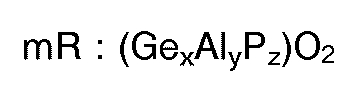


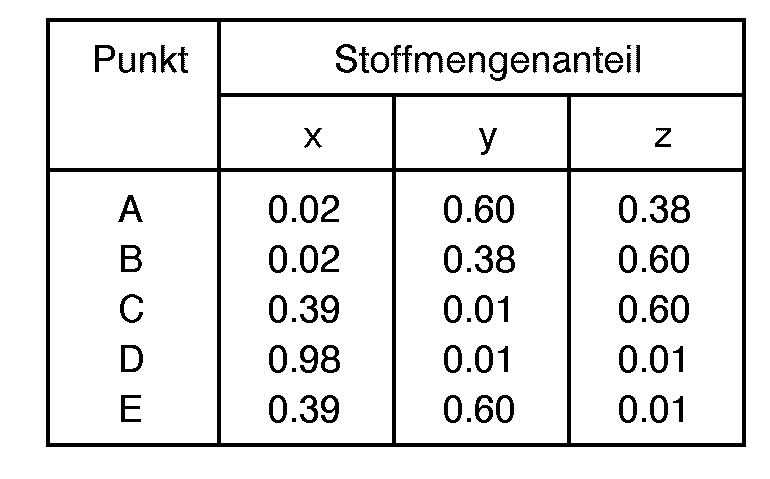


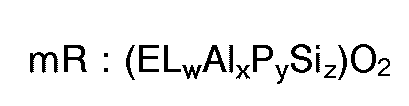
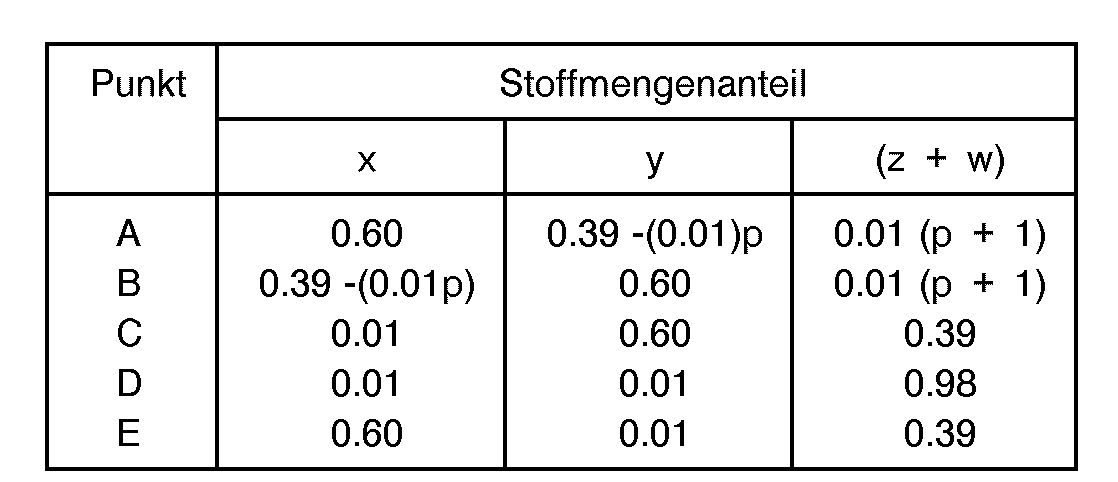


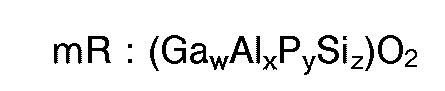
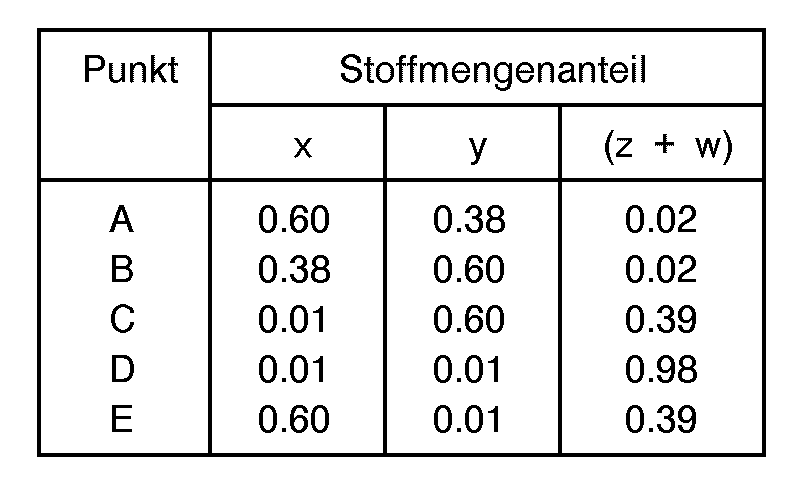

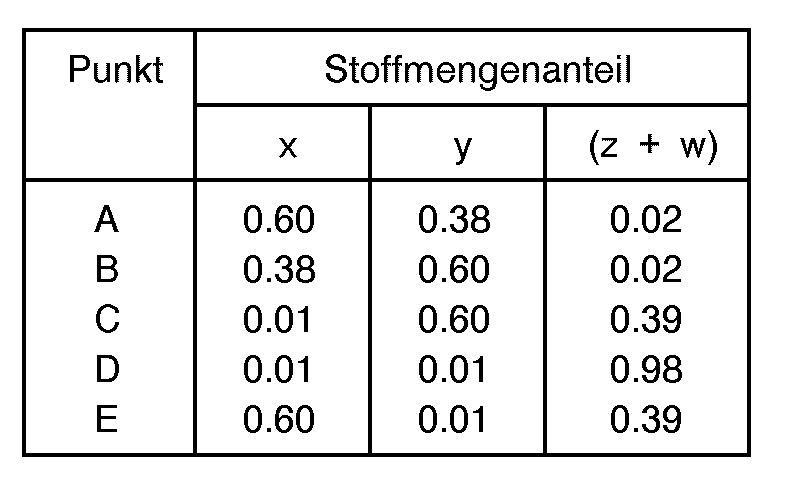


Applications Claiming Priority (5)
| Application Number | Priority Date | Filing Date | Title |
|---|---|---|---|
| US134815 | 1987-12-18 | ||
| US07/134,863 US5120860A (en) | 1987-12-18 | 1987-12-18 | Process for the production of aziridines |
| PCT/US1988/004455 WO1989006229A1 (en) | 1987-12-18 | 1988-12-16 | Process for the production of amines, hydroxyamines and aziridines |
| CA000586724A CA1329213C (en) | 1987-12-18 | 1988-12-21 | Process for the production of aziridines |
| CA000586709A CA1336717C (en) | 1987-12-18 | 1988-12-21 | Process for the production of amines, hydroxyamines and aziridines |
Publications (2)
| Publication Number | Publication Date |
|---|---|
| EP0346443A1 EP0346443A1 (de) | 1989-12-20 |
| EP0346443B1 true EP0346443B1 (de) | 1994-08-31 |
Family
ID=27168158
Family Applications (2)
| Application Number | Title | Priority Date | Filing Date |
|---|---|---|---|
| EP89901223A Expired - Lifetime EP0346443B1 (de) | 1987-12-18 | 1988-12-16 | Verfahren zur herstellung von aminen, hydroxyaminen und aziridinen |
| EP89901980A Withdrawn EP0358736A1 (de) | 1987-12-18 | 1988-12-16 | Verfahren zur herstellung von aziridinen |
Family Applications After (1)
| Application Number | Title | Priority Date | Filing Date |
|---|---|---|---|
| EP89901980A Withdrawn EP0358736A1 (de) | 1987-12-18 | 1988-12-16 | Verfahren zur herstellung von aziridinen |
Country Status (3)
| Country | Link |
|---|---|
| US (1) | US5120860A (de) |
| EP (2) | EP0346443B1 (de) |
| WO (2) | WO1989005797A2 (de) |
Families Citing this family (12)
| Publication number | Priority date | Publication date | Assignee | Title |
|---|---|---|---|---|
| DE3934459A1 (de) * | 1989-10-14 | 1991-04-18 | Bayer Ag | Verfahren zur herstellung von triethylendiamin und piperazin |
| DE19533662A1 (de) * | 1995-09-12 | 1997-03-13 | Basf Ag | Verfahren zur Herstellung von Aziridinen |
| DE19600156A1 (de) | 1996-01-04 | 1997-07-10 | Basf Ag | Verfahren zur Herstellung von Aziridinen |
| CN1067603C (zh) * | 1996-06-07 | 2001-06-27 | 中国科学院大连化学物理研究所 | 金属改性小孔磷硅铝型分子筛催化剂及其制备方法和应用 |
| GB9619725D0 (en) * | 1996-09-20 | 1996-11-06 | Ici Plc | Catalytic process |
| JP4109893B2 (ja) * | 2002-04-24 | 2008-07-02 | 株式会社日本触媒 | アジリジン類およびn−ビニルアミド類の製造方法 |
| CN101284244B (zh) * | 2007-04-13 | 2010-10-13 | 中国中化股份有限公司 | 一种用于合成乙烯亚胺类化合物的催化剂 |
| US7683216B2 (en) | 2007-04-20 | 2010-03-23 | Basf Se | Continuous process for the preparation of alkyleneimines |
| US10763491B2 (en) | 2014-04-01 | 2020-09-01 | The Research Foundation For The State University Of New York | Low-temperature synthesis process of making MgzMxOy, where M is Mn, V or Fe, for manufacture of electrode materials for group II cation-based batteries |
| CN109996782A (zh) * | 2016-11-30 | 2019-07-09 | 巴斯夫欧洲公司 | 使用mor骨架结构的纳米晶沸石将单乙醇胺转化成乙二胺的方法 |
| WO2018099964A1 (en) * | 2016-11-30 | 2018-06-07 | Basf Se | Process for the conversion of monoethanolamine to ethylenediamine employing a copper-modified zeolite of the mor framework structure |
| US11091425B2 (en) * | 2016-11-30 | 2021-08-17 | Basf Se | Process for the conversion of ethylene glycol to ethylenediamine employing a zeolite catalyst |
Family Cites Families (37)
| Publication number | Priority date | Publication date | Assignee | Title |
|---|---|---|---|---|
| US2977363A (en) * | 1958-07-30 | 1961-03-28 | Houdry Process Corp | Synthesis of 1, 4-diazabicyclo (2.2.2) octane |
| US3166558A (en) * | 1961-08-11 | 1965-01-19 | Air Prod & Chem | Method for preparing diazabicyclo-(2, 2, 2)-octane |
| US3369019A (en) * | 1963-11-26 | 1968-02-13 | Mobil Oil Corp | Production of heterocyclic compounds |
| US4001213A (en) * | 1970-04-06 | 1977-01-04 | Monsanto Company | Repression of polymer formation in the conversion of linear or branched primary diamines to cyclic imines |
| US3903079A (en) * | 1971-08-27 | 1975-09-02 | Celanese Corp | Production of polymethylenimines by cycloammonolysis |
| US3772293A (en) * | 1971-12-13 | 1973-11-13 | Air Prod & Chem | Single step synthesis of trietylene diamine |
| JPS5337876B2 (de) * | 1973-07-19 | 1978-10-12 | ||
| DE2442929C3 (de) * | 1974-09-07 | 1978-07-06 | Basf Ag, 6700 Ludwigshafen | Verfahren zur Herstellung von 1,4- Diazabicyclo [2,2,2 eckige Klammer zu octan |
| US4257885A (en) * | 1976-02-04 | 1981-03-24 | Union Carbide Corporation | Novel zeolite compositions and processes for preparing and using same |
| DE2860763D1 (en) * | 1977-12-12 | 1981-09-17 | Azote & Prod Chim | Catalyst and process for the manufacture of amines from alcohols |
| DE2846813A1 (de) * | 1978-10-27 | 1980-05-08 | Bayer Ag | Verfahren zur herstellung von 1,4-diazabicyclo-(2,2,2)-octan |
| US4418201A (en) * | 1980-05-16 | 1983-11-29 | The Dow Chemical Company | Process for preparation of N-heterocyclic compounds |
| US4310440A (en) * | 1980-07-07 | 1982-01-12 | Union Carbide Corporation | Crystalline metallophosphate compositions |
| US4385994A (en) * | 1980-07-07 | 1983-05-31 | Union Carbide Corporation | Adsorptive use of crystalline metallophosphate compositions |
| US4337175A (en) * | 1980-07-14 | 1982-06-29 | The Dow Chemical Company | Catalyst for the preparation of ethylenimine |
| US4289656A (en) * | 1980-07-17 | 1981-09-15 | The Dow Chemical Company | Catalyst for the preparation of ethylenimine |
| US4358405A (en) * | 1980-07-17 | 1982-11-09 | The Dow Chemical Co. | Process for the preparation of ethylenimine |
| US4301036A (en) * | 1980-07-18 | 1981-11-17 | The Dow Chemical Company | Dehydration catalyst for making ethylenimine |
| US4448997A (en) * | 1981-07-16 | 1984-05-15 | Texaco Inc. | Preparation of linear polyethylenepolyamines with an aluminum phosphate catalyst |
| US4440871A (en) * | 1982-07-26 | 1984-04-03 | Union Carbide Corporation | Crystalline silicoaluminophosphates |
| US4524143A (en) * | 1983-01-03 | 1985-06-18 | Texaco Inc. | Catalyst for preparation of linear polyethylenepolyamines |
| US4438281A (en) * | 1983-01-24 | 1984-03-20 | Texaco Inc. | Selective production of monoalkanolamines from alkylene oxides and ammonia over acidic inorganic catalysts |
| US4500651A (en) * | 1983-03-31 | 1985-02-19 | Union Carbide Corporation | Titanium-containing molecular sieves |
| US4567029A (en) * | 1983-07-15 | 1986-01-28 | Union Carbide Corporation | Crystalline metal aluminophosphates |
| JPS60260574A (ja) * | 1984-04-10 | 1985-12-23 | ユニオン・カ−バイド・コ−ポレ−シヨン | 1−アザビシクロ〔2.2.2〕オクタン又は1,4−ジアザビシクロ〔2.2.2〕オクタンの合成 |
| US4686093A (en) * | 1984-04-13 | 1987-08-11 | Union Carbide Corporation | Molecular sieve compositions with aluminum, phosphorus and at least two other elements |
| US4683217A (en) * | 1984-04-13 | 1987-07-28 | Union Carbide Corporation | Iron-aluminum-phosphorus-silicon-oxide molecular sieves |
| US4686092A (en) * | 1984-04-13 | 1987-08-11 | Union Carbide Corporation | Manganese-aluminum-phosphorus-silicon-oxide molecular sieves |
| EP0180983B1 (de) * | 1984-11-07 | 1988-08-03 | Air Products And Chemicals, Inc. | Herstellung von Aminen durch Aminierung von Alkanolen unter Verwendung von dealuminierten Zeolithen |
| DE3690621T (de) * | 1985-12-05 | 1987-11-19 | ||
| AU591208B2 (en) * | 1985-12-23 | 1989-11-30 | Nippon Shokubai Kagaku Kogyo Co. Ltd. | Catalyst for vapor-phase intramolecular dehydration reaction of alkanolamines |
| US4774218A (en) * | 1985-12-27 | 1988-09-27 | Nippon Shokubai Kagaku Kogyo Co., Ltd. | Catalyst for vapor-phase intramolecular dehydration reaction of alkanolamines |
| EP0263463B1 (de) * | 1986-10-08 | 1992-03-25 | BASF Aktiengesellschaft | Verfahren zur Herstellung von 1,4-Diazabicyclo(2,2,2)-octanen |
| WO1988007038A1 (en) * | 1987-03-12 | 1988-09-22 | Nippon Shokubai Kagaku Kogyo Co., Ltd. | Process for producing aziridines |
| DE3735214A1 (de) * | 1987-10-17 | 1989-04-27 | Huels Chemische Werke Ag | Verfahren zur herstellung von 1,4-diazabicyclo(2.2.2)-octan aus piperazin |
| DE3735212A1 (de) * | 1987-10-17 | 1989-04-27 | Huels Chemische Werke Ag | Verfahren zur herstellung von gemischen aus 1,4-diazabicyclo(2.2.2)-octan und piperazin |
| US4973709A (en) * | 1987-12-18 | 1990-11-27 | Union Carbide Chemicals And Plastics Company, Inc. | Process for the production of amines, hydroxyamines and aziridines |
-
1987
- 1987-12-18 US US07/134,863 patent/US5120860A/en not_active Expired - Fee Related
-
1988
- 1988-12-16 WO PCT/US1988/004456 patent/WO1989005797A2/en not_active Ceased
- 1988-12-16 EP EP89901223A patent/EP0346443B1/de not_active Expired - Lifetime
- 1988-12-16 WO PCT/US1988/004455 patent/WO1989006229A1/en not_active Ceased
- 1988-12-16 EP EP89901980A patent/EP0358736A1/de not_active Withdrawn
Also Published As
| Publication number | Publication date |
|---|---|
| WO1989005797A2 (en) | 1989-06-29 |
| EP0346443A1 (de) | 1989-12-20 |
| US5120860A (en) | 1992-06-09 |
| WO1989006229A1 (en) | 1989-07-13 |
| WO1989005797A3 (en) | 1989-07-27 |
| EP0358736A1 (de) | 1990-03-21 |
Similar Documents
| Publication | Publication Date | Title |
|---|---|---|
| AU597985B2 (en) | Production of light olefins | |
| EP0324082B1 (de) | Synthese-Verfahren von nichtzeolitischen Molekularsieben | |
| EP0249914B1 (de) | Xylolisomerisierung | |
| EP0251167A2 (de) | Verfahren zur Kondensation von Ketonen | |
| US4906351A (en) | Dewaxing catalysts and processes employing non-zeolitic molecular sieves | |
| US4818739A (en) | Hydrocracking catalysts and processes employing non-zeolitic molecular sieves | |
| US4874896A (en) | Process for the production of alkylamines | |
| US5120860A (en) | Process for the production of aziridines | |
| US4701562A (en) | Process for the condensation of aldehydes | |
| KR19990014054A (ko) | 메탄올 전환 반응용 촉매 | |
| US4791083A (en) | Catalytic cracking catalysts comprising non-zeolitic molecular sieves | |
| US4859314A (en) | Catalytic cracking catalysts and cracking process using non-zeolitic molecular sieves | |
| US4751340A (en) | Selective production of para-aromatics | |
| US4777301A (en) | Process for the condensation of carbonyl and aromatic compounds | |
| US4973709A (en) | Process for the production of amines, hydroxyamines and aziridines | |
| US4873325A (en) | Process for the production of amides | |
| US4904518A (en) | Multiphase composite and processes for preparing same | |
| US4734538A (en) | Process for the production of dienes | |
| WO1989005810A1 (en) | Processes for the production of amines | |
| CA1336717C (en) | Process for the production of amines, hydroxyamines and aziridines | |
| JPH0676204B2 (ja) | モレキュラーシーブの製造方法 | |
| CA1329213C (en) | Process for the production of aziridines | |
| DE3851327T2 (de) | Verfahren zur herstellung von aminen, hydroxyaminen und aziridinen. | |
| JPH03127764A (ja) | アミンの製法 |
Legal Events
| Date | Code | Title | Description |
|---|---|---|---|
| PUAI | Public reference made under article 153(3) epc to a published international application that has entered the european phase |
Free format text: ORIGINAL CODE: 0009012 |
|
| AK | Designated contracting states |
Kind code of ref document: A1 Designated state(s): BE DE FR GB IT NL SE |
|
| 17P | Request for examination filed |
Effective date: 19900109 |
|
| 17Q | First examination report despatched |
Effective date: 19911016 |
|
| GRAA | (expected) grant |
Free format text: ORIGINAL CODE: 0009210 |
|
| AK | Designated contracting states |
Kind code of ref document: B1 Designated state(s): BE DE FR GB IT NL SE |
|
| PG25 | Lapsed in a contracting state [announced via postgrant information from national office to epo] |
Ref country code: FR Effective date: 19940831 Ref country code: IT Free format text: LAPSE BECAUSE OF FAILURE TO SUBMIT A TRANSLATION OF THE DESCRIPTION OR TO PAY THE FEE WITHIN THE PRE;WARNING: LAPSES OF ITALIAN PATENTS WITH EFFECTIVE DATE BEFORE 2007 MAY HAVE OCCURRED AT ANY TIME BEFORE 2007. THE CORRECT EFFECTIVE DATE MAY BE DIFFERENT FROM THE ONE RECORDED.SCRIBED TIME-LIMIT Effective date: 19940831 |
|
| REF | Corresponds to: |
Ref document number: 3851327 Country of ref document: DE Date of ref document: 19941006 |
|
| EN | Fr: translation not filed | ||
| EAL | Se: european patent in force in sweden |
Ref document number: 89901223.1 |
|
| PLBE | No opposition filed within time limit |
Free format text: ORIGINAL CODE: 0009261 |
|
| STAA | Information on the status of an ep patent application or granted ep patent |
Free format text: STATUS: NO OPPOSITION FILED WITHIN TIME LIMIT |
|
| 26N | No opposition filed | ||
| PGFP | Annual fee paid to national office [announced via postgrant information from national office to epo] |
Ref country code: SE Payment date: 19981203 Year of fee payment: 11 Ref country code: GB Payment date: 19981203 Year of fee payment: 11 |
|
| PGFP | Annual fee paid to national office [announced via postgrant information from national office to epo] |
Ref country code: DE Payment date: 19981204 Year of fee payment: 11 |
|
| PGFP | Annual fee paid to national office [announced via postgrant information from national office to epo] |
Ref country code: NL Payment date: 19981217 Year of fee payment: 11 |
|
| PGFP | Annual fee paid to national office [announced via postgrant information from national office to epo] |
Ref country code: BE Payment date: 19981231 Year of fee payment: 11 |
|
| PG25 | Lapsed in a contracting state [announced via postgrant information from national office to epo] |
Ref country code: GB Free format text: LAPSE BECAUSE OF NON-PAYMENT OF DUE FEES Effective date: 19991216 |
|
| PG25 | Lapsed in a contracting state [announced via postgrant information from national office to epo] |
Ref country code: SE Free format text: LAPSE BECAUSE OF NON-PAYMENT OF DUE FEES Effective date: 19991217 |
|
| PG25 | Lapsed in a contracting state [announced via postgrant information from national office to epo] |
Ref country code: BE Free format text: LAPSE BECAUSE OF NON-PAYMENT OF DUE FEES Effective date: 19991231 |
|
| BERE | Be: lapsed |
Owner name: UNION CARBIDE CORP. Effective date: 19991231 |
|
| PG25 | Lapsed in a contracting state [announced via postgrant information from national office to epo] |
Ref country code: NL Free format text: LAPSE BECAUSE OF NON-PAYMENT OF DUE FEES Effective date: 20000701 |
|
| GBPC | Gb: european patent ceased through non-payment of renewal fee |
Effective date: 19991216 |
|
| EUG | Se: european patent has lapsed |
Ref document number: 89901223.1 |
|
| NLV4 | Nl: lapsed or anulled due to non-payment of the annual fee |
Effective date: 20000701 |
|
| PG25 | Lapsed in a contracting state [announced via postgrant information from national office to epo] |
Ref country code: DE Free format text: LAPSE BECAUSE OF NON-PAYMENT OF DUE FEES Effective date: 20001003 |