EP0344724B1 - Metal Radionukleid-Chelatverbindungen mit verbesserter Chelatierungskinetik - Google Patents
Metal Radionukleid-Chelatverbindungen mit verbesserter Chelatierungskinetik Download PDFInfo
- Publication number
- EP0344724B1 EP0344724B1 EP89109756A EP89109756A EP0344724B1 EP 0344724 B1 EP0344724 B1 EP 0344724B1 EP 89109756 A EP89109756 A EP 89109756A EP 89109756 A EP89109756 A EP 89109756A EP 0344724 B1 EP0344724 B1 EP 0344724B1
- Authority
- EP
- European Patent Office
- Prior art keywords
- targeting agent
- chelate
- metal
- compound
- solution
- Prior art date
- Legal status (The legal status is an assumption and is not a legal conclusion. Google has not performed a legal analysis and makes no representation as to the accuracy of the status listed.)
- Expired - Lifetime
Links
- 0 CC(*(*)*)N(*)C(*)C(*)S* Chemical compound CC(*(*)*)N(*)C(*)C(*)S* 0.000 description 9
Classifications
-
- C—CHEMISTRY; METALLURGY
- C07—ORGANIC CHEMISTRY
- C07D—HETEROCYCLIC COMPOUNDS
- C07D209/00—Heterocyclic compounds containing five-membered rings, condensed with other rings, with one nitrogen atom as the only ring hetero atom
- C07D209/02—Heterocyclic compounds containing five-membered rings, condensed with other rings, with one nitrogen atom as the only ring hetero atom condensed with one carbocyclic ring
- C07D209/44—Iso-indoles; Hydrogenated iso-indoles
- C07D209/48—Iso-indoles; Hydrogenated iso-indoles with oxygen atoms in positions 1 and 3, e.g. phthalimide
-
- A—HUMAN NECESSITIES
- A61—MEDICAL OR VETERINARY SCIENCE; HYGIENE
- A61K—PREPARATIONS FOR MEDICAL, DENTAL OR TOILETRY PURPOSES
- A61K47/00—Medicinal preparations characterised by the non-active ingredients used, e.g. carriers or inert additives; Targeting or modifying agents chemically bound to the active ingredient
- A61K47/50—Medicinal preparations characterised by the non-active ingredients used, e.g. carriers or inert additives; Targeting or modifying agents chemically bound to the active ingredient the non-active ingredient being chemically bound to the active ingredient, e.g. polymer-drug conjugates
- A61K47/51—Medicinal preparations characterised by the non-active ingredients used, e.g. carriers or inert additives; Targeting or modifying agents chemically bound to the active ingredient the non-active ingredient being chemically bound to the active ingredient, e.g. polymer-drug conjugates the non-active ingredient being a modifying agent
- A61K47/68—Medicinal preparations characterised by the non-active ingredients used, e.g. carriers or inert additives; Targeting or modifying agents chemically bound to the active ingredient the non-active ingredient being chemically bound to the active ingredient, e.g. polymer-drug conjugates the non-active ingredient being a modifying agent the modifying agent being an antibody, an immunoglobulin or a fragment thereof, e.g. an Fc-fragment
- A61K47/6835—Medicinal preparations characterised by the non-active ingredients used, e.g. carriers or inert additives; Targeting or modifying agents chemically bound to the active ingredient the non-active ingredient being chemically bound to the active ingredient, e.g. polymer-drug conjugates the non-active ingredient being a modifying agent the modifying agent being an antibody, an immunoglobulin or a fragment thereof, e.g. an Fc-fragment the modifying agent being an antibody or an immunoglobulin bearing at least one antigen-binding site
- A61K47/6887—Antibody-chelate conjugates using chelates for therapeutic purposes
-
- A—HUMAN NECESSITIES
- A61—MEDICAL OR VETERINARY SCIENCE; HYGIENE
- A61K—PREPARATIONS FOR MEDICAL, DENTAL OR TOILETRY PURPOSES
- A61K51/00—Preparations containing radioactive substances for use in therapy or testing in vivo
- A61K51/02—Preparations containing radioactive substances for use in therapy or testing in vivo characterised by the carrier, i.e. characterised by the agent or material covalently linked or complexing the radioactive nucleus
- A61K51/04—Organic compounds
- A61K51/08—Peptides, e.g. proteins, carriers being peptides, polyamino acids, proteins
- A61K51/10—Antibodies or immunoglobulins; Fragments thereof, the carrier being an antibody, an immunoglobulin or a fragment thereof, e.g. a camelised human single domain antibody or the Fc fragment of an antibody
- A61K51/1093—Antibodies or immunoglobulins; Fragments thereof, the carrier being an antibody, an immunoglobulin or a fragment thereof, e.g. a camelised human single domain antibody or the Fc fragment of an antibody conjugates with carriers being antibodies
-
- C—CHEMISTRY; METALLURGY
- C07—ORGANIC CHEMISTRY
- C07C—ACYCLIC OR CARBOCYCLIC COMPOUNDS
- C07C327/00—Thiocarboxylic acids
- C07C327/20—Esters of monothiocarboxylic acids
- C07C327/30—Esters of monothiocarboxylic acids having sulfur atoms of esterified thiocarboxyl groups bound to carbon atoms of hydrocarbon radicals substituted by nitrogen atoms, not being part of nitro or nitroso groups
-
- C—CHEMISTRY; METALLURGY
- C07—ORGANIC CHEMISTRY
- C07C—ACYCLIC OR CARBOCYCLIC COMPOUNDS
- C07C327/00—Thiocarboxylic acids
- C07C327/20—Esters of monothiocarboxylic acids
- C07C327/32—Esters of monothiocarboxylic acids having sulfur atoms of esterified thiocarboxyl groups bound to carbon atoms of hydrocarbon radicals substituted by carboxyl groups
-
- C—CHEMISTRY; METALLURGY
- C07—ORGANIC CHEMISTRY
- C07D—HETEROCYCLIC COMPOUNDS
- C07D207/00—Heterocyclic compounds containing five-membered rings not condensed with other rings, with one nitrogen atom as the only ring hetero atom
- C07D207/46—Heterocyclic compounds containing five-membered rings not condensed with other rings, with one nitrogen atom as the only ring hetero atom with hetero atoms directly attached to the ring nitrogen atom
-
- C—CHEMISTRY; METALLURGY
- C07—ORGANIC CHEMISTRY
- C07D—HETEROCYCLIC COMPOUNDS
- C07D307/00—Heterocyclic compounds containing five-membered rings having one oxygen atom as the only ring hetero atom
- C07D307/02—Heterocyclic compounds containing five-membered rings having one oxygen atom as the only ring hetero atom not condensed with other rings
- C07D307/04—Heterocyclic compounds containing five-membered rings having one oxygen atom as the only ring hetero atom not condensed with other rings having no double bonds between ring members or between ring members and non-ring members
- C07D307/18—Heterocyclic compounds containing five-membered rings having one oxygen atom as the only ring hetero atom not condensed with other rings having no double bonds between ring members or between ring members and non-ring members with hetero atoms or with carbon atoms having three bonds to hetero atoms with at the most one bond to halogen, e.g. ester or nitrile radicals, directly attached to ring carbon atoms
-
- C—CHEMISTRY; METALLURGY
- C07—ORGANIC CHEMISTRY
- C07D—HETEROCYCLIC COMPOUNDS
- C07D405/00—Heterocyclic compounds containing both one or more hetero rings having oxygen atoms as the only ring hetero atoms, and one or more rings having nitrogen as the only ring hetero atom
- C07D405/02—Heterocyclic compounds containing both one or more hetero rings having oxygen atoms as the only ring hetero atoms, and one or more rings having nitrogen as the only ring hetero atom containing two hetero rings
- C07D405/12—Heterocyclic compounds containing both one or more hetero rings having oxygen atoms as the only ring hetero atoms, and one or more rings having nitrogen as the only ring hetero atom containing two hetero rings linked by a chain containing hetero atoms as chain links
-
- A—HUMAN NECESSITIES
- A61—MEDICAL OR VETERINARY SCIENCE; HYGIENE
- A61K—PREPARATIONS FOR MEDICAL, DENTAL OR TOILETRY PURPOSES
- A61K2121/00—Preparations for use in therapy
-
- A—HUMAN NECESSITIES
- A61—MEDICAL OR VETERINARY SCIENCE; HYGIENE
- A61K—PREPARATIONS FOR MEDICAL, DENTAL OR TOILETRY PURPOSES
- A61K2123/00—Preparations for testing in vivo
Definitions
- the present invention relates generally to metal chelating compounds, to chelates and chelate-targeting agent conjugates formed from the chelating compounds, and to methods for making and using these compositions.
- This invention is more particularly related to chelate-targeting agent conjugates in which the metal is a radionuclide and to methods employing the conjugates for diagnostic and therapeutic purposes.
- Radiolabeled chelating compounds are useful medical agents.
- radiolabeled ethylenediamine tetraacetic acid (EDTA), diethylenetetramine-pentaacetate (DTPA) and o-iodohippurate (OIH) have been reported to be useful in evaluating renal functions (Klingensmith et al., J. Nucl. Med. 29 :377, 1982).
- Kasina et al., J. Med. Chem. 29 :1933 (1986) report promising renal pharmaceuticals that are technetium ( 99m Tc) chelates of diamide-dimercaptides (N2S2).
- Chelating compounds are useful both as therapeutic and diagnostic agents. They are investigated for the purpose of stably linking the radionuclides to target-specific biological molecules such as antibodies and antibody fragments. Diagnostic imaging of specific target tissue in vivo with a radiometal-chelate-antibody conjugate was reported by Khaw et al., Science 209 :295, 1980. Similarly, the therapeutic use of radiometal-chelate-antibody conjugates to treat cellular disorders is referred to by Gansow et al., U.S. Patent No. 4,454,106.
- Difficulties associated with the known chelating compounds have limited their usefulness. For example, the rate of chelation of diamide-dimercaptide (N2S2) ligands is relatively low despite the high stability of the Tc and Re complexes formed.
- N2S2 diamide-dimercaptide
- stability problems have often limited their use in diagnostic and therapeutic applications involving antibody and antibody fragments. The stability problems can be attributed, in part, to the large metal chelate ring sizes required to attain desired donor atom to metal ratios.
- the present invention in one aspect, provides a compound having the formula (I): wherein:
- the invention provides a compound having the formula (II): wherein:
- a metal radionuclide may be added to a chelating compound of formula I or II, either before or after the chelating compound is attached to a targeting agent.
- the chelate-targeting agent conjugates described above may be used for diagnostic and therapeutic purposes.
- a diagnostic method is described for detecting the presence or absence of a target site within a mammalian host. This method comprises the steps of administering to a mammal a diagnostically effective dose of the chelate-targeting agent conjugate containing a metal radionuclide, such as 99m Tc, and detecting the biodistribution of the radionuclide.
- a therapeutic method is described for delivering a radionuclide, such as 186Re or 188Re, to a target site within a mammalian host. This method comprises the step of administering to a mammal a therapeutically effective dose of the chelate-targeting agent conjugate.
- Targeting agent - is any molecule that has the capacity to bind to a defined population of cells.
- Protein - as used herein includes proteins, polypeptides, and peptides; and may be an intact molecule, a fragment thereof, or a functional equivalent thereof; and may be genetically engineered; an example is an antibody.
- Antibody - as used herein includes both polyclonal and monoclonal antibodies; and may be an intact molecule, a fragment thereof, or a functional equivalent thereof; and may be genetically engineered; examples of antibody fragments include F(ab′)2, Fab′, Fab and Fv.
- the present invention provides compounds of two general formulae that are capable of chelating metals.
- An advantage of these compounds is that they are capable of rapidly complexing a metal as well as forming a stable chelate.
- N nitrogen
- the presence of nitrogen (N) atoms within the chelating compound accelerates complex formation with a metal. This acceleration is due, in part, to the fact that a metal, e.g., Tc, is a soft acid and N, in the form of an amine or amide, is a base.
- Amines provide a greater increase in chelation rates than amides.
- the presence of sulfur (S) atoms within the chelating compound in addition to providing for increased rates of complexation, contribute to the stability of the resulting chelate.
- the compounds of the present invention represent a combination of desirable kinetic properties for the formation of a complex with a metal and desirable thermodynamic properties for the retention of the metal. Accordingly, attachment of radionuclides to targeting agent-chelate conjugates formed from the compounds of the present invention which possess increased -S-(thiolate) groups situated at an appropriate distance alleviates the stability and kinetic problems encountered in both the direct metallation reaction of proteins and protein-chelate conjugates formed from the known chelating compounds.
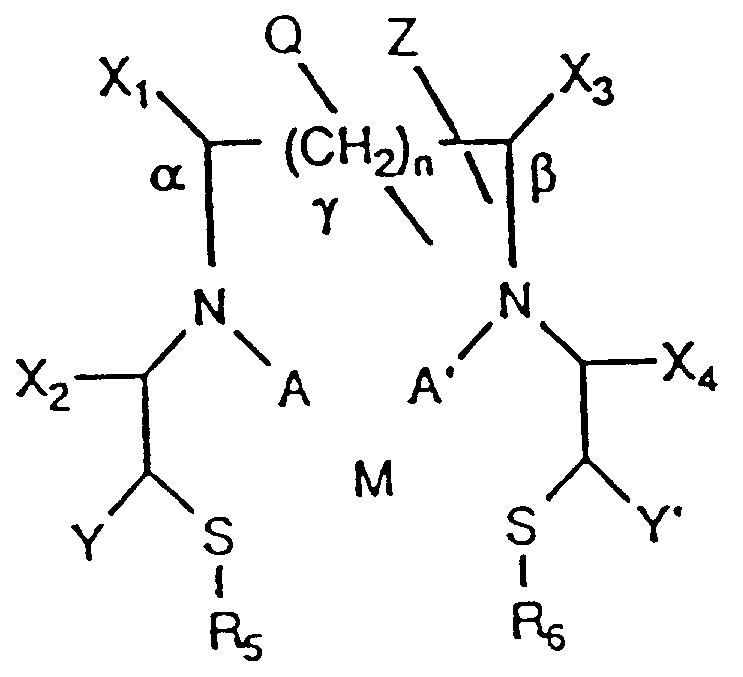
- Compound I has the following formula:
- the N interposed between the carbons to which X1 and X2 are bonded will be an amide.
- the N interposed between the carbons to which X3 and X4 are bonded will be an amide.
- a compound with zero, one or two amides may be formed by the appropriate selection of X1, X2, X3 and X4.
- Amide nitrogens relative to amine nitrogens, afford greater stability to the complex formed with a metal, but at the expense of a diminished acceleration of complex formation.
- X1, X2, X3 and X4 compounds with a wide variety of chelating properties may be formed.
- Y is -CH2-S-R3, or H, when A is H or an alkyl group of C6 or less and A′ is H or an alkyl group C6 or less.
- Y is H.
- Y′ is -CH2-S-R4, or H, when A is H or an alkyl group of C6 or less and A′ is H or an alkyl group of C6 or less.
- Y and Y′ are both not H when A is H or an alkyl group of C6 or less and A′ is H or an alkyl group of C6 or less.
- Y′ is H.
- compounds of the formula depicted above may be formed containing two nitrogens and three or four sulfurs ("N2S3" and "N2S4", respectively).
- N2S4 compounds two of the sulfurs are the sulfurs bearing R5 and R6 and the remaining two sulfurs are from A and A′ or Y and Y′.
- R1, R2, R3, R4, R5 and R6 are independently selected from sulfur protecting groups. Groups which may be used include any of the alkyl, acyl and aryl groups, disulfides and bunte salts known by those skilled in the art.
- Preferred groups are those that result in the formation of a thioacetal, hemithioacetal, thioester or acetamidomethyl substituent.
- Particularly preferred groups include p-anisylidine, acetonyl, tetrahydrylfuranyl, ethoxyethyl, tetrahydrylpyranyl, acetamidomethyl and derivatives thereof.
- the protecting groups may be removed and left as sulfydryls either during storage or just prior to radiolabeling.
- Q may be H or a polar group.
- a polar group One function of a polar group is to increase the hydrophilicity of the compound, e.g., in order to increase its aqueous solubility.
- Groups which may be used include carboxylates, sulfonates and secondary alcohols.
- a preferred group is -CH2-COOH.
- Q may be attached to one of the positions designated as ⁇ , ⁇ , and ⁇ . Because the number of methylene carbons at the ⁇ position is defined by n which may be greater than one, the ⁇ position includes additional points for attachment of Q.
- the distance by which the nitrogen atoms are separated may be increased by interposing methylene (-CH2-) groups between the carbons bonded to the nitrogens.
- -CH2- groups When the number of -CH2- groups, represented by n, is greater than zero, then the number of carbon atoms separating the nitrogen atoms in compound I is increased accordingly.
- Preferred integers for n are 0 to 2.
- Z is -(W) m -R′.
- W is a group that functions as a "spacer arm” and may be useful to distance R′ from the chelating portion of the compound.
- Groups which may be used include methylene (-CH2-), methyleneoxy (-CH2-O-), methylenecarbonyl (-CH2-CO-), or combinations thereof.
- the number, m, of groups such as these would be typically 0 to 30 and preferably 0 to 5.
- Z, or R′ when m is 0, may be attached to one of the positions designated as ⁇ , ⁇ , and ⁇ . Because the number of methylene carbons at the ⁇ position is defined by n which may be greater than one, the ⁇ position includes additional points for attachment of a Z or an R′.
- R′ is a chemically reactive moiety.
- the moiety may be strongly electrophilic or nucleophilic and thereby be available for reacting directly with a targeting agent.
- the moiety may be a weaker electrophile or nucleophile and therefore require activation prior to the conjugation with a targeting agent. This alternative would be desirable where it is necessary to delay activation of R′ until a compound has been formed.
- R′ is chemically reactive, the scenarios differ by whether following formation of a compound, R′ is reacted directly with a targeting agent or is reacted first with one or more chemicals to render R′ capable of reacting with a targeting agent.
- a metal chelate is formed by addition of a metal or metal oxide to compound I and has the following formula: wherein: X1-X4, A, A′, Y, Y′, R5-R6, Q, n, and Z are defined as described above.
- M is a metal, or metal oxide radionuclide capable of being chelated. Particularly preferred are 64Cu, 67Cu, 97Ru, 99m Tc, 105Rh, 109Pd, 186Re, 188Re, 198Au, 199Au, 203Pb, 212Pb, and 212Bi.
- the following formulae depict chelation of M by a compound I in which two of the sulfurs are from Y and Y′ (I-M-A) and by a compound I in which two of the sulfurs are from A and A′ (I-M-B).
- the six atoms available for bonding M are shown.
- M may be bound to 4-6 of the nitrogen and sulfur atoms of compound I.
- the invention provides chelate-targeting agent conjugates having the formula: wherein: X1-X4, A, A′, Y, Y′, R5-R6, Q, n, and M are defined as described above.
- Z′ is -(W) m -Targeting agent.
- W is a group that functions as a "spacer arm” and may be useful to distance a targeting agent from the compound.
- Groups which may be used include methylene (-CH2-), methyleneoxy (-CH2-O-), methylenecarbonyl (-CH2-CO-), or combinations thereof.
- the number, m, of groups such as these would be typically 0 to 30 and preferrably 0 to 5.
- Z′, or Targeting agent when m is 0, may be attached to one of the positions designated as ⁇ , ⁇ , and ⁇ . Because the number of methylene carbons at the ⁇ position is defined by n which may be greater than one, the ⁇ position includes additional points for attachment of a Z′ or a Targeting agent.
- targeting agent includes any linking group that may be used to join the targeting agent. It will be evident to one skilled in the art that a variety of linking groups, including bifunctional reagents, may be employed within the present invention.
- a targeting agent has the capacity to bind to a defined population of cells.
- the targeting agent may bind through a receptor, substrate, antigenic determinant, or other binding site on the target cell population.
- Preferred targeting agents useful within the present invention include antibody and antibody fragments; peptides, such as bombesin, gastrin-releasing peptide, RGD peptide, substance P, neuromedin-B, neuromedin-C, and metenkephalin; and hormones, such as estradiol, neurotensin, melanocyte stimulating hormone, follicle stimulating hormone, lutenizing hormone, and human growth hormone.
- Suitable targeting agents include serum proteins, fibrinolytic enzymes, and biological response modifiers, such as interleukin, interferon, erythropoietin and colony-stimulating factor. Analogs of the above-listed targeting agents that retain the ability to bind to the defined target cell population may also be used within the claimed invention.
- synthetic targeting proteins and peptides may be designed and made to "fit" a particular, characterized epitope (binding site). That is, a synthetic targeting protein/peptide would be designed to bind a specific epitope in a "lock and key” fashion.
- antibody and antibody fragments, bombesin and gastrin-releasing peptide and their analogs are particularly preferred targeting agents.
- MAbs monoclonal antibodies
- MAbs directed against tumor cells include those designated NR-ML-05, NR-LU-10, Nr-CO-02, and NR-CE-01, which are specific for human melanoma, lung, colon, and lung tumor cells, respectively.
- Two methods are provided for producing a chelate-targeting agent conjugate having the formula depicted immediately above.
- a chelate is formed which is then joined to a targeting agent to form the conjugate.
- This method comprises the steps of reacting a compound (I) having the formula: with a metal or metal oxide capable of being chelated, thereby forming a metal chelate, and combining the metal chelate with a targeting agent under reactive conditions to form the chelate-targeting agent conjugate.
- X1-X4, A, A′, Y, Y′, R5-R6, Q, n, and Z are defined as described above.
- the preferred, and particularly preferred, metals and metal oxides are also described above. The discussion provided above regarding targeting agent is applicable here as well.
- a chelating compound is joined to a targeting agent to form a conjugate to which a metal or metal oxide is added.
- This method comprises the steps of combining a compound (I) having the formula: with a targeting agent under reactive conditions to form a derivatized targeting agent and reacting the derivatized targeting agent with a metal, or metal oxide, capable of being chelated, thereby forming the chelate-targeting agent conjugate.
- X1-X4, A, A′, Y, Y′, R5-R6, Q, n, and Z are defined as described above.
- the preferred, and particularly preferred, metals and metal oxides are also described above. The discussion provided above regarding targeting agent is applicable here as well.
- the two methods for producing a chelate-targeting agent conjugate have a different order for the addition of the targeting agent.
- the targeting agent is joined to the chelate, i.e., after a metal or metal oxide has been added to a chelating compound.
- the targeting agent is joined to the chelating compound, i.e., before a metal or metal oxide has been added.
- a chelate-targeting agent conjugate has a targeting agent joined via R′.
- a targeting agent may be joined by a direct reaction with R′ or following the activation of R′.
- the step of combining a targeting agent with a chelate or chelating compound may be performed by direct reaction of the targeting agent with R′ on the chelate or chelating compound.
- a targeting agent may be modified in preparation for a direct reaction with R′.
- the modification of a targeting agent includes reaction with any of the numerous bifunctional reagents reported in the literature.
- R′ is capable of reacting with the modified or unmodified targeting agent.
- R′ may be an alkyl group containing a good leaving group, e.g., a halide, or a carbonyl-containing group, such as an anhydride, acid halide, or "active ester.”
- active ester is known to refer to esters which are highly reactive in nucleophilic substitution reactions.
- the modified or unmodified targeting agent would be the nucleophile.
- the esters will be activated phenols and cyclic compounds based on hydroxylamine.
- R′ may be a nucleophilic group, such as an amino or sulfhydryl group, which is capable of reacting with a modified targeting agent, e.g., containing a maleimide group.
- R′ is a carboxyl group and is then activated. Activation of a carboxyl group includes formation of an "active ester" as defined above.
- R′ is a succinimide derivative containing a protective group, such as phenylsulfonyl. Upon removal of the group, the succinimide is converted to a maleimide which is highly reactive in nucleophilic addition reactions.
- R′ may be a nucleophilic group, such as an amino or sulfhydryl group, and the conversion comprises reaction with a bifunctional reagent. It will be evident to one skilled in the art that a variety of bifunctional reagents, both homobifunctional and heterobifunctional, may be employed within the present invention.
- the present invention provides compounds of two formulae that are capable of chelating metals.
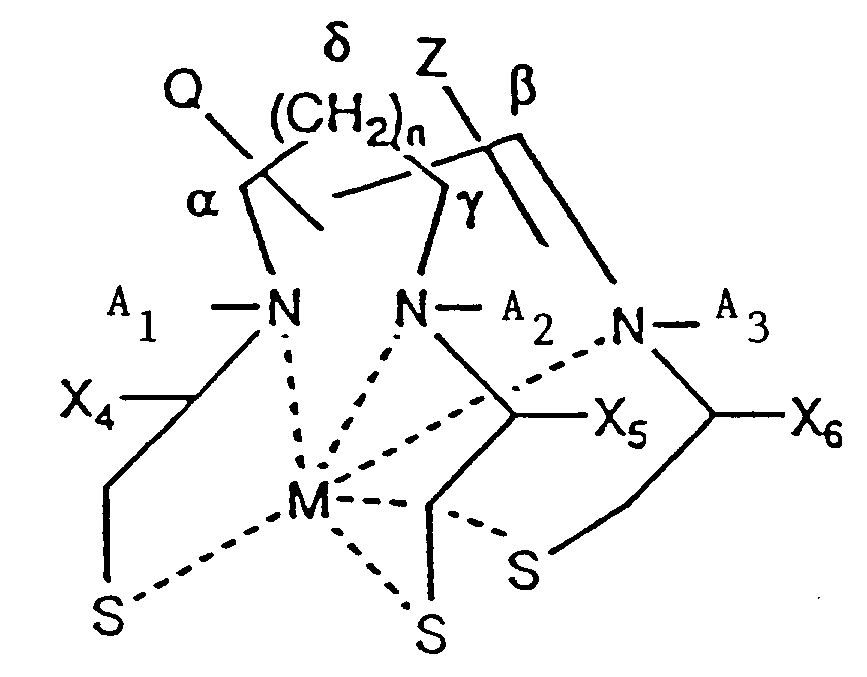
- Compound II which contains three nitrogens and three sulfurs (“N3S3”), has the following formula: Examples of specific embodiments of the elements of compound II include the following.
- R1, R2, and R3 are independently selected from sulfur protecting groups.
- Groups which may be used include any of the alkyl, acyl, aryl groups, disulfides and bunte salts known by those skilled in the art.
- Preferred groups are those that result in an acyl, a thioacetal or a hemithioacetal.
- Particularly preferred groups include thioesters, p-anisylidine, acetonyl, tetrahydrylfuranyl, ethoxyethyl, tetrahydrylpyranyl, acetamidomethyl, and derivatives thereof.
- A1 and A2 are independently selected from hydrogen (H) and an alkyl group of C6 or less.
- A3 is an H, an alkyl group of C6 or less, or Z.
- a compound with zero, one, two or three amides may be formed by the appropriate selection of X4, X5, and X6.
- Amide nitrogens, relative to amine nitrogens, afford greater stability to the complex formed with a metal, but at the expense of a diminished acceleration of complex formation.
- X4, X5, and X6 compounds with a wide variety of chelating properties may be formed.
- Q may be H or a polar group.
- a polar group One function of a polar group is to increase the hydrophilicity of the compound, e.g., in order to increase its aqueous solubility.
- Groups which may be used include carboxylates, sulfonates and secondary alcohols.
- a preferred group is -CH2-COOH.
- Q may be attached to one of the positions designated as ⁇ , ⁇ , ⁇ and ⁇ . Because the number of methylene carbons at the ⁇ position is defined by n which may be greater than one, the ⁇ position includes additional points for attachment of Q.
- the distance by which the nitrogen atoms are separated may be increased by interposing methylene (-CH2-) groups between the carbons bonded to the nitrogens.
- -CH2- groups When the number of -CH2- groups, represented by n, is greater than zero, then the number of carbon atoms separating the nitrogen atoms in compound II is increased accordingly.
- Preferred integers for n are 0 to 4.
- Z is -(W) m -R′.
- W is a group that functions as a "spacer arm” and may be useful to distance R′ from the chelating portion of the compound.
- Groups which may be used include methylene (-CH2-), methyleneoxy (-CH2-O-), methylenecarbonyl (-CH2-CO-), or combinations thereof.
- the number, m, of groups such as these would be typically 0 to 30 and preferrably 0 to 5.
- Z, or R′ when m is 0, may be attached to A3 or to one of the positions designated as ⁇ , ⁇ , ⁇ , and ⁇ . Because the number of methylene carbons at the ⁇ position is defined by n which may be greater than one, the ⁇ position includes additional points for attachment of a Z or an R′.
- R′ is a chemically reactive group and the discussion of it provided above for compound I is applicable here as well.
- the carbon designated as ⁇ may be bonded to any one of the carbons designated as ⁇ , ⁇ and ⁇ .
- a metal chelate is formed by addition of a metal or metal oxide to compound II and has the following formula: wherein: R1-R3, A1-A2, A3, X4-X6, Q, n, and Z are defined as described above.
- M is a metal, or metal oxide radionuclide capable of being chelated. The six atoms available for bonding M are shown.
- M may be bound to 4-6 of the nitrogen and sulfur atoms of compound II.
- Preferred metals and metal oxides are 64Cu, 67Cu, 97Ru, 99m Tc, 105Rh, 109Pd, 186Re, 188Re, 198Au, 199Au, 203Pb, 212Pb, and 212Bi.
- the invention provides chelate-targeting agent conjugates having the formula: wherein: R1-R3, A1-A2, A3, X4-X6, Q, n, and M are defined as described above.
- Z′ is -(W) m -Targeting agent.
- W is a group that functions as a "spacer arm” and may be useful to distance a targeting agent from the compound.
- Groups which may be used include methylene (-CH2-), methyleneoxy (-CH2-O-), methylenecarbonyl (-CH2-CO-), or combinations thereof.
- the number, m, of groups such as these would be typically 0 to 30 and preferrably 0 to 5.
- Z′, or Targeting agent when m is 0, may be attached to A3 or to one of the positions designated as ⁇ , ⁇ , ⁇ and ⁇ . Because the number of methylene carbons at the ⁇ position is defined by n which may be greater than one, the ⁇ position includes additional points for attachment of a Z′ or a Targeting agent.
- targeting agent includes any linking group that may be used to join the targeting agent. It will be evident to one skilled in the art that a variety of linking groups, including bifunctional reagents, may be employed within the present invention. The discussion of targeting agent provided above for compound I-type conjugates is applicable here as well.
- Two methods are provided for producing a chelate-targeting agent conjugate having the formula depicted immediately above.
- a chelate is formed which is then joined to a targeting agent to form the conjugate.
- This method comprises the steps of reacting a compound (II) having the formula: with a metal or metal oxide capable of being chelated, thereby forming a metal chelate, and combining the metal chelate with a targeting agent under reactive conditions to form the chelate-targeting agent conjugate.
- R1-R3, A1-A2, A3, X4-X6, Q, n, and Z are defined as described above.
- the preferred, and particularly preferred, metals and metal oxides are also described above. The discussion provided above regarding targeting agent is applicable here as well.
- a chelating compound is joined to a targeting agent to form a conjugate to which a metal or metal oxide is added.
- This method comprises the steps of combining a compound (II) having the formula: with a targeting agent under reactive conditions to form a derivatized targeting agent and reacting the derivatized targeting agent with a metal, or metal oxide, capable of being chelated, thereby forming the chelate-targeting agent conjugate.
- R1-R3, A1-A2, A3, X4-X6, Q, n, and Z are defined as described above.
- the preferred, and particularly preferred, metals and metal oxides are also described above. The discussion provided above regarding targeting agent is applicable here as well.
- kits Two types of diagnostic and therapeutic kits are prepared for use in the administration of chelate-targeting agent conjugates.
- the first type of kit (“pre-formed”) comprises compound I, or compound II, and a targeting agent to be radiolabeled, each in separate containers.
- the compound is labeled with a metal, or metal oxide, radionuclide and then the resulting chelate is joined to the targeting agent.
- the radionuclide is added to the chelating compound prior to the addition of the targeting agent.
- the second type of kit (“post-formed”) comprises in one container compound I, or compound II, attached to a targeting agent to be radiolabeled and in another container a reducing agent and a complexing agent which in combination are capable of allowing a metal, or metal oxide, radionuclide to form an exchange complex.
- the radionuclide is added to the chelating compound after the addition of the targeting agent.
- Preferred radionuclides for use in conjunction with a diagnostic kit are 99m Tc, 97Ru and 203Pb and with a therapeutic kit are 186Re, 188Re, 67Cu, 105Rh, 198Au, 199Au and 212Bi.
- the discussion provided above regarding targeting agent is applicable here as well.
- the diagnostic and therapeutic kits, both in a pre-formed and a post-formed type, are described in detail in Example IV.
- the chelate-targeting agent conjugates described above may be used for diagnostic and therapeutic purposes.
- the diagnostic method may be used to detect the presence or absence of a target site within a mammalian host.
- the method comprises the steps of administering to a mammal a diagnostically effective dose of one of the chelate-targeting agent conjugates described above, where the metal or metal oxide is a radionuclide and the conjugate is capable of binding to the target site. This step is followed by a step of detecting the biodistribution of the radionuclide in the mammal to determine the presence or absence of the target site in the host.
- a diagnostically effective dose of a chelate-targeting agent conjugate is generally from about 5 to about 35 and typically from about 10 to about 30 mCi per 70 kg body weight.
- the precise dose for a chelate-targeting agent conjugate is dependent upon the particular targeting agent used because the level of uptake of a conjugate into a tumor is dependent upon the number of receptors for the targeting agent and its affinity for the receptors.
- the precise dose further depends upon the particular route of administration, e.g., intravenous, intracompartmental, intraarteoral or intratumoral. It will be evident to one skilled in the art how to determine the optimal effective dose for a particular chelate-targeting agent conjugate and a particular route of administration.
- the discussion provided above regarding targeting agent is applicable here as well.
- Preferred radionuclides are 97Ru, 99m Tc and 203Pb. A preferred mammal is man.
- the therapeutic method may be used for delivering a radionuclide to a target site within a mammalian host.
- the method comprises the step of administering to a mammal a therapeutically effective dose of one of the chelate-targeting agent conjugates described above, where the metal or metal oxide is a radionuclide and the conjugate is capable of binding to the target site.
- a therapeutically effective dose is generally from about 20 mCi to about 300mCi.
- Preferred radionuclides are 186Re, 188Re, 67Cu, 105Rh, 198Au, 199Au and 212Bi.
- a preferred mammal is man.
- Example I provides the preparation of chelating compounds.
- Example II describes the preparation of radiolabeled chelates and conjugation with targeting agents.
- Example III describes the preparation of targeting agent-chelating compound conjugates followed by radiolabeling of the conjugates.
- Example IV discloses kits for producing chelate-targeting agent conjugates.
- Example V describes biodistribution studies in mice.
- Example VI provides imaging of tumors in humans.
- N-t-butoxycarbonylaziridine-3-propionic acid 4 To a solution of 1 mmol of 3 5 mL of ethanol is added 2 mL of 1 N NaOH and the mixture is stirred for 2 hours at ambient temperature. The mixture is partitioned between 25 mL of water and 25 mL of ether. The aqueous layer is acidified to pH 2 and extracted with 2 X 25 mL of ether. The combined either extracts are washed with brine, dried with anhydrous MgSO4, filtered and concentrated to yield 4 .
- 4-N-t-butoxycarbonylamino-5-amino-pentanoic acid 5 To a solution of 4 (1 mmol) in 5 mL of chloroform is added an excess of hydrazoic acid in chloroform. The mixture is stirred at ambient temperature and concentrated to give the azide. The azide is dissolved in 5 mL of isopropanol. To the solution is added 5 mmol of sodium borohydride. The mixture is refluxed for 16 hours, allowed to cool to ambient temperature and 5 mL of 1N HCl is added. The mixture is concentrated to give the crude hydrochloride salt of 5 .
- Bis-4,5-(2′,3′-mercaptioisobuyryl)propionamido pentanoic acid 19 A solution of 4,5-diaminopentanoic acid 18 (1 mmol) in 10 mL of dimethylformamide is treated with 2.2 mmol of triethylamine and stirred for a few minutes. To this suspension 2.2 mmol of succinimidyl 2,3-bis (mercaptoisobutryl) propionate 9 (Scheme 1). The solution is stirred for 2 hours at ambient temperature. Dimethylformamide is removed in vacuo and the residue is dissolved in ethyl acetate and washed with water. The organic layer is dried with anhydrous sodium sulfate and evaporated to give 19 .
- Succinimidyl-bis-4,5-(2′,3′-mercaptoisobutyryl) propionamido pentanoate 20 To a solution of bis-4,5-(2′,3′-mercaptoisobutyryl) propionamido pentanoic acid 19 (1 mmol) in 10 mL of anhydrous tetrahydrofuran, N,N′-dicyclohexylohexylcarbodiimide (1.2 mmol) and N-hydroxysuccinimide (1.2 mmol) is added. The mixture is stirred overnight at room temperature. Dicyclohexylurea is filtered and the solution is evaporated to dryness. The residue is dissolved in ethyl acetate and washed with water, dried with anhydrous MgSO4 and evaporated to give 20 . The product is purified by silica gel chromatography followed by HPLC.
- 2,3-Bis(mercaptoisobutryl) propanol 21 To an ice-cold solution of 2,3-bis(mercaptoisobutryl) propionic acid 9 (Scheme 1) (1 mmol) in 10 mL of anhydrous tetrahydrofuran, 1.5 mL of 1M BH3.THF is added over a period of 5 minutes (min.). The solution is stirred for another 10 min. and evaporated to dryness. Ten ml of water is added to the residue and the mixture is extracted with ethyl acetate. The organic layer is washed with water, dried and evaporated in vacuo to give the product 21 , which is purified by flash column chromatography.
- N,N′-Dimethyl-4,5-diaminopentanoic acid 23 To a solution of 4,5-diaminopentanoic acid ( 18 ; Scheme 2) (2 mmol) in 30 mL of anhydrous dimethylformamide, 5 mmol of di-t-butyldicarbonate is added and the solution is stirred overnight at room temperature. The solvent is removed in vacuo and the residue is crystallized to give N,N′-di-t-butoxycarbonylpentanoic acid.
- N,N′-Dimethyl-bis-4,5-(2′3′-mercaptoisobutyryl pentanoic acid 24 A solution of 21 (2 mmol) in 5 mL of methylene chloride containing 3 mmol of pyridine is cooled to 0°C and 2.1 mmol of methanesulfonyl chloride is added. The solution is stirred at this temperature for 2 hours to give the mesylate 22 in-situ . The mesylate most likely is present as sulfonium ion. To this solution, a solution of 23 (1 mmol) in 5 mL of dimethyl formamide is added and stirred for 2 hours. The solution is allowed to come to room temperature and refluxed for another 2 hours. Evaporation of the solvent followed by chromatography yield the product, 24 .
- Succinimidyl-N,N′-dimethyl-bis-4,5-(2′,3′-mercaptoisobutyryl)-propionyl pentanoate 25 The active ester is prepared by mixed anhydride method. A solution of the acid 24 (1 mmol) in 5 mL of anhydrous tetrahydrofuran and 2 mmol of 4-dimethylaminopyridine is cooled to -5°C to 0°C. To this solution is added 1.1 mmol of isobutylchloroformate and stirred at this temperature for 10 min. A pre-cooled solution of N-hydroxysuccinimide (1.1 mmol) in 5 mL is added and the solution is stirred for another hour. Water is added and the mixture is evaporated. The residue is dissolved in 20 mL of methylene chloride and washed with water. The organic layer is dried and evaporated. The product 25 is isolated by reverse phase HPLC.
- 2-Carboxymethylthio-2-methyltetrahydrofuran 26 A solution of mercaptoacetic acid (10 mmol) in 5 mL of dichloromethane containing p-toluenesulfonic acid mono-hydrate (100 mg) is cooled with stirring to -10° to -25°C. 2-Methyl-4,5-dihydrofuran (10 mmol) in 10 mL of dichloromethane is added dropwise to the cold solution while the temperature is maintained between -10°C to -25°C. Then 5 mL of phosphate buffer is added and the solution is allowed to come to room temperature. The mixture is poured into a 30 mL of ethyl acetate and 10 mL of water. Organic layer is separated and the aqueous layer is extracted with ethyl acetate. The combined ethyl acetate layer is dried and evaporated to give 26 as a colorless oil.
- 2-Hydroxyethylthio-2-methyltetrahydrofuran 27 To a solution of 2 mmol of 26 in 10 mL of anhydrous tetrahydrofuran (kept at 0°C) 3mL of BH3. THF complex (1M) is added slowly. The mixture is stirred for 3 hours in a nitrogen atmosphere at 0°C. Approximately 10 mL of water added slowly and the reaction is stirred for 15 min. The mixture is concentrated in vacuo at 40°-45°C and the aqueous residue is extracted with ethyl acetate. The organic layer is washed with 10% bicarbonate. The ethyl acetate layer is dried and evaporated to give the product, 27 as an oil.
- 2-Methylsulfonylmethylthio-2-methytetrahydrofuran 28 To a solution of 27 (2 mmol) in 10 mL of methylene chloride containing 2 mmol of triethylamine maintained at 0°C is added methanesulfonylchloride (2 mmol) and the solution is stirred at room temperature for 1 hour.
- the mesylate 28 is unstable and hence the N-alkylation is carried out in situ without isolating the mesylate as described in the next step.
- N,N,N′N′-Tetra-(S-2-methyltetrahydrofuran-2-yl)- ⁇ -mercaptoethyl-3-p-nitrophenyl-1,2-diaminopropane 30 To the above solution 0.5 mmol of 1,2-diamino-3-p-nitrophenylpropane 29 (prepared according to the procedure of L. H. DeRiemer, C. F. Meares, D. A Goodwin and C. I. Diamanti, J. of Labelled Compounds and Radiopharmaceuticals 18 :1517, 1981) is added and the solution is stirred at room temperature and refluxed for another 2-3 hours. The product is isolated by evaporation purified by silica gel chromatography.
- N,N,N′,N′-Tetra-(S-2-methyltetrahydrofuran-2-yl)- ⁇ -mercaptoethyl-3-p-amino-phenyl-1,2-diaminopropane 31 A solution of the nitro compound 30 (1 mmol) in 10 mL of absolute ethanol containing 100 mg of PtO2(Adams catalyst) is shaken in a Paar hydrogenator for 3 hours. The catalyst is removed by filtration and the solvent is removed in vacuo to yield the amino derivative 31 , which is used in the next without further purification.
- N,N,N′N′-Tetra-(S-2-methyltetrahydrofuran-2-yl)- ⁇ -mercaptoethyl-3-p-isothiocyanatophenyl-1,2-diaminopropane 32 To a solution of the above amino compound in 20 mL of methylene chloride is added. 1 mmol of thiocarbonyldiimidazole is added and the mixture is stirred at room temperature overnight. The solution is diluted with methylene chloride and washed with water. Evaporation and purification by liquid chromatography yields the isothiocyanate 32 .
- N-(S-2′-Methyl-tetrahydrofuran-2-yl)- ⁇ -mercaptoethyl- ⁇ -aminobutryic acid 34 A solution of 28 (1mmol) (see Scheme 4) and ⁇ -aminobutyric acid in 10 mL of methylene chloride and 2 mL pyridine is stirred for 10-15 hours at room temperature. The organic solvent is evaporated and the residue is dissolved in water. Acidification with glacial acetic acid precipitates the product, N-(S-2′-methyl-tetrahydrofuran-2-yl)- ⁇ -mercaptoethyl ⁇ -aminobutyric acid 34 .
- 1,3-(N,N′-Bis- ⁇ -trimethylsilylethoxycarbonyl)diamino-2-propanol 36 To a solution of 10 mmol of 1,3-diamino-2-propanol 35 in 30 mL of 5% sodium bicarbonate and 10 mL of methylene chloride 22 mmol of ⁇ -trimethylsilylethoxycarbonyl chloride is added and the mixture is stirred for 6 hours at room temperature. The organic layer is separated and the aqueous layer is extracted with 2 X 50 mL of methylene chloride. The combined organic layer is washed with water, dried and evaporated to give the product 26 .
- 1,3-(N,N′-Bis- ⁇ -trimethylsilylethoxycarbonyl)diamino-2-O-(p-tosyl)propanol 37 To a solution of the above compound (2 mmol) in 5 mL of pyridine at 0°C, 2 mmol of p-toluenesulfonyl chloride is added and the mixture is stirred at this temperature for 2 hours and kept at 0°C overnight. The mixture is poured into crushed ice to precipitate the product, which is purified by crystallization.
- 2-N-( ⁇ -Trimethylsilylethoxycarbonyl)-aminomethyl-1-( ⁇ )-Trimethylsilylethoxycarbonyl)-aziridine 38 To a solution of the above tosyl derivative (1 mmol) 27 , in 5 mL of dry dimethylformamide, 1.1 mmol of sodium hydride is added and the solution is stirred for 2 hours at room temperature. The solvent is removed in vacuo and the residue is dissolved in ethyl acetate. The solution is washed with water, dried with anhydrous sodium sulfate and evaporated to give the aziridine derivative 28 .
- N-(S-2′-Methyl-tetrahydrofuran-2′-yl)- ⁇ -mercaptoethyl-N-( ⁇ , ⁇ -di-trimethylsilylethoxycarbonylamino-propyl- ⁇ -butyric acid 39 A solution of the aziridine derivative (1 mmol) 38 , in 5 mL of acetonitrile is stirred under reflux with 1 mmol of N-(S-2′-Methyltetrahydrofurn-2- ⁇ -1)- ⁇ -mercaptoethyl- ⁇ -aminobutyric acid 34 at ambient temperature for 6 hours. Evaporation of the solvent in vacuo and purification of the residue by silica gel chromatography yields the desired product 39 .
- N-(S-2′-Methyl-tetrahydrofuran-2′-yl)- ⁇ -mercaptoethyl-N-( ⁇ , ⁇ -bis-S-isobutryl-mercaptoacetamido)- ⁇ -butyric acid 42 To a solution of 1 mmol of 40 5 mL of dimethylformamide, S-isobutrylmercaptoacetic acid succinimidate ester 41 (2 mmol) is added and the solution is stirred for 3 hours at room temperature. The solvent is removed in vacuo and the residue is dissolved in ethyl acetate. The organic layer is washed with water, dried and evaporated to give 42 .
- N-(S-2′-Methyl-tetrahydrofuran-2′-yl)- ⁇ -mercaptoethyl-N-( ⁇ , ⁇ -bis-S-isobutryl-mercaptoacetamido)- ⁇ -butyric acid 43 To a solution of the above compound (1 mmol) in 5 mL of tetrahydrofuran containing 1 mmol of 4-dimethylaminopyridine kept at 0°C, 1 mmol of isobutylchloroformate is added and the solution is stirred for 20 mins.
- N-( ⁇ , ⁇ -Dicyano)ethylene-N- ⁇ -(S-2′-methyltetrahydrofuran-2-yl)mercapto-ethyl- ⁇ -butyryic acid 45 An equimolar mixture of ethyoxyethylenemalononitrile 44 and compund 34 (scheme 5) are heated in an oil bath at 95° to 100°C with an air condenser. The mixture is cooled to room temperature and the solidified mass is broken up in ethanol and filtered. The filtered solid is recrystallized.
- N- ⁇ , ⁇ -Dicyano)ethyl-N- ⁇ -(S-2′-methyl-tetrahydrofuran-2-yl)mercapto-ethyl-butyryic acid 46 To a solution of the compound 45 (1 mmol) in 10 mL of isopropanol containing 1 gm of silica gel, 3 mmol of sodium borohydride is added and the mixture is stirred for 2-3 hours at room temperature. The silica gel is removed by filtration and the filtrate is evaporated to dryness. The water, dried and evaporated to give the product. If necessary, the product is purified by silica gel flash chromatography.
- N- ⁇ , ⁇ -Diaminomethyl)ethyl-N- ⁇ -(S-2′-methyltetrahydrofuran-2-yl)-mercapto-ethyl- ⁇ -butyryic acid 47 A solution of the compound 46 (1 mmol) dissolved in 10 mL of ethanol containing 2 mmol of hydrogen chloride is hydrogenated at 50 psi in the presence of sulfided Pd-on carbon. After 10-12 hours the catalyst is removed by filtration and the filtrate is evaporated in vacuo . The product diamine 47 is used in the succeeding step without further purification.
- N-( ⁇ , ⁇ -S-2′-methylmetetrahydrofuran-2-yl-mercaraptoacetamidomethyl)-ethyl-N- ⁇ -(S-2′-methylmetetrahydrofuran-2-yl)mercaptoethyl- ⁇ -butyryic acid tetrafluorophenyl ester 50 A solution of the above acid (1 mmol) in 15-20 mL of tetrahydrofuran is stirred with 1.1 mmol of tetrafluorophenol and 1.1 mmol of N,N′-dicyclohexylcarbodiimide.
- the 188Re chelate of the chelating compound is prepared by a similar procedure.
- Sodium perrhenate (3 mL, 30 mCi/mL produced from a 188W/188Re generator) is added to a vial containing a lyophilized mixture comprising citric acid, 75 mg; stannous chloride, 0.75 mg; gentisic acid, 0.25 mg and lactose, 100 mg.
- the vial is agitated gently to mix the contents, then incubated at room temperature for 10 min.
- 0.50 mL of 2-propanol is added and the vial is agitated for 2 min. to completely dissolve the compound.
- 0.3 mL of this solution is transferred to the vial containing the 188Re-citrate complex.
- the reaction mixture is heated to 75°C for 15 min., then cooled in ice for 5 min.
- the 186Re chelate of the chelating compound is prepared by a procedure similar to the 188Re procedure.
- Perrhenate 186ReO4 as sodium, lithium, ammonium or any other suitable counter ion is obtained from irradiation of 185Re (0.1 to few mg) in a nuclear reactor dissolution and purification of the original solution by previously described procedure (Venderhyden et al., Inorg.Chem. 24 : 1666, 1985) or any other suitable procedure.
- 186ReO4 vial To the 186ReO4 vial is added 0.75 mL reconstituted solution made of 1.0 mL of sterile water added to a vial containing a lyophilized mixture comprising citric acid 25 mg, stannous chloride 1 mg, gentisic acid 1 mg and lactose 75 mg.
- the vial is agitated gently to mix the contents, then incubated at room temperature of 75°C.
- 2-propanol is added to obtain a completely dissolved solution.
- An appropriate amount of this solution to give a ligand to rhenium mole ratio of 1:5 (preferentially between 1 and 1.5 ligand to rhenium mole ratio) is then transfered to the vial containing the 186Re-citrate complex.
- the reaction mixture is heated to 75°C for 20 min. then cooled on ice for 5 min.
- a solution containing antibody (or fragment) at 5 mg/mL is added in the same buffer.
- the antibody is a monoclonal antibody (or fragments thereof) designated as NR-ML-05, NR-LU-10, NR-CO-02, NR-CE-01 specific for human melanoma, lung, colon and CEA secreting tumor cells, respectively.
- the reaction mixtures are incubated at room temperature for 15-30 min. as necessary.
- the ITLC procedure Nuclear Medicine Technology and Techniques , ed. Bernier, D., Longan, J., and Wells, L.: The C. V. Mosby Co., St Louis, Mo., 1981; pp. 172-174) using 12% trichloroacetic acid is utilized to determine the percentage of chelate attached to the protein.
- an extra purification step is added depending on the form, e.g., F(ab′)2, of the antibody to be labeled.
- This step is designed to guarantee efficient labeling of the F(ab′)2 fragment, which is usually more susceptible to reduction into two Fab′ fragments.
- the labeling approach is similar to technetium using the appropriate pH and volume of buffer for conjugation.
- the final purification of the antibody-chelate complex is achieved by passing the conjugate through an ion exchange (DEAE or QAE Sephadex) or gel permeation column (as sephadex G-25 or acrylamide gel): Sephadex is a registered trade mark.
- the purity of the conjugate is over 90% before administration to test animals and to humans. Asceptic techniques are used throughout the radiolabeled monoclonal antibody preparation for human administration.
- the antibody conjugation reaction is performed in a final volume of 4.0 mL: 1 mg of the chelating compound (61.67 ⁇ mol), 1.1 mg of a monoclonal antibody (IgG, 7.8 nmol), 1-2 mL of distilled dimethyl formamide (if necessary to solubilize the chelating compound), 0.05 M of borate or 0.5 M bicarbonate buffer at pH 8.5. After stirring for 90 min. at room temperature, 4.4 mL of 5N sodium chloride is added. After an additional 30 min., the reaction mixture is centrifuged to remove any particulates and the supernatent is fractioned by gel filtration column chromatography. The column eluent is monitored at 280 nm and the fractions containing monomeric antibody conjugate are pooled and concentrated in an Amicon stirred cell (30,000 molecular weight cutoff).
- Stannous tartrate kits were prepared from degassed solutions of 0.5 mL disodium tartrate (10 mg/mL) and 0.1 mL stannous chloride (1.0 mg/mL in ethanol) in an evacuated vial under nitrogen atmosphere.
- sodium pertechnetate 0.5 mL (about 15 mCi) is added and allowed to stand at room temperature for 5 min.
- Quality control for 99m Tc-tartrate and insoluble 99m Tc is carried out on Gelman ITLC using methyl ethyl ketone and 0.01 M sodium tartrate pH 7.0 eluents, respectively.
- 99m Tc-tartrate formation is typically 98-99% with insoluble 99m Tc values as TcO2 ranging from 0.1 to 0.2%.
- the 188Re chelate form of the conjugate is prepared in a procedure similar to that described for 188Re above.
- Sodium perrhenate (3 mL, 15 mCi, produced from a 188W/188Re generator) is added to a vial containing a lyophilized mixture comprising: citric acid, 75 mg; stannous chloride, 0.75 mg; gentisic acid, 0.25 mg; and lactose, 75 mg.
- the vial is agitated gently to mix the contents, then incubated at 75°C for 15 min. to form a activated 188Re-citrate complex.
- Labeling of the conjugate is carried out in a similar procedure described for 99m Tc above.
- the 186Re chelate form of the conugate is obtained by a procedure similar to the 186Re labeling of the chelating compound described above.
- To the purified perrhenate vial is added 0.75 mL of the reconstituted solution made of 1.0 mL of sterile water added to a vial containing a lyophilized mixture comprising citric acid 15 mg, stannous chloride 1 mg, gentisic acid 1 mg and lactose 75 mg.
- the vial is incubated at 75°C for 15 min. then cooled for 5 min. to field 186Re-citrate complex ready for labeling of the conjugate.
- Labeling of the conjugate is carried out in a similar procedure described for Tc-99m with a protein to rhenium mole ratio varying from 0.2 to 10 (preferentially around 1).
- chelate-protein conjugates Two different types, pre-formed and post-formed, of diagnostic and therapeutic kits are prepared for use in the administration of chelate-protein conjugates: (1) Conjugates from a chelate which is produced by radiolabeling a chelating compound followed by attachment to a protein, e.g., Example II, and (2) Conjugates produced by radiolabeling a chelating compound-protein conjugate, e.g., Example III.
- a diagnostic kit containing reagents for preparation of a 99m Tc-radiolabeled protein conjugate is used as follows. The procedures are conducted under conditions which ensure the sterility of the product (e.g., sterile vials and sterilized reagents are used where possible, and reagents are transferred using sterile syringes). Proper shielding is used once the radioisotope is introduced.
- a stannous gluconate complex 50 mg sodium gluconate and 1.2 mg stannous chloride dihydrate in dry solid form
- a sterile insulin syringe is used to inject 0.1 mL of the resulting stannous gluconate solution into an empty sterile vial.
- Sodium pertechnetate (1.0 mL, 75-100 mCi, from a 99Mo/99Tc generator available from DuPont, Mediphysics, Mallinckrodt or E.R. Squibb) is added, and the vial is agitated gently to mix the contents, then incubated at room temperature for 10 minutes to form a 99m Tc-gluconate complex.
- the kit in an alternative procedure for providing the 99m Tc-gluconate exchange complex, includes a vial containing a lyophilized preparation comprising 5 mg sodium gluconate, 0.12 mg stannous chloride dihydrate, about 0.1 mg gentisic acid as a stabilizer compound, and about 20 mg lactose as a filler compound.
- the amount of gentisic acid may vary, with the stabilizing effect generally increasing up to about 0.1 mg. Interference with the desired reactions may occur when about 0.2 mg or more gentisic acid is added.
- the amount of lactose also may vary, with amounts between 20 and 100 mg, for example, being effective in aiding lyophilization.
- Addition of stabilizer and a filler compound is especially important when the vial contained these relatively small amounts of sodium gluconate and stannous chloride (compared to the alternative embodiment above).
- One mL of sodium pertechnetate (about 100 mCi) is added directly to the lyophilized preparation. The vial is agitated gently to mix the contents, then incubated as described above to form the 99m Tc-gluconate complex.
- a separate vial containing 0.3 mg of a chelating agent in dry solid form is prepared by dispensing a solution of 0.3 mg chelating agent in 2-propanol into the vial, then removing the solvent under N2 gas, and the resulting vial containing the chelating compound is provided in the kit.
- To this vial is then added 0.87 mL of 100% isopropyl alcohol, and the vial is gently shaken for about 2 minutes to completely dissolve the chelating agent.
- 0.58 mL of this solution of the chelating agent is transferred to a vial containing 0.16 mL of glacial acetic acid/0.2 N HCl (2:14), and the vial is gently agitated.
- the vial containing the acidified solution of the 99m Tc-labeled chelate (see above) is removed from the ice bath, 0.1 mL of the sodium bicarbonate buffer is added, and the vial is agitated to mix. Immediately, the buffered antibody solution (above) is added, gently agitated to mix and incubated at room temperature for 20 minutes to allow conjugation of the radiolabeled chelate to the antibody.
- a column containing an anion exchanger is used to purify the conjugate.
- a 5 mL QAE Sephadex column is washed with 5 mL of 37 mM sodium phosphate buffer, pH 6.8.
- a 1.2 ⁇ filter (available from Millipore) is attached to the column, and a 0.2u filter is attached to the 1.2 u filter.
- a 22-gauge sterile, nonpyrogenic needle is attached to the 0.2u filter.
- the reaction mixture is drawn up into a 3 mL or 5 mL syringe, and any air bubbles are removed from the solution.
- the syringe is connected to the QAE-Sephadex column on the end opposite the filters.
- the needle cap is removed from the 22-gauge needle attached to the filter end of the column and the needle tip is inserted into a sterile, nonpyrogenic 10 mL nonevacuated empty vial labeled radio-labeled antibody. Slowly, over 2 minutes, the reaction mixture is injected into the column.
- the total radioactivity in the serum vial is measured using a dose calibrator.
- the yield of the radiolabeled antibody is normally in the 40-60% range.
- the contents of the serum vial are drawn up into a sterile, pyrogen-free, 30cc syringe and diluted to a total volume of 30 mL with sterile 0.9% NaCl for injection into a human patient.
- a quality control test is normally performed on a 0.01 mL aliquot before injection by instant thin layer chromatography.
- radiochemical purity is less than 85%, the material should not be injected into a human patient. Using this procedure, radiochemical purities generally range from about 90% to 99%. The total amount of radioactivity also is measured prior to injection. In general, from 10 to 30 mCi will be administered to a human patient.
- an irrelevant antibody and an unlabeled specific antibody Prior to administering the radiolabeled F(ab) fragment (the diagnostic radiolabeled antibody fragment), an irrelevant antibody and an unlabeled specific antibody are to be administered to the patient to improve the diagnostic images, as described above.
- the irrelevant antibody provided in a separate vial in the kit, is a whole murine monoclonal antibody directed against a B-cell lymphoma idiotype.
- the unlabeled specific antibody also is in the kit. Both the irrelevant antibody and the unlabeled specific antibody are administered.
- the entire 30 mL sample containing the radiolabeled antibody fragment is administered to a patient by intravenous infusion.
- the infusion is completed in from about 5 min. to about 15 min.
- the antibody fragment concentration in the sample is 0.33 mg/mL.
- Stannous tartrate kits were prepared from degassed solutions of 0.5 mL disodium tartrate (10 mg/mL) and 0.1 mL stannous chloride (1.0 mg/mL in ethanol) in an evacuated vial under nitrogen atmosphere.
- sodium pertechnetate 0.5 mL (about 15 mCi) is added and heated at 50°C for 10-15 min.
- quality control for 99m Tc tartrate and insoluble 99m Tc is carried out on Gelman ITLC using methyl ethyl ketone and 0.01 M sodium tartrate pH 7.0 eluents, respectively.
- 99m Tc-tartrate formation is typically 98-99% with soluble 99m Tc values as Tco2 ranging from 0.1 to 0.2%.
- Antibody fragments radiolabeled with 99m Tc according to the procedures outlined in Examples II and III are injected into mice.
- the biodistribution of the radionuclide protein conjugate is analyzed for 20 hours after injection according to the method of Hwang et al., Cancer Res. , 45 : 4150-4155 (1985).
- the antibody fragment is a Fab fragment of the above-described monoclonal antibodies: NR-ML-05, NR-LU-10, NR-CO-02, NR-Ce-01.
- the data is collected in terms of the percentage of the injected radioctivity per gram of each specified tissue type and tumor/tissue ratio of injected radioactivity.
- the tissue types evaluated are as follows: tail; tumor, skin; muscle; bone; lung; liver; spleen; stomach; thyroid; kidney; and intestine. Tumor sites effectively identified in each of the mice.
- the chelate Re-N2S4, in which the radionuclide metal is 188Rhenium as shown above, is prepared by the methods described herein.
- the chelate is conjugated to a Fab fragment of a monoclonal antibody specific for a tumor, e.g., NR-ML-05, NR-LU-10, NR-CO-2, or NR-Ce-1.
- the Fab fragment is produced by treatment of the monoclonal antibody with papain according to conventional techniques.
- the conjugation step and purification of the resulting radiolabeled antibody are as described in Example lI.
- the chelate-antibody conjugate is injected into tumor-bearing mice, biodistribution of the radiolabeled material is analyzed 20 hours after injection according to the method of Hwang et al., Cancer Res. 45 : 4150-4155, 1985, and compared to Tc-99m biodistribution.
- the chelate Re-N2S4 in which the radionuclide method is 186Re is prepared by the methods described herein. To verify tumor uptake, the chelate is conjugated to a Fab fragment of NRMI or antibody. The chelate-antibody conjugate is injected into tumor-bearing mice, biodistribution is analyzed after 20 hours and compared to Re-199 biodistribution.
- Antibody fragments radiolabeled with 99m Tc according to the method of the invention are injected into human patients to detect tumor sites, i.e., melanoma, lung, colon) within the body.
- the antibody fragments used are F(ab)2, Fab′ or Fab fragments of monoclonal antibodies specific for an antigen of the particular tumor.
- the antibody fragment used may be, for example, a fragment of a monoclonal antibody designated NR-ML-05, NR-LU-10, NR-CE-01 or NR-CO-02, described above.
- the fragments are generated by standard techniques (i.e., pepsin treatment of the monoclonal antibody to generate the F(ab′)2 fragment, papain treatment of the monoclonal antibody to generate the Fab fragment, and treatment with a reducing agent such as dithiothreitol or cysteine to generate the Fab′ fragment).
- the chelate compound (Tc-N2S4) is prepared by one of the methods described herein.
- a patient receives the chelate prepared and conjugated to the antibody fragment according to procedures outlined in Examples II and III.
- the resulting radiolabeled antibody fragment is purified, and a quality control test is performed, as described in Example III.
- each patient may receive 41 to 50 mg of an irrelevant antibody in 12 to 20 mL of sterile saline by intravenous infusion.
- each patient receives 7.5 mg of a non-radiolabeled specific antibody in 20 mL of sterile saline by intravenous infusion either simultaneously with, or approximately 5 min.
- the non-radiolabeled specific antibody is exactly the same as the one used for radiolabeling.
- the irrelevant antibody is a monoclonal antibody designated NR2AD, which is a murine IgG 2a immunoglobulin that is designed as an anti-idiotype that bound to a single patient's B-cell lymphoma and to no other human tissue.
- each patient is injected 20 to 30 mL of sterile saline comprising the radiolabeled antibody fragment, by intravenous infusion.
- the patients receive from 10 mCi to about 30 mCi of 99m Tc radioisotope.
- the desired upper limit of radioisotope administered is 30 mCi, and the minimum for effective imaging of tumors is generally about 10 mCi.
- the total amount of protein in the administered solutions ranged from 2.5 mg to 10 mg. Imaging with a gamma camera is performed at three time points: immediately following infusion, from 7 to 8 hours post infusion, and from 19 to 20 hours post infusion.
- the best images of the target sites are achieved by imaging at from 7 to 8 hours after completion of infusion of the radiolabeled antibody. Although some accumulation of radioactivity in the kidneys is detected during these imaging procedures, the kidneys generally are not considered to be target sites in the diagnostic procedures of the invention.
- the percentage of the total injected dose radioactivity (in cpm) which had localized in each of the various tissue types sampled are to be calculated.
- the ratio of the radioactivity found in tumor site(s) to the radioactivity found in the other types of tissue are also calculated.
- the value for the percent injected dose per mg for the tumor tissue in a particular patient is divided by the value for the percent injected dose per mg for each non-tumor tissue sample biopsied from the patient to give the tumor:tissue ratio for each non-tumor tissue sample.
Landscapes
- Chemical & Material Sciences (AREA)
- Organic Chemistry (AREA)
- Health & Medical Sciences (AREA)
- Life Sciences & Earth Sciences (AREA)
- Veterinary Medicine (AREA)
- Public Health (AREA)
- Immunology (AREA)
- Proteomics, Peptides & Aminoacids (AREA)
- Medicinal Chemistry (AREA)
- Pharmacology & Pharmacy (AREA)
- Epidemiology (AREA)
- Engineering & Computer Science (AREA)
- Animal Behavior & Ethology (AREA)
- General Health & Medical Sciences (AREA)
- Nuclear Medicine, Radiotherapy & Molecular Imaging (AREA)
- Biomedical Technology (AREA)
- Bioinformatics & Cheminformatics (AREA)
- Physics & Mathematics (AREA)
- Optics & Photonics (AREA)
- Medicines Containing Antibodies Or Antigens For Use As Internal Diagnostic Agents (AREA)
Claims (15)
- Chelat-Anzielsubstanz-Konjugat mit der Formel:
 M ein Metall- oder Metalloxid-Radionuklid ist, das chelatisiert werden kann;X₁ und X₂ H oder =O sind, aber nicht beide =O sind;X₃ und X₄ H oder =O sind, aber nicht beide =O sind;A H, Alkylgruppe mit C₆ oder weniger, -CH₂-CH₂-S-R₁ oder -CO-CH₂-S-R₁ ist, mit der Maßgabe, daß, wenn X₁ oder X₂ =O ist, A H ist;A' H, Alkylgruppe mit C₆ oder weniger, -CH₂-CH₂-S-R₂ oder -CO-CH₂-S-R₂ ist, mit der Maßgabe, daß, wenn X₃ oder X₄ =O ist, A' H ist;Y(a) -CH₂-S-R₃ oder H, wenn A H oder eine Alkylgruppe mit C₆ oder weniger ist und A' H oder eine Alkylgruppe mit C₆ oder weniger ist, oder(b) Hist;Y'(a) -CH₂-S-R₄ oder H, wenn A H oder eine Alkylgruppe mit C₆ oder weniger ist und A' H oder eine Alkylgruppe mit C₆ oder weniger ist, mit der Maßgabe, daß Y und Y' nicht beide H sind, wenn sowohl A als auch A' H oder eine Alkylgruppe mit C₆ oder weniger sind, oder(b) Hist;R₁, R₂, R₃, R₄, R₅ und R₆ unabhängig voneinander ausgewählt sind aus Schwefel-Schutzgruppen;Q H oder eine polare Gruppe ist, um die Hydrophilie der Verbindung zu erhöhen;n 0 bis 2 ist; undZ' -(W)m-Azielsubstanz ist, wo W-CH₂-, -CH₂-O-, -CH₂-CO- oder Kombinationen derselben ist, m 0 bis 5 ist und Anzielsubstanz eine Verknüpfungsgruppe einschließt, mit den Maßgaben, daß, wenn Z' mit dem mit α bezeichneten Kohlenstoff verknüpft ist, es entweder kein X₁ oder kein Q an α gibt, daß, wenn Z' mit dem mit β bezeichneten Kohlenstoff verknüpft ist, es entweder kein X₃ oder kein Q an β gibt, daß, wenn X₁ =O ist, es kein Z' an α gibt, und daß, wenn X₃ =O ist, es kein Z' an β gibt.
 - Chelat-Anzielsubstanz-Konjugat mit der Formel:
 M ein Metall- oder Metalloxid-Radionuklid ist, das chelatisiert werden kann;A₁ und A₂ unabhängig voneinander ausgewählt sind aus H und einer Alkylgruppe mit C₆ oder weniger;A₃ H, eine Alkylgruppe mit C₆ oder weniger oder Z' ist;X₄, X₅ und X₆ unabhängig voneinander ausgewählt sind aus H und =O, mit den Maßgaben, daß X₄ H ist, wenn A₁ eine Alkylgruppe ist, daß X₅ H ist, wenn A₂ eine Alkylgruppe ist, und daß X₆ H ist, wenn A₃ eine Alkylgruppe oder Z' ist;Q H oder eine polare Gruppe ist, um die Hydrophilie der Verbindung zu erhöhen;n 0 bis 4 ist; undZ' -(W)m-Anzielsubstanz ist, wo W -CH₂-, -CH₂-O-, -CH₂-CO oder Kombinationen derselben ist, m 0 bis 5 ist und Anzielsubstanz eine Verknüpfungsgruppe einschließt.
 - Chelat-Anzielsubstanz-Konjugat nach Anspruch 1 oder Anspruch 2 zur Verwendung in einem Verfahren zum Nachweis des Vorhandenseins oder der Abwesenheit einer Zielstelle.
- Chelat-Anzielsubstanz-Konjugat nach Anspruch 1 oder Anspruch 2 zur Verwendung als eine aktive therapeutische Substanz.
- Chelat-Anzielsubstanz-Konjugat nach den Ansprüchen 1, 2, 3 oder 4, wobei das Metall- oder Metalloxid-Radionuklid ausgewählt ist aus ⁶⁴Cu, ⁶⁷Cu, ⁹⁷Ru, 99mTc,¹⁰⁵Rh, ¹⁰⁹Pd, ¹⁸⁶Re, ¹⁸⁸Re, ¹⁹⁸Au, ¹⁹⁹Au, ²⁰³Pb, ²¹²Pb und ²¹²Bi.
- Chelat-Anzielsubstanz-Konjugat nach den Ansprüchen 1, 2, 3 oder 4, wobei die Anzielsubstanz ein monoklonaler Antikörper ist.
- Chelat-Anzielsubstanz-Konjugat nach Anspruch 6, wobei der monoklonale Antikörper gegen ein Antigen auf einer Tumorzelle gerichtet ist.
- Verfahren zur Herstellung eines Chelat-Anzielsubstanz-Konjugats nach Anspruch 1, welches die Schritte umfaßt:
Umsetzen einer Verbindung mit der Formel: X₁, X₂, X₃, X₄, A, A', Y, Y', R₅, R₆, Q und n wie in Anspruch 1 definiert sind; undZ -(W)m-R', wo W -CH₂-, -CH₂-O-, CH₂-CO- oder Kombinationen derselben ist, m 0 bis 5 ist und R' eine chemisch reaktive Gruppe ist, mit den Maßgaben, daß wenn Z mit dem mit α bezeichneten Kohlenstoff verknüpft ist, es kein X₁ oder kein Q an α gibt, daß, wenn Z mit dem mit β bezeichneten Kohlenstoff verknüpft ist, es kein X₃ oder kein Q an β gibt, daß, wenn X₁ =O ist, es kein Z an α gibt, und daß, wenn X₃ =O ist, es kein Z an β gibt;mit einem Metall- oder Metalloxid-Radionuklid, das chelatisiert werden kann, wodurch ein Metallchelat gebildet wird; und
Kombinieren besagten Metallchelats mit einer Anzielsubstanz unter reaktiven Bedingungen, um besagtes Chelat-Anzielsubstanz-Konjugat zu bilden. - Verfahren zur Herstellung eines Chelat-Anzielsubstanz-Konjugats nach Anspruch 1, welches die Schritte umfaßt:
Kombinieren einer Verbindung mit der Formel: X₁, X₂, X₃, X₄, A, A', Y, Y', R₅, R₆, Q, n und Z wie in Anspruch 8 definiert sindmit einer Anzielsubstanz unter reaktiven Bedingungen, um eine derivatisierte Anzielsubstanz zu bilden; und
Umsetzen besagter derivatisierten Anzielsubstanz mit einem Metall- oder Metalloxid-Radionuklid, das chelatisiert werden kann, wodurch besagtes Chelat-Anzielsubstanz-Konjugat gebildet wird. - Verfahren zur Herstellung eines Chelat-Anzielsubstanz-Konjugats nach Anspruch 2, welches die Schritte umfaßt:
Umsetzen einer Verbindung mit der Formel: A₁, A₂, A₃, X₄, X₅, X₆, Q und n wie in Anspruch 2 definiert sind; undR₁, R₂ und R₃ unabhängig voneinander ausgewählt sind aus Schwefel-Schutzgruppen undZ -(W)m-R' ist, wo W -CH₂-, -CH₂-O-, -CH₂-CO- oder Kombinationen derselben ist, m 0 bis 5 ist undR' eine chemisch reaktive Gruppe ist;mit einem Metall- oder Metalloxid-Radionuklid, das chelatisiert werden kann, wodurch ein Metallchelat gebildet wird; und
Kombinieren besagten Metallchelats mit einer Anzielsubstanz unter reaktiven Bedingungen, um besagtes Chelat-Anzielsubstanz-Konjugat zu bilden. - Verfahren zur Herstellung eines Chelat-Anzielsubstanz-Konjugats nach Anspruch 2, welches die Schritte umfaßt:
Kombinieren einer Verbindung mit der Formel: R₁, R₂, R₃, A₁, A₂, A₃, X₄, X₅, X₆, Q, n und Z wie in Anspruch 10 definiert sindmit einer Anzielsubstanz unter reaktiven Bedingungen, um eine derivatisierte Anzielsubstanz zu bilden; und
Umsetzen besagter derivatisierten Anzielsubstanz mit einem Metall- oder Metalloxid-Radionuklid, das chelatisiert werden kann, wodurch besagtes Chelat-Anzielsubstanz-Konjugat gebildet wird. - Metallchelat mit der Formel:
 M X₁, X₂, X₃, X₄, A, A', Y, Y', R₅, R₆, Q und n wie in Anspruch 1 definiert sind undZ wie in Anspruch 8 definiert ist.
 - Metallchelat mit der Formel:
 M A₁, A₂, A₃, X₄, X₅, X₆, Q und n wie in Anspruch 2 definiert sind undZ wie in Anspruch 10 definiert ist.
 - Verbindung mit der Formel:
 X₁, X₂, X₃, X₄, A, A', Y, Y', R₅, R₆, Q, n und Z wie in Anspruch 1 definiert sind.
 - Verbindung mit der Formel:
 R₁, R₂, R₃, unabhängig voneinander ausgewählt sind aus Schwefel-Schutzgruppen,A₁, A₂, A₃, X₄, X₅, X₆, Q und n wie in Anspruch 2 definiert sind undZ wie in Anspruch 10 definiert ist.
Applications Claiming Priority (2)
| Application Number | Priority Date | Filing Date | Title |
|---|---|---|---|
| US201134 | 1988-05-31 | ||
| US07/201,134 US4988496A (en) | 1988-05-31 | 1988-05-31 | Metal radionuclide chelating compounds for improved chelation kinetics |
Publications (3)
| Publication Number | Publication Date |
|---|---|
| EP0344724A2 EP0344724A2 (de) | 1989-12-06 |
| EP0344724A3 EP0344724A3 (en) | 1990-12-05 |
| EP0344724B1 true EP0344724B1 (de) | 1993-08-11 |
Family
ID=22744618
Family Applications (1)
| Application Number | Title | Priority Date | Filing Date |
|---|---|---|---|
| EP89109756A Expired - Lifetime EP0344724B1 (de) | 1988-05-31 | 1989-05-30 | Metal Radionukleid-Chelatverbindungen mit verbesserter Chelatierungskinetik |
Country Status (3)
| Country | Link |
|---|---|
| US (1) | US4988496A (de) |
| EP (1) | EP0344724B1 (de) |
| DE (1) | DE68908273T2 (de) |
Families Citing this family (76)
| Publication number | Priority date | Publication date | Assignee | Title |
|---|---|---|---|---|
| US5686410A (en) * | 1989-07-20 | 1997-11-11 | Novartis Ag | Polypeptide derivatives |
| US5443816A (en) * | 1990-08-08 | 1995-08-22 | Rhomed Incorporated | Peptide-metal ion pharmaceutical preparation and method |
| US5460785A (en) * | 1989-08-09 | 1995-10-24 | Rhomed Incorporated | Direct labeling of antibodies and other protein with metal ions |
| US5112953A (en) * | 1989-12-29 | 1992-05-12 | Neorx Corporation | Radiolabeled proteins for diagnostic or therapeutic use |
| WO1991016076A1 (en) * | 1990-04-17 | 1991-10-31 | Mallinckrodt Medical, Inc. | Method and kit for preparing technetium-99m complexes |
| US5656253A (en) * | 1990-09-14 | 1997-08-12 | Mallinckrodt Medical, Inc. | Ligands useful in radiographic imaging |
| US5252721A (en) * | 1990-09-28 | 1993-10-12 | Neorx Corporation | S3 N chelating compounds |
| US5684137A (en) * | 1990-09-28 | 1997-11-04 | Neorx Corporation | S3 N chelating compounds for the radiolabeling of ligands, anti-ligands or other proteins |
| US5997844A (en) * | 1991-02-08 | 1999-12-07 | Diatide, Inc. | Technetium-99m labeled peptides for imaging |
| US5443815A (en) * | 1991-11-27 | 1995-08-22 | Diatech, Inc. | Technetium-99m labeled peptides for imaging |
| US5965107A (en) * | 1992-03-13 | 1999-10-12 | Diatide, Inc. | Technetium-99m labeled peptides for imaging |
| NZ244613A (en) * | 1991-10-29 | 1996-05-28 | Bracco International B V Subst | A ligand containing a hypoxia-localising moiety, preparation thereof; a kit (optionally multivial) for preparing a metal complex containing the ligand |
| US5808091A (en) | 1991-10-29 | 1998-09-15 | Bracco International B.V. | Rhenium and technetium complexes containing a hypoxia localizing moiety |
| JPH07501332A (ja) * | 1991-11-14 | 1995-02-09 | バッテル・メモリアル・インスティチュート | 癌を診断および治療する方法 |
| US5330737A (en) * | 1991-12-06 | 1994-07-19 | Mallinckrodt Medical, Inc. | Nitrogen-sulfur ligands as opiate receptor drug mimics |
| US5989519A (en) * | 1992-03-13 | 1999-11-23 | Diatide, Inc. | Technetium-99m labeled peptides for imaging inflammation |
| US5508020A (en) * | 1992-06-05 | 1996-04-16 | Diatech, Inc. | Technetium-99M labeled peptides for imaging |
| US5716596A (en) * | 1992-06-23 | 1998-02-10 | Diatide, Inc. | Radioactively labeled somatostatin-derived peptides for imaging and therapeutic uses |
| US5879657A (en) * | 1993-03-30 | 1999-03-09 | The Dupont Merck Pharmaceutical Company | Radiolabeled platelet GPIIb/IIIa receptor antagonists as imaging agents for the diagnosis of thromboembolic disorders |
| US5608110A (en) * | 1993-06-15 | 1997-03-04 | Bracco International B.V. | Heteroatom-bearing ligands and metal complexes thereof |
| US5690904A (en) * | 1993-07-12 | 1997-11-25 | Amersham International Plc | Diagnostic radiopharmaceutical compounds (That) |
| US5789555A (en) * | 1993-11-16 | 1998-08-04 | Resolution Pharmaceuticals Inc. | Immobilized labelling method |
| US6066309A (en) | 1996-02-02 | 2000-05-23 | Rhomed Incorporated | Post-labeling stabilization of radiolabeled proteins and peptides |
| WO1997028181A2 (en) * | 1996-02-02 | 1997-08-07 | Rhomed Incorporated | Post-labeling stabilization of radiolabeled proteins and peptides |
| US20010055563A1 (en) | 1999-09-09 | 2001-12-27 | Rhomed Incorporated | Post-labeling stabilization of radiolabeled proteins and peptides |
| US5736120A (en) * | 1996-06-07 | 1998-04-07 | Srinivasan; Ananthachari | Method for preparing radiolabeled peptides |
| WO1998016256A1 (en) * | 1996-10-16 | 1998-04-23 | The Burnham Institute | Magnetic resonance imaging of thrombi |
| CA2283854A1 (en) * | 1997-04-22 | 1998-10-29 | The Curators Of The University Of Missouri | Gastrin receptor-avid peptide conjugates |
| CA2346154A1 (en) * | 2001-05-02 | 2002-11-02 | University Of Missouri | Gastrin receptor-avid peptide conjugates |
| US6083480A (en) * | 1997-05-01 | 2000-07-04 | Diatide, Inc. | Calcitonin receptor binding reagents |
| DE69838483T2 (de) | 1997-10-14 | 2008-07-03 | Darwin Molecular Corp. | Thymidinkinase mutanten und fusionproteine mit thymidinkinase und guanylatekinase aktivitäten |
| US6534037B1 (en) | 1998-01-21 | 2003-03-18 | Neorx Corporation | Non-steroidal compounds for steroid receptors and uses relating thereto |
| US20060263382A1 (en) * | 1998-06-20 | 2006-11-23 | Richard Hotchkiss | Membrane-permeant peptide complexes for treatment of sepsis |
| US8038984B2 (en) * | 1998-06-20 | 2011-10-18 | Washington University | Membrane-permeant peptide complexes for treatment of sepsis |
| US6589503B1 (en) * | 1998-06-20 | 2003-07-08 | Washington University | Membrane-permeant peptide complexes for medical imaging, diagnostics, and pharmaceutical therapy |
| US7306784B2 (en) | 1998-06-20 | 2007-12-11 | Washington University | Membrane-permeant peptide complexes for medical imaging, diagnostics, and pharmaceutical therapy |
| DE69933044T3 (de) | 1998-11-27 | 2016-11-24 | Ucb Pharma, S.A. | Zusammensetzungen und verfahren zur erhöhung der knochenmineralisierung |
| US20040009535A1 (en) | 1998-11-27 | 2004-01-15 | Celltech R&D, Inc. | Compositions and methods for increasing bone mineralization |
| US6911429B2 (en) * | 1999-04-01 | 2005-06-28 | Transition Therapeutics Inc. | Compositions and methods for treating cellular response to injury and other proliferating cell disorders regulated by hyaladherin and hyaluronans |
| US6864235B1 (en) | 1999-04-01 | 2005-03-08 | Eva A. Turley | Compositions and methods for treating cellular response to injury and other proliferating cell disorders regulated by hyaladherin and hyaluronans |
| AU6870600A (en) * | 1999-09-06 | 2001-04-10 | Takeda Chemical Industries Ltd. | Process for the preparation of 2,3-dihydroazepine compounds |
| US7067111B1 (en) | 1999-10-25 | 2006-06-27 | Board Of Regents, University Of Texas System | Ethylenedicysteine (EC)-drug conjugates, compositions and methods for tissue specific disease imaging |
| US6692724B1 (en) * | 1999-10-25 | 2004-02-17 | Board Of Regents, The University Of Texas System | Ethylenedicysteine (EC)-drug conjugates, compositions and methods for tissue specific disease imaging |
| ES2518926T3 (es) | 2000-06-02 | 2014-11-05 | Board Of Regents, The University Of Texas System | Conjugados de etilendicisteína y un análogo de glucosa |
| US20030003048A1 (en) * | 2001-04-26 | 2003-01-02 | Chun Li | Diagnostic imaging compositions, their methods of synthesis and use |
| US7507542B2 (en) | 2001-05-08 | 2009-03-24 | Ucb Sa | Method for regulating immune function using the FOXP3 protein |
| JP4202250B2 (ja) * | 2001-07-25 | 2008-12-24 | バイオマリン ファーマシューティカル インコーポレイテッド | 血液脳関門輸送を調節するための組成物および方法 |
| US7261875B2 (en) * | 2001-12-21 | 2007-08-28 | Board Of Regents, The University Of Texas System | Dendritic poly (amino acid) carriers and methods of use |
| KR101086690B1 (ko) * | 2002-11-07 | 2011-11-25 | 셀>포인트, 엘엘씨 | 에틸렌디시스테인(ec)-약물 콘쥬게이트, 조성물 및조직 특이적 질환 영상 방법 |
| US8420050B2 (en) * | 2003-01-13 | 2013-04-16 | Bracco Imaging S.P.A. | Gastrin releasing peptide compounds |
| US20060239923A1 (en) * | 2003-01-13 | 2006-10-26 | Bracco Imaging S.P.A. | Gastrin releasing peptide compounds |
| US7922998B2 (en) * | 2003-01-13 | 2011-04-12 | Bracco Imaging S.P.A. | Gastrin releasing peptide compounds |
| CA2512310C (en) * | 2003-01-13 | 2012-09-25 | Bracco Imaging S.P.A. | Improved linkers for radiopharmaceutical compounds |
| US7850947B2 (en) | 2003-01-13 | 2010-12-14 | Bracco Imaging S.P.A. | Gastrin releasing peptide compounds |
| US7611692B2 (en) | 2003-01-13 | 2009-11-03 | Bracco Imaging S.P.A. | Gastrin releasing peptide compounds |
| US7226577B2 (en) * | 2003-01-13 | 2007-06-05 | Bracco Imaging, S. P. A. | Gastrin releasing peptide compounds |
| CN1774267A (zh) * | 2003-01-22 | 2006-05-17 | 综合医院有限公司 | 与淀粉样物质结合的金属螯合剂 |
| US20050026823A1 (en) | 2003-06-20 | 2005-02-03 | Biomarin Pharmaceutical Inc. | Use of the chaperone receptor-associated protein (RAP) for the delivery of therapeutic compounds to the brain and other tissues |
| US9050378B2 (en) * | 2003-12-10 | 2015-06-09 | Board Of Regents, The University Of Texas System | N2S2 chelate-targeting ligand conjugates |
| ATE465172T1 (de) * | 2004-03-05 | 2010-05-15 | Univ Illinois | Peptidträger für die verabreichung von arzneimitteln |
| DE102004022461B4 (de) * | 2004-05-06 | 2006-07-06 | Forschungszentrum Rossendorf E.V. | Metallkomplexe auf der Basis von Tetrathiol-Liganden und deren Anwendung in der nuklearmedizinischen Diagnostik und Endoradionuklidtherapie sowie Verfahren zur Herstellung der Metallkomplexe |
| EP1991274A4 (de) | 2006-01-20 | 2009-06-10 | Women S And Children S Health | Verfahren zur behandlung, prophylaxe und diagnose von knochenerkrankungen |
| US8758723B2 (en) * | 2006-04-19 | 2014-06-24 | The Board Of Regents Of The University Of Texas System | Compositions and methods for cellular imaging and therapy |
| KR20090014164A (ko) * | 2006-04-19 | 2009-02-06 | 더 보드 오브 리전츠 오브 더 유니버시티 오브 텍사스 시스템 | 세포 영상화 및 치료를 위한 조성물 및 방법 |
| US10925977B2 (en) * | 2006-10-05 | 2021-02-23 | Ceil>Point, LLC | Efficient synthesis of chelators for nuclear imaging and radiotherapy: compositions and applications |
| WO2008119036A2 (en) * | 2007-03-27 | 2008-10-02 | Radiomedix Inc. | Compositions for targeted imaging and therapy |
| EP2005970A1 (de) | 2007-06-22 | 2008-12-24 | Berlin Science Partners GmbH i.V. | Bildgebende Diagnostik durch Kombination von Kontrastmitteln |
| EP2072060A1 (de) | 2007-12-18 | 2009-06-24 | Institut Curie | Verfahren und Zusammensetzungen zur Herstellung und Verwendung von Toxinkonjugaten |
| EP2416806B8 (de) | 2009-04-10 | 2017-03-15 | INSERM (Institut National de la Santé et de la Recherche Médicale) | Fucoidane als liganden zur diagnose von degenerativen pathologien |
| DK2721045T3 (en) | 2011-06-20 | 2017-07-24 | Radiomedix Inc | COMPOSITIONS, METHODS OF SYNTHESIS AND USE OF CARBOHYDRATE TARGETED AGENTS |
| US20150337308A1 (en) | 2012-04-11 | 2015-11-26 | Chu De Bordeaux | Matrix metalloproteinase 9 (mmp-9) aptamer and uses thereof |
| US20140147381A1 (en) * | 2012-11-29 | 2014-05-29 | Gregory David Espenan | 89zr compounds, to include somatostatin, apparatus and products comprising such compounds, methods of making same, and methods of using same for radio imaging and/or treatment |
| EP3672939A1 (de) | 2017-08-21 | 2020-07-01 | Celgene Corporation | Verfahren zur herstellung von (s)-tert-butyl 4,5-diamino-5-oxopentanoat |
| WO2020081174A1 (en) | 2018-10-16 | 2020-04-23 | Nant Holdings Ip, Llc | Alpha emitter compositions and methods |
| KR102269315B1 (ko) * | 2019-10-24 | 2021-06-24 | 서울대학교산학협력단 | 전립선 암의 영상 또는 치료를 위한 동위원소 표지 화합물 |
| AU2023415270A1 (en) | 2022-12-28 | 2025-06-26 | Idexx Laboratories, Inc. | Devices and methods for detecting pancreatic lipase |
Family Cites Families (15)
| Publication number | Priority date | Publication date | Assignee | Title |
|---|---|---|---|---|
| FR2515046B1 (fr) * | 1981-10-27 | 1985-11-29 | Hybritech Inc | Anticorps monoclonaux marques par un radionucleide et leur application a la visualisation d'une tumeur |
| US4444690A (en) * | 1982-02-25 | 1984-04-24 | University Patents, Inc. | Technetium chelates |
| US4434151A (en) * | 1982-11-08 | 1984-02-28 | Medi-Physics, Inc. | Bifunctional chelating agents |
| US4666697A (en) * | 1982-12-08 | 1987-05-19 | Nihon Medi-Physics Co., Ltd. | Radioactive diagnostic agent |
| US4615876A (en) * | 1983-04-25 | 1986-10-07 | Curators Of The University Of Missouri | Macrocyclic complexes of technetium-99m for use as diagnostic radionuclides |
| US4673562A (en) * | 1983-08-19 | 1987-06-16 | The Children's Medical Center Corporation | Bisamide bisthiol compounds useful for making technetium radiodiagnostic renal agents |
| US4638051A (en) * | 1984-04-30 | 1987-01-20 | The Johns Hopkins University | Brain imaging radiopharmaceuticals |
| US4670545A (en) * | 1984-05-11 | 1987-06-02 | University Patents, Inc. | Chelating agents for technetium-99M |
| EP0188256B1 (de) * | 1985-01-14 | 1991-08-21 | NeoRx | Metall-Radionuklid markiertes Protein für Diagnose und Therapie |
| US4746505A (en) * | 1985-04-26 | 1988-05-24 | President And Fellows Of Harvard College | Technetium radiodiagnostic fatty acids derived from bisamide bisthiol ligands |
| US4678667A (en) * | 1985-07-02 | 1987-07-07 | 501 Regents of the University of California | Macrocyclic bifunctional chelating agents |
| GB8603537D0 (en) * | 1986-02-13 | 1986-03-19 | Parker D | Conjugate compound |
| US4861869A (en) * | 1986-05-29 | 1989-08-29 | Mallinckrodt, Inc. | Coupling agents for joining radionuclide metal ions with biologically useful proteins |
| ATE106898T1 (de) * | 1987-03-26 | 1994-06-15 | Neorx Corp | Metall-radionuklid-markierte proteine und glykoproteine zur diagnose und therapie. |
| US4867962A (en) * | 1988-02-26 | 1989-09-19 | Neorx Corporation | Functionally specific antibodies |
-
1988
- 1988-05-31 US US07/201,134 patent/US4988496A/en not_active Expired - Lifetime
-
1989
- 1989-05-30 DE DE89109756T patent/DE68908273T2/de not_active Expired - Fee Related
- 1989-05-30 EP EP89109756A patent/EP0344724B1/de not_active Expired - Lifetime
Also Published As
| Publication number | Publication date |
|---|---|
| DE68908273D1 (de) | 1993-09-16 |
| DE68908273T2 (de) | 1993-11-25 |
| US4988496A (en) | 1991-01-29 |
| EP0344724A2 (de) | 1989-12-06 |
| EP0344724A3 (en) | 1990-12-05 |
Similar Documents
| Publication | Publication Date | Title |
|---|---|---|
| EP0344724B1 (de) | Metal Radionukleid-Chelatverbindungen mit verbesserter Chelatierungskinetik | |
| US5075099A (en) | Metal radionuclide chelating compounds for improved chelation kinetics | |
| US4897255A (en) | Metal radionuclide labeled proteins for diagnosis and therapy | |
| US5175343A (en) | Metal radionuclide labeled proteins for diagnosis and therapy | |
| US5037630A (en) | Metal radionuclide labeled proteins for diagnosis and therapy | |
| US5606028A (en) | Anchimeric radiometal chelating compounds | |
| US5242679A (en) | Metal radionuclide labeled proteins for diagnosis and therapy | |
| US4965392A (en) | Chelating compounds for metal-radionuclide labeled proteins | |
| CA1328147C (en) | Metal-radionuclide-labeled proteins and glycoproteins for diagnosis and therapy | |
| US5180816A (en) | One vial method for labeling protein/linker conjugates with technetium-99M | |
| JPS61225163A (ja) | 放射性核種金属キレ−ト | |
| US5616692A (en) | Metal-radionuclide-labeled proteins and glycoproteins for diagnosis and therapy | |
| US5095111A (en) | Thiolactone bifunctional chelating agents for diagnostic and therapeutic products | |
| US5556982A (en) | Metal radionuclide labeled proteins for diagnosis and therapy | |
| US5218128A (en) | Bifunctional coupling agents and radionuclide labeled compositions prepared therefrom | |
| US5310536A (en) | Ligands for improving metal chelate formation kinetics | |
| WO1994005627A1 (en) | Hydroxamic acid-based bifunctional chelating compounds | |
| US5120526A (en) | Method of producing metal radionuclide labeled proteins for diagnosis and therapy | |
| US5175257A (en) | Radiolabeled proteins for diagnostic or therapeutic use | |
| US5196515A (en) | Thiolactone bifunctional chelating agents for diagnostic and therapeutic products | |
| US5164176A (en) | Radionuclide metal chelates for the radiolabeling of proteins | |
| US5250666A (en) | Radionuclide metal chelates for the radiolabeling of proteins | |
| EP0630264A4 (de) | Liganden zur verbesserung der metallchelatbildungskinetik. | |
| WO2000059896A1 (en) | 225Ac-HEHA AND RELATED COMPOUNDS, METHODS OF SYNTHESIS AND METHODS OF USE | |
| EP0759913B1 (de) | Aromatische aminsubstituierte liganden mit verbrückten stickstoff-und schwefeldonatoratomen für bildformung |
Legal Events
| Date | Code | Title | Description |
|---|---|---|---|
| PUAI | Public reference made under article 153(3) epc to a published international application that has entered the european phase |
Free format text: ORIGINAL CODE: 0009012 |
|
| AK | Designated contracting states |
Kind code of ref document: A2 Designated state(s): DE FR GB IT SE |
|
| PUAL | Search report despatched |
Free format text: ORIGINAL CODE: 0009013 |
|
| RHK1 | Main classification (correction) |
Ipc: A61K 43/00 |
|
| AK | Designated contracting states |
Kind code of ref document: A3 Designated state(s): DE FR GB IT SE |
|
| 17P | Request for examination filed |
Effective date: 19910206 |
|
| 17Q | First examination report despatched |
Effective date: 19910912 |
|
| GRAA | (expected) grant |
Free format text: ORIGINAL CODE: 0009210 |
|
| AK | Designated contracting states |
Kind code of ref document: B1 Designated state(s): DE FR GB IT SE |
|
| PG25 | Lapsed in a contracting state [announced via postgrant information from national office to epo] |
Ref country code: SE Effective date: 19930811 |
|
| REF | Corresponds to: |
Ref document number: 68908273 Country of ref document: DE Date of ref document: 19930916 |
|
| ITF | It: translation for a ep patent filed | ||
| ET | Fr: translation filed | ||
| PLBE | No opposition filed within time limit |
Free format text: ORIGINAL CODE: 0009261 |
|
| STAA | Information on the status of an ep patent application or granted ep patent |
Free format text: STATUS: NO OPPOSITION FILED WITHIN TIME LIMIT |
|
| 26N | No opposition filed | ||
| REG | Reference to a national code |
Ref country code: GB Ref legal event code: IF02 |
|
| PGFP | Annual fee paid to national office [announced via postgrant information from national office to epo] |
Ref country code: FR Payment date: 20030520 Year of fee payment: 15 |
|
| PGFP | Annual fee paid to national office [announced via postgrant information from national office to epo] |
Ref country code: GB Payment date: 20030521 Year of fee payment: 15 |
|
| PGFP | Annual fee paid to national office [announced via postgrant information from national office to epo] |
Ref country code: DE Payment date: 20030626 Year of fee payment: 15 |
|
| PG25 | Lapsed in a contracting state [announced via postgrant information from national office to epo] |
Ref country code: GB Free format text: LAPSE BECAUSE OF NON-PAYMENT OF DUE FEES Effective date: 20040530 |
|
| PG25 | Lapsed in a contracting state [announced via postgrant information from national office to epo] |
Ref country code: DE Free format text: LAPSE BECAUSE OF NON-PAYMENT OF DUE FEES Effective date: 20041201 |
|
| GBPC | Gb: european patent ceased through non-payment of renewal fee | ||
| PG25 | Lapsed in a contracting state [announced via postgrant information from national office to epo] |
Ref country code: FR Free format text: LAPSE BECAUSE OF NON-PAYMENT OF DUE FEES Effective date: 20050131 |
|
| REG | Reference to a national code |
Ref country code: FR Ref legal event code: ST |
|
| PG25 | Lapsed in a contracting state [announced via postgrant information from national office to epo] |
Ref country code: IT Free format text: LAPSE BECAUSE OF NON-PAYMENT OF DUE FEES;WARNING: LAPSES OF ITALIAN PATENTS WITH EFFECTIVE DATE BEFORE 2007 MAY HAVE OCCURRED AT ANY TIME BEFORE 2007. THE CORRECT EFFECTIVE DATE MAY BE DIFFERENT FROM THE ONE RECORDED. Effective date: 20050530 |