EP0344557A2 - Flüssigkristallkomponenten mit einer Trimethylenoxygruppe - Google Patents
Flüssigkristallkomponenten mit einer Trimethylenoxygruppe Download PDFInfo
- Publication number
- EP0344557A2 EP0344557A2 EP89109129A EP89109129A EP0344557A2 EP 0344557 A2 EP0344557 A2 EP 0344557A2 EP 89109129 A EP89109129 A EP 89109129A EP 89109129 A EP89109129 A EP 89109129A EP 0344557 A2 EP0344557 A2 EP 0344557A2
- Authority
- EP
- European Patent Office
- Prior art keywords
- trans
- propyloxy
- pentylcyclohexyl
- phenyl
- benzene
- Prior art date
- Legal status (The legal status is an assumption and is not a legal conclusion. Google has not performed a legal analysis and makes no representation as to the accuracy of the status listed.)
- Granted
Links
- 0 C***1CCC(C)CC1 Chemical compound C***1CCC(C)CC1 0.000 description 1
Classifications
-
- C—CHEMISTRY; METALLURGY
- C07—ORGANIC CHEMISTRY
- C07D—HETEROCYCLIC COMPOUNDS
- C07D213/00—Heterocyclic compounds containing six-membered rings, not condensed with other rings, with one nitrogen atom as the only ring hetero atom and three or more double bonds between ring members or between ring members and non-ring members
- C07D213/02—Heterocyclic compounds containing six-membered rings, not condensed with other rings, with one nitrogen atom as the only ring hetero atom and three or more double bonds between ring members or between ring members and non-ring members having three double bonds between ring members or between ring members and non-ring members
- C07D213/04—Heterocyclic compounds containing six-membered rings, not condensed with other rings, with one nitrogen atom as the only ring hetero atom and three or more double bonds between ring members or between ring members and non-ring members having three double bonds between ring members or between ring members and non-ring members having no bond between the ring nitrogen atom and a non-ring member or having only hydrogen or carbon atoms directly attached to the ring nitrogen atom
- C07D213/24—Heterocyclic compounds containing six-membered rings, not condensed with other rings, with one nitrogen atom as the only ring hetero atom and three or more double bonds between ring members or between ring members and non-ring members having three double bonds between ring members or between ring members and non-ring members having no bond between the ring nitrogen atom and a non-ring member or having only hydrogen or carbon atoms directly attached to the ring nitrogen atom with substituted hydrocarbon radicals attached to ring carbon atoms
- C07D213/28—Radicals substituted by singly-bound oxygen or sulphur atoms
- C07D213/30—Oxygen atoms
-
- C—CHEMISTRY; METALLURGY
- C07—ORGANIC CHEMISTRY
- C07C—ACYCLIC OR CARBOCYCLIC COMPOUNDS
- C07C43/00—Ethers; Compounds having groups, groups or groups
- C07C43/02—Ethers
- C07C43/18—Ethers having an ether-oxygen atom bound to a carbon atom of a ring other than a six-membered aromatic ring
-
- C—CHEMISTRY; METALLURGY
- C07—ORGANIC CHEMISTRY
- C07C—ACYCLIC OR CARBOCYCLIC COMPOUNDS
- C07C255/00—Carboxylic acid nitriles
- C07C255/49—Carboxylic acid nitriles having cyano groups bound to carbon atoms of six-membered aromatic rings of a carbon skeleton
- C07C255/54—Carboxylic acid nitriles having cyano groups bound to carbon atoms of six-membered aromatic rings of a carbon skeleton containing cyano groups and etherified hydroxy groups bound to the carbon skeleton
-
- C—CHEMISTRY; METALLURGY
- C07—ORGANIC CHEMISTRY
- C07C—ACYCLIC OR CARBOCYCLIC COMPOUNDS
- C07C255/00—Carboxylic acid nitriles
- C07C255/49—Carboxylic acid nitriles having cyano groups bound to carbon atoms of six-membered aromatic rings of a carbon skeleton
- C07C255/55—Carboxylic acid nitriles having cyano groups bound to carbon atoms of six-membered aromatic rings of a carbon skeleton containing cyano groups and esterified hydroxy groups bound to the carbon skeleton
-
- C—CHEMISTRY; METALLURGY
- C07—ORGANIC CHEMISTRY
- C07C—ACYCLIC OR CARBOCYCLIC COMPOUNDS
- C07C255/00—Carboxylic acid nitriles
- C07C255/49—Carboxylic acid nitriles having cyano groups bound to carbon atoms of six-membered aromatic rings of a carbon skeleton
- C07C255/57—Carboxylic acid nitriles having cyano groups bound to carbon atoms of six-membered aromatic rings of a carbon skeleton containing cyano groups and carboxyl groups, other than cyano groups, bound to the carbon skeleton
-
- C—CHEMISTRY; METALLURGY
- C07—ORGANIC CHEMISTRY
- C07C—ACYCLIC OR CARBOCYCLIC COMPOUNDS
- C07C331/00—Derivatives of thiocyanic acid or of isothiocyanic acid
- C07C331/16—Isothiocyanates
- C07C331/28—Isothiocyanates having isothiocyanate groups bound to carbon atoms of six-membered aromatic rings
-
- C—CHEMISTRY; METALLURGY
- C07—ORGANIC CHEMISTRY
- C07C—ACYCLIC OR CARBOCYCLIC COMPOUNDS
- C07C43/00—Ethers; Compounds having groups, groups or groups
- C07C43/02—Ethers
- C07C43/18—Ethers having an ether-oxygen atom bound to a carbon atom of a ring other than a six-membered aromatic ring
- C07C43/184—Ethers having an ether-oxygen atom bound to a carbon atom of a ring other than a six-membered aromatic ring to a carbon atom of a non-condensed ring
-
- C—CHEMISTRY; METALLURGY
- C07—ORGANIC CHEMISTRY
- C07C—ACYCLIC OR CARBOCYCLIC COMPOUNDS
- C07C43/00—Ethers; Compounds having groups, groups or groups
- C07C43/02—Ethers
- C07C43/20—Ethers having an ether-oxygen atom bound to a carbon atom of a six-membered aromatic ring
- C07C43/205—Ethers having an ether-oxygen atom bound to a carbon atom of a six-membered aromatic ring the aromatic ring being a non-condensed ring
-
- C—CHEMISTRY; METALLURGY
- C07—ORGANIC CHEMISTRY
- C07C—ACYCLIC OR CARBOCYCLIC COMPOUNDS
- C07C43/00—Ethers; Compounds having groups, groups or groups
- C07C43/02—Ethers
- C07C43/20—Ethers having an ether-oxygen atom bound to a carbon atom of a six-membered aromatic ring
- C07C43/205—Ethers having an ether-oxygen atom bound to a carbon atom of a six-membered aromatic ring the aromatic ring being a non-condensed ring
- C07C43/2055—Ethers having an ether-oxygen atom bound to a carbon atom of a six-membered aromatic ring the aromatic ring being a non-condensed ring containing more than one ether bond
-
- C—CHEMISTRY; METALLURGY
- C07—ORGANIC CHEMISTRY
- C07C—ACYCLIC OR CARBOCYCLIC COMPOUNDS
- C07C43/00—Ethers; Compounds having groups, groups or groups
- C07C43/02—Ethers
- C07C43/20—Ethers having an ether-oxygen atom bound to a carbon atom of a six-membered aromatic ring
- C07C43/21—Ethers having an ether-oxygen atom bound to a carbon atom of a six-membered aromatic ring containing rings other than six-membered aromatic rings
-
- C—CHEMISTRY; METALLURGY
- C07—ORGANIC CHEMISTRY
- C07C—ACYCLIC OR CARBOCYCLIC COMPOUNDS
- C07C43/00—Ethers; Compounds having groups, groups or groups
- C07C43/02—Ethers
- C07C43/20—Ethers having an ether-oxygen atom bound to a carbon atom of a six-membered aromatic ring
- C07C43/225—Ethers having an ether-oxygen atom bound to a carbon atom of a six-membered aromatic ring containing halogen
-
- C—CHEMISTRY; METALLURGY
- C07—ORGANIC CHEMISTRY
- C07D—HETEROCYCLIC COMPOUNDS
- C07D239/00—Heterocyclic compounds containing 1,3-diazine or hydrogenated 1,3-diazine rings
- C07D239/02—Heterocyclic compounds containing 1,3-diazine or hydrogenated 1,3-diazine rings not condensed with other rings
- C07D239/24—Heterocyclic compounds containing 1,3-diazine or hydrogenated 1,3-diazine rings not condensed with other rings having three or more double bonds between ring members or between ring members and non-ring members
- C07D239/26—Heterocyclic compounds containing 1,3-diazine or hydrogenated 1,3-diazine rings not condensed with other rings having three or more double bonds between ring members or between ring members and non-ring members with only hydrogen atoms, hydrocarbon or substituted hydrocarbon radicals, directly attached to ring carbon atoms
-
- C—CHEMISTRY; METALLURGY
- C07—ORGANIC CHEMISTRY
- C07D—HETEROCYCLIC COMPOUNDS
- C07D241/00—Heterocyclic compounds containing 1,4-diazine or hydrogenated 1,4-diazine rings
- C07D241/02—Heterocyclic compounds containing 1,4-diazine or hydrogenated 1,4-diazine rings not condensed with other rings
- C07D241/10—Heterocyclic compounds containing 1,4-diazine or hydrogenated 1,4-diazine rings not condensed with other rings having three double bonds between ring members or between ring members and non-ring members
- C07D241/12—Heterocyclic compounds containing 1,4-diazine or hydrogenated 1,4-diazine rings not condensed with other rings having three double bonds between ring members or between ring members and non-ring members with only hydrogen atoms, hydrocarbon or substituted hydrocarbon radicals, directly attached to ring carbon atoms
-
- C—CHEMISTRY; METALLURGY
- C07—ORGANIC CHEMISTRY
- C07D—HETEROCYCLIC COMPOUNDS
- C07D285/00—Heterocyclic compounds containing rings having nitrogen and sulfur atoms as the only ring hetero atoms, not provided for by groups C07D275/00 - C07D283/00
-
- C—CHEMISTRY; METALLURGY
- C07—ORGANIC CHEMISTRY
- C07D—HETEROCYCLIC COMPOUNDS
- C07D285/00—Heterocyclic compounds containing rings having nitrogen and sulfur atoms as the only ring hetero atoms, not provided for by groups C07D275/00 - C07D283/00
- C07D285/01—Five-membered rings
- C07D285/02—Thiadiazoles; Hydrogenated thiadiazoles
- C07D285/04—Thiadiazoles; Hydrogenated thiadiazoles not condensed with other rings
- C07D285/12—1,3,4-Thiadiazoles; Hydrogenated 1,3,4-thiadiazoles
-
- C—CHEMISTRY; METALLURGY
- C07—ORGANIC CHEMISTRY
- C07D—HETEROCYCLIC COMPOUNDS
- C07D319/00—Heterocyclic compounds containing six-membered rings having two oxygen atoms as the only ring hetero atoms
- C07D319/04—1,3-Dioxanes; Hydrogenated 1,3-dioxanes
- C07D319/06—1,3-Dioxanes; Hydrogenated 1,3-dioxanes not condensed with other rings
-
- C—CHEMISTRY; METALLURGY
- C09—DYES; PAINTS; POLISHES; NATURAL RESINS; ADHESIVES; COMPOSITIONS NOT OTHERWISE PROVIDED FOR; APPLICATIONS OF MATERIALS NOT OTHERWISE PROVIDED FOR
- C09K—MATERIALS FOR MISCELLANEOUS APPLICATIONS, NOT PROVIDED FOR ELSEWHERE
- C09K19/00—Liquid crystal materials
- C09K19/04—Liquid crystal materials characterised by the chemical structure of the liquid crystal components, e.g. by a specific unit
- C09K19/06—Non-steroidal liquid crystal compounds
- C09K19/08—Non-steroidal liquid crystal compounds containing at least two non-condensed rings
- C09K19/30—Non-steroidal liquid crystal compounds containing at least two non-condensed rings containing saturated or unsaturated non-aromatic rings, e.g. cyclohexane rings
- C09K19/3001—Cyclohexane rings
-
- C—CHEMISTRY; METALLURGY
- C09—DYES; PAINTS; POLISHES; NATURAL RESINS; ADHESIVES; COMPOSITIONS NOT OTHERWISE PROVIDED FOR; APPLICATIONS OF MATERIALS NOT OTHERWISE PROVIDED FOR
- C09K—MATERIALS FOR MISCELLANEOUS APPLICATIONS, NOT PROVIDED FOR ELSEWHERE
- C09K19/00—Liquid crystal materials
- C09K19/04—Liquid crystal materials characterised by the chemical structure of the liquid crystal components, e.g. by a specific unit
- C09K19/06—Non-steroidal liquid crystal compounds
- C09K19/32—Non-steroidal liquid crystal compounds containing condensed ring systems, i.e. fused, bridged or spiro ring systems
- C09K19/321—Compounds containing a bicyclo [2,2,2] octane ring
-
- C—CHEMISTRY; METALLURGY
- C09—DYES; PAINTS; POLISHES; NATURAL RESINS; ADHESIVES; COMPOSITIONS NOT OTHERWISE PROVIDED FOR; APPLICATIONS OF MATERIALS NOT OTHERWISE PROVIDED FOR
- C09K—MATERIALS FOR MISCELLANEOUS APPLICATIONS, NOT PROVIDED FOR ELSEWHERE
- C09K19/00—Liquid crystal materials
- C09K19/04—Liquid crystal materials characterised by the chemical structure of the liquid crystal components, e.g. by a specific unit
- C09K19/06—Non-steroidal liquid crystal compounds
- C09K19/32—Non-steroidal liquid crystal compounds containing condensed ring systems, i.e. fused, bridged or spiro ring systems
- C09K19/322—Compounds containing a naphthalene ring or a completely or partially hydrogenated naphthalene ring
-
- C—CHEMISTRY; METALLURGY
- C09—DYES; PAINTS; POLISHES; NATURAL RESINS; ADHESIVES; COMPOSITIONS NOT OTHERWISE PROVIDED FOR; APPLICATIONS OF MATERIALS NOT OTHERWISE PROVIDED FOR
- C09K—MATERIALS FOR MISCELLANEOUS APPLICATIONS, NOT PROVIDED FOR ELSEWHERE
- C09K19/00—Liquid crystal materials
- C09K19/04—Liquid crystal materials characterised by the chemical structure of the liquid crystal components, e.g. by a specific unit
- C09K19/06—Non-steroidal liquid crystal compounds
- C09K19/34—Non-steroidal liquid crystal compounds containing at least one heterocyclic ring
- C09K19/3402—Non-steroidal liquid crystal compounds containing at least one heterocyclic ring having oxygen as hetero atom
-
- C—CHEMISTRY; METALLURGY
- C09—DYES; PAINTS; POLISHES; NATURAL RESINS; ADHESIVES; COMPOSITIONS NOT OTHERWISE PROVIDED FOR; APPLICATIONS OF MATERIALS NOT OTHERWISE PROVIDED FOR
- C09K—MATERIALS FOR MISCELLANEOUS APPLICATIONS, NOT PROVIDED FOR ELSEWHERE
- C09K19/00—Liquid crystal materials
- C09K19/04—Liquid crystal materials characterised by the chemical structure of the liquid crystal components, e.g. by a specific unit
- C09K19/06—Non-steroidal liquid crystal compounds
- C09K19/34—Non-steroidal liquid crystal compounds containing at least one heterocyclic ring
- C09K19/3441—Non-steroidal liquid crystal compounds containing at least one heterocyclic ring having nitrogen as hetero atom
-
- C—CHEMISTRY; METALLURGY
- C09—DYES; PAINTS; POLISHES; NATURAL RESINS; ADHESIVES; COMPOSITIONS NOT OTHERWISE PROVIDED FOR; APPLICATIONS OF MATERIALS NOT OTHERWISE PROVIDED FOR
- C09K—MATERIALS FOR MISCELLANEOUS APPLICATIONS, NOT PROVIDED FOR ELSEWHERE
- C09K19/00—Liquid crystal materials
- C09K19/04—Liquid crystal materials characterised by the chemical structure of the liquid crystal components, e.g. by a specific unit
- C09K19/06—Non-steroidal liquid crystal compounds
- C09K19/34—Non-steroidal liquid crystal compounds containing at least one heterocyclic ring
- C09K19/3441—Non-steroidal liquid crystal compounds containing at least one heterocyclic ring having nitrogen as hetero atom
- C09K19/3444—Non-steroidal liquid crystal compounds containing at least one heterocyclic ring having nitrogen as hetero atom the heterocyclic ring being a six-membered aromatic ring containing one nitrogen atom, e.g. pyridine
-
- C—CHEMISTRY; METALLURGY
- C09—DYES; PAINTS; POLISHES; NATURAL RESINS; ADHESIVES; COMPOSITIONS NOT OTHERWISE PROVIDED FOR; APPLICATIONS OF MATERIALS NOT OTHERWISE PROVIDED FOR
- C09K—MATERIALS FOR MISCELLANEOUS APPLICATIONS, NOT PROVIDED FOR ELSEWHERE
- C09K19/00—Liquid crystal materials
- C09K19/04—Liquid crystal materials characterised by the chemical structure of the liquid crystal components, e.g. by a specific unit
- C09K19/06—Non-steroidal liquid crystal compounds
- C09K19/34—Non-steroidal liquid crystal compounds containing at least one heterocyclic ring
- C09K19/3441—Non-steroidal liquid crystal compounds containing at least one heterocyclic ring having nitrogen as hetero atom
- C09K19/345—Non-steroidal liquid crystal compounds containing at least one heterocyclic ring having nitrogen as hetero atom the heterocyclic ring being a six-membered aromatic ring containing two nitrogen atoms
- C09K19/3452—Pyrazine
-
- C—CHEMISTRY; METALLURGY
- C09—DYES; PAINTS; POLISHES; NATURAL RESINS; ADHESIVES; COMPOSITIONS NOT OTHERWISE PROVIDED FOR; APPLICATIONS OF MATERIALS NOT OTHERWISE PROVIDED FOR
- C09K—MATERIALS FOR MISCELLANEOUS APPLICATIONS, NOT PROVIDED FOR ELSEWHERE
- C09K19/00—Liquid crystal materials
- C09K19/04—Liquid crystal materials characterised by the chemical structure of the liquid crystal components, e.g. by a specific unit
- C09K19/06—Non-steroidal liquid crystal compounds
- C09K19/34—Non-steroidal liquid crystal compounds containing at least one heterocyclic ring
- C09K19/3441—Non-steroidal liquid crystal compounds containing at least one heterocyclic ring having nitrogen as hetero atom
- C09K19/345—Non-steroidal liquid crystal compounds containing at least one heterocyclic ring having nitrogen as hetero atom the heterocyclic ring being a six-membered aromatic ring containing two nitrogen atoms
- C09K19/3458—Uncondensed pyrimidines
-
- C—CHEMISTRY; METALLURGY
- C09—DYES; PAINTS; POLISHES; NATURAL RESINS; ADHESIVES; COMPOSITIONS NOT OTHERWISE PROVIDED FOR; APPLICATIONS OF MATERIALS NOT OTHERWISE PROVIDED FOR
- C09K—MATERIALS FOR MISCELLANEOUS APPLICATIONS, NOT PROVIDED FOR ELSEWHERE
- C09K19/00—Liquid crystal materials
- C09K19/04—Liquid crystal materials characterised by the chemical structure of the liquid crystal components, e.g. by a specific unit
- C09K19/06—Non-steroidal liquid crystal compounds
- C09K19/34—Non-steroidal liquid crystal compounds containing at least one heterocyclic ring
- C09K19/3491—Non-steroidal liquid crystal compounds containing at least one heterocyclic ring having sulfur as hetero atom
- C09K19/3497—Non-steroidal liquid crystal compounds containing at least one heterocyclic ring having sulfur as hetero atom the heterocyclic ring containing sulfur and nitrogen atoms
-
- C—CHEMISTRY; METALLURGY
- C07—ORGANIC CHEMISTRY
- C07C—ACYCLIC OR CARBOCYCLIC COMPOUNDS
- C07C2601/00—Systems containing only non-condensed rings
- C07C2601/12—Systems containing only non-condensed rings with a six-membered ring
- C07C2601/14—The ring being saturated
-
- C—CHEMISTRY; METALLURGY
- C07—ORGANIC CHEMISTRY
- C07C—ACYCLIC OR CARBOCYCLIC COMPOUNDS
- C07C2602/00—Systems containing two condensed rings
- C07C2602/02—Systems containing two condensed rings the rings having only two atoms in common
- C07C2602/04—One of the condensed rings being a six-membered aromatic ring
- C07C2602/10—One of the condensed rings being a six-membered aromatic ring the other ring being six-membered, e.g. tetraline
-
- C—CHEMISTRY; METALLURGY
- C07—ORGANIC CHEMISTRY
- C07C—ACYCLIC OR CARBOCYCLIC COMPOUNDS
- C07C2602/00—Systems containing two condensed rings
- C07C2602/36—Systems containing two condensed rings the rings having more than two atoms in common
- C07C2602/44—Systems containing two condensed rings the rings having more than two atoms in common the bicyclo ring system containing eight carbon atoms
-
- C—CHEMISTRY; METALLURGY
- C09—DYES; PAINTS; POLISHES; NATURAL RESINS; ADHESIVES; COMPOSITIONS NOT OTHERWISE PROVIDED FOR; APPLICATIONS OF MATERIALS NOT OTHERWISE PROVIDED FOR
- C09K—MATERIALS FOR MISCELLANEOUS APPLICATIONS, NOT PROVIDED FOR ELSEWHERE
- C09K19/00—Liquid crystal materials
- C09K19/04—Liquid crystal materials characterised by the chemical structure of the liquid crystal components, e.g. by a specific unit
- C09K19/06—Non-steroidal liquid crystal compounds
- C09K19/32—Non-steroidal liquid crystal compounds containing condensed ring systems, i.e. fused, bridged or spiro ring systems
- C09K19/322—Compounds containing a naphthalene ring or a completely or partially hydrogenated naphthalene ring
- C09K2019/325—Compounds containing a naphthalene ring or a completely or partially hydrogenated naphthalene ring containing a tetrahydronaphthalene, e.g. -2,6-diyl (tetralin)
-
- C—CHEMISTRY; METALLURGY
- C09—DYES; PAINTS; POLISHES; NATURAL RESINS; ADHESIVES; COMPOSITIONS NOT OTHERWISE PROVIDED FOR; APPLICATIONS OF MATERIALS NOT OTHERWISE PROVIDED FOR
- C09K—MATERIALS FOR MISCELLANEOUS APPLICATIONS, NOT PROVIDED FOR ELSEWHERE
- C09K19/00—Liquid crystal materials
- C09K19/04—Liquid crystal materials characterised by the chemical structure of the liquid crystal components, e.g. by a specific unit
- C09K19/06—Non-steroidal liquid crystal compounds
- C09K19/32—Non-steroidal liquid crystal compounds containing condensed ring systems, i.e. fused, bridged or spiro ring systems
- C09K19/322—Compounds containing a naphthalene ring or a completely or partially hydrogenated naphthalene ring
- C09K2019/326—Compounds containing a naphthalene ring or a completely or partially hydrogenated naphthalene ring containing a decahydronaphthalene, e.g. -2,6-diyl (decalin)
-
- C—CHEMISTRY; METALLURGY
- C09—DYES; PAINTS; POLISHES; NATURAL RESINS; ADHESIVES; COMPOSITIONS NOT OTHERWISE PROVIDED FOR; APPLICATIONS OF MATERIALS NOT OTHERWISE PROVIDED FOR
- C09K—MATERIALS FOR MISCELLANEOUS APPLICATIONS, NOT PROVIDED FOR ELSEWHERE
- C09K19/00—Liquid crystal materials
- C09K19/04—Liquid crystal materials characterised by the chemical structure of the liquid crystal components, e.g. by a specific unit
- C09K19/06—Non-steroidal liquid crystal compounds
- C09K19/34—Non-steroidal liquid crystal compounds containing at least one heterocyclic ring
- C09K19/3402—Non-steroidal liquid crystal compounds containing at least one heterocyclic ring having oxygen as hetero atom
- C09K2019/3422—Non-steroidal liquid crystal compounds containing at least one heterocyclic ring having oxygen as hetero atom the heterocyclic ring being a six-membered ring
Definitions
- the present invention relates to new compounds with a trimethyleneoxy group, liquid-crystalline mixtures which contain such compounds and the use for electro-optical purposes.
- Liquid crystals are mainly used as dielectrics in display devices, since the optical properties of such substances can be influenced by an applied voltage.
- Electro-optical devices based on liquid crystals are well known to the person skilled in the art and can be based on various effects. Examples of such devices are cells with dynamic scattering, DAP cells (deformation of aligned phases), guest / host cells, TN cells ("twisted nematic") and STN cells ("super-twisted nematic”) with a twisted nematic structure, SBE cells (“super birefringence effect”). Phase change cells with a cholesteric-nematic phase transition and OMI cells (“optical mode interference"). The most common display devices are based on the Schadt-Helfrich effect and have a twisted nematic structure.
- Suitable tilted smectic phases are, for example, smectic C, F, G, H, I and K phases. In general, smectic C phases are preferred, which enable particularly high response speeds.
- the chirally tilted phases are usually marked with S , P etc., where the asterisk indicates chirality.
- the liquid crystal materials must have good chemical and thermal stability and high stability to electric fields and electromagnetic radiation. Furthermore, the liquid crystal materials should have a low viscosity and give short response times, low threshold voltages and a high contrast in the cells. Furthermore, they should have a suitable mesophase at normal operating temperatures, for example a nematic, cholesteric or chirally tilted smectic phase. Other properties, such as electrical conductivity, dielectric anisotropy and optical anisotropy, must meet different requirements depending on the cell type and field of application. For example, materials for cells with a twisted nematic structure should have positive dielectric anisotropy and the lowest possible electrical conductivity.
- Liquid crystals are usually used as mixtures of several components to optimize their properties. It is therefore important that the components can be mixed well with one another. Cholesteric mixtures can preferably consist of one or more optically active dopants and a nematic liquid crystal material, and ferroelectric liquid crystals can preferably consist of one or more optically active dopants and a liquid crystal material with a tilted smectic phase.
- the present invention relates to the compounds of the general formula R1-A1-Z1-A2- (Z2-A3) n -R2 I wherein Z1 denotes the group -CH2CH2CH2O- or -OCH2CH2CH2-; n represents the number 0 or 1; R1 represents a group R3 or R3-A4-Z3-; R2 represents a group R4 or R4-A5-Z4-; Z2, Z3 and Z4 independently of one another are a simple covalent bond, -CH2CH2-, -CH2O-, -OCH2-, -COO-, -OOC-, -CH2CH2CH2O- or -OCH2CH2CH2-; A1, A2, A3, A4 and A5 independently of one another unsubstituted or substituted with methyl, halogen and / or cyano, in which 1-4 CH groups are optionally replaced by nitrogen, unsubstituted or with methyl and / or cyano
- the compounds of the formula I surprisingly have a high tendency to form liquid-crystalline phases, in particular to form nematic, smectic A or tilted smectic (especially S C ) phases in the case of the achiral compounds or to form cholesteric or chirally tilted smectic (especially S ) Phases in the case of chiral compounds.
- These mesophase types are particularly suitable for achieving nematic, cholesteric or chirally tilted smectic phases in mixtures.
- the compounds of the formula I have high stability, are comparatively easy to prepare and are very readily soluble with one another and in known liquid crystal materials. Furthermore, they have low viscosities and give short response times in display devices.
- the compounds according to the invention therefore enable a further optimization of the liquid crystal mixtures and a modification of the electro-optical properties, e.g. viscosities, elastic properties and the like.
- the properties of the compounds of the formula I can be varied within wide limits depending on the number and meaning of the rings and on the choice of the substituents. For example, aromatic rings result in higher and saturated rings result in lower optical anisotropy values, and a larger number of rings generally result in higher clearing points.
- Polar end groups such as cyano, halogen or -NCS, and rings such as pyrimidine-2,5-diyl, trans-1,3-dioxane-2,5-diyl etc. increase the dielectric anisotropy and lateral halogen or cyano substituents, Pyridazin-2,5-diyl etc. reduce the dielectric anisotropy of the compounds of the formula I.
- the elastic properties, the threshold voltages, the response times and the mesophases are further modified.
- unsubstituted or substituted with methyl, halogen and / or cyano-substituted 1,4-phenylene, in which 1-4 CH groups are optionally replaced by nitrogen in the context of the present invention includes groups such as 1,4-phenylene, Pyridine-2,5-diyl, pyrazine-2,5-diyl, pyrimidine-2,5-diyl, pyridazine-3,6-diyl and tetrazine-3,6-diyl as well as rings substituted with methyl, halogen and / or cyano , in particular 1,4-phenylene substituted with methyl, halogen and / or cyano, such as methyl-1,4-phenylene, fluoro-1,4-phenylene, 2,3-difluoro-1,4-phenylene, chlorine-1, 4-phenylene, cyano-1,4-phenylene, 2,3-dicyano-1,4
- unsubstituted or substituted with methyl and / or cyano-trans-1,4-cyclohexylene, in which 2 CH2 groups are optionally replaced by oxygen and / or sulfur includes groups such as trans-1,4-cyclohexylene, trans- 1,3-dioxane-2,5-diyl, trans-1,3-dithiane-2,5-diyl, 1-cyano-trans-1,4-cyclohexylene, 2-methyl-trans-1,4-cyclohexylene, 1-methyl-trans-1,4-cyclohexylene and the like.
- halogen includes fluorine, chlorine, bromine and iodine.
- unsubstituted or halogen and / or cyano substituted alkyl and / or alkenyl group in which 1 or 2 non-adjacent CH2 groups are optionally replaced by -O-, -COO- and / or -OOC- includes straight-chain and branched (optionally chiral) radicals such as alkyl, 1-alkenyl (in particular 1E-alkenyl), 3-alkenyl (esp special 3E-alkenyl), 4-alkenyl (in particular 4Z-alkenyl), 5-alkenyl, 6-alkenyl, 7-alkenyl and the like, radicals derived therefrom with ether and / or ester functions, such as alkoxy, alkoxymethoxy, alkenyloxy (for example 2E -Alkenyloxy, 3-alkenyloxy, 4-alkenyloxy, 5-alkenyloxy etc.), alkanoyloxy, alkenoyloxy, alkenoy
- radicals are methyl, ethyl, propyl, butyl, pentyl, hexyl, heptyl, octyl, nonyl, decyl, undecyl, dodecyl, 1-methylheptyl, 2-methylbutyl, 3-methylpentyl, 4-methylhexyl, 5-methylheptyl, 6- Methyl octyl, methoxy, ethoxy, propyloxy butyloxy, pentyloxy, hexyloxy, heptyloxy, octyloxy, nonyloxy, decyloxy, undecyloxy, dodecyloxy, 1-methylheptyloxy, 2-methylbutyloxy, 3-methylpentyloxy, 4-methylhexyloxy, 5-methylheptyloxy, 6-methylo , 1E-propenyl, 1E-butenyl, 1E-pentenyl, 1E-hexy
- tetralin-2,6-diyl denotes 1,2,3,4-tetrahydro-naphthalene-2,6-diyl.
- decalin-2,6-diyl includes 2,6-disubstituted groups derived from decahydronaphthalene, in particular (4a ⁇ H, 8a ⁇ H) -decahydronaphthalene-2 ⁇ , 6 ⁇ -yl.
- saturated ring encompasses unsubstituted or methyl and / or cyano-substituted trans-1,4-cyclohexylene, in which 2 CH2 groups are optionally replaced by oxygen and / or sulfur, and bicyclo [2,2,2] octane-1,4-diyl.
- Decalin-2,6-diyl and in connection with groups bound in the 2-position also tetralin-2,6-diyl.
- aromatic ring encompasses unsubstituted or substituted with methyl, halogen and / or cyano 1,4-phenylene, in which 1-4 CH groups are optionally replaced by nitrogen, and 1,3,4-thiadiazole-2,5 -diyl, naphthalene-2,6-diyl and in connection with groups bound in the 6-position also tetralin-2,6-diyl.
- those compounds of the formula I are preferred in which A1, A2, A3, A4 and A5 independently denote 1,4-phenylene or trans-1,4-cyclohexylene, or one of the groups A1, A2, A3, A4 and A5 also referred to as methyl, halogen and / or cyano substituted 1,4-phenylene or with methyl and / or cyano substituted trans-1,4-cyclohexylene, and / or one of the groups A1, A2, A3, A4 and A5 also 1,4-phenylene, in which 1-4 (preferably 1 or 2) CH groups are replaced by nitrogen, trans-1,4-cyclohexylene, in which 2 CH2 groups by Oxygen and / or sulfur are replaced, bicyclo [2,2,2] octane-1,4-diyl, 1,3,4-thiadiazole-2,5-diyl, naphthalene-2,6-diyl, tetralin-2, Designated 6-diyl
- those compounds of the formula I are preferred in which one of the groups Z2, Z3 and Z4 (in particular Z2) has a simple covalent bond, -CH2CH2-, -CH2O-, -OCH2-, -COO-, -OOC-, -CH2CH2CH2O- or -OCH2CH2CH2- means and the two other groups Z2, Z3 and Z4 each represent a simple covalent bond, -COO- and / or -OOC-.
- At least one of the groups A1, A2, A3, A4 and A5 is a saturated ring, in particular trans-1,4-cyclohexylene or trans-1,3-dioxane-2 , 5-diyl.
- These compounds generally have a higher tendency to form liquid-crystalline phases.
- the methylene group of the trimethylene group Z 1 is preferably linked to a saturated ring (in particular trans-1,4-cyclohexylene or trans-1,3-dioxane-2,5-diyl); i.e.
- preferred compounds of formula I are those in which Z1 represents the group -CH2CH2CH2O- and A1 represents a saturated ring or Z1 represents the group -OCH2CH2CH2- and A2 represents a saturated ring, and in particular those in which the saturated ring A1 or A2 is trans-1 , 4-cyclohexylene or trans-1,3-dioxane-2,5-diyl.
- a preferred group of compounds according to the invention are the compounds of the general formula especially the compounds of the general formulas wherein each A2, A3, R1, R2, Z2 and n each have the above meanings and X1, X2, X3 and X4 independently denote hydrogen, methyl, halogen or cyano.
- Another preferred group of compounds according to the invention are the compounds of the general formula in particular the compounds of the general formula wherein A1, A3, Z2, R1, R2 and n have the above meanings and X1 and X2 independently represent hydrogen, methyl, halogen or cyano.
- n stands for the number 1
- the groups A1, A2, A3, A4 and A5 in the above formulas I, IA to IG and I-1 to I-11 each preferably mean 1,4-phenylene, fluoro-1,4-phenylene, 2,3-difluoro -1,4-phenylene, chloro-1,4-phenylene, cyano-1,4-phenylene, 2,3-dicyano-1,4-phenylene, methyl-1,4-phenylene, pyridine-2,5-diyl , Pyazin-2,5-diyl, pyrimidine-2,5-diyl, trans-1,4-cyclohexylene, trans-1,3-dioxane-2,5-diyl, bicyclo [2,2,2] octane-1 , 4-diyl, 1,3,4-thiadiazole-2,5-diyl, naphthalene-2,6-diyl, tetralin-2,6-diyl
- one of the groups Z2, Z3 and Z4 is preferably a simple covalent bond, -CH2CH2-, -CH2O-, -OCH2-, -COO-, -OOC -, - CH2CH2CH2O- or -OCH2CH2CH2- and the other two of the groups Z2, Z3 and Z4 (or the other of the groups Z3 and Z4 in the formulas I-1, I-2 and I-3 or the other of the groups Z2 and Z3 in formula I-9) preferably stand for simple covalent bonds.
- X1, X2, X3 and X4 in the above formulas IB, ID, IG, I-1, I-4, I-5, I-6 and I-11 independently of one another are preferably hydrogen, methyl, fluorine, chlorine and / or Cyano, particularly preferably hydrogen and / or fluorine.
- X1-X4 in the molecule have a meaning other than hydrogen and in particular all X1-X4 can also be hydrogen.
- A3 in formula I-3 are 1,4-phenylene, fluoro-1,4-phenylene, 2,3-difluoro-1,4-phenylene, pyridine-2,5-diyl, pyrimidine-2,5 -diyl, trans-1,4-cyclohexylene, trans-1,3-dioxane-2,5-diyl and Decalin-2,6-diyl.
- Z2 preferably represents a simple covalent bond, -COO- or -OOC-.
- those compounds of the formula I-5 are generally preferred in which one of the substituents X1-X4 (preferably X4) is hydrogen, fluorine, chlorine, bromine or cyano, another of the substituents X1-X4 (preferably X3) is hydrogen or fluorine and the other two of the substituents X1-X4 are hydrogen.
- Z2 preferably represents a simple covalent bond, -COO- or -OOC-.
- A5 in formula I-9 can preferably mean 1,4-phenylene, pyrimidine-2,5-diyl, trans-1,4-cyclohexylene or bicyclo [2.2.2.] Octane-1,4-diyl.
- Z2 preferably represents a simple covalent bond or -CH2CH2-.
- Particularly preferred meanings of X1 and X2 in formula I-11 are hydrogen and fluorine.
- R1 is a group R3 and R2 is a group R4.
- Compounds in which R1 is a group R3-A4-Z3- and / or R2 is a group R4-A5-Z4- are also of interest, especially as dopants to increase the clearing points of mixtures.
- R3 and R4 preferably each have at most about 18 carbon atoms, that is to say R3 and R4 in the above formulas independently of one another are preferably an unsubstituted or substituted by halogen and / or cyano-substituted C1-C1 Alkyl alkyl or C2-C18 alkenyl groups, in which 1 or 2 non-adjacent CH2 groups are replaced by -O-, -COO- and / or -OOC-, or one of the radicals R3 and R4 can preferably also be hydrogen, halogen, Cyano or -NCS mean.
- residues for example residues with at most 12, preferably at most 7 carbon atoms
- one of the residues can preferably also be hydrogen, halogen, cyano or -NCS.
- R3 and R4 independently of one another are an unsubstituted or substituted by halogen and / or cyano-substituted C1-C18 alkyl or C2-C18 alkenyl group, in which 1 or 2 non-adjacent CH2 groups are replaced by -O-, -COO- and / or -OOC-, and the sum of the carbon atoms in R3 and R4 together is at least 10, preferably at least 12.
- radicals R3 are alkyl, alkenyl, alkoxy, alkenyloxy, alkoxycarbonyl, alkenyloxycarbonyl, alkanoyloxy and alkenoyloxy, in particular alkyl, alkenyl, alkoxy and alkenyloxy.
- Particularly preferred radicals R4 are alkyl, alkenyl, alkoxy, alkenyloxy, alkoxycarbonyl, alkenyloxycarbonyl, alkanoyloxy and alkenoyloxy, in particular alkyl, alkenyl, alkoxy and alkenyloxy, and also halogen (in particular fluorine and chlorine), cyano and -NCS.
- Straight-chain radicals R3 or R4 are generally preferred.
- branched-chain and / or radicals substituted with halogen and / or cyano can also be used.
- the chirality center ie the chain branch or the halogen or cyano substituent
- the tendency to form liquid-crystalline phases is basically retained if one or 2 non-adjacent CH2 groups in the chains are replaced by -O-, -COO- and / or -OOC-.
- the mesophase ranges, the threshold voltage, the response speed, the steepness of the transmission characteristic, etc. can also be varied by choosing the position of the CC double bond in unsaturated radicals such as alkenyl, alkenyloxy and the like.
- unsaturated radicals such as alkenyl, alkenyloxy and the like.
- the effect is known in principle, for example from Mol. Cryst. Liq. Cryst. 122 , 241 (1985), 131 , 109 (1985) and 148 , 123 (1987).
- radicals which have the double bond in the 1-position (in particular the E isomer), in the 3 position (in particular the E isomer) or in the 4 position (in particular the Z isomer) of the chain, including any heteroatoms, such as 1E- Alkenyl, 3E-alkenyl, 4Z-alkenyl, 2E-alkenyloxy, 3Z-alkenyloxy and the like.
- the double bond can preferably also be in the terminal position, in particular in the case of compounds for smectic applications.
- Examples of preferred radicals with a terminal position of the double bond are 6-heptenyl, 7-octenyl, 8-nonenyl, 9-decenyl, 10-undecenyl, 11-dodecenyl, 5-hexenyloxy, 6-heptenyloxy, 7-octenyloxy, 8-nonenyloxy, 9 -Decenyloxy, 10-undecenyloxy, 11-dodecenyloxy and the like.
- the compounds according to the invention can be prepared in a manner known per se from known or analogs of known compounds.
- the easiest way to prepare is by etherifying the hydroxy compound in question with the corresponding 3-substituted 1-propyl halide (preferably the 1-propyl bromide).
- the preparation can preferably be carried out by esterification of the corresponding carboxylic acid with the corresponding hydroxy compound or by esterification of suitable derivatives thereof.
- the compounds in which one of the rings is 1,3-dioxane or 1,3-dithiane can be obtained by reacting the corresponding aldehyde with the corresponding 2-substituted 1,3-propanediol or 1,3-propanedithiol.
- the compounds according to the invention can be used in the form of mixtures with one another and / or with other liquid crystal components.
- suitable liquid crystal components are known to the person skilled in the art, e.g. from D. Demus et al., Liquid Crystals in Tables, VEB Deutscher Verlag für Grundstoffindustrie, Leipzig, Volumes I and II, and many of them are also commercially available.
- the invention therefore also relates to a liquid-crystalline mixture with at least 2 components, which is characterized in that at least one component is a compound of the formula I (in particular one of the compounds mentioned as preferred).
- the proportion of compounds of the formula I in the mixtures according to the invention can vary within a wide range and can be about 0.1 to 100% by weight.
- the mixture can consist of compounds of the formula I.
- chiral dopants often only in relatively small amounts e.g. uses about 0.1 to 10% by weight.
- the proportion of compounds of the formula I in the mixtures according to the invention is about 1-60% by weight. A range of about 5-30% by weight is generally preferred.
- the mixtures according to the invention for nematic or cholesteric applications preferably contain one or more compounds from the group of compounds of the general formulas wherein R5 is alkyl, 3E-alkenyl or 4-alkenyl; R6 represents cyano or fluorine; R7 and R8 denote alkyl or alkoxy; R8 and R15 are independently alkyl, 1E-alkenyl, 3E-alkenyl or 4-alkenyl; R10 denotes cyano, -NCS, alkyl, 1E-alkenyl, 3E-alkenyl, 4-alkenyl, alkoxy, 2E-alkenyloxy or 3-alkenyloxy; R11 is alkoxy, 2E-alkenyloxy or 3-alkenyloxy: m represents the number 0 or 1: Z represents a simple covalent bond or -CH2CH2-; R12 is cyano, alkyl, 1E-alkeny
- the radicals R5 and R7-R17 preferably have at most 12 carbon atoms, in particular at most 7 carbon atoms.
- the mixtures according to the invention for smectic applications preferably contain, in addition to one or more compounds of the formula I, one or more compounds from the group of compounds of the general formulas wherein R18 and R19 are alkyl, alkoxy, alkanoyl, alkanoyloxy, alkoxycarbonyl or alkoxycarbonyloxy having up to 18 carbon atoms; r and s are independently 1 or 2; R20 and R21 represent alkyl or alkoxy of 1-18 carbon atoms; X7 is CH and X8 is N or X7 is N and X8 is CH; G represents a simple covalent bond, trans-1,4-cyclohexylene, cis-4-cyano-trans-1,4-cyclohexylene or 1,4-phenylene optionally substituted with halogen or methyl; Ring F is trans-1,4-cyclohexylene, 1,4-
- liquid-crystalline mixtures and the electro-optical devices can be produced in a manner known per se.
- the optical antipodes of chiral compounds each have the same phase transition temperatures and absolutely the same values of the twist but with opposite signs.
- the abbreviations used to characterize the phase changes have the following meanings: C for crystalline S for smectic S A , S B , S C etc. for smectic A, B, C etc. S , P for chiral smectic C, F etc.
- the crude product obtained was purified chromatographically on silica gel using toluene.
- the 4-heptyloxybenzoic acid 4- [3- (trans-4-pentylcyclohexyl) -1-propyloxy] phenyl ester obtained was recrystallized from ethanol; Mp (CS C ) 74 ° C, conversion SS C 67 ° C (monotropic), conversion S C -N 86 ° C, clp. (NI) 148 ° C;
- the 4- [3- (trans-4-pentylcyclohexyl) -1-propyloxy] phenol used as the starting material was prepared as follows; A mixture of 5.0 g of 3- (trans-4-pentylcyclohexyl) -1-propyl bromide, 10.0 g of hydroquinone, 10.0 g of anhydrous potassium carbonate and 250 ml of absolute butanone was heated under reflux overnight. The cooled reaction mixture was then poured onto water and extracted three times with 100 ml of dichloromethane each time. The combined organic phases were washed with 500 ml of water, dried over magnesium sulfate, filtered and concentrated.
- the 4- [3- (trans-4-pentylcyclohexyl) -1-propyloxy] benzaldehyde used as the starting material was prepared as follows: 1.9 g of 4-hydroxybenzaldehyde, 5.0 g of 3- (trans-4-pentylcyclohexyl) -1-propylbromide, 8.3 g of potassium carbonate and 50 ml of butanone were added in an analogous manner to Example 1 to 6.0 g of 4- [ 3- (trans-4-pentylcyclohexyl) -1-propyloxy] benzaldehyde.
- the 4- [3- (trans-4-pentylcyclohexyl) -1-propyloxy] benzoic acid used as the starting material was prepared as follows: A solution of 5 g of 4- [3- (trans-4-pentylcyclohexyl) -1-propyloxy] benzaldehyde in 100 ml of acetone was added dropwise with 10 ml of Jones' reagent. The mixture was stirred at room temperature for 1 hour and then poured onto 100 ml of water. The resulting precipitate was filtered off, washed in portions with water, and dried in vacuo.
- trans-4-propylcyclohexyl-3- trans-4-methylcyclohexyl) -1-propyl ether
- trans-4-propylcyclohexyl-3- trans-4-ethylcyclohexyl) -1-propyl ether
- trans-4-propylcyclohexyl-3- trans-4-propylcyclohexyl) -1-propyl ether
- trans-4-propylcyclohexyl-3- trans-4-butylcyclohexyl) -1-propyl ether
- trans-4-propylcyclohexyl-3- trans-4-pentylcyclohexyl) -1-propyl ether
- trans-4-propylcyclohexyl-3- trans-4-hexylcyclohexyl) -1-propyl ether
- trans-4-propylcyclohexyl-3- trans-4-hexylcyclohexyl) -1-
- Example 5 The other compounds mentioned in Example 5 can also be prepared in an analogous manner.
Landscapes
- Chemical & Material Sciences (AREA)
- Organic Chemistry (AREA)
- Crystallography & Structural Chemistry (AREA)
- Engineering & Computer Science (AREA)
- Materials Engineering (AREA)
- Liquid Crystal Substances (AREA)
- Organic Low-Molecular-Weight Compounds And Preparation Thereof (AREA)
- Nitrogen- Or Sulfur-Containing Heterocyclic Ring Compounds With Rings Of Six Or More Members (AREA)
- Pyridine Compounds (AREA)
- Heterocyclic Compounds That Contain Two Or More Ring Oxygen Atoms (AREA)
- Plural Heterocyclic Compounds (AREA)
Abstract
R¹-A¹-Z¹-A²-(Z²-A³)n-R² I
worin Z¹ die Gruppe -CH₂CH₂CH₂O- oder -OCH₂CH₂CH₂- bezeichnet; n für die Zahl 0 oder 1 steht; R¹ eine Gruppe R³ oder R³-A⁴-Z³- darstellt; R² eine Gruppe R⁴ oder R⁴-A⁵-Z⁴- darstellt; Z², Z³ und Z⁴ unabhängig voneinander eine einfache Kovalenzbindung, -CH₂CH₂-, -CH₂O-, -OCH₂-, -COO-, -OOC-,-CH₂CH₂CH₂O- oder -OCH₂CH₂CH₂- bedeuten; A¹, A², A³, A⁴ und A⁵ unabhängig voneinander unsubstituiertes oder mit Methyl, Halogen und/oder Cyano substituiertes 1,4-Phenylen, in welchem gegebenenfalls 1-4 CH-Gruppen durch Stickstoff ersetzt sind, unsubstituiertes oder mit Methyl und/oder Cyano substituiertes trans-1,4-Cyclohexylen, in welchem gegebenenfalls 2 CH₂-Gruppen durch Sauerstoff und/oder Schwefel ersetzt sind, Bicyclo[2,2,2]octan-1,4-diyl, 1,3,4-Thiadiazol-2,5-diyl, Naphthalin-2,6-diyl, Tetralin-2,6-diyl oder Decalin-2,6-diyl bezeichnen; R³ und R⁴ unabhängig voneinander eine unsubstituierte oder mit Halogen und/oder Cyano substituierte Alkyl- oder Alkenylgruppe darstellen, in welcher gegebenenfalls 1 oder 2 nicht benachbarte CH₂-Gruppen durch -O-, -COO- und/oder -OOC- ersetzt sind, oder einer der Reste R³ und R⁴ auch Wasserstoff, Halogen, Cyano oder -NCS darstellt,
sowie flüssigkristalline Gemische und die Verwendung für elektro-optische Zwecke.
Description
- Die vorliegende Erfindung betrifft neue Verbindungen mit einer Trimethylenoxygruppe, flüssigkristalline Gemische, die solche Verbindungen enthalten sowie die Verwendung für elektro-optische Zwecke.
- Flüssige Kristalle werden vor allem als Dielektrika in Anzeigevorrichtungen eingesetzt, da die optischen Eigenschaften solcher Substanzen durch eine angelegte Spannung beeinflusst werden können. Elektro-optische Vorrichtungen auf der Basis von Flüssigkristallen sind dem Fachmann bestens bekannt und können auf verschiedenen Effekten beruhen. Beispiele solcher Vorrichtungen sind Zellen mit dynamischer Streuung, DAP-Zellen (Deformation aufgerichteter Phasen), Gast/Wirt-Zellen, TN-Zellen ("twisted nematic") und STN-Zellen ("super-twisted nematic") mit verdrillt nematischer Struktur, SBE-Zellen ("super-birefringence effect"). Phase-Change-Zellen mit einem cholesterisch-nematischen Phasenübergang und OMI-Zellen ("optical mode interference"). Die gebräuchlichsten Anzeigevorrichtungen beruhen auf dem Schadt-Helfrich-Effekt und besitzen eine verdrillt nematische Struktur.
- In Appl. Phys. Lett. 36, 899 (1980) und in Recent Developments in Condensed Matter Physics 4, 309 (1981) werden ferner elektro-optische Vorrichtungen auf der Basis von chiral getilteten smektischen Flüssigkristallen vorgeschlagen. Hierbei werden die ferroelektrischen Eigenschaften dieser Materialien ausgenutzt. Als getiltete smektische Phasen eignen sich beispielsweise smektisch C, F, G, H, I und K Phasen. Bevorzugt sind im allgemeinen smektisch C Phasen, welche besonders grosse Ansprechgeschwindigkeiten ermöglichen. Die chiral getilteten Phasen werden üblicherweise mit S, S
 etc. bezeichnet, wobei der Stern die Chiralität angibt.
- Die Flüssigkristallmaterialien müssen eine gute chemische und thermische Stabilität und eine hohe Stabilität gegenüber elektrischen Feldern und elektromagnetischer Strahlung besitzen. Ferner sollten die Flüssigkristallmaterialien niedere Viskosität aufweisen und in den Zellen kurze Ansprechzeiten, tiefe Schwellenspannungen und einen hohen Kontrast ergeben. Weiterhin sollen sie bei üblichen Betriebstemperaturen eine geeignete Mesophase besitzen, beispielsweise eine nematische, cholesterische oder chiral getiltete smektische Phase. Weitere Eigenschaften, wie die elektrische Leitfähigkeit, die dielektrische Anisotropie und die optische Anisotropie, müssen je nach Zellentyp und Anwendungsgebiet unterschiedlichen Anforderungen genügen. Beispielsweise sollten Materialien für Zellen mit verdrillt nematischer Struktur eine positive dielektrische Anisotropie und eine möglichst geringe elektrische Leitfähigkeit aufweisen. Neben dem generellen Interesse an Flüssigkristallmaterialien mit hoher optischer Anisotropie besteht in letzter Zeit ein vermehrtes Interesse an Materialien mit niedriger optischer Anisotropie, insbesondere für aktiv adressierte Flüssigkristallanzeigen, z.B. bei TFT-Anwendungen (Dünnfilmtransistor) in Fernsehgeräten. Anderseits sollten chiral getiltete smektische Flüssigkristalle eine ausreichend hohe spontane Polarisation besitzen.
- Flüssigkristalle werden zwecks Optimierung der Eigenschaften in der Regel als Mischungen mehrerer Komponenten verwendet. Es ist daher wichtig, dass die Komponenten untereinander gut mischbar sind. Cholesterische Gemische können vorzugsweise aus einem oder mehreren optisch aktiven Dotierstoffen und einem nematischen Flüssigkristallmaterial bestehen, und ferroelektrische Flüssigkristalle können vorzugsweise aus einem oder mehreren optisch aktiven Dotierstoffen und einem Flüssigkristallmaterial mit getilteter smektischer Phase bestehen.
- Gegenstand der vorliegenden Erfindung sind die Verbindungen der allgemeinen Formel
R¹-A¹-Z¹-A²-(Z²-A³)n-R² I
worin Z¹ die Gruppe -CH₂CH₂CH₂O- oder -OCH₂CH₂CH₂- bezeichnet; n für die Zahl 0 oder 1 steht; R¹ eine Gruppe R³ oder R³-A⁴-Z³- darstellt; R² eine Gruppe R⁴ oder R⁴-A⁵-Z⁴- darstellt; Z², Z³ und Z⁴ unabhängig voneinander eine einfache Kovalenzbindung, -CH₂CH₂-, -CH₂O-, -OCH₂-, -COO-, -OOC-, -CH₂CH₂CH₂O- oder -OCH₂CH₂CH₂- bedeuten; A¹, A², A³, A⁴ und A⁵ unabhängig voneinander unsubstituiertes oder mit Methyl, Halogen und/oder Cyano substituiertes 1,4-Phenylen, in welchem gegebenenfalls 1-4 CH-Gruppen durch Stickstoff ersetzt sind, unsubstituiertes oder mit Methyl und/oder Cyano substituiertes trans-1,4-Cyclohexylen, in welchem gegebenenfalls 2 CH₂-Gruppen durch Sauerstoff und/oder Schwefel ersetzt sind, Bicyclo[2.2.2]octan-1,4-diyl, 1,3,4-Thiadiazol-2,5-diyl, Naphthalin-2,6-diyl, Tetralin-2,6-diyl oder Decalin-2,6-diyl bezeichnen; R³ und R⁴ unabhängig voneinander eine unsubstituierte oder mit Halogen und/oder Cyano substituierte Alkyl- oder Alkenylgruppe darstellen, in welcher gegebenenfalls 1 oder 2 nicht benachbarte CH₂-Gruppen durch -O-, -COO- und/oder -OOC- ersetzt sind, oder einer der Reste R³ und R⁴ auch Wasserstoff, Halogen, Cyano oder -NCS darstellt. - Die Verbindungen der Formel I besitzen trotz der hohen Flexibilität der Trimethylenoxygruppe Z¹ erstaunlicherweise eine hohe Tendenz zur Ausbildung flüssigkristalliner Phasen, insbesondere zur Ausbildung von nematischen, smektisch A oder getilteten smektischen (vor allem SC) Phasen im Falle der achiralen Verbindungen bzw. zur Ausbildung von cholesterischen oder chiral getilteten smektischen (vor allem S) Phasen im Falle der chiralen Verbindungen. Diese Mesophasentypen eignen sich insbesondere zur Erzielung nematischen, cholesterischen oder chiral getilteten smektischen Phasen in Gemischen.

- Die Verbindungen der Formel I besitzen eine hohe Stabilität, sind vergleichsweise einfach herzustellen und sind sehr gut löslich untereinander und in bekannten Flüssigkristallmaterialien. Ferner besitzen sie tiefe Viskositäten und ergeben in Anzeigevorrichtungen kurze Ansprechzeiten.
- Die erfindungsgemässen Verbindungen ermöglichen daher eine weitere Optimierung der Flüssigkristallgemische und eine Modifizierung der elektro-optischen Eigenschaften, z.B. der Viskositäten, der elastischen Eigenschaften und dergleichen.
- Die Eigenschaften der Verbindungen der Formel I können je nach Anzahl und Bedeutung der Ringe und je nach Wahl der Substituenten in breiten Bereichen variiert werden. Beispielsweise führen aromatische Ringe zu höheren und gesättigte Ringe zu tieferen Werten der optischen Anisotropie, und eine grössere Zahl von Ringen führt im allgemeinen zu höheren Klärpunkten. Polare Endgruppen, wie Cyano, Halogen oder -NCS, und Ringe wie Pyrimidin-2,5-diyl, trans-1,3-Dioxan-2,5-diyl etc. erhöhen die dielektrische Anisotropie und laterale Halogen- oder Cyanosubstituenten, Pyridazin-2,5-diyl etc. vermindern die dielektrische Anisotropie der Verbindungen der Formel I. Ferner können z.B. durch laterale Substitution der Ringe die Mesophasebereiche und die Löslichkeit und/oder durch eine C-C-Doppelbindung in der Seitenkette die elastischen Eigenschaften, die Schwellenspannunen, die Ansprechzeiten und die Mesophasen weiter modifiziert werden.
- Der obige Ausdruck "unsubstituiertes oder mit Methyl, Halogen und/oder Cyano substituiertes 1,4-Phenylen, in welchem gegebenenfalls 1-4 CH-Gruppen durch Stickstoff ersetzt sind," umfasst im Rahmen der vorliegenden Erfindung Gruppen wie 1,4-Phenylen, Pyridin-2,5-diyl, Pyrazin-2,5-diyl, Pyrimidin-2,5-diyl, Pyridazin-3,6-diyl und Tetrazin-3,6-diyl sowie mit Methyl, Halogen und/oder Cyano substituierte Ringe, insbesondere mit Methyl, Halogen und/oder Cyano substituiertes 1,4-Phenylen, wie Methyl-1,4-phenylen, Fluor-1,4-phenylen, 2,3-Difluor-1,4-phenylen, Chlor-1,4-phenylen, Cyano-1,4-phenylen, 2,3-Dicyano-1,4-phenylen und dergleichen.
- Der Ausdruck "unsubstituiertes oder mit Methyl und/oder Cyano substituiertes trans-1,4-Cyclohexylen, in welchem gegebenenfalls 2 CH₂-Gruppen durch Sauerstoff und/oder Schwefel ersetzt sind," umfasst Gruppen wie trans-1,4-Cyclohexylen, trans-1,3-Dioxan-2,5-diyl, trans-1,3-Dithian-2,5-diyl, 1-Cyano-trans-1,4-cyclohexylen, 2-Methyl-trans-1,4-cyclohexylen, 1-Methyl-trans-1,4-cyclohexylen und dergleichen.
- Der Ausdruck "Halogen" umfasst Fluor, Chlor, Brom und Jod.
- Der Ausdruck "unsubstituierte oder mit Halogen und/oder Cyano substituierte Alkyl- und/oder Alkenylgruppe, in welcher gegebenenfalls 1 oder 2 nicht benachbarte CH₂-Gruppen durch -O-, -COO- und/oder -OOC- ersetzt sind," umfasst geradkettige und verzweigte (gegebenenfalls chirale) Reste wie Alkyl, 1-Alkenyl (insbesondere 1E-Alkenyl), 3-Alkenyl (insbe sondere 3E-Alkenyl), 4-Alkenyl (insbesondere 4Z-Alkenyl), 5-Alkenyl, 6-Alkenyl, 7-Alkenyl und dergleichen, davon abgeleitete Reste mit Aether- und/oder Esterfunktionen, wie Alkoxy, Alkoxymethoxy, Alkenyloxy (z.B. 2E-Alkenyloxy, 3-Alkenyloxy, 4-Alkenyloxy, 5-Alkenyloxy etc.), Alkanoyloxy, Alkenoyloxy, Alkoxycarbonyl, Alkenyloxycarbonyl, 1-(Alkoxycarbonyl)äthoxy und dergleichen, und abgeleitete Reste mit Halogen- und/oder Cyano-Substituenten, wie 1-Fluoralkyl, 1-Chloralkyl, 1-Cyanoalkyl, 1-Fluoralkoxy, 2-Fluoralkoxy, 1-Chloralkoxy, 2-Chloralkoxy, 1-Cyanoalkoxy, 2-Cyanoalkoxy, 2-Fluoralkanoyloxy, 2-Chloralkanoyloxy, 1-Fluoralkoxycarbonyl, 2-Fluoralkoxycarbonyl, 1-Chloralkoxycarbonyl, 2-Chloralkoxycarbonyl, 2-Cyanoalkoxycarbonyl und dergleichen. Beispiele solcher Reste sind Methyl, Aethyl, Propyl, Butyl, Pentyl, Hexyl, Heptyl, Octyl, Nonyl, Decyl, Undecyl, Dodecyl, 1-Methylheptyl, 2-Methylbutyl, 3-Methylpentyl, 4-Methylhexyl, 5-Methylheptyl, 6-Methyloctyl, Methoxy, Aethoxy, Propyloxy Butyloxy, Pentyloxy, Hexyloxy, Heptyloxy, Octyloxy, Nonyloxy, Decyloxy, Undecyloxy, Dodecyloxy, 1-Methylheptyloxy, 2-Methylbutyloxy, 3-Methylpentyloxy, 4-Methylhexyloxy, 5-Methylheptyloxy, 6-Methyloctyloxy, Vinyl, 1E-Propenyl, 1E-Butenyl, 1E-Pentenyl, 1E-Hexenyl, 1E-Heptenyl, 3-Butenyl, 3E-Pentenyl, 3E-Hexenyl, 3E-Heptenyl, 4-Pentenyl, 4Z-Hexenyl, 4Z-Heptenyl, 5-Hexenyl, 6-Heptenyl, 7-Octenyl, 8-Nonenyl, 9-Decenyl, 10-Undecenyl, 11-Dodecenyl, Allyloxy, 2E-Butenyloxy, 2E-Pentenyloxy, 2E-Hexenyloxy, 2E-Heptenyloxy, 3-Butenyloxy, 3Z-Pentenyloxy, 3Z-Hexenyloxy, 3Z-Heptenyloxy, 4-Pentenyloxy, 5-Hexenyloxy, 6-Heptenyloxy, 7-Octenyloxy, 8-Nonenyloxy, 9-Decenyloxy, 10-Undecenyloxy, 11-Dodecenyloxy, Acetoxy, Propanoyloxy, Butanoyloxy, Pentanoyloxy, Hexanoyloxy, Fluoracetoxy, 2-Fluorpropanoyloxy, 2-Fluorbutanoyloxy, 2-Fluorpentanoyloxy, 2-Fluorhexanoyloxy, Chloracetoxy, 2-Chlorpropanoyloxy, 2-Chlorbutanoyloxy, 2-Chlorpentanoyloxy, 2-Chlorhexanoyloxy, 2-Chlorheptanoyloxy, 1-Methylheptyloxycarbonyl, 2-Methylbutyloxycarbonyl, 2-Methylpentyloxycarbonyl, 2-Methylhexyloxycarbonyl, 2-Fluorpropyloxycarbonyl, 2-Fluorbutyloxycarbonyl, 2-Fluorpentyloxycarbonyl, 2-Fluor hexyloxycarbonyl, 2-Fluor-3-methylbutyloxycarbonyl, 2-Fluor-4-methylpentyloxycarbonyl, 2-Chlorpropyloxycarbonyl, 2-Chlorbutyloxycarbonyl, 2-Chlorpentyloxycarbonyl, 2-Chlorhexyloxycarbonyl, 2-Chlor-3-methylbutyloxycarbonyl, 2-Chlor-4-methylpentyloxycarbonyl, 2-Cyanopropyloxycarbonyl, 2-Cyanobutyloxycarbonyl, 2-Cyanopentyloxycarbonyl, 2-Cyanohexyloxycarbonyl, 2-Cyano-3-methylbutyloxycarbonyl, 2-Cyano-4-methylpentyloxycarbonyl und dergleichen.
- Der Ausdruck "Tetralin-2,6-diyl" bezeichnet 1,2,3,4-Tetrahydro-naphthalin-2,6-diyl. Der Ausdruck "Decalin-2,6-diyl" umfasst von Decahydronaphthalin abgeleitete, 2,6-disubstituierte Gruppen, insbesondee (4aαH,8aβH)-Decahydronaphthalin-2α,6β-yl.
- Der Ausdruck "gesättigter Ring" umfasst unsubstituiertes oder mit Methyl und/oder Cyano-substituiertes trans-1,4-Cyclohexylen, in welchem gegebenenfalls 2 CH₂-Gruppen durch Sauerstoff und/oder Schwefel ersetzt sind, sowie Bicyclo[2,2,2]octan-1,4-diyl. Decalin-2,6-diyl und im Zusammenhang mit in 2-Stellung gebundenen Gruppen auch Tetralin-2,6-diyl.
- Der Ausdruck "aromatischer Ring" umfasst unsubstituietes oder mit Methyl, Halogen und/oder Cyano substituiertes 1,4-Phenylen, in welchem gegebenenfalls 1-4 CH-Gruppen durch Stickstoff ersetzt sind, sowie 1,3,4-Thiadiazol-2,5-diyl, Naphthalin-2,6-diyl und im Zusammenhang mit in 6-Stellung gebundenen Gruppen auch Tetralin-2,6-diyl.
- Im allgemeinen sind diejenigen Verbindungen der Formel I bevorzugt, worin A¹, A², A³, A⁴ und A⁵ unabhängig voneinander 1,4-Phenylen oder trans-1,4-Cyclohexylen bezeichnen, oder eine der Gruppen A¹, A², A³, A⁴ und A⁵ auch mit Methyl, Halogen und/oder Cyano substituiertes 1,4-Phenylen oder mit Methyl und/oder Cyano substituiertes trans-1,4-Cyclohexylen bezeichnet, und/oder eine der Gruppen A¹, A², A³, A⁴ und A⁵ auch 1,4-Phenylen, in welchem 1-4 (vorzugsweise 1 oder 2) CH-Gruppen durch Stickstoff ersetzt sind, trans-1,4-Cyclohexylen, in welchem 2 CH₂-Gruppen durch Sauerstoff und/oder Schwefel ersetzt sind, Bicyclo[2,2,2]octan-1,4-diyl, 1,3,4-Thiadiazol-2,5-diyl, Naphthalin-2,6-diyl, Tetralin-2,6-diyl oder Decalin-2,6-diyl bezeichnet. Ferner sind diejenigen Verbindungen der Formel I bevorzugt, worin eine der Gruppen Z², Z³ und Z⁴ (insbesondere Z²) eine einfache Kovalenzbindung, -CH₂CH₂-, -CH₂O-, -OCH₂-, -COO-, -OOC-, -CH₂CH₂CH₂O- oder -OCH₂CH₂CH₂- bedeutet und die beiden andern der Gruppen Z², Z³ und Z⁴ je eine einfache Kovalenzbindung, -COO- und/oder -OOC- bedeuten.
- Vorzugsweise ist mindestens eine der Gruppen A¹, A², A³, A⁴ und A⁵ (insbesondere mindestens eine der an Z¹ gebundenen Gruppen A¹ und A²) ein gesättigter Ring, insbesondere trans-1,4-Cyclohexylen oder trans-1,3-Dioxan-2,5-diyl. Diese Verbindungen besitzen in der Regel eine höhere Tendenz zur Ausbildung flüssigkristalliner Phasen. Vorzugsweise ist die Methylengruppe der Trimethylengruppe Z¹ mit einem gesättigten Ring (insbesondere trans-1,4-Cyclohexylen oder trans-1,3-Dioxan-2,5-diyl) verknüpft; d.h. bevorzugte Verbindungen der Formel I sind diejenigen, worin Z¹ die Gruppe -CH₂CH₂CH₂O- und A¹ einen gesättigten Ring bedeuten oder Z¹ die Gruppe -OCH₂CH₂CH₂- und A² einen gesättigten Ring bedeuten, und insbesondere diejenigen, worin der gesättigte Ring A¹ bzw. A² trans-1,4-Cyclohexylen oder trans-1,3-Dioxan-2,5-diyl ist.
- Eine bevorzugte Gruppe erfindungsgemässer Verbindungen sind die Verbindungen der allgemeinen Formel


- Eine weitere bevorzugte Gruppe von erfindungsgemässen Verbindungen sind die Verbindungen der allgemeinen Formel


- Die obigen Bemerkungen bezüglich A², A³, A⁴, A⁵, Z², Z³ und Z⁴ in Formel I gelten sinngemäss auch für die Formeln IA-IG.
- Beispiele besonders bevorzugter Untergruppen sind die Verbindungen der allgemeinen Formeln


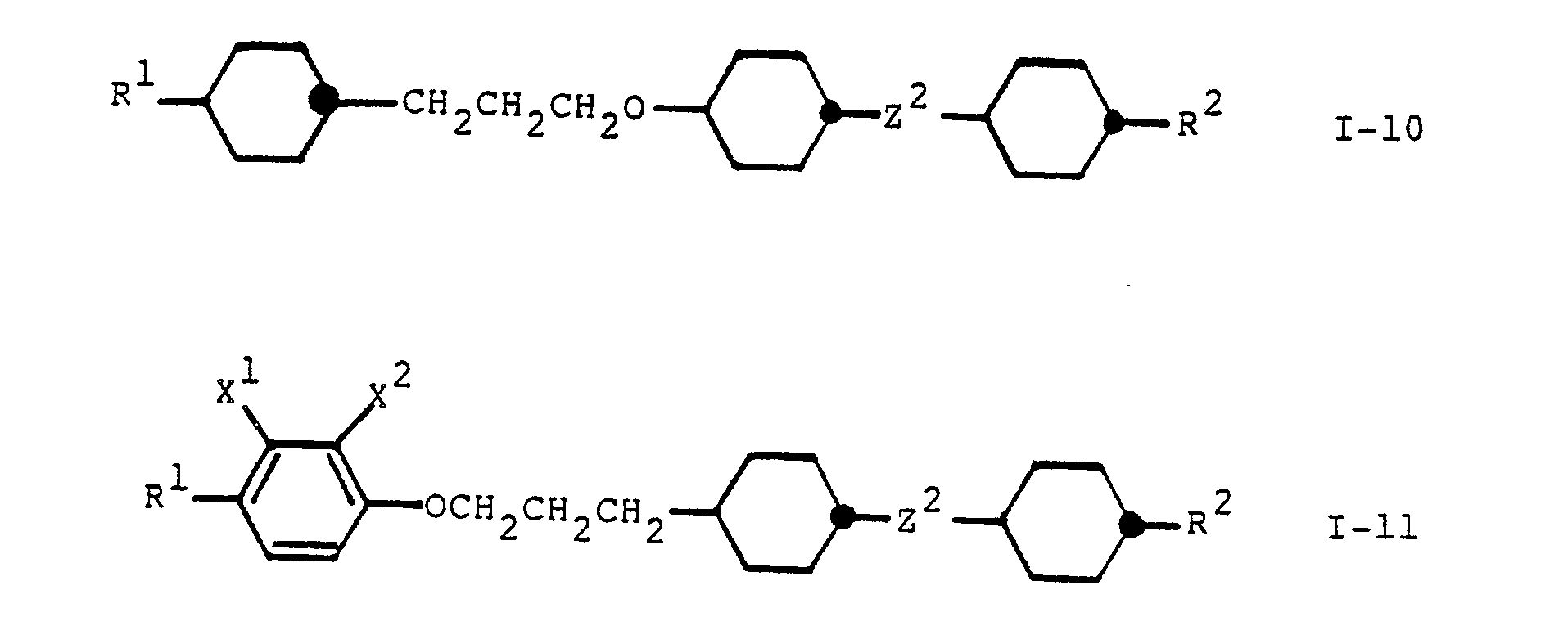
- Die Verbindungen der Formeln I und IA bis IG, worin n für die Zahl 1 steht, sind meist Flüssigkristalle mit relativ hohen Klärpunkten. Diejenigen Verbindungen, worin n für die Zahl 0 steht, eignen sich hingegen vor allem als niederviskose Dotierstoffe, insbesondere wenn R¹ eine Gruppe R³ und R² eine Gruppe R⁴ bedeuten.
- Die Gruppen A¹, A², A³, A⁴ und A⁵ in den obigen Formeln I, IA bis IG und I-1 bis I-11 bedeuten jeweils vorzugsweise 1,4-Phenylen, Fluor-1,4-phenylen, 2,3-Difluor-1,4-phenylen, Chlor-1,4-phenylen, Cyano-1,4-phenylen, 2,3-Dicyano-1,4-phenylen, Methyl-1,4-phenylen, Pyridin-2,5-diyl, Pyazin-2,5-diyl, Pyrimidin-2,5-diyl, trans-1,4-Cyclohexylen, trans-1,3-Dioxan-2,5-diyl, Bicyclo[2,2,2]octan-1,4-diyl, 1,3,4-Thiadiazol-2,5-diyl, Naphthalin-2,6-diyl, Tetralin-2,6-diyl oder Decalin-2,6-diyl, wobei eine gegebenenfalls vorhandene Gruppe A⁴ und/oder A⁵ bevorzugt 1,4-Phenylen oder trans-1,4-Cyclohexylen bedeuet. Besonders bevorzugt sind jeweils diejenigen Verbindungen der obigen Formeln I, IA bis IG und I-1 bis I-11, worin eine der in der Formel vorkommenden Gruppen A (insbesondere A³ oder A⁴) 1,4-Phenylen, Fluor-1,4-phenylen, 2,3-Difluor-1,4-phenylen, Chlor-1,4-phenylen, Cyano-1,4-phenylen, 2,3-Dicyano-1,4-phenylen, Methyl-1,4-phenylen oder trans-1,4-Cylohexylen bedeutet, und/oder eine der in der Formel vorkommenden Gruppen A (insbesondere A² oder A³) 1,4-Phenylen, Pyridin-2,5-diyl, Pyrazin-2,5-diyl, Pyrimidin-2,5-diyl, trans-1,4-Cyclohexylen, trans-1,3-Dioxan-2,5-diyl, Bicyclo[2,2,2]octan-1,4-diyl, 1,3,4-Thiadiazol-2,5-diyl, Naphthalin-2,6-diyl, Tetralin-2,6-diyl oder Decalin-2,6-diyl bedeuten, und weitere in der Formel gegebenenfalls vorkommende Gruppen A (insbesondere auch A⁴ und A⁵) unabhängig voneinander 1,4-Phenylen oder trans-1,4-Cyclohexylen bedeuten.
- In den obigen Formeln I, IA bis IG and I-1 bis I-11 steht vorzugsweise eine der Gruppen Z², Z³ und Z⁴ für eine einfache Kovalenzbindung, -CH₂CH₂-, -CH₂O-, -OCH₂-, -COO-, -OOC-,-CH₂CH₂CH₂O- oder -OCH₂CH₂CH₂- und die beiden anderen der Gruppen Z², Z³ und Z⁴ (bzw. die andere der Gruppen Z³ und Z⁴ in den Formeln I-1, I-2 und I-3 bzw. die andere der Gruppen Z² und Z³ in Formel I-9) stehen vorzugsweise für einfache Kovalenzbindungen.
- X¹, X², X³ und X⁴ in den obigen Formeln IB, ID, IG, I-1, I-4, I-5, I-6 und I-11 bedeuten unabhängig voneinander vorzugsweise Wasserstoff, Methyl, Fluor, Chlor und/oder Cyano, besonders bevorzugt Wasserstoff und/oder Fluor. Vorzugsweise besitzen höchstens einer oder zwei der Substituenten X¹-X⁴ im Molekül eine von Wasserstoff verschiedene Bedeutung und insbesondere können auch alle X¹-X⁴ Wasserstoff bedeuten.
- Besonders bevorzugt Bedeutungen von A³ in Formel I-3 sind 1,4-Phenylen, Fluor-1,4-phenylen, 2,3-Difluor-1,4-phenylen, Pyridin-2,5-diyl, Pyrimidin-2,5-diyl, trans-1,4-Cyclohexylen, trans-1,3-Dioxan-2,5-diyl und Decalin-2,6-diyl.
- In Formel I-5 steht Z² vorzugsweise für eine einfache Kovalenzbindung, -COO- oder -OOC-. Ferner sind im allgemeinen diejenigen Verbindungen der Formel I-5 bevorzugt, worin einer der Substituenten X¹-X⁴ (vorzugsweise X⁴) Wasserstoff, Fluor, Chlor, Brom oder Cyano bedeutet, ein weiterer der Substituenten X¹-X⁴ (vorzugsweise X³) Wasserstoff oder Fluor bedeutet und die beiden andern der Substituenten X¹-X⁴ Wasserstoff bedeuten.
- In den Formeln I-8 und I-9 steht Z² vorzugsweise für eine einfache Kovalenzbindung, -COO- oder -OOC-. Ferner kann A⁵ in Formel I-9 vorzugsweise 1,4-Phenylen, Pyrimidin-2,5-diyl, trans-1,4-Cyclohexylen oder Bicyclo[2.2.2.]octan-1,4-diyl bedeuten.
- In den Formeln I-10 und I-11 steht Z² vorzugsweise für eine einfache Kovalenzbindung oder -CH₂CH₂-. Besonders bevorzugte Bedeutungen von X¹ und X² in Formel I-11 sind Wasserstoff und Fluor.
- In den obigen Formeln I, IA bis IG und I-1 bis I-11 bedeuten vorzugsweise R¹ eine Gruppe R³ und R² eine Gruppe R⁴. Verbindungen, worin R¹ eine Gruppe R³-A⁴-Z³- und/oder R² eine Gruppe R⁴-A⁵-Z⁴- bedeuten, sind jedoch ebenfalls von Interesse, vor allem als Dotierstofe zur Erhöhung der Klärpunkte von Gemischen.
- R³ und R⁴ besitzen vorzugsweise höchstens je etwa 18 Kohlenstoffatome, d.h. R³ und R⁴ in den obigen Formeln bedeuten unabhängig voneinander vorzugsweise eine unsubstituierte oder mit Halogen und/oder Cyano substituierte C₁-C₁₈-Alkyl- oder C₂-C₁₈-Alkenylgruppen, in welcher gegebenenfalls 1 oder 2 nicht benachbarte CH₂-Gruppen durch -O-, -COO- und/oder -OOC- ersetzt sind, oder einer der Reste R³ und R⁴ kann vorzugsweise auch Wasserstoff, Halogen, Cyano oder -NCS bedeuten. Für nematische und cholesterische Anwendungen sind im allgemeinen kurze Reste (z.B. Reste mit höchstens 12, vorzugsweise höchstens 7 Kohlenstoffatomen) bevorzugt und vorzugsweise kann auch einer der Reste Wasserstoff, Halogen, Cyano oder -NCS bedeuten. Für smektische Anwendung (insbesondere getiltete smektische Phasen) sind im allgemeinen diejenigen Verbindungen bevorzugt, worin R³ und R⁴ unabhängig voneinander eine unsubstituierte oder mit Halogen und/oder Cyano substituierte C₁-C₁₈-Alkyl- oder C₂-C₁₈-Alkenylgruppe bedeuten, in welcher gegebenenfalls 1 oder 2 nicht benachbarte CH₂-Gruppen durch -O-, -COO- und/oder -OOC- ersetzt sind, und die Summe der Kohlenstoffatome in R³ und R⁴ zusammen mindestens 10, vorzugsweise mindestens 12 beträgt.
- Besonders bevorzugte Reste R³ sind Alkyl, Alkenyl, Alkoxy, Alkenyloxy, Alkoxycarbonyl, Alkenyloxycarbonyl, Alkanoyloxy und Alkenoyloxy, insbesondee Alkyl, Alkenyl, Alkoxy und Alkenyloxy. Besonders bevorzugte Reste R⁴ sind Alkyl, Alkenyl, Alkoxy, Alkenyloxy, Alkoxycarbonyl, Alkenyloxycarbonyl, Alkanoyloxy und Alkenoyloxy, insbesondere Alkyl, Alkenyl, Alkoxy und Alkenyloxy, sowie Halogen (insbesondere Fluor und Chlor), Cyano und -NCS. Geradkettige Reste R³ bzw. R⁴ sind im allgemeinen bevorzugt. Um beispielsweise chirale Dotierstoffe für cholesterische oder für chiral getiltete smektische Flüssigkristalle zu erhalten, können jedoch auch verzweigt-kettige und/oder mit Halogen und/oder Cyano substituierte Reste verwendet werden. Um bei smektischen Anwendungen eine hohe spontane Polarisation zu erhalten, sollte hierbei das Chiralitätszentrum (d.h. die Kettenverzweigung oder der Halogen- oder Cyanosubstituent) vorzugsweise nahe am Ringsystem, beispielsweise in 1- oder 2-Stellung des Restes R³ bzw. R⁴ sein. Ferner bleibt die Tendenz zur Bildung flüssigkristalliner Phasen grundsätzlich erhalten, wenn eine oder 2 nicht benachbarte CH₂-Gruppen in den Ketten durch -O-, -COO- und/oder -OOC- ersetzt werden.
- Die Mesophasenbereiche, die Schwellenspannung, die Ansprechgeschwindigkeit, die Steilheit der Transmissionskennlinie etc. können ferner variiert werden durch Wahl der Stellung der C-C-Doppelbindung in ungesättigten Resten wie Alkenyl, Alkenyloxy und dergleichen. Der Effekt ist grundsätzlich bekannt z.B. aus Mol. Cryst. Liq. Cryst. 122, 241 (1985), 131, 109 (1985) und 148, 123 (1987). Bevorzugt sind Reste, welche die Doppelbindung in 1-Stellung (insbesondere E-Isomer), in 3-Stellung (insbesondere E-Isomer) oder in 4-Stellung (insbesondere Z-Isomer) der Kette unter Einschluss allfälliger Heteroatome aufweisen, wie 1E-Alkenyl, 3E-Alkenyl, 4Z-Alkenyl, 2E-Alkenyloxy, 3Z-Alkenyloxy und dergleichen. Ferner kann die Doppelbindung vorzugsweise auch in endständiger Position stehen, insbesondere im Falle von Verbindungen für smektische Anwendungen. Beispiele bevorzugter Reste mit endständiger Stellung der Doppelbindung sind 6-Heptenyl, 7-Octenyl, 8-Nonenyl, 9-Decenyl, 10-Undecenyl, 11-Dodecenyl, 5-Hexenyloxy, 6-Heptenyloxy, 7-Octenyloxy, 8-Nonenyloxy, 9-Decenyloxy, 10-Undecenyloxy, 11-Dodecenyloxy und dergleichen.
- Die Herstellung der erfindungsgemässen Verbindungen kann in an sich bekannter Weise aus bekannten oder Analogen bekannter Verbindungen erfolgen. In der Regel erfolgt die Herstellung am einfachsten durch Verätherung der betreffenden Hydroxyverbindung mit dem entsprechenden 3-substituierten 1-Propylhalogenid (vorzugsweise dem 1-Propylbromid). Wenn eine der Gruppen Z², Z³ und Z⁴ -COO- oder -OOC- bedeutet, kann die Herstellung vorzugsweise durch Veresterung der entspechenden Carbonsäure mit der entsprechenden Hydroxyverbindung oder durch Veresterung geeigneter Derivate hiervon erfolgen. Ferner können die Verbindungen, worin einer der Ringe 1,3-Dioxan oder 1,3-Dithian bedeutet, durch Umsetzung des entsprechenden Aldehyds mit dem ensprechenden 2-substituierten 1,3-Propandiol oder 1,3-Propandithiol erhalten werden.
- Die erfindungsgemässen Verbindungen können in Form von Gemischen untereinander und/oder mit andern Flüssigkristallkomponenten verwendet werden. Geeignete Flüssigkristallkomponenten sind dem Fachmann in grosser Zahl bekannt, z.B. aus D. Demus et al., Flüssige Kristalle in Tabellen, VEB Deutscher Verlag für Grundstoffindustrie, Leipzig, Bände I und II, und viele davon sind zudem in Handel erhältlich.
- Die Erfindung betrifft daher ebenfalls ein flüssigkristallines Gemisch mit mindestens 2 Komponenten, welches dadurch gekennzeichnet ist, dass mindestens eine Komponente eine Verbindung der Formel I (insbesondere eine der als bevorzugt genannten Verbindungen) ist.
- Aufgrund der guten Löslichkeit sowie anderseits der grossen Variationsbreite der Eigenschaften und Anwendungsbereiche, kann der Anteil an Verbindungen der Formel I in den erfindungsgemässen Gemischen in einem breiten Bereich variieren und etwa 0,1 bis 100 Gew.% betragen. Beispielsweise kann das Gemisch aus Verbindungen der Formel I bestehen. Anderseits werden z.B. chirale Dotierstoffe oft nur in relativ kleinen Mengen z.B. etwa 0,1 bis 10 Gew.% einsetzt. Im allgemeinen beträgt jedoch der Anteil an Verbindungen der Formel I in den erfindungsgemässen Gemischen etwa 1-60 Gew.%. Bevorzugt ist in der Regel ein Bereich von etwa 5-30 Gew.%.
- Die erfindungsgemässen Gemische für nematische oder cholesterische Anwendungen enthalten neben einer oder mehreren Verbindungen der Formel I vorzugsweise eine oder mehrere Verbindungen aus der Gruppe der Verbindungen der allgemeinen Formeln


- Vorzugsweise besitzen die Reste R⁵ und R⁷-R¹⁷ höchstens je 12 Kohlenstoffatome, insbesondere höchstens je 7 Kohlenstoffatome.
- Die erfindungsgemässen Gemische für smektische Anwendungen (insbesondere für getiltete smektische oder chiral getiltete smektische Phasen) enthalten neben einer oder mehreren Verbindungen der Formel I vorzugsweise eine oder mehrere Verbindungen aus der Gruppe der Verbindungen der allgemeinen Formeln

- Die Herstellung der flüssigkristallinen Gemische und der elektro-optischen Vorrichtungen kann in an sich bekannter Weise erfolgen.
- Die Erfindung wird durch die folgenden Beispiele weiter veranschaulicht. Die optischen Antipoden von chiralen Verbindungen besitzen jeweils die gleichen Phasenumwandlungstemperaturen und absolut gleiche Werte der Verdrillung aber mit entgegengesetzten Vorzeichen. Die zur Charakterisierung der Phasenumwandlungen verwendeten Abkürzungen stehen für folgende Bedeutungen:
C für kristallin
S für smektisch
SA, SB, SC etc. für smektisch A, B, C etc.
S, S für chiral smektische C, F etc.
Ch für cholesterisch
N für nematisch
I für isotrop. - Ein Gemisch von 0,5 g 4-(5-Nonyl-2-pyrimidinyl)phenol, 0,55 g 3-(trans-4-Pentylcyclohexyl)-1-propylbromid, 0.91 g Kaliumcarbonat und 50 ml absolutem Butanon wurde über Nacht unter Rückfluss erhitzt. Anschliessend wurde das abgekühlte Reaktionsgemisch auf Wasser gegossen und dreimal mit je 50 ml Diäthyläther extrahiert. Die vereinigten organischen Phasen wurden mit 500 ml Wasser gewaschen, über Magnesiumsulfat getrocknet, filtriert und eingeengt. Chromatographie des Rückstandes an Keiselgel mit Toluol und Umkristallisation aus Aethanol ergab reines 2-(4-[3-(trans-4-Pentylcyclohexyl)-1-propyloxy]phenyl -5-nonylpyridimin mit Smp. (C-SC) 83°C. Umwandlung SC-N 103°C, Klp. (N-I) 133°C.
- In analoger Weise können folgende Verbindungen hergestellt werden:
2-(4-[3-(trans-4-Methylcyclohexyl)-1-propyloxy]phenyl)-5-propylpyrimidin;
2-(4-[3-(trans-4-Aethylcyclohexyl)-1-propyloxy]phenyl)-5-propylpyrimidin;
2-(4-[3-(trans-4-Porpylcyclohexyl)-1-propyloxy]phenyl)-5-propylpyrimidin;
2-(4-[3-(trans-4-Butylcyclohexyl)-1-propyloxy]phenyl)-5-propylpyrimidin;
2-(4-[3-(trans-4-Pentylcyclohexyl)-1-propyloxy]phenyl)-5-propylpyrimidin;
2-(4-[3-(trans-4-Hexylcyclohexyl)-1-propyloxy]phenyl)-5-propylpyrimidin;
2-(4-[3-(trans-4-Heptylcyclohexyl)-1-propyloxy]phenyl)-5-propylpyrimidin;
2-(4-[3-(trans-4-Octylcyclohexyl)-1-propyloxy]phenyl)-5-propylpyrimidin;
2-(4-[3-(trans-4-Nonylcyclohexyl)-1-propyloxy]phenyl)-5-propylpyrimidin;
2-(4-[3-(trans-4-Decylcyclohexyl)-1-propyloxy]phenyl)- 5-propylpyrimidin;
2-(4-[3-(trans-4-Methylcyclohexyl)-1-propyloxy]phenyl)-5-butylpyrimidin;
2-(4-{3-(trans-4-Aethylcyclohexyl)-1-propyloxy]phenyl)-5-butylpyrimidin;
2-(4-[3-(trans-4-Propylcyclohexyl)-1-propyloxy]phenyl)-5-butylpyrimidin;
2-(4-[3-(trans-4-Butylcyclohexyl)-1-propyloxy]phenyl)-5-butylpyrimidin;
2-(4-[3-(trans-4-Pentylcyclohexyl)-1- propyloxy]phenyl)-5-butylpyrimidin;
2-(4-[3-(trans-4-Hexylcyclohexyl)-1-propyloxy]phenyl)-5-butylpyrimidin;
2-(4-[3-(trans-4-Heptylcyclohexyl)-1-propyloxy]phenyl)-5-butylpyrimidin;
2-(4-[3-(trans-4-Octylcyclohexyl)-1-propyloxy]phenyl)-5-butylpyrimidin;
2-(4-[3-(trans-4-Nonylcyclohexyl)-1-propyloxy]phenyl)-5-butylpyrimidin;
2-(4-[3-(trans-4-Decylcyclohexyl)-1-propyloxy]phenyl)-5-butylpyrimidin;
2-(4-[3-(trans-4-Methylcyclohexyl)-1-propyloxy]phenyl)-5-pentylpyrimidin;
2-(4-[3-(trans-4-Aethylcyclohexyl)-1-propyloxy]phenyl)-5-pentylpyrimidin;
2-(4-[3-(trans-4-Propylcyclohexyl)-1-propyloxy]phenyl)-5-pentylpyrimidin;
2-(4-[3-(trans-4-Butylcyclohexyl)-1-propyloxy]phenyl)-5-pentylpyrimidin;
2-(4-[3-(trans-4-Pentylcyclohexyl)-1-propyloxy]phenyl)-5-pentylpyrimidin, Smp. (C-N) 82°C; Klp. (N-I) 139°C;
2-(4-[3-(trans-4-Hexylcyclohexyl)-1-propyloxy]phenyl)-5-pentylpyrimidin;
2-(4-[3-(trans-4-Heptylcyclohexyl)-1-propyloxy]phenyl)-5-pentylpyrimidin;
2-(4-[3-(trans-4-Octylcyclohexyl)-1-propyloxy]phenyl)-5-pentylpyrimidin;
2-(4-[3-(trans-4-Nonylcyclohexyl)-1-propyloxy]phenyl)-5-pentylpyrimidin;
2-(4-[3-(trans-4-Decylcyclohexyl)-1-propyloxy]phenyl)-5-pentylpyrimidin;
2-(4-[3-(trans-4-Propylcyclohexyl)-1-propyloxy]phenyl)-5-hexylpyrimidin;
2-(4-[3-(trans-4-Butylcyclohexyl)-1-propyloxy]phenyl)-5-hexylpyrimidin;
2-(4-[3-(trans-4-Pentylcyclohexyl)-1-propyloxy]phenyl)-5-hexylpyrimidin, Smp. (C-N) 74°C, Klp. (N-I) 135°C;
2-(4-[3-(trans-4-Hexylcyclohexyl)-1-propyloxy]phenyl)-5-hexylpyrimidin;
2-(4-[3-(trans-4-Heptylcyclohexyl)-1-propyloxy]phenyl)-5-hexylpyrimidin;
2-(4-[3-(trans-4-Octylcyclohexyl)-1-propyloxy]phenyl)-5-hexylpyrimidin;
2-(4-[3-(trans-4-Nonylcyclohexyl)-1-propyloxy]phenyl)-5-hexylpyrimidin;
2-(4-[3-trans-4-Decylcyclohexyl)-1-propyloxy]phenyl)-5-hexylpyrimidin;
2-(4-[3-(trans-4-Methylcyclohexyl)-1-propyloxy]phenyl)-5-heptylpyrimidin;
2-(4-[3-(trans-4-Aethylcyclohexyl)-1-propyloxy]phenyl)-5-heptylpyrimidin;
2-(4-[3-(trans-4-Propylcyclohexyl)-1-propyloxy]phenyl)-5-heptylpyrimidin;
2-(4-[3-(trans-4-Butylcyclohexyl)-1-propyloxy]phenyl)-5-heptylpyrimidin;
2-(4-[3-(trans-4-Pentylcyclohexyl)-1-propyloxy]phenyl)-5-heptylpyrimidin, Smp. (C-N) 84°C, Klp. (N-I) 137°C;
2-(4-[3-(trans-4-Hexylcyclohexyl)-1-propyloxy]phenyl)-5-heptylpyrimidin;
2-(4-[3-(trans-4-Heptylcyclohexyl)-1-propyloxy]phenyl)-5-heptylpyrimidin;
2-(4-[3-(trans-4-Octylcyclohexyl)-1-propyloxy]phenyl)-5-heptylpyrimidin;
2-(4-[3-(trans-4-Nonylcyclohexyl)-1-propyloxy]phenyl)- 5-heptylpyrimidin;
2-(4-[3-(trans-4-Decylcyclohexyl)-1-propyloxy]phenyl)-5-heptylpyrimidin;
2-(4-[3-(trans-4-Methylcyclohexyl)-1-propyloxy]phenyl)-5-octylpyrimidin;
2-(4-[3-(trans-4-Aethylcyclohexyl)-1-propyloxy]phenyl)-5-octylpyrimidin;
2-(4-[3-(trans-4-Porpylcyclohexyl)-1-propyloxy]phenyl)-5-octylpyrimidin;
2-(4-[3-(trans-4-Butylcyclohexyl)-1-propyloxy]phenyl)-5-octylpyrimidin;
2-(4-[3-(trans-4-Pentylcyclohexyl)-1-propyloxy]phenyl)-5-octylpyrimidin, Smp. (C-SC) 79°C. Umwandlung SC-N 88°C,
Klp. (N-I) 133°C;
2-(4-[3-(trans-4-Hexylcyclohexyl)-1-propyloxy]phenyl)-5-octylpyrimidin;
2-(4-[3-(trans-4-Heptylcyclohexyl)-1-propyloxy]phenyl)-5-octylpyrimidin;
2-(4-[3-(trans-4-Octylcyclohexyl)-1-propyloxy]phenyl)-5-octylpyrimidin;
2-(4-[3-(trans-4-Nonylcyclohexyl)-1-propyloxy]phenyl)-5-octylpyrimidin;
2-(4-[3-(trans-4-Decylocyclohexyl)-1-propyloxy]phenyl)-5-octylpyrimidin;
2-(4-[3-(trans-4-Methylcyclohexyl)-1-propyloxy]phenyl)-5-nonylpyrimidin;
2-(4-[3-(trans-4-Aethylcyclohexyl)-1-propyloxy]phenyl)-5-nonylpyrimidin;
2-(4-[3-(trans-4-Propylcyclohexyl)-1-propyloxy]phenyl)-5-nonylpyrimidin;
2-(4-[3-(trans-4-Butylcyclohexyl)-1-propyloxy]phenyl)-5-nonylpyrimidin;
2-(4-[3-(trans-4-Hexylcyclohexyl)-1-propyloxy]phenyl)-5-nonylpyrimidin;
2-(4-[3-(trans-4-Heptylcyclohexyl)-1-propyloxy]phenyl)-5-nonylpyrimidin;
2-(4-[3-(trans-4-Octylcyclohexyl)-1-propyloxy]phenyl)- 5-nonylpyrimidin;
2-(4-[3-(trans-4-Nonylcyclohexyl)-1-propyloxy]phenyl)-5-nonylpyrimidin;
2-(4-[3-(trans-4-Decylcyclohexyl)-1-propyloxy]phenyl)-5-nonylpyrimidin;
2-(4-[3-(trans-4-Methylcyclohexyl)-1-propyloxy]phenyl)-5-decylpyrimidin;
2-(4-[3-(trans-4-Aethylcyclohexyl)-1-propyloxy]phenyl)-5-decylpyrimidin;
2-(4-[3-(trans-4-Propylcyclohexyl)-1-propyloxy]phenyl)-5-decylpyrimidin;
2-(4-[3-(trans-4-Butylcyclohexyl)-1-propyloxy]phenyl)-5-decylpyrimidin;
2-(4-[3-(trans-4-Pentylcyclohexyl)-1-propyloxy]phenyl)-5-decylpyrimidin, Smp. (C-SC) 69°C, Umwandlung SC-N 110°C, Klp. (N-I) 130°C;
2-(4-[3-(trans-4-Hexylcyclohexyl)-1-propyloxy])phenyl)-5-decylpyrimidin;
2-(4-[3-(trans-4-Heptylcyclohexyl)-1-propyloxy])phenyl)-5-decylpyrimidin;
2-(4-[3-(trans-4-Octylcyclohexyl)-1-propyloxy])phenyl)-5-decylpyrimidin;
2-(4-[3-(trans-4-Nonylcyclohexyl)-1-propyloxy])phenyl)-5-decylpyrimidin;
2-(4-[3-(trans-4-Decylcyclohexyl)-1-propyloxy])phenyl)-5-decylpyrimidin;
2-(4-[3-(trans-4-Pentylcyclohexyl)-1-propyloxy]phenyl)-5-[(S)-2-methylbutyl]pyrimidin;
2-(4-[3-(trans-4-Pentylcyclohexyl)-1-propyloxy]phenyl)-5-[(S)-3-methylpentyl]pyrimidin;
2-(4-[3-(trans-4-Pentylcyclohexyl)-1-propyloxy]phenyl)-5-[(S)-4-methylhexyl]pyrimidin;
2-(4-[3-(trans-4-Pentylcyclohexyl)-1-propyloxy]phenyl)-5-[(S)-5-methylheptyl]pyrimidin;
2-(4-[3-(trans-4-Propylcyclohexyl)-1-propyloxy]phenyl)-5-methylpyridin;
2-(4-[3-(trans-4-Propylcyclohexyl)-1-propyloxy]phenyl)- 5-äthylpyridin;
2-(4-[3-(trans-4-Propylcyclohexyl)-1-propyloxy]phenyl)-5-propylpyridin;
2-(4-[3-(trans-4-Propylcyclohexyl)-1-propyloxy]phenyl)-5-butylpyridin;
2-(4-[3-(trans-4-Propylcyclohexyl)-1-propyloxy]phenyl)-5-pentylpyridin;
2-(4-[3-(trans-4-Propylcyclohexyl)-1-propyloxy]phenyl)-5-hexylpyridin;
2-(4-[3-(trans-4-Propylcyclohexyl)-1-propyloxy]phenyl)-5-heptylpyridin;
2-(4-[3-(trans-4-Propylcyclohexyl)-1-propyloxy]phenyl)-5-octylpyridin;
2-(4-[3-(trans-4-Propylcyclohexyl)-1-propyloxy]phenyl)-5-nonylpyridin;
2-(4-[3-(trans-4-Propylcyclohexyl)-1-propyloxy]phenyl)-5-decylpyridin;
2-(4-[3-(trans-4-Pentylcyclohexyl)-1-propyloxy]phenyl)-5-methylpyridin;
2-(4-[3-(trans-4-Pentylcyclohexyl)-1-propyloxy]phenyl)-5-äthylpyridin;
2-(4-[3-(trans-4-Pentylcyclohexyl)-1-propyloxy]phenyl)-5-propylpyridin;
2-(4-[3-(trans-4-Pentylcyclohexyl)-1-propyloxy]phenyl)-5-butylpyridin;
2-(4-[3-(trans-4-Pentylcyclohexyl)-1-propyloxy]phenyl)-5-pentylpyridin;
2-(4-[3-(trans-4-Pentylcyclohexyl)-1-propyloxy]phenyl)-5-hexylpyridin;
2-(4-[3-(trans-4-Pentylcyclohexyl)-1-propyloxy]phenyl)-5-heptylpyridin;
2-(4-[3-(trans-4-Pentylcyclohexyl)-1-propyloxy]phenyl)-5-octylpyridin;
2-(4-[3-(trans-4-Pentylcyclohexyl)-1-propyloxy]phenyl)-5-nonylpyridin;
2-(4-[3-(trans-4-Pentylcyclohexyl)-1-propyloxy]phenyl)-5-decylpyridin, Smp. (C-S) 57°C, Umwandlung S-S 71°C, Umwand lung S-SC 122°C, Umwandlung SC-SA 136°C, Klp. (SA-I) 139°C;
2-(4-[3-(trans-4-Heptylcyclohexyl)-1-propyloxy]phenyl)-5-methylpyridin;
2-(4-[3-(trans-4-Heptylcyclohexyl)-1-propyloxy]phenyl)-5-äthylpyridin;
2-(4-[3-(trans-4-Heptylcyclohexyl)-1-propyloxy]phenyl)-5-propylpyridin;
2-(4-[3-(trans-4-Heptylcyclohexyl)-1-propyloxy]phenyl)-5-butylpyridin;
2-(4-[3-(trans-4-Heptylcyclohexyl)-1-propyloxy]phenyl)-5-pentylpyridin;
2-(4-[3-(trans-4-Heptylcyclohexyl)-1-propyloxy]phenyl)-5-hexylpyridin;
2-(4-[3-(trans-4-Heptylcyclohexyl)-1-propyloxy]phenyl)-5-heptylpyridin;
2-(4-[3-(trans-4-Heptylcyclohexyl)-1-propyloxy]phenyl)-5-octylpyridin;
2-(4-[3-(trans-4-Heptylcyclohexyl)-1-propyloxy]phenyl)-5-nonylpyridin;
2-(4-[3-(trans-4-Heptylcyclohexyl)-1-propyloxy]phenyl)-5-decylpyridin;
2-(4-[3-(trans-4-Pentylcyclohexyl)-1-propyloxy]phenyl)-5-[(S)-2-methylbutyl]pyridin;
2-(4-[3-(trans-4-Pentylcyclohexyl)-1-propyloxy]phenyl)-5-[(S)-3-methylpentyl]pyridin;
2-(4-[3-(trans-4-Pentylcyclohexyl)-1-propyloxy]phenyl)-5-[(S)-4-methylhexyl]pyridin;
2-(4-[3-(trans-4-Pentylcyclohexyl)-1-propyloxy]phenyl)5-[(S)-5-methylheptyl]pyridin;
2-(4-[3-(trans-4-Pentylcyclohexyl)-1-propyloxy]phenyl)-5-[(S)-6-methyloctyl]pyridin;
2-(4-[3-(trans-4-Pentylcyclohexyl)-1-propyloxy]phenyl)-5-[(S)-1-methylheptyloxy]pyridin;
2-(4-[3-(trans-4-Propylcyclohexyl)-1-propyloxy]phenyl)-5-methylpyrazin;
2-(4-[3-(trans-4-Propylcyclohexyl)-1-propyloxy]phenyl)- 5-äthylpyrazin;
2-(4-[3-(trans-4-Propylcyclohexyl)-1-propyloxy]phenyl)-5-propylpyrazin;
2-(4-[3-(trans-4-Propylcyclohexyl)-1-propyloxy]phenyl)-5-butylpyrazin;
2-(4-[3-(trans-4-Propylcyclohexyl)-1-propyloxy]phenyl)-5-pentylpyrazin;
2-(4-[3-(trans-4-Propylcyclohexyl)-1-propyloxy]phenyl)-5-hexylpyrazin;
2-(4-[3-(trans-4-Propylcyclohexyl)-1-propyloxy]phenyl)-5-heptylpyrazin;
2-(4-[3-(trans-4-Pentylcyclohexyl)-1-propyloxy]phenyl)-5-methylpyrazin;
2-(4-[3-(trans-4-Pentylcyclohexyl)-1-propyloxy]phenyl)-5-äthylpyrazin;
2-(4-[3-(trans-4-Pentylcyclohexyl)-1-propyloxy]phenyl)-5-propylpyrazin;
2-(4-[3-(trans-4-Pentylcyclohexyl)-1-propyloxy]phenyl)-5-butylpyrazin;
2-(4-[3-(trans-4-Pentylcyclohexyl)-1-propyloxy]phenyl)-5-pentylpyrazin;
2-(4-[3-(trans-4-Pentylcyclohexyl)-1-propyloxy]phenyl)-5-hexylpyrazin;
2-(4-[3-(trans-4-Pentylcyclohexyl)-1-propyloxy]phenyl)-5-heptylpyrazin;
2-(4-[3-(trans-4-Heptylcyclohexyl)-1-propyloxy]phenyl)-5-methylpyrazin;
2-(4-[3-(trans-4-Hetpylcyclohexyl)-1-propyloxy]phenyl)-5-äthylpyrazin;
2-(4-[3-(trans-4-Heptylcyclohexyl)-1-propyloxy]phenyl)-5-propylpyrazin;
2-(4-[3-(trans-4-Heptylcyclohexyl)-1-propyloxy]phenyl)-5-butylpyrazin;
2-(4-[3-(trans-4-Heptylcyclohexyl)-1-propyloxy]phenyl)-5-pentylpyrazin;
2-(4-[3-(trans-4-Heptylcyclohexyl)-1-propyloxy]phenyl)-5-hexylpyrazin;
2-(4-[3-(trans-4-Heptylcyclohexyl)-1-propyloxy]phenyl)-5-heptylpyrazin;
2-Methyl-5-(4-[3-(trans-4-Pentylcyclohexyl)-1-propyloxy]-phenyl)-1,3,4-thiadiazol;
2-Aethyl-5-(4-[3-(trans-4-Pentylcyclohexyl)-1-propyloxy]-phenyl)-1,3,4-thiadiazol;
2-Propyl-5-(4-[3-(trans-4-Pentylcyclohexyl)-1-propyloxy]-phenyl)-1,3,4-thiadiazol;
2-Butyl-5-(4-[3-(trans-4-Pentylcyclohexyl)-1-propyloxy]-phenyl)-1,3,4-thiadiazol;
2-Pentyl-5-(4-[3-(trans-4-Pentylcyclohexyl)-1-propyloxy]-phenyl)-1,3,4-thiadiazol;
2-Hexyl-5-(4-[3-(trans-4-Pentylcyclohexyl)-1-propyloxy]-phenyl)-1,3,4-thiadiazol;
2-Heptyl-5-(4-[3-(trans-4-Pentylcyclohexyl)-1-propyloxy]-phenyl)-1,3,4-thiadiazol;
2-Octyl-5-(4-[3-(trans-4-Pentylcyclohexyl)-1-propyloxy]-phenyl)-1,3,4-thiadiazol;
2-Nonyl-5-(4-[3-(trans-4-Pentylcyclohexyl)-1-propyloxy]-phenyl)-1,3,4-thiadiazol;
2-Decyl-5-(4-[3-(trans-4-Pentylcyclohexyl)-1-propyloxy]-phenyl)-1,3,4-thiadiazol;
2-(4-Methoxyphenyl)-5-[3-(trans-4-pentylcyclohexyl)-1-propyloxy]-1,3,4-thiadiazol;
2-(4-Aethoxyphenyl)-5-[3-(trans-4-pentylcyclohexyl)-1-propyloxy]-1,3,4-thiadiazol;
2-(4-Propyloxyphenyl)-5-[3-(trans-4-pentylcyclohexyl)-1-propyloxy]-1,3,4-thiadiazol;
2-(4-Butoxyphenyl)-5-[3-(trans-4-pentylcyclohexyl)-1-propyloxy]-1,3,4-thiadiazol;
2-(4-Pentyloxyphenyl)-5-[3-(trans-4-pentylcyclohexyl)-1-propyloxy]-1,3,4-thiadiazol;
2-(4-Hexyloxyphenyl)-5-[3-(trans-4-pentylcyclohexyl)-1-propyloxy]1,3,4-thiadiazol;
2-(4-Heptyloxyphenyl)-5-[3-(trans-4-pentylcyclohexyl)-1-propyloxy]-1,3,4-thiadiazol;
2-(4-Octyloxyphenyl)-5-[3-(trans-4-pentylcyclohexyl)-1- propyloxy]-1,3,4-thiadiazol;
2-(4-Nonyloxyphenyl)-5-[3-(trans-4-pentylcyclohexyl)-1-propyloxy]-1,3,4-thiadiazol;
2-(4-Decyloxyphenyl)-5-[3-(trans-4-pentylcyclohexyl)-1-propyloxy]-1,3,4-thiadiazol;
1-Methoxy-4-[3-(trans-4-propylcyclohexyl)-1-propyloxy]-benzol;
1-Aethoxy-4-[3-(trans-4-propylcyclohexyl)-1-propyloxy]-benzol;
1-Propyloxy-4-[3-(trans-4-propylcyclohexyl)-1-propyloxy]-benzol;
1-Butyloxy-4-[3-(trans-4-propylcyclohexyl)-1-propyloxy]-benzol;
1-Pentyloxy-4-[3-(trans-4-propylcyclohexyl)-1-propyloxy]-benzol;
1-Hexyloxy-4-[3-(trans-4-propylcyclohexyl)-1-propyloxy]-benzol;
1-Heptyloxy-4-[3-(trans-4-propylcyclohexyl)-1-propyloxy]-benzol;
1-Octyloxy-4-[3-(trans-4-propylcyclohexyl)-1-propyloxy]-benzol;
1-Nonyloxy-4-[3-(trans-4-propylcyclohexyl)-1-propyloxy]-benzol;
1-Decyloxy-4-[3-(trans-4-propylcyclohexyl)-1-propyloxy]-benzol;
1-Methoxy-4-[3-(trans-4-pentylcyclohexyl)-1-propyloxy]-benzol, Smp. (C-I) 47°C, Klp. (N-I) 46°C;
1-Aethoxy-4-[3-(trans-4-pentylcyclohexyl-1-propyloxy]-benzol, Smp. (C-N) 50°C, Klp. (N-I) 57°C;
1-Propyloxy-4-[3-(trans-4-pentylcyclohexyl)-1-propyloxy]-benzol, Smp. (C-I) 51°C, Klp. (N-I) 48°C;
1-Butyloxy-4-[3-(trans-4-pentylcyclohexyl)-1-propyloxy]-benzol, Smp. (C-I) 59°C, Umwandlung SA-N 45°C, Klp. (N-I) 55°C;
1-Pentyloxy-4-[3-(trans-4-pentylcyclohexyl)-1-propyloxy]-benzol, Smp. (C-SA) 42°C, Umwandlung SA-N 48°C, Klp. (N-I) 53°C;
1-Hexyloxy-4-[3-(trans-4-pentylcyclohexyl)-1-propyloxy]-benzol, Smp. (C-SA) 44°C, Umwandlung SA-N 54°C, Klp. (N-I) 57°C;
1-Heptyloxy-4-[3-(trans-4-pentylcyclohexyl)-1-propyloxy]-benzol, Smp. (C-SA) 51°C, Klp. (SA-I) 57°C;
1-Octyloxy-4-[3-(trans-4-pentylcyclohexyl)-1-propyloxy]-benzol;
1-Nonyloxy-4-[3-(trans-4-pentylcyclohexyl)-1-propyloxy]-benzol;
1-Decyloxy-4-[3-(trans-4-pentylcyclohexyl)-1-propyloxy]-benzol;
1-Methoxy-4-[3-(trans-4-heptylcyclohexyl-1-propyloxy]-benzol;
1-Aethoxy-4-[3-(trans-4-heptylcyclohexyl)-1-propyloxy]-benzol;
1-Propyloxy-4-[3-(trans-4-heptylcyclohexyl-1-propyloxy]-benzol;
1-Butyloxy-4-[3-(trans-4-heptylcyclohexyl)-1-propyloxy]-benzol;
1-Pentyloxy-4-[3-(trans-4-heptylcyclohexyl)-1-propyloxy]-benzol;
1-Hexyloxy-4-[3-(trans-4-heptylcyclohexyl)-1-propyloxy]-benzol;
1-Heptyloxy-4-[3-(trans-4-heptylcyclohexyl)-1-propyloxy]-benzol;
1-Octyloxy-4-[3-(trans-4-heptylcyclohexyl)-1-propyloxy]-benzol;
1-Nonyloxy-4-[3-(trans-4-heptylcyclohexyl)-1-propyloxy]-benzol;
1-Decyloxy-4-[3-(trans-4-heptylcyclohexyl)-1-propyloxy]-benzol;
1-[(R)-1-Methylheptyloxy]-4-[3-(trans-4-[(S)-3-methylpentyl]cyclohexyl)-1-propyloxy]benzol;
1-Methyl-4-[3-(trans-4-pentylcyclohexyl)-1-propyloxy]-benzol;
1-Aethyl-4-[3-(trans-4-pentylcyclohexyl)-1-propyloxy]-benzol;
1-Propyl-4-[3-(trans-4-pentylcyclohexyl)-1-propyloxy]-benzol;
1-Butyl-4-[3-(trans-4-pentylcyclohexyl)-1-propyloxy]-benzol;
1-Pentyl-4-[3-(trans-4-pentylcyclohexyl)-1-propyloxy]-benzol;
1-Hexyl-4-[3-(trans-4-pentylcyclohexyl)-1-propyloxy]-benzol;
1-Heptyl-4-[3-(trans-4-pentylcyclohexyl)-1-propyloxy]-benzol;
1-Octyl-4-[3-trans-4-pentylcyclohexyl)-1-propyloxy]-benzol;
1-Nonyl-4-[3-(trans-4-pentylcyclohexyl)-1-propyloxy]-benzol;
1-Decyl-4-[3-(trans-4-pentylcyclohexyl)-1-propyloxy]-benzol;
4-[3-(trans-4-Methylcyclohexyl)-1-propyloxy]benzonitril;
4-[3-(trans-4-Aethylcyclohexyl)-1-propyloxy]benzonitril;
4-[3-(trans-4-Propylcyclohexyl)-1-propyloxy]benzonitril;
4-[3-(trans-4-Butylcyclohexyl)-1-propyloxy]benzonitril;
4-[3-(trans-4-Pentylcyclohexyl)-1-propyloxy]benzonitril, Smp. (C-I) 62°C, Klp. (N-I) 54°C;
4-[3-(trans-4-Hexylcyclohexyl)-propyloxy]benzonitril;
4-[3-(trans-4-Heptylcyclohexyl)-1-propyloxy]benzonitril;
4-[3-(trans-4-Octylcyclohexyl)-1-propyloxy]benzonitril;
4-[3-(trans-4-Nonylcyclohexyl)-1-propyloxy]benzonitril;
4-[3-(trans-4-Decylcyclohexyl)-1-propyloxy]benzonitril;
4-[3-(trans-4-Methylcyclohexyl)-1-propyloxy]-2-fluorbenzonitril;
4-[3-(trans-4-Aethylcyclohexyl)-1-propyloxy]-2-fluorbenzonitril;
4-[3-(trans-4-Propylcyclohexyl)-1-propyloxy]-2-fluorbenzonitril;
4-[3-(trans-4-Butylcyclohexyl)-1-propyloxy]-2-fluorbenzonitril;
4-[3-(trans-4-Pentylcyclohexyl)-1-propyloxy]-2-fluorbenzonitril, Smp. (C-I) 59°C, Klp. (N-I) 29°C;
4-[3-(trans-4-Hexylcyclohexyl)-1-propyloxy]-2-fluorbenzonitril;
4-[3-(trans-4-Heptylcyclohexyl)-1-propyloxy]-2-fluorbenzonitril;
4-[3-(trans-4-Octylcyclohexyl)-1-propyloxy]-2-fluorbenzonitril;
4-[3-(trans-4-Nonylcyclohexyl)-1-propyloxy]-2-fluorbenzonitril;
4-[3-(trans-4-Decylcyclohexyl)-1-propyloxy]-2-fluorbenzonitril;
4-[3-(trans-4-Methylcyclohexyl)-1-propyloxy]-3-fluorbenzonitril;
4-[3-(trans-4-Aethylcyclohexyl)-1-propyloxy]-3-fluorbenzonitril;
4-[3-(trans-4-Propylcyclohexyl)-1-propyloxy]-3-fluorbenzonitril;
4-[3-(trans-4-Butylcyclohexyl)-1-propyloxy]-3-fluorbenzonitril;
4-[3-(trans-4-Pentylcyclohexyl)-1-propyloxy]-3-fluorbenzonitril, Smp. (C-N) 45°C, Klp. (N-I) 46°C;
4-[3-(trans-4-Hexylcyclohexyl)-1-propyloxy]-3-fluorbenzonitril;
4-[3-(trans-4-Heptylcyclohexyl)-1-propyloxy]-3-fluorbenzonitril;
4-[3-(trans-4-Octylcyclohexyl)-1-propyloxy]-3-fluorbenzonitril;
4-[3-(trans-4-Nonylcyclohexyl)-1-propyloxy]-3-fluorbenzonitril;
4-[3-(trans-4-Decylcyclohexyl)-1-propyloxy]-3-fluorbenzonitril;
1-[3-(trans-4-Methylcyclohexyl)-1-propyloxy]-4-fluorbenzol;
1-[3-(trans-4-Aethylcyclohexyl)-1-propyloxy]-4-fluorbenzol;
1-[3-(trans-4-Propylcyclohexyl)-1-propyloxy]-4-fluorbenzol;
1-[3-(trans-4-Butylcyclohexyl)-1-propyloxy]-4-fluor benzol;
1-[3-(trans-4-Pentylcyclohexyl)-1-propyloxy]-4-fluorbenzol; Smp. (C-I) 17°C, Klp. (N-I) 11°C;
1-[3-(trans-4-Hexylcyclohexyl)-1-propyloxy]-4-fluorbenzol;
1-[3-(trans-4-Heptylcyclohexyl)-1-propyloxy]-4-fluorbenzol;
1-[3-(trans-4-Pentylcyclohexyl)-1-propyloxy]-4-chlorbenzol, Smp. (C-I) 37°C, Klp. (N-I) 33°C;
1-[3-(trans-4-Pentylcyclohexyl)-1-propyloxy]-4-brombenzol, Smp. (C-I) 48°C, Klp. (N-I) 37°C;
1-[3-(trans-4-Pentylcyclohexyl)-1-propyloxy]-4-jodbenzol, Smp. (C-I) 54°C, Klp. (N-I) 34°C;
1-[3-(trans-4-Methylcyclohexyl)-1-propyloxy]-3,4-difluorbenzol;
1-[3-(trans-4-Aethylcyclohexyl)-1-propyloxy]-3,4-difluorbenzol;
1-[3-(trans-4-Propylcyclohexyl)-1-propyloxy]-3,4-difluorbenzol;
1-[3-(trans-4-Butylcyclohexyl)-1-propyloxy]-3,4-difluorbenzol;
1-[3-(trans-4-Pentylcyclohexyl)-1-propyloxy]-3,4-dilfuorbenzol, Smp. (C-I) 4°C;
1-[3-(trans-4-Hexylcylohexyl)-1-propyloxy]-3,4-difluorbenzol;
1-[3-(trans-4-Heptylcyclohexyl)-1-propyloxy]-3,4-difluorbenzol;
1-[3-(trans-4-Octylcyclohexyl)-1-propyloxy]-3,4-difluorbenzol;
1-[3-(trans-4-[trans-4-Propylcyclohexyl]cyclohexyl)-1-propyloxy]-4-fluorbenzol;
1-[3-(trans-4-[trans-4-Pentylcyclohexyl]cyclohexyl)-1-propyloxy]-4-fluorbenzol, Smp. (C-SB) 69°C, Umwandlung SB-N 95°C, Klp. (N-I) 127°C;
1-[3-(trans-4-[trans-4-Propylcyclohexyl]cyclohexyl)-1-propyloxy]-3,4-difluorbenzol; Smp. (C-N) 79°C, Klp. (N-I) 107°C;
1-[3-(trans-4-[trans-4-Pentylcyclohexyl]cyclohexyl)-1-propyloxy]-3,4-difluorbenzol, Smp. (C-SB) 57°C. Umwandlung SB-N 81°C, Klp. (N-I) 112°C;
4-[3-(trans-4-[trans-4-Propylcyclohexyl]cyclohexyl)-1-propyloxy]-3-fluorbenzonitril;
4-[3-(trans-4-trans-4-Pentylcyclohexyl]cyclohexyl)-1-propyloxy]-3-fluorbenzonitril, Smp. (C-N) 98°C, Klp. (N-I) 143°C;
4-[3-(trans-4-[trans-4-Propylcyclohexyl]cyclohexyl)-1-propyloxy]benzonitril;
4-[3-(trans-4-[trans-4-Pentylcyclohexyl]cyclohexyl)-1-propyloxy]benzonitril, Smp. (C-N) 93°C, Klp. (N-I) 159°C;
1-[3-(trans-4-[trans-4-Propylcyclohexyl]cyclohexyl)-1-propyloxy]-4-äthoxy-2,3-difluorbenzol, Smp. (C-N) 59°C, Klp. (N-I) 136°C;
1-[3-(trans-4-[trans-4-Pentylcyclohexyl]cyclohexyl)-1-propyloxy]-4-äthoxy-2,3-difluorbenzol, Smp. (C-SA) 49°C, Umwandlung SA-N 100°C, Klp. (N-I) 137°C;
4-[3-(trans-4-Methylcyclohexyl)-1-propyloxy]-phenylisothiocyanat;
4-[3-(trans-4-Aethylcyclohexyl)-1-propyloxy]-phenylisothiocyanat;
4-[3-(trans-4-Propylcyclohexyl)-1-propyloxy]-phenylisothiocyanat;
4-[3-(trans-4-Butylcyclohexyl)-1-propyloxy]-phenylisothiocyanat;
4-[3-(trans-4-Pentylcyclohexyl)-1-propyloxy]-phenylisothiocyanat;
4-[3-(trans-4-Hexylcyclohexyl)-1-propyloxy]-phenylisothiocyanat;
4-[3-(trans-4-Heptylcyclohexyl)-1-propyloxy]-phenylisothiocyanat;
4-[3-(trans-4-Octylcyclohexyl)-1-propyloxy]-phenylisothiocyanat;
2,3-Dicyano-1-propyl-4-[3-(trans-4-propylcyclohexyl)-1-propyloxy]benzol;
2,3-Dicyano-1-pentyl-4-[3-(trans-4-propylcyclohexyl)-1- propyloxy]benzol;
2,3-Dicyano-1-heptyl-4-[3-(trans-4-propylcyclohexyl)-1-propyloxy]benzol;
2,3-Dicyano-1-propyl-4-[3-(trans-4-pentylcyclohexyl)-1-propyloxy]benzol;
2,3-Dicyano-1-pentyl-4-[3-(trans-4-pentylcyclohexyl)-1-propyloxy]benzol, Smp. (C-I) 123°C;
2,3-Dicyano-1-heptyl-4-[3-(trans-4-pentylcyclohexyl)-1-propyloxy]benzol;
2,3-Dicyano-1-propyl-4-[3-(trans-4-heptylcyclohexyl)-1-propyloxy]benzol;
2,3-Dicyano-1-pentyl-4-[3-(trans-4-heptylcyclohexyl)-1-propyloxy]benzol;
2,3-Dicyano-1-heptyl-4-[3-(trans-4-heptylcyclohexyl)-1-propyloxy]benzol;
2,3-Difluor-1-äthoxy-4-[3-(trans-4-propylcyclohexyl)-1-propyloxy]benzol;
2,3-Difluor-1-äthoxy-4-[3-(trans-4-pentylcyclohexyl)-1-propyloxy]benzol;
2,3-Dicyano-1-[3-(trans-4-propylcyclohexyl)-1-propyloxy]-4-[2-(trans-4-pentylcyclohexyl)äthyl]benzol;
2,3-Dicyano-1-[3-(trans-4-pentylcyclohexyl)-1-propyloxy]-4-[2-(trans-4-pentylcyclohexyl)äthyl]benzol, Smp. (C-I) 198°C;
2,3-Dicyano-1-[3-(trans-4-heptylcyclohexyl)-1-propyloxy]-4-[2-(trans-4-pentylcyclohexyl)äthyl]benzol;
4-[3-(trans-4-Methylcyclohexyl)-1-propyloxy]-4′-cyanobiphenyl;
4-[3-(trans-4-Aethylcyclohexyl)-1-propyloxy]-4′-cyanobiphenyl;
4-[3-(trans-4-Propylcyclohexyl)-1-propyloxy]-4′-cyanobiphenyl;
4-[3-(trans-4-Butylcyclohexyl)-1-propyloxy]-4′-cyanobiphenyl;
4-[3-(trans-4-Pentylcyclohexyl)-1-propyloxy]-4′-cyanobiphenyl, Smp. (C-SA) 83°C, Umwandlung SA-N 149°C, Klp. (N-I) 167°C;
4-[3-(trans-4-Hexylcyclohexyl)-1-propyloxy]-4′-cyano biphenyl;
4-[3-(trans-4-Heptylcyclohexyl)-1-propyloxy]-4′-cyanobiphenyl;
4-[3-(trans-4-Octylcyclohexyl)-1-propyloxy]-4′-cyanobiphenyl;
4-[3-(trans-4-Methylcyclohexyl)-1-propyloxy]-4′-fluorbiphenyl;
4-[3-(trans-4-Aethylcyclohexyl)-1-propyloxy]-4′-fluorbiphenyl;
4-[3-(trans-4-Propylcyclohexyl)-1-propyloxy]-4′-fluorbiphenyl;
4-[3-(trans-4-Butylcyclohexyl)-1-propyloxy]-4′-fluorbiphenyl;
4-[3-(trans-4-Pentylcyclohexyl)-1-propyloxy]-4′-fluorbiphenyl;
4-[3-(trans-4-Hexylcyclohexyl)-1-propyloxy-4′-fluorbiphenyl;
4-[3-(trans-4-Heptylcyclohexyl)-1-propyloxy-4′-fluorbiphenyl;
4-[3-(trans-4-Octylcyclohexyl)-1-propyloxy]-4′-fluorbiphenyl;
(R)-α-[(4′-[3-(trans-4-Pentylcyclohexyl)-1-propyloxy]-4-biphenylyl)oxy]propionsäure-äthylester; Smp. (C-SA) 79°C, Umwandlung SA-Ch 80°C, Klp. (Ch-I) 81°C;
1,4-Di-[3-(trans-4-methylcyclohexyl)-1-propyloxy]benzol;
1,4-Di-[3-(trans-4-äthylcylohexyl)-1-propyloxy]benzol;
1,4-Di-[3-(trans-4-propylcyclohexyl)-1-propyloxy]benzol;
1,4-Di-[3-(trans-4-butylcyclohexyl)-1-propyloxy]benzol;
1,4-Di-[3-(trans-4-pentylcyclohexyl)-1-propyloxy]benzol, Smp. (C-SA) 108°C, Umwandlung SA-N 112°C, N-I 115°C;
1,4-Di-[3-(trans-4-hexylcyclohexyl)-1-propyloxy]benzol;
1,4-Di-[3-(trans-4-heptylcyclohexyl)-1-propyloxy]benzol;
1,4-Di-[3-(trans-4-octylcyclohexyl)-1-propyloxy]benzol;
1,4-Di-[3-(trans-4-nonylcyclohexyl)-1-propyloxy]benzol;
1,4-Di-[3-(trans-4-decylcyclohexyl)-1-propyloxy]benzol;
1-[3-(trans-4-Pentylcyclohexyl)-1-propyloxy]-4-[3-(trans-4-propylcyclohexyl)-1-propyloxy]benzol;
4,4′-Di-[3-(trans-4-methylcyclohexyl)-1-propyloxy]-biphenyl;
4,4′-Di-[3-(trans-4-äthylcyclohexyl)-1-propyloxy]-biphenyl;
4,4′-Di-[3-(trans-4-propylcyclohexyl)-1-propyloxy]-biphenyl;
4,4′-Di-[3-(trans-4-butylcyclohexyl)-1-propyloxy]-biphenyl;
4,4′-Di-[3-(trans-4-pentylcyclohexyl)-1-propyloxy]-biphenyl, Smp. (C-S) 67°C, Umwandlung S-SA 182°C, Klp. (SA-I) 202°C;
4,4′-Di-[3-(trans-4-hexylcyclohexyl)-1-propyloxy]-biphenyl;
4,4′-Di-[3-(trans-4-heptylcyclohexyl)-1-propyloxy]-biphenyl;
4,4′-Di-[3-(trans-4-octylcyclohexyl)-1-propyloxy]-biphenyl;
4,4′-Di-[3-(trans-4-nonylcyclohexyl)-1-propyloxy]-biphenyl;
4,4′-Di-[3-(trans-4-Decylcyclohexyl)-1-propyloxy]-biphenyl;
4-[3-(trans-4-Pentylcyclohexyl)-1-propyloxy]-4′-[3-(trans-4-propylcyclohexyl)-1-propyloxy]biphenyl;
1-[3-(trans-4-Methylcyclohexyl)-1-propyloxy]-4-[2-(trans-4-methylcyclohexyl)äthyl]benzol;
1-[3-(trans-4-Aethylcyclohexyl)-1-propyloxy]-4-[2-(trans-4-methylcyclohexyl)äthyl]benzol;
1-[3-(trans-4-Propylcyclohexyl)-1-propyloxy]-4-[2-(trans-4-methylcyclohexyl)äthyl]benzol;
1-[3-(trans-4-Butylcyclohexyl)-1-propyloxy]-4-[2-(trans-4-methylcyclohexyl)äthyl]benzol;
1-[3-(trans-4-Pentylcyclohexyl)-1-propyloxy]-4-[2-(trans-4-methylcyclohexyl)äthyl]benzol;
1-[3-(trans-4-Hexylcyclohexyl)-1-propyloxy]-4-[2-(trans-4-methylcyclohexyl)äthyl]benzol;
1-[3-(trans-4-Heptylcyclohexyl)-1-propyloxy]-4-[2-(trans-4-methylcyclohexyl)äthyl]benzol;
1-[3-(trans-4-Methylcyclohexyl)-1-propyloxy]-4-[2-(trans-4-äthylcyclohexyl)äthyl]benzol;
1-[3-(trans-4-Aethylcyclohexyl)-1-propyloxy]-4-[2-(trans-4-äthylcyclohexyl)äthyl]benzol;
1-[3-(trans-4-Propylcyclohexyl)-1-propyloxy]-4-[2-(trans-4-äthylcyclohexyl)äthyl]benzol;
1-[3-(trans-4-Butylcyclohexyl)-1-propyloxy]-4-[2-(trans-4-äthylcyclohexyl)äthyl]benzol;
1-[3-(trans-4-Pentylcyclohexyl)-1-propyloxy]-4-[2-(trans-4-äthylcyclohexyl)äthyl]benzol;
1-[3-(trans-4-Hexylcyclohexyl)-1-propyloxy-4-[2-(trans-4-äthylcyclohexyl)äthyl]benzol;
1-[3-(trans-4-Heptylcyclohexyl)-1-propyloxy]-4-[2-(trans-4-äthylcyclohexyl)äthyl]benzol;
1-[3-(trans-4-Methylcyclohexyl)-1-propyloxy]-4-[2-(trans-4-propylcyclohexyl)äthyl]benzol;
1-[3-(trans-4-Aethylcyclohexyl)-1-propyloxy]-4-[2-(trans-4-propylcyclohexyl)äthyl]benzol;
1-[3-(trans-4-Propylcyclohexyl)-1-propyloxy]-4-[2-(trans-4-propylcyclohexyl)äthyl]benzol;
1-[3-(trans-4-Butylcyclohexyl)-1-propyloxy]-4-[2-(trans-4-propylcyclohexyl)äthyl]benzol;
1-[3-(trans-4-Pentylcyclohexyl)-1-propyloxy]-4-[2-(trans-4-propylcyclohexyl)äthyl]benzol;
1-[3-(trans-4-Hexylcyclohexyl)-1-propyloxy]-4-[2-(trans-4-propylcyclohexyl)äthyl]benzol;
1-[3-(trans-4-Heptylcyclohexyl)-1-propyloxy]-4-[2-(trans-4-propylcyclohexyl)äthyl]benzol;
1-[3-(trans-4-Methylcyclohexyl)-1-propyloxy]-4-[2-(trans-4-butylcyclohexyl)äthyl]benzol;
1-[3-(trans-4-Aethylcyclohexyl)-1-propyloxy]-4-[2-(trans-4-butylcyclohexyl)äthyl]benzol;
1-[3-(trans-4-Propylcyclohexyl)-1-propyloxy]-4-[2-(trans-4-butylcyclohexyl)äthyl]benzol;
1-[3-(trans-4-Butylcyclohexyl)-1-propyloxy]-4-[2-(trans-4-butylcyclohexyl)äthyl]benzol;
1-[3-(trans-4-Pentylcyclohexyl)-1-propyloxy]-4-[2- trans-4-butylcyclohexyl)äthyl]benzol;
1-[3-(trans-4-Hexylcyclohexyl)-1-propyloxy]-4-[2-(trans-4-butylcyclohexyl)äthyl]benzol;
1-[3-(trans-4-Heptylcyclohexyl)-1-propyloxy]-4-[2-(trans-4-butylcyclohexyl)äthyl]benzol;
1-[3-(trans-4-Methylcyclohexyl)-1-propyloxy]-4-[2-(trans-4-pentylcyclohexyl)äthyl]benzol;
1-[3-(trans-4-Aethylcyclohexyl)-1-propyloxy]-4-[2-(trans-4-pentylcyclohexyl)äthyl]benzol;
1-[3-(trans-4-Propylcyclohexyl)-1-propyloxy]-4-[2-(trans-4-pentylcyclohexyl)äthyl]benzol;
1-[3-(trans-4-Butylcyclohexyl)-1-propyloxy]-4-[2-(trans-4-pentylcyclohexyl)äthyl]benzol;
1-[3-(trans-4-Pentylcyclohexyl)-1-propyloxy]-4-[2-(trans-4-pentylcyclohexyl)äthyl]benzol, Smp. (C-SB) 86°C, Umwandlung SB-N 109°C, Klp. (N-I) 117°C;
1-[3-(trans-4-Hexylcyclohexyl)-1-propyloxy]-4-[2-(trans-4-pentylcyclohexyl)äthyl]benzol;
1-[3-(trans-4-Heptylcyclohexyl)-1-propyloxy]-4-[2-(trans-4-pentylcyclohexyl)äthyl]benzol;
1-[3-(trans-4-Methylcyclohexyl)-1-propyloxy]-4-[2-(trans-4-hexylcyclohexyl)äthyl]benzol;
1-[3-(trans-4-Aethylcyclohexyl)-1-propyloxy]-4-[2-(trans-4-hexylcyclohexyl)äthyl]benzol;
1-[3-(trans-4-Propylcyclohexyl)-1-propyloxy]-4-[2-(trans-4-hexylcyclohexyl)äthyl]benzol;
1-[3-(trans-4-Butylcyclohexyl)-1-propyloxy]-4-[2-(trans-4-hexylcyclohexyl)äthyl]benzol;
1-[3-(trans-4-Pentylcyclohexyl)-1-propyloxy]-4-[2-(trans-4-hexylcyclohexyl)äthyl]benzol;
1-[3-(trans-4-Hexylcyclohexyl)-1-propyloxy]-4-[2-(trans-4-hexylcyclohexyl)äthyl]benzol;
1-[3-(trans-4-Heptylcyclohexyl)-1-propyloxy]-4-[2-(trans-4-hexylcyclohexyl)äthyl]benzol;
1-[3-(trans-4-Methylcyclohexyl)-1-propyloxy]-4-[2-(trans-4-heptylcyclohexyl)äthyl]benzol;
1-[3-(trans-4-Aethylcyclohexyl)-1-propyloxy]-4-[2-(trans- 4-heptylcyclohexyl)äthyl]benzol;
1-[3-(trans-4-Propylcyclohexyl)-1-propyloxy]-4-[2-(trans-4-heptylcyclohexyl)äthyl]benzol;
1-[3-(trans-4-Butylcyclohexyl)-1-propyloxy]-4-[2-(trans-4-heptylcyclohexyl)äthyl]benzol;
1-[3-(trans-4-Pentylcyclohexyl)-1-propyloxy]-4-[2-(trans-4-heptylcyclohexyl)äthyl]benzol;
1-[3-(trans-4-Hexylcyclohexyl)-1-propyloxy]-4-[2-(trans-4-heptylcyclohexyl)äthyl]benzol;
1-[3-(trans-4-Heptylcyclohexyl)-1-propyloxy]-4-[2-(trans-4-heptylcyclohexyl)äthyl]benzol;
4-[3-(trans-4-Propylcyclohexyl)-1-propyloxy]-4′-[2-(trans-4-propylcyclohexyl)äthyl]biphenyl;
4-[3-(trans-4-Pentylcyclohexyl)-1-propyloxy]-4′-[2-(trans-4-propylcyclohexyl)äthyl]biphenyl;
4-[3-(trans-4-Pentylcyclohexyl)-1-propyloxy]-4′-[2-(trans-4-pentylcyclohexyl)äthyl]biphenyl;
1-[3-(trans-4-Methylcyclohexyl)-1-propyloxy]-4-[(trans-4-methylcyclohexyl)methoxy]benzol;
1-[3-(trans-4-Aethylcyclohexyl)-1-propyloxy]-4-[(trans-4-methylcyclohexyl)methoxy]benzol;
1-[3-(trans-4-Propylcyclohexyl)-1-propyloxy]-4-[(trans-4-methylcyclohexyl)methoxy]benzol;
1-[3-(trans-4-Butylcyclohexyl)-1-propyloxy]-4-[(trans-4-methylcyclohexyl)methoxy]benzol;
1-[3-(trans-4-Pentylcyclohexyl)-1-propyloxy]-4-[(trans-4-methylcyclohexyl)methoxy]benzol;
1-[3-(trans-4-Hexylcyclohexyl)-1-propyloxy]-4-[(trans-4-methylcyclohexyl)methoxy]benzol;
1-[3-(trans-4-Heptylcyclohexyl)-1-propyloxy]-4-[(trans-4-methylcyclohexyl)methoxy]benzol;
1-[3-(trans-4-Methylcyclohexyl)-1-propyloxy]-4-[(trans-4-äthylcyclohexyl)methoxy]benzol;
1-[3-(trans-4-Aethylcyclohexyl)-1-propyloxy]-4-[(trans-4-äthylcyclohexyl)methoxy]benzol;
1-[3-(trans-4-Propylcyclohexyl)-1-propyloxy]-4-[(trans-4-äthylcyclohexyl)methoxy]benzol;
1-[3-(trans-4-Butylcyclohexyl)-1-propyloxy]-4-[(trans-4-äthylcyclohexyl)methoxy]benzol;
1-[3-(trans-4-Methylcyclohexyl)-1-propyloxy]-4-[(trans-4-propylcyclohexyl)methoxy]benzol;
1-[3-(trans-4-Aethylcyclohexyl)-1-propyloxy]-4-[(trans-4-propylcyclohexyl)methoxy]benzol;
1-[3-(trans-4-Propylcyclohexyl)-1-propyloxy]-4-[(trans-4-propylcyclohexyl)methoxy]benzol;
1-[3-(trans-4-Butylcyclohexyl)-1-propyloxy]-4-[(trans-4-propylcyclohexyl)methoxy]benzol;
1-[3-(trans-4-Pentylcyclohexyl)-1-propyloxy]-4-[(trans-4-propylcyclohexyl)methoxy]benzol;
1-[3-(trans-4-Hexylcyclohexyl)-1-propyloxy]-4-[(trans-4-propylcyclohexyl)methoxy]benzol;
1-[3-(trans-4-Heptylcyclohexyl)-1-propyloxy]-4-[(trans-4-propylcyclohexyl)methoxy]benzol;
1-[3-(trans-4-Methylcyclohexyl)-1-propyloxy]-4-[(trans-4-butylcyclohexyl)methoxy]benzol;
1-[3-(trans-4-Aethylcyclohexyl)-1-propyloxy]-4-[(trans-4-butylcyclohexyl)methoxy]benzol;
1-[3-(trans-4-Propylcyclohexyl)-1-propyloxy]-4-[(trans-4-butylcyclohexyl)methoxy]benzol;
1-[3-(trans-4-Butylcyclohexyl)-1-propyloxy]-4-[(trans-4-butylcyclohexyl)methoxy]benzol;
1-[3-(trans-4-Methylcyclohexyl)-1-propyloxy]-4-[(trans-4-pentylcyclohexyl)methoxy]benzol;
1-[3-(trans-4-Aethylcyclohexyl)-1-propyloxy]-4-[(trans-4-pentylcyclohexyl)methoxy]benzol;
1-[3-(trans-4-Propylcyclohexyl)-1-propyloxy]-4-[(trans-4-pentylcyclohexyl)methoxy]benzol;
1-[3-(trans-4-Butylcyclohexyl)-1-propyloxy]-4-[(trans-4-pentylcyclohexyl)methoxy]benzol;
1-[3-(trans-4-Pentylcyclohexyl)-1-propyloxy]-4-[(trans-4-pentylcyclohexyl)methoxy]benzol, Smp. (C-SA) 104°C, Umwandlung SA-N 116°C. Klp. (N-I) 124°C;
1-[3-(trans-4-Hexylcyclohexyl)-1-propyloxy]-4-[(trans-4-pentylcyclohexyl)methoxy]benzol;
1-[3-(trans-4-Heptylcyclohexyl)-1-propyloxy]-4-[(trans-4-pentylcyclohexyl)methoxy]benzol;
1-[3-(trans-4-Methylcyclohexyl)-1-propyloxy]-4-[(trans-4-hexylcyclohexyl)methoxy]benzol;
1-[3-(trans-4-Aethylcyclohexyl)-1-propyloxy]-4-[(trans-4-hexylcyclohexyl)methoxy]benzol;
1-[3-(trans-4-Propylcyclohexyl)-1-propyloxy]-4-[(trans-4-hexylcyclohexyl)methoxy]benzol;
1-[3-(trans-4-Butylcyclohexyl)-1-propyloxy]-4-[(trans-4-hexylcyclohexyl)methoxy]benzol;
1-[3-(trans-4-Pentylcyclohexyl)-1-propyloxy]-4-[(trans-4-hexylcyclohexyl)methoxy]benzol;
1-[3-(trans-4-Hexylcyclohexyl)-1-propyloxy]-4-[(trans-4-hexylcyclohexyl)methoxy]benzol;
1-[3-(trans-4-Heptylcyclohexyl)-1-propyloxy]-4-[(trans-4-hexylcyclohexyl)methoxy]benzol;
1-[3-(trans-4-Methylcyclohexyl)-1-propyloxy]-4-[(trans-4-heptylcyclohexyl)methoxy]benzol;
1-[3-(trans-4-Aethylcyclohexyl)-1-propyloxy]-4-[(trans-4-heptylcyclohexyl)methoxy]benzol;
1-[3-(trans-4-Propylcyclohexyl)-1-propyloxy]-4-[(trans-4-heptylcyclohexyl)methoxy]benzol;
1-[3-(trans-4-Butylcyclohexyl)-1-propyloxy]-4-[(trans-4-heptylcyclohexyl)methoxy]benzol;
1-[3-(trans-4-Pentylcyclohexyl)-1-propyloxy]-4-[(trans-4-heptylcyclohexyl)methoxy]benzol;
1-[3-(trans-4-Hexylcyclohexyl)-1-propyloxy]-4-[(trans-4-heptylcyclohexyl)methoxy]benzol;
1-[3-(trans-4-Heptylcyclohexyl)-1-propyloxy]-4-[(trans-4-heptylcyclohexyl)methoxy]benzol;
1-[3-(trans-4-Methylcyclohexyl)-1-propyloxy]-4-(trans-4-methylcyclohexyl)benzol;
1-[3-(trans-4-Aethylcyclohexyl)-1-propyloxy]-4-(trans-4-methylcyclohexyl)benzol;
1-[3-(trans-4-Propylcyclohexyl)-1-propyloxy]-4-(trans-4-methylcyclohexyl)benzol;
1-[3-(trans-4-Butylcyclohexyl)-1-propyloxy]-4-(trans- 4-methylcyclohexyl)benzol;
1-[3-(trans-4-Pentylcyclohexyl)-1-propyloxy]-4-(trans-4-methylcyclohexyl)benzol;
1-[3-(trans-4-Hexylcyclohexyl)-1-propyloxy]-4-(trans-4-methylcyclohexyl)benzol;
1-[3-(trans-4-Heptylcyclohexyl)-1-propyloxy]-4-(trans-4-methylcyclohexyl)benzol;
1-[3-(trans-4-Methylcyclohexyl)-1-propyloxy]-4-(trans-4-äthylcylohexyl)benzol;
1-[3-(trans-4-Aethylcyclohexyl)-1-propyloxy]-4-(trans-4-äthylcyclohexyl)benzol;
1-[3-(trans-4-Propylcyclohexyl)-1-propyloxy]-4-(trans-4-äthylcyclohexyl)benzol;
1-[3-(trans-4-Butylcyclohexyl)-1-propyloxy]-4-(trans-4-äthylcyclohexyl)benzol;
1-[3-(trans-4-Pentylcyclohexyl)-1-propyloxy]-4-(trans-4-äthylcyclohexyl)benzol;
1-[3-(trans-4-Hexylcyclohexyl)-1-propyloxy]-4-(trans-4-äthylcyclohexyl)benzol;
1-[3-(trans-4-Heptylcyclohexyl)-1-propyloxy]-4-(trans-4-äthylcyclohexyl)benzol;
1-[3-(trans-4-Methylcyclohexyl)-1-propyloxy]-4-(trans-4-propylcyclohexyl)benzol;
1-[3-(trans-4-Aethylcyclohexyl)-1-propyloxy]-4-(trans-4-propylcyclohexyl)benzol;
1-[3-(trans-4-Propylcyclohexyl)-1-propyloxy]-4-(trans-4-propylcyclohexyl)benzol;
1-[3-(trans-4-Butylcyclohexyl)-1-propyloxy]-4-(trans-4-propylcyclohexyl)benzol;
1-[3-(trans-4-Pentylcyclohexyl)-1-propyloxy]-4-(trans-4-propylcyclohexyl)benzol;
1-[3-(trans-4-Hexylcyclohexyl)-1-propyloxy]-4-(trans-4-propylcyclohexyl)benzol;
1-[3-(trans-4-Heptylcyclohexyl)-1-propyloxy]-4-(trans-4-propylcyclohexyl)benzol;
1-[3-(trans-4-Methylcyclohexyl)-1-propyloxy]-4-(trans-4-butylcyclohexyl)benzol;
1-[3-(trans-4-Aethylcyclohexyl)-1-propyloxy]-4-(trans-4-butylcyclohexyl)benzol;
1-[3-(trans-4-Propylcyclohexyl)-1-propyloxy]-4-(trans-4-butylcyclohexyl)benzol;
1-[3-(trans-4-Butylcyclohexyl)-1-propyloxy]-4-(trans-4-butylcyclohexyl)benzol;
1-[3-(trans-4-Pentylcyclohexyl)-1-propyloxy]-4-(trans-4-butylcyclohexyl)benzol;
1-[3-(trans-4-Hexylcyclohexyl)-1-propyloxy]-4-(trans-4-butylcyclohexyl)benzol;
1-[3-(trans-4-Heptylcyclohexyl)-1-propyloxy]-4-(trans-4-butylcyclohexyl)benzol;
1-[3-(trans-4-Methylcyclohexyl)-1-propyloxy]-4-(trans-4-pentylcyclohexyl)benzol;
1-[3-(trans-4-Aethylcyclohexyl)-1-propyloxy]-4-(trans-4-pentylcyclohexyl)benzol;
1-[3-(trans-4-Propylcyclohexyl)-1-propyloxy]-4-(trans-4-pentylcyclohexyl)benzol;
1-[3-(trans-4-Butylcyclohexyl)-1-propyloxy]-4-(trans-4-pentylcyclohexyl)benzol;
1-[3-(trans-4-Pentylcyclohexyl)-1-propyloxy]-4-(trans-4-pentylcyclohexyl)benzol, Smp. (C-SB) 67°C, Umwandlung SB-N 113°C, Klp. (N-I) 127°C;
1-[3-(trans-4-Methylcyclohexyl)-1-propyloxy]-4-(trans-4-hexylcyclohexyl)benzol;
1-[3-(trans-4-Aethylcyclohexyl)-1-propyloxy]-4-(trans-4-hexylcyclohexyl)benzol;
1-[3-(trans-4-Propylcyclohexyl)-1-propyloxy]-4-(trans-4-hexylcyclohexyl)benzol;
1-[3-(trans-4-Butylcyclohexyl)-1-propyloxy]-4-(trans-4-hexylcyclohexyl)benzol;
1-[3-(trans-4-Pentylcyclohexyl)-1-propyloxy]-4-(trans-4-hexylcyclohexyl)benzol;
1-[3-(trans-4-Hexylcyclohexyl)-1-propyloxy]-4-(trans-4-hexylcyclohexyl)benzol;
1-[3-(trans-4-Heptylcyclohexyl)-1-propyloxy]-4-(trans-4-hexylcyclohexyl)benzol;
1-[3-(trans-4-Methylcyclohexyl)-1-propyloxy]-4-(trans-4-heptylcyclohexyl)benzol;
1-[3-(trans-4-Aethylcyclohexyl)-1-propyloxy]-4-(trans-4-heptylcyclohexyl)benzol;
1-[3-(trans-4-Propylcyclohexyl)-1-propyloxy]-4-(trans-4-heptylcyclohexyl)benzol;
1-[3-(trans-4-Butylcyclohexyl)-1-propyloxy]-4-(trans-4-heptylcyclohexyl)benzol;
1-[3-(trans-4-Pentylcyclohexyl)-1-propyloxy]-4-(trans-4-heptylcyclohexyl)benzol;
1-[3-(trans-4-Hexylcyclohexyl)-1-propyloxy]-4-(trans-4-heptylcyclohexyl)benzol;
1-[3-(trans-4-Heptylcyclohexyl)-1-propyloxy]-4-(trans-4-heptylcyclohexyl)benzol;
4-[3-(trans-4-Propylcyclohexyl)-1-propyloxy]-4′-(trans-4-propylcyclohexyl)biphenyl;
4-[3-(trans-4-Pentylcyclohexyl)-1-propyloxy]-4′-(trans-4-propylcyclohexyl)biphenyl;
4-[3-(trans-4-Pentylcyclohexyl)-1-propyloxy]-4′-(trans-4-pentylcyclohexyl)biphenyl;
(4aαH, 8aβH)-Decahydro-2α-(4-[3-(trans-4-methyl-cyclohexyl)-1-propyloxy]phenyl)-6β-pentylnaphthalin;
(4aαH, 8aβH)-Decahydro-2α-(4-[3-(trans-4-äthylcyclohexyl)-1-propyloxy]phenyl)-6β-pentylnaphthalin;
(4aαH, 8aβH)-Decahydro-2α-(4-[3-(trans-4-propylcyclohexyl)-1-propyloxy]phenyl)-6β-pentylnaphthalin;
(4aαH, 8aβH)-Decahydro-2α-(4-[3-(trans-4-butylcyclohexyl)-1-propyloxy]phenyl)-6β-pentylnaphthalin;
(4aαH, 8aβH)-Decahydro-2α-(4-[3-(trans-4-pentylcyclohexyl)-1-propyloxy]phenyl)-6β-pentylnaphtalin, Smp. (C-SA) 95°C, Umwandlung SA-N 121°C, Klp. (N-I) 159°C;
(4aαH, 8aβH)-Decahydro-2α-(4-[3-(trans-4-hexylcyclohexyl)-1-propyloxy]phenyl)-6β-pentylnaphthalin;
(4aαH, 8aβH)-Decahydro-2α(4-[3-(trans-4-heptylcyclohexyl)-1-propyloxy]phenyl)-6β-pentylnaphthalin;
(4aαH, 8aβH)-Decahydro-2α-(4-[3-(trans-4-octylcyclohexyl)-1-propyloxy]phenyl)-6β-pentylnaphthalin;
1-Methyl-4-(4-[3-(trans-4-Pentylcyclohexyl)-1-propyloxy]phenyl)bicyclo[2,2,2]octan;
1-Aethyl-4-(4-[3-(trans-4-Pentylcyclohexyl)-1-propyloxy]phenyl)bicyclo[2,2,2]octan;
1-Propyl-4-(4-[3-(trans-4-Pentylcyclohexyl)-1-propyloxy]phenyl)bicyclo[2,2,2]octan;
1-Butyl-4-(4-[3-(trans-4-Pentylcyclohexyl)-1-propyloxy]phenyl)bicyclo[2,2,2]octan;
1-Pentyl-4-(4[3-(trans-4-Pentylcyclohexyl)-1-propyloxy]phenyl)bicyclo[2,2,2]octan;
1-Hexyl-4-(4-[3-(trans-4-Pentylcyclohexyl)-1-propyloxy]phenyl)bicyclo[2,2,2]octan;
1-Heptyl-4-(4-[3-(trans-4-Pentylcyclohexyl)-1-propyloxy]phenyl)bicyclo[2,2,2,]octan;
1-Octyl-4-(4-[3-(trans-4-Pentylcyclohexyl)-1-propyloxy]phenyl)bicyclo[2,2,2]octan;
1-Nonyl-4-(4-[3-(trans-4-Pentylcyclohexyl)-1-propyloxy]phenyl)bicyclo[2,2,2,]octan;
1-Decyl-4-(4-[3-(trans-4-Pentylcyclohexyl)-1-propyloxy]phenyl)bicyclo[2,2,2]octan;
2-(4′-[3-(trans-4-Pentylcyclohexyl)-1-propyloxy]-4-biphenylyl)-5-methylpyrimidin;
2-(4′-[3-(trans-4-Pentylcyclohexyl)-1-propyloxy]-4-biphenylyl)-5-äthylpyrimidin;
2-(4′-[3-(trans-4-Pentylcyclohexyl)-1-propyloxy]-4-biphenylyl)-5-propylpyrimidin;
2-(4′-[3-(trans-4-Pentylcyclohexyl)-1-propyloxy]-4-biphenylyl)-5-butylpyrimidin;
2-(4′-[3-(trans-4-Pentylcyclohexyl)-1-propyloxy]-4-biphenylyl)-5-pentylpyrimidin;
2-(4′-[3-(trans-4-Pentylcyclohexyl)-1-propyloxy]-4-biphenylyl)-5-hexylpyrimidin;
2-(4′-[3-(trans-4-Pentylcyclohexyl)-1-propyloxy]-4-biphenylyl)-5-heptylpyrimidin;
2-(4′-[3-(trans-4-Pentylcyclohexyl)-1-propyloxy]-4-biphenylyl)-5-octylpyrimidin;
2-(4′-[3-(trans-4-Pentylcyclohexyl)-1-propyloxy]-4- biphenylyl)-5-nonylpyrimidin;
2-(4′-[3-(trans-4-Pentylcyclohexyl)-1-propyloxy]-4-biphenylyl)-5-decylpyrimidin, Smp. (C-S) 115°C, Umwandlung S-SC 142°C, Umwandlung SC-N 205°C, Klp. (N-I) 215°C. - 1,9 g 4-Heptyloxybenzoesäure, 2,5 g 4-[3-(trans-4-Pentylcyclohexyl)-1-propyloxy]phenol, 0.1 g 4-(Dimethylamino)-pyridin wurden in 50 ml Dichlormethan gelöst und die Lösung innert 10 Minuten unter Rühren protionenweise mit 2,0 g N,N′-Dicyclohexylcarbodiimid versetzt. Das Gemisch wurde über Nacht bie Raumtemperatur gerührt und dann filtriert. Das Filtrat wurde mit Dichlormethan verdünnt, zweimal mit je 50 ml gesättigter Natriumcarbonat-Lösung und dann mit Wasser gewaschen, über Magnesiumsulfat getrocknet, filtriert und eingeengt. Das erhaltene Rohprodukt wurde an Keiselgel mit Toluol chromatographisch gereinigt. Der erhaltene 4-Heptyloxybenzoesäure-4-[3-(trans-4-pentylcyclohexyl)-1-propyloxy]-phenylester wurde aus Aethanol umkristallisiert; Smp. (C-SC) 74°C, Umwandlung S-SC 67°C (monotrop), Umwandlung SC-N 86°C, Klp. (N-I) 148°C;
- Das als Ausgangsmaterial verwendete 4-[3-(trans-4-Pentylcyclohexyl)-1-propyloxy]phenol wurde wie folgt hergestellt;
Ein Gemisch von 5,0 g 3-(trans-4-Pentylcyclohexyl)-1-propylbromid, 10,0 g Hydrochinon, 10,0 g wasserfreiem Kaliumcarbonat und 250 ml absolutem Butanon wurde über Nacht unter Rückfluss erhitzt. Anschliessend wurde das abgekühlte Reaktionsgemisch auf Wasser gegossen und dreimal mit je 100 ml Dichlormethan extrahiert. Die vereinigten organischen Phasen wurden mit 500 ml Wasser gewaschen, über Magnesiumsulfat getrocknet, filtriert und eingeengt. Chromatographie des Rückstandes an Kieselgel mit Toluol/Aethylacetat (Vol. 4:1) ergab 2,9 g 4-[3-(trans-4-Pentylcyclohexyl)-1-propyl oxy]phenol; Smp. 100-101°C. - In analoger Weise können folgende Verbindungen hergestellt werden:
4-Methoxybenzoesäure-4-[3-(trans-4-propylcyclohexyl)-1-propyloxy]phenylester;
4-Aethoxybenzoesäure-4-[3-(trans-4-propylcyclohexyl)-1-propyloxy]phenylester;
4-Propyloxybenzoesäure-4-[3-(trans-4-propylcyclohexyl)-1-propyloxy]phenylester;
4-Butyloxybenzoesäure-4-[3-(trans-4-propylcyclohexyl)-1-propyloxy]phenylester;
4-Pentyloxybenzoesäure-4-[3-(trans-4-propylcyclohexyl)-1-propyloxy]phenylester;
4-Hexyloxybenzoesäure-4-[3-(trans-4-propylcyclohexyl)-1-propyloxy]phenylester;
4-Heptyloxybenzoesäure-4-[3-(trans-4-propylcyclohexyl)-1-propyloxy]phenylester;
4-Octyloxybenzoesäure-4-[3-(trans-4-propylcyclohexyl)-1-propyloxy]phenylester;
4-Nonyloxybenzoesäure-4-[3-(trans-4-propylcyclohexyl)-1-propyloxy]phenylester;
4-Decyloxybenzoesäure-4-[3-(trans-4-propylcyclohexyl)-1-propyloxy]phenylester;
4-Undecycloxybenzoesäure-4-[3-(trans-4-propylcyclohexyl)-1-propyloxy]phenylester;
4-Dodecyloxybenzoesäure-4-[3-(trans-4-propylcyclohexyl)-1-propyloxy]phenylester;
4-Methoxybenzoesäure-4-[3-(trans-4-pentylcyclohexyl)-1-propyloxy]phenylester;
4-Aethoxybenzoesäure-4-[3-(trans-4-pentylcyclohexyl)-1-propyloxy]phenylester;
4-Propyloxybenzoesäure-4-[3-(trans-4-pentylcyclohexyl)-1-propyloxy]phenylester;
4-Butyloxybenzoesäure-4-[3-(trans-4-pentylcyclohexyl)-1-propyloxy]phenylester;
4-Pentyloxybenzoesäure-4-[3-(trans-4-pentylcyclohexyl)-1-propyloxy]phenylester;
4-Hexyloxybenzoesäure-4-[3-(trans-4-pentylcyclohexyl)-1-propyloxy]phenylester;
4-Octyloxybenzoesäure-4-[3-(trans-4-pentylcyclohexyl)-1-propyloxy]phenylester, smp. (C-SC) 68°C, Umwandlung S-SC 67°C (monotrop), Umwandlung SC-N 99°C, Klp. (N-I) 147°C.
4-Nonyloxybenzoesäure-4-[3-(trans-4-pentylcyclohexyl)-1-propyloxy]phenylester, Smp. (C-SC) 77°C, Umwandlung S-SC 68°C (monotrop), Umwandlung SC-N 109°C, Klp. (N-I) 144°C;
4-Decyloxybenzoesäure-4-[3-(trans-4-pentylcyclohexyl)-1-propyloxy]phenylester, Smp. (C-S) 64°C, Umwandlung S-SC 70°C, Umwandlung SC-N 116°C, Klp. (N-I) 143°C;
4-Undecyloxybenzoesäure-4-[3-(trans-4-pentylcyclohexyl)-1-propyloxy]phenylester, Smp. (C-SC) 75°C, Umwandlung S-SC 71°C (monotrop), Umwandlung SC-N 121°C, Klp. (N-I) 141°C;
4-Dodecyloxybenzoesäure-4-[3-(trans-4-pentylcyclohexyl)-1-propyloxy]phenylester, Smp. (C-SC) 58°C, Umwandlung S-SC 75°C (monotrop), Umwandlung SC-N 125°C, Klp. (N-I) 140°C;
4-Methoxybenzoesäure-4-[3-(trans-4-heptylcyclohexyl)-1-propyloxy]phenylester;
4-Aethoxybenzoesäure-4-[3-(trans-4-heptylcyclohexyl)-1-propyloxy]phenylester;
4-Propyloxybenzoesäure-4-[3-(trans-4-heptylcyclohexyl)-1-propyloxy]phenylester;
4-Butyloxybenzoesäure-4-[3-(trans-4-heptylcyclohexyl)-1-propyloxy]phenylester;
4-Pentyloxybenzoesäure-4-[3-(trans-4-heptylcyclohexyl)-1-propyloxy]phenylester;
4-Hexyloxybenzoesäure-4-[3-(trans-4-heptylcyclohexyl)-1-propyloxy]phenylester;
4-Heptyloxybenzoesäure-4-[3-(trans-4-heptylcyclohexyl)-1-propyloxy]phenylester;
4-Octyloxybenzoesäure-4-[3-(trans-4-heptylcyclohexyl)-1-propyloxy]phenylester;
4-Nonyloxybenzoesäure-4-[3-(trans-4-heptylcyclohexyl)-1-propyloxy]phenylester;
4-Decyloxybenzoesäure-4-[3-(trans-4-heptylcyclohexyl)-1-propyloxy]phenylester;
4-Undecyloxybenzoesäure-4-[3-(trans-4-heptylcyclohexyl)-1-propyloxy]phenylester;
4-Dodecyloxybenzoesäure-4-[3-(trans-4-heptylcyclohexyl)-1-propyloxy]phenylester;
4-(Allyloxy)benzoesäure-4-[3-trans-4-propylcyclohexyl)-1-propyloxy]phenylester;
4-(3-Butenyl)oxybenzoesäure-4-[3-(trans-4-propylcyclohexyl)-1-propyloxy]phenylester;
4-(4-Pentenyl)oxybenzoesäure-4-[3-(trans-4-propylcyclohexyl)-1-propyloxy]phenylester;
4-(5-Hexenyl)oxybenzoesäure-4-[3-(trans-4-propylcyclohexyl)-1-propyloxy]phenylester;
4-(6-Heptenyl)oxybenzoesäure-4-[3-(trans-4-propylcyclohexyl)-1-propyloxy]phenylester;
4-(7-Octenyl)oxybenzoesäure-4-[3-(trans-4-propylcyclohexyl)-1-propyloxy]phenylester;
4-(8-Nonenyl)oxybenzoesäure-4-[3-(trans-4-propylcyclohexyl)-1-propyloxy]phenylester;
4-(9-Decenyl)oxybenzoesäure-4-[3-(trans-4-propylcyclohexyl)-1-propyloxy]phenylester;
4-(10-Undecyl)oxybenzoesäure-4-[3-(trans-4-propylcyclohexyl)-1-propyloxy]phenylester;
4-(11-Dodecyl)oxybenzoesäure-4-[3-(trans-4-propylcyclohexyl)-1-propyloxy]phenylester;
4-Allyloxybenzoesäure-4-[3-(trans-4-pentylcyclohexyl)-1-propyloxy]phenylester;
4-(3-Pentenyl)oxybenzoesäure-4-[3-(trans-4-pentylcyclohexyl)-1-propyloxy]phenylester;
4-(4-Butenyl)oxybenzoesäure-4-[3-(trans-4-pentylcyclohexyl)-1-propyloxy]phenylester;
4-(5-Hexenyl)oxybenzoesäure-4-[3-(trans-4-pentylcyclohexyl)-1-propyloxy]phenylester;
4-(6-Heptenyl)oxybenzoesäure-4-[3-(trans-4-pentylcyclo hexyl)-1-propyloxy]phenylester, Smp. (C-SC) 64°C, Umwandlung S-SC 52°C (monotrop), Umwandlung SC-N 73°C, Klp. (N-I) 147°C;
4-(7-Octenyl)oxybenzoesäure-4-[3-(trans-4-pentylcyclohexyl)-1-propyloxy]phenylester, Smp. (C-SC) 75°C, Umwandlung S-SC 57°C (monotrop), Umwandlung SC-N 86°C, Klp. (N-I) 142°C;
4-(8-Nonenyl)oxybenzoesäure-4-[3-(trans-4-pentylcyclohexyl)-1-propyloxy]phenylester, Smp. (C-SC) 61°C, Umwandlung S-SC 56°C (monotrop), Umwandlung SC-N 99°C, Klp. (N-I) 144°C;
4-(9-Decenyl)oxybenzoesäure-4-[3-(trans-4-pentylcyclohexyl)-1-propyloxy]phenylester, Smp. (C-SC) 64°C, Umwandlung S-SC 58°C (monotrop), Umwandlung SC-N 105°C, Klp. (N-I) 138°C;
4-(10-Undecenyl)oxybenzoesäure-4-[3-(trans-4-pentylcyclohexyl)-1-propyloxy]phenylester, Smp. (C-SC) 71°C, Umwandlung S-SC 61°C (monotrop), Umwandlung SC-N 114°C, Klp. (N-I) 139°C;
4-(11-Dodecenyl)oxybenzoesäure-4-[3-(trans-4-pentylcyclohexyl)-1-propyloxy]phenylester, Smp. (C-S) 55°C, Umwandlung S-SC 65°C, Umwandlung SC-N 117°C , Klp. (N-I) 136°C;
4-Allyloxybenzoesäure-4-[3-(trans-4-heptylcyclohexyl)-1-propyloxy]phenylester;
4-(3-Butenyl)oxybenzoesäure-4-[3-(trans-4-heptylcyclohexyl)-1-propyloxy]phenylester;
4-(4-Pentenyl)oxybenzoesäure-4-[3-(trans-4-heptylcyclohexyl)-1-propyloxy]phenylester;
4-(5-Hexenyl)oxybenzoesäure-4-[3-(trans-4-heptylcyclohexyl)-1-propyloxy]phenylester;
4-(6-Heptenyl)oxybenzoesäure-4-[3-(trans-4-heptylcyclohexyl)-1-propyloxy]phenylester;
4-(7-Octenyl)oxybenzoesäure-4-[3-(trans-4-heptylcyclohexyl)-1-propyloxy]phenylester;
4-(8-Nonenyl)oxybenzoesäure-4-[3-(trans-4-heptylcyclohexyl)-1-propyloxy]phenylester;
4-(9-Decenyl)oxybenzoesäure-4-[3-(trans-4-heptylcyclo hexyl)-1-propyloxy]phenylester;
4-Methoxy-3-fluorbenzoesäure-4-[3-(trans-4-propylcyclohexyl)-1-propyloxy]phenylester;
4-Aethoxy-3-fluorbenzoesäure-4-[3-(trans-4-propylcyclohexyl)-1-propyloxy[phenylester;
4-Propyloxy-3-fluorbenzoesäure-4-[3-(trans-4-propylcyclohexyl)-1-propyloxy]phenylester;
4-Butyloxy-3-fluorbenzoesäure-4-[3-(trans-4-propylcyclohexyl)-1-propyloxy]phenylester;
4-Pentyloxy-3-fluorbenzoesäure-4-[3-(trans-4-propylcyclohexyl)-1-propyloxy]phenylester;
4-Hexyloxy-3-fluorbenzoesäure-4-[3-(trans-4-propylcyclohexyl)-1-propyloxy]phenylester;
4-Heptyloxy-3-fluorbenzoesäure-4-[3-(trans-4-propylcyclohexyl)-1-propyloxy]phenylester;
4-Octyloxy-3-fluorbenzoesäure-4-[3-(trans-4-propylcyclohexyl)-1-propyloxy]phenylester;
4-Nonyloxy-3-fluorbenzoesäure-4-[3-(trans-4-propylcyclohexyl)-1-propyloxy]phenylester;
4-Decyloxy-3-fluorbenzoesäure-4-[3-(trans-4-propylcyclohexyl)-1-propyloxy]phenylester;
4-Undecyloxy-3-fluorbenzoesäure-4-[3-(trans-4-propylcyclohexyl)-1-propyloxy]phenylester;
4-Dodecyloxy-3-fluorbenzoesäure-4-[3-(trans-4-propylcyclohexyl)-1-propyloxy]phenylester;
4-Methoxy-3-fluorbenzoesäure-4-[3-(trans-4-pentylcyclohexyl)-1-propyloxy]phenylester;
4-Aethoxy-3-fluorbenzoesäure-4-[3-(trans-4-pentylcyclohexyl)-1-propyloxy]phenylester;
4-Propyloxy-3-fluorbenzoesäure-4-[3-(trans-4-pentylcyclohexyl)-1-propyloxy]phenylester;
4-Butyloxy-3-fluorbenzoesäure-4-[3-(trans-4-pentylcyclohexyl)-1-propyloxy]phenylester;
4-Pentyloxy-3-fluorbenzoesäure-4-[3-(trans-4-pentylcyclohexyl)-1-propyloxy]phenylester;
4-Hexyloxy-3-fluorbenzoesäure-4-[3-(trans-4-pentylcyclohexyl)-1-propyloxy]phenylester;
4-Octyloxy-3-fluorbenzoesäure-4-[3-(trans-4-pentylcyclohexyl)-1-propyloxy]phenylester;
4-Nonyloxy-3-fluorbenzoesäure-4-[3-(trans-4-pentylcyclohexyl)-1-propyloxy]phenylester;
4-Decyloxy-3-fluorbenzoesäure-4-[3-(trans-4-pentylcyclohexyl)-1-propyloxy]phenylester;
4-Undecyloxy-3-fluorbenzoesäure-4-[3-(trans-4-pentylcyclohexyl)-1-propyloxy]phenylester;
4-Dodecyloxy-3-fluorbenzoesäure-4-[3-(trans-4-pentylcyclohexyl)-1-propyloxy]phenylester, Smp. (C-SC) 69°C, Umwandlung S-SC <40°C, Umwandlung SC-N 120°C, Klp. (N-I) 129°C;
4-Methoxy-3-fluorbenzoesäure-4-[3-(trans-4-heptylcyclohexyl)-1-propyloxy]phenylester;
4-Aethoxy-3-fluorbenzoesäure-4-[3-(trans-4-heptylcyclohexyl)-1-propyloxy]phenylester;
4-Propyloxy-3-fluorbenzoesäure-4-[3-(trans-4-heptylcyclohexyl)-1-propyloxy]phenylester;
4-Butyloxy-3-fluorbenzoesäure-4-[3-(trans-4-heptylcyclohexyl)-1-propyloxy]phenylester;
4-Pentyloxy-3-fluorbenzoesäure-4-[3-(trans-4-heptylcyclohexyl)-1-propyloxy]phenylester;
4-Hexyloxy-3-fluorbenzoesäure-4-[3-(trans-4-heptylcyclohexyl)-1-propyloxy]phenylester;
4-Heptyloxy-3-fluorbenzoesäure-4-[3-(trans-4-heptylcyclohexyl)-1-propyloxy]phenylester;
4-Octyloxy-3-fluorbenzoesäure-4-[3-(trans-4-heptylcyclohexyl)-1-propyloxy]phenylester;
4-Nonyloxy-3-fluorbenzoesäure-4-[3-(trans-4-heptylcyclohexyl)-1-propyloxy]phenylester;
4-Decyloxy-3-fluorbenzoesäure-4-[3-(trans-4-heptylcyclohexyl)-1-propyloxy]phenylester;
4-Undecyloxy-3-fluorbenzoesäure-4-[3-(trans-4-heptylcyclohexyl)-1-propyloxy]phenylester;
4-Dodecyloxy-3-fluorbenzoesäure-4-[3-(trans-4-heptylcyclohexyl)-1-propyloxy]phenylester;
4-(11-Dodecenyl)oxy-3-fluorbenzoesäure-4-[3-(trans-4- pentylcyclohexyl)-1-propyloxy]phenylester;
4-Heptyloxy-2,3-difluorbenzoesäure-4-[3-(trans-4-pentylcyclohexyl)-1-propyloxy]phenylester, Smp. (C-SC) 79°C, Umwandlung SC-N 94°C, Klp. (N-I) 139°C;
4-Octyloxy-2,3-difluorbenzoesäure-4-[3-(trans-4-pentylcyclohexyl)-1-propyloxy]phenylester, Smp. (C-SC) 70°C, Umwandlung SC-N 103°C, Klp. (N-I) 138°C;
4-Nonyloxy-2,3-difluorbenzoesäure-4-[3-(trans-4-pentylcyclohexyl)-1-propyloxy]phenylester, Smp. (C-SC) 73°C, Umwandlung SC-N 110°C, Klp. (N-I) 136°C;
4-Decyloxy-2,3-difluorbenzoesäure-4-[3-(trans-4-pentylcyclohexyl)-1-propyloxy]phenylester, Smp. (C-SC) 68°C, Umwandlung SC-N 115°C, Klp. (N-I) 135°C;
4-Undecyloxy-2,3-difluorbenzoesäure-4-[3-(trans-4-pentylcyclohexyl)-1-propyloxy]phenylester, Smp. (C-SC) 68°C, Umwandlung SC-N 118°C, Klp. (N-I) 133°C;
4-Dodecyloxy-2,3-difluorbenzosäure-4-[3-(trans-4-pentylcyclohexyl)-1-propyloxy]phenylester, Smp. (C-SC) 66°C, Umwandlung SC-N 121°C, Klp. (N-I) 133°C;
4-Dodecyloxy-2-chlorbenzoesäure-4-[3-(trans-4-pentylcyclohexyl)-1-propyloxy]phenylester;
4-Dodecyloxy-2-brombenzoesäure-4-[3-(trans-4-pentylcyclohexyl)-1-propyloxy]phenylester;
4-Dodecyloxy-2-cyanobenzoesäure-4-[3-(trans-4-pentylcyclohexyl)-1-propyloxy]phenylester;
4-Dodecyloxy-2-chlorbenzoesäure-4-[3-(trans-4-pentylcyclohexyl)-1-propyloxy]phenylester, Smp (C-SC) 60°C, Umwandlung SC-N 105°C, Klp. (N-I) 122°C;
4-Dodecyloxy-2-brombenzoesäure-4-[3-(trans-4-pentylcyclohexyl)-1-propyloxy]phenylester, Smp (C-SC) 70°C, Umwandlung SC-N 92°C, Klp. (N-I) 112°C;
4-Dodecyloxy-2-cyanobenzoesäure-4-[3-(trans-4-pentylcyclohexyl)-1-propyloxy]phenylester, Smp (C-I) 103°C, Umwandlung SC-N 97°C, Klp. (N-I) 100°C;
(S)-4-(1-Methylheptyl)oxybenzoesäure-4-[3-(trans-4-pentylcyclohexyl)-1-propyloxy]phenylester;
(S)-4-(1-Methylheptyl)oxy-3-fluorbenzoesäure-4-[3-(trans- 4-pentylcyclohexyl)-1-propyloxy]phenylester;
(S)-4-(1-Methylheptyl)oxy-3-chlorbenzoesäure-4-[3-(trans-4-pentylcyclohexyl)-1-propyloxy]phenylester;
(S)-4-(1-Methylheptyl)oxy-3-brombenzoesäure-4-[3-(trans-4-pentylcyclohexyl)-1-propyloxy]phenylester;
(S)-4-(1-Methylheptyl)oxy-3-cyanobenzoesäure-4-[3-(trans-4-pentylcyclohexyl)-1-propyloxy]phenylester;
trans-4-Methylcyclohexancarbonsäure-4-[3-(trans-4-propylcyclohexyl)-1-propyloxy]phenylester;
trans-4-Aethylcyclohexancarbonsäure-4-[3-(trans-4-propylcyclohexyl)-1-propyloxy]phenylester;
trans-4-Propylcyclohexancarbonsäure-4-[3-(trans-4-propylcyclohexyl)-1-propyloxy]phenylester;
trans-4-Butylcyclohexancarbonsäure-4-[3-(trans-4-propylcyclohexyl)-1-propyloxy]phenylester;
trans-4-Pentylcyclohexancarbonsäure-4-[3-(trans-4-propylcyclohexyl)-1-propyloxy]phenylester;
trans-4-Hexylcyclohexancarbonsäure-4-[3-(trans-4-propylcyclohexyl)-1-propyloxy]phenylester;
trans-4-Heptylcyclohexancarbonsäure-4-[3-(trans-4-propylcyclohexyl)-1-propyloxy]phenylester;
trans-4-Methylcyclohexancarbonsäure-4-[3-(trans-4-pentylcyclohexyl)-1-propyloxy]phenylester;
trans-4-Aethylcyclohexancarbonsäure-4-[3-(trans-4-pentylcyclohexyl)-1-propyloxy]phenylester;
trans-4-Propylcyclohexancarbonsäure-4-[3-(trans-4-pentylcyclohexyl)-1-propyloxy]phenylester;
trans-4-Butylcyclohexancarbonsäure-4-[3-(trans-4-pentylcyclohexyl)-1-propyloxy]phenylester;
trans-4-Pentylcyclohexancarbonsäure-4-[3-(trans-4-pentylcyclohexyl)-1-propyloxy]phenylester, Smp. (C-S) 88°C, Umwandlung S-SB 102°C, Umwandlung SB-SA 114°C, Umwandlung SA-N 127°C, Klp. (N-I) 15-°C;
trans-4-Hexylcyclohexancarbonsäure-4-[3-(trans-4-pentylcyclohexyl)-1-propyloxy]phenylester;
trans-4-Heptylcyclohexancarbonsäure-4-[3-(trans-4-pentylcyclohexyl)-1-propyloxy]phenylester;
trans-4-Methylcyclohexancarbonsäure-4-[3-(trans-4-heptylcyclohexyl)-1-propyloxy]phenylester;
trans-4-Aethylcyclohexancarbonsäure-4-[3-(trans-4-heptylcyclohexyl)-1-propyloxy]phenylester;
trans-4-Propylcyclohexancarbonsäure-4-[3-(trans-4-heptylcyclohexyl)-1-propyloxy]phenylester;
trans-4-Butylcyclohexancarbonsäure-4-[3-(trans-4-heptylcyclohexyl)-1-propyloxy]phenylester;
trans-4-Pentylcyclohexancarbonsäure-4-[3-(trans-4-heptylcyclohexyl)-1-propyloxy]phenylester;
trans-4-Hexylcyclohexancarbonsäure-4-[3-(trans-4-heptylcyclohexyl)-1-propyloxy]phenylester;
trans-4-Heptylcyclohexancarbonsäure-4-[3-(trans-4-heptylcyclohexyl)-1-propyloxy]phenylester;
trans-4-Vinylcyclohexancarbonsäure-4-[3-(trans-4-pentylcyclohexyl)-1-propyloxy]phenylester;
trans-4-(2-Propenyl)cyclohexancarbonsäure-4-[3-(trans-4-pentylcyclohexyl)-1-propyloxy]phenylester;
trans-4-(3-Butenyl)cyclohexancarbonsäure-4-[3-(trans-4-pentylcyclohexyl)-1-propyloxy]phenylester;
trans-4-(4-Pentenyl)cyclohexancarbonsäure-4-[3-(trans-4-pentylcyclohexyl)-1-propyloxy]phenylester;
4-(trans-4-Pentylcyclohexyl)benzoesäure-4-[3-(trans-4-pentylcyclohexyl)-1-propyloxy]phenylester, Smp. (C-SC) 132°C, Umwandlung SC-SA 142°C, Umwandlung SA-N 161°C, Klp. (N-I) 232°C;
4-(4-Pentylbicyclo[2,2,2]oct-1-yl)benzoesäure-4-[3-(trans-4-pentylcyclohexyl)-1-propyloxy]phenylester, Smp. (C-SA) 171°C, Umwandlung SA-N 194°C, Klp. (N-I) 260°C;
4-(5-Pentyl-2-pyrimidinyl)benzoesäure-4-[3-(trans-4-pentylcyclohexyl)-1-propyloxy]phenylester, Smp. (C-SC) 97°C, Umwandlung SC-N 80°C, Klp. (N-I) 229°C;
4-(5-Hexyl-2-pyrimidinyl)benzoesäure-4-[3-(trans-4-pentylcyclohexyl)-1-propyloxy]phenylester;
4-(5-Heptyl-2-pyrimidinyl)benzoesäure-4-[3-(trans-4-pentylcyclohexyl)-1-propyloxy]phenylester, Smp. (C-N) 118°C, Klp. (N-I) 219°C;
4-(5-Octyl-2-pyrimidinyl)benzoesäure-4-[3-(trans-4-pentylcyclohexyl)-1-propyloxy]phenylester;
4-(5-Nonyl-2-pyrimidinyl)benzoesäure-4-[3-(trans-4-pentylcyclohexyl)-1-propyloxy]phenylester;
4-(5-Decyl-2-pyrimidinyl)benzoesäure-4-[3-(trans-4-pentylcyclohexyl)-1-propyloxy]phenylester, Smp. (C-SC) 108°C, Umwandlung SC-N 126°C, Klp. (N-I) 205°C;
trans-4-(trans-4-Pentylcyclohexyl)cyclohexancarbonsäure-4-[3-(trans-4-pentylcyclohexyl)-1-propyloxy]phenylester, Smp. (C-SC) 77°C, Umwandlung SB-SA 189°C, Umwandlung SA-N 220°C, Klp. (N-I) 239°C;
4-[2-(trans-4-Pentylcyclohexyl)äthyl]benzoesäure-4-[3-(trans-4-pentylcyclohexyl)-1-propyloxy]phenylester, Smp. (C-SB) 85°C, Umwandlung SB-SC 117°C, Umwandlung SC-SA 134°C, Umwandlung SA-N 182°C, Klp. (N-I) 206°C;
4-[(trans-4-Pentylcyclohexyl)methoxy]benzoesäure-4-[3-(trans-4-pentylcyclohexyl)-1-propyloxy]phenylester, Smp. (C-SB) 95°C, Umwandlung SB-SC 103°C, Umwandlung SC-SA 154°C, Umwandlung SA-N 178°C, Klp. (N-I) 212°C;
4-[trans-4-Pentylcyclohexylcarbonyloxy]benzoesäure-4-[3-(trans-4-pentylcyclohexyl)-1-propyloxy]phenylester, Smp. (C-S) 95°C, Umwandlung S-SC 98°C, Umwandlung SC-N 113°C, Klp. (N-I) 228°C;
4-[3-(trans-4-Pentylcyclohexyl)-1-propyloxy]benzoesäure-4-[3-(trans-4-pentylcyclohexyl)-1-propyloxy]phenylester, Smp. (C-S) 88°C, Umwandlung S-SC 112°C, Umwandlung SC-SA 157°C, Umwandlung SA-N 183°C, Klp. (N-I) 196°C;
4-[3-(trans-4-Pentylcyclohexyl)-1-propyloxy]benzoesäure-4-[2-(trans-4-pentylcyclohexyl)äthyl]phenylester, Smp. (C-S) 77°C, Umwandlung S-SC 116°C, Umwandlung SC-SA 132°C, Umwandlung SA-N 190°C, Klp. (N-I) 210°C;
4-[3-(trans-4-Pentylcyclohexyl)-1-propyloxy]benzoesäure-4-[(trans-4-pentylcyclohexyl)methoxy]phenylester;
4-[3-(trans-4-Pentylcyclohexyl)-1-propyloxy]benzoesäure-4-(trans-4-pentylcyclohexyl)phenylester;
4-[3-(trans-4-Pentylcyclohexyl)-1-propyloxy]benzoesäure-4-(trans-4-pentylcyclohexylcarbonyloxy)phenylester; - Eine Lösung von 2,1 g 4-[3-(trans-4-Pentylcyclohexyl)-1-propyloxy]benzaldehyd und 1,2 g 2-Pentyl-1,3-propandiol in 50 ml Toluol wurde mit 2 Tropfen 10%iger (Vol.) Schwefelsäure versetzt. Das Gemisch wurde 2,5 Stunden zum Sieden erhitzt, wobei das entstandene Wasser gleichzeitig abdestilliert wurde. Dann wurden 4 Tropfen Triäthylamin zum Reaktionsgemisch zugegeben. Nach dem Erkalten wurde das Gemisch mit 20 ml 1N Natriumhydrogencarbonat-Lösung und zweimal mit je 20 ml Wasser gewaschen, über Natriumsulfat getrocknet, filtriert und eingeengt. Chromatographie des Rückstandes an Kieselgel mit Toluol ergab 0,6 g trans-5-Pentyl-2-(4-[3-(trans-4-pentylcyclohexyl) -1-propyloxy]phenyl)-1,3-dioxan. Smp. (C-SB) 65°C, Umwandlung SB-N 73°C, Klp. (N-I) 128°C.
- Der als Ausgansmaterial verwendete 4-[3-(trans-4-Pentylcyclohexyl)-1-propyloxy]benzaldehyd wurde wie folgt hergestellt:
1,9 g 4-Hydroxybenzaldehyd, 5,0 g 3-(trans-4-Pentylcyclohexyl)-1-propylbromid, 8,3 g Kaliumcarbonat und 50 ml Butanon wurden in analoger Weise zu Beispiel 1 zu 6,0 g 4-[3-(trans-4-Pentylcyclohexyl)-1-propyloxy]benzaldehyd umgesetzt. - In analoger Weise können folgende Verbindungen hergestellt werden:
trans-5-Methyl-2-(4-[3-(trans-4-propylcyclohexyl)-1-propyloxy]phenyl]-1,3-dioxan;
trans-5-Aethyl-2-(4-[3-(trans-4-propylcyclohexyl)-1-propyloxy]phenyl]-1,3-dioxan;
trans-5-Propyl-2-(4-[3-(trans-4-propylcyclohexyl)-1-propyloxy]phenyl]-1,3-dioxan;
trans-5-Butyl-2-(4-[3-(trans-4-propylcyclohexyl)-1-propyloxy]phenyl]-1,3-dioxan;
trans-5-Pentyl-2-(4-[3-(trans-4-propylcyclohexyl)-1-propyloxy]phenyl]-1,3-dioxan;
trans-5-Hexyl-2-(4-[3-(trans-4-propylcyclohexyl)-1-propyloxy]phenyl]-1,3-dioxan;
trans-5-Heptyl-2-(4-[3-(trans-4-propylcyclohexyl)-1-propyloxy]phenyl]-1,3-dioxan;
trans-5-Methyl-2-(4-[3-(trans-4-pentylcyclohexyl)-1-propyloxy]phenyl]-1,3-dioxan;
trans-5-Aethyl-2-(4-[3-(trans-4-pentylcyclohexyl)-1-propyloxy]phenyl]-1,3-dioxan;
trans-5-Propyl-2-(4-[3-(trans-4-pentylcyclohexyl)-1-propyloxy]phenyl]-1,3-dioxan;
trans-5-Butyl-2-(4-[3-(trans-4-pentylcyclohexyl)-1-propyloxy]phenyl]-1,3-dioxan;
trans-5-Hexyl-2-(4-[3-(trans-4-pentylcyclohexyl)-1-propyloxy]phenyl]-1,3-dioxan;
trans-5-Heptyl-2-(4-[3-(trans-4-pentylcyclohexyl)-1-propyloxy]phenyl]-1,3-dioxan;
trans-5-Methyl-2-(4-[3-(trans-4-heptylcyclohexyl)-1-propyloxy]phenyl)-1,3-dioxan;
trans-5-Aethyl-2-(4-[3-(trans-4-heptylcyclohexyl)-1-propyloxy]phenyl)-1,3-dioxan;
trans-5-Propyl-2-(4-[3-(trans-4-heptylcyclohexyl)-1-propyloxy]phenyl)-1,3-dioxan;
trans-5-Butyl-2-(4-[3-(trans-4-heptylcyclohexyl)-1-propyloxy]phenyl)-1,3-dioxan;
trans-5-Pentyl-2-(4-[3-(trans-4-heptylcyclohexyl)-1-propyloxy]phenyl)-1,3-dioxan;
trans-5-Hexyl-2-(4-[3-(trans-4-heptylcyclohexyl)-1-propyloxy]phenyl)-1,3-dioxan;
trans-5-Heptyl-2-(4-[3-(trans-4-heptylcyclohexyl)-1-propyloxy]phenyl)-1,3-dioxan. - 0,14 g 4-Hydroxy-2-fluorbenzonitril, 0,35 g 4-[3-(trans-4-Pentylcyclohexyl)-1-propyloxy]benzoesäure, 0,24 g N,N′-Dicyclohexylcarbodiimid, 0,04 g 4-(Dimethylamino)pyridin und 25 ml Dichlormethan wurden in analoger Weise zu Beispiel 2 umgesetzt. Dies ergab 0,32 g 4-[3-(trans-4-Pentylcyclohexyl)-1-propyloxy]benzoesäure -4-cyano-3-fluorphenylester mit Smp. (C-N) 75°C, Klp. (N-I) 146°C.
- Die als Ausgangsmaterial verwendete 4-[3-(trans-4-Pentylcyclohexyl)-1-propyloxy]benzoesäure wurde die folgt hergestellt:
Eine Lösung von 5 g 4-[3-(trans-4-Pentylcyclohexyl)-1-propyloxy]benzaldehyd in 100 ml Aceton wurde tropfenweise mit 10 ml Jones'Reagenz versetzt. Das Gemisch wurde 1 Stunde bei Raumtemperatur gerührt und dann auf 100 ml Wasser gegossen. Der dabei entstandene Niederschlag wurde abfiltriert, portionenweise mit Wasser gewaschen, und am Vakuum getrocknet. Das Rohprodukt wurde aus Aethanol umkristallisiert und ergab 2,2 g reine 4-[3-(trans-4-Pentylcyclohexyl)-1-propyloxy]benzoesäure mit Smp. (C-N) 204°C, Klp. (N-I) 215°C. - In analoger Weise können folgende Verbindungen hergestellt werden:
4-[3-(trans-4-Methylcyclohexyl)-1-propyloxy]benzoesäure-4-cyano-3-fluorphenylester;
4-[3-(trans-4-Aethylcyclohexyl)-1-propyloxy]benzoesäure-4-cyano-3-fluorphenylester;
4-[3-(trans-4-Propylcyclohexyl)-1-propyloxy]benzoesäure-4-cyano-3-fluorphenylester;
4-[3-(trans-4-Butylcyclohexyl)-1-propyloxy]benzoesäure-4-cyano-3-fluorphenylester;
4-[3-(trans-4-Hexylcyclohexyl)-1-propyloxy]benzoesäure- 4-cyano-3-fluorphenylester;
4-[3-(trans-4-Heptylcyclohexyl)-1-propyloxy]benzoesäure-4-cyano-3-fluorphenylester;
4-[3-(trans-4-Octylcyclohexyl)-1-propyloxy]benzoesäure-4-cyano-3-fluorphenylester;
4-[3-(trans-4-Nonylcyclohexyl)-1-propyloxy]benzoesäure-4-cyano-3-fluorphenylester;
4-[3-(trans-4-Decylcyclohexyl)-1-propyloxy]benzoesäure-4-cyano-3-fluorphenylester;
4-[3-(trans-4-Methylcyclohexyl)-1-propyloxy]benzoesäure-4-cyano-2-fluorphenylester;
4-[3-(trans-4-Aethylcyclohexyl)-1-propyloxy]benzoesäure-4-cyano-2-fluorphenylester;
4-[3-(trans-4-Propylcyclohexyl)-1-propyloxy]benzoesäure-4-cyano-2-fluorphenylester;
4-[3-(trans-4-Butylcyclohexyl)-1-propyloxy]benzoesäure-4-cyano-2-fluorphenylester;
4-[3-(trans-4-Pentylcyclohexyl)-1-propyloxy]benzoesäure-4-cyano-2-fluorphenylester;
4-[3-(trans-4-Hexylcyclohexyl)-1-propyloxy]benzoesäure-4-cyano-2-fluorphenylester;
4-[3-(trans-4-Heptylcyclohexyl)-1-propyloxy]benzoesäure-4-cyano-2-fluorphenylester;
4-[3-(trans-4-Octylcyclohexyl)-1-propyloxy]benzoesäure-4-cyano-2-fluorphenylester;
4-[3-(trans-4-Nonylcyclohexyl)-1-propyloxy]benzoesäure-4-cyano-2-fluorphenylester;
4-[3-(trans-4-Decylcyclohexyl)-1-propyloxy]benzoesäure-4-cyano-2-fluorphenylester;
4-[3-(trans-4-Methylcyclohexyl)-1-propyloxy]benzoesäure-4-cyanophenylester;
4-[3-(trans-4-Aethylcyclohexyl)-1-propyloxy]benzoesäure-4-cyanophenylester;
4-[3-(trans-4-Propylcyclohexyl)-1-propyloxy]benzoesäure-4-cyanophenylester;
4-[3-(trans-4-Butylcyclohexyl)-1-propyloxy]benzoesäure-4-cyanophenylester;
4-[3-(trans-4-Pentylcyclohexyl)-1-propyloxy]benzoesäure-4-cyanophenylester, Smp. (C-SA) 82°C, Umwandlung SA-N 117°C, Klp. (N-I) 168°C;
4-[3-(trans-4-Pentylcyclohexyl)-1-propyloxy]benzoesäure-3,4-difluorphenylester, Smp. (C-N) 75°C, Umwandlung SA-N 65°C, Klp. (N-I) 110°C;
4-[3-(trans-4-Pentylcyclohexyl)-1-propyloxy]benzoesäure-4-fluorphenylester, Smp. (C-N) 90°C, Umwandlung SA-N 73°C, Klp. (N-I) 127°C;
4-[3-(trans-4-Pentylcyclohexyl)-1-propyloxy]benzoesäure-4-chlorphenylester, Smp. (C-SA) 96°C, Umwandlung SA-N 123°C, Klp. (N-I) 150°C;
4-[3-(trans-4-Pentylcyclohexyl)-1-propyloxy]benzoesäure-4-bromphenylester, Smp. (C-SA) 108°C, Umwandlung SA-N 131°C, Klp. (N-I) 152°C;
4-[3-(trans-4-Pentylcyclohexyl)-1-propyloxy]benzoesäure-4-jodphenylester, Smp. (C-SA) 114°C, Umwandlung SA-N 133°C, Klp. (N-I) 149°C;
4-[3-(trans-4-Propylcyclohexyl)-1-propyloxy]benzoesäure-4-methylphenylester;
4-[3-(trans-4-Propylcyclohexyl)-1-propyloxy]benzoesäure-4-äthylphenylester;
4-[3-(trans-4-Propylcyclohexyl)-1-propyloxy]benzoesäure-4-propylphenylester;
4-[3-(trans-4-Propylcyclohexyl)-1-propyloxy]benzoesäure-4-butylphenylester;
4-[3-(trans-4-Propylcyclohexyl)-1-propyloxy]benzoesäure-4-pentylphenylester;
4-[3-(trans-4-Propylcyclohexyl)-1-propyloxy]benzoesäure-4-hexylphenylester;
4-[3-(trans-4-Propylcyclohexyl)-1-propyloxy]benzoesäure-4-heptylphenylester;
4-[3-(trans-4-Propylcyclohexyl)-1-propyloxy]benzoesäure-4-octylphenylester;
4-[3-(trans-4-Pentylcyclohexyl)-1-propyloxy]benzoesäure-4-methylphenylester;
4-[3-(trans-4-Pentylcyclohexyl)-1-propyloxy]benzoesäure- 4-äthylphenylester;
4-[3-(trans-4-Pentylcyclohexyl)-1-propyloxy]benzoesäure-4-propylphenylester;
4-[3-(trans-4-Pentylcyclohexyl)-1-propyloxy]benzoesäure-4-butylphenylester;
4-[3-(trans-4-Pentylcyclohexyl)-1-propyloxy]benzoesäure-4-pentylphenylester;
4-[3-(trans-4-Pentylcyclohexyl)-1-propyloxy]benzoesäure-4-hexylphenylester;
4-[3-(trans-4-Pentylcyclohexyl)-1-propyloxy]benzoesäure-4-heptylphenylester;
4-[3-(trans-4-Pentylcyclohexyl)-1-propyloxy]benzoesäure-4-octylphenylester;
4-[3-(trans-4-Heptylcyclohexyl)-1-propyloxy]benzoesäure-4-methylphenylester;
4-[3-(trans-4-Heptylcyclohexyl)-1-propyloxy]benzoesäure-4-äthylphenylester;
4-[3-(trans-4-Heptylcyclohexyl)-1-propyloxy]benzoesäure-4-propylphenylester;
4-[3-(trans-4-Heptylcyclohexyl)-1-propyloxy]benzoesäure-4-butylphenylester;
4-[3-(trans-4-Heptylcyclohexyl)-1-propyloxy]benzoesäure-4-pentylphenylester;
4-[3-(trans-4-Heptylcyclohexyl)-1-propyloxy]benzoesäure-4-hexylphenylester;
4-[3-(trans-4-Heptylcyclohexyl)-1-propyloxy]benzoesäure-4-heptylphenylester;
4-[3-(trans-4-Heptylcyclohexyl)-1-propyloxy]benzoesäure-4-octylphenylester;
4-[3-(trans-4-Pentylcyclohexyl)-1-propyloxy]benzoesäure-4-methyl-2-fluorphenylester;
4-[3-(trans-4-Pentylcyclohexyl)-1-propyloxy]benzoesäure-4-äthyl-2-fluorphenylester;
4-[3-(trans-4-Pentylcyclohexyl)-1-propyloxy]benzoesäure-4-propyl-2-fluorphenylester;
4-[3-(trans-4-Pentylcyclohexyl)-1-propyloxy]benzoesäure-4-butyl-2-fluorphenylester;
4-[3-(trans-4-Pentylcyclohexyl)-1-propyloxy]benzoesäure-4-pentyl-2-fluorphenylester;
4-[3-(trans-4-Pentylcyclohexyl)-1-propyloxy]benzoesäure-4-hexyl-2-fluorphenylester;
4-[3-(trans-4-Pentylcyclohexyl)-1-propyloxy]benzoesäure-4-heptyl-2-fluorphenylester;
4-[3-(trans-4-Pentylcyclohexyl)-1-propyloxy]benzoesäure-4-octyl-2-fluorphenylester;
4-[3-(trans-4-Pentylcyclohexyl)-1-propyloxy]benzoesäure-4-nonyl-2-fluorphenylester;
4-[3-(trans-4-Pentylcyclohexyl)-1-propyloxy]benzoesäure-4-decyl-2-fluorphenylester;
4-[3-(trans-4-Pentylcyclohexyl)-1-propyloxy]benzoesäure-4-methyl-3-fluorphenylester;
4-[3-(trans-4-Pentylcyclohexyl)-1-propyloxy]benzoesäure-4-äthyl-3-fluorphenylester;
4-[3-(trans-4-Pentylcyclohexyl)-1-propyloxy]benzoesäure-4-propyl-3-fluorphenylester;
4-[3-(trans-4-Pentylcyclohexyl)-1-propyloxy]benzoesäure-4-butyl-3-fluorphenylester;
4-[3-(trans-4-Pentylcyclohexyl)-1-propyloxy]benzoesäure-4-pentyl-3-fluorphenylester;
4-[3-(trans-4-Pentylcyclohexyl)-1-propyloxy]benzoesäure-4-hexyl-3-fluorphenylester;
4-[3-(trans-4-Pentylcyclohexyl)-1-propyloxy]benzoesäure-4-heptyl-3-fluorphenylester;
4-[3-(trans-4-Pentylcyclohexyl)-1-propyloxy]benzoesäure-4-octyl-3-fluorphenylester;
4-[3-(trans-4-Pentylcyclohexyl)-1-propyloxy]benzoesäure-4-nonyl-3-fluorphenylester;
4-[3-(trans-4-Pentylcyclohexyl)-1-propyloxy]benzoesäure-4-decyl-3-fluorphenylester;
4-[3-(trans-4-Pentylcyclohexyl)-1-propyloxy]benzoesäure-trans-4-methylcyclohexylester;
4-[3-(trans-4-Pentylcyclohexyl)-1-propyloxy]benzoesäure-trans-4-äthylcyclohexylester;
4-[3-(trans-4-Pentylcyclohexyl)-1-propyloxy]benzoesäure- trans-4-propylcyclohexylester;
4-[3-(trans-4-Pentylcyclohexyl)-1-propyloxy]benzoesäure-trans-4-butylcyclohexylester;
4-[3-(trans-4-Pentylcyclohexyl)-1-propyloxy]benzoesäure-trans-4-pentylcyclohexylester, Smp. (C-SA) 64°C, Umwandlung SA-N 108°C, Klp. (N-I) 132°C;
4-[3-(trans-4-Pentylcyclohexyl)-1-propyloxy]benzoesäure-trans-4-hexylcyclohexylester;
4-[3-(trans-4-Pentylcyclohexyl)-1-propyloxy]benzoesäure-trans-4-heptylcyclohexylester;
4-[3-(trans-4-Pentylcyclohexyl)-1-propyloxy]benzoesäure-trans-4-octylcyclohexylester;
4-[3-(trans-4-Propylcyclohexyl)-1-propyloxy]benzoesäure-methylester;
4-[3-(trans-4-Propylcyclohexyl)-1-propyloxy]benzoesäure-äthylester;
4-[3-(trans-4-Propylcyclohexyl)-1-propyloxy]benzoesäure-propylester;
4-[3-(trans-4-Propylcyclohexyl)-1-propyloxy]benzoesäure-butylester;
4-[3-(trans-4-Propylcyclohexyl)-1-propyloxy]benzoesäure-pentylester;
4-[3-(trans-4-Propylcyclohexyl)-1-propyloxy]benzoesäure-hexylester;
4-[3-(trans-4-Propylcyclohexyl)-1-propyloxy]benzoesäure-heptylester;
4-[3-(trans-4-Propylcyclohexyl)-1-propyloxy]benzoesäure-octylester;
4-[3-(trans-4-Pentylcyclohexyl)-1-propyloxy]benzoesäure-methylester, Smp. (C-N) 57°C, Klp. (N-I) 62°C;
4-[3-(trans-4-Pentylcyclohexyl)-1-propyloxy]benzoesäure-äthylester;
4-[3-(trans-4-Pentylcyclohexyl)-1-propyloxy]benzoesäure-propylester;
4-[3-(trans-4-Pentylcyclohexyl)-1-propyloxy]benzoesäure-butylester;
4-[3-(trans-4-Pentylcyclohexyl)-1-propyloxy]benzoesäure- pentylester;
4-[3-(trans-4-Pentylcyclohexyl)-1-propyloxy]benzoesäure-hexylester;
4-[3-(trans-4-Pentylcyclohexyl)-1-propyloxy]benzoesäure-heptylester;
4-[3-(trans-4-Pentylcyclohexyl)-1-propyloxy]benzoesäure-octylester;
4-[3-(trans-4-Heptylcyclohexyl)-1-propyloxy]benzoesäure-methylester;
4-[3-(trans-4-Heptylcyclohexyl)-1-propyloxy]benzoesäure-äthylester;
4-[3-(trans-4-Heptylcyclohexyl)-1-propyloxy]benzoesäure-propylester;
4-[3-(trans-4-Heptylcyclohexyl)-1-propyloxy]benzoesäure-butylester;
4-[3-(trans-4-Heptylcyclohexyl)-1-propyloxy]benzoesäure-pentylester;
4-[3-(trans-4-Heptylcyclohexyl)-1-propyloxy]benzoesäure-hexylester;
4-[3-(trans-4-Heptylcyclohexyl)-1-propyloxy]benzoesäure-heptylester;
4-[3-(trans-4-Methylcyclohexyl)-1-propyloxy]benzoesäure-[(S)-1-methylheptyl]ester;
4-[3-(trans-4-Aethylcyclohexyl)-1-propyloxy]benzoesäure-[(S)-1-methylheptyl]ester;
4-[3-(trans-4-Propylcyclohexyl)-1-propyloxy]benzoesäure-[(S)-1-methylheptyl]ester;
4-[3-(trans-4-Butylcyclohexyl)-1-propyloxy]benzoesäure-[(S)-1-methylheptyl]ester;
4-[3-(trans-4-Pentylcyclohexyl)-1-propyloxy]benzoesäure-[(S)-1-methylheptyl]ester;
4-[3-(trans-4-Hexylcyclohexyl)-1-propyloxy]benzoesäure-[(S)-1-methylheptyl]ester;
4-[3-(trans-4-Heptylcyclohexyl)-1-propyloxy]benzoesäure-[(S)-1-methylheptyl]ester;
4-[3-(trans-4-Octylcyclohexyl)-1-propyloxy]benzoesäure-[(S)-1-methylheptyl]ester;
4-[3-(trans-4-Nonylcyclohexyl)-1-propyloxy]benzoesäure-[(S)-1-methylheptyl]ester;
4-[3-(trans-4-Decylcyclohexyl)-1-propyloxy]benzoesäure-[(S)-1-methylheptyl]ester. - Ein Gemisch von 0,3 g trans-4-Pentylcyclohexanol, 0,5 g 3-(trans-4-Pentylcyclohexyl)-1-propylbromid, 1,0 g Kaliumcarbonat und 50 ml absolutem Cyclohexanon wird während 7 Tagen unter Rückfluss erhitzt. Anschliessend wird der Ansatz in analoger Weise zu Beispiel 1 aufgearbeitet und gereinigt. Dies ergibt 0,5 g trans-4-Pentylcyclohexyl-3-(trans-4-pentylcyclohexyl)-1-propyläther; Smp. (C-SB) 36°C, Klp. (SB-I) 42°C.
- In analoger Weise können folgende Verbindungen hergestellt werden:
trans-4-Propylcyclohexyl-3-(trans-4-methylcyclohexyl)-1-propyläther;
trans-4-Propylcyclohexyl-3-(trans-4-äthylcyclohexyl)-1-propyläther;
trans-4-Propylcyclohexyl-3-(trans-4-propylcyclohexyl)-1-propyläther;
trans-4-Propylcyclohexyl-3-(trans-4-butylcyclohexyl)-1-propyläther;
trans-4-Propylcyclohexyl-3-(trans-4-pentylcyclohexyl)-1-propyläther;
trans-4-Propylcyclohexyl-3-(trans-4-hexylcyclohexyl)-1-propyläther;
trans-4-Propylcyclohexyl-3-(trans-4-heptylcyclohexyl)-1-propyläther;
trans-4-Pentylcyclohexyl-3-(trans-4-methylcyclohexyl)-1-propyläther;
trans-4-Pentylcyclohexyl-3-(trans-4-äthylcyclohexyl)-1-propyläther;
trans-4-Pentylcyclohexyl-3-(trans-4-propylcyclohexyl)-1-propyläther;
trans-4-Pentylcyclohexyl-3-(trans-4-butylcyclohexyl)-1-propyläther;
trans-4-Pentylcyclohexyl-3-(trans-4-hexylcyclohexyl)-1-propyläther;
trans-4-Pentylcyclohexyl-3-(trans-4-heptylcyclohexyl)-1-propyläther;
trans-4-Heptylcyclohexyl-3-(trans-4-methylcyclohexyl)-1-propyläther;
trans-4-Heptylcyclohexyl-3-(trans-4-äthylcyclohexyl)-1-propyläther;
trans-4-Heptylcyclohexyl-3-(trans-4-propylcyclohexyl)-1-propyläther;
trans-4-Heptylcyclohexyl-3-(trans-4-butylcyclohexyl)-1-propyläther;
trans-4-Heptylcyclohexyl-3-(trans-4-pentylcyclohexyl)-1-propyläther;
trans-4-Heptylcyclohexyl-3-(trans-4-hexylcyclohexyl)-1-propyläther;
trans-4-Heptylcyclohexyl-3-(trans-4-heptylcyclohexyl)-1-propyläther;
trans-4-Cyanocyclohexyl-3-(trans-4-methylcyclohexyl)-1-propyläther;
trans-4-Cyanocyclohexyl-3-(trans-4-äthylcyclohexyl)-1-propyläther;
trans-4-Cyanocyclohexyl-3-(trans-4-propylcyclohexyl)-1-propyläther;
trans-4-Cyanocyclohexyl-3-(trans-4-butylcyclohexyl)-1-propyläther;
trans-4-Cyanocyclohexyl-3-(trans-4-pentylcyclohexyl)-1-propyläther;
trans-4-Cyanocyclohexyl-3-(trans-4-hexylcyclohexyl)-1-propyläther;
trans-4-Cyanocyclohexyl-3-(trans-4-heptylcyclohexyl)-1-propyläther;
trans-4-Cyanocyclohexyl-3-(trans-4-octylcyclohexyl)- 1-propyläther;
trans-4-Cyanocyclohexyl-3-(trans-4-nonylcyclohexyl)-1-propyläther;
trans-4-Cyanocyclohexyl-3-(trans-4-decylcyclohexyl)-1-propyläther;
trans-4-(trans-4-Propylcyclohexyl)cyclohexyl-3-(trans-4-propylcyclohexyl)-1-propyläther;
trans-4-(trans-4-Pentylcyclohexyl)cyclohexyl-3-(trans-4-propylcyclohexyl)-1-propyläther;
trans-4-(trans-4-Heptylcyclohexyl)cyclohexyl-3-(trans-4-propylcyclohexyl)-1-propyläther;
trans-4-(trans-4-Propylcyclohexyl)cyclohexyl-3-(trans-4-pentylcyclohexyl)-1-propyläther;
trans-4-(trans-4-Pentylcyclohexyl)cyclohexyl-3-(trans-4-pentylcyclohexyl)-1-propyläther;
trans-4-(trans-4-Heptylcyclohexyl)cyclohexyl-3-(trans-4-pentylcyclohexyl)-1-propyläther;
trans-4-(trans-4-Propylcyclohexyl)cyclohexyl-3-(trans-4-heptylcyclohexyl)-1-propyläther;
trans-4-(trans-4-Pentylcyclohexyl)cyclohexyl-3-(trans-4-heptylcyclohexyl)-1-propyläther;
trans-4-(trans-4-Heptylcyclohexyl)cyclohexyl-3-(trans-4-heptylcyclohexyl)-1-propyläther;
3-(trans-4-Methylcyclohexyl)-1-propyl-trans-4-(4-cyanophenyl)cyclohexyläther;
3-(trans-4-Aethylcyclohexyl)-1-propyl-trans-4-(4-cyanophenyl)cyclohexyläther;
3-(trans-4-Propylcyclohexyl)-1-propyl-trans-4-(4-cyanophenyl)cyclohexyläther;
3-(trans-4-Butylcyclohexyl)-1-propyl-trans-4-(4-cyanophenyl)cyclohexyläther;
3-(trans-4-Pentylcyclohexyl)-1-propyl-trans-4-(4-cyanophenyl)cyclohexyläther;
3-(trans-4-Hexylcyclohexyl)-1-propyl-trans-4-(4-cyanophenyl)cyclohexyläther;
3-(trans-4-Heptylcyclohexyl)-1-propyl-trans-4-(4-cyanophenyl)cyclohexyläther;
3-(trans-4-Octylcyclohexyl)-1-propyl-trans-4-(4-cyanophenyl)cyclohexyläther;
3-(trans-4-Nonylcyclohexyl)-1-propyl-trans-4-(4-cyanophenyl)cyclohexyläther;
3-(trans-4-Decylcyclohexyl)-1-propyl-trans-4-(4-cyanophenyl)cyclohexyläther;
3-(trans-4-Methylcyclohexyl)-1-propyl-trans-4-(4-propylphenyl)cyclohexyläther;
3-(trans-4-Aethylcyclohexyl)-1-propyl-trans-4-(4-propylphenyl)cyclohexyläther;
3-(trans-4-Propylcyclohexyl)-1-propyl-trans-4-(4-propylphenyl)cyclohexyläther;
3-(trans-4-Butylcyclohexyl)-1-propyl-trans-4-(4-propylphenyl)cyclohexyläther;
3-(trans-4-Pentylcyclohexyl)-1-propyl-trans-4-(4-propylphenyl)cyclohexyläther;
3-(trans-4-Hexylcyclohexyl)-1-propyl-trans-4-(4-propylphenyl)cyclohexyläther;
3-(trans-4-Heptylcyclohexyl)-1-propyl-trans-4-(4-propylphenyl)cyclohexyläther;
3-(trans-4-Octylcyclohexyl)-1-propyl-trans-4-(4-propylphenyl)cyclohexyläther;
3-(trans-4-Nonylcyclohexyl)-1-propyl-trans-4-(4-propylphenyl)cyclohexyläther;
3-(trans-4-Decylcyclohexyl)-1-propyl-trans-4-(4-propylphenyl)cyclohexyläther;
3-(trans-4-Methylcyclohexyl)-1-propyl-trans-4-(4-pentylphenyl)cyclohexyläther;
3-(trans-4-Aethylcyclohexyl)-1-propyl-trans-4-(4-pentylphenyl)cyclohexyläther;
3-(trans-4-Propylcyclohexyl)-1-propyl-trans-4-(4-pentylphenyl)cyclohexyläther;
3-(trans-4-Butylcyclohexyl)-1-propyl-trans-4-(4-pentylphenyl)cyclohexyläther;
3-(trans-4-Pentylcyclohexyl)-1-propyl-trans-4-(4-pentylphenyl)cyclohexyläther;
3-(trans-4-Hexylcyclohexyl)-1-propyl-trans-4-(4-pentyl phenyl)cyclohexyläther;
3-(trans-4-Heptylcyclohexyl)-1-propyl-trans-4-(4-pentylphenyl)cyclohexyläther;
3-(trans-4-Octylcyclohexyl)-1-propyl-trans-4-(4-pentylphenyl)cyclohexyläther;
3-(trans-4-Nonylcyclohexyl)-1-propyl-trans-4-(4-pentylphenyl)cyclohexyläther;
3-(trans-4-Decylcyclohexyl)-1-propyl-trans-4-(4-pentylphenyl)cyclohexyläther;
3-(trans-4-Methylcyclohexyl)-1-propyl-trans-4-(4-heptylphenyl)cyclohexyläther;
3-(trans-4-Aethylcyclohexyl)-1-propyl-trans-4-(4-heptylphenyl)cyclohexyläther;
3-(trans-4-Propylcyclohexyl)-1-propyl-trans-4-(4-heptylphenyl)cyclohexyläther;
3-(trans-4-Butylcyclohexyl)-1-propyl-trans-4-(4-heptylphenyl)cyclohexyläther;
3-(trans-4-Pentylcyclohexyl)-1-propyl-trans-4-(4-heptylphenyl)cyclohexyläther;
3-(trans-4-Hexylcyclohexyl)-1-propyl-trans-4-(4-heptylphenyl)cyclohexyläther;
3-(trans-4-Heptylcyclohexyl)-1-propyl-trans-4-(4-heptylphenyl)cyclohexyläther;
3-(trans-4-Octylcyclohexyl)-1-propyl-trans-4-(4-heptylphenyl)cyclohexyläther;
3-(trans-4-Nonylcyclohexyl)-1-propyl-trans-4-(4-heptylphenyl)cyclohexyläther;
3-(trans-4-Decylcyclohexyl)-1-propyl-trans-4-(4-heptylphenyl)cyclohexyläther. - Ein Gemisch von 0,1 g Natriumhydrid und 25 ml Tetrahydrofuran wurde unter Stickstoffbegasung mit 0,5 g trans-4-Pentylcyclohexanol versetzt, 2 Stunden gerührt, dann mit 1,0 g 3-(trans-4-Pentylcyclohexyl)-1-propylbromid versetzt und anschliessend über Nacht bei 70°C erwärmt. Anschliessend wurde der Ansatz in analoger Weise zu Beispiel 1 aufgearbeitet und gereinigt. Dies ergab 0,7 g trans-4-Pentylcyclohexyl-3-(trans-4-pentylcyclohexyl)-1-propyläther. Schmelzpunkt (C-SB) 36°C, Klp. (SB-I) 42°C.
- In analoger Weise wurde folgende Verbindung hergestellt:
trans-4-[2-(trans-4-Propylcyclohexyl)äthyl]cyclohexyl-3-(trans-4-pentylcyclohexyl)-1-propyläther, Smp. (C-SB) 58°C, Klp. (SB-I) 129°C. - In analoger Weise können auch die weiteren, in Beispiel 5 genannten Verbindungen hergestellt werden.
Claims (16)
R¹-A¹-Z¹-A²-(Z²-A³)n-R² I
worin Z¹ die Gruppe -CH₂CH₂CH₂O- oder -OCH₂CH₂CH₂- bezeichnet; n für die Zahl 0 oder 1 steht; R¹ eine Gruppe R³ oder R³-A⁴-Z³- darstellt; R² eine Gruppe R⁴ oder R⁴-A⁵-Z⁴- darstellt; Z², Z³ und Z⁴ unabhängig voneinander eine einfache Kovalenzbindung, -CH₂CH₂-, -CH₂O-, -OCH₂-, -COO-, -OOC-,-CH₂CH₂CH₂O- oder -OCH₂CH₂CH₂- bedeuten; A¹, A², A³, A⁴ und A⁵ unabhängig voneinander unsubstituiertes oder mit Methyl, Halogen und/oder Cyano substituiertes 1,4-Phenylen, in welchem gegebenenfalls 1-4 CH-Gruppen durch Stickstoff ersetzt sind, unsubstituiertes oder mit Methyl und/oder Cyano substituiertes trans-1,4-Cyclohexylen, in welchem gegebenenfalls 2 CH₂-Gruppen durch Sauerstoff und/oder Schwefel ersetzt sind, Bicyclo[2,2,2]octan-1,4-diyl, 1,3,4-Thiadiazol-2,5-diyl, Naphthalin-2,6-diyl, Tetralin-2,6-diyl oder Decalin-2,6-diyl bezeichnen; R³ und R⁴ unabhängig voneinander eine unsubstituierte oder mit Halogen und/oder Cyano substituierte Alkyl- oder Alkenylgruppe darstellen, in welcher gegebenenfalls 1 oder 2 nicht benachbarte CH₂-Gruppen durch -O-, -COO- und/oder -OOC- ersetzt sind, oder einer der Reste R³ und R⁴ auch Wasserstoff, Halogen, Cyano oder -NCS darstellt.
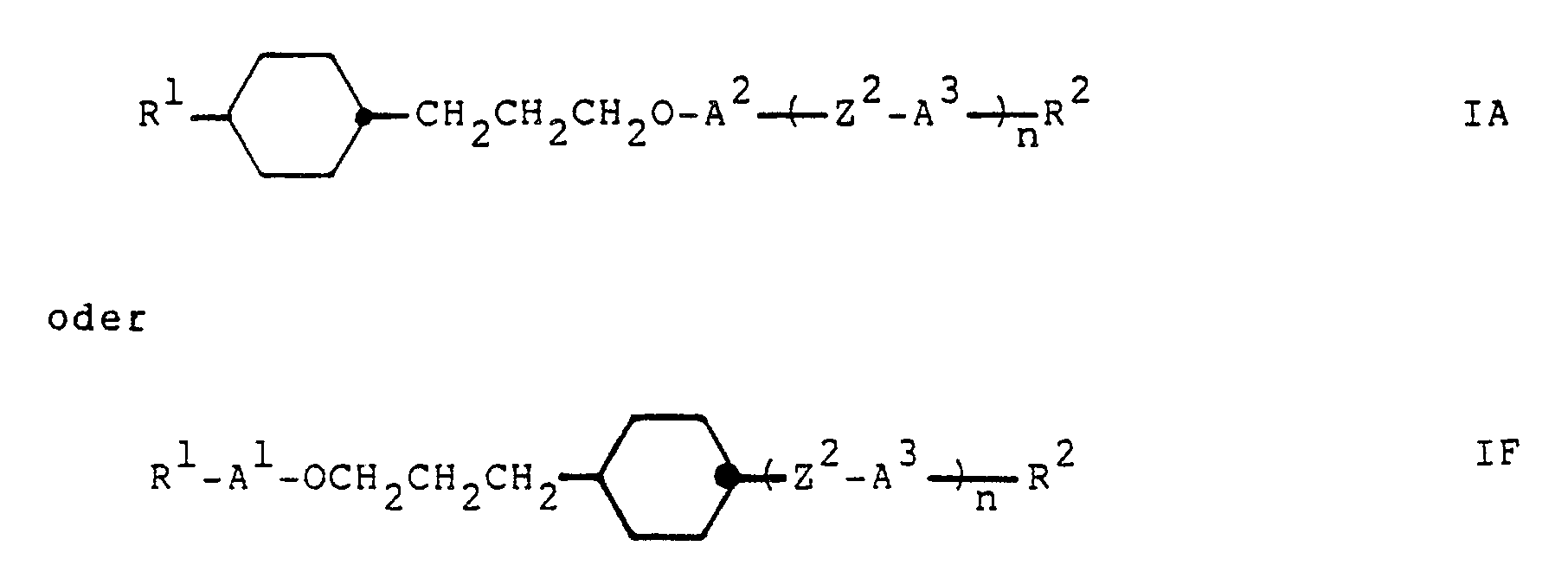


Applications Claiming Priority (4)
| Application Number | Priority Date | Filing Date | Title |
|---|---|---|---|
| CH2093/88 | 1988-06-01 | ||
| CH209388 | 1988-06-01 | ||
| CH896/89 | 1989-03-10 | ||
| CH89689 | 1989-03-10 |
Publications (3)
| Publication Number | Publication Date |
|---|---|
| EP0344557A2 true EP0344557A2 (de) | 1989-12-06 |
| EP0344557A3 EP0344557A3 (en) | 1990-12-12 |
| EP0344557B1 EP0344557B1 (de) | 1994-08-10 |
Family
ID=25686042
Family Applications (1)
| Application Number | Title | Priority Date | Filing Date |
|---|---|---|---|
| EP89109129A Expired - Lifetime EP0344557B1 (de) | 1988-06-01 | 1989-05-20 | Flüssigkristallkomponenten mit einer Trimethylenoxygruppe |
Country Status (5)
| Country | Link |
|---|---|
| US (1) | US5238600A (de) |
| EP (1) | EP0344557B1 (de) |
| JP (1) | JPH0225440A (de) |
| KR (1) | KR900017974A (de) |
| DE (1) | DE58908166D1 (de) |
Cited By (7)
| Publication number | Priority date | Publication date | Assignee | Title |
|---|---|---|---|---|
| EP0410233A3 (en) * | 1989-07-25 | 1991-04-17 | F. Hoffmann-La Roche Ag | (4-arylbutyl) cyclohexane derivatives |
| EP0423520A3 (en) * | 1989-10-19 | 1992-04-22 | Merck Patent Gesellschaft Mit Beschraenkter Haftung | Liquid crystalline composition for the use in a twisted nematic cell |
| EP0442306A3 (en) * | 1990-02-01 | 1992-08-19 | F. Hoffmann-La Roche & Co. Aktiengesellschaft | (4e-cyclohexyl-3-butenyl)phenyl derivatives |
| US5346647A (en) * | 1989-07-25 | 1994-09-13 | Hoffmann-La Roche Inc. | Cyclohexane compounds used in liquid crystalline mixtures |
| EP0640677A1 (de) * | 1993-08-31 | 1995-03-01 | Canon Kabushiki Kaisha | Mesomorphe Verbindung, eine diese enthaltende Flüssigkristallzusammensetzung, eine die Zusammensetzung verwendende Flüssigkristallvorrichtung, Flüssigkristallapparat und Anzeigeverfahren |
| EP0882696A4 (de) * | 1995-12-05 | 1999-04-21 | Chisso Corp | Alkenylverbindungen mit sauerstoffbindungen, flussigkristalline zusammensetzungen und flussigkristallines anzeigeelement |
| US6913797B1 (en) | 1998-08-24 | 2005-07-05 | Dainippon Ink And Chemicals, Inc. | Decahydronaphthalene derivative |
Families Citing this family (8)
| Publication number | Priority date | Publication date | Assignee | Title |
|---|---|---|---|---|
| JP2952141B2 (ja) * | 1993-01-08 | 1999-09-20 | キヤノン株式会社 | 液晶性化合物、それを含む液晶組成物、及びこれを用いた液晶素子 |
| JP2001039903A (ja) * | 1999-07-30 | 2001-02-13 | Dainippon Ink & Chem Inc | デカヒドロナフタレン誘導体 |
| US9923148B2 (en) | 2002-10-30 | 2018-03-20 | Udc Ireland Limited | Electroluminescent device |
| EP1556360B1 (de) * | 2002-10-30 | 2008-01-23 | Ciba SC Holding AG | Elektroluminezierende vorrichtung |
| JP5018857B2 (ja) * | 2009-10-21 | 2012-09-05 | Dic株式会社 | フェニルデカヒドロナフタレン誘導体 |
| EP2617701B1 (de) | 2010-08-11 | 2016-07-27 | JNC Corporation | Verbindung mit propylether als bindungsgruppe, flüssigkristallzusammensetzung und flüssigkristall-anzeigeelement |
| US10655063B2 (en) | 2016-10-17 | 2020-05-19 | Jnc Corporation | Liquid crystal composition and liquid crystal display device |
| JP6696405B2 (ja) * | 2016-10-28 | 2020-05-20 | Jnc株式会社 | 液晶組成物および液晶表示素子 |
Family Cites Families (10)
| Publication number | Priority date | Publication date | Assignee | Title |
|---|---|---|---|---|
| GB1551043A (en) * | 1975-04-22 | 1979-08-22 | Secr Defence | Biphenyl compounds containing a cyano group and liquid crystal materials and devices containing such compounds |
| CA1047490A (en) * | 1973-04-18 | 1979-01-30 | Friedrich Karrer | Ethers |
| DE3225290A1 (de) * | 1982-07-07 | 1984-01-12 | Merck Patent Gmbh | Ringverbindungen |
| EP0122389B1 (de) * | 1983-03-16 | 1987-08-05 | F. HOFFMANN-LA ROCHE & CO. Aktiengesellschaft | Flüssigkristallkomponenten mit einer Alkenylseitenkette |
| DE3509170C2 (de) * | 1985-03-14 | 1995-01-05 | Merck Patent Gmbh | trans-Ethenylenverbindungen |
| JPS61227546A (ja) * | 1985-03-22 | 1986-10-09 | メルク・パテント・ゲゼルシヤフト・ミツト・ベシユレンクテル・ハフツング | 炭素環式化合物 |
| DE3510434A1 (de) * | 1985-03-22 | 1986-09-25 | Merck Patent Gmbh, 6100 Darmstadt | Cyclohexanderivate |
| GB8520715D0 (en) * | 1985-08-19 | 1985-09-25 | Secr Defence | Secondary alcohol derivatives |
| DE3650014D1 (de) * | 1985-09-18 | 1994-09-08 | Merck Patent Gmbh | Smektische flüssigkristalline phasen. |
| US5032312A (en) * | 1989-04-20 | 1991-07-16 | Hoffmann-La Roche Inc. | 3E-cyclohexylalkoxy derivatives |
-
1989
- 1989-05-02 US US07/346,190 patent/US5238600A/en not_active Expired - Fee Related
- 1989-05-20 EP EP89109129A patent/EP0344557B1/de not_active Expired - Lifetime
- 1989-05-20 DE DE58908166T patent/DE58908166D1/de not_active Expired - Fee Related
- 1989-05-31 JP JP1136233A patent/JPH0225440A/ja active Pending
- 1989-05-31 KR KR1019890007391A patent/KR900017974A/ko not_active Ceased
Cited By (8)
| Publication number | Priority date | Publication date | Assignee | Title |
|---|---|---|---|---|
| EP0410233A3 (en) * | 1989-07-25 | 1991-04-17 | F. Hoffmann-La Roche Ag | (4-arylbutyl) cyclohexane derivatives |
| US5346647A (en) * | 1989-07-25 | 1994-09-13 | Hoffmann-La Roche Inc. | Cyclohexane compounds used in liquid crystalline mixtures |
| EP0423520A3 (en) * | 1989-10-19 | 1992-04-22 | Merck Patent Gesellschaft Mit Beschraenkter Haftung | Liquid crystalline composition for the use in a twisted nematic cell |
| EP0442306A3 (en) * | 1990-02-01 | 1992-08-19 | F. Hoffmann-La Roche & Co. Aktiengesellschaft | (4e-cyclohexyl-3-butenyl)phenyl derivatives |
| EP0640677A1 (de) * | 1993-08-31 | 1995-03-01 | Canon Kabushiki Kaisha | Mesomorphe Verbindung, eine diese enthaltende Flüssigkristallzusammensetzung, eine die Zusammensetzung verwendende Flüssigkristallvorrichtung, Flüssigkristallapparat und Anzeigeverfahren |
| US5462694A (en) * | 1993-08-31 | 1995-10-31 | Canon Kabushiki Kaisha | Mesomorphic compound, liquid crystal composition containing the compound, liquid crystal device using the composition, liquid crystal apparatus and display method |
| EP0882696A4 (de) * | 1995-12-05 | 1999-04-21 | Chisso Corp | Alkenylverbindungen mit sauerstoffbindungen, flussigkristalline zusammensetzungen und flussigkristallines anzeigeelement |
| US6913797B1 (en) | 1998-08-24 | 2005-07-05 | Dainippon Ink And Chemicals, Inc. | Decahydronaphthalene derivative |
Also Published As
| Publication number | Publication date |
|---|---|
| JPH0225440A (ja) | 1990-01-26 |
| EP0344557A3 (en) | 1990-12-12 |
| KR900017974A (ko) | 1990-12-20 |
| DE58908166D1 (de) | 1994-09-15 |
| US5238600A (en) | 1993-08-24 |
| EP0344557B1 (de) | 1994-08-10 |
Similar Documents
| Publication | Publication Date | Title |
|---|---|---|
| EP0144013B1 (de) | Thienothiophenderivate | |
| EP0334911B1 (de) | Substituierte phenyltrifluormethylether | |
| EP0264435B1 (de) | Smektische flüssigkristalline phasen | |
| EP0257048B1 (de) | Optisch aktive verbindungen | |
| EP0247466B1 (de) | Flüssigkristalline Derivate von Phenylbenzoat | |
| EP0344557B1 (de) | Flüssigkristallkomponenten mit einer Trimethylenoxygruppe | |
| EP0182054A2 (de) | Heterocyclische Verbindungen | |
| EP0442306B1 (de) | (4E-Cyclohexyl-3-butenyl)aryl-Derivate | |
| EP0268198B1 (de) | Ferroelektrische Flüssigkristalle | |
| EP0501268B1 (de) | Flüssigkristalline Verbindungen mit endständigem 1-Alkinylrest | |
| EP0391203B1 (de) | 2-Phenylpyridine | |
| EP0242716B1 (de) | Flüssigkristalline Pyridinderivate | |
| EP0355552B1 (de) | Alkoxymethyl- und Alkenyloxymethyl-cyclohexane | |
| EP0589331B1 (de) | Acetylen Derivate und sie enthaltende flüssigkristalline Mischungen | |
| EP0427957B1 (de) | Alkinyl-substituierte Flüssigkristallkomponenten | |
| EP0464648B1 (de) | 4-Cyano-3-fluorophenylester | |
| EP0410233B1 (de) | (4-Arylbutyl)cyclohexan-Derivate | |
| EP0361157B1 (de) | Phenylpyridine | |
| EP0475273A1 (de) | Halogenierte Alkenyl-Verbindungen | |
| EP0393501B1 (de) | Flüssigkristallkomponenten mit einer trans-3-Cyclohexylallyloxygruppe | |
| US5380462A (en) | Cyclohexyl alkenoate compounds | |
| EP0471287B1 (de) | Alkyloxypropenyl Derivate | |
| DE3814346A1 (de) | Pyridinderivate, ihre verwendung als komponenten fluessigkristalliner phasen, entsprechende fluessigkristallphasen und sie enthaltende fluessigkristallanzeigeelemente | |
| EP0433835B1 (de) | Dioxanylpyridine | |
| EP0475254B1 (de) | Chlorphenylalkoxyalkyl-Verbindungen |
Legal Events
| Date | Code | Title | Description |
|---|---|---|---|
| PUAI | Public reference made under article 153(3) epc to a published international application that has entered the european phase |
Free format text: ORIGINAL CODE: 0009012 |
|
| 17P | Request for examination filed |
Effective date: 19890606 |
|
| AK | Designated contracting states |
Kind code of ref document: A2 Designated state(s): CH DE FR GB IT LI NL |
|
| PUAL | Search report despatched |
Free format text: ORIGINAL CODE: 0009013 |
|
| AK | Designated contracting states |
Kind code of ref document: A3 Designated state(s): CH DE FR GB IT LI NL |
|
| 17Q | First examination report despatched |
Effective date: 19930326 |
|
| GRAA | (expected) grant |
Free format text: ORIGINAL CODE: 0009210 |
|
| AK | Designated contracting states |
Kind code of ref document: B1 Designated state(s): CH DE FR GB IT LI NL |
|
| REF | Corresponds to: |
Ref document number: 58908166 Country of ref document: DE Date of ref document: 19940915 |
|
| ITF | It: translation for a ep patent filed | ||
| GBT | Gb: translation of ep patent filed (gb section 77(6)(a)/1977) |
Effective date: 19941026 |
|
| ET | Fr: translation filed | ||
| PGFP | Annual fee paid to national office [announced via postgrant information from national office to epo] |
Ref country code: CH Payment date: 19950516 Year of fee payment: 7 |
|
| PLBE | No opposition filed within time limit |
Free format text: ORIGINAL CODE: 0009261 |
|
| STAA | Information on the status of an ep patent application or granted ep patent |
Free format text: STATUS: NO OPPOSITION FILED WITHIN TIME LIMIT |
|
| 26N | No opposition filed | ||
| PGFP | Annual fee paid to national office [announced via postgrant information from national office to epo] |
Ref country code: GB Payment date: 19960416 Year of fee payment: 8 |
|
| PGFP | Annual fee paid to national office [announced via postgrant information from national office to epo] |
Ref country code: FR Payment date: 19960423 Year of fee payment: 8 |
|
| PGFP | Annual fee paid to national office [announced via postgrant information from national office to epo] |
Ref country code: DE Payment date: 19960522 Year of fee payment: 8 |
|
| PG25 | Lapsed in a contracting state [announced via postgrant information from national office to epo] |
Ref country code: LI Effective date: 19960531 Ref country code: CH Effective date: 19960531 |
|
| PGFP | Annual fee paid to national office [announced via postgrant information from national office to epo] |
Ref country code: NL Payment date: 19960531 Year of fee payment: 8 |
|
| REG | Reference to a national code |
Ref country code: CH Ref legal event code: PL |
|
| PG25 | Lapsed in a contracting state [announced via postgrant information from national office to epo] |
Ref country code: GB Effective date: 19970520 |
|
| REG | Reference to a national code |
Ref country code: GB Ref legal event code: 732E |
|
| PG25 | Lapsed in a contracting state [announced via postgrant information from national office to epo] |
Ref country code: NL Effective date: 19971201 |
|
| GBPC | Gb: european patent ceased through non-payment of renewal fee |
Effective date: 19970520 |
|
| PG25 | Lapsed in a contracting state [announced via postgrant information from national office to epo] |
Ref country code: FR Free format text: LAPSE BECAUSE OF NON-PAYMENT OF DUE FEES Effective date: 19980130 |
|
| NLV4 | Nl: lapsed or anulled due to non-payment of the annual fee |
Effective date: 19971201 |
|
| PG25 | Lapsed in a contracting state [announced via postgrant information from national office to epo] |
Ref country code: DE Free format text: LAPSE BECAUSE OF NON-PAYMENT OF DUE FEES Effective date: 19980203 |
|
| REG | Reference to a national code |
Ref country code: FR Ref legal event code: ST |
|
| PG25 | Lapsed in a contracting state [announced via postgrant information from national office to epo] |
Ref country code: IT Free format text: LAPSE BECAUSE OF NON-PAYMENT OF DUE FEES;WARNING: LAPSES OF ITALIAN PATENTS WITH EFFECTIVE DATE BEFORE 2007 MAY HAVE OCCURRED AT ANY TIME BEFORE 2007. THE CORRECT EFFECTIVE DATE MAY BE DIFFERENT FROM THE ONE RECORDED. Effective date: 20050520 |