EP0343525B1 - Elastomer-Zusammensetzung - Google Patents
Elastomer-Zusammensetzung Download PDFInfo
- Publication number
- EP0343525B1 EP0343525B1 EP89109019A EP89109019A EP0343525B1 EP 0343525 B1 EP0343525 B1 EP 0343525B1 EP 89109019 A EP89109019 A EP 89109019A EP 89109019 A EP89109019 A EP 89109019A EP 0343525 B1 EP0343525 B1 EP 0343525B1
- Authority
- EP
- European Patent Office
- Prior art keywords
- acrylate
- mole
- elastomer composition
- composition according
- copolymer
- Prior art date
- Legal status (The legal status is an assumption and is not a legal conclusion. Google has not performed a legal analysis and makes no representation as to the accuracy of the status listed.)
- Expired - Lifetime
Links
Classifications
-
- C—CHEMISTRY; METALLURGY
- C08—ORGANIC MACROMOLECULAR COMPOUNDS; THEIR PREPARATION OR CHEMICAL WORKING-UP; COMPOSITIONS BASED THEREON
- C08L—COMPOSITIONS OF MACROMOLECULAR COMPOUNDS
- C08L23/00—Compositions of homopolymers or copolymers of unsaturated aliphatic hydrocarbons having only one carbon-to-carbon double bond; Compositions of derivatives of such polymers
- C08L23/02—Compositions of homopolymers or copolymers of unsaturated aliphatic hydrocarbons having only one carbon-to-carbon double bond; Compositions of derivatives of such polymers not modified by chemical after-treatment
- C08L23/04—Homopolymers or copolymers of ethene
- C08L23/08—Copolymers of ethene
-
- C—CHEMISTRY; METALLURGY
- C08—ORGANIC MACROMOLECULAR COMPOUNDS; THEIR PREPARATION OR CHEMICAL WORKING-UP; COMPOSITIONS BASED THEREON
- C08F—MACROMOLECULAR COMPOUNDS OBTAINED BY REACTIONS ONLY INVOLVING CARBON-TO-CARBON UNSATURATED BONDS
- C08F210/00—Copolymers of unsaturated aliphatic hydrocarbons having only one carbon-to-carbon double bond
- C08F210/02—Ethene
-
- C—CHEMISTRY; METALLURGY
- C08—ORGANIC MACROMOLECULAR COMPOUNDS; THEIR PREPARATION OR CHEMICAL WORKING-UP; COMPOSITIONS BASED THEREON
- C08K—Use of inorganic or non-macromolecular organic substances as compounding ingredients
- C08K5/00—Use of organic ingredients
- C08K5/04—Oxygen-containing compounds
- C08K5/14—Peroxides
-
- C—CHEMISTRY; METALLURGY
- C08—ORGANIC MACROMOLECULAR COMPOUNDS; THEIR PREPARATION OR CHEMICAL WORKING-UP; COMPOSITIONS BASED THEREON
- C08L—COMPOSITIONS OF MACROMOLECULAR COMPOUNDS
- C08L23/00—Compositions of homopolymers or copolymers of unsaturated aliphatic hydrocarbons having only one carbon-to-carbon double bond; Compositions of derivatives of such polymers
- C08L23/02—Compositions of homopolymers or copolymers of unsaturated aliphatic hydrocarbons having only one carbon-to-carbon double bond; Compositions of derivatives of such polymers not modified by chemical after-treatment
- C08L23/04—Homopolymers or copolymers of ethene
- C08L23/08—Copolymers of ethene
- C08L23/0846—Copolymers of ethene with unsaturated hydrocarbons containing atoms other than carbon or hydrogen
- C08L23/0869—Copolymers of ethene with unsaturated hydrocarbons containing atoms other than carbon or hydrogen with unsaturated acids, e.g. [meth]acrylic acid; with unsaturated esters, e.g. [meth]acrylic acid esters
-
- C—CHEMISTRY; METALLURGY
- C08—ORGANIC MACROMOLECULAR COMPOUNDS; THEIR PREPARATION OR CHEMICAL WORKING-UP; COMPOSITIONS BASED THEREON
- C08L—COMPOSITIONS OF MACROMOLECULAR COMPOUNDS
- C08L23/00—Compositions of homopolymers or copolymers of unsaturated aliphatic hydrocarbons having only one carbon-to-carbon double bond; Compositions of derivatives of such polymers
- C08L23/02—Compositions of homopolymers or copolymers of unsaturated aliphatic hydrocarbons having only one carbon-to-carbon double bond; Compositions of derivatives of such polymers not modified by chemical after-treatment
- C08L23/04—Homopolymers or copolymers of ethene
- C08L23/08—Copolymers of ethene
- C08L23/0846—Copolymers of ethene with unsaturated hydrocarbons containing atoms other than carbon or hydrogen
- C08L23/0869—Copolymers of ethene with unsaturated hydrocarbons containing atoms other than carbon or hydrogen with unsaturated acids, e.g. [meth]acrylic acid; with unsaturated esters, e.g. [meth]acrylic acid esters
- C08L23/0884—Epoxide-containing esters
Definitions
- the present invention relates to a vulcanizable elastomer composition.
- it relates to an ethylene-copolymer type elastomer composition which can give vulcanizates having an excellent oil resistance and low-temperature resistance.
- Such specialty elastomers already known include crosslinkable elastomer composition which is mainly composed of an ethylene copolymer derived from ethylene and an acrylic ester.
- JP-A-61-266407 through 266410 disclose ethylene copolymers obtained by modifying a copolymer derived from ethylene, alkyl acrylate and third component or ethylene, alkoxyalkyl acrylate and third component with an unsaturated amine, unsaturated alcohol, unsaturated carboxylic acid, etc.
- the ethylene copolymer disclosed therein is characterized in that it is obtained by modifying a copolymer comprising as monomer units ethylene, either an alkyl acrylate or an alkoxyalkyl acrylate, and further an acid anhydride group as the third component with an unsaturated amine, unsaturated alcohol or unsaturated carboxylic acid.
- the crosslinked compositions prepared from the above ethylene copolymers have an excellent oil resistance. However, they are still unsatisfactory in low-temperature resistance, therefore crosslinked compositions having both two resistances in a good balance has been desired.
- a vulcanizable elastomer composition which can give vulcanizates having an improved low-temperature resistance together with an excellent oil resistance, which composition having been derived from ethylene, acrylic ester and third component. It was impossible to obtain a vulcanizable composition giving vulcanizates having an excellent low-temperature resistance without damaging the oil resistance.
- the present inventors are the first to find a vulcanizable composition satisfying the following limitations gives vulcanizates exhibiting an excellent low-temperature resistance and oil resistance that have been difficult to simultaneously satisfy.
- the present invention relates to a vulcanizable elastomer composition which comprises 100 parts by weight of a copolymer containing
- the invention also relates to a vulcanizate obtainable by vulcanizing the elastomer composition.
- the copolymer used in the present invention is obtained by copolymerizing the monomers which become contained as a unit in the copolymer.
- the proportion of each monomer to be copolymerized may be determined so as to give a copolymer having the intended composition.
- the ethylene unit (A), one of the units constituting the copolymer, has the following formula -CH2-CH2-.
- the unit is derived from ethylene as a monomer.
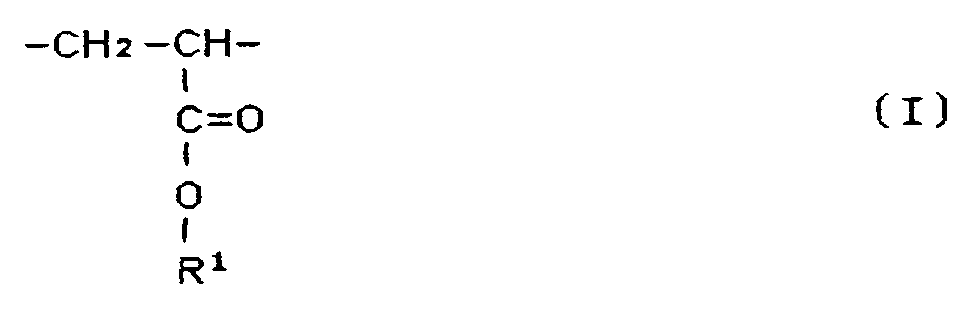
- the alkyl acrylate unit having the formula (I) is derived from an alkyl acrylate monomer.
- alkyl acrylates are methyl acrylate, ethyl acrylate, n-butyl acrylate, tert-butyl acrylate and 2-ethylhexyl acrylate.
- Methyl acrylate is particularly preferable.
- the alkoxyalkyl acrylate unit having the formula (II) is derived from an alkoxyalkyl acrylate monomer.
- Specific examples of the alkoxyalkyl acrylates are methoxymethyl acrylate, methoxyethyl acrylate, ethoxyethyl acrylate, butoxyethyl acrylate, methoxypropyl acrylate, ethoxypropyl acrylate, methoxymethyl methacrylate, ethoxymethyl methacrylate, ethoxyethyl methacrylate and methoxyethyl methacrylate.
- Methoxyethyl acrylate and ethoxyethyl methacrylate are particularly preferable.
- the glycidyl ester unit having the formula (III) is derived from an unsaturated glycidyl ester monomer.
- unsaturated glycidyl esters are, as disclosed for example in JP-B-46-45085, glycidyl acrylate, glycidyl methacrylate, diglycidyl itaconate, triglycidyl butenetricarboxylate and glycidyl p-styrenecarboxylate.
- Particularly preferable is glycidyl methacrylate.
- the proportion of the ethylene unit (A) constituting the copolymer of the present invention is 50-85% by mole, preferably 55-75% by mole, more preferably 65-75% by mole.
- the proportion of the ethylene unit is less than 50% by mole, the resulting vulcanizate is poor in low-temperature resistance, whereas when it is more than 85% by mole, the vulcanizate shows a high permanent set and permanent compression strain and a low rubber elasticity.
- the proportion of the alkyl acrylate unit (B) constituting the copolymer of the present invention is 10-45% by mole, preferably 12-35% by mole, more preferably 15-35% by mole.
- the proportion of the alkyl acrylate unit is less than 10% by mole, the vulcanizate is poor in oil resistance, whereas when it is higher than 45% by mole, the vulcanizate is poor in low-temperature resistance.
- the proportion of the alkoxyalkyl acrylate unit (C) constituting the copolymer of the present invention is 1-35% by mole, preferably 2-35% by mole, more preferably 2-25% by mole, more preferably 2-15% by mole.
- the proportion of the alkoxyalkyl acrylate unit is less than 1% by mole, the vulcanizate is not improved in low-temperature resistance, whereas when it is more than 35% by mole, the vulcanizate is poor in oil resistance.
- the glycidyl ester (D), another unit constituting the copolymer of the present invention, may be introduced into the copolymer in a small proportion of up to 5% by mole, preferably 0.5-3% by mole, more preferably 0.5-1.5% by mole.
- the introduction of said glycidyl ester units enables to vulcanize the copolymer with agents other than organic peroxides, i.e. multifunctional organic amines, for example.
- the glycidyl ester unit is not introduced, the copolymer is mainly vulcanized with organic peroxides.
- comonomers copolymerizable with ethylene may be copolymerized.
- specific examples of the comonomers are acrylic acid, methacrylic acid, maleic acid, maleic anhydride, isobutylene, styrene and the derivatives thereof, vinyl acetate, tetrafluoroethylene and hexafluoropropylene.
- the copolymer of the present invention may be prepared by a known method.
- it can be prepared by free radical-initiated mass polymerization, emulsion polymerization, or solution polymerization.
- Some typical methods of polymerization are described in JP-B-46-45085.
- the preparation may be conducted in the presence of an initiator which generates a free radical under a pressure of 500 kg/cm2 or more and at a temperature of 40°-300°C.
- copolymers suitably used in the present invention which is obtained by copolymerizing the above-mentioned components, are those having a melt index at 190°C of 0.5-500 g/10 minutes determined according to JIS K6791, preferably 0.5-50 g/10 minutes, and an intrinsic viscosity [ ⁇ ] of 0.50-2.0 dl/g determined in xylene at 70°C.
- the elastomer composition of the present invention comprises 100 parts by weight of the above-mentioned copolymer and 0.1-10 parts by weight, preferably 0.5-5 parts by weight of at least one vulcanizing agent.
- the amount of the vulcanizing agent added exceeds 10 parts by weight, the tensile elongation percentage and the thermal resistance of the resulting product become unsatisfactory.
- the amount of the vulcanizing agent added is less than 0.1 part by weight, no satisfactory crosslinking effect is obtained.
- the vulcanization is preferably carried out with at least one vulcanizing agent selected from the group consisting of organic peroxides, multifunctional organic amines or the salts thereof, organic carboxylic acid ammonium salts, dithiocarbamates, thiourea derivatives, and acid anhydrides.
- at least one vulcanizing agent selected from the group consisting of organic peroxides, multifunctional organic amines or the salts thereof, organic carboxylic acid ammonium salts, dithiocarbamates, thiourea derivatives, and acid anhydrides.
- the organic peroxides usable in the present invention include those of peroxyketal type, hydroperoxide type, dialkyl peroxide type, diacyl peroxide type, and peroxyester type organic peroxides. Specific examples thereof are dicumyl peroxide, di-t-butyl peroxide, t-butylperoxycumene, benzoyl peroxide and 2,5-dimethyl-2,5-di(t-butylperoxy)hexane. They are selected in consideration of safety in handling, odor and other factors.
- the amount of the organic peroxide to be compounded is 0.1-10 parts by weight, preferably 1-10 parts by weight, more preferably 0.5-5 parts by weight relative to 100 parts by weight of the copolymer. And it may be varied depending upon the desirable properties of crosslinked product to be obtained.
- composition of the present invention may usually be incorporated, in order to enhance the crosslinking efficiency in the crosslinking effected by organic peroxides, with crosslinking assistants usually used in the art, for example p,p'-dibenzoylquinone dioxime, quinone dioxime, triallyl cyanurate, sulfur, ethylene dimethacrylate, N,N'-m-phenylene bismaleimide, triallyl isocyanurate and trimethylolpropane trimethacrylate.
- crosslinking assistants usually used in the art, for example p,p'-dibenzoylquinone dioxime, quinone dioxime, triallyl cyanurate, sulfur, ethylene dimethacrylate, N,N'-m-phenylene bismaleimide, triallyl isocyanurate and trimethylolpropane trimethacrylate.
- multifunctional organic amines and the salts thereof organic carboxylic acid ammonium salts, dithiocarbamates, thiourea derivatives and acid anhydrides, which are useful vulcanizing agents for copolymers containing a glycidyl ester unit (D), are aliphatic amines such as polymethylenediamine and polyetherdiamine, ammonium benzoate, zinc dimethyldithiocarbamate, copper dimethyldithiocarbamate, phthalic anhydride and itaconic anhydride. More specifically, the vulcanizing agents disclosed in JP-B-62-14568 may be used.
- the elastomer composition of the present invention may be optionally incorporated at need with additives well known in the rubber industry.
- additives include vulcanization accelerators, processing assistants, zinc white, stearic acid, reinforcements, fillers, antioxidants, softeners and defoaming agents.
- elastomer composition of the present invention may be further added carbon black and/or plasticizers.
- Suitable inorganic fillers include white fillers such as silica, talc and clay.
- Suitable plasticizers are, for example, paraffinic plasticizers, polyester type plasticizers and polyether type plasticizers.
- the amount of carbon black, inorganic fillers, and plasticizers to be added may be optionally selected depending upon the desirable properties of the product.
- the elastomer composition thus obtained can be vulcanized at a temperature of 150°-230°C for 5-45 minutes, preferably at 160°-190°C for 10-30 minutes, to exhibit practically useful properties.
- the elastomer composition of the present invention can also be vulcanized in a press, steam autoclave, or in hot air.
- the vulcanization thus obtained has a better balance in oil resistance and low-temperature resistance than in prior art products, and can be suitably used for various hoses, diaphragms, packings, rolls, and belt materials.
- composition to be examined was vulcanized with a steam press at 170°C for 20 minutes.
- the vulcanizate was then examined for physical properties and oil resistance and subjected to Gehman torsion test according to JIS K-6301.
- the oil resistance was examined by determining the degree of volume swelling after 70 hours of immersion at 150°C in JIS No. 3 oil.
- the low-temperature resistance was evaluated by determining the glass transition point (Tg) of unvulcanized rubber with a differential scanning calorimeter (DSC) and by Gehman torsion test of vulcanized rubber.
- Tg glass transition point
- DSC differential scanning calorimeter
- the copolymer was prepared by using a continuous reactor equipped with a stirrer having an internal volume of 2 liters. Thereto were continuously fed 13.5 kg/hour of ethylene, 1.0 kg/hour of methyl acrylate, 0.34 kg/hour of methoxyethyl acrylate, 1.0 g/hour of tert-butyl peroxypivalate (as 0.3% by weight n-heptane solution) as an initiator, and 0.45 kg/hour of methylcyclohexane as a chain transfer agent, as indicated in Table 1. Then the copolymerization was carried out at a pressure of 2100 kg/cm2 and a temperature of 170°C.
- the copolymer was obtained with the same apparatus in the same manner as used for copolymer A.
- the condition of polymerization and the properties of the copolymer are shown in Table 1.
- copolymers were obtained with the same apparatus in the same manner as used for copolymer A except that methoxyethyl acrylate was replaced by ethoxyethyl methacrylate.
- the conditions of polymerization and the properties of the copolymers obtained are shown in Table 1.
- copolymer was obtained with the same apparatus in the same manner as used for copolymer A except that glycidyl methacrylate was further added to cause crosslinking.
- a copolymer of ethylene and methyl acrylate was obtained with the same apparatus in the same manner as used for copolymer A.
- the conditions of polymerization and the properties of the copolymer obtained are shown in Table 1.
- copolymers A to F obtained as described above were mixed with the compounding ingredients in compounding ratios (in parts by weight) shown in Table 2, then kneaded and vulcanized on a (10-inch) 25,4 cm open roll to obtain vulcanizates.
- a vulcanizable composition which can give vulcanizates of well-balanced properties having an improved low-temperature resistance and retaining excellent oil resistance.
Landscapes
- Chemical & Material Sciences (AREA)
- Health & Medical Sciences (AREA)
- Chemical Kinetics & Catalysis (AREA)
- Medicinal Chemistry (AREA)
- Polymers & Plastics (AREA)
- Organic Chemistry (AREA)
- Compositions Of Macromolecular Compounds (AREA)
- Addition Polymer Or Copolymer, Post-Treatments, Or Chemical Modifications (AREA)
- Epoxy Resins (AREA)
Claims (14)
- Vulkanisierbare Elastomerzusammensetzung, umfassend: 100 Gew.-Teile eines Copolymers, enthaltend(A) 50-85 Mol-% Ethyleneinheiten,(B) 10-45 Mol-% einer Alkylacrylateinheit der Formel (I),
 (C) 1-35 Mol-% einer Alkoxyalkylacrylateinheit der Formel (II),
 (D) bis zu 5 Mol-% einer Glycidylestereinheit der Formel (III),
- Elastomerzusammensetzung nach Anspruch 1, in der das Alkylacrylat (B) Methylacrylat, Ethylacrylat, n-Butylacrylat, tert-Butylacrylat und/oder 2-Ethylhexylacrylat ist.
- Elastomerzusammensetzung nach Anspruch 1, in der das Alkylacrylat (B) Methylacrylat ist.
- Elastomerzusammensetzung nach einem der Ansprüche 1 bis 3, in der das Alkoxyalkylacrylat (C) Methoxymethylacrylat, Methoxyethylacrylat, Ethoxyethylacrylat, Butoxyethylacrylat, Methoxypropylacrylat, Ethoxypropylacrylat, Methoxymethylmethacrylat, Ethoxymethylmethacrylat, Ethoxyethylmethacrylat und/oder Methoxyethylmethacrylat ist.
- Elastomerzusammensetzung nach einem der Ansprüche 1 bis 3, in der das Alkoxyalkylacrylat (C) Methoxyethylacrylat und/oder Ethoxyethylmethacrylat ist.
- Elastomerzusammensetzung nach einem der Ansprüche 1 bis 5, in der der Glycidylester (D) Glycidylacrylat, Glycidylmethacrylat, Diglycidylitaconat, Butentricarbonsäuretriglycidylester und/oder p-Styrolcarbonsäureglycidylester ist.
- Elastomerzusammensetzung nach einem der Ansprüche 1 bis 5, in der der Glycidylester (D) Glycidylmethacrylat ist.
- Elastomerzusammensetzung nach einem der Ansprüche 1 bis 7, in der der Gehalt an Ethyleneinheiten (A) im Copolymer 55-75 Mol-%, vorzugsweise 65-75 Mol-% ist.
- Elastomerzusammensetzung nach einem der Ansprüche 1 bis 8, in der der Gehalt an Alkylacrylateinheiten (B) im Copolymer 12-35 Mol-%, vorzugsweise 15-35 Mol-% ist.
- Elastomerzusammensetzung nach einem der Ansprüche 1 bis 9, in der der Gehalt an Alkoxyalkylacrylateinheiten (C) im Copolymer 2-25 Mol-%, vorzugsweise 2-15 Mol-% ist.
- Elastomerzusammensetzung nach einem der Ansprüche 1 bis 10, in der der Gehalt an Glycidylestereinheiten (D) 0,5-3 Mol-%, vorzugsweise 0,5-1,5 Mol-% ist.
- Elastomerzusammensetzung nach einem der Ansprüche 1 bis 11, in der die Menge des zugesetzten Vulkanisationsmittels 0,5-5 Gew.-Teile ist.
- Elastomerzusammensetzung nach einem der Ansprüche 1 bis 5, 8 bis 10 und 12, in der der Gehalt an Glycidylestereinheiten (D) 0 (Null) und das Vulkanisationsmittel ein organisches Peroxid ist.
- Vulkanisat, erhältlich durch Vulkanisation der Elastomerzusammensetzung nach einem der Ansprüche 1 bis 13.
Applications Claiming Priority (2)
| Application Number | Priority Date | Filing Date | Title |
|---|---|---|---|
| JP63128623A JP2606282B2 (ja) | 1988-05-26 | 1988-05-26 | エラストマー組成物 |
| JP128623/88 | 1988-05-26 |
Publications (3)
| Publication Number | Publication Date |
|---|---|
| EP0343525A2 EP0343525A2 (de) | 1989-11-29 |
| EP0343525A3 EP0343525A3 (de) | 1991-07-17 |
| EP0343525B1 true EP0343525B1 (de) | 1994-11-09 |
Family
ID=14989373
Family Applications (1)
| Application Number | Title | Priority Date | Filing Date |
|---|---|---|---|
| EP89109019A Expired - Lifetime EP0343525B1 (de) | 1988-05-26 | 1989-05-19 | Elastomer-Zusammensetzung |
Country Status (6)
| Country | Link |
|---|---|
| US (2) | US4985507A (de) |
| EP (1) | EP0343525B1 (de) |
| JP (1) | JP2606282B2 (de) |
| KR (1) | KR900018245A (de) |
| DE (1) | DE68919275T2 (de) |
| ES (1) | ES2063780T3 (de) |
Families Citing this family (5)
| Publication number | Priority date | Publication date | Assignee | Title |
|---|---|---|---|---|
| US5242899A (en) * | 1989-09-05 | 1993-09-07 | Total Compagnie Franciase Des Petroles | Emulsfiying agent, reverse emulsions produced using this emulsifying agent and use of these emulsions in drilling wells |
| JPH0641370A (ja) * | 1992-05-11 | 1994-02-15 | Sumitomo Chem Co Ltd | ゴム組成物 |
| US7730012B2 (en) * | 2004-06-25 | 2010-06-01 | Apple Inc. | Methods and systems for managing data |
| JP4595940B2 (ja) * | 2004-07-14 | 2010-12-08 | Nok株式会社 | エチレン−アルキルアクリレート共重合ゴム組成物 |
| US20160046842A1 (en) * | 2013-03-27 | 2016-02-18 | Japan Polyethylene Corporation | Polar-group-containing olefin copolymer, polar-group-containing multinary olefin copolymer, olefin-based resin composition, and adhesive and layered product each using the same |
Family Cites Families (8)
| Publication number | Priority date | Publication date | Assignee | Title |
|---|---|---|---|---|
| GB1166443A (en) * | 1966-02-14 | 1969-10-08 | Ici Ltd | Ethylene Copolymers and Laminates made therewith |
| FR2087531A5 (de) * | 1970-05-22 | 1971-12-31 | Ugine Kuhlmann | |
| CA962398A (en) * | 1971-03-16 | 1975-02-04 | Sumitomo Chemical Company | Process for producing ethylene copolymers |
| US3925326A (en) * | 1971-04-07 | 1975-12-09 | Du Pont | Alternating copolymers of ethylene/alkyl acrylates/cure-site monomers and a process for their preparation |
| US3904588A (en) * | 1973-08-09 | 1975-09-09 | Du Pont | Random ethylene/alkyl acrylate 1,4-butene-dioic acid terpolymers |
| US4303560A (en) * | 1979-03-17 | 1981-12-01 | Denki Kagaku Kogyo Kabushiki Kaisha | Rubbery polymer composition |
| JPS612712A (ja) * | 1984-06-14 | 1986-01-08 | Denki Kagaku Kogyo Kk | 共重合体エラストマー |
| JPS63500578A (ja) * | 1985-05-21 | 1988-03-03 | ゲゼンクシユミ−デ シユナイデル ゲゼルシヤフト ミツト ベシユレンクテル ハフツング | 横方向押出によつて中空部品にフランジ又はカラ−を作る方法 |
-
1988
- 1988-05-26 JP JP63128623A patent/JP2606282B2/ja not_active Expired - Lifetime
-
1989
- 1989-05-15 US US07/351,663 patent/US4985507A/en not_active Expired - Fee Related
- 1989-05-19 ES ES89109019T patent/ES2063780T3/es not_active Expired - Lifetime
- 1989-05-19 DE DE68919275T patent/DE68919275T2/de not_active Expired - Fee Related
- 1989-05-19 EP EP89109019A patent/EP0343525B1/de not_active Expired - Lifetime
- 1989-05-26 KR KR1019890007088A patent/KR900018245A/ko not_active Ceased
-
1990
- 1990-12-04 US US07/626,096 patent/US5075385A/en not_active Expired - Fee Related
Also Published As
| Publication number | Publication date |
|---|---|
| DE68919275D1 (de) | 1994-12-15 |
| JP2606282B2 (ja) | 1997-04-30 |
| US4985507A (en) | 1991-01-15 |
| DE68919275T2 (de) | 1995-03-23 |
| JPH01299805A (ja) | 1989-12-04 |
| KR900018245A (ko) | 1990-12-20 |
| US5075385A (en) | 1991-12-24 |
| ES2063780T3 (es) | 1995-01-16 |
| EP0343525A3 (de) | 1991-07-17 |
| EP0343525A2 (de) | 1989-11-29 |
Similar Documents
| Publication | Publication Date | Title |
|---|---|---|
| US3904588A (en) | Random ethylene/alkyl acrylate 1,4-butene-dioic acid terpolymers | |
| EP0962311B1 (de) | Gummiverbundstoff und verwendungen davon | |
| US3497571A (en) | Acrylic ester-cyclic ester elastomeric compositions | |
| US3873494A (en) | Oil-resistant and aging-resistant elastomers | |
| JP4903564B2 (ja) | 低温特性が改善されたエチレン/アルキルアクリレートランダムコポリマー、該ポリマーのコンパウンドおよびエラストマー組成物 | |
| JP2669621B2 (ja) | ゴム組成物 | |
| US3201373A (en) | Synthetic chlorine containing rubberacrylate type polymers | |
| US4508885A (en) | Elastomer of acrylic ester type copolymer | |
| US5093429A (en) | Multiplex ethylene copolymer, process for preparation thereof and cured product thereof | |
| EP0343525B1 (de) | Elastomer-Zusammensetzung | |
| EP0015627B1 (de) | Elastomer aus modifiziertem Monoolefin-Copolymer mit verbesserter Wärme- und Ölbeständigkeit | |
| US4412043A (en) | Vulcanizable ethylene copolymers | |
| CA1040794A (en) | Random ethylene/alkyl acrylate copolymers | |
| KR950008475B1 (ko) | 고무 조성물 | |
| US3972857A (en) | Sulfur vulcanizable ethylene-vinyl acetate copolymer elastomers | |
| US4202845A (en) | Sulfur vulcanizable ethylene-vinyl acetate copolymer elastomers | |
| US5252675A (en) | Cured product of a modified multiplex ethylene copolymer | |
| US5589550A (en) | Peroxide-cured polyacrylates | |
| EP0738758B1 (de) | Acrylkautschukzusammensetzung | |
| JP2025126916A (ja) | ゴム組成物及び架橋物 | |
| JPS59136303A (ja) | 加硫可能なアクリルゴムの製造法 | |
| JPH02166137A (ja) | ゴム組成物 | |
| JPS6215249A (ja) | 塩化ビニル樹脂組成物 | |
| JPH0134261B2 (de) |
Legal Events
| Date | Code | Title | Description |
|---|---|---|---|
| PUAI | Public reference made under article 153(3) epc to a published international application that has entered the european phase |
Free format text: ORIGINAL CODE: 0009012 |
|
| AK | Designated contracting states |
Kind code of ref document: A2 Designated state(s): DE ES FR GB IT |
|
| 17P | Request for examination filed |
Effective date: 19910102 |
|
| PUAL | Search report despatched |
Free format text: ORIGINAL CODE: 0009013 |
|
| AK | Designated contracting states |
Kind code of ref document: A3 Designated state(s): DE ES FR GB IT |
|
| 17Q | First examination report despatched |
Effective date: 19930401 |
|
| GRAA | (expected) grant |
Free format text: ORIGINAL CODE: 0009210 |
|
| AK | Designated contracting states |
Kind code of ref document: B1 Designated state(s): DE ES FR GB IT |
|
| REF | Corresponds to: |
Ref document number: 68919275 Country of ref document: DE Date of ref document: 19941215 |
|
| ITF | It: translation for a ep patent filed | ||
| ET | Fr: translation filed | ||
| REG | Reference to a national code |
Ref country code: ES Ref legal event code: FG2A Ref document number: 2063780 Country of ref document: ES Kind code of ref document: T3 |
|
| PLBE | No opposition filed within time limit |
Free format text: ORIGINAL CODE: 0009261 |
|
| STAA | Information on the status of an ep patent application or granted ep patent |
Free format text: STATUS: NO OPPOSITION FILED WITHIN TIME LIMIT |
|
| 26N | No opposition filed | ||
| PGFP | Annual fee paid to national office [announced via postgrant information from national office to epo] |
Ref country code: GB Payment date: 19960510 Year of fee payment: 8 Ref country code: FR Payment date: 19960510 Year of fee payment: 8 |
|
| PGFP | Annual fee paid to national office [announced via postgrant information from national office to epo] |
Ref country code: DE Payment date: 19960528 Year of fee payment: 8 |
|
| PGFP | Annual fee paid to national office [announced via postgrant information from national office to epo] |
Ref country code: ES Payment date: 19960530 Year of fee payment: 8 |
|
| PG25 | Lapsed in a contracting state [announced via postgrant information from national office to epo] |
Ref country code: GB Effective date: 19970519 |
|
| PG25 | Lapsed in a contracting state [announced via postgrant information from national office to epo] |
Ref country code: ES Free format text: LAPSE BECAUSE OF NON-PAYMENT OF DUE FEES Effective date: 19970520 |
|
| GBPC | Gb: european patent ceased through non-payment of renewal fee |
Effective date: 19970519 |
|
| PG25 | Lapsed in a contracting state [announced via postgrant information from national office to epo] |
Ref country code: FR Free format text: LAPSE BECAUSE OF NON-PAYMENT OF DUE FEES Effective date: 19980130 |
|
| PG25 | Lapsed in a contracting state [announced via postgrant information from national office to epo] |
Ref country code: DE Free format text: LAPSE BECAUSE OF NON-PAYMENT OF DUE FEES Effective date: 19980203 |
|
| REG | Reference to a national code |
Ref country code: FR Ref legal event code: ST |
|
| REG | Reference to a national code |
Ref country code: ES Ref legal event code: FD2A Effective date: 19990301 |
|
| PG25 | Lapsed in a contracting state [announced via postgrant information from national office to epo] |
Ref country code: IT Free format text: LAPSE BECAUSE OF NON-PAYMENT OF DUE FEES;WARNING: LAPSES OF ITALIAN PATENTS WITH EFFECTIVE DATE BEFORE 2007 MAY HAVE OCCURRED AT ANY TIME BEFORE 2007. THE CORRECT EFFECTIVE DATE MAY BE DIFFERENT FROM THE ONE RECORDED. Effective date: 20050519 |