EP0342331A2 - Ziehfähige Zusammensetzung für die Behandlung von polyesterhaltigen Fasermaterialien - Google Patents
Ziehfähige Zusammensetzung für die Behandlung von polyesterhaltigen Fasermaterialien Download PDFInfo
- Publication number
- EP0342331A2 EP0342331A2 EP89104695A EP89104695A EP0342331A2 EP 0342331 A2 EP0342331 A2 EP 0342331A2 EP 89104695 A EP89104695 A EP 89104695A EP 89104695 A EP89104695 A EP 89104695A EP 0342331 A2 EP0342331 A2 EP 0342331A2
- Authority
- EP
- European Patent Office
- Prior art keywords
- substituted
- alkyl group
- straight
- carbon atoms
- branched chain
- Prior art date
- Legal status (The legal status is an assumption and is not a legal conclusion. Google has not performed a legal analysis and makes no representation as to the accuracy of the status listed.)
- Granted
Links
Classifications
-
- D—TEXTILES; PAPER
- D06—TREATMENT OF TEXTILES OR THE LIKE; LAUNDERING; FLEXIBLE MATERIALS NOT OTHERWISE PROVIDED FOR
- D06M—TREATMENT, NOT PROVIDED FOR ELSEWHERE IN CLASS D06, OF FIBRES, THREADS, YARNS, FABRICS, FEATHERS OR FIBROUS GOODS MADE FROM SUCH MATERIALS
- D06M15/00—Treating fibres, threads, yarns, fabrics, or fibrous goods made from such materials, with macromolecular compounds; Such treatment combined with mechanical treatment
- D06M15/19—Treating fibres, threads, yarns, fabrics, or fibrous goods made from such materials, with macromolecular compounds; Such treatment combined with mechanical treatment with synthetic macromolecular compounds
- D06M15/21—Macromolecular compounds obtained by reactions only involving carbon-to-carbon unsaturated bonds
-
- D—TEXTILES; PAPER
- D06—TREATMENT OF TEXTILES OR THE LIKE; LAUNDERING; FLEXIBLE MATERIALS NOT OTHERWISE PROVIDED FOR
- D06M—TREATMENT, NOT PROVIDED FOR ELSEWHERE IN CLASS D06, OF FIBRES, THREADS, YARNS, FABRICS, FEATHERS OR FIBROUS GOODS MADE FROM SUCH MATERIALS
- D06M13/00—Treating fibres, threads, yarns, fabrics or fibrous goods made from such materials, with non-macromolecular organic compounds; Such treatment combined with mechanical treatment
- D06M13/244—Treating fibres, threads, yarns, fabrics or fibrous goods made from such materials, with non-macromolecular organic compounds; Such treatment combined with mechanical treatment with compounds containing sulfur or phosphorus
- D06M13/282—Treating fibres, threads, yarns, fabrics or fibrous goods made from such materials, with non-macromolecular organic compounds; Such treatment combined with mechanical treatment with compounds containing sulfur or phosphorus with compounds containing phosphorus
- D06M13/292—Mono-, di- or triesters of phosphoric or phosphorous acids; Salts thereof
- D06M13/295—Mono-, di- or triesters of phosphoric or phosphorous acids; Salts thereof containing polyglycol moieties; containing neopentyl moieties
-
- D—TEXTILES; PAPER
- D06—TREATMENT OF TEXTILES OR THE LIKE; LAUNDERING; FLEXIBLE MATERIALS NOT OTHERWISE PROVIDED FOR
- D06M—TREATMENT, NOT PROVIDED FOR ELSEWHERE IN CLASS D06, OF FIBRES, THREADS, YARNS, FABRICS, FEATHERS OR FIBROUS GOODS MADE FROM SUCH MATERIALS
- D06M7/00—Treating fibres, threads, yarns, fabrics, or fibrous goods made of other substances with subsequent freeing of the treated goods from the treating medium, e.g. swelling, e.g. polyolefins
-
- D—TEXTILES; PAPER
- D06—TREATMENT OF TEXTILES OR THE LIKE; LAUNDERING; FLEXIBLE MATERIALS NOT OTHERWISE PROVIDED FOR
- D06M—TREATMENT, NOT PROVIDED FOR ELSEWHERE IN CLASS D06, OF FIBRES, THREADS, YARNS, FABRICS, FEATHERS OR FIBROUS GOODS MADE FROM SUCH MATERIALS
- D06M2200/00—Functionality of the treatment composition and/or properties imparted to the textile material
- D06M2200/40—Reduced friction resistance, lubricant properties; Sizing compositions
-
- Y—GENERAL TAGGING OF NEW TECHNOLOGICAL DEVELOPMENTS; GENERAL TAGGING OF CROSS-SECTIONAL TECHNOLOGIES SPANNING OVER SEVERAL SECTIONS OF THE IPC; TECHNICAL SUBJECTS COVERED BY FORMER USPC CROSS-REFERENCE ART COLLECTIONS [XRACs] AND DIGESTS
- Y10—TECHNICAL SUBJECTS COVERED BY FORMER USPC
- Y10S—TECHNICAL SUBJECTS COVERED BY FORMER USPC CROSS-REFERENCE ART COLLECTIONS [XRACs] AND DIGESTS
- Y10S8/00—Bleaching and dyeing; fluid treatment and chemical modification of textiles and fibers
- Y10S8/04—Polyester fibers
Definitions
- the invention relates to mixtures which contain oxidized polyethylenes and selected quaternary ammonium phosphates, and to the use of these mixtures as drawable textile auxiliaries for the antistatic, smooth and / or plasticizing of polyester-containing fiber materials.
- the Aviv für aqueezing is part of the textile finishing and should give the flake, the sliver, woven fabric, knitted fabric or nonwoven in particular such properties as feel, smoothness, antistatic and fullness, through which the appearance, saleability, fitness for purpose and processing properties are increased.
- the textile auxiliaries used for finishing can, for example, be applied to textile fiber materials in a full bath (exhaust process).
- the full bath treatment the textiles are wetted for a long time in a large liquor ratio and then dewatered by squeezing, suctioning or centrifuging.
- the full bath treatment has the advantage that the treatment times and temperatures can be chosen and varied as desired (see, for example, W. Bernard: “Textile finishing", 2nd edition, page 257-258, Springer-Verlag 1967).
- Fat-polyamine condensation products, fatty acid amide derivatives, paraffin emulsions and silicone derivatives are usually used as antistatic agents, smoothing agents and / or plasticizers in the exhaust process.
- antistatic agents smoothing agents and / or plasticizers in the exhaust process.
- polyester-containing fiber materials have no or only unsatisfactory antistatic properties, smoothness and / or softness after finishing with these known substances.
- the object on which the invention is based was therefore to develop textile auxiliaries which have a high substantivity to polyester-containing fiber materials and which give these fiber materials excellent antistatic smoothing and / or softening properties.
- blends containing oxidized polyethylenes and certain quaternary ammonium phosphates have a high affinity for polyester-containing fiber materials.
- the weight ratio of components A: B in the mixtures according to the invention is preferably between 10: 1 and 1: 5, particularly preferably between 10: 3 and 1: 2.
- mixtures containing anoxidized polyethylenes with average molecular weights between 3000 and 8000, acid numbers between 25 and 60, saponification numbers between 40 and 80 and densities between 0.94 and 1.09 g / cm 3 and at least one quaternary ammonium phosphate from at least one of the Groups (B) 1 -3, as textile auxiliaries for antistatic, smoothing and / or softening of polyester-containing fiber materials is therefore also an object of the invention.
- Anoxidized polyethylenes with average molecular weights between 3500 and 5000 and densities between 0.98 and 1.00 gicm 3 are preferred in the mixtures according to the invention.
- the mixtures according to the invention which are preferably in the form of dispersions or solutions, particularly preferably in the form of aqueous emulsions, preferably contain between 5 and 50% by weight, particularly preferably between 10 and 30% by weight of components A and B.
- the dispersions or solutions, preferably aqueous emulsions are applied in a manner known per se in rinsing, washing or dipping baths or by spraying onto polyester-containing fiber materials and dried between 80 and 160 ° C. by means of spinning, squeezing and temperature treatment.
- the mixtures according to the invention are preferably applied in the exhaust process from aqueous liquors at liquor ratios between 1: 5 and 1:25 at liquor pH values between 4.0 and 7.0 and temperatures between 40 and 80 ° C. Since textile auxiliaries containing the invention Component A and component B, which have a high affinity for polyester-containing fiber materials, achieve a high exhaustion of the treatment liquors.
- Polyethylene-containing fiber materials include pure polyester fibers and mixtures of polyester fibers and natural and / or synthetic fibers, for example mixtures of polyester fibers and cotton; Polyester fibers and polyamide fibers; Polyester fibers, cotton and polyamide fibers; Polyester fibers and polyacrylic fibers understood.
- the textile fiber materials are in the form of a flake, sliver, yarn, knitwear, woven fabric or nonwoven, preferably a flake or sliver.
- the material can be raw white, bleached or colored.
- the anoxidized polyethylenes contained in the mixtures according to the invention are commercial products which are offered, for example, by Allied Corp., USA under the name A-C @ polyethylenes.
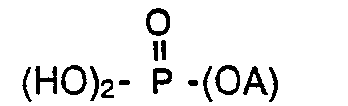
- the quaternary ammonium phosphates contained in the mixtures according to the invention are prepared by the process described in JP 59/47478 by amines, imidazoline and / or amino-functional polyesters obtained according to DE-OS 30 32 216 by condensation of alkoxylated tertiary amines with dicarboxylic acids with phosphoric acid esters of the general formulas and wherein R is a saturated or unsaturated, straight or branched chain, substituted or unsubstituted alkyl group with 6 to 22 C atoms and A is an alkylene chain with 2 to 4 C atoms, mixed at 50 to 80 C and then these mixtures in an autoclave at 80 up to 100 C with alkylene oxides having 2 to 4 C atoms, with the proviso that the polyalkyl ether chain of the quaternized amine functions consists of 1 to 10 alkylene oxide units.
- NEN The imidazolines required as starting materials for the production of quaternary imidazolinium phosphates can NEN can be produced by condensation of carboxylic acids, carboxylic acid esters or carboxylic acid chlorides with diamine compounds (G. Gawalek: "Tenside", pp. 305-306, Akademie Verlag, Berlin 1975).
- the imidazolines are preferably prepared according to German Offenlegungsschrift DE-OS 36 18 944 by condensation of carboxylic acids of the general formula R 4- COOH in which R 4 is a straight-chain or branched-chain, saturated or unsaturated, substituted or unsubstituted alkyl group having 5 to 21 C atoms, with diamines of the general formula H 2 N-CH 2 CH 2 -NH-CH 2 CH 2 R 6 . in the R 6 OH or means.
- the condensation is carried out at temperatures between 150 and 240 ° C., preferably between 150 and 200 ° C.
- the molar ratio of carboxylic acid: diamine is preferably between 1: 1 and 1: 2.
- the carboxylic acids can be used either individually or in a mixture to prepare the imidazolines. Of particular importance is the use of fatty acid mixtures, such as those that occur when natural fats and / or oils are split. Individual fractions of such fatty acid mixtures are also suitable for the preparation of the imidazolines.
- the carboxylic acids used are preferably those of the general formula R * - COOH in which the radical R 4 is for a straight or branched chain, substituted or unsubstituted, saturated alkyl group having 7 to 17 carbon atoms or for a straight or branched chain. substituted or unsubstituted, unsaturated alkyl group having 17 to 21 carbon atoms.
- caprylic acid for example caprylic acid, capric acid, lauric acid, palmitic acid, stearic acid, oleic acid, linoleic acid, linolinic acid, gadoleic acid and / or ricinoleic acid.
- 1-Hydroxyethyl-2-undecylimidazoline, 1-hydroxyethyl-2-heptadecenylimidazoline and 1-hydroxyethyl-2-heptylimidazoline are suitable imidazolines.
- the amino-functional polyesters have degrees of polymerization between 2 and 50 if 0.8 to 1.1 mol of dicarboxylic acid are used per mole of alkoxylated, tertiary amine.
- dicarboxylic acids include malonic acid, maleic acid and fumaric acid.
- R 7 disappears in the general formula.
- Particularly suitable aliphatic dicarboxylic acids are acids with 6 to 10 carbon atoms, such as adipic acid, pimelic acid, suberic acid, azelaic acid and / or sebacic acid.
- alkoxylated tertiary amines required for the production of amino-functional polyesters are derived from primary alkylamines and alkenylamines, for example from methylamine, ethylamine, butylamine, octylamine, decylamine, dodecylamine, cetylamine, oleylamine, linoleylamine, coconut amine and / or tallow amine. Alkyl amines made from coconut oil or tallow are preferred.
- Alkyl and / or alkenyl amines are alkoxylated in a manner known per se at from 130 to 180 ° C. with ethylene oxide and / or propylene oxide, with the proviso that the degree of alkoxylation (sum of a and b) is between 2 and 30.
- Tallow polyester 5 ethylene oxide units (EO) and adipic acid, polyester from coconut amine. 2 EO and adipic acid, polyester from coconut amine. 5 EO and succinic acid and / or polyester from tallow amine. 10 EO and sebacic acid are examples of suitable amino-functional polyesters.
- the phosphoric acid partial esters are prepared from straight-chain or branched-chain, saturated or unsaturated, substituted or unsubstituted, optionally alkoxylated alcohols having 6 to 22 carbon atoms.
- Straight or branched chain, substituted or unsubstituted, saturated, optionally alkoxylated alcohols having 8 to 18 C atoms and / or straight or branched chain, substituted or unsubstituted, unsaturated, optionally alkoxylated alcohols having 18 to 22 C atoms are used, for example 2-ethylhexanol, n-octanol, isononyl alcohol, decyl alcohol, dodecyl alcohol, isotridecyl alcohol, tetradecyl alcohol, hexadecyl alcohol, octadecyl alcohol, octadecenyl alcohol, eicosenyl alcohol, docosenyl alcohol.
- alcohols are optionally reacted with 1 to 10 moles of ethylene oxide, propylene oxide and / or butylene oxide.
- the optionally alkoxylated alcohols are phosphated in a manner known per se by reacting 3 mol of alcohol with 1 mol of phosphorus pentoxide at 50 to 80 ° C.
- water is treated at 90 to 100 ° C. for several hours.
- the mixtures according to the invention are used as textile auxiliaries for the antistatic, smoothing and / or softening of polyester-containing fiber materials, these mixtures are preferably in the form of dispersions or solutions, particularly preferably in the form of aqueous emulsions. These emulsions contain 2 to 20% by weight of nonionic, cationic and / or amphoteric dispersants.
- Suitable nonionic dispersants are alkoxylated, preferably ethoxylated and / or propoxylated fats, oils, fatty alcohols with 8 to 24 C atoms in the fat residue, fatty amines with 8 to 24 C atoms in the fat residue and / or C 8-18 alkylphenols, for example ethoxylated castor oil , Oleyl alcohol. 5 EO, omelet acetyl alcohol. 5 EO, tallow alcohol. 14 EO, stearylamine. 2 EO, tallow amine. 2 EO, stearylamine. 10 EO and / or nonylphenol. 10 EO.
- Suitable cationic dispersants are alkoxylated, preferably ethoxylated and / or propoxylated, alkylamines having 10 to 20 carbon atoms in the form of their ammonium salts, for example stearylamine. 10 EO.
- Suitable amphoteric dispersants are, for example, Cs-z 2 -alkyldimethylbetaines, N-Ca-z 2 -alkylamido betaines and / or amphoteric surfactants to be derived from amino acids.
- the solutions or dispersions can contain further smoothing agents, for example paraffins with softening points between 35 and 80 C, fatty acid esters with 12 to 24 C atoms both in the fatty acid residue and in the straight and / or branched chain, saturated and / or unsaturated alcohol residue such as Isotridecyl stearate, stearyl stearate and / or behenyl behenate and / or silicones such as dimethylpolysiloxane, plasticizers such as fatty acid amidopolyamines and / or quaternary ammonium salts, for example dimethyldistearylammonium chloride, antioxidants, for example oxygen acids of phosphorus and / or alkali disulfites and pH acids, for example C 1-4 regulant and / or contain C 1-4 hydroxycarboxylic acids such as acetic acid and / or glycolic acid.
- paraffins with softening points between 35 and 80 C saturated and / or unsaturated alcohol
- aqueous dispersions and emulsions The proportion of optional components in aqueous dispersions and emulsions is between 2 and 20% by weight.
- the dispersions and solutions, preferably the aqueous emulsions, which contain the mixtures according to the invention, are prepared in a manner known per se by mixing anoxidized polyethylenes, dispersants and optional constituents with water and stirring at 130 to 170 ° C. in a pressure-resistant apparatus. After cooling, finely divided, storage-stable emulsions are obtained, into which quaternary ammonium phosphates and optionally further dispersants are stirred.
- the mixtures according to the invention are heat-resistant and do not cause discoloration of the fiber materials.
- the polyester-containing fiber materials finished with the mixtures according to the invention show, compared to untreated, fiber-containing fiber materials treated only with oxidized polyethylenes or only with quaternary ammonium phosphates, significantly reduced antistatic charges, low static and dynamic fiber / fiber and fiber / metal friction, excellent smoothness and a good soft grip.
- quaternary ammonium phosphate 2.1 were diluted with 25.6 g of water and then 5.4 g of an oleyl / cetyl alcohol mixture alkoxylated with 5 mol of ethylene oxide were added.
- a pH of 5.2 was set by adding 9.5 g of 40% by weight acetic acid and mixed with 47.6 g of the aqueous emulsion 1.1.
- a storage-stable liquid, milky white emulsion with a solids content of 25% by weight and a pH of 4.5 was obtained.
- Polyester staple fiber Dyed and reductively aftertreated polyester staple fiber material (1.7 dtex / 40 mm) was treated with a liquor ratio of 1:10 for 20 minutes at a temperature of 60 to 70 ° C with an acetic acidic aqueous solution, which, calculated on the weight of the goods, in each case 2% by weight of the mixtures mentioned under 1., 2., 3. or 4. contained. Following the application, the material was spun and dried at 80 ° C for 2 hours.
- the measurement of the electrostatic effect was carried out on a laboratory card after a 24 h air conditioning (22 o C, 62 to 65% relative air humidity) of the fiber material with an Eltex device using the induction current method (measuring distance 100 mm).
- a colored and reductively aftertreated polyester sliver (20 g / m; 6.7 dtex / 80 mm) was treated with a liquor ratio of 1:15 for 20 minutes at a temperature of 60 to 70 ° C. with an acetic acidic aqueous solution, calculated on the product weight contained 2% by weight of the mixtures described under 1, 2, 3 or 4. After the finishing, the comb was spun and dried at 80 ° C. for 2 hours.
- the conveyor belts produced on the needle bar section were assessed according to the cohesion meter measuring method.
- the measured values cN. tex -1 represent the forces that occur with a delay of 1.25 times, which are required to bring about a change in the length of the original material.
- the measured values determined were processed statistically using a Rothschild F-Meter with the aid of a connected small computer.
Landscapes
- Engineering & Computer Science (AREA)
- Textile Engineering (AREA)
- Chemical & Material Sciences (AREA)
- Chemical Kinetics & Catalysis (AREA)
- Treatments For Attaching Organic Compounds To Fibrous Goods (AREA)
- Compositions Of Macromolecular Compounds (AREA)
- Yarns And Mechanical Finishing Of Yarns Or Ropes (AREA)
- Chemical Or Physical Treatment Of Fibers (AREA)
- Woven Fabrics (AREA)
- Materials For Medical Uses (AREA)
- Chemical Treatment Of Fibers During Manufacturing Processes (AREA)
Abstract
Description
- Die Erfindung betrifft Mischungen, die anoxidierte Polyethylene und ausgewählte quartäre Ammoniumphosphate enthalten, sowie die Verwendung dieser Mischungen als ziehfähige Textilhilfsmittel zum Antistatisch-, Glatt- und/oder Weichmachen polyesterhaltiger Fasermaterialien.
- Die Aviverung ist ein Teil der Textilveredlung und soll der Flocke, dem Kammzug, Gewebe, Gewirke oder Nonwovens insbesondere solche Eigenschaften wie Griff, Glätte, Antistatik und Fülle verleihen, durch die Aussehen, Verkaufsfähigkeit, Gebrauchstüchtigkeit und Verarbeitungseigenschaften erhöht werden. Die zur Avivierung verwendeten Textilhilfsmittel können beispielsweise auf Textilfasermaterialien im Vollbad (Ausziehverfahren) appliziert werden. Bei der Vollbadbehandlung werden die Textilien im großen Flottenverhältnis eine längere Zeit benetzt und anschließend durch Abquetschen, Absaugen oder Zentrifugieren entwässert. Im Vergleich zu anderen Behandlungsverfahren wie Foulardieren, Pflatschen, Rakeln, Besprühen, hat die Vollbadbehandlung den Vorteil, daß die Behandlungszeiten und -temperaturen beliebig gewählt und variiert werden können (siehe beispielsweise W. Bernard: "Appretur der Textilien", 2. Auflage, Seite 257-258, Springer-Verlag 1967).
- Das Ausziehverfahren ist jedoch nur dann wirtschaftlich, wenn Textilhilfsmittel zum Einsatz gelangen, die eine genügend hohe Substantivität zu Fasermaterialien aufweisen und damit eine gute Erschöpfung der Behandlungsflotten ermöglichen. Kationische Textilhilfsmittel, die Fasermaterialien antistatische und/oder weichmachende Eigenschaften verleihen, zeigen gegenüber natürlichen Fasern, beispielsweise Cellulose, Baumwolle und/oder Wolle eine hohe Substantivität, während die Affinität zu den meisten synthetischen Fasermaterialien, insbesondere Polyesterfasern, deutlich geringer ist (Chwala/Anger: "Handbuch der Textilhilfsmittel", Seiten 689-692, Verlag Chemie Weinheim 1967).
- Üblicherweise werden Fett-Polyamin-Kondensationsprodukte, Fettsäureamidderivate, Paraffinemulsionen sowie Silikonderivate als Antistatika, Glättemittel und/oder Weichmacher im Ausziehverfahren verwendet.. Nachteilig ist jedoch, daß diese Substanzen nur eine ungenügende Substantivität gegenüber polyesterhaltigen Fasermaterialien besitzen. Ferner weisen polyesterhaltige Fasermaterialien nach der Avivierung mit diesen bekannten Substanzen keine oder nur unbefriedigende Antistatik, Glätte und/oder Weichheit auf.
- Die der Erfindung zugrunde liegende Aufgabe bestand daher in der Entwicklung von Textilhilfsmitteln, die eine hohe Substantivität zu polyesterhaltigen Fasermaterialien besitzen und die diesen Fasermaterialien ausgezeichnete antistatische glatt- und/oder weichmachende Eigenschaften verleihen.
- Es wurde gefunden, daß Mischungen, die anoxidierte Polyethylene und bestimmte quartäre Ammoniumphosphate enthalten, eine hohe Affinität zu polyesterhaltigen Fasermaterialien haben.
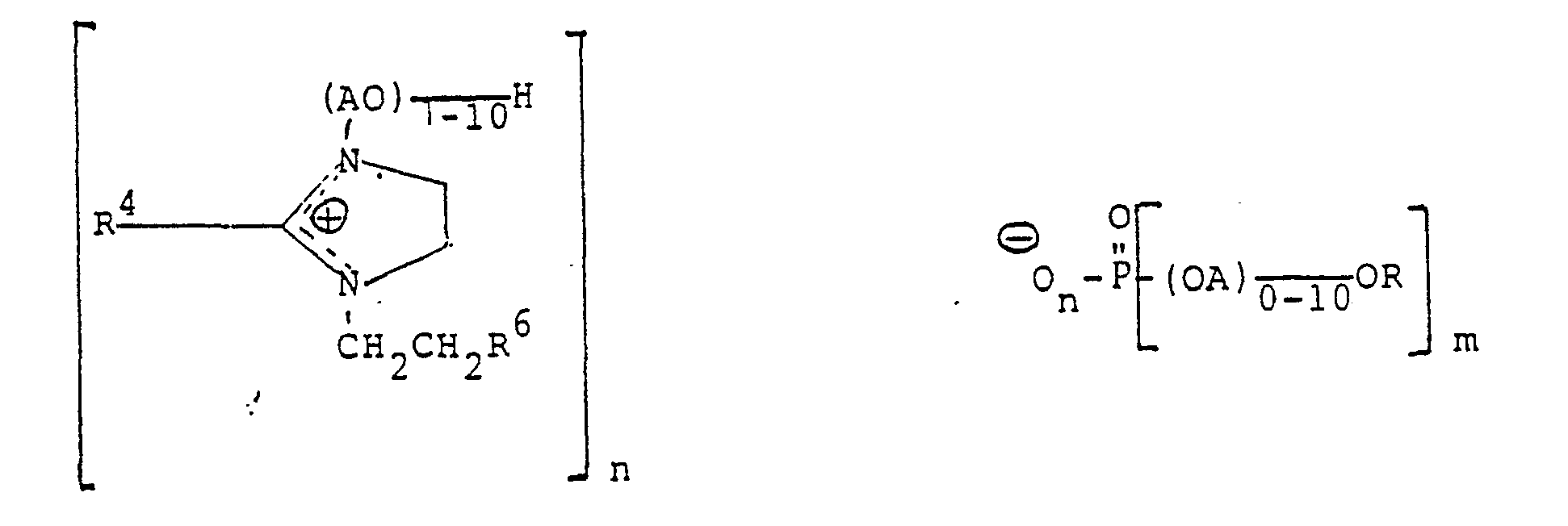
- Erfindungsgegenstand sind demgemäß Mischungen, enthaltend:
- (A) anoxidierte Polyethylene mit mittleren Molekulargewichten zwischen 3000 und 8000, mit Säurezahlen zwischen 25 und 60, Verseifungszahlen zwischen 40 und 80 und Dichten zwischen 0,94 und 1,09 g/cm3 und
- (B) mindestens ein quartäres Ammoniumphosphat aus mindestens einer der folgenden Gruppen:
- 1.)

- R1 eine gesättigte oder ungesättigte, gerad- oder verzweigtkettige, substituierte oder unsubstituierte
- Alkylgruppe mit 6 bis 22 C-Atomen oder

- R2 (AO) , Methyl oder Ethyl

- R3 (AO) , Methyl oder Ethyl oder R2 und R3 zusammen -CH2CH2-O-CH2CH2-,
- R4 eine gesättigte oder ungesättigte, gerad- oder verzweigtkettige, substituierte oder -unsubstituierte Alkylgruppe mit 5 bis 21 C-Atomen,
- R5 H oder eine Alkylgruppe mit 1 bis 4 C-Atomen,
- R eine gesättigte oder ungesättigte, gerad- oder verzweigtkettige, substituierte oder unsubstituierte Alkylgruppe mit 6 bis 22 C-Atomen und
- A eine Alkylenkette mit 2 bis 4 C-Atomen bedeutet,
- p 2 oder 3 und
- n = 1, m = 2 oder n = 2, m = 1 ist,
-
- 2.)

- R4 eine gesättigte oder ungesättigte, gerad- oder verzweigtkettige, substituierte oder unsubstuierte Alkylgruppe mit 5 bis 21 C-Atomen,

- R eine gesättigte oder ungesättigte, gerad- oder verzweigtkettige, substituierte oder unsubstituierte Alkylgruppe mit 6 bis 22 C-Atomen und
- A eine Alkylenkette mit 2 bis 4 C-Atomen bedeutet und n = 1, m = 2 oder n = 2, m = 1 ist,
- R4 eine gesättigte oder ungesättigte, gerad- oder verzweigtkettige, substituierte oder unsubstuierte Alkylgruppe mit 5 bis 21 C-Atomen,



- 2.)
- In den erfindungsgemäßen Mischungen liegt das Gewichtsverhältnis der Komponenten A : B vorzugsweise zwischen 10 : 1 und 1 : 5, besonders bevorzugt zwischen 10 : 3 und 1 : 2.
- Aus der japanischen Patentanmeldung JP 59/47478 ist bereits bekannt, quartäre Ammoniumphosphate der allgemeinen Formel

- R. eine Alkyl- oder Alkenylgruppe mit 8 bis 22 C-Atomen,

- oder ß-Hydroxyalkyl bedeutet, R2 und R3 unabhängig voneinander eine Alkyl- oder Alkenylgruppe mit 1 bis 22 C-Atomen, eine Benzylgruppe oder -(AO)
n H bedeutet oder R2 und R3 -CH2CH2-0-CH2CH2- bedeuten, R4 (OCH(R6)CH2)1-OH. - Rs eine Alkyl- oder Alkenylgruppe mit 7 bis 21 C-Atomen,
- R6 H oder eine Alkylgruppe mit 1 bis 18 C-Atomen,
- X- das Anion eines organischen Phosphorsäureesters der allgemeinen Formel

- R7 eine Alkyl- oder Alkenylgruppe mit 8 bis 22 C-Atomen,
- A und A' eine Alkylengruppe mit 2 bis 4 C-Atomen bedeutet,
- m 1 bis 3,
- n 1 bis 20,
- 1 1 bis 5,
- p 0 bis 20 und
- q 1 oder 2 ist,
- als Antistatika für synthetische Textilfasern, beispielsweise Polyesterfasern zu verwenden.
- Durch Kombination bestimmter quartärer Ammoniumphosphate (Komponente (B) 1 - 3) mit anoxidierten Polyethylenen (Komponente A) wird nun überraschenderweise sowohl die antistatische Wirkung als auch die Glätte polyesterhaltiger Fasermaterialien deutlich verbessert. Des weiteren verleihen die erfindungsgemäßen Mischungen polyesterhaltigen Fasermaterialien ein gutes Griffgefühl.
- Die Verwendung von Mischungen, enthaltend anoxidierte Polyethylene mit mittleren Molekulargewichten zwischen 3000 und 8000, Säurezahlen zwischen 25 und 60, Verseifungszahlen zwischen 40 und 80 und Dichten zwischen 0,94 und 1,09 g/cm3 und mindestens ein quartäres Ammoniumphosphat aus mindestens einer der Gruppen (B) 1 -3, als Textilhilfsmittel zum Antistatisch-, Glatt- und/oder Weichmachen polyesterhaltiger Fasermaterialien ist daher ebenfalls Erfindungsgegenstand.
- Anoxidierte Polyethylene mit mittleren Molekulargewichten zwischen 3500 und 5000 und Dichten zwischen 0,98 und 1,00 gicm3 werden in den erfindungsgemäßen Mischungen bevorzugt.
- Als Komponente B gelangen vorzugsweise solche quartären Ammoniumphosphate der allgemeinen Formeln zu (B) 1 - 3 zum Einsatz, in denen die Reste folgende Bedeutung haben:
- R' eine gesättigte, gerad- oder verzweigtkettige, substituierte oder unsubstituierte Alkylgruppe mit 8 bis 18 C-Atomen, eine ungesättigte, gerad- oder verzweigtkettige, substituierte oder unsubstituierte Alkylgruppe mit 18 bis 22 C-Atomen oder

- R6 OH,
- Rs eine gesättigte oder ungesättigte, gerad- oder verzweigtkettige, substituierte oder unsubstituierte Alkylgruppe mit 6 bis 20 C-Atomen,
- R eine gesättigte, gerad- oder verzweigtkettige, substituierte oder unsubstituierte Alkylgruppe mit 8 bis 18 C-Atomen oder eine ungesättigte gerad- oder verzweigtkettige, substituierte oder unsubstituierte Alkylgruppe mit 18 bis 22 C-Atomen und
- A Ethylen- und/oder Isopropylengruppen.
- Die erfindungsgemäßen Mischungen, die vorzugsweise in Form von Dispersionen oder Lösungen, besonders bevorzugt in Form wäßriger Emulsionen vorliegen, enthalten vorzugsweise zwischen 5 und 50 Gew.-%, besonders bevorzugt zwischen 10 und 30 Gew.-% der Komponenten A und B. Die Dispersionen oder Lösungen, vorzugsweise wäßrigen Emulsionen, werden in an sich bekannter Weise in Spül-, Wasch-oder Tauchbädern oder durch Sprühprozesse auf polyesterhaltige Fasermaterialien appliziert und mittels Schleudern, Abquetschen und Temperaturbehandlung zwischen 80 und 160 C getrocknet. Vorzugsweise erfolgt die Applikation der erfindungsgemäßen Mischungen im Ausziehverfahren aus wäßrigen Flotten bei Flottenverhältnissen zwischen 1 : 5 und 1 : 25 bei Flotten-pH-Werten zwischen 4,0 und 7,0 und Temperaturen zwischen 40 und 80 ° C. Da Textilhilfsmittel, enthaltend erfindungsgemäß Komponente A und Komponente B, eine hohe Affinität zu polyesterhaltigen Fasermaterialien haben, wird eine hohe Auszehrung der Behandlungsflotten erreicht.
- Unter "polyesterhaltige Fasermaterialien" werden reine Polyesterfasern sowie Mischungen aus Polyesterfasern und Natur-und/oder Synthesefasern, beispielsweise Mischungen aus Polyesterfasern und Baumwolle; Polyesterfasern und Polyamidfasern; Polyesterfasern, Baumwolle und Polyamidfasern; Polyesterfasern und Polyacrylfasern verstanden. Die Textilfasermaterialien liegen als Flocke, Kammzug, Garn, Wirkware, Gewebe oder Nonwovens, vorzugsweise als Flocke oder Kammzug vor. Das Material kann rohweiß, gebleicht oder gefärbt sein.
- Die in den erfindungsgemäßen Mischungen enthaltenen anoxidierten Polyethylene sind handelsübliche Produkte, die beispielsweise von Allied Corp., USA unter dem Namen A-C@ Polyethylene angeboten werden.
- Die Herstellung der in den erfindungsgemäßen Mischungen enthaltenen quartären Ammoniumphosphate erfolgt nach dem in JP 59/47478 beschriebenen Verfahren, indem man Amine, Imidazolin und/oder aminofunktionelle Polyester, erhalten gemäß DE-OS 30 32 216 durch Kondensation alkoxylierter tertiärer Amine mit Dicarbonsäuren, mit Phosphorsäureestern der allgemeinen Formeln


- Die als Edukte zur Herstellung quartärer Ammoniumphosphate benötigten Amine, Imidazoline und aminofunktionellen Polyester sowie Phosphorsäurepartialester sind nach literaturbekannten Verfahren zugänglich:
- Amine, die beispielsweise durch Hydrierung von Fettsäurenitrilen (Ullmann's Encyclopädie der technischen Chemie, Band 11, Seite 448 - 449, Verlag Chemie, Weinheim 1976) oder direkt aus Fettalkoholen und Ammoniak gemäß GB 1 074 603 hergestellt werden können, werden gewünschtenfalls vorzugsweise mit Ethylenoxid und/oder Propylenoxid bei Temperaturen zwischen 130 und 180 C umgesetzt mit der Maßgabe, daß die Polyalkyletherketten der gebildeten tertiären Amine aus 1 bis 5 Ethylenoxid- und/oder Propylenoxideinheiten bestehen. Kokosamin, Oleylamin, Talgamin, Kokosalkyl-di-2-hydroxyethyl-amin, Dimethyl-laurylamin und N-C12-14-Alkylmorpholin sind Beispiele für Amine, die sich zur Herstellung quartärer Ammoniumphosphate eignen. Als Beispiel für acylierte Amine ist Kokoylamidopropyl-dimethylamin zu nennen.
- Die als Ausgangsstoffe zur Herstellung quartärer Imidazoliniumphosphate benötigten Imidazoline können durch Kondensation von Carbonsäuren, Carbonsäureestern oder Carbonsäurechloriden mit Diaminverbindungen hergestellt werden (G. Gawalek: "Tenside", S. 305 - 306, Akademie Verlag, Berlin 1975). Vorzugsweise erfolgt die Herstellung der Imidazoline gemäß der deutschen Offenlegungsschrift DE-OS 36 18 944 durch Kon densation von Carbonsäuren der allgemeinen Formel R4-COOH, in der R4 eine gerad-oder verzweigtkettige, gesättigte oder ungesättigte, substituierte oder unsubstituierte Alkylgruppe mit 5 bis 21 C-Atomen bedeutet, mit Diaminen der allgemeinen Formel H2N-CH2CH2-NH-CH2CH2R6. in der R 6 OH oder

- Die Kondensation wird bei Temperaturen zwischen 150 und 240 C, vorzugsweise zwischen 150 und 200°C durchgeführt. Das Molverhältnis Carbonsäure : Diamin liegt vorzugsweise zwischen 1 : 1 und 1 : 2.
- Zur Herstellung der Imidazoline können die Carbonsäuren sowohl einzeln als auch im Gemisch eingesetzt werden. Von besonderer Bedeutung ist der Einsatz von Fettsäuregemischen, wie sie bei der Spaltung natürlich vorkommender Fette und/oder Öle anfallen. Einzelne Fraktionen solcher Fettsäuregemische eignen sich ebenfalls zur Herstellung der Imidazoline. Als Carbonsäuren werden vorzugsweise solche der allgemeinen Formel R* - COOH eingesetzt, in der der Rest R4 für eine gerad- oder verzweigtkettige, substituierte oder unsubstituierte, gesättigte Alkylgruppe mit 7 bis 17 C-Atomen oder für eine gerad- oder verzweigtkettige. substituierte oder unsubstituierte, ungesättigte Alkylgruppe mit 17 bis 21 C-Atomen steht. beispielsweise Caprylsäure, Caprinsäure, Laurinsäure, Palmitinsäure, Stearinsäure, Ölsäure, Linolsäure, Linolinsäure, Gadoleinsäure und/oder Rizinolsäure.
- 1-Hydroxyethyl-2-undecylimidazolin, 1-Hydroxyethyl-2-heptadecenylimidazolin und 1-Hydroxyethyl-2- heptylimidazolin sind geeignete Imidazoline.
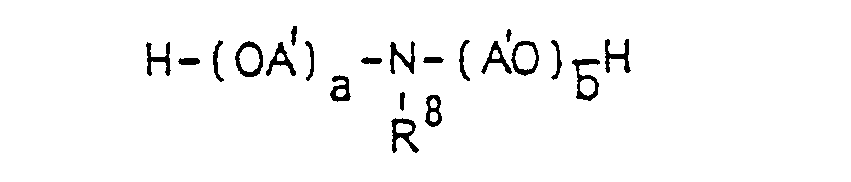
- Aminofunktionelle Polyester werden gemäß DE-OS 30 32 216 durch Kondensation alkoxylierter tertiärer Amine der allgemeinen Formel
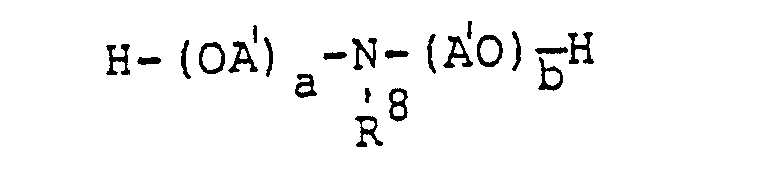
- R8 einen gesättigten oder ungesättigten, gerad- oder verzweigtkettigen, substituierten oder unsubstituierten Alkylrest mit 1 bis 20 C-Atomen und
- A eine Alkylenkette mit 2 bis 3 C-Atomen bedeutet,
- a und b Zahlen zwischen 1 und 20 sind mit der Maßgabe, daß die Summe von a und b 2 bis 30 ist.
- mit Dicarbonsäuren der allgemeinen Formel HOOC-R7-COOH, in welcher der Rest
- R7 einen aliphatischen, alicyclischen oder aromatischen, substituierten oder unsubstituierten Rest mit 1 bis 10 0 C-Atomen bedeutet,
- bei Temperaturen zwischen 180 und 260 °C, gegebenenfalls in Gegenwart von mit Wasser nicht mischbaren organischen Lösungsmitteln, beispielsweise Xylol oder Toluol, zur azeotropen Entfernung von Reaktionsnebenprodukten unter Ausschluß von Luftsauerstoff erhalten. Die aminofunktionellen Polyester besitzen Polymerisationsgrade zwischen 2 und 50, wenn pro Mol alkoxyliertem, tertiärem Amin 0,8 bis 1,1 Mol Dicarbonsäure eingesetzt werden. Als aliphatische, alicyclische und/oder aromatische, gegebenfalls substituierte Dicarbonsäuren kommen beispielsweise Malonsäure, Maleinsäure, Fumarsäure. Bernsteinsäure, Hydroxymalonsäure, Äpfelsäure, Chlorethandicarbonsäure, Oxalsäure und/oder Terephthalsäure in Frage. Im Falle der Oxalsäure verschwindet R7 in der allgemeinen Formel. Besonders geeignete aliphatische Dicarbonsäuren sind Säuren mit 6 bis 10 C-Atomen, wie Adipinsäure, Pimelinsäure, Korksäure, Azelainsäure und/oder Sebazinsäure.
- Anstelle der freien Säuren können mit gleichem Ergebnis auch Derivate dieser Säuren, beispielsweise Anhydride, Halogenide, Dimethylester in äquimolaren Mengen eingesetzt werden. Vorzugsweise werden jedoch die freien Dicarbonsäuren verwendet. Die zur Herstellung aminofunktioneller Polyester benötigten alkoxylierten tertiären Amine leiten sich von primären Alkyl-undioder Alkenylaminen ab, beispielsweise von Methylamin, Ethylamin, Butylamin, Octylamin, Decylamin, Dodecylamin, Cetylamin, Oleylamin, Linoleylamin, Kokosamin und/oder Talgamin. Alkylamine, die aus Kokosöl oder Talg hergestellt werden, werden bevorzugt. Alkyl- und/oder Alkenylamine werden in an sich bekannter Weise bei Temperaturen zwischen 130 und 180 C mit Ethylenoxid und/oder Propylenoxid alkoxyliert mit der Maßgabe, daß der Alkoxylierungsgrad (Summe von a und b) zwischen 2 und 30 liegt.
- Polyester aus Talgamin . 5 Ethylenoxideinheiten (EO) und Adipinsäure, Polyester aus Kokosamin . 2 EO und Adipinsäure, Polyester aus Kokosamin . 5 EO und Bernsteinsäure und/oder Polyester aus Talgamin . 10 EO und Sebazinsäure sind Beispiele für geeignete aminofunktionelle Polyester.
- Die Herstellung der Phosphorsäurepartialester geht aus von gerad- oder verzweigtkettigen, gesättigten oder ungesättigten, substituierten oder unsubstituierten, gegebenenfalls alkoxylierten Alkoholen mit 6 bis 22 C-Atomen. Vorzugsweise werden gerad- oder verzweigtkettige, substituierte oder unsubstituierte, gesättigte, gegebenenfalls alkoxylierte Alkohole mit 8 bis 18 C-Atomen und/oder gerad- oder verzweigtkettige, substituierte oder unsubstituierte, ungesättigte, gegebenenfalls alkoxylierte Alkohole mit 18 bis 22 C-Atomen ein gesetzt, beispielsweise 2-Ethylhexanol, n-Octanol, Isononylalkohol, Decylalkohol, Dodecylalkohol, Isotridecylalkohol, Tetradecylalkohol, Hexadecylalkohol, Octadecylalkohol, Octadecenylalkohol, Eicosenylalkohol, Docosenylalkohol. Diese Alkohole werden gegebenenfalls mit 1 bis 10 Mol Ethylenoxid, Propylenoxid und/oder Butylenoxid umgesetzt. Die Phosphatierung der gegebenenfalls alkoxylierten Alkohole erfolgt in an sich bekannter Weise, indem bei 50 bis 80 ° C 3 Mol Alkohol mit 1 Mol Phosphorpentoxid umgesetzt werden. Zur Hydrolyse von Polyphosphorsäureverbindungen wird mehrere Stunden bei 90 bis 100 C mit Wasser behandelt.
- Werden die erfindungsgemäßen Mischungen als Textilhilfsmittel zum Antistatisch-, Glatt- und/oder Weichmachen von polyesterhaltigen Fasermaterialien verwendet, liegen diese Mischungen vorzugsweise in Form von Dispersionen oder Lösungen, besonders bevorzugt in Form wäßriger Emulsionen, vor. Diese Emulsionen enthalten 2 bis 20 Gew.-% an nichtionischen, kationischen und/oder amphoteren Dispergatoren. Geeignete nichtionische Dispergatoren sind alkoxylierte, vorzugsweise ethoxylierte und/oder propoxylierte Fette, Öle, Fettalkohole mit 8 bis 24 C-Atomen im Fettrest, Fettamine mit 8 bis 24 C-Atomen im Fettrest und/oder C8-18-Alkylphenole, beispielsweise ethoxyliertes Rizinusöl, Oleylalkohol . 5 EO, Oleylacetylalkohol . 5 EO, Talgalkohol . 14 EO, Stearylamin . 2 EO, Talgamin . 2 EO, Stearylamin . 10 EO und/oder Nonylphenol . 10 EO. Als kationische Dispergatoren kommen alkoxylierte, vorzugsweise ethoxylierte und/oder propoxylierte Alkylamine mit 10 bis 20 C-Atomen in Form ihrer Ammioniumsalze in Frage, beispielsweise Stearylamin . 10 EO. Als amphotere Dispergatoren eignen sich beispielsweise Cs-z2-Alkyldimethylbetaine, N-Ca-z2-Alkylamidobetaine und/oder von Aminosäuren abzuleitende Amphotenside.
- Als fakultative Bestandteile können die Lösungen oder Dispersionen weitere Glättemittel, beispielsweise Paraffine mit Erweichungspunkten zwischen 35 und 80 C, Fettsäureester mit 12 bis 24 C-Atomen sowohl im Fettsäurerest, als auch im gerad- und/oder verzweigtkettigen, gesättigten und/oder ungesättigten Alkoholrest wie Isotridecylstearat, Stearylstearat und/oder Behenylbehenat und/oder Silicone wie Dimethylpolysiloxan, Weichmacher wie Fettsäureamidopolyamine und/oder quartäre Ammoniumsalze, beispielsweise Dimethyldistearylammoniumchlorid, Antioxidantien, beispielsweise Sauerstoffsäuren des Phosphors und/oder Alkalidisulfite und pH-Wert-Regulantien, beispielsweise C1-4-Carbonsäuren und/oder C1-4-Hydroxycarbonsäuren wie Essigsäure und/oder Glykolsäure enthalten. Der Anteil der fakultativen Bestandteile liegt in wäßrigen Dispersionen und Emulsionen zwischen 2 und 20 Gew.-%. Die Herstellung der Dispersionen und Lösungen, vorzugsweise der wäßrigen Emulsionen, die die erfindungsgemäßen Mischungen enthalten, erfolgt in an sich bekannter Weise, indem anoxidierte Polyethylene, Dispergatoren und fakultative Bestandteile mit Wasser gemischt und in einer druckfesten Apparatur bei 130 bis 170 C gerührt werden. Nach dem Abkühlen werden feinteilige, lagerstabile Emulsionen erhalten, in die quartäre Ammoniumphosphate und gegebenenfalls weitere Dispergatoren eingerührt werden.
- Es entstehen lagerstabile, flüssige, milchig-weiße Emulsionen mit Feststoffgehalten von 5 bis 50 Gew.- %. Durch Zusatz von Säuren, vorzugsweise Essigsäure, Glykolsäure oder Milchsäure, wird ein pH-Wert von 3,0 - 6,0 eingestellt.
- Die erfindungsgemäßen Mischungen sind hitzebeständig und bewirken keine Verfärbungen der Fasermaterialien. Die mit den erfindungsgemäßen Mischungen ausgerüsteten polyesterhaltigen Fasermaterialien zeigen im Vergleich zu unbehandelten, nur mit anoxidierten Polyethylenen oder nur mit quartären Ammoniumphosphaten behandelten polyesterhaltigen Fasermaterialien deutlich reduzierte antielektrostatische Aufladungen, niedrige statische und dynamische Faser/Faser-und Faser/Metall-Reibungen, eine hervorragende Glätte sowie einen guten Weichgriff.
- 1. Herstellung stabiler, wäßriger Emulsionen, die anoxidierte Polyethylene (Komponente A) enthalten.
- 1.1 5,0 g Oleylcetylalkohol . 5 EO 8,1 g anoxidiertes Polyethylen (mittleres Molekulargewicht = 4000, Säurezahl (SZ) = 28, Verseifungszahl (VZ) = 45, Dichte = 0,99 g/cm3) 2,6 g Paraffin (Schmelzpunkt = 52 bis 54 °C) 1,7 g Stearinsäure-isotridecylester 2,4 g Stearylamin . 2 EO 0,2 g Natriumbisulfit 11,9 g Essigsäure, 60 gewichts-%ig 63,1 g Wasser Die aufgeführten Einsatzstoffe wurden bei 155 bis 165 C unter Rühren in einer Druckapparatur gemischt. Es wurden 95 g einer feinteiligen Emulsionen mit einem pH-Wert von 4,1 erhalten.
- 1.2 5,0 g Oleylcetylalkohol . 5 EO 10,9 g anoxidiertes Polyethylen (mittleres Molekulargewicht = 4500, SZ = 30, VZ = 45, Dichte = 1,00 g/cm3) 3,1 g Stearylamin . 10 EO 0,3 g Natriumbisulfit 11,9 g Essigsäure, 60 gewichts-%ig 58,8 g Wasser Aus den Einsatzstoffen wurden analog 1.1 90 g einer feinteiligen Emulsion hergestellt, deren pH-Wert 3,9 betrug.
- 1.3 5,0 g Oleylalkohol . 5 EO 6,5 g anoxidiertes Polyethylen analog 1.1 1,7 g Fettsäureamidopolyamin aus 2 Mol Behensäure und 1 Mol Tetraethylenpentamin 0,7 g Talgalkohol . 14 EO 0,8 g Dimethylpolysiloxan (Viskosität = 12 500 cSt) 12.0 g Essigsäure, 60 gewichts-%ig 1,5 g Stearylamin . 5 EO 0,2 g Natriumbisulfit 51,6 g Wasser Aus den Einsatzstoffen wurden analog 1.1 80 g einer feinteiligen Emulsion hergestellt, deren pH-Wert 4,1 betrug.
- 2.1 127,4 g (0,47 Mol) Kokosalkyl-di-2-hydroxyethyl-amin wurden zusammen mit 80,0 g Wasser und 88,4 g (0,47 Säureäquivalente) eines Gemisches aus Mono- und Di-2-Ethylhexylphosphorsäureester im Gewichtsverhältnis 4 : 3 in einem Autoklaven vorgelegt und innerhalb von 4 h mit 104,0 g (2,35 Mol) Ethylenoxid bei 80 °C/3 bar zur Reaktion gebracht. Es wurden 392 g einer niedrigviskosen, ohne Gelbildung mit Wasser verdünnbaren Flüssigkeit erhalten.
- 2.2 126 g (0,47 Mol) 1-Hydroxyethyl-2-undecylimidazolin wurden zusammen mit 80,0 g Wasser und 88,4 g (0,47 Säureäquivalente) eines Gemisches aus Mono- und Di-2-Ethylhexylphosphorsäureester im Gewichtsverhältnis 4 : 3 in einem Autoklaven vorgelegt und innerhalb von 4 h mit 103,4 g (2,35 Mol) Ethylenoxid bei 80°C/3 bar zur Reaktion gebracht. Es wurden 395 g einer gelben, niedrigviskosen, ohne Gelbildung mit Wasser verdünnbaren Flüssigkeit erhalten.
- 2.3 125,1 g (0,44 Mol) Kokosalkyl-di-2-hydroxyethyl-amin, 80,0 g Wasser und 97,3 g (0,44 Säureäquivalente) eines Gemisches aus Mono- und Didodecylphosphat (molares Verhältnis 1,5 : 1) wurden analog 2.1 mit 97,6 g (2,22 Mol) Ethylenoxid umgesetzt. Es wurden 395 g einer mittelviskosen, hellbraunen Flüssigkeit erhalten, die leicht mit Wasser zu einer wenig getrübten Lösung verdünnbar war.
- 3. Herstellung wäßriger Emulsionen, die die erfindungsgemäßen Mischungen (Komponente A und B) enthalten
- 3.1 11,9 g quartäres Ammoniumphosphat 2.1 wurden mit 25.6 g Wasser verdünnt und anschließend mit 5,4 g eines mit 5 Mol Ethylenoxid alkoxyliertem Oleyl/Cetylalkoholgemisches versetzt. Durch Zugabe von 9,5 g 40 gewichts-%iger Essigsäure wurde ein pH-Wert von 5,2 eingestellt und mit 47,6 g der wäßrigen Emulsion 1.1 gemischt. Es entstand eine lagerstabile flüssige, milchig-weiße Emulsion mit einem Feststoffgehalt von 25 Gew.-% und einem pH-Wert von 4,5.
- 3.2 11,9 g quartäres Ammoniumphosphat 2.2 wurden mit 25,6 g Wasser verdünnt und mit 5,4 g eines mit 5 Mol Ethylenoxid alkoxylierten Oleyl/Cetylalkoholgemisches versetzt. Durch Zugabe von 9,5 g 40 gewichts-%iger Essigsäure wurde ein pH-Wert von 5,2 eingestellt und mit 47,6 g der wäßrigen Emulsion 1.2 gemischt. Es entstand eine lagerstabile flüssige, milchig-weiße Emulsion mit einem Feststoffgehalt von 25 Gew.-% und einem pH-Wert von 4,5.
- 3.3 11,9 g quartäres Ammoniumphosphat 2.3 wurden mit 25,6 g Wasser verdünnt und mit 5,4 g eines mit 5 Mol Ethylenoxid alkoxylierten Öleyl/Cetylalkoholgemisches versetzt. Durch Zugabe von 9,5 g 40 gewichts-%iger Essigsäure wurde ein pH-Wert von 5,2 eingestellt und mit 47,6 g der wäßrigen Emulsion 1.1 gemischt. Es entstand eine lagerstabile flüssige, milchig-weiße Emulsion mit einem Feststoffgehalt von 25 Gew.-% und einem pH-Wert von 4,5.
- Fettalkylamidoamin auf Basis von gehärtetem Rindertalg und Aminoethylethanolamin (Belfasin@ 44, Henkel KGaA)
- 5.1 Polyesterstapelfaser Gefärbtes und reduktiv nachbehandeltes Polyesterstapelfaser-Material (1.7 dtex/40 mm) wurde bei einem Flottenverhältnis von 1 : 10 20 Minuten bei einer Temperatur von 60 bis 70 °C mit einer essigsauren wäßrigen Lösung behandelt, die, berechnet auf das Warengewicht, jeweils 2 Gew.-% der unter 1., 2., 3. oder 4. genannten Mischungen enthielt. Im Anschluß an die Applikation wurde das Material geschleudert und bei 80 ° C 2 h getrocknet.
- Die Messung des elektrostatischen Effektes wurde auf einer Laborkarde nach einer 24 h Klimatisierung (22 o C, 62 bis 65 % relative Luftfeuchte) des Fasermaterials mit einem Eltex-Gerät nach der Induktionsstrommethode (Meßabstand 100 mm) durchgeführt.

- Ein gefärbter und reduktiv nachbehandelter Polyester-Kammzug (20 g/m; 6.7 dtex/80 mm) wurde bei einem Flottenverhältnis von 1 : 15 20 minuten bei einer Temperatur von 60 bis 70 °C mit einer essigsauren wäßrigen Lösung behandelt, die, berechnet auf das Warengewicht, jeweils 2 Gew.-% der unter 1., 2., 3. oder 4. beschriebenen Mischungen enthielt. Nach Beendigung der Avivierung wurde der Kammzug geschleudert und 2 h bei 80 C getrocknet.
- Die Messung der elektrostatischen Aufladung wurde auf einer Doppelnadelstabstrecke während der Verstreckung (Liefergeschwindigkeit V = 150 m/min) nach der Induktionsstrommeßmethode zwischen Streckwerkausgang und Coilereinlauf im Abstand von 100 mm durchgeführt.

- Die auf der Nadelstabstrecke hergestellten Streckenbänder wurden nach der Cohesionmetermeßmethodik beurteilt. Die Meßwerte cN . tex -1 repräsentieren die bei einem Verzug von 1,25fach auftretenden Kräfte, die benötigt werden, um eine Längenänderung des Vorlagematerials herbeizuführen. Die ermittelten Meßwerte wurden über ein Rothschild F-Meter unter Zuhilfenahme eines angeschlossenen Kleincomputers statistisch aufbereitet.

Claims (11)







Priority Applications (1)
| Application Number | Priority Date | Filing Date | Title |
|---|---|---|---|
| AT89104695T ATE95855T1 (de) | 1988-03-24 | 1989-03-16 | Ziehfaehige zusammensetzung fuer die behandlung von polyesterhaltigen fasermaterialien. |
Applications Claiming Priority (2)
| Application Number | Priority Date | Filing Date | Title |
|---|---|---|---|
| DE3809928 | 1988-03-24 | ||
| DE3809928A DE3809928A1 (de) | 1988-03-24 | 1988-03-24 | Ziehfaehige textilhilfsmittel fuer polyesterhaltige fasermaterialien |
Publications (3)
| Publication Number | Publication Date |
|---|---|
| EP0342331A2 true EP0342331A2 (de) | 1989-11-23 |
| EP0342331A3 EP0342331A3 (de) | 1991-11-21 |
| EP0342331B1 EP0342331B1 (de) | 1993-10-13 |
Family
ID=6350572
Family Applications (1)
| Application Number | Title | Priority Date | Filing Date |
|---|---|---|---|
| EP89104695A Expired - Lifetime EP0342331B1 (de) | 1988-03-24 | 1989-03-16 | Ziehfähige Zusammensetzung für die Behandlung von polyesterhaltigen Fasermaterialien |
Country Status (8)
| Country | Link |
|---|---|
| US (1) | US4975091A (de) |
| EP (1) | EP0342331B1 (de) |
| JP (1) | JPH01314783A (de) |
| AT (1) | ATE95855T1 (de) |
| AU (1) | AU614045B2 (de) |
| BR (1) | BR8901358A (de) |
| DE (2) | DE3809928A1 (de) |
| ES (1) | ES2059597T3 (de) |
Cited By (1)
| Publication number | Priority date | Publication date | Assignee | Title |
|---|---|---|---|---|
| FR2655068A1 (fr) * | 1989-11-30 | 1991-05-31 | Kao Corp | Composition d'huile d'ensimage pour le filage a grande vitesse. |
Families Citing this family (11)
| Publication number | Priority date | Publication date | Assignee | Title |
|---|---|---|---|---|
| NZ235490A (en) * | 1989-10-16 | 1993-08-26 | Colgate Palmolive Co | Fabric-softening compositions |
| JPH0441776A (ja) * | 1990-06-01 | 1992-02-12 | Kao Corp | 液体柔軟仕上剤 |
| US5282983A (en) * | 1990-08-22 | 1994-02-01 | Kao Corporation | Fabric softener composition and ammonium salt |
| US5182033A (en) * | 1991-06-14 | 1993-01-26 | Sherex Chemical Company, Inc. | Polyamide salts |
| US5491004A (en) * | 1994-05-26 | 1996-02-13 | Henkel Corporation | Process for applying a low soiling fiber finish |
| US5728673A (en) * | 1996-01-31 | 1998-03-17 | The Procter & Gamble Company | Process for making a fluid, stable liquid fabric softening composition including dispersible polyolefin |
| US5830843A (en) * | 1996-01-31 | 1998-11-03 | The Procter & Gamble Company | Fabric care compositions including dispersible polyolefin and method for using same |
| US5789373A (en) * | 1996-01-31 | 1998-08-04 | Baker; Ellen Schmidt | Laundry additive compositions including dispersible polyolefin |
| US6140413A (en) * | 1999-03-29 | 2000-10-31 | Henkel Corporation | Silicone softener viscosity reducer |
| WO2002079364A1 (en) * | 2001-03-30 | 2002-10-10 | Ciba Specialty Chemicals Holding Inc. | Softener compositions and their use |
| SE543907C2 (en) * | 2019-12-13 | 2021-09-21 | Organoclick Ab | Non-rewetting o/w (oil in water) emulsification system for hydrophobic compounds |
Family Cites Families (10)
| Publication number | Priority date | Publication date | Assignee | Title |
|---|---|---|---|---|
| US3390184A (en) * | 1965-06-01 | 1968-06-25 | Jefferson Chem Co Inc | Production of primary amines by ammonolysis |
| US3984335A (en) * | 1975-01-16 | 1976-10-05 | Basf Wyandotte Corporation | Compositions for souring and softening laundered textile materials and stock solutions prepared therefrom |
| DE3007930A1 (de) * | 1980-03-01 | 1981-09-24 | Henkel KGaA, 4000 Düsseldorf | Neue polyesterverbindungen, ein verfahren zu ihrer herstellung und ihre verwendung als textilweichmacher |
| DE3032216A1 (de) * | 1980-08-27 | 1982-04-08 | Henkel KGaA, 4000 Düsseldorf | Haarwasch- und haarbehandlungsmittel |
| JPS5947478A (ja) * | 1982-09-06 | 1984-03-17 | 花王株式会社 | 合成繊維用紡績油剤 |
| DE3238395A1 (de) * | 1982-10-16 | 1984-04-19 | Henkel KGaA, 4000 Düsseldorf | Glaettemittel fuer textilfasermaterial |
| JPS61108767A (ja) * | 1984-10-31 | 1986-05-27 | 竹本油脂株式会社 | 合成繊維用帯電防止剤 |
| JPS61289182A (ja) * | 1985-06-14 | 1986-12-19 | 竹本油脂株式会社 | 合成繊維用帯電防止剤 |
| DE3618944A1 (de) * | 1986-06-05 | 1987-12-10 | Henkel Kgaa | Quartaere 2-alkylimidazoliniumsalze, verfahren zu deren herstellung und deren verwendung |
| US4698391A (en) * | 1986-07-30 | 1987-10-06 | Eastman Kodak Company | Crosslinked polymers with lowered resistivity and materials and methods for their preparation |
-
1988
- 1988-03-24 DE DE3809928A patent/DE3809928A1/de not_active Withdrawn
-
1989
- 1989-03-16 DE DE89104695T patent/DE58905875D1/de not_active Expired - Fee Related
- 1989-03-16 EP EP89104695A patent/EP0342331B1/de not_active Expired - Lifetime
- 1989-03-16 AT AT89104695T patent/ATE95855T1/de not_active IP Right Cessation
- 1989-03-16 ES ES89104695T patent/ES2059597T3/es not_active Expired - Lifetime
- 1989-03-22 US US07/327,210 patent/US4975091A/en not_active Expired - Fee Related
- 1989-03-22 BR BR898901358A patent/BR8901358A/pt unknown
- 1989-03-23 AU AU31702/89A patent/AU614045B2/en not_active Ceased
- 1989-03-24 JP JP1073679A patent/JPH01314783A/ja active Pending
Cited By (2)
| Publication number | Priority date | Publication date | Assignee | Title |
|---|---|---|---|---|
| FR2655068A1 (fr) * | 1989-11-30 | 1991-05-31 | Kao Corp | Composition d'huile d'ensimage pour le filage a grande vitesse. |
| US5190676A (en) * | 1989-11-30 | 1993-03-02 | Kao Corporation | High-speed spinning oil composition containing an organophosphoric ester salt and an oxyalkylene polymer |
Also Published As
| Publication number | Publication date |
|---|---|
| JPH01314783A (ja) | 1989-12-19 |
| BR8901358A (pt) | 1989-11-07 |
| EP0342331A3 (de) | 1991-11-21 |
| ATE95855T1 (de) | 1993-10-15 |
| AU614045B2 (en) | 1991-08-15 |
| US4975091A (en) | 1990-12-04 |
| EP0342331B1 (de) | 1993-10-13 |
| DE3809928A1 (de) | 1989-10-05 |
| ES2059597T3 (es) | 1994-11-16 |
| DE58905875D1 (de) | 1993-11-18 |
| AU3170289A (en) | 1989-09-28 |
Similar Documents
| Publication | Publication Date | Title |
|---|---|---|
| EP0342331B1 (de) | Ziehfähige Zusammensetzung für die Behandlung von polyesterhaltigen Fasermaterialien | |
| EP0417047A2 (de) | Mikroemulsionen von Aminopolysiloxanen | |
| DE3501293C2 (de) | ||
| DE69109579T2 (de) | Textilweichmacherzusammensetzung. | |
| EP0075770A2 (de) | Textilbehandlungsmittel und ihre Verwendung zum Ausrüsten von Textilmaterialien | |
| EP0001620B1 (de) | Quaternierte Amin-Amid Kondensationsprodukte und deren Verwendung in ölhaltigen Faserpräparationsmitteln | |
| EP0131865B1 (de) | Veresterte, oxalkylierte quaternäre Ammoniumverbindungen, Verfahren zu deren Herstellung und deren Verwendung als Faserpräparationsmittel | |
| DE4243547C2 (de) | Quaternierte Fettsäure-triethanolaminester-Salze | |
| CH444809A (de) | Verwendung von Salzen als antielektrostatische Mittel | |
| EP0230910B1 (de) | Textilbehandlungsmittel | |
| EP0331030A1 (de) | Quartäre Imidazoliniumphosphate | |
| DE3807069A1 (de) | Quataere ammoniumphosphate auf basis aminofunktioneller polyester | |
| DE1149687B (de) | Verfahren zur Behandlung, insbesondere antistatischen Ausruestung von Textilmaterialien | |
| DE4243550C1 (de) | Faserhilfsmittel und deren Verwendung | |
| DE2659705B2 (de) | Präparation für synthetische Fäden und Fasern | |
| DE2241845B2 (de) | Oberflächenaktive Stoffmischungen und deren Verwendung | |
| EP0535438A1 (de) | Wässrige Lecithindispersionen und ihre Verwendung zur Behandlung von Fasermaterialien | |
| DE1769525A1 (de) | Verfahren zum Weichmachen von Textilmaterialien | |
| DE2335674C3 (de) | Verfahren und Mittel zum Präparieren von Fasern | |
| DE2447410B2 (de) | Praeparationsmittel zur herstellung von synthetischen stapelfasern mit ausgepraegter oeffnungswilligkeit | |
| DE1211577B (de) | Verfahren zur antistatischen Avivage von Fasern, Faeden und daraus hergestellten Textilien | |
| DE1815706A1 (de) | Ester und ihre Verwendung als Textil-Hilfsmittel | |
| AT210380B (de) | Fett- und ölfreie Schmälzmittel für die Wollindustrie | |
| DE1276025B (de) | Verfahren zur Herstellung von kationischen, quaternaere Stickstoffatome enthaltendenHarnstoffverbindungen | |
| EP0539790A1 (de) | Alkylbetainsulfosuccinate und ihre Verwendung zur Herstellung von textilen Präparationen |
Legal Events
| Date | Code | Title | Description |
|---|---|---|---|
| PUAI | Public reference made under article 153(3) epc to a published international application that has entered the european phase |
Free format text: ORIGINAL CODE: 0009012 |
|
| AK | Designated contracting states |
Kind code of ref document: A2 Designated state(s): AT BE CH DE ES FR GB GR IT LI LU NL SE |
|
| PUAL | Search report despatched |
Free format text: ORIGINAL CODE: 0009013 |
|
| AK | Designated contracting states |
Kind code of ref document: A3 Designated state(s): AT BE CH DE ES FR GB GR IT LI LU NL SE |
|
| RBV | Designated contracting states (corrected) |
Designated state(s): AT CH DE ES FR GB IT LI NL |
|
| 17P | Request for examination filed |
Effective date: 19911210 |
|
| 17Q | First examination report despatched |
Effective date: 19920723 |
|
| GRAA | (expected) grant |
Free format text: ORIGINAL CODE: 0009210 |
|
| AK | Designated contracting states |
Kind code of ref document: B1 Designated state(s): AT CH DE ES FR GB IT LI NL |
|
| REF | Corresponds to: |
Ref document number: 95855 Country of ref document: AT Date of ref document: 19931015 Kind code of ref document: T |
|
| ET | Fr: translation filed | ||
| REF | Corresponds to: |
Ref document number: 58905875 Country of ref document: DE Date of ref document: 19931118 |
|
| ITF | It: translation for a ep patent filed | ||
| GBT | Gb: translation of ep patent filed (gb section 77(6)(a)/1977) |
Effective date: 19940119 |
|
| PLBE | No opposition filed within time limit |
Free format text: ORIGINAL CODE: 0009261 |
|
| STAA | Information on the status of an ep patent application or granted ep patent |
Free format text: STATUS: NO OPPOSITION FILED WITHIN TIME LIMIT |
|
| 26N | No opposition filed | ||
| REG | Reference to a national code |
Ref country code: ES Ref legal event code: FG2A Ref document number: 2059597 Country of ref document: ES Kind code of ref document: T3 |
|
| PGFP | Annual fee paid to national office [announced via postgrant information from national office to epo] |
Ref country code: ES Payment date: 20010228 Year of fee payment: 13 |
|
| PGFP | Annual fee paid to national office [announced via postgrant information from national office to epo] |
Ref country code: DE Payment date: 20010312 Year of fee payment: 13 |
|
| PGFP | Annual fee paid to national office [announced via postgrant information from national office to epo] |
Ref country code: FR Payment date: 20010313 Year of fee payment: 13 Ref country code: AT Payment date: 20010313 Year of fee payment: 13 |
|
| PGFP | Annual fee paid to national office [announced via postgrant information from national office to epo] |
Ref country code: GB Payment date: 20010314 Year of fee payment: 13 |
|
| PGFP | Annual fee paid to national office [announced via postgrant information from national office to epo] |
Ref country code: CH Payment date: 20010315 Year of fee payment: 13 |
|
| PGFP | Annual fee paid to national office [announced via postgrant information from national office to epo] |
Ref country code: NL Payment date: 20010330 Year of fee payment: 13 |
|
| REG | Reference to a national code |
Ref country code: GB Ref legal event code: IF02 |
|
| PG25 | Lapsed in a contracting state [announced via postgrant information from national office to epo] |
Ref country code: GB Free format text: LAPSE BECAUSE OF NON-PAYMENT OF DUE FEES Effective date: 20020316 Ref country code: AT Free format text: LAPSE BECAUSE OF NON-PAYMENT OF DUE FEES Effective date: 20020316 |
|
| PG25 | Lapsed in a contracting state [announced via postgrant information from national office to epo] |
Ref country code: ES Free format text: LAPSE BECAUSE OF NON-PAYMENT OF DUE FEES Effective date: 20020317 |
|
| PG25 | Lapsed in a contracting state [announced via postgrant information from national office to epo] |
Ref country code: LI Free format text: LAPSE BECAUSE OF NON-PAYMENT OF DUE FEES Effective date: 20020331 Ref country code: CH Free format text: LAPSE BECAUSE OF NON-PAYMENT OF DUE FEES Effective date: 20020331 |
|
| PG25 | Lapsed in a contracting state [announced via postgrant information from national office to epo] |
Ref country code: NL Free format text: LAPSE BECAUSE OF NON-PAYMENT OF DUE FEES Effective date: 20021001 Ref country code: DE Free format text: LAPSE BECAUSE OF NON-PAYMENT OF DUE FEES Effective date: 20021001 |
|
| GBPC | Gb: european patent ceased through non-payment of renewal fee |
Effective date: 20020316 |
|
| REG | Reference to a national code |
Ref country code: CH Ref legal event code: PL |
|
| PG25 | Lapsed in a contracting state [announced via postgrant information from national office to epo] |
Ref country code: FR Free format text: LAPSE BECAUSE OF NON-PAYMENT OF DUE FEES Effective date: 20021129 |
|
| NLV4 | Nl: lapsed or anulled due to non-payment of the annual fee |
Effective date: 20021001 |
|
| REG | Reference to a national code |
Ref country code: FR Ref legal event code: ST |
|
| REG | Reference to a national code |
Ref country code: ES Ref legal event code: FD2A Effective date: 20030410 |
|
| PG25 | Lapsed in a contracting state [announced via postgrant information from national office to epo] |
Ref country code: IT Free format text: LAPSE BECAUSE OF NON-PAYMENT OF DUE FEES;WARNING: LAPSES OF ITALIAN PATENTS WITH EFFECTIVE DATE BEFORE 2007 MAY HAVE OCCURRED AT ANY TIME BEFORE 2007. THE CORRECT EFFECTIVE DATE MAY BE DIFFERENT FROM THE ONE RECORDED. Effective date: 20050316 |