EP0341997B1 - Ajustage de prothèses auditives en utilisant des vecteurs - Google Patents
Ajustage de prothèses auditives en utilisant des vecteurs Download PDFInfo
- Publication number
- EP0341997B1 EP0341997B1 EP89304714A EP89304714A EP0341997B1 EP 0341997 B1 EP0341997 B1 EP 0341997B1 EP 89304714 A EP89304714 A EP 89304714A EP 89304714 A EP89304714 A EP 89304714A EP 0341997 B1 EP0341997 B1 EP 0341997B1
- Authority
- EP
- European Patent Office
- Prior art keywords
- signal processing
- processing parameters
- vector
- auditory
- signal
- Prior art date
- Legal status (The legal status is an assumption and is not a legal conclusion. Google has not performed a legal analysis and makes no representation as to the accuracy of the status listed.)
- Expired - Lifetime
Links
Images


Classifications
-
- H—ELECTRICITY
- H04—ELECTRIC COMMUNICATION TECHNIQUE
- H04R—LOUDSPEAKERS, MICROPHONES, GRAMOPHONE PICK-UPS OR LIKE ACOUSTIC ELECTROMECHANICAL TRANSDUCERS; ELECTRIC HEARING AIDS; PUBLIC ADDRESS SYSTEMS
- H04R25/00—Electric hearing aids
-
- H—ELECTRICITY
- H04—ELECTRIC COMMUNICATION TECHNIQUE
- H04R—LOUDSPEAKERS, MICROPHONES, GRAMOPHONE PICK-UPS OR LIKE ACOUSTIC ELECTROMECHANICAL TRANSDUCERS; ELECTRIC HEARING AIDS; PUBLIC ADDRESS SYSTEMS
- H04R25/00—Electric hearing aids
- H04R25/70—Adaptation of deaf aid to hearing loss, e.g. initial electronic fitting
-
- H—ELECTRICITY
- H04—ELECTRIC COMMUNICATION TECHNIQUE
- H04R—LOUDSPEAKERS, MICROPHONES, GRAMOPHONE PICK-UPS OR LIKE ACOUSTIC ELECTROMECHANICAL TRANSDUCERS; ELECTRIC HEARING AIDS; PUBLIC ADDRESS SYSTEMS
- H04R2225/00—Details of deaf aids covered by H04R25/00, not provided for in any of its subgroups
- H04R2225/41—Detection or adaptation of hearing aid parameters or programs to listening situation, e.g. pub, forest
-
- H—ELECTRICITY
- H04—ELECTRIC COMMUNICATION TECHNIQUE
- H04R—LOUDSPEAKERS, MICROPHONES, GRAMOPHONE PICK-UPS OR LIKE ACOUSTIC ELECTROMECHANICAL TRANSDUCERS; ELECTRIC HEARING AIDS; PUBLIC ADDRESS SYSTEMS
- H04R25/00—Electric hearing aids
- H04R25/30—Monitoring or testing of hearing aids, e.g. functioning, settings, battery power
- H04R25/305—Self-monitoring or self-testing
-
- H—ELECTRICITY
- H04—ELECTRIC COMMUNICATION TECHNIQUE
- H04R—LOUDSPEAKERS, MICROPHONES, GRAMOPHONE PICK-UPS OR LIKE ACOUSTIC ELECTROMECHANICAL TRANSDUCERS; ELECTRIC HEARING AIDS; PUBLIC ADDRESS SYSTEMS
- H04R25/00—Electric hearing aids
- H04R25/50—Customised settings for obtaining desired overall acoustical characteristics
- H04R25/505—Customised settings for obtaining desired overall acoustical characteristics using digital signal processing
Definitions
- the present invention relates generally to auditory prostheses and more particularly to auditory prostheses having adjustable acoustic parameters.
- Auditory prostheses have been utilized to modify the auditory characteristics of sound received by a user or wearer of that auditory prosthesis. Usually the intent of the prosthesis is, at least partially, to compensate for a hearing impairment of the user or wearer. Hearing aids which provide an acoustic signal in the audible range to a wearer have been well known and are an example of an auditory prosthesis. More recently, cochlear implants which stimulate the auditory nerve with an electrical stimulus signal have been used to improve the hearing of a wearer. Other examples of auditory prostheses are implanted hearing aids which stimulate the auditory response of the wearer by a mechanical stimulation of the middle ear and prostheses which otherwise electromechanically stimulate the user.
- Hearing impairments are quite variable from one individual to another individual.
- An auditory prosthesis which compensates for the hearing impairment of one individual may not be beneficial or may be disruptive to another individual.
- auditory prostheses must be adjustable to serve the needs of an individual user or patient.
- the process by which an individual auditory prosthesis is adjusted to be of optimum benefit to the user or patient is typically called “fitting". Stated another way, the auditory prosthesis must be “fit” to the individual user of that auditory prosthesis in order to provide a maximum benefit to that user, or patient.
- the "fitting" of the auditory prosthesis provides the auditory prosthesis with the appropriate auditory characteristics to be of benefit to the user.
- This fitting process involves measuring the auditory characteristics of the individual's hearing, calculating the nature of the acoustic characteristics, e.g., acoustic amplification in specified frequency bands, needed to compensate for the particular auditory deficiency is measured, adjusting the auditory characteristics of the auditory prosthesis to enable the prosthesis to deliver the appropriate acoustic characteristic, e. g., acoustic amplification in specified frequency bands, and verifying that this particular auditory characteristic does compensate tor the hearing deficiency found by operating the auditory prosthesis in conjunction with the individual.
- the adjustment of the auditory characteristics is accomplished by selection of components during the manufacturing process, so called “custom" hearing aids, or by adjusting potentiometers available to the fitter, typically an otologist, audiologist, hearing aid dispenser, otolaryngologist or other doctor or medical specialist.
- Some hearing aids are programmable in addition to being adjustable.
- Programmable hearing aids have some memory device in which is stored the acoustic parameters which the hearing aid can utilize to provide a particular auditory characteristic.
- the memory device may be changed or modified to provide a new or modified auditory parameter or set of acoustic parameters which in turn will provide the hearing aid with a modified auditory characteristic.
- the memory device will be an electronic memory, such as a register or randomly addressable memory, but may also be other types of memory devices such as programmed cards, switch settings or other alterable mechanism having retention capability.
- An example of a programmable hearing aid which utilizes electronic memory is described in U.S. Patent No. 4,425,481, Mangold.
- a memory contains plural sets of control parameters, each set being appropriate to a different listening situation.
- the hearing aid has a manual switch which enables the user to switch from one set of control parameters, appropriate to a first listening situation to a second set of control parameters appropriate to a second listening situation.
- the number of complete auditory characteristics is restricted to the number of sets of control parameters which are stored.
- GB-A-2,184,629 discloses another programmable hearing aid.
- An electrically erasable programmable memory stores filter parameters determined to compensate for the wearer's hearing impairment.
- the filter parameters may be changed, e.g. to compensate for changes in the hearing impairment, by use of a temporarily connected calibration unit.
- changes or moaifications in the acoustic parameters may need to be made, either initially to achieve an initial setting or value of the acoustic parameters or to revise such settings or values after the hearing aid has been used by the user.
- Known mechanisms for providing settings or values for the acoustic parameters usually involve measuring the hearing impairment of an individual and determining the setting or values necessary for an individual acoustic parameter in order to ameliorate the hearing impairment so measurea. Such mechanisms operate well to obtain initial settings or values but do not operate well to obtain changes or moaifications in such parameters to obtain a different auditory characteristic of the hearing aid.
- the present invention solves these problems by providing a fitting adjustment mechanism which adjusts the auditory characteristic of the auditory prosthesis by providing relative changes in a plurality of individual ones of a set of acoustic parameters which specify an auditory characteristic. Instead of modifying the acoustic parameters individually and instead of redetermining the acoustic parameters ab initio, the vector is selected which selectively specifies relative changes to a plurality of acoustic parameters. Since relative changes are provided to the settings or values of the acoustic parameters, a relative change in the auditory characteristic of the auditory prosthesis may be obtained.
- a vector which increases intelligibility in low noise environments provides relative changes in the values of individual acoustic parameters which may increase the gain provided to high frequency signals and which may raise the cutoff frequency between low and high frequency bands. Since the vector provides relative changes in a particular direction to achieve a particular improvement or change in the auditory characteristic, the vector may be applied multiple times or a combination of vectors may be applied to achieve a desired result. Typically the vector may be applied regardless of the values of the acoustic parameters specified in the original fitting. Further since many of the acoustic parameters may interact with each other, the use of a vector helps to eliminate repetitive, empirical readjusting of individual acoustic parameters to achieve a particular overall beneficial result.
- a method of determining a new set of signal processing parameters for an auditory prosthesis having a storage means for storing a set of signal processing parameters corresponding to a known signal processing characteristic, and a signal processor to process a signal representing sound in accordance with said set of signal processing parameters, said new set being determined in accordance with a desired change in the auditory characteristics of said auditory prosthesis characterised by the steps of: selecting a vector consisting of changes in the values of individual signal processing parameters in accordance with predetermined signal processing characteristics related to said desired change in the auditory characteristics of said auditory prosthesis; and applying said changes in the values of said individual signal processing parameters of said vector against the values of corresponding ones of the individual signal processing parameters of said set of signal processinq characteristics to create a new set of signal processing parameters.
- an apparatus for determining the values of signal processing parameters for an auditory prosthesis having a plurality of memories, each of said plurality of memories for storing a signal processing characteristic specifying a plurality of signal processing parameters, a signal processor to process a signal representing sound in accordance with a selected signal processing characteristic, and memory selection means coupled to said plurality of memories and to said signal processor for selecting one of said plurality of memories to determine which signal processing characteristic is utilized by said signal processor, said values being determined for a particular signal processing characteristic from the values of said signal processing parameters of a known signal processing characteristic, characterised by:- vector selection means for selecting a vector consisting of changes in the values of individual signal processing parameters in accordance with predetermined signal processing characteristics; application means coupled to said vector selection means for applying said changes in the values of said individual signal processing parameters of said vector against the values of the signal processing parameters of a known signal processing characteristic to create a new signal processing characteristic; and storing means coupled to said application means for storing said new signal processing characteristic in one of said
- the device have a plurality of channels, each of the channels having a different frequency band, and a cutoff frequency specifying a cutoff between at. least two of the plurality of channels, and wherein at leasc some of the individual signal processing parameters of the set of signal processing parameters comprise the value of gain of at least one of the plurality of channels and the value of the cutoff frequency. It is preferred that the at least some of the acoustic parameters of the set of acoustic parameters further comprise the value of a release time for at least one of the plurality of channels. It is preferred that the value of the acoustic parameters of the vector and the corresponding one of the set of acoustic parameters of the auditory characteristic are combined according to a predetermined set of mathematical operations.
- the value of the individual one of the set of acoustic parameters of the vector is additive with the corresponding one of the set of acoustic parameters of the auditory characteristic.
- the value of each individual one of the set of acoustic parameters of the auditory characteristic is modified utilizing a value interpolated from the corresponding ones of the set of acoustic parameters from at least two of the vectors.
- a plurality of the vectors are utilized and a particular one of the plurality of vectors is determined based upon the desired auditory signal processing characteristic.
- at least some of the plurality of vectors are based upon the desired auditory signal processing characteristic and comprise a noise reduction vector and an intelligibility vector.
- More than one of the plurality of vectors may be utilized at one time.
- the value of relative change for each individual acoustic parameter is determined by examining all of the plurality of vectors which are being utilized and selecting and utilizing only the value of the relative change in the acoustic parameter from among the plurality of vectors which has the greatest absolute magnitude.
- U.S. Patent No. 4,425,481, Mangold et al, Programmable Signal Processing Device is an example of a programmable signal processing device which may be utilized in a hearing improvement device, auditory prosthesis or hearing aid and with which the present invention finds utility.
- the programmable signal processing device of Mangold et al consists mainly of a signal processor, a microphone supplying a signal to the signal processor and an earphone connected to the output of the signal processor which provides the output of the signal processing device.
- a memory is connected to the signal processor for storing certain acoustic parameters by which the signal processor determines the appropriate characteristics, which in the instance of a hearing aid are auditory characteristics, to be utilized by the signal processor.
- a control unit is coupled between the memory and the signal processor for selecting one of a plurality of sets of acoustic parameters to be supplied to the signal processing device and by which or through which the memories may be loaded with new acoustic parameter values.
- the signal processing device described in Mangold et al discloses a signal processing device which may be advantageously utilized in a hearing improvement device, auditory prosthesis or hearing aid. The description in Mangold et al, however, does not describe how the individual acoustic parameters which can be stored in the memory of the Mangold et al device are to be determined.
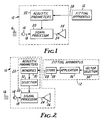
- FIG. 1 illustrates an auditory prosthesis 10, or hearing improvement device or hearing aid, which may be externally connected to a fitting apparatus 12.
- auditory prosthesis 10 contains a microphone 14 for receiving an acoustic signal 16 and transforming that acoustic signal 16 into an electrical input signal 18 which is supplied to a signal processor 20.
- Signal processor 20 then operates on the electrical input signal 18 according to a set of acoustic parameters 22 designed to compensate for a hearing impairment and producing a processed electrical signal 24.
- the processed electrical signal 24 is supplied to a receiver 26 which in hearing aid parlance is a miniature speaker to produce a signal perceptible to the user as sound.
- hearing aids While this description is generally discussed in terms of hearing aids, it is to be recognized and understood that the present invention finds utility with other forms of auditory prostheses such as cochlear implants, in which case the receiver 24 would be replaced by an electrode or electrodes, an implanted hearing aid, in which the receiver 24 would be replaced with an electrical to mechanical transducer or tactile hearing aids, in which case the receiver would be replaced by a vibrotactile transducer.
- auditory prostheses such as cochlear implants, in which case the receiver 24 would be replaced by an electrode or electrodes
- an implanted hearing aid in which the receiver 24 would be replaced with an electrical to mechanical transducer or tactile hearing aids, in which case the receiver would be replaced by a vibrotactile transducer.
- the auditory prosthesis 10 In order to provide an individual, or user, with an auditory prosthesis 10 with appropriate auditory characteristic, as specified by the acoustic parameters 22, the auditory prosthesis 10 must be "fit" to the individual's hearing impairment.
- the fitting process involves measuring the auditory characteristics of the individual's hearing, calculating the nature of the amplification or other signal processing characteristics needed to compensate for a particular hearing impairment, determining the individual acoustic parameters which are to be utilized by the auditory prosthesis, and verifying that these acoustic parameters do operate in conjunction with the individual's hearing to obtain the amelioration desired.
- fitting apparatus 12 is a host computer which may be programmed to provide an initial "fitting", i.e., determine the initial values for acoustic parameters 22 in order to compensate for a particular hearing impairment for a particular individual with which the auditory prosthesis 10 is intended to be utilized.
- initial “fitting” process is well known in the art.
- the DPS Digital Programming System
- SPI Sound Programming Interface
- WSP Wood Speech Processor
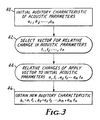
- FIG. 2 illustrates a block diagram of a preferred embodiment of the auditory prosthesis 10 operating in conjunction with the fitting apparatus 12.
- the auditory prosthesis 10 receives an acoustic signal 16 by microphone 14 which sends an electrical input signal 18 to a signal processor 20.
- the signal processor 20 processes the electrical input signal 18 in conjunction with a set of acoustic parameters 22 and produces a processed electrical signal 24 which is sent to a receiver 26.
- Acoustic parameters 22 are illustrated as consisting of a plurality of memories 30, each of which contain a set of acoustic parameters which specify an auditory characteristic to which the auditory prosthesis 10 is designed to operate.
- a selection unit 32 operates to select one of the sets of acoustic parameters from memories 30 and supplies that selected set to the signal processor 20.
- Fitting apparatus 12 in the context of the present invention, is connected with the memories 30 by communication link 28.
- the fitting apparatus 12 consists of a vector selection mechanism 34, to be described later, a vector application mechanism 36, also to be described later, and a storage mechanism 38 receiving the output of the vector application mechanism 36 for supplying the new values of the acoustic parameters 22 via communication link 28 to memories 30 within the auditory prosthesis 10.
- Known mechanisms of determining the values for the acoustic parameters in order to determine the auditory characteristics of an auditory prosthesis usually involve measuring the hearing impairment of the individual and determining the value of acoustic parameters necessary in order to compensate for the hearing impairment so measured. These known mechanisms operate well to determine ab initio the values of the acoustic parameters to be initially supplied to the auditory prosthesis 10. However, during fitting it is commonly advisable to change or modify the supplied auditory characteristics and, in particular, to modify the known or existing auditory characteristic toward a particular auditory goal such as decreasing the response of the auditory prosthesis to extraneous noise or increasing the intelligibility which the user will achieve using the auditory prosthesis 10.
- the auditory prosthesis 10 and the fitting apparatus 12 of the present invention operate to solve this problem by providing a fitting adjustment mechanism which utilizes a vector concept to provide relative changes in the auditory characteristic of the auditory prosthesis 10 by providing relative changes to a plurality of individual ones of the set of acoustic parameters 22 which specify that auditory characteristic.
- the vector concept of the present invention operates by selecting a vector which specifies relative changes to a plurality of acoustic parameters 22 on an entire set basis. Since relative changes are provided to the settings or values of the acoustic parameters 22, a relative change in the auditory characteristics of the auditory prosthesis 10 may be obtained.
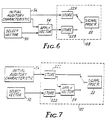
- step 40 the initial auditory characteristic of the auditory prosthesis 10 is determined, or has been determined, by selecting values of acoustic parameters A1, A2 . . . , A n .
- step 42 selects a vector consisting of a relative change in individual ones of the acoustic parameters 22 as illustrated in step 42 and defined by F1, F2 . . . , F n .
- Changes in the auditory characteristics of the auditory prosthesis 10 known in the prior art usually involve revising the settings or values of individual acoustic parameters 22. Since many of these individual acoustic parameters interact with each other, changing one may, in fact, necessitate the modification of another of the acoustic parameters.
- the present invention operates by a coordinated adjustment of more than one of the acoustic parameters simultaneously. It is preferred that the entire set of acoustic parameters be altered. In this way, the auditory goal of an adjustment may be defined and applied to the auditory prosthesis 10, and result in appropriately altered values for more than one, and preferably the entire set, of acoustic parameters 22 to result in an auditory characteristic which achieves the auditory goal desired.
- a given auditory prosthesis in this case a hearing aid, has a set of acoustic parameters to specify the auditory characteristic of a two channel hearing aid.
- the individual acoustic parameters are defined by a low pass gain, low pass attack time, high pass gain, high pass attack time and low pass-high pass cutoff frequency.
- a "noise reduction" vector may be applied which contains a set of relative changes for these individual acoustic parameters.
- a typical noise reduction vector may consist of acoustic parameters in which the low pass gain is lowered by 5 dB, the low pass attack time is shortened by 10 milliseconds, the high pass gain is not modified, the high pass attack time is not modified and the low pass-high pass cutoff frequency is lowered by 500 Hertz.
- Applying this "noise reduction" vector to the initial acoustic parameters results in a low pass gain of 25 dB, a low pass attack time of 0 milliseconds, an unchanged high pass gain of 40 dB, an unchanged high pass attack time of 20 milliseconds and a low pass-high pass cutoff frequency of 1500 Hertz. This processing is illustrated in Table 1.
- a "noise reduction" vector has been applied that might be appropriate to reduce the susceptibility of the auditory characteristic of the hearing aid to extraneous noise of low frequency impulsive type.
- the "noise reduction" vector as described above could be applied to produce the new setting which has less gain in a more reduced low pass frequency region and a more rapid automatic gain control attack time.
- the noise reduction vector thus, operates to decrease the amplification of low frequency sounds which is the major contributor to noise in most environments and to ensure that the automatic gain control circuitry rapidly responds to those noise components which do get through the low pass channel.
- noise reduction vector has been described in terms of a mathematical addition to the previously obtained acoustic parameters, it is noted that these vectors may have two potential types of elements, relative and absolute.
- Relative elements specify the change from the initial value to the new value by a mathematical process, such as addition.
- Absolute elements may specify the value of a particular acoustic parameter independent of its original value among the initial settings. Both types may be mixed together depending upon the particular desired auditory characteristic to be obtained.
- more than one vector may be combined to form a new or composite vector or combined to provide a new or composite result which results in a new auditory characteristic which has an auditory characteristic which is a composite of both vectors.
- both vectors are utilized, however, the appropriate alteration of the initial acoustic parameters is not the sequential addition of the relative changes of both vectors to modify the characteristic. Rather the appropriate alteration is to look at the maximum value of change of individual acoustic parameters of both vectors and apply the relative change of that acoustic parameter selected from both vectors which provides the maximum change to the original acoustic parameter.
- the auditory prosthesis may itself operate as the fitting apparatus 12 to create additional sets of acoustic parameters which specify differing auditory characteristics according to predetermined goals which are then stored within the memory of the auditory prosthesis.
- the auditory prosthesis once provided with an initial set of acoustic parameters, may bootstrap another set of acoustic parameters or another entire memory full of sets of acoustic parameters utilizing vectors, all of which which are individually adjusted to the individual hearing impairment of the user.
- the following table gives an example of the vector concept at work with a hearing aid which contains a different set of acoustic parameters from that discussed above.
- the table illustrates the initial set of acoustic parameters, the acoustic parameters of the vector which operates to modify that set of acoustic parameters and the modified set of acoustic parameters which represent the modified auditory characteristic of the hearing aid.
- the modification vector may be applied more than once depending upon the degree of change of the desired auditory characteristic. That is, the relative changes specified in this particular vector may be applied a number of times, e.g., twice to result in double the modification toward the particular auditory goal desired than which would otherwise result from a single application.
- FIG. 4 A flow chart illustrating the application of a selected vector, in this case an "intelligibility" vector, is illustrated in Figure 4.
- the initial fitting i. e., the initial determination of the acoustic parameters
- the process at step 112 determines the change required, or desired, from some objective or subjective technique determined by the user or by the fitter. This is analogous to selecting the particular vector to be utilized.
- Either the "noise reduction" vector can be applied, step 114, the "intelligibility” vector can be applied, step 116, or the "increased loudness with high input protection” vector, step 118, can be applied.
- the series of steps following the "intelligibility" vector are shown.
- step 124 The next acoustic parameter is then altered through step 124 until step 122 determines that the value of n exceeds the number of acoustic parameters of the vector indicating that all acoustic parameters in the vector have been applied. The process then exits, or ends, at step 128.
- the vector may specify that degree of change in the crossover frequency between the low pass and the high pass frequency bands. Since it is impractical to change the crossover frequency in one Hertz increments, the vector may specify the number of quantization steps to be changed, the quantization steps being variable, and in one example may be 150 Hertz quantization steps. Thus, the number 1 for this acoustic parameter in the vector would specify a 150 Hertz change in the value of the crossover frequency, a number 2 would specify a 300 Hertz change, etc.
- Another way to utilize the relative vector concept of the present invention is to utilize two vectors which modify the auditory characteristic by making a relative change based upon a blend of an individual acoustic parameter from both vectors.
- This technique would avoid the use of successively applied vectors or largest magnitude change by interpolating between the individual acoustic parameters specified in both vectors.
- one vector called for a 5 dB increase of a given acoustic parameter and the second vector called for a 10 dB increase of the same acoustic parameter then by interpolating between the values of change of this acoustic parameter a modification to the existing acoustic parameter of 7.5 dB would be specified.
- the auditory prosthesis 10A illustrated in Figure 5 provides a different concept from the auditory prosthesis 10 of Figure 1.
- the auditory prosthesis 10A has a microphone 14 for receiving an acoustic signal 16 and providing an electrical input signal 18 to a signal processor 20 which operates in accordance with a set of acoustic parameters 22 in this case stored in a memory.
- the processed electrical signal 24 from the signal processor 20 is supplied to a receiver 26 which provides a sound which is perceptible to the user.
- the auditory prosthesis 10A, illustrated in Figure 5, however, in contrast to that disclosed in Mangold et al, provides a memory which stores only a single set of acoustic parameters 22.
- the auditory prosthesis 10A does provide a memory 50 for storing at least one vector consisting of a relative change in the acoustic parameters 22.
- memory 50 would store a plurality of vectors. One of these vectors would then be selected by selection mechanism 52 and applied, as discussed above, by application mechanism 54. Hence, the modified set of acoustic parameters would be supplied to the signal processor 20. This would provide a readily obtainable modification to the auditory characteristic of the auditory prosthesis 10A.
- the selection mechanism 52 would operate to supply information to the application mechanism 54 in order to interpolate or adjust for varying degrees of the vector 50 which are to be applied to the acoustic parameters 22 in accordance with a particular desired change in the auditory characteristic of the auditory prosthesis 10A.
- Figure 6 shows a block diagram of an auditory prosthesis 10B in which the signal processor 20 is shown but the microphone 14 and the receiver 26 have been omitted for clarity.
- Signal processor 20 can select from either of two sets of acoustic parameters 22A and 22B.
- the values for the set of acoustic parameters 22A is obtained from the values of the initial fitting criteria 56 which were initially obtained by the fitting system and separate from the auditory prosthesis 10B.
- the values for the set of acoustic parameters 22B can be obtained from application mechanism 54 which applies the values for the vector from vector storage 50 to the values of the initial fitting criteria 56.
- both sets of acoustic parameters 22A and 22B are contained within the auditory prosthesis 10B while the application mechanism 54, the initial fitting criteria 56 and the vector storage 50 are located outside of the auditory prosthesis 10B.
- Figure 7 shows a block diagram of an auditory prosthesis 10C again in which the signal processor 20 is shown but the microphone 14 and the receiver 26 have been omitted for clarity.
- the signal processor 20 can select from either the set of acoustic parameters 22C which are obtained from the initial fitting criteria 56 or from application mechanism 54.
- Application mechanism 54 applies the vector stored in the set of acoustic parameters 22D to the values from initial fitting criteria 56.
- the set of acoustic parameters are obtained from vector storage 50.
- the application mechanism 54 and the sets of acoustic parameters is contained in the auditory prosthesis 10C while the initial fitting criteria 56 and the vector storage 50 are located outside of the auditory prosthesis 10C.
- vectors are stored in memory 50 within the auditory prosthesis 10A.
- the user may then effect alterations in the prescription (auditory characteristics) depending upon his environment by operating a switch or remote control which modifies selection mechanism 52.
- the automatic application of differing vectors depends on recognizing some characteristic of the sound incident on the microphone 14 of the auditory prosthesis 10A and selecting via selection mechanism 52 the vector to be applied via application mechanism 54 based on the degree to which this characteristic is present, or not to modify it all.
- one of the vectors available is a "noise reduction" vector designed to improve the performance of the auditory prosthesis 10A in a noisy environment.
- the auditory prosthesis 10A could detect whether the electrical input signal 18 indicated the presence of noise and when was detected would cause the "noise reduction" vector to be applied. In this situation, electrical input signal 18 would also be supplied as in input to selection mechanism 52 as shown by the dotted line in Figure 5.
Landscapes
- Health & Medical Sciences (AREA)
- General Health & Medical Sciences (AREA)
- Neurosurgery (AREA)
- Otolaryngology (AREA)
- Physics & Mathematics (AREA)
- Engineering & Computer Science (AREA)
- Acoustics & Sound (AREA)
- Signal Processing (AREA)
- Prostheses (AREA)
- Measurement Of The Respiration, Hearing Ability, Form, And Blood Characteristics Of Living Organisms (AREA)
- Tone Control, Compression And Expansion, Limiting Amplitude (AREA)
- Peptides Or Proteins (AREA)
- Measuring Pulse, Heart Rate, Blood Pressure Or Blood Flow (AREA)
- Bidet-Like Cleaning Device And Other Flush Toilet Accessories (AREA)
- Emergency Protection Circuit Devices (AREA)
- General Factory Administration (AREA)
- Electrically Operated Instructional Devices (AREA)
Claims (10)
- Méthode de détermination d'un nouvel ensemble de paramètres de traitement de signal (22) pour une prothèse auditive (10) comportant des moyens de mémoire pour stocker un ensemble de paramètres de traitement de signal (22) correspondant à une caractéristique connue de traitement de signal, et un processeur de signal (20) pour traiter un signal représentant un son conformément audit ensemble de paramètres de traitement de signal (22), ledit nouvel ensemble étant déterminé conformément à un changement désiré des caractéristiques auditives de ladite prothèse auditive (10),
caractérisée par les étapes de :
sélection (42) d'un vecteur (50) constitué des changements des valeurs de paramètres individuels de traitement de signal (22) conformément à des caractéristiques prédéterminées de traitement de signal en relation avec ledit changement désiré des caractéristiques auditives de ladite prothèse auditive ; et
application (44) des dits changements des valeurs desdits paramètres individuels de traitement de signal (22) dudit vecteur (50) aux valeurs des paramètres correspondants parmi les paramètres individuels de traitement de signal (22) dudit ensemble de caractéristiques de traitement de signal afin de créer un nouvel ensemble de paramètres de traitement de signal (22). - Méthode suivant la revendication 1, dans laquelle la valeur desdits paramètres auditifs dudit vecteur (50) et la valeur correspondante dudit ensemble de paramètres de traitement de signal (22) de ladite caractéristique auditive sont combinées conformément à un ensemble prédéterminé d'opérations mathématiques.
- Méthode suivant la revendication 1, caractérisée en ce que ladite prothèse auditive (10) est un dispositif d'amélioration de l'audition, en ce que lesdits moyens de mémoire comprennent une pluralité de mémoires, chacune de ladite pluralité de mémoires servant à stocker un ensemble de paramètres de traitement de signal (22), au moins un desdits paramètres de traitement de signal (22) étant prévu pour compenser une déficience d'audition,et en ce que ledit vecteur (50) est constitué des changements relatifs des valeurs de paramètres individuels de traitement de signal (22), et caractérisée en outre en ce qu'on utilise ladite nouvelle caractéristique de traitement de signal dans ledit processeur de signal (20) de ladite prothèse auditive (10).
- Méthode suivant la revendication 3, dans laquelle la valeur d'un desdits paramètres de traitement de signal (22) dudit vecteur (50) et la valeur correspondante dudit ensemble de paramètres de traitement de signal (22) de ladite caractéristique choisie parmi ladite pluralité de caractéristiques de traitement de signal sont combinées conformément à un ensemble prédéterminé d'opérations mathématiques.
- Appareil de détermination des valeurs de paramètres de traitement de signal (22) pour une prothèse auditive (10) comprenant une pluralité de mémoires, chacune de ladite pluralité de mémoires servant à stocker une caractéristique de traitement de signal qui spécifie une pluralité de paramètres de traitement de signal (22), un processeur de signal (20) pour traiter un signal représentant un son conformément à une caractéristique choisie de traitement de signal, et des moyens de sélection de mémoire reliés à ladite pluralité de mémoires et audit processeur de signal (20) pour choisir une de ladite pluralité de mémoires afin de déterminer la caractéristique de traitement de signal qui est utilisée par ledit processeur de signal (20), lesdites valeurs étant déterminées pour une caractéristique particulière de traitement de signal à partir des valeurs desdits paramètres de traitement de signal (22) d'une caractéristique connue de traitement de signal, caractérisé en ce qu'il comprend :
des moyens de sélection de vecteur (52) pour choisir un vecteur (50) constitué des changements des valeurs de paramètres individuels de traitement de signal (22), conformément aux caractéristiques prédéterminées de traitement de signal ;
des moyens d'application (54) reliés auxdits moyens de sélection de vecteur (50) pour appliquer les dits changements des valeurs desdits paramètres individuels de traitement de signal (22) dudit vecteur (50) aux valeurs des paramètres de traitement de signal (22) d'une caractéristique connue de traitement de signal afin de créer une nouvelle caractéristique de traitement de signal; et
des moyens de stockage (22) reliés auxdits moyens d'application (54) pour stocker ladite nouvelle caractéristique de traitement de signal dans une de la dite pluralité de mémoires. - Appareil suivant la revendication 5, dans lequel ladite prothèse auditive (10) comprend une pluralité de canaux, chacun desdits canaux ayant une bande de fréquence différente, et une fréquence de croisement spécifiant un croisement entre au moins deux de ladite pluralité de canaux, et dans lequel au moins certains desdits paramètres individuels de traitement de signal (22) dudit ensemble de paramètres de traitement de signal (22) comprennent la valeur de gain d'au moins un de ladite pluralité de canaux et la valeur de ladite fréquence de croisement.
- Appareil suivant la revendication 5, dans lequel la valeur desdits paramètres de traitement de signal (22) dudit vecteur (50) et la valeur correspondante dudit ensemble de paramètres de traitement de signal (22) de ladite caractéristique de traitement de signal sont combinées par lesdits moyens d'application conformément à un ensemble prédéterminé d'opérations mathématiques qui spécifie un changement relatif.
- Appareil suivant la revendication 5, caractérisé en outre en ce que ladite prothèse auditive (10) est une aide à l'audition, dans lequel au moins un de ladite pluralité de paramètres de traitement de signal (22) est prévu pour compenser une déficience d'audition, par utilisation d'un microphone (14) pour convertir une information acoustique (16) en un signal d'entrée électrique (18) ; dans lequel ledit processeur de signal (20) reçoit ledit signal électrique d'entrée (18) et agit sur ledit signal électrique d'entrée (18) en réponse audit ensemble de paramètres de traitement de signal (22) pour produire un signal électrique traité, par utilisation d'un récepteur (26) relié audit processeur de signal (20) pour convertir ledit signal électrique traité (24) en un signal pouvant être perçu par un patient ; et dans lequel lesdits moyens de stockage comprennent une première mémoire fonctionnellement reliée audit processeur de signal (20) pour stocker au moins un dudit ensemble de paramètres (22) de traitement de signal.
- Aide auditive suivant la revendication 8, qui comprend une pluralité de canaux, chacun desdits canaux ayant une bande de fréquence différente, et une fréquence de croisement spécifiant un croisement entre au moins deux de ladite pluralité de canaux, et au moins certains desdits paramètres individuels de traitement de signal (22) dudit ensemble de paramètres de traitement de signal (22) comprennent la valeur de gain d'au moins un de ladite pluralité de canaux et la valeur de ladite fréquence de croisement.
- Aide auditive suivant la revendication 8, dans laquelle la valeur desdits paramètres de traitement de signal (22) dudit vecteur (50) et la valeur correspondante dudit ensemble de paramètres de traitement de signal (22) de ladite caractéristique de traitement de signal sont combinées par lesdits moyens d'application conformément à un ensemble prédéterminé d'opérations mathématiques.
Applications Claiming Priority (2)
| Application Number | Priority Date | Filing Date | Title |
|---|---|---|---|
| US07/192,351 US4901353A (en) | 1988-05-10 | 1988-05-10 | Auditory prosthesis fitting using vectors |
| US192351 | 1988-05-10 |
Publications (3)
| Publication Number | Publication Date |
|---|---|
| EP0341997A2 EP0341997A2 (fr) | 1989-11-15 |
| EP0341997A3 EP0341997A3 (fr) | 1991-05-15 |
| EP0341997B1 true EP0341997B1 (fr) | 1994-09-07 |
Family
ID=22709283
Family Applications (1)
| Application Number | Title | Priority Date | Filing Date |
|---|---|---|---|
| EP89304714A Expired - Lifetime EP0341997B1 (fr) | 1988-05-10 | 1989-05-10 | Ajustage de prothèses auditives en utilisant des vecteurs |
Country Status (11)
| Country | Link |
|---|---|
| US (1) | US4901353A (fr) |
| EP (1) | EP0341997B1 (fr) |
| JP (1) | JP3021467B2 (fr) |
| KR (1) | KR970003989B1 (fr) |
| AT (1) | ATE111289T1 (fr) |
| AU (1) | AU621101B2 (fr) |
| BR (1) | BR8902175A (fr) |
| CA (1) | CA1300732C (fr) |
| DE (2) | DE68917980T2 (fr) |
| DK (1) | DK175586B1 (fr) |
| MY (1) | MY103711A (fr) |
Cited By (2)
| Publication number | Priority date | Publication date | Assignee | Title |
|---|---|---|---|---|
| US7269269B2 (en) | 2003-02-27 | 2007-09-11 | Siemens Audiologische Technik Gmbh | Method to adjust an auditory system and corresponding auditory system |
| WO2009155649A1 (fr) * | 2008-06-25 | 2009-12-30 | Cochlear Limited | Prothèses auditives programmables |
Families Citing this family (43)
| Publication number | Priority date | Publication date | Assignee | Title |
|---|---|---|---|---|
| US4953112A (en) * | 1988-05-10 | 1990-08-28 | Minnesota Mining And Manufacturing Company | Method and apparatus for determining acoustic parameters of an auditory prosthesis using software model |
| CH679966A5 (fr) * | 1989-11-29 | 1992-05-15 | Ascom Audiosys Ag | |
| US5386475A (en) * | 1992-11-24 | 1995-01-31 | Virtual Corporation | Real-time hearing aid simulation |
| EP0674464A1 (fr) * | 1994-03-23 | 1995-09-27 | Siemens Audiologische Technik GmbH | Prothèse auditive programmable avec commande en logique floue |
| EP0676909A1 (fr) * | 1994-03-31 | 1995-10-11 | Siemens Audiologische Technik GmbH | Prothèse auditive programmable |
| US5825894A (en) * | 1994-08-17 | 1998-10-20 | Decibel Instruments, Inc. | Spatialization for hearing evaluation |
| JP2638563B2 (ja) * | 1995-05-16 | 1997-08-06 | 日本電気株式会社 | 履歴保持型補聴器 |
| US5626629A (en) * | 1995-05-31 | 1997-05-06 | Advanced Bionics Corporation | Programming of a speech processor for an implantable cochlear stimulator |
| JP2970498B2 (ja) * | 1995-10-26 | 1999-11-02 | 日本電気株式会社 | ディジタル補聴器 |
| CN1260104A (zh) * | 1995-12-20 | 2000-07-12 | 戴西伯仪器有限公司 | 用于非辅助、模拟辅助和辅助听觉评价的虚拟电声听力测试法 |
| JPH09182194A (ja) * | 1995-12-27 | 1997-07-11 | Nec Corp | 補聴器 |
| JPH1083193A (ja) * | 1996-09-09 | 1998-03-31 | Matsushita Electric Ind Co Ltd | 音声合成装置および音声素片作成方法 |
| EP0917397A1 (fr) * | 1997-10-14 | 1999-05-19 | Siemens Audiologische Technik GmbH | Procédé de déterminer une série de paramètres d'une prothèse acoustique |
| EP0917398B1 (fr) | 1997-11-12 | 2007-04-11 | Siemens Audiologische Technik GmbH | Prothèse auditive et procédé d'établissement de paramètres audiologiques/acoustiques |
| US6154546A (en) * | 1997-12-18 | 2000-11-28 | Resound Corporation | Probe microphone |
| US6201875B1 (en) | 1998-03-17 | 2001-03-13 | Sonic Innovations, Inc. | Hearing aid fitting system |
| US6289247B1 (en) | 1998-06-02 | 2001-09-11 | Advanced Bionics Corporation | Strategy selector for multichannel cochlear prosthesis |
| US6240193B1 (en) | 1998-09-17 | 2001-05-29 | Sonic Innovations, Inc. | Two line variable word length serial interface |
| GB9907050D0 (en) | 1999-03-26 | 1999-05-19 | Sonomax Sft Inc | System for fitting a hearing device in the ear |
| KR100303853B1 (ko) * | 1999-06-09 | 2001-11-01 | 이희영 | 디지탈 보청기의 자동 피팅방법 |
| DK1208723T3 (da) * | 1999-09-02 | 2004-03-08 | Gn Resound As | Høreapparat og ekstern enhed til kommunikation dermed |
| EP1091620A1 (fr) * | 1999-10-08 | 2001-04-11 | Siemens Audiologische Technik GmbH | Dispositif pour l'ajustage d'une prothèse auditive |
| US7399282B2 (en) * | 2000-05-19 | 2008-07-15 | Baycrest Center For Geriatric Care | System and method for objective evaluation of hearing using auditory steady-state responses |
| WO2001087147A2 (fr) | 2000-05-19 | 2001-11-22 | Michael Sasha John | Systeme et methode d'evaluation objective d'audibilite au moyen de reponses en regime permanent auditif |
| US7155289B1 (en) * | 2001-08-17 | 2006-12-26 | Advanced Bionics Corporation | Auto-referencing mixed mode phase locked loop for audio playback applications |
| US7292891B2 (en) * | 2001-08-20 | 2007-11-06 | Advanced Bionics Corporation | BioNet for bilateral cochlear implant systems |
| DE10152197B4 (de) * | 2001-10-23 | 2009-07-09 | Siemens Audiologische Technik Gmbh | Verfahren zum Programmieren eines Hörgerätes, Programmiergerät sowie Fernbedienung für das Hörgerät |
| CA2433390A1 (fr) | 2001-11-09 | 2002-01-17 | Phonak Ag | Procede pur actionner une prothese auditive et prothese auditive correspondante |
| US7130694B1 (en) * | 2001-12-26 | 2006-10-31 | Advanced Bionics Corporation | Pulse skipping strategy |
| US7889879B2 (en) * | 2002-05-21 | 2011-02-15 | Cochlear Limited | Programmable auditory prosthesis with trainable automatic adaptation to acoustic conditions |
| AU2005218900B2 (en) * | 2004-03-10 | 2010-07-01 | Oticon A/S | Equipment for fitting a hearing aid to the specific needs of a hearing impaired individual and software for use in a fitting equipment for fitting a hearing aid |
| GB0500616D0 (en) * | 2005-01-13 | 2005-02-23 | Univ Dundee | Hearing implant |
| WO2006109826A1 (fr) * | 2005-04-12 | 2006-10-19 | Matsushita Electric Industrial Co., Ltd. | Dispositif de reglage de prothese auditive |
| EP1941782B1 (fr) | 2005-10-18 | 2018-07-18 | Widex A/S | Equipement de programmation d'un appareil auditif |
| JP2007295323A (ja) * | 2006-04-26 | 2007-11-08 | Matsushita Electric Ind Co Ltd | 補聴器調整装置 |
| GB0704125D0 (en) * | 2007-03-03 | 2007-04-11 | Univ Dundee | Ossicular replacement prosthesis |
| US8385572B2 (en) * | 2007-03-12 | 2013-02-26 | Siemens Audiologische Technik Gmbh | Method for reducing noise using trainable models |
| GB2449114A (en) | 2007-05-11 | 2008-11-12 | Sentient Medical Ltd | Middle ear implant with piezoelectric actuator acting on stapes footplate |
| WO2008154706A1 (fr) * | 2007-06-20 | 2008-12-24 | Cochlear Limited | Procédé et appareil pour optimiser la commande de fonctionnement d'une prothèse auditive |
| US8435291B2 (en) * | 2008-06-20 | 2013-05-07 | University Of Florida Research Foundation, Inc. | Method and apparatus for in-situ adjustability of a middle ear prosthesis |
| US8144909B2 (en) * | 2008-08-12 | 2012-03-27 | Cochlear Limited | Customization of bone conduction hearing devices |
| DK3082350T3 (en) | 2015-04-15 | 2019-04-23 | Starkey Labs Inc | USER INTERFACE WITH REMOTE SERVER |
| DK3267695T3 (en) | 2016-07-04 | 2019-02-25 | Gn Hearing As | AUTOMATED SCANNING OF HEARING PARAMETERS |
Family Cites Families (13)
| Publication number | Priority date | Publication date | Assignee | Title |
|---|---|---|---|---|
| US4185168A (en) * | 1976-05-04 | 1980-01-22 | Causey G Donald | Method and means for adaptively filtering near-stationary noise from an information bearing signal |
| US4025721A (en) * | 1976-05-04 | 1977-05-24 | Biocommunications Research Corporation | Method of and means for adaptively filtering near-stationary noise from speech |
| DE2716336B1 (de) * | 1977-04-13 | 1978-07-06 | Siemens Ag | Verfahren und Hoergeraet zur Kompensation von Gehoerdefekten |
| US4396806B2 (en) * | 1980-10-20 | 1998-06-02 | A & L Ventures I | Hearing aid amplifier |
| SE428167B (sv) * | 1981-04-16 | 1983-06-06 | Mangold Stephan | Programmerbar signalbehandlingsanordning, huvudsakligen avsedd for personer med nedsatt horsel |
| DE3131193A1 (de) * | 1981-08-06 | 1983-02-24 | Siemens AG, 1000 Berlin und 8000 München | Geraet zur kompensation von gehoerschaeden |
| DE3205685A1 (de) * | 1982-02-17 | 1983-08-25 | Robert Bosch Gmbh, 7000 Stuttgart | Hoergeraet |
| US4622440A (en) * | 1984-04-11 | 1986-11-11 | In Tech Systems Corp. | Differential hearing aid with programmable frequency response |
| US4548082A (en) * | 1984-08-28 | 1985-10-22 | Central Institute For The Deaf | Hearing aids, signal supplying apparatus, systems for compensating hearing deficiencies, and methods |
| US4791672A (en) * | 1984-10-05 | 1988-12-13 | Audiotone, Inc. | Wearable digital hearing aid and method for improving hearing ability |
| US4596902A (en) * | 1985-07-16 | 1986-06-24 | Samuel Gilman | Processor controlled ear responsive hearing aid and method |
| GB2184629B (en) * | 1985-12-10 | 1989-11-08 | Colin David Rickson | Compensation of hearing |
| US4953112A (en) * | 1988-05-10 | 1990-08-28 | Minnesota Mining And Manufacturing Company | Method and apparatus for determining acoustic parameters of an auditory prosthesis using software model |
-
1988
- 1988-05-10 US US07/192,351 patent/US4901353A/en not_active Expired - Lifetime
-
1989
- 1989-04-12 CA CA000596414A patent/CA1300732C/fr not_active Expired - Lifetime
- 1989-04-12 DK DK198901765A patent/DK175586B1/da not_active IP Right Cessation
- 1989-04-13 AU AU32789/89A patent/AU621101B2/en not_active Expired
- 1989-05-02 MY MYPI89000594A patent/MY103711A/en unknown
- 1989-05-09 BR BR898902175A patent/BR8902175A/pt not_active IP Right Cessation
- 1989-05-09 JP JP1115928A patent/JP3021467B2/ja not_active Expired - Lifetime
- 1989-05-09 KR KR1019890006180A patent/KR970003989B1/ko not_active Expired - Fee Related
- 1989-05-10 DE DE68917980T patent/DE68917980T2/de not_active Expired - Lifetime
- 1989-05-10 DE DE89304714T patent/DE341997T1/de active Pending
- 1989-05-10 AT AT89304714T patent/ATE111289T1/de not_active IP Right Cessation
- 1989-05-10 EP EP89304714A patent/EP0341997B1/fr not_active Expired - Lifetime
Cited By (2)
| Publication number | Priority date | Publication date | Assignee | Title |
|---|---|---|---|---|
| US7269269B2 (en) | 2003-02-27 | 2007-09-11 | Siemens Audiologische Technik Gmbh | Method to adjust an auditory system and corresponding auditory system |
| WO2009155649A1 (fr) * | 2008-06-25 | 2009-12-30 | Cochlear Limited | Prothèses auditives programmables |
Also Published As
| Publication number | Publication date |
|---|---|
| EP0341997A3 (fr) | 1991-05-15 |
| KR890017996A (ko) | 1989-12-18 |
| EP0341997A2 (fr) | 1989-11-15 |
| DE68917980T2 (de) | 1995-03-16 |
| DK176589D0 (da) | 1989-04-12 |
| DE341997T1 (de) | 1994-02-03 |
| DE68917980D1 (de) | 1994-10-13 |
| KR970003989B1 (ko) | 1997-03-24 |
| JP3021467B2 (ja) | 2000-03-15 |
| AU621101B2 (en) | 1992-03-05 |
| DK176589A (da) | 1989-11-11 |
| US4901353A (en) | 1990-02-13 |
| MY103711A (en) | 1993-08-28 |
| DK175586B1 (da) | 2004-12-13 |
| JPH0220200A (ja) | 1990-01-23 |
| CA1300732C (fr) | 1992-05-12 |
| AU3278989A (en) | 1989-11-23 |
| BR8902175A (pt) | 1990-01-02 |
| ATE111289T1 (de) | 1994-09-15 |
Similar Documents
| Publication | Publication Date | Title |
|---|---|---|
| EP0341997A2 (fr) | Ajustage de prothèses auditives en utilisant des vecteurs | |
| US4953112A (en) | Method and apparatus for determining acoustic parameters of an auditory prosthesis using software model | |
| US4992966A (en) | Calibration device and auditory prosthesis having calibration information | |
| EP0250679B1 (fr) | Système de reproduction sonore programmable | |
| US7933419B2 (en) | In-situ-fitted hearing device | |
| EP0693249B1 (fr) | Circuit de filtrage et de gain adaptatif destine a un systeme de reproduction des sons | |
| US4879749A (en) | Host controller for programmable digital hearing aid system | |
| JP2782475B2 (ja) | 遠隔制御可能、特にプログラム可能な補聴器系 | |
| EP2152161B1 (fr) | Procédure de réglage pour dispositifs auditifs et dispositif auditif correspondant | |
| EP1363473B1 (fr) | Prothèse auditive avec une performance variable dans le temps | |
| US7330557B2 (en) | Hearing aid, method, and programmer for adjusting the directional characteristic dependent on the rest hearing threshold or masking threshold | |
| US20020076072A1 (en) | Software implemented loudness normalization for a digital hearing aid | |
| EP2566193A1 (fr) | Système et procédé d'adaptation d'un appareil auditif | |
| US5046102A (en) | Hearing aid with adjustable frequency response | |
| CA2486893C (fr) | Prothese auditive programmable avec adaptation automatique par apprentissage aux conditions acoustiques | |
| EP1617705B1 (fr) | Prothèse auditive avec adaptation in-situ | |
| AU2002338609A1 (en) | Fitting method and a hearing aid for suppression of perceived occlusion | |
| EP1439732B1 (fr) | Méthode pour opérer une prothèse auditive et prothèse auditive | |
| Sammeth | Current availability of digital and hybrid hearing aids | |
| Wallace | Maico Hearing Instruments, Inc.: Phox |
Legal Events
| Date | Code | Title | Description |
|---|---|---|---|
| PUAI | Public reference made under article 153(3) epc to a published international application that has entered the european phase |
Free format text: ORIGINAL CODE: 0009012 |
|
| AK | Designated contracting states |
Kind code of ref document: A2 Designated state(s): AT CH DE FR GB IT LI NL SE |
|
| 17P | Request for examination filed |
Effective date: 19910102 |
|
| PUAL | Search report despatched |
Free format text: ORIGINAL CODE: 0009013 |
|
| AK | Designated contracting states |
Kind code of ref document: A3 Designated state(s): AT CH DE FR GB IT LI NL SE |
|
| 17Q | First examination report despatched |
Effective date: 19930218 |
|
| ITCL | It: translation for ep claims filed |
Representative=s name: BARZANO' E ZANARDO S.P.A. ROMA |
|
| TCAT | At: translation of patent claims filed | ||
| TCNL | Nl: translation of patent claims filed | ||
| EL | Fr: translation of claims filed | ||
| DET | De: translation of patent claims | ||
| GRAA | (expected) grant |
Free format text: ORIGINAL CODE: 0009210 |
|
| AK | Designated contracting states |
Kind code of ref document: B1 Designated state(s): AT CH DE FR GB IT LI NL SE |
|
| REF | Corresponds to: |
Ref document number: 111289 Country of ref document: AT Date of ref document: 19940915 Kind code of ref document: T |
|
| REF | Corresponds to: |
Ref document number: 68917980 Country of ref document: DE Date of ref document: 19941013 |
|
| ITF | It: translation for a ep patent filed | ||
| ET | Fr: translation filed | ||
| EAL | Se: european patent in force in sweden |
Ref document number: 89304714.2 |
|
| PLBI | Opposition filed |
Free format text: ORIGINAL CODE: 0009260 |
|
| 26 | Opposition filed |
Opponent name: TOPHOLM & WESTERMANN APS Effective date: 19950529 |
|
| NLR1 | Nl: opposition has been filed with the epo |
Opponent name: TOPHOLM & WESTERMANN APS |
|
| PLBF | Reply of patent proprietor to notice(s) of opposition |
Free format text: ORIGINAL CODE: EPIDOS OBSO |
|
| PGFP | Annual fee paid to national office [announced via postgrant information from national office to epo] |
Ref country code: SE Payment date: 19970520 Year of fee payment: 9 |
|
| NLS | Nl: assignments of ep-patents |
Owner name: K/S HIMPP;RESOUND CORPORATION |
|
| PLBL | Opposition procedure terminated |
Free format text: ORIGINAL CODE: EPIDOS OPPC |
|
| REG | Reference to a national code |
Ref country code: CH Ref legal event code: PUE Owner name: MINNESOTA MINING AND MANUFACTURING COMPANY -DANN A |
|
| RAP2 | Party data changed (patent owner data changed or rights of a patent transferred) |
Owner name: K/S HIMPP |
|
| REG | Reference to a national code |
Ref country code: FR Ref legal event code: TP |
|
| NLT2 | Nl: modifications (of names), taken from the european patent patent bulletin |
Owner name: K/S HIMPP |
|
| PLBM | Termination of opposition procedure: date of legal effect published |
Free format text: ORIGINAL CODE: 0009276 |
|
| STAA | Information on the status of an ep patent application or granted ep patent |
Free format text: STATUS: OPPOSITION PROCEDURE CLOSED |
|
| 27C | Opposition proceedings terminated |
Effective date: 19970823 |
|
| PG25 | Lapsed in a contracting state [announced via postgrant information from national office to epo] |
Ref country code: SE Free format text: LAPSE BECAUSE OF NON-PAYMENT OF DUE FEES Effective date: 19980511 |
|
| NLR2 | Nl: decision of opposition | ||
| REG | Reference to a national code |
Ref country code: GB Ref legal event code: 732E |
|
| EUG | Se: european patent has lapsed |
Ref document number: 89304714.2 |
|
| REG | Reference to a national code |
Ref country code: GB Ref legal event code: IF02 |
|
| PGFP | Annual fee paid to national office [announced via postgrant information from national office to epo] |
Ref country code: AT Payment date: 20050420 Year of fee payment: 17 |
|
| PG25 | Lapsed in a contracting state [announced via postgrant information from national office to epo] |
Ref country code: AT Free format text: LAPSE BECAUSE OF NON-PAYMENT OF DUE FEES Effective date: 20060510 |
|
| REG | Reference to a national code |
Ref country code: CH Ref legal event code: PFA Owner name: K/S HIMPP Free format text: K/S HIMPP#NY VESTERGAARDSVEJ 25#3500 VAERLOESE (DK) -TRANSFER TO- K/S HIMPP#NY VESTERGAARDSVEJ 25#3500 VAERLOESE (DK) |
|
| PGFP | Annual fee paid to national office [announced via postgrant information from national office to epo] |
Ref country code: CH Payment date: 20080530 Year of fee payment: 20 |
|
| PGFP | Annual fee paid to national office [announced via postgrant information from national office to epo] |
Ref country code: DE Payment date: 20080630 Year of fee payment: 20 Ref country code: NL Payment date: 20080524 Year of fee payment: 20 |
|
| PGFP | Annual fee paid to national office [announced via postgrant information from national office to epo] |
Ref country code: IT Payment date: 20080528 Year of fee payment: 20 |
|
| PGFP | Annual fee paid to national office [announced via postgrant information from national office to epo] |
Ref country code: GB Payment date: 20080529 Year of fee payment: 20 |
|
| REG | Reference to a national code |
Ref country code: CH Ref legal event code: PL |
|
| REG | Reference to a national code |
Ref country code: GB Ref legal event code: PE20 Expiry date: 20090509 |
|
| NLV7 | Nl: ceased due to reaching the maximum lifetime of a patent |
Effective date: 20090510 |
|
| PG25 | Lapsed in a contracting state [announced via postgrant information from national office to epo] |
Ref country code: NL Free format text: LAPSE BECAUSE OF EXPIRATION OF PROTECTION Effective date: 20090510 |
|
| PG25 | Lapsed in a contracting state [announced via postgrant information from national office to epo] |
Ref country code: GB Free format text: LAPSE BECAUSE OF EXPIRATION OF PROTECTION Effective date: 20090509 |
|
| PGFP | Annual fee paid to national office [announced via postgrant information from national office to epo] |
Ref country code: FR Payment date: 20080519 Year of fee payment: 20 |