EP0339414A2 - Optisch aktive Diester - Google Patents
Optisch aktive Diester Download PDFInfo
- Publication number
- EP0339414A2 EP0339414A2 EP89106808A EP89106808A EP0339414A2 EP 0339414 A2 EP0339414 A2 EP 0339414A2 EP 89106808 A EP89106808 A EP 89106808A EP 89106808 A EP89106808 A EP 89106808A EP 0339414 A2 EP0339414 A2 EP 0339414A2
- Authority
- EP
- European Patent Office
- Prior art keywords
- group
- optically active
- methyl
- cyano
- methoxy
- Prior art date
- Legal status (The legal status is an assumption and is not a legal conclusion. Google has not performed a legal analysis and makes no representation as to the accuracy of the status listed.)
- Granted
Links
- 0 **C(CC1)CCC1c(cc1)ccc1-c1ccc(**)cc1 Chemical compound **C(CC1)CCC1c(cc1)ccc1-c1ccc(**)cc1 0.000 description 1
- RODWJGWVERYJMM-UHFFFAOYSA-N OC(C(CC1)CCC1c(cc1)ccc1-c(cc1)ccc1C(O)=O)=O Chemical compound OC(C(CC1)CCC1c(cc1)ccc1-c(cc1)ccc1C(O)=O)=O RODWJGWVERYJMM-UHFFFAOYSA-N 0.000 description 1
Classifications
-
- C—CHEMISTRY; METALLURGY
- C09—DYES; PAINTS; POLISHES; NATURAL RESINS; ADHESIVES; COMPOSITIONS NOT OTHERWISE PROVIDED FOR; APPLICATIONS OF MATERIALS NOT OTHERWISE PROVIDED FOR
- C09K—MATERIALS FOR MISCELLANEOUS APPLICATIONS, NOT PROVIDED FOR ELSEWHERE
- C09K19/00—Liquid crystal materials
- C09K19/04—Liquid crystal materials characterised by the chemical structure of the liquid crystal components, e.g. by a specific unit
- C09K19/06—Non-steroidal liquid crystal compounds
- C09K19/08—Non-steroidal liquid crystal compounds containing at least two non-condensed rings
- C09K19/10—Non-steroidal liquid crystal compounds containing at least two non-condensed rings containing at least two benzene rings
- C09K19/12—Non-steroidal liquid crystal compounds containing at least two non-condensed rings containing at least two benzene rings at least two benzene rings directly linked, e.g. biphenyls
-
- C—CHEMISTRY; METALLURGY
- C09—DYES; PAINTS; POLISHES; NATURAL RESINS; ADHESIVES; COMPOSITIONS NOT OTHERWISE PROVIDED FOR; APPLICATIONS OF MATERIALS NOT OTHERWISE PROVIDED FOR
- C09K—MATERIALS FOR MISCELLANEOUS APPLICATIONS, NOT PROVIDED FOR ELSEWHERE
- C09K19/00—Liquid crystal materials
- C09K19/04—Liquid crystal materials characterised by the chemical structure of the liquid crystal components, e.g. by a specific unit
- C09K19/06—Non-steroidal liquid crystal compounds
- C09K19/08—Non-steroidal liquid crystal compounds containing at least two non-condensed rings
- C09K19/10—Non-steroidal liquid crystal compounds containing at least two non-condensed rings containing at least two benzene rings
- C09K19/20—Non-steroidal liquid crystal compounds containing at least two non-condensed rings containing at least two benzene rings linked by a chain containing carbon and oxygen atoms as chain links, e.g. esters or ethers
- C09K19/2007—Non-steroidal liquid crystal compounds containing at least two non-condensed rings containing at least two benzene rings linked by a chain containing carbon and oxygen atoms as chain links, e.g. esters or ethers the chain containing -COO- or -OCO- groups
- C09K19/2021—Compounds containing at least one asymmetric carbon atom
- C09K19/2028—Compounds containing at least one asymmetric carbon atom containing additionally a linking group other than -COO- or -OCO-, e.g. -CH2-CH2-, -CH=CH-, -C=C-; containing at least one additional carbon atom in the chain containing -COO- or -OCO- groups, e.g. -COO-CH*-CH3
-
- C—CHEMISTRY; METALLURGY
- C09—DYES; PAINTS; POLISHES; NATURAL RESINS; ADHESIVES; COMPOSITIONS NOT OTHERWISE PROVIDED FOR; APPLICATIONS OF MATERIALS NOT OTHERWISE PROVIDED FOR
- C09K—MATERIALS FOR MISCELLANEOUS APPLICATIONS, NOT PROVIDED FOR ELSEWHERE
- C09K19/00—Liquid crystal materials
- C09K19/04—Liquid crystal materials characterised by the chemical structure of the liquid crystal components, e.g. by a specific unit
- C09K19/06—Non-steroidal liquid crystal compounds
- C09K19/08—Non-steroidal liquid crystal compounds containing at least two non-condensed rings
- C09K19/10—Non-steroidal liquid crystal compounds containing at least two non-condensed rings containing at least two benzene rings
- C09K19/12—Non-steroidal liquid crystal compounds containing at least two non-condensed rings containing at least two benzene rings at least two benzene rings directly linked, e.g. biphenyls
- C09K19/126—Compounds containing at least one asymmetric carbon atom
-
- C—CHEMISTRY; METALLURGY
- C09—DYES; PAINTS; POLISHES; NATURAL RESINS; ADHESIVES; COMPOSITIONS NOT OTHERWISE PROVIDED FOR; APPLICATIONS OF MATERIALS NOT OTHERWISE PROVIDED FOR
- C09K—MATERIALS FOR MISCELLANEOUS APPLICATIONS, NOT PROVIDED FOR ELSEWHERE
- C09K19/00—Liquid crystal materials
- C09K19/04—Liquid crystal materials characterised by the chemical structure of the liquid crystal components, e.g. by a specific unit
- C09K19/06—Non-steroidal liquid crystal compounds
- C09K19/34—Non-steroidal liquid crystal compounds containing at least one heterocyclic ring
-
- C—CHEMISTRY; METALLURGY
- C09—DYES; PAINTS; POLISHES; NATURAL RESINS; ADHESIVES; COMPOSITIONS NOT OTHERWISE PROVIDED FOR; APPLICATIONS OF MATERIALS NOT OTHERWISE PROVIDED FOR
- C09K—MATERIALS FOR MISCELLANEOUS APPLICATIONS, NOT PROVIDED FOR ELSEWHERE
- C09K19/00—Liquid crystal materials
- C09K19/04—Liquid crystal materials characterised by the chemical structure of the liquid crystal components, e.g. by a specific unit
- C09K19/06—Non-steroidal liquid crystal compounds
- C09K19/34—Non-steroidal liquid crystal compounds containing at least one heterocyclic ring
- C09K19/3441—Non-steroidal liquid crystal compounds containing at least one heterocyclic ring having nitrogen as hetero atom
-
- C—CHEMISTRY; METALLURGY
- C09—DYES; PAINTS; POLISHES; NATURAL RESINS; ADHESIVES; COMPOSITIONS NOT OTHERWISE PROVIDED FOR; APPLICATIONS OF MATERIALS NOT OTHERWISE PROVIDED FOR
- C09K—MATERIALS FOR MISCELLANEOUS APPLICATIONS, NOT PROVIDED FOR ELSEWHERE
- C09K19/00—Liquid crystal materials
- C09K19/04—Liquid crystal materials characterised by the chemical structure of the liquid crystal components, e.g. by a specific unit
- C09K19/06—Non-steroidal liquid crystal compounds
- C09K19/08—Non-steroidal liquid crystal compounds containing at least two non-condensed rings
- C09K19/10—Non-steroidal liquid crystal compounds containing at least two non-condensed rings containing at least two benzene rings
- C09K19/12—Non-steroidal liquid crystal compounds containing at least two non-condensed rings containing at least two benzene rings at least two benzene rings directly linked, e.g. biphenyls
- C09K2019/121—Compounds containing phenylene-1,4-diyl (-Ph-)
- C09K2019/123—Ph-Ph-Ph
Definitions
- the present invention relates to new liquid-crystalline mixtures, in particular mixtures with a chirally tilted smectic phase, and to new optically active diesters and their use for electro-optical purposes.
- Liquid crystals are suitable as dielectrics in display devices because their optical properties can be influenced by an electrical voltage.
- Suitable electro-optical devices are well known to those skilled in the art. Examples of such devices are cells with dynamic scattering, DAP cells (deformation of aligned phases).
- TN cells twisted nematic
- STN cells super twisted nematic with twisted nematic structure
- guest / host cells phase change cells with a cholesteric-nematic phase transition
- SBE cells super birefringence effect
- Suitable tilted smectic phases are, for example, smectic C, F, G, H, I and K phases. In general, smectic C phases are preferred which enable particularly high response speeds.
- the chirally tilted phases are usually marked with S * C. , P * F etc., where the asterisk indicates chirality.
- Ferroelectric liquid crystals should have good stability against chemical and thermal influences and against electric fields. Furthermore, they should have a suitable mesophase over a wide temperature range, low viscosity and in particular a sufficiently high spontaneous polarization.
- Suitable ferroelectric liquid crystals are preferably mixtures consisting of one or more optically active dopants and a liquid crystal material, which can consist of one or more components and should generally have a tilted smectic phase.
- the optically active dopants do not have to be smectic themselves, but should generate a chirally tilted smectic phase in the liquid crystal material and induce a high spontaneous polarization.
- dopants are desirable which can induce a high spontaneous polarization even in small amounts.
- the invention relates to optically active compounds of the general formula wherein the rings A, B and C independently of one another are unsubstituted or substituted by halogen, cyano, methyl and / or methoxy, in which 1 or 2 CH groups are optionally replaced by nitrogen;
- R1 represents the radical of an optically active terpene alcohol after removal of the hydroxy group or a group - (CH2) m -C * HX1-R3;
- R2 represents the radical of an optically active terpene alcohol after removal of the hydroxy group or a group - (CH2) n -C * HX2-R4;
- m and n independently of one another represent the number 0 or 1;
- C * denotes a chiral carbon atom;
- X1 and X2 independently represent fluorine, chlorine, cyano, methyl or methoxy;
- R3 and R4 independently denote a group R, phenyl or phenyl substituted with R, with the
- the compounds according to the invention induce a surprisingly high spontaneous polarization in tilted smectic phases. They are stable, colorless and surprisingly readily soluble in common liquid crystal materials. Some of them themselves have liquid crystalline properties; but also the non-liquid-crystalline compounds of the formula I generally give no or only slight clearing point depressions in mixtures.
- halogen includes fluorine, chlorine, bromine and iodine, preferably fluorine and chlorine.
- radical of an optically active terpene alcohol after splitting off the hydroxyl group denotes the group T of an optically active terpene alcohol of the formula TOH.
- terpene alcohol is familiar to the person skilled in the art e.g. from Römpps Chemie-Lexikon, Volume 6 (1977), and describes the alcohols derived from monoterpenes.
- monoterpene includes terpene hydrocarbons C1 CH16 and their hydrogenation and dehydrogenation derivatives.
- Examples of preferred optically active terpene alcohols are (1R, 2S, 5R) - (-) - menthol, (1S, 2R, 5R) - (+) - isomenthol, (1S, 2S, 3S, 5R) - (+) - isopinocampheol, (1S) - (-) - Borneol, (1R) - (-) - Myrtenol, (1S, 2S, 5R) - (+) - Neomenthol, (-) - Carveol, (+) - Dihydrocarveol, (+) - Terpinen-4-ol, (+) - ⁇ -terpineol and the like.
- the groups R preferably have 1-15, in particular 1-9, carbon atoms.
- phenyl substituted with R accordingly denotes a phenyl radical which is substituted by one or more of the groups R mentioned, preferably a phenyl radical which is substituted in the p-position by R and / or in the o- or m-position by methyl or methoxy is substituted such as o-tolyl, m-tolyl, p-tolyl, 2-methoxyphenyl, 4-methoxyphenyl, 2-methyl-4-methoxyphenyl, 4-ethylphenyl, 4-ethoxyphenyl, 4-allyloxyphenyl and the like.
- the phenyl radicals substituted by R preferably have a total of 7-15, in particular 7-9, carbon atoms.
- the groups R in R3 and R4 can have the same or different meanings.
- the rings A, B and C preferably represent 1,4-phenylene or one or two of the rings also fluorine 1,4-phenylene, chloro-1,4-phenylene, cyano -1,4-phenylene, 2,3-dicyano-1,4-phenylene, methyl-1,4-phenylene, methoxy-1,4-phenylene, pyridine-2,5-diyl, pyrimidine-2,5-diyl and / or pyrazine-2,5-diyl.
- rings A, B and C are unsubstituted or halogen, cyano or methyl and / or methoxy-substituted 1,4-phenylene, or one of the rings A, B and C also represents pyrimidine-2,5-diyl.
- the phenylene groups are preferably unsubstituted or at most one of the groups is substituted.
- Preferred compounds of the above formulas I and Ib-Il are those in which m represents the number O and X1 for cyano, methyl or methoxy or m represents the number 1 and X1 for fluorine, chlorine, cyano, methyl or methoxy. Furthermore, in the above formulas I and Ib-Il, preferably n is the number 0 and X2 is cyano, methyl or methoxy, or n is preferably the number 1 and X2 is fluorine, chlorine, cyano, methyl or methoxy.
- X1 and X2 are chlorine, cyano and methyl.
- R5 and R6 preferably have 1-15 and particularly preferably 2-9 carbon atoms.
- Preferred radicals R5 and R6 are alkyl and alkenyl.
- R5 can preferably also mean alkoxy or alkenyloxy
- R6 can preferably also mean alkoxy or alkenyloxy.
- Particularly preferred radicals R5 and R6 are n-alkyl and isoalkyl.
- R7 and R8 preferably have 1-9, particularly preferably 1-3 carbon atoms.
- Preferred radicals R7 and R8 are alkyl, alkoxy and alkenyloxy, in particular methyl, methoxy and allyloxy.
- Rings D and E preferably denote 1,4-phenylene.
- R3 or R4 in the above formulas can preferably be alkyl, alkenyl, phenyl, p-alkylphenyl, p-alkoxyphenyl or p-alkenyloxyphenyl each having at most 15 carbon atoms, particularly preferably at most 9 carbon atoms.
- particularly preferred radicals R3 and R4 are n-alkyl, isoalkyl, phenyl, p-methylphenyl, p-methoxyphenyl and the like.
- radicals R1 and R2 result from the above information.
- Particularly preferred radicals R1 and R2 are the groups -C * H (CH3) -R3 and -CH2-C * HX1-R3 or C * H (CH3) -R4 and -CH2-CHX2-R4 where R3 and R4 are the above have preferred meanings mentioned and X1 and X2 are fluorine, chlorine, cyano, methyl or methoxy, preferably chlorine or cyano.
- R 1 and / or R 2 can preferably also follow the radical (T 1 or T 2) of an optically active terpene alcohol, such as menthol, isomenthol, isopinocampheol, borneol, myrtenol, neomenthol, carveol, dihydrocarveol, terpinen-4-ol or ⁇ -terpineol Elimination of the hydroxy group mean.
- an optically active terpene alcohol such as menthol, isomenthol, isopinocampheol, borneol, myrtenol, neomenthol, carveol, dihydrocarveol, terpinen-4-ol or ⁇ -terpineol Elimination of the hydroxy group mean.
- R 1 and R2 are menthyl, 2-alkyl, 2-methylalkyl, 2-chloroalkyl, 2-cyanoalkyl, 1-phenylethyl and the like.
- the configuration at the centers of chirality of the compounds of the formula I is preferably such that the two chiral groups induce spontaneous polarization in the same direction in the liquid crystal mixture.
- the influence on helix twisting can be the same or opposite.
- radicals R1 and R2 in the above formulas I and Id-Il can be different or preferably the same. If the radicals R 1 and R 2 have the same groups and bonds, that is to say they have the same meaning apart from the configuration, they should preferably not be mirror images of one another, but preferably those have the same configuration. This applies in particular if the ring system consisting of rings A, B and C has a plane of symmetry perpendicular to the longitudinal axis of the molecule.
- the wing groups in the formulas Ib and Ic can preferably have the same meaning, i.e. m can have the meaning of n, X1 the meaning of X2, R5 the meaning of R6, Ring D the meaning of Ring E and R7 the meaning of R8, and the configuration on the chiral carbon atoms is preferably the same in this case.
- the compounds of the formula I and the starting materials can be prepared in a manner known per se by the methods described in standard works (for example Houben-Weyl, Methods of Organic Chemistry, Georg Thieme Verlag, Stuttgart).
- the preparation is preferably carried out by esterification of the dicarboxylic acids of the general formula wherein the rings A, B and C have the meanings given above, or suitable derivatives (for example acid chlorides) of these dicarboxylic acids with the alcohol R1OH (if R1 and R2 have the same meaning) or with the alcohols R1OH and R2OH.
- R1 and R2 have different meanings
- the esterification can be carried out in stages. If desired, the esterification can also be carried out in one step and the mixture of compounds of the formula I obtained used as such or separated by customary methods (for example chromatographic separation, recrystallization).
- the dicarboxylic acids of the formula II are known compounds or can be prepared in an analogous manner to known compounds.
- they can be obtained from corresponding compounds by hydrolysis, which have suitable functions instead of the carboxy groups, for example cyano, amide and / or ester groups.
- Suitable compounds are known, for example, from D. Demus et al., Liquid Crystals in Tables, VEB Deutscher Verlag für Grundstoffindustrie, Leipzig and the literature references mentioned there.
- they can be used in a manner analogous to known methods for producing liquid crystals [eg DE-A-2641724, Z. Naturforschung 33b , 433 (1978), Z. Chemie 17 , 63 (1977) Mol. Cryst. Lig. Cryst. 42 , 1225 (1977)] are obtained if, instead of the commonly used alkyl or alkoxy wing groups, corresponding compounds with cyano, amide or methoxycarbonyl wing groups are used, for example.
- the dicarboxylic acids of the formula II can be obtained from the compounds of the general formula in which the rings A, B and C have the meanings given above, are obtained, for example, by Friedel-Crafts reaction with acetyl chloride in the presence of aluminum trichloride and subsequent haloform degradation with sodium hypobromite or by Friedel-Crafts reaction with oxalyl chloride in the presence of aluminum trichloride and if desired, hydrolysis of the dicarboxylic acid chloride obtained.
- the compounds of formula I can be used as chiral dopants in liquid-crystalline mixtures.
- the invention therefore also relates to a liquid-crystalline mixture with at least 2 components, which is characterized in that at least one component is an optically active compound of the formula I.
- the mixture expediently contains a liquid crystal material with a nematic, cholesteric or smectic phase and one or more optically active compounds of the formula I.
- Mixtures with a chirally tilted smectic phase are preferred, in particular those with an S * C. -Phase.
- These mixtures preferably contain a liquid crystal material with tilted smectic phase (in particular with a smectic C phase) and one or more optically active compounds of the formula I.
- the proportion of compounds of the formula I in the mixtures according to the invention can vary within wide limits and can be, for example, about 0.5-40% by weight. A range of about 1-20% by weight is generally preferred, and a range of about 3-10% by weight is particularly preferred.
- the mixtures according to the invention preferably contain one or more of the compounds of the following general formulas wherein R9 and R10 are alkyl, alkoxy, alkanoyl, alkanoyloxy, alkoxycarbonyl or alkoxycarbonyloxy having up to 18 carbon atoms; r and s are independently 1 or 2; R11 and R12 represent alkyl or alkoxy of 1-18 carbon atoms; X3 is CH and X4 is N or X3 is N and X4 is CH; G represents a simple covalent bond, trans-1,4-cyclohexylene, cis-4-cyano-trans-1,4-cyclohexylene or 1,4-phenylene optionally substituted with halogen or methyl; Ring F is trans-1,4-cyclohexylene, 1,4-phenylene optionally substituted with halogen or methyl or, if G is a simple covalent bond, trans-1,4-cyclohexylene, cis-4-cyano-
- liquid-crystalline mixtures and the electro-optical devices can be produced in a manner known per se.
- Optical antipodes each have the same phase transition temperatures and induce absolutely the same values of the spontaneous polarization and the twisting but with opposite signs.
- the clarifications used to characterize the phase changes have the following meanings: C for crystalline S for smectic S A , S B etc. for smectic A, B etc. S * C. , P * F for chiral smectic C, F etc. Ch for cholesteric N for nematic I for isotropic.
- the alcohols used as starting materials are known or analogs of known compounds or can be prepared by the following methods:
- 1-phenylethanol was reacted with phthalic anhydride to give the racemic monoester.
- the resolution was carried out by salt formation with (-) - 1-phenylethylamine and fractional crystallization. Hydrolysis of the optically active monoesters with dilute potassium hydroxide solution gave S - (+) - 1-phenylethanol and R - (-) - 1-phenylethanol. Derivatives with a substituted phenyl radical can be obtained in an analogous manner.
- the spontaneous polarization induced by compounds of the formula I in tilted smectic phases was investigated using mixtures with 4-octyloxybenzoic acid 4-hexyloxyphenyl ester.
- 4-octyloxybenzoic acid 4-hexyloxyphenyl ester (95% by weight) was each doped with 5% by weight of a compound of the formula I.
- the spontaneous polarization P S of the mixtures was measured at 40 ⁇ 1 ° C, and from this the extrapolated value P e S the spontaneous polarization for the compound in question.
- the values of P S and P given below e S are absolute values.
Landscapes
- Chemical & Material Sciences (AREA)
- Crystallography & Structural Chemistry (AREA)
- Engineering & Computer Science (AREA)
- Materials Engineering (AREA)
- Organic Chemistry (AREA)
- Organic Low-Molecular-Weight Compounds And Preparation Thereof (AREA)
- Liquid Crystal Substances (AREA)
- Pyridine Compounds (AREA)
Abstract

Description
- Die vorliegende Erfindung betrifft neue flüssigkristalline Gemische, insbesondere Gemische mit chiral getilteter smektischer Phase, sowie neue optisch aktive Diester und deren Verwendung für elektro-optische Zwecke.
- Flüssige Kristalle eignen sich als Dielektrika in Anzeigevorrichtungen, da ihre optischen Eigenschaften durch eine elektrische Spannung beeinflusst werden können. Geeignete elektro-optische Vorrichtungen sind dem Fachmann gut bekannt. Beispiele solcher Vorrichtungen sind Zellen mit dynamischer Streuung, DAP-Zellen (Deformation aufgerichteter Phasen). TN-Zellen (twisted-nematic) und STN-Zellen (super twisted-nematic) mit verdrillt nematischer Struktur, Gast/Wirt-Zellen, Phase-Change-Zellen mit einem cholesterisch-nematischen Phasenübergang und SBE-Zellen (super birefringence effect).
- In Appl. Phys. Lett. 36. 899 (1980) und in Recent Developments in Condensed Matter Physics 4, 309 (1981) werden ferner elektro-optische Vorrichtungen auf der Basis von chiral getilteten smektischen Flüssigkristallen vorge schlagen. Hierbei werden die ferroelektrischen Eigenschaften dieser Materialien ausgenutzt. Als getiltete smektische Phasen, eignen sich beispielsweise smektisch C, F, G, H, I und K Phasen. Bevorzugt sind im allgemeinen smektisch C Phasen welche besonders grosse Ansprechgeschwindigkeiten ermöglichen. Die chiral getilteten Phasen werden üblicherweise mit S


- Ferroelektrische Flüssigkristalle sollten eine gute Stabilität gegenüber chemischen und thermischen Einflüssen und gegenüber elektrischen Feldern aufweisen. Ferner sollten sie eine geeignete Mesophase über einen breiten Temperaturbereich, niedere Viskosität und insbesondere eine ausreichend hohe spontane Polarisation besitzen.
- Als ferroelektrische Flüssigkristalle eignen sich vorzugsweise Gemische bestehend aus einem oder mehreren optisch aktiven Dotierstoffen und einem Flüssigkristallmaterial, welches aus einer oder mehreren Komponenten bestehen kann und in der Regel eine getiltete smektische Phase aufweisen sollte. Die optisch aktiven Dotierstoffe müssen nicht selbst smektisch sein, sollten aber im Flüssigkristallmaterial eine chiral getiltete smektische Phase erzeugen und eine hohe spontane Polarisation induzieren. Um eine hohe spontane Polarisation im Gemisch zu erzielen und/oder die Menge an optisch aktivem Dotierstoff relativ niedrig halten zu können, sind Dotierstoffe erwünscht, die bereits in geringen Mengen eine hohe spontane Polarisation zu induzieren vermögen.
- Die Erfindung betrifft optisch aktive Verbindungen der allgemeinen Formel

- Die erfindungsgemässen Verbindungen induzieren in getilteten smektischen Phasen eine überraschend hohe spontane Polarisation. Sie sind stabil, farblos und in üblichen Flüssigkristallmaterialien erstaunlich gut löslich. Sie besitzen zum Teil selbst flüssigkristalline Eigenschaften; aber auch die nicht flüssigkristallinen Verbindungen der Formel I ergeben in Gemischen in der Regel keine oder nur geringe Klärpunktsdepressionen.
- Der Ausdruck "unsubstituiertes oder mit Halogen, Cyano, Methyl und/oder Methoxy substituiertes 1,4-Phenylen, in welchen gegebenenfalls 1 oder 2 CH-Gruppen durch Stickstoff ersetzt sind" umfasst im Rahmen der vorliegenden Erfindung Gruppen wie 1,4-Phenylen, Fluor-1,4-phenylen, Chlor-1,4-phenylen, Cyano-1,4-phenylen, 2,3-Dicyano-1,4-phenylen, Methyl-1,4-phenylen, Methoxy-1,4-phenylen, Pyridin-2,5-diyl, Pyrimidin-2,5-diyl, Pyrazin-2,5-diyl, Pyridazin-3,6-diyl und dergleichen.
- Der Ausdruck "Halogen" umfasst Fluor, Chlor, Brom und Jod, vorzugsweise Fluor und Chlor.
- Der Ausdruck "Radikal eines optisch aktiven Terpenalkohols nach Abspaltung der Hydroxygruppe" bezeichnet die Gruppe T eines optisch aktiven Terpenalkohols der Formel TOH. Der Ausdruck "Terpenalkohol" ist dem Fachmann geläufig z.B. aus Römpps Chemie-Lexikon, Band 6 (1977), und bezeichnet die von Monoterpenen abgeleiteten Alkohole. Der Ausdruck "Monoterpen" umfasst Terpenkohlenwasserstoffe C₁₀H₁₆ und deren Hydrierungs- und Dehydrierungsderivate. Beispiele bevorzugter optisch aktiver Terpenalkohole sind (1R,2S,5R)-(-)-Menthol, (1S,2R,5R)-(+)-Isomenthol, (1S,2S,3S,5R)-(+)-Isopinocampheol, (1S)-(-)-Borneol, (1R)-(-)-Myrtenol, (1S,2S,5R)-(+)-Neomenthol, (-)-Carveol, (+)-Dihydrocarveol, (+)-Terpinen-4-ol, (+)-α-Terpineol und dergleichen.
- Der Ausdruck "Alkylgruppe, in welcher gegebenenfalls eine Methylengruppe durch Sauerstoff ersetzt ist und/oder gegebenenfalls eine Gruppe CH-CH durch eine Gruppe C=C ersetzt ist" umfasst Alkyl, Alkoxy, Alkoxyalkyl, Alkenyl, Alkenyloxy, Alkenyloxyalkyl und Alkoxyalkenyl, wie Methyl, Aethyl, Propyl, Isopropyl, Butyl, Isobutyl, Pentyl, Hexyl, Heptyl, Octyl, Nonyl, Methoxy, Aethoxy, Propyloxy, Butyloxy, Pentyloxy, Hexyloxy, Methoxymethyl, Aethoxymethyl, 2-Methoxyäthyl, Vinyl, 1-Propenyl, 1-Butenyl, 1-Pentenyl, Allyl, 2-Butenyl, 2-Pentenyl, 3-Butenyl, 3-Pentenyl, 4-Pentenyl, 5-Hexenyl, 6-Heptenyl, Allyloxy, 3-Butenyloxy, 4-Pentenyloxy, Allyloxymethyl, 3-Methoxy-1-propenyl und dergleichen. Bevorzugte Gruppen R sind Alkyl, Alkoxy, Alkenyl und Alkenyloxy. Bevorzugt sind ferner geradkettiges Alkyl und Isoalkyl sowie die davon abgeleiteten Gruppen mit einem Sauerstoffatom und/oder einer C=C-Doppelbindung. Vorzugsweise besitzen die Gruppen R 1-15, insbesondere 1-9 Kohlenstoffatome.
- Der Ausdruck "mit R substituiertes Phenyl" bezeichnet dementsprechend einen Phenylrest, welcher mit einer oder mehreren der genannten Gruppen R substituiert ist, vorzugsweise einen Phenylrest, welcher in p-Stellung mit R substituiert ist und/oder in o- oder m-Stellung mit Methyl oder Methoxy substituiert ist, wie o-Tolyl, m-Tolyl, p-Tolyl, 2-Methoxyphenyl, 4-Methoxyphenyl, 2-Methyl-4-methoxyphenyl, 4-Aethylphenyl, 4-Aethoxyphenyl, 4-Allyloxyphenyl und dergleichen. Die mit R substituierten Phenylreste besitzen insgesamt vorzugsweise 7-15, insbesondere 7-9 Kohlenstoffatome.
- Die Gruppen R können in R³ und R⁴ gleiche oder verschiedene Bedeutungen haben.
- Die obige Formel I umfasst insbesondere die optisch aktiven Verbindungen der allgemeinen Formeln


- In den obigen Formeln I, Ia, Ib und Ic stehen vorzugsweise die Ringe A, B und C für 1,4-Phenylen oder einer oder zwei der Ringe auch für Fluor 1,4-Phenylen, Chlor-1,4-phenylen, Cyano-1,4-phenylen, 2,3-Dicyano-1,4-phenylen, Methyl-1,4-phenylen, Methoxy-1,4-phenylen, Pyridin-2,5-diyl, Pyrimidin-2,5-diyl und/oder Pyrazin-2,5-diyl. Besonders bevorzugt sind im allgemeinen diejenigen, worin die Ringe A, B und C für unsubstituiertes oder mit Halogen, Cyano, Methyl und/oder Methoxy substituiertes 1,4-Phenylen stehen, oder einer der Ringe A, B und C auch für Pyrimidin-2,5-diyl steht. Vorzugsweise sind die Phenylen-Gruppen unsubstituiert oder höchstens eine der Gruppen substituiert.
- Von den Verbindungen der Formeln Id-Il sind im allgemeinen diejenigen bevorzugt, worin einer der Substituenten Y¹ und Y² oder beide Substituenten Y¹ und Y² Wasserstoff bedeuten. Verbindungen der Formeln Id, Ih, Ii und Ij sind im allgemeinen bevorzugt.
- Bevorzugte Verbindungen der obigen Formeln I und Ib-Il sind diejenigen, worin m für die Zahl O und X¹ für Cyano, Methyl oder Methoxy stehen oder m für die Zahl 1 und X¹ für Fluor, Chlor, Cyano, Methyl oder Methoxy stehen. Ferner steht in den obigen Formel I und Ib-Il vorzugsweise n für die Zahl 0 und X² für Cyano, Methyl oder Methoxy, oder n steht vorzugsweise für die Zahl 1 und X² für Fluor, Chlor, Cyano, Methyl oder Methoxy.
- Bevorzugte Bedeutungen von X¹ und X² sind Chlor, Cyano und Methyl.
- R⁵ und R⁶ besitzen vorzugsweise 1-15 und besonders bevorzugt 2-9 Kohlenstoffatome. Bevorzugte Reste R⁵ und R⁶ sind Alkyl und Alkenyl. Wenn X¹ Methyl darstellt. kann R⁵ vorzugsweise auch Alkoxy oder Alkenyloxy bedeuten, und, wenn X² Methyl darstellt, kann R⁶ vorzugsweise auch Alkoxy oder Alkenyloxy bedeuten. Besonders bevorzugte Reste R⁵ und R⁶ sind n-Alkyl und Isoalkyl.
- R⁷ und R⁸ besitzen vorzugsweise 1-9, besonders bevorzugt 1-3 Kohlenstoffatome. Bevorzugte Reste R⁷ und R⁸ sind Alkyl, Alkoxy und Alkenyloxy insbesondere Methyl, Methoxy und Allyloxy.
- Die Ringe D und E bezeichnen vorzugsweise 1,4-Phenylen.
- Dementsprechend können R³ bzw. R⁴ in den obigen Formeln vorzugsweise Alkyl, Alkenyl, Phenyl, p-Alkylphenyl, p-Alkoxyphenyl oder p-Alkenyloxyphenyl mit jeweils höchstens 15 Kohlenstoffatomen, besonders bevorzugt höchstens 9 Kohlenstoffatomen bedeuten. Beispiele besonders bevorzugter Reste R³ bzw. R⁴ sind n-Alkyl, Isoalkyl, Phenyl, p-Methylphenyl, p-Methoxyphenyl und dergleichen.
- Bevorzugte Reste R¹ und R² ergeben sich aus den obigen Angaben. Besonders bevorzugte Reste R¹ und R² sind die Gruppen -C*H(CH₃)-R³ und -CH₂-C*HX¹-R³ bzw. C*H(CH₃)-R⁴ und -CH₂-CHX²-R⁴ worin R³ und R⁴ die oben genannten bevorzugten Bedeutungen haben und X¹ und X² Fluor, Chlor, Cyano, Methyl oder Methoxy, vorzugsweise Chlor oder Cyano bedeuten. Ferner kann R¹ und/oder R² vorzugsweise auch das Radikal (T¹ bzw. T²) eines optisch aktiven Terpenalkohols, wie Menthol, Isomenthol, Isopinocampheol, Borneol, Myrtenol, Neomenthol, Carveol, Dihydrocarveol, Terpinen-4-ol oder α-Terpineol, nach Abspaltung der Hydroxygruppe bedeuten. Beispiele besonders bevorzugter Reste R¹ und R² sind Menthyl, 2-Alkyl, 2-Methylalkyl, 2-Chloralkyl, 2-Cyanoalkyl, 1-Phenyläthyl und dergleichen.
- Die Konfiguration an den Chiralitätszentren der Verbindungen der Formel I ist vorzugsweise so, dass die beiden chiralen Gruppen im Flüssigkristallgemisch eine gleichsinnige spontane Polarisation induzieren. Der Einfluss auf die Helixverdrillung kann gleichsinnig oder entgegengesetzt sein.
- Die Reste R¹ und R² in den obigen Formeln I und Id-Il können verschieden oder vorzugsweise gleich sein. Wenn die Reste R¹ und R² die gleichen Gruppen und Bindungen aufweisen, d.h. abgesehen von der Konfiguration gleiche Bedeutung besitzen, so sollten sie vorzugsweise nicht Spiegelbilder zueinander sein, sondern vorzugsweise die gleiche Konfiguration aufweisen. Dies gilt insbesondere, wenn das Ringsystem bestehend aus den Ringen A, B und C eine Symmetrieebene senkrecht zur Moleküllängsachse aufweist.
- Analog können die Flügelgruppen in den Formeln Ib und Ic vorzugsweise gleiche Bedeutung haben, d.h. m kann die Bedeutung von n, X¹ die Bedeutung von X², R⁵ die Bedeutung von R⁶, Ring D die Bedeutung von Ring E und R⁷ die Bedeutung von R⁸ haben, und die Konfiguration an den chiralen Kohlenstoffatomen ist in diesem Fall vorzugsweise gleich.
- Die Herstellung der Verbindungen der Formel I und der Ausgangsmaterialien kann in an sich bekannter Weise nach den in Standardwerken (z.B. Houben-Weyl, Methoden der Organischen Chemie, Georg Thieme Verlag, Stuttgart) beschriebenen Methoden erfolgen. Vorzugsweise erfolgt die Herstellung durch Veresterung der Dicarbonsäuren der allgemeinen Formel

- Die Dicarbonsäuren der Formel II sind bekannte Verbindungen oder können in analoger Weise zu bekannten Verbindungen hergestellt werden. Beispielsweise können sie durch Hydrolyse aus entsprechenden Verbindungen erhalten werden, welche anstelle der Carboxygruppen geeignete Funktionen, z.B. Cyano-, Amid- und/oder Estergruppen, aufweisen. Geeignete Verbindungen sind beispielsweise aus D. Demus et al., Flüssige Kristalle in Tabellen, VEB Deutscher Verlag für Grundstoffindustrie, Leipzig und den dort erwähnten Literaturstellen bekannt. Ferner können sie in analoger Weise zu bekannten Methoden zur Herstellung von Flüssigkritallen [z.B. DE-A-2641724, Z. Naturforschung 33b, 433 (1978), Z. Chemie 17, 63 (1977) Mol. Cryst. Lig. Cryst. 42, 1225 (1977)] erhalten werden, wenn anstelle der üblicherweise verwendeten Alkyl- oder Alkoxyflügelgruppen z.B. entsprechende Verbindungen mit Cyano-, Amid- oder Methoxycarbonyl-Flügelgruppen verwendet werden.
- Weiterhin können die Dicarbonsäuren der Formel II aus den Verbindungen der allgemeinen Formel

- Die Verbindungen der Formel I können als chirale Dotierstoffe in flüssigkristallinen Gemischen verwendet werden. Die Erfindung betrifft daher ebenfalls ein flüssigkristallines Gemisch mit mindestens 2 Komponenten, welches dadurch gekennzeichnet ist, dass mindestens eine Komponente eine optisch aktive Verbindung der Formel I ist. Zweckmässigerweise enthält das Gemisch ein Flüssigkristallmaterial mit nematischer, cholesterischer oder smektischer Phase und eine oder mehrere optisch aktive Verbindungen der Formel I.
- Bevorzugt sind Gemische mit chiral getilteter smektischer Phase, insbesondere solche mit einer S

- Der Anteil an Verbindungen der Formel I in den erfindungsgemässen Gemischen kann in breiten Grenzen variieren und beispielsweise etwa 0,5-40 Gew.-% betragen. Bevorzugt ist im allgemeinen ein Bereich von etwa 1-20 Gew.-% und besondere bevorzugt ein Bereich von etwa 3-10 Gew.-%.
- Als weitere Komponenten kommen übliche Flüssigkristallmaterialien in Betracht. Vorzugsweise enthalten die erfindungsgemässen Gemische neben einer oder mehreren Verbindungen der Formel I eine oder mehrere der Verbindungen der folgenden allgemeinen Formeln
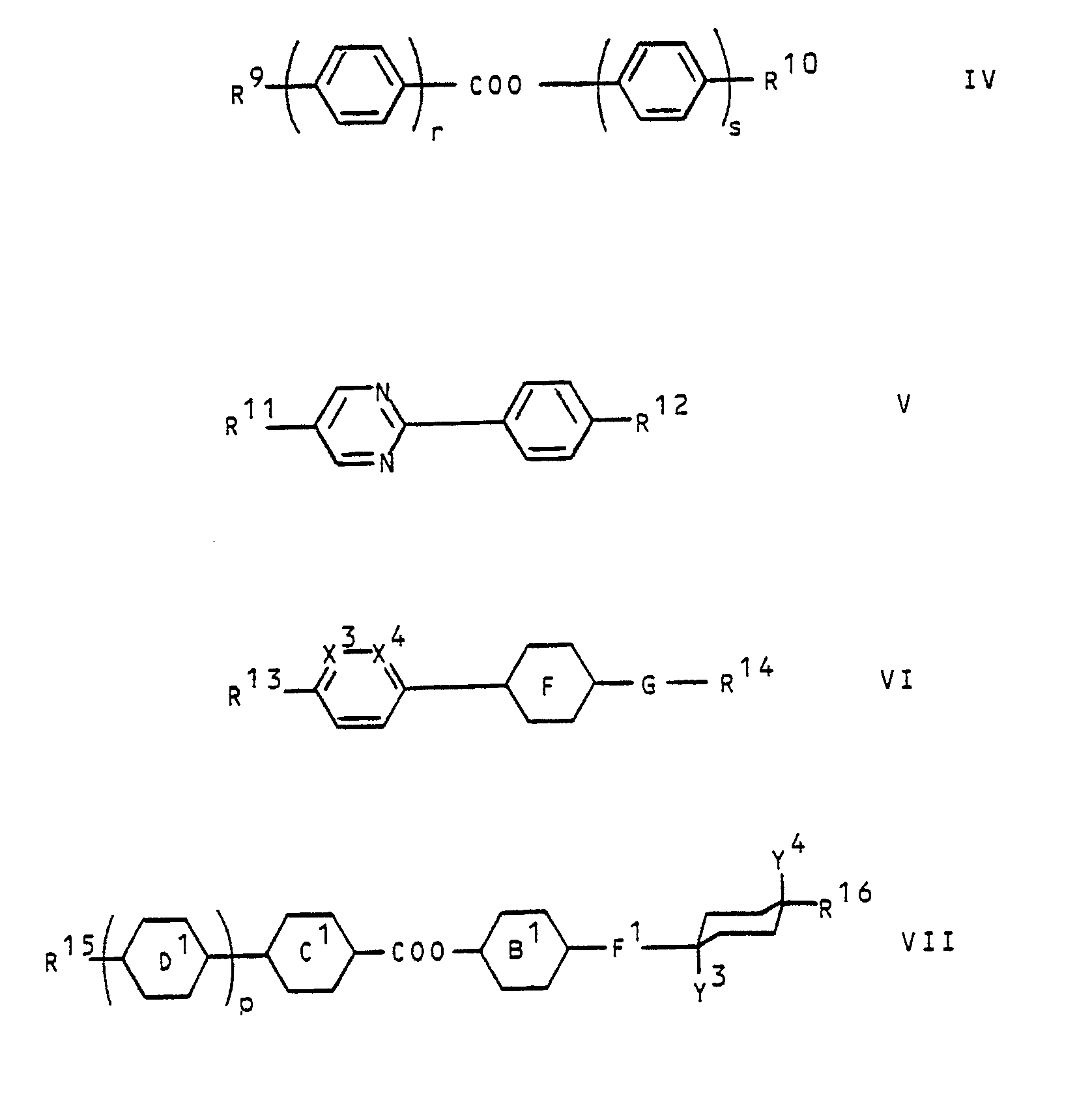

- Die Herstellung der flüssigkristallinen Gemische und der elektro-optischen Vorrichtungen kann in an sich bekannter Weise erfolgen.
- Die Erfindung wird durch die folgenden Beispiele weiter veranschaulicht. Optische Antipoden besitzen jeweils die gleichen Phasenumwandlungstemperaturen und induzieren absolut gleiche Werte der spontanen Polarisation und der Verdrillung aber mit entgegengesetzten Vorzeichen. Die zur Charakterisierung der Phasenumwandlungen verwendeten Abklärungen stehen für folgende Bedeutungen:
C für kristallin
S für smektisch
SA, SB etc. für smektisch A,B etc.
S

Ch für cholesterisch
N für nematisch
I für isotrop. - Eine Lösung von 2 g 4,4˝-p-Terphenyldicarbonsäuredichlorid (herstellbar durch Umsetzung von 4,4˝-Terphenyldicarbonsäure mit Thionylchlorid in Pyridin bei 80°C) in 200 ml trockenem Pyridin wurde mit 2,16 g L-(-)-Menthol [1(R),2(S),5(R)-Menthol] versetzt und 24 Stunden bei 20°C gerührt. Anschliessend wurde das Reaktionsgemisch auf ein Gemisch von Eis und verdünnter Salzsäure gegossen. Das kristalline Produkt wurde abfiltriert, mit Wasser gewaschen und am Hochvakuum getrocknet. Chromatographische Reinigung und Umkristallisation ergab reines 4,4˝-Di-[1(R),2(S),5(R)-menthyloxycarbonyl]-p-terphenyl mit Smp. 168-169°C.
- In analoger Weise können folgende Verbindungen hergestellt werden:
4,4˝-Di-[1(S)-phenyl-1-äthoxycarbonyl]-p-terphenyl, Smp. 166,5-167,5°C;
4,4˝-Di-[1(S)-(p-methylphenyl)-1-äthoxycarbonyl]-p-terphenyl;
4,4˝-Di-[1(S)-(p-methoxyphenyl)-1-äthoxycarbonyl]-p-terphenyl;
4,4˝-Di-[2(S)-methyl-1-butyloxycarbonyl]-p-terphenyl, Smp. (C-SA) 132°C, (SA-Ch) 143°C, Klp. (Ch-I) 145°C;
4,4˝-Di-[2(S)-methyl-1-pentyloxycarbonyl]-p-terphenyl;
4,4˝-Di-[2(S)-methyl-1-hexyloxycarbonyl]-p-terphenyl;
4,4˝-Di-[2(S)-fluor-1-propyloxycarbonyl]-p-terphenyl;
4,4˝-Di-[2(S)-chlor-1-propyloxycarbonyl]-p-terphenyl, Smp. (C-SA) 123°C, (SA-Ch) 135°C, Klp. (Ch-I) 138°C;
4,4˝-Di-[2(R)-cyano-1-propyloxycarbonyl]-p-terphenyl, Smp. 179,2°C;
4,4˝-Di-[2(S)-fluor-1-butyloxycarbonyl]-p-terphenyl;
4,4˝-Di-[2(S)-chlor-1-butyloxycarbonyl]-p-terphenyl;
4,4˝-Di-[2(R)-cyano-1-butyloxycarbonyl]-p-terphenyl;
4,4˝-Di-[2(S)-fluor-3-methyl-1-butyloxycarbonyl]-p-terphenyl;
4,4˝-Di-[2(S)-chlor-3-methyl-1-butyloxycarbonyl]-p-terphenyl;
4,4˝-Di-[2(R)-cyano-3-methyl-1-butyloxycarbonyl]-p-terphenyl;
4,4˝-Di-[2(S)-fluor-1-pentyloxycarbonyl]-p-terphenyl;
4,4˝-Di-[2(S)-chlor-1-pentyloxycarbonyl]-p-terphenyl. Smp. (C-S

4,4˝-Di-[2(R)-cyano-1-pentyloxycarbonyl]-p-terphenyl, Smp. 129-131°C;
4,4˝-Di-[2(R)-fluor-4-methyl-1-pentyloxycarbonyl]-p-terphenyl;
4,4˝-Di-[2(R)-chlor-4-methyl-1-pentyloxycarbonyl]-p-terphenyl, Smp. 169,4-170,0°C;
4,4˝-Di-[2(S)-cyano-4-methyl-1-pentyloxycarbonyl]-p-terphenyl, Smp. 129-131°C;
4,4˝-Di-[2(R)-fluor-1-hexyloxycarbonyl]-p-terphenyl;
4,4˝-Di-[2(S)-chlor-1-hexyloxycarbonyl]-p-terphenyl;
4,4˝-Di-[2(R)-cyano-1-hexyloxycarbonyl]-p-terphenyl;
4-[2(S)-Octyloxycarbonyl]-4˝-[1(S)-phenyl-1-äthoxycarbonyl]-p-terphenyl;
4-[2(R)-Octyloxycarbonyl]-4˝-[1(S)-phenyl-1-äthoxycarbonyl]-p-terphenyl;
4-[2(S)-Octyloxycarbonyl]-4˝-[2(S)-chlor-1-pentyloxycarbonyl]-p-terphenyl;
4-[2(R)-Octyloxycarbonyl]-4˝-[2(S)-chlor-1-pentyloxycarbonyl]-p-terphenyl;
4-[2(S)-Octyloxycarbonyl]-4˝-[2(R)-cyano-1-pentyloxycarbonyl]-p-terphenyl;
4-[2(R)-Octyloxycarbonyl]-4˝-[2(R)-cyano-1-pentyloxycarbonyl]-p-terphenyl;
4-[2(S)-Octyloxycarbonyl]-4˝-[2(R)-chlor-4-methyl-1-pentyloxycarbonyl]-p-terphenyl;
4-[2(R)-Octyloxycarbonyl]-4˝-[2(R)-chlor-4-methyl-1-pentyloxycarbonyl]-p-terphenyl;
4-[2(S)-Octyloxycarbonyl]-4˝-[2(S)-cyano-4-methyl-1-pentyloxycarbonyl]-p-terphenyl;
4-[2(R)-Octyloxycarbonyl]-4˝-[2(S)-cyano-4-methyl-1-pentyloxycarbonyl]-p-terphenyl;
2,5-Bis-[4-[2(S)-octyloxycarbonyl]phenyl]pyrimidin;
2,5-Bis-[4-[1(R),2(S),5(R)-menthyloxycarbonyl]phenyl]pyrimidin;
2,5-Bis-[4-[1(S)-phenyl-1-äthoxycarbonyl]phenyl]pyrimidin;
2,5-Bis-[4-[2(S)-methyl-1-butyloxycarbonyl]phenyl]pyrimidin;
2,5-Bis-[4-[2(S)-chlor-1-propyloxycarbonyl]phenyl]pyrimidin;
2,5-Bis-[4-[2(R)-cyano-1 propyloxycarbonyl]phenyl]pyrimidin;
2,5-Bis-[4-[2(S)-chlor-1-pentyloxycarbonyl]phenyl]pyrimidin;
2,5-Bis-[4-[2(R)-cyano-1-pentyloxycarbonyl]phenyl]pyrimidin;
2,5-Bis-[4-[2(R)-chlor-4-methyl-1-pentyloxycarbonyl]phenyl]pyrimidin;
2,5-Bis-[4-[2(S)-cyano-4-methyl-1-pentyloxycarbonyl]phenyl]pyrimidin;
und die optischen Antipoden der genannten Verbindungen. - Die als Ausgangsmaterialien verwendeten Alkohole sind bekannte oder Analoge bekannter Verbindungen oder können nach folgenden Methoden hergestellt werden:
- 1-Phenyläthanol wurde mit Phthalsäureanhydrid zum racemischen Monoester umgesetzt. Die Racematspaltung erfolgte durch Salzbildung mit (-)-1-Phenyläthylamin und fraktionierte Kristallisation. Hydrolyse der optisch aktiven Monoester mit verdünnter Kalilauge ergab S-(+)-1-Phenyläthanol und R-(-)-1-Phenyläthanol. In analoger Weise können Derivate mit substituiertem Phenylrest erhalten werden.
- L-Alanin wurde durch Diazotierung mit Natriumnitrit in 6N Salzsäure und anschliessende Extraktion mit Methylenchlorid in S-2-Chlorpropionsäure übergeführt. Reduktion der erhaltenen Säure mit Lithiumaluminiumhydrid in trockenem Diäthyläther ergab S-(+)-2-Chlor-1-propanol mit αD = +19,3°. Eine analoge Umsetzung von L-Norvalin ergab S-(-)-2-Chlor-1-pentanol mit αD = -32.5°. Eine analoge Umsetzung von D-Leucin ergab R-(+)-2-Chlor-4-methyl-1-pentanol mit αD = +43,2°.
- Eine Lösung von S-(+)-2-Chlor-1-propanol in Dimethylformamid wurde mit Kaliumcyanid versetzt und unter Rühren 70 Stunden auf 70-75°C erwärmt. Hierbei wurde R-(-)-2-Cyano-1-propanol mit αD = -1,3° erhalten. Eine analoge Umsetzung von S-(-)-2-Chlor-1-pentanol ergab R-(+)-2-Cyano-1-Pentanol mit αD = +10,3°. Eine analoge Umsetzung von R-(+)-2-Chlor-4-methyl-1-pentanol ergab S-(-)-2-Cyano-4-methyl-1-pentanol mit αD = -11,5°.
-
- a) Eine Suspension von 37,2 g Methoxymethyl-triphenylphosphoniumchlorid in 250 ml t-Butylmethyläther wird bei Raumtemperatur unter Argonbegasung mit 13,4 g Kalium-t-butylat versetzt und 1 Stunde gerührt. Anschliessend wird das Reaktionsgemisch bei ca. 20°C mit einem Gemisch von 9,49 g 4-Cyanobenzaldehyd und 100 ml t-Butylmethyläther versetzt und noch 1 Stunde gerührt. Danach wird das Reaktionsgemisch in Diäthyläther/Wasser verteilt. Die wässrige Phase wird noch mehrmals mit Diäthyläther extrahiert. Die organischen Phasen werden mit Wasser gewaschen, über Magnesiumsulfat getrocknet, filtriert und eingedampft. Chromatographische Reinigung des erhaltenen Rohproduktes an Kieselgel mit Petroläther und Toluol/Hexan (Vol. 3:1) ergibt 4-(2-Methoxyvinyl)benzonitril.
- b) 15 ml Orthoameisensäuretrimethylester werden bei 0°C unter Argonbegasung mit 187 µl Bortrifluorid-diäthylätherat und dann innert 10 Minuten bei ca. 9°C mit einer Lösung von 2,7 g 4-(2-Methoxyvinyl)benzonitril in 30 ml Orthoameisensäuretrimethylester versetzt. Die Reaktionslösung wird etwa 60 Stunden bei Raumtemperatur gerührt, dann mit 100 µl Triäthylamin versetzt und eingedampft. Das erhaltene Rohprodukt wird in Diäthyläther und wässriger Natriumhydrogencarbonat-Lösung verteilt. Die wässrige Phase wird noch mehrmals mit Diäthyläther extrahiert. Die organischen Phasen werden mit wässriger Natriumhydrogencarbonat-Lösung und mit Wasser gewaschen, über Magnesiumsulfat getrocknet, filtriert und eingedampft. Chromatographische Reinigung des Rückstandes an Kieselgel mit Aethylacetat/Petroläther ergibt 2-(4-Cyanophenyl)malondialdehyd-tetramethylacetal.
- c) Eine Lösung von 3,9 g 2-(4-Cyanophenyl)malondialdehyd-tetramethylacetal in 50 ml Acetonitril wird unter Argonbegasung mit 81,5 mg p-Toluolsulfonsäure-Monohydrat und 241 µl Wasser versetzt und 2 Stunden zum Rückfluss erhitzt. Anschliessend wird das Reaktionsgemisch in Diäthyläther und wässriger Natriumhydrogencarbonat Lösung verteilt. Die wässrige Phase wird noch mehrmals mit Diäthyläther extrahiert. Die organischen Phasen werden mit wässriger Natriumhydrogencarbonat-Lösung gewaschen, über Magnesiumsulfat getrocknet, filtriert und eingedampft. Chromatographische Reinigung des erhaltenen Rohproduktes an Kieselgel mit Aethylacetat/Petroläther ergibt 2-(4-Cyanophenyl)-3-methoxyacrolein.
- d) 247 mg Natrium werden bei Raumtemperatur mit 10 ml Methanol versetzt. Nach 15 Minuten wird die erhaltene Lösung bei Raumtemperatur mit 1,58 g 4-Amidinobenzamid-hydrochlorid versetzt. Hierbei bildet sich eine weisse Suspension, die bei Raumtemperatur innert 10 Minuten tropfenweise mit einer Lösung von 1,42 g 2-(4-Cyanophenyl)-3-methoxyacrolein in 50 ml Methanol versetzt wird. Das Reaktionsgemisch wird noch 2 Stunden bei Raumtemperatur gerührt und dann genutscht. Der Rückstand wird mit Wasser, Tetrahydrofuran und Diäthyläther gewaschen und am Hochvakuum getrocknet. Hierbei wird 4-[5-(4-Cyanophenyl)-2-pyrimidinyl]benzamid erhalten.
- e) 1,8 g 4-[5-(4-Cyanophenyl)-2-pyrimidinyl]benzamid werden in 30 ml Eisessig und 40 ml 50-prozentiger Schwefelsäure suspendiert und das Gemisch 3 Stunden erhitzt (Badtemperatur 160°C). Danach wird das abgekühlte Reaktionsgemisch auf 200 ml Wasser gegossen und genutscht. Der Rückstand wird mit Wasser gewaschen und am Hochvakuum getrocknet. Hierbei wird Pyrimidin-2,5-ylen-bis(4-benzoesäure) erhalten.
- f) Ein Gemisch von 80 mg Pyrimidin-2,5-ylen-bis(4-benzoesäure) und 10 ml Pyridin wird mit 80 µl Thionylchlorid versetzt und 20 Stunden auf 80°C erhitzt. Anschliessend wird das abgekühlte Reaktionsgemisch mit 0,5 ml R-(-)-2-Octanol versetzt und unter Rühren innert 20 Stunden langsam bis auf 100°C erhitzt. Danach wird das Reaktionsgemisch abgekühlt und in Diäthyläther und Wasser verteilt. Die wässrige Phase wird abgetrennt und mit Diäthyläther nachextrahiert. Die organischen Phasen werden mit 2N Salzsäure und mit Wasser gewaschen, über Magnesiumsulfat getrocknet, filtriert und eingedampft. Chromatograhische Reinigung des Rückstandes an Kieselgel mit Aethylacetat/Petroläther ergibt 2,5-Bis-[4-(2(R)-Octyloxycarbonyl)phenyl]pyrimidin.
- In analoger Weise können folgende Verbindungen hergestellt werden:
2,5-Bis-[4-(1(R),2(S),5(R)-menthyloxycarbonyl)phenyl]pyrimidin;
2,5-Bis-[4-(1(S)-phenyl-1-äthoxycarbonyl)phenyl]pyrimidin;
2,5-Bis-[4-(2(S)-methyl-1-butyloxycarbonyl)phenyl] pyrimidin; 2,5-Bis-[4-(2(S)-chlor-1-propyloxycarbonyl)phenyl]pyrimidin;
2,5-Bis-[4-(2(R)-cyano-1-propyloxycarbonyl)phenyl]pyrimidin;
2,5-Bis-[4-(2(S)-chlor-1-pentyloxycarbonyl)phenyl]pyrimidin;
2,5-Bis-[4-(2(R)-cyano-1-pentyloxycarbonyl)phenyl]pyrimidin;
2,5-Bis-[4-(2(R)-chlor-4-methyl-1-pentyloxycarbonyl)phenyl]pyrimidin;
2,5-Bis-[4-(2(S)-cyano-4-methyl-1-pentyloxycarbonyl)phenyl]pyrimidin;
und die optischen Antipoden der genannten Verbindungen. - Die durch Verbindungen der Formel I in getilteten smektischen Phasen induzierte spontane Polarisation wurde anhand von Gemischen mit 4-Octyloxybenzoesäure-4-hexyloxyphenylester untersucht. 4-Octyloxybenzoesäure-4-hexyloxyphenylester (95 Gew. %) wurde jeweils mit 5 Gew.-% einer Verbindung der Formel I dotiert. Die spontane Polarisation PS der Gemische wurde bei 40 ± 1°C gemessen, und daraus der extrapolierte Wert P


4,4˝-Di-[1(R),2(S),5(R)-menthyloxycarbonyl]-p-terphenyl, PS = 11 nC/cm², P
4,4˝-Di-[1(S)-phenyl-1-äthoxycarbonyl]-p-terphenyl, PS = 14 nC/cm², P
4,4˝-Di-[2(S)-methyl-1-butyloxycarbonyl]-p-terphenyl, PS = 0,85 nC/cm², P
4,4˝-Di-[2(S)-chlor-1-propyloxycarbonyl]-p-terphenyl, PS = 0,51 nC/cm², P
4,4˝-Di-[2(R)-cyano-1-propyloxycarbonyl]-p-terphenyl, PS = 5,53 nC/cm², P
4,4˝-Di-[2(S)-chlor-1-pentyloxycarbonyl]-p-terphenyl, PS = 6,8 nC/cm², P
4,4˝-Di-[2(R)-cyano-1-pentyloxycarbonyl]-p-terphenyl, PS = 20 nC/cm², P
4,4˝-Di-[2(R)-chlor-4-methyl-1-pentyloxycarbonyl]-p-terphenyl, PS = 9 nC/cm², P
4,4˝-Di-[2(S)-cyano-4-methyl-1-pentyloxycarbonyl]-p-terphenyl, PS = 20 nC/cm², P
Claims (10)


Applications Claiming Priority (2)
| Application Number | Priority Date | Filing Date | Title |
|---|---|---|---|
| CH157088 | 1988-04-27 | ||
| CH1570/88 | 1988-04-27 |
Publications (3)
| Publication Number | Publication Date |
|---|---|
| EP0339414A2 true EP0339414A2 (de) | 1989-11-02 |
| EP0339414A3 EP0339414A3 (en) | 1990-12-12 |
| EP0339414B1 EP0339414B1 (de) | 1993-12-01 |
Family
ID=4213515
Family Applications (1)
| Application Number | Title | Priority Date | Filing Date |
|---|---|---|---|
| EP89106808A Expired - Lifetime EP0339414B1 (de) | 1988-04-27 | 1989-04-17 | Optisch aktive Diester |
Country Status (6)
| Country | Link |
|---|---|
| EP (1) | EP0339414B1 (de) |
| JP (1) | JP3022570B2 (de) |
| KR (1) | KR0152645B1 (de) |
| DE (1) | DE58906274D1 (de) |
| HK (1) | HK147896A (de) |
| RU (1) | RU2030390C1 (de) |
Cited By (8)
| Publication number | Priority date | Publication date | Assignee | Title |
|---|---|---|---|---|
| EP0523543A1 (de) * | 1991-07-19 | 1993-01-20 | F. Hoffmann-La Roche Ag | Chirale Piperazin-Derivative |
| US5242619A (en) * | 1988-04-27 | 1993-09-07 | Hoffmann-La Roche Inc. | Liquid crystalline mixtures having a chiral tilted smectic phase |
| US5486310A (en) * | 1988-04-27 | 1996-01-23 | Hoffmann-La Roche Inc. | Liquid crystalline mixtures having a chiral tilted smectic phase |
| EP0821050A1 (de) * | 1996-07-26 | 1998-01-28 | Takasago International Corporation | Optisch aktive Verbindung und antiferroelektrische Flüssigkristallzusammensetzung |
| US5753139A (en) * | 1990-07-20 | 1998-05-19 | Displaytech, Inc. | High contrast distorted helix effect electro-optic devices and tight ferroelectric pitch ferroelectric pitch ferroelectric liquid crystal compositions useful therein |
| US5948551A (en) * | 1994-07-01 | 1999-09-07 | Hoechst Aktiengesellschaft | Use of conjugated compounds containing pyrimidine groups as electroluminescence materials |
| WO2010031431A1 (en) | 2008-09-17 | 2010-03-25 | Tetragon Lc Chemie Ag | Chiral compounds, cholesteric and ferroelectric liquid crystal compositions comprising these chiral compounds, and liquid crystal displays comprising these liquid crystal compositions |
| CN116554889A (zh) * | 2022-02-07 | 2023-08-08 | 香港科技大学 | 化合物和液晶组合物 |
Families Citing this family (2)
| Publication number | Priority date | Publication date | Assignee | Title |
|---|---|---|---|---|
| WO2003036371A1 (fr) * | 2001-10-26 | 2003-05-01 | Utar International Ltd. | Cellule d'affichage ferro-electrique a cristaux liquides |
| JP2005281222A (ja) * | 2004-03-30 | 2005-10-13 | Chisso Corp | 複数の不斉炭素を有する光学活性化合物、液晶組成物、液晶表示素子及び成形体 |
Family Cites Families (2)
| Publication number | Priority date | Publication date | Assignee | Title |
|---|---|---|---|---|
| WO1987005015A1 (fr) * | 1986-02-17 | 1987-08-27 | MERCK Patent Gesellschaft mit beschränkter Haftung | Composes chiraux |
| EP0309774B1 (de) * | 1987-09-18 | 1992-11-19 | F. Hoffmann-La Roche Ag | Ferroelektrische Flüssigkristallzelle |
-
1989
- 1989-03-17 RU SU894663266A patent/RU2030390C1/ru active
- 1989-04-17 EP EP89106808A patent/EP0339414B1/de not_active Expired - Lifetime
- 1989-04-17 DE DE89106808T patent/DE58906274D1/de not_active Expired - Fee Related
- 1989-04-26 KR KR89005476A patent/KR0152645B1/ko not_active Expired - Fee Related
- 1989-04-26 JP JP1104789A patent/JP3022570B2/ja not_active Expired - Fee Related
-
1996
- 1996-08-01 HK HK147896A patent/HK147896A/xx not_active IP Right Cessation
Cited By (12)
| Publication number | Priority date | Publication date | Assignee | Title |
|---|---|---|---|---|
| US5242619A (en) * | 1988-04-27 | 1993-09-07 | Hoffmann-La Roche Inc. | Liquid crystalline mixtures having a chiral tilted smectic phase |
| US5486310A (en) * | 1988-04-27 | 1996-01-23 | Hoffmann-La Roche Inc. | Liquid crystalline mixtures having a chiral tilted smectic phase |
| US5753139A (en) * | 1990-07-20 | 1998-05-19 | Displaytech, Inc. | High contrast distorted helix effect electro-optic devices and tight ferroelectric pitch ferroelectric pitch ferroelectric liquid crystal compositions useful therein |
| EP0523543A1 (de) * | 1991-07-19 | 1993-01-20 | F. Hoffmann-La Roche Ag | Chirale Piperazin-Derivative |
| US5948551A (en) * | 1994-07-01 | 1999-09-07 | Hoechst Aktiengesellschaft | Use of conjugated compounds containing pyrimidine groups as electroluminescence materials |
| EP0821050A1 (de) * | 1996-07-26 | 1998-01-28 | Takasago International Corporation | Optisch aktive Verbindung und antiferroelektrische Flüssigkristallzusammensetzung |
| US5820782A (en) * | 1996-07-26 | 1998-10-13 | Takasago International Corporation | Optically active compound and antiferroelectric liquid crystal composition containing the same |
| WO2010031431A1 (en) | 2008-09-17 | 2010-03-25 | Tetragon Lc Chemie Ag | Chiral compounds, cholesteric and ferroelectric liquid crystal compositions comprising these chiral compounds, and liquid crystal displays comprising these liquid crystal compositions |
| US8883037B2 (en) | 2008-09-17 | 2014-11-11 | Tetragon Lc Chemie Ag | Chiral compounds, cholesteric and ferroelectric liquid crystal compositions comprising these chiral compounds, and liquid crystal displays comprising these liquid crystal compositions |
| CN116554889A (zh) * | 2022-02-07 | 2023-08-08 | 香港科技大学 | 化合物和液晶组合物 |
| US12480049B2 (en) * | 2022-02-07 | 2025-11-25 | The Hong Kong University Of Science And Technology | Compound and liquid crystal composition |
| CN116554889B (zh) * | 2022-02-07 | 2026-04-21 | 香港科技大学 | 化合物和液晶组合物 |
Also Published As
| Publication number | Publication date |
|---|---|
| EP0339414A3 (en) | 1990-12-12 |
| KR900016429A (ko) | 1990-11-13 |
| DE58906274D1 (de) | 1994-01-13 |
| JP3022570B2 (ja) | 2000-03-21 |
| HK147896A (en) | 1996-08-09 |
| EP0339414B1 (de) | 1993-12-01 |
| JPH0211538A (ja) | 1990-01-16 |
| RU2030390C1 (ru) | 1995-03-10 |
| KR0152645B1 (en) | 1998-10-01 |
Similar Documents
| Publication | Publication Date | Title |
|---|---|---|
| DE3246440C2 (de) | Acetylene | |
| EP0325796B1 (de) | Flüssigkristallverbindung und Gemische, die diese Verbindung enthalten | |
| EP0247466B1 (de) | Flüssigkristalline Derivate von Phenylbenzoat | |
| DE3342631A1 (de) | Thienothiophenderivate | |
| JPH0539287A (ja) | シクロヘキサンカルボニトリル誘導体 | |
| EP0268198B1 (de) | Ferroelektrische Flüssigkristalle | |
| EP0344557B1 (de) | Flüssigkristallkomponenten mit einer Trimethylenoxygruppe | |
| EP0339414B1 (de) | Optisch aktive Diester | |
| EP0442306B1 (de) | (4E-Cyclohexyl-3-butenyl)aryl-Derivate | |
| EP0242716B1 (de) | Flüssigkristalline Pyridinderivate | |
| DE3228350A1 (de) | Pyridazine | |
| EP0464648B1 (de) | 4-Cyano-3-fluorophenylester | |
| HK107294A (en) | Alkoxymethyl- and alkenyloxymethyl-cyclohexanes | |
| EP0410233B1 (de) | (4-Arylbutyl)cyclohexan-Derivate | |
| EP0361157B1 (de) | Phenylpyridine | |
| DE68902443T2 (de) | Fluorinierte oligophenylderivate. | |
| EP0343487B1 (de) | Alpha-Fluorcarbonsäurecyclohexylester | |
| EP0552658A1 (de) | Derivate der 3-Cyclohexylpropionsäure und ihre Verwendung in ferroelektrischen Flüssigkristallmischungen | |
| EP0269963B1 (de) | Ferroelektrische Flüssigkristalle | |
| DE4331679A1 (de) | Spiro[5,5]undecane und ihre Verwendung in Flüssigkristallmischungen | |
| EP0595144A1 (de) | Cyclohexyl-alkenoate als Komponente flüssigkristalliner Gemische | |
| EP0821049B1 (de) | Cyclopentyl-Verbindungen | |
| EP0393501A1 (de) | Flüssigkristallkomponenten mit einer trans-3-Cyclohexylallyloxygruppe | |
| JPH04506817A (ja) | フェニルシクロヘキサン類および液晶媒体 | |
| EP0799830A1 (de) | Imidazothiazol-Derivate als komponente flüssigkristalline Mischungen |
Legal Events
| Date | Code | Title | Description |
|---|---|---|---|
| PUAI | Public reference made under article 153(3) epc to a published international application that has entered the european phase |
Free format text: ORIGINAL CODE: 0009012 |
|
| 17P | Request for examination filed |
Effective date: 19890417 |
|
| AK | Designated contracting states |
Kind code of ref document: A2 Designated state(s): CH DE GB IT LI |
|
| PUAL | Search report despatched |
Free format text: ORIGINAL CODE: 0009013 |
|
| AK | Designated contracting states |
Kind code of ref document: A3 Designated state(s): CH DE GB IT LI |
|
| 17Q | First examination report despatched |
Effective date: 19911029 |
|
| GRAA | (expected) grant |
Free format text: ORIGINAL CODE: 0009210 |
|
| AK | Designated contracting states |
Kind code of ref document: B1 Designated state(s): CH DE GB IT LI |
|
| REF | Corresponds to: |
Ref document number: 58906274 Country of ref document: DE Date of ref document: 19940113 |
|
| ITF | It: translation for a ep patent filed | ||
| GBT | Gb: translation of ep patent filed (gb section 77(6)(a)/1977) |
Effective date: 19940218 |
|
| PLBE | No opposition filed within time limit |
Free format text: ORIGINAL CODE: 0009261 |
|
| STAA | Information on the status of an ep patent application or granted ep patent |
Free format text: STATUS: NO OPPOSITION FILED WITHIN TIME LIMIT |
|
| 26N | No opposition filed | ||
| REG | Reference to a national code |
Ref country code: CH Ref legal event code: PUE Owner name: NIOPIC MOSCOW RESEARCH AND PRODUCTION ASSOCIATION; Ref country code: CH Ref legal event code: NV Representative=s name: PATENTANWALTSBUERO EDER AG |
|
| REG | Reference to a national code |
Ref country code: GB Ref legal event code: 732E |
|
| REG | Reference to a national code |
Ref country code: CH Ref legal event code: PFA Free format text: ROLIC AG,INNERE GUETERSTRASSE 2,6301 ZUG (CH) TRANSFER- ROLIC AG,CHAMERSTRASSE 50,6301 ZUG (CH) |
|
| REG | Reference to a national code |
Ref country code: GB Ref legal event code: IF02 |
|
| PGFP | Annual fee paid to national office [announced via postgrant information from national office to epo] |
Ref country code: CH Payment date: 20030217 Year of fee payment: 15 |
|
| PGFP | Annual fee paid to national office [announced via postgrant information from national office to epo] |
Ref country code: GB Payment date: 20030313 Year of fee payment: 15 |
|
| PGFP | Annual fee paid to national office [announced via postgrant information from national office to epo] |
Ref country code: DE Payment date: 20030324 Year of fee payment: 15 |
|
| PG25 | Lapsed in a contracting state [announced via postgrant information from national office to epo] |
Ref country code: GB Free format text: LAPSE BECAUSE OF NON-PAYMENT OF DUE FEES Effective date: 20040417 |
|
| PG25 | Lapsed in a contracting state [announced via postgrant information from national office to epo] |
Ref country code: LI Free format text: LAPSE BECAUSE OF NON-PAYMENT OF DUE FEES Effective date: 20040430 Ref country code: CH Free format text: LAPSE BECAUSE OF NON-PAYMENT OF DUE FEES Effective date: 20040430 |
|
| PG25 | Lapsed in a contracting state [announced via postgrant information from national office to epo] |
Ref country code: DE Free format text: LAPSE BECAUSE OF NON-PAYMENT OF DUE FEES Effective date: 20041103 |
|
| GBPC | Gb: european patent ceased through non-payment of renewal fee |
Effective date: 20040417 |
|
| REG | Reference to a national code |
Ref country code: CH Ref legal event code: PL |
|
| PG25 | Lapsed in a contracting state [announced via postgrant information from national office to epo] |
Ref country code: IT Free format text: LAPSE BECAUSE OF NON-PAYMENT OF DUE FEES;WARNING: LAPSES OF ITALIAN PATENTS WITH EFFECTIVE DATE BEFORE 2007 MAY HAVE OCCURRED AT ANY TIME BEFORE 2007. THE CORRECT EFFECTIVE DATE MAY BE DIFFERENT FROM THE ONE RECORDED. Effective date: 20050417 |