EP0336984A1 - Messfühler - Google Patents
Messfühler Download PDFInfo
- Publication number
- EP0336984A1 EP0336984A1 EP88105675A EP88105675A EP0336984A1 EP 0336984 A1 EP0336984 A1 EP 0336984A1 EP 88105675 A EP88105675 A EP 88105675A EP 88105675 A EP88105675 A EP 88105675A EP 0336984 A1 EP0336984 A1 EP 0336984A1
- Authority
- EP
- European Patent Office
- Prior art keywords
- sheath
- wire
- locking means
- measuring probe
- probe
- Prior art date
- Legal status (The legal status is an assumption and is not a legal conclusion. Google has not performed a legal analysis and makes no representation as to the accuracy of the status listed.)
- Granted
Links
Images


Classifications
-
- A—HUMAN NECESSITIES
- A61—MEDICAL OR VETERINARY SCIENCE; HYGIENE
- A61B—DIAGNOSIS; SURGERY; IDENTIFICATION
- A61B5/00—Measuring for diagnostic purposes; Identification of persons
- A61B5/145—Measuring characteristics of blood in vivo, e.g. gas concentration or pH-value ; Measuring characteristics of body fluids or tissues, e.g. interstitial fluid or cerebral tissue
- A61B5/14539—Measuring characteristics of blood in vivo, e.g. gas concentration or pH-value ; Measuring characteristics of body fluids or tissues, e.g. interstitial fluid or cerebral tissue for measuring pH
-
- A—HUMAN NECESSITIES
- A61—MEDICAL OR VETERINARY SCIENCE; HYGIENE
- A61B—DIAGNOSIS; SURGERY; IDENTIFICATION
- A61B5/00—Measuring for diagnostic purposes; Identification of persons
- A61B5/145—Measuring characteristics of blood in vivo, e.g. gas concentration or pH-value ; Measuring characteristics of body fluids or tissues, e.g. interstitial fluid or cerebral tissue
- A61B5/1455—Measuring characteristics of blood in vivo, e.g. gas concentration or pH-value ; Measuring characteristics of body fluids or tissues, e.g. interstitial fluid or cerebral tissue using optical sensors, e.g. spectral photometrical oximeters
- A61B5/1459—Measuring characteristics of blood in vivo, e.g. gas concentration or pH-value ; Measuring characteristics of body fluids or tissues, e.g. interstitial fluid or cerebral tissue using optical sensors, e.g. spectral photometrical oximeters invasive, e.g. introduced into the body by a catheter
-
- A—HUMAN NECESSITIES
- A61—MEDICAL OR VETERINARY SCIENCE; HYGIENE
- A61M—DEVICES FOR INTRODUCING MEDIA INTO, OR ONTO, THE BODY; DEVICES FOR TRANSDUCING BODY MEDIA OR FOR TAKING MEDIA FROM THE BODY; DEVICES FOR PRODUCING OR ENDING SLEEP OR STUPOR
- A61M25/00—Catheters; Hollow probes
- A61M25/0009—Making of catheters or other medical or surgical tubes
-
- A—HUMAN NECESSITIES
- A61—MEDICAL OR VETERINARY SCIENCE; HYGIENE
- A61M—DEVICES FOR INTRODUCING MEDIA INTO, OR ONTO, THE BODY; DEVICES FOR TRANSDUCING BODY MEDIA OR FOR TAKING MEDIA FROM THE BODY; DEVICES FOR PRODUCING OR ENDING SLEEP OR STUPOR
- A61M25/00—Catheters; Hollow probes
- A61M25/0067—Catheters; Hollow probes characterised by the distal end, e.g. tips
- A61M25/0068—Static characteristics of the catheter tip, e.g. shape, atraumatic tip, curved tip or tip structure
- A61M25/0069—Tip not integral with tube
-
- A—HUMAN NECESSITIES
- A61—MEDICAL OR VETERINARY SCIENCE; HYGIENE
- A61M—DEVICES FOR INTRODUCING MEDIA INTO, OR ONTO, THE BODY; DEVICES FOR TRANSDUCING BODY MEDIA OR FOR TAKING MEDIA FROM THE BODY; DEVICES FOR PRODUCING OR ENDING SLEEP OR STUPOR
- A61M25/00—Catheters; Hollow probes
- A61M2025/0098—Catheters; Hollow probes having a strain relief at the proximal end, e.g. sleeve
Definitions
- This invention relates to a measuring probe for the invasive measurement of blood parameters such as pH, pO2 or pCO2 with at least one optical fiber guided in a tubing element and connected at its proximal end to a sensor which is surrounded by a tube-like sheath.
- Probes for the invasive measurement of blood parameters consist of at least one sensor comprising an optical fiber, said fiber ending up with a gel zone containing a dye.
- the optical density or another optical parameter of said dye varies with the blood parameter (such as pH) to be measured.
- a reflector is positioned on the other side of the dye-containing gel.
- the end of the fiber, the gel and the reflector are surrounded by a semi-permeable envelope (for example, a hydrogen ion permeable envelope in the case of a pH sensor) to keep the gel in place.
- Light from this optical fiber passes the dye-containing gel, is reflected by said reflector, passes the gel again and is transmitted through the optical fiber to an appropriate detector which measures light attenuation or changes in other optical parameters caused by the dye.
- This attenuation or change is a function of the blood parameter to be measured, and the relation between attenuation, absorbance or the change of another optical parameter and the blood parameter is well-known.
- Such a probe can be introduced in the patient's artery to measure - depending on the dye and/or the selected semi-permeable envelope - various blood parameters such as pH, pO2 or pCO2.
- Such a probe comprises a wire which is - as well as the optical fiber(s) leading to the sensor(s) and in parallel to them - guided in the tubing element.
- the wire then passes the sheath (in parallel to the sensor(s)) and is fastened to the locking means (e.g., a metal cap) which closes the sheath at its outer end and is preferably connected with the same.
- the locking means e.g., a metal cap
- the wire is preferably carried to the outside through a hole in the tubing element and glued to the outer side of the tubing element by means of a plastic part. This is performed in a distal portion of the probe (in the terms of this description, "distal end” of the probe means those portions of the probe which are not to be introduced into the patient's body; “proximal end” means the end of the probe which is near the body of the patient, i.e. to be introduced into the patient's artery, and "outer end” of the sheath means its most proximal end).
- the wire may also be fastened to a connector or the like; in this case, the optical fiber is also connected to said connecting means, said optical fiber providing light guidance from and to a monitor and the wire ensuring strain relieving of the probe.
- Such a measuring probe ensures a very tight mechanical connection between all probe components.
- the sheath cannot get off the tube, and no break of the probe distal to the sensor tip can occur (measuring probes according to the state of the art could even break off in this region which is also partially introduced into the patient's artery).
- the strain relieving wire also ensures that no break of a sensor or an optical fiber can occur as all or at least most tension forces are absorbed by the wire parallel to the sensor(s)/optical fiber(s).
- the sheath and/or the locking means consist of metal, in particular stainless steel.
- metal in particular stainless steel.
- the metal/metal connections e.g., sheath to locking means and locking means to wire
- the wire may only fulfill its strain relieving function if this connection is reliable.
- Still another solution may be selected, e.g. to embed the wire in a plastic locking means.
- the locking means has a sphere-like contour.
- metal as the basic material for the locking means has the advantage that finishing can be performed after the attachment of the locking means to the sheath.
- this finishing is performed by electropolishing which ensures that the outer contour of the locking means as well as its (welded or soldered) connection to the sheath is extremely smooth.
- the invention further refers to a method for manufacturing a measuring probe of the type described above wherein the sheath as well as the locking means consist of metal.
- the wire is first passed through said sheath, and then said locking means is welded or soldered to said sheath as well as to said wire in a single welding or soldering process.
- This method ensures that both relevant connections (locking means to sheath and wire to locking means) can be welded or soldered and is - due to the fact that only a single manufacturing step is necessary - very easy to perform.
- a very solid and smooth welding connection even in the small dimensions of such a measuring probe may be obtained if welding is performed by a laser, preferably in an argon atmosphere.
- the outer side of the locking means and its connection to the sheath may be electropolished afterwards to remove any projecting burrs.
- the sheath For the purpose of measuring blood parameters, the sheath must have openings or the like to allow ions or molecules to come into contact with the sensors. As just outlined above, it is evident that a patient's artery is not injured by the outer contour of the probe. Therefore, according to a further advantageous aspect of the invention, the edges of the window(s) of the sheath are rounded. It has turned out in a lot of tests that the best method to obtain such rounded edges is to use the spark erosion technique.
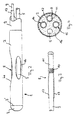
- Fig. 1a depicts a probe tip 1 of a measuring probe for the invasive measurement of blood parameters. This probe tip is not yet completely assembled.
- a metal sheath 2 closed at its outer end by sphere-like locking means 3, is provided for introduction into a patient's artery. Sheath 2 further provides three windows 4a, 4b and 4c with inclined edges.
- a metal wire 5 is provided for strain relieving.
- Fig. 1b - which is a cross section along line Ib-Ib of Fig. 1a - depicts the contour of sphere-like locking means 3.
- This locking means also consists of metal, in particular stainless steel.
- wire 5 is first passed through sheath 2 (from the right to the left) and then welded in an argon atmosphere by a laser to locking means 3.
- locking means 3 is welded to sheath 2 (same manufacturing process).
- the outer contour of locking means 3 is electropolished; in particular, burrs protruding at the connection line 3′ between locking means 3 and sheath 2 are removed.
- locking means 3 and sheath 2 are no longer visible after electropolishing.
- locking means 3 and wire 5 consist of the same material and form an integral part after welding or soldering.
- Locking means 3 may - as in the present example - also be formed from the material of wire 5 and sheath 2 upon welding or soldering.
- Sheath 2 further defines a recess 6 for the introduction of a flexible tubing as will be explained below.
- Windows 4a to 4c allow the blood to reach the sensors as will be also explained below.
- Wire 5 serves as a strain relieving member and is therefore not only attached to locking means 3 at the outer end of sheath 2, but also at its distal end to a connector or to the Kevlar fibers of the tubing.
- Fig. 1c depicts a cross section along line Ic-Ic of Fig. 1b. This cross section shows openings or windows 4a to 4c in detail.
- Fig. 2 depicts an outside view of a completely assembled probe tip 1.
- Sheath 2 is connected (e.g. by an adhesive or glue) to a tubing 7.
- Sheath 2 contains wire 5 as well as three sensors one of which (8) is shown in Fig. 2 (with respect to the other sensors, see Fig. 4).
- FIG. 3 This figure depicts a longitudinal section through a sensor and the associated optical fiber. With reference to Fig. 2, the left and right side are reversed in Fig. 3.
- dye-containing gel 10 in sensor 8 Light guided in an optical fiber 9 reaches a dye-containing gel 10 in sensor 8.
- the absorption spectrum of dye 10 is dependent on the parameter to be measured.
- the dye may be phenol red.
- the transmitted light is then reflected at reflector 11.
- this reflector is made of metal such as platinum or stainless steel, the surface of this metal being polished on the side of gel 10.
- the reflected light passes dye-containing gel 10 again and is directed back through optical fiber 9 and appropriately received by and processed in a monitor.
- the whole system is packed in a selective membrane or envelope 12, this membrane being permeable for the ions or gas molecules to be measured - in case of a pH electrode, for hydrogen ions - , so that these ions/gas molecules can reach the dye-containing gel.
- Membrane 12 is fastened on optical fiber 9 and reflector 11 by a glue 13.
- the preferred material for membrane 12 is a hydrophilic material such as cellulose.
- windows 4a to 4c are required to allow ions or gas molecules to reach the selective membranes and, consequently, the dye-containing gel of the sensors.
- Fig. 4 is a cross section of the measuring probe in the region of sheath 2 near its outer end, i.e. outside windows 4a to 4c.
- this sheath contains wire 5 and a sensor 8 (e.g., a pH sensor) of which reflector 11 and envelope 12 can be seen in Fig. 4.
- a sensor 8 e.g., a pH sensor
- Further sensors shown in Fig. 4 are a pO2 sensor 14 and a pCO2 sensor 15 which are basically equal to sensor 8 (but, of course, contain other dyes and/or envelopes depending on the parameter to be measured).
- the sheath itself is filled with a glue or adhesive 16 which holds the sensors and the wire in place.
- Fig. 5 is a longitudinal section of sheath 2 and illustrates manufacturing of the rounded edges of window 4b.
- a wire 17 is moved in a direction perpendicular to its axis (cf. arrow 18) and thereby provides a window 4b with rounded edges.
- Fig. 6 depicts a schematical outside view of the complete measuring probe. Tubing 7 is partially broken away to show wire 5 and membrane 12 covering optical fiber 9. The other optical fibers are not shown in Fig. 6.
- a connector 19 is provided for connection with a monitor which contains a light source and a light receiving means. All optical fibers and wire 5 are fastened to said connector, the optical fibers to ensure light guidance and wire 5 to ensure strain relieving of the measuring probe.
- Proximal end 20 of the measuring probe (the probe tip) is intended for introduction into a patient's artery, whereas the other end 21 is - as just mentioned - to be connected with a monitor.
- Fig. 7 depicts another way of fastening the wire.
- the distal portion (which is not to be introduced into the patient's artery) of tubing 7 is thicker (indicated by reference number 22).
- wire 5 runs through a hole in the tubing (see the broken-away region in Fig. 7) and is fixed to the outside by means of a glued plastic sleeve 23.
- This solution has - with reference to the embodiment of Fig. 6 - the advantage that there is no danger of an unwanted electrical connection between the monitor and the probe.
Landscapes
- Health & Medical Sciences (AREA)
- Life Sciences & Earth Sciences (AREA)
- Physics & Mathematics (AREA)
- Animal Behavior & Ethology (AREA)
- Veterinary Medicine (AREA)
- Biophysics (AREA)
- Engineering & Computer Science (AREA)
- Biomedical Technology (AREA)
- Heart & Thoracic Surgery (AREA)
- Public Health (AREA)
- General Health & Medical Sciences (AREA)
- Pathology (AREA)
- Surgery (AREA)
- Molecular Biology (AREA)
- Medical Informatics (AREA)
- Optics & Photonics (AREA)
- Pulmonology (AREA)
- Anesthesiology (AREA)
- Hematology (AREA)
- Spectroscopy & Molecular Physics (AREA)
- Measurement Of The Respiration, Hearing Ability, Form, And Blood Characteristics Of Living Organisms (AREA)
- Measuring Pulse, Heart Rate, Blood Pressure Or Blood Flow (AREA)
Priority Applications (6)
| Application Number | Priority Date | Filing Date | Title |
|---|---|---|---|
| EP88105675A EP0336984B1 (de) | 1988-04-09 | 1988-04-09 | Messfühler |
| DE8888105675T DE3861463D1 (de) | 1988-04-09 | 1988-04-09 | Messfuehler. |
| US07/326,582 US5020537A (en) | 1988-04-09 | 1989-03-20 | Measuring probe |
| JP1089592A JPH01310641A (ja) | 1988-04-09 | 1989-04-07 | 測定用プローブ |
| CA000596063A CA1334372C (en) | 1988-04-09 | 1989-04-07 | Measuring probe for blood parameters |
| CN89102189.2A CN1018890B (zh) | 1988-04-09 | 1989-04-08 | 一种血液参数测量探头及其制造方法 |
Applications Claiming Priority (1)
| Application Number | Priority Date | Filing Date | Title |
|---|---|---|---|
| EP88105675A EP0336984B1 (de) | 1988-04-09 | 1988-04-09 | Messfühler |
Publications (2)
| Publication Number | Publication Date |
|---|---|
| EP0336984A1 true EP0336984A1 (de) | 1989-10-18 |
| EP0336984B1 EP0336984B1 (de) | 1990-12-27 |
Family
ID=8198873
Family Applications (1)
| Application Number | Title | Priority Date | Filing Date |
|---|---|---|---|
| EP88105675A Expired EP0336984B1 (de) | 1988-04-09 | 1988-04-09 | Messfühler |
Country Status (6)
| Country | Link |
|---|---|
| US (1) | US5020537A (de) |
| EP (1) | EP0336984B1 (de) |
| JP (1) | JPH01310641A (de) |
| CN (1) | CN1018890B (de) |
| CA (1) | CA1334372C (de) |
| DE (1) | DE3861463D1 (de) |
Cited By (14)
| Publication number | Priority date | Publication date | Assignee | Title |
|---|---|---|---|---|
| EP0476161A1 (de) * | 1990-09-17 | 1992-03-25 | Hewlett-Packard GmbH | Optische Sonde |
| US5174303A (en) * | 1991-05-03 | 1992-12-29 | Intermedics, Inc. | Pacer lead with replaceable sensor |
| US5251633A (en) * | 1990-08-13 | 1993-10-12 | Hewlett-Packard Company | Optical probe |
| EP0570938A3 (de) * | 1992-05-19 | 1994-03-16 | Minnesota Mining & Mfg | |
| US5357955A (en) * | 1992-05-22 | 1994-10-25 | Puritan-Bennett Corporation | Reinforced catheter probe |
| WO1996019254A1 (en) * | 1994-12-22 | 1996-06-27 | Astra Aktiebolag | Process for manufacturing a catheter and catheter made by the process |
| US7094220B2 (en) | 2001-06-29 | 2006-08-22 | Coloplast A/S | Catheter assembly including a catheter applicator |
| WO2007100796A3 (en) * | 2006-02-27 | 2007-11-01 | Edwards Lifesciences Corp | Catheter with integral biosensor |
| US7311698B2 (en) | 2001-09-24 | 2007-12-25 | Coloplast A/S | Urinary catheter assembly allowing for non-contaminated insertion of the catheter into a urinary canal |
| US7517343B2 (en) | 2001-06-29 | 2009-04-14 | Coloplast A/S | Catheter assembly |
| US20090240121A1 (en) * | 2008-03-21 | 2009-09-24 | Nova Biomedical Corporation | Intravascular sensor and insertion set combination |
| EP2157462A1 (de) * | 2008-08-22 | 2010-02-24 | Pulsion Medical Systems AG | Faseroptische Sonde |
| US7682353B2 (en) | 2001-06-29 | 2010-03-23 | Coloplast A/S | Catheter device |
| US20150313473A1 (en) * | 2012-12-18 | 2015-11-05 | Koninklijke Philips N.V. | Reusable mr safe temperature probe for surface and body temperature measurement |
Families Citing this family (25)
| Publication number | Priority date | Publication date | Assignee | Title |
|---|---|---|---|---|
| US5460610A (en) * | 1990-01-12 | 1995-10-24 | Don Michael; T. Anthony | Treatment of obstructions in body passages |
| US5222941A (en) * | 1990-01-12 | 1993-06-29 | Don Michael T Anthony | Method of dissolving an obstruction in a vessel |
| EP0453599A1 (de) * | 1990-04-25 | 1991-10-30 | Hewlett-Packard GmbH | Messsystem zur Bestimmung von Blutgasparametern |
| US5201755A (en) * | 1990-09-11 | 1993-04-13 | Datascope Investment Corp. | Method and apparatus for early detection of leakage and failure of a balloon membrane of a balloon catheter |
| WO1992019150A1 (en) * | 1991-05-03 | 1992-11-12 | Innerspace, Inc. | Direct insertable tissue probe |
| US5280786A (en) * | 1992-01-21 | 1994-01-25 | Fiberoptic Sensor Technologies, Inc. | Fiberoptic blood pressure and oxygenation sensor |
| FI96379C (fi) * | 1992-10-16 | 1996-06-25 | Instrumentarium Oy | Menetelmä ja laitteisto näytteen analysoimiseksi |
| US5423320A (en) * | 1993-04-20 | 1995-06-13 | Argus Critical Care, Inc. | Air tonometry method and apparatus for measuring intraluminal gastrointestinal pCO2 and pO2 |
| US5417688A (en) * | 1993-12-22 | 1995-05-23 | Elstrom; John A. | Optical distal targeting system for an intramedullary nail |
| SE9600276D0 (sv) | 1996-01-25 | 1996-01-25 | Astra Ab | A wetting device for wetting a hydrophilic catheter and a urine collection bag incorporating said device |
| US6999809B2 (en) | 2002-07-16 | 2006-02-14 | Edwards Lifesciences Corporation | Central venous catheter having a soft tip and fiber optics |
| US7029467B2 (en) | 2002-07-16 | 2006-04-18 | Edwards Lifesciences Corporation | Multiple lumen catheter having a soft tip |
| WO2004071279A2 (en) * | 2003-02-07 | 2004-08-26 | Alfred E. Mann Institute For Biomedical Engineering At The University Of Southern California | Surgical drain with sensors for tissue monitoring |
| DE102005024578A1 (de) * | 2005-05-25 | 2006-11-30 | Raumedic Ag | Sonde zur Messung des Sauerstoffgehaltes in biologischem Gewebe sowie Katheter mit einer derartigen Sonde |
| US7753902B1 (en) * | 2005-11-17 | 2010-07-13 | Hebah Noshy Mansour | Methods and devices for tissue monitoring |
| US8409864B2 (en) * | 2006-01-06 | 2013-04-02 | Renal Solutions, Inc. | Ammonia sensor and system for use |
| US7519407B2 (en) * | 2006-02-21 | 2009-04-14 | Physical Logic Ag | Optical sensing catheter system |
| US20070197888A1 (en) * | 2006-02-21 | 2007-08-23 | Physical Logic Ag | Blood Oxygenation Sensor |
| CN101158676B (zh) * | 2006-12-31 | 2011-12-14 | 重庆大学 | 一种评价血液及其代用品携氧、释氧功能的分析方法及装置 |
| US8467843B2 (en) * | 2009-11-04 | 2013-06-18 | Glumetrics, Inc. | Optical sensor configuration for ratiometric correction of blood glucose measurement |
| US9585784B2 (en) | 2011-08-29 | 2017-03-07 | Coloplast A/S | Catheter activation by handle removal |
| GB201210439D0 (en) * | 2012-06-13 | 2012-07-25 | Softcell Medicals | Apparatus |
| EP3758586B1 (de) * | 2018-04-17 | 2021-07-28 | St. Jude Medical Coordination Center BVBA | Sensorführungsdraht mit ummantelung mit drei öffnungen für verbesserte herstellbarkeit und reduzierten drift |
| US12043915B2 (en) | 2019-10-08 | 2024-07-23 | Lake Region Manufacturing, Inc. | Electropolishing of MP35N wire for fatigue life improvement of an implantable lead |
| CN115916035A (zh) * | 2020-06-09 | 2023-04-04 | 飞利浦影像引导治疗公司 | 生理感测管腔内设备及相关方法 |
Citations (3)
| Publication number | Priority date | Publication date | Assignee | Title |
|---|---|---|---|---|
| US4016863A (en) * | 1975-08-27 | 1977-04-12 | Brantigan John W | Tissue tonometer device for use in measuring gas in body tissue |
| EP0176865A1 (de) * | 1984-09-18 | 1986-04-09 | Medtronic Versaflex, Inc. | Lenkbarer Katheter mit weicher Spitze und Methode zu seinem Gebrauch |
| EP0255234A1 (de) * | 1986-06-30 | 1988-02-03 | Meadox Medicals, Inc. | Lenkbarer Führungsdraht |
Family Cites Families (1)
| Publication number | Priority date | Publication date | Assignee | Title |
|---|---|---|---|---|
| US3674013A (en) * | 1970-09-30 | 1972-07-04 | American Optical Corp | Fiberoptic catheter |
-
1988
- 1988-04-09 DE DE8888105675T patent/DE3861463D1/de not_active Expired - Fee Related
- 1988-04-09 EP EP88105675A patent/EP0336984B1/de not_active Expired
-
1989
- 1989-03-20 US US07/326,582 patent/US5020537A/en not_active Expired - Fee Related
- 1989-04-07 JP JP1089592A patent/JPH01310641A/ja active Pending
- 1989-04-07 CA CA000596063A patent/CA1334372C/en not_active Expired - Fee Related
- 1989-04-08 CN CN89102189.2A patent/CN1018890B/zh not_active Expired
Patent Citations (3)
| Publication number | Priority date | Publication date | Assignee | Title |
|---|---|---|---|---|
| US4016863A (en) * | 1975-08-27 | 1977-04-12 | Brantigan John W | Tissue tonometer device for use in measuring gas in body tissue |
| EP0176865A1 (de) * | 1984-09-18 | 1986-04-09 | Medtronic Versaflex, Inc. | Lenkbarer Katheter mit weicher Spitze und Methode zu seinem Gebrauch |
| EP0255234A1 (de) * | 1986-06-30 | 1988-02-03 | Meadox Medicals, Inc. | Lenkbarer Führungsdraht |
Cited By (22)
| Publication number | Priority date | Publication date | Assignee | Title |
|---|---|---|---|---|
| US5251633A (en) * | 1990-08-13 | 1993-10-12 | Hewlett-Packard Company | Optical probe |
| EP0476161A1 (de) * | 1990-09-17 | 1992-03-25 | Hewlett-Packard GmbH | Optische Sonde |
| US5383453A (en) * | 1990-09-17 | 1995-01-24 | Hewlett-Packard Company | Method for manufacturing an optical probe |
| US5174303A (en) * | 1991-05-03 | 1992-12-29 | Intermedics, Inc. | Pacer lead with replaceable sensor |
| EP0570938A3 (de) * | 1992-05-19 | 1994-03-16 | Minnesota Mining & Mfg | |
| US5333609A (en) * | 1992-05-19 | 1994-08-02 | Minnesota Mining And Manufacturing Company | Catheter and probe-catheter assembly |
| US5357955A (en) * | 1992-05-22 | 1994-10-25 | Puritan-Bennett Corporation | Reinforced catheter probe |
| EP0571184A3 (de) * | 1992-05-22 | 1995-01-25 | Puritan Bennett Corp | Messfühler in Form eines mechanisch-verstärkten Katheters. |
| WO1996019254A1 (en) * | 1994-12-22 | 1996-06-27 | Astra Aktiebolag | Process for manufacturing a catheter and catheter made by the process |
| US5853518A (en) * | 1994-12-22 | 1998-12-29 | Astra Aktiebolag | Catheter |
| US7094220B2 (en) | 2001-06-29 | 2006-08-22 | Coloplast A/S | Catheter assembly including a catheter applicator |
| US7517343B2 (en) | 2001-06-29 | 2009-04-14 | Coloplast A/S | Catheter assembly |
| US7682353B2 (en) | 2001-06-29 | 2010-03-23 | Coloplast A/S | Catheter device |
| US10441454B2 (en) | 2001-06-29 | 2019-10-15 | Coloplast A/S | Urinary catheter provided as a package |
| US7311698B2 (en) | 2001-09-24 | 2007-12-25 | Coloplast A/S | Urinary catheter assembly allowing for non-contaminated insertion of the catheter into a urinary canal |
| US7922712B2 (en) | 2001-09-24 | 2011-04-12 | Coloplast A/S | Urinary catheter assembly allowing for non-contaminated insertion of the catheter into a urinary canal |
| WO2007100796A3 (en) * | 2006-02-27 | 2007-11-01 | Edwards Lifesciences Corp | Catheter with integral biosensor |
| US20090240121A1 (en) * | 2008-03-21 | 2009-09-24 | Nova Biomedical Corporation | Intravascular sensor and insertion set combination |
| EP2157462A1 (de) * | 2008-08-22 | 2010-02-24 | Pulsion Medical Systems AG | Faseroptische Sonde |
| US8521248B2 (en) | 2008-08-22 | 2013-08-27 | Pulsion Medical Systems Se | Fiber-optic probe |
| US20150313473A1 (en) * | 2012-12-18 | 2015-11-05 | Koninklijke Philips N.V. | Reusable mr safe temperature probe for surface and body temperature measurement |
| US10631736B2 (en) * | 2012-12-18 | 2020-04-28 | Koninklijke Philips N.V. | Reusable MR safe temperature probe for surface and body temperature measurement |
Also Published As
| Publication number | Publication date |
|---|---|
| CN1018890B (zh) | 1992-11-04 |
| JPH01310641A (ja) | 1989-12-14 |
| EP0336984B1 (de) | 1990-12-27 |
| DE3861463D1 (de) | 1991-02-07 |
| CN1036831A (zh) | 1989-11-01 |
| US5020537A (en) | 1991-06-04 |
| CA1334372C (en) | 1995-02-14 |
Similar Documents
| Publication | Publication Date | Title |
|---|---|---|
| EP0336984B1 (de) | Messfühler | |
| EP0336985B1 (de) | Herstellungsverfahren für eine optische Sonde | |
| Goldstein et al. | A miniature fiber optic pH sensor for physiological use | |
| DE2348402C2 (de) | Fiberoptischer Katheter | |
| EP0073558A2 (de) | Lichtleitsonde zur Messung des pH-Wertes von Gewebe | |
| US4598715A (en) | Instrument for spectral measurement in the bloodstream | |
| US4800886A (en) | Sensor for measuring the concentration of a gaseous component in a fluid by absorption | |
| CA2171640C (en) | Non-invasive blood analyte sensor | |
| US6041247A (en) | Non-invasive optical measuring sensor and measuring method | |
| CA1292665C (en) | Fiber optic probe for quantification of colorimetric reactions | |
| US4050450A (en) | Reflection standard for fiber optic probe | |
| US3068742A (en) | Means for performing colorimetry | |
| EP0693271A1 (de) | Optischer Glukose-Sensor | |
| US4900381A (en) | Method for manufacturing a measuring probe | |
| JPS62218844A (ja) | 光フアイバ装置 | |
| EP0104619B1 (de) | EKG-Spiralelektrode in Kombination mit einer pH-Sonde | |
| JPH01107737A (ja) | 生理学的測定装置のための光ファイバープローブコネクター | |
| WO1992019150A1 (en) | Direct insertable tissue probe | |
| EP0471861B1 (de) | Optische Sonde | |
| US8095196B2 (en) | Microsensor needle for pH measurement in tissue | |
| BRPI0904900A2 (pt) | sonda de fibra-óptica para medida intravascular e arranjo de sonda de fibra-óptica | |
| US5383453A (en) | Method for manufacturing an optical probe | |
| DE1498513B2 (de) | Sonde zur kolorimetrischen bestimmung der sauerstoffanreicherung im blut lebender blutgefaesse | |
| CN112168181A (zh) | 一种脑组织血氧饱和度探测装置及其制备方法 | |
| DE3921929A1 (de) | Kathetervorrichtung mit thermo-optischem temperatursensor |
Legal Events
| Date | Code | Title | Description |
|---|---|---|---|
| PUAI | Public reference made under article 153(3) epc to a published international application that has entered the european phase |
Free format text: ORIGINAL CODE: 0009012 |
|
| 17P | Request for examination filed |
Effective date: 19890412 |
|
| AK | Designated contracting states |
Kind code of ref document: A1 Designated state(s): DE FR GB |
|
| 17Q | First examination report despatched |
Effective date: 19900523 |
|
| GRAA | (expected) grant |
Free format text: ORIGINAL CODE: 0009210 |
|
| AK | Designated contracting states |
Kind code of ref document: B1 Designated state(s): DE FR GB |
|
| REF | Corresponds to: |
Ref document number: 3861463 Country of ref document: DE Date of ref document: 19910207 |
|
| ET | Fr: translation filed | ||
| K2C2 | Correction of patent specification (partial reprint) published |
Effective date: 19901227 |
|
| PLBE | No opposition filed within time limit |
Free format text: ORIGINAL CODE: 0009261 |
|
| STAA | Information on the status of an ep patent application or granted ep patent |
Free format text: STATUS: NO OPPOSITION FILED WITHIN TIME LIMIT |
|
| 26N | No opposition filed | ||
| PGFP | Annual fee paid to national office [announced via postgrant information from national office to epo] |
Ref country code: GB Payment date: 19940330 Year of fee payment: 7 |
|
| PGFP | Annual fee paid to national office [announced via postgrant information from national office to epo] |
Ref country code: FR Payment date: 19940427 Year of fee payment: 7 |
|
| PGFP | Annual fee paid to national office [announced via postgrant information from national office to epo] |
Ref country code: DE Payment date: 19940510 Year of fee payment: 7 |
|
| PG25 | Lapsed in a contracting state [announced via postgrant information from national office to epo] |
Ref country code: GB Effective date: 19950409 |
|
| GBPC | Gb: european patent ceased through non-payment of renewal fee |
Effective date: 19950409 |
|
| PG25 | Lapsed in a contracting state [announced via postgrant information from national office to epo] |
Ref country code: FR Effective date: 19951229 |
|
| PG25 | Lapsed in a contracting state [announced via postgrant information from national office to epo] |
Ref country code: DE Effective date: 19960103 |
|
| REG | Reference to a national code |
Ref country code: FR Ref legal event code: ST |