EP0336028B1 - Beheizbare Rolle für die Elektrofotografie - Google Patents
Beheizbare Rolle für die Elektrofotografie Download PDFInfo
- Publication number
- EP0336028B1 EP0336028B1 EP88303032A EP88303032A EP0336028B1 EP 0336028 B1 EP0336028 B1 EP 0336028B1 EP 88303032 A EP88303032 A EP 88303032A EP 88303032 A EP88303032 A EP 88303032A EP 0336028 B1 EP0336028 B1 EP 0336028B1
- Authority
- EP
- European Patent Office
- Prior art keywords
- heat roll
- core
- insert
- thermal conductivity
- electrophotography
- Prior art date
- Legal status (The legal status is an assumption and is not a legal conclusion. Google has not performed a legal analysis and makes no representation as to the accuracy of the status listed.)
- Expired
Links
Images


Classifications
-
- G—PHYSICS
- G03—PHOTOGRAPHY; CINEMATOGRAPHY; ANALOGOUS TECHNIQUES USING WAVES OTHER THAN OPTICAL WAVES; ELECTROGRAPHY; HOLOGRAPHY
- G03G—ELECTROGRAPHY; ELECTROPHOTOGRAPHY; MAGNETOGRAPHY
- G03G15/00—Apparatus for electrographic processes using a charge pattern
- G03G15/20—Apparatus for electrographic processes using a charge pattern for fixing, e.g. by using heat
- G03G15/2003—Apparatus for electrographic processes using a charge pattern for fixing, e.g. by using heat using heat
- G03G15/2014—Apparatus for electrographic processes using a charge pattern for fixing, e.g. by using heat using heat using contact heat
- G03G15/2053—Structural details of heat elements, e.g. structure of roller or belt, eddy current, induction heating
- G03G15/2057—Structural details of heat elements, e.g. structure of roller or belt, eddy current, induction heating relating to the chemical composition of the heat element and layers thereof
Definitions
- the present invention relates to improvements of a heat roll for electrophotography in which a bonding layer, an insulating layer, a resistance layer, and a surface insulating layer are provided sequentially on an outer surface of a core formed into a hollow tubular shape, and heat is generated by energization of the resistance layer so as to fix a toner image on a recording medium.
- a conventionally known heat roll used in an electrophotographic printing system for thermally fixing a toner image transferred onto a recording medium such as copying paper is arranged such that a halogen lamp is provided in a hollow tubular core as a heat source to effect heating.
- a heat roll of this type there are drawbacks in that the rate of power consumption is large, and that a warming-up time required until the start of copying after energization is long.
- its outside diameter cannot be made small since the lamp is provided inside it.
- a direct-heating heat roll is known in which a heating resistor is arranged on the outer surface of the core.
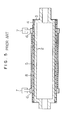
- FIG. 5 is a partial cross-sectional view illustrating one example thereof, in which an insulating layer 4 and a resistance layer 5 are provided on the outer surface of a core 2 formed into a hollow tubular shape via a bonding layer 3. Electrode rings 6 are respectively fixed to opposite end portions of the resistance layer 5 and are electrically connected to the resistance layer 5. A feeder brush 7 is disposed such as to slidably abut against the outer periphery of each of the electrode rings 6.
- a surface insulating layer 8 is disposed on the outer periphery of the resistance layer 5 to electrically protect the insulating layer 5 and prevent the insulating layer 5 from becoming damaged by external force.
- a ceramic is used for the insulating layer 8 and the resistance layer 5.
- the bonding layer 3 and the insulating layer 4 may not be provided.
- a ceramic is used for the insulating layer or the resistance layer, it is necessary to use a material for the core having a coefficient of thermal expansion which is close to that of the ceramic (generally 5 to 10 x 10 ⁇ 6/°C. If an aluminium alloy which has a large coefficient of thermal expansion is used as the core, cracks occur in the ceramic owing to repetition of thermal load during production or usage thereof, resulting in deterioration of its electrical properties and breakage of the resistor. In terms of economic efficiency, a ferrous ally (e.g. mild steel, ferrite-based stainless steel or martensite-based stainless steel) is most desirable. In addition, there are cases where an insulating ceramic formed of alumina or the like is used.
- a ferrous ally e.g. mild steel, ferrite-based stainless steel or martensite-based stainless steel
- an object of the present invention is to provide a heat roll for electrophotography which is capable of alleviating effects which are attributable to a difference in the coefficients of thermal expansion and in its preferred form, of accelerating a rise in the surface temperature of the heat roll up to a predetermined temperature, thereby overcoming the above-described drawbacks of the prior art.
- a heat roll for electrophotography as defined in claim 1.
- the provision of the pipe or round bar formed of aluminium or aluminium alloy, copper, a copper alloy or the like which has a greater coefficient of thermal conductivity than that of mild steel inside the core assists even heating of the next roll and maintenance of the working surface of the roll at a level temperature.
- a gap of 0.2 mm or more is provided between the inner surface of the core and the outer surface of an insert member formed of a high-thermal conductivity material so as to alleviate effects that are attributable to a difference in the coefficients of thermal expansion during a temperature rise.
- an arrangement is preferably provided in such a manner as to substantially prevent the axial movement of the pipe or the round bar. The above-described arrangements produce the effect of preventing the exfoliation of the insulating film, the resistance film etc.
- the high-temperature conductive material is provided inside the heat roll, there is an advantage of making the temperature uniform. Furthermore, if the gap of 0.2 mm or more is provided the temperature rise up to a predetermined temperature of the heat roll surface is accelerated as compared with a case where a smaller gap is provided.
- FIG. 1 is a cross-sectional view of a heat roll embodying the present invention.
- a pipe 1 is made of a material having a high coefficient of thermal conductivity such as aluminium and has a thickness of, for example, 2 to 3 mm.
- the material may be an aluminium alloy, copper, a copper alloy or the like. If it is necessary, a round bar may be used in place of the pipe 1.
- a core 2 made of mild steel is formed into a hollow tubular shape and a gap of 0.2 mm or more is provided between the core 2 and the pipe 1 in the cool state of the heat roll.
- An outer surface of this core is sequentially coated with a bonding layer 3 made of Ni-Al-Mo with a thickness of 25 ⁇ m, an insulating layer 4 made of Al2O3 with a thickness of 300 ⁇ m or thereabout, a resistance layer 5, i.e. a heating resistor made of Al2O3 + NiCr with a thickness of 70 ⁇ m or thereabout, and a surface insulating layer 8, i.e. an insulating film, made of Al2O3 with a thickness of 100 ⁇ m or thereabout.
- An electrode ring 6 made of a conductive materia such as aluminium bronze is provided at each opposite end of the resistance layer 5 such as to project therefrom, and a feeder brush 7 is provided thereon such as to be slidable.
- an outer peripheral surface 9 of the surface insulating layer 8 is coated with Teflon with a thickness of approximately 30 ⁇ m, while the end surface portions of the insulating layer 4 that are outside the electrode rings 6 are provided with insulation by means of silicone resin.
- the heat roll is capable of demonstrating its function.
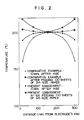
- a pipe made of aluminium (A 5056) and having an outside diameter of 36.4 mm, an inside diameter of 33.8 mm, and a length of 350 mm was inserted into a conventional heat roll using a core made of mild steel and having an outside diameter of 40 mm, an inside diameter of 37.2 mm, and a length of 330 mm between electrodes in such a manner as to substantially correspond with the distance between the electrodes.
- a comparison was made between the temperature distribution in this case and that of a conventional structure in which the pipe was not provided.
- the results are shown in Figure 2.
- the dotted lines indicate temperature distributions obtained when the temperature of the heat roll in accordance with the invention became stable and immediately after 100 sheets of A4 size paper were continuously fed.
- solid lines indicate temperature distributions in the case of a conventional heat roll which was not provided with the insert of high thermal conductivity material.
- the present invention displays a large effect in improving the temperature distribution and contributes greatly to the improvement of the fixing performance.
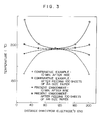
- a round bar made of an aluminium alloy (A 5056) and having an outside diameter of 11.8 mm was inserted into a conventional heat roll using a core made of mild steel and having an outside diameter of 15 mm, an inside diameter of 12.6 mm and a length of 220 mm between electrodes in such a manner as to substantially correspond with the distance between the electrodes.
- a comparison was made between the temperature distribution in this case and that of a conventional structure in which the round bar was not provided.
- the results are shown in Figure 3.
- the dotted lines indicate temperature distributions obtained when the temperature of the heat roll in accordance with the invention became stable and immediately after 100 sheets of A4 size paper were continuously fed.
- solid lines indicate temperature distributions in the case of a conventional heat roll which was not provided with the insert of high thermal conductivity material.
- the present invention enables a substantial improvement in the temperature distribution.
- a round bar made of an aluminium alloy (A 5056) and having an outer diameter of 16.8 mm was inserted into a conventional heat roll having an outside diameter of 20 mm, an inside diameter of 17 mm, and a length of 220 mm between electrodes in such a manner as to substantially correspond with the distance between the electrodes and a test was conducted in the same way as Example 2. Consequently, results similar to those of Example 2 were obtained.
- the preferred method in which an insert of the material having a high thermal conductivity is inserted with the provision of a gap is most simple and since the occurrence of stress in the outer cylinder during heating is small, this method is most desirable.
- the inner high-thermal conductivity material may be extended to the end portions of the roll, or a composite pipe may be used.
Landscapes
- Physics & Mathematics (AREA)
- General Physics & Mathematics (AREA)
- Fixing For Electrophotography (AREA)
- Control Of Resistance Heating (AREA)
- Rolls And Other Rotary Bodies (AREA)
Claims (5)
- Wärmewalze für die Elektrophotographie von einem Oberflächenheizungstyp, die einen Heizwiderstand (5) auf einer äußeren Oberfläche eines hohlen zylindrischen Kerns (2), der aus Stahl hergestellt ist, hat, dadurch gekennzeichnet, daß der Kern (2) aus Weichstahl ist und einen Einsatz (1) hat, der ein Material umfaßt, das eine hohe Wärmeleitfähigkeit hat, welches zu der Form eines Rohrs oder eines Rundstabs geformt ist und einen größeren Wärmeleitungskoeffizienten hat als es derjenige von Weichstahl ist, wobei der Einsatz (1) aus Material hoher Wärmeleitfähigkeit innerhalb des hohlen Kerns (2) vorgesehen ist.
- Wärmewalze für die Elektrophotographie nach Anspruch 1, worin das Material hoher Wärmeleitfähigkeit des Einsatzes (1) Aluminium oder eine Aluminiumlegierung ist.
- Wärmewalze für die Elektrophotographie nach Anspruch 1 oder 2, worin der Einsatz (1) einen Außendurchmesser hat, der kleiner als der Innendurchmesser des Kerns ist.
- Wärmewalze für die Elektrophotographie nach Anspruch 3, worin die Differenz zwischen dem Innen- und Außendurchmesser 0,2 mm oder mehr ist, die Wärmeausdehnungskoeffizienten des Kerns und des Einsatzes derart sind, daß die innere Oberfläche des Kerns und die äußere Oberfläche des Einsatzes miteinander in Eingriff treten, wenn die Temperatur auf 200°C oder daherum erhöht ist.
- Wärmewalze für die Elektrophotographie nach irgendeinem vorhergehenden Anspruch, worin der Durchmesser der Wärmewalze (9) 20 mm oder weniger ist.
Priority Applications (1)
| Application Number | Priority Date | Filing Date | Title |
|---|---|---|---|
| DE8888303032T DE3876980T2 (de) | 1986-10-23 | 1988-04-06 | Beheizbare rolle fuer die elektrofotografie. |
Applications Claiming Priority (1)
| Application Number | Priority Date | Filing Date | Title |
|---|---|---|---|
| JP61252241A JPS63106682A (ja) | 1986-10-23 | 1986-10-23 | 電子写真用ヒ−トロ−ル |
Publications (2)
| Publication Number | Publication Date |
|---|---|
| EP0336028A1 EP0336028A1 (de) | 1989-10-11 |
| EP0336028B1 true EP0336028B1 (de) | 1992-12-23 |
Family
ID=17234475
Family Applications (1)
| Application Number | Title | Priority Date | Filing Date |
|---|---|---|---|
| EP88303032A Expired EP0336028B1 (de) | 1986-10-23 | 1988-04-06 | Beheizbare Rolle für die Elektrofotografie |
Country Status (4)
| Country | Link |
|---|---|
| US (1) | US4888464A (de) |
| EP (1) | EP0336028B1 (de) |
| JP (1) | JPS63106682A (de) |
| DE (1) | DE3876980T2 (de) |
Families Citing this family (27)
| Publication number | Priority date | Publication date | Assignee | Title |
|---|---|---|---|---|
| JPS63106682A (ja) * | 1986-10-23 | 1988-05-11 | Hitachi Metals Ltd | 電子写真用ヒ−トロ−ル |
| US5270777A (en) * | 1987-12-18 | 1993-12-14 | Canon Kabushiki Kaisha | Fixing apparatus having heat conducting member inside a fixing roller |
| JPH01161389A (ja) * | 1987-12-18 | 1989-06-26 | Canon Inc | 定着ローラ |
| JP2762710B2 (ja) | 1990-06-25 | 1998-06-04 | 住友金属工業株式会社 | 熱クラウン抑制ハースロール |
| US5257966A (en) * | 1990-10-08 | 1993-11-02 | Yamauchi Corporation | Press roll for paper machines |
| WO1992019809A1 (de) * | 1991-05-03 | 1992-11-12 | Sulzer-Escher Wyss Gmbh | Durchbiegungseinstellwalze und deren verwendung |
| US5173736A (en) * | 1991-09-06 | 1992-12-22 | Xerox Corporation | Apparatus and method for fusing marking particles onto a support member |
| US5153411A (en) * | 1992-02-28 | 1992-10-06 | Eastman Kodak Company | Fuser roller having surface-temperature reducing member |
| JP3102132B2 (ja) * | 1992-03-31 | 2000-10-23 | 住友金属工業株式会社 | ヒートクラウン抑制炉内ロール |
| DE59300659D1 (de) * | 1992-06-22 | 1995-11-02 | Walzen Irle Gmbh | Elektrisch beheizbare Kalanderwalze. |
| US5420395A (en) * | 1992-11-09 | 1995-05-30 | American Roller Company | Ceramic heater roller with zone heating |
| US5616263A (en) * | 1992-11-09 | 1997-04-01 | American Roller Company | Ceramic heater roller |
| US5609553A (en) * | 1992-11-09 | 1997-03-11 | American Roller Company | Ceramic roller for ESA printing and coating |
| US6069346A (en) * | 1993-01-12 | 2000-05-30 | American Roller Company | Ceramic heater roller with ground shield and fault detection |
| EP0813632B1 (de) * | 1995-05-09 | 1998-11-11 | Eduard Küsters Maschinenfabrik GmbH & Co. KG | Beheizbare walze |
| KR970007538A (ko) * | 1995-07-04 | 1997-02-21 | 김광호 | 전자사진 방식을 이용한 기기의 히팅롤러장치 |
| US5722025A (en) * | 1995-10-24 | 1998-02-24 | Minolta Co., Ltd. | Fixing device |
| JP3387328B2 (ja) * | 1996-09-03 | 2003-03-17 | ミノルタ株式会社 | 定着装置 |
| DE19635845C1 (de) * | 1996-09-04 | 1998-06-10 | Voith Sulzer Finishing Gmbh | Kalanderwalze mit einem Bezug aus elastischem Kunststoff |
| TW422895B (en) * | 1997-10-28 | 2001-02-21 | Sms Scholoemann Siemag Aktieng | Current roller for electrolytic stratification device for strip |
| US6137087A (en) * | 1997-12-26 | 2000-10-24 | Brother Kogyo Kabushiki Kaisha | Thermal roller for thermal fixing device |
| US6122480A (en) * | 1999-09-27 | 2000-09-19 | Xerox Corporation | Metallic core rapid warm-up fuser roller |
| CN1308778C (zh) * | 2000-03-15 | 2007-04-04 | 富士施乐株式会社 | 定影装置 |
| KR100388997B1 (ko) * | 2001-02-22 | 2003-06-25 | 삼성전자주식회사 | 전자사진 방식 인쇄기의 가열롤러 조립체 |
| WO2003078123A2 (en) * | 2002-03-13 | 2003-09-25 | Watlow Electric Manufacturing Company | Hot runner heater device and method of manufacture thereof |
| EP2290469A1 (de) * | 2009-08-20 | 2011-03-02 | Samsung Electronics Co., Ltd. | Sicherungsvorrichtung mit Widerstandsheizschicht und Bilderzeugungsvorrichtung mit der Sicherungsvorrichtung |
| US20110070006A1 (en) * | 2009-09-22 | 2011-03-24 | Kabushiki Kaisha Toshiba | Temperature equalizing roller and fixing device |
Family Cites Families (11)
| Publication number | Priority date | Publication date | Assignee | Title |
|---|---|---|---|---|
| US4395109A (en) * | 1979-06-11 | 1983-07-26 | Tokyo Shibaura Denki Kabushiki Kaisha | Fixing device for electronic duplicator machine |
| JPS56158359A (en) * | 1980-05-12 | 1981-12-07 | Canon Inc | Fixing roller |
| JPS58169168A (ja) * | 1982-03-31 | 1983-10-05 | Copyer Co Ltd | ヒ−トロ−ル |
| JPS58198071A (ja) * | 1982-05-14 | 1983-11-17 | Ricoh Co Ltd | 加熱定着装置 |
| JPS58203471A (ja) * | 1982-05-21 | 1983-11-26 | Hitachi Metals Ltd | ヒ−トロ−ル定着装置 |
| JPS59155873A (ja) * | 1983-02-24 | 1984-09-05 | Hitachi Metals Ltd | 加熱定着装置 |
| US4714819A (en) * | 1985-07-17 | 1987-12-22 | Hitachi Metals, Ltd. | Directly heating fixing apparatus having current collecting bearings |
| US4724305A (en) * | 1986-03-07 | 1988-02-09 | Hitachi Metals, Ltd. | Directly-heating roller for fuse-fixing toner images |
| US4801968A (en) * | 1986-03-18 | 1989-01-31 | Kabushiki Kaisha Toshiba | Fixing device including a heat roller having a device for heating a region of the roller corresponding to the width of an image forming medium |
| JPH0746252B2 (ja) * | 1986-09-13 | 1995-05-17 | キヤノン株式会社 | 弾性回転体及び定着装置 |
| JPS63106682A (ja) * | 1986-10-23 | 1988-05-11 | Hitachi Metals Ltd | 電子写真用ヒ−トロ−ル |
-
1986
- 1986-10-23 JP JP61252241A patent/JPS63106682A/ja active Pending
-
1988
- 1988-04-05 US US07/177,982 patent/US4888464A/en not_active Expired - Fee Related
- 1988-04-06 EP EP88303032A patent/EP0336028B1/de not_active Expired
- 1988-04-06 DE DE8888303032T patent/DE3876980T2/de not_active Expired - Fee Related
Also Published As
| Publication number | Publication date |
|---|---|
| DE3876980D1 (de) | 1993-02-04 |
| EP0336028A1 (de) | 1989-10-11 |
| US4888464A (en) | 1989-12-19 |
| JPS63106682A (ja) | 1988-05-11 |
| DE3876980T2 (de) | 1993-04-29 |
Similar Documents
| Publication | Publication Date | Title |
|---|---|---|
| EP0336028B1 (de) | Beheizbare Rolle für die Elektrofotografie | |
| KR940001087B1 (ko) | 직접 가열식 토우너상 정착롤러 | |
| KR940001086B1 (ko) | 직접 가열식 토우너상 정착 롤 | |
| KR100458880B1 (ko) | 화상 가열 장치 | |
| US20010025840A1 (en) | Device with induction heating roller | |
| JPH061397B2 (ja) | コロナ装置 | |
| US5532807A (en) | Heating roller having electrodes for supplying power to a heating element | |
| JPH10111610A (ja) | 定着装置 | |
| US5932125A (en) | Roller for fixing toner and method for manufacturing same | |
| KR920006988B1 (ko) | 전자사진용 가열 롤 | |
| US5270777A (en) | Fixing apparatus having heat conducting member inside a fixing roller | |
| EP0903646B1 (de) | Keramisches Heizelement zur Fixierung von Tonerbildern | |
| JPH06128623A (ja) | 加熱ロール | |
| JPH08110723A (ja) | 定着用加熱ローラ | |
| JPH08171982A (ja) | 誘導加熱コイル | |
| JP3281750B2 (ja) | 円筒状ヒータ及び定着用ヒートローラ | |
| WO1999045746A1 (en) | End cap contact assembly for a heater roller | |
| JPH11282300A (ja) | 定着装置 | |
| JPS59189381A (ja) | 複写機の熱定着装置 | |
| KR100659270B1 (ko) | 화상형성장치의 히팅롤러 조립체 | |
| JPH07302010A (ja) | 定着用加熱ローラ | |
| JPS62251780A (ja) | 電子写真用ヒ−トロ−ル | |
| JPS6247170Y2 (de) | ||
| JPS6385676A (ja) | 電子写真用ヒ−トロ−ル | |
| JPH10221984A (ja) | 定着器用セラミックスヒーター及び加熱定着装置 |
Legal Events
| Date | Code | Title | Description |
|---|---|---|---|
| PUAI | Public reference made under article 153(3) epc to a published international application that has entered the european phase |
Free format text: ORIGINAL CODE: 0009012 |
|
| AK | Designated contracting states |
Kind code of ref document: A1 Designated state(s): DE FR GB IT |
|
| 17P | Request for examination filed |
Effective date: 19891208 |
|
| 17Q | First examination report despatched |
Effective date: 19911104 |
|
| GRAA | (expected) grant |
Free format text: ORIGINAL CODE: 0009210 |
|
| AK | Designated contracting states |
Kind code of ref document: B1 Designated state(s): DE FR GB IT |
|
| PG25 | Lapsed in a contracting state [announced via postgrant information from national office to epo] |
Ref country code: IT Free format text: LAPSE BECAUSE OF FAILURE TO SUBMIT A TRANSLATION OF THE DESCRIPTION OR TO PAY THE FEE WITHIN THE PRE;WARNING: LAPSES OF ITALIAN PATENTS WITH EFFECTIVE DATE BEFORE 2007 MAY HAVE OCCURRED AT ANY TIME BEFORE 2007. THE CORRECT EFFECTIVE DATE MAY BE DIFFERENT FROM THE ONE RECORDED.SCRIBED TIME-LIMIT Effective date: 19921223 Ref country code: FR Effective date: 19921223 |
|
| REF | Corresponds to: |
Ref document number: 3876980 Country of ref document: DE Date of ref document: 19930204 |
|
| PGFP | Annual fee paid to national office [announced via postgrant information from national office to epo] |
Ref country code: DE Payment date: 19930326 Year of fee payment: 6 |
|
| PG25 | Lapsed in a contracting state [announced via postgrant information from national office to epo] |
Ref country code: GB Effective date: 19930406 |
|
| EN | Fr: translation not filed | ||
| PLBE | No opposition filed within time limit |
Free format text: ORIGINAL CODE: 0009261 |
|
| STAA | Information on the status of an ep patent application or granted ep patent |
Free format text: STATUS: NO OPPOSITION FILED WITHIN TIME LIMIT |
|
| GBPC | Gb: european patent ceased through non-payment of renewal fee |
Effective date: 19930406 |
|
| 26N | No opposition filed | ||
| PG25 | Lapsed in a contracting state [announced via postgrant information from national office to epo] |
Ref country code: DE Effective date: 19950103 |