EP0334809B1 - Mittel zum Schutz von Pflanzen gegen Krankheiten - Google Patents
Mittel zum Schutz von Pflanzen gegen Krankheiten Download PDFInfo
- Publication number
- EP0334809B1 EP0334809B1 EP89810198A EP89810198A EP0334809B1 EP 0334809 B1 EP0334809 B1 EP 0334809B1 EP 89810198 A EP89810198 A EP 89810198A EP 89810198 A EP89810198 A EP 89810198A EP 0334809 B1 EP0334809 B1 EP 0334809B1
- Authority
- EP
- European Patent Office
- Prior art keywords
- formula
- plants
- compound according
- compounds
- infected
- Prior art date
- Legal status (The legal status is an assumption and is not a legal conclusion. Google has not performed a legal analysis and makes no representation as to the accuracy of the status listed.)
- Expired - Lifetime
Links
- 201000010099 disease Diseases 0.000 title description 8
- 208000037265 diseases, disorders, signs and symptoms Diseases 0.000 title description 8
- 150000001875 compounds Chemical class 0.000 claims description 76
- 239000004480 active ingredient Substances 0.000 claims description 45
- 239000000203 mixture Substances 0.000 claims description 39
- -1 trifluoromethyl- Chemical group 0.000 claims description 22
- ZAMOUSCENKQFHK-UHFFFAOYSA-N Chlorine atom Chemical compound [Cl] ZAMOUSCENKQFHK-UHFFFAOYSA-N 0.000 claims description 16
- WKBOTKDWSSQWDR-UHFFFAOYSA-N Bromine atom Chemical compound [Br] WKBOTKDWSSQWDR-UHFFFAOYSA-N 0.000 claims description 15
- 239000000460 chlorine Substances 0.000 claims description 12
- 238000002360 preparation method Methods 0.000 claims description 12
- PXGOKWXKJXAPGV-UHFFFAOYSA-N Fluorine Chemical compound FF PXGOKWXKJXAPGV-UHFFFAOYSA-N 0.000 claims description 11
- 229910052801 chlorine Inorganic materials 0.000 claims description 11
- GDTBXPJZTBHREO-UHFFFAOYSA-N bromine Substances BrBr GDTBXPJZTBHREO-UHFFFAOYSA-N 0.000 claims description 10
- 229910052794 bromium Inorganic materials 0.000 claims description 10
- 125000000623 heterocyclic group Chemical class 0.000 claims description 10
- 244000005700 microbiome Species 0.000 claims description 10
- 238000000034 method Methods 0.000 claims description 8
- 229910052731 fluorine Inorganic materials 0.000 claims description 7
- 239000011737 fluorine Substances 0.000 claims description 7
- 125000001305 1,2,4-triazol-3-yl group Chemical group [H]N1N=C([*])N=C1[H] 0.000 claims description 6
- 125000004521 1,3,4-thiadiazol-2-yl group Chemical group S1C(=NN=C1)* 0.000 claims description 6
- 125000002941 2-furyl group Chemical group O1C([*])=C([H])C([H])=C1[H] 0.000 claims description 6
- 239000000969 carrier Substances 0.000 claims description 6
- 229910052736 halogen Inorganic materials 0.000 claims description 6
- 150000002367 halogens Chemical class 0.000 claims description 6
- 125000001793 isothiazol-3-yl group Chemical group [H]C1=C([H])C(*)=NS1 0.000 claims description 6
- 125000004284 isoxazol-3-yl group Chemical group [H]C1=C([H])C(*)=NO1 0.000 claims description 6
- 125000004287 oxazol-2-yl group Chemical group [H]C1=C([H])N=C(*)O1 0.000 claims description 6
- 230000003032 phytopathogenic effect Effects 0.000 claims description 6
- 239000002904 solvent Substances 0.000 claims description 6
- 125000000437 thiazol-2-yl group Chemical group [H]C1=C([H])N=C(*)S1 0.000 claims description 6
- 125000004515 1,2,4-thiadiazol-3-yl group Chemical group S1N=C(N=C1)* 0.000 claims description 5
- 125000004496 thiazol-5-yl group Chemical group S1C=NC=C1* 0.000 claims description 5
- 150000001408 amides Chemical class 0.000 claims description 4
- 125000004499 isoxazol-5-yl group Chemical group O1N=CC=C1* 0.000 claims description 4
- 150000001412 amines Chemical class 0.000 claims description 3
- 239000012442 inert solvent Substances 0.000 claims description 3
- 230000008569 process Effects 0.000 claims description 3
- 229920006395 saturated elastomer Polymers 0.000 claims description 3
- RHXODWBNFRXWJD-UHFFFAOYSA-N 2,6-dichloro-3-[1-(furan-2-yl)ethyl]pyridine-4-carboxamide Chemical compound ClC=1N=C(Cl)C=C(C(N)=O)C=1C(C)C1=CC=CO1 RHXODWBNFRXWJD-UHFFFAOYSA-N 0.000 claims description 2
- 125000005842 heteroatom Chemical group 0.000 claims description 2
- 125000002883 imidazolyl group Chemical group 0.000 claims description 2
- 229910052740 iodine Inorganic materials 0.000 claims description 2
- TWBYWOBDOCUKOW-UHFFFAOYSA-N isonicotinic acid Natural products OC(=O)C1=CC=NC=C1 TWBYWOBDOCUKOW-UHFFFAOYSA-N 0.000 claims description 2
- 229910052760 oxygen Inorganic materials 0.000 claims description 2
- 229910052717 sulfur Inorganic materials 0.000 claims description 2
- 125000001425 triazolyl group Chemical group 0.000 claims description 2
- ZCYVEMRRCGMTRW-UHFFFAOYSA-N 7553-56-2 Chemical compound [I] ZCYVEMRRCGMTRW-UHFFFAOYSA-N 0.000 claims 1
- 239000002671 adjuvant Substances 0.000 claims 1
- 125000005843 halogen group Chemical group 0.000 claims 1
- 239000011630 iodine Substances 0.000 claims 1
- 241000196324 Embryophyta Species 0.000 description 76
- 239000000725 suspension Substances 0.000 description 27
- 239000013543 active substance Substances 0.000 description 26
- 239000007921 spray Substances 0.000 description 25
- 241000233866 Fungi Species 0.000 description 23
- 230000001681 protective effect Effects 0.000 description 22
- 239000004563 wettable powder Substances 0.000 description 20
- 206010061217 Infestation Diseases 0.000 description 19
- 239000000126 substance Substances 0.000 description 19
- 230000002538 fungal effect Effects 0.000 description 17
- 230000000694 effects Effects 0.000 description 16
- 238000011534 incubation Methods 0.000 description 16
- 208000015181 infectious disease Diseases 0.000 description 15
- 240000005979 Hordeum vulgare Species 0.000 description 13
- 240000008067 Cucumis sativus Species 0.000 description 12
- 240000007594 Oryza sativa Species 0.000 description 12
- 230000009471 action Effects 0.000 description 11
- 230000001580 bacterial effect Effects 0.000 description 11
- 239000002689 soil Substances 0.000 description 11
- YMWUJEATGCHHMB-UHFFFAOYSA-N Dichloromethane Chemical compound ClCCl YMWUJEATGCHHMB-UHFFFAOYSA-N 0.000 description 9
- RTZKZFJDLAIYFH-UHFFFAOYSA-N Diethyl ether Chemical compound CCOCC RTZKZFJDLAIYFH-UHFFFAOYSA-N 0.000 description 9
- 235000007340 Hordeum vulgare Nutrition 0.000 description 9
- XLYOFNOQVPJJNP-UHFFFAOYSA-N water Substances O XLYOFNOQVPJJNP-UHFFFAOYSA-N 0.000 description 9
- 240000003768 Solanum lycopersicum Species 0.000 description 8
- 239000000654 additive Substances 0.000 description 8
- 239000003795 chemical substances by application Substances 0.000 description 7
- 239000007787 solid Substances 0.000 description 7
- 239000005995 Aluminium silicate Substances 0.000 description 6
- 241000894006 Bacteria Species 0.000 description 6
- LYCAIKOWRPUZTN-UHFFFAOYSA-N Ethylene glycol Chemical compound OCCO LYCAIKOWRPUZTN-UHFFFAOYSA-N 0.000 description 6
- ZMXDDKWLCZADIW-UHFFFAOYSA-N N,N-Dimethylformamide Chemical compound CN(C)C=O ZMXDDKWLCZADIW-UHFFFAOYSA-N 0.000 description 6
- ZMANZCXQSJIPKH-UHFFFAOYSA-N Triethylamine Chemical compound CCN(CC)CC ZMANZCXQSJIPKH-UHFFFAOYSA-N 0.000 description 6
- 239000002253 acid Substances 0.000 description 6
- 235000012211 aluminium silicate Nutrition 0.000 description 6
- 239000008187 granular material Substances 0.000 description 6
- 238000005507 spraying Methods 0.000 description 6
- 239000004094 surface-active agent Substances 0.000 description 6
- 239000002202 Polyethylene glycol Substances 0.000 description 5
- 241000589516 Pseudomonas Species 0.000 description 5
- 241000209140 Triticum Species 0.000 description 5
- 241000589652 Xanthomonas oryzae Species 0.000 description 5
- 241000567019 Xanthomonas vesicatoria Species 0.000 description 5
- 239000003513 alkali Substances 0.000 description 5
- 125000004432 carbon atom Chemical group C* 0.000 description 5
- 239000000839 emulsion Substances 0.000 description 5
- 238000009472 formulation Methods 0.000 description 5
- NLYAJNPCOHFWQQ-UHFFFAOYSA-N kaolin Chemical compound O.O.O=[Al]O[Si](=O)O[Si](=O)O[Al]=O NLYAJNPCOHFWQQ-UHFFFAOYSA-N 0.000 description 5
- 239000007788 liquid Substances 0.000 description 5
- 238000002156 mixing Methods 0.000 description 5
- 238000005554 pickling Methods 0.000 description 5
- 229920001223 polyethylene glycol Polymers 0.000 description 5
- 125000001424 substituent group Chemical group 0.000 description 5
- 244000105624 Arachis hypogaea Species 0.000 description 4
- IAZDPXIOMUYVGZ-UHFFFAOYSA-N Dimethylsulphoxide Chemical compound CS(C)=O IAZDPXIOMUYVGZ-UHFFFAOYSA-N 0.000 description 4
- IAYPIBMASNFSPL-UHFFFAOYSA-N Ethylene oxide Chemical compound C1CO1 IAYPIBMASNFSPL-UHFFFAOYSA-N 0.000 description 4
- YLQBMQCUIZJEEH-UHFFFAOYSA-N Furan Chemical compound C=1C=COC=1 YLQBMQCUIZJEEH-UHFFFAOYSA-N 0.000 description 4
- 235000002637 Nicotiana tabacum Nutrition 0.000 description 4
- 244000061176 Nicotiana tabacum Species 0.000 description 4
- 235000007164 Oryza sativa Nutrition 0.000 description 4
- JUJWROOIHBZHMG-UHFFFAOYSA-N Pyridine Chemical compound C1=CC=NC=C1 JUJWROOIHBZHMG-UHFFFAOYSA-N 0.000 description 4
- 235000007238 Secale cereale Nutrition 0.000 description 4
- 244000082988 Secale cereale Species 0.000 description 4
- WYURNTSHIVDZCO-UHFFFAOYSA-N Tetrahydrofuran Chemical compound C1CCOC1 WYURNTSHIVDZCO-UHFFFAOYSA-N 0.000 description 4
- 241000723873 Tobacco mosaic virus Species 0.000 description 4
- JHIVVAPYMSGYDF-UHFFFAOYSA-N cyclohexanone Chemical compound O=C1CCCCC1 JHIVVAPYMSGYDF-UHFFFAOYSA-N 0.000 description 4
- MTHSVFCYNBDYFN-UHFFFAOYSA-N diethylene glycol Chemical group OCCOCCO MTHSVFCYNBDYFN-UHFFFAOYSA-N 0.000 description 4
- 230000001338 necrotic effect Effects 0.000 description 4
- 239000000843 powder Substances 0.000 description 4
- 239000000243 solution Substances 0.000 description 4
- 230000009885 systemic effect Effects 0.000 description 4
- ZWEHNKRNPOVVGH-UHFFFAOYSA-N 2-Butanone Chemical compound CCC(C)=O ZWEHNKRNPOVVGH-UHFFFAOYSA-N 0.000 description 3
- UHPMCKVQTMMPCG-UHFFFAOYSA-N 5,8-dihydroxy-2-methoxy-6-methyl-7-(2-oxopropyl)naphthalene-1,4-dione Chemical compound CC1=C(CC(C)=O)C(O)=C2C(=O)C(OC)=CC(=O)C2=C1O UHPMCKVQTMMPCG-UHFFFAOYSA-N 0.000 description 3
- CSCPPACGZOOCGX-UHFFFAOYSA-N Acetone Chemical compound CC(C)=O CSCPPACGZOOCGX-UHFFFAOYSA-N 0.000 description 3
- WEVYAHXRMPXWCK-UHFFFAOYSA-N Acetonitrile Chemical compound CC#N WEVYAHXRMPXWCK-UHFFFAOYSA-N 0.000 description 3
- UHOVQNZJYSORNB-UHFFFAOYSA-N Benzene Chemical compound C1=CC=CC=C1 UHOVQNZJYSORNB-UHFFFAOYSA-N 0.000 description 3
- 235000002566 Capsicum Nutrition 0.000 description 3
- 240000004160 Capsicum annuum Species 0.000 description 3
- 241001157813 Cercospora Species 0.000 description 3
- 241000222235 Colletotrichum orbiculare Species 0.000 description 3
- 235000009849 Cucumis sativus Nutrition 0.000 description 3
- 235000010799 Cucumis sativus var sativus Nutrition 0.000 description 3
- LFQSCWFLJHTTHZ-UHFFFAOYSA-N Ethanol Chemical compound CCO LFQSCWFLJHTTHZ-UHFFFAOYSA-N 0.000 description 3
- 241000223218 Fusarium Species 0.000 description 3
- 229920001732 Lignosulfonate Polymers 0.000 description 3
- 235000011430 Malus pumila Nutrition 0.000 description 3
- 244000070406 Malus silvestris Species 0.000 description 3
- 235000015103 Malus silvestris Nutrition 0.000 description 3
- 241001281803 Plasmopara viticola Species 0.000 description 3
- 241000221300 Puccinia Species 0.000 description 3
- VYPSYNLAJGMNEJ-UHFFFAOYSA-N Silicium dioxide Chemical compound O=[Si]=O VYPSYNLAJGMNEJ-UHFFFAOYSA-N 0.000 description 3
- YXFVVABEGXRONW-UHFFFAOYSA-N Toluene Chemical compound CC1=CC=CC=C1 YXFVVABEGXRONW-UHFFFAOYSA-N 0.000 description 3
- 235000021307 Triticum Nutrition 0.000 description 3
- 241000317942 Venturia <ichneumonid wasp> Species 0.000 description 3
- 125000000217 alkyl group Chemical group 0.000 description 3
- 150000008064 anhydrides Chemical class 0.000 description 3
- 239000002585 base Substances 0.000 description 3
- 238000006243 chemical reaction Methods 0.000 description 3
- 239000011248 coating agent Substances 0.000 description 3
- 238000000576 coating method Methods 0.000 description 3
- 239000012141 concentrate Substances 0.000 description 3
- 235000008504 concentrate Nutrition 0.000 description 3
- 238000005520 cutting process Methods 0.000 description 3
- 238000005516 engineering process Methods 0.000 description 3
- 235000019441 ethanol Nutrition 0.000 description 3
- 150000002170 ethers Chemical class 0.000 description 3
- 239000003337 fertilizer Substances 0.000 description 3
- RAXXELZNTBOGNW-UHFFFAOYSA-N imidazole Natural products C1=CNC=N1 RAXXELZNTBOGNW-UHFFFAOYSA-N 0.000 description 3
- 238000011081 inoculation Methods 0.000 description 3
- 238000004519 manufacturing process Methods 0.000 description 3
- AICOOMRHRUFYCM-ZRRPKQBOSA-N oxazine, 1 Chemical compound C([C@@H]1[C@H](C(C[C@]2(C)[C@@H]([C@H](C)N(C)C)[C@H](O)C[C@]21C)=O)CC1=CC2)C[C@H]1[C@@]1(C)[C@H]2N=C(C(C)C)OC1 AICOOMRHRUFYCM-ZRRPKQBOSA-N 0.000 description 3
- 235000009566 rice Nutrition 0.000 description 3
- 239000008096 xylene Substances 0.000 description 3
- 125000004209 (C1-C8) alkyl group Chemical group 0.000 description 2
- VHYFNPMBLIVWCW-UHFFFAOYSA-N 4-Dimethylaminopyridine Chemical compound CN(C)C1=CC=NC=C1 VHYFNPMBLIVWCW-UHFFFAOYSA-N 0.000 description 2
- 241000235349 Ascomycota Species 0.000 description 2
- 235000016068 Berberis vulgaris Nutrition 0.000 description 2
- 241000335053 Beta vulgaris Species 0.000 description 2
- 229910021532 Calcite Inorganic materials 0.000 description 2
- 229920002134 Carboxymethyl cellulose Polymers 0.000 description 2
- HEDRZPFGACZZDS-UHFFFAOYSA-N Chloroform Chemical compound ClC(Cl)Cl HEDRZPFGACZZDS-UHFFFAOYSA-N 0.000 description 2
- 235000013162 Cocos nucifera Nutrition 0.000 description 2
- 244000060011 Cocos nucifera Species 0.000 description 2
- 241000222199 Colletotrichum Species 0.000 description 2
- 241000218631 Coniferophyta Species 0.000 description 2
- 241000371644 Curvularia ravenelii Species 0.000 description 2
- 241000221787 Erysiphe Species 0.000 description 2
- 206010017533 Fungal infection Diseases 0.000 description 2
- 235000007688 Lycopersicon esculentum Nutrition 0.000 description 2
- 241001459558 Monographella nivalis Species 0.000 description 2
- 208000031888 Mycoses Diseases 0.000 description 2
- SECXISVLQFMRJM-UHFFFAOYSA-N N-Methylpyrrolidone Chemical compound CN1CCCC1=O SECXISVLQFMRJM-UHFFFAOYSA-N 0.000 description 2
- CTQNGGLPUBDAKN-UHFFFAOYSA-N O-Xylene Chemical compound CC1=CC=CC=C1C CTQNGGLPUBDAKN-UHFFFAOYSA-N 0.000 description 2
- 241000233614 Phytophthora Species 0.000 description 2
- 241000233622 Phytophthora infestans Species 0.000 description 2
- 241000758706 Piperaceae Species 0.000 description 2
- 241000521936 Pseudomonas amygdali pv. lachrymans Species 0.000 description 2
- 241000589626 Pseudomonas syringae pv. tomato Species 0.000 description 2
- 241000228454 Pyrenophora graminea Species 0.000 description 2
- KAESVJOAVNADME-UHFFFAOYSA-N Pyrrole Chemical compound C=1C=CNC=1 KAESVJOAVNADME-UHFFFAOYSA-N 0.000 description 2
- 206010037888 Rash pustular Diseases 0.000 description 2
- 206010039509 Scab Diseases 0.000 description 2
- 235000002595 Solanum tuberosum Nutrition 0.000 description 2
- 244000061456 Solanum tuberosum Species 0.000 description 2
- YTPLMLYBLZKORZ-UHFFFAOYSA-N Thiophene Chemical compound C=1C=CSC=1 YTPLMLYBLZKORZ-UHFFFAOYSA-N 0.000 description 2
- 241000221566 Ustilago Species 0.000 description 2
- 241000007070 Ustilago nuda Species 0.000 description 2
- 241000228452 Venturia inaequalis Species 0.000 description 2
- 241000700605 Viruses Species 0.000 description 2
- 230000000996 additive effect Effects 0.000 description 2
- 239000000853 adhesive Substances 0.000 description 2
- 230000001070 adhesive effect Effects 0.000 description 2
- 150000001298 alcohols Chemical class 0.000 description 2
- 150000001338 aliphatic hydrocarbons Chemical class 0.000 description 2
- 229910052784 alkaline earth metal Inorganic materials 0.000 description 2
- 150000003863 ammonium salts Chemical class 0.000 description 2
- 239000003945 anionic surfactant Substances 0.000 description 2
- RDOXTESZEPMUJZ-UHFFFAOYSA-N anisole Chemical compound COC1=CC=CC=C1 RDOXTESZEPMUJZ-UHFFFAOYSA-N 0.000 description 2
- 230000000844 anti-bacterial effect Effects 0.000 description 2
- 150000004945 aromatic hydrocarbons Chemical class 0.000 description 2
- 239000003899 bactericide agent Substances 0.000 description 2
- 239000011230 binding agent Substances 0.000 description 2
- SZKLQJZEAFLPDA-UHFFFAOYSA-L calcium;2,4-dioxo-1h-pyrimidine-6-carboxylate Chemical compound [Ca+2].[O-]C(=O)C1=CC(=O)NC(=O)N1.[O-]C(=O)C1=CC(=O)NC(=O)N1 SZKLQJZEAFLPDA-UHFFFAOYSA-L 0.000 description 2
- 239000001768 carboxy methyl cellulose Substances 0.000 description 2
- 235000010948 carboxy methyl cellulose Nutrition 0.000 description 2
- 239000008112 carboxymethyl-cellulose Substances 0.000 description 2
- 239000003093 cationic surfactant Substances 0.000 description 2
- 235000013339 cereals Nutrition 0.000 description 2
- MVPPADPHJFYWMZ-UHFFFAOYSA-N chlorobenzene Chemical compound ClC1=CC=CC=C1 MVPPADPHJFYWMZ-UHFFFAOYSA-N 0.000 description 2
- 239000003240 coconut oil Substances 0.000 description 2
- 125000004093 cyano group Chemical group *C#N 0.000 description 2
- 230000007123 defense Effects 0.000 description 2
- 230000018109 developmental process Effects 0.000 description 2
- 235000014113 dietary fatty acids Nutrition 0.000 description 2
- 239000012895 dilution Substances 0.000 description 2
- 238000010790 dilution Methods 0.000 description 2
- 239000000194 fatty acid Substances 0.000 description 2
- 229930195729 fatty acid Natural products 0.000 description 2
- 150000004665 fatty acids Chemical class 0.000 description 2
- 239000000417 fungicide Substances 0.000 description 2
- 238000000227 grinding Methods 0.000 description 2
- 150000004820 halides Chemical class 0.000 description 2
- 239000004009 herbicide Substances 0.000 description 2
- 238000002649 immunization Methods 0.000 description 2
- 230000003053 immunization Effects 0.000 description 2
- PNDPGZBMCMUPRI-UHFFFAOYSA-N iodine Chemical compound II PNDPGZBMCMUPRI-UHFFFAOYSA-N 0.000 description 2
- JEIPFZHSYJVQDO-UHFFFAOYSA-N iron(III) oxide Inorganic materials O=[Fe]O[Fe]=O JEIPFZHSYJVQDO-UHFFFAOYSA-N 0.000 description 2
- 150000002576 ketones Chemical class 0.000 description 2
- 230000003902 lesion Effects 0.000 description 2
- 239000000463 material Substances 0.000 description 2
- 239000002736 nonionic surfactant Substances 0.000 description 2
- FDPIMTJIUBPUKL-UHFFFAOYSA-N pentan-3-one Chemical compound CCC(=O)CC FDPIMTJIUBPUKL-UHFFFAOYSA-N 0.000 description 2
- 229920000151 polyglycol Polymers 0.000 description 2
- 239000010695 polyglycol Substances 0.000 description 2
- 235000012015 potatoes Nutrition 0.000 description 2
- 208000029561 pustule Diseases 0.000 description 2
- UMJSCPRVCHMLSP-UHFFFAOYSA-N pyridine Natural products COC1=CC=CN=C1 UMJSCPRVCHMLSP-UHFFFAOYSA-N 0.000 description 2
- 239000000344 soap Substances 0.000 description 2
- 238000009331 sowing Methods 0.000 description 2
- 239000004575 stone Substances 0.000 description 2
- 239000004546 suspension concentrate Substances 0.000 description 2
- 208000024891 symptom Diseases 0.000 description 2
- 239000000454 talc Substances 0.000 description 2
- 229910052623 talc Inorganic materials 0.000 description 2
- VZGDMQKNWNREIO-UHFFFAOYSA-N tetrachloromethane Chemical compound ClC(Cl)(Cl)Cl VZGDMQKNWNREIO-UHFFFAOYSA-N 0.000 description 2
- 125000002023 trifluoromethyl group Chemical group FC(F)(F)* 0.000 description 2
- GETQZCLCWQTVFV-UHFFFAOYSA-N trimethylamine Chemical compound CN(C)C GETQZCLCWQTVFV-UHFFFAOYSA-N 0.000 description 2
- 244000045561 useful plants Species 0.000 description 2
- WRIDQFICGBMAFQ-UHFFFAOYSA-N (E)-8-Octadecenoic acid Natural products CCCCCCCCCC=CCCCCCCC(O)=O WRIDQFICGBMAFQ-UHFFFAOYSA-N 0.000 description 1
- DSSYKIVIOFKYAU-XCBNKYQSSA-N (R)-camphor Chemical compound C1C[C@@]2(C)C(=O)C[C@@H]1C2(C)C DSSYKIVIOFKYAU-XCBNKYQSSA-N 0.000 description 1
- 125000001766 1,2,4-oxadiazol-3-yl group Chemical group [H]C1=NC(*)=NO1 0.000 description 1
- 125000001401 1,2,4-triazol-4-yl group Chemical group N=1N=C([H])N([*])C=1[H] 0.000 description 1
- WSLDOOZREJYCGB-UHFFFAOYSA-N 1,2-Dichloroethane Chemical compound ClCCCl WSLDOOZREJYCGB-UHFFFAOYSA-N 0.000 description 1
- CFGDUGSIBUXRMR-UHFFFAOYSA-N 1,2-dihydropyrrol-2-ide Chemical class C=1C=[C-]NC=1 CFGDUGSIBUXRMR-UHFFFAOYSA-N 0.000 description 1
- RYHBNJHYFVUHQT-UHFFFAOYSA-N 1,4-Dioxane Chemical compound C1COCCO1 RYHBNJHYFVUHQT-UHFFFAOYSA-N 0.000 description 1
- QZTMHCLQBRFNOF-UHFFFAOYSA-N 2,6-dichloropyridine-4-carbohydrazide Chemical class NNC(=O)C1=CC(Cl)=NC(Cl)=C1 QZTMHCLQBRFNOF-UHFFFAOYSA-N 0.000 description 1
- QLRUROKTVFUQIV-UHFFFAOYSA-N 2,6-dichloropyridine-4-carbonyl chloride Chemical compound ClC(=O)C1=CC(Cl)=NC(Cl)=C1 QLRUROKTVFUQIV-UHFFFAOYSA-N 0.000 description 1
- XNWFRZJHXBZDAG-UHFFFAOYSA-N 2-METHOXYETHANOL Chemical group COCCO XNWFRZJHXBZDAG-UHFFFAOYSA-N 0.000 description 1
- IMSODMZESSGVBE-UHFFFAOYSA-N 2-Oxazoline Chemical compound C1CN=CO1 IMSODMZESSGVBE-UHFFFAOYSA-N 0.000 description 1
- LQJBNNIYVWPHFW-UHFFFAOYSA-N 20:1omega9c fatty acid Natural products CCCCCCCCCCC=CCCCCCCCC(O)=O LQJBNNIYVWPHFW-UHFFFAOYSA-N 0.000 description 1
- 125000003682 3-furyl group Chemical group O1C([H])=C([*])C([H])=C1[H] 0.000 description 1
- FKPXGNGUVSHWQQ-UHFFFAOYSA-N 5-methyl-1,2-oxazol-3-amine Chemical compound CC1=CC(N)=NO1 FKPXGNGUVSHWQQ-UHFFFAOYSA-N 0.000 description 1
- QSBYPNXLFMSGKH-UHFFFAOYSA-N 9-Heptadecensaeure Natural products CCCCCCCC=CCCCCCCCC(O)=O QSBYPNXLFMSGKH-UHFFFAOYSA-N 0.000 description 1
- 244000291564 Allium cepa Species 0.000 description 1
- 235000002732 Allium cepa var. cepa Nutrition 0.000 description 1
- 241000223600 Alternaria Species 0.000 description 1
- 244000144725 Amygdalus communis Species 0.000 description 1
- 244000003416 Asparagus officinalis Species 0.000 description 1
- 235000005340 Asparagus officinalis Nutrition 0.000 description 1
- 235000007319 Avena orientalis Nutrition 0.000 description 1
- 244000075850 Avena orientalis Species 0.000 description 1
- 235000000832 Ayote Nutrition 0.000 description 1
- 208000035143 Bacterial infection Diseases 0.000 description 1
- 241000221198 Basidiomycota Species 0.000 description 1
- 241000219310 Beta vulgaris subsp. vulgaris Species 0.000 description 1
- BVKZGUZCCUSVTD-UHFFFAOYSA-M Bicarbonate Chemical class OC([O-])=O BVKZGUZCCUSVTD-UHFFFAOYSA-M 0.000 description 1
- 241001480061 Blumeria graminis Species 0.000 description 1
- 241001465180 Botrytis Species 0.000 description 1
- 241000167854 Bourreria succulenta Species 0.000 description 1
- 244000056139 Brassica cretica Species 0.000 description 1
- 235000003351 Brassica cretica Nutrition 0.000 description 1
- 240000002791 Brassica napus Species 0.000 description 1
- 240000007124 Brassica oleracea Species 0.000 description 1
- 235000003899 Brassica oleracea var acephala Nutrition 0.000 description 1
- 235000011301 Brassica oleracea var capitata Nutrition 0.000 description 1
- 235000001169 Brassica oleracea var oleracea Nutrition 0.000 description 1
- 235000003343 Brassica rupestris Nutrition 0.000 description 1
- 235000004977 Brassica sinapistrum Nutrition 0.000 description 1
- 244000025254 Cannabis sativa Species 0.000 description 1
- 235000012766 Cannabis sativa ssp. sativa var. sativa Nutrition 0.000 description 1
- 235000012765 Cannabis sativa ssp. sativa var. spontanea Nutrition 0.000 description 1
- 235000002567 Capsicum annuum Nutrition 0.000 description 1
- 239000004215 Carbon black (E152) Substances 0.000 description 1
- 241000723346 Cinnamomum camphora Species 0.000 description 1
- 235000005979 Citrus limon Nutrition 0.000 description 1
- 244000131522 Citrus pyriformis Species 0.000 description 1
- 241001672694 Citrus reticulata Species 0.000 description 1
- 240000000560 Citrus x paradisi Species 0.000 description 1
- 240000007154 Coffea arabica Species 0.000 description 1
- 240000000491 Corchorus aestuans Species 0.000 description 1
- 235000011777 Corchorus aestuans Nutrition 0.000 description 1
- 235000010862 Corchorus capsularis Nutrition 0.000 description 1
- 229920000742 Cotton Polymers 0.000 description 1
- 241000219112 Cucumis Species 0.000 description 1
- 235000015510 Cucumis melo subsp melo Nutrition 0.000 description 1
- 240000004244 Cucurbita moschata Species 0.000 description 1
- 235000009854 Cucurbita moschata Nutrition 0.000 description 1
- 235000009804 Cucurbita pepo subsp pepo Nutrition 0.000 description 1
- XDTMQSROBMDMFD-UHFFFAOYSA-N Cyclohexane Chemical compound C1CCCCC1 XDTMQSROBMDMFD-UHFFFAOYSA-N 0.000 description 1
- 235000002767 Daucus carota Nutrition 0.000 description 1
- 244000000626 Daucus carota Species 0.000 description 1
- MQIUGAXCHLFZKX-UHFFFAOYSA-N Di-n-octyl phthalate Natural products CCCCCCCCOC(=O)C1=CC=CC=C1C(=O)OCCCCCCCC MQIUGAXCHLFZKX-UHFFFAOYSA-N 0.000 description 1
- ZAFNJMIOTHYJRJ-UHFFFAOYSA-N Diisopropyl ether Chemical compound CC(C)OC(C)C ZAFNJMIOTHYJRJ-UHFFFAOYSA-N 0.000 description 1
- 101100326341 Drosophila melanogaster brun gene Proteins 0.000 description 1
- 241000588698 Erwinia Species 0.000 description 1
- 241000588694 Erwinia amylovora Species 0.000 description 1
- 239000004606 Fillers/Extenders Substances 0.000 description 1
- WSFSSNUMVMOOMR-UHFFFAOYSA-N Formaldehyde Chemical compound O=C WSFSSNUMVMOOMR-UHFFFAOYSA-N 0.000 description 1
- 240000009088 Fragaria x ananassa Species 0.000 description 1
- 235000010469 Glycine max Nutrition 0.000 description 1
- 244000068988 Glycine max Species 0.000 description 1
- 244000299507 Gossypium hirsutum Species 0.000 description 1
- 241000208818 Helianthus Species 0.000 description 1
- 235000003222 Helianthus annuus Nutrition 0.000 description 1
- 241001181537 Hemileia Species 0.000 description 1
- 244000043261 Hevea brasiliensis Species 0.000 description 1
- 235000008694 Humulus lupulus Nutrition 0.000 description 1
- 244000025221 Humulus lupulus Species 0.000 description 1
- 235000003228 Lactuca sativa Nutrition 0.000 description 1
- 240000008415 Lactuca sativa Species 0.000 description 1
- 240000004322 Lens culinaris Species 0.000 description 1
- 235000014647 Lens culinaris subsp culinaris Nutrition 0.000 description 1
- 235000004431 Linum usitatissimum Nutrition 0.000 description 1
- 240000006240 Linum usitatissimum Species 0.000 description 1
- 241001330975 Magnaporthe oryzae Species 0.000 description 1
- 244000081841 Malus domestica Species 0.000 description 1
- BZLVMXJERCGZMT-UHFFFAOYSA-N Methyl tert-butyl ether Chemical compound COC(C)(C)C BZLVMXJERCGZMT-UHFFFAOYSA-N 0.000 description 1
- 241001518729 Monilinia Species 0.000 description 1
- 240000005561 Musa balbisiana Species 0.000 description 1
- 235000018290 Musa x paradisiaca Nutrition 0.000 description 1
- JCXJVPUVTGWSNB-UHFFFAOYSA-N Nitrogen dioxide Chemical class O=[N]=O JCXJVPUVTGWSNB-UHFFFAOYSA-N 0.000 description 1
- IGFHQQFPSIBGKE-UHFFFAOYSA-N Nonylphenol Natural products CCCCCCCCCC1=CC=C(O)C=C1 IGFHQQFPSIBGKE-UHFFFAOYSA-N 0.000 description 1
- 241000207836 Olea <angiosperm> Species 0.000 description 1
- 239000005642 Oleic acid Substances 0.000 description 1
- ZQPPMHVWECSIRJ-UHFFFAOYSA-N Oleic acid Natural products CCCCCCCCC=CCCCCCCCC(O)=O ZQPPMHVWECSIRJ-UHFFFAOYSA-N 0.000 description 1
- 241000233654 Oomycetes Species 0.000 description 1
- ZCQWOFVYLHDMMC-UHFFFAOYSA-N Oxazole Chemical compound C1=COC=N1 ZCQWOFVYLHDMMC-UHFFFAOYSA-N 0.000 description 1
- 235000008753 Papaver somniferum Nutrition 0.000 description 1
- 241000315044 Passalora arachidicola Species 0.000 description 1
- 239000006002 Pepper Substances 0.000 description 1
- CYTYCFOTNPOANT-UHFFFAOYSA-N Perchloroethylene Chemical group ClC(Cl)=C(Cl)Cl CYTYCFOTNPOANT-UHFFFAOYSA-N 0.000 description 1
- 241000582441 Peronospora tabacina Species 0.000 description 1
- 244000025272 Persea americana Species 0.000 description 1
- 235000008673 Persea americana Nutrition 0.000 description 1
- 235000010627 Phaseolus vulgaris Nutrition 0.000 description 1
- 244000046052 Phaseolus vulgaris Species 0.000 description 1
- 231100000674 Phytotoxicity Toxicity 0.000 description 1
- 235000016761 Piper aduncum Nutrition 0.000 description 1
- 240000003889 Piper guineense Species 0.000 description 1
- 235000017804 Piper guineense Nutrition 0.000 description 1
- 235000008184 Piper nigrum Nutrition 0.000 description 1
- 235000010582 Pisum sativum Nutrition 0.000 description 1
- 240000004713 Pisum sativum Species 0.000 description 1
- 241000233626 Plasmopara Species 0.000 description 1
- 241000896242 Podosphaera Species 0.000 description 1
- 240000005809 Prunus persica Species 0.000 description 1
- 235000006040 Prunus persica var persica Nutrition 0.000 description 1
- 241000589624 Pseudomonas amygdali pv. tabaci Species 0.000 description 1
- 241001281802 Pseudoperonospora Species 0.000 description 1
- 241000221301 Puccinia graminis Species 0.000 description 1
- WTKZEGDFNFYCGP-UHFFFAOYSA-N Pyrazole Chemical compound C=1C=NNC=1 WTKZEGDFNFYCGP-UHFFFAOYSA-N 0.000 description 1
- 241000220324 Pyrus Species 0.000 description 1
- 235000014443 Pyrus communis Nutrition 0.000 description 1
- 240000001987 Pyrus communis Species 0.000 description 1
- 241001361634 Rhizoctonia Species 0.000 description 1
- 240000000528 Ricinus communis Species 0.000 description 1
- 235000004443 Ricinus communis Nutrition 0.000 description 1
- 240000007651 Rubus glaucus Species 0.000 description 1
- 240000000111 Saccharum officinarum Species 0.000 description 1
- 235000007201 Saccharum officinarum Nutrition 0.000 description 1
- 239000004113 Sepiolite Substances 0.000 description 1
- 241001533598 Septoria Species 0.000 description 1
- 240000003829 Sorghum propinquum Species 0.000 description 1
- 235000011684 Sorghum saccharatum Nutrition 0.000 description 1
- 235000009337 Spinacia oleracea Nutrition 0.000 description 1
- 244000300264 Spinacia oleracea Species 0.000 description 1
- 235000021355 Stearic acid Nutrition 0.000 description 1
- 235000021536 Sugar beet Nutrition 0.000 description 1
- 244000125380 Terminalia tomentosa Species 0.000 description 1
- 244000269722 Thea sinensis Species 0.000 description 1
- 244000299461 Theobroma cacao Species 0.000 description 1
- 235000009470 Theobroma cacao Nutrition 0.000 description 1
- FZWLAAWBMGSTSO-UHFFFAOYSA-N Thiazole Chemical compound C1=CSC=N1 FZWLAAWBMGSTSO-UHFFFAOYSA-N 0.000 description 1
- 241000510929 Uncinula Species 0.000 description 1
- 244000078534 Vaccinium myrtillus Species 0.000 description 1
- 235000014787 Vitis vinifera Nutrition 0.000 description 1
- 240000006365 Vitis vinifera Species 0.000 description 1
- 240000008042 Zea mays Species 0.000 description 1
- 235000005824 Zea mays ssp. parviglumis Nutrition 0.000 description 1
- 235000002017 Zea mays subsp mays Nutrition 0.000 description 1
- 239000002250 absorbent Substances 0.000 description 1
- 230000002745 absorbent Effects 0.000 description 1
- 150000001242 acetic acid derivatives Chemical class 0.000 description 1
- 230000004913 activation Effects 0.000 description 1
- 230000006978 adaptation Effects 0.000 description 1
- 230000000274 adsorptive effect Effects 0.000 description 1
- 230000002411 adverse Effects 0.000 description 1
- 239000003905 agrochemical Substances 0.000 description 1
- 239000012872 agrochemical composition Substances 0.000 description 1
- 150000008431 aliphatic amides Chemical class 0.000 description 1
- 125000001931 aliphatic group Chemical group 0.000 description 1
- 150000001342 alkaline earth metals Chemical class 0.000 description 1
- 229940045714 alkyl sulfonate alkylating agent Drugs 0.000 description 1
- 150000008052 alkyl sulfonates Chemical class 0.000 description 1
- 235000020224 almond Nutrition 0.000 description 1
- 235000021016 apples Nutrition 0.000 description 1
- 229960000892 attapulgite Drugs 0.000 description 1
- 208000022362 bacterial infectious disease Diseases 0.000 description 1
- 230000008901 benefit Effects 0.000 description 1
- 239000000440 bentonite Substances 0.000 description 1
- 229910000278 bentonite Inorganic materials 0.000 description 1
- SVPXDRXYRYOSEX-UHFFFAOYSA-N bentoquatam Chemical compound O.O=[Si]=O.O=[Al]O[Al]=O SVPXDRXYRYOSEX-UHFFFAOYSA-N 0.000 description 1
- 125000003785 benzimidazolyl group Chemical class N1=C(NC2=C1C=CC=C2)* 0.000 description 1
- 125000001797 benzyl group Chemical group [H]C1=C([H])C([H])=C(C([H])=C1[H])C([H])([H])* 0.000 description 1
- 235000021028 berry Nutrition 0.000 description 1
- 230000004071 biological effect Effects 0.000 description 1
- QKSKPIVNLNLAAV-UHFFFAOYSA-N bis(2-chloroethyl) sulfide Chemical compound ClCCSCCCl QKSKPIVNLNLAAV-UHFFFAOYSA-N 0.000 description 1
- BJQHLKABXJIVAM-UHFFFAOYSA-N bis(2-ethylhexyl) phthalate Chemical compound CCCCC(CC)COC(=O)C1=CC=CC=C1C(=O)OCC(CC)CCCC BJQHLKABXJIVAM-UHFFFAOYSA-N 0.000 description 1
- 235000021029 blackberry Nutrition 0.000 description 1
- 239000011449 brick Substances 0.000 description 1
- CODNYICXDISAEA-UHFFFAOYSA-N bromine monochloride Chemical compound BrCl CODNYICXDISAEA-UHFFFAOYSA-N 0.000 description 1
- 230000001680 brushing effect Effects 0.000 description 1
- 125000000484 butyl group Chemical class [H]C([*])([H])C([H])([H])C([H])([H])C([H])([H])[H] 0.000 description 1
- 235000009120 camo Nutrition 0.000 description 1
- 229960000846 camphor Drugs 0.000 description 1
- 229930008380 camphor Natural products 0.000 description 1
- 239000001511 capsicum annuum Substances 0.000 description 1
- 150000004649 carbonic acid derivatives Chemical class 0.000 description 1
- 239000012876 carrier material Substances 0.000 description 1
- 239000004359 castor oil Substances 0.000 description 1
- 235000019438 castor oil Nutrition 0.000 description 1
- 125000002091 cationic group Chemical group 0.000 description 1
- 235000005607 chanvre indien Nutrition 0.000 description 1
- 235000019693 cherries Nutrition 0.000 description 1
- 235000020971 citrus fruits Nutrition 0.000 description 1
- 235000019864 coconut oil Nutrition 0.000 description 1
- 235000016213 coffee Nutrition 0.000 description 1
- 235000013353 coffee beverage Nutrition 0.000 description 1
- 235000005822 corn Nutrition 0.000 description 1
- 150000001983 dialkylethers Chemical class 0.000 description 1
- GUJOJGAPFQRJSV-UHFFFAOYSA-N dialuminum;dioxosilane;oxygen(2-);hydrate Chemical compound O.[O-2].[O-2].[O-2].[Al+3].[Al+3].O=[Si]=O.O=[Si]=O.O=[Si]=O.O=[Si]=O GUJOJGAPFQRJSV-UHFFFAOYSA-N 0.000 description 1
- DOIRQSBPFJWKBE-UHFFFAOYSA-N dibutyl phthalate Chemical group CCCCOC(=O)C1=CC=CC=C1C(=O)OCCCC DOIRQSBPFJWKBE-UHFFFAOYSA-N 0.000 description 1
- 239000002270 dispersing agent Substances 0.000 description 1
- YRIUSKIDOIARQF-UHFFFAOYSA-N dodecyl benzenesulfonate Chemical compound CCCCCCCCCCCCOS(=O)(=O)C1=CC=CC=C1 YRIUSKIDOIARQF-UHFFFAOYSA-N 0.000 description 1
- MOTZDAYCYVMXPC-UHFFFAOYSA-N dodecyl hydrogen sulfate Chemical compound CCCCCCCCCCCCOS(O)(=O)=O MOTZDAYCYVMXPC-UHFFFAOYSA-N 0.000 description 1
- 229940043264 dodecyl sulfate Drugs 0.000 description 1
- 229940071161 dodecylbenzenesulfonate Drugs 0.000 description 1
- 239000010459 dolomite Substances 0.000 description 1
- 229910000514 dolomite Inorganic materials 0.000 description 1
- 239000000428 dust Substances 0.000 description 1
- 238000010410 dusting Methods 0.000 description 1
- 210000005069 ears Anatomy 0.000 description 1
- 235000013399 edible fruits Nutrition 0.000 description 1
- 230000001804 emulsifying effect Effects 0.000 description 1
- 238000005538 encapsulation Methods 0.000 description 1
- 150000002148 esters Chemical class 0.000 description 1
- 125000001495 ethyl group Chemical group [H]C([H])([H])C([H])([H])* 0.000 description 1
- 238000011156 evaluation Methods 0.000 description 1
- 230000002349 favourable effect Effects 0.000 description 1
- 239000000835 fiber Substances 0.000 description 1
- 239000008098 formaldehyde solution Substances 0.000 description 1
- 229910021485 fumed silica Inorganic materials 0.000 description 1
- 230000000855 fungicidal effect Effects 0.000 description 1
- ZEMPKEQAKRGZGQ-XOQCFJPHSA-N glycerol triricinoleate Natural products CCCCCC[C@@H](O)CC=CCCCCCCCC(=O)OC[C@@H](COC(=O)CCCCCCCC=CC[C@@H](O)CCCCCC)OC(=O)CCCCCCCC=CC[C@H](O)CCCCCC ZEMPKEQAKRGZGQ-XOQCFJPHSA-N 0.000 description 1
- 150000002334 glycols Chemical class 0.000 description 1
- 230000012010 growth Effects 0.000 description 1
- 150000008282 halocarbons Chemical class 0.000 description 1
- 239000011487 hemp Substances 0.000 description 1
- 125000003187 heptyl group Chemical class [H]C([*])([H])C([H])([H])C([H])([H])C([H])([H])C([H])([H])C([H])([H])C([H])([H])[H] 0.000 description 1
- 150000002391 heterocyclic compounds Chemical class 0.000 description 1
- 125000004051 hexyl group Chemical class [H]C([H])([H])C([H])([H])C([H])([H])C([H])([H])C([H])([H])C([H])([H])* 0.000 description 1
- 229930195733 hydrocarbon Natural products 0.000 description 1
- 150000004679 hydroxides Chemical class 0.000 description 1
- 125000003037 imidazol-2-yl group Chemical group [H]N1C([*])=NC([H])=C1[H] 0.000 description 1
- MTNDZQHUAFNZQY-UHFFFAOYSA-N imidazoline Chemical compound C1CN=CN1 MTNDZQHUAFNZQY-UHFFFAOYSA-N 0.000 description 1
- 239000003701 inert diluent Substances 0.000 description 1
- 150000007529 inorganic bases Chemical class 0.000 description 1
- 229910052500 inorganic mineral Inorganic materials 0.000 description 1
- 239000002917 insecticide Substances 0.000 description 1
- 125000000959 isobutyl group Chemical group [H]C([H])([H])C([H])(C([H])([H])[H])C([H])([H])* 0.000 description 1
- QRXWMOHMRWLFEY-UHFFFAOYSA-N isoniazide Chemical class NNC(=O)C1=CC=NC=C1 QRXWMOHMRWLFEY-UHFFFAOYSA-N 0.000 description 1
- VFQXVTODMYMSMJ-UHFFFAOYSA-N isonicotinamide Chemical class NC(=O)C1=CC=NC=C1 VFQXVTODMYMSMJ-UHFFFAOYSA-N 0.000 description 1
- QXJSBBXBKPUZAA-UHFFFAOYSA-N isooleic acid Natural products CCCCCCCC=CCCCCCCCCC(O)=O QXJSBBXBKPUZAA-UHFFFAOYSA-N 0.000 description 1
- 125000001972 isopentyl group Chemical group [H]C([H])([H])C([H])(C([H])([H])[H])C([H])([H])C([H])([H])* 0.000 description 1
- 125000001449 isopropyl group Chemical group [H]C([H])([H])C([H])(*)C([H])([H])[H] 0.000 description 1
- 125000004501 isothiazol-5-yl group Chemical group S1N=CC=C1* 0.000 description 1
- ZLTPDFXIESTBQG-UHFFFAOYSA-N isothiazole Chemical compound C=1C=NSC=1 ZLTPDFXIESTBQG-UHFFFAOYSA-N 0.000 description 1
- CTAPFRYPJLPFDF-UHFFFAOYSA-N isoxazole Chemical compound C=1C=NOC=1 CTAPFRYPJLPFDF-UHFFFAOYSA-N 0.000 description 1
- 235000021374 legumes Nutrition 0.000 description 1
- 239000000155 melt Substances 0.000 description 1
- UZKWTJUDCOPSNM-UHFFFAOYSA-N methoxybenzene Substances CCCCOC=C UZKWTJUDCOPSNM-UHFFFAOYSA-N 0.000 description 1
- 125000002496 methyl group Chemical group [H]C([H])([H])* 0.000 description 1
- 230000003641 microbiacidal effect Effects 0.000 description 1
- 239000011707 mineral Substances 0.000 description 1
- 235000010755 mineral Nutrition 0.000 description 1
- 239000003750 molluscacide Substances 0.000 description 1
- 230000002013 molluscicidal effect Effects 0.000 description 1
- 229910052901 montmorillonite Inorganic materials 0.000 description 1
- 235000010460 mustard Nutrition 0.000 description 1
- LHMUZCNPQGLQPE-UHFFFAOYSA-N n-pyrrolidin-1-ylpyridin-4-amine Chemical compound C1CCCN1NC1=CC=NC=C1 LHMUZCNPQGLQPE-UHFFFAOYSA-N 0.000 description 1
- 150000002790 naphthalenes Chemical class 0.000 description 1
- 239000005645 nematicide Substances 0.000 description 1
- 150000002825 nitriles Chemical class 0.000 description 1
- 125000000449 nitro group Chemical group [O-][N+](*)=O 0.000 description 1
- 229910052757 nitrogen Inorganic materials 0.000 description 1
- SNQQPOLDUKLAAF-UHFFFAOYSA-N nonylphenol Chemical compound CCCCCCCCCC1=CC=CC=C1O SNQQPOLDUKLAAF-UHFFFAOYSA-N 0.000 description 1
- 235000014571 nuts Nutrition 0.000 description 1
- QIQXTHQIDYTFRH-UHFFFAOYSA-N octadecanoic acid Chemical class CCCCCCCCCCCCCCCCCC(O)=O QIQXTHQIDYTFRH-UHFFFAOYSA-N 0.000 description 1
- OQCDKBAXFALNLD-UHFFFAOYSA-N octadecanoic acid Chemical class CCCCCCCC(C)CCCCCCCCC(O)=O OQCDKBAXFALNLD-UHFFFAOYSA-N 0.000 description 1
- 125000002347 octyl group Chemical class [H]C([*])([H])C([H])([H])C([H])([H])C([H])([H])C([H])([H])C([H])([H])C([H])([H])C([H])([H])[H] 0.000 description 1
- 239000003921 oil Substances 0.000 description 1
- 235000019198 oils Nutrition 0.000 description 1
- 150000002888 oleic acid derivatives Chemical class 0.000 description 1
- 150000007530 organic bases Chemical class 0.000 description 1
- WCPAKWJPBJAGKN-UHFFFAOYSA-N oxadiazole Chemical compound C1=CON=N1 WCPAKWJPBJAGKN-UHFFFAOYSA-N 0.000 description 1
- 229910052625 palygorskite Inorganic materials 0.000 description 1
- 244000045947 parasite Species 0.000 description 1
- 235000020232 peanut Nutrition 0.000 description 1
- 235000021017 pears Nutrition 0.000 description 1
- 125000001147 pentyl group Chemical class C(CCCC)* 0.000 description 1
- 239000003208 petroleum Substances 0.000 description 1
- 150000003021 phthalic acid derivatives Chemical class 0.000 description 1
- 230000000704 physical effect Effects 0.000 description 1
- 230000008635 plant growth Effects 0.000 description 1
- 244000000003 plant pathogen Species 0.000 description 1
- 235000021018 plums Nutrition 0.000 description 1
- 239000002798 polar solvent Substances 0.000 description 1
- 229920000642 polymer Polymers 0.000 description 1
- 229910052700 potassium Inorganic materials 0.000 description 1
- LPNYRYFBWFDTMA-UHFFFAOYSA-N potassium tert-butoxide Chemical compound [K+].CC(C)(C)[O-] LPNYRYFBWFDTMA-UHFFFAOYSA-N 0.000 description 1
- FVSKHRXBFJPNKK-UHFFFAOYSA-N propionitrile Chemical compound CCC#N FVSKHRXBFJPNKK-UHFFFAOYSA-N 0.000 description 1
- 125000001436 propyl group Chemical class [H]C([*])([H])C([H])([H])C([H])([H])[H] 0.000 description 1
- 239000008262 pumice Substances 0.000 description 1
- 235000015136 pumpkin Nutrition 0.000 description 1
- 125000004289 pyrazol-3-yl group Chemical group [H]N1N=C(*)C([H])=C1[H] 0.000 description 1
- DNXIASIHZYFFRO-UHFFFAOYSA-N pyrazoline Chemical compound C1CN=NC1 DNXIASIHZYFFRO-UHFFFAOYSA-N 0.000 description 1
- 150000003242 quaternary ammonium salts Chemical class 0.000 description 1
- 150000003254 radicals Chemical class 0.000 description 1
- 235000021013 raspberries Nutrition 0.000 description 1
- 239000012429 reaction media Substances 0.000 description 1
- 239000011541 reaction mixture Substances 0.000 description 1
- 150000003839 salts Chemical class 0.000 description 1
- 239000004576 sand Substances 0.000 description 1
- 150000004671 saturated fatty acids Chemical class 0.000 description 1
- 235000003441 saturated fatty acids Nutrition 0.000 description 1
- 125000002914 sec-butyl group Chemical group [H]C([H])([H])C([H])([H])C([H])(*)C([H])([H])[H] 0.000 description 1
- 229910052624 sepiolite Inorganic materials 0.000 description 1
- 235000019355 sepiolite Nutrition 0.000 description 1
- 229910010271 silicon carbide Inorganic materials 0.000 description 1
- 239000000377 silicon dioxide Substances 0.000 description 1
- 229920002545 silicone oil Polymers 0.000 description 1
- 238000002791 soaking Methods 0.000 description 1
- PYODKQIVQIVELM-UHFFFAOYSA-M sodium;2,3-bis(2-methylpropyl)naphthalene-1-sulfonate Chemical compound [Na+].C1=CC=C2C(S([O-])(=O)=O)=C(CC(C)C)C(CC(C)C)=CC2=C1 PYODKQIVQIVELM-UHFFFAOYSA-M 0.000 description 1
- 235000012424 soybean oil Nutrition 0.000 description 1
- 239000003549 soybean oil Substances 0.000 description 1
- 238000009987 spinning Methods 0.000 description 1
- 235000020354 squash Nutrition 0.000 description 1
- 239000003381 stabilizer Substances 0.000 description 1
- 239000007858 starting material Substances 0.000 description 1
- 239000008117 stearic acid Chemical class 0.000 description 1
- 230000000638 stimulation Effects 0.000 description 1
- 235000021012 strawberries Nutrition 0.000 description 1
- 150000003467 sulfuric acid derivatives Chemical class 0.000 description 1
- 239000003760 tallow Substances 0.000 description 1
- 235000013616 tea Nutrition 0.000 description 1
- 125000000999 tert-butyl group Chemical group [H]C([H])([H])C(*)(C([H])([H])[H])C([H])([H])[H] 0.000 description 1
- 150000003512 tertiary amines Chemical class 0.000 description 1
- 229950011008 tetrachloroethylene Drugs 0.000 description 1
- VLLMWSRANPNYQX-UHFFFAOYSA-N thiadiazole Chemical compound C1=CSN=N1.C1=CSN=N1 VLLMWSRANPNYQX-UHFFFAOYSA-N 0.000 description 1
- CBDKQYKMCICBOF-UHFFFAOYSA-N thiazoline Chemical compound C1CN=CS1 CBDKQYKMCICBOF-UHFFFAOYSA-N 0.000 description 1
- 239000002562 thickening agent Substances 0.000 description 1
- 229930192474 thiophene Natural products 0.000 description 1
- 239000011573 trace mineral Substances 0.000 description 1
- 235000013619 trace mineral Nutrition 0.000 description 1
- 238000007056 transamidation reaction Methods 0.000 description 1
- 125000005270 trialkylamine group Chemical group 0.000 description 1
- 150000003852 triazoles Chemical class 0.000 description 1
- YFTHZRPMJXBUME-UHFFFAOYSA-N tripropylamine Chemical compound CCCN(CCC)CCC YFTHZRPMJXBUME-UHFFFAOYSA-N 0.000 description 1
- 239000000814 tuberculostatic agent Substances 0.000 description 1
- 150000004670 unsaturated fatty acids Chemical class 0.000 description 1
- 235000021122 unsaturated fatty acids Nutrition 0.000 description 1
- 235000015112 vegetable and seed oil Nutrition 0.000 description 1
- 239000008158 vegetable oil Substances 0.000 description 1
- 235000013311 vegetables Nutrition 0.000 description 1
- 230000017260 vegetative to reproductive phase transition of meristem Effects 0.000 description 1
- 238000009736 wetting Methods 0.000 description 1
- 239000000080 wetting agent Substances 0.000 description 1
- 150000003738 xylenes Chemical class 0.000 description 1
Classifications
-
- C—CHEMISTRY; METALLURGY
- C07—ORGANIC CHEMISTRY
- C07D—HETEROCYCLIC COMPOUNDS
- C07D401/00—Heterocyclic compounds containing two or more hetero rings, having nitrogen atoms as the only ring hetero atoms, at least one ring being a six-membered ring with only one nitrogen atom
- C07D401/02—Heterocyclic compounds containing two or more hetero rings, having nitrogen atoms as the only ring hetero atoms, at least one ring being a six-membered ring with only one nitrogen atom containing two hetero rings
- C07D401/12—Heterocyclic compounds containing two or more hetero rings, having nitrogen atoms as the only ring hetero atoms, at least one ring being a six-membered ring with only one nitrogen atom containing two hetero rings linked by a chain containing hetero atoms as chain links
-
- A—HUMAN NECESSITIES
- A01—AGRICULTURE; FORESTRY; ANIMAL HUSBANDRY; HUNTING; TRAPPING; FISHING
- A01N—PRESERVATION OF BODIES OF HUMANS OR ANIMALS OR PLANTS OR PARTS THEREOF; BIOCIDES, e.g. AS DISINFECTANTS, AS PESTICIDES OR AS HERBICIDES; PEST REPELLANTS OR ATTRACTANTS; PLANT GROWTH REGULATORS
- A01N43/00—Biocides, pest repellants or attractants, or plant growth regulators containing heterocyclic compounds
- A01N43/48—Biocides, pest repellants or attractants, or plant growth regulators containing heterocyclic compounds having rings with two nitrogen atoms as the only ring hetero atoms
- A01N43/56—1,2-Diazoles; Hydrogenated 1,2-diazoles
-
- A—HUMAN NECESSITIES
- A01—AGRICULTURE; FORESTRY; ANIMAL HUSBANDRY; HUNTING; TRAPPING; FISHING
- A01N—PRESERVATION OF BODIES OF HUMANS OR ANIMALS OR PLANTS OR PARTS THEREOF; BIOCIDES, e.g. AS DISINFECTANTS, AS PESTICIDES OR AS HERBICIDES; PEST REPELLANTS OR ATTRACTANTS; PLANT GROWTH REGULATORS
- A01N43/00—Biocides, pest repellants or attractants, or plant growth regulators containing heterocyclic compounds
- A01N43/64—Biocides, pest repellants or attractants, or plant growth regulators containing heterocyclic compounds having rings with three nitrogen atoms as the only ring hetero atoms
- A01N43/647—Triazoles; Hydrogenated triazoles
- A01N43/653—1,2,4-Triazoles; Hydrogenated 1,2,4-triazoles
-
- A—HUMAN NECESSITIES
- A01—AGRICULTURE; FORESTRY; ANIMAL HUSBANDRY; HUNTING; TRAPPING; FISHING
- A01N—PRESERVATION OF BODIES OF HUMANS OR ANIMALS OR PLANTS OR PARTS THEREOF; BIOCIDES, e.g. AS DISINFECTANTS, AS PESTICIDES OR AS HERBICIDES; PEST REPELLANTS OR ATTRACTANTS; PLANT GROWTH REGULATORS
- A01N43/00—Biocides, pest repellants or attractants, or plant growth regulators containing heterocyclic compounds
- A01N43/72—Biocides, pest repellants or attractants, or plant growth regulators containing heterocyclic compounds having rings with nitrogen atoms and oxygen or sulfur atoms as ring hetero atoms
- A01N43/74—Biocides, pest repellants or attractants, or plant growth regulators containing heterocyclic compounds having rings with nitrogen atoms and oxygen or sulfur atoms as ring hetero atoms five-membered rings with one nitrogen atom and either one oxygen atom or one sulfur atom in positions 1,3
-
- A—HUMAN NECESSITIES
- A01—AGRICULTURE; FORESTRY; ANIMAL HUSBANDRY; HUNTING; TRAPPING; FISHING
- A01N—PRESERVATION OF BODIES OF HUMANS OR ANIMALS OR PLANTS OR PARTS THEREOF; BIOCIDES, e.g. AS DISINFECTANTS, AS PESTICIDES OR AS HERBICIDES; PEST REPELLANTS OR ATTRACTANTS; PLANT GROWTH REGULATORS
- A01N43/00—Biocides, pest repellants or attractants, or plant growth regulators containing heterocyclic compounds
- A01N43/72—Biocides, pest repellants or attractants, or plant growth regulators containing heterocyclic compounds having rings with nitrogen atoms and oxygen or sulfur atoms as ring hetero atoms
- A01N43/80—Biocides, pest repellants or attractants, or plant growth regulators containing heterocyclic compounds having rings with nitrogen atoms and oxygen or sulfur atoms as ring hetero atoms five-membered rings with one nitrogen atom and either one oxygen atom or one sulfur atom in positions 1,2
-
- A—HUMAN NECESSITIES
- A01—AGRICULTURE; FORESTRY; ANIMAL HUSBANDRY; HUNTING; TRAPPING; FISHING
- A01N—PRESERVATION OF BODIES OF HUMANS OR ANIMALS OR PLANTS OR PARTS THEREOF; BIOCIDES, e.g. AS DISINFECTANTS, AS PESTICIDES OR AS HERBICIDES; PEST REPELLANTS OR ATTRACTANTS; PLANT GROWTH REGULATORS
- A01N43/00—Biocides, pest repellants or attractants, or plant growth regulators containing heterocyclic compounds
- A01N43/72—Biocides, pest repellants or attractants, or plant growth regulators containing heterocyclic compounds having rings with nitrogen atoms and oxygen or sulfur atoms as ring hetero atoms
- A01N43/82—Biocides, pest repellants or attractants, or plant growth regulators containing heterocyclic compounds having rings with nitrogen atoms and oxygen or sulfur atoms as ring hetero atoms five-membered rings with three ring hetero atoms
-
- C—CHEMISTRY; METALLURGY
- C07—ORGANIC CHEMISTRY
- C07D—HETEROCYCLIC COMPOUNDS
- C07D405/00—Heterocyclic compounds containing both one or more hetero rings having oxygen atoms as the only ring hetero atoms, and one or more rings having nitrogen as the only ring hetero atom
- C07D405/02—Heterocyclic compounds containing both one or more hetero rings having oxygen atoms as the only ring hetero atoms, and one or more rings having nitrogen as the only ring hetero atom containing two hetero rings
- C07D405/12—Heterocyclic compounds containing both one or more hetero rings having oxygen atoms as the only ring hetero atoms, and one or more rings having nitrogen as the only ring hetero atom containing two hetero rings linked by a chain containing hetero atoms as chain links
-
- C—CHEMISTRY; METALLURGY
- C07—ORGANIC CHEMISTRY
- C07D—HETEROCYCLIC COMPOUNDS
- C07D409/00—Heterocyclic compounds containing two or more hetero rings, at least one ring having sulfur atoms as the only ring hetero atoms
- C07D409/02—Heterocyclic compounds containing two or more hetero rings, at least one ring having sulfur atoms as the only ring hetero atoms containing two hetero rings
- C07D409/12—Heterocyclic compounds containing two or more hetero rings, at least one ring having sulfur atoms as the only ring hetero atoms containing two hetero rings linked by a chain containing hetero atoms as chain links
-
- C—CHEMISTRY; METALLURGY
- C07—ORGANIC CHEMISTRY
- C07D—HETEROCYCLIC COMPOUNDS
- C07D413/00—Heterocyclic compounds containing two or more hetero rings, at least one ring having nitrogen and oxygen atoms as the only ring hetero atoms
- C07D413/02—Heterocyclic compounds containing two or more hetero rings, at least one ring having nitrogen and oxygen atoms as the only ring hetero atoms containing two hetero rings
- C07D413/12—Heterocyclic compounds containing two or more hetero rings, at least one ring having nitrogen and oxygen atoms as the only ring hetero atoms containing two hetero rings linked by a chain containing hetero atoms as chain links
-
- C—CHEMISTRY; METALLURGY
- C07—ORGANIC CHEMISTRY
- C07D—HETEROCYCLIC COMPOUNDS
- C07D417/00—Heterocyclic compounds containing two or more hetero rings, at least one ring having nitrogen and sulfur atoms as the only ring hetero atoms, not provided for by group C07D415/00
- C07D417/02—Heterocyclic compounds containing two or more hetero rings, at least one ring having nitrogen and sulfur atoms as the only ring hetero atoms, not provided for by group C07D415/00 containing two hetero rings
- C07D417/12—Heterocyclic compounds containing two or more hetero rings, at least one ring having nitrogen and sulfur atoms as the only ring hetero atoms, not provided for by group C07D415/00 containing two hetero rings linked by a chain containing hetero atoms as chain links
Definitions
- the present invention relates to new substituted isonicotinic acid amides and isonicotinic acid hydrazides of the formula I below.
- the invention further relates to the preparation of these substances and to the agents comprising at least one of these compounds as active ingredient.
- the invention also relates to the production of the agents mentioned and the use of the active compounds or the agents for protecting plants against attack by harmful microorganisms, for example fungi, bacteria and viruses which damage plants.
- Alkyl itself or as part of another substituent means straight-chain or branched alkyls. Depending on the number of carbon atoms specified, they represent, for example, the following groups: methyl, ethyl and the isomers of propyl, butyl, pentyl, hexyl, heptyl or octyl, such as isopropyl, isobutyl, tert-butyl, sec-butyl or isopentyl.
- 5-membered heterocycles are to be understood for example: furan, tetrahydrofuran, thiophene, pyrrole, imidazole, imidazoline, pyrazole, pyrazoline, triazole, oxazole, isoxazole, thiazole, isothiazole, thiadiazole, oxadiazole, thiazoline or oxazoline.
- the heterocyclic radicals are e.g. bound as: furan-2-yl, furan-3-yl, thiophene-2-yl, thiophene-3-yl, imidazol-2-yl, 4,5-imidazolin-2-yl, pyrazol-3-yl, pyrazoline -3-yl, 1,2,4-triazol-3-yl, 1,2,4-triazol-4-yl, oxazol-2-yl, isoxazol-5-yl, isoxazol-3-yl, thiazol-2 -yl, isothiazol-3-yl, isothiazol-5-yl, 1,3,4-thiadiazol-2-yl, 1,3,4-thiadiazol-3-yl, 1,3,4-oxadiazol-3-yl or 1,2,4-oxadiazol-3-yl and furthermore 3-thiono-1,2-dithia-4-azol-5-yl, 2-
- the following compounds are distinguished by particularly advantageous plant protection properties: 3-methylisoxazole-5- (2,6-dichloroisonicotinic acid) amide, 5-methylisoxazole-3- (2,6-dichloroisonicotinic acid) amide, ⁇ -methylfurfuryl-2,6-dichloroisonicotinamide; 3-methylisothiazole-5- (2,6-dichloroisonicotinic acid) amide.
- 2,6-dihaloisonicotinic acid derivatives are already partially known.
- British Patent No. 923,387 describes 2,6-dihaloisonicotinic acid derivatives, for example aliphatic amides, as herbicides.
- 2,6-dichloroisonicotinic acid hydrazides for controlling phytopathogenic microorganisms.
- 2,6-dihaloisonicotinic acid derivatives have become known as tuberculostatic agents (cf. Acta Fac. Pharm. Brun. Bratislav. 4 , 65-66 [1962]; Chem. Abstr. Vol 57, 1962, 4769b).
- N-cyanoalkylisonicotinamides as fungicides or bactericides are disclosed in EP-A-246507.
- the compounds of the formula I according to the invention by their use, prevent infestation of plants by harmful microorganisms and thus prevent damage to the plants caused by the infestation. It is characteristic of the active compounds according to the invention that the protection of the plants can occur both by direct action on the plant-damaging microorganisms by means of leaf application (direct action) or soil application (systemic action) and by activation and stimulation of the plant's own defense system (immunization).
- the great advantage of the compounds of the formula I is that the plants treated with these substances can be kept healthy on their own without the use of further microbicidal substances during the growing season.
- the compounds of the formula I according to the invention Due to the double action of the compounds of the formula I according to the invention, namely on the one hand the direct control of the plant pathogens and on the other hand the increase in the general defense readiness of the plants treated with these active compounds by immunization, a broad range of protection of the plants against diseases can be achieved.
- the use of the active compounds according to the invention is therefore particularly suitable for practical conditions.
- the systemic activity inherent in the compounds of the formula I has the effect that the protective effect also extends to growing parts of the plants in the treated plants.
- the general plant protection of the active compounds according to the invention is e.g. effective against the phytopathogenic fungi belonging to the following classes: fungi imperfecti (e.g. botrytis, helminthosporium, fusarium, septoria, cercospora and alternaria); Basidiomycetes (e.g. the genera Hemileia, Rhizoctonia, Puccinia); Ascomycetes (e.g. Venturia, Podosphaera, Erysiphe, Monilinia, Uncinula).
- fungi imperfecti e.g. botrytis, helminthosporium, fusarium, septoria, cercospora and alternaria
- Basidiomycetes e.g. the genera Hemileia, Rhizoctonia, Puccinia
- Ascomycetes e.g. Venturia, Podosphaera, Erysiphe, Monilinia, Uncinula).
- the active ingredients can be used particularly advantageously against the following harmful organisms: Fungi such as Oomycetes (e.g. Plasmopara viticola, Phytophthora infestans, Peronospora tabacina, Pseudoperonospora), Fungi imperfecti (e.g. Colletotrichum lagenarium, Piricularia oryzae, Cercospora nicotinae), Ascomycetes (e.g.
- Fungi such as Oomycetes (e.g. Plasmopara viticola, Phytophthora infestans, Peronospora tabacina, Pseudoperonospora), Fungi imperfecti (e.g. Colletotrichum lagenarium, Piricularia oryzae, Cercospora nicotinae), Ascomycetes (e.g.
- Venturia inaequalis Bacteria such as Pseudomonas (Pseudomonas lachrymans, Pseudomonas tomato, Pseudomonas tabaci); Xanthomonads (e.g. Xanthomonas oryzae, Xanthomonas vesicatoria); Erwinia (e.g. Erwinia amylovora); and viruses such as the tobacco mosaic virus.
- Pseudomonas Pseudomonas lachrymans, Pseudomonas tomato, Pseudomonas tabaci
- Xanthomonads e.g. Xanthomonas oryzae, Xanthomonas vesicatoria
- Erwinia e.g. Erwinia amylovora
- viruses such as the tobacco mosaic virus.
- the compounds according to the invention can be used to protect plants from different crops.
- cereals wheat, barley, rye, oats, rice, sorghum and relatives
- Beets saliva beet and fodder beet
- Pome, stone and berry fruits apples, pears, plums, peaches, almonds, cherries, strawberries, raspberries and blackberries
- Legumes beans, lentils, peas, soybeans
- Oil crops rapeseed, mustard, poppy seeds, olives, sunflowers, coconut, castor bean, cocoa, peanuts
- Cucumber plants pumpkin, cucumber, melons
- Fiber plants cotton, flax, hemp, jute
- Citrus fruits oranges, lemons, grapefruit, mandarins
- Vegetables spinach, lettuce, asparagus, cabbage, carrots, onions, tomatoes, potatoes, peppers
- Laurel plants avocado, cinnamonum, camphor
- plants are to be regarded as particularly suitable target cultures for the application of the method according to the invention: cucumber, tobacco, vines, rice, pepper, potatoes, tomato, wheat, barley, pear and apple.
- the compounds of the formula I are obtained from 2,6-dihalo-isonicotinic acid halides, anhydrides or azolides, preferably from 2,6-dihalo-isonicotinic acid halides or particularly preferably from dihalo-isonicotinic acid chlorides.
- the compounds of formula I are prepared by using an isonicotinic acid halide of formula II with an amine of formula III H2N- (Y) n -X (III) in the presence of a base in an inert solvent or without solvent at temperatures from -20 ° to 150 ° C, preferably 0 ° to 80 ° C, where Hal is halogen, A halogen, an acyloxy radical of the formula Mean imidazolyl or triazolyl and X, Y and n have the meanings given under formula I.
- Suitable bases for acid binding in the process described above are organic and inorganic bases, e.g. tertiary amines such as trialkylamines (trimethylamine, triethylamine, tripropylamine, etc.), pyridine, pyridine bases (4-dimethylaminopyridine, 4-pyrrolidylaminopyridine, etc.), and alcoholates such as e.g. Potassium tert-butoxide, oxides and hydroxides, carbonates and bicarbonates of alkali and alkaline earth metals as well as alkali acetates.
- tertiary amines such as trialkylamines (trimethylamine, triethylamine, tripropylamine, etc.)
- pyridine pyridine bases (4-dimethylaminopyridine, 4-pyrrolidylaminopyridine, etc.
- alcoholates such as e.g. Potassium tert-butoxide, oxides and hydroxides, carbonates and
- reaction-inert solvents and diluents are used as reaction media in adaptation to the respective reaction conditions.
- suitable reaction-inert solvents and diluents include: aliphatic and aromatic hydrocarbons such as benzene, toluene, xylenes, petroleum ether; halogenated hydrocarbons such as chlorobenzene, methylene chloride, ethylene chloride, chloroform, carbon tetrachloride, tetrachlorethylene; Ethers and ethereal compounds such as dialkyl ether (diethyl ether, diisopropyl ether, tert-butyl methyl ether, etc.), anisole, dioxane, tetrahydrofuran; Nitriles such as acetonitrile, propionitrile; N, N-dialkylated amides such as dimethylformamide; Dimethyl sulfoxide; Ketones such as acetone, diethyl ketone, methyl eth
- agents used in the context of the invention for protecting plants against diseases which contain the compounds of the formula I as active substances are to be regarded as part of the invention.
- Active substances of the formula I are usually used in the form of compositions and can be applied to the plant or its surroundings simultaneously or in succession with further active substances.
- These further active ingredients can be both fertilizers, trace element mediators or other preparations which influence plant growth.
- it can also be selective herbicides, insecticides, fungicides, bactericides, nematicides, molluscicides or mixtures of several of these preparations, together with any other carriers, surfactants or other application-promoting additives which are customary in formulation technology.
- Suitable carriers and additives can be solid or liquid and correspond to the substances useful in formulation technology, e.g. natural or regenerated mineral substances, solvents, dispersants, wetting agents, adhesives, thickeners, binders or fertilizers.
- One method of using an active ingredient of the formula I or an agrochemical composition which contains at least one of these active ingredients is application to the plant (foliar application).
- the active ingredients of formula I can also get into the plant through the roots through the root system (soil application) by soaking the location of the plant with a liquid preparation or introducing the substances into the soil in solid form, for example in the form of granules.
- the compounds of formula I can also be applied to seeds (coating) by either the grains in a liquid preparation of the active ingredient soaks or coated them with a solid preparation (pickling application).
- other types of application are possible, such as the targeted treatment of plant stems or buds.
- the compounds of the formula I are used in unchanged form or preferably together with the auxiliaries customary in formulation technology.
- they are e.g. to emulsion concentrates, spreadable pastes, directly sprayable or dilutable solutions, diluted emulsions, wettable powders, soluble powders, dusts, granules, by encapsulation in e.g. polymeric materials processed in a known manner.
- the methods of application such as spraying, atomizing, dusting, scattering, brushing or pouring are selected in the same way as the type of agent, in accordance with the intended goals and the prevailing conditions.
- Favorable application rates are generally 50 g to 5 kg of active ingredient (AS) per ha; preferably at 100 g to 2 kg ai / ha, in particular at 100 g to 600 g ai / ha.
- the formulations i.e.
- the agents, preparations or compositions containing the active ingredient of formula I and optionally a solid or liquid additive are prepared by intimately mixing and / or grinding the active ingredients with extenders, such as e.g. with solvents, solid carriers, and optionally surface-active compounds (surfactants).
- Possible solvents are: aromatic hydrocarbons, preferably the fractions C8 to C12, such as xylene mixtures or substituted naphthalenes, phthalic acid esters such as dibutyl or dioctyl phthalate, aliphatic hydrocarbons such as cyclohexane or paraffins, alcohols and glycols and their ethers and esters such as ethanol, Ethylene glycol, ethylene glycol monomethyl or ethyl ether, ketones such as cyclohexanone, strongly polar solvents such as N-methyl-2-pyrrolidone, dimethyl sulfoxide or dimethylformamide; and optionally epoxidized vegetable oils such as epoxidized coconut oil or soybean oil; or water.
- aromatic hydrocarbons preferably the fractions C8 to C12, such as xylene mixtures or substituted naphthalenes, phthalic acid esters such as dibutyl or dioctyl phthalate,
- solid carriers e.g. natural dust, such as calcite, talc, kaolin, montmorillonite or attapulgite
- solid carriers e.g. natural dust, such as calcite, talc, kaolin, montmorillonite or attapulgite
- highly disperse silica or highly disperse absorbent polymers can also be added.
- adsorptive granulate carriers come porous types such as Pumice stone, broken brick, sepiolite or bentonite, as non-sorptive carrier materials e.g. Calcite or sand in question.
- a large number of pregranulated materials of inorganic or organic nature such as in particular dolomite or comminuted plant residues, can be used.
- suitable surface-active compounds are nonionic, cationic and / or anionic surfactants with good emulsifying, dispersing and wetting properties.
- surfactants are also understood to mean surfactant mixtures.
- the cationic surfactants are primarily quaternary ammonium salts which contain at least one alkyl radical having 8 to 22 carbon atoms as N substituents and have lower, optionally halogenated alkyl and benzyl or lower hydroxyalkyl radicals as further substituents.
- Suitable anionic surfactants can be both so-called water-soluble soaps and water-soluble synthetic surface-active compounds.
- soaps are the alkali, alkaline earth or optionally substituted ammonium salts of higher fatty acids (C10-C22), e.g. the Na or K salts of oleic or stearic acid or of natural fatty acid mixtures, e.g. can be obtained from coconut or tallow oil.
- C10-C22 e.g. the Na or K salts of oleic or stearic acid or of natural fatty acid mixtures, e.g. can be obtained from coconut or tallow oil.
- fatty alcohol sulfonates fatty alcohol sulfates, sulfonated benzimidazole derivatives or alkyl sulfonates can be used as synthetic surfactants.
- the fatty alcohol sulfonates or sulfates are generally present as alkali, alkaline earth or optionally substituted ammonium salts and have an alkali radical with 8 to 22 carbon atoms.
- Suitable nonionic surfactants are primarily polyglycol ether derivatives of aliphatic or cycloaliphatic alcohols, saturated or unsaturated fatty acids and alkylphenols, which contain 3 to 30 glycol ether groups and 8 to 20 carbon atoms in the (aliphatic) hydrocarbon radical and 6 to 18 carbon atoms in the alkyl radical of the alkylphenols can.
- the agents can also contain other additives such as stabilizers, defoamers, viscosity regulators, binders, adhesives and fertilizers or other active ingredients to achieve special effects.
- the agrochemical preparations generally contain 0.1 to 99% by weight, in particular 0.1 to 95% by weight, of active compound of the formula I, 99.9 to 1% by weight, in particular 99.8 to 5% by weight .-%, a solid or liquid additive and 0 to 25 wt .-%, in particular 0.1 to 25 wt .-%, of a surfactant.
- the active ingredient is mixed with the additives and homogeneously ground in a suitable mill.
- Spray powder is obtained which can be diluted with water to form suspensions of any desired concentration.
- Emulsions of any desired concentration can be prepared from this concentrate by dilution with water.
- Ready-to-use dusts are obtained by mixing the active ingredient with the carrier substances and grinding them in a suitable mill.
- the active ingredient is mixed with the additives, ground and moistened with water. This mixture is extruded and then dried in an air stream.
- the finely ground active ingredient is applied evenly in a mixer to the kaolin moistened with polyethylene glycol. In this way, dust-free coating granules are obtained.
- a suspension concentrate is obtained, from which suspensions of any desired concentration can be prepared by dilution with water.
- Example 3.1 Action against Colletotrichum lagenarium on Cucumis sativus L.
- 10-15 cm high peanut plants are sprayed with a spray mixture (0.02% active substance) made from wettable powder of the active substance and infected 48 hours later with a conidia suspension of the fungus.
- the infected plants are incubated for 72 hours at approx. 21 ° C and high atmospheric humidity and then placed in a greenhouse until the typical leaf spots appear.
- the fungicidal activity is assessed 12 days after infection based on the number and size of the spots that occur.
- peanut plants treated with active substances from Tables 1 and 2 showed a reduced Cercospora infestation.
- Example 3.6 Action against Pyricularia oryzae on rice plants
- Rice plants which were treated with a spray mixture which contained a compound from Tables 1 and 2 as active substance showed only a slight fungal attack in comparison to untreated control plants (100% attack).
- test (a) compounds 1.6, 1.8, 1.29 and 1.33 and in test (b) compounds 1.6 and 1.33 the fungal attack to 0 to 20%.
- the protective effect is assessed based on the bacterial infestation 7-8 days after inoculation.
- 8-week-old tobacco plants are sprayed with a formulated solution of the active ingredient (concentration: 200 ppm) or injected (concentration: 200 ppm). After 4 days, the plants are mechanically inoculated with a suspension of the tobacco mosaic virus (0.5 »g / ml + carborundum) and incubated at a temperature of 20 ° -22 ° C.
- the protective effect is assessed based on the number and size of the local lesions 7 days after the inoculation.
- Example 3.9 Action against Pseudomonas lachrymans on Cucumis sativus L.
- rye of the Tetrahell variety infected with Fusarium nivale is pickled on a mixing roll with the test substance, using the following concentrations: 600, 200 or 60 ppm AS (based on the weight of the seed).
- the infected and treated rye is sown outdoors in October using a seeder on plots of 3 m in length and 6 rows of seeds, with 3 repetitions per test product.
- test planting is cultivated under normal field conditions (preferably in a region with closed snow cover during the winter months).
- the percentage of plants infected with Fusarium is counted immediately after the snow melts in spring.
- the infected and treated barley is sown outdoors in October using a seeder on plots of 2 m in length and 3 rows of seeds, with 3 repetitions per test product.
- the trial planting is cultivated under normal field conditions.
- the percentage of stalks infected with Helminthosporium is counted at the time of ear spinning.
- the infected and treated barley is sown in the field in October using a seeder on plots of 2 m in length and 3 rows of seeds, with 3 repetitions per test product.
- the trial planting is cultivated under normal field conditions.
- the percentage of Ustilago infected ears is counted during flowering.
- Example 3.15 Pickling action against Colletotrichum lagenarium on Cucumis sativus L.
- Cucumber seeds are pickled with a solution of the active ingredient (concentration: 180 g / 100 kg of seeds). The seeds are sown. After 4 weeks, the plants are infected with a spore suspension of 1.5 ⁇ 105 spores / ml) of the fungus and for 36 hours in high humidity and one Incubated at 23 ° C. The incubation is then continued at normal atmospheric humidity and at 22 ° to 23 ° C. The protective effect is assessed 7-8 days after infection due to the fungal attack.
- Apple cuttings with 10-20 cm long fresh shoots are sprayed with a spray mixture (0.02% active substance) made from wettable powder of the active ingredient. After 24 hours, the treated plants are infected with a conidia suspension of the fungus. The plants are then incubated for 5 days at 90-100% relative atmospheric humidity and placed in a greenhouse at 20-24 ° C. for a further 10 days. Scab infestation is assessed 15 days after infection.
- the treated plants are dusted with conidia of the fungus.
- the infected barley plants are placed in a greenhouse at approximately 22 ° C. and the fungal attack is assessed after 10 days.
Landscapes
- Organic Chemistry (AREA)
- Chemical & Material Sciences (AREA)
- Life Sciences & Earth Sciences (AREA)
- Dentistry (AREA)
- Health & Medical Sciences (AREA)
- Engineering & Computer Science (AREA)
- Plant Pathology (AREA)
- General Health & Medical Sciences (AREA)
- Wood Science & Technology (AREA)
- Zoology (AREA)
- Environmental Sciences (AREA)
- Pest Control & Pesticides (AREA)
- Agronomy & Crop Science (AREA)
- Agricultural Chemicals And Associated Chemicals (AREA)
- Plural Heterocyclic Compounds (AREA)
Description
- Die vorliegende Erfindung betrifft neue substituierte Isonicotinsäureamide und Isonicotinsäurehydrazide der nachstehenden Formel I. Die Erfindung betrifft ferner die Herstellung dieser Substanzen sowie die als Wirkstoff mindestens eine dieser Verbindungen enthaltenden Mittel. Die Erfindung betrifft darüber hinaus die Herstellung der genannten Mittel sowie die Verwendung der Wirkstoffe oder der Mittel zum Schutz von Pflanzen gegen den Befall durch schädliche Mikroorganismen, beispielsweise pflanzenschädigende Pilze, Bakterien und Viren.
- Die erfindungsgemässen Verbindungen entsprechen der allgemeinen Formel I

in welcher bedeuten: - Hal
- unabhängig voneinander Fluor, Chlor, Brom oder Jod, vorzugsweise Fluor, Chlor oder Brom;
- Y
- NH;
- n
- 1 oder 0;
- X
- ein 5-gliedriger gesättigter oder ungesättigter unsubstituierter oder mit C₁-C₈-Alkyl, Halogen, Trifluormethyl, Cyano oder Nitro substituierter Heterocyclus mit 1-3 Heteroatomen, wie N, O oder S, wobei der Heterocyclus zusätzlich eine Oxo- oder Thionogruppe enthalten kann.
- Alkyl selbst oder als Bestandteil eines anderen Substituenten bedeutet geradkettige oder verzweigte Alkyle. Sie stellen je nach Zahl der angegebenen Kohlenstoffatome beispielsweise folgende Gruppen dar: Methyl, Ethyl sowie die Isomeren von Propyl, Butyl, Pentyl, Hexyl, Heptyl oder Octyl, wie z.B. Isopropyl, Isobutyl, tert.-Butyl, sek.-Butyl oder Isopentyl.
- Unter 5-gliedrigen Heterocyclen sind beispielsweise zu verstehen: Furan, Tetrahydrofuran, Thiophen, Pyrrol, Imidazol, Imidazolin, Pyrazol, Pyrazolin, Triazol, Oxazol, Isoxazol, Thiazol, Isothiazol, Thiadiazol, Oxadiazol, Thiazolin oder Oxazolin.
- Als Bestandteil von Verbindungen der Formel I sind die heterocyclischen Reste z.B. gebunden als: Furan-2-yl, Furan-3-yl, Thiophen-2-yl, Thiophen-3-yl, Imidazol-2-yl, 4,5-Imidazolin-2-yl, Pyrazol-3-yl, Pyrazolin-3-yl, 1,2,4-Triazol-3-yl, 1,2,4-Triazol-4-yl, Oxazol-2-yl, Isoxazol-5-yl, Isoxazol-3-yl, Thiazol-2-yl, Isothiazol-3-yl, Isothiazol-5-yl, 1,3,4-Thiadiazol-2-yl, 1,3,4-Thiadiazol-3-yl, 1,3,4-Oxadiazol-3-yl oder 1,2,4-Oxadiazol-3-yl sowie ferner 3-Thiono-1,2-dithia-4-azol-5-yl, 2-Thiono-thiazolin-4-on-3-yl oder 2-Oxy-4,5-dihydrooxazol-3-yl.
- Wegen hervorragender biologischer Aktivität sind von den Verbindungen der Formel I folgende Gruppen bevorzugt:
- 1. Verbindungen gemäss Anspruch 1 der Formel 1b

- Hal
- unabhängig voneinander Fluor, Chlor oder Brom;
- X
- ein wie unter Formel I angegebener Heterocyclus.
- 2. Verbindungen der Formel Ic

- Hal
- unabhängig voneinander Fluor, Chlor oder Brom;
- X
- ein wie unter Formel I angegebener Heterocyclus.
- Es sind diejenigen Wirkstoffe der Formel I bevorzugt, die folgende Substituenten oder Kombinationen dieser Substituenten untereinander aufweisen:
- 1.1. Verbindungen der Formel Ib, worin bedeuten:
- Hal
- Chlor oder Brom;
- X
- Furan-2-yl, 1,2,4-Triazol-3-yl, Thiazol-2-yl, Thiazol-5-yl, Isothiazol-3-yl, Oxazol-2-yl, Isoxazol-3-yl, Isoxazol-5-yl, 1,3,4-Thiadiazol-2-yl, 1,2,4-Thiadiazol-3-yl oder 3-Thiono-1,2-dithia-4-azol-5-yl.
- 1.2. Verbindungen der Formel Ic, worin bedeuten:
- Hal
- Chlor oder Brom;
- X
- Furan-2-yl, 1,2,4-Triazol-3-yl, Thiazol-2-yl, Thiazol-5-yl, Isothiazol-3-yl, Oxazol-2-yl, Isoxazol-3-yl, Isoxazol-5-yl, 1,3,4-Thiadiazol-2-yl, 1,2,4-Thiadiazol-3-yl oder 3-Thiono-1,2-dithia-4-azol-5-yl.
- Ferner sind besonders bevorzugt die Verbindungen der Formeln Ib und Ic, in denen Hal Chlor bedeutet und X die unter den genannten Formeln angegebenen Bedeutungen darstellt.
- Von den vorstehend aufgeführten Verbindungsgruppen sind insbesondere die Verbindungen der Formel Ic bevorzugt.
- Die folgenden Verbindungen zeichnen sich durch besonders vorteilhafte pflanzenschützende Eigenschaften aus:
3-Methylisoxazol-5-(2,6-dichlorisonicotinsäure)-amid,
5-Methylisoxazol-3-(2,6-dichlorisonicotinsäure)-amid,
α-Methylfurfuryl-2,6-dichlorisonicotinsäureamid;
3-Methylisothiazol-5-(2,6-dichlorisonicotinsäure)-amid. - 2,6-Dihaloisonicotinsäure-Derivate sind bereits teilweise bekannt. So sind in der britischen Patentschrift Nr. 923,387 2,6-Dihaloisonicotinsäurederivate, z.B. aliphatische Amide als Herbizide beschrieben. Ferner sind in der USA-Patentschrift No. 4,137,067 und in der kanadischen Patentschrift No. 1,072,443 2,6-Dichlorisonicotinsäurehydrazide zur Bekämpfung phytopathogener Mikroorganismen offenbart. Darüber hinaus sind 2,6-Dihaloisonicotinsäure-Derivate als Tuberkulostatika bekannt geworden (vgl. Acta Fac. Pharm. Brun. Bratislav. 4, 65-66 [1962]; Chem. Abstr. Vol 57, 1962, 4769b). Ferner sind N-Cyanoalkylisonicotinsäureamide als Fungizide oder Bakterizide in der EP-A-246507 offenbart.
- Es wurde nun überraschenderweise gefunden, dass die erfindungsgemässen Verbindungen der Formel I durch ihre Verwendung den Befall von Pflanzen durch schädliche Mikroorganismen verhindern und damit den befallsbedingten Schädigungen der Pflanzen vorbeugen. Für die erfindungsgemässen Wirkstoffe ist charakteristisch, dass der Schutz der Pflanzen sowohl durch direkte Einwirkung auf die pflanzenschädigenden Mikroorganismen mittels Blattapplikation (direkte Wirkung) oder Bodenapplikation (systemische Wirkung) als auch durch Aktivierung und Stimulierung des pflanzeneigenen Abwehrsystems (Immunisierung) eintreten kann. Der grosse Vorteil der Verbindungen der Formel I besteht darin, dass die Gesunderhaltung der mit diesen Stoffen behandelten Pflanzen auch aus eigener Kraft ohne Einsatz weiterer mikrobizider Substanzen während der Vegetationsperiode gewährleistet werden kann. Demzufolge ist es möglich, durch die Anwendung der erfindungsgemässen Wirkstoffe nachteilige Nebeneffekte, wie sie bei der direkten Parasitenbekämpfung mit chemischen Substanzen z.B. einerseits durch Schädigung der Nutzpflanzen (Phytotoxizität) und andererseits durch Hervorrufung von Resistenzerscheinungen bei den schädlichen Mikroorganismen in Erscheinung treten können, zu vermeiden, was vorteilhafterweise ein völlig ungestörtes Wachstum der Nutzpflanzen zur Folge hat.
- Aufgrund der doppelten Wirkungsweise der erfindungsgemässen Verbindungen der Formel I, nämlich einerseits der direkten Bekämpfung der Pflanzenpathogene und andererseits der Erhöhung der allgemeinen Abwehrbereitschaft der mit diesen Wirkstoffen behandelten Pflanzen durch Immunisierung, kann ein breit gefächerter Schutz der Pflanzen gegen Krankheiten erzielt werden. Die Anwendung der erfindungsgemässen Wirkstoffe ist deshalb besonders für praktische Bedingungen geeignet. Darüber hinaus bewirkt die den Verbindungen der Formel I zueigene systemische Aktivität, dass sich der Schutzeffekt auch auf zuwachsende Pflanzenteile der behandelten Pflanzen erstreckt.
- Die allgemein pflanzenschützende der erfindungsgemässen Wirkstoffe ist z.B. gegen die den folgenden Klassen angehörenden phytopathogenen Fungi wirksam: Fungi imperfecti (z.B. Botrytis, Helminthosporium, Fusarium, Septoria, Cercospora und Alternaria); Basidiomyceten (z.B. die Gattungen Hemileia, Rhizoctonia, Puccinia); Ascomyceten (z.B. Venturia, Podosphaera, Erysiphe, Monilinia, Uncinula).
- Darüber hinaus können die Wirkstoffe besonders vorteilhaft gegen folgende Schadorganismen eingesetzt werden:
Pilze, wie z.B. Oomyceten (z.B. Plasmopara viticola, Phytophthora infestans, Peronospora tabacina, Pseudoperonospora), Fungi imperfecti (z.B. Colletotrichum lagenarium, Piricularia oryzae, Cercospora nicotinae), Ascomyceten (z.B. Venturia inaequalis);
Bakterien, wie z.B. Pseudomonaden (Pseudomonas lachrymans, Pseudomonas tomato, Pseudomonas tabaci); Xanthomonaden (z.B. Xanthomonas oryzae, Xanthomonas vesicatoria); Erwinia (z.B. Erwinia amylovora); und Viren, wie z.B. das Tabakmosaikvirus. - Die erfindungsgemässen Verbindungen können zum Schutz von Pflanzen aus unterschiedlichen Nutzkulturen eingesetzt werden.
- Für den Einsatz der erfindungsgemässen Verbindungen der Formel I im Rahmen der Erfindung sind beispielsweise folgende Pflanzenarten geeignet: Getreide (Weizen, Gerste, Roggen, Hafer, Reis, Sorghum und Verwandte); Rüben (Zucker- und Futterrüben); Kern-, Stein- und Beerenobst (Aepfel, Birnen, Pflaumen, Pfirsiche, Mandeln, Kirschen, Erdbeeren, Himbeeren und Brombeeren); Hülsenfrüchte (Bohnen, Linsen, Erbsen, Soja); Oelkulturen (Raps, Senf, Mohn, Oliven, Sonnenblumen, Kokos, Rizinus, Kakao, Erdnüsse); Gurkengewächse (Kürbis, Gurken, Melonen); Fasergewächse (Baumwolle, Flachs, Hanf, Jute); Citrusfrüchte (Orangen, Zitronen, Grapefruit, Mandarinen); Gemüsesorten (Spinat, Kopfsalat, Spargel, Kohlarten, Möhren, Zwiebeln, Tomaten, Kartoffeln, Paprika); Lorbeergewächse (Avocado, Cinnamonum, Kampfer) oder Pflanzen wie Mais, Tabak, Nüsse, Kaffee, Zuckerrohr, Tee, Weinreben, Hopfen, Bananen- und Naturkautschukgewächse sowie Zierpflanzen (Blumen, Sträucher, Laubbäume und Nadelbäume wie Koniferen). Diese Aufzählung stellt keine Limitierung dar.
- Als besonders geeignete Zielkulturen für die Anwendung des erfindungsgemässen Verfahrens sind folgende Pflanzen anzusehen: Gurke, Tabak, Reben, Reis, Pfeffer, Kartoffeln, Tomate, Weizen, Gerste, Birne und Apfel.
- Die Verbindungen der Formel I werden aus 2,6-Dihalogen-isonicotinsäurehalogeniden, -anhydriden oder -azoliden, vorzugsweise aus 2,6-Dihalogenisonicotinsäurehalogeniden oder besonders bevorzugt aus Dihalogenisonicotinsäurechloriden, gewonnen.
- Die Verbindungen der Formel I werden hergestellt, indem man ein Isonicotinsäurehalogenid der Formel II

mit einem Amin der Formel III
H₂N-(Y)n-X (III)
in Gegenwart einer Base in einem inerten Lösungsmittel oder ohne Lösungsmittel bei Temperaturen von -20° bis 150°C, vorzugsweise 0° bis 80°C, umsetzt, wobei Hal Halogen, A Halogen, einen Acyloxyrest der Formel
Imidazolyl oder Triazolyl bedeuten und X, Y und n die unter der Formel I angegebenen Bedeutungen besitzen. - Als Basen zur Säurebindung im vorgängig beschriebenen Verfahren kommen organische und anorganische Basen in Betracht, z.B. tertiäre Amine wie Trialkylamine (Trimethylamin, Triethylamin, Tripropylamin usw.), Pyridin, Pyridinbasen (4-Dimethylaminopyridin, 4-Pyrrolidylaminopyridin usw.), und Alkoholate wie z.B. Kaliumtert.-Butylat, Oxide und Hydroxide, Carbonate und Hydrogencarbonate von Alkali- und Erdalkalimetallen sowie Alkaliacetate.
- In dem Verfahren werden als Reaktionsmedien in Anpassung an die jeweiligen Reaktionsbedingungen geeignete reaktionsinerte Lösungs- und Verdünnungsmittel verwendet. Als Beispiele sind zu nennen: aliphatische und aromatische Kohlenwasserstoffe wie Benzol, Toluol, Xylole, Petrolether; halogenierte Kohlenwasserstoffe wie Chlorbenzol, Methylenchlorid, Ethylenchlorid, Chloroform, Tetrachlorkohlenstoff, Tetrachlorethylen; Ether und etherartige Verbindungen wie Dialkylether (Diethylether, Diisopropylether, tert.-Butylmethylether usw.), Anisol, Dioxan, Tetrahydrofuran; Nitrile wie Acetonitril, Propionitril; N,N-dialkylierte Amide wie Dimethylformamid; Dimethylsulfoxid; Ketone wie Aceton, Diethylketon, Methylethylketon; sowie Gemisch solcher Lösungsmittel untereinander.
- Umsetzungsreaktionen von Säurehalogeniden bzw. -anhydriden mit Aminen sind in Houben-Weyl Bd. 18, S. 655 beschrieben, während über Umamidierung in Angew. Chemie 1962, S. 413/412 berichtet wird.
- Die Herstellung der Ausgangsstoffe wie Säurehalogenide und -anhydride sowie Heterocyclen ist dem Fachmann geläufig und aus der Fachliteratur bekannt [z.B. Houben-Weyl 5/3, S. 925; Chemistry of Heterocyclic Compounds, Arnold Weisenberger und Edward C. Taylor, Vol. 4 (1952), Vol. 6 (1953), Vol. 34 (1979), Vol. 37 (1981), Vol. 44 (1985), Vol. 45 (1986)].
- Die im Rahmen der Erfindung zur Anwendung gelangenden Mittel zum Schutz von Pflanzen gegen Krankheiten welche die Verbindungen der Formel I als Aktivstoffe enthalten, sind als Teil der Erfindung zu betrachten.
- Wirkstoffe der Formel I werden üblicherweise in Form von Zusammensetzungen verwendet und können gleichzeitig oder nacheinander mit weiteren Wirkstoffen auf die Pflanze oder deren Umgebung gegeben werden. Diese weiteren Wirkstoffe können sowohl Düngemittel, Spurenelement-Vermittler oder andere das Pflanzenwachstum beeinflussende Präparate sein. Es können aber auch selektive Herbizide, Insektizide, Fungizide, Bakterizide, Nematizide, Molluskizide oder Gemische mehrerer dieser Präparate sein, zusammen mit gegebenenfalls weiteren in der Formulierungstechnik üblichen Trägerstoffen, Tensiden oder anderen applikationsfördernden Zusätzen.
- Geeignete Träger und Zusätze können fest oder flüssig sein und entsprechen den in der Formulierungstechnik zweckdienlichen Stoffen, wie z.B. natürlichen oder regenerierten mineralischen Stoffen, Lösungs-, Dispergier-, Netz-, Haft-, Verdickungs-, Binde- oder Düngemitteln.
- Ein Verfahren zur Anwendung eines Wirkstoffes der Formel I bzw. eines agrochemischen Mittels, das mindestens einen dieser Wirkstoffe enthält, ist das Aufbringen auf die Pflanze (Blattapplikation). Die Wirkstoffe der Formel I können aber auch über den Erdboden durch das Wurzelwerk in die Pflanze gelangen (Bodenapplikation), indem man den Standort der Pflanze mit einer flüssigen Zubereitung tränkt oder die Substanzen in fester Form in den Boden einbringt z.B. in Form von Granulat. Die Verbindungen der Formel I können aber auch auf Samenkörner aufgebracht werden (Coating), indem man die Körner entweder in einer flüssigen Zubereitung des Wirkstoffs tränkt oder sie mit einer festen Zubereitung beschichtet (Beizapplikation). Darüber hinaus sind in besonders Fällen weitere Applikationsarten möglich, so z.B. die gezielte Behandlung der Pflanzenstengel oder der Knospen.
- Die Verbindungen der Formel I werden dabei in unveränderter Form oder vorzugsweise zusammen mit den in der Formulierungstechnik üblichen Hilfsmitteln eingesetzt. Zu diesem Zweck werden sie z.B. zu Emulsionskonzentraten, streichfähigen Pasten, direkt versprühbaren oder verdünnbaren Lösungen, verdünnten Emulsionen, Spritzpulvern, löslichen Pulvern, Stäubemitteln, Granulaten, durch Verkapselungen in z.B. polymeren Stoffen in bekannter Weise verarbeitet. Die Anwendungsverfahren wie Versprühen, Vernebeln, Verstäuben, Verstreuen, Bestreichen oder Giessen werden gleich wie die Art der Mittel den angestrebten Zielen und den gegebenen Verhältnissen entsprechend gewählt. Günstige Aufwandmengen liegen im allgemeinen bei 50 g bis 5 kg Aktivsubstanz (AS) je ha; bevorzugt bei 100 g bis 2 kg AS/ha, insbesondere bei 100 g bis 600 g AS/ha.
- Die Formulierungen, d.h. die den Wirkstoff der Formel I und gegebenenfalls einen festen oder flüssigen Zusatzstoff enthaltenden Mittel, Zubereitungen oder Zusammensetzungen werden hergestellt durch inniges Vermischen und/oder Vermahlen der Wirkstoffe mit Streckmitteln, wie z.B. mit Lösungsmitteln, festen Trägerstoffen, und gegebenfalls oberflächenaktiven Verbindungen (Tensiden).
- Als Lösungsmittel können in Frage kommen: Aromatische Kohlenwasserstoffe, bevorzugt die Fraktionen C₈ bis C₁₂, wie z.B. Xylolgemische oder substituierte Naphthaline, Phthalsäureester wie Dibutyl- oder Dioctylphthalat, aliphatische Kohlenwasserstoffe wie Cyclohexan oder Paraffine, Alkohole und Glykole sowie deren Ether und Ester, wie Ethanol, Ethylenglykol, Ethylenglykolmonomethyl- oder Ethylether, Ketone wie Cyclohexanon, stark polare Lösungsmittel wie N-Methyl-2-pyrrolidon, Dimethylsulfoxid oder Dimethylformamid; sowie gegebenenfalls epoxydierte Pflanzenöle wie epoxydiertes Kokosnussöl oder Sojaöl; oder Wasser.
- Als feste Trägerstoffe, z.B. für Stäubemittel und dispergierbare Pulver, werden in der Regel natürliche Gesteinsmehle verwendet, wie Calcit, Talkum, Kaolin, Montmorillonit oder Attapulgit. Zur Verbesserung der physikalischen Eigenschaften können auch hochdisperse Kieselsäure oder hochdisperse saugfähige Polymerisate zugesetzt werden. Als gekörnte, adsorptive Granulatträger kommen poröse Typen wie z.B. Bimsstein, Ziegelbruch, Sepiolit oder Bentonit, als nicht-sorptive Trägermaterialien z.B. Calcit oder Sand in Frage. Darüber hinaus kann eine Vielzahl von vorgranulierten Materialien anorganischer oder organischer Natur, wie insbesondere Dolomit oder zerkleinerte Pflanzenrückstände, verwendet werden.
- Als oberflächenaktive Verbindungen kommen je nach Art des zu formulierenden Wirkstoffes der Formel I nicht-ionogene, kation- und/oder anionaktive Tenside mit guten Emulgier-, Dispergier- und Netzeigenschaften in Betracht. Unter Tensiden sind auch Tensidgemische zu verstehen.
- Bei den kationischen Tensiden handelt es sich vor allem um quartäre Ammoniumsalze, welche als N-Substituenten mindestens einen Alkylrest mit 8 bis 22 C-Atomen enthalten und als weitere Substituenten niedere, gegebenenfalls halogenierte Alkyl-, und Benzyl- oder niedere Hydroxyalkylreste aufweisen.
- Geeignete anionische Tenside können sowohl sog. wasserlösliche Seifen, als auch wasserlösliche synthetische oberflächenaktive Verbindungen sein.
- Als Seifen seien die Alkali-, Erdalkali- oder gegebenenfalls substituierten Ammoniumsalze von höheren Fettsäuren (C₁₀-C₂₂), wie z.B. die Na- oder K-Salze der Oel- oder Stearinsäure oder von natürlichen Fettsäuregemischen, die z.B. aus Kokosnuss- oder Talgöl gewonnen werden können, genannt.
- Als synthetische Tenside können insbesondere Fettalkoholsulfonate, Fettalkoholsulfate, sulfonierte Benzimidazolderivate oder Alkylsulfonate Verwendung finden. Die Fettalkoholsulfonate oder -sulfate liegen in der Regel als Alkali-, Erdalkali- oder gegebenenfalls substituierte Ammoniumsalze vor und weisen einen Alkalirest mit 8 bis 22 C-Atomen auf.
- Als nicht-ionische Tenside kommen in erster Linie Polyglykoletherderivate von aliphatischen oder cycloaliphatischen Alkoholen, gesättigten oder ungesättigten Fettsäuren und Alkylphenolen in Frage, die 3 bis 30 Glykolethergruppen und 8 bis 20 Kohlenstoffatome im (aliphatischen) Kohlenwasserstoffrest und 6 bis 18 Kohlenstoffatome im Alkylrest der Alkylphenole enthalten können.
- Die Mittel können auch weitere Zusätze wie Stabilisatoren, Entschäumer, Viskositätsregulatoren, Bindemittel, Haftmittel sowie Dünger oder andere Wirkstoffe zur Erzielung spezieller Effekte enthalten.
- Die agrochemischen Zubereitungen enthalten in der Regel 0,1 bis 99 Gew.-%, insbesondere 0,1 bis 95 Gew.-%, Wirkstoff der Formel I, 99,9 bis 1 Gew.-%, insbesondere 99,8 bis 5 Gew.-%, eines festen oder flüssigen Zusatzstoffes und 0 bis 25 Gew.-%, insbesondere 0,1 bis 25 Gew.-%, eines Tensides.
- Die nachfolgenden Beispiele dienen zur näheren Erläuterung der Erfindung, ohne dieselbe einzuschränken.
-

3 g (0,03 Mol) 3-Amino-5-methylisoxazol und 3 g (0,03 Mol) Triethylamin wurden in 70 ml Dichlormethan gelöst und bei 0°-5°C mit einer Lösung von 2,6-Dichlorisonicotinsäurechlorid in 30 ml Dichlormethan tropfenweise versetzt. Das Reaktionsgemisch wurde anschliessend über Nacht bei Raumtemperatur gerührt, dann auf 500 ml Wasser gegossen und das Produkt abfiltriert und getrocknet. Man erhält so 7 g (86 % d. Th.) Produkt vom Smp. (Zers.) > 270°C. - Gemäss der vorbeschriebenen Herstellung werden die nachfolgend aufgeführten Verbindungen erhalten.


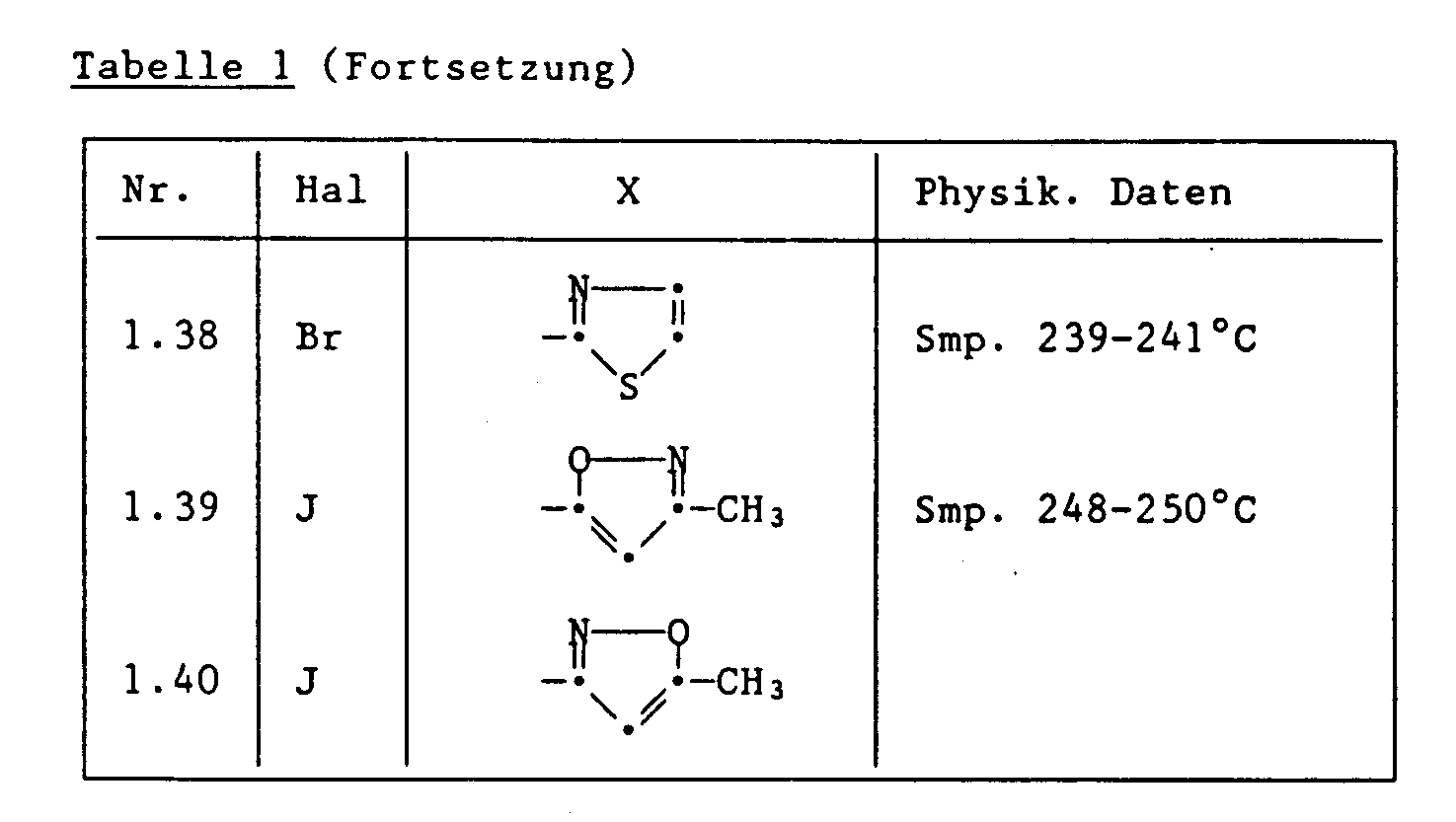

-
a) b) c) Wirkstoff aus den Tabellen 25 % 50 % 75 % Na-Ligninsulfonat 5 % 5 % Na-Laurylsulfat 3 % - 5 % Na-Diisobutylnaphthalinsulfonat - 6 % 10 % Octylphenolpolyethylenglykolether (7-8 Mol Ethylenoxid) - 2 % - Hochdisperse Kieselsäure 5 % 10 % 10 % Kaolin 62 % 27 % - - Der Wirkstoff wird mit den Zusatzstoffen vermischt und in einer geeigneten Mühle homogen vermahlen. Man erhält Spritzpulver, die sich mit Wasser zu Suspensionen jeder gewünschten Konzentration verdünnen lassen.
-
Wirkstoff aus den Tabellen 10 % Octylphenolpolyethylenglykolether (4-5 Mol Ethylenoxid) 3 % Ca-Dodecylbenzolsulfonat 3 % Ricinusölpolyglykolether (35 Mol Ethylenoxid) 4 % Cyclohexanon 30 % Xylolgemisch 50 % - Aus diesem Konzentrat können durch Verdünnen mit Wasser Emulsionen jeder gewünschten Konzentration hergestellt werden.
-
a) b) Wirkstoff aus den Tabellen 5 % 8 % Talkum 95 % - Kaolin - 92 % - Man erhält anwendungsfertige Stäubemittel, indem der Wirkstoff mit den Trägerstoffen vermischt und auf einer geeigneten Mühle vermahlen wird.
-
Wirkstoff aus den Tabellen 10 % Na-Ligninsulfonat 2 % Carboxymethylcellulose 1 % Kaolin 87 % - Der Wirkstoff wird mit den Zusatzstoffen vermischt, vermahlen und mit Wasser angefeuchtet. Dieses Gemisch wird extrudiert und anschliessend im Luftstrom getrocknet.
-
Wirkstoff aus den Tabellen 3 % Polyethylenglykol (MG 200) 3 % Kaolin 94 % (MG = Molekulargewicht) - Der fein gemahlene Wirkstoff wird in einem Mischer auf das mit Polyethylenglykol angefeuchtete Kaolin gleichmässig aufgetragen. Auf diese Weise erhält man staubfreie Umhüllungs-Granulate.
-
Wirkstoff aus den Tabellen 40 % Ethylenglykol 10 % Nonylphenolpolyethylenglykolether (15 Mol Ethylenoxid) 6 % N-Ligninsulfonat 10 % Carboxymethylcellulose 1 % 37%ige wässrige Formaldehyd-Lösung 0,2 % Silikonöl in Form einer 75%igen wässrigen Emulsion 0,8 % Wasser 32 % - Der fein gemahlene Wirkstoff wird mit den Zusatzstoffen innig vermischt. Man erhält ein Suspensions-Konzentrat, aus welchem durch Verdünnen mit Wasser Suspensionen jeder gewünschten Konzentration hergestellt werden können.
-
- a) Gurkenpflanzen werden nach 2-wöchiger Anzucht mit einer aus Spritzpulver des Wirkstoffes hergestellten Spritzbrühe besprüht (Konzentration: 200 ppm).
Nach 48 Stunden werden die Pflanzen mit einer Sporensuspension (1.5 · 10⁵ Sporen/ml) des Pilzes infiziert und für 36 Stunden bei hoher Luftfeuchtigkeit und einer Temperatur von 23°C inkubiert. Die Inkubation wird dann bei normaler Luftfeuchtigkeit und bei 22°C bis 23°C weitergeführt.
Die Beurteilung der Schutzwirkung erfolgt aufgrund des Pilzbefalls 7-8 Tage nach der Infektion. - b) Gurkenpflanzen werden nach 2-wöchiger Anzucht mit einer aus Spritzpulver des Wirkstoffes hergestellten Spritzbrühe durch Bodenapplikation behandelt (Konzentration: 60 oder 20 ppm bezogen auf das Bodenvolumen).
Nach 48 Stunden werden die Pflanzen mit einer Sporensuspension (1.5·10⁵ Sporen/ml) des Pilzes infiziert und für 36 Stunden bei hoher Luftfeuchtigkeit und einer Temperatur von 23°C inkubiert. Die Inkubation wird dann bei normaler Luftfeuchtigkeit und bei 22°C weitergeführt.
Die Beurteilung der Schutzwirkung erfolgt aufgrund des Pilzbefalls 7-8 Tage nach der Infektion. - c) Gurkenpflanzen werden nach 2-wöchiger Anzucht mit einer aus Spritzpulver des Wirkstoffes hergestellten Spritzbrühe besprüht (Konzentration: 200 ppm).
Nach 3 Wochen werden die Pflanzen mit einer Sporensuspension (1.5·10⁵ Sporen/ml) des Pilzes infiziert und für 36 Stunden bei hoher Luftfeuchtigkeit und einer Temperatur von 23°C inkubiert. Die Inkubation wird dann bei normaler Luftfeuchigkeit und bei 22° bis 23°C weitergeführt.
Die Beurteilung der Schutzwirkung erfolgt aufgrund des Pilzbefalls 7-8 Tage nach der Infektion. - Verbindungen aus den Tabellen 1 und 2 zeigten in den Tests (a) und (b) gute Wirkung. So reduzierten z.B. die Verbindungen 1.1, 1.2, 1.6, 1.7, 1.8 und 1.23 den Pilzbefall auf 0 bis 20 %. Unbehandelte jedoch infizierte Kontrollpflanzen wiesen dagegen einen Colletotrichum-Befall von 100 % auf.
-
- a) Weizenpflanzen werden 6 Tage nach der Aussaat mit einer aus Spritzpulver des Wirkstoffes hergestellten Spritzbrühe (0,02 % Aktivsubstanz) besprüht. Nach 24 Stunden werden die behandelten Pflanzen mit einer Uredosporensuspension des Pilzes infiziert. Nach einer Inkubation während 48 Stunden bei 95-100 % relativer Luftfeuchtigkeit und ca. 20°C werden die infizierten Pflanzen in einem Gewächshaus bei ca. 22°C aufgestellt. Die Beurteilung der Rostpustelnentwicklung erfolgt 12 Tage nach der Infektion.
- b) Zu Weizenpflanzen wird 5 Tage nach Aussaat eine aus Spritzpulver des Wirkstoffes hergestellte Spritzbrühe gegossen (0,006 % Aktivsubstanz bezogen auf das Bodenvolumen). Nach 48 Stunden werden die behandelten Pflanzen mit einer Uredosporensuspension des Pilzes infiziert. Nach einer Inkubation während 48 Stunden bei 95-100 % relativer Luftfeuchtigkeit und ca. 20°C werden die infizierten Pflanzen in einem Gewächshaus bei ca. 22°C aufgestellt. Die Beurteilung der Rostpustelnentwicklung erfolgt 12 Tage nach der Infektion.
- Verbindungen aus den Tabellen 1 und 2 zeigten gegen Puccinia-Pilze eine gute Wirkung. So reduzierten z.B. die Verbindungen 1.1, 1.2, 1.30, und 3.7 den Pilzbefall auf 0 bis 20 %. Unbehandelte jedoch infizierte Kontrollpflanzen wiesen dagegen einen Puccinia-Befall von 100 % auf.
-
- a) Tomatenpflanzen werden nach 3-wöchiger Anzucht mit einer aus Spritzpulver des Wirkstoffes hergestellten Spritzbrühe (0,02 % Aktivsubstanz) besprüht. Nach 24 Stunden werden die behandelten Pflanzen mit einer Sporangiensuspension des Pilzes infiziert. Die Beurteilung des Pilzbefalls erfolgte nach einer Inkubation der infizierten Pflanzen während 5 Tagen bei 9O-100 % relativer Luftfeuchtigkeit und 20°C.
- b) Zu Tomatenpflanzen wird nach 3-wöchiger Anzucht eine aus Spritzpulver des Wirkstoffes hergestellte Spritzbrühe gegossen (0,006 % Aktivsubstanz bezogen auf das Erdvolumen). Es wird dabei darauf geachtet, dass die Spritzbrühe nicht mit den oberirdischen Pflanzenteilen in Berührung kommt. Nach 48 Stunden werden die behandelten Pflanzen mit einer Sporangiensuspension des Pilzes infiziert. Die Beurteilung des Pilzbefalls erfolgt nach einer Inkubation der infizierten Pflanzen während 5 Tagen bei 90-100 % relativer Luftfeuchtigkeit und 20°C.
- Verbindungen aus den Tabellen 1 und 2 zeigten gegen den Phytophthora-Pilz eine gute Schutzwirkung. So reduzierten z.B. die Verbindungen 1.13, 1.17, 1.20 und 1.32 den Pilzbefall auf 0 bis 20 %. Unbehandelte jedoch infizierte Kontrollpflanzen wiesen dagegen einen 100 %igen Phytophthora-Befall auf.
- 10-15 cm hohe Erdnusspflanzen werden mit einer aus Spritzpulver der Wirksubstanz hergestellten Spritzbrühe (0,02 % Aktivsubstanz) besprüht und 48 Stunden später mit einer Konidiensuspension des Pilzes infiziert. Die infizierten Pflanzen werden während 72 Stunden bei ca. 21°C und hoher Luftfeuchtigkeit inkubiert und anschliessend bis zum Auftreten der typischen Blattflecken in einem Gewächshaus aufgestellt.
- Die Beurteilung der fungiziden Wirkung erfolgt 12 Tage nach der Infektion basierend auf Anzahl und Grösse der auftretenden Flecken.
- Im Vergleich zu unbehandelten, jedoch infizierten Kontrollpflanzen (Anzahl und Grösse der Flecken = 100 %), zeigten Erdnusspflanzen, die mit Wirkstoffen aus den Tabellen 1 und 2 behandelt wurden, einen reduzierten Cercospora-Befall.
-
- a) Im 4-5 Blattstadium werden Rebensämlinge mit einer aus Spritzpulver des Wirkstoffes hergestellten Spritzbrühe (0,02 % Aktivsubstanz) besprüht. Nach 24 Stunden werden die behandelten Pflanzen mit einer Sporangiensuspension des Pilzes infiziert. Nach einer Inkubation während 6 Tagen bei 95-100 % relativer Luftfeuchtigkeit und 20°C wird der Pilzbefall beurteilt.
- b) Im 4-5 Blattstadium werden Rebensämlinge mit einer Sporangiensuspension des Pilzes infiziert. Nach einer Inkubation während 24 Stunden in einer Feuchtkammer bei 95-100 % relativer Luftfeuchtigkeit und 20°C werden die infizierten Pflanzen getrocknet und mit einer aus Spritzpulver des Wirkstoffes hergestellten Spritzbrühe (0,06 % Aktivsubstanz) besprüht. Nach dem Antrocknen des Spritzbelages werden die behandelten Pflanzen wieder in die Feuchtkammer gebracht. Die Beurteilung des Pilzbefalls erfolgt 6 Tage nach der Infektion.
- Verbindungen aus den Tabellen 1 und 2 zeigten gegen Plasmopara viticola eine gute Schutzwirkung, so reduzierte z.B. die Verbindung 1.8 den Pilzbefall auf 0-20 %. Unbehandelte jedoch infizierte Kontrollpflanzen wiesen dagegen einen 100%igen Plasmopara-Befall auf.
-
- a) Reispflanzen werden nach 2-wöchiger Anzucht mit einer aus Spritzpulver des Wirkstoffes hergestellten Spritzbrühe (0,02 % Aktivsubstanz) besprüht. Nach 48 Stunden werden die behandelten Pflanzen mit einer Konidiensuspension des Pilzes infiziert. Nach 5 Tagen Inkubation bei 95-100 % relativer Luftfeuchtigkeit und 24°C wird der Pilzbefall beurteilt.
- b) Zu 2-wöchigen Reispflanzen wird eine aus Spritzpulver des Wirkstoffes hergestellte Spritzbrühe gegossen (0,006 % Aktivsubstanz bezogen auf das Erdvolumen). Darauf werden die Töpfe mit Wasser soweit gefüllt, dass die untersten Stengelteile der Reispflanzen im Wasser stehen. Nach 96 Stunden werden die behandelten Reispflanzen mit einer Konidiensuspension des Pilzes infiziert. Nach einer Inkubation der infizierten Pflanzen während 5 Tagen bei 95-100 % relativer Luftfeuchtigkeit und ca. 24°C wird der Pilzbefall beurteilt.
- Reispflanzen, die mit einer Spritzbrühe behandelt wurden, die als Aktivsubstanz eine Verbindung aus den Tabellen 1 und 2 enthielt, zeigten im Vergleich zu unbehandelten Kontrollpflanzen (100 % Befall) nur geringen Pilzbefall. So reduzierten z.B. im Test (a) die Verbindungen 1.6, 1.8, 1.29 und 1.33 und im Test (b) die Verbindungen 1.6 und 1.33 den Pilzbefall auf 0 bis 20 %.
-
- a) Tomatenpflanzen werden nach 3-wöchiger Anzucht mit einer aus Spritzpulver des Wirkstoffes hergestellten Spritzbrühe durch Blattapplikation behandelt (Konzentration: 200 ppm). Nach 3,5 Wochen werden die Pflanzen mit einer Bakteriensuspension (10⁸ Bakterien/ml) inokuliert und für 6 Tage bei hoher Luftfeuchtigkeit und bei einer Temperatur von 25°C inkubiert. Die Beurteilung der Schutzwirkung erfolgt aufgrund des Bakterienbefalls 7-8 Tage nach Inokulation.
- b) Tomatenpflanzen werden nach 3-wöchiger Anzucht mit einer aus Spritzpulver des Wirkstoffes hergestellten Spritzbrühe durch Bodenapplikation behandelt (Konzentration: 60 ppm bezogen auf das Bodenvolumen). Nach 3,5 Wochen werden die Pflanzen mit Bakteriensuspension (10⁸ Bakterien/ml) inokuliert und für 6 Tage bei hoher Luftfeuchtigkeit und bei einer Temperatur von 25°C inkubiert.
- Die Beurteilung der Schutzwirkung erfolgt aufgrund des Bakterienbefalls 7-8 Tage nach Inokulation.
- Verbindungen aus den Tabellen 1 und 2 zeigten gegen Pseudomonas eine gute Schutzwirkung. So verhinderten im Test (a) die Verbindungen 1.1, 1.23, 1.30 und 1.32 und im Test (b) die Verbindungen 1.1, 1.8, 1.23, 1.24, 1.25, 1.27, 1.28, 1.30, 1.32 und 1.34 den Bakterienbefall auf 0 bis 20 %. Unbehandelte jedoch infizierte Kontrollpflanzen wiesen dagegen einen 100%-igen Pseudomonas-Befall auf.
- 8 Wochen alte Tabakpflanzen werden mit einer formulierten Lösung des Wirkstoffes besprüht (Konzentration: 200 ppm) oder injiziert (Konzentration: 200 ppm). Nach 4 Tagen werden die Pflanzen mit einer Suspension des Tabakmosaik-Virus (0.5 »g/ml + Carborundum) mechanisch inokuliert und bei einer Temperatur von 20°-22°C inkubiert.
- Die Beurteilung der Schutzwirkung erfolgt aufgrund der Anzahl und Grösse der Lokalläsionen 7 Tage nach der Inokulation.
- Verbindungen aus den Tabellen 1 und 2 zeigten eine gute Schutzwirkung gegen den Tabakmosaik-Virus. Infizierte jedoch unbehandelte Kontrollpflanzen wiesen dagegen Läsionen von 100 % auf.
-
- a) Gurkenpflanzen werden nach 2-wöchiger Anzucht mit einer aus Spritzpulver des Wirkstoffes hergestellten Spritzbrühe besprüht (Konzentration: 20 ppm).
Nach 1 Woche werden die Pflanzen mit einer Bakteriensuspension (10⁸ Bakterien/ml) infiziert und für 7 Tage bei hoher Luftfeuchtigkeit und einer Temperatur von 23°C inkubiert.
Die Beurteilung der Schutzwirkung erfolgt aufgrund des Bakterienbefalls 7-8 Tage nach der Infektion. - b) Gurkenpflanzen werden nach 2-wöchiger Anzucht mit einer aus Spritzpulver des Wirkstoffes hergestellten Spritzbrühe durch Bodenapplikation behandelt (Konzentrationen: 60, 20, 6, 2 ppm bezogen auf das Bodenvolumen).
Nach 1 Woche werden die Pflanzen mit einer Bakteriensuspension (10⁸ Bakterien/ml) infiziert und für 7 Tage bei hoher Luftfeuchtigkeit und einer Temperatur von 23°C inkubiert.
Die Beurteilung der Schutzwirkung erfolgt aufgrund des Bakterienbefalls 7 - 8 Tage nach der Infektion. - Verbindungen aus den Tabellen 1 und 2 zeigten eine gute Schutzwirkung gegen Pseudomonasbefall. So wurde der Bakterienbefall in Test (a) durch die Verbindungen 1.8 und 1.23. und im Test (b) durch die Verbindung 1.23 auf 0-20 % reduziert. Unbehandelte jedoch infizierte Kontrollpflanzen wiesen dagegen einen 100 %igen Pseudomonas-Befall auf.
-
- a) Reispflanzen der Sorte "Calora" oder "S6" werden nach 3-wöchiger Anzucht im Gewächshaus mit der Prüfsubstanz in Form einer Spritzbrühe (0,02 % Aktivsubstanz) besprüht. Nach eintägigem Antrocken dieses Spritzbelags werden die Pflanzen in einem Klimaraum bei 24°C und 75-85 % relativer Luftfeuchtigkeit aufgestellt und infiziert. Die Infektion erfolgt, indem die Blattspitzen mit einer Schere, die zuvor in eine Suspension von Xanthomonas oryzae eingetaucht worden war, abgeschnitten werden. Nach 10-tägiger Inkubation werden die angeschnittenen Blätter bei Befall welk, rollen sich ein und werden nekrotisch. Das Ausmass dieser Krankheitssymptome dient zur Beurteilung der residual Wirksamkeit der Prüfsubstanz.
- b) Reispflanzen der Sorte "Calora" oder "S6" werden nach 3-wöchiger Anzucht im Gewächshaus mit einer Suspension der Prüfsubstanz begossen (0,006 % Aktivsubstanz bezogen auf das Erdvolumen). Drei Tage nach dieser Behandlung werden die Pflanzen in einem Klimaraum bei 24°C und 75-85 % relativer Luftfeuchtigkeit aufgestellt und infiziert. Die Infektion erfolgt, indem die Blattspitzen mit einer Schere, die zuvor in eine Suspension von Xanthomonas oryzae eingetaucht worden war, abgeschnitten werden. Nach 10-tägiger Inkubation werden die angeschnittenen Blätter bei Befall welk, rollen sich ein und werden nekrotisch. Das Ausmass dieser Krankheitssymptome dient zur Beurteilung der systemischen Wirksamkeit der Prüfsubstanz.
- Verbindungen aus den Tabellen 1 und 2 zeigten eine gute Schutzwirkung gegen Xanthomonas oryzae. So reduzierten z.B. im Test (a) die Verbindungen 1.1, 1.23 und 1.32 und im Test (b) die Verbindungen 1.1, 1.30, 1.31, 1.32, 1.33, 1.34, 1.35 und 1.36 den Bakterienbefall auf 0 bis 20 %. Unbehandelte jedoch infizierte Kontrollpflanzen wiesen dagegen einen Krankheitsbefall von 100 % auf.
-
- a) Paprikapflanzen der Sorte "California Wonder" werden nach 3-wöchiger Anzucht im Gewächshaus mit der Prüfsubstanz in Form einer Spritzbrühe (0,02 % Aktivsubstanz) besprüht. Nach eintägigem Antrocknen dieses Spritzbelages werden die Pflanzen in einem Klimaraum bei 26°C und 95-100 % relativer Luftfeuchtigkeit aufgestellt und durch Besprühen der Blattunterseiten mit einer standardisierten Suspension von Xanthomonas vesicatoria infiziert. Nach 6-tägiger Inkubation bilden sich bei Befall auf den Blättern runde, anfangs wässrige, später nekrotische, aufgehellte Flecken. Das Ausmass dieser Flecken dient zur Beurteilung der residualen Wirksamkeit der Prüfsubstanz.
- b) Paprikapflanzen der Sorte "California Wonder" werden nach 3-wöchiger Anzucht im Gewächshaus mit einer Suspension der Prüfsubstanz begossen (0,006 % Aktivsubstanz bezogen auf das Erdvolumen). Drei Tage nach dieser Behandlung werden die Pflanzen in einem Klimaraum bei 26°C und 95-100 % relativer Luftfeuchtigkeit aufgestellt und durch Besprühen der Blattunterseiten mit einer standardisierten Suspension von Xanthomonas vesicatoria infiziert. Nach 6-tägiger Inkubation bilden sich bei Befall auf den Blättern runde, anfangs wässrige, später nekrotische, aufgehellte Flecken. Das Ausmass dieser Flecken dient zur Beurteilung der systemischen Wirksamkeit der Prüfsubstanz.
- Verbindungen aus den Tabellen 1 und 2 zeigten eine gute Schutzwirkung gegen Xanthomonas vesicatoria. So reduzierten z.B. im Test (a) die Verbindung 1.32 und im Test (b) die Verbindungen 1.23, 1.30, 1.32, 1.38 und 1.39, den Bakterienbefall auf 0 bis 20 %. Unbehandelte jedoch infizierte Kontrollpflanzen wiesen dagegen einen Krankheitsbefall von 100 % auf.
- Natürlich mit Fusarium nivale infizierter Roggen der Sorte Tetrahell wird auf einer Mischrolle mit der Prüfsubstanz gebeizt, wobei folgende Konzentrationen zur Anwendung gelangen: 600, 200 oder 60 ppm AS (bezogen auf das Gewicht des Saatgutes).
- Der infizierte und behandelte Roggen wird im Oktober im Freiland mittels einer Sämaschine auf Parzellen von 3 m Länge und 6 Saatreihen ausgesät, mit 3 Wiederholungen pro Versuchsprodukt.
- Bis zur Befallsauswertung wird die Versuchspflanzung unter normalen Feldbedingungen kultiviert (vorzugsweise in einer Region mit geschlossener Schneedecke während der Wintermonate).
- Zur Ermittlung der Wirkstoffaktivität wird im Frühjahr unmittelbar nach der Schneeschmelze, der prozentuale Anteil mit Fusarium befallener Pflanzen ausgezählt.
- Verbindungen aus den Tabellen 1 und 2 zeigten eine gute Schutzwirkung gegen Fusarium. Unbehandelte jedoch infizierte Kontrollpflanzen wiesen einen Krankheitsbefall von 100 % auf.
- Natürlich mit Helminthosporium gramineum infizierte Wintergerste der Sorte "Cl" wird auf einer Mischrolle mit der Prüfsubstanz gebeizt, wobei folgende Konzentrationen zur Anwendung gelangen: 600, 200 oder 60 ppm AS (bezogen auf das Gewicht des Saatgutes).
- Die infizierte und behandelte Gerste wird im Oktober im Freiland mittels einer Sämaschine auf Parzellen von 2 m Länge und 3 Saatreihen ausgesät, mit 3 Wiederholungen pro Versuchsprodukt.
- Bis zur Befallsauswertung wird die Versuchspflanzung unter normalen Feldbedingungen kultiviert.
- Zur Ermittlung der Wirkstoffaktivität werden zum Zeitpunkt des Aehrenschiebens der prozentuale Anteil mit Helminthosporium befallener Halme ausgezählt.
- Verbindungen aus den Tabellen 1 und 2 zeigten eine gute Schutzwirkung gegen Helminthospora. Unbehandelte jedoch infizierte Kontrollpflanzen wiesen einen Krankheitsbefall von 100 % auf.
- Natürlich mit Ustilago nuda infizierte Wintergerste der Sorte "RM1" wird auf einer Mischrolle mit der Prüfsubstanz gebeizt, wobei folgende Konzentrationen zur Anwendung gelangen: 600, 200 oder 60 ppm As (bezogen auf das Gewicht des Saatgutes).
- Die infizierte und behandelte Gerste wird im Oktober im Freiland mittels einer Sämaschine auf Parzellen von 2 m Länge und 3 Saatreihen ausgesät, mit 3 Wiederholungen pro Versuchsprodukt.
- Bis zur Befallsauswertung wird die Versuchspflanzung unter normalen Feldbedingungen kultiviert.
- Zur Ermittlung der Wirkstoffaktivität wird während der Blüte der prozentuale Anteil Ustilago befallener Aehren ausgezählt.
- Verbindungen aus den Tabellen 1 und 2 zeigten eine gute Schutzwirkung gegen Ustilago. Unbehandelte jedoch infizierte Kontrollpflanzen wiesen einen Krankheitsbefall von 100 % auf.
- Gurkensamen werden mit einer Lösung des Wirkstoffes gebeizt (Konzentration: 180 g/100 kg Samen). Die Samen werden ausgesät. Nach 4 Wochen werden die Pflanzen mit einer Sporensuspension 1.5·10⁵ Sporen/ml) des Pilzes infiziert und für 36 Stunden bei hoher Luftfeuchtigkeit und einer Temperatur von 23°C inkubiert. Die Inkubation wird dann bei normaler Luftfeuchtigkeit und bei 22° bis 23°C weitergeführt. Die Beurteilung der Schutzwirkung erfolgt aufgrund des Pilzbefalls 7-8 Tage nach der Infektion.
- Verbindungen aus den Tabellen 1 und 2 zeigten eine gute Schutzwirkung gegen Colletotrichum. Infizierte Kontrollpflanzen, deren Samen nicht behandelt wurden, wiesen einen Pilzbefall von 100 % auf.
- Apfelstecklinge mit 10 - 20 cm langen Frischtrieben werden mit einer aus Spritzpulver des Wirkstoffes hergestellten Spritzbrühe (0,02 % Aktivsubstanz) besprüht. Nach 24 Stunden werden die behandelten Pflanzen mit einer Konidiensuspension des Pilzes infiziert. Die Pflanzen werden dann während 5 Tagen bei 90-100 % relativer Luftfeuchtigkeit inkubiert und während 10 weiteren Tagen in einem Gewächshaus bei 20-24 °C aufgestellt. Der Schorfbefall wird 15 Tage nach der Infektion beurteilt.
- Verbindungen aus den Tabellen 1 und 2 zeigten gute Schutzwirkung gegen Venturia. So reduzierte z.B. die Verbindung 1.32 den Schorfbefall auf 5 bis 20 %. Unbehandelte jedoch infizierte Triebe wiesen dagegen einen 100 %igen Venturia-Befall auf.
-
- a) Ca. 8 cm hohe Gerstenpflanzen werden mit einer aus Spritzpulver des Wirkstoffes hergestellten Spritzbrühe (0,02 % Aktivsubstanz) besprüht. Nach 3 - 4 Stunden werden die behandelten Pflanzen mit Konidien des Pilzes bestäubt. Die infizierten Gerstenpflanzen werden in einem Gewächshaus bei ca. 22°C aufgestellt und der Pilzbefall nach 10 Tagen beurteilt.
- b) Zu ca. 8 cm hohen Gerstenpflanzen wird eine aus Spritzpulver des Wirkstoffes hergestellte Spritzbrühe gegossen (0,006 % Aktivsubstanz bezogen auf das Erdvolumen). Es wird dabei darauf geachtet, dass die Spritzbrühe nicht mit den oberirdischen Pflanzenteilen in Berührung kommt.
- Nach 48 Stunden werden die behandelten Pflanzen mit Konidien des Pilzes bestäubt. Die infizierten Gerstenpflanzen werden in einem Gewächshaus bei ca. 22°C aufgestellt und der Pilzbefall nach 10 Tagen beurteilt.
- Verbindungen aus den Tabellen 1 und 2 zeigten einen guten Schutzeffekt gegen Erysiphe. So reduzierte z.B. die Verbindung 1.24. den Pilzbefall auf weniger als 20 %, während unbehandelte aber infizierte Kontrollpflanzen zu 100 % befallen waren.
Claims (13)
- Verfahren zur Herstellung der Verbindungen der Formel I
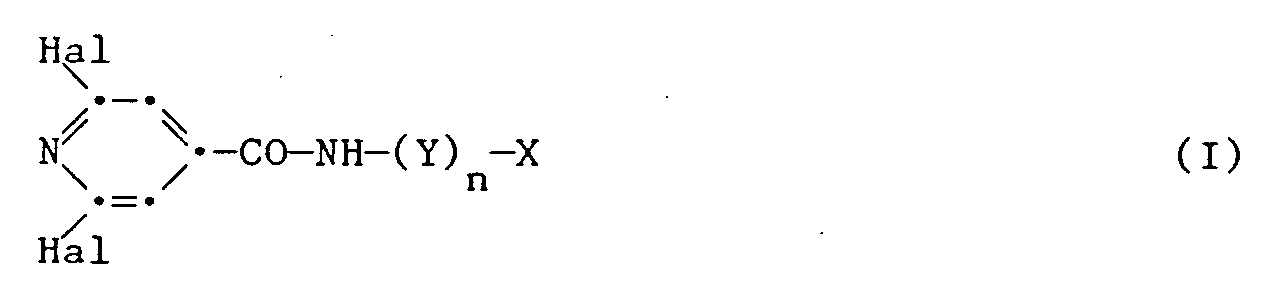 Hal unabhängig voneinander Fluor, Chlor, Brom oder Jod;Y NH;n 1 oder 0;X ein 5-gliedriger gesättigter oder ungesättigter unsubstituierter oder mit C₁-C₈-Alkyl, Halogen, Trifluormethyl, Cyano oder Nitro substituierter Heterocyclus mit 1-3 Heteroatomen, wie N, O oder S, wobei der Heterocyclus zusätzlich eine Oxo- oder Thionogruppe enthalten kann, dadurch gekennzeichnet, dass man ein Isonicotinsäurehalogenid der Formel II
H₂N-(Y)n-X (III)
in Gegenwart einer Base in einem inerten Lösungsmittel oder ohne Lösungsmittel bei Temperaturen von -20° bis 150°C, vorzugsweise 0° bis 80°C, umsetzt, wobei Hal Halogen, A Halogen, einen Acyloxyrest der Formel
- Verfahren gemäss Anspruch 1, dadurch gekennzeichnet, dass Verbindungen der Formel 1b
 Hal unabhängig voneinander Fluor, Chlor oder Brom;X ein wie unter Formel I in Anspruch 1 angegebener Heterocyclus; hergestellt werden.
 - Verfahren gemäss Anspruch 1, dadurch gekennzeichnet, dass Verbindungen der Formel Ic
 Hal unabhängig voneinander Fluor, Chlor oder Brom;X ein wie unter Formel I in Anspruch 1 angegebener Heterocyclus; hergestellt werden.
 - Verfahren gemäss Anspruch 1, dadurch gekennzeichnet, dass Verbindungen der Formel Ib in Anspruch 2, worin bedeuten:Hal Chlor oder Brom;X Furan-2-yl, 1,2,4-Triazol-3-yl, Thiazol-2-yl, Thiazol-5-yl, Isothiazol-3-yl, Oxazol-2-yl, Isoxazol-3-yl, Isoxazol-5-yl, 1,3,4-Thiadiazol-2-yl, 1,2,4-Thiadiazol-3-yl oder 3-Thiono-1,2-dithia-4-azol-5-yl; hergestellt werden.
- Verfahren gemäss Anspruch 1, dadurch gekennzeichnet, dass eine Verbindung aus der Gruppe:
3-Methylisoxazol-5-(2,6-dichlorisonicotinsäure)-amid,
5-Methylisoxazol-3-(2,6-dichlorisonicotinsäure)-amid,
α-Methylfurfuryl-2,6-dichlorisonicotinsäureamid,
3-Methylisothiazol-5-(2,6-dichlorisonicotinsäure)-amid,
hergestellt wird.
Applications Claiming Priority (2)
| Application Number | Priority Date | Filing Date | Title |
|---|---|---|---|
| CH1068/88 | 1988-03-21 | ||
| CH106888 | 1988-03-21 |
Publications (3)
| Publication Number | Publication Date |
|---|---|
| EP0334809A2 EP0334809A2 (de) | 1989-09-27 |
| EP0334809A3 EP0334809A3 (en) | 1989-12-06 |
| EP0334809B1 true EP0334809B1 (de) | 1994-06-15 |
Family
ID=4201694
Family Applications (1)
| Application Number | Title | Priority Date | Filing Date |
|---|---|---|---|
| EP89810198A Expired - Lifetime EP0334809B1 (de) | 1988-03-21 | 1989-03-14 | Mittel zum Schutz von Pflanzen gegen Krankheiten |
Country Status (11)
| Country | Link |
|---|---|
| US (1) | US4966908A (de) |
| EP (1) | EP0334809B1 (de) |
| JP (1) | JPH01283284A (de) |
| KR (1) | KR890014532A (de) |
| AU (1) | AU622892B2 (de) |
| BR (1) | BR8901325A (de) |
| DE (1) | DE58907869D1 (de) |
| DK (1) | DK134289A (de) |
| ES (1) | ES2055808T3 (de) |
| IL (1) | IL89663A (de) |
| ZA (1) | ZA892094B (de) |
Families Citing this family (18)
| Publication number | Priority date | Publication date | Assignee | Title |
|---|---|---|---|---|
| ATE106394T1 (de) * | 1987-04-29 | 1994-06-15 | Ciba Geigy Ag | Mittel zum schutz gegen pflanzenkrankheiten. |
| ES2057172T3 (es) * | 1988-03-09 | 1994-10-16 | Ciba Geigy Ag | Agente para la proteccion de plantas contra enfermedades. |
| NZ238917A (en) * | 1990-07-20 | 1994-04-27 | Buckman Labor Inc | Microbicidal compositions containing a 1-hydroxymethylpyrazole derivative |
| DE4138026A1 (de) * | 1991-11-19 | 1993-06-03 | Bayer Ag | Substituierte pyridin-4-carbonsaeureamide |
| AU6492694A (en) * | 1993-03-30 | 1994-10-24 | Epitope, Inc. | Floral preservative method and composition |
| JPH09136887A (ja) * | 1995-09-13 | 1997-05-27 | Nippon Bayeragrochem Kk | クロロピリジルカルボニル誘導体 |
| DE19542372A1 (de) * | 1995-11-14 | 1997-05-15 | Bayer Ag | Acylierte 5-Aminoisothiazole |
| JPH10338673A (ja) * | 1997-06-04 | 1998-12-22 | Nippon Bayeragrochem Kk | イソニコチン酸ヒドラジド誘導体および有害生物防除剤 |
| DE19736545A1 (de) * | 1997-08-22 | 1999-02-25 | Bayer Ag | Acylierte 5-Aminoisothiazole |
| KR100479137B1 (ko) * | 1999-12-02 | 2005-03-31 | 노파르티스 아게 | 살충제 및 항기생충제로서의 아미노헤테로시클릴아미드 |
| IL154004A0 (en) * | 2000-09-18 | 2003-07-31 | Du Pont | Pyridinyl amides and imides for use as fungicides |
| DE10063868A1 (de) * | 2000-12-21 | 2002-06-27 | Bayer Ag | Dichlorpyridincarbamide |
| JP2004269515A (ja) * | 2003-02-18 | 2004-09-30 | Nippon Nohyaku Co Ltd | 置換複素環アミド誘導体、その中間体及び農園芸用薬剤並びにその使用方法 |
| EP2540734B1 (de) * | 2004-04-05 | 2016-03-30 | Alnylam Pharmaceuticals, Inc. | Prozess und Reagenzien für Oligonukleotidsynthese und -reinigung |
| US7935716B2 (en) * | 2005-05-31 | 2011-05-03 | Sumitomo Chemical Company, Limited | Carboxamide compound and use of the same |
| JP5034293B2 (ja) * | 2005-07-14 | 2012-09-26 | 住友化学株式会社 | カルボキサミド化合物及びこれを含有する植物病害防除剤 |
| JP5003014B2 (ja) * | 2005-07-14 | 2012-08-15 | 住友化学株式会社 | カルボキサミド化合物及びその植物病害防除用途 |
| RU2762833C2 (ru) * | 2017-03-17 | 2021-12-23 | Мейдзи Сейка Фарма Ко., Лтд. | Средство для борьбы с болезнями растений |
Family Cites Families (9)
| Publication number | Priority date | Publication date | Assignee | Title |
|---|---|---|---|---|
| NL244939A (de) * | 1958-11-05 | |||
| CH384929A (de) * | 1959-10-26 | 1965-02-26 | Geigy Ag J R | Mittel zur Hemmung des Pflanzenwachstums |
| US4137067A (en) * | 1975-05-14 | 1979-01-30 | Ciba-Geigy Corporation | Pyridine-4-carboxylic acid hydrazides for combatting phytopathogenic microorganisms and for regulating plant growth |
| CH608341A5 (en) * | 1975-05-14 | 1979-01-15 | Ciba Geigy Ag | Method of controlling phytopathogenic bacteria |
| DE2854598A1 (de) * | 1978-12-18 | 1980-07-03 | Basf Ag | N-substituierte carbonsaeureanilide, verfahren zu ihrer herstellung sowie ihre verwendung als fungizide |
| US4804762A (en) * | 1986-05-13 | 1989-02-14 | Nippon Kayaku Kabushiki Kaisha | N-cyanoalkylisonicotinamide derivatives |
| JPH0784462B2 (ja) * | 1986-07-25 | 1995-09-13 | 日清製粉株式会社 | ベンゾイミダゾ−ル誘導体 |
| ES2057172T3 (es) * | 1988-03-09 | 1994-10-16 | Ciba Geigy Ag | Agente para la proteccion de plantas contra enfermedades. |
| EP0334812B1 (de) * | 1988-03-25 | 1994-04-06 | Ciba-Geigy Ag | Mittel zum Schutz von Pflanzen gegen Krankheiten |
-
1989
- 1989-03-14 ES ES89810198T patent/ES2055808T3/es not_active Expired - Lifetime
- 1989-03-14 EP EP89810198A patent/EP0334809B1/de not_active Expired - Lifetime
- 1989-03-14 US US07/323,456 patent/US4966908A/en not_active Expired - Fee Related
- 1989-03-14 DE DE58907869T patent/DE58907869D1/de not_active Expired - Fee Related
- 1989-03-20 IL IL89663A patent/IL89663A/xx unknown
- 1989-03-20 DK DK134289A patent/DK134289A/da not_active Application Discontinuation
- 1989-03-20 ZA ZA892094A patent/ZA892094B/xx unknown
- 1989-03-20 JP JP1069116A patent/JPH01283284A/ja active Pending
- 1989-03-20 AU AU31502/89A patent/AU622892B2/en not_active Ceased
- 1989-03-21 BR BR898901325A patent/BR8901325A/pt unknown
- 1989-03-21 KR KR1019890003588A patent/KR890014532A/ko not_active Withdrawn
Also Published As
| Publication number | Publication date |
|---|---|
| IL89663A (en) | 1993-02-21 |
| AU3150289A (en) | 1989-09-21 |
| BR8901325A (pt) | 1989-11-07 |
| KR890014532A (ko) | 1989-10-24 |
| ZA892094B (en) | 1989-11-29 |
| EP0334809A3 (en) | 1989-12-06 |
| ES2055808T3 (es) | 1994-09-01 |
| DK134289A (da) | 1989-09-22 |
| DK134289D0 (da) | 1989-03-20 |
| AU622892B2 (en) | 1992-04-30 |
| DE58907869D1 (de) | 1994-07-21 |
| JPH01283284A (ja) | 1989-11-14 |
| EP0334809A2 (de) | 1989-09-27 |
| IL89663A0 (en) | 1989-09-28 |
| US4966908A (en) | 1990-10-30 |
Similar Documents
| Publication | Publication Date | Title |
|---|---|---|
| EP0332579B1 (de) | Mittel zum Schutz von Pflanzen gegen Krankheiten | |
| DE69712331T2 (de) | Pyrimidin-4-on derivate als pestizidesmittel | |
| EP0313512B1 (de) | Benzothiadiazole und ihre Verwendung in Verfahren und Mitteln gegen Pflanzenkrankheiten | |
| EP0450355B1 (de) | Verbindungen zur Bekämpfung von Pflanzenkrankheiten | |
| EP0334809A2 (de) | Mittel zum Schutz von Pflanzen gegen Krankheiten | |
| EP0276432A2 (de) | Schädlingsbekämpfungsmittel | |
| EP0139613A1 (de) | N-(2-Nitrophenyl)-4-aminopyrimidin-Derivate, deren Herstellung und Verwendung | |
| EP0172786A2 (de) | Pyrimidinderivate wirksam als Schädlingsbekämpfungsmittel | |
| EP0268775B1 (de) | Verfahren zum Schutz von Pflanzen gegen Krankheiten | |
| EP0430033A2 (de) | Mikrobizide Mittel | |
| EP0217747B1 (de) | Nematizide Mittel | |
| EP0334813B1 (de) | Mittel zum Schutz von Pflanzen gegen Krankheiten | |
| EP0387195B1 (de) | Mittel zum Schutz von Pflanzen gegen Krankheiten | |
| EP0334812B1 (de) | Mittel zum Schutz von Pflanzen gegen Krankheiten | |
| EP0364396A1 (de) | Nematizide und fungizide Mittel | |
| EP0288976B1 (de) | Mittel zum Schutz gegen Pflanzenkrankheiten | |
| EP0517660B1 (de) | Benzo-1,2,3-thiadiazol-Derivate | |
| EP0384889B1 (de) | Mittel zum Schutz von Pflanzen gegen Krankheiten | |
| EP0285565B1 (de) | 2-Mercapto-5-pyridyl-1,3,4-oxadiazole und -1,3,4-thiadiazole, Verfahren zu ihrer Herstellung und ihre Verwendung als nematizide Mittel | |
| EP0420803B1 (de) | Benzo-1,2,3-thiadiazol-Derivate und ihre Verwendung zum Schutz von Pflanzen gegen Krankheiten | |
| EP0263066A2 (de) | 2-Mercapto-oxadiazol- und -thiadiazol-Derivate, Verfahren zu ihrer Herstellung und diese enthaltende nematizide Mittel | |
| EP0780394A1 (de) | Mikrobizide | |
| EP0170906B1 (de) | Pflanzenschützende Mittel auf Basis von Oximestern | |
| EP0384890B1 (de) | Mittel zum Schutz von Pflanzen gegen Krankheiten | |
| EP0259737B1 (de) | 2-Cyano-2-alkoximino-acetamide |
Legal Events
| Date | Code | Title | Description |
|---|---|---|---|
| PUAI | Public reference made under article 153(3) epc to a published international application that has entered the european phase |
Free format text: ORIGINAL CODE: 0009012 |
|
| 17P | Request for examination filed |
Effective date: 19890316 |
|
| AK | Designated contracting states |
Kind code of ref document: A2 Designated state(s): AT BE CH DE ES FR GB GR IT LI LU NL SE |
|
| PUAL | Search report despatched |
Free format text: ORIGINAL CODE: 0009013 |
|
| AK | Designated contracting states |
Kind code of ref document: A3 Designated state(s): AT BE CH DE ES FR GB GR IT LI LU NL SE |
|
| RHK1 | Main classification (correction) |
Ipc: C07D405/12 |
|
| 17Q | First examination report despatched |
Effective date: 19920311 |
|
| RBV | Designated contracting states (corrected) |
Designated state(s): CH DE ES FR GB IT LI NL |
|
| GRAA | (expected) grant |
Free format text: ORIGINAL CODE: 0009210 |
|
| AK | Designated contracting states |
Kind code of ref document: B1 Designated state(s): CH DE ES FR GB IT LI NL |
|
| ITF | It: translation for a ep patent filed | ||
| REF | Corresponds to: |
Ref document number: 58907869 Country of ref document: DE Date of ref document: 19940721 |
|
| ET | Fr: translation filed | ||
| REG | Reference to a national code |
Ref country code: ES Ref legal event code: FG2A Ref document number: 2055808 Country of ref document: ES Kind code of ref document: T3 |
|
| GBT | Gb: translation of ep patent filed (gb section 77(6)(a)/1977) |
Effective date: 19940915 |
|
| PLBE | No opposition filed within time limit |
Free format text: ORIGINAL CODE: 0009261 |
|
| STAA | Information on the status of an ep patent application or granted ep patent |
Free format text: STATUS: NO OPPOSITION FILED WITHIN TIME LIMIT |
|
| 26N | No opposition filed | ||
| PGFP | Annual fee paid to national office [announced via postgrant information from national office to epo] |
Ref country code: FR Payment date: 19970123 Year of fee payment: 9 |
|
| PGFP | Annual fee paid to national office [announced via postgrant information from national office to epo] |
Ref country code: NL Payment date: 19970128 Year of fee payment: 9 |
|
| PGFP | Annual fee paid to national office [announced via postgrant information from national office to epo] |
Ref country code: DE Payment date: 19970205 Year of fee payment: 9 |
|
| PGFP | Annual fee paid to national office [announced via postgrant information from national office to epo] |
Ref country code: CH Payment date: 19970206 Year of fee payment: 9 |
|
| PGFP | Annual fee paid to national office [announced via postgrant information from national office to epo] |
Ref country code: GB Payment date: 19970211 Year of fee payment: 9 |
|
| REG | Reference to a national code |
Ref country code: CH Ref legal event code: PFA Free format text: CIBA-GEIGY AG TRANSFER- NOVARTIS AG |
|
| PGFP | Annual fee paid to national office [announced via postgrant information from national office to epo] |
Ref country code: ES Payment date: 19970317 Year of fee payment: 9 |
|
| REG | Reference to a national code |
Ref country code: GB Ref legal event code: 732E |
|
| NLS | Nl: assignments of ep-patents |
Owner name: NOVARTIS AG |
|
| REG | Reference to a national code |
Ref country code: FR Ref legal event code: TP |
|
| REG | Reference to a national code |
Ref country code: ES Ref legal event code: PC2A |
|
| PG25 | Lapsed in a contracting state [announced via postgrant information from national office to epo] |
Ref country code: GB Free format text: LAPSE BECAUSE OF NON-PAYMENT OF DUE FEES Effective date: 19980314 |
|
| PG25 | Lapsed in a contracting state [announced via postgrant information from national office to epo] |
Ref country code: ES Free format text: LAPSE BECAUSE OF NON-PAYMENT OF DUE FEES Effective date: 19980316 |
|
| PG25 | Lapsed in a contracting state [announced via postgrant information from national office to epo] |
Ref country code: LI Free format text: LAPSE BECAUSE OF NON-PAYMENT OF DUE FEES Effective date: 19980331 Ref country code: FR Free format text: THE PATENT HAS BEEN ANNULLED BY A DECISION OF A NATIONAL AUTHORITY Effective date: 19980331 Ref country code: CH Free format text: LAPSE BECAUSE OF NON-PAYMENT OF DUE FEES Effective date: 19980331 |
|
| PG25 | Lapsed in a contracting state [announced via postgrant information from national office to epo] |
Ref country code: NL Free format text: LAPSE BECAUSE OF NON-PAYMENT OF DUE FEES Effective date: 19981001 |
|
| GBPC | Gb: european patent ceased through non-payment of renewal fee |
Effective date: 19980314 |
|
| REG | Reference to a national code |
Ref country code: CH Ref legal event code: PL |
|
| NLV4 | Nl: lapsed or anulled due to non-payment of the annual fee |
Effective date: 19981001 |
|
| PG25 | Lapsed in a contracting state [announced via postgrant information from national office to epo] |
Ref country code: DE Free format text: LAPSE BECAUSE OF NON-PAYMENT OF DUE FEES Effective date: 19981201 |
|
| REG | Reference to a national code |
Ref country code: FR Ref legal event code: ST |
|
| REG | Reference to a national code |
Ref country code: ES Ref legal event code: FD2A Effective date: 20010503 |
|
| PG25 | Lapsed in a contracting state [announced via postgrant information from national office to epo] |
Ref country code: IT Free format text: LAPSE BECAUSE OF NON-PAYMENT OF DUE FEES Effective date: 20050314 |