EP0334584A2 - Développement d'images obtenues par jet d'encre après l'impression, sur un support n'acceptant pas l'encre - Google Patents
Développement d'images obtenues par jet d'encre après l'impression, sur un support n'acceptant pas l'encre Download PDFInfo
- Publication number
- EP0334584A2 EP0334584A2 EP89302750A EP89302750A EP0334584A2 EP 0334584 A2 EP0334584 A2 EP 0334584A2 EP 89302750 A EP89302750 A EP 89302750A EP 89302750 A EP89302750 A EP 89302750A EP 0334584 A2 EP0334584 A2 EP 0334584A2
- Authority
- EP
- European Patent Office
- Prior art keywords
- ink
- receptive
- dots
- coating
- drops
- Prior art date
- Legal status (The legal status is an assumption and is not a legal conclusion. Google has not performed a legal analysis and makes no representation as to the accuracy of the status listed.)
- Withdrawn
Links
Images
Classifications
-
- B—PERFORMING OPERATIONS; TRANSPORTING
- B41—PRINTING; LINING MACHINES; TYPEWRITERS; STAMPS
- B41M—PRINTING, DUPLICATING, MARKING, OR COPYING PROCESSES; COLOUR PRINTING
- B41M5/00—Duplicating or marking methods; Sheet materials for use therein
- B41M5/50—Recording sheets characterised by the coating used to improve ink, dye or pigment receptivity, e.g. for ink-jet or thermal dye transfer recording
- B41M5/52—Macromolecular coatings
-
- C—CHEMISTRY; METALLURGY
- C09—DYES; PAINTS; POLISHES; NATURAL RESINS; ADHESIVES; COMPOSITIONS NOT OTHERWISE PROVIDED FOR; APPLICATIONS OF MATERIALS NOT OTHERWISE PROVIDED FOR
- C09D—COATING COMPOSITIONS, e.g. PAINTS, VARNISHES OR LACQUERS; FILLING PASTES; CHEMICAL PAINT OR INK REMOVERS; INKS; CORRECTING FLUIDS; WOODSTAINS; PASTES OR SOLIDS FOR COLOURING OR PRINTING; USE OF MATERIALS THEREFOR
- C09D11/00—Inks
- C09D11/30—Inkjet printing inks
-
- B—PERFORMING OPERATIONS; TRANSPORTING
- B41—PRINTING; LINING MACHINES; TYPEWRITERS; STAMPS
- B41M—PRINTING, DUPLICATING, MARKING, OR COPYING PROCESSES; COLOUR PRINTING
- B41M5/00—Duplicating or marking methods; Sheet materials for use therein
- B41M5/50—Recording sheets characterised by the coating used to improve ink, dye or pigment receptivity, e.g. for ink-jet or thermal dye transfer recording
- B41M5/502—Recording sheets characterised by the coating used to improve ink, dye or pigment receptivity, e.g. for ink-jet or thermal dye transfer recording characterised by structural details, e.g. multilayer materials
- B41M5/508—Supports
-
- B—PERFORMING OPERATIONS; TRANSPORTING
- B41—PRINTING; LINING MACHINES; TYPEWRITERS; STAMPS
- B41M—PRINTING, DUPLICATING, MARKING, OR COPYING PROCESSES; COLOUR PRINTING
- B41M5/00—Duplicating or marking methods; Sheet materials for use therein
- B41M5/50—Recording sheets characterised by the coating used to improve ink, dye or pigment receptivity, e.g. for ink-jet or thermal dye transfer recording
- B41M5/52—Macromolecular coatings
- B41M5/5254—Macromolecular coatings characterised by the use of polymers obtained by reactions only involving carbon-to-carbon unsaturated bonds, e.g. vinyl polymers
-
- B—PERFORMING OPERATIONS; TRANSPORTING
- B41—PRINTING; LINING MACHINES; TYPEWRITERS; STAMPS
- B41M—PRINTING, DUPLICATING, MARKING, OR COPYING PROCESSES; COLOUR PRINTING
- B41M7/00—After-treatment of prints, e.g. heating, irradiating, setting of the ink, protection of the printed stock
- B41M7/0027—After-treatment of prints, e.g. heating, irradiating, setting of the ink, protection of the printed stock using protective coatings or layers by lamination or by fusion of the coatings or layers
Definitions
- the present invention relates to ink-jet devices, such as ink-jet printers, and, more particularly, to methods of enhancing and optimizing image density on non-ink receptive substrates, such as surface-modified polyester films for use in overhead transparency projections, photographic imaging, archival imaging, and the like.
- ink-jet printers to form images such as alphanumeric characters and graphics on absorbent substrates such as paper is well-known.
- non-ink receptive substrates such as polyester films, commonly known as Mylar
- Mylar has not produced the same high density of print, which results in intense colors, obtained with inherently absorbent substrates.
- non-ink receptive substrates do not readily absorb the aqueous-based inks commonly employed in ink-jet printing, with the result that dots of ink do not spread laterally and are slow to dry.
- non-ink receptive substrates is used to describe those substrates comprising materials which drops of ink deposited thereon do not penetrate.
- a method of printing on a non-ink receptive substrate provided with an ink-receptive coating to provide images having increased color uniformity and density comprises a four-step mechanism.
- the components of the printing method are selected to optimize the four-phase imaging process.
- the phases are: placement of drops of ink by ink-jet techniques onto the ink-receptive coating such that adjacent drops do not contact one another, penetration of ink drops into the non-ink receptive coating without surface coalescence to form ink dots, followed by radial diffusion of the ink dots within the coating, then followed by termination of dot growth at an optimal size by solvent elimination.
- the method of the invention comprises printing on a non-ink receptive substrate having an ink-receptive coating thereon to form an imaged medium:
- the ink employed should comprise a solution of one or more dyes in a vehicle containing one or more suitable solvents.
- dyes must have suitable solubility, color, intensity, stability and polarity, and the solvents should have suitable volatility and polarity, for use in the practice of the invention.
- a method of printing on a non-ink receptive substrate such as an overhead transparency film, which avoids the common problem of surface coalescence of ink drops yet enhances the density of images printed by ink-jet techniques is provided.
- the latent dot spreading begins immediately upon printing and proceeds for about 1 to 2 hours after the film has been printed and dried to the touch.
- the vehicle or solvent portion of the ink migrates radially from the dot origin and causes diffusion of the dye or colorant within the ink-receptive layer coated on the film substrate.
- the resultant image has much higher optical density and more pleasing print quality than systems where either individual drop dots can be discerned or large coalesced puddles are formed in the final image. Rather, a smooth uniform image prevails upon printing a non-ink receptive substrate with the present invention.
- a removable sheet protector comprising a vapor permeable and water absorbent material is used in storing printed images, such as transparencies, immediately after imaging.
- printed images such as transparencies
- the use of such absorbent and permeable sheet protectors precludes long term need for drying of the images in air prior to storage. Consequently, the final printed image has the same quality of images dried in air.
- Improved image density on non-ink receptive substrates, such as transparent films, is obtained by providing the substrate with a coating which coacts with the ink to promote sufficient post-printing diffusion of the ink.
- a coating is called herein an ink-receptive coating.
- the non-ink receptive substrate employed in the practice of the invention is one that finds use, for exam strictlyple, in overhead transparency projections.
- a material used in such applications is polyester film, such as polyethylene terephthalate (PET), commonly available as Mylar from E.I. duPont de Nemours, Inc. (Wilmington, DE).
- PET polyethylene terephthalate
- Other uses include glossy imaging, such as photographic-quality images, archival images, and the like produced by ink-jet printing.
- non-ink receptive substrate prevents absorption of the ink drop deposited on the substrate by ink-jet printing.
- absorptive coatings or surface treatments are applied to permit reception of drops. However, upon projection of the image through an overhead projector, a pale or low density image is perceived with prior art approaches.
- the ink drops penetrate the film to form ink dots, which then spread laterally within the coating after printing to form continuous arrays of dots.
- the result is a projected image having a considerably greater density of color due to elimination of white light projecting though gaps in the dot arrays.
- the coating has the property such that upon depositing ink drops on the surface thereof, adjacent drops do not contact one another.
- the drop-to-drop spacing is 1/DPI, where DPI is the drops per inch.
- DPI the drops per inch.
- the coating is also optically transparent.
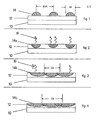
- FIG. 1 depicts a non-ink receptive coating 10, upon which an ink receptive coating 12 is formed.
- Drops of ink 14 having a surface diameter D1, where D1 ⁇ 1/DPI, are deposited on the surface of the receptive coating 12 by an ink-jet device (not shown).
- the center-to-center spacing of drops is accordingly 1/DPI.
- the coating 12 rapidly absorbs the ink drops, to form ink dots 14a, as shown in FIG. 2.
- the dye is not fixed by the coating.
- the ink dots 14a diffuse within the coating after printing.
- the coating 12 is capable of supporting such absorption and lateral diffusion, permitting the ink dots 14a to diffuse to the optimal size.
- the ink vehicle spreads laterally, which transports the dye coextensively.
- the combination is such that as the vehicle becomes more diluted during spreading and evaporation, it is no longer able to transport the dye, and the lateral spreading of the dye ceases. However, the lateral movement of the dye that has occurred is sufficient to yield ink dots 14b with diameters greater than about ⁇ 2 (or 1. 41) times dot spacing, thereby creating the desired effect (FIG. 3).
- An overhead transparency showing the desired performance can be generated by ink-jet printing with an ink/coating combination comprising, for example, an ink consisting essentially of Food Black 2 dye in a 50/50 weight ratio of water/diethylene glycol vehicle printed on Hewlett-Packard 5163OQ transparent film, which includes an ink-receptive coating thereon, and printed at a resolution of 180 dots per inch.
- an ink consisting essentially of Food Black 2 dye in a 50/50 weight ratio of water/diethylene glycol vehicle printed on Hewlett-Packard 5163OQ transparent film, which includes an ink-receptive coating thereon, and printed at a resolution of 180 dots per inch.
- polyacrylic acid a resin which is available from B.F. Goodrich as Carbopol 907 and which can be readily coated from alcohol solutions.
- the polyacrylic acid is available in a free acid form with a molecular weight ranging from about 250,000 to 1,250,000.
- the polyacrylic acid coating when dry, has a preferred thickness ranging from about 4 to 12 ⁇ m. If the coating is less than about 4 ⁇ m, then too much dot growth is observed, with consequent loss of resolution, while if it is greater than about 12 ⁇ m, then too little dot growth is observed, with consequent poor color density. For other coatings, this range may vary, but is readily determinable without undue experimentation.
- the optimal coating prevents drop coalescence by providing an initial dot size ⁇ 1/DPI. This prevents adjacent drops from coalescing and allows post-print lateral spreading until the dot size grows to ⁇ 2/DPI, yielding complete overlap of adjacent drops.
- DPI ranges from about 100 to 400.
- the initial dot size must be ⁇ 1/DPI to prevent coalescence or puddling of drops of ink.
- the final dot size must be at least about ⁇ 2/DPI and less than about 2/DPI to eliminate any uncolored area between adjacent dots and to avoid fuzzy or distorted images.
- both sides of the non-ink receptive substrate are coated. This prevents buckling due to hygroscopicity of the coating, even though only one side is printed.
- the coating may be applied by any of the conventional techniques for applying coatings to films, including air knife, doctor blade, gravure, metering rod, reverse roll, etc.
- the coating may be applied as an aqueous solution or emulsion or as a solvent lacquer.
- the coating may be post-cured thermally or by irradiation.
- the ink preferably contains a water-based vehicle containing about 30 to 99 wt% water, to impart volatility and solubility, with the balance comprising higher boiling solvents, such as glycols, glycol ethers, pyrrolidones and amides to optimize penetration and polarity.
- the ink preferably contains acid or direct dyes which are available in optimal solubility, colors and polarity.
- a microscopic view of the image shows discernible dots.
- the optical density has a measurable value.
- the printed dots are observed to spread laterally until the dots are no longer discernible and the optical density increases considerably, as much as three-fold.
- the lateral spreading ceases, as does the increase in optical density.
- the only change observable is the increase in optical density, as seen in the increased intensity of colors.
- Diffusion begins as soon as the drops penetrate the surface of the coating after printing and ceases as a consequence of vehicle evaporation by about 1 to 2 hours later.
- the increase in color density is observed to follow the diffusion time onset and cessation.
- the image itself is dry to the touch in less than about 60 seconds.
- ink on uncoated Mylar just beads up and wipes off, without absorbing thereinto.
- a vapor permeable and water absorbent sheet protector permits obtaining substantially the same results as if the coated non-ink receptive substrate, or imaged medium, were dried in air without waiting for the ink to dry.
- a sheet protector must have a water absorption greater than about 3% and a water vapor transmission rate greater than about 10 g water per 1 mil thickness per 100 square inches per 24 hours in order to promote the correct amount of lateral dot spread, indicated above.
- An example of a suitable material is an acetate, e.g., cellulose diacetate or triacetate. The sheet protector may be removed prior to projecting a transparency for maximum clarity and brightness.
- sheet protectors made of acetate or other material having the properties indicated above for storing imaged media has several advantages over conventional sheet protectors such as polyvinyl chloride (PVC), polypropylene and polyester, (polyethylene terephthalate PET).
- PVC polyvinyl chloride
- PET polyethylene terephthalate PET
- the vapor permeability allows for solvent (vehicle) from the inks to leave the imaged media/sleeve system, and for long term drying of the inks to be similar to drying in air.
- the net result of this property is that the dot growth (intentional, controlled diffusion) on the imaged media in accordance with the invention will be nearly the same when air dried or placed in the preferred sheet protector.
- Vapor impermeable sleeves are unlikely to match air dried quality, and are more likely to cause permanent changes in clarity due to solvent trapping.
- Blocking Vehicle absorption at a proper level is necessary to prevent optical contact between the sheet protector and the imaged surface of the substrate, a behavior referred to as "blocking". Blocking is visible as blotches or puddles, and can permanently damage an image on coated non-ink receptive substrates. Blocking also appears on other such substrates when sleeved in conventional sheet protectors, especially if printing or plotting is done in humid environments, but this blocking does not typically cause permanent damage to the image.
- the use of acetate protectors in accordance with this aspect of the invention helps prevent blocking with many imaged media, and will also provide a quick initial drying of the solvents to help protect the image, while still maintaining complete optical clarity as solvents are absorbed.
- the ink comprised 48 parts diethylene glycol, 48 parts water and 4 parts Food Black 2. All parts are by weight, unless otherwise specified.
- the ink was applied as 90 picoliter (pl) drops at 180 DPI (32,400 dots/in2) with a double pass of the ink-jet printhead.
- the optical density of the resulting image was measured immediately after printing and again at 5 minute intervals.
- Hewlett-Packard 5136OQ transparency was printed with an ink-jet engine employing an ink of aqueous base and soluble dye.
- the ink comprised 48 parts diethylene glycol, 48 parts water and 4 parts Food Black 2.
- the ink was applied as 90 picoliter (pl) drops at 180 DPI (32,400 dots/in2) with a double pass of the ink-jet printhead.
- the optical density of the resulting image was measured immediately after printing and again at 5 minute intervals.
- Printed Hewlett-Packard 5136OQ transparencies prepared in accordance with the teachings of the invention, were inserted into removable sheet protectors comprising various materials and the extent of vehicle retained in each transparency was compared over a period of time to an unprotected transparency. The results are summarized in the Table below.
Landscapes
- Chemical & Material Sciences (AREA)
- Life Sciences & Earth Sciences (AREA)
- Engineering & Computer Science (AREA)
- Materials Engineering (AREA)
- Wood Science & Technology (AREA)
- Organic Chemistry (AREA)
- Ink Jet Recording Methods And Recording Media Thereof (AREA)
Applications Claiming Priority (2)
| Application Number | Priority Date | Filing Date | Title |
|---|---|---|---|
| US172946 | 1988-03-23 | ||
| US07/172,946 US4914451A (en) | 1987-06-01 | 1988-03-23 | Post-printing image development of ink-jet generated transparencies |
Publications (2)
| Publication Number | Publication Date |
|---|---|
| EP0334584A2 true EP0334584A2 (fr) | 1989-09-27 |
| EP0334584A3 EP0334584A3 (fr) | 1991-01-16 |
Family
ID=22629860
Family Applications (1)
| Application Number | Title | Priority Date | Filing Date |
|---|---|---|---|
| EP19890302750 Withdrawn EP0334584A3 (fr) | 1988-03-23 | 1989-03-20 | Développement d'images obtenues par jet d'encre après l'impression, sur un support n'acceptant pas l'encre |
Country Status (2)
| Country | Link |
|---|---|
| US (1) | US4914451A (fr) |
| EP (1) | EP0334584A3 (fr) |
Cited By (4)
| Publication number | Priority date | Publication date | Assignee | Title |
|---|---|---|---|---|
| DE4207623A1 (de) * | 1992-03-06 | 1993-09-16 | Inkjet Systems Gmbh Co Kg | Verfahren zum verbessern der druckqualitaet von tintendruckeinrichtungen |
| EP1316433A3 (fr) * | 2001-11-29 | 2003-12-10 | Eastman Kodak Company | Procédé pour augmenter le diamètre d'un point obtenu par jet d'encre |
| US7144469B2 (en) * | 1998-09-22 | 2006-12-05 | Avery Dennison Corporation | Method of forming a printable media sheet construction |
| US7288163B2 (en) | 1998-09-22 | 2007-10-30 | Avery Dennison Corporation | Method of forming a sheet of printable media |
Families Citing this family (18)
| Publication number | Priority date | Publication date | Assignee | Title |
|---|---|---|---|---|
| ES2085272T3 (es) * | 1988-12-30 | 1996-06-01 | Canon Kk | Aparato para la impresion por chorros de tinta. |
| US6406118B1 (en) | 1988-12-30 | 2002-06-18 | Canon Kabushiki Kaisha | Ink jet recording apparatus having a heat fixing mechanism |
| US5102737A (en) * | 1989-06-09 | 1992-04-07 | Avery Dennison Corporation | Print receiving coatings |
| EP0595522A1 (fr) * | 1992-10-26 | 1994-05-04 | Hewlett-Packard Company | Système de stabilisation et de rangement d'une feuille portant des images obtenues par jet d'encre |
| US6155670A (en) * | 1997-03-05 | 2000-12-05 | Hewlett-Packard Company | Method and apparatus for improved ink-drop distribution in inkjet printing |
| US6099108A (en) * | 1997-03-05 | 2000-08-08 | Hewlett-Packard Company | Method and apparatus for improved ink-drop distribution in ink-jet printing |
| US6153288A (en) * | 1997-07-24 | 2000-11-28 | Avery Dennison Corporation | Ink-receptive compositions and coated products |
| US7090890B1 (en) * | 1998-04-13 | 2006-08-15 | The Trustees Of Princeton University | Modification of polymer optoelectronic properties after film formation by impurity addition or removal |
| US8530020B2 (en) | 1998-09-22 | 2013-09-10 | Ccl Label, Inc. | Sheet of printable business cards |
| US6720042B2 (en) | 2001-04-18 | 2004-04-13 | 3M Innovative Properties Company | Primed substrates comprising radiation cured ink jetted images |
| US6896944B2 (en) | 2001-06-29 | 2005-05-24 | 3M Innovative Properties Company | Imaged articles comprising a substrate having a primed surface |
| US6881458B2 (en) | 2002-06-03 | 2005-04-19 | 3M Innovative Properties Company | Ink jet receptive coating |
| US6702425B1 (en) | 2002-09-23 | 2004-03-09 | Eastman Kodak Company | Coalescence-free inkjet printing by controlling drop spreading on/in a receiver |
| CN101378911A (zh) * | 2006-02-03 | 2009-03-04 | 3M创新有限公司 | 数字印刷带图像的指示牌的方法和设备 |
| US9272815B2 (en) | 2006-05-09 | 2016-03-01 | Plastipak Packaging, Inc. | Digital printing plastic container |
| MX2010014343A (es) | 2008-06-24 | 2011-02-21 | Plastipak Packaging Inc | Aparato y metodo para imprimir sobre articulos que tienen una superficie no plana. |
| US20130077998A1 (en) * | 2011-09-27 | 2013-03-28 | Thomas Nathaniel Tombs | Electrographic printing using fluidic charge dissipation |
| US20130077999A1 (en) * | 2011-09-27 | 2013-03-28 | Thomas Nathaniel Tombs | Electrographic printer using fluidic charge dissipation |
Citations (1)
| Publication number | Priority date | Publication date | Assignee | Title |
|---|---|---|---|---|
| US4503111A (en) | 1983-05-09 | 1985-03-05 | Tektronix, Inc. | Hydrophobic substrate with coating receptive to inks |
Family Cites Families (4)
| Publication number | Priority date | Publication date | Assignee | Title |
|---|---|---|---|---|
| US4521785A (en) * | 1982-06-21 | 1985-06-04 | Canon Kabushiki Kaisha | Image forming device |
| US4474850A (en) * | 1983-11-02 | 1984-10-02 | Transcopy, Inc. | Ink jet recording transparency |
| JPH0669754B2 (ja) * | 1985-03-04 | 1994-09-07 | キヤノン株式会社 | インクジェット用透光性被記録材 |
| JPH072426B2 (ja) * | 1985-06-18 | 1995-01-18 | キヤノン株式会社 | インクジエツト記録方法 |
-
1988
- 1988-03-23 US US07/172,946 patent/US4914451A/en not_active Expired - Fee Related
-
1989
- 1989-03-20 EP EP19890302750 patent/EP0334584A3/fr not_active Withdrawn
Patent Citations (1)
| Publication number | Priority date | Publication date | Assignee | Title |
|---|---|---|---|---|
| US4503111A (en) | 1983-05-09 | 1985-03-05 | Tektronix, Inc. | Hydrophobic substrate with coating receptive to inks |
Non-Patent Citations (1)
| Title |
|---|
| D. R. TITTERINGTON ET AL.: "Development of a Transparent Receiving Sheet for Ink-Jet Printing", JOURNAL OF IMAGING SCIENCE, vol. 30, no. 1, January 1986 (1986-01-01), pages 4 - 8 |
Cited By (6)
| Publication number | Priority date | Publication date | Assignee | Title |
|---|---|---|---|---|
| DE4207623A1 (de) * | 1992-03-06 | 1993-09-16 | Inkjet Systems Gmbh Co Kg | Verfahren zum verbessern der druckqualitaet von tintendruckeinrichtungen |
| DE4207623C2 (de) * | 1992-03-06 | 1998-08-27 | Eastman Kodak Co | Verfahren zum Drucken mit einem seriellen Tintenstrahldrucker |
| US7144469B2 (en) * | 1998-09-22 | 2006-12-05 | Avery Dennison Corporation | Method of forming a printable media sheet construction |
| US7288163B2 (en) | 1998-09-22 | 2007-10-30 | Avery Dennison Corporation | Method of forming a sheet of printable media |
| US7374631B1 (en) | 1998-09-22 | 2008-05-20 | Avery Dennison Corporation | Methods of forming printable media using a laminate sheet construction |
| EP1316433A3 (fr) * | 2001-11-29 | 2003-12-10 | Eastman Kodak Company | Procédé pour augmenter le diamètre d'un point obtenu par jet d'encre |
Also Published As
| Publication number | Publication date |
|---|---|
| US4914451A (en) | 1990-04-03 |
| EP0334584A3 (fr) | 1991-01-16 |
Similar Documents
| Publication | Publication Date | Title |
|---|---|---|
| US4914451A (en) | Post-printing image development of ink-jet generated transparencies | |
| US4642247A (en) | Recording medium | |
| US4578285A (en) | Ink jet printing substrate | |
| US4903041A (en) | Transparent image-recording elements comprising vinyl pyrrolidone polymers and polyesters | |
| CA1291909C (fr) | Feuille absorbant l'encre | |
| CA2052129C (fr) | Materiaux transparents absorbants a encrage direct | |
| CA2155584C (fr) | Support d'impression au jet d'encre | |
| EP0812268B1 (fr) | Feuilles presentant une receptivite a l'encre | |
| US4903039A (en) | Transparent image-recording elements | |
| US4903040A (en) | Transparent image-recording elements comprising vinyl pyrrolidone polymers | |
| EP1085984B1 (fr) | Materiaux recepteurs de jet d'encre et solutions de revetement pour ceux-ci | |
| US6015624A (en) | Ink-receptive sheet | |
| JPS60214989A (ja) | インキ印刷可能シート,その製法,およびそれを含む画像付き透明体 | |
| CA2021498A1 (fr) | Feuille a absorption d'encre | |
| EP0820876B1 (fr) | Elément donneur de colorant pour transfert thermique de colorant avec couche protectrice transférable | |
| EP0529797B2 (fr) | Support encrable | |
| US5656378A (en) | Ink acceptor material containing an amino compound | |
| EP0671280B1 (fr) | Méthode d'enregistrement par jet d'encre | |
| CN1329211C (zh) | 纳孔接收体元件和传质热成象方法 | |
| EP0530963B1 (fr) | Elément récepteur de colorant pour fabriquer une image par transfert thermique | |
| EP0733488B1 (fr) | Elément donneur de colorant pour transfert thermique de colorant contenant une couche protectrice transférable | |
| EP0294155A1 (fr) | Formation d'image sur feuilles translucides pour rétroprojection | |
| US5114904A (en) | Thermal transfer recording medium and image forming body | |
| EP0704316B1 (fr) | Matériau d'enregistrement par jet d'encre contenant un sel du vanadium | |
| US5397761A (en) | Heat transfer image-receiving sheet |
Legal Events
| Date | Code | Title | Description |
|---|---|---|---|
| PUAI | Public reference made under article 153(3) epc to a published international application that has entered the european phase |
Free format text: ORIGINAL CODE: 0009012 |
|
| AK | Designated contracting states |
Kind code of ref document: A2 Designated state(s): DE FR GB IT |
|
| PUAL | Search report despatched |
Free format text: ORIGINAL CODE: 0009013 |
|
| AK | Designated contracting states |
Kind code of ref document: A3 Designated state(s): DE FR GB IT |
|
| 17P | Request for examination filed |
Effective date: 19910712 |
|
| 17Q | First examination report despatched |
Effective date: 19930609 |
|
| STAA | Information on the status of an ep patent application or granted ep patent |
Free format text: STATUS: THE APPLICATION HAS BEEN WITHDRAWN |
|
| 18W | Application withdrawn |
Withdrawal date: 19931023 |