EP0333656B1 - Reaktivfarbstoffe, Verfahren zu deren Herstellung und deren Verwendung - Google Patents
Reaktivfarbstoffe, Verfahren zu deren Herstellung und deren Verwendung Download PDFInfo
- Publication number
- EP0333656B1 EP0333656B1 EP89810179A EP89810179A EP0333656B1 EP 0333656 B1 EP0333656 B1 EP 0333656B1 EP 89810179 A EP89810179 A EP 89810179A EP 89810179 A EP89810179 A EP 89810179A EP 0333656 B1 EP0333656 B1 EP 0333656B1
- Authority
- EP
- European Patent Office
- Prior art keywords
- formula
- radical
- triazine
- dye
- condensing
- Prior art date
- Legal status (The legal status is an assumption and is not a legal conclusion. Google has not performed a legal analysis and makes no representation as to the accuracy of the status listed.)
- Expired - Lifetime
Links
- 239000000985 reactive dye Substances 0.000 title claims description 28
- 238000000034 method Methods 0.000 title claims description 20
- 230000008569 process Effects 0.000 title claims description 16
- 238000002360 preparation method Methods 0.000 title claims description 15
- -1 β-acetoxyethyl Chemical group 0.000 claims description 86
- 239000000975 dye Substances 0.000 claims description 55
- 150000001875 compounds Chemical class 0.000 claims description 18
- UHOVQNZJYSORNB-UHFFFAOYSA-N monobenzene Natural products C1=CC=CC=C1 UHOVQNZJYSORNB-UHFFFAOYSA-N 0.000 claims description 16
- 238000004043 dyeing Methods 0.000 claims description 15
- 229920000742 Cotton Polymers 0.000 claims description 13
- MGNCLNQXLYJVJD-UHFFFAOYSA-N cyanuric chloride Chemical compound ClC1=NC(Cl)=NC(Cl)=N1 MGNCLNQXLYJVJD-UHFFFAOYSA-N 0.000 claims description 12
- 125000001424 substituent group Chemical group 0.000 claims description 12
- QGZKDVFQNNGYKY-UHFFFAOYSA-N Ammonia Chemical compound N QGZKDVFQNNGYKY-UHFFFAOYSA-N 0.000 claims description 10
- 150000001412 amines Chemical class 0.000 claims description 10
- 125000000020 sulfo group Chemical group O=S(=O)([*])O[H] 0.000 claims description 10
- 239000007788 liquid Substances 0.000 claims description 9
- MCLXKFUCPVGZEN-UHFFFAOYSA-N 4,6-dichloro-1,3,5-triazin-2-amine Chemical compound NC1=NC(Cl)=NC(Cl)=N1 MCLXKFUCPVGZEN-UHFFFAOYSA-N 0.000 claims description 8
- 229910052736 halogen Inorganic materials 0.000 claims description 8
- 150000001266 acyl halides Chemical class 0.000 claims description 6
- 238000006243 chemical reaction Methods 0.000 claims description 6
- 150000002367 halogens Chemical class 0.000 claims description 6
- 229910021529 ammonia Inorganic materials 0.000 claims description 5
- 125000004093 cyano group Chemical group *C#N 0.000 claims description 5
- 125000002887 hydroxy group Chemical group [H]O* 0.000 claims description 5
- 239000000463 material Substances 0.000 claims description 5
- 239000000203 mixture Substances 0.000 claims description 5
- XOAAWQZATWQOTB-UHFFFAOYSA-N taurine Chemical compound NCCS(O)(=O)=O XOAAWQZATWQOTB-UHFFFAOYSA-N 0.000 claims description 5
- 125000004178 (C1-C4) alkyl group Chemical group 0.000 claims description 4
- 125000001931 aliphatic group Chemical group 0.000 claims description 4
- 239000000835 fiber Substances 0.000 claims description 4
- 125000005843 halogen group Chemical group 0.000 claims description 4
- 239000001257 hydrogen Substances 0.000 claims description 4
- 229910052739 hydrogen Inorganic materials 0.000 claims description 4
- 125000000843 phenylene group Chemical group C1(=C(C=CC=C1)*)* 0.000 claims description 4
- 125000000391 vinyl group Chemical group [H]C([*])=C([H])[H] 0.000 claims description 4
- 229920002554 vinyl polymer Polymers 0.000 claims description 4
- 125000000229 (C1-C4)alkoxy group Chemical group 0.000 claims description 3
- UFHFLCQGNIYNRP-UHFFFAOYSA-N Hydrogen Chemical group [H][H] UFHFLCQGNIYNRP-UHFFFAOYSA-N 0.000 claims description 3
- TXKNVCBMVDNRGP-UHFFFAOYSA-N 2-[(4,6-dichloro-1,3,5-triazin-2-yl)amino]ethanesulfonic acid Chemical compound OS(=O)(=O)CCNC1=NC(Cl)=NC(Cl)=N1 TXKNVCBMVDNRGP-UHFFFAOYSA-N 0.000 claims description 2
- 125000003118 aryl group Chemical group 0.000 claims 2
- 125000003178 carboxy group Chemical group [H]OC(*)=O 0.000 claims 2
- 238000009472 formulation Methods 0.000 claims 1
- 239000000243 solution Substances 0.000 description 31
- HEMHJVSKTPXQMS-UHFFFAOYSA-M Sodium hydroxide Chemical compound [OH-].[Na+] HEMHJVSKTPXQMS-UHFFFAOYSA-M 0.000 description 27
- XLYOFNOQVPJJNP-UHFFFAOYSA-N water Substances O XLYOFNOQVPJJNP-UHFFFAOYSA-N 0.000 description 21
- VMGAPWLDMVPYIA-HIDZBRGKSA-N n'-amino-n-iminomethanimidamide Chemical group N\N=C\N=N VMGAPWLDMVPYIA-HIDZBRGKSA-N 0.000 description 17
- BOLDJAUMGUJJKM-LSDHHAIUSA-N renifolin D Natural products CC(=C)[C@@H]1Cc2c(O)c(O)ccc2[C@H]1CC(=O)c3ccc(O)cc3O BOLDJAUMGUJJKM-LSDHHAIUSA-N 0.000 description 17
- 150000003254 radicals Chemical class 0.000 description 16
- FAPWRFPIFSIZLT-UHFFFAOYSA-M Sodium chloride Chemical compound [Na+].[Cl-] FAPWRFPIFSIZLT-UHFFFAOYSA-M 0.000 description 14
- 125000004432 carbon atom Chemical group C* 0.000 description 12
- 235000002639 sodium chloride Nutrition 0.000 description 11
- 238000009833 condensation Methods 0.000 description 10
- 230000005494 condensation Effects 0.000 description 10
- 239000004744 fabric Substances 0.000 description 10
- CDBYLPFSWZWCQE-UHFFFAOYSA-L Sodium Carbonate Chemical compound [Na+].[Na+].[O-]C([O-])=O CDBYLPFSWZWCQE-UHFFFAOYSA-L 0.000 description 9
- 238000004519 manufacturing process Methods 0.000 description 8
- 239000011780 sodium chloride Substances 0.000 description 8
- 230000007935 neutral effect Effects 0.000 description 7
- 0 CC(C)*C(C*)*1=CC*(**)CC1 Chemical compound CC(C)*C(C*)*1=CC*(**)CC1 0.000 description 6
- 239000002657 fibrous material Substances 0.000 description 6
- 229910052757 nitrogen Inorganic materials 0.000 description 6
- VEXZGXHMUGYJMC-UHFFFAOYSA-N Hydrochloric acid Chemical compound Cl VEXZGXHMUGYJMC-UHFFFAOYSA-N 0.000 description 5
- 230000015572 biosynthetic process Effects 0.000 description 5
- 125000001997 phenyl group Chemical group [H]C1=C([H])C([H])=C(*)C([H])=C1[H] 0.000 description 5
- WKBOTKDWSSQWDR-UHFFFAOYSA-N Bromine atom Chemical compound [Br] WKBOTKDWSSQWDR-UHFFFAOYSA-N 0.000 description 4
- 239000007900 aqueous suspension Substances 0.000 description 4
- 238000009835 boiling Methods 0.000 description 4
- GDTBXPJZTBHREO-UHFFFAOYSA-N bromine Substances BrBr GDTBXPJZTBHREO-UHFFFAOYSA-N 0.000 description 4
- 229910052794 bromium Inorganic materials 0.000 description 4
- 238000004040 coloring Methods 0.000 description 4
- 239000007859 condensation product Substances 0.000 description 4
- 239000003599 detergent Substances 0.000 description 4
- 239000000843 powder Substances 0.000 description 4
- 239000000725 suspension Substances 0.000 description 4
- 238000003786 synthesis reaction Methods 0.000 description 4
- 239000004753 textile Substances 0.000 description 4
- ZAMOUSCENKQFHK-UHFFFAOYSA-N Chlorine atom Chemical compound [Cl] ZAMOUSCENKQFHK-UHFFFAOYSA-N 0.000 description 3
- PXGOKWXKJXAPGV-UHFFFAOYSA-N Fluorine Chemical compound FF PXGOKWXKJXAPGV-UHFFFAOYSA-N 0.000 description 3
- QAOWNCQODCNURD-UHFFFAOYSA-N Sulfuric acid Chemical compound OS(O)(=O)=O QAOWNCQODCNURD-UHFFFAOYSA-N 0.000 description 3
- XSQUKJJJFZCRTK-UHFFFAOYSA-N Urea Chemical compound NC(N)=O XSQUKJJJFZCRTK-UHFFFAOYSA-N 0.000 description 3
- 239000002253 acid Substances 0.000 description 3
- 125000003277 amino group Chemical group 0.000 description 3
- 239000007864 aqueous solution Substances 0.000 description 3
- 239000004202 carbamide Substances 0.000 description 3
- 229920002678 cellulose Polymers 0.000 description 3
- 239000001913 cellulose Substances 0.000 description 3
- 229910052801 chlorine Inorganic materials 0.000 description 3
- 239000000460 chlorine Substances 0.000 description 3
- 125000001309 chloro group Chemical group Cl* 0.000 description 3
- 125000001495 ethyl group Chemical group [H]C([H])([H])C([H])([H])* 0.000 description 3
- 229910052731 fluorine Inorganic materials 0.000 description 3
- 239000011737 fluorine Substances 0.000 description 3
- 239000012669 liquid formulation Substances 0.000 description 3
- 125000002496 methyl group Chemical group [H]C([H])([H])* 0.000 description 3
- 150000003839 salts Chemical class 0.000 description 3
- 235000017550 sodium carbonate Nutrition 0.000 description 3
- 229910000029 sodium carbonate Inorganic materials 0.000 description 3
- 235000019832 sodium triphosphate Nutrition 0.000 description 3
- 238000003756 stirring Methods 0.000 description 3
- 230000019635 sulfation Effects 0.000 description 3
- 238000005670 sulfation reaction Methods 0.000 description 3
- 230000008719 thickening Effects 0.000 description 3
- 239000002562 thickening agent Substances 0.000 description 3
- 210000002268 wool Anatomy 0.000 description 3
- CSCPPACGZOOCGX-UHFFFAOYSA-N Acetone Chemical compound CC(C)=O CSCPPACGZOOCGX-UHFFFAOYSA-N 0.000 description 2
- BVKZGUZCCUSVTD-UHFFFAOYSA-M Bicarbonate Chemical class OC([O-])=O BVKZGUZCCUSVTD-UHFFFAOYSA-M 0.000 description 2
- 229920003043 Cellulose fiber Polymers 0.000 description 2
- DHMQDGOQFOQNFH-UHFFFAOYSA-N Glycine Chemical compound NCC(O)=O DHMQDGOQFOQNFH-UHFFFAOYSA-N 0.000 description 2
- 230000002378 acidificating effect Effects 0.000 description 2
- 230000010933 acylation Effects 0.000 description 2
- 238000005917 acylation reaction Methods 0.000 description 2
- 239000003513 alkali Substances 0.000 description 2
- 150000008044 alkali metal hydroxides Chemical class 0.000 description 2
- 125000003545 alkoxy group Chemical group 0.000 description 2
- 125000003282 alkyl amino group Chemical group 0.000 description 2
- 125000000217 alkyl group Chemical group 0.000 description 2
- 125000004397 aminosulfonyl group Chemical group NS(=O)(=O)* 0.000 description 2
- 239000001045 blue dye Substances 0.000 description 2
- 150000004649 carbonic acid derivatives Chemical class 0.000 description 2
- 239000003795 chemical substances by application Substances 0.000 description 2
- AOLYLEFSPFALGJ-UHFFFAOYSA-N copper formazan Chemical compound [Cu].NN=CN=N AOLYLEFSPFALGJ-UHFFFAOYSA-N 0.000 description 2
- 125000004956 cyclohexylene group Chemical group 0.000 description 2
- 238000010612 desalination reaction Methods 0.000 description 2
- 238000001035 drying Methods 0.000 description 2
- 229910000041 hydrogen chloride Inorganic materials 0.000 description 2
- IXCSERBJSXMMFS-UHFFFAOYSA-N hydrogen chloride Substances Cl.Cl IXCSERBJSXMMFS-UHFFFAOYSA-N 0.000 description 2
- 238000002955 isolation Methods 0.000 description 2
- 239000012466 permeate Substances 0.000 description 2
- NFBAXHOPROOJAW-UHFFFAOYSA-N phenindione Chemical class O=C1C2=CC=CC=C2C(=O)C1C1=CC=CC=C1 NFBAXHOPROOJAW-UHFFFAOYSA-N 0.000 description 2
- 239000002243 precursor Substances 0.000 description 2
- 125000001436 propyl group Chemical group [H]C([*])([H])C([H])([H])C([H])([H])[H] 0.000 description 2
- 238000001223 reverse osmosis Methods 0.000 description 2
- 238000005185 salting out Methods 0.000 description 2
- 229920006395 saturated elastomer Polymers 0.000 description 2
- 239000001488 sodium phosphate Substances 0.000 description 2
- LJRGBERXYNQPJI-UHFFFAOYSA-M sodium;3-nitrobenzenesulfonate Chemical compound [Na+].[O-][N+](=O)C1=CC=CC(S([O-])(=O)=O)=C1 LJRGBERXYNQPJI-UHFFFAOYSA-M 0.000 description 2
- 239000000126 substance Substances 0.000 description 2
- JYEUMXHLPRZUAT-UHFFFAOYSA-N 1,2,3-triazine Chemical compound C1=CN=NN=C1 JYEUMXHLPRZUAT-UHFFFAOYSA-N 0.000 description 1
- KEQGZUUPPQEDPF-UHFFFAOYSA-N 1,3-dichloro-5,5-dimethylimidazolidine-2,4-dione Chemical compound CC1(C)N(Cl)C(=O)N(Cl)C1=O KEQGZUUPPQEDPF-UHFFFAOYSA-N 0.000 description 1
- GINUIEXFKFIZSF-UHFFFAOYSA-N 1-(methylamino)ethanesulfonic acid Chemical compound CNC(C)S(O)(=O)=O GINUIEXFKFIZSF-UHFFFAOYSA-N 0.000 description 1
- IXPNQXFRVYWDDI-UHFFFAOYSA-N 1-methyl-2,4-dioxo-1,3-diazinane-5-carboximidamide Chemical compound CN1CC(C(N)=N)C(=O)NC1=O IXPNQXFRVYWDDI-UHFFFAOYSA-N 0.000 description 1
- NZRKSWBAWMLMJU-UHFFFAOYSA-N 2,4-dichloro-6-methyl-2h-1,3,5-triazin-1-amine Chemical compound CC1=NC(Cl)=NC(Cl)N1N NZRKSWBAWMLMJU-UHFFFAOYSA-N 0.000 description 1
- HZAXFHJVJLSVMW-UHFFFAOYSA-N 2-Aminoethan-1-ol Chemical compound NCCO HZAXFHJVJLSVMW-UHFFFAOYSA-N 0.000 description 1
- WGVFBZQYKQRRSC-UHFFFAOYSA-N 2-[2-(2-aminoethoxy)ethylsulfonyl]ethanol Chemical compound NCCOCCS(=O)(=O)CCO WGVFBZQYKQRRSC-UHFFFAOYSA-N 0.000 description 1
- MLFIYYDKLNZLAO-UHFFFAOYSA-N 2-aminoethane-1,1-diol Chemical compound NCC(O)O MLFIYYDKLNZLAO-UHFFFAOYSA-N 0.000 description 1
- VKPPFDPXZWFDFA-UHFFFAOYSA-N 2-chloroethanamine Chemical compound NCCCl VKPPFDPXZWFDFA-UHFFFAOYSA-N 0.000 description 1
- BPGIOCZAQDIBPI-UHFFFAOYSA-N 2-ethoxyethanamine Chemical compound CCOCCN BPGIOCZAQDIBPI-UHFFFAOYSA-N 0.000 description 1
- ASUDFOJKTJLAIK-UHFFFAOYSA-N 2-methoxyethanamine Chemical compound COCCN ASUDFOJKTJLAIK-UHFFFAOYSA-N 0.000 description 1
- RMKDFOIZRBERJZ-UHFFFAOYSA-N 3-(2-chloroethylsulfonyl)benzoyl chloride Chemical compound ClCCS(=O)(=O)C1=CC=CC(C(Cl)=O)=C1 RMKDFOIZRBERJZ-UHFFFAOYSA-N 0.000 description 1
- FAXDZWQIWUSWJH-UHFFFAOYSA-N 3-methoxypropan-1-amine Chemical compound COCCCN FAXDZWQIWUSWJH-UHFFFAOYSA-N 0.000 description 1
- LIFQHEOXAVQTBU-UHFFFAOYSA-N 4-(2-chloroethylsulfonyl)benzoyl chloride Chemical compound ClCCS(=O)(=O)C1=CC=C(C(Cl)=O)C=C1 LIFQHEOXAVQTBU-UHFFFAOYSA-N 0.000 description 1
- GXABPZGKYAAVJX-UHFFFAOYSA-N 4-(2-chloroethylsulfonyl)butanoyl chloride Chemical compound ClCCS(=O)(=O)CCCC(Cl)=O GXABPZGKYAAVJX-UHFFFAOYSA-N 0.000 description 1
- FHVDTGUDJYJELY-UHFFFAOYSA-N 6-{[2-carboxy-4,5-dihydroxy-6-(phosphanyloxy)oxan-3-yl]oxy}-4,5-dihydroxy-3-phosphanyloxane-2-carboxylic acid Chemical compound O1C(C(O)=O)C(P)C(O)C(O)C1OC1C(C(O)=O)OC(OP)C(O)C1O FHVDTGUDJYJELY-UHFFFAOYSA-N 0.000 description 1
- HWTDMFJYBAURQR-UHFFFAOYSA-N 80-82-0 Chemical compound OS(=O)(=O)C1=CC=CC=C1[N+]([O-])=O HWTDMFJYBAURQR-UHFFFAOYSA-N 0.000 description 1
- ASDRIMNWZLUJLC-UHFFFAOYSA-N CC1N(C2)C2C1 Chemical compound CC1N(C2)C2C1 ASDRIMNWZLUJLC-UHFFFAOYSA-N 0.000 description 1
- 239000004471 Glycine Substances 0.000 description 1
- QGIPHXAEIYNEBP-UHFFFAOYSA-N N-(acetamido-amino-ethoxy-methoxy-lambda5-chloranyl)benzamide Chemical compound COCl(N)(NC(C1=CC=CC=C1)=O)(NC(C)=O)OCC QGIPHXAEIYNEBP-UHFFFAOYSA-N 0.000 description 1
- SECXISVLQFMRJM-UHFFFAOYSA-N N-Methylpyrrolidone Chemical compound CN1CCCC1=O SECXISVLQFMRJM-UHFFFAOYSA-N 0.000 description 1
- 125000005118 N-alkylcarbamoyl group Chemical group 0.000 description 1
- OPKOKAMJFNKNAS-UHFFFAOYSA-N N-methylethanolamine Chemical compound CNCCO OPKOKAMJFNKNAS-UHFFFAOYSA-N 0.000 description 1
- 239000004952 Polyamide Substances 0.000 description 1
- WUGQZFFCHPXWKQ-UHFFFAOYSA-N Propanolamine Chemical compound NCCCO WUGQZFFCHPXWKQ-UHFFFAOYSA-N 0.000 description 1
- PJANXHGTPQOBST-VAWYXSNFSA-N Stilbene Natural products C=1C=CC=CC=1/C=C/C1=CC=CC=C1 PJANXHGTPQOBST-VAWYXSNFSA-N 0.000 description 1
- 230000009471 action Effects 0.000 description 1
- 125000004442 acylamino group Chemical group 0.000 description 1
- 238000007259 addition reaction Methods 0.000 description 1
- 229940072056 alginate Drugs 0.000 description 1
- 235000010443 alginic acid Nutrition 0.000 description 1
- 229920000615 alginic acid Polymers 0.000 description 1
- 125000004453 alkoxycarbonyl group Chemical group 0.000 description 1
- 125000004390 alkyl sulfonyl group Chemical group 0.000 description 1
- 125000002947 alkylene group Chemical group 0.000 description 1
- OBESRABRARNZJB-UHFFFAOYSA-N aminomethanesulfonic acid Chemical compound NCS(O)(=O)=O OBESRABRARNZJB-UHFFFAOYSA-N 0.000 description 1
- 239000011230 binding agent Substances 0.000 description 1
- 235000010290 biphenyl Nutrition 0.000 description 1
- 239000004305 biphenyl Substances 0.000 description 1
- 125000006267 biphenyl group Chemical group 0.000 description 1
- 239000006172 buffering agent Substances 0.000 description 1
- 125000004106 butoxy group Chemical group [*]OC([H])([H])C([H])([H])C(C([H])([H])[H])([H])[H] 0.000 description 1
- 125000000484 butyl group Chemical group [H]C([*])([H])C([H])([H])C([H])([H])C([H])([H])[H] 0.000 description 1
- 239000006227 byproduct Substances 0.000 description 1
- 125000003917 carbamoyl group Chemical group [H]N([H])C(*)=O 0.000 description 1
- 229910052799 carbon Inorganic materials 0.000 description 1
- 125000002915 carbonyl group Chemical group [*:2]C([*:1])=O 0.000 description 1
- 150000001805 chlorine compounds Chemical class 0.000 description 1
- XTHPWXDJESJLNJ-UHFFFAOYSA-N chlorosulfonic acid Substances OS(Cl)(=O)=O XTHPWXDJESJLNJ-UHFFFAOYSA-N 0.000 description 1
- 238000004587 chromatography analysis Methods 0.000 description 1
- 238000001816 cooling Methods 0.000 description 1
- 150000001879 copper Chemical class 0.000 description 1
- 125000004122 cyclic group Chemical group 0.000 description 1
- 238000011033 desalting Methods 0.000 description 1
- HPNMFZURTQLUMO-UHFFFAOYSA-N diethylamine Chemical compound CCNCC HPNMFZURTQLUMO-UHFFFAOYSA-N 0.000 description 1
- 238000009792 diffusion process Methods 0.000 description 1
- BNIILDVGGAEEIG-UHFFFAOYSA-L disodium hydrogen phosphate Chemical compound [Na+].[Na+].OP([O-])([O-])=O BNIILDVGGAEEIG-UHFFFAOYSA-L 0.000 description 1
- 229910000397 disodium phosphate Inorganic materials 0.000 description 1
- 235000019800 disodium phosphate Nutrition 0.000 description 1
- 239000002270 dispersing agent Substances 0.000 description 1
- 239000000428 dust Substances 0.000 description 1
- 238000003379 elimination reaction Methods 0.000 description 1
- 230000032050 esterification Effects 0.000 description 1
- 238000005886 esterification reaction Methods 0.000 description 1
- 125000003754 ethoxycarbonyl group Chemical group C(=O)(OCC)* 0.000 description 1
- 125000006125 ethylsulfonyl group Chemical group 0.000 description 1
- 238000001704 evaporation Methods 0.000 description 1
- 230000008020 evaporation Effects 0.000 description 1
- 239000012065 filter cake Substances 0.000 description 1
- 238000001914 filtration Methods 0.000 description 1
- 238000010438 heat treatment Methods 0.000 description 1
- 150000002431 hydrogen Chemical group 0.000 description 1
- 229910000039 hydrogen halide Inorganic materials 0.000 description 1
- 239000012433 hydrogen halide Substances 0.000 description 1
- 150000002440 hydroxy compounds Chemical class 0.000 description 1
- 239000013067 intermediate product Substances 0.000 description 1
- 125000001449 isopropyl group Chemical group [H]C([H])([H])C([H])(*)C([H])([H])[H] 0.000 description 1
- 239000010985 leather Substances 0.000 description 1
- 239000012528 membrane Substances 0.000 description 1
- 125000001160 methoxycarbonyl group Chemical group [H]C([H])([H])OC(*)=O 0.000 description 1
- 125000004170 methylsulfonyl group Chemical group [H]C([H])([H])S(*)(=O)=O 0.000 description 1
- 239000010446 mirabilite Substances 0.000 description 1
- 229910000403 monosodium phosphate Inorganic materials 0.000 description 1
- 235000019799 monosodium phosphate Nutrition 0.000 description 1
- ZUHZZVMEUAUWHY-UHFFFAOYSA-N n,n-dimethylpropan-1-amine Chemical compound CCCN(C)C ZUHZZVMEUAUWHY-UHFFFAOYSA-N 0.000 description 1
- 238000006386 neutralization reaction Methods 0.000 description 1
- 125000000449 nitro group Chemical class [O-][N+](*)=O 0.000 description 1
- QJGQUHMNIGDVPM-UHFFFAOYSA-N nitrogen group Chemical group [N] QJGQUHMNIGDVPM-UHFFFAOYSA-N 0.000 description 1
- 239000003960 organic solvent Substances 0.000 description 1
- FWFGVMYFCODZRD-UHFFFAOYSA-N oxidanium;hydrogen sulfate Chemical compound O.OS(O)(=O)=O FWFGVMYFCODZRD-UHFFFAOYSA-N 0.000 description 1
- 238000009980 pad dyeing Methods 0.000 description 1
- 239000002245 particle Substances 0.000 description 1
- ZUOUZKKEUPVFJK-UHFFFAOYSA-N phenylbenzene Natural products C1=CC=CC=C1C1=CC=CC=C1 ZUOUZKKEUPVFJK-UHFFFAOYSA-N 0.000 description 1
- 239000003495 polar organic solvent Substances 0.000 description 1
- 229920002647 polyamide Polymers 0.000 description 1
- 239000004814 polyurethane Substances 0.000 description 1
- 229920002635 polyurethane Polymers 0.000 description 1
- 230000001376 precipitating effect Effects 0.000 description 1
- 239000000047 product Substances 0.000 description 1
- 230000001737 promoting effect Effects 0.000 description 1
- 230000009257 reactivity Effects 0.000 description 1
- 239000004627 regenerated cellulose Substances 0.000 description 1
- 239000002002 slurry Substances 0.000 description 1
- 239000000344 soap Substances 0.000 description 1
- 229910052708 sodium Inorganic materials 0.000 description 1
- 239000011734 sodium Substances 0.000 description 1
- 239000000661 sodium alginate Substances 0.000 description 1
- 235000010413 sodium alginate Nutrition 0.000 description 1
- 229940005550 sodium alginate Drugs 0.000 description 1
- AJPJDKMHJJGVTQ-UHFFFAOYSA-M sodium dihydrogen phosphate Chemical compound [Na+].OP(O)([O-])=O AJPJDKMHJJGVTQ-UHFFFAOYSA-M 0.000 description 1
- RSIJVJUOQBWMIM-UHFFFAOYSA-L sodium sulfate decahydrate Chemical compound O.O.O.O.O.O.O.O.O.O.[Na+].[Na+].[O-]S([O-])(=O)=O RSIJVJUOQBWMIM-UHFFFAOYSA-L 0.000 description 1
- RPACBEVZENYWOL-XFULWGLBSA-M sodium;(2r)-2-[6-(4-chlorophenoxy)hexyl]oxirane-2-carboxylate Chemical compound [Na+].C=1C=C(Cl)C=CC=1OCCCCCC[C@]1(C(=O)[O-])CO1 RPACBEVZENYWOL-XFULWGLBSA-M 0.000 description 1
- 239000002904 solvent Substances 0.000 description 1
- 238000001694 spray drying Methods 0.000 description 1
- 239000007858 starting material Substances 0.000 description 1
- PJANXHGTPQOBST-UHFFFAOYSA-N stilbene Chemical compound C=1C=CC=CC=1C=CC1=CC=CC=C1 PJANXHGTPQOBST-UHFFFAOYSA-N 0.000 description 1
- 235000021286 stilbenes Nutrition 0.000 description 1
- 238000003860 storage Methods 0.000 description 1
- 125000000542 sulfonic acid group Chemical group 0.000 description 1
- DHCDFWKWKRSZHF-UHFFFAOYSA-N sulfurothioic S-acid Chemical compound OS(O)(=O)=S DHCDFWKWKRSZHF-UHFFFAOYSA-N 0.000 description 1
- 239000000979 synthetic dye Substances 0.000 description 1
- 229960003080 taurine Drugs 0.000 description 1
- 125000002023 trifluoromethyl group Chemical group FC(F)(F)* 0.000 description 1
- 230000004584 weight gain Effects 0.000 description 1
- 235000019786 weight gain Nutrition 0.000 description 1
- 238000009736 wetting Methods 0.000 description 1
Classifications
-
- C—CHEMISTRY; METALLURGY
- C09—DYES; PAINTS; POLISHES; NATURAL RESINS; ADHESIVES; COMPOSITIONS NOT OTHERWISE PROVIDED FOR; APPLICATIONS OF MATERIALS NOT OTHERWISE PROVIDED FOR
- C09B—ORGANIC DYES OR CLOSELY-RELATED COMPOUNDS FOR PRODUCING DYES, e.g. PIGMENTS; MORDANTS; LAKES
- C09B62/00—Reactive dyes, i.e. dyes which form covalent bonds with the substrates or which polymerise with themselves
-
- C—CHEMISTRY; METALLURGY
- C09—DYES; PAINTS; POLISHES; NATURAL RESINS; ADHESIVES; COMPOSITIONS NOT OTHERWISE PROVIDED FOR; APPLICATIONS OF MATERIALS NOT OTHERWISE PROVIDED FOR
- C09B—ORGANIC DYES OR CLOSELY-RELATED COMPOUNDS FOR PRODUCING DYES, e.g. PIGMENTS; MORDANTS; LAKES
- C09B62/00—Reactive dyes, i.e. dyes which form covalent bonds with the substrates or which polymerise with themselves
- C09B62/002—Reactive dyes, i.e. dyes which form covalent bonds with the substrates or which polymerise with themselves with the linkage of the reactive group being alternatively specified
- C09B62/018—Formazane dyes
Definitions
- Reactive dyes are widely used for dyeing and printing textile fiber materials. Although a large number of usable reactive dyes with different properties and for different areas of application are available today, the technical status achieved, in view of the high requirements with regard to suitability for specific dyeing processes and the authenticity level of the dyeings, can in many cases not fully satisfy.
- Copper formazan dyes with the basic structure of the following formula (1) are already known from US-A-4024123, but other substituents are provided in the chlorotriazinyl radical Y of the formula (2).
- substituents are provided in the chlorotriazinyl radical Y of the formula (2).
- the object of the present invention is to find new reactive dyes which are particularly suitable for printing on textile fiber materials.
- the dyes should have a high degree of fixation and, at the same time, good washability of the non-fixed portions, furthermore generally good fastness properties and in particular blue shades. It has been shown that the new dyes defined below largely fulfill the task.
- the invention relates to reactive dyes of the formula wherein Y is a radical of the formula or -CO-A-SO2-X (3), R1 and R2 are independently hydrogen or C1 ⁇ 4 alkyl substituted by halogen, cyano, C1 ⁇ 4 alkoxy, N, N-di-C1 ⁇ 4 alkylamino, hydroxy, carboxy, sulfo or sulfato; A is an optionally substituted aliphatic or aromatic bridge member and X is ⁇ -sulfatoethyl, ⁇ -thiosulfatoethyl, ⁇ -phosphatoethyl, ⁇ -acyloxyethyl, ⁇ -halogenoethyl or vinyl, the benzene residues I, II and III apart from 2 to 4 sulfo groups or the rest - NH-Y may contain further substituents in the benzene radical II; and the reactive dyes of the formula (1) contain only a single fiber-reactive radical.
- Possible substituents R1 and R2 in the chloro-1,3,5-triazinyl radicals Y of the formula (2) are: hydrogen, C1 ⁇ 4-alkyl substituted with halogen, such as fluorine, chlorine and bromine, cyano, C1 ⁇ 4- Alkoxy, N, N-di-C1 ⁇ 4-alkylamino, hydroxy, carboxy, sulfo or sulfato.
- halogen such as fluorine, chlorine and bromine
- cyano C1 ⁇ 4- Alkoxy
- N, N-di-C1 ⁇ 4-alkylamino hydroxy, carboxy, sulfo or sulfato.
- amino groups are: -NH2, ⁇ -methoxyethylamino, ⁇ -methoxypropylamino, ⁇ -ethoxyethylamino, ⁇ -chloroethylamino, ⁇ -cyanoethylamino, ⁇ -cyanopropylamino, ⁇ -carboxyethylamino, sulfomethylamino, ⁇ -sulfoethylamino, N-methyl-N- ⁇ -sulfoethylamino, N-ethyl-N- ⁇ -sulfoethylamino, ⁇ -hydroxy N, N-Di- ⁇ -hydroxyethylamino, ⁇ -sulfatoethylamino, ⁇ -hydroxypropylamino, 3- (N, N-dimethylamino) propylamino, carboxymethylamino, cyclohexylamino, ⁇ -hydroxyethylsulf
- the aliphatic or aromatic bridge member A in the rest of the formula (3) is preferably an alkylene or arylene radical.
- A can be a long (e.g. with 10 or more carbon atoms) or shorter, straight-chain or branched, cyclic or bicyclic alkylene radical; in particular an alkylene radical with 2 to 6 carbon atoms comes into consideration, e.g. Ethylene, propylene, butylene, hexylene, cyclohexylene or endomethylenecyclohexylene.
- A is e.g. a naphthylene radical, the radical of a diphenyl or stilbene or in particular a phenylene radical.
- the radical A can contain further substituents, e.g. Halogen atoms such as fluorine, chlorine and bromine, alkyl groups with 1 to 4 carbon atoms such as methyl, ethyl and propyl, alkoxy groups with 1 to 4 carbon atoms such as methoxy, ethoxy, propyloxy and isopropyloxy, carboxy or sulfo.
- A is preferably C2 ⁇ 6-alkylene or phenylene.
- the phenylene, propylene or endomethylenecyclohexylene radical is preferred.
- the ⁇ -acyloxyethyl for X is in particular the ⁇ -acetoxyethyl radical and the ⁇ -haloethyl in particular the ⁇ -chloroethyl radical.
- alkyl groups with 1 to 4 carbon atoms such as methyl, ethyl, propyl, isopropyl or butyl
- alkoxy groups with 1 to 4 carbon atoms such as methoxy, ethoxy, propoxy, isopropoxy or butoxy
- Acylamino groups with 1 to 8 carbon atoms especially C2 ⁇ 6-alkanoylamino groups such as acetylamino, propionylamino or benzoylamino, amino, alkylamino with 1 to 4 carbon atoms, such as methylamino, ethylamino, propylamino, isopropylamino or butylamino, phenylamino, N, N-di- ⁇ -hydroxyethylamino, N, N-di- ⁇ -sulfatoethylamino, sulfobenzylamino,
- the most suitable substituents are methyl, ethyl, methoxy, ethoxy, acetylamino, benzoylamino, amino, chlorine, bromine, ureido, hydroxy, carboxy, sulfomethyl or sulfo.
- the benzene residues I, II and III preferably contain only sulfo groups.
- Particularly preferred reactive dyes of the formula (4) are those of the formula in which the 2, 3 or 4 sulfonic acid groups in the benzene rings I and III are bonded as follows: 1,3,3'-trisulfo;1,2'-disulfo;1,3-disulfo;3,2'-disulfo; 1,3,2 ', 4'-tetrasulfo;1,3,4'-trisulfo; 1,2 ', 4'-trisulfo; 3,2 ', 4'-trisulfo;1,3'-disulfo; or 1,3,2'-trisulfo.
- the reactive dye of the formula is very particularly preferred
- the reactive dye of the formula is also very particularly preferred
- the radical of the formula contained in the dyes of the formula (1) is a reactive group in which the Cl atom is a fiber-reactive leaving group. Furthermore, the radical of the formula (3) has a reactive radical, namely the group -SO2-X; this reactive radical contains a leaving group, for example if X is ⁇ -chloroethyl, or can act in the manner of fiber-reactive groups, for example if X is vinyl (for the basic information on reactive dyes see Venkataraman, K .: The Chemistry of Synthetic Dyes. New York: Academic Press 1972; Vol VI, Reactive Dyes).
- the process for the preparation of the reactive dyes of the formula (1) is characterized in that a compound of the formula condensed with 2,4,6-trichloro-s-triazine and the primary condensation product obtained with an amine of the formula wherein R1 and R2 have the meanings given, condensed, or condensed with a 2-amino-4,6-dichloro-s-triazine; or condensed with an acyl halide corresponding to the rest of the formula (3), and optionally followed by a further conversion reaction.
- Very particularly preferred embodiments of the process according to the invention are characterized in that a compound of the formula (11) is condensed with 2,4,6-trichloro-s-triazine and the primary condensation product obtained is condensed with an amine of the formula (9) or with a 2-Amino-4,6-dichloro-s-triazine condensed.
- the important compounds of formulas (6) and (7) are obtained by using a compound of formula condensed with 2,4,6-trichloro-s-triazine and the primary condensation product obtained is condensed with ammonia or ⁇ -sulfoethylamine, or with 2-amino-4,6-dichloro-s-triazine or 2- ( ⁇ -sulfoethylamino) - 4,6-dichloro-s-triazine condensed.
- Compounds of the formula (8) are, for example, the copper complexes of N- (4-amino-2-carboxyphenyl) -N '- (2'-hydroxy-3', 5'-disulfophenyl) -ms- (2 '' - sulfophenyl) formazan, N- (4-amino-2-carboxyphenyl) -N '- (2'-hydroxy-3', 5'-disulfophenyl) -ms- (4 '' - amino-2 '' - sulfophenyl) formazan, N- (2-hydroxy-5-sulfophenyl) -N '- (2'-carboxy-4'-aminophenyl) -ms- (2''- sulfophenyl) formazan, N- (2-hydroxy-5-sulfophenyl) -N '- (2'-carboxy-4'-aminophenyl) -ms-
- amines of the formula (9) ammonia, methoxyethylamine, ethoxyethylamine, methoxypropylamine, chloroethylamine, hydroxyethylamine, dihydroxyethylamine, aminomethanesulfonic acid, hydroxypropylamine, glycine, aminoethanesulfonic acid, N-methylaminoethanesulfonic acid, N-ethylethylamine ⁇ -sulfonate, N, N-dimethylpropylamine, N-methyl-N- ⁇ -hydroxyethylamine, hydroxyethylsulfonylethoxyethylamine.
- the individual process steps can be carried out in a different order, and in some cases also simultaneously. Different process variants are possible. In general, the implementation is carried out step by step. It depends on the structure of the starting materials which of the possible process variants gives the best results or under which special conditions, e.g. at which condensation temperature the reaction is most advantageously carried out.
- Acyl halides which correspond to the rest of the formula (3) are known. Examples include: 4- ( ⁇ -chloroethylsulfonyl) butyryl chloride, 3- ( ⁇ -chloroethylsulfonyl) benzoic acid chloride, 4- ( ⁇ -chloroethylsulfonyl) benzoic acid chloride, 4- ( ⁇ -chloroethylsulfonyl) -2,5-endomethylene-cyclohexane carboxylic acid chloride.
- a modified embodiment of the method consists in first producing a dye which contains a precursor of the reactive radical and converting it subsequently into the final stage, for example by esterification or an addition reaction.
- the sulfation of the hydroxyl group in a dye of the formula (1) or a suitable precursor is carried out, for example, by reaction with concentrated sulfuric acid at 0 ° C. to a moderately elevated temperature.
- the sulfation can also be carried out by reacting the hydroxy compound with two equivalents of chlorosulfonic acid per hydroxy group in a polar organic solvent, such as, for example, N-methylpyrrolidone, at 10 to 80 ° C.
- the sulfation is preferably carried out by introducing the compound in question into sulfuric acid monohydrate at temperatures between 5 and 15.degree.
- reactive dyes of the formula (1) which contain chloroethylsulfonyl or sulfatoethylsulfonyl radicals can be treated with acid-releasing agents such as sodium hydroxide, the chloroethylsulfonyl or sulfatoethylsulfonyl radicals being converted into vinylsulfonyl radicals.
- the condensation of 2,4,6-trichloro-s-triazine with a compound of the formula (8) is preferably carried out in aqueous solution or suspension, at low temperatures, preferably between 0 ° and 5 ° C. and in the case of weakly acidic, neutral to weakly alkaline pH.
- the hydrogen chloride liberated in the condensation is advantageously continuously neutralized by adding aqueous alkali metal hydroxides, carbonates or bicarbonates.
- the free amines or their salts are used for the further reaction of the chlorotriazine dyes thus obtained or for the reaction of 2,4,6-trichloro-s-triazine with the amines of the formula (9).
- the initial setting is carried out at temperatures between about 0 and 40 °, preferably between 5 and 25 ° C., with the addition of acid-binding agents, preferably sodium carbonate or an excess of the amine, in a pH range from 2 to 10, preferably 5 to 8.
- acid-binding agents preferably sodium carbonate or an excess of the amine
- the condensation of an acyl halide with a compound of the formula (8) is likewise preferably carried out in aqueous solution or suspension, at room temperature and at a slightly acidic to neutral pH.
- the hydrogen halide liberated during the condensation is advantageously neutralized by the continuous addition of aqueous alkali metal hydroxides, carbonates or bicarbonates.
- the reactive dyes of the formula (1) can be isolated and processed into usable, dry dyeing preparations.
- the isolation is preferably carried out at the lowest possible temperatures by salting out and filtering.
- the filtered dyes can optionally after addition of coupé agents and / or buffering agents, for example after adding a mixture of equal parts of mono- and disodium phosphate or of sodium tripolyphosphate; drying is preferably carried out at temperatures which are not too high and under reduced pressure.
- the dry preparations according to the invention can be produced directly by spray-drying the entire production mixture, ie without intermediate isolation of the dyes.
- the invention further relates to storage-stable, concentrated liquid dye preparations of the reactive dyes of the formula (1) and their use for the production of padding liquors, dye baths and, in particular, printing pastes which are used for dyeing and printing fiber materials, in particular cellulose-containing fiber materials.
- Liquid dye preparations have advantages over the powder form, e.g. No dust development when preparing printing pastes and padding and dyeing liquors, no wetting problems due to lump formation, no stained stains due to undissolved dye particles.
- Such liquid formulations should be highly concentrated (at least 10% by weight and preferably more than 15% by weight of dye) and should be stable for at least several months in a wide temperature range (-10 to + 40 ° C).
- the starting solution or suspension for the preparation of the dye preparations can be the aqueous solution or suspension, if appropriate containing solvent, obtained directly from the synthesis, or an aqueous suspension of the moist press or filter cakes of the raw dyes of different content of undesirable dissolved substances with low molecular weight, especially use of by-products and dissolved inorganic and organic salts resulting from the synthesis of the dye.
- the crude condensation or neutralization solution can also be used directly.
- Starting solutions or suspensions containing 2 to 50% of dye are advantageously used.
- the concentrated liquid preparations according to the invention are generally genuine or colloidal solutions. They are thin (viscosity of about 5 to 300 cp / 20 ° C) and have a good shelf life, i.e. they remain in a usable state for at least several months at temperatures from -20 to + 60 ° C, in particular -10 to + 40 ° C.
- these preparations can be mixed with both water and with organic solvents and / or thickeners without the dye precipitating or without other inhomogeneities.
- dye baths and printing pastes mentioned you can e.g. Dyeing or printing textile materials made from natural or synthetic, in particular cellulose-containing, fiber materials in a known manner.
- the stable, concentrated liquid dye preparations according to the invention are particularly suitable for the production of printing pastes for printing cellulose fiber materials.
- the reactive dyes of formula (1) are new. They are characterized by high reactivity and they result in dyeings with good wet and light fastness. It is particularly noteworthy that the dyes have good solubility and high dye fixation, that they diffuse well in the cellulose fiber and that the non-fixed portions can be easily removed.
- the reactive dyes of the formula (1) are suitable for dyeing and printing a wide variety of materials, such as silk, leather, wool, polyamide fibers and polyurethanes, but in particular cellulosic materials with a fibrous structure, such as linen, cellulose, regenerated cellulose and especially cotton. They are suitable both for the exhaust process and for dyeing according to the pad dyeing process, after which the goods are impregnated with aqueous and, if appropriate, also saline dye solutions, and the dyes are fixed after an alkali treatment or in the presence of alkali, if appropriate under the action of heat.
- They are particularly suitable for printing, especially on cotton, but also for printing nitrogen-containing fibers, e.g. of blended fabrics containing wool, silk or wool.
- the dyes according to the invention are advantageously used as liquid dyeing or printing preparations.
- Example 1 10.0 parts by weight of cyanuric chloride are added to a neutral solution of 33.8 parts by weight of the formazan of the formula (100) in 400 parts by volume of water at 0-5 ° C. During the condensation, the pH is first dropped to 4.0 and is kept there by adding 21 parts by volume of 2N sodium hydroxide solution. Then 16 parts by volume of 30% ammonia are added. At a pH of 10.5, which is initially established, condensation is now carried out at 40 ° C. until the reaction is complete, during which the pH drops to 9.0. The pH is adjusted to 7.5 by adding 6 parts by volume of 10N HCl; then the dye of the formula is: like. With the dark blue dye powder obtained in this way, cotton can be dyed or printed in neutral blue tones.
- the resulting real solution is thin (approx. 6 cP at 20 ° C Brookfield, spindle No. 2) and can be kept unchanged for several months at -10 ° C to + 40 ° C. (Chemical and physical storage stability)
- an equivalent amount of the neutralized synthesis solution (possibly after appropriate adjustment of the concentration) can also be used.
- the liquid commercial form thus produced can be used in place of the powdery dye in all dyeing and printing recipes, the same results are obtained.
- Example 13 33.8 parts by weight of the formazan chromophore of the formula (100) are suspended in 500 ml of water and dissolved at pH 7 by adding sodium hydroxide solution. A solution of 14.5 parts by weight of ⁇ -chloroethyl-4-benzoyl chloride sulfone in 50 parts by volume of acetone is added dropwise. The pH is kept between 5 and 6 by further addition of 2N sodium hydroxide solution. After stirring for about 4 hours at the same pH and at room temperature, no free amino group can be detected. The dye of the formula thus prepared is isolated by salting out. It dyes cotton in a neutral blue, very real shade.
- Example 17 A neutral solution of 33.8 parts by weight of the formazan chromophore of the formula (100) in 400 parts by volume is added to a finely ground suspension of 9.4 parts by weight of cyanuric chloride in 25 parts by volume of water. Parts of water run in such a way that the pH can be kept at 4.5 by simultaneously metering in 1N sodium hydroxide solution. The temperature is kept at 0-5 ° C by cooling. When the end of the first condensation has been determined by chromatography, a solution of 6.25 parts by weight of taurine in 65 parts by volume of water is added. The pH is adjusted to 8.5 by adding sodium hydroxide solution and, after heating to 40 ° C., is kept at 8.5. (Consumption approx.
- Example 2 2 parts of the dye obtained in Example 1 are dissolved in 2000 parts of water with the addition of 120 parts of table salt or calcined Glauber's salt at 75 ° C. You go with 100 parts of a cotton fabric in this dye bath and keep the temperature constant for 30 to 60 minutes. Then 10 parts of soda ash and 4 ml of sodium hydroxide solution (36 ° Bé) are added. The temperature is held at 75 to 80 ° C for a further 45 to 60 minutes, then soaped in a 0.1% boiling solution of an ion-free detergent for 15 minutes, rinsed and dried.
- Example 2 parts of the dye obtained in Example 1 are dissolved in 100 parts of water with the addition of 0.5 part of sodium m-nitrobenzenesulfonate.
- a cotton fabric is impregnated with the solution obtained so that it increases by 75% of its weight, and then dried. Then the fabric is impregnated with a 20 ° C warm solution containing 5 g of sodium hydroxide and 300 g of sodium chloride per liter, squeezed to 75% weight gain, the dye is dampened for 30 seconds at 100 to 101 ° C, rinsed, soaped for one Quarter of an hour in a 0.3% boiling solution of an ion-free detergent, rinse and dry.
- Example 2 parts of the dye obtained in Example 1 are dissolved in 100 parts of water.
- the solution is added to 1900 parts of cold water, 60 parts of sodium chloride are added and 100 parts of a cotton fabric are added to this dye bath.
- the temperature is raised to 60 ° C., 40 parts of calcined soda and another 60 parts of sodium chloride being added after 30 minutes.
- the temperature is kept at 60 ° C. for 30 minutes, rinsed and the soap is then soaped for 15 minutes in a 0.3% boiling solution of an ion-free detergent, rinsed and dried.
- the two prints are fixed in saturated steam and then rinsed in cold and hot water.
- the first print results in a strong, brilliant and level color motif
- the second print results in a pastel-colored, absolutely speck-free and level motif.
Landscapes
- Chemical & Material Sciences (AREA)
- Organic Chemistry (AREA)
- Coloring (AREA)
Description
- Reaktivfarbstoffe werden in grossem Umfang für das Färben und Bedrucken von textilen Fasermaterialien eingesetzt. Obwohl heute eine grosse Anzahl von brauchbaren Reaktivfarbstoffen mit unterschiedlichen Eigenschaften und für verschiedene Anwendungsbereiche zur Verfügung steht, kann der erreichte technische Stand, angesichts der hohen Anforderungen in bezug auf Eignung für bestimmte Färbeverfahren und Echtheitsniveau der Färbungen, vielfach nicht voll befriedigen.
- Das gilt auch für Reaktivfarbstoffe für den Textildruck. Das vorhandene Angebot an qualitativ hochwertigen Druckfarbstoffen ist, besonders unter Berücksichtigung der Nuance, allgemein noch lückenhaft. Die Bereitstellung weiterer verbesserter Reaktivfarbstoffe ist daher dringend erwünscht.
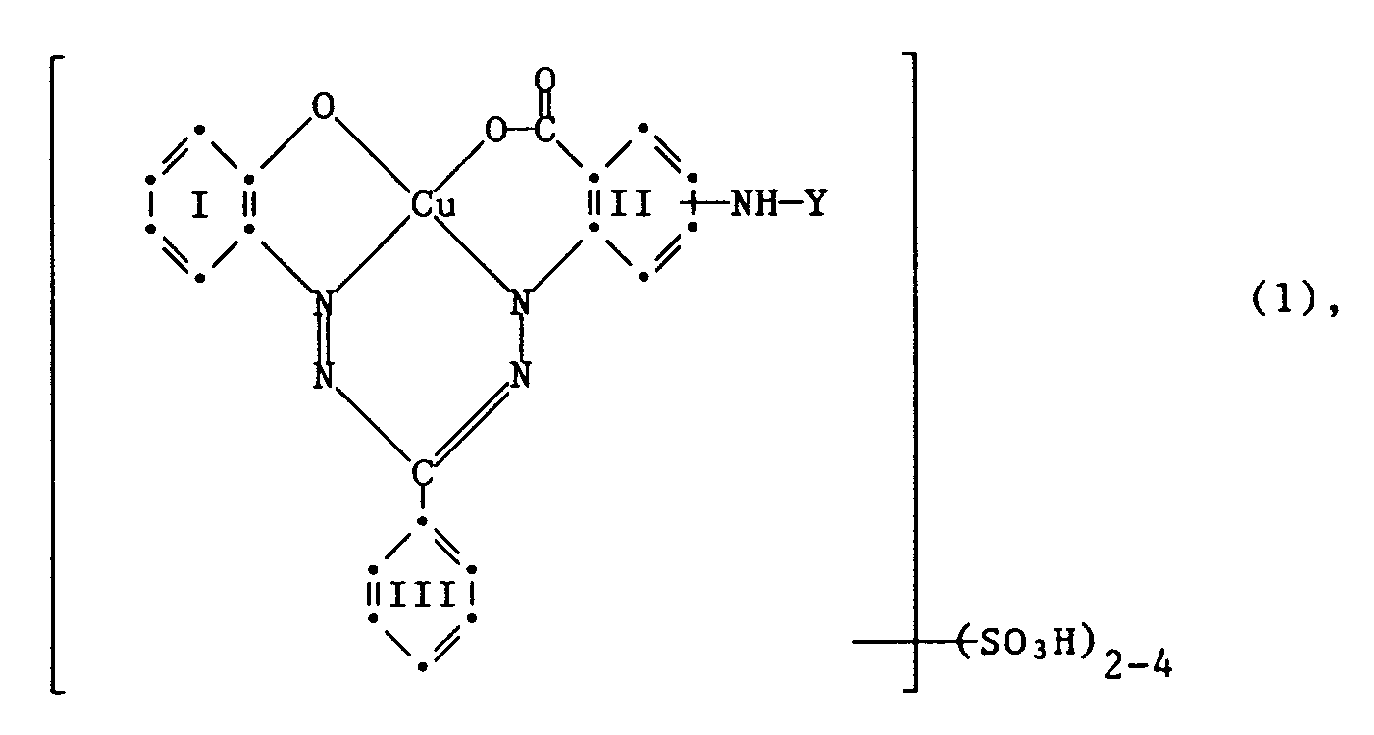
- Kupferformazan-Farbstoffe mit der Grundstruktur der nachfolgenden Formel (1) sind bereits aus der US-A-4024123 bekannt, wobei jedoch im Chlortriazinylrest Y der Formel (2) andere Substituenten vorgesehen sind. Genannt ist z.B. das 2,4-Dichlor-6-methylamino-s-triazin, aus dem der Substituent Y gebildet werden kann.
- Aus der EP-A-210951 sind schliesslich bereits Kupferformazan-Farbstoffe bekannt, die Reaktivgruppen mit einem Sulfonbrückenglied (-SO₂-) enthalten und an die Formazanstruktur über eine Carbonylgruppe (-CO-) und nicht über eine Aminogruppe (-NH-) gebunden sind.
- Der vorliegenden Erfindung liegt die Aufgabe zugrunde, neue Reaktivfarbstoffe zu finden, die besonders für das Bedrucken von textilen Fasermaterialien geeignet sind. Die Farbstoffe sollten einen hohen Fixiergrad und zugleich eine gute Auswaschbarkeit der nichtfixierten Anteile haben, ferner allgemein gute Echtheiten und insbesondere blaue Farbtöne besitzen. Es hat sich gezeigt, dass die weiter unten definierten neuen Farbstoffe die gestellte Aufgabe weitgehend erfüllen.
- Gegenstand der Erfindung sind Reaktivfarbstoffe der Formel
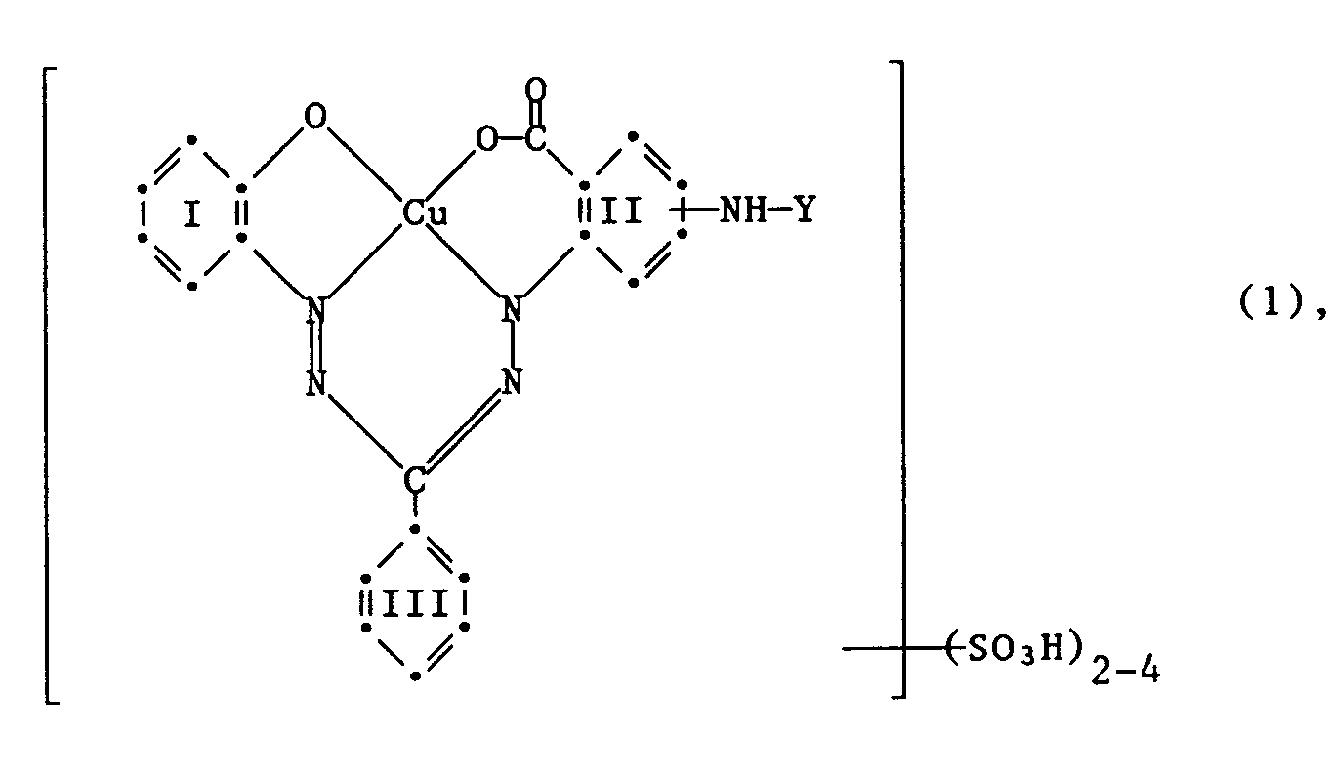
worin Y ein Rest der Formel
oder
-CO-A-SO₂-X (3),
R₁ und R₂ unabhängig voneinander Wasserstoff oder C₁₋₄-Alkyl sind, substituiert durch Halogen, Cyan, C₁₋₄-Alkoxy, N,N-Di-C₁₋₄-alkylamino, Hydroxy, Carboxy, Sulfo oder Sulfato; A ein gegebenenfalls substituiertes aliphatisches oder aromatisches Brückenglied und X β-Sulfatoäthyl, β-Thiosulfatoäthyl, β-Phosphatoäthyl, β-Acyloxyäthyl, β-Halogenäthyl oder Vinyl ist, die Benzolreste I, II und III ausser 2 bis 4 Sulfogruppen bzw. dem Rest -NH-Y im Benzolrest II weitere Substituenten enthalten können; und die Reaktivfarbstoffe der Formel (1) nur einen einzigen faserreaktiven Rest enthalten. - Als Substituenten R₁ und R₂ in den Chlor-1,3,5-triazinylresten Y der Formel (2) kommen in Betracht: Wasserstoff, C₁₋₄-Alkyl substituiert mit Halogen, wie Fluor, Chlor und Brom, Cyan, C₁₋₄-Alkoxy, N,N-Di-C₁₋₄-alkylamino, Hydroxy, Carboxy, Sulfo oder Sulfato. Als Beispiele für derartige Aminogruppen seien genannt: -NH₂, β-Methoxyäthylamino, γ-Methoxypropylamino, β-Aethoxyäthylamino, β-Chloräthylamino, β-Cyanäthylamino, γ-Cyanpropylamino, β-Carboxyäthylamino, Sulfomethylamino, β-Sulfoäthylamino, N-Methyl-N-β-sulfoäthylamino, N-Aethyl-N-β-sulfoäthylamino, β-Hydroxyäthylamino, N,N-Di-β-hydroxyäthylamino, β-Sulfatoäthylamino, γ-Hydroxypropylamino, 3-(N,N-Dimethylamino)-propylamino, Carboxymethylamino, Cyclohexylamino, β-Hydroxyäthylsulfonyläthoxyäthylamino.
- Das aliphatische oder aromatische Brückenglied A im Rest der Formel (3) ist vorzugsweise ein Alkylen- oder Arylenrest. So kann A ein langer (z.B. mit 10 oder mehr Kohlenstoffatomen) oder kürzerer, geradkettiger oder verzweigter, cyclischer oder bicyclischer Alkylenrest sein; insbesondere kommt ein Alkylenrest mit 2 bis 6 Kohlenstoffatomen in Betracht, z.B. Aethylen, Propylen, Butylen, Hexylen, Cyclohexylen oder Endomethylencyclohexylen. Als Arylenrest ist A z.B. ein Naphthylenrest, der Rest eines Diphenyls oder Stilbens oder insbesondere ein Phenylenrest. Der Rest A kann weitere Substituenen enthalten, z.B. Halogenatome, wie Fluor, Chlor und Brom, Alkylgruppen mit 1 bis 4 Kohlenstoffatomen, wie Methyl, Aethyl und Propyl, Alkoxygruppen mit 1 bis 4 Kohlenstoffatomen, wie Methoxy, Aethoxy, Propyloxy und Isopropyloxy, Carboxy oder Sulfo. Vorzugsweise ist A C₂₋₆-Alkylen oder Phenylen. Bevorzugt ist der Phenylen-, Propylen- oder Endomethylencyclohexylenrest.
- Als β-Acyloxyäthyl kommt für X insbesondere der β-Acetoxyäthylrest und als β-Halogenäthyl insbesondere der β-Chloräthylrest in Betracht.
- Als Beispiele für weitere Substituenten an den Benzolresten I, II und III seien genannt Alkylgruppen mit 1 bis 4 Kohlenstoffatomen, wie Methyl, Aethyl, Propyl, Isopropyl oder Butyl, Alkoxygruppen mit 1 bis 4 Kohlenstoffatomen, wie Methoxy, Aethoxy, Propoxy, Isopropoxy oder Butoxy, Acylaminogruppen mit 1 bis 8 Kohlenstoffatomen, insbesondere C₂₋₆-Alkanoylaminogruppen wie Acetylamino, Propionylamino oder Benzoylamino, Amino, Alkylamino mit 1 bis 4 Kohlenstoffatomen, wie Methylamino, Aethylamino, Propylamino, Isopropylamino oder Butylamino, Phenylamino, N,N-Di-β-hydroxyäthylamino, N,N-Di-β-sulfatoäthylamino, Sulfobenzylamino, N,N-Disulfobenzylamino, Alkoxycarbonyl mit 1 bis 4 Kohlenstoffatomen im Alkoxyrest, wie Methoxycarbonyl oder Aethoxycarbonyl, Alkylsulfonyl mit 1 bis 4 Kohlenstoffatomen, wie Methylsulfonyl oder Aethylsulfonyl, Trifluormethyl, Nitro, Cyano, Halogen, wie Fluor, Chlor oder Brom, Carbamoyl, N-Alkylcarbamoyl mit 1 bis 4 Kohlenstoffatomen im Alkylrest, wie N-Methylcarbamoyl oder N-Aethylcarbamoyl, Sulfamoyl, N-Alkylsulfamoyl mit 1 bis 4 Kohlenstoffatomen, wie N-Methylsulfamoyl, N-Propylsulfamoyl, N-Isopropylsulfamoyl oder N-Butylsulfamoyl, N-(4-Hydroxyäthyl)-sulfamoyl, N,N-Di-(β-hydroxyäthyl)-sulfamoyl, N-Phenylsulfamoyl, Ureido, Hydroxy, Carboxy, Sulfomethyl oder Sulfo. Als Substituenten kommen vor allem Methyl, Aethyl, Methoxy, Aethoxy, Acetylamino, Benzoylamino, Amino, Chlor, Brom, Ureido, Hydroxy, Carboxy, Sulfomethyl oder Sulfo in Betracht. Vorzugsweise enthalten die Benzolreste I, II und III nur Sulfogruppen. Die Benzolreste I, II und III enthalten zusammen 2 bis 4 Sulfogruppen.
- Bevorzugt sind:
- (a) Reaktivfarbstoffe der Formel (1), worin Y ein Rest der Formel
-CO-A-SO₂-CH₂CH₂-Cl (3a)
ist, worin A n-Propylen, Phenylen oder Endomethylencyclohexylen ist. - (b) Reaktivfarbstoffe der Formel (1), worin die Benzolreste I, II und III keine weiteren Substituenten enthalten.
- Besonders bevorzugt ist der Reaktivfarbstoff der Formel
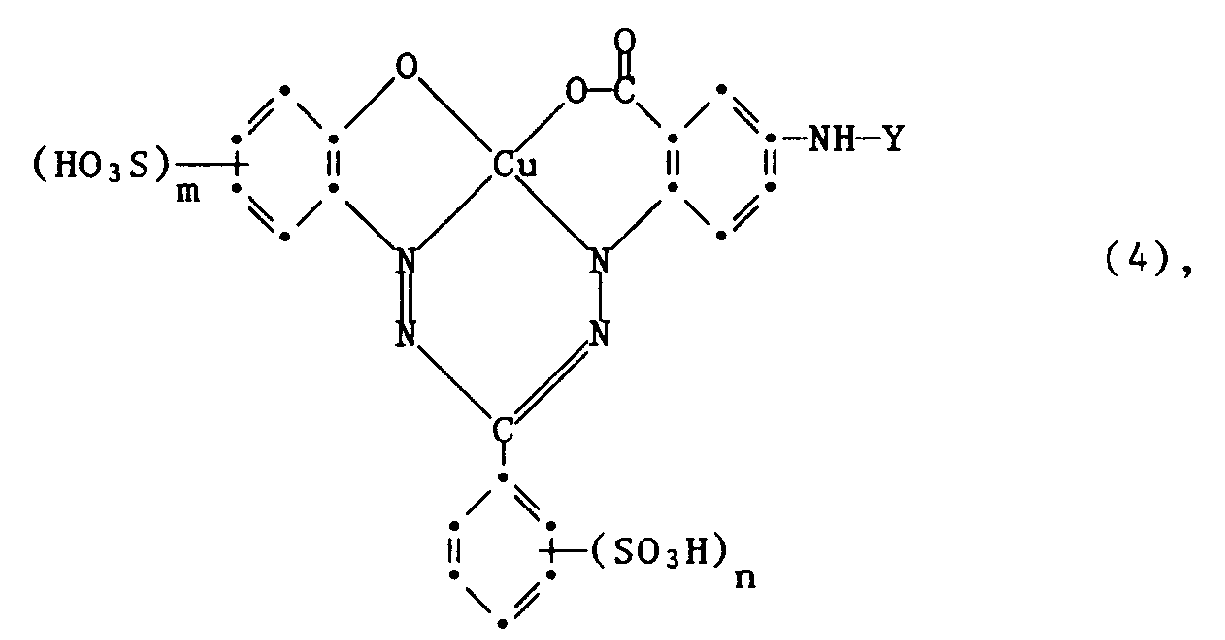
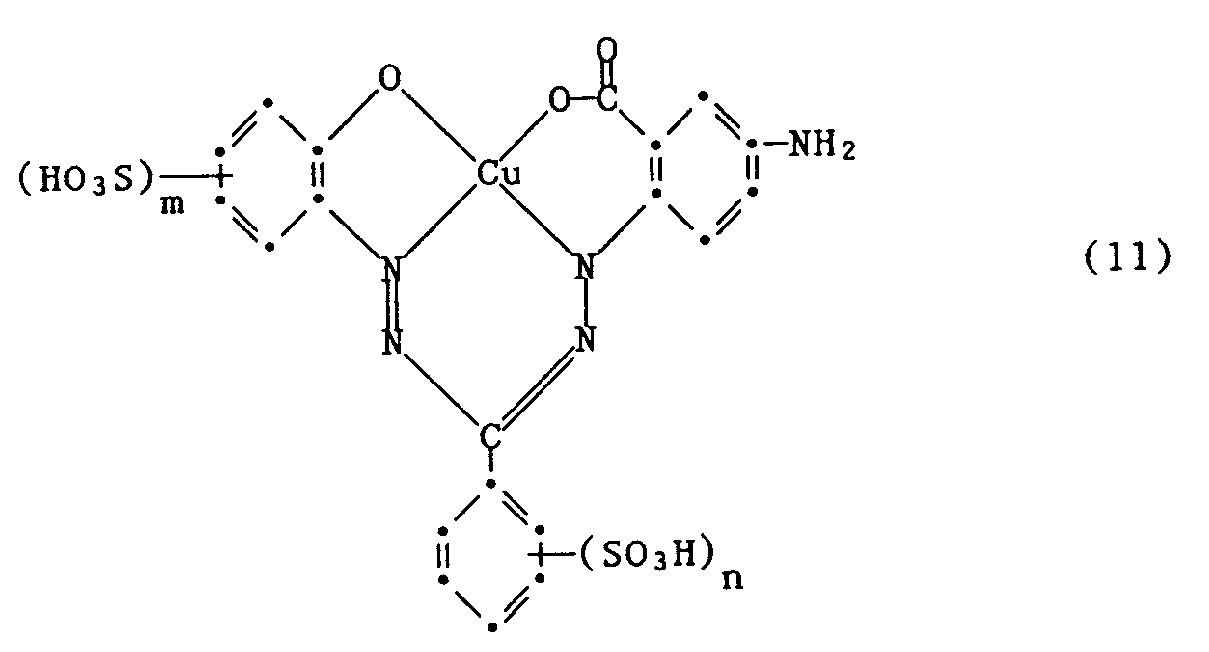
worin Y die unter Formel (1) angegebene Bedeutung hat, m die Zahl 1 oder 2 und n die Zahl 0, 1 oder 2 ist und m+n = 2, 3 oder 4 ist. - Als besonders bevorzugte Reaktivfarbstoffe der Formel (4) kommen solche der Formel
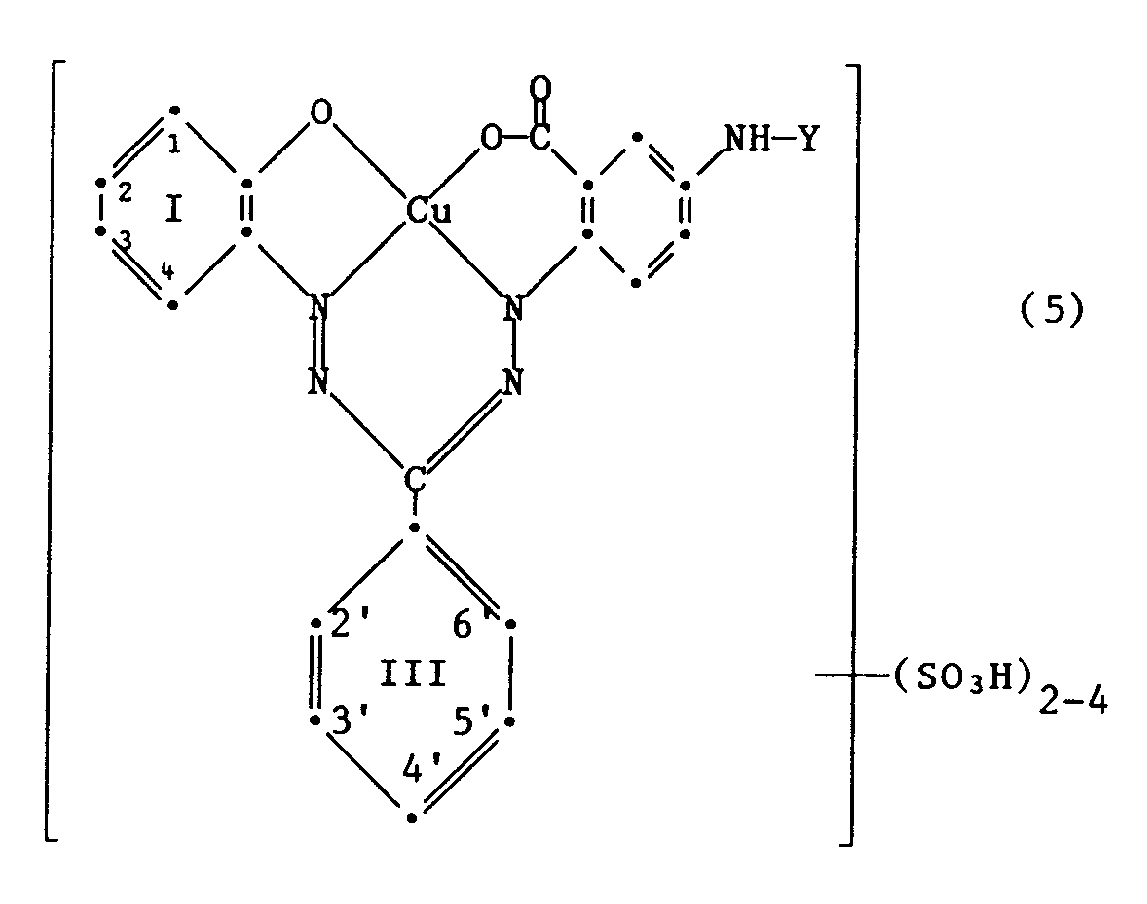
in Betracht, worin die 2, 3 oder 4 Sulfosäuregruppen in den Benzringen I und III wie folgt gebunden sind: 1,3,3'-Trisulfo; 1,2'-Disulfo; 1,3-Disulfo; 3,2'-Disulfo; 1,3,2',4'-Tetrasulfo; 1,3,4'-Trisulfo; 1,2',4'-Trisulfo; 3,2',4'-Trisulfo; 1,3'-Disulfo; oder 1,3,2'-Trisulfo. - Ganz besonders bevorzugt ist der Reaktivfarbstoff der Formel

- Ebenfalls ganz besonders bevorzugt ist der Reaktivfarbstoff der Formel

- Der in den Farbstoffen der Formel (1) enthaltene Rest der Formel

ist eine reaktive Gruppierung, worin das Cl-Atom eine faserreaktive Abgangsgruppe darstellt. Ferner weist der Rest der Formel (3) einen Reaktivrest auf, und zwar die Gruppe -SO₂-X; dieser Reaktivrest enthält eine Abgangsgruppe, z.B. wenn X β-Chloräthyl ist, oder kann nach Art von faserreaktiven Gruppen wirksam werden, z.B. wenn X Vinyl ist (Grundlegendes über Reaktivfarbstoffe siehe Venkataraman, K.: The Chemistry of Synthetic Dyes. New York: Academic Press 1972; Vol VI, Reactive Dyes). - Das Verfahren zur Herstellung der Reaktivfarbstoffe der Formel (1) ist dadurch gekennzeichnet, dass man eine Verbindung der Formel

mit 2,4,6-Trichlor-s-triazin kondensiert und das erhaltene primäre Kondensationsprodukt mit einem Amin der Formel
worin R₁ und R₂ die angegebenen Bedeutungen haben, kondensiert, oder mit einem 2-Amino-4,6-dichlor-s-triazin kondensiert; oder mit einem dem Rest der Formel (3) entsprechenden Acylhalogenid kondensiert, und gegebenenfalls eine weitere Umwandlungsreaktion anschliesst. - Bevorzugte Ausführungsformen des erfindungsgerässen Verfahrens sind dadurch gekennzeichnet, dass man
- (a) ein Amin der Formel (9) oder ein 2-Amino-4,6-dichlor-s-triazin verwendet,
- (b) ein Acylhalogenid der Formel
Hal-CO-A-SO₂-CH₂CH₂Cl (10)
verwendet, worin Hal Halogen und A n-Propylen, Phenylen oder Endomethylencyclohexylen ist, - (c) eine Verbindung der Formel (8) verwendet, worin die Benzolreste I, II und III keine weiteren Substituenten enthalten.
- Eine besonders bevorzugte Ausführungsform des erfindungsgemässen Verfahrens ist dadurch gekennzeichnet, dass man eine Verbindung der Formel

worin m die Zahl 1 oder 2 und n die Zahl 0, 1 oder 2 ist und m+n = 2, 3 oder 4 ist, verwendet. - Ganz besonders bevorzugte Ausführungsformen des erfindungsgemässen Verfahrens sind dadurch gekennzeichnet, dass man eine Verbindung der Formel (11) mit 2,4,6-Trichlor-s-triazin kondensiert und das erhaltene primäre Kondensationsprodukt mit einem Amin der Formel (9) kondensiert oder mit einem 2-Amino-4,6-dichlor-s-triazin kondensiert.
- Die wichtigen Verbindungen der Formeln (6) und (7) werden erhalten, indem man eine Verbindung der Formel

mit 2,4,6-Trichlor-s-triazin kondensiert und das erhaltene primäre Kondensationsprodukt mit Ammoniak oder β-Sulfoäthylamin kondensiert, oder mit 2-Amino-4,6-dichlor-s-triazin oder 2-(β-Sulfoäthylamino)-4,6-dichlor-s-triazin kondensiert. - Verbindungen der Formel (8) sind z.B. die Kupferkomplexe von
N-(4-Amino-2-carboxyphenyl)-N'-(2'-hydroxy-3',5'-disulfophenyl)-ms-(2''-sulfophenyl)-formazan,
N-(4-Amino-2-carboxyphenyl)-N'-(2'-hydroxy-3',5'-disulfophenyl)-ms-(4''-amino-2''-sulfophenyl)-formazan,
N-(2-Hydroxy-5-sulfophenyl)-N'-(2'-carboxy-4'-aminophenyl)-ms-(2''-sulfophenyl)-formazan,
N-(2-Hydroxy-5-sulfophenyl)-N'-(2'-carboxy-4'-aminophenyl)-ms-(2''-chlor-5''-sulfophenyl)-formazan,
N-(2-Carboxy-4-aminophenyl)-N'-(2'-hydroxy-4'-sulfonaphth-1'-yl)-ms-(2''-sulfophenyl)-formazan,
N-(4-Amino-2-carboxyphenyl)-N'-(2'-hydroxy-3',5'-disulfophenyl)-ms-(3''-sulfophenyl)-formazan,
N-(4-Amino-2-carboxyphenyl)-N'-(2'-hydroxy-3'-sulfophenyl)-ms-(2''-sulfophenyl)-formazan,
N-(4-Amino-2-carboxyphenyl)-N'-(2'-hydroxy-3',5'-disulfophenyl)-ms-(phenyl)-formazan,
N-(4-Amino-2-carboxyphenyl)-N'-(2'-hydroxy-5'-sulfophenyl)-ms-(2''-sulfophenyl)-formazan,
N-(4-Amino-2-carboxyphenyl)-N'-(2'-hydroxy-3',5'-disulfophenyl)-ms-(2'',4''-disulfophenyl)-formazan,
N-(4-Amino-2-carboxyphenyl)-N'-(2'-hydroxy-3',5'-disulfophenyl)-ms-(4''-sulfophenyl)-formazan,
N-(4-Amino-2-carboxyphenyl)-N'-(2'-hydroxy-3'-sulfophenyl)-ms-(2'',4''-di-sulfophenyl)-formazan,
N-(4-Amino-2-carboxyphenyl)-N'-(2'-hydroxy-5'-sulfophenyl)-ms-(2'',4''-di-sulfophenyl)-formazan,
N-(4-Amino-2-carboxyphenyl)-N'-(2'-hydroxy-3'-sulfophenyl)-ms-(3'-sulfophenyl)-formazan. - Als Beispiele für Amine der Formel (9) seien die folgenden genannt: Ammoniak, Methoxyäthylamin, Aethoxyäthylamin, Methoxypropylamin, Chloräthylamin, Hydroxyäthylamin, Dihydroxyäthylamin, Aminomethansulfonsäure, Hydroxypropylamin, Glycin, Aminoäthansulfonsäure, N-Methylaminoäthansulfonsäure, N-Aethylaminoäthansulfonsäure, β-Sulfatoäthylamin, γ-N,N-Di-methylpropylamin, N-Methyl-N-β-hydroxyäthylamin, Hydroxyäthylsulfonyläthoxyäthylamin.
- Bei der Herstellung derartiger Triazinfarbstoffe können die einzelnen Verfahrensschritte in unterschiedlicher Reihenfolge, gegebenenfalls teilweise auch gleichzeitig, ausgeführt werden. Dabei sind verschiedene Verfahrensvarianten möglich. Im allgemeinen führt man die Umsetzung schrittweise nacheinander aus. Dabei hängt es von der Struktur der Ausgangsstoffe ab, welche der möglichen Verfahrensvarianten die besten Resultate ergeben, oder unter welchen speziellen Bedingungen, z.B. bei welcher Kondensationstemperatur, die Reaktion am vorteilhaftesten auszuführen ist.
- Acylhalogenide, welche der Rest der Formel (3) entsprechen, sind bekannt. Als Beispiele seien genannt:
4-(β-Chloräthylsulfonyl)-butyrylchlorid,
3-(β-Chloräthylsulfonyl)-benzoesäurechlorid,
4-(β-Chloräthylsulfonyl)-benzoesäurechlorid,
4-(β-Chloräthylsulfonyl)-2,5-endomethylen-cyclohexancarbonsäurechlorid. - Eine abgewandelte Ausführungsform des Verfahrens besteht darin, zunächst einen Farbstoff herzustellen, der eine Vorstufe des Reaktivrestes enthält, und diese nachträglich in die Endstufe umzuwandeln, z.B. durch Veresterung oder eine Additionsreaktion. Beispielsweise kann man einen Farbstoff, worin X ein Rest HO-CH₂CH₂- ist, herstellen und das Zwischenprodukt vor oder nach der Acylierung mit Schwefelsäure umsetzen, so dass die Hydroxygruppe in die Sulfatogruppe übergeführt wird; oder man verwendet einen analogen Farbstoff, worin X die Gruppe H₂C=CH- ist, und lagert an das Zwischenprodukt Thioschwefelsäure an, wobei ein Rest HO₃SS-CH₂CH₂- entsteht. Die Sulfatierung der Hydroxygruppe in einem Farbstoff der Formel (1) oder einem geeigneten Vorprodukt, erfolgt z.B. durch Umsetzung mit konzentrierter Schwefelsäure bei 0°C bis mässig erhöhter Temperatur. Die Sulfatierung kann auch durch Reaktion der Hydroxyverbindung mit zwei Aequivalenten Chlorsulfonsäure pro Hydroxygruppe in einem polaren organischen Lösungsmittel, wie beispielsweise N-Methylpyrrolidon, bei 10 bis 80°C erfolgen. Vorzugsweise erfolgt die Sulfatierung durch Eintragen der betreffenden Verbindung in Schwefelsäuremonohydrat bei Temperaturen zwischen 5 und 15°C. Die Einführung eines anderen Restes für X in eine Verbindung der Formel (1) oder ein Zwischenprodukt anstelle eines Halogenatoms oder der Sulfatogruppe, beispielsweise einer Thiosulfato-oder Phosphatogruppe, erfolgt in an sich bekannter Weise. Der Weg der Herstellung über eine Zwischenstufe des Reaktivrestes geht in vielen Fällen einheitlich und vollständig.
- Ausserdem können Eliminierungsreaktionen an die Synthese angeschlossen werden. Beispielsweise kann man Reaktivfarbstoffe der Formel (1), welche Chloräthylsulfonyl- oder Sulfatoäthylsulfonylreste enthalten, mit säureabspaltenden Mitteln, wie Natriumhydroxid, behandeln, wobei die Chloräthylsulfonyl- oder Sulfatoäthylsulfonylreste in Vinylsulfonylreste übergehen.
- Die Kondensation des 2,4,6-Trichlor-s-triazins mit einer Verbindung der Formel (8) erfolgt vorzugsweise in wässriger Lösung oder Suspension, bei niedrigen Temperaturen, vorzugsweise zwischen 0° und 5°C und bei schwach saurem, neutralem bis schwach alkalischer pH-Wert. Vorteilhaft wird der bei der Kondensation freiwerdende Chlorwasserstoff laufend durch Zugabe wässriger Alkalihydroxide, -carbonate oder -bicarbonate neutralisiert. Für die weitere Umsetzung der so erhaltenen Chlortriazinfarbstoffe bzw. für die Umsetzung des 2,4,6-Trichlor-s-triazins mit den Aminen der Formel (9) setzt man die freien Amine oder deren Salze, bevorzugt in Form des Hydrochlorids, ein. Die Ursetzung wird bei Temperaturen etwa zwischen 0 und 40°, bevorzugt zwischen 5 und 25°C, unter Zusatz säurebindender Mittel, bevorzugt Natriumcarbonat oder eines Ueberschusses des Amins, in einem pH-Bereich von 2 bis 10 bevorzugt 5 bis 8, durchgeführt.
- Die Kondensation eines Acylhalogenids mit einer Verbindung der Formel (8) erfolgt ebenfalls vorzugsweise in wässriger Lösung oder Suspension, bei Raumtemperatur und bei schwach saurem bis neutralem pH-Wert. Auch hier wird der bei der Kondensation freiwerdende Halogenwasserstoff vorteilhafterweise durch laufende Zugabe von wässrigen Alkalihydroxiden, -carbonaten oder -bicarbonaten neutralisiert.
- Die Reaktivfarbstoffe der Formel (1) können isoliert und zu brauchbaren, trockenen Färbepräparaten verarbeitet werden. Die Isolierung erfolgt vorzugsweise bei möglichst niedrigen Temperaturen durch Aussalzen und Filtrieren. Die filtrierten Farbstoffe können gegebenenfalls nach Zugabe von Coupagemitteln und/oder Puffermitteln, z.B. nach Zugabe eines Gemisches gleicher Teile Mono- und Dinatriumphosphat oder von Natriumtripolyphosphat, getrocknet werden; vorzugsweise wird die Trocknung bei nicht zu hohen Temperaturen und unter vermindertem Druck vorgenommen. Durch Zerstäubungstrocknung des ganzen Herstellungsgemisches kann man in gewissen Fällen die erfindungsgemässen trockenen Präparate direkt, d.h. ohne Zwischenisolierung der Farbstoffe herstellen.
- Gegenstand der Erfindung sind ferner lagerstabile, konzentrierte flüssige Farbstoffpräparationen der Reaktivfarbstoffe der Formel (1) sowie ihre Verwendung zur Herstellung von Klotzflotten, Färbebädern und vor allem Druckpasten, die zum Färben und Bedrucken von Fasermaterialien, insbesondere cellulosehaltigen Fasermaterialien verwendet werden.
- Flüssige Farbstoffpräparationen haben Vorteile gegenüber der Pulverform, z.B. keine Staubentwicklung beim Ansetzen von Druckpasten sowie von Klotz- und Färbeflotten, keine Benetzungsprobleme durch Klumpenbildung , keine fleckigen Färbungen durch ungelöste Farbstoffpartikel. Solche flüssige Formulierungen sollten hoch konzentriert (mindestens 10 Gew.-% und vorzugsweise mehr als 15 Gew.-% Farbstoffgehalt) und mindestens über mehrere Monate in einem breiten Temperaturbereich (-10 bis +40°C) unverändert haltbar sein.
- Als Ausgangslösung bzw. -suspension zur Herstellung der Farbstoffpräparationen kann man die direkt aus der Synthese erhaltene wässrige, gegebenenfalls Lösungsmittel enthaltende Lösung bzw. Suspension oder eine wässrige Anschlämmung der feuchten Press- oder Filterkuchen der Rohfarbstoffe von unterschiedlichem Gehalt an unerwünschten gelösten Stoffen mit niedrigem Molekulargewicht, besonders von bei der Synthese des Farbstoffes anfallenden Nebenprodukten und gelösten anorganischen und organischen Salzen verwenden. In Fällen, in denen das Kondensationsprodukt nicht oder nur äusserst mühsam aussalzbar ist, kann auch direkt die rohe Kondensations- bzw. Neutralisationslösung verwendet werden. Vorteilhaft verwendet man Ausgangslösungen bzw. -suspensionen, die 2 bis 50 % Farbstoff enthalten.
- Man kann aber auch von dem trockenen Rohfarbstoffpulver ausgehen, wenn man es zunächst mit Wasser anschlämmt.
- Bei den erfindungsgemässen, konzentrierten flüssigen Präparationen handelt es sich in der Regel um echte oder kolloidale Lösungen. Sie sind dünnflüssig (Viskosität von etwa 5 bis 300 cp/20°C) und gut lagerstabil, d.h. sie bleiben mindestens mehrere Monate bei Temperaturen von -20 bis +60°C, insbesondere -10 bis +40°C in gebrauchsfähigem Zustand. Diese Präparationen können bei der Herstellung von Klotzflotten, Färbebädern und Druckpasten sowohl mit Wasser als auch mit organischen Lösungmsitteln und/oder Verdickungsmittel versetzt werden, ohne dass der Farbstoff ausfällt oder dass es zu anderen Inhomogenitäten kommt. Mit den genannten Klotzflotten, Färbebädern und Druckpasten kann man z.B. Textilmaterialien aus natürlichen oder synthetischen, insbesondere cellulose-haltigen Fasermaterialien in bekannter Weise färben oder bedrucken.
- Besonders geeignet sind die erfindungsgemässen stabilen konzentrierten flüssigen Farbstoffpräparationen zur Herstellung von Druckpasten für das Bedrucken von Cellulose-Fasermaterialien.
- Ein Verfahren zur Herstellung einer erfindungsgemässen flüssigen Präparation ist in den Ausführungsbeispielen beschrieben.
- Die Reaktivfarbstoffe der Formel (1) sind neu. Sie zeichnen sich durch hohe Reaktivität aus, und sie ergeben Färbungen mit guten Nass- und Lichtechtheiten. Besonders hervorzuheben ist es, dass die Farbstoffe eine gute Löslichkeit und hohe Farbstoff-Fixierung aufweisen, dass sie gut in der Cellulosefaser diffundieren, und dass sich die nichtfixierten Anteile leicht entfernen lassen.
- Die Reaktivfarbstoffe der Formel (1) eignen sich zum Färben und Bedrucken der verschiedensten Materialien, wie Seide, Leder, Wolle, Polyamidfasern und Polyurethanen, insbesondere aber cellulosehaltiger Materialien faseriger Struktur, wie Leinen, Zellstoff, regenerierte Cellulose und vor allem Baumwolle. Sie eignen sich sowohl für das Ausziehverfahren als auch zum Färben nach dem Foulardfärbeverfahren, wonach die Ware mit wässrigen und gegebenenfalls auch salzhaltigen Farbstofflösungen imprägniert wird, und die Farbstoffe nach einer Alkalibehandlung oder in Gegenwart von Alkali, gegebenenfalls unter Wärmeeinwirkung fixiert werden.
- Sie eignen sich vor aller zum Druck, insbesondere auf Baumwolle, ebenso aber auch zur Bedrucken von stickstoffhaltigen Fasern, z.B. von Wolle, Seide oder Wolle enthaltenden Mischgeweben.
- Es empfiehlt sich, die Färbungen und Drucke einer gründlichen Spülen mit kaltem und heisser Wasser, gegebenenfalls unter Zusatz eines dispergierend wirkenden und die Diffusion der nichtfixierten Anteile fördernden Mittels zu unterwerfen.
- Bei dem Anwendung in der Praxis werden die erfindungsgemässen Farbstoffe vorteilhaft als flüssige Färbe- oder Druckpräparate eingesetzt.
- Die in den nachfolgenden Beispielen als Ausgangsprodukt verwendete Formazanverbindung hat die Formel

- Beispiel 1: Zu einer neutralen Lösung von 33.8 Gew.-Teilen des Formazans der Formel (100) in 400 Vol.-Teilen Wasser werden bei 0-5°C 10.0 Gew.-Teile Cyanurchlorid gegeben. Während der Kondensation lässt man den pH zunächst auf 4.0 fallen und hält ihn dort durch Zugabe von 21 Vol.-Teilen 2n Natronlauge. Danach werden 16 Vol.-Teile Ammoniak à 30 % zugegeben. Bei dem sich zunächst einstellenden pH von 10.5 wird nun bei 40°C bis zur vollständigen Umsetzung kondensiert, dabei fällt der pH auf 9.0. Durch Zugabe von 6 Vol.-Teilen 10n HCl wird der pH auf 7.5 gestellt; danach wird mit Kochsalz der Farbstoff der Formel:

gefällt. Mit dem so erhaltenen dunkelblauen Farbstoffpulver lässt sich Baumwolle in neutralblauen Tönen färben oder bedrucken. - Weitere Farbstoffe werden erhalten, wenn anstelle von Ammoniak äquivalente Mengen der unten aufgeführten Amine verwendet werden.

- 9 kg Presskuchen des Rohfarbstoffes der Formel von Beispiel 1 werden mit 35 kg Wasser angeschlämmt. Die erhaltene Suspension mit einem Trockengehalt von 7,9 % (ca. 5,9 % Farbstoff und 2,07 % NaCl) wird auf einer Anlage für Umkehr-Osmose (0,84 m² Membranfläche), die wie in der EP-A-59782 beschrieben hergestellt wurde und die einen "Cut-off-level" von 500 besitzt, entsalzt und aufkonzentriert. Die Umkehr-Osmose wird bei pH 6,5-7,5, 20°C und einem Druck von 25 bar in zwei Stufen durchgeführt:
- Nach der Zugabe von 40 l Wasser und anschliessender Entfernung von 40 l Permeat (mittlere Durchflussmenge ca. 20 l/Std.), erhält man eine Farbstofflösung mit einem Salzgehalt von 0,43 %.
- Nach der Entsalzung werden 33,1 l Permeat (mittlere Durchflussmenge ca. 12 l/Std.) entfernt. Man erhält 10,9 kg einer konzentrierten Farbstofflösung mit 23,6 % Trockengehalt, deren Natriumchloridgehalt geringer als 0,01 % ist.
- 94,4 Teile der so erhaltenen Farbstofflösung werden unter Rühren bei 40°C innerhalb von 10 Minuten mit 1,5 Teilen Natriumtripolyphosphat versetzt und mit 4,2 Teilen Wasser verdünnt. Man erhält eine Flüssigformulierung mit einem pH-Wert von 7,0 folgender Zusammensetzung:
22,3 Gew.-% Farbstoff
1,5 Gew.-% Natriumtripolyphosphat
ca. 76,3 Gew.-% Wasser
<0,1 Gew.-% Natriumchlorid - Die entstandene echte Lösung ist dünnflüssig (ca. 6 cP bei 20°C Brookfield, Spindel No. 2) und ist während mehrerer Monate bei -10°C bis +40°C unverändert haltbar. (Chemische und physikalische Lagerstabilität)
- Statt des im obigen Beispiel verwendeten Presskuchens kann auch eine äquivalente Menge der neutralisierten Syntheselösung (ev. nach entsprechender Einstellung der Konzentration) verwendet werden.
- Die so hergestellte flüssige Handelsform kann anstelle des pulverförmigen Farbstoffs in allen Färbe- und Druck-Rezepten verwendet werden, man erhält die gleichen Ergebnisse.
- Beispiel 13: In 500 ml Wasser werden 33,8 Gew.-Teile des Formazan-Chromophors der Formel (100) angeschlämmt und durch Zugabe von Natronlauge bei pH 7 gelöst. Nun wird eine Lösung von 14,5 Gew.-Teilen β-Chlorethyl-4-benzoylchlorid-sulfon in 50 Vol.-Teilen Aceton zugetropft. Durch weitere Zugabe von 2n Natronlauge wird der pH zwischen 5 und 6 gehalten. Nach etwa 4-stündigem Nachrühren bei dem gleichen pH und bei Raumtemperatur ist keine freie Amino-Gruppe mehr nachzuweisen. Der so hergestellte Farbstoff der Formel
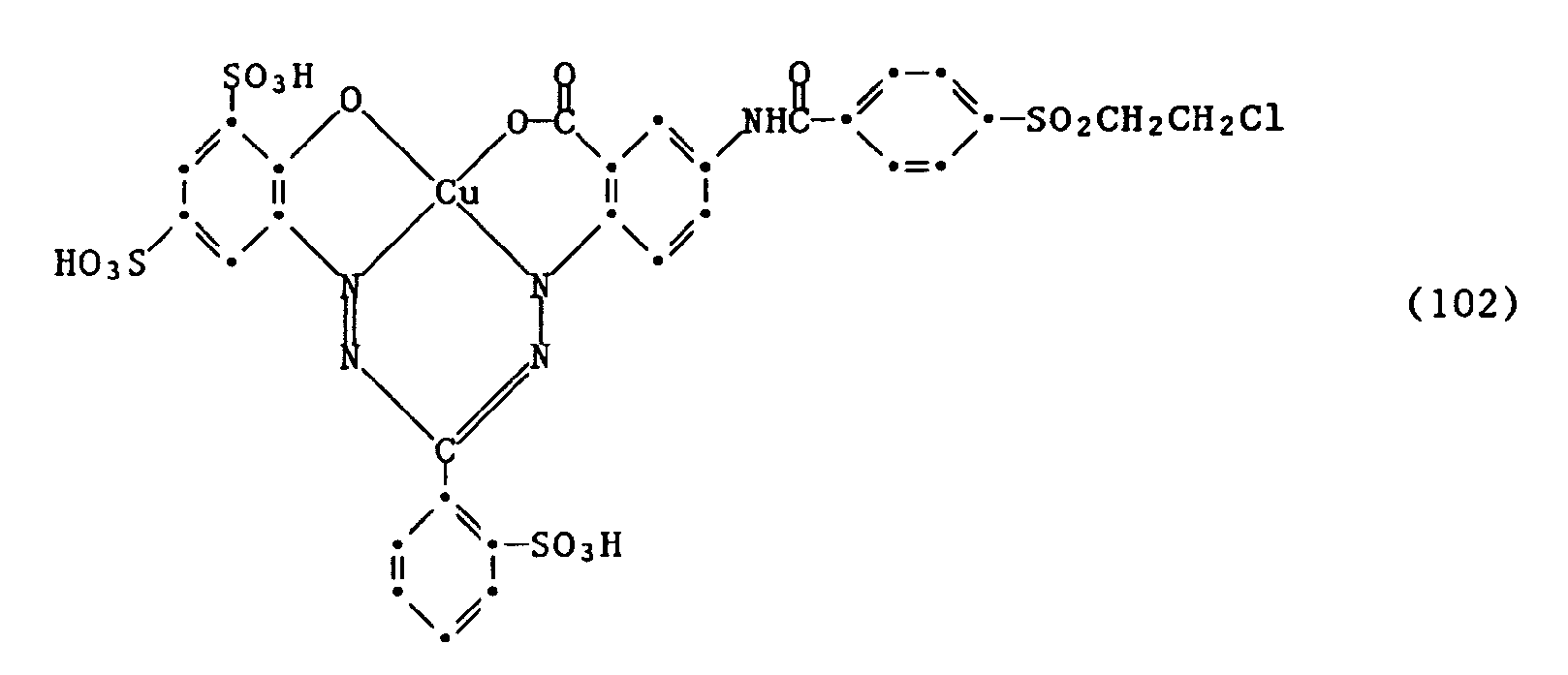
wird durch Aussalzen isoliert. Er färbt Baumwolle in neutralblauer, sehr echtem Farbton. - Farbstoffe von ähnlich guten Eigenschaften und der gleichen Nuance lassen sich herstellen, indem man zur Acylierung äquivalente Mengen der folgenden Säurechloride verwendet:


- Beispiel 17: Zu einer fein gemahlenen Suspension von 9,4 Gew.-Teilen Cyanurchlorid in 25 Vol.-Teilen Wasser wird eine neutrale Lösung von 33,8 Gew.-Teilen des Formazan-Chromophors der Formel (100) in 400 Vol.- Teilen Wasser so zulaufen gelassen, dass der pH durch gleichzeitiges Zudosieren von 1n Natronlauge auf 4,5 gehalten werden kann. Die Temperatur wird durch Kühlung auf 0-5 °C gehalten. Wenn das Ende der ersten Kondensation chromatographisch festgestellt worden ist, wird eine Lösung von 6,25 Gew.-Teilen Taurin in 65 Vol.-Teilen Wasser zugestürzt. Durch Zugabe von Natronlauge wird der pH auf 8,5 gestellt und nach Aufheizen auf 40°C bei 8,5 gehalten. (Verbrauch ca. 165 Vol.-Teile 1n-Natronlauge). Nach dem Ende der 2. Kondensation wird mit wenig konzentrierter Salzsäure der pH auf 7,0 gestellt. Nach Entsalzen und Eindampfen erhält man ein schwarz-blaues Farbstoffpulver der Formel:

mit dem Baumwolle in klaren neutralblauen Tönen sehr echt bedruckt und gefärbt werden kann. - Wenn man wie in den Beispielen 1 bis 17 angegeben verfährt und anstelle des Formazans der Formel (100) eine Verbindung der folgenden Formeln (104) bis (112) verwendet,
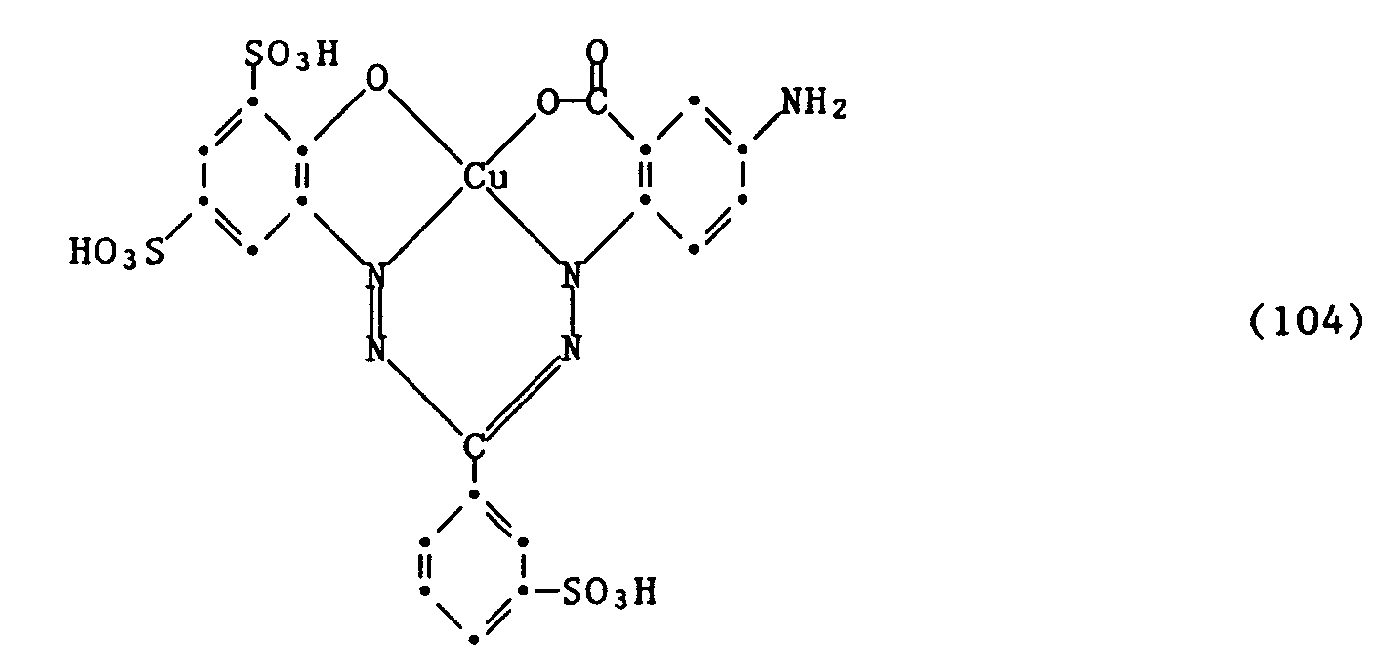


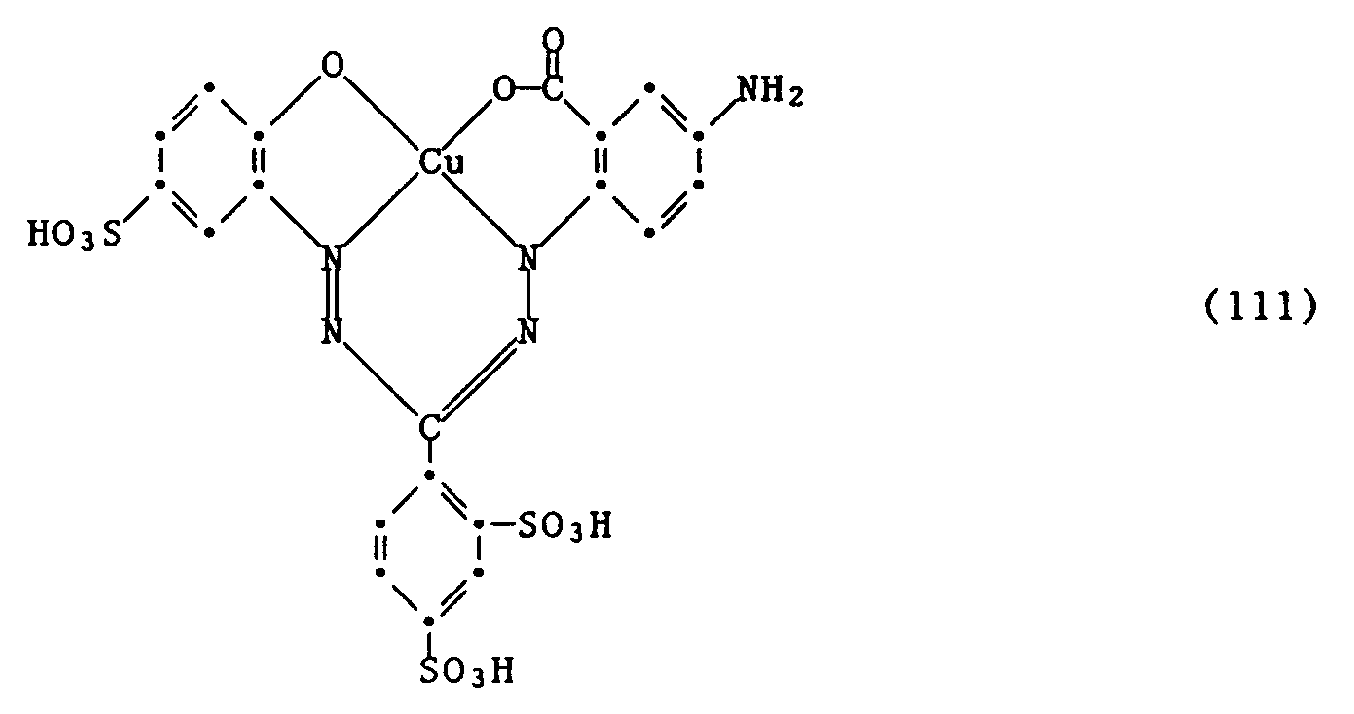

so erhält man Farbstoffe mit ähnlich guten Eigenschaften und ähnlicher Nuance. - 2 Teile des gemäss Beispiel 1 erhaltenen Farbstoffes werden unter Zusatz von 5 bis 20 Teilen Harnstoff und 2 Teilen kalzinierter Soda in 100 Teilen Wasser bei 20 bis 50°C gelöst. Mit der erhaltenen Lösung wird ein Baumwollgewebe imprägniert, so dass es um 50 bis 80 % seines Gewichtes zunimmt, und dann getrocknet. Danach wird während 1 1/2 bis 5 Minuten bei 140 bis 210°C thermofixiert, dann während einer Viertelstunde in einer 0,1%igen kochenden Lösung eines ionenfreien Waschmittels geseift, gespült und getrocknet.
- 2 Teile des gemäss Beispiel 1 erhaltenen Farbstoffes werden in 2000 Teilen Wasser unter Zusatz von 120 Teilen Kochsalz oder kalziniertem Glaubersalz bei 75°C gelöst. Man geht mit 100 Teilen eines Baumwollgewebes in dieses Färbebad ein und hält die Temperatur während 30 bis 60 Minuten konstant. Danach werden 10 Teile kalzinierter Soda und 4 ml Natronlauge (36°Bé) zugegeben. Die Temperatur wird weitere 45 bis 60 Minuten bei 75 bis 80°C gehalten, dann wird während 15 Minuten in einer 0,1%igen kochenden Lösung eines ionenfreien Waschmittels geseift, gespült und getrocknet.
- 2 Teile des gemäss Beispiel 1 erhaltenen Farbstoffes werden unter Zusatz von 0,5 Teilen m-nitrobenzolsulfonsaurem Natrium in 100 Teilen Wasser gelöst. Mit der erhaltenen Lösung wird ein Baumwollgewebe imprägniert, so dass es um 75 % seines Gewichtes zunimmt, und dann getrocknet. Danach imprägniert man das Gewebe mit einer 20°C warmen Lösung, die pro Liter 5 g Natriumhydroxid und 300 g Natriumchlorid enthält, quetscht auf 75 % Gewichtszunahme ab, dämpft die Färbung während 30 Sekunden bei 100 bis 101°C, spült, seift während einer Viertelstunde in einer 0,3%igen kochenden Lösung eines ionenfreien Waschmittels, spült und trocknet.
- 2 Teile des gemäss Beispiel 1 erhaltenen Farbstoffes werden in 100 Teilen Wasser gelöst. Die Lösung gibt man zu 1900 Teilen kaltem Wasser, fügt 60 Teile Natriumchlorid zu und geht mit 100 Teilen eines Baumwollgewebes in dieses Färbebad ein. Man steigert die Temperatur auf 60°C, wobei nach 30 Minuten 40 Teile kalzinierte Soda und nochmals 60 Teile Natriumchlorid zugegeben werden. Man hält die Temperatur 30 Minuten auf 60°C, spült und seift dann die Färbung während 15 Minuten in einer 0,3%igen kochenden Lösung eines ionenfreien Waschmittels, spült und trocknet.
- 2 Teile des gemäss Beispiel 1 hergestellten Farbstoffes werden unter schnellem Rühren in 100 Teile einer Stammverdickung, enthaltend 45 Teile 5%ige Natriumalginatverdickung, 32 Teile Wasser, 20 Teile Harnstoff, 1 Teil m-nitrobenzolsulfonsaures Natrium sowie 2 Teile Natriumcarbonat, eingestreut. Mit der so erhaltenen Druckpaste bedruckt man ein Baumwollgewebe auf einer Rouleauxdruckmaschine und dämpft den erhaltenen bedruckten Stoff 4 bis 8 Minuten bei 100°C in gesättigtem Dampf. Das bedruckte Gewebe wird dann in kaltem und heisser Wasser gründlich gespült, wobei sich die nicht chemisch fixierten Anteile sehr leicht von der Faser entfernen lassen, und anschliessend getrocknet.
-
- a) Eine Stammverdickung wird wie folgt zubereitet:
500 kg einer 5 %-igen Na-Alginatlösung von hoher Viskosität werden mit
125 kg Harnstoff
12,5 kg Na-Salz der Nitrobenzolsulfonsäure
75 kg einer 25 %-igen Sodalösung und
287,5 kg Wasser
in einem Behälter mittels eines Rührwerkes gut durchmischt. - b) In 800 g dieser Stammverdickung werden nun manuell 200 g der flüssigen Formulierung des im Beispiel 1 angegebenen Reaktivfarbstoffes eingerührt. Man erhält eine gebrauchsfähige homogene Druckfarbe. Mit einem Teil dieser Druckfarbe wird ein Gewebe aus mercerisierter, gebleichter Baumwolle bedruckt.
- Vom Rest der Druckfarbe werden 20 g abgewogen und wiederum manuell mit 980 g der obigen Stammverdickung vermischt und damit ebenfalls ein Gewebe aus mercerisierter, gebleichter Baumwolle bedruckt.
- Nach dem Trocknen werden die beiden Drucke in gesättigtem Wasserdampf fixiert und anschliessend in kaltem und heissem Wasser gespült.
- Es resultieren vom ersten Druck ein farbstarkes, brillantes und egales Farbmotiv, vom zweiten Druck ein pastellfarbenes, absolut sprickelfreies und egales Motiv.
Claims (10)
- Verfahren zur Herstellung von Reaktivfarbstoffen der Formel

-CO-A-SO₂-X (3),
R₁ und R₂ unabhängig voneinander Wasserstoff oder C₁₋₄-Alkyl sind, substituiert durch Halogen, Cyan, C₁₋₄-Alkoxy, N,N-Di-C₁₋₄-alkylamino, Hydroxy, Carboxy, Sulfo oder Sulfato; A ein gegebenenfalls substituiertes aliphatisches oder aromatisches Brückenglied, und X β-Sulfatoäthyl, β-Thiosulfatoäthyl, β-Phosphatoäthyl, β-Acyloxyäthyl, β-Halogenäthyl oder Vinyl ist, die Benzolreste I, II und III ausser 2 bis 4 Sulfogruppen bzw. dem Rest -NH-Y im Benzolrest II weitere Substituenten enthalten können; und die Reaktivfarbstoffe der Formel (1) nur einen einzigen faserreaktiven Rest enthalten, dadurch gekennzeichnet, dass man eine Verbindung der Formel

- Verfahren nach Anspruch 1, dadurch gekennzeichnet, dass man ein Acylhalogenid der Formel
Hal-CO-A-SO₂-CH₂CH₂Cl (10)
verwendet, worin Hal Halogen und A n-Propylen, Phenylen oder Endomethylencyclohexylen ist. - Verfahren nach Anspruch 1, dadurch gekennzeichnet, dass man eine Verbindung der Formel (8) verwendet, worin die Benzolreste I, II und III keine weiteren Substituenten enthalten.
- Verfahren nach einem der Ansprüche 1 bis 3, dadurch gekennzeichnet, dass man eine Verbindung der Formel
- Verfahren nach Anspruch 4, dadurch gekennzeichnet, dass man eine Verbindung der Formel (11) mit 2,4,6-Trichlor-s-triazin kondensiert und das erhaltene primäre Kondensationsprodukt mit einem Amin der Formel (9) oder mit einem 2-Amino-4,6-dichlor-s-triazin kondensiert, worin der Rest

- Verfahren gemäss Anspruch 5, dadurch gekennzeichnet, dass man eine Verbindung der Formel

- Verfahren gemäss Anspruch 6, dadurch gekennzeichnet, dass man eine Verbindung der Formel

- Verwendung der gemäss Anspruch 1 erhaltenen Reaktivfarbstoffe zum Färben oder Bedrucken von cellulosehaltigen Fasermaterialien.
- Verwendung gemäss Anspruch 8, zum Färben oder Bedrucken von Baumwolle.
- Lagerstabile, konzentrierte flüssige Farbstoffpräparationen von wasserlöslichen Reaktivfarbstoffen der Formel


-CO-A-SO₂-X (3),
R₁ und R₂ unabhängig voneinander Wasserstoff oder C₁₋₄-Alkyl sind, substituiert durch Halogen, Cyan, C₁₋₄-Alkoxy, N,N-Di-C₁₋₄-alkylamino, Hydroxy, Carboxy, Sulfo oder Sulfato; A ein gegebenenfalls substituiertes aliphatisches oder aromatisches Brückenglied, und X β-Sulfatoäthyl, β-Thiosulfatoäthyl, β-Phosphatoäthyl, β-Acyloxyäthyl, β-Halogenäthyl oder Vinyl ist, die Benzolreste I, II und III ausser 2 bis 4 Sulfogruppen bzw. dem Rest -NH-Y im Benzolrest II weitere Substituenten enthalten können; und die Reaktivfarbstoffe der Formel (1) nur einen einzigen faserreaktiven Rest enthalten.
Applications Claiming Priority (2)
| Application Number | Priority Date | Filing Date | Title |
|---|---|---|---|
| CH1003/88 | 1988-03-17 | ||
| CH100388 | 1988-03-17 |
Publications (2)
| Publication Number | Publication Date |
|---|---|
| EP0333656A1 EP0333656A1 (de) | 1989-09-20 |
| EP0333656B1 true EP0333656B1 (de) | 1993-04-28 |
Family
ID=4200185
Family Applications (1)
| Application Number | Title | Priority Date | Filing Date |
|---|---|---|---|
| EP89810179A Expired - Lifetime EP0333656B1 (de) | 1988-03-17 | 1989-03-08 | Reaktivfarbstoffe, Verfahren zu deren Herstellung und deren Verwendung |
Country Status (12)
| Country | Link |
|---|---|
| US (2) | US5021557A (de) |
| EP (1) | EP0333656B1 (de) |
| JP (1) | JP2773888B2 (de) |
| KR (1) | KR970001686B1 (de) |
| CN (1) | CN1036596A (de) |
| AR (1) | AR245475A1 (de) |
| BR (1) | BR8901228A (de) |
| CA (1) | CA1312857C (de) |
| DE (1) | DE58904174D1 (de) |
| ES (1) | ES2055152T3 (de) |
| HK (1) | HK1003228A1 (de) |
| MX (1) | MX15265A (de) |
Families Citing this family (4)
| Publication number | Priority date | Publication date | Assignee | Title |
|---|---|---|---|---|
| DE59010337D1 (de) * | 1989-11-01 | 1996-06-27 | Ciba Geigy Ag | Faserreaktive Formazanfarbstoffe, Verfahren zu deren Herstellung und deren Verwendung |
| BR0007953A (pt) | 1999-02-05 | 2001-11-06 | Ciba Sc Holding Ag | Tintas para tingimento em preto e seu uso |
| US7120656B1 (en) | 2000-10-04 | 2006-10-10 | Marvell International Ltd. | Movable tap finite impulse response filter |
| KR200483401Y1 (ko) | 2016-08-09 | 2017-05-15 | 라하나 | 커터 및 이를 이용한 스트리퍼 |
Family Cites Families (13)
| Publication number | Priority date | Publication date | Assignee | Title |
|---|---|---|---|---|
| US3068219A (en) * | 1959-11-13 | 1962-12-11 | Geigy Ag J R | Formazane dyes containing a halogen-pyrimidyl substituent |
| US4024123A (en) * | 1966-07-21 | 1977-05-17 | Paul Dussy | Fiber-reactive, heavy metal-containing formazane dyestuffs |
| CA922311A (en) * | 1968-01-29 | 1973-03-06 | Ciba-Geigy Ag | Process for the preparation of fibre-reactive heavy metal-containing formazan dyes |
| CH577544A5 (de) * | 1972-12-29 | 1976-07-15 | Ciba Geigy Ag | |
| CH612448A5 (de) * | 1974-12-20 | 1979-07-31 | Ciba Geigy Ag | |
| JPS5533777A (en) * | 1978-08-31 | 1980-03-10 | Matsushita Electric Works Ltd | Production of mount for fluorescent lamp tube |
| DE3066996D1 (en) * | 1979-09-19 | 1984-04-19 | Aligena Ag | Porous semipermeable cellulose acetate membranes modified by ionic groups, process for their production and their use |
| EP0174909B1 (de) * | 1984-08-30 | 1991-10-16 | Ciba-Geigy Ag | Reaktivfarbstoffe, deren Herstellung und Verwendung |
| FR2578852B1 (fr) * | 1985-03-16 | 1988-09-09 | Sandoz Sa | Melanges de composes formazyliques, leur preparation et leur utilisation comme colorants. |
| DE3669323D1 (de) * | 1985-07-12 | 1990-04-12 | Ciba Geigy Ag | Reaktivfarbstoffe, deren herstellung und verwendung. |
| KR960004541B1 (ko) * | 1987-01-05 | 1996-04-09 | 미쯔비시 가가꾸 가부시끼가이샤 | 수용성 포르마잔 착색제 및 그를 사용한 염색방법 |
| DE3705789A1 (de) * | 1987-02-24 | 1988-09-01 | Hoechst Ag | Kupferkomplex-formazan-verbindungen, verfahren zu ihrer herstellung und ihre verwendung als farbstoffe |
| DE3718397A1 (de) * | 1987-06-02 | 1988-12-22 | Bayer Ag | Farbstoffgemische |
-
1989
- 1989-03-08 DE DE8989810179T patent/DE58904174D1/de not_active Expired - Fee Related
- 1989-03-08 US US07/320,658 patent/US5021557A/en not_active Expired - Fee Related
- 1989-03-08 ES ES89810179T patent/ES2055152T3/es not_active Expired - Lifetime
- 1989-03-08 EP EP89810179A patent/EP0333656B1/de not_active Expired - Lifetime
- 1989-03-14 MX MX1526589A patent/MX15265A/es unknown
- 1989-03-15 AR AR89313422A patent/AR245475A1/es active
- 1989-03-15 CA CA000593726A patent/CA1312857C/en not_active Expired - Fee Related
- 1989-03-16 KR KR1019890003246A patent/KR970001686B1/ko not_active Expired - Fee Related
- 1989-03-17 JP JP1063972A patent/JP2773888B2/ja not_active Expired - Fee Related
- 1989-03-17 CN CN89101434A patent/CN1036596A/zh active Pending
- 1989-03-17 BR BR898901228A patent/BR8901228A/pt not_active IP Right Cessation
-
1991
- 1991-03-07 US US07/666,273 patent/US5118826A/en not_active Expired - Fee Related
-
1998
- 1998-03-19 HK HK98102331A patent/HK1003228A1/xx not_active IP Right Cessation
Also Published As
| Publication number | Publication date |
|---|---|
| DE58904174D1 (de) | 1993-06-03 |
| US5021557A (en) | 1991-06-04 |
| KR970001686B1 (ko) | 1997-02-13 |
| AR245475A1 (es) | 1994-01-31 |
| MX15265A (es) | 1993-11-01 |
| JP2773888B2 (ja) | 1998-07-09 |
| CA1312857C (en) | 1993-01-19 |
| EP0333656A1 (de) | 1989-09-20 |
| CN1036596A (zh) | 1989-10-25 |
| BR8901228A (pt) | 1989-11-07 |
| ES2055152T3 (es) | 1994-08-16 |
| JPH01278570A (ja) | 1989-11-08 |
| KR890014695A (ko) | 1989-10-25 |
| US5118826A (en) | 1992-06-02 |
| HK1003228A1 (en) | 1998-10-16 |
Similar Documents
| Publication | Publication Date | Title |
|---|---|---|
| EP0074928A2 (de) | Reaktivfarbstoffe, deren Herstellung und Verwendung | |
| EP0070807A2 (de) | Reaktivfarbstoffe, deren Herstellung und Verwendung | |
| DE2557141A1 (de) | Reaktivfarbstoffe, deren herstellung und verwendung | |
| EP0179019B1 (de) | Reaktivfarbstoffe, deren Herstellung und Verwendung | |
| EP0114032B1 (de) | Reaktivfarbstoffe, deren Herstellung und Verwendung | |
| EP0141367B1 (de) | Reaktivfarbstoffe, deren Herstellung und Verwendung | |
| EP0803543B1 (de) | Faserreaktive Farbstoffe, ihre Herstellung und Verwendung | |
| EP0174275B1 (de) | Verfahren zum Färben oder Bedrucken von textilen Fasermaterialien mit Reaktivfarbstoffen | |
| EP0132223B1 (de) | Reaktivfarbstoffe, deren Herstellung und Verwendung | |
| EP1061105B1 (de) | Faserreaktive Farbstoffe, Verfahren zu ihrer Herstellung und ihre Verwendung | |
| EP0428482B1 (de) | Reaktivfarbstoffe, Verfahren zu deren Herstellung und deren Verwendung | |
| EP0131545B1 (de) | Reaktivfarbstoffe, deren Herstellung und Verwendung | |
| EP0495753B1 (de) | Reaktivfarbstoffe, Verfahren zu deren Herstellung und deren Verwendung | |
| EP0333656B1 (de) | Reaktivfarbstoffe, Verfahren zu deren Herstellung und deren Verwendung | |
| EP0073178B1 (de) | Reaktivfarbstoffe, deren Herstellung und Verwendung | |
| EP0309406B2 (de) | Reaktivfarbstoffe, deren Herstellung und Verwendung | |
| EP0305021A2 (de) | Reaktive Monoazofarbstoffe, deren Herstellung und Verwendung | |
| EP0170612B1 (de) | Reaktivfarbstoffe, deren Herstellung und Verwendung | |
| EP0096659B1 (de) | Verfahren zum Färben oder Bedrucken von textilen Fasermaterialien mit Reaktivfarbstoffen | |
| EP0708151B1 (de) | Faserreaktive Anthrachinonfarbstoffe, Verfahren zu deren Herstellung und deren Verwendung | |
| EP1041121B1 (de) | Farbstoffe, Verfahren zu deren Herstellung und deren Verwendung | |
| EP0426616B1 (de) | Reaktivfarbstoffe, deren Herstellung und Verwendung | |
| EP0739950A2 (de) | Reaktivfarbstoffe der Dioxazinreihe, ihre Herstellung und Verwendung | |
| EP0233139A2 (de) | Reaktivfarbstoffe, deren Herstellung und Verwendung | |
| EP0641839B1 (de) | Faserreaktive Farbstoffe, deren Herstellung und Verwendung |
Legal Events
| Date | Code | Title | Description |
|---|---|---|---|
| PUAI | Public reference made under article 153(3) epc to a published international application that has entered the european phase |
Free format text: ORIGINAL CODE: 0009012 |
|
| 17P | Request for examination filed |
Effective date: 19890310 |
|
| AK | Designated contracting states |
Kind code of ref document: A1 Designated state(s): BE CH DE ES FR GB IT LI |
|
| 17Q | First examination report despatched |
Effective date: 19910918 |
|
| PGFP | Annual fee paid to national office [announced via postgrant information from national office to epo] |
Ref country code: GR Payment date: 19930309 Year of fee payment: 5 |
|
| GRAA | (expected) grant |
Free format text: ORIGINAL CODE: 0009210 |
|
| AK | Designated contracting states |
Kind code of ref document: B1 Designated state(s): BE CH DE ES FR GB IT LI |
|
| ET | Fr: translation filed | ||
| REF | Corresponds to: |
Ref document number: 58904174 Country of ref document: DE Date of ref document: 19930603 |
|
| ITF | It: translation for a ep patent filed | ||
| GBT | Gb: translation of ep patent filed (gb section 77(6)(a)/1977) |
Effective date: 19930630 |
|
| PLBE | No opposition filed within time limit |
Free format text: ORIGINAL CODE: 0009261 |
|
| STAA | Information on the status of an ep patent application or granted ep patent |
Free format text: STATUS: NO OPPOSITION FILED WITHIN TIME LIMIT |
|
| ITTA | It: last paid annual fee | ||
| 26N | No opposition filed | ||
| REG | Reference to a national code |
Ref country code: ES Ref legal event code: FG2A Ref document number: 2055152 Country of ref document: ES Kind code of ref document: T3 |
|
| REG | Reference to a national code |
Ref country code: CH Ref legal event code: PUE Owner name: CIBA-GEIGY AG TRANSFER- CIBA SC HOLDING AG |
|
| BECN | Be: change of holder's name |
Effective date: 19961129 |
|
| REG | Reference to a national code |
Ref country code: FR Ref legal event code: TP |
|
| REG | Reference to a national code |
Ref country code: CH Ref legal event code: PFA Free format text: CIBA SC HOLDING AG TRANSFER- CIBA SPECIALTY CHEMICALS HOLDING INC. |
|
| REG | Reference to a national code |
Ref country code: GB Ref legal event code: 732E |
|
| REG | Reference to a national code |
Ref country code: FR Ref legal event code: CD |
|
| REG | Reference to a national code |
Ref country code: ES Ref legal event code: PC2A |
|
| REG | Reference to a national code |
Ref country code: GB Ref legal event code: IF02 |
|
| PGFP | Annual fee paid to national office [announced via postgrant information from national office to epo] |
Ref country code: FR Payment date: 20020212 Year of fee payment: 14 |
|
| PGFP | Annual fee paid to national office [announced via postgrant information from national office to epo] |
Ref country code: ES Payment date: 20020304 Year of fee payment: 14 |
|
| PGFP | Annual fee paid to national office [announced via postgrant information from national office to epo] |
Ref country code: GB Payment date: 20020307 Year of fee payment: 14 |
|
| PGFP | Annual fee paid to national office [announced via postgrant information from national office to epo] |
Ref country code: BE Payment date: 20020424 Year of fee payment: 14 |
|
| PG25 | Lapsed in a contracting state [announced via postgrant information from national office to epo] |
Ref country code: GB Free format text: LAPSE BECAUSE OF NON-PAYMENT OF DUE FEES Effective date: 20030308 |
|
| PG25 | Lapsed in a contracting state [announced via postgrant information from national office to epo] |
Ref country code: ES Free format text: LAPSE BECAUSE OF NON-PAYMENT OF DUE FEES Effective date: 20030310 |
|
| PG25 | Lapsed in a contracting state [announced via postgrant information from national office to epo] |
Ref country code: BE Free format text: LAPSE BECAUSE OF NON-PAYMENT OF DUE FEES Effective date: 20030331 |
|
| BERE | Be: lapsed |
Owner name: *CIBA SPECIALTY CHEMICALS HOLDING INC. Effective date: 20030331 |
|
| GBPC | Gb: european patent ceased through non-payment of renewal fee |
Effective date: 20030308 |
|
| PG25 | Lapsed in a contracting state [announced via postgrant information from national office to epo] |
Ref country code: FR Free format text: LAPSE BECAUSE OF NON-PAYMENT OF DUE FEES Effective date: 20031127 |
|
| REG | Reference to a national code |
Ref country code: FR Ref legal event code: ST |
|
| PGFP | Annual fee paid to national office [announced via postgrant information from national office to epo] |
Ref country code: DE Payment date: 20040227 Year of fee payment: 16 |
|
| REG | Reference to a national code |
Ref country code: ES Ref legal event code: FD2A Effective date: 20030310 |
|
| PG25 | Lapsed in a contracting state [announced via postgrant information from national office to epo] |
Ref country code: DE Free format text: LAPSE BECAUSE OF NON-PAYMENT OF DUE FEES Effective date: 20051001 |
|
| PGFP | Annual fee paid to national office [announced via postgrant information from national office to epo] |
Ref country code: CH Payment date: 20060214 Year of fee payment: 18 |
|
| REG | Reference to a national code |
Ref country code: CH Ref legal event code: PUE Owner name: HUNTSMAN ADVANCED MATERIALS (SWITZERLAND) GMBH Free format text: CIBA SPECIALTY CHEMICALS HOLDING INC.#KLYBECKSTRASSE 141#4057 BASEL (CH) -TRANSFER TO- HUNTSMAN ADVANCED MATERIALS (SWITZERLAND) GMBH#KLYBECKSTRASSE 200#4057 BASEL (CH) |
|
| REG | Reference to a national code |
Ref country code: CH Ref legal event code: PL |
|
| PGFP | Annual fee paid to national office [announced via postgrant information from national office to epo] |
Ref country code: IT Payment date: 20070612 Year of fee payment: 19 |
|
| PG25 | Lapsed in a contracting state [announced via postgrant information from national office to epo] |
Ref country code: CH Free format text: LAPSE BECAUSE OF NON-PAYMENT OF DUE FEES Effective date: 20070331 Ref country code: LI Free format text: LAPSE BECAUSE OF NON-PAYMENT OF DUE FEES Effective date: 20070331 |
|
| PG25 | Lapsed in a contracting state [announced via postgrant information from national office to epo] |
Ref country code: IT Free format text: LAPSE BECAUSE OF NON-PAYMENT OF DUE FEES Effective date: 20080308 |