EP0332912B1 - Hemmung von Migration von Zellen mit Hilfe von synthetischen Peptiden - Google Patents
Hemmung von Migration von Zellen mit Hilfe von synthetischen Peptiden Download PDFInfo
- Publication number
- EP0332912B1 EP0332912B1 EP89103359A EP89103359A EP0332912B1 EP 0332912 B1 EP0332912 B1 EP 0332912B1 EP 89103359 A EP89103359 A EP 89103359A EP 89103359 A EP89103359 A EP 89103359A EP 0332912 B1 EP0332912 B1 EP 0332912B1
- Authority
- EP
- European Patent Office
- Prior art keywords
- cells
- gly
- asp
- arg
- peptide
- Prior art date
- Legal status (The legal status is an assumption and is not a legal conclusion. Google has not performed a legal analysis and makes no representation as to the accuracy of the status listed.)
- Expired - Lifetime
Links
Images

Classifications
-
- C—CHEMISTRY; METALLURGY
- C07—ORGANIC CHEMISTRY
- C07K—PEPTIDES
- C07K14/00—Peptides having more than 20 amino acids; Gastrins; Somatostatins; Melanotropins; Derivatives thereof
- C07K14/435—Peptides having more than 20 amino acids; Gastrins; Somatostatins; Melanotropins; Derivatives thereof from animals; from humans
- C07K14/78—Connective tissue peptides, e.g. collagen, elastin, laminin, fibronectin, vitronectin or cold insoluble globulin [CIG]
-
- A—HUMAN NECESSITIES
- A61—MEDICAL OR VETERINARY SCIENCE; HYGIENE
- A61P—SPECIFIC THERAPEUTIC ACTIVITY OF CHEMICAL COMPOUNDS OR MEDICINAL PREPARATIONS
- A61P35/00—Antineoplastic agents
Definitions
- the present invention relates to synthetic cell adhesion peptides and, more specifically, to their use in inhibiting cell migration.
- Arg-Gly-Asp or RGD arginine-glycine-aspartic acid
- RGD arginine-glycine-aspartic acid
- Such receptor-ligand interactions are critical to the orderly migration and differentiation of cells and tissues during development, and to the continued maintenance of normal cell to cell interactions, and the binding specifity in cell adhesion is influenced by the stereochemistry of the sequence Arg-Gly-Asp-Xaa (Pierschbacher and Ruoslahti in J. Biol. Chem. 262 , 1987, 17294-17298).
- Synthetic peptides containing the Arg-Gly-Asp sequence are capable of competing with adhesion proteins for their receptors, thereby inhibiting cell attachment of both normal and tumor cells on substrates coated with the adhesion proteins.
- the metastatic process is comprised of a complex series of events, the details of which are largely unknown.
- a tumor cell For a tumor cell to be metastatic, it must be capable of attaching to the extracellular matrices that separate tissues and must penetrate such matrices.
- These matrices are composed of macromolecules that include fibronectin, laminin, collagens and proteoglycans.
- the interactions of cells with the extracellular matrix is mediated by cell surface receptors, including those which recognize and specifically bind to RGD containing sequences.
- the present invention provides a method for inhibiting the invasion of cells, particularly malignant cells, through an extra-cellular membrane by contacting the membrane-cell interface with synthetic Arg-Gly-Asp-containing peptides.
- a synthetic Arg-Gly-Asp-containing peptide is used for the preparation of a medicament for inhibiting cell invasion, wherein said synthetic Arg-Gly-Asp-containing peptide is R1-Arg-Gly-Asp-X-R2, wherein R1 is one or more amino acids or H, X is Thr or other amino acid and R2 is one or more amino acids or OH, whereby the total number of amino acids of said synthetic peptide does not exceed about 30, provided that neither R1, X nor R2 interfere with the ability of the peptide to inhibit cell invasion.
- the invention provides peptides containing the amino acid sequence Arg-Gly-Asp-Thr, more specifically Gly-Arg-Gly-Asp-Thr-Pro, which inhibits the attachment of cells to type I collagen in addition to fibronectin and vitronectin, and a method of inhibiting the attachment of cells to type I collagen.
- peptides are stabilized to prevent their breakdown in a cellular environment. Such stabilization may be accomplished by conjugating the peptides to polymers such as polymeric sugars.
- the invention further provides an assay for quantitating the invasive quality of cells by determining the amount of such peptides necessary to prevent the cells from penetrating an extracellular membrane, such as an amniotic membrane, in vitro.
- the invention provides a method for quantitating the invasiveness of a cell line, comprising the steps of placing samples of cells from said cell line in each of several individual seeding chambers, each seeding chamber being separated from a corresponding target chamber by an extracellular membrane, incubating said samples of cells in said individual seeding chambers to allow attachment of said samples of cells to said extracellular membrane, adding increasing concentration of an RGD-containing peptide to said individual seeding chambers, incubating said samples of cells in the individual seeding chambers for a time sufficient to permit invasion of said samples of cells through the extracellular membrane, counting the number of cells which are present in each target chamber, and determining the concentration of RGD-containing peptide necessary to inhibit migration of said cells into the target chamber, said concentration providing a measure of the invasiveness of the cell line.
- Figure 1 shows the effect of Arg-Gly-Asp-containing peptides on tumor cell invasion, using the MICS invasion system.
- the numbers of cells that had accumulated in the lower chamber compartment at 72 hours were used to calculate invasion.
- the uninhibited control values were set at 100% with the data derived from nine observations for each point.
- the mean and standard deviation is shown as a percentage of tumor cell invasion relative to the controls.
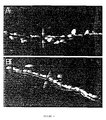
- Figure 2 shows a visualization of invading tumor cells within the amniotic membrane.
- the cells were labelled with a fluorescent dye and allowed to invade the amniotic membrane for 72 hours in the presence of either Gly-Arg-Gly-Asp-Glu-Ser-Pro (GRGESP photograph A) or Gly-Arg-Gly-Asp-Thr-Pro (GRGDTP photograph B).
- the visualization of cell location during the invasion period was then determined by fluorescent microscopic examination of the sectioned amniotic membrane.
- Basement membrane surface (upper arrow) and the lower stromal surface (lower arrow) of the amniotic membrane are shown.
- the present invention relates to methods of inhibiting the invasion of cells through extracellular membranes by providing Arg-Gly-Asp-containing synthetic peptides. This inhibition is concentration dependent, non-toxic and correlates with both the ability of the peptides to interact with matrix adhesion receptors and with the invasive quality of the cells.
- all peptides are referred to by their standard three letter abbreviation, or one letter symbol, as detailed in, for example, U.S. Pat. No. 4,578,079, which is incorporated herein by reference.
- a membrane such as an amniotic membrane
- the cells For tumor cells to migrate through a membrane, such as an amniotic membrane, they must go through a series of steps.
- the cells have to attach to the basement membrane, a step which appears to be important in both in vitro as well as in in vivo invasion systems.
- Peptides containing the sequence Arg-Gly-Asp show only minimal inhibition of the attachment of tumor cells to the basement membrane and have no detaching effect after the cells have already attached to it.
- the cells must penetrate into and through the stromal portion of the membrane, which in the amnion is about four-fifths the thickness of the membrane. While not wishing to be bound by this explanation, it is believed that the Arg-Gly-Asp containing peptides inhibit this step of the invasion process.
- stromal extracellular matric contains the adhesive proteins fibronectin and type I collagen, cell attachment to which is specifically inhibited by the particular Arg-Gly-Asp-containing peptides shown to have the greatest inhibitory effect.
- the invention further provides specific Arg-Gly-Asp-containing peptides having particular efficacy in inhibiting membrane invasion by tumor cells.
- Such peptides include those having the amino acid sequences Arg-Gly-Asp-Thr, and, more particularly, the sequence Gly-Arg-Gly-Asp-Thr-Pro. It is contemplated that such peptides may or may not include various other amino acids, or other chemical moieties, on either the amino terminal or carboxy terminal side of these specific sequences, provided that such additional moieties do not interfere with the ability of the peptides to inhibit membrane invasion, and, moreover, provided that such peptides are not identical to naturally occurring peptides.
- the length of the synthetic peptides utilized in the present invention is limited by their solubility. Over about thirty amino acid residues the solubility becomes so reduced that they are not feasibly utilized. Preferably, the peptides under about thirty amino acids in length, more preferably four to ten, or more preferably five to eight.
- these peptides are stabilized so that they will not be quickly broken down or otherwise eliminated in a cellular or in vivo environment.
- Such stabilization may be effected by conjugating the peptides to organic polymers, such as polymeric sugars, preferably dextran.
- organic polymers such as polymeric sugars, preferably dextran.
- the molecular weight of the polymer can be specifically chosen to provide for the desired longevity, the higher molecular weight correlating with a longer half life of the conjugate.
- the assay system includes two chambers, the “seeding chamber” and the “target chamber” separated by an extracellular membrane, such as an amniotic membrane. Both chambers contain growth medium appropriate for the maintenance of the cells utilized. Cells suspected of being malignant are placed in the seeding chamber for a time sufficient to permit them to attach to and penetrate the membrane. Thereafter, the growth medium from one or both of the chambers is collected and the presence of cells therein determined. The presence of cells in the target chamber indicates that the cells are capable of membrane invasion.
- the described assay is repeated with increasing concentrations of Arg-Gly-Asp-containing, invasion-inhibiting peptides being added to the seeding chamber.
- Such peptides may be added contemporaneously with the addition of the cells to the chamber, or preferably, may be added at a time determined to correlate with the penetration of the cells into and through the stromal portion of the membrane.
- concentration of peptide necessary to achieve a particular level of invasion inhibition correlates with the invasiveness of the cells, providing an "invasiveness index".
- Arg-Gly-Asp-containing peptides may be useful in counteracting the invasion of tumor cells through connective tissue matrices.
- Arg-Gly-Asp-containing peptides may be therapeutically useful in preventing the metastasis of tumor cells.
- Peptides were synthesized using an automated peptide synthesizer (Model 430A; Applied Biosystems, Foster City, CA), using the instructions provided by the manufacturer, and purified by reverse phase HPLC on a Biogel TSK SP-5-PW cation exchange column (Bio-Rad Laboratories, Richmond, CA).
- cyclization was accomplished as follows. 611 mg of the synthesized peptide were dissolved in 4 L of water that had been previously boiled and allowed to cool. Immediately prior to addition of the peptide, nitrogen was bubbled through the water for 45 minutes. After the peptide was dissolved, a solution of 0.1 ug/mL of potassium ferrous cyanide K3[Fe(CN)6] in water was added dropwise to the stirred peptide solution until the yellow color persisted for 5 minutes (approximately 5 ml). The pH of the solution was held at 7.0 throughout this procedure by addition of NH4OH. The solution was allowed to stand for 20 hours under low vacuum and then lyophilized.
- the major peak obtained from the C18 column constituted 90% of recovered peptide and was deduced to be a monomeric cyclic peptide because it was retained on the column for the length of time predicted for that sequence and because the uncyclized material and the multimeric forms were well separated from the main peak.
- Invasiveness of tumor cells was determined using a modification of the Membrane Invasion Culture System (MICS) as described in Hendrix et al. (1985) Clin. Exp. Metastasis 3:221-223.
- the cell lines used included two human melanoma cell lines designated A375P and A375M, the derivation and metastatic properties of which have been described in Kozlowski et al., (1984) J.N.C.L. 72:913, and a human glioblastoma cell line (RuGli) described in Goodman and Newgreen (1985) EMBO 4:2769.
- Noninvasive fibroblasts were used as control cells.
- the bottom wells (the "target wells") were filled with sterile DMEM (Gibco) containing 10% fetal bovine serum.
- DMEM fetal bovine serum
- the amniotic epithelium was removed by treatment with freshly prepared 0.25 M ammonium hydroxide (NH4OH) for 5 minutes at room temperature followed by extensive washing in PBS, which left a denuded basement membrane with an underlying collagenous stroma. In this manner, the interaction of cells with an extracellular matrix could be studied without the interference of host cells.
- NH4OH 0.25 M ammonium hydroxide
- the labelled cells were delivered into each upper, or "seeding" chamber in serum-containing DMEM at a final concentration of 1.0 x 10⁵/ml and placed in a humidified incubator at 37 C with 5% CO2 and 95% air atmosphere. All membranes were carefully examined for leakiness prior to cell seeding by allowing the denuded basement membrane surface to incubate for 1 hour with density marker beads (Pharmacia Fine Chemicals, Piscataway, NJ) with a buoyant density of 1.049 g/ml in a percoll gradient containing 0.25 M sucrose. If the colored beads, which were measured to be the same density as the cells from each cell line, were detected in the bottom wells of MICS, those portions of the membranes were not used.
- density marker beads Pharmacia Fine Chemicals, Piscataway, NJ
- the number of cells able to successfully invade the basement membrane and underlying collagenous stroma was determined by removing the media in the lower wells (1.1 ml) after each 24 hour increment and 72 hours via the side ports in the MICS chambers without disruption of the ongoing experiment. After each lower well was sampled, fresh media was replenished in the lower wells. In this manner, tumor cell invasion could be assessed repeatedly in the same experiment over various time intervals.
- the 14C-thymidine radio-labeled cells in all the lower well samples were pelleted and then placed in scintillation vials. In all experiments, the collected 14C-labelled cells were then lysed with 0.5 ml of 1 N NaOH.
- peptides were added after a preattachment incubation period of 37 C in a 7% CO2-air atmosphere and at 24 hour intervals thereafter, at which time medium in both the upper and lower compartments of the chambers was replaced with fresh, peptide-containing medium.
- medium from the upper and lower chambers was removed, the membranes were washed with fresh medium and the medium and wash fractions were centrifuged and the number of cells in the cell pellets was determined by counting the cell-associated radioactivity by liquid scintillation. The total number of cells that had passed through the membrane was derived by adding the lower chamber value to those from the previous samplings.
- Fig. 1 The results shown in Fig. 1 indicate that Arg-Gly-Asp-containing adhesion proteins and their receptors play a role in tumor cell invasion. Differing degrees of inhibition were associated with specific sequences.
- the Gly-Arg-Gly-Asp-Thr-Pro peptide which, unlike Gly-Arg-Asp-Ser-Pro and Gly-Arg-Gly-Asp-Asn-Pro, inhibits the attachment of cells to type I collagen as well as to fibronectin and vitronectin was consistently the most active of those tested in the MICS system, suggesting that type I collagen plays some role in the invasion process.
- Gly-Arg-Gly-Asp-D-Ser-Pro which inhibits attachment to fibronectin but not to vitronectin was as active as Gly-Arg-Gly-Asp-Ser-Pro, while the cyclic peptide, which inhibits attachment predominantly to vitronectin was an inefficient inhibitor of invasion.
Landscapes
- Health & Medical Sciences (AREA)
- Chemical & Material Sciences (AREA)
- Life Sciences & Earth Sciences (AREA)
- Organic Chemistry (AREA)
- General Health & Medical Sciences (AREA)
- Medicinal Chemistry (AREA)
- Proteomics, Peptides & Aminoacids (AREA)
- General Chemical & Material Sciences (AREA)
- Biochemistry (AREA)
- Genetics & Genomics (AREA)
- Gastroenterology & Hepatology (AREA)
- Molecular Biology (AREA)
- Zoology (AREA)
- Toxicology (AREA)
- Chemical Kinetics & Catalysis (AREA)
- Biophysics (AREA)
- Nuclear Medicine, Radiotherapy & Molecular Imaging (AREA)
- Pharmacology & Pharmacy (AREA)
- Animal Behavior & Ethology (AREA)
- Public Health (AREA)
- Veterinary Medicine (AREA)
- Peptides Or Proteins (AREA)
- Medicines That Contain Protein Lipid Enzymes And Other Medicines (AREA)
- Measuring Or Testing Involving Enzymes Or Micro-Organisms (AREA)
Claims (3)
- Verwendung eines synthetischen Arg-Gly-Asp enthaltenden Peptids zur Herstellung eines Medikaments zur Hemmung der Zellinvasion, bei der das synthetische Arg-Gly-Asp enthaltende Peptid R₁-Arg-Gly-Asp-X-R₂ ist, wobei R₁ eine oder mehrere Aminosäuren oder H ist, X Thr oder eine andere Aminosäure ist, und R₂ eine oder mehrere Aminosäuren oder OH ist, und wobei die Gesamtanzahl von Aminosäuren des synthetischen Peptids etwa 30 nicht übersteigt, vorausgesetzt, daß weder R₁ noch X oder R₂ die Fähigkeit des Peptids zur Hemmung der Zellinvasion beeinträchtigen.
- Verwendung nach Anspruch 1, bei der das Peptid Gly-Arg-Gly-Asp-Thr-Pro ist.
- Verfahren zur Quantifizierung der Invasivität einer Zellinie, umfassend die Schritte:a) Anordnung von Zellproben der Zellinie in jede von mehreren einzelnen Saatkammern, wobei jede Saatkammer von einer korrespondierenden Zielkammer mittels einer extrazellulären Membran getrennt ist;b) Inkubieren der Zellproben in den einzelnen Saatkammern, um eine Anheftung der Zellproben an die extrazelluläre Membran zu erlauben;c) Zugabe steigender Konzentrationen eines RGD enthaltenden Peptids zu den einzelnen Saatkammern;d) Inkubieren der Zellproben in den einzelnen Saatkammern für eine Zeitdauer, die ausreicht, um eine Invasion der Zellproben durch die extrazelluläre Membran zu erlauben;e) Ermittlung der Anzahl der Zellen die in jeder Zielkammer vorhanden sind; undf) Bestimmung der zur Hemmung der Migration der Zellen in die Zielkammer erforderlichen Konzentration des RGD enthaltenden Peptids, wobei die Konzentration ein Maß für die Invasivität der Zellinie liefert.
Applications Claiming Priority (2)
| Application Number | Priority Date | Filing Date | Title |
|---|---|---|---|
| US16653088A | 1988-03-10 | 1988-03-10 | |
| US166530 | 1988-03-10 |
Publications (3)
| Publication Number | Publication Date |
|---|---|
| EP0332912A2 EP0332912A2 (de) | 1989-09-20 |
| EP0332912A3 EP0332912A3 (en) | 1989-11-08 |
| EP0332912B1 true EP0332912B1 (de) | 1995-04-19 |
Family
ID=22603704
Family Applications (1)
| Application Number | Title | Priority Date | Filing Date |
|---|---|---|---|
| EP89103359A Expired - Lifetime EP0332912B1 (de) | 1988-03-10 | 1989-02-25 | Hemmung von Migration von Zellen mit Hilfe von synthetischen Peptiden |
Country Status (6)
| Country | Link |
|---|---|
| EP (1) | EP0332912B1 (de) |
| JP (2) | JPH024716A (de) |
| AT (1) | ATE121421T1 (de) |
| CA (1) | CA1324954C (de) |
| DE (1) | DE68922234T2 (de) |
| ES (1) | ES2073414T3 (de) |
Families Citing this family (7)
| Publication number | Priority date | Publication date | Assignee | Title |
|---|---|---|---|---|
| JP2662830B2 (ja) * | 1990-10-26 | 1997-10-15 | 富士写真フイルム株式会社 | Cm−キチン誘導体およびその用途 |
| CA2074945A1 (en) * | 1990-11-30 | 1992-05-31 | Atsushi Isoai | Tumor cell invasion-inhibiting peptides, peptide complexes and cancer metastasis inhibitors |
| US5879657A (en) * | 1993-03-30 | 1999-03-09 | The Dupont Merck Pharmaceutical Company | Radiolabeled platelet GPIIb/IIIa receptor antagonists as imaging agents for the diagnosis of thromboembolic disorders |
| WO2003038431A1 (en) * | 2001-10-26 | 2003-05-08 | The Regents Of The University Of California | Method for screening combinatorial bead library, capturing cells from body fluids, and ligands for cancer cells |
| EP1862476B1 (de) * | 2003-03-28 | 2009-12-23 | Fuji Film Manufacturing Europe B.V. | RGD-angereicherte, gelatine-ähnliche Proteine zur Verhinderung der Zelladhäsion |
| WO2009043441A1 (en) * | 2007-09-11 | 2009-04-09 | Mondobiotech Laboratories Ag | D-ala-gln-octadecyl ester as a therapeutic agent |
| KR20100061680A (ko) * | 2007-09-11 | 2010-06-08 | 몬도바이오테크 래보래토리즈 아게 | 치료제로서의 gly-pro-glu-oh(gpe)의 용도 |
Family Cites Families (2)
| Publication number | Priority date | Publication date | Assignee | Title |
|---|---|---|---|---|
| DE3781263T2 (de) * | 1986-12-15 | 1993-04-08 | Inst Nat Sante Rech Med | Peptid-derivate und deren verwendung in der therapie. |
| IT1222437B (it) * | 1987-08-04 | 1990-09-05 | Ellem Ind Farmaceutica | Tripeptidi utili come immunostimolanti e nella prevenzione delle metastasi e relativo procedimento di preparazione |
-
1989
- 1989-02-17 CA CA000591334A patent/CA1324954C/en not_active Expired - Fee Related
- 1989-02-25 DE DE68922234T patent/DE68922234T2/de not_active Expired - Lifetime
- 1989-02-25 ES ES89103359T patent/ES2073414T3/es not_active Expired - Lifetime
- 1989-02-25 AT AT89103359T patent/ATE121421T1/de not_active IP Right Cessation
- 1989-02-25 EP EP89103359A patent/EP0332912B1/de not_active Expired - Lifetime
- 1989-03-09 JP JP1057663A patent/JPH024716A/ja active Pending
-
1996
- 1996-05-22 JP JP8126684A patent/JP2744902B2/ja not_active Expired - Lifetime
Non-Patent Citations (2)
| Title |
|---|
| Arg-Gly-Asp-containing synthetic peptides",&& J. CELL. BIOL. 1988, 106(3), 925-30 * |
| Hendrix, M. J. C. et al. (1985), Clin. Exp. Metastasis, 3(4), 221-223 * |
Also Published As
| Publication number | Publication date |
|---|---|
| JP2744902B2 (ja) | 1998-04-28 |
| JPH024716A (ja) | 1990-01-09 |
| JPH08332097A (ja) | 1996-12-17 |
| DE68922234T2 (de) | 1995-08-31 |
| DE68922234D1 (de) | 1995-05-24 |
| ES2073414T3 (es) | 1995-08-16 |
| EP0332912A3 (en) | 1989-11-08 |
| ATE121421T1 (de) | 1995-05-15 |
| CA1324954C (en) | 1993-12-07 |
| EP0332912A2 (de) | 1989-09-20 |
Similar Documents
| Publication | Publication Date | Title |
|---|---|---|
| Aumailley et al. | Nidogen mediates the formation of ternary complexes of basement membrane components | |
| Gehlsen et al. | Inhibition of in vitro tumor cell invasion by Arg-Gly-Asp-containing synthetic peptides. | |
| Rønnov-Jessen et al. | A function for filamentous alpha-smooth muscle actin: retardation of motility in fibroblasts. | |
| Giese et al. | Determinants of human astrocytoma migration | |
| Iwamoto et al. | YIGSR, a synthetic laminin pentapeptide, inhibits experimental metastasis formation | |
| EP0366728B1 (de) | Polypeptide mit fibronektinbindender aktivität | |
| Pieske et al. | Sarcoplasmic reticulum Ca2+ load in human heart failure | |
| CA2315279A1 (en) | 14-3-3.sigma. arrests the cell cycle | |
| AU5350490A (en) | Human high-affinity neurotransmitter uptake system | |
| US4870160A (en) | Polypeptides with laminin activity | |
| US5547936A (en) | Inhibition of cell migration with synthetic peptides | |
| US4839464A (en) | Polypeptides with fibronectin activity | |
| EP0332912A2 (de) | Hemmung von Migration von Zellen mit Hilfe von synthetischen Peptiden | |
| Kataoka et al. | Signaling events initiated by transforming growth factor-beta 1 that require Gi alpha 1. | |
| EP0514481B1 (de) | Merosin, dafür kodierende nukleinsäuren, fragmente und deren verwendung | |
| US5872231A (en) | Nucleic acids encoding merosin | |
| US5116368A (en) | Polypeptides with fibronectin activity | |
| JPH06508603A (ja) | HIV Tatタンパク質に対する新規インテグリン特異性 | |
| Beguinot et al. | Differentiation-dependent phosphorylation of a 175,000 molecular weight protein in response to insulin and insulin-like growth factor-I in L6 skeletal muscle cells | |
| WO1995008628A9 (en) | Nucleic acids encoding merosin, merosin fragments and uses thereof | |
| EP1440084B1 (de) | Sperm faktoren sequenzen | |
| NO149631B (no) | Analogifremgangsmaate for fremstilling av biologisk aktive polypeptider | |
| WO1998020897A1 (en) | Modulation of map kinase phosphatase 1 (mkp-1) | |
| WO2012097084A2 (en) | Tenomodulin (tnmd) isoforms and uses thereof | |
| US8709774B2 (en) | Sperm factor sequences |
Legal Events
| Date | Code | Title | Description |
|---|---|---|---|
| PUAI | Public reference made under article 153(3) epc to a published international application that has entered the european phase |
Free format text: ORIGINAL CODE: 0009012 |
|
| PUAL | Search report despatched |
Free format text: ORIGINAL CODE: 0009013 |
|
| AK | Designated contracting states |
Kind code of ref document: A2 Designated state(s): AT BE CH DE ES FR GB GR IT LI LU NL SE |
|
| AK | Designated contracting states |
Kind code of ref document: A3 Designated state(s): AT BE CH DE ES FR GB GR IT LI LU NL SE |
|
| 17P | Request for examination filed |
Effective date: 19900112 |
|
| 17Q | First examination report despatched |
Effective date: 19910909 |
|
| RAP1 | Party data changed (applicant data changed or rights of an application transferred) |
Owner name: LA JOLLA CANCER RESEARCH FOUNDATION |
|
| GRAA | (expected) grant |
Free format text: ORIGINAL CODE: 0009210 |
|
| AK | Designated contracting states |
Kind code of ref document: B1 Designated state(s): AT BE CH DE ES FR GB GR IT LI LU NL SE |
|
| REF | Corresponds to: |
Ref document number: 121421 Country of ref document: AT Date of ref document: 19950515 Kind code of ref document: T |
|
| ITF | It: translation for a ep patent filed | ||
| REF | Corresponds to: |
Ref document number: 68922234 Country of ref document: DE Date of ref document: 19950524 |
|
| ET | Fr: translation filed | ||
| REG | Reference to a national code |
Ref country code: ES Ref legal event code: FG2A Ref document number: 2073414 Country of ref document: ES Kind code of ref document: T3 |
|
| REG | Reference to a national code |
Ref country code: GR Ref legal event code: FG4A Free format text: 3016441 |
|
| PLBE | No opposition filed within time limit |
Free format text: ORIGINAL CODE: 0009261 |
|
| STAA | Information on the status of an ep patent application or granted ep patent |
Free format text: STATUS: NO OPPOSITION FILED WITHIN TIME LIMIT |
|
| 26N | No opposition filed | ||
| PGFP | Annual fee paid to national office [announced via postgrant information from national office to epo] |
Ref country code: GR Payment date: 19961230 Year of fee payment: 9 |
|
| PGFP | Annual fee paid to national office [announced via postgrant information from national office to epo] |
Ref country code: AT Payment date: 19970213 Year of fee payment: 9 |
|
| PGFP | Annual fee paid to national office [announced via postgrant information from national office to epo] |
Ref country code: ES Payment date: 19970227 Year of fee payment: 9 |
|
| PGFP | Annual fee paid to national office [announced via postgrant information from national office to epo] |
Ref country code: LU Payment date: 19970327 Year of fee payment: 9 |
|
| PGFP | Annual fee paid to national office [announced via postgrant information from national office to epo] |
Ref country code: SE Payment date: 19980218 Year of fee payment: 10 |
|
| PG25 | Lapsed in a contracting state [announced via postgrant information from national office to epo] |
Ref country code: AT Free format text: LAPSE BECAUSE OF NON-PAYMENT OF DUE FEES Effective date: 19980225 Ref country code: LU Free format text: LAPSE BECAUSE OF NON-PAYMENT OF DUE FEES Effective date: 19980225 |
|
| PG25 | Lapsed in a contracting state [announced via postgrant information from national office to epo] |
Ref country code: ES Free format text: LAPSE BECAUSE OF NON-PAYMENT OF DUE FEES Effective date: 19980226 |
|
| PGFP | Annual fee paid to national office [announced via postgrant information from national office to epo] |
Ref country code: NL Payment date: 19980226 Year of fee payment: 10 |
|
| PG25 | Lapsed in a contracting state [announced via postgrant information from national office to epo] |
Ref country code: GR Free format text: LAPSE BECAUSE OF NON-PAYMENT OF DUE FEES Effective date: 19980228 |
|
| PGFP | Annual fee paid to national office [announced via postgrant information from national office to epo] |
Ref country code: BE Payment date: 19980417 Year of fee payment: 10 |
|
| PG25 | Lapsed in a contracting state [announced via postgrant information from national office to epo] |
Ref country code: SE Free format text: LAPSE BECAUSE OF NON-PAYMENT OF DUE FEES Effective date: 19990226 |
|
| PG25 | Lapsed in a contracting state [announced via postgrant information from national office to epo] |
Ref country code: BE Free format text: LAPSE BECAUSE OF NON-PAYMENT OF DUE FEES Effective date: 19990228 |
|
| BERE | Be: lapsed |
Owner name: LA JOLLA CANCER RESEARCH FOUNDATION Effective date: 19990228 |
|
| PG25 | Lapsed in a contracting state [announced via postgrant information from national office to epo] |
Ref country code: NL Free format text: LAPSE BECAUSE OF NON-PAYMENT OF DUE FEES Effective date: 19990901 |
|
| EUG | Se: european patent has lapsed |
Ref document number: 89103359.9 |
|
| REG | Reference to a national code |
Ref country code: ES Ref legal event code: FD2A Effective date: 20010910 |
|
| REG | Reference to a national code |
Ref country code: GB Ref legal event code: IF02 |
|
| PGFP | Annual fee paid to national office [announced via postgrant information from national office to epo] |
Ref country code: FR Payment date: 20030225 Year of fee payment: 15 |
|
| PGFP | Annual fee paid to national office [announced via postgrant information from national office to epo] |
Ref country code: GB Payment date: 20030226 Year of fee payment: 15 |
|
| PGFP | Annual fee paid to national office [announced via postgrant information from national office to epo] |
Ref country code: CH Payment date: 20030228 Year of fee payment: 15 |
|
| PG25 | Lapsed in a contracting state [announced via postgrant information from national office to epo] |
Ref country code: GB Free format text: LAPSE BECAUSE OF NON-PAYMENT OF DUE FEES Effective date: 20040225 |
|
| PG25 | Lapsed in a contracting state [announced via postgrant information from national office to epo] |
Ref country code: CH Free format text: LAPSE BECAUSE OF NON-PAYMENT OF DUE FEES Effective date: 20040229 Ref country code: LI Free format text: LAPSE BECAUSE OF NON-PAYMENT OF DUE FEES Effective date: 20040229 |
|
| GBPC | Gb: european patent ceased through non-payment of renewal fee |
Effective date: 20040225 |
|
| REG | Reference to a national code |
Ref country code: CH Ref legal event code: PL |
|
| PG25 | Lapsed in a contracting state [announced via postgrant information from national office to epo] |
Ref country code: FR Free format text: LAPSE BECAUSE OF NON-PAYMENT OF DUE FEES Effective date: 20041029 |
|
| REG | Reference to a national code |
Ref country code: FR Ref legal event code: ST |
|
| PG25 | Lapsed in a contracting state [announced via postgrant information from national office to epo] |
Ref country code: IT Free format text: LAPSE BECAUSE OF NON-PAYMENT OF DUE FEES;WARNING: LAPSES OF ITALIAN PATENTS WITH EFFECTIVE DATE BEFORE 2007 MAY HAVE OCCURRED AT ANY TIME BEFORE 2007. THE CORRECT EFFECTIVE DATE MAY BE DIFFERENT FROM THE ONE RECORDED. Effective date: 20050225 |
|
| PGFP | Annual fee paid to national office [announced via postgrant information from national office to epo] |
Ref country code: DE Payment date: 20080331 Year of fee payment: 20 |