EP0327874B1 - Verfahren zur Herstellung von N-Alkylanilinen - Google Patents
Verfahren zur Herstellung von N-Alkylanilinen Download PDFInfo
- Publication number
- EP0327874B1 EP0327874B1 EP89101169A EP89101169A EP0327874B1 EP 0327874 B1 EP0327874 B1 EP 0327874B1 EP 89101169 A EP89101169 A EP 89101169A EP 89101169 A EP89101169 A EP 89101169A EP 0327874 B1 EP0327874 B1 EP 0327874B1
- Authority
- EP
- European Patent Office
- Prior art keywords
- zsm
- zeolite
- process according
- zeolites
- particularly preferably
- Prior art date
- Legal status (The legal status is an assumption and is not a legal conclusion. Google has not performed a legal analysis and makes no representation as to the accuracy of the status listed.)
- Expired - Lifetime
Links
- 238000000034 method Methods 0.000 title claims description 18
- 238000002360 preparation method Methods 0.000 title claims description 4
- 239000010457 zeolite Substances 0.000 claims description 48
- HNPSIPDUKPIQMN-UHFFFAOYSA-N dioxosilane;oxo(oxoalumanyloxy)alumane Chemical compound O=[Si]=O.O=[Al]O[Al]=O HNPSIPDUKPIQMN-UHFFFAOYSA-N 0.000 claims description 26
- 229910021536 Zeolite Inorganic materials 0.000 claims description 25
- PAYRUJLWNCNPSJ-UHFFFAOYSA-N Aniline Chemical compound NC1=CC=CC=C1 PAYRUJLWNCNPSJ-UHFFFAOYSA-N 0.000 claims description 24
- 238000006243 chemical reaction Methods 0.000 claims description 16
- 150000001448 anilines Chemical class 0.000 claims description 11
- 239000003054 catalyst Substances 0.000 claims description 11
- 150000001768 cations Chemical class 0.000 claims description 9
- 229910052739 hydrogen Inorganic materials 0.000 claims description 9
- 239000001257 hydrogen Substances 0.000 claims description 9
- -1 offretite Inorganic materials 0.000 claims description 7
- 239000012013 faujasite Substances 0.000 claims description 6
- 239000000203 mixture Substances 0.000 claims description 6
- 229910052680 mordenite Inorganic materials 0.000 claims description 6
- 125000004178 (C1-C4) alkyl group Chemical group 0.000 claims description 5
- 239000007789 gas Substances 0.000 claims description 5
- ZAMOUSCENKQFHK-UHFFFAOYSA-N Chlorine atom Chemical compound [Cl] ZAMOUSCENKQFHK-UHFFFAOYSA-N 0.000 claims description 4
- PXGOKWXKJXAPGV-UHFFFAOYSA-N Fluorine Chemical compound FF PXGOKWXKJXAPGV-UHFFFAOYSA-N 0.000 claims description 4
- 229910000323 aluminium silicate Inorganic materials 0.000 claims description 4
- 125000000229 (C1-C4)alkoxy group Chemical group 0.000 claims description 3
- WKBOTKDWSSQWDR-UHFFFAOYSA-N Bromine atom Chemical compound [Br] WKBOTKDWSSQWDR-UHFFFAOYSA-N 0.000 claims description 3
- 239000000460 chlorine Substances 0.000 claims description 3
- 229910052801 chlorine Inorganic materials 0.000 claims description 3
- 229910052731 fluorine Inorganic materials 0.000 claims description 3
- 239000011737 fluorine Substances 0.000 claims description 3
- 150000002431 hydrogen Chemical class 0.000 claims description 3
- GDTBXPJZTBHREO-UHFFFAOYSA-N bromine Substances BrBr GDTBXPJZTBHREO-UHFFFAOYSA-N 0.000 claims description 2
- 229910052794 bromium Inorganic materials 0.000 claims description 2
- 229910052663 cancrinite Inorganic materials 0.000 claims description 2
- 229910001657 ferrierite group Inorganic materials 0.000 claims description 2
- 229910001683 gmelinite Inorganic materials 0.000 claims description 2
- 239000011148 porous material Substances 0.000 claims description 2
- XLYOFNOQVPJJNP-UHFFFAOYSA-N water Substances O XLYOFNOQVPJJNP-UHFFFAOYSA-N 0.000 claims description 2
- 229910052677 heulandite Inorganic materials 0.000 claims 1
- 239000007791 liquid phase Substances 0.000 claims 1
- 239000012071 phase Substances 0.000 claims 1
- 238000010555 transalkylation reaction Methods 0.000 description 8
- JLTDJTHDQAWBAV-UHFFFAOYSA-N N,N-dimethylaniline Chemical compound CN(C)C1=CC=CC=C1 JLTDJTHDQAWBAV-UHFFFAOYSA-N 0.000 description 7
- UHOVQNZJYSORNB-UHFFFAOYSA-N Benzene Chemical compound C1=CC=CC=C1 UHOVQNZJYSORNB-UHFFFAOYSA-N 0.000 description 6
- AFBPFSWMIHJQDM-UHFFFAOYSA-N N-methylaniline Chemical compound CNC1=CC=CC=C1 AFBPFSWMIHJQDM-UHFFFAOYSA-N 0.000 description 6
- VYPSYNLAJGMNEJ-UHFFFAOYSA-N Silicium dioxide Chemical compound O=[Si]=O VYPSYNLAJGMNEJ-UHFFFAOYSA-N 0.000 description 6
- GGSUCNLOZRCGPQ-UHFFFAOYSA-N diethylaniline Chemical compound CCN(CC)C1=CC=CC=C1 GGSUCNLOZRCGPQ-UHFFFAOYSA-N 0.000 description 6
- 239000002253 acid Substances 0.000 description 4
- 239000011230 binding agent Substances 0.000 description 4
- 239000007858 starting material Substances 0.000 description 4
- VTLYFUHAOXGGBS-UHFFFAOYSA-N Fe3+ Chemical compound [Fe+3] VTLYFUHAOXGGBS-UHFFFAOYSA-N 0.000 description 3
- YXFVVABEGXRONW-UHFFFAOYSA-N Toluene Chemical compound CC1=CC=CC=C1 YXFVVABEGXRONW-UHFFFAOYSA-N 0.000 description 3
- 229910052681 coesite Inorganic materials 0.000 description 3
- 229910052906 cristobalite Inorganic materials 0.000 description 3
- 238000004519 manufacturing process Methods 0.000 description 3
- 239000000376 reactant Substances 0.000 description 3
- 239000000377 silicon dioxide Substances 0.000 description 3
- 235000012239 silicon dioxide Nutrition 0.000 description 3
- 229910052682 stishovite Inorganic materials 0.000 description 3
- 229910052905 tridymite Inorganic materials 0.000 description 3
- 229910003158 γ-Al2O3 Inorganic materials 0.000 description 3
- UFHFLCQGNIYNRP-UHFFFAOYSA-N Hydrogen Chemical compound [H][H] UFHFLCQGNIYNRP-UHFFFAOYSA-N 0.000 description 2
- OJGMBLNIHDZDGS-UHFFFAOYSA-N N-Ethylaniline Chemical compound CCNC1=CC=CC=C1 OJGMBLNIHDZDGS-UHFFFAOYSA-N 0.000 description 2
- 150000007513 acids Chemical class 0.000 description 2
- 230000029936 alkylation Effects 0.000 description 2
- 238000005804 alkylation reaction Methods 0.000 description 2
- 230000015572 biosynthetic process Effects 0.000 description 2
- 238000001354 calcination Methods 0.000 description 2
- NNBZCPXTIHJBJL-UHFFFAOYSA-N decalin Chemical compound C1CCCC2CCCCC21 NNBZCPXTIHJBJL-UHFFFAOYSA-N 0.000 description 2
- 238000002474 experimental method Methods 0.000 description 2
- 239000000463 material Substances 0.000 description 2
- 125000004433 nitrogen atom Chemical group N* 0.000 description 2
- XHXFXVLFKHQFAL-UHFFFAOYSA-N phosphoryl trichloride Chemical compound ClP(Cl)(Cl)=O XHXFXVLFKHQFAL-UHFFFAOYSA-N 0.000 description 2
- QAOWNCQODCNURD-UHFFFAOYSA-N sulfuric acid Substances OS(O)(=O)=O QAOWNCQODCNURD-UHFFFAOYSA-N 0.000 description 2
- XDTMQSROBMDMFD-UHFFFAOYSA-N Cyclohexane Chemical compound C1CCCCC1 XDTMQSROBMDMFD-UHFFFAOYSA-N 0.000 description 1
- NHTMVDHEPJAVLT-UHFFFAOYSA-N Isooctane Chemical compound CC(C)CC(C)(C)C NHTMVDHEPJAVLT-UHFFFAOYSA-N 0.000 description 1
- CTQNGGLPUBDAKN-UHFFFAOYSA-N O-Xylene Chemical compound CC1=CC=CC=C1C CTQNGGLPUBDAKN-UHFFFAOYSA-N 0.000 description 1
- 238000006887 Ullmann reaction Methods 0.000 description 1
- 230000002378 acidificating effect Effects 0.000 description 1
- 150000001298 alcohols Chemical class 0.000 description 1
- 239000003513 alkali Substances 0.000 description 1
- 125000000217 alkyl group Chemical group 0.000 description 1
- XAGFODPZIPBFFR-UHFFFAOYSA-N aluminium Chemical compound [Al] XAGFODPZIPBFFR-UHFFFAOYSA-N 0.000 description 1
- 229910052782 aluminium Inorganic materials 0.000 description 1
- PNEYBMLMFCGWSK-UHFFFAOYSA-N aluminium oxide Inorganic materials [O-2].[O-2].[O-2].[Al+3].[Al+3] PNEYBMLMFCGWSK-UHFFFAOYSA-N 0.000 description 1
- QGZKDVFQNNGYKY-UHFFFAOYSA-O ammonium group Chemical group [NH4+] QGZKDVFQNNGYKY-UHFFFAOYSA-O 0.000 description 1
- 235000013877 carbamide Nutrition 0.000 description 1
- 239000012159 carrier gas Substances 0.000 description 1
- 230000003197 catalytic effect Effects 0.000 description 1
- 238000006555 catalytic reaction Methods 0.000 description 1
- 230000000052 comparative effect Effects 0.000 description 1
- 150000001875 compounds Chemical class 0.000 description 1
- 238000005260 corrosion Methods 0.000 description 1
- 230000007797 corrosion Effects 0.000 description 1
- 229910052593 corundum Inorganic materials 0.000 description 1
- 230000003247 decreasing effect Effects 0.000 description 1
- 150000001983 dialkylethers Chemical class 0.000 description 1
- JVSWJIKNEAIKJW-UHFFFAOYSA-N dimethyl-hexane Natural products CCCCCC(C)C JVSWJIKNEAIKJW-UHFFFAOYSA-N 0.000 description 1
- 239000000975 dye Substances 0.000 description 1
- 238000004817 gas chromatography Methods 0.000 description 1
- 239000003502 gasoline Substances 0.000 description 1
- 239000008187 granular material Substances 0.000 description 1
- 229930195733 hydrocarbon Natural products 0.000 description 1
- 150000002430 hydrocarbons Chemical class 0.000 description 1
- 125000004435 hydrogen atom Chemical group [H]* 0.000 description 1
- 230000001771 impaired effect Effects 0.000 description 1
- 239000013462 industrial intermediate Substances 0.000 description 1
- 239000012442 inert solvent Substances 0.000 description 1
- 229910052500 inorganic mineral Inorganic materials 0.000 description 1
- 150000002500 ions Chemical class 0.000 description 1
- 239000011707 mineral Substances 0.000 description 1
- 239000002808 molecular sieve Substances 0.000 description 1
- 239000006259 organic additive Substances 0.000 description 1
- 239000011541 reaction mixture Substances 0.000 description 1
- URGAHOPLAPQHLN-UHFFFAOYSA-N sodium aluminosilicate Chemical compound [Na+].[Al+3].[O-][Si]([O-])=O.[O-][Si]([O-])=O URGAHOPLAPQHLN-UHFFFAOYSA-N 0.000 description 1
- 239000003381 stabilizer Substances 0.000 description 1
- 235000011149 sulphuric acid Nutrition 0.000 description 1
- 150000003672 ureas Chemical class 0.000 description 1
- 150000003673 urethanes Chemical class 0.000 description 1
- PXXNTAGJWPJAGM-UHFFFAOYSA-N vertaline Natural products C1C2C=3C=C(OC)C(OC)=CC=3OC(C=C3)=CC=C3CCC(=O)OC1CC1N2CCCC1 PXXNTAGJWPJAGM-UHFFFAOYSA-N 0.000 description 1
- 239000008096 xylene Substances 0.000 description 1
- 229910001845 yogo sapphire Inorganic materials 0.000 description 1
Classifications
-
- C—CHEMISTRY; METALLURGY
- C07—ORGANIC CHEMISTRY
- C07C—ACYCLIC OR CARBOCYCLIC COMPOUNDS
- C07C209/00—Preparation of compounds containing amino groups bound to a carbon skeleton
- C07C209/64—Preparation of compounds containing amino groups bound to a carbon skeleton by disproportionation
Definitions
- the present invention relates to a process for the preparation of N-alkylanilines in which non-substituted anilines on the N atom are reacted with N, N-dialkylanilines in the presence of zeolites at elevated temperature.
- N-monoalkylated anilines are important industrial intermediates for the production of dyes, stabilizers, urethanes or ureas. They are prepared by alkylation of anilines with alcohols or the corresponding dialkyl ethers in the presence of acidic catalysts, for example in the presence of phosphorus oxychloride, under pressure. However, this does not result in pure monoalkylated anilines, but always also to a considerable extent in N, N-dialkylanilines (Ullmanns Encyclopedia of Industrial Chemistry, 4th edition, Vol. 7 (1974), pp. 572 ff.).
- the ratio of the monoalkylated to the dialkylated anilines does not always meet the respective requirements.
- the monoalkylated anilines are generally the more sought after and at the same time the more difficult to access products.
- N, N-dialkyl-anilines can also be obtained in good yield by special processes. It is therefore desirable to make the ratio of monoalkylated to dialkylated anilines more flexible, ie to have an effective process for converting N, N-dialkyl anilines into N-monoalkyl anilines.
- JP 60-045 552-A proposes the transalkylation between N, N-dimethylaniline and aniline in the presence of considerable amounts of concentrated sulfuric acid with a large excess of aniline at 180 ° to 300 ° C in an autoclave. This reaction takes several hours; the H2SO4 catalyst must be neutralized with alkali (disposed of) and is lost; finally, the conversion is still incomplete despite the high amount of catalyst and excess aniline.
- a pressure reaction is fundamentally associated with special technical outlay and, in the present case, also with the risk of corrosion.
- zeolite Different types or structures of zeolite are described, for example, in DW Breck, Zeolite Molecular Sieves, John Wiley and Sons Inc., New York 1974.
- the aluminum can also be partially replaced by other trivalent ions such as Fe (III), B (III) or Ga (III).
- a calcination is required to remove organic residues before the exchanged forms which can be used according to the invention are produced.
- the H-form of the zeolites according to the invention can be produced by ammonium exchange and subsequent calcination or by the exchange of hydrogen ions with the aid of mineral acids.
- cations in zeolites which can be used according to the invention are, for example: Na ⁇ , K ⁇ , Li ⁇ , Ca2+, Mg2+, Ba2+, Zn2+, Cu2+, Ag+, Ga3+, La3+, Ce3+, Fe3+, Ni2+ , Sn2+, Ti4+, Zr4+, Mn2+, Cr3+, Co2+, preferably Na+, K+, Li+, Ca2+, Mg2+, Zn2+, Cu2+, La3+, Ce3+, Fe3+, Ni2+, Sn2+.
- zeolites with an Si / Al ratio n / m ⁇ 1 are used in particular.
- Zeolites with a pore diameter ⁇ 5 ⁇ are also used according to the invention.
- Formula (IV) includes, for example, zeolites of the structure type of zeolite L, faujasite, mazzite, mordenite, offretite, cancrinite, gmelinite, ZSM 12, ZSM 25, ferrierite, zeolite ⁇ , zeolite Y, ZSM 5, ZSM 11, ZSM 22, ZSM 23, ZSM 48, ZSM 43, PSH 3 and Heulandit.
- zeolites of the structure type of zeolite L, faujasite, mazzite, mordenite, offretite, cancrinite, gmelinite, ZSM 12, ZSM 25, ferrierite, zeolite ⁇ , zeolite Y, ZSM 5, ZSM 11, ZSM 22, ZSM 23, ZSM 48, ZSM 43, PSH 3 and Heulandit are preferred.
- Zeolites of the structure type faujasite such as zeolite Y
- zeolite L are particularly preferred.
- zeolites Since the H+ forms of such zeolites have acid properties, they are particularly effective catalytically. According to the invention, preference is therefore given to zeolites of the abovementioned structure types in which some of the exchangeable cations are hydrogen ions, preferably more than 50 equivalent%, particularly preferably at least 80 equivalent%, of the exchangeable cations being hydrogen ions.
- some of the exchangeable cations are hydrogen ions, preferably more than 50 equivalent%, particularly preferably at least 80 equivalent%, of the exchangeable cations being hydrogen ions.
- the production of such partially acid forms of zeolites with the aid of strong acids is state of the art and therefore need not be explained further. Such methods are described for example in J.A. Rabo, Zeolite Chemistry and Catalysis, ACS Monograph 171, Washington D.C. 1976.
- the transalkylation according to the invention can be carried out in such a way that the reactants aniline and N, N-dialkyl-aniline or their core-substituted derivatives are gaseous at temperatures from 200 ° C., optionally using an inert carrier gas such as N2, via one of the zeolite contacts mentioned .
- the catalyst loading can be set to 0.1 to 8, preferably 0.2 to 5, particularly preferably 0.3 to 4, liters of mixture to be reacted per liter of zeolite per hour.
- the reaction can also be carried out in the bottom phase at temperatures above 200 ° C. under the autogenous pressure that arises.
- the amount of zeolite contact is 2-50% by weight, preferably 5-40% by weight, particularly preferably 7-30% by weight, based on the total weight of the batch.
- the variant of the process according to the invention with implementation in the gas phase is particularly elegant because it can generally be carried out without pressure and is therefore preferred.
- the zeolites to be used according to the invention are brought into pieces. For this purpose, they are pressed with binders and granulated.
- binder materials are preferably ⁇ -Al2O3 and SiO2, for example in amounts of 15 to 50 wt .-%, based on the finished zeolite catalyst used.
- the molar ratio of the reactants is not critical and can be 0.3 to 5, preferably 0.5 to 3, particularly preferably 0.8 to 1.5, mol of aniline to mol of N, N-dialkylaniline.
- inert solvents for example hydrocarbons such as benzene, toluene, xylene, gasoline, cyclohexane, decalin and / or isooctane.
- the starting materials to be implemented for the process according to the invention are those of the formulas (II) and (III).
- Preferred starting materials are those in which R11 is C1-C2-alkyl instead of R1.
- Further preferred starting materials are those in which R12 and R13 with the independently meaning hydrogen, C1-C2-alkyl, C1-C2-alkoxy, fluorine or chlorine or particularly preferably R22 and R23 with the independently meaning hydrogen or C1-C2- Alkyl replace R2 and R3.
- Other preferred starting materials are those in which R3 is hydrogen.
- N-methylaniline 0.5 mol each of aniline and N, N-dimethylaniline were dissolved in 200 ml of benzene and heated with 20 g of one of the zeolites mentioned for 3 hours at 300 ° C. in an autoclave.
- the formation of N-methylaniline is shown in Table I below: Table I No. Zeolite N-methylaniline (% by weight) 1.1 H-ZSM 5 21 1.2 H-ZSM 11 27th 1.3 Sn-ZSM 5 14 1.4 H-mordenite 32 1.5 HY 49
- Table I shows the results of the transalkylation, which are obtained when carried out in batches, and also shows the outstanding catalytic activity of the zeolites, in particular of H-ZSM 11, H-mordenite and especially HY.
- N, N-diethylaniline and aniline were passed in a molar ratio of 1: 1 as in Example 2 over a zeolite contact.
- Table III shows the result:
- a high selectivity of the Y zeolites with regard to the formation of N-ethylaniline can also be seen here.
Landscapes
- Chemical & Material Sciences (AREA)
- Organic Chemistry (AREA)
- Catalysts (AREA)
- Organic Low-Molecular-Weight Compounds And Preparation Thereof (AREA)
- Low-Molecular Organic Synthesis Reactions Using Catalysts (AREA)
Description
- Die vorliegende Erfindung hat ein Verfahren zur Herstellung von N-Alkylanilinen zum Gegenstand, worin man am N-Atom nichtsubstituierte Aniline mit N,N-Dialkylanilinen in Gegenwart von Zeolithen bei erhöhter Temperatur miteinander umsetzt.
- N-monoalkylierte Aniline sind wichtige industrielle Zwischenprodukte zur Herstellung von Farbstoffen, Stabilisatoren, Urethanen oder Harnstoffen. Sie werden hergestellt durch Alkylierung von Anilinen mit Alkoholen oder den entsprechenden Dialkylethern in Gegenwart saurer Katalysatoren, beispielsweise in Gegenwart von Phosphoroxychlorid, unter Druck. Dabei entstehen jedoch keine reinen monoalkylierten Aniline, sondern immer auch in beträchtlichem Umfang N,N-Dialkylaniline (Ullmanns Encyclopädie der technischen Chemie, 4. Auflage, Bd. 7 (1974), S. 572 ff.).
- Das Verhältnis der monoalkylierten zu den dialkylierten Anilinen, wie es bei derartigen Herstellungsverfahren anfällt, entspricht jedoch nicht immer dem jeweiligen Bedarf. Die monoalkylierten Aniline sind im allgemeinen die begehrteren und gleichzeitig die schwerer zugänglichen Produkte. N,N-Dialkyl-aniline sind zudem nach besonderen Verfahren in guter Ausbeute erhältlich. Daher ist es wünschenswert, das Verhältnis von monoalkylierten zu dialkylierten Anilinen flexibler zu gestalten, d.h. über ein wirksames Verfahren zur Umwandlung von N,N-Dialkyl-anilinen in N-Monoalkyl-aniline zu verfügen. Nach Acta Chim. Hung. 20 (1959), 321 kann eine Transalkylierung zwischen N,N-Diethyl-anilin und Anilin bewirkt werden, wenn man die beiden Reaktionspartner bei erhöhter Temperatur in der Gasphase über Al₂O₃ leitet. Diese Transalkylierung verläuft jedoch sehr langsam. Bei einer Katalysatorbelastung von 0,25 ml/ml Katalysator/h bei 250°C werden nur 0,16 Mol-% umgewandelt. Erhöht man zur Beschleunigung der Reaktion die Temperatur, wird N,N-Diethylanilin verstärkt umgewandelt, wobei jedoch mehr und mehr kernalkylierte Produkte auftreten und Anilin praktisch nicht am N-Atom alkyliert wird (loc. cit., S. 322, Tab. II). Erhöht man bei 280°C die Katalysatorbelastung nur geringfügig, geht der Umsatz merklich zurück, und dennoch bilden sich nicht vernachlässigbare Mengen an kernalkylierten Produkten (loc. cit., S. 323, Tab. III).
- In JP 60-045 552-A wird vorgeschlagen, die Transalkylierung zwischen N,N-Dimethylanilin und Anilin in Gegenwart von beträchtlichen Mengen an konzentrierter Schwefelsäure mit einem großen Überschuß an Anilin bei 180° bis 300°C im Autoklaven durchzuführen. Diese Reaktion nimmt mehrere Stunden in Anspruch; der H₂SO₄-Katalysator muß mit Alkali neutralisiert (entsorgt) werden und geht verloren; schließlich ist der Umsatz trotz hoher Katalysatormenge und Anilinüberschuß noch unvollständig. Darüber hinaus ist eine Druckreaktion grundsätzlich mit besonderem technischen Aufwand und im vorliegenden Fall auch mit Korrosionsgefahren verbunden.
- Es wurde nun gefunden, daß man die Transalkylierung deutlich rascher und selektiver in Gegenwart von Alumosilikaten von Zeolithtyp bei Temperaturen zwischen 200 und 350°C durchführen kann. Bei hohen Umsätzen verläuft die Reaktion glatt und praktisch ohne Kernalkylierung.
- Es wurde demnach ein Verfahren zur Herstellung von N-Alkylanilinen der Formel

durch Umsetzung von Anilinen mit N,N-Dialkyl-anilinen der Formeln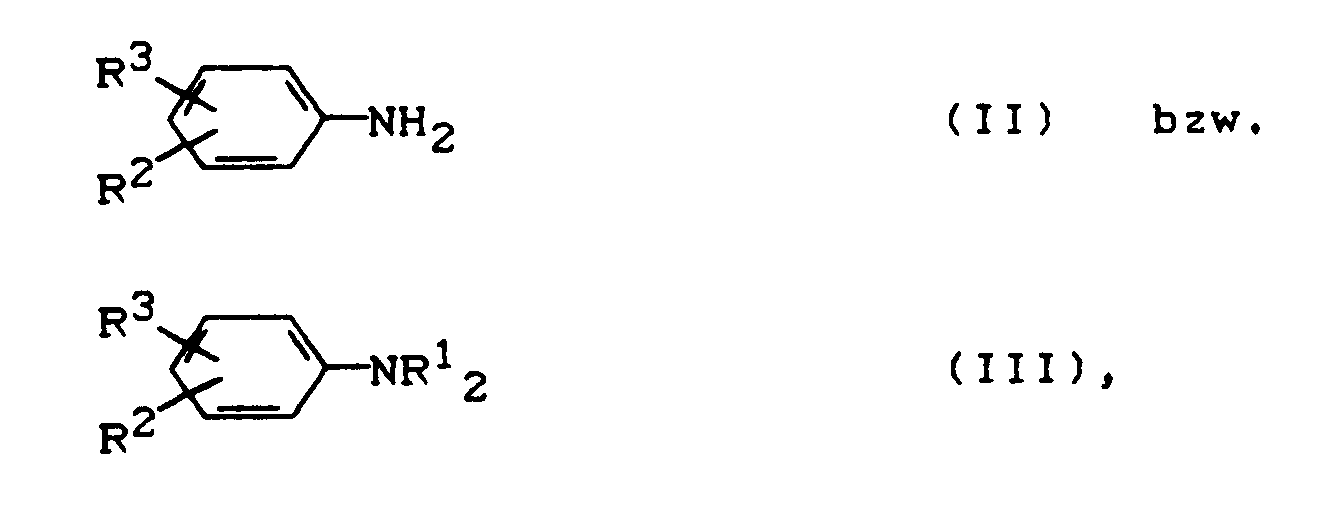
wobei in den Formeln - R¹
- C₁-C₄-Alkyl bedeutet und
- R² und R³
- unabhängig voneinander für Wasserstoff, C₁-C₄-Alkyl, C₁-C₄-Alkoxy, Fluor, Chlor oder Brom stehen,
- Bevorzugte Zeolithe sind kristalline Alumosilikate mit folgender allgemeiner oxidischer Formel:
Mm/z[mAlO₂·nSiO₂]·qH₂O (IV),
worin - n/m
- das Si/Al-Verhältnis darstellt,
- Mm/z
- austauschbare Kationen bedeutet, wobei
- z
- die Wertigkeit des Kations angibt, und
- q
- die Menge der sorbierten Wasserphase angibt.
- Verschiedene Zeolith-Typen bzw. -Strukturen sind beispielsweise in D.W. Breck, Zeolite Molecular Sieves, John Wiley and Sons Inc., New York 1974 beschrieben. In solchen Zeolithen kann weiterhin das Aluminium teilweise durch andere dreiwertige Ionen wie z.B. Fe(III), B (III) oder Ga (III) ersetzt sein.
- Bei synthetischen Zeolith-Strukturtypen, die man durch Verwendung von organischen Zusatzstoffen erhält, ist vor der Herstellung der erfindungsgemäß einsetzbaren ausgetauschten Formen eine Calcinierung zur Entfernung organischer Reste erforderlich. Die H-Form der erfindungsgemäßen Zeolithe kann durch Ammoniumaustausch und anschließende Kalzinierung bzw. durch Eintausch von Wasserstoffionen mit Hilfe von Mineralsäuren hergestellt werden. Andere Kationen in erfindungsgemäß einsetzbaren Zeolithen sind beispielsweise: Na⊕, K⊕, Li⊕, Ca²⁺, Mg²⁺, Ba²⁺, Zn²⁺, Cu²⁺, Ag⁺, Ga³⁺, La³⁺, Ce³⁺, Fe³⁺, Ni²⁺, Sn²⁺, Ti⁴⁺, Zr⁴⁺, Mn²⁺, Cr³⁺, Co²⁺, bevorzugt Na⁺, K⁺, Li⁺, Ca²⁺, Mg²⁺, Zn²⁺, Cu²⁺, La³⁺, Ce³⁺, Fe³⁺, Ni²⁺, Sn²⁺.
- Erfindungsgemäß werden insbesondere Zeolithe mit einem Si/Al-Verhältnis n/m ≧1 eingesetzt. Weiterhin werden erfindungsgemäß Zeolithe mit einem Porendurchmesser ≧5Å eingesetzt.
- Unter die Formel (IV) fallen beispielsweise Zeolithe vom Strukturtyp des Zeolith L, Faujasit, Mazzit, Mordenit, Offretit, Cancrinit, Gmelinit, ZSM 12, ZSM 25, Ferrierit, Zeolith β, Zeolith Y, ZSM 5, ZSM 11, ZSM 22, ZSM 23, ZSM 48, ZSM 43, PSH 3 und Heulandit. Bevorzugt unter diesen Strukturtypen sind Faujasit, Zeolith L, ZSM 12 und Mordenit. Besonders bevorzugt sind Zeolithe vom Strukturtyp Faujasit (wie z.B. Zeolith Y) und Zeolith L.
- Da die H⁺-Formen solcher Zeolithe saure Eigenschaften aufweisen, sind sie katalytisch besonders wirksam. Erfindungsgemäß bevorzugt sind daher weiterhin Zeolithe der obengenannten Strukturtypen, bei denen ein Teil der austauschbaren Kationen Wasserstoffionen bedeuten, wobei bevorzugt über 50 Äquivalent-%, besonders bevorzugt mindestens 80 Äquivalent-%, der austauschbaren Kationen Wasserstoffionen sind. Dier Herstellung solcher teilweise sauren Formen von Zeolithen mit Hilfe von starken Säuren ist Stand der Technik und braucht daher nicht weiter dargelegt zu werden. Beschrieben werden derartige Verfahren beispielsweise in J.A. Rabo, Zeolite Chemistry and Catalysis, ACS Monograph 171, Washington D.C. 1976.
- Die erfindungsgemäße Transalkylierung kann so durchgeführt werden, daß man die Reaktionspartner Anilin und N,N-Dialkyl-anilin bzw. ihre kernsubstituierten Derivate bei Temperaturen ab 200°C gasförmig, gegebenenfalls unter Verwendung eines inerten Trägergases, wie N₂, über einen der genannten Zeolithkontakte leitet. Die Katalysatorbelastung kann 0,1 bis 8, bevorzugt 0,2 bis 5, besonders bevorzugt 0,3 bis 4, Liter umzusetzendes Gemisch pro Liter Zeolith pro Stunde eingestellt werden. Die Reaktion kann jedoch ebenfalls in der Sumpfphase bei Temperaturen ab 200°C unter dem sich einstellenden Eigendruck durchgeführt werden. Hierbei beträgt die Menge des Zeolithkontaktes 2 - 50 Gew.-%, bevorzugt 5 - 40 Gew.-%, besonders bevorzugt 7 - 30 Gew.-%, bezogen auf das Gesamtgewicht des Ansatzes. Die Variante des erfindungsgemäßen Verfahrens mit Umsetzung in der Gasphase ist besonders elegant, weil sie im allgemeinen drucklos durchgeführt werden kann, und ist daher bevorzugt.
- Für den Betrieb in Gasphasenreaktoren werden die erfindungsgemäß einzusetzenden Zeolithe in stückige Form gebracht. Hierzu werden sie mit Bindern verpreßt und granuliert. Als Bindermaterialien werden vorzugsweise γ-Al₂O₃ und SiO₂, beispielsweise in Mengen von 15 bis 50 Gew.-%, bezogen auf den fertigen Zeolith-Katalysator, verwendet.
- Das Molverhältnis der Reaktionspartner ist nicht kritisch und kann 0,3 bis 5, bevorzugt 0,5 bis 3, besonders bevorzugt 0,8 bis 1,5, Mol Anilin zu Mol N,N-Dialkylanilin betragen.
- Es ist weiterhin möglich, inerte Lösungsmittel mit zu verwenden, beispielsweise Kohlenwasserstoffe wie Benzol, Toluol, Xylol, Benzin, Cyclohexan, Decalin und/oder Isooctan.
- Die umzusetzenden Ausgangsmaterialien für das erfindungsgemäße Verfahren sind solche der Formeln (II) und (III). Bevorzugte Ausgangsstoffe sind solche, in denen R¹¹ mit der Bedeutung C₁-C₂-Alkyl anstelle von R¹ tritt. Weitere bevorzugte Ausgangsstoffe sind solche, in denen R¹² und R¹³ mit der voneinander unabhängigen Bedeutung Wasserstoff, C₁-C₂-Alkyl, C₁-C₂-Alkoxy, Fluor oder Chlor oder besonders bevorzugt R²² und R²³ mit der voneinander unabhängigen Bedeutung Wasserstoff oder C₁-C₂-Alkyl an die Stelle von R² und R³ treten. Weitere bevorzugte Ausgangsstoffe sind solche, in denen R³ Wasserstoff ist.
- Je 0,5 mol Anilin und N,N-Dimethylanilin wurden in 200 ml Benzol gelöst und mit 20 g eines der genannten Zeolithen 3 Stunden bei 300°C im Autoklaven erhitzt. Die Bildung von N-Methylanilin gibt die folgende Tabelle I wieder:
Tabelle I Nr. Zeolith N-Methylanilin (Gew.-%) 1.1 H-ZSM 5 21 1.2 H-ZSM 11 27 1.3 Sn-ZSM 5 14 1.4 H-Mordenit 32 1.5 H-Y 49 - Die Tabelle I gibt die Ergebnisse der Transalkylierung wieder, die bei absatzweiser Durchführung erhalten werden und zeigt auch die herausragende Katalytische Wirkung der Zeolithe besonders von H-ZSM 11, H-Mordenit und besonders H-Y.
- In ein Reaktionsrohr von ca. 20 mm Durchmesser wurden 20 g eines Zeolithgranulats mit je ca. 30 Gew.-% Binder und einem mittleren Korndurchmesser von 1 bis 2 mm eingefüllt. Ein Gemisch von Anilin und N,N-Dimethylanilin wurde verdampft und das Dampfgemisch bei unterschiedlichen Temperaturen über die Katalysatorschüttung geleitet. Die folgende Tabelle II gibt die Umwandlung in N-Methylanilin wieder. Die Zusammensetzung der Reaktionsgemische wurde gaschromatographisch ermittelt.

- Nach Tabelle II wurden also bei weit höherer Katalysatorbelastung als nach dem Stand der Technik hohe Transalkylierungsraten erzielt. Schon bei 250°C wurde auch ohne Anilinüberschuß ein großer Teil, nämlich bis 40 Mol-% des Dimethylanilins umgesetzt. Dabei entstanden praktisch keine kernalkylierten Produkte. Mit den Materialien (SiO₂, γ-Al₂O₃), die als Binder für die Zeolithe verwendet wurden, konnte unter den Bedingungen der Erfindung keine (SiO₂) oder nur eine sehr geringe (γ-Al₂O₃) Transalkylierung bewirkt werden. Die Versuche 2.5 und 2.6 sind daher Vergleichsversuche.
- N,N-Diethylanilin und Anilin wurden im Molverhältnis 1:1 wie in Beispiel 2 über einen Zeolith-Kontakt geleitet. Die folgende Tabelle III gibt das Resultat wieder:

- Man erkennt auch hier eine hohe Selektivität der Y-Zeolithe bezüglich der Bildung von N-Ethylanilin. Der Anteil an kernalkylierten Verbindungen, der in einigen Fällen zu Beginn der Reaktion verhältnismäßig hoch ist, geht innerhalb kurzer Zeit auf unbedeutende Werte zurück, ohne daß der Umsatz ansonsten beeinträchtigt wird. Dies verdeutlichen die Angaben unter 3.3 und 3.4, wo während der 5-stündigen Laufzeit der Kernalkylanteil von 3,1 auf 1,5 Gew.-% zurückging.
Claims (10)
- Verfahren zur Herstellung von N-Alkylanilinen der Formel


 R¹ C₁-C₄-Alkyl bedeutet undR² und R³ unabhängig voneinander für Wasserstoff, C₁-C₄-Alkyl, C₁-C₄-Alkoxy, Fluor, Chlor oder Brom stehen,in der Gas- oder Sumpfphase bei erhöhten Temperaturen, dadurch gekennzeichnet, daß man die Umsetzung in Gegenwart von Alumosilikaten vom Zeolithtyp bei Temperaturen von 200 bis 350°C, bevorzugt 220 bis 330°C, besonders bevorzugt 230 bis 320°C, durchführt.
 - Verfahren nach Anspruch 1, dadurch gekennzeichnet, daß als Zeolithe solche der Formel:
Mm/z[mAlO₂·nSiO₂]·qH₂O
eingesetzt werden, worinn/m das Si/Al-Verhältnis darstellt,Mm/z austauschbare Kationen bedeutet, wobeiz die Wertigkeit des Kations angibt, undq die Menge der sorbierten Wasserphase angibt. - Verfahren nach Anspruch 2, dadurch gekennzeichnet, daß Zeolithe mit einem Si/Al-Verhältnis n/m ≧1 eingesetzt werden.
- Verfahren nach Anspruch 1, dadurch gekennzeichnet, daß Zeolithe mit einem Porendurchmesser ≧5Å eingesetzt werden.
- Verfahren nach Anspruch 2, dadurch gekennzeichnet, daß als Zeolithe solche vom Strukturtyp Zeolith L, Faujasit, Mazzit, Mordenit, Offretit, Cancrinit, Gmelinit, ZSM 12, ZSM 25, Ferrierit, Zeolith β, Zeolith Y, ZSM 5, ZSM 11, ZSM 22, ZSM 23, ZSM 48, ZSM 43, PSH 3 oder Heulandit eingesetzt werden.
- Verfahren nach Anspruch 5, dadurch gekennzeichnet, daß als Zeolithe solche vom Strukturtyp Faujasit, Zeolith β, Zeolith L, ZSM 12 oder Mordenit eingesetzt werden.
- Verfahren nach Anspruch 6, dadurch gekennzeichnet, daß als Zeolithe solche vom Strukturtyp Faujasit und Zeolith L eingesetzt werden.
- Verfahren nach Anspruch 2, dadurch gekennzeichnet, daß ein Teil der austauschbaren Kationen Wasserstoffionen bedeuten, bevorzugt >50 Äquivalent-%, besonders bevorzugt ≧80 Åquivalent-% aller austauschbaren Kationen.
- Verfahren nach Anspruch 1, dadurch gekennzeichnet, daß bei einer Katalysatorbelastung von 0,1 bis 8, bevorzugt 0,2 bis 5, besonders bevorzugt 0,3 bis 4, Liter umzusetzendes Gemisch/l Zeolith/h gearbeitet wird.
- Verfahren nach Anspruch 1, dadurch gekennzeichnet, daß ein Molverhältnis von 0,3 bis 5, bevorzugt 0,5 bis 3, besonders bevorzugt 0,8 bis 1,5, Mol Anilin/Mol N,N-Dialkyl-anilin im umzusetzenden Gemisch eingestellt wird.
Applications Claiming Priority (2)
| Application Number | Priority Date | Filing Date | Title |
|---|---|---|---|
| DE3803662A DE3803662A1 (de) | 1988-02-06 | 1988-02-06 | Verfahren zur herstellung von n-alkylanilinen |
| DE3803662 | 1988-02-06 |
Publications (3)
| Publication Number | Publication Date |
|---|---|
| EP0327874A2 EP0327874A2 (de) | 1989-08-16 |
| EP0327874A3 EP0327874A3 (en) | 1990-09-12 |
| EP0327874B1 true EP0327874B1 (de) | 1993-04-14 |
Family
ID=6346828
Family Applications (1)
| Application Number | Title | Priority Date | Filing Date |
|---|---|---|---|
| EP89101169A Expired - Lifetime EP0327874B1 (de) | 1988-02-06 | 1989-01-24 | Verfahren zur Herstellung von N-Alkylanilinen |
Country Status (4)
| Country | Link |
|---|---|
| US (1) | US4940817A (de) |
| EP (1) | EP0327874B1 (de) |
| JP (1) | JPH0825967B2 (de) |
| DE (2) | DE3803662A1 (de) |
Families Citing this family (4)
| Publication number | Priority date | Publication date | Assignee | Title |
|---|---|---|---|---|
| DE3928152A1 (de) * | 1989-08-25 | 1991-02-28 | Bayer Ag | Verfahren zur herstellung von n,n-dialkylanilinen |
| EP0433811B1 (de) * | 1989-12-21 | 1995-06-28 | Bayer Ag | Verfahren zur Herstellung von N-alkylierten aromatischen Aminen |
| ITPD20020325A1 (it) * | 2002-12-18 | 2004-06-19 | Consorzio Interuniversitario Nazionale La Chimic | Sintesi di aniline funzionalizzate mono-n-sostituite. |
| JP5958957B2 (ja) * | 2011-03-31 | 2016-08-02 | 国立大学法人福井大学 | アミノ基含有非ペプチド化合物を高効率かつ高感度で多重定量する方法およびそのためのキット |
Family Cites Families (5)
| Publication number | Priority date | Publication date | Assignee | Title |
|---|---|---|---|---|
| FR1070320A (de) * | 1954-07-22 | |||
| US3130007A (en) * | 1961-05-12 | 1964-04-21 | Union Carbide Corp | Crystalline zeolite y |
| US3702886A (en) * | 1969-10-10 | 1972-11-14 | Mobil Oil Corp | Crystalline zeolite zsm-5 and method of preparing the same |
| US4300011A (en) * | 1980-04-28 | 1981-11-10 | Mobil Oil Corporation | Selective production of aromatics |
| JPS6045554A (ja) * | 1983-08-22 | 1985-03-12 | Yodogawa Seiyaku Kk | 2−(ジエチルアミノ)−ν−(2,6−ジメチルフェニル)−アセトアミドの結晶化方法 |
-
1988
- 1988-02-06 DE DE3803662A patent/DE3803662A1/de not_active Withdrawn
-
1989
- 1989-01-24 EP EP89101169A patent/EP0327874B1/de not_active Expired - Lifetime
- 1989-01-24 DE DE8989101169T patent/DE58904032D1/de not_active Expired - Fee Related
- 1989-01-25 US US07/301,672 patent/US4940817A/en not_active Expired - Lifetime
- 1989-02-01 JP JP1020929A patent/JPH0825967B2/ja not_active Expired - Lifetime
Also Published As
| Publication number | Publication date |
|---|---|
| JPH0825967B2 (ja) | 1996-03-13 |
| EP0327874A3 (en) | 1990-09-12 |
| EP0327874A2 (de) | 1989-08-16 |
| DE3803662A1 (de) | 1989-08-17 |
| JPH021430A (ja) | 1990-01-05 |
| US4940817A (en) | 1990-07-10 |
| DE58904032D1 (de) | 1993-05-19 |
Similar Documents
| Publication | Publication Date | Title |
|---|---|---|
| EP0064205B1 (de) | Kristallines Alumosilicat, Verfahren zu dessen Herstellung sowie dessen Verwendung zur katalytischen Umwandlung von Methanol und/oder Dimethylether in Kohlenwasserstoffe | |
| DE2442240A1 (de) | Verfahren zur herstellung eines kristallinen aluminosilicatzeolithen | |
| DE2755901A1 (de) | Zeolithmasse und ihre verwendung in einem verfahren zur herstellung von aromatischen kohlenwasserstoffen | |
| EP0334096A2 (de) | Verfahren zur Herstellung von in 4-Stellung veretherten Phenylketonen | |
| EP0077522A2 (de) | Titanhaltige Zeolithe und Verfahren zu ihrer Herstellung sowie ihre Verwendung | |
| EP0092103B1 (de) | Verfahren zur Herstellung von o-Toluidin und/oder m-Toluidin und/oder p-Toluidin | |
| EP0327874A2 (de) | Verfahren zur Herstellung von N-Alkylanilinen | |
| EP0327875B1 (de) | Verfahren zur Herstellung von N-alkylierten Anilinen | |
| EP0224220A1 (de) | Verfahren zur Herstellung von Diisobuten aus Isobuten | |
| EP0352505B1 (de) | Verfahren zur Herstellung von Thymol | |
| EP0473023A1 (de) | Verfahren zur Herstellung von Acylbenzolen | |
| EP0019158B1 (de) | Verfahren zur Herstellung von m-substituierten N-Methylanilinen | |
| DE3522727C2 (de) | ||
| EP0043933A1 (de) | Verfahren zur Herstellung von Polyamingemischen mit einem hohen Anteil an 4,4'-Diaminodiphenylmethan | |
| EP0226152B1 (de) | Verfahren zur Herstellung von gegebenenfalls substituierten 2-Benzyl-toluolen | |
| EP0499799A1 (de) | Katalysator zur Umwandlung technischer C8-Aromatenfraktionen | |
| EP0701987A1 (de) | Verfahren zur Herstellung von aromatischen Ketonen | |
| EP0648724B1 (de) | Verfahren zur Herstellung von 1-Brom-3,5-difluorbenzol | |
| EP0140123A1 (de) | Verfahren zur Herstellung von m-Dichlorbenzol | |
| EP0414077B1 (de) | Verfahren zur Herstellung von N,N-Dialkylaninlinen | |
| EP0370343B1 (de) | Verfahren zur Herstellung von 4-Methyl-2-cyclohexyl-phenol | |
| EP0550871A2 (de) | Verfahren zur Herstellung von Cycloalkanolen | |
| DE3634257A1 (de) | Verfahren zur herstellung von 1,4- diazabicyclo(2,2,2)-octanen | |
| EP0645356A1 (de) | Verfahren zur Herstellung von Cyclohexen durch partielle Hydrierung von Benzol | |
| EP0526794B1 (de) | Verfahren zur Herstellung benzylierter Aromaten |
Legal Events
| Date | Code | Title | Description |
|---|---|---|---|
| PUAI | Public reference made under article 153(3) epc to a published international application that has entered the european phase |
Free format text: ORIGINAL CODE: 0009012 |
|
| 17P | Request for examination filed |
Effective date: 19890124 |
|
| AK | Designated contracting states |
Kind code of ref document: A2 Designated state(s): BE DE FR GB IT |
|
| PUAL | Search report despatched |
Free format text: ORIGINAL CODE: 0009013 |
|
| AK | Designated contracting states |
Kind code of ref document: A3 Designated state(s): BE DE FR GB IT |
|
| 17Q | First examination report despatched |
Effective date: 19920409 |
|
| GRAA | (expected) grant |
Free format text: ORIGINAL CODE: 0009210 |
|
| AK | Designated contracting states |
Kind code of ref document: B1 Designated state(s): BE DE FR GB IT |
|
| ITF | It: translation for a ep patent filed | ||
| REF | Corresponds to: |
Ref document number: 58904032 Country of ref document: DE Date of ref document: 19930519 |
|
| GBT | Gb: translation of ep patent filed (gb section 77(6)(a)/1977) |
Effective date: 19930426 |
|
| ET | Fr: translation filed | ||
| PLBE | No opposition filed within time limit |
Free format text: ORIGINAL CODE: 0009261 |
|
| STAA | Information on the status of an ep patent application or granted ep patent |
Free format text: STATUS: NO OPPOSITION FILED WITHIN TIME LIMIT |
|
| 26N | No opposition filed | ||
| PGFP | Annual fee paid to national office [announced via postgrant information from national office to epo] |
Ref country code: DE Payment date: 20011213 Year of fee payment: 14 |
|
| PGFP | Annual fee paid to national office [announced via postgrant information from national office to epo] |
Ref country code: FR Payment date: 20011219 Year of fee payment: 14 |
|
| REG | Reference to a national code |
Ref country code: GB Ref legal event code: IF02 |
|
| PGFP | Annual fee paid to national office [announced via postgrant information from national office to epo] |
Ref country code: GB Payment date: 20020123 Year of fee payment: 14 |
|
| PGFP | Annual fee paid to national office [announced via postgrant information from national office to epo] |
Ref country code: BE Payment date: 20020130 Year of fee payment: 14 |
|
| PG25 | Lapsed in a contracting state [announced via postgrant information from national office to epo] |
Ref country code: GB Free format text: LAPSE BECAUSE OF NON-PAYMENT OF DUE FEES Effective date: 20030124 |
|
| PG25 | Lapsed in a contracting state [announced via postgrant information from national office to epo] |
Ref country code: BE Free format text: LAPSE BECAUSE OF NON-PAYMENT OF DUE FEES Effective date: 20030131 |
|
| PG25 | Lapsed in a contracting state [announced via postgrant information from national office to epo] |
Ref country code: DE Free format text: LAPSE BECAUSE OF NON-PAYMENT OF DUE FEES Effective date: 20030801 |
|
| GBPC | Gb: european patent ceased through non-payment of renewal fee | ||
| PG25 | Lapsed in a contracting state [announced via postgrant information from national office to epo] |
Ref country code: FR Free format text: LAPSE BECAUSE OF NON-PAYMENT OF DUE FEES Effective date: 20030930 |
|
| REG | Reference to a national code |
Ref country code: FR Ref legal event code: ST |
|
| PG25 | Lapsed in a contracting state [announced via postgrant information from national office to epo] |
Ref country code: IT Free format text: LAPSE BECAUSE OF NON-PAYMENT OF DUE FEES;WARNING: LAPSES OF ITALIAN PATENTS WITH EFFECTIVE DATE BEFORE 2007 MAY HAVE OCCURRED AT ANY TIME BEFORE 2007. THE CORRECT EFFECTIVE DATE MAY BE DIFFERENT FROM THE ONE RECORDED. Effective date: 20050124 |