EP0326939B1 - Verfahren zum Abtrennen von Celluloseethern aus einer Celluloseethersuspension - Google Patents
Verfahren zum Abtrennen von Celluloseethern aus einer Celluloseethersuspension Download PDFInfo
- Publication number
- EP0326939B1 EP0326939B1 EP89101327A EP89101327A EP0326939B1 EP 0326939 B1 EP0326939 B1 EP 0326939B1 EP 89101327 A EP89101327 A EP 89101327A EP 89101327 A EP89101327 A EP 89101327A EP 0326939 B1 EP0326939 B1 EP 0326939B1
- Authority
- EP
- European Patent Office
- Prior art keywords
- filter
- cloth
- water
- suspension
- cellulose ether
- Prior art date
- Legal status (The legal status is an assumption and is not a legal conclusion. Google has not performed a legal analysis and makes no representation as to the accuracy of the status listed.)
- Expired - Lifetime
Links
- 229920003086 cellulose ether Polymers 0.000 title claims description 32
- 238000000034 method Methods 0.000 title claims description 25
- 239000000725 suspension Substances 0.000 title claims description 21
- 239000004744 fabric Substances 0.000 claims description 66
- XLYOFNOQVPJJNP-UHFFFAOYSA-N water Substances O XLYOFNOQVPJJNP-UHFFFAOYSA-N 0.000 claims description 33
- 239000012065 filter cake Substances 0.000 claims description 23
- 230000001681 protective effect Effects 0.000 claims description 21
- 229910052751 metal Inorganic materials 0.000 claims description 13
- 239000002184 metal Substances 0.000 claims description 13
- 239000000706 filtrate Substances 0.000 claims description 12
- 238000000926 separation method Methods 0.000 claims description 9
- 239000007787 solid Substances 0.000 claims description 8
- 239000002245 particle Substances 0.000 claims description 6
- 238000005260 corrosion Methods 0.000 claims description 5
- 230000007797 corrosion Effects 0.000 claims description 5
- 238000001914 filtration Methods 0.000 claims description 5
- 238000005189 flocculation Methods 0.000 claims description 5
- 230000016615 flocculation Effects 0.000 claims description 5
- PXHVJJICTQNCMI-UHFFFAOYSA-N Nickel Chemical compound [Ni] PXHVJJICTQNCMI-UHFFFAOYSA-N 0.000 claims description 4
- 238000011085 pressure filtration Methods 0.000 claims description 3
- VYZAMTAEIAYCRO-UHFFFAOYSA-N Chromium Chemical compound [Cr] VYZAMTAEIAYCRO-UHFFFAOYSA-N 0.000 claims description 2
- CWYNVVGOOAEACU-UHFFFAOYSA-N Fe2+ Chemical compound [Fe+2] CWYNVVGOOAEACU-UHFFFAOYSA-N 0.000 claims description 2
- 229910052804 chromium Inorganic materials 0.000 claims description 2
- 239000011651 chromium Substances 0.000 claims description 2
- 229910052759 nickel Inorganic materials 0.000 claims description 2
- 229910001220 stainless steel Inorganic materials 0.000 claims description 2
- 239000010935 stainless steel Substances 0.000 claims description 2
- 238000005406 washing Methods 0.000 description 10
- 239000000047 product Substances 0.000 description 8
- 239000000463 material Substances 0.000 description 5
- 150000003839 salts Chemical class 0.000 description 5
- 238000007790 scraping Methods 0.000 description 4
- FAPWRFPIFSIZLT-UHFFFAOYSA-M Sodium chloride Chemical compound [Na+].[Cl-] FAPWRFPIFSIZLT-UHFFFAOYSA-M 0.000 description 3
- 238000010586 diagram Methods 0.000 description 3
- 229920000609 methyl cellulose Polymers 0.000 description 3
- 239000001923 methylcellulose Substances 0.000 description 3
- 235000010981 methylcellulose Nutrition 0.000 description 3
- 239000004753 textile Substances 0.000 description 3
- 239000003513 alkali Substances 0.000 description 2
- 238000005452 bending Methods 0.000 description 2
- 238000007664 blowing Methods 0.000 description 2
- 229920002678 cellulose Polymers 0.000 description 2
- 239000001913 cellulose Substances 0.000 description 2
- NEHMKBQYUWJMIP-UHFFFAOYSA-N chloromethane Chemical compound ClC NEHMKBQYUWJMIP-UHFFFAOYSA-N 0.000 description 2
- 238000006266 etherification reaction Methods 0.000 description 2
- 206010016256 fatigue Diseases 0.000 description 2
- 239000007788 liquid Substances 0.000 description 2
- 238000007789 sealing Methods 0.000 description 2
- 239000011780 sodium chloride Substances 0.000 description 2
- 238000010626 work up procedure Methods 0.000 description 2
- 229920001479 Hydroxyethyl methyl cellulose Polymers 0.000 description 1
- 238000009835 boiling Methods 0.000 description 1
- 230000015556 catabolic process Effects 0.000 description 1
- 238000006243 chemical reaction Methods 0.000 description 1
- 238000004140 cleaning Methods 0.000 description 1
- 238000005336 cracking Methods 0.000 description 1
- 238000001035 drying Methods 0.000 description 1
- 229920001971 elastomer Polymers 0.000 description 1
- 239000000806 elastomer Substances 0.000 description 1
- 230000002349 favourable effect Effects 0.000 description 1
- 238000011010 flushing procedure Methods 0.000 description 1
- 210000004907 gland Anatomy 0.000 description 1
- -1 hydroxyethyl groups Chemical group 0.000 description 1
- 238000011068 loading method Methods 0.000 description 1
- 239000012528 membrane Substances 0.000 description 1
- 229940050176 methyl chloride Drugs 0.000 description 1
- GRVDJDISBSALJP-UHFFFAOYSA-N methyloxidanyl Chemical compound [O]C GRVDJDISBSALJP-UHFFFAOYSA-N 0.000 description 1
- 239000000203 mixture Substances 0.000 description 1
- 230000035515 penetration Effects 0.000 description 1
- 239000011148 porous material Substances 0.000 description 1
- 239000000843 powder Substances 0.000 description 1
- 238000002360 preparation method Methods 0.000 description 1
- 239000011541 reaction mixture Substances 0.000 description 1
- 239000008237 rinsing water Substances 0.000 description 1
- 238000005507 spraying Methods 0.000 description 1
- 239000000126 substance Substances 0.000 description 1
Images
Classifications
-
- C—CHEMISTRY; METALLURGY
- C08—ORGANIC MACROMOLECULAR COMPOUNDS; THEIR PREPARATION OR CHEMICAL WORKING-UP; COMPOSITIONS BASED THEREON
- C08B—POLYSACCHARIDES; DERIVATIVES THEREOF
- C08B11/00—Preparation of cellulose ethers
- C08B11/20—Post-etherification treatments of chemical or physical type, e.g. mixed etherification in two steps, including purification
- C08B11/22—Isolation
-
- B—PERFORMING OPERATIONS; TRANSPORTING
- B01—PHYSICAL OR CHEMICAL PROCESSES OR APPARATUS IN GENERAL
- B01D—SEPARATION
- B01D33/00—Filters with filtering elements which move during the filtering operation
- B01D33/06—Filters with filtering elements which move during the filtering operation with rotary cylindrical filtering surfaces, e.g. hollow drums
- B01D33/073—Filters with filtering elements which move during the filtering operation with rotary cylindrical filtering surfaces, e.g. hollow drums arranged for inward flow filtration
-
- B—PERFORMING OPERATIONS; TRANSPORTING
- B01—PHYSICAL OR CHEMICAL PROCESSES OR APPARATUS IN GENERAL
- B01D—SEPARATION
- B01D33/00—Filters with filtering elements which move during the filtering operation
- B01D33/35—Filters with filtering elements which move during the filtering operation with multiple filtering elements characterised by their mutual disposition
- B01D33/41—Filters with filtering elements which move during the filtering operation with multiple filtering elements characterised by their mutual disposition in series connection
- B01D33/42—Filters with filtering elements which move during the filtering operation with multiple filtering elements characterised by their mutual disposition in series connection concentrically or coaxially
-
- B—PERFORMING OPERATIONS; TRANSPORTING
- B01—PHYSICAL OR CHEMICAL PROCESSES OR APPARATUS IN GENERAL
- B01D—SEPARATION
- B01D33/00—Filters with filtering elements which move during the filtering operation
- B01D33/44—Regenerating the filter material in the filter
- B01D33/46—Regenerating the filter material in the filter by scrapers, brushes nozzles or the like acting on the cake-side of the filtering element
- B01D33/463—Regenerating the filter material in the filter by scrapers, brushes nozzles or the like acting on the cake-side of the filtering element nozzles
-
- B—PERFORMING OPERATIONS; TRANSPORTING
- B01—PHYSICAL OR CHEMICAL PROCESSES OR APPARATUS IN GENERAL
- B01D—SEPARATION
- B01D33/00—Filters with filtering elements which move during the filtering operation
- B01D33/44—Regenerating the filter material in the filter
- B01D33/46—Regenerating the filter material in the filter by scrapers, brushes nozzles or the like acting on the cake-side of the filtering element
- B01D33/466—Regenerating the filter material in the filter by scrapers, brushes nozzles or the like acting on the cake-side of the filtering element scrapers
-
- B—PERFORMING OPERATIONS; TRANSPORTING
- B01—PHYSICAL OR CHEMICAL PROCESSES OR APPARATUS IN GENERAL
- B01D—SEPARATION
- B01D33/00—Filters with filtering elements which move during the filtering operation
- B01D33/58—Handling the filter cake in the filter for purposes other than for regenerating the filter cake remaining on the filtering element
- B01D33/60—Handling the filter cake in the filter for purposes other than for regenerating the filter cake remaining on the filtering element for washing
-
- B—PERFORMING OPERATIONS; TRANSPORTING
- B01—PHYSICAL OR CHEMICAL PROCESSES OR APPARATUS IN GENERAL
- B01D—SEPARATION
- B01D33/00—Filters with filtering elements which move during the filtering operation
- B01D33/58—Handling the filter cake in the filter for purposes other than for regenerating the filter cake remaining on the filtering element
- B01D33/62—Handling the filter cake in the filter for purposes other than for regenerating the filter cake remaining on the filtering element for drying
- B01D33/66—Handling the filter cake in the filter for purposes other than for regenerating the filter cake remaining on the filtering element for drying by gases or by heating
- B01D33/663—Handling the filter cake in the filter for purposes other than for regenerating the filter cake remaining on the filtering element for drying by gases or by heating by direct contact with a fluid
-
- B—PERFORMING OPERATIONS; TRANSPORTING
- B01—PHYSICAL OR CHEMICAL PROCESSES OR APPARATUS IN GENERAL
- B01D—SEPARATION
- B01D35/00—Filtering devices having features not specifically covered by groups B01D24/00 - B01D33/00, or for applications not specifically covered by groups B01D24/00 - B01D33/00; Auxiliary devices for filtration; Filter housing constructions
- B01D35/30—Filter housing constructions
- B01D35/31—Filter housing constructions including arrangements for environmental protection, e.g. pressure resisting features
-
- B—PERFORMING OPERATIONS; TRANSPORTING
- B01—PHYSICAL OR CHEMICAL PROCESSES OR APPARATUS IN GENERAL
- B01D—SEPARATION
- B01D2201/00—Details relating to filtering apparatus
- B01D2201/28—Position of the filtering element
- B01D2201/282—Filtering elements with a horizontal rotation or symmetry axis
Definitions
- the invention relates to a method for separating solids from a suspension, in which the solids are separated by pressure filtration in a rotary pressure filter as a filter cake, the separation in the rotary pressure filter using a multi-layer metal wire mesh made of layers of wire of different wire thickness as the filter medium.
- Such a method for separating a solid from a suspension by pressure filtration is known from BE-A-519 392 in the most general form.
- the separation can be carried out, for example, with a three-layer metal wire mesh as the filter medium, which is formed from fabric layers of different mesh sizes.
- this document also describes that other filter materials can be used, for example textile filter cloths or porous materials.
- the document does not contain any references to special solids to be separated, especially none Reference to the particularly problematic separation of cellulose ether from cellulose ether suspensions.
- Cellulose ether is obtained, for example, by etherification of alkali cellulose with methyl chloride at temperatures of approximately 90 ° to 110 ° C., as is described in detail in Ullmann's Encyclopedia of Industrial Chemistry, 4th edition, volume 9, page 205.
- the reaction mixture formed is placed in a stirred vessel which is charged with softened water at about 95 ° C.
- the sodium chloride formed during the reaction is dissolved out in the stirred vessel and the remaining alkali is neutralized.
- the suspension leaving the stirred vessel must then be subjected to a separation in order to obtain the desired pure cellulose ether.
- the object of the invention is to provide a solution with which the separation of cellulose ethers, in particular cellulose ethers with plastic properties and / or high flocculation point, is made possible from a cellulose ether suspension, clogging of the separating device being avoided and the separating device should have a long service life.
- This object is achieved according to the invention with a method of the type mentioned at the outset in that, for separating cellulose ethers, in particular cellulose ethers with plastic properties and / or high flocculation point, from a cellulose ether suspension as filter medium, a multi-layer square mesh fabric in linen weave with at least one protective fabric on each side surrounding filter cloth is used, and that after removing the filter cake, the filter medium is cleaned with steam, compressed air or pressurized water.
- a four-layer square mesh fabric in linen weave with a first upper protective fabric, a second filter fabric, a third lower protective fabric and a fourth supporting fabric is used as the filter medium. It has been found that this structure of the filter medium has particularly favorable separation properties and does not tend to clog or filter breakdown.
- the upper protective fabric is approximately three times
- the lower protective fabric is approximately five times
- the supporting fabric is approximately thirteen times the mesh size of the mesh size of the filter fabric.
- the invention provides that a filter fabric is used whose mesh size corresponds approximately to the average particle diameter of the suspension particles. It has been found that such a filter fabric reliably retains all suspension particles, even particles with smaller ones Diameter than the mesh size of the filter fabric, so that no filter penetration occurs.
- the use of these materials prevents the occurrence of stress corrosion cracking due to the high salt content of the hot suspension.
- a highly concentrated cellulose ether suspension is used in a concentration ratio of cellulose ether to water of 1: 5 to 1:50.
- a concentration ratio of 1: 8 to 1:20, in particular 1:10 to 1:15, is preferably selected. It must of course be ensured that the suspension used is still pumpable.
- the invention provides that the filter cake is washed out with hot water and / or steam after the filtration and is then detached from the wire mesh by steam or hot air before being removed.
- the foreign substances such as salts or the like, are washed out of the filter cake, so that the filter cake consists almost exclusively of cellulose ether.
- the invention provides that, after the filter cake has been removed, the wire mesh is rinsed in the filtrate direction with hot water at at least 1.0, preferably 1.5 to 2.0 MPa (15 to 20 bar) overpressure by means of flat jet nozzles. It is provided that the rinsing water obtained is returned to filter cake washing or used as preparation water. As a result, the filter medium is cleaned and at the same time the product of value remaining in the filter medium is obtained, which is then returned to the process. All that is required is a small proportion of rinsing liquid, which is in the order of the amount of washing water in filter cake washing.
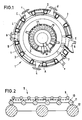
- a rotary pressure filter 1 has a stationary housing 2 and a filter drum 3 rotatable therein.
- the housing 2 is divided into five working chambers A to E, which are delimited by separating elements 4, each separating element being pressed pneumatically against the filter drum 3.
- the moving parts are sealed with an elastomer sealing frame or with a membrane seal.
- the lateral sealing of the rotating drum 3 against the fixed housing 2 is done by glands, which is not shown in the drawing.
- the filter drum 3 is divided by separating strips and separating rings into filter cells into which four-layer metal wire mesh are inserted, which are shown in more detail in FIG. 2. From these filter cells, the filtrate is led out of the rotary pressure filter 1 via filtrate pipes 5.
- a scraping device 6 and flat jet nozzles 7 for spraying water onto the metal wire mesh are arranged in the working chamber E.
- a four-layer metal wire mesh 8 is shown, which consists of an upper protective fabric 9, a filter fabric 10, a protective fabric 11 and finally one Support fabric 12 is made.
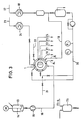
- FIG. 3 shows a simplified process flow diagram of a methyl cellulose workup, the same reference numerals as in FIGS. 1 and 2 being used when the same parts are identified.
- a stirred tank 13 with an agitator 14 has a line 16 provided with a pump 15 for the cellulose ether suspension at the tank outlet.
- a water pipe 17 is guided over a heat exchanger 18 and splits into two feed lines 19 and 20.
- Two lines 21 and 22 are used to supply steam, water or compressed air to the rotary pressure filter 1.
- a line 23 for air is led to a rotary pressure filter 1 via a heat exchanger 24.
- Filtrate lines F1 to F4 lead from the rotary pressure filter 1 into a container 25.
- the rotary pressure filter 1 has an inlet line ZL and an outlet line AL and a line FK for the filter cake.
- the filtering process takes place as follows (Fig. 1): A cellulose ether suspension is pumped under pressure through the nozzle a into the working chamber A. While a filter cake builds up on the filter cells from the solid cellulose ether, the filtrate, which mainly comes out There is water and salt dissolved in it, through the metal wire mesh into the filtrate tubes 5. The rotary movement of the filter drum 3 conveys the filter cells with the filter cake into the working chamber B. In this chamber B the filter cake is washed out by pressurized steam which is introduced through the nozzle b. The washed-out salt flows through the metal wire mesh into the filtrate tubes 5. In the working chamber C, this washing process is repeated with hot water under pressure, which is pumped in through the nozzle c.
- the moisture content of the filter cake in chamber D is adjusted according to the requirements in the subsequent processing stages. For this purpose, steam or compressed air or liquid is pumped through the nozzle d into the chamber D with a slight excess pressure. In the unpressurized chamber E, the filter cake is finally removed and the metal wire mesh is cleaned. First, the filter cake is released from the filter cells by counter-blowing with compressed air or the like and then removed with the scraping device 6. The wire mesh is then washed out with hot water, which enters through the nozzle e and is sprayed onto the filter cells via the flat jet nozzles 7.
- the four-layer metal wire mesh 8 serving as the filter medium is shown.
- the filtrate first passes through the upper protective fabric 9, then through the filter fabric 10, the lower protective fabric 11 and finally through the support fabric 12.
- the individual wire fabrics 9 to 12 are woven as a square mesh fabric in a linen weave, which cannot be seen in FIG. 2.
- the actual filter fabric 10 is fine-meshed and fine-wire and is surrounded by the coarser protective fabrics 9 and 11 and by the support fabric 12.
- the upper protective fabric 9 has a mesh size of 250 ⁇ m
- the filter fabric 10 has a mesh size of 75 ⁇ m
- the lower protective fabric 11 has a mesh size of 400 ⁇ m
- the lower support fabric 12 has a mesh size of 1000 ⁇ m.
- the four-layer wire mesh 8 is sintered and consists of a highly corrosion-resistant material.
- FIG. 3 shows a simplified process flow diagram of a methyl cellulose workup: From the stirred tank 13 with the stirrer 14, a cellulose ether suspension is conveyed via the pump 15 through the line 16 into the rotary pressure filter 1 (into the chamber A according to FIG. 1). Via the water line 17, water passes through the heat exchanger 18, in which it is heated, via further apparatuses, which are not important here, into the two feed lines 19 and 20. Via the line 19, the water flows into the chamber E of the rotary pressure filter 1 promoted to filter fabric washing, which is designated in the drawing with ZL. The escaping rinse water, in which cellulose ether washed out of the filter fabric is present, is discharged via the drain line AL and can be fed to the washing chamber C, for example.
- the hot, pressurized water is conveyed into the washing chambers C and, if necessary, B of the rotary pressure filter 1 via the water line 20.
- Low pressure steam up to a maximum of 3 bar is led through line 21 into the washing chamber B of the rotary pressure filter 1.
- steam reaches the drying chamber D of the rotary pressure filter 1 via the line 22.
- Air 23, which is heated in the heat exchanger 24, is conveyed through the line 23 into the rotary pressure filter 1, which is required for counter-blowing and detaching the filter cake from the wire filter fabric in the working chamber E.
- the resulting in the working chambers A to D of the rotary pressure filter 1 is discharged through the filtrate lines F1 to F4 and fed into the container 25.
- the filter cake consisting of the valuable product cellulose ether is removed after removal in the working chamber E of the rotary pressure filter 1 via a line FK and fed to further processing, which is not important here.
- the suspension was fed to a rotary pressure filter preheated to 100 ° C. with a filter area of 1 m2 and a drum revolution per minute with a pump pressure of 0.2 MPa (2 bar).
- the filter surface consisted of a four-layer, sintered metal fabric in a square linen weave with the following dimensions (order in the direction of the filtrate flow): No. Mesh size Wire strength 1 250 ⁇ m 160 ⁇ m (upper protective thread) 2nd 75 ⁇ m 50 ⁇ m (filter fabric) 3rd 400 ⁇ m 250 ⁇ m (lower protective thread) 4th 1000 ⁇ m 630 ⁇ m (support fabric)
- the open filter area of this laminate made of material no. 1.4539 was 35%.
- a closed filter cake of 20 mm thickness was formed on the filter surface, which was then blown out intensively with 2 bar steam, which led to a sharp reduction in the residual salt content.
- the metal wire mesh laminates were cleaned intensively by hot water nozzles with flat jet nozzles at at least 1.0, preferably 1.5 to 2.0 MPa. The cycle described was then repeated again and again in the same way, with performance comparisons showed no drop in filter throughput for many hours.
- the invention is not limited to the exemplary embodiments. Further configurations are possible without leaving the basic idea.
- the metal wire mesh is washed out by hot water nozzles with flat jet nozzles at pressures of more than 10.0 MPa.
- the method according to the invention is not limited to use on rotary pressure filters. The process can accordingly also be carried out in discontinuously operated pressure filters.
Landscapes
- Chemical & Material Sciences (AREA)
- Chemical Kinetics & Catalysis (AREA)
- Engineering & Computer Science (AREA)
- Biochemistry (AREA)
- Materials Engineering (AREA)
- Health & Medical Sciences (AREA)
- Life Sciences & Earth Sciences (AREA)
- Medicinal Chemistry (AREA)
- Polymers & Plastics (AREA)
- Organic Chemistry (AREA)
- Environmental & Geological Engineering (AREA)
- Filtering Materials (AREA)
- Polysaccharides And Polysaccharide Derivatives (AREA)
- Filtration Of Liquid (AREA)
Applications Claiming Priority (2)
| Application Number | Priority Date | Filing Date | Title |
|---|---|---|---|
| DE3803370 | 1988-02-05 | ||
| DE3803370A DE3803370A1 (de) | 1988-02-05 | 1988-02-05 | Verfahren zum abtrennen von celluloseethern aus einer celluloseethersuspension |
Publications (3)
| Publication Number | Publication Date |
|---|---|
| EP0326939A2 EP0326939A2 (de) | 1989-08-09 |
| EP0326939A3 EP0326939A3 (en) | 1990-11-22 |
| EP0326939B1 true EP0326939B1 (de) | 1994-11-30 |
Family
ID=6346648
Family Applications (1)
| Application Number | Title | Priority Date | Filing Date |
|---|---|---|---|
| EP89101327A Expired - Lifetime EP0326939B1 (de) | 1988-02-05 | 1989-01-26 | Verfahren zum Abtrennen von Celluloseethern aus einer Celluloseethersuspension |
Country Status (4)
| Country | Link |
|---|---|
| US (1) | US4954268A (enExample) |
| EP (1) | EP0326939B1 (enExample) |
| JP (1) | JP2895084B2 (enExample) |
| DE (2) | DE3803370A1 (enExample) |
Cited By (1)
| Publication number | Priority date | Publication date | Assignee | Title |
|---|---|---|---|---|
| WO2024223265A1 (de) * | 2023-04-27 | 2024-10-31 | Rt-Filtertechnik Gmbh | Filtervorrichtung |
Families Citing this family (23)
| Publication number | Priority date | Publication date | Assignee | Title |
|---|---|---|---|---|
| AT395430B (de) * | 1991-03-14 | 1992-12-28 | Chemiefaser Lenzing Ag | Verfahren zur filtration von celluloseacetat und anlage zur durchfuehrung des verfahrens |
| US5637216A (en) * | 1991-10-04 | 1997-06-10 | Rosenmund Ag, A Swiss Corporation | Filter matting for a reversible-flow filter |
| US5373615A (en) * | 1992-09-01 | 1994-12-20 | National Filtration | Filtration screen |
| DE19546038A1 (de) * | 1995-12-09 | 1997-06-12 | Deutz Ag | Trommelfilter zur Trennung von Feststoff-Flüssigkeitsgemischen |
| US6416665B1 (en) | 1997-12-09 | 2002-07-09 | Mcgrath Kevin Douglas | Filtration apparatus |
| DE10056518A1 (de) * | 2000-11-15 | 2002-05-23 | Bhs Sonthofen Maschinen & Anlagenbau Gmbh | Filterplatte, Verfahren zur Herstellung der Filterplatte, Verwendung der Filterplatte in einem Drehfilter |
| ATE490813T1 (de) * | 2001-04-11 | 2010-12-15 | Bekaert Sa Nv | Filtervorrichtung |
| JP2004026861A (ja) | 2002-06-21 | 2004-01-29 | Shin Etsu Chem Co Ltd | 濾過性に優れる水溶性セルロースエーテル及びその選定方法 |
| GB0225619D0 (en) * | 2002-11-02 | 2002-12-11 | United Wire Ltd | Improved screen |
| JP5233067B2 (ja) * | 2004-11-02 | 2013-07-10 | 信越化学工業株式会社 | 水溶性セルロースエーテルの分離方法 |
| DE602005010362D1 (de) * | 2004-11-02 | 2008-11-27 | Shinetsu Chemical Co | Verfahren zur Abtrennung wasserlöslicher Celluloseether |
| EP1764373B1 (de) * | 2005-09-17 | 2016-04-27 | Dow Global Technologies LLC | Verfahren zur Herstellung von Methylhydroxyalkylcellulose mit einer geringen Anzahl gefärbter Partikel |
| JP2007083105A (ja) * | 2005-09-20 | 2007-04-05 | Mosunikku Kk | 濾過装置 |
| KR101445270B1 (ko) * | 2006-05-18 | 2014-09-29 | 다우 글로벌 테크놀로지스 엘엘씨 | 셀룰로스 분말의 제조에서 특정한 스크린의 용도 |
| DE102006042438A1 (de) * | 2006-09-09 | 2008-03-27 | Wolff Cellulosics Gmbh & Co. Kg | Verfahren zur Wäsche von Polysaccharidderivaten |
| DE102007003611A1 (de) * | 2007-01-18 | 2008-07-24 | Haver & Boecker Ohg | Stützgewebe |
| US8309711B2 (en) * | 2009-08-07 | 2012-11-13 | Corn Products Development Inc. | Filtration of corn starch followed by washing and collection of the resultant corn starch cake |
| JP5512196B2 (ja) * | 2009-08-24 | 2014-06-04 | 株式会社フジタ | 固液分離装置 |
| EP2522414A1 (de) | 2011-05-11 | 2012-11-14 | Siemens Aktiengesellschaft | Filtereinrichtung, Verfahren zu deren Betrieb sowie deren Verwendung |
| US9651304B1 (en) | 2013-03-14 | 2017-05-16 | Green Recovery Technologies, LLC | Pretreatment of biomass prior to separation of saturated biomass |
| CA2910273C (en) * | 2013-04-30 | 2018-05-29 | M-I Drilling Fluids Uk Ltd. | Screen having frame members with angled surface(s) |
| KR102160894B1 (ko) * | 2020-04-10 | 2020-09-29 | 주식회사 에싸 | 수중이물질을 여과, 분리, 탈수하는 다중구조의 여과장치 |
| CN118949534B (zh) * | 2024-10-17 | 2025-02-28 | 洛阳朔洁环保设备有限公司 | 一种反冲洗固液分离装置 |
Family Cites Families (9)
| Publication number | Priority date | Publication date | Assignee | Title |
|---|---|---|---|---|
| BE504438A (enExample) * | 1937-08-19 | |||
| US2352304A (en) * | 1940-08-03 | 1944-06-27 | Frank W Young | Filter |
| BE519392A (enExample) * | 1952-04-24 | |||
| US2814620A (en) * | 1955-02-24 | 1957-11-26 | Atlantic Res Corp | Cellulose ether processing |
| US3592341A (en) * | 1970-01-05 | 1971-07-13 | Envirotech Corp | Method and apparatus for steam drying filter cake |
| CH619970A5 (enExample) * | 1976-09-07 | 1980-10-31 | Chemap Ag | |
| DE3044696A1 (de) * | 1980-11-27 | 1982-06-24 | Bayer Ag, 5090 Leverkusen | Reinigung von cellulose- und staerkeethern |
| JPS59156407A (ja) * | 1983-02-25 | 1984-09-05 | Ishigaki Kiko Kk | 連続回転式濾過機 |
| GB8418658D0 (en) * | 1984-07-21 | 1984-08-22 | Thule United Ltd | Filtering screens |
-
1988
- 1988-02-05 DE DE3803370A patent/DE3803370A1/de not_active Withdrawn
-
1989
- 1989-01-26 DE DE58908666T patent/DE58908666D1/de not_active Expired - Fee Related
- 1989-01-26 EP EP89101327A patent/EP0326939B1/de not_active Expired - Lifetime
- 1989-02-03 JP JP1026526A patent/JP2895084B2/ja not_active Expired - Fee Related
- 1989-02-03 US US07/306,427 patent/US4954268A/en not_active Expired - Lifetime
Cited By (1)
| Publication number | Priority date | Publication date | Assignee | Title |
|---|---|---|---|---|
| WO2024223265A1 (de) * | 2023-04-27 | 2024-10-31 | Rt-Filtertechnik Gmbh | Filtervorrichtung |
Also Published As
| Publication number | Publication date |
|---|---|
| EP0326939A3 (en) | 1990-11-22 |
| JP2895084B2 (ja) | 1999-05-24 |
| DE58908666D1 (de) | 1995-01-12 |
| US4954268A (en) | 1990-09-04 |
| DE3803370A1 (de) | 1989-08-17 |
| JPH01217001A (ja) | 1989-08-30 |
| EP0326939A2 (de) | 1989-08-09 |
Similar Documents
| Publication | Publication Date | Title |
|---|---|---|
| EP0326939A2 (de) | Verfahren zum Abtrennen von Celluloseethern aus einer Celluloseethersuspension | |
| EP0029802A1 (de) | Keramischer Filter mit schaumartiger Struktur zum Filtrieren von Metallschmelzen | |
| DE2703598C2 (de) | Verfahren zur chargenweisen Druckfiltration einer Mischung aus Flüssigkeit und darin feinverteiltem Feststoff in einer Röhrenfilterpresse | |
| DE102004033328A1 (de) | Filter mit Feststoff-Resuspendierung | |
| DE2460411A1 (de) | Filterplatte | |
| EP1144069B1 (de) | Kerzenfilterelement | |
| AT395182B (de) | Verfahren und vorrichtung zum filtern von suspensionen | |
| EP0287579B2 (de) | Verfahren zum bilden und entfeuchten von filterkuchen | |
| WO2009021588A2 (de) | Mischung aus filterhilfsmitteln zur verwendung bei der anschwemmfiltration sowie verfahren zur anschwemmfiltration von flüssigkeiten | |
| DE3335127C2 (enExample) | ||
| EP2429680B1 (de) | Filtergewebe für einen bandfilter | |
| DE2042067C3 (de) | Filterpresse | |
| WO2024200024A1 (de) | Rührwerkskugelmühle mit externer mahlkörperabtrennung | |
| DE98389C (enExample) | ||
| DE69216579T2 (de) | Verfahren und anlage zur filtrierung einer fluessigkeit, die suspendierte teilchen enthaelt | |
| DE3634315A1 (de) | Lokomotivenschmieroelfilter | |
| DE2108464C2 (de) | Vorrichtung zur Abscheidung bzw. Abtrennung von Feststoffteilchen aus einer Flüssigkeit | |
| DE1436316C (de) | Flüssigkeitsfilter | |
| EP0876196A1 (de) | Verfahren zur reinigung einer mit fadenmolekülen verschmutzten flüssigkeit | |
| DE855546C (de) | Druckdrehfilter | |
| DE1188558B (de) | Plandrehfilter | |
| DE2458863C2 (de) | Verfahren zum Herstellen von Kohleauszügen | |
| EP2544803A1 (de) | Vorrichtung zur verfahrenstechnischen behandlung feststoffreicher suspensionen | |
| DE2546722C3 (de) | Verfahren zur Vorbereitung der Bauxittrübe für den Tonerdeaufschluß | |
| DE561483C (de) | Filtertuch zum Filtrieren von Fluessigkeiten |
Legal Events
| Date | Code | Title | Description |
|---|---|---|---|
| PUAI | Public reference made under article 153(3) epc to a published international application that has entered the european phase |
Free format text: ORIGINAL CODE: 0009012 |
|
| AK | Designated contracting states |
Kind code of ref document: A2 Designated state(s): BE DE FR GB NL |
|
| PUAL | Search report despatched |
Free format text: ORIGINAL CODE: 0009013 |
|
| AK | Designated contracting states |
Kind code of ref document: A3 Designated state(s): BE DE FR GB NL |
|
| 17P | Request for examination filed |
Effective date: 19901018 |
|
| 17Q | First examination report despatched |
Effective date: 19920811 |
|
| RAP1 | Party data changed (applicant data changed or rights of an application transferred) |
Owner name: HERCULES GMBH |
|
| GRAA | (expected) grant |
Free format text: ORIGINAL CODE: 0009210 |
|
| AK | Designated contracting states |
Kind code of ref document: B1 Designated state(s): BE DE FR GB NL |
|
| REF | Corresponds to: |
Ref document number: 58908666 Country of ref document: DE Date of ref document: 19950112 |
|
| GBT | Gb: translation of ep patent filed (gb section 77(6)(a)/1977) |
Effective date: 19941220 |
|
| ET | Fr: translation filed | ||
| PLBE | No opposition filed within time limit |
Free format text: ORIGINAL CODE: 0009261 |
|
| STAA | Information on the status of an ep patent application or granted ep patent |
Free format text: STATUS: NO OPPOSITION FILED WITHIN TIME LIMIT |
|
| 26N | No opposition filed | ||
| PGFP | Annual fee paid to national office [announced via postgrant information from national office to epo] |
Ref country code: GB Payment date: 20001211 Year of fee payment: 13 |
|
| PGFP | Annual fee paid to national office [announced via postgrant information from national office to epo] |
Ref country code: FR Payment date: 20010103 Year of fee payment: 13 |
|
| REG | Reference to a national code |
Ref country code: GB Ref legal event code: IF02 |
|
| PG25 | Lapsed in a contracting state [announced via postgrant information from national office to epo] |
Ref country code: GB Free format text: LAPSE BECAUSE OF NON-PAYMENT OF DUE FEES Effective date: 20020126 |
|
| GBPC | Gb: european patent ceased through non-payment of renewal fee |
Effective date: 20020126 |
|
| PG25 | Lapsed in a contracting state [announced via postgrant information from national office to epo] |
Ref country code: FR Free format text: LAPSE BECAUSE OF NON-PAYMENT OF DUE FEES Effective date: 20020930 |
|
| REG | Reference to a national code |
Ref country code: FR Ref legal event code: ST |
|
| PGFP | Annual fee paid to national office [announced via postgrant information from national office to epo] |
Ref country code: NL Payment date: 20051212 Year of fee payment: 18 |
|
| PGFP | Annual fee paid to national office [announced via postgrant information from national office to epo] |
Ref country code: BE Payment date: 20060127 Year of fee payment: 18 |
|
| PGFP | Annual fee paid to national office [announced via postgrant information from national office to epo] |
Ref country code: DE Payment date: 20070131 Year of fee payment: 19 |
|
| NLV4 | Nl: lapsed or anulled due to non-payment of the annual fee |
Effective date: 20070801 |
|
| BERE | Be: lapsed |
Owner name: *HERCULES G.M.B.H. Effective date: 20070131 |
|
| PG25 | Lapsed in a contracting state [announced via postgrant information from national office to epo] |
Ref country code: BE Free format text: LAPSE BECAUSE OF NON-PAYMENT OF DUE FEES Effective date: 20070131 |
|
| PG25 | Lapsed in a contracting state [announced via postgrant information from national office to epo] |
Ref country code: NL Free format text: LAPSE BECAUSE OF NON-PAYMENT OF DUE FEES Effective date: 20070801 |
|
| PG25 | Lapsed in a contracting state [announced via postgrant information from national office to epo] |
Ref country code: DE Free format text: LAPSE BECAUSE OF NON-PAYMENT OF DUE FEES Effective date: 20080801 |