EP0324774B1 - Recombinant plasmid comprising a fragment of a dna segment coding for a 47 kda surface immunogen of treponema pallidum - Google Patents
Recombinant plasmid comprising a fragment of a dna segment coding for a 47 kda surface immunogen of treponema pallidum Download PDFInfo
- Publication number
- EP0324774B1 EP0324774B1 EP87906542A EP87906542A EP0324774B1 EP 0324774 B1 EP0324774 B1 EP 0324774B1 EP 87906542 A EP87906542 A EP 87906542A EP 87906542 A EP87906542 A EP 87906542A EP 0324774 B1 EP0324774 B1 EP 0324774B1
- Authority
- EP
- European Patent Office
- Prior art keywords
- pallidum
- kda
- immunogen
- dna
- treponema pallidum
- Prior art date
- Legal status (The legal status is an assumption and is not a legal conclusion. Google has not performed a legal analysis and makes no representation as to the accuracy of the status listed.)
- Expired - Lifetime
Links
- 241000589884 Treponema pallidum Species 0.000 title claims abstract description 167
- 230000002163 immunogen Effects 0.000 title claims abstract description 93
- 239000013612 plasmid Substances 0.000 title claims abstract description 47
- 239000012634 fragment Substances 0.000 title claims description 49
- 108020004414 DNA Proteins 0.000 claims abstract description 69
- 241000588724 Escherichia coli Species 0.000 claims abstract description 50
- 108090000623 proteins and genes Proteins 0.000 claims abstract description 25
- 230000000813 microbial effect Effects 0.000 claims abstract description 14
- 102000004169 proteins and genes Human genes 0.000 claims abstract description 11
- 108091028043 Nucleic acid sequence Proteins 0.000 claims abstract description 9
- 238000000034 method Methods 0.000 claims description 25
- 244000005700 microbiome Species 0.000 claims description 16
- 238000009396 hybridization Methods 0.000 claims description 14
- 230000001717 pathogenic effect Effects 0.000 claims description 14
- 230000008569 process Effects 0.000 claims description 8
- 230000015572 biosynthetic process Effects 0.000 claims description 5
- 238000000151 deposition Methods 0.000 claims description 4
- 230000008021 deposition Effects 0.000 claims description 3
- 230000009466 transformation Effects 0.000 claims description 3
- 239000013600 plasmid vector Substances 0.000 claims description 2
- 108091007433 antigens Proteins 0.000 abstract description 73
- 102000036639 antigens Human genes 0.000 abstract description 72
- 239000000427 antigen Substances 0.000 abstract description 71
- 241000283973 Oryctolagus cuniculus Species 0.000 abstract description 41
- 210000002966 serum Anatomy 0.000 abstract description 20
- 238000002105 Southern blotting Methods 0.000 abstract description 10
- 238000003156 radioimmunoprecipitation Methods 0.000 abstract description 9
- 238000001262 western blot Methods 0.000 abstract description 9
- 238000002474 experimental method Methods 0.000 abstract description 8
- 230000037230 mobility Effects 0.000 abstract description 4
- 238000012742 biochemical analysis Methods 0.000 abstract description 3
- 230000001419 dependent effect Effects 0.000 abstract description 3
- 230000008506 pathogenesis Effects 0.000 abstract description 3
- 230000002865 vaccinogenic effect Effects 0.000 abstract description 3
- 239000012528 membrane Substances 0.000 abstract description 2
- 241000894007 species Species 0.000 abstract description 2
- 102000053602 DNA Human genes 0.000 description 60
- 239000000523 sample Substances 0.000 description 21
- 239000000499 gel Substances 0.000 description 14
- 108020004511 Recombinant DNA Proteins 0.000 description 11
- 108091008146 restriction endonucleases Proteins 0.000 description 11
- 239000013598 vector Substances 0.000 description 11
- 238000003556 assay Methods 0.000 description 10
- 244000052769 pathogen Species 0.000 description 10
- 239000000047 product Substances 0.000 description 10
- 108090000765 processed proteins & peptides Proteins 0.000 description 9
- 210000004408 hybridoma Anatomy 0.000 description 8
- 229920001184 polypeptide Polymers 0.000 description 8
- 102000004196 processed proteins & peptides Human genes 0.000 description 8
- 208000006379 syphilis Diseases 0.000 description 8
- 208000015181 infectious disease Diseases 0.000 description 7
- 238000004458 analytical method Methods 0.000 description 6
- 210000004027 cell Anatomy 0.000 description 6
- 238000010367 cloning Methods 0.000 description 6
- 239000013642 negative control Substances 0.000 description 6
- 230000028996 humoral immune response Effects 0.000 description 5
- 238000000338 in vitro Methods 0.000 description 5
- 229920002401 polyacrylamide Polymers 0.000 description 5
- 230000009257 reactivity Effects 0.000 description 5
- 102000003886 Glycoproteins Human genes 0.000 description 4
- 108090000288 Glycoproteins Proteins 0.000 description 4
- 241001529936 Murinae Species 0.000 description 4
- FAPWRFPIFSIZLT-UHFFFAOYSA-M Sodium chloride Chemical compound [Na+].[Cl-] FAPWRFPIFSIZLT-UHFFFAOYSA-M 0.000 description 4
- 238000001727 in vivo Methods 0.000 description 4
- 238000004519 manufacturing process Methods 0.000 description 4
- 239000002773 nucleotide Substances 0.000 description 4
- 125000003729 nucleotide group Chemical group 0.000 description 4
- 238000013518 transcription Methods 0.000 description 4
- 230000035897 transcription Effects 0.000 description 4
- 241000894006 Bacteria Species 0.000 description 3
- 239000003298 DNA probe Substances 0.000 description 3
- 241001646716 Escherichia coli K-12 Species 0.000 description 3
- 241000589892 Treponema denticola Species 0.000 description 3
- 241000589910 Treponema phagedenis Species 0.000 description 3
- 241000984746 Treponema vincentii Species 0.000 description 3
- 239000013060 biological fluid Substances 0.000 description 3
- 239000003795 chemical substances by application Substances 0.000 description 3
- 238000003776 cleavage reaction Methods 0.000 description 3
- 230000000295 complement effect Effects 0.000 description 3
- 238000001514 detection method Methods 0.000 description 3
- 230000001900 immune effect Effects 0.000 description 3
- 230000003902 lesion Effects 0.000 description 3
- 230000000644 propagated effect Effects 0.000 description 3
- 230000007017 scission Effects 0.000 description 3
- 210000001550 testis Anatomy 0.000 description 3
- 229960005486 vaccine Drugs 0.000 description 3
- 241000699800 Cricetinae Species 0.000 description 2
- KCXVZYZYPLLWCC-UHFFFAOYSA-N EDTA Chemical compound OC(=O)CN(CC(O)=O)CCN(CC(O)=O)CC(O)=O KCXVZYZYPLLWCC-UHFFFAOYSA-N 0.000 description 2
- 241000282412 Homo Species 0.000 description 2
- DBMJMQXJHONAFJ-UHFFFAOYSA-M Sodium laurylsulphate Chemical compound [Na+].CCCCCCCCCCCCOS([O-])(=O)=O DBMJMQXJHONAFJ-UHFFFAOYSA-M 0.000 description 2
- 241000589886 Treponema Species 0.000 description 2
- 241000589904 Treponema pallidum subsp. pertenue Species 0.000 description 2
- 239000011543 agarose gel Substances 0.000 description 2
- 238000000376 autoradiography Methods 0.000 description 2
- 238000012512 characterization method Methods 0.000 description 2
- 238000004891 communication Methods 0.000 description 2
- 201000010099 disease Diseases 0.000 description 2
- 208000037265 diseases, disorders, signs and symptoms Diseases 0.000 description 2
- 239000013604 expression vector Substances 0.000 description 2
- 230000002068 genetic effect Effects 0.000 description 2
- 230000035876 healing Effects 0.000 description 2
- 230000036039 immunity Effects 0.000 description 2
- 210000004185 liver Anatomy 0.000 description 2
- 239000000463 material Substances 0.000 description 2
- 239000000203 mixture Substances 0.000 description 2
- 238000012986 modification Methods 0.000 description 2
- 230000004048 modification Effects 0.000 description 2
- 239000002243 precursor Substances 0.000 description 2
- 238000002360 preparation method Methods 0.000 description 2
- 238000011160 research Methods 0.000 description 2
- 230000004044 response Effects 0.000 description 2
- 239000011780 sodium chloride Substances 0.000 description 2
- 239000006228 supernatant Substances 0.000 description 2
- 230000002194 synthesizing effect Effects 0.000 description 2
- 238000012360 testing method Methods 0.000 description 2
- 201000009482 yaws Diseases 0.000 description 2
- DGVVWUTYPXICAM-UHFFFAOYSA-N β‐Mercaptoethanol Chemical compound OCCS DGVVWUTYPXICAM-UHFFFAOYSA-N 0.000 description 2
- QKNYBSVHEMOAJP-UHFFFAOYSA-N 2-amino-2-(hydroxymethyl)propane-1,3-diol;hydron;chloride Chemical compound Cl.OCC(N)(CO)CO QKNYBSVHEMOAJP-UHFFFAOYSA-N 0.000 description 1
- 101710092702 47 kDa protein Proteins 0.000 description 1
- 229920000936 Agarose Polymers 0.000 description 1
- 241000972773 Aulopiformes Species 0.000 description 1
- 241000212384 Bifora Species 0.000 description 1
- 241000589893 Brachyspira hyodysenteriae Species 0.000 description 1
- 241000283707 Capra Species 0.000 description 1
- 108020004635 Complementary DNA Proteins 0.000 description 1
- GUBGYTABKSRVRQ-WFVLMXAXSA-N DEAE-cellulose Chemical compound OC1C(O)C(O)C(CO)O[C@H]1O[C@@H]1C(CO)OC(O)C(O)C1O GUBGYTABKSRVRQ-WFVLMXAXSA-N 0.000 description 1
- 108020003215 DNA Probes Proteins 0.000 description 1
- 108010076804 DNA Restriction Enzymes Proteins 0.000 description 1
- 238000001712 DNA sequencing Methods 0.000 description 1
- 238000007900 DNA-DNA hybridization Methods 0.000 description 1
- 108090000204 Dipeptidase 1 Proteins 0.000 description 1
- SNRUBQQJIBEYMU-UHFFFAOYSA-N Dodecane Natural products CCCCCCCCCCCC SNRUBQQJIBEYMU-UHFFFAOYSA-N 0.000 description 1
- 206010053025 Endemic syphilis Diseases 0.000 description 1
- 101001125837 Escherichia coli (strain K12) Pilin Proteins 0.000 description 1
- WQZGKKKJIJFFOK-GASJEMHNSA-N Glucose Natural products OC[C@H]1OC(O)[C@H](O)[C@@H](O)[C@@H]1O WQZGKKKJIJFFOK-GASJEMHNSA-N 0.000 description 1
- 108060003951 Immunoglobulin Proteins 0.000 description 1
- 102100038609 Lactoperoxidase Human genes 0.000 description 1
- 108010023244 Lactoperoxidase Proteins 0.000 description 1
- 101710164702 Major outer membrane protein Proteins 0.000 description 1
- 241001465754 Metazoa Species 0.000 description 1
- 101710116435 Outer membrane protein Proteins 0.000 description 1
- 201000000860 Secondary syphilis Diseases 0.000 description 1
- 229920002684 Sepharose Polymers 0.000 description 1
- PMZURENOXWZQFD-UHFFFAOYSA-L Sodium Sulfate Chemical compound [Na+].[Na+].[O-]S([O-])(=O)=O PMZURENOXWZQFD-UHFFFAOYSA-L 0.000 description 1
- 241000282898 Sus scrofa Species 0.000 description 1
- 239000004098 Tetracycline Substances 0.000 description 1
- 241000030538 Thecla Species 0.000 description 1
- 208000025884 Treponema infectious disease Diseases 0.000 description 1
- 241000520846 Treponema paraluiscuniculi Species 0.000 description 1
- 241000732551 Treponema refringens Species 0.000 description 1
- 208000035055 Treponemal Infections Diseases 0.000 description 1
- 208000025865 Ulcer Diseases 0.000 description 1
- 238000010521 absorption reaction Methods 0.000 description 1
- 238000001042 affinity chromatography Methods 0.000 description 1
- 238000013019 agitation Methods 0.000 description 1
- 229960000723 ampicillin Drugs 0.000 description 1
- AVKUERGKIZMTKX-NJBDSQKTSA-N ampicillin Chemical compound C1([C@@H](N)C(=O)N[C@H]2[C@H]3SC([C@@H](N3C2=O)C(O)=O)(C)C)=CC=CC=C1 AVKUERGKIZMTKX-NJBDSQKTSA-N 0.000 description 1
- 239000003242 anti bacterial agent Substances 0.000 description 1
- 229940088710 antibiotic agent Drugs 0.000 description 1
- 230000001580 bacterial effect Effects 0.000 description 1
- 210000001124 body fluid Anatomy 0.000 description 1
- 239000010839 body fluid Substances 0.000 description 1
- 239000000872 buffer Substances 0.000 description 1
- 208000003796 chancre Diseases 0.000 description 1
- 239000003153 chemical reaction reagent Substances 0.000 description 1
- VDQQXEISLMTGAB-UHFFFAOYSA-N chloramine T Chemical compound [Na+].CC1=CC=C(S(=O)(=O)[N-]Cl)C=C1 VDQQXEISLMTGAB-UHFFFAOYSA-N 0.000 description 1
- 239000013599 cloning vector Substances 0.000 description 1
- 238000004440 column chromatography Methods 0.000 description 1
- 150000001875 compounds Chemical class 0.000 description 1
- 238000012790 confirmation Methods 0.000 description 1
- 238000010276 construction Methods 0.000 description 1
- 238000012217 deletion Methods 0.000 description 1
- 230000037430 deletion Effects 0.000 description 1
- 238000011161 development Methods 0.000 description 1
- 238000003745 diagnosis Methods 0.000 description 1
- 230000029087 digestion Effects 0.000 description 1
- 208000001848 dysentery Diseases 0.000 description 1
- 238000001962 electrophoresis Methods 0.000 description 1
- 238000005516 engineering process Methods 0.000 description 1
- 238000011156 evaluation Methods 0.000 description 1
- 229930182830 galactose Natural products 0.000 description 1
- 238000001502 gel electrophoresis Methods 0.000 description 1
- 210000004392 genitalia Anatomy 0.000 description 1
- 239000008103 glucose Substances 0.000 description 1
- 150000002402 hexoses Chemical class 0.000 description 1
- 230000008348 humoral response Effects 0.000 description 1
- 230000002209 hydrophobic effect Effects 0.000 description 1
- 230000028993 immune response Effects 0.000 description 1
- 238000010166 immunofluorescence Methods 0.000 description 1
- 102000018358 immunoglobulin Human genes 0.000 description 1
- 239000012133 immunoprecipitate Substances 0.000 description 1
- 238000000099 in vitro assay Methods 0.000 description 1
- 238000005462 in vivo assay Methods 0.000 description 1
- 238000011534 incubation Methods 0.000 description 1
- 230000006698 induction Effects 0.000 description 1
- 238000003780 insertion Methods 0.000 description 1
- 230000037431 insertion Effects 0.000 description 1
- 230000003993 interaction Effects 0.000 description 1
- 230000026045 iodination Effects 0.000 description 1
- 238000006192 iodination reaction Methods 0.000 description 1
- 229940057428 lactoperoxidase Drugs 0.000 description 1
- 238000011031 large-scale manufacturing process Methods 0.000 description 1
- IZWSFJTYBVKZNK-UHFFFAOYSA-N lauryl sulfobetaine Chemical compound CCCCCCCCCCCC[N+](C)(C)CCCS([O-])(=O)=O IZWSFJTYBVKZNK-UHFFFAOYSA-N 0.000 description 1
- 230000021633 leukocyte mediated immunity Effects 0.000 description 1
- 210000001165 lymph node Anatomy 0.000 description 1
- 238000013507 mapping Methods 0.000 description 1
- 238000006386 neutralization reaction Methods 0.000 description 1
- 238000011587 new zealand white rabbit Methods 0.000 description 1
- 239000006916 nutrient agar Substances 0.000 description 1
- 201000005737 orchitis Diseases 0.000 description 1
- 239000013641 positive control Substances 0.000 description 1
- 230000004481 post-translational protein modification Effects 0.000 description 1
- 238000001556 precipitation Methods 0.000 description 1
- 125000002924 primary amino group Chemical group [H]N([H])* 0.000 description 1
- 208000009090 primary syphilis Diseases 0.000 description 1
- 238000000746 purification Methods 0.000 description 1
- 230000002285 radioactive effect Effects 0.000 description 1
- 238000000163 radioactive labelling Methods 0.000 description 1
- 238000010814 radioimmunoprecipitation assay Methods 0.000 description 1
- 238000005215 recombination Methods 0.000 description 1
- 230000006798 recombination Effects 0.000 description 1
- 235000019515 salmon Nutrition 0.000 description 1
- 238000012216 screening Methods 0.000 description 1
- 230000028327 secretion Effects 0.000 description 1
- 230000000405 serological effect Effects 0.000 description 1
- 238000009589 serological test Methods 0.000 description 1
- 231100000444 skin lesion Toxicity 0.000 description 1
- 206010040882 skin lesion Diseases 0.000 description 1
- 229910052708 sodium Inorganic materials 0.000 description 1
- 239000011734 sodium Substances 0.000 description 1
- 239000001509 sodium citrate Substances 0.000 description 1
- NLJMYIDDQXHKNR-UHFFFAOYSA-K sodium citrate Chemical compound O.O.[Na+].[Na+].[Na+].[O-]C(=O)CC(O)(CC([O-])=O)C([O-])=O NLJMYIDDQXHKNR-UHFFFAOYSA-K 0.000 description 1
- 229910052938 sodium sulfate Inorganic materials 0.000 description 1
- 235000011152 sodium sulphate Nutrition 0.000 description 1
- 239000007787 solid Substances 0.000 description 1
- 239000011537 solubilization buffer Substances 0.000 description 1
- 238000012916 structural analysis Methods 0.000 description 1
- 239000000126 substance Substances 0.000 description 1
- 230000002381 testicular Effects 0.000 description 1
- 229960002180 tetracycline Drugs 0.000 description 1
- 229930101283 tetracycline Natural products 0.000 description 1
- 235000019364 tetracycline Nutrition 0.000 description 1
- 150000003522 tetracyclines Chemical class 0.000 description 1
- 210000001519 tissue Anatomy 0.000 description 1
- 238000012546 transfer Methods 0.000 description 1
- 230000001131 transforming effect Effects 0.000 description 1
- 238000013519 translation Methods 0.000 description 1
- 231100000397 ulcer Toxicity 0.000 description 1
- 241001515965 unidentified phage Species 0.000 description 1
- 238000002255 vaccination Methods 0.000 description 1
Images




Classifications
-
- C—CHEMISTRY; METALLURGY
- C07—ORGANIC CHEMISTRY
- C07K—PEPTIDES
- C07K14/00—Peptides having more than 20 amino acids; Gastrins; Somatostatins; Melanotropins; Derivatives thereof
- C07K14/195—Peptides having more than 20 amino acids; Gastrins; Somatostatins; Melanotropins; Derivatives thereof from bacteria
- C07K14/20—Peptides having more than 20 amino acids; Gastrins; Somatostatins; Melanotropins; Derivatives thereof from bacteria from Spirochaetales (O), e.g. Treponema, Leptospira
-
- G—PHYSICS
- G01—MEASURING; TESTING
- G01N—INVESTIGATING OR ANALYSING MATERIALS BY DETERMINING THEIR CHEMICAL OR PHYSICAL PROPERTIES
- G01N33/00—Investigating or analysing materials by specific methods not covered by groups G01N1/00 - G01N31/00
- G01N33/48—Biological material, e.g. blood, urine; Haemocytometers
- G01N33/50—Chemical analysis of biological material, e.g. blood, urine; Testing involving biospecific ligand binding methods; Immunological testing
- G01N33/53—Immunoassay; Biospecific binding assay; Materials therefor
- G01N33/569—Immunoassay; Biospecific binding assay; Materials therefor for microorganisms, e.g. protozoa, bacteria, viruses
- G01N33/571—Immunoassay; Biospecific binding assay; Materials therefor for microorganisms, e.g. protozoa, bacteria, viruses for venereal disease, e.g. syphilis, gonorrhoea
-
- A—HUMAN NECESSITIES
- A61—MEDICAL OR VETERINARY SCIENCE; HYGIENE
- A61K—PREPARATIONS FOR MEDICAL, DENTAL OR TOILETRY PURPOSES
- A61K39/00—Medicinal preparations containing antigens or antibodies
-
- Y—GENERAL TAGGING OF NEW TECHNOLOGICAL DEVELOPMENTS; GENERAL TAGGING OF CROSS-SECTIONAL TECHNOLOGIES SPANNING OVER SEVERAL SECTIONS OF THE IPC; TECHNICAL SUBJECTS COVERED BY FORMER USPC CROSS-REFERENCE ART COLLECTIONS [XRACs] AND DIGESTS
- Y02—TECHNOLOGIES OR APPLICATIONS FOR MITIGATION OR ADAPTATION AGAINST CLIMATE CHANGE
- Y02A—TECHNOLOGIES FOR ADAPTATION TO CLIMATE CHANGE
- Y02A50/00—TECHNOLOGIES FOR ADAPTATION TO CLIMATE CHANGE in human health protection, e.g. against extreme weather
- Y02A50/30—Against vector-borne diseases, e.g. mosquito-borne, fly-borne, tick-borne or waterborne diseases whose impact is exacerbated by climate change
Definitions
- the present invention generally relates to the use of recombinant DNA technology to create a microorganism capable of producing antigens reactive with antibodies developed in response to Treponema pallidum .
- the invention further relates to a process for detecting the presence of Treponema pallidum in a clinical sample.
- Treponema pallidum Infection by Treponema pallidum is the well-established cause of syphilis. Syphilis, despite the continued availability of effective antibiotics, continues to result in worldwide misery and morbidity. The inability to establish in vitro cultures of Treponema pallidum has restricted research studies of this organism. This microorganism is usually propagated by in vivo culture in hamster lymph nodes or rabbit testes, which are useful but not methods conducive to large-scale production of Treponema pallidum or the antigens thereof, particularly pure antigens. It has proven difficult to obtain Treponema pallidum antigens free of hamster or rabbit antigens from Treponema pallidum cultured in vivo. Thus, purified treponemal antigens have not been available from traditional techniques of microorganism production.
- Treponema pallidum antigens More modern techniques of molecular biology have been applied in relation to characterization and detection of Treponema pallidum , Treponema pallidum antigens and infection by Treponema pallidum .
- Various polyclonal and monoclonal antibodies to Treponema pallidum antigens have also been prepared.
- T. pallidum DNA was cleaved with Bam HI endonucleus and the cleavage fragments ligated to Bam HI-cleaved plasmid pBR322.
- Four transformed E. coli clones were noted as generally producing T. pallidum antigens.
- Stamm et al . (1983) ( Infect. and Immuno. , V 41, pp 709-721) described the expression of Treponema pallidum Antigens in Escherichia coli K-12. Stamm et al. (1983) describe use of a pBR322 bank of recombinant plasmids harboring Treponema pallidum DNA inserts in Escherichia coli and identification of clones expressing Treponema pallidum antigens.
- the molecular weights of antigens produced by plasmid pLV32-transformed E. coli . were 25 kDa, 35 kDa and 39 kDa in size.
- Rodgers et al ., (1985) (Abstracts of the 85th Annual Meeting of Amer. Soc. for Microbiol., Abstract C30, p 305) described evaluation of the reactivity of a 37 kDa polypeptide T. pallidum antigen produced by an E. coli transformant.
- PCT patent application (1984) number PCT/US83/01718 International Publication Number WO84/01961 entitled "Recombinant DNA Derived Antigens of Treponema Pallidum” by Lovett) described E. coli transformant clones containing plasmid-bound T. pallidum DNA and expressing T. pallidum peptide antigens.
- Various clones produced antigens with molecular weights or weight ranges of: 16-20 kDa; 43 kDa; 37-46 kDa; 18-23 kDa; 150 kDa; or 180 kDa.
- the 47 kDa antigen was shown to be: (i) surface-associated; (ii) abundant (Jones et al., (1984) J. Exp. Med., V 160, pp 1404-1420; Marchitto et al. (1984) Infect. Immun. , V 45, pp 660-666; and Marchitto et al. (1986) Infect. Immun. , V 51, pp 168-176); (iii) highly immunogenic in both rabbits and humans (Baker-Zander et al.
- Anti-47 kDa mAbs possess diagnostic value; they bind strongly in immunofluorescence assays to T. pallidum isolated from human syphilitic Lesions. Anti-47 kDa mAbs also partially block the attachment of T. pallidum to host cells in vitro (Jones et al., (1984) J. Exp. Med. , V 160, pp 1404-1420). Anti-47 kDa mAbs bind to T. pallidum in the T. pallidum immobilization (TPI) assay, resulting in complement-dependent immobilization of motile organisms and these mAbs in the present of complement neutralize (kill) T.
- TPI T. pallidum immobilization
- T. pallidum contains an immunodominant, 47 kDa major outer membrane protein.
- our earlier findings (Marchitto et al. (1986) Infect. Immun. , V 51, pp 168-176; and Norgard et al. (1984) J. Clin. Microbiol. , V 20, pp 711-717) that anti-47 kDa mAbs can be used diagnostically to detect relatively few T. pallidum has been confirmed by Lukehart et al. (Lukehart et al. (1985) J.
- Hook et al. (Lukehart et al. (1986) Sex. Trans. Dis. , V 13, pp 9-15) also reported a correlation between early immune clearance of infecting T. pallidum and healing of the primary lesion in the experimental rabbit; it was postulated that primary lesion healing may be influenced by antibody directed against immunodominant molecules, such as the 47 kDa immunogen (Lukehart et al. (1986) Sex. Trans. Dis. , V 13, pp 9-15).
- pallidum immunogen may possess "pathogen-specific" determinants may be located on separate polypeptides which co-migrate in polyacrylamide gels.
- "pathogen-specific" determinants may be located on separate polypeptides which co-migrate in polyacrylamide gels.
- a 3.85 kb Hind III DNA fragment of the 5.4 kb encoding sequence or intact hybrid plasmid DNA (containing the entire 5.4 kb encoding sequence) were used as DNA hybridization probes under moderate or low DNA hybridization stringency, no hybridization with any homologous DNA fragment of the nonpathogenic treponemes was observed.
- mAb C2-1 of Lukehart directed against a "common" treponemal epitope of a 47 kDa immunogen (Hook et al. (1985) J. Clin. Microbiol.
- T. pallidum 47 kDa immunogen gene in Escherichia coli is described herein as a component of the present invention.
- Monoclonal antibodies directed against the 47 kDa major outer membrane surface immunogen of virulent Treponema pallidum were used to select E. coli recombinant clones expressing the 47 kDa immunogen.
- the phenotype of the clones was dependent on the presence of recombinant plasmid in the host cell.
- Southern hybridization revealed that the cloned T. pallidum DNA sequence was an accurate representation of the T. pallidum genomic DNA arrangement. Purified IgG from rabbits experimentally infected with T. pallidum or human secondary syphilitic sera specifically reacted with the clones while normal human serum or IgG from normal rabbit serum did not.
- results of Southern hybridization indicated that a homologous 47 kDa immunogen gene was absent in at least 4 species of nonpathogenic treponemes tested, as well as from total rabbit genomic DNA.
- Rabbit anti- T. phagedenis biotype Reiter (treponemal nonpathogen) antiserum and a monoclonal antibody directed against a "common" treponemal determinant were unreactive with the clones.
- Western blotting and radioimmunoprecipitation experiments with specific monoclonal antibodies revealed that the recombinant ( E. coli) and native ( T. pallidum ) forms of the antigen had identical electrophoretic mobilities.
- the availability of recombinant 47 kDa immunogen provides a new opportunity for biochemical analysis of the protein, structure-function studies, examination of its role in microbial pathogenesis, and direct assessment of its diagnostic and vaccinogenic potentials.
- FIG. 1 Radioimmuno-colony blot assay of E. coli recombinant DNA clone colonies expressing the 47 kDa surface immunogen of T. pallidum .
- T. pallidum cells (lane 1) were spotted onto each filter as a positive control.
- Negative control clones included pMN7 (lane 2) and pBR322 in E. coli RR1 (lane 3). Filters were reacted with mAbs 11E3 (row A), 8G2 (row B), and 3B5 (row C) (negative control), prior to probing with 125 I-labeled rabbit anti-mouse IgG.
- FIG. 2 Partial restriction enzyme map of the 5.4 kb insert of pMN23 encoding the 47 kDa immunogen of T. pallidum .
- the Eco RI site of pBR322 is located to the right of the figure.
- the direction of transcription for the 47 kDa antigen gene appears to be from left to right, opposite that of the beta-lactamase gene.
- the insert is flanked by Pst I sites just outside short GC tails, and possesses a 3.85 kb internal HindIII fragment.
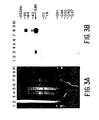
- FIG. 3 Southern blot hybridization of Hind III-restricted genomic DNAs and recombinant plasmid pMN23 encoding the 47 kDa immunogen of T. pallidum .
- Panel A 1% agarose gel containing HindIII-restricted genomic DNA of rabbit (lane 2), T. pallidum (lane 3), T. denticola (lane 4), T. phagedenis (lane 5), T. scoliodontum (lane 6), T. vincentii (lane 7), recombinant plasmid pMN23 (lane 8), and plasmid pBR322.
- Lanes 1 and 10 contain combined pBR322- Alu I and bacteriophage lambda-HindIII molecular weight markers.
- B Southern Blot of Panel A; a fragment of plasmid DNA from clone pMN23 was used as the labeled hybridization probe. Note the presence of the 3.85 kb homologous DNA Hind III-fragment present only in T. pallidum genomic DNA (lane 3) and the recombinant plasmid pMN23 (lane 8).
- FIG. 4 Radioimmunoprecipitation of the 47 kDa immunogen of T. pallidum from 125 I-labeled T. pallidum and 35 S-labeled E. coli recombinant clone pMN23. Lanes 1-3, 4-6, and 7-9 were immunoprecipitated with mAbs 11E3, 8G2, and 385 (control), respectively. Lanes 1, 4, and 7 contained 125 I-labeled T. pallidum antigens. Lanes 2, 5, and 8 contained 35 S-labeled products from the 47 kDa immunogen-expressing clone pMN23.
- Lanes 3, 6, and 9 contained 35 S-labeled products from clone pMN20, which expresses a 34 kDa immunogen of T. pallidum recognized by mAb 3B5. Protein molecular weights are indicated on the left (in kDa), derived from 14 C-molecular weight markers electrophoresed on the gel. Arrows indicate the location of the 47 kDa and 34 kDa immunogens.
- FIG. 5 Western blot of the 47 kDa immunogen expressed by recombinant clones pMN23 and pMN24. Solubilized antigens were detected after gel electrophoresis and protein transfer by incubation with anti-47 kDa mAb8G2, which produced its characteristic reactivity profile with the 47 kDa T. pallidum immunogen (lane 1). Lanes 2 and 3 contained the 47 kDa immunogen-expressing clones pMN23 and pMN24, respectively. Lanes 4, 5, and 6 contained the 34 kDa immunogen-expressing clone pMN20, pBR322 in E. coli RR1, and the 44 kDa immunogen-expressing clone pMN7, respectively, as negative controls.
- the present invention involves the use of a clone bank produced by conventional recombinant DNA techniques involving insertion of Treponema pallidum DNA fragments into a suitable vector and transferring the DNA fragments into a microorganism recipient.
- a clone bank produced by conventional recombinant DNA techniques involving insertion of Treponema pallidum DNA fragments into a suitable vector and transferring the DNA fragments into a microorganism recipient.
- any clone bank comprising Treponema pallidum DNA may be utilized, the preestablished (June 9, 1982) pBR322 hybrid clone bank described by the inventor was used as a preferred source of recombinant E. coli clones (Norgard et al. (1983), Infection and Immunity , 42 435-445). This clone bank of microorganisms was screened for clones producing a particular Treponema pallidum antigen.
- the screening was performed by observing interactions of clone colonies with antibodies specifically binding to the Treponema pallidum antigen of interest. Clones producing antigen of interest were selected, separated and propagated to produce Treponema pallidum antigen for further identification, characterization or use. This use may be, for example, in the detection of antibodies to Treponema pallidum or in the production of a vaccine useful for the induction of immunity to syphilis.
- An exemplary process for preparing microbial clones expressing the 47 kDa surface immunogen of Treponema pallidum is as follows: Initially the DNA of a microbial vector is cleaved, preferably by a restriction endonuclease, to produce a first DNA fragment. Said first DNA fragment is combined with a second DNA fragment, the second DNA fragment being from Treponema pallidum . Said first and second DNA fragments are characterized as being capable of recombination, and a recombinant vector bearing Treponema pallidum DNA is ligatively formed.
- a suitable microbial host is transfected with said recombinant vector to produce microbial clones expressing Treponema pallidum antigens.
- These microbial clones are then cultivated, preferably on the surface of a nutrient agar, to form visible colonies.
- the colonies are then contacted with an antibody having a specific affinity for the 47 kDa surface immunogen of Treponema pallidum .
- Microbial clone colonies having an affinity for the antibody are then identified and selected. Said selected colonies are characterized by their expression of the 47 kDa surface immunogen of Treponema pallidum .
- the 47 kDa surface immunogen described above may be defined by having a specific affinity for monoclonal antibody produced by murine hybridoma cell line 8G2 (American Type Culture Collection deposit number HB8134). Although most workers in the field have agreed on the 47 kDa size of this Treponema pallidum immunodominant surface immunogen, such weight determinations may vary to a minor extent.
- the microbial vector is most preferably a plasmid although other usable vectors such as many phages are well known in the art.
- the most preferred microbial vector is plasmid pBR322.
- the microbial vector is preferably cleaved with Pst I and dG-tailed to form the first DNA fragment.
- a monoclonal antibody as an antibody for identification and selection of clone colonies producing the 47 kDa surface immunogen.
- a most preferred monoclonal antibody is that produced by murine hybridoma cell line 8G2 (American Type Culture Collection number HB8134).
- a microbial host particularly preferred in the practice of this invention is of the species Escherichia coli .
- the second DNA fragment used for the formation of a recombinant vector for the creation of recombinant microorganisms is preferably from a partial restriction enzyme digest of Treponema pallidum or other pathogenic subspecies of Treponema .
- the second DNA fragment is preferably obtained from this partial restriction enzyme digest and tailed with dC residues.
- the recombinant plasmid adapted for transformation of a microbial host and formation of a Treponema pallidum immunogen comprises a plasmid vector into which a deoxyribonucleic acid (DNA) segment which codes for the 47 kDa surface immunogen of Treponema pallidum has been inserted.
- DNA deoxyribonucleic acid
- the recombinant plasmid according to the present invention is plasmid pMN23, which has been deposited with the American Type Culture Collection, Rockville, MD, as ATCC Deposit No. 67204.
- the transformant microorganisms of the present invention include a recombinant plasmid as mentioned above.
- the microorganism according to the present invention is of a strain of Escherichia coli having the deposition number ATCC 67204, said microorganism being capable of producing the 47 kDa surface immunogen of Treponema pallidum reactive with antibodies to Treponema pallidum ,
- the inserted Treponema pallidum DNA segment coding for the 47 kDa surface immunogen is shown as a 5.4 kb partially restriction enzyme-mapped fragment in Figure 2.
- the presence of antibodies to Treponema pallidum in biological fluids may be detected by a process of the present invention.
- a sample of biological fluid is first obtained and then a 47 kDa surface immunogen of Treponema pallidum produced by the recombinant DNA techniques of the present invention are added to the sample of biological fluid. Then, whether said immunogen reacts with antibodies to Treponema pallidum present in said sample may be determined by any of the numerous immunological methods for such determinations well known in the field.
- a microorganism of the strain Escherichia coli capable of producing the 47 kDa surface immunogen of Treponema pallidum has been produced by the processes described here and has been deposited with the American Type Culture Collection, Rockville, MD as ATCC Deposit No. 67204.
- This microorganism has an identifying characteristic of being reactive with antibodies to Treponema pallidum , particularly antibody to the 47 kDa surface immunogen of Treponema pallidum .
- Such 47 kDa recombinant-synthesized antigens identified by molecular mass (size) and immunological characteristics (binding of monoclonal antibodies 8G2 [ATCC No. HB-8134] and 11E3 [Patent No. 4,514,498 and Patent Application Serial No. 702,327]) as the 47 kDa surface immunogen of Treponema pallidum , may be used to prepare unique compositions of matter useful in the diagnosis of or vaccination against pathogenic treponemal infections such as by Treponema pallidum or other pathogenic subspecies of Treponema .
- a process for detecting the presence of Treponema pallidum in a clinical sample may be devised using plasmid pMN23 of the present invention coding for the 47 kDa surface immunogen of Treponema pallidum, or fragment thereof.
- nucleotide fragments are included within the 5.4 kb insert of plasmid pMN23 shown in Figure 2.
- This plasmid has been deposited with the American Type Culture Collection as ATCC Deposit No. 67204.
- Labeled nucleotide fragments may be prepared directly from the 5.4 kb insert or from complementary nucleotide fragments synthesized from the nucleotide sequences of that insert.
- a 1.28 kb fragment between about the Cla I cleavage site and the second internal Pst I cleavage site appeared to represent the smallest fragment (discounting any leader sequences) actually coding the 47 kDa structural surface immunogen.
- the methods and reagents described in U.S. Patent No. 4,358,535, which is incorporated by reference herein may be utilized but with the above-described Treponema pallidum nucleotide fragments or nucleotide sequences contained therein.
- the Treponema pallidum antigen of particular interest in this invention was the 47 kiloDalton (kDa) surface immunogen previously described (Jones et al. (1984) J. Exp. Med. , V 160, pp 1404-1420) and Marchitto et al. (1984) Infect. Immun. , V 45, pp 660-666).
- kDa 47 kiloDalton
- monoclonal antibodies specifically binding this antigen were used.
- These antibodies and the hybridomas producing them (8G2 [ATCC HB3184] and 11E3) are described in U.S. Patent No. 4,514,498 and pending U.S. Patent Application Serial No. 702,327.
- T. pallidum The virulent Nichols strain of Treponema pallidum subspecies pallidum ( T. pallidum ) was used as the representative pathogen in this study. It was maintained and cultivated in the testicles of New Zealand white rabbits as previously described (Norgard et al. (1983) Infect. Immun. , V 42, pp 435-445 and Robertson et al. (1982) Infect. Immun. , V 36, pp 1076-1085).
- E. coli RR1 harboring the plasmid pMN7 (old designation: RICB2-1) has been described (Norgard et al. (1983) Infect. Immun. , V 42, pp 435-445); pMN7 originated from the clone bank referenced below and it contains a 3.7-kilobase (kb) DNA insert of T. pallidum DNA cloned by GC-tailing into the Pst I site of pBR322. It encodes a 44 kDa reccmbination antigen unrelated to the 47 kDa antigen. The 44 kDa antigen of the clone pMN7 is immunoprecipitable by immune rabbit serum (Norgard et al.
- T. pallidum was purified frcm rabbit testicular tissue by the Percoll density gradient method (Hanff et al. (1984) Sex. Trans. Dis. , V 11, pp 275-286); bacteria were radiolabeled with Na- 125 I using a lactoperoxidase method (Alderete et al. (1980) (Infect. Immun. , V 30, pp 814-823, Jones et al., (1984) J. Exp. Med. , V 160, pp 1404-1420).
- coli RR1 harboring various pBR322 plasmid derivatives were metabolically labeled with L- 35 S-methionine as previously described (Norgard et al. (1983) Infect. Immun. , V 42, pp 435-445). All probe DNA was radiolabeled with alpha- 32 P-dCTP using the nick translation kit of New England Nuclear (Boston, MA). Antibody probes were radiolabeled with Na- 125 I using a chloramine T method (Hunter et al. (1962) Nature , V 194, pp 495-496).
- Southern blots were performed according to the previously published method (Norgard et al. (1981) Science , V 213, pp 553-555, Southern (1975) J. Mol. Biol. , V 98, pp 503-517, (Swancutt et al. (1986) Infect. Immun. , V 52, pp 110-119).
- a DNA restriction enzyme fragment was isolated from low melt agarose by Elutip TM (Schleicher & Schuell, Keene, NH) affinity chromatography (Schmitt et al. (1983) Anal. Biochem., V 13, pp 462-464).
- filters were washed 3 times (30 min per wash) at room temperature with 500 ml portions of 2X SSC+0.1% sodium dodecyl sulfate followed by an additional 3 washes at room temperature (30 min per wash) using 500 ml portions of 0.1X SSC+0.1% sodium dodecyl sulfate. Filters were dried and subjected to autoradiography (Laskey (1977) FEBS Lett. , V 82, pp 314-316).
- Murine mAbs 8G2 (IgGl), 11E3 (IgG2a), and 3B5 (IgGl) directed specifically against T. pallidum were generated, maintained, and characterized as previously described (Jones et al. (1984) J. Exp. Med. , V 160, pp 1404-1420; Marchitto et al. (1984) Infect. Immun. , V 45, pp 660-666; Marchitto et al. (1986) Infect. Immun. , V 51, pp 168-176; Norgard et al. (1984) J. Clin. Microbiol.
- MAb 11E3 has been described in detail (Jones et al. (1984) J. Exp. Med. , V 160, pp 1404-1420; Marchitto et al. (1984) Infect. Immun. , V 45, pp 660-666; Marchitto et al. (1986) Infect. Immun. , V 51, pp 168-176; and Norgard et al. (1984) J. Clin. Microbiol.
- MAbs 8G2 and 11E3 are directed against the major 47 kDa immunogen (Jones et al., (1984) J. Exp. Med. , V 160, pp 1404-1420, Marchitto et al. (1984) Infect. Immun., V 45, pp 660-666).
- MAb 3B5 reacts with a 34 kDa surface immunogen of T. pallidum (Swancutt et al. (1986) Infect. Immun. , V 52, pp 110-119).
- MAbs were used within in vitro hybridoma clone supernatants or were affinity purified from hybridoma clone supernatants using individual protein A-Sepharose columns (Ey et al. (1978) Immunochemistry , V 15, pp 429-436).
- MAbs C2-1 (IgM) and H9-1 (IgGl) were directed against "common” and "pathogen-specific" epitopes of T. pallidum ,respectively (Hook et al. (1985) J. Clin. Microbiol. , V 22, pp 241-244, Lukehart et al. (1985) J. Immunol. , V 134, pp 585-592).
- Rabbit anti- T. pallidum serum (immune rabbit serum) was obtained and pooled from 4 animals 3 to 12 months following a firm orchitis in both testicles after T. pallidum intratesticular infection; immune rabbits were shown to be "chancre immune” when challenged intradermally with 1 x 10 5 motile T. pallidum per site (Jones et al., (1984) J. Exp. Med. , V 160, pp 1404-1420). Rabbit anti-T. phagedenis biotype Reiter antiserum was provided by S.A. Lukehart. Seven human secondary syphilitic serum samples were provided by Dr.
- Radioimmuno-Colony Blot Assay The radioimmuno-colony blot (RICB) assay for the detection of E. coli clone colonies synthesizing T. pallidum antigens was carried out according to Norgard and Miller (Norgard et al. (1983) Infect. Immun. , V 42, pp 435-445) with minor modifications (Swancutt et al. (1986) Infect. Immun. , V 52, pp 110-119).
- Radioimmunoprecipitation was performed as previously described (Swancutt et al. (1986) Infect. Immun. , V 52, pp 110-119) with minor modifications.
- RIP Radioimmunoprecipitation
- For the radioimmuno-precipitation of T. pallidum approximately 5 x 10 6 counts per min of 125 I-labeled treponemes (1-3 counts per min per treponeme) were incubated in 1.0 ml of solubilization buffer (10 mM Tris-HCl [pH 7.8], 150 mM NaCl, 10 mM EDTA, and 0.2% Zwittergent 3-12 [Calbiochem-Behring Corp., La Jolla, CA]).
- Western Blots Western Blots . Western blots were performed as previously described (Marchitto et al. (1984) Infect. Immun. , V 45, pp 660-666). For the analysis of T. pallidum antigens, approximately 1 x 10 7 solubilized treponemes per polyacrylamide gel lane were blotted. For E. coli recombinant derivatives, approximately 1 x 10 8 solubilized E. coli per gel lane were used.
- FIG. 1 shows the results of RICB assays using mAbs.
- MAb 3B5 directed against a 34 kDa surface immunogen of T. pallidum (Swancutt et al. (1986) Infect. Immun. , V 52, pp 110-119), reacted only with T. pallidum .
- mAb C2-1 directed against a common treponemal epitope (Hook et al. (1985) J. Clin. Microbiol. , V 22, pp 241-244, Lukehart et al. (1985) J. Immunol. , V 134, pp 585-592), reacted with T. pallidum and T. phagendenis biotype Reiter, but not with any E. coli clones (not shown).
- FIG. 2 shows a preliminary restriction enzyme map of the 5.4 kb insert of plasmid pMN23.
- the pMN23 insert is flanked by short dGC tails inside Pst I sites, with 5 internal Pst I sites located within the insert.
- a strategic fragment for structural analysis of the 47 kDa immunogen encoding region included a 3.85 kb Hind III fragment; subcloning of this fragment into the Hind III site of pBR322, however, failed to result in expression of the relevant epitope(s) when 54 ampicillin-resistant, tetracycline-sensitive, 3.85 kb HindIII fragment-containing subclones were tested in the RICB assay using mAbs 11E3 or 8G2.
- Analogous restriction enzyme mapping of clone pMN24 revealed the presence of restriction enzyme fragments similar to those of pMN23. Thus, pMN23 and pMN24 may be identical.
- FIG. 3A contained Hind III-restricted preparations of genomic DNAs from T. pallidum , rabbit liver, and four nonpathogenic treponemes.
- lanes 3 and 8 of Fig. 3B the 3.85 kb Hind III probe hybridized to a 3.85 kb Hind III fragment of T. pallidum DNA and to itself; no hybridization with rabbit DNA, the DNAs of four nonpathogenic treponemes, or control DNA (lambda or pBR322) was observed.
- Multiple hybridizing bands observed in Hind III-cleaved pMN23 (Fig. 3B, lane 8) represented the minute proportion of pMN23 not completely restricted by HindIII treatment.
- Fig. 4 shows the results of RIP assays performed using 125 I-labeled T. pallidum and 35 S-labeled recombinant clones pMN23 and pMN20 as antigens. Solubilized antigens were immunoprecipitated using mAbs 11E3, 8G2, and 3B5. MAb 3B5, directed against a 34 kDa immunogen of T. pallidum (lane 7), was used as a control. MAbs 11E3 and 8G2 immunoprecipitated the 47 kDa immunogen from 125 I-labeled T. pallidum (Fig. 4, lanes 1, 4).
- the 48 kDa immunogen of T. pallidum may be a glycoprotein (Lukehart et al., (1982) J. Immunol. , V 129, pp 833-838).
- F-pilin of E. coli may be considered a glycoprotein (containing one glucose and possibly one each of galactose and of a dideoxy hexose) (Willetts et al. (1980) Ann. Rev. Genet. , V 14, pp 41-76)
- the precedent for glycoproteins in prokaryotes is poor.
- the fact that E. coli expresses a 47 kDa antigen with an identical electrophoretic mobility to the native 47 kDa immunogen of T. pallidum suggests that the 47 kDa immunogen is not a glycoprotein.
- the native 47 kDa immunogen often appears as a "47-48 kDa doublet" on Western blots of the immunogen (Marchitto et al. (1984) Infect. Immun. , V 45, pp 660-666; and Norgard et al. (1984) J. Clin. Microbiol. , V 20, pp 711-717).
- the appearance of the "doublet” is obscured in RIP analysis (Jones et al., (1984) J. Exp. Med. , V 160, pp 1404-1420), presumably due to the intensity of the broad radioactive band appearing on the polyacrylamide gel.
- the 48 kDa component may represent unprocessed outer membrane protein precursor which is subsequently cleaved to the lower molecular weight (mature) 47 kDa form during transmembrane secretion.
- the 48 kDa component may represent some post-translational modification of the 47 kDa product.
- the recombinant DNA-derived 47 kDa immunogen has not yet been observed to exhibit the 47-48 kDa doublet phenomenon, although this may be due to undetectably low levels of 48 kDa product expressed in E. coli .
- Subcloning of the 47 kDa gene into an expression vector should help to clarify the observation.
- DNA sequencing studies also will be instrumental in establishing the primary amino acid sequence of a mature 47 kDa immunogen and any possible precursor form.
- DNA encoding the 47 kDa antigen may be useful as a diagnostic DNA probe (Moseley et al. (1980) J. Infect. Dis., V 142, pp 892-898) to identify treponemal pathogens in genital ulcers, skin lesions, and other body fluids.
- Purified 47 kDa immunogen can be used to re-examine, using in vitro and in vivo methods, both humoral and cell-mediated immune responses to purified antigens; this may help to further clarify the respective roles of both arms of the immune response to T. pallidum infection in the host.
- the recombinant DNA-derived immunogen also may provide the basis for an improved serological test for syphilis, potentially possessing increased specificity and simplicity over currently employed methods. Additionally, recombinant immunogen should allow direct assessment of the immunogenic potential of the 47 kDa immunogen. Inasmuch as the 47 kDa immunogen has, at the very least, pathogen-specific epitopes, the demonstration of vaccinogenic potential for the recombinant molecule may be extended to a broad spectrum treponemal vaccine.
Landscapes
- Health & Medical Sciences (AREA)
- Life Sciences & Earth Sciences (AREA)
- Chemical & Material Sciences (AREA)
- Molecular Biology (AREA)
- Immunology (AREA)
- Engineering & Computer Science (AREA)
- Biomedical Technology (AREA)
- Biochemistry (AREA)
- General Health & Medical Sciences (AREA)
- Hematology (AREA)
- Medicinal Chemistry (AREA)
- Organic Chemistry (AREA)
- Urology & Nephrology (AREA)
- Physics & Mathematics (AREA)
- Gastroenterology & Hepatology (AREA)
- Microbiology (AREA)
- Cell Biology (AREA)
- Analytical Chemistry (AREA)
- Biotechnology (AREA)
- Virology (AREA)
- General Physics & Mathematics (AREA)
- Pathology (AREA)
- Food Science & Technology (AREA)
- Biophysics (AREA)
- Genetics & Genomics (AREA)
- Proteomics, Peptides & Aminoacids (AREA)
- Tropical Medicine & Parasitology (AREA)
- Preparation Of Compounds By Using Micro-Organisms (AREA)
- Medicines Containing Antibodies Or Antigens For Use As Internal Diagnostic Agents (AREA)
- Peptides Or Proteins (AREA)
- Micro-Organisms Or Cultivation Processes Thereof (AREA)
- Measuring Or Testing Involving Enzymes Or Micro-Organisms (AREA)
Applications Claiming Priority (3)
| Application Number | Priority Date | Filing Date | Title |
|---|---|---|---|
| US913724 | 1986-09-30 | ||
| US06/913,724 US4868118A (en) | 1986-09-30 | 1986-09-30 | Cloning and expression of the 47-kilodalton antigen of treponema pallidum |
| PCT/US1987/002403 WO1988002403A1 (en) | 1986-09-30 | 1987-09-21 | Cloning and expression of the 47-kilodalton antigen of treponema pallidum |
Publications (2)
| Publication Number | Publication Date |
|---|---|
| EP0324774A1 EP0324774A1 (en) | 1989-07-26 |
| EP0324774B1 true EP0324774B1 (en) | 1996-08-14 |
Family
ID=25433526
Family Applications (1)
| Application Number | Title | Priority Date | Filing Date |
|---|---|---|---|
| EP87906542A Expired - Lifetime EP0324774B1 (en) | 1986-09-30 | 1987-09-21 | Recombinant plasmid comprising a fragment of a dna segment coding for a 47 kda surface immunogen of treponema pallidum |
Country Status (11)
| Country | Link |
|---|---|
| US (1) | US4868118A (enExample) |
| EP (1) | EP0324774B1 (enExample) |
| JP (1) | JPH02500403A (enExample) |
| AT (1) | ATE141325T1 (enExample) |
| AU (1) | AU8021487A (enExample) |
| CA (1) | CA1336692C (enExample) |
| CH (1) | CH676606A5 (enExample) |
| DE (1) | DE3751870T2 (enExample) |
| DK (1) | DK293988A (enExample) |
| IL (1) | IL84006A (enExample) |
| WO (1) | WO1988002403A1 (enExample) |
Families Citing this family (13)
| Publication number | Priority date | Publication date | Assignee | Title |
|---|---|---|---|---|
| US5681934A (en) * | 1986-09-30 | 1997-10-28 | Board Of Regents, The University Of Texas System | 47-kilodalton antigen of Treponema pallidum |
| US4956230A (en) * | 1987-04-13 | 1990-09-11 | Minnesota Mining And Manufacturing Company | Ink receptive transparency sheet |
| WO1990015132A2 (en) * | 1989-05-24 | 1990-12-13 | Syntro Corporation | Cloned treponema hyodysenteriae endoflagellar antigen |
| US5474900A (en) * | 1990-03-16 | 1995-12-12 | Sekisui Chemical Co., Ltd. | Process for preparing purified syphilis antigen from Treponema palljdum |
| FR2707168B1 (fr) * | 1993-07-08 | 1995-08-18 | Rhone Merieux | Vaccin contre la dysenterie hémorragique du porc et ensemble de vaccination y relatif. |
| RU2103362C1 (ru) * | 1995-07-14 | 1998-01-27 | Товарищество с ограниченной ответственностью Биотехнологическая компания "БИОСЕРВИС" | Набор для обнаружения антител к бледной спирохете treponema pallidum, рекомбинантный полипептидный антиген treponema pallidum 15 кда, рекомбинантный полипептидный антиген treponema pallidum 17 кда и рекомбинантный полипептидный антиген treponema pallidum tmp a |
| DE19536166C1 (de) * | 1995-09-29 | 1997-03-06 | Siegfried Dr Krell | Verfahren zur Bestimmung von Antikörpern gegen Treponema pallidum (Syphilis) |
| US6020128A (en) * | 1997-06-10 | 2000-02-01 | United States Of Ameria | DNA polymerase from Treponema pallidum |
| WO1999053099A1 (en) * | 1998-04-10 | 1999-10-21 | University Of Washington | Recombinant proteins of treponema pallidum and their use for a syphilis vaccine |
| US6667038B1 (en) * | 1999-04-21 | 2003-12-23 | Boston Medical Center Corp. | Prevention, diagnosis and treatment of lyme disease |
| CA2794710C (en) | 2010-03-31 | 2018-05-08 | Sekisui Medical Co., Ltd. | Reagent for assaying anti-treponema pallidum antibody |
| JP5911889B2 (ja) | 2011-01-13 | 2016-04-27 | オーソ−クリニカル・ダイアグノスティックス・インコーポレイテッドOrtho−Clinical Diagnostics, Inc. | 梅毒トレポネーマトリプレット抗原 |
| CN112772552B (zh) * | 2020-12-31 | 2022-05-17 | 青岛胶南康大饲料有限公司 | 肉兔饲养方法 |
Family Cites Families (3)
| Publication number | Priority date | Publication date | Assignee | Title |
|---|---|---|---|---|
| SE427516B (sv) * | 1981-11-10 | 1983-04-11 | Ericsson Telefon Ab L M | Sett och anordning for att korrigera distortion i en pa elektronisk veg upptecknad av bildelement lengs linjer uppbyggd bild |
| US4514498A (en) * | 1982-05-26 | 1985-04-30 | The Board Of Regents, The University Of Texas System | Hybrid cell lines producing monoclonal antibodies directed against Treponema |
| JPS59502131A (ja) * | 1982-11-12 | 1984-12-27 | ザ リ−ジエンツ オブ ユニバ−シテイ オブ カリフオルニア | 組換えdna誘導型梅毒トレポネ−マ抗原 |
-
1986
- 1986-09-30 US US06/913,724 patent/US4868118A/en not_active Expired - Lifetime
-
1987
- 1987-09-21 WO PCT/US1987/002403 patent/WO1988002403A1/en not_active Ceased
- 1987-09-21 EP EP87906542A patent/EP0324774B1/en not_active Expired - Lifetime
- 1987-09-21 AU AU80214/87A patent/AU8021487A/en not_active Abandoned
- 1987-09-21 DE DE3751870T patent/DE3751870T2/de not_active Expired - Lifetime
- 1987-09-21 JP JP62505911A patent/JPH02500403A/ja active Pending
- 1987-09-21 AT AT87906542T patent/ATE141325T1/de not_active IP Right Cessation
- 1987-09-21 CH CH2160/88A patent/CH676606A5/de not_active IP Right Cessation
- 1987-09-23 CA CA000547633A patent/CA1336692C/en not_active Expired - Lifetime
- 1987-09-27 IL IL84006A patent/IL84006A/xx not_active IP Right Cessation
-
1988
- 1988-05-30 DK DK293988A patent/DK293988A/da not_active Application Discontinuation
Non-Patent Citations (3)
| Title |
|---|
| INFECTION & IMMUNITY, vol. 45, no. 3, September 1984, American Society for Microbiology, US; K.S. MARCHITTO et al., pp. 660-666 * |
| INFECTION & IMMUNITY, vol. 52, no. 1, April 1986, American Society for Microbiology, US; M.A. SWANCUTT et al., pp. 110-119 * |
| INFECTION & IMMUNITY, vol. 54, no. 2, November 1986, American Society for Microbiology, US; M.V. NORGARD et al., pp. 500-506 * |
Also Published As
| Publication number | Publication date |
|---|---|
| US4868118A (en) | 1989-09-19 |
| JPH02500403A (ja) | 1990-02-15 |
| EP0324774A1 (en) | 1989-07-26 |
| CA1336692C (en) | 1995-08-15 |
| AU8021487A (en) | 1988-04-21 |
| WO1988002403A1 (en) | 1988-04-07 |
| DK293988D0 (da) | 1988-05-30 |
| CH676606A5 (enExample) | 1991-02-15 |
| DK293988A (da) | 1988-07-14 |
| IL84006A0 (en) | 1988-02-29 |
| ATE141325T1 (de) | 1996-08-15 |
| IL84006A (en) | 1992-11-15 |
| DE3751870D1 (de) | 1996-09-19 |
| DE3751870T2 (de) | 1997-03-20 |
Similar Documents
| Publication | Publication Date | Title |
|---|---|---|
| EP0462210B1 (en) | Vaccines for nontypable haemophilus influenzae | |
| US6509019B1 (en) | Immunologically active proteins from Borrelia burgdorferi | |
| Norgard et al. | Cloning and expression of the major 47-kilodalton surface immunogen of Treponema pallidum in Escherichia coli | |
| EP0196215A1 (en) | Recombinant surface antigens of swine mycoplasma and vaccines and diagnostics based on them | |
| Coleman et al. | Identification and characterization of an endoflagellar antigen of Borrelia burgdorferi. | |
| EP0324774B1 (en) | Recombinant plasmid comprising a fragment of a dna segment coding for a 47 kda surface immunogen of treponema pallidum | |
| CA1332366C (en) | Leukotoxin gene of pasteurella haemolytica | |
| CA1341133C (en) | Chlamydia major outer membrane protein | |
| JP2776633B2 (ja) | ストレプトコッカス・スイスの病毒性をコードするdna配列,該dna配列の一部,該dna配列に由来するポリペプチドおよび抗体 | |
| Wise et al. | A family of strain-variant surface lipoproteins of Mycoplasma fermentans | |
| US5324630A (en) | Methods and compositions for diagnosing lyme disease | |
| US5350842A (en) | DNAs encoding Treponema pallidum antigens | |
| US5369005A (en) | Method for mycoplasma detection in a biological sample | |
| Purcell et al. | Molecular cloning and characterization of the 15-kilodalton major immunogen of Treponema pallidum | |
| Chamberlain et al. | Genetic and physicochemical characterization of the recombinant DNA-derived 47-kilodalton surface immunogen of Treponema pallidum subsp. pallidum | |
| US6610301B1 (en) | Immunologically active proteins from Borrelia burgdorferi, nucleic acids which encode them, and their use in test kits and as vaccines | |
| Swancutt et al. | Monoclonal antibody selection and analysis of a recombinant DNA-derived surface immunogen of Treponema pallidum expressed in Escherichia coli | |
| Vosloo et al. | Characterisation of a lipoprotein in Mycobacterium bovis (BCG) with sequence similarity to the secreted protein MPB70 | |
| US5026636A (en) | Methods and compositions for production of mycoplasmal adhesins | |
| Lee et al. | Identification of the gene encoding BmpB, a 30 kDa outer envelope lipoprotein of Brachyspira (Serpulina) hyodysenteriae, and immunogenicity of recombinant BmpB in mice and pigs | |
| EP0293079A2 (en) | Chlamydia vaccine | |
| US5885589A (en) | Pasteurella vaccine | |
| WO1992012235A1 (en) | FLAGELLA-LESS $i(BORRELIA) | |
| JPH022357A (ja) | ヘモフィルス・インフルエンゼb型主外層膜蛋白質抗原の製造方法および組成物 | |
| Bailey et al. | Monoclonal antibodies directed against surface-associated polypeptides of Treponema pallidum define a biologically active antigen |
Legal Events
| Date | Code | Title | Description |
|---|---|---|---|
| PUAI | Public reference made under article 153(3) epc to a published international application that has entered the european phase |
Free format text: ORIGINAL CODE: 0009012 |
|
| 17P | Request for examination filed |
Effective date: 19890329 |
|
| AK | Designated contracting states |
Kind code of ref document: A1 Designated state(s): AT BE CH DE FR GB IT LI LU NL SE |
|
| 17Q | First examination report despatched |
Effective date: 19911212 |
|
| GRAH | Despatch of communication of intention to grant a patent |
Free format text: ORIGINAL CODE: EPIDOS IGRA |
|
| GRAH | Despatch of communication of intention to grant a patent |
Free format text: ORIGINAL CODE: EPIDOS IGRA |
|
| GRAA | (expected) grant |
Free format text: ORIGINAL CODE: 0009210 |
|
| AK | Designated contracting states |
Kind code of ref document: B1 Designated state(s): AT BE CH DE FR GB IT LI LU NL SE |
|
| PG25 | Lapsed in a contracting state [announced via postgrant information from national office to epo] |
Ref country code: LI Free format text: LAPSE BECAUSE OF FAILURE TO SUBMIT A TRANSLATION OF THE DESCRIPTION OR TO PAY THE FEE WITHIN THE PRESCRIBED TIME-LIMIT Effective date: 19960814 Ref country code: CH Free format text: LAPSE BECAUSE OF FAILURE TO SUBMIT A TRANSLATION OF THE DESCRIPTION OR TO PAY THE FEE WITHIN THE PRESCRIBED TIME-LIMIT Effective date: 19960814 Ref country code: BE Effective date: 19960814 Ref country code: AT Effective date: 19960814 |
|
| REF | Corresponds to: |
Ref document number: 141325 Country of ref document: AT Date of ref document: 19960815 Kind code of ref document: T |
|
| RTI1 | Title (correction) | ||
| REF | Corresponds to: |
Ref document number: 3751870 Country of ref document: DE Date of ref document: 19960919 |
|
| PG25 | Lapsed in a contracting state [announced via postgrant information from national office to epo] |
Ref country code: LU Free format text: LAPSE BECAUSE OF NON-PAYMENT OF DUE FEES Effective date: 19960930 |
|
| ITF | It: translation for a ep patent filed | ||
| PG25 | Lapsed in a contracting state [announced via postgrant information from national office to epo] |
Ref country code: SE Effective date: 19961114 |
|
| ET | Fr: translation filed | ||
| REG | Reference to a national code |
Ref country code: CH Ref legal event code: PL |
|
| PLBE | No opposition filed within time limit |
Free format text: ORIGINAL CODE: 0009261 |
|
| STAA | Information on the status of an ep patent application or granted ep patent |
Free format text: STATUS: NO OPPOSITION FILED WITHIN TIME LIMIT |
|
| 26N | No opposition filed | ||
| REG | Reference to a national code |
Ref country code: GB Ref legal event code: IF02 |
|
| PGFP | Annual fee paid to national office [announced via postgrant information from national office to epo] |
Ref country code: NL Payment date: 20060903 Year of fee payment: 20 |
|
| PGFP | Annual fee paid to national office [announced via postgrant information from national office to epo] |
Ref country code: FR Payment date: 20060908 Year of fee payment: 20 |
|
| PGFP | Annual fee paid to national office [announced via postgrant information from national office to epo] |
Ref country code: DE Payment date: 20060914 Year of fee payment: 20 |
|
| PGFP | Annual fee paid to national office [announced via postgrant information from national office to epo] |
Ref country code: GB Payment date: 20060920 Year of fee payment: 20 |
|
| PGFP | Annual fee paid to national office [announced via postgrant information from national office to epo] |
Ref country code: IT Payment date: 20060930 Year of fee payment: 20 |
|
| REG | Reference to a national code |
Ref country code: GB Ref legal event code: PE20 |
|
| NLV7 | Nl: ceased due to reaching the maximum lifetime of a patent |
Effective date: 20070921 |
|
| PG25 | Lapsed in a contracting state [announced via postgrant information from national office to epo] |
Ref country code: GB Free format text: LAPSE BECAUSE OF EXPIRATION OF PROTECTION Effective date: 20070920 |
|
| PG25 | Lapsed in a contracting state [announced via postgrant information from national office to epo] |
Ref country code: NL Free format text: LAPSE BECAUSE OF EXPIRATION OF PROTECTION Effective date: 20070921 |