EP0323816B1 - Method of detecting enterogastric reflux and apparatus for the implementation of this method - Google Patents
Method of detecting enterogastric reflux and apparatus for the implementation of this method Download PDFInfo
- Publication number
- EP0323816B1 EP0323816B1 EP88830561A EP88830561A EP0323816B1 EP 0323816 B1 EP0323816 B1 EP 0323816B1 EP 88830561 A EP88830561 A EP 88830561A EP 88830561 A EP88830561 A EP 88830561A EP 0323816 B1 EP0323816 B1 EP 0323816B1
- Authority
- EP
- European Patent Office
- Prior art keywords
- radiation
- gastric juice
- detecting
- wavelengths
- bile
- Prior art date
- Legal status (The legal status is an assumption and is not a legal conclusion. Google has not performed a legal analysis and makes no representation as to the accuracy of the status listed.)
- Expired - Lifetime
Links
- 238000000034 method Methods 0.000 title claims abstract description 33
- 238000010992 reflux Methods 0.000 title claims abstract description 33
- 230000005855 radiation Effects 0.000 claims abstract description 52
- 210000004051 gastric juice Anatomy 0.000 claims abstract description 43
- 210000000941 bile Anatomy 0.000 claims abstract description 30
- 238000010521 absorption reaction Methods 0.000 claims abstract description 21
- 230000005670 electromagnetic radiation Effects 0.000 claims abstract description 5
- 239000000835 fiber Substances 0.000 claims description 35
- BPYKTIZUTYGOLE-IFADSCNNSA-N Bilirubin Chemical compound N1C(=O)C(C)=C(C=C)\C1=C\C1=C(C)C(CCC(O)=O)=C(CC2=C(C(C)=C(\C=C/3C(=C(C=C)C(=O)N\3)C)N2)CCC(O)=O)N1 BPYKTIZUTYGOLE-IFADSCNNSA-N 0.000 claims description 20
- 238000001514 detection method Methods 0.000 claims description 16
- 210000002784 stomach Anatomy 0.000 claims description 15
- 210000000056 organ Anatomy 0.000 claims description 13
- 238000005259 measurement Methods 0.000 claims description 12
- 229910052736 halogen Inorganic materials 0.000 claims description 6
- 150000002367 halogens Chemical class 0.000 claims description 6
- 238000012545 processing Methods 0.000 claims description 4
- 238000011835 investigation Methods 0.000 claims description 3
- 239000000463 material Substances 0.000 claims description 3
- 238000001914 filtration Methods 0.000 claims description 2
- 239000000523 sample Substances 0.000 description 14
- 230000005540 biological transmission Effects 0.000 description 10
- 238000012544 monitoring process Methods 0.000 description 8
- 238000010586 diagram Methods 0.000 description 7
- 239000013307 optical fiber Substances 0.000 description 5
- 230000000694 effects Effects 0.000 description 4
- 235000013305 food Nutrition 0.000 description 4
- 238000012360 testing method Methods 0.000 description 4
- 210000003238 esophagus Anatomy 0.000 description 3
- 210000004877 mucosa Anatomy 0.000 description 3
- HEDRZPFGACZZDS-UHFFFAOYSA-N Chloroform Chemical compound ClC(Cl)Cl HEDRZPFGACZZDS-UHFFFAOYSA-N 0.000 description 2
- 230000037406 food intake Effects 0.000 description 2
- 235000011389 fruit/vegetable juice Nutrition 0.000 description 2
- 238000013110 gastrectomy Methods 0.000 description 2
- 239000011521 glass Substances 0.000 description 2
- 230000007935 neutral effect Effects 0.000 description 2
- 230000002093 peripheral effect Effects 0.000 description 2
- 239000000049 pigment Substances 0.000 description 2
- 238000002798 spectrophotometry method Methods 0.000 description 2
- 208000004300 Atrophic Gastritis Diseases 0.000 description 1
- GWZYPXHJIZCRAJ-UHFFFAOYSA-N Biliverdin Natural products CC1=C(C=C)C(=C/C2=NC(=Cc3[nH]c(C=C/4NC(=O)C(=C4C)C=C)c(C)c3CCC(=O)O)C(=C2C)CCC(=O)O)NC1=O GWZYPXHJIZCRAJ-UHFFFAOYSA-N 0.000 description 1
- RCNSAJSGRJSBKK-NSQVQWHSSA-N Biliverdin IX Chemical compound N1C(=O)C(C)=C(C=C)\C1=C\C1=C(C)C(CCC(O)=O)=C(\C=C/2C(=C(C)C(=C/C=3C(=C(C=C)C(=O)N=3)C)/N\2)CCC(O)=O)N1 RCNSAJSGRJSBKK-NSQVQWHSSA-N 0.000 description 1
- 206010015150 Erythema Diseases 0.000 description 1
- 208000036495 Gastritis atrophic Diseases 0.000 description 1
- 230000003321 amplification Effects 0.000 description 1
- QBUVFDKTZJNUPP-UHFFFAOYSA-N biliverdin-IXalpha Natural products N1C(=O)C(C)=C(C=C)C1=CC1=C(C)C(CCC(O)=O)=C(C=C2C(=C(C)C(C=C3C(=C(C=C)C(=O)N3)C)=N2)CCC(O)=O)N1 QBUVFDKTZJNUPP-UHFFFAOYSA-N 0.000 description 1
- 210000000038 chest Anatomy 0.000 description 1
- 208000016644 chronic atrophic gastritis Diseases 0.000 description 1
- 210000001198 duodenum Anatomy 0.000 description 1
- 231100000321 erythema Toxicity 0.000 description 1
- 235000012631 food intake Nutrition 0.000 description 1
- 210000001156 gastric mucosa Anatomy 0.000 description 1
- 208000021302 gastroesophageal reflux disease Diseases 0.000 description 1
- 230000009931 harmful effect Effects 0.000 description 1
- 229910052739 hydrogen Inorganic materials 0.000 description 1
- 239000001257 hydrogen Substances 0.000 description 1
- -1 hydrogen ions Chemical class 0.000 description 1
- 206010020718 hyperplasia Diseases 0.000 description 1
- 238000000338 in vitro Methods 0.000 description 1
- 238000001727 in vivo Methods 0.000 description 1
- 239000007788 liquid Substances 0.000 description 1
- 235000021056 liquid food Nutrition 0.000 description 1
- 238000003199 nucleic acid amplification method Methods 0.000 description 1
- 230000003287 optical effect Effects 0.000 description 1
- 230000035515 penetration Effects 0.000 description 1
- 230000004044 response Effects 0.000 description 1
- 229910001220 stainless steel Inorganic materials 0.000 description 1
- 239000010935 stainless steel Substances 0.000 description 1
- 239000000126 substance Substances 0.000 description 1
- 208000011580 syndromic disease Diseases 0.000 description 1
- 210000001519 tissue Anatomy 0.000 description 1
- 238000000411 transmission spectrum Methods 0.000 description 1
Images
Classifications
-
- A—HUMAN NECESSITIES
- A61—MEDICAL OR VETERINARY SCIENCE; HYGIENE
- A61B—DIAGNOSIS; SURGERY; IDENTIFICATION
- A61B5/00—Measuring for diagnostic purposes; Identification of persons
- A61B5/0059—Measuring for diagnostic purposes; Identification of persons using light, e.g. diagnosis by transillumination, diascopy, fluorescence
- A61B5/0082—Measuring for diagnostic purposes; Identification of persons using light, e.g. diagnosis by transillumination, diascopy, fluorescence adapted for particular medical purposes
- A61B5/0084—Measuring for diagnostic purposes; Identification of persons using light, e.g. diagnosis by transillumination, diascopy, fluorescence adapted for particular medical purposes for introduction into the body, e.g. by catheters
-
- A—HUMAN NECESSITIES
- A61—MEDICAL OR VETERINARY SCIENCE; HYGIENE
- A61B—DIAGNOSIS; SURGERY; IDENTIFICATION
- A61B5/00—Measuring for diagnostic purposes; Identification of persons
- A61B5/42—Detecting, measuring or recording for evaluating the gastrointestinal, the endocrine or the exocrine systems
- A61B5/4211—Diagnosing or evaluating reflux
-
- G—PHYSICS
- G01—MEASURING; TESTING
- G01N—INVESTIGATING OR ANALYSING MATERIALS BY DETERMINING THEIR CHEMICAL OR PHYSICAL PROPERTIES
- G01N21/00—Investigating or analysing materials by the use of optical means, i.e. using sub-millimetre waves, infrared, visible or ultraviolet light
- G01N21/17—Systems in which incident light is modified in accordance with the properties of the material investigated
- G01N21/25—Colour; Spectral properties, i.e. comparison of effect of material on the light at two or more different wavelengths or wavelength bands
- G01N21/31—Investigating relative effect of material at wavelengths characteristic of specific elements or molecules, e.g. atomic absorption spectrometry
- G01N21/314—Investigating relative effect of material at wavelengths characteristic of specific elements or molecules, e.g. atomic absorption spectrometry with comparison of measurements at specific and non-specific wavelengths
- G01N21/3151—Investigating relative effect of material at wavelengths characteristic of specific elements or molecules, e.g. atomic absorption spectrometry with comparison of measurements at specific and non-specific wavelengths using two sources of radiation of different wavelengths
-
- G—PHYSICS
- G01—MEASURING; TESTING
- G01N—INVESTIGATING OR ANALYSING MATERIALS BY DETERMINING THEIR CHEMICAL OR PHYSICAL PROPERTIES
- G01N21/00—Investigating or analysing materials by the use of optical means, i.e. using sub-millimetre waves, infrared, visible or ultraviolet light
- G01N21/17—Systems in which incident light is modified in accordance with the properties of the material investigated
- G01N21/25—Colour; Spectral properties, i.e. comparison of effect of material on the light at two or more different wavelengths or wavelength bands
- G01N21/31—Investigating relative effect of material at wavelengths characteristic of specific elements or molecules, e.g. atomic absorption spectrometry
- G01N21/314—Investigating relative effect of material at wavelengths characteristic of specific elements or molecules, e.g. atomic absorption spectrometry with comparison of measurements at specific and non-specific wavelengths
- G01N2021/3181—Investigating relative effect of material at wavelengths characteristic of specific elements or molecules, e.g. atomic absorption spectrometry with comparison of measurements at specific and non-specific wavelengths using LEDs
Definitions
- the invention relates to a method of detecting enterogastric reflux and to apparatus for implementing said method.
- Enterogastric reflux i.e. the reflux of bile from the duodenum into the stomach, is an important phenomenon in gastroenterology. It has, in fact, been found that the presence of bile in the gastric juice can have a harmful effect on the esophageal mucosa. Furthermore, although it has not yet been shown that the said reflux has a manifest effect on the nonoperated stomach, it has been demonstrated that erythema and foveolate hyperplasia of the gastric mucosa correlate with enterogastric reflux after partial gastrectomy. In addition, enterogastric reflux can be responsible for a number of dyspeptic syndromes of uncertain classification. It is therefore necessary to perform in-vivo tests to determine whether bile is present in the gastric juice of the patient.
- enterogastric reflux is based on measurements of the acidity of the gastric juice, that is to say on pH measuring.
- the pH monitoring technique is well known for different medical applications. In J. Thorac. Cardiovasc. Sur., Vol. 79, number 5, May 1980, pages 656-670, an application to the monitoring of gastroesophageal reflux is described. The same technique is presently used also for monitoring enterogastric reflux. It is well-known, in fact, that gastric juice ⁇ under normal conditions ⁇ has a pH value of between 2 and 3, whereas the pH of the bile is approximately 7. A reflux of bile into the stomach therefore raises the pH of the gastric juice since it reduces its acidity.
- a glass electrode capable of detecting the concentration of hydrogen ions in the gastric juice is introduced into the stomach of the patient for the purpose of effecting continuous monitoring ⁇ over a period of up to a whole day ⁇ of the acidity of the gastric juice, thereby obtaining indirect evidence of the presence of enterogastric reflux.
- This method has numerous limitations and disadvantages.
- the findings are not reliable: if the sensitive part of the electrode comes to rest on the internal mucosa of the stomach, this will be sufficient to give a false indication of reflux. This is because the mucosa is kept at a pH of approximately 7, i.e. in a neutral condition. If the probe touches these tissues, it will automatically register a rise in pH, which may be erroneously interpreted as a sign of enterogastric reflux, whereas such reflux may not have taken place.
- enterogastric reflux may not be detected by monitoring the pH value.
- the monitoring may last for many hours.
- the probe is in the patient's stomach it is necessary to give the patient food.
- the ingestion of food brings about changes in the acidity of the gastric juices, making it necessary to disregard the measurements taken over a specific period of time (approximately one and a half hours) after the food is consumed.
- the method currently in use also does not permit the reflux of bile into the esophagus to be detected, since the pH value in the esophagus is close to 7 and the reflux of bile therefore has no effect on this pH value.
- the object of the invention is a method of detecting enterogastric reflux that does not have the limitations and disadvantages mentioned above.
- the method of detecting enterogastric reflux according to the invention is characterized in that it measures the degree of absorption of electromagnetic radiation by the gastric juice at at least two wavelengths of the said radiation, one of said wavelengths corresponding to an absorption peak of a component of the bile and the other having a value at which absorption is unaffected by the concentration of bile.
- the first of said measurements is taken at a wavelength of approximately 460 nm, at the absorption peak of bilirubin, while the second of the said measurements can be taken at a wavelength of approximately 600 nm.
- electromagnetic radiation at these two wavelengths is directed into the stomach of a patient, said radiation is detected ⁇ after passing through a sample of gastric juice ⁇ at said two wavelength values, and the intensity values measured are compared to determine the concentration of bile in the sample investigated.
- the radiation can be modulated.
- the radiation detected at each of said two wavelengths is converted into an electrical signal, said signal is amplified, filtered and rectified, and the two signals obtained are compared to obtain a signal proportional to the concentration of bile in the gastric juice.
- the electrical signals corresponding to the two wavelengths may be converted into digital signals and fed into a computer.
- the invention also relates to apparatus for implementing the method of detecting enterogastric reflux, which consists of a sensor comprising a capillary tube made of material resistant to the action of gastric juice, into one end of which are introduced and fixed respectively the terminal end of one or more optical fibers for the transmission and detection of the radiation; the opposite end of said capillary tube is sealed by a mirror-wall, and between this mirror-wall and said optical fiber(s) are provided apertures for the passage of the juice to be examined.
- Said apparatus can also include at least one radiation source; at least one optical fiber to convey said radiation to a sensor to be introduced into the stomach of the patient; at least one optical fiber to receive the radiation after it has passed through the sample of gastric juice and convey it to organs of detection; and, connected to said organs of detection, devices for converting and processing the signal received.
- the said radiation source is a halogen lamp; two optical fibers can be provided to collect the radiation after it has passed through the sample of gastric juice, while at the output of said two optic fibers are provided filters for preset wavelengths.
- the first of said filters is transparent to radiation of approximately 460 nm and the second filter is transparent to radiation of approximately 600 nm.
- said halogen lamp is connected to a modulating device and said organs of detection comprise in combination, for each wavelength used: a photodiode, an amplifier, a circuit for filtering and a circuit for rectifying the signal.
- An analog-digital converter may also be provided, at the input of which are fed the signals from the rectifiers and the output of which is transmitted to a digital computer.
- the source can comprise two light-emitting diodes, which emit radiation at two preset wavelengths; said radiation is conveyed to said sensor by means of two optic fibers.
- the first of said diodes emits light radiation with a peak at the wavelength of 460 nm, and the second diode emits at a wavelength at which the absorption is unaffected by the concentration of bile in the sample of gastric juice under investigation.
- the optic fibers from the light source can converge in a directional coupler, from which a single optic fiber conveys the radiation to the sensor.
- the optic fiber(s) that collect the radiation after it has passed through the sample of gastric juice come from said directional coupler, a single optic fiber conveying the radiation from said coupler to the said sensor and the radiation modulated by the gastric juice from said sensor to said coupler.
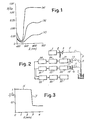
- Fig. 1 shows the transmission spectra, standardized in relation to the transmission value of air (indicated by So), of, respectively:
- bilirubin the pigment present in the bile
- the same absorption peak occurs, as is to be expected, in the transmission measurements performed on the bile, though these show a further transmission trough at a wavelength of approximately 650 nm, which corresponds to the absorption peak of another pigment present in bile (biliverdin).
- the transmission measurements taken in a sample of gastric juice from a patient suffering from enterogastric reflux (curve c) also show a transmission trough at a wavelength of 460 nm.
- the method according to the invention exploits the results of the spectrophotometric measurements reported above and is based on the concept of detecting the presence of bile in the gastric juice by measuring the transmission of the said juice.
- Fig. 2 shows a diagram of the functioning of an initial embodiment of apparatus for the implementation of the method according to the invention.
- a light source 1 for example a halogen lamp, emits radiation at various wavelengths, including radiation at a wavelength of 460 nm, which corresponds to the absorption peak of bilirubin, and radiation at a wavelength which does not correspond to any peak or trough in the absorption curves, for example approximately 600 nm.
- the light beam emitted by the source 1 is conveyed via a lens 3, along an optic fiber 5 to a sensor 7, which is described in greater detail below.
- the light radiation is modulated by the gastric juice and then collected by two further optic fibers 9 and 11 and transmitted to detecting organs through two band-pass filters 13 and 15 respectively, one set at a wavelength of 460 nm, corresponding to the absorption peak of bilirubin, and the other at a wavelength where the absorption is unaffected by the concentration of bilirubin (for example, 600 nm).
- the filtered radiation is detected by two photodiodes 17, 19 and converted into corresponding electrical signals which can be subjected to the subsequent processing.
- the light from the source 1 is modulated by a modulator 2 (known as a "chopper") before it is introduced into the optic fiber 5.
- the signal that reaches the photodiodes 17, 19 and the corresponding electrical signal are consequently of an alternating type, for example in the form of a square wave.
- the signals emitted by the photodiodes 17, 19 are amplified by corresponding amplifiers 21, 23, suitably filtered by filters 25 and 27 and then converted into direct signals in rectifier circuits 29, 31.
- Fig. 3 shows an example of a diagram that can be obtained with apparatus of the type illustrated in an in-vitro detection test.
- the ordinate shows the ratio, I/Io, of the intensity of the radiation collected by the photodiode 17 to the intensity of the radiation collected by the photodiode 19, while the abscissa shows the time in minutes. If the sample of gastric juice being monitored contains no bile, the ratio I/Io remains at a value of approximately 1, as shown by the section of curve X. When gastric juice containing bile is added, there is a break Y in the detection curve and the ratio I/Io falls to values well below unity.
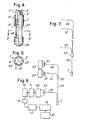
- the sensor 7 comprises a capillary tube 41 in material resistant to the action of the gastric juice, for example stainless steel, that is approximately 2 cm long and has an external diameter that depends on the diameter of the optic fibers used; for example, if the optic fibers used have an internal nucleus with a diameter of 600 ⁇ m, a capillary tube with an external diameter of approximately 2.5 mm can be used.
- a capillary tube 41 At one end of the capillary tube 41 are fixed the ends of the optic fibers 5, 9, 11, while the other end is sealed by an element 43 that has a mirror surface 45 facing the ends of the optic fibers.
- the cylindrical lateral mantle of the capillary tube 41 bears apertures 47 to permit the free penetration of the gastric juice into the sensor 7 between the ends of the optic fibers and the mirror surface 45.
- the light radiation emanating from the optic fiber 5 passes through the sample of gastric juice that has penetrated into the capillary tube via the apertures 47, is reflected by the surface 45 and reaches the optic fibers 9 and 11, which convey it to the organs of detection and in particular to the band-pass filters 13, 15.
- the method and apparatus according to the invention enable monitoring to be performed over prolonged periods of time with minimal discomfort for the patient without the measurements being affected by any food consumption and without the need to introduce voltage-carrying electrical wires into the esophagus and stomach of the patient.
- the sensor 7 can, in fact, be made smaller than the ordinary glass sensors used to measure the pH of the gastric juice. Furthermore, since it is an optical characteristic (transmission) of a substance present in the bile that is being measured, and the method therefore detects the presence of bilirubin in the gastric juice directly, there can be no errors due to spurious factors that affect an order of magnitude, such as acidity, that correlates only indirectly with the presence of bilirubin.
- the apparatus for implementing the method according to the invention can also include, instead of a halogen lamp, one or more light-emitting diodes.
- the light source comprises two light-emitting diodes (LED) 51, 53, controlled by two electronic circuits 55, 57.
- the first of said diodes can emit light radiation with a peak at a wavelength of 460 nm, while the second can emit light radiation at a wavelength of approximately 600 nm or another suitable wavelength.
- the two radiations are conveyed by two optic fibers 59, 61, via a directional coupler 62, to a single optic fiber 63 connected to the sensor 7, from which another optic fiber 65 conveys the radiation collected after it has passed through the sample of gastric juice to organs of detection similar to those described earlier.
- Said organs comprise a photodiode 67, an amplifier 69, a filter 71, a circuit 73 capable of picking up the two signals emitted by the light-emitting diodes 51, 53. Downstream of the said circuit 73 are provided a rectifier 75, an analog-digital converter 77, a computer 79 and any peripherals 81, for example for plotting diagrams.
- Known methods of data transmission can be used for the emission of the signal by the light-emitting diodes 51, 53 and the subsequent detection by the organs 67, 69, 71, 73.
- Fig. 7 shows a variant of the solution shown in Fig. 6 (relating only to the diagram of the probe) in which both the optic fibers originating from the source and the optic fiber connected to the organs of detection converge in a directional coupler 64.
- a single optic fiber 66 then connects the coupler 64 to the sensor 7, said fiber serving to convey the radiation in both directions. This enables the dimensions of the sensor 7 to be further reduced, thereby increasing the tolerability to the patient during the monitoring procedure.
Landscapes
- Health & Medical Sciences (AREA)
- Life Sciences & Earth Sciences (AREA)
- Physics & Mathematics (AREA)
- General Health & Medical Sciences (AREA)
- Pathology (AREA)
- Spectroscopy & Molecular Physics (AREA)
- Engineering & Computer Science (AREA)
- Biomedical Technology (AREA)
- Heart & Thoracic Surgery (AREA)
- Medical Informatics (AREA)
- Molecular Biology (AREA)
- Surgery (AREA)
- Animal Behavior & Ethology (AREA)
- Biophysics (AREA)
- Public Health (AREA)
- Veterinary Medicine (AREA)
- Gastroenterology & Hepatology (AREA)
- Physiology (AREA)
- Toxicology (AREA)
- Endocrinology (AREA)
- Chemical & Material Sciences (AREA)
- Analytical Chemistry (AREA)
- Biochemistry (AREA)
- General Physics & Mathematics (AREA)
- Immunology (AREA)
- Investigating Or Analysing Materials By Optical Means (AREA)
- Measuring And Recording Apparatus For Diagnosis (AREA)
- Measurement Of The Respiration, Hearing Ability, Form, And Blood Characteristics Of Living Organisms (AREA)
- Paper (AREA)
- Electrical Discharge Machining, Electrochemical Machining, And Combined Machining (AREA)
- Nozzles (AREA)
- Crystals, And After-Treatments Of Crystals (AREA)
- Investigating Or Analyzing Materials By The Use Of Ultrasonic Waves (AREA)
Priority Applications (1)
| Application Number | Priority Date | Filing Date | Title |
|---|---|---|---|
| AT88830561T ATE69306T1 (de) | 1987-12-23 | 1988-12-22 | Messmethode des enterogastrischen rueckflusses und geraet zur anwendung dieser methode. |
Applications Claiming Priority (2)
| Application Number | Priority Date | Filing Date | Title |
|---|---|---|---|
| IT958487 | 1987-12-23 | ||
| IT8709584A IT1213864B (it) | 1987-12-23 | 1987-12-23 | Metodo di rilevamento del reflusso enterogastrico ed attrezzatura per l'attuazione di detto metodo |
Publications (2)
| Publication Number | Publication Date |
|---|---|
| EP0323816A1 EP0323816A1 (en) | 1989-07-12 |
| EP0323816B1 true EP0323816B1 (en) | 1991-11-06 |
Family
ID=11132483
Family Applications (1)
| Application Number | Title | Priority Date | Filing Date |
|---|---|---|---|
| EP88830561A Expired - Lifetime EP0323816B1 (en) | 1987-12-23 | 1988-12-22 | Method of detecting enterogastric reflux and apparatus for the implementation of this method |
Country Status (8)
| Country | Link |
|---|---|
| US (1) | US4976265A (enExample) |
| EP (1) | EP0323816B1 (enExample) |
| JP (1) | JPH01221136A (enExample) |
| AT (1) | ATE69306T1 (enExample) |
| DE (1) | DE3866099D1 (enExample) |
| ES (1) | ES2027422T3 (enExample) |
| GR (1) | GR3003730T3 (enExample) |
| IT (1) | IT1213864B (enExample) |
Families Citing this family (20)
| Publication number | Priority date | Publication date | Assignee | Title |
|---|---|---|---|---|
| GB2269007B (en) * | 1992-07-01 | 1996-03-27 | Imperial College | Monitoring of the condition of a foetus during labour |
| US5477860A (en) * | 1992-11-05 | 1995-12-26 | Synectics Medical, Inc. | Catheter for measuring respiration and respiratory effort |
| US5810741A (en) * | 1992-11-05 | 1998-09-22 | Synectics Medical Ab | Method of measuring respiration and respiratory effort using plural catheters |
| US5438985A (en) * | 1993-01-25 | 1995-08-08 | Synectics Medical, Incorporated | Ambulatory recording of the presence and activity of substances in gastro-intestinal compartments |
| US5551425A (en) * | 1993-05-13 | 1996-09-03 | Synectics Medical, Inc. | Potential difference and perfusion pressure catheter |
| US5657759A (en) * | 1993-05-13 | 1997-08-19 | Synectics Medical, Incorporated | Measurement of gastric emptying and gastrointestinal output |
| US5341803A (en) * | 1993-06-22 | 1994-08-30 | Goldberg Michael S | Apparatus and method for monitoring gastric fluid pH |
| US5507289A (en) * | 1993-09-16 | 1996-04-16 | Synectics Medical, Inc. | System and method to diagnose bacterial growth |
| US5477854A (en) * | 1993-09-16 | 1995-12-26 | Synectics Medical, Inc. | System and method to monitor gastrointestinal Helicobacter pylori infection |
| US5479935A (en) * | 1993-10-21 | 1996-01-02 | Synectics Medical, Inc. | Ambulatory reflux monitoring system |
| US5833625A (en) * | 1993-10-21 | 1998-11-10 | Synectics Medical Ab | Ambulatory reflux monitoring system |
| SE514900C2 (sv) * | 1994-01-19 | 2001-05-14 | Synectics Medical Ab | Förfarande och system för ambulatorisk gastrointestinal registrering |
| JPH10506545A (ja) * | 1994-07-14 | 1998-06-30 | ワシントン リサーチ ファンデイション | 食道のバレット化生を検出するための方法および装置 |
| IL113333A (en) * | 1995-04-11 | 2001-01-28 | Yoav Paltieli | Fiber-optic endoscope |
| EP2382463B1 (en) * | 2009-01-29 | 2016-05-25 | Given Imaging Ltd. | Device,system and method for detection of bleeding |
| WO2010138847A2 (en) * | 2009-05-29 | 2010-12-02 | Acco Brands Usa Llc | Security apparatus including attachment device |
| ITFI20100237A1 (it) * | 2010-12-03 | 2012-06-04 | Consiglio Naz Delle Richerche | "sonda a fibra ottica e sensore di misura utilizzante detta sonda" |
| WO2012093309A1 (en) * | 2011-01-04 | 2012-07-12 | Koninklijke Philips Electronics N.V. | An apparatus for optical analysis of an associated tissue |
| GB2495479B (en) * | 2011-10-03 | 2015-12-02 | Babiesfirst Ltd | Reflux probe |
| NL2020692B1 (en) * | 2018-03-29 | 2019-10-07 | Stichting Vu | Fiber endoscope |
Family Cites Families (8)
| Publication number | Priority date | Publication date | Assignee | Title |
|---|---|---|---|---|
| US3569721A (en) * | 1969-01-13 | 1971-03-09 | American Optical Corp | Measuring bilirubin in blood using light at two wavelengths |
| JPS5326437A (en) * | 1976-08-24 | 1978-03-11 | Kenzou Shigiyou | Method of removing parasites from steel structure in sea |
| IT1075513B (it) * | 1977-04-28 | 1985-04-22 | E L V I Spa | Apparecchiatura automatica per la determinazione fotometrica della concentrazione di bilirubina nel siero umano |
| US4505583A (en) * | 1981-04-10 | 1985-03-19 | Masaaki Konomi | Spectroscopic analyzer system for examining intravital tissue |
| EP0109826A3 (en) * | 1982-11-17 | 1985-05-15 | Medasid Ltd. | System for deriving medical information |
| US4567882A (en) * | 1982-12-06 | 1986-02-04 | Vanderbilt University | Method for locating the illuminated tip of an endotracheal tube |
| US4637729A (en) * | 1983-12-14 | 1987-01-20 | Carrier Corporation | Fiber optic moisture analysis probe |
| IT1206462B (it) * | 1984-08-07 | 1989-04-27 | Anic Spa | Fotometro a luce impulsata a lunghezza d'onda multipla per monitoraggio non-invasivo. |
-
1987
- 1987-12-23 IT IT8709584A patent/IT1213864B/it active
-
1988
- 1988-12-20 US US07/287,480 patent/US4976265A/en not_active Expired - Lifetime
- 1988-12-21 JP JP63320770A patent/JPH01221136A/ja active Pending
- 1988-12-22 AT AT88830561T patent/ATE69306T1/de not_active IP Right Cessation
- 1988-12-22 ES ES198888830561T patent/ES2027422T3/es not_active Expired - Lifetime
- 1988-12-22 DE DE8888830561T patent/DE3866099D1/de not_active Expired - Lifetime
- 1988-12-22 EP EP88830561A patent/EP0323816B1/en not_active Expired - Lifetime
-
1992
- 1992-02-06 GR GR910401603T patent/GR3003730T3/el unknown
Also Published As
| Publication number | Publication date |
|---|---|
| ATE69306T1 (de) | 1991-11-15 |
| US4976265A (en) | 1990-12-11 |
| EP0323816A1 (en) | 1989-07-12 |
| DE3866099D1 (de) | 1991-12-12 |
| JPH01221136A (ja) | 1989-09-04 |
| ES2027422T3 (es) | 1992-06-01 |
| IT8709584A0 (it) | 1987-12-23 |
| GR3003730T3 (enExample) | 1993-03-16 |
| IT1213864B (it) | 1990-01-05 |
Similar Documents
| Publication | Publication Date | Title |
|---|---|---|
| EP0323816B1 (en) | Method of detecting enterogastric reflux and apparatus for the implementation of this method | |
| EP0359433B1 (en) | Physiological probe | |
| US4528986A (en) | Apparatus for determining a discolored skin area on the surface of skin | |
| US4016761A (en) | Optical temperature probe | |
| Bechi et al. | Long-term ambulatory enterogastric reflux monitoring: validation of a new fiberoptic technique | |
| JP2539707B2 (ja) | 吸光スペクトルの補正方法およびその方法を用いた光拡散物質の分光測定装置 | |
| JP2003194714A (ja) | 生体組織血液量測定装置 | |
| GB2058343A (en) | In teeth using visible luminescence apparatus and method for detecting the presence of caries | |
| HK161195A (en) | Oximeter for cooperation with an oximeter probe | |
| JPH01105134A (ja) | 測光装置 | |
| EP0283285A3 (en) | Method and apparatus for monitoring analytes in fluids | |
| US6020587A (en) | Plant chlorophyll content meter | |
| EP0253492A2 (en) | Fibre-optic probe | |
| EP0003015B1 (en) | Apparatus for non-invasive detection of zinc protoporphyrin in erythrocytes | |
| EP0329196B1 (en) | Oximeter for cooperation with an oximeter probe | |
| EP4175538A1 (en) | Device for non-invasive blood glucose concentration measurement | |
| EP0096696B1 (en) | Method and apparatus for measuring moisture content | |
| US5300769A (en) | Method and system of compensating for signal artifacts in a fiber-optic sensing system | |
| JPH0399292A (ja) | 核放射能の線量又はその強度を測定する方法とその装置 | |
| US4911549A (en) | Heparin monitoring system and methodology | |
| EP1161659B1 (en) | Analytical quantification and process control | |
| Baldini et al. | A new fiber-optic sensor for bile reflux | |
| CN1326488C (zh) | 光学测量鼻肿胀的设备 | |
| JP2001137247A (ja) | 生体光計測装置 | |
| JP4709430B2 (ja) | 濃度測定装置 |
Legal Events
| Date | Code | Title | Description |
|---|---|---|---|
| PUAI | Public reference made under article 153(3) epc to a published international application that has entered the european phase |
Free format text: ORIGINAL CODE: 0009012 |
|
| AK | Designated contracting states |
Kind code of ref document: A1 Designated state(s): AT BE CH DE ES FR GB GR LI LU NL SE |
|
| 17P | Request for examination filed |
Effective date: 19890913 |
|
| 17Q | First examination report despatched |
Effective date: 19910122 |
|
| GRAA | (expected) grant |
Free format text: ORIGINAL CODE: 0009210 |
|
| AK | Designated contracting states |
Kind code of ref document: B1 Designated state(s): AT BE CH DE ES FR GB GR LI LU NL SE |
|
| REF | Corresponds to: |
Ref document number: 69306 Country of ref document: AT Date of ref document: 19911115 Kind code of ref document: T |
|
| REF | Corresponds to: |
Ref document number: 3866099 Country of ref document: DE Date of ref document: 19911212 |
|
| ET | Fr: translation filed | ||
| REG | Reference to a national code |
Ref country code: ES Ref legal event code: FG2A Ref document number: 2027422 Country of ref document: ES Kind code of ref document: T3 |
|
| PLBE | No opposition filed within time limit |
Free format text: ORIGINAL CODE: 0009261 |
|
| STAA | Information on the status of an ep patent application or granted ep patent |
Free format text: STATUS: NO OPPOSITION FILED WITHIN TIME LIMIT |
|
| 26N | No opposition filed | ||
| REG | Reference to a national code |
Ref country code: GR Ref legal event code: FG4A Free format text: 3003730 |
|
| EPTA | Lu: last paid annual fee | ||
| EAL | Se: european patent in force in sweden |
Ref document number: 88830561.2 |
|
| PGFP | Annual fee paid to national office [announced via postgrant information from national office to epo] |
Ref country code: SE Payment date: 20011126 Year of fee payment: 14 |
|
| PGFP | Annual fee paid to national office [announced via postgrant information from national office to epo] |
Ref country code: ES Payment date: 20011130 Year of fee payment: 14 |
|
| PGFP | Annual fee paid to national office [announced via postgrant information from national office to epo] |
Ref country code: LU Payment date: 20011213 Year of fee payment: 14 Ref country code: BE Payment date: 20011213 Year of fee payment: 14 |
|
| PGFP | Annual fee paid to national office [announced via postgrant information from national office to epo] |
Ref country code: CH Payment date: 20011214 Year of fee payment: 14 |
|
| PGFP | Annual fee paid to national office [announced via postgrant information from national office to epo] |
Ref country code: AT Payment date: 20011217 Year of fee payment: 14 |
|
| PGFP | Annual fee paid to national office [announced via postgrant information from national office to epo] |
Ref country code: GR Payment date: 20011219 Year of fee payment: 14 |
|
| PGFP | Annual fee paid to national office [announced via postgrant information from national office to epo] |
Ref country code: NL Payment date: 20011228 Year of fee payment: 14 |
|
| REG | Reference to a national code |
Ref country code: GB Ref legal event code: IF02 |
|
| PGFP | Annual fee paid to national office [announced via postgrant information from national office to epo] |
Ref country code: DE Payment date: 20020219 Year of fee payment: 14 |
|
| PG25 | Lapsed in a contracting state [announced via postgrant information from national office to epo] |
Ref country code: LU Free format text: LAPSE BECAUSE OF NON-PAYMENT OF DUE FEES Effective date: 20021222 Ref country code: AT Free format text: LAPSE BECAUSE OF NON-PAYMENT OF DUE FEES Effective date: 20021222 |
|
| PG25 | Lapsed in a contracting state [announced via postgrant information from national office to epo] |
Ref country code: SE Free format text: LAPSE BECAUSE OF NON-PAYMENT OF DUE FEES Effective date: 20021223 Ref country code: ES Free format text: LAPSE BECAUSE OF NON-PAYMENT OF DUE FEES Effective date: 20021223 |
|
| PGFP | Annual fee paid to national office [announced via postgrant information from national office to epo] |
Ref country code: FR Payment date: 20021224 Year of fee payment: 15 |
|
| PG25 | Lapsed in a contracting state [announced via postgrant information from national office to epo] |
Ref country code: LI Free format text: LAPSE BECAUSE OF NON-PAYMENT OF DUE FEES Effective date: 20021231 Ref country code: CH Free format text: LAPSE BECAUSE OF NON-PAYMENT OF DUE FEES Effective date: 20021231 Ref country code: BE Free format text: LAPSE BECAUSE OF NON-PAYMENT OF DUE FEES Effective date: 20021231 |
|
| PGFP | Annual fee paid to national office [announced via postgrant information from national office to epo] |
Ref country code: GB Payment date: 20021231 Year of fee payment: 15 |
|
| BERE | Be: lapsed |
Owner name: *CONSIGLIO NAZIONALE DELLE RICERCHE Effective date: 20021231 |
|
| PG25 | Lapsed in a contracting state [announced via postgrant information from national office to epo] |
Ref country code: NL Free format text: LAPSE BECAUSE OF NON-PAYMENT OF DUE FEES Effective date: 20030701 Ref country code: DE Free format text: LAPSE BECAUSE OF NON-PAYMENT OF DUE FEES Effective date: 20030701 |
|
| PG25 | Lapsed in a contracting state [announced via postgrant information from national office to epo] |
Ref country code: GR Free format text: LAPSE BECAUSE OF NON-PAYMENT OF DUE FEES Effective date: 20030707 |
|
| EUG | Se: european patent has lapsed | ||
| REG | Reference to a national code |
Ref country code: CH Ref legal event code: PL |
|
| NLV4 | Nl: lapsed or anulled due to non-payment of the annual fee |
Effective date: 20030701 |
|
| PG25 | Lapsed in a contracting state [announced via postgrant information from national office to epo] |
Ref country code: GB Free format text: LAPSE BECAUSE OF NON-PAYMENT OF DUE FEES Effective date: 20031222 |
|
| GBPC | Gb: european patent ceased through non-payment of renewal fee |
Effective date: 20031222 |
|
| REG | Reference to a national code |
Ref country code: ES Ref legal event code: FD2A Effective date: 20021223 |
|
| PG25 | Lapsed in a contracting state [announced via postgrant information from national office to epo] |
Ref country code: FR Free format text: LAPSE BECAUSE OF NON-PAYMENT OF DUE FEES Effective date: 20040831 |
|
| REG | Reference to a national code |
Ref country code: FR Ref legal event code: ST |