EP0321658B1 - Verfahren zur Herstellung von blockierten harnstoffgruppenhaltigen Polyisocyanaten sowie die danach hergestellten Produkte - Google Patents
Verfahren zur Herstellung von blockierten harnstoffgruppenhaltigen Polyisocyanaten sowie die danach hergestellten Produkte Download PDFInfo
- Publication number
- EP0321658B1 EP0321658B1 EP88115942A EP88115942A EP0321658B1 EP 0321658 B1 EP0321658 B1 EP 0321658B1 EP 88115942 A EP88115942 A EP 88115942A EP 88115942 A EP88115942 A EP 88115942A EP 0321658 B1 EP0321658 B1 EP 0321658B1
- Authority
- EP
- European Patent Office
- Prior art keywords
- polyisocyanate
- process according
- blocked
- weight
- polyamines
- Prior art date
- Legal status (The legal status is an assumption and is not a legal conclusion. Google has not performed a legal analysis and makes no representation as to the accuracy of the status listed.)
- Expired - Lifetime
Links
- 239000005056 polyisocyanate Substances 0.000 title claims abstract description 60
- 229920001228 polyisocyanate Polymers 0.000 title claims abstract description 60
- 238000000034 method Methods 0.000 title claims abstract description 26
- XSQUKJJJFZCRTK-UHFFFAOYSA-N urea group Chemical group NC(=O)N XSQUKJJJFZCRTK-UHFFFAOYSA-N 0.000 title claims abstract description 9
- 238000002360 preparation method Methods 0.000 title abstract description 13
- 238000006243 chemical reaction Methods 0.000 claims abstract description 33
- 229920000768 polyamine Polymers 0.000 claims abstract description 27
- 239000002981 blocking agent Substances 0.000 claims abstract description 12
- 239000004202 carbamide Substances 0.000 claims abstract description 11
- 238000004821 distillation Methods 0.000 claims abstract description 11
- 239000004814 polyurethane Substances 0.000 claims abstract description 6
- 239000002904 solvent Substances 0.000 claims description 24
- NIMLQBUJDJZYEJ-UHFFFAOYSA-N isophorone diisocyanate Chemical compound CC1(C)CC(N=C=O)CC(C)(CN=C=O)C1 NIMLQBUJDJZYEJ-UHFFFAOYSA-N 0.000 claims description 21
- 150000004985 diamines Chemical class 0.000 claims description 19
- YXFVVABEGXRONW-UHFFFAOYSA-N Toluene Chemical compound CC1=CC=CC=C1 YXFVVABEGXRONW-UHFFFAOYSA-N 0.000 claims description 18
- 238000004519 manufacturing process Methods 0.000 claims description 12
- 239000000203 mixture Substances 0.000 claims description 12
- 125000001931 aliphatic group Chemical group 0.000 claims description 9
- 125000003118 aryl group Chemical group 0.000 claims description 8
- 150000001875 compounds Chemical class 0.000 claims description 8
- XDTMQSROBMDMFD-UHFFFAOYSA-N Cyclohexane Chemical compound C1CCCCC1 XDTMQSROBMDMFD-UHFFFAOYSA-N 0.000 claims description 7
- 125000000217 alkyl group Chemical group 0.000 claims description 7
- DZIHTWJGPDVSGE-UHFFFAOYSA-N 4-[(4-aminocyclohexyl)methyl]cyclohexan-1-amine Chemical compound C1CC(N)CCC1CC1CCC(N)CC1 DZIHTWJGPDVSGE-UHFFFAOYSA-N 0.000 claims description 6
- 239000012948 isocyanate Substances 0.000 claims description 6
- RNLHGQLZWXBQNY-UHFFFAOYSA-N 3-(aminomethyl)-3,5,5-trimethylcyclohexan-1-amine Chemical compound CC1(C)CC(N)CC(C)(CN)C1 RNLHGQLZWXBQNY-UHFFFAOYSA-N 0.000 claims description 4
- 125000003710 aryl alkyl group Chemical group 0.000 claims description 3
- 238000009835 boiling Methods 0.000 claims description 3
- 239000000178 monomer Substances 0.000 claims description 3
- LSHROXHEILXKHM-UHFFFAOYSA-N n'-[2-[2-[2-(2-aminoethylamino)ethylamino]ethylamino]ethyl]ethane-1,2-diamine Chemical compound NCCNCCNCCNCCNCCN LSHROXHEILXKHM-UHFFFAOYSA-N 0.000 claims description 3
- 239000004033 plastic Substances 0.000 claims description 3
- 229920003023 plastic Polymers 0.000 claims description 3
- FAGUFWYHJQFNRV-UHFFFAOYSA-N tetraethylenepentamine Chemical compound NCCNCCNCCNCCN FAGUFWYHJQFNRV-UHFFFAOYSA-N 0.000 claims description 3
- IQPQWNKOIGAROB-UHFFFAOYSA-N isocyanate group Chemical group [N-]=C=O IQPQWNKOIGAROB-UHFFFAOYSA-N 0.000 claims description 2
- 239000004922 lacquer Substances 0.000 claims description 2
- 239000003208 petroleum Substances 0.000 claims description 2
- 229920002635 polyurethane Polymers 0.000 claims description 2
- AFABGHUZZDYHJO-UHFFFAOYSA-N 2-Methylpentane Chemical compound CCCC(C)C AFABGHUZZDYHJO-UHFFFAOYSA-N 0.000 claims 2
- 125000005442 diisocyanate group Chemical group 0.000 claims 2
- IGSBHTZEJMPDSZ-UHFFFAOYSA-N 4-[(4-amino-3-methylcyclohexyl)methyl]-2-methylcyclohexan-1-amine Chemical compound C1CC(N)C(C)CC1CC1CC(C)C(N)CC1 IGSBHTZEJMPDSZ-UHFFFAOYSA-N 0.000 claims 1
- 150000001491 aromatic compounds Chemical class 0.000 claims 1
- 239000000470 constituent Substances 0.000 claims 1
- 125000004836 hexamethylene group Chemical group [H]C([H])([*:2])C([H])([H])C([H])([H])C([H])([H])C([H])([H])C([H])([H])[*:1] 0.000 claims 1
- 239000010409 thin film Substances 0.000 abstract description 7
- 125000003277 amino group Chemical group 0.000 abstract description 4
- 239000003973 paint Substances 0.000 abstract description 3
- 150000001412 amines Chemical class 0.000 description 18
- 239000005058 Isophorone diisocyanate Substances 0.000 description 15
- CSCPPACGZOOCGX-UHFFFAOYSA-N Acetone Chemical compound CC(C)=O CSCPPACGZOOCGX-UHFFFAOYSA-N 0.000 description 13
- 239000000126 substance Substances 0.000 description 13
- 239000007795 chemical reaction product Substances 0.000 description 12
- 238000003756 stirring Methods 0.000 description 11
- XEKOWRVHYACXOJ-UHFFFAOYSA-N Ethyl acetate Chemical compound CCOC(C)=O XEKOWRVHYACXOJ-UHFFFAOYSA-N 0.000 description 10
- XLYOFNOQVPJJNP-UHFFFAOYSA-N water Substances O XLYOFNOQVPJJNP-UHFFFAOYSA-N 0.000 description 9
- 230000009477 glass transition Effects 0.000 description 7
- 230000008018 melting Effects 0.000 description 7
- 238000002844 melting Methods 0.000 description 7
- 239000011541 reaction mixture Substances 0.000 description 7
- 238000000576 coating method Methods 0.000 description 5
- 150000002513 isocyanates Chemical class 0.000 description 5
- 125000002924 primary amino group Chemical group [H]N([H])* 0.000 description 5
- 230000015572 biosynthetic process Effects 0.000 description 4
- 235000013877 carbamide Nutrition 0.000 description 4
- JBKVHLHDHHXQEQ-UHFFFAOYSA-N epsilon-caprolactam Chemical compound O=C1CCCCCN1 JBKVHLHDHHXQEQ-UHFFFAOYSA-N 0.000 description 4
- 150000003672 ureas Chemical class 0.000 description 4
- LFQSCWFLJHTTHZ-UHFFFAOYSA-N Ethanol Chemical compound CCO LFQSCWFLJHTTHZ-UHFFFAOYSA-N 0.000 description 3
- OKKJLVBELUTLKV-UHFFFAOYSA-N Methanol Chemical compound OC OKKJLVBELUTLKV-UHFFFAOYSA-N 0.000 description 3
- 239000011248 coating agent Substances 0.000 description 3
- 230000000052 comparative effect Effects 0.000 description 3
- -1 heterocyclic diamines Chemical class 0.000 description 3
- NAQMVNRVTILPCV-UHFFFAOYSA-N hexane-1,6-diamine Chemical compound NCCCCCCN NAQMVNRVTILPCV-UHFFFAOYSA-N 0.000 description 3
- 239000002244 precipitate Substances 0.000 description 3
- KIDHWZJUCRJVML-UHFFFAOYSA-N putrescine Chemical compound NCCCCN KIDHWZJUCRJVML-UHFFFAOYSA-N 0.000 description 3
- 125000000467 secondary amino group Chemical group [H]N([*:1])[*:2] 0.000 description 3
- CXWXQJXEFPUFDZ-UHFFFAOYSA-N tetralin Chemical compound C1=CC=C2CCCCC2=C1 CXWXQJXEFPUFDZ-UHFFFAOYSA-N 0.000 description 3
- XFNJVJPLKCPIBV-UHFFFAOYSA-N trimethylenediamine Chemical compound NCCCN XFNJVJPLKCPIBV-UHFFFAOYSA-N 0.000 description 3
- VZXPHDGHQXLXJC-UHFFFAOYSA-N 1,6-diisocyanato-5,6-dimethylheptane Chemical compound O=C=NC(C)(C)C(C)CCCCN=C=O VZXPHDGHQXLXJC-UHFFFAOYSA-N 0.000 description 2
- PWGJDPKCLMLPJW-UHFFFAOYSA-N 1,8-diaminooctane Chemical compound NCCCCCCCCN PWGJDPKCLMLPJW-UHFFFAOYSA-N 0.000 description 2
- VILCJCGEZXAXTO-UHFFFAOYSA-N 2,2,2-tetramine Chemical compound NCCNCCNCCN VILCJCGEZXAXTO-UHFFFAOYSA-N 0.000 description 2
- SVONRAPFKPVNKG-UHFFFAOYSA-N 2-ethoxyethyl acetate Chemical compound CCOCCOC(C)=O SVONRAPFKPVNKG-UHFFFAOYSA-N 0.000 description 2
- JZUHIOJYCPIVLQ-UHFFFAOYSA-N 2-methylpentane-1,5-diamine Chemical compound NCC(C)CCCN JZUHIOJYCPIVLQ-UHFFFAOYSA-N 0.000 description 2
- RXFCIXRFAJRBSG-UHFFFAOYSA-N 3,2,3-tetramine Chemical compound NCCCNCCNCCCN RXFCIXRFAJRBSG-UHFFFAOYSA-N 0.000 description 2
- MBRGOFWKNLPACT-UHFFFAOYSA-N 5-methylnonane-1,9-diamine Chemical compound NCCCCC(C)CCCCN MBRGOFWKNLPACT-UHFFFAOYSA-N 0.000 description 2
- 239000004971 Cross linker Substances 0.000 description 2
- RPNUMPOLZDHAAY-UHFFFAOYSA-N Diethylenetriamine Chemical compound NCCNCCN RPNUMPOLZDHAAY-UHFFFAOYSA-N 0.000 description 2
- PIICEJLVQHRZGT-UHFFFAOYSA-N Ethylenediamine Chemical compound NCCN PIICEJLVQHRZGT-UHFFFAOYSA-N 0.000 description 2
- 239000005057 Hexamethylene diisocyanate Substances 0.000 description 2
- KFZMGEQAYNKOFK-UHFFFAOYSA-N Isopropanol Chemical compound CC(C)O KFZMGEQAYNKOFK-UHFFFAOYSA-N 0.000 description 2
- CTQNGGLPUBDAKN-UHFFFAOYSA-N O-Xylene Chemical compound CC1=CC=CC=C1C CTQNGGLPUBDAKN-UHFFFAOYSA-N 0.000 description 2
- UKLDJPRMSDWDSL-UHFFFAOYSA-L [dibutyl(dodecanoyloxy)stannyl] dodecanoate Chemical compound CCCCCCCCCCCC(=O)O[Sn](CCCC)(CCCC)OC(=O)CCCCCCCCCCC UKLDJPRMSDWDSL-UHFFFAOYSA-L 0.000 description 2
- 125000005263 alkylenediamine group Chemical group 0.000 description 2
- RWGFKTVRMDUZSP-UHFFFAOYSA-N cumene Chemical compound CC(C)C1=CC=CC=C1 RWGFKTVRMDUZSP-UHFFFAOYSA-N 0.000 description 2
- 239000012975 dibutyltin dilaurate Substances 0.000 description 2
- RRAMGCGOFNQTLD-UHFFFAOYSA-N hexamethylene diisocyanate Chemical compound O=C=NCCCCCCN=C=O RRAMGCGOFNQTLD-UHFFFAOYSA-N 0.000 description 2
- 125000004435 hydrogen atom Chemical group [H]* 0.000 description 2
- 239000004848 polyfunctional curative Substances 0.000 description 2
- 239000000843 powder Substances 0.000 description 2
- 239000000047 product Substances 0.000 description 2
- 230000009257 reactivity Effects 0.000 description 2
- 239000008096 xylene Substances 0.000 description 2
- RVCHQYCXJDVJQF-UHFFFAOYSA-N (3,5-diethylphenyl)methanediamine Chemical compound CCC1=CC(CC)=CC(C(N)N)=C1 RVCHQYCXJDVJQF-UHFFFAOYSA-N 0.000 description 1
- ZKALVNREMFLWAN-VOTSOKGWSA-N (ne)-n-(4-methylpentan-2-ylidene)hydroxylamine Chemical compound CC(C)C\C(C)=N\O ZKALVNREMFLWAN-VOTSOKGWSA-N 0.000 description 1
- RKMGAJGJIURJSJ-UHFFFAOYSA-N 2,2,6,6-Tetramethylpiperidine Substances CC1(C)CCCC(C)(C)N1 RKMGAJGJIURJSJ-UHFFFAOYSA-N 0.000 description 1
- WCZNKVPCIFMXEQ-UHFFFAOYSA-N 2,3,5,6-tetramethylbenzene-1,4-diamine Chemical compound CC1=C(C)C(N)=C(C)C(C)=C1N WCZNKVPCIFMXEQ-UHFFFAOYSA-N 0.000 description 1
- RLYCRLGLCUXUPO-UHFFFAOYSA-N 2,6-diaminotoluene Chemical compound CC1=C(N)C=CC=C1N RLYCRLGLCUXUPO-UHFFFAOYSA-N 0.000 description 1
- PTTPXKJBFFKCEK-UHFFFAOYSA-N 2-Methyl-4-heptanone Chemical compound CC(C)CC(=O)CC(C)C PTTPXKJBFFKCEK-UHFFFAOYSA-N 0.000 description 1
- NQBXSWAWVZHKBZ-UHFFFAOYSA-N 2-butoxyethyl acetate Chemical compound CCCCOCCOC(C)=O NQBXSWAWVZHKBZ-UHFFFAOYSA-N 0.000 description 1
- CCTFMNIEFHGTDU-UHFFFAOYSA-N 3-methoxypropyl acetate Chemical compound COCCCOC(C)=O CCTFMNIEFHGTDU-UHFFFAOYSA-N 0.000 description 1
- YBRVSVVVWCFQMG-UHFFFAOYSA-N 4,4'-diaminodiphenylmethane Chemical compound C1=CC(N)=CC=C1CC1=CC=C(N)C=C1 YBRVSVVVWCFQMG-UHFFFAOYSA-N 0.000 description 1
- DLYLVPHSKJVGLG-UHFFFAOYSA-N 4-(cyclohexylmethyl)cyclohexane-1,1-diamine Chemical compound C1CC(N)(N)CCC1CC1CCCCC1 DLYLVPHSKJVGLG-UHFFFAOYSA-N 0.000 description 1
- QTBSBXVTEAMEQO-UHFFFAOYSA-M Acetate Chemical compound CC([O-])=O QTBSBXVTEAMEQO-UHFFFAOYSA-M 0.000 description 1
- DKPFZGUDAPQIHT-UHFFFAOYSA-N Butyl acetate Natural products CCCCOC(C)=O DKPFZGUDAPQIHT-UHFFFAOYSA-N 0.000 description 1
- RWSOTUBLDIXVET-UHFFFAOYSA-N Dihydrogen sulfide Chemical class S RWSOTUBLDIXVET-UHFFFAOYSA-N 0.000 description 1
- JHWNWJKBPDFINM-UHFFFAOYSA-N Laurolactam Chemical compound O=C1CCCCCCCCCCCN1 JHWNWJKBPDFINM-UHFFFAOYSA-N 0.000 description 1
- 238000005684 Liebig rearrangement reaction Methods 0.000 description 1
- 229920000877 Melamine resin Polymers 0.000 description 1
- NAUBYZNGDGDCHH-UHFFFAOYSA-N N=C=O.N=C=O.CCCC(C)C Chemical compound N=C=O.N=C=O.CCCC(C)C NAUBYZNGDGDCHH-UHFFFAOYSA-N 0.000 description 1
- 241000022844 Praxis Species 0.000 description 1
- OFOBLEOULBTSOW-UHFFFAOYSA-N Propanedioic acid Natural products OC(=O)CC(O)=O OFOBLEOULBTSOW-UHFFFAOYSA-N 0.000 description 1
- PXAJQJMDEXJWFB-UHFFFAOYSA-N acetone oxime Chemical compound CC(C)=NO PXAJQJMDEXJWFB-UHFFFAOYSA-N 0.000 description 1
- 239000000654 additive Substances 0.000 description 1
- 230000000996 additive effect Effects 0.000 description 1
- 150000001298 alcohols Chemical class 0.000 description 1
- OTBHHUPVCYLGQO-UHFFFAOYSA-N bis(3-aminopropyl)amine Chemical compound NCCCNCCCN OTBHHUPVCYLGQO-UHFFFAOYSA-N 0.000 description 1
- OHJMTUPIZMNBFR-UHFFFAOYSA-N biuret Chemical compound NC(=O)NC(N)=O OHJMTUPIZMNBFR-UHFFFAOYSA-N 0.000 description 1
- 230000000903 blocking effect Effects 0.000 description 1
- 125000004432 carbon atom Chemical group C* 0.000 description 1
- HPXRVTGHNJAIIH-UHFFFAOYSA-N cyclohexanol Chemical compound OC1CCCCC1 HPXRVTGHNJAIIH-UHFFFAOYSA-N 0.000 description 1
- 238000009826 distribution Methods 0.000 description 1
- QFTYSVGGYOXFRQ-UHFFFAOYSA-N dodecane-1,12-diamine Chemical compound NCCCCCCCCCCCCN QFTYSVGGYOXFRQ-UHFFFAOYSA-N 0.000 description 1
- XYIBRDXRRQCHLP-UHFFFAOYSA-N ethyl acetoacetate Chemical compound CCOC(=O)CC(C)=O XYIBRDXRRQCHLP-UHFFFAOYSA-N 0.000 description 1
- 238000001704 evaporation Methods 0.000 description 1
- 230000008020 evaporation Effects 0.000 description 1
- 238000001125 extrusion Methods 0.000 description 1
- 150000002391 heterocyclic compounds Chemical class 0.000 description 1
- 125000000623 heterocyclic group Chemical group 0.000 description 1
- FUZZWVXGSFPDMH-UHFFFAOYSA-N hexanoic acid Chemical compound CCCCCC(O)=O FUZZWVXGSFPDMH-UHFFFAOYSA-N 0.000 description 1
- AOGQPLXWSUTHQB-UHFFFAOYSA-N hexyl acetate Chemical group CCCCCCOC(C)=O AOGQPLXWSUTHQB-UHFFFAOYSA-N 0.000 description 1
- 239000000543 intermediate Substances 0.000 description 1
- GKQPCPXONLDCMU-CCEZHUSRSA-N lacidipine Chemical compound CCOC(=O)C1=C(C)NC(C)=C(C(=O)OCC)C1C1=CC=CC=C1\C=C\C(=O)OC(C)(C)C GKQPCPXONLDCMU-CCEZHUSRSA-N 0.000 description 1
- 150000003951 lactams Chemical class 0.000 description 1
- 229920002521 macromolecule Polymers 0.000 description 1
- JDSHMPZPIAZGSV-UHFFFAOYSA-N melamine Chemical compound NC1=NC(N)=NC(N)=N1 JDSHMPZPIAZGSV-UHFFFAOYSA-N 0.000 description 1
- XWGMOJUZTAZNAK-UHFFFAOYSA-N n'-(2,2,6,6-tetramethylpiperidin-1-yl)propane-1,3-diamine Chemical compound CC1(C)CCCC(C)(C)N1NCCCN XWGMOJUZTAZNAK-UHFFFAOYSA-N 0.000 description 1
- WHIVNJATOVLWBW-UHFFFAOYSA-N n-butan-2-ylidenehydroxylamine Chemical compound CCC(C)=NO WHIVNJATOVLWBW-UHFFFAOYSA-N 0.000 description 1
- IJGRMHOSHXDMSA-UHFFFAOYSA-N nitrogen Substances N#N IJGRMHOSHXDMSA-UHFFFAOYSA-N 0.000 description 1
- 229910052757 nitrogen Inorganic materials 0.000 description 1
- 150000002923 oximes Chemical class 0.000 description 1
- 239000000376 reactant Substances 0.000 description 1
- 238000007086 side reaction Methods 0.000 description 1
- 239000007787 solid Substances 0.000 description 1
- 125000001302 tertiary amino group Chemical group 0.000 description 1
- RUELTTOHQODFPA-UHFFFAOYSA-N toluene 2,6-diisocyanate Chemical compound CC1=C(N=C=O)C=CC=C1N=C=O RUELTTOHQODFPA-UHFFFAOYSA-N 0.000 description 1
Classifications
-
- C—CHEMISTRY; METALLURGY
- C08—ORGANIC MACROMOLECULAR COMPOUNDS; THEIR PREPARATION OR CHEMICAL WORKING-UP; COMPOSITIONS BASED THEREON
- C08G—MACROMOLECULAR COMPOUNDS OBTAINED OTHERWISE THAN BY REACTIONS ONLY INVOLVING UNSATURATED CARBON-TO-CARBON BONDS
- C08G18/00—Polymeric products of isocyanates or isothiocyanates
- C08G18/06—Polymeric products of isocyanates or isothiocyanates with compounds having active hydrogen
- C08G18/70—Polymeric products of isocyanates or isothiocyanates with compounds having active hydrogen characterised by the isocyanates or isothiocyanates used
- C08G18/72—Polyisocyanates or polyisothiocyanates
- C08G18/77—Polyisocyanates or polyisothiocyanates having heteroatoms in addition to the isocyanate or isothiocyanate nitrogen and oxygen or sulfur
- C08G18/78—Nitrogen
- C08G18/7806—Nitrogen containing -N-C=0 groups
- C08G18/7818—Nitrogen containing -N-C=0 groups containing ureum or ureum derivative groups
- C08G18/7825—Nitrogen containing -N-C=0 groups containing ureum or ureum derivative groups containing ureum groups
-
- C—CHEMISTRY; METALLURGY
- C07—ORGANIC CHEMISTRY
- C07D—HETEROCYCLIC COMPOUNDS
- C07D251/00—Heterocyclic compounds containing 1,3,5-triazine rings
- C07D251/02—Heterocyclic compounds containing 1,3,5-triazine rings not condensed with other rings
- C07D251/12—Heterocyclic compounds containing 1,3,5-triazine rings not condensed with other rings having three double bonds between ring members or between ring members and non-ring members
- C07D251/26—Heterocyclic compounds containing 1,3,5-triazine rings not condensed with other rings having three double bonds between ring members or between ring members and non-ring members with only hetero atoms directly attached to ring carbon atoms
- C07D251/30—Only oxygen atoms
- C07D251/34—Cyanuric or isocyanuric esters
-
- C—CHEMISTRY; METALLURGY
- C08—ORGANIC MACROMOLECULAR COMPOUNDS; THEIR PREPARATION OR CHEMICAL WORKING-UP; COMPOSITIONS BASED THEREON
- C08G—MACROMOLECULAR COMPOUNDS OBTAINED OTHERWISE THAN BY REACTIONS ONLY INVOLVING UNSATURATED CARBON-TO-CARBON BONDS
- C08G18/00—Polymeric products of isocyanates or isothiocyanates
- C08G18/06—Polymeric products of isocyanates or isothiocyanates with compounds having active hydrogen
- C08G18/70—Polymeric products of isocyanates or isothiocyanates with compounds having active hydrogen characterised by the isocyanates or isothiocyanates used
- C08G18/72—Polyisocyanates or polyisothiocyanates
- C08G18/80—Masked polyisocyanates
- C08G18/8003—Masked polyisocyanates masked with compounds having at least two groups containing active hydrogen
- C08G18/8006—Masked polyisocyanates masked with compounds having at least two groups containing active hydrogen with compounds of C08G18/32
- C08G18/8038—Masked polyisocyanates masked with compounds having at least two groups containing active hydrogen with compounds of C08G18/32 with compounds of C08G18/3225
-
- C—CHEMISTRY; METALLURGY
- C08—ORGANIC MACROMOLECULAR COMPOUNDS; THEIR PREPARATION OR CHEMICAL WORKING-UP; COMPOSITIONS BASED THEREON
- C08G—MACROMOLECULAR COMPOUNDS OBTAINED OTHERWISE THAN BY REACTIONS ONLY INVOLVING UNSATURATED CARBON-TO-CARBON BONDS
- C08G18/00—Polymeric products of isocyanates or isothiocyanates
- C08G18/06—Polymeric products of isocyanates or isothiocyanates with compounds having active hydrogen
- C08G18/70—Polymeric products of isocyanates or isothiocyanates with compounds having active hydrogen characterised by the isocyanates or isothiocyanates used
- C08G18/72—Polyisocyanates or polyisothiocyanates
- C08G18/80—Masked polyisocyanates
- C08G18/8061—Masked polyisocyanates masked with compounds having only one group containing active hydrogen
-
- C—CHEMISTRY; METALLURGY
- C08—ORGANIC MACROMOLECULAR COMPOUNDS; THEIR PREPARATION OR CHEMICAL WORKING-UP; COMPOSITIONS BASED THEREON
- C08G—MACROMOLECULAR COMPOUNDS OBTAINED OTHERWISE THAN BY REACTIONS ONLY INVOLVING UNSATURATED CARBON-TO-CARBON BONDS
- C08G2150/00—Compositions for coatings
- C08G2150/20—Compositions for powder coatings
Definitions
- the invention relates to the production of blocked polyisocyanates containing urea groups from semi-blocked polyisocyanates and polyamines.
- symmetrical urea derivatives can in principle also be obtained by direct reaction of polyisocyanates and water according to the procedure of DE-OS 23 41 065, it must be accepted that gaseous reaction products are formed during urea formation, which must be carefully removed.
- this water / isocyanate reaction suffers from the disadvantage of limited variability and the formation of oligomeric ureas with the remains of monomeric polyisocyanate in a stoichiometric procedure.
- DE-OS 23 41 065 teaches that the polyisocyanate isophorone diisocyanate is frequently used in excess or that solvents have to be used for reasons of viscosity.
- DE-OS 31 43 060 describes a process for the preparation of blocked isophorone diisocyanate adducts containing urea groups.
- Such compounds are obtained by reacting 3-isocyanatomethyl-3.5.5-trimethylcyclohexyl isocyanate, also called isophorone diisocyanate (IPDI), partially blocked with epsilon-caprolactam, and diamines with two sterically unimpeded primary and / or secondary amino nitrogen.
- IPDI isophorone diisocyanate
- the reaction is carried out in bulk and must be above 130 ° C and, as demonstrated in the examples, even at 160 ° C for reasons of viscosity.
- the partially blocked polyisocyanates according to the teaching of DE-OS 31 43 060 with polyamines are not suitable for the production of urea compounds which are of interest for polyurethane chemistry.
- a targeted further reaction was made possible by using a partially blocked polyisocyanate with a monomeric polyisocyanate content of up to 6.5% by weight, preferably up to 3.5% by weight and very preferably up to 2.5% by weight.
- the production of these partially blocked polyisocyanates is done by reacting the polyisocyanate in a large excess - 5 to 20 mol - with the blocking agent - 1 mol - at temperatures of 50 ° C. to 130 ° C., preferably 70 ° C. to 100 ° C., and then the excess Polyisocyanate separated by thin film distillation. This manufacture is the subject of a separate patent application.
- the invention therefore relates to a process for the preparation of blocked urea-containing polyisocyanates from semi-blocked polyisocyanates and polyamines, characterized in that a semi-blocked polyisocyanate with primary and / or secondary polyamines in an isocyanate / amino group ratio is largely freed from unblocked, monomeric polyisocyanate by thin-layer distillation from 1 to 1.3: 1, preferably 1: 1 at a temperature in the range from RT to 80 ° C, the polyisocyanate used for thin-film distillation having a boiling point in vacuo below the deblocking temperature of the blocking agent used, the semi-blocked polyisocyanate by adding 1 mol of blocking agent to 5 to 20 mol of polyisocyanate is obtained and the semi-blocked polyisocyanate after thin-film distillation has a monomeric, unblocked polyisocyanate content of up to 6.5% by weight, preferably up to 3.5% by weight and in particular up to 2.5% by weight.
- the polyisocyanates to be used according to the invention are e.g. B. in "Methods of Organic Chemistry, Houben-Weyl, Vol. 14/2, 4th edition, Georg Thieme Verlag Stuttgart, 1963, pp. 61-70 and with W. Siefken, Liebigs Ann. Chem. 562 , p. 75-136, only such come Polyisocyanates in question, the boiling points of which are in vacuum below the deblocking temperature of the blocking agent used and can therefore be separated off by thin-film distillation.
- the technically easily accessible aliphatic, (cyclo) aliphatic and aromatic polyisocyanates such as hexamethylene diisocyanate 1.6 (HDI), 2.2.4 (2.4.4) trimethylhexamethylene diisocyanate (TMDI), 2-methylpentane diisocyanate 1.5 (DI51), and 2.4- or 2,6-tolylene diisocyanate, especially 3-isocyanatomethyl-3.5.5-trimethylcyclohexyl isocyanate (IPDI) and their isomer mixtures.
- Polyamines with primary and / or secondary amino groups are suitable for the preparation of the polyisocyanate-urea adducts according to the invention. They contain 2 to 36 carbon atoms and can be aliphatic or contain one or more cycloaliphatic, aromatic or heterocyclic 5- to 8-membered rings. In addition, the polyamines that can be used can also carry tertiary amino groups.
- heterocyclic compounds mentioned are of great interest since they make it possible to produce permanent UV-stabilized plastics, in particular also coating systems. Not only do they simply act as an additive, they are built directly into the macromolecule.
- suitable blocking agents are those which, under curing conditions, ie. H. between 140 and 220 ° C.
- alcohols e.g. As methanol, ethanol, isopropanol, cyclohexanol, oximes such as acetone oxime, methyl isobutyl ketoxime, mercaptans, lactams, e.g. B. Lauryllactam, acetoacetic ester, malonic acid ester and especially epsilon-caprolactam and methyl ethyl ketoxime counted (see “Methods of Organic Chemistry", Houben-Weyl, Vol. 14/2, 4th ed., Georg Thieme Verlag Stuttgart, 1963, p. 61 ff.).
- the hardeners are prepared in the solvent in such a way that the partially blocked polyisocyanate is placed in the solvent and the polyamine is added dropwise either in bulk or in solution in the solvent.
- the compounds mentioned can also be used as mixtures.
- concentrations of the polyisocyanate-urea adducts can vary within wide limits. Concentrations of 30 to 70% by weight have proven to be advantageous.
- the reaction takes place between RT and 80 ° C., preferably between RT and 70 ° C.
- the reaction mixture it is advantageous for the reaction mixture to be heated to, if appropriate, 100 to 120.degree. If the reaction product is to be freed from the solvent, this can be done by simply applying a vacuum. Melt extrusion in an evaporation screw is particularly suitable for removing the solvent.
- the reaction is carried out here at room temperature in such a way that the semi-blocked polyisocyanate is dissolved in special gasoline or cyclohexane and the polyamine is added dropwise with vigorous stirring so that the reaction temperature does not exceed 70.degree.
- the reaction product precipitates out during the dropping process.
- the mixture is stirred for a further 30 to 45 minutes and then freed from the solvent.
- the reactants - polyisocyanate and polyamine - are used in an isocyanate / amino group ratio of 1-1.3: 1, preferably one primary and / or secondary amino group per isocyanate group.
- the adducts according to the invention generally have an NCO content of 4 to 20, preferably 6 to 15,% by weight.
- the polyisocyanate addition products have a melting range of 90 to 210 ° C. They are particularly suitable as hardeners for higher functional compounds containing Zerewitinoff active hydrogen atoms.
- the polyaddition products above 140 ° C., preferably 180 to 220 ° C. lead to high-quality plastics-curing systems.
- the most important area of application for such systems is certainly their use as a crosslinker for PU powder coatings as well as solvent-based one-component PUR stoving lacquers.
- the compounds according to the invention are used as intermediates for the production of plastics, in particular paints. They are particularly valuable because they allow PUR powder coatings with a reduced degree of gloss to be easily produced.
- Example B f X NCO content in% by weight Melting range ° C Glass transition temperature (DTA) ° C total free 1 1.05 9.9 0.4 145-148 35-58 2nd 1.1 10.7 0.8 140-142 33-59 3rd 1.2 11.5 1.4 138-140 35-58 4th 1.3 12.0 1.95 131-136 33-55
- reaction is carried out in ethyl acetate.
- the reaction product had the following chemical and physical characteristics: NCO content (latent) 10.04% by weight NCO content (free) 0% by weight Melting range 146-148 ° C Glass transition temperature (DTA): 46-59 ° C
- Example B i X Y Z CO2 in l NCO content in% by weight Melting range ° C DTA * ° C total free 1 359 146 9 11.3-12 12.5 0.3 105-107 45-65 2nd 185 120 3.45 4.3-4.6 15.2 2.1 94-96 38-56 * Glass transition temperature
- Example C b X Y Z CO2 in l NCO content in% by weight Flow time in DIN 4 cup 20 ° C in s total free 1 185 120 3.45 4.2-4.6 9.4 1.6 215 2nd 183.3 120 2.3 2.8-3.0 10.9 3.4 50 3rd 181.6 120 1.15 4.2-4.5 12.8 5.0 20th
- One mole of blocking agent is added to one mole of polyisocyanate at 90 to 110 ° C. in such a way that the temperature of the reaction mixture does not rise above 120 ° C. After the blocking agent has been added, the mixture is heated until the NCO content of the reaction mixture has reached the calculated value.
- the chemical and physical characteristics of the reaction products are summarized in the following table:
- DI Amine component NCO content in% by weight Melting range in ° C Glass transition temperature (DTA) ° C latent free 1 1 4,4'-diaminodicyclohexylmethane 9.4 0.2 158-160 19-110 2nd 3rd " 10.6 0.1 102-104 17-38 3rd 5 " 10.8 0 90-92 14-34 4th 7 " 8.5 0 160-162 26-85 5 1 IPD 9.9 0 141-145 20-83
Landscapes
- Chemical & Material Sciences (AREA)
- Organic Chemistry (AREA)
- Health & Medical Sciences (AREA)
- Chemical Kinetics & Catalysis (AREA)
- Medicinal Chemistry (AREA)
- Polymers & Plastics (AREA)
- Polyurethanes Or Polyureas (AREA)
- Organic Low-Molecular-Weight Compounds And Preparation Thereof (AREA)
- Paints Or Removers (AREA)
Description
- Die Erfindung betrifft eine Herstellung von blockierten harnstoffgruppenhaltigen Polyisocyanaten aus halbblockierten Polyisocyanaten und Polyaminen.
- Die Umsetzung von Polyisocyanaten mit Polyaminen erfolgt mit so großer Heftigkeit, daß "sie vor allen anderen Isocyanatreaktionen den Vorzug hat" (vgl. Houben-Weyl, Methoden der organischen Chemie, Band XIII, Seite 132). Diese hohe Reaktivität dürfte auch die Ursache dafür sein, daß die direkte Reaktion zwischen Polyaminen und Polyisocyanaten zu den entsprechenden Harnstoffderivaten lange Zeit wenig untersucht worden ist.
- Zwar sind symmetrische Harnstoffderivate im Prinzip auch durch direkte Umsetzung von Polyisocyanaten und Wasser nach der Verfahrensweise der DE-OS 23 41 065 erhältlich, doch muß hierbei in Kauf genommen werden, daß während der Harnstoffbildung gasförmige Reaktionsprodukte entstehen, die sorgfältig entfernt werden müssen. Außerdem haftet dieser Wasser/Isocyanat-Reaktion der Nachteil der begrenzten Variabilität an sowie die Bildung von oligomeren Harnstoffen unter Verbleib von monomerem Polyisocyanat bei stöchiometrischer Verfahrensweise. Zudem lehrt die DE-OS 23 41 065, daß häufig das Polyisocyanat-Isophorondiisocyanat im Überschuß eingesetzt wird bzw. aus Viskositätsgründen Lösemittel verwendet werden müssen.
- Ein weiterer Nachteil ist darin zu sehen, daß die hohe Reaktivität der Polyamin/Polyisocyanat-Reaktion nur schwer kontrollierbare Reaktionsabläufe zur Folge hat, was sich in einer breiten Molekulargewichtsverteilung niederschlägt.
- Des weiteren wird diese Reaktion auch bei der Herstellung von Biuretpolyisocyanaten beobachtet und stellt dort eine unerwünschte Nebenreaktion dar (vgl. DE-OSS 22 61 065, 26 09 995 und US-PS 3 903 126).
- Schließlich wird in der DE-OS 31 43 060 ein Verfahren zur Herstellung von blockierten, Harnstoffgruppen aufweisenden Isophorondiisocyanat-Addukten beschrieben. Solche Verbindungen werden durch Umsetzung von partiell mit Epsilon-Caprolactam blockiertem 3-Isocyanatomethyl-3.5.5-trimethylcyclohexylisocyanat, auch Isophorondiisocyanat (IPDI) genannt, und Diaminen mit zwei sterisch ungehinderten primären und/oder sekundären Aminostickstoffen erhalten. Die Umsetzung erfolgt hierbei in Substanz und muß aus Viskositätsgründen oberhalb 130 °C und, wie in den Beispielen belegt, sogar bei 160 °C erfolgen. Wird die partielle Blockierung von IPDI gemäß der Lehre der DE-OS 31 43 060 durchgeführt, so wird nicht, wie die Reaktionsgleichung aufzeigt und es wünschenswert wäre,

mit R =
nur das halbblockierte IPDI-Addukt erhalten, sondern es bildet sich unter Erhalt von 15 bis 17 Gew.-% nicht umgesetztem, also unblockiertem monomerem IPDI vollständig blockiertes IPDI. Dieser hohe Monomergehalt stellt einen schwerwiegenden Nachteil dar, da er bei der Umsetzung mit Diaminen für die Bildung unerwünschter polymerer Harnstoffanteile verantwortlich ist. - Für eine gezielte Weiterreaktion kommen die partiell blockierten Polyisocyanate gemäß der Lehre der DE-OS 31 43 060 mit Polyaminen zur Herstellung von für die Polyurethanchemie interessanten Harnstoffverbindungen nicht infrage.
- Eine gezielte Weiterreaktion wurde durch die Verwendung eines partiell blockierten Polyisocyanats mit einem Gehalt an monomerem Polyisocyanat bis 6,5 Gew.-%, vorzugsweise bis 3,5 Gew.-% und ganz bevorzugt bis 2,5 Gew.-%, möglich. Die Herstellung dieser partiell blockierten Polyisocyanate erfolgt dadurch, daß man das Polyisocyanat im großen Überschuß - 5 bis 20 Mol - mit dem Blockierungsmittel - 1 Mol - bei Temperaturen von 50 °C bis 130 °C, vorzugsweise 70 °C bis 100 °C, zur Reaktion bringt und anschließend das überschüssige Polyisocyanat durch Dünnschichtdestillation abtrennt. Diese Herstellung ist Gegenstand einer gesonderten Patentanmeldung.
- Gegenstand der Erfindung ist daher ein Verfahren zur Herstellung von blockierten harnstoffgruppenhaltigen Polyisocyanaten aus halbblockierten Polyisocyanaten und Polyaminen, dadurch gekennzeichnet, daß man ein mittels Dünnschichtdestillation weitgehend von unblockiertem, monomerem Polyisocyanat befreites halbblockiertes Polyisocyanat mit primären und/oder sekundären Polyaminen im Isocyanat-/Aminogruppen-Verhältnis von 1 bis 1,3 : 1, bevorzugt 1 : 1 bei einer Temperatur im Bereich von RT bis 80 °C umsetzt, wobei das zur Dünnschichtdestillation eingesetzte Polyisocyanat einen Siedepunkt im Vakuum unterhalb der Deblockierungstemperatur des eingesetzten Blockierungsmittels besitzt, das halbblockierte Polyisocyanat durch Zugabe von 1 Mol Blockierungsmittel zu 5 bis 20 Mol Polyisocyanat erhalten wird und das halbblockierte Polyisocyanat nach der Dünnschichtdestillation einen Gehalt an monomerem, unblockiertem Polyisocyanat bis 6,5 Gew.-%, vorzugsweise bis 3,5 Gew.-% und insbesondere bis 2,5 Gew.-%, aufweist.
- Als Polyamine werden solche gemäß den Formel I und II verwendet

worin - R =
- (CH₂)-₂₋₃₆, geradkettig oder alkylverzweigt,
- R¹ =
- gleich oder verschieden von R³ = H, alkyl-, (cyclo)-alkyl-, aryl-, aralkyl, ggf. alkylverzweigt
- R² =
- CH₂-, ggf. alkylverzweigt
- m =
- 2 bis 8
- X =
- 0 bis 6
- n =
- 2 bis 8
- Die erfindungsgemäß einzusetzenden Polyisocyanate sind z. B. in "Methoden der organischen Chemie, Houben-Weyl, Bd. 14/2, 4. Auflage, Georg Thieme Verlag Stuttgart, 1963, S. 61-70 und bei W. Siefken, Liebigs Ann. Chem. 562, S. 75-136, beschrieben. Es kommen nur solche Polyisocyanate infrage, deren Siedepunkte im Vakuum unterhalb der Deblockierungstemperatur des eingesetzten Blockierungsmittels liegen und somit mittels Dünnschichtdestillation abgetrennt werden können.
- Besonders bevorzugt werden die technisch leicht zugänglichen aliphatischen, (cyclo)aliphatischen und aromatischen Polyisocyanate wie Hexamethylendiisocyanat-1.6 (HDI), 2.2.4(2.4.4)-Trimethylhexamethylendiisocyanat (TMDI), 2-Methylpentandiisocyanat-1.5 (DI51), und 2.4- bzw. 2.6-Toluylendiisocyanat, insbesondere das 3-Isocyanatomethyl-3.5.5-trimethylcyclohexylisocyanat (IPDI) sowie deren Isomerengemische.
- Für die Herstellung der erfindungsgemäßen Polyisocyanat-Harnstoff-Addukte kommen Polyamine mit primären und/oder sekundären Aminogruppen infrage. Sie enthalten 2 bis 36 C-Atome und können aliphatischer Art sein oder einen oder mehrere cycloaliphatische, aromatische oder heterocyclische 5- bis 8-gliedrige Ringe enthalten. Zusätzlich können die einsetzbaren Polyamine auch tertiäre Aminogruppen tragen.
- Beispielhaft seien genannt:
- unverzweigte primäre Alkylendiamine, wie Ethylendiamin, Trimethylendiamin, Tetramethylendiamin, Hexamethylendiamin, Octamethylendiamin, Dodecamethylendiamin und das C₃₆-Diamin,
- verzweigte primäre Alkylendiamine, wie 2-Methyl-pentamethylendiamin, 2.2.4(2.4.4)-Trimethylhexamethylendiamin und 5-Methyl-nonamethylendiamin,
- cycloaliphatische primäre Diamine wie 1.4(1.2)-Diaminocyclohexan, 2.4(2.6)-Diamino-1-methylcyclohexan, 4.4'-Diaminodicyclohexylmethan, 4.4'-Diamino-3.3'-dimethyldicyclohexylmethan, 4.4'-Diamino-3.3'5.5'-tetramethyldicyclohexylmethan,
- cycloaliphatische/aliphatische primäre oder sekundäre Diamine, wie N-Cyclohexyl-propylendiamin-1.3, Bis-(1.4-aminomethyl)-cyclohexan und 3-Aminomethyl-3.5.5-trimethylcyclohexylamin (Isophorondiamin - IPD),
- aliphatische primäre und sekundäre Polyamine wie Diethylentriamin, Triethylentetramin, Tetraethylenpentamin, Pentaethylenhexamin, Dipropylentriamin, Dihexamethylentriamin, Dioctamethylentriamin und Bis-(3-aminopropyl)-ethylendiamin,
- aromatische primäre Diamine wie 3.5-Diethyl-toluylendiamin, 2.4(2.6)-Toluylendiamin, 1.4-Diamino-2.3.5.6-tetramethylbenzol und 4.4'-Diaminodiphenylmethan,
- aliphatische sekundäre Diamine wie 1.1.6.6-Tetraisopropyl-2.5-diazahexan und N.N'-Diisobutylisophorondiamin,
- heterocyclische Diamine wie 4(3-Aminopropyl-amino)-2.2.6.6-tetramethylpiperidin und 4[(Bis-3-aminopropyl)amino]-2.2.6.6-tetramethylpiperidin,
- sowie deren Gemische.
- Es können auch Melamin und Wasser verwendet werden.
- Der Einsatz der genannten heterocyclischen Verbindungen ist von großem Interesse, da sie es gestatten, permanente UV-stabilisierte Kunststoffe, insbesondere auch Lacksysteme, herzustellen. Sie fungieren hierbei nicht nur einfach als Additiv, sondern sie sind direkt in das Makromolekül eingebaut.
- Als Blockierungsmittel kommen erfindungsgemäß solche infrage, die bei Härtungsbedingungen, d. h. zwischen 140 und 220 °C, respalten. Dazu werden Alkohole, z. B. Methanol, Ethanol, Isopropanol, Cyclohexanol, Oxime, wie Acetonoxim, Methylisobutylketoxim, Mercaptane, Lactame, z. B. Lauryllactam, Acetessigester, Malonsäureester und insbesondere Epsilon-Caprolactam und Methylethylketoxim gezählt (vgl. "Methoden der Organischen Chemie", Houben-Weyl, Bd. 14/2, 4. Aufl., Georg Thieme Verlag Stuttgart, 1963, S. 61 ff.).
- Die Herstellung der Härter erfolgt erfindungsgemäß im Lösungsmittel und zwar so, daß das partiell blockierte Polyisocyanat im Lösungsmittel vorgelegt wird und das Polyamin entweder in Substanz oder ebenfalls im Lösungsmittel gelöst zugetropft wird. Geeignete Lösungsmittel sind einmal solche, die leicht entfernt werden können, wie Toluol, Xylol, Cyclohexan, Spezialbenzin (mit = 1 Vol.-% Aromaten), Essigester und Aceton, um die erfindungsgemäßen Polyisocyanat- Harnstoff-Addukte zu isolieren, zum anderen solche Lösungsmittel wie Toluol, Xylol, SOLVESSO® 100 und 150 (Aromatengemische der Fa. Esso), Tetralin, Cumol, Methylisobutyl- und Diisobutylketon, Essigsäurehexyl-, Essigsäurebutylester, Ethylglykolacetat (EGA), Methoxypropylacetat (MOP-acetat), Butylglykolacetat usw., die in praxi für lösungsmittelhaltige Lacksysteme eingesetzt werden.
- Die genannten Verbindungen können auch als Gemische verwendet werden. Die Konzentrationen der Polyisocyanat-Harnstoff-Addukte können in weiten Grenzen schwanken. Als vorteilhaft haben sich Konzentrationen von 30 bis 70 Gew.-% erwiesen.
- Die Umsetzung findet erfindungsgemäß zwischen RT und 80 °C, vorzugsweise zwischen RT und 70 °C statt. Nach erfolgter Polyaminzugabe ist es vorteilhaft, daß das Reaktionsgemisch auf gegebenenfalls 100 bis 120 °C erhitzt wird. Soll das Reaktionsprodukt vom Lösungsmittel befreit werden, so kann das durch einfaches Anlegen von Vakuum erfolgen. Besonders geeignet zur Beseitigung des Lösungsmittels ist die Schmelzextrusion in einer Abdampfschnecke.
- Als besonders vorteilhaftes Verfahren zur erfindungsgemäßen Herstellung der festen, blockierten Polyisocyanat-Harnstoff-Addukte hat sich die Verwendung von Spezialbenzinen mit = 1 Vol.-% Aromaten oder Cyclohexan als Lösungsmittel erwiesen. Die Reaktion wird hier bei Raumtemperatur durchgeführt, und zwar so, daß das halbblockierte Polyisocyanat in Spezialbenzin oder Cyclohexan gelöst wird und das Polyamin unter intensivem Rühren so zugetropft wird, daß die Reaktionstemperatur 70 °C nicht übersteigt. Das Reaktionsprodukt fällt während des Zutropfvorganges aus. Nach beendeter Aminzugabe wird noch 30 bis 45 Minuten weiter gerührt und anschließend vom Lösungsmittel befreit.
- Bei der erfindungsgemäßen Umsetzung werden die Reaktionspartner - Polyisocyanat und Polyamin - im Isocyanat/Aminogruppen-Verhältnis von 1-1,3:1, vorzugsweise pro Isocyanatgruppe eine primäre und/oder sekundäre Aminogruppe eingesetzt. Die erfindungsgemäßen Addukte besitzen im allgemeinen einen NCO-Gehalt von 4 bis 20, vorzugsweise von 6 bis 15 Gew.-%. Der freie Isocyanatgehalt beträgt = 0,7 Gew.-% bis 5 Gew.-%. Die Polyisocyanatadditionsprodukte weisen einen Schmelzbereich von 90 bis 210 °C auf. Sie eignen sich insbesondere als Härter für Zerewitinoff-aktive Wasserstoffatome aufweisende höherfunktionelle Verbindungen. In Kombination mit derartigen Zerewitinoff-aktiven Wasserstoffatome aufweisenden Verbindungen führen die Polyadditionsprodukte oberhalb 140 °C, vorzugsweise 180 bis 220 °C zu hochwertigen Kunststoffen aushärtenden Systemen. Das sicherlich bedeutendste Anwendungsgebiet für derartige Systeme ist ihre Verwendung als Vernetzer für PUR-Pulverlacke sowie lösungsmittelhaltige Einkomponenten-PUR-Einbrennlacke.
- Die erfindungsgemäßen Verbindungen finden als Zwischenprodukte zur Herstellung von Kunststoffen, insbesondere von Lacken, Verwendung. Sie sind deshalb besonders wertvoll, weil sie es gestatten, auf einfache Weise auch PUR-Pulverlacke mit reduziertem Glanzgrad herzustellen.
- Zu 5 bis 20 Mol Polyisocyanat wird bei 70 bis 80 °C unter Rühren portionsweise 1 Mol Blockierungsmittel zugegeben. Nach beendeter Blockierungsmittelzugabe wird das Reaktionsgemisch noch eine Stunde bei 100 °C erhitzt und anschließend das nicht umgesetzte Polyisocyanat mittels Dünnschichtdestillation bei 90 bis 140 °C und 0,0133 mbar entfernt. Vom Reaktionsprodukt (= Rückstand) wurden die chemischen und physikalischen Kenndaten bestimmt und in der folgenden Tabelle zusammengefaßt.

- Zu einer 50 bis 70 %igen toluolischen Lösung eines partiell blockierten Polyisocyanates werden - bezogen auf den freien NCO-Gehalt - die äquivalenten Mengen einer 50 bis 70 %igen toluolischen Lösung eines Diamins oder Polyamins oder deren Gemische bei 55 bis 65 °C unter intensivem Rühren so zugegeben, daß die Reaktionstemperatur 70 °C nicht übersteigt. Nach beendeter Aminzugabe wird das Reaktionsgemisch noch 30 bis 45 Minuten weiter erhitzt. Während dieser Zeit wird die Temperatur auf 100 bis 120 °C langsam erhöht. Anschließend wird das Reaktionsprodukt im Vakuum bei 0,133 mbar vom Toluol befreit. In den folgenden Tabellen sind die chemischen und physikalischen Kenndaten der Reaktionsprodukte zusammengefaßt:
- a) IPDI-Harnstoff-Addukte gemäß A 2 und Aminkomponente
- b) IPDI-Harnstoff-Addukte gemäß A 1 und Aminkomponente
- c) HDI-Harnstoff-Addukt gemäß A 7 und Aminkomponente
- d) DI51-Harnstoff-Addukt gemäß A 9 und Aminkomponente
- e) IPDI-Harnstoff-Addukte gemäß A 3, A 4, A 5 und Aminkomponente
- f) IPDI-Harnstoff-Addukte gemäß A 2 im NCO/NH₂-Verhältnis von 1,05 bis 1,3:1 und Aminkomponente
- g) IPDI-Harnstoff-Addukte gemäß A 2 und Aminkomponente, hergestellt zwischen 40 und 110 °C
- h) IPDI-Harnstoff-Addukte gemäß A 2 und Aminkomponente, hergestellt in Aceton oder Essigester
- i) IPDI-Harnstoff-Addukte gemäß A 2 und Wasser
- j) IPDI-Harnstoff-Addukte gemäß A 2 und Aminkomponente, hergestellt in Spezialbenzin oder Cyclohexan
- Gemäß der allgemeinen Herstellungsvorschrift B wurden die partiell blockierten IPDI-Addukte gemäß A 3, A 4 und A 5 mit 4.4'-Diaminodicyclohexylmethan zur Reaktion gebracht. In der folgenden Tabelle sind die chemischen und physikalischen Kenndaten dargestellt:
Beispiel B e IPDI-Add. gemäß NCO-Gehalt in Gew.-% Schmelzbereich °C Glasumwandlungstemperatur (DTA) °C latent frei 1 A 3 10,3 0,3 148-150 38-72 2 A 4 10,2 0,1 155-161 37-78 3 A 5 10,25 0,2 155-157 40-96 - Gemäß der allgemeinen Herstellungsvorschrift B wurde partiell blockiertes IPDI gemäß A 2 mit 4.4′-Diaminodicyclohexylmethan nicht im äquivalenten Verhältnis, sondern im NCO/Amin-Verhältnis = X : 1 umgesetzt. In der folgenen Tabelle sind die chemischen und physikalischen Kenndaten zusammengefaßt:
Beispiel B f X NCO-Gehalt in Gew.-% Schmelzbereich °C Glasumwandlungstemperatur (DTA) °C gesamt frei 1 1,05 9,9 0,4 145-148 35-58 2 1,1 10,7 0,8 140-142 33-59 3 1,2 11,5 1,4 138-140 35-58 4 1,3 12,0 1,95 131-136 33-55 - Gemäß der allgemeinen Herstellungsvorschrift für die blockierten Polyisocyanat-Harnstoff-Addukte wurde bei X °C partiell blockiertes IPDI gemäß Beispiel A 2 mit 4.4'-Diaminodicyclohexylmethan zur Reaktion gebracht und in der folgenden Tabelle die chemischen und physikalischen Kenndaten der erfinderischen und nichterfinderischen Reaktionsprodukte gegenübergestellt:
Beispiele B g Reaktionstemperatur X °C NCO-Gehalt in Gew.-% Glasumwandlungstemperatur in °C (DTA) latent frei 1 I 40 10,27 0,2 36- 59 2 50 10,25 0,3 38- 58 3 60 10,1 0,2 40- 57 4 70 10,3 0,25 40- 59 5 80 10,0 0,15 40- 56 6 II 90 10,3 0,1 28- 81 7 100 10,2 0 19- 90 8 110 10,15 0,2 17-125 Bemerkungen:
I = Erfindung
II = Vergleich - Zu 730 Gew.-T. partiell blockiertem IPDI gemäß A 2, gelöst in 506 Gew.-T. Aceton, werden - bezogen auf den freien NCO-Gehalt - 210 Gew.-T. 4.4'-Diamino-dicyclohexylmethan bei 55 bis 60 °C unter intensivem Rühren so zugegeben, daß die Reaktionstemperatur 65 °C nicht übersteigt. Nach beendeter Diaminzugabe wird das Reaktionsgemisch noch 30 bis 45 Minuten weiter gerührt, bis der NCO-Gehalt auf = 0,5 Gew.-% gesunken ist. Anschließend wird das Reaktionsprodukt im Vakuum bei 0,133 mbar vom Aceton befreit. Das Reaktionsprodukt hatte folgende chemischen und physikalischen Kenndaten:
NCO-Gehalt (latent) 10,3 Gew.-% NCO-Gehalt (frei) 0,3 Gew.-% Schmelzbereich 147-149 °C Glasumwandlungstemperatur (DTA) 40- 59 °C - Gemäß Beispiel B h1 wird die Reaktion im Essigester ausgeführt. Das Reaktionsprodukt hatte folgende chemischen und physikalischen Kenndaten:
NCO-Gehalt (latent) 10,04 Gew.-% NCO-Gehalt (frei) 0 Gew.-% Schmelzbereich 146-148 °C Glasumwandlungstemperatur (DTA): 46- 59 °C - Zu X Gew.-T. partiell blockiertem IPDI gemäß Beispiel A 2 und 0,15 Gew.-% DBTL, bezogen auf eingesetztes partiell blockiertes IPDI, gelöst in Y Gew.-T. Aceton, werden - bezogen auf den freien NCO-Gehalt - Z Gew.-T. Wasser bei 50 bis 60 °C unter intensivem Rühren so zugegeben, daß die Reaktionstemperatur 65 °C nicht übersteigt. Nach beendeter Wasserzugabe wird noch so lange unter Rühren weiter erhitzt, bis die berechnete Menge CO₂ abgespalten worden ist. Anschließend wird die Umsetzung mittels titrimetrischer NCO-Bestimmung kontrolliert und danach das Reaktionsprodukt im Vakuum bei 0,133 mbar vom Aceton befreit. In der nachstehenden Tabelle sind die Rezepturen sowie die entsprechenden chemischen und physikalischen Kenndaten zusammengefaßt:
Beispiel B i X Y Z CO₂ in l NCO-Gehalt in Gew.-% Schmelzbereich °C DTA * °C gesamt frei 1 359 146 9 11,3-12 12,5 0,3 105-107 45-65 2 185 120 3,45 4,3-4,6 15,2 2,1 94- 96 38-56 * Glasumwandlungstemperatur - Zu 730 Gew.-T. partiell blockiertem IPDI gemäß Beispiel A 2, gelöst in 500 bis 550 Gew.-T. Spezialbenzin (enthält 3 Vol-% Aromaten) oder Cyclohexan wird - bezogen auf den freien NCO-Gehalt - die berechnete Menge Aminkomponente bei Raumtemperatur unter heftigem Rühren so zugetropft, daß die Reaktionstemperatur 70 °C nicht übersteigt. Das Polyisocyanat-Harnstoff-Addukt fällt bereits während der Diaminzugabe aus. Nach beendeter Diaminzugabe wird noch 30 bis 45 Minuten weiter gerührt und anschließend, nach der titrimetrischen NCO-Bestimmung, vom Lösungsmittel befreit. Die folgende Tabelle gibt die chemischen und physikalischen Kenndaten wieder:


- Zu einer 30 bis 50 %igen lacküblichen Lösemittellösung eines partiell blockierten Polysiocyanats werden - bezogen auf den freien NCO-Gehalt - die äquivalenten Mengen - gelöst oder in Substanz - eines Diamins oder Polyamins oder deren Gemische bei 50 bis 60 °C unter intensivem Rühren so zugegeben, daß die Reaktionstemperatur 70 °C nicht übersteigt. Nach beendeter Aminzugabe wird das Reaktionsgemisch noch so lange weiter erhitzt, bis der NCO-Gehalt auf Null gesunken ist. In der folgenden Tabelle sind die chemischen und physikalischen Kenndaten zusammengefaßt:

- Zu X Gew.-T. partiell blockiertem IPDI gemäß Beispiel A 1 und 0,15 Gew.-% DBTL, bezogen auf eingesetztes partiell blockiertes IPDI, gelöst in Y Gew.-T. lacküblichem Lösungsmittel, werden - bezogen auf den freien NCO-Gehalt - Z Gew.-T. Wasser bei 55 bis 60 °C unter intensivem Rühren so zugegeben, daß die Reaktionstemperatur 65 °C nicht übersteigt. Nach beendeter Wasserzugabe wird noch so lange unter Rühren weiter erhitzt, bis die berechnete Menge CO₂ abgespalten worden ist. Anschließend wird die Umsetzung mittels titrimetrischer NCO-Bestimmung kontrolliert. In der folgenden Tabelle sind die Rezepturen und die entsprechenden chemischen und physikalischen Kenndaten der Vernetzerlösungen angegeben:
Beispiel C b X Y Z CO₂ in l NCO-Gehalt in Gew.-% Auslaufzeit im DIN-4-Becher 20 °C in s gesamt frei 1 185 120 3,45 4,2-4,6 9,4 1,6 215 2 183,3 120 2,3 2,8-3,0 10,9 3,4 50 3 181,6 120 1,15 4,2-4,5 12,8 5,0 20 - Zu einem Mol Polyisocyanat wird bei 90 bis 110 °C ein Mol Blockierungsmittel so zugegeben, daß die Temperatur des Reaktionsgemisches nicht über 120 °C ansteigt. Nach beendeter Blockierungsmittelzugabe wird noch so lange erhitzt, bis der NCO-Gehalt des Reaktionsgemisches den berechneten Wert erreicht hat. Die chemischen und physikalischen Kenndaten der Reaktionsprodukte sind in der folgenden Tabelle zusammengefaßt:

- Gemäß der allgemeinen Herstellungsvorschrift B für die blockierten Polyisocyanat-Harnstoff-Addukte wurden die partiell blockierten Polyisocyanate gemäß D I mit der Aminkomponente zur Reaktion gebracht. In der folgenden Tabelle sind die chemischen und physikalischen Kenndaten zusammengefaßt:
Beispiel D II Polyisocyanat gem. D I Aminkomponente NCO-Gehalt in Gew.-% Schmelzbereich in °C Glasumwandlungstemperatur (DTA) °C latent frei 1 1 4.4'-Diaminodicyclohexylmethan 9,4 0,2 158-160 19-110 2 3 " 10,6 0,1 102-104 17- 38 3 5 " 10,8 0 90- 92 14- 34 4 7 " 8,5 0 160-162 26- 85 5 1 IPD 9,9 0 141-145 20- 83 - In allen Beispielen trat bereits während der Aminzugabe mehr oder minder starke Unverträglichkeit (Klumpenbildung) auf, so daß die Reaktion zwischen NCO- und Aminogruppen nicht einwandfrei ablief. Die Polyisocyanat-Harnstoff-Addukte wiesen noch eine schwache Basizität auf.
- Werden die partiell blockierten Polyisocyanate gemäß D I gemäß der allgemeinen Herstellungsvorschrift C mit der Aminkomponente zur Reaktion gebracht, so fallen die Polyisocyanat-Harnstoff-Addukte bereits während der Aminzugabe aus und können für die Herstellung von lösemittelhaltigen Lacksystemen nicht verwendet werden.


worin


Claims (14)
- Verfahren zur Herstellung von blockierten harnstoffgruppenhaltigen Polyisocyanaten aus halbblockierten Polyisocyanaten und Polyaminen,
dadurch gekennzeichnet,
daß man ein mittels Dünnschichtdestillation weitgehend von unblockiertem, monomerem Polyisocyanat befreites halbblockiertes Polyisocyanat mit primären und/oder sekundären Polyaminen im Isocyanat-/Aminogruppen-Verhältnis von 1 bis 1,3 : 1, bevorzugt 1 : 1 bei einer Temperatur im Bereich von RT bis 80 °C umsetzt, wobei das zur Dünnschichtdestillation eingesetzte Polyisocyanat einen Siedepunkt im Vakuum unterhalb der Deblockierungstemperatur des eingesetzten Blockierungsmittels besitzt, das halbblockierte Polyisocyanat durch Zugabe von 1 Mol Blockierungsmittel zu 5 bis 20 Mol Polyisocyanat erhalten wird und das halbblockierte Polyisocyanat nach der Dünnschichtdestillation einen Gehalt an monomerem, unblockiertem Polyisocyanat bis 6,5 Gew.-%, vorzugsweise bis 3,5 Gew.-% und insbesondere- bis 2,5 Gew.-%, aufweist. - Verfahren nach Anspruch 1,
dadurch gekennzeichnet,
daß als Polyamine primäre und/oder sekundäre aliphatische, aromatische, (cyclo)aliphatische und heterocyclische Polyamine oder deren Gemische gemäß den allgemeinen Formeln I und II eingesetzt werden: R = -(CH₂)-₂₋₃₆, geradkettig oder alkylverzweigt,
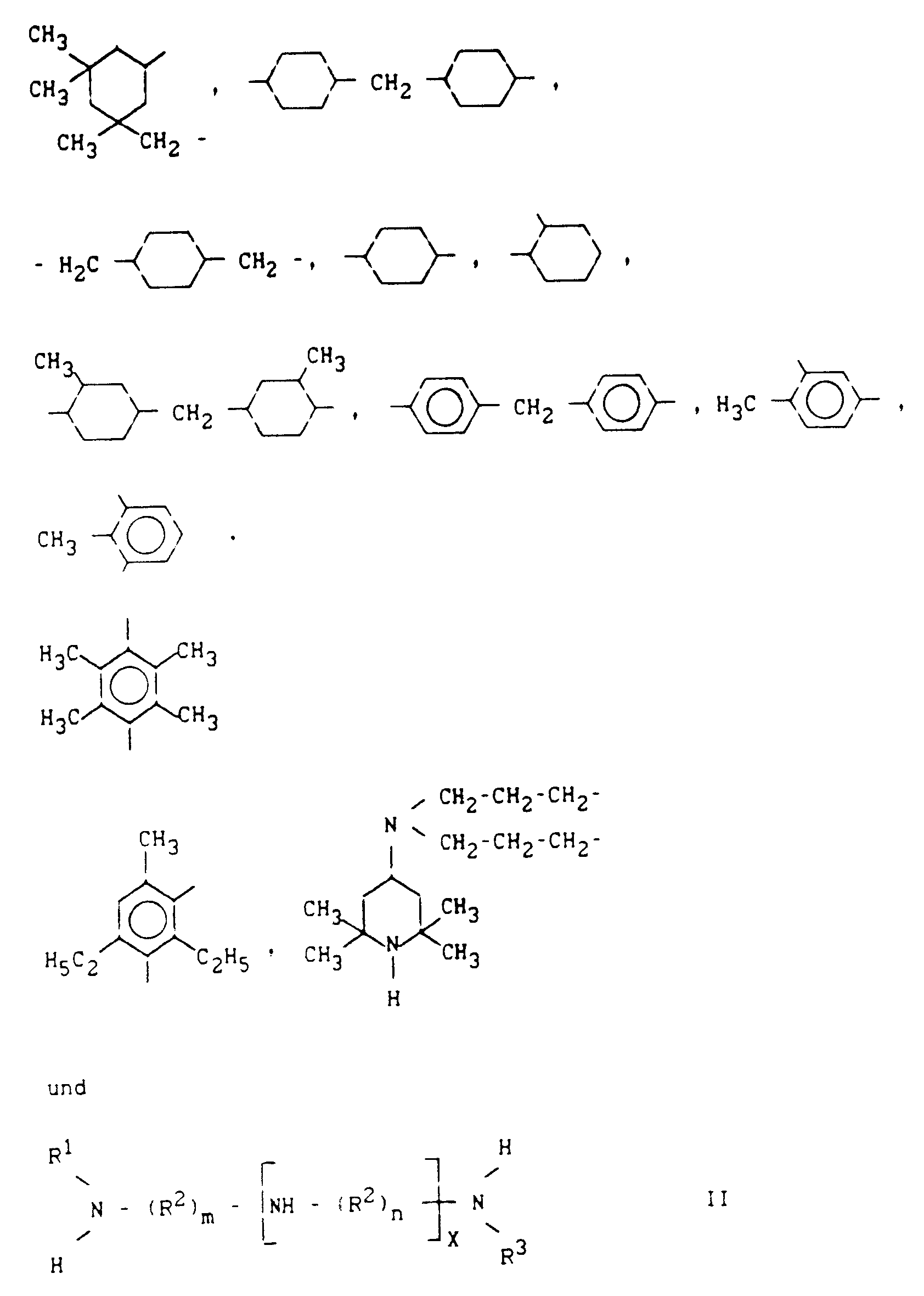 R1 = gleich oder verschieden von R³ = H, alkyl-, (cyclo)-alkyl-, aryl-, aralkyl-, ggf. alkylverzweigt,R² = CH₂-, ggf. alkylverzweigt,m = 2 bis 8X = 0 bis 6n = 2 bis 8ist.
 - Verfahren nach Anspruch 2,
dadurch gekennzeichnet,
daß bevorzugte Polyamine die Diamine Dodecamethylendiamin-1,12, 3,3'-Dimethyl-4,4'-diaminodicyclohexylmethan, Tetraethylenpentamin, Pentaethylenhexamin oder 4,4'-Diaminophenylmethan sind. - Verfahren nach Anspruch 2,
dadurch gekennzeichnet,
daß ganz besonders bevorzugte Diamine 4,4'-Diaminodicyclohexylmethan, Bis-(1,4-aminomethyl)-cyclohexan sowie Isophorondiamin, 2,2,4(2,4,4)-Trimethylhexamethylendiamin-1,6 und deren Gemische sind. - Verfahren nach Anspruch 1,
dadurch gekennzeichnet,
daß als bevorzugte Polyisocyanate aliphatische und/oder (cyclo)-aliphatische Diisocyanate eingesetzt werden. - Verfahren nach Anspruch 5,
dadurch gekennzeichnet,
daß als bevorzugte Diisocyanate Hexamethylendiisocyanat-1,6, 2-Methylpentandiisocyanat-1,5 und 2,2,4(2,4,4)-Trimethylhexamethylendiisocyanat-1,6 eingesetzt werden. - Verfahren nach Anspruch 5,
dadurch gekennzeichnet,
daß als besonders bevorzugtes Diisocyanat 3-Isocyanatomethyl-3,5,5-trimethylcyclohexylisocyanat eingesetzt wird. - Verfahren nach den Ansprüchen 1 bis 7,
dadurch gekennzeichnet,
daß die Reaktionskomponenten im Lösungsmittel eingesetzt werden und nach erfolgter Reaktion das Lösungsmittel verbleibt oder entfernt wird. - Verfahren nach den Ansprüchen 1 bis 8,
dadurch gekennzeichnet,
daß das Polyamin in Substanz oder im Lösungsmittel dem partiell blockierten Polyisocyanat zugesetzt wird. - Verfahren nach den Ansprüchen 1 und 9,
dadurch gekennzeichnet,
daß als Lösungsmittel die lacküblichen Lösungsmittel eingesetzt werden. - Verfahren nach den Ansprüchen 1 und 9,
dadurch gekennzeichnet,
daß als Lösungsmittel Toluol, Cyclohexan und Spezialbenzin mit = 1 Vol.-% Aromaten eingesetzt werden. - Verfahren nach den Ansprüchen 1 bis 11,
dadurch gekennzeichnet,
daß der NCO-Gehalt der Polyisocyanat-Harnstoff-Addukte 4 bis 20 Gew.-%, bevorzugt 6 bis 15 Gew.-%, beträgt. - Verfahren nach den Ansprüchen 1 bis 12,
dadurch gekennzeichnet,
daß der freie NCO-Gehalt der Polyisocyanat-Harnstoffaddukte von 0,7 bis 5 Gew.-% beträgt. - Verwendung der blockierten Polyisocyanat-Harnstoffaddukte, hergestellt gemäß den Ansprüchen 1 bis 13, in Polyurethan-Kunststoffen.
Priority Applications (1)
| Application Number | Priority Date | Filing Date | Title |
|---|---|---|---|
| AT88115942T ATE90668T1 (de) | 1987-11-21 | 1988-09-28 | Verfahren zur herstellung von blockierten harnstoffgruppenhaltigen polyisocyanaten sowie die danach hergestellten produkte. |
Applications Claiming Priority (2)
| Application Number | Priority Date | Filing Date | Title |
|---|---|---|---|
| DE19873739480 DE3739480A1 (de) | 1987-11-21 | 1987-11-21 | Verfahren zur herstellung von blockierten harnstoffgruppenhaltigen polyisocyanaten sowie die danach hergestellten produkte |
| DE3739480 | 1987-11-21 |
Publications (2)
| Publication Number | Publication Date |
|---|---|
| EP0321658A1 EP0321658A1 (de) | 1989-06-28 |
| EP0321658B1 true EP0321658B1 (de) | 1993-06-16 |
Family
ID=6340959
Family Applications (1)
| Application Number | Title | Priority Date | Filing Date |
|---|---|---|---|
| EP88115942A Expired - Lifetime EP0321658B1 (de) | 1987-11-21 | 1988-09-28 | Verfahren zur Herstellung von blockierten harnstoffgruppenhaltigen Polyisocyanaten sowie die danach hergestellten Produkte |
Country Status (7)
| Country | Link |
|---|---|
| US (1) | US4925974A (de) |
| EP (1) | EP0321658B1 (de) |
| JP (1) | JPH01160950A (de) |
| AT (1) | ATE90668T1 (de) |
| CA (1) | CA1331758C (de) |
| DE (2) | DE3739480A1 (de) |
| ES (1) | ES2058202T3 (de) |
Families Citing this family (17)
| Publication number | Priority date | Publication date | Assignee | Title |
|---|---|---|---|---|
| US5112979A (en) * | 1990-11-29 | 1992-05-12 | Texaco Chemical Company | Polyoxyalkyleneamines containing tetraalkylpiperidine functionality and their use as light, heat and oxidation stabilizers |
| DE4337236A1 (de) * | 1993-10-30 | 1995-05-04 | Huels Chemische Werke Ag | Kalthärtende, lösungsmittelarme oder lösungsmittelfreie 2K-Polyurethan-Polyharnstoff-Massen |
| DE4439421A1 (de) * | 1994-11-04 | 1996-05-09 | Huels Chemische Werke Ag | Neue harnstoffgruppenhaltige Polyamine und Verfahren zu ihrer Herstellung |
| DE19604326A1 (de) * | 1996-02-07 | 1997-08-14 | Huels Chemische Werke Ag | Blockierte und kettenverlängerte Diisocyanataddukte, ein Verfahren zu ihrer Herstellung sowie deren Verwendung |
| JPH10204040A (ja) * | 1997-01-24 | 1998-08-04 | Daicel Chem Ind Ltd | 脂環式ポリアミン類およびその製造方法 |
| US6403752B1 (en) | 2000-07-17 | 2002-06-11 | Uop Llc | Secondary aliphatic diamines as curing agents for polyurethanes and polyureas prepared using high-pressure impingement mixing |
| CA2449369C (en) * | 2001-06-15 | 2011-08-23 | Huntsman Petrochemical Corporation | Synergistic amine chain-extenders in polyurea spray elastomers |
| WO2006104528A1 (en) * | 2005-03-28 | 2006-10-05 | Albemarle Corporation | Diimines and secondary diamines |
| US7964695B2 (en) * | 2005-03-28 | 2011-06-21 | Albemarle Corporation | Chain extenders |
| US8076518B2 (en) * | 2005-03-28 | 2011-12-13 | Albemarle Corporation | Chain extenders |
| CA2670041A1 (en) * | 2007-01-10 | 2008-07-17 | Albemarle Corporation | Formulations for reaction injection molding and for spray systems |
| US20110040016A1 (en) * | 2008-04-21 | 2011-02-17 | Yakulis Jr George | Curable compositions that form a high modulus polyurea |
| US20100311890A1 (en) * | 2009-06-05 | 2010-12-09 | Ppg Industries Ohio, Inc. | Curable compositions that form a low modulus polyurea |
| US20110076485A1 (en) * | 2009-09-29 | 2011-03-31 | Ppg Industries Ohio, Inc. | Substrates coated with clear polyurea film-forming compositions |
| JP6520657B2 (ja) * | 2015-11-16 | 2019-05-29 | Jnc株式会社 | ジアミン、ポリアミック酸またはその誘導体、液晶配向剤、液晶配向膜および液晶表示素子 |
| TWI874681B (zh) | 2019-06-27 | 2025-03-01 | 日商旭化成股份有限公司 | 聚異氰酸酯組合物、薄膜形成用組合物、薄膜、薄膜積層體、接著性樹脂組合物及接著性樹脂硬化物、塗料用組合物及塗料硬化物 |
| KR102808361B1 (ko) * | 2021-11-15 | 2025-05-16 | 미쯔비시 가스 케미칼 컴파니, 인코포레이티드 | 폴리우레탄 쇄연장제, 폴리우레탄계 수지 형성용 조성물, 폴리우레탄계 수지, 폴리우레탄계 수지 조성물, 성형체 및 물품 |
Family Cites Families (6)
| Publication number | Priority date | Publication date | Assignee | Title |
|---|---|---|---|---|
| FR1233866A (fr) * | 1959-08-17 | 1960-10-12 | Bayer Ag | Procédé de préparation de mono- et polyisocyanates inoffensifs au point de vue physiologique, avec une faible pression de vapeur |
| DE1174759B (de) * | 1963-02-08 | 1964-07-30 | Bayer Ag | Verfahren zur Herstellung von Polyisocyanaten mit Biuretstruktur |
| JPS4928255B1 (de) * | 1969-04-30 | 1974-07-25 | ||
| JPS5339476B2 (de) * | 1972-07-03 | 1978-10-21 | ||
| DE3143060A1 (de) * | 1981-10-30 | 1983-05-11 | Chemische Werke Hüls AG, 4370 Marl | Pulverlacke auf der basis von blockierten isophorondiisocyanataddukten |
| US4410678A (en) * | 1981-12-28 | 1983-10-18 | Ford Motor Company | Coating composition comprising chain-extendable crosslinkable polyol and diblocked diisocyanate diurea oligomer |
-
1987
- 1987-11-21 DE DE19873739480 patent/DE3739480A1/de not_active Withdrawn
-
1988
- 1988-09-16 US US07/245,217 patent/US4925974A/en not_active Expired - Fee Related
- 1988-09-28 AT AT88115942T patent/ATE90668T1/de not_active IP Right Cessation
- 1988-09-28 DE DE8888115942T patent/DE3881852D1/de not_active Expired - Fee Related
- 1988-09-28 ES ES88115942T patent/ES2058202T3/es not_active Expired - Lifetime
- 1988-09-28 EP EP88115942A patent/EP0321658B1/de not_active Expired - Lifetime
- 1988-11-18 CA CA000583469A patent/CA1331758C/en not_active Expired - Fee Related
- 1988-11-18 JP JP63290314A patent/JPH01160950A/ja active Pending
Also Published As
| Publication number | Publication date |
|---|---|
| CA1331758C (en) | 1994-08-30 |
| ATE90668T1 (de) | 1993-07-15 |
| DE3739480A1 (de) | 1989-06-01 |
| ES2058202T3 (es) | 1994-11-01 |
| US4925974A (en) | 1990-05-15 |
| JPH01160950A (ja) | 1989-06-23 |
| EP0321658A1 (de) | 1989-06-28 |
| DE3881852D1 (de) | 1993-07-22 |
Similar Documents
| Publication | Publication Date | Title |
|---|---|---|
| EP0321658A1 (de) | Verfahren zur Herstellung von blockierten harnstoffgruppenhaltigen Polyisocyanaten sowie die danach hergestellten Produkte | |
| EP0010589B1 (de) | Verfahren zur Herstellung von Isocyanuratgruppen aufweisenden Polyisocyanaten und ihre Verwendung als Isocyanatkomponente in Polyurethanlacken | |
| EP0003765B1 (de) | Verfahren zur Herstellung von Isocyanuratgruppen aufweisenden Polyisocyanaten auf Basis von 1-Isocyanato-3,3,5-trimethyl-5-isocyanatomethylcyclohexan und ihre Verwendung als Isocyanatkomponente in Polyurethanlacken | |
| EP0013880B1 (de) | Neue Isocyanato-isocyanurate, ein Verfahren zu ihrer Herstellung sowie ihre Verwendung als Isocyanatkomponente in Polyurethan-Lacken | |
| DE69116599T3 (de) | Polyisocyanatoisocyanurat, Verfahren zu seiner Herstellung und seine Verwendung | |
| EP0671426A1 (de) | Modifizierte (cyclo)aliphatische Polyisocyanatmischungen, Verfahren zu ihrer Herstellung und ihre Verwendung | |
| DE1215365B (de) | Verfahren zur Herstellung von hoehermolekularen Polyisocyanaten mit Biuret-Struktur | |
| EP0649866A1 (de) | Lackpolyisocyanate und ihre Verwendung | |
| EP0178398B1 (de) | Lagerstabile Polyurethanharz-Pulverlacke | |
| EP1170283A2 (de) | Verfahren zur Herstellung von geruchsarmen und lagerstabilen monomerhaltigen Polyisocyanuraten aus Isophorondiisocyanat | |
| EP0193828B1 (de) | Isocyanuratgruppen aufweisende Polyisocyanate, ein Verfahren zu ihrer Herstellung und ihre Verwendung als Isocyanatkomponente in Polyurethanlacken | |
| DE3440912A1 (de) | Verfahren zur herstellung von waermefarbbestaendigen aliphatischen und/oder cycloaliphatischen diisocyanaten und ihre verwendung zur herstellung von farbverbesserten, modifizierten polyisocyanaten | |
| US4491663A (en) | Trifunctional blocked isocyanate containing an isocyanurate ring | |
| EP0224165B1 (de) | Verfahren zur Herstellung von Isocyanuratgruppen aufweisenden Polyisocyanaten und ihre Verwendung als Isocyanatkomponente in Polyurethanlacken | |
| DE3326188A1 (de) | Verfahren zur herstellung von organischen polyisocyanaten mit zumindest teilweise blockierten isocyanatgruppen, die nach dem verfahren erhaeltlichen verbindungen und ihre verwendung zur herstellung von polyurethanen, einbrennlacken oder waessrigen polyisocyanatloesungen bzw. -dispersionen | |
| DE4439421A1 (de) | Neue harnstoffgruppenhaltige Polyamine und Verfahren zu ihrer Herstellung | |
| EP0787754A2 (de) | Blockierte aliphatische Diisocyanate oder Diisocyanat-Addukte | |
| EP0727453B1 (de) | Isocyanurat-Polyisocyanate auf Basis von 1,3-Diisocyanatocycloalkanen | |
| EP1454933A1 (de) | Verfahren zur Herstellung von geruchsarmen und lagerstabilen monomerhaltigen Polyisocyanuraten auf Basis von Isophorondiisocyanat | |
| EP0839845B1 (de) | Blockierte Polyisocyanate mit eingebautem HALS-Stabilisator | |
| DE3610758C2 (de) | ||
| EP3845576A1 (de) | Verfahren zur herstellung von isocyanurat | |
| EP0039864A1 (de) | Neue Isocyanato-isocyanurate, ein Verfahren zu ihrer Herstellung, sowie ihre Verwendung als Isocyanat-Komponente in Polyurethan-Lacken | |
| DE1203792B (de) | Verfahren zur Herstellung von Isocyanursaeure-derivaten durch katalytische Polymerisation von organischen Isocyanaten | |
| DE4204995A1 (de) | Mit 2,5-diketopiperazinen blockierte diisocyanate, ein verfahren zu ihrer herstellung sowie ihre verwendung in polyurethan-pulverlacken |
Legal Events
| Date | Code | Title | Description |
|---|---|---|---|
| PUAI | Public reference made under article 153(3) epc to a published international application that has entered the european phase |
Free format text: ORIGINAL CODE: 0009012 |
|
| AK | Designated contracting states |
Kind code of ref document: A1 Designated state(s): AT BE CH DE ES FR GB IT LI NL SE |
|
| 17P | Request for examination filed |
Effective date: 19890602 |
|
| 17Q | First examination report despatched |
Effective date: 19910226 |
|
| GRAA | (expected) grant |
Free format text: ORIGINAL CODE: 0009210 |
|
| AK | Designated contracting states |
Kind code of ref document: B1 Designated state(s): AT BE CH DE ES FR GB IT LI NL SE |
|
| REF | Corresponds to: |
Ref document number: 90668 Country of ref document: AT Date of ref document: 19930715 Kind code of ref document: T |
|
| REF | Corresponds to: |
Ref document number: 3881852 Country of ref document: DE Date of ref document: 19930722 |
|
| GBT | Gb: translation of ep patent filed (gb section 77(6)(a)/1977) |
Effective date: 19930629 |
|
| ET | Fr: translation filed | ||
| ITF | It: translation for a ep patent filed | ||
| PLBE | No opposition filed within time limit |
Free format text: ORIGINAL CODE: 0009261 |
|
| STAA | Information on the status of an ep patent application or granted ep patent |
Free format text: STATUS: NO OPPOSITION FILED WITHIN TIME LIMIT |
|
| 26N | No opposition filed | ||
| REG | Reference to a national code |
Ref country code: ES Ref legal event code: FG2A Ref document number: 2058202 Country of ref document: ES Kind code of ref document: T3 |
|
| EAL | Se: european patent in force in sweden |
Ref document number: 88115942.0 |
|
| PGFP | Annual fee paid to national office [announced via postgrant information from national office to epo] |
Ref country code: SE Payment date: 19960812 Year of fee payment: 9 |
|
| PGFP | Annual fee paid to national office [announced via postgrant information from national office to epo] |
Ref country code: ES Payment date: 19960902 Year of fee payment: 9 |
|
| PGFP | Annual fee paid to national office [announced via postgrant information from national office to epo] |
Ref country code: BE Payment date: 19960911 Year of fee payment: 9 |
|
| PGFP | Annual fee paid to national office [announced via postgrant information from national office to epo] |
Ref country code: GB Payment date: 19960920 Year of fee payment: 9 |
|
| PGFP | Annual fee paid to national office [announced via postgrant information from national office to epo] |
Ref country code: AT Payment date: 19960924 Year of fee payment: 9 |
|
| PGFP | Annual fee paid to national office [announced via postgrant information from national office to epo] |
Ref country code: NL Payment date: 19960930 Year of fee payment: 9 Ref country code: FR Payment date: 19960930 Year of fee payment: 9 |
|
| PGFP | Annual fee paid to national office [announced via postgrant information from national office to epo] |
Ref country code: DE Payment date: 19961007 Year of fee payment: 9 |
|
| PGFP | Annual fee paid to national office [announced via postgrant information from national office to epo] |
Ref country code: CH Payment date: 19961202 Year of fee payment: 9 |
|
| PG25 | Lapsed in a contracting state [announced via postgrant information from national office to epo] |
Ref country code: GB Free format text: LAPSE BECAUSE OF NON-PAYMENT OF DUE FEES Effective date: 19970928 Ref country code: AT Free format text: LAPSE BECAUSE OF NON-PAYMENT OF DUE FEES Effective date: 19970928 |
|
| PG25 | Lapsed in a contracting state [announced via postgrant information from national office to epo] |
Ref country code: SE Free format text: LAPSE BECAUSE OF NON-PAYMENT OF DUE FEES Effective date: 19970929 Ref country code: ES Free format text: LAPSE BECAUSE OF THE APPLICANT RENOUNCES Effective date: 19970929 |
|
| PG25 | Lapsed in a contracting state [announced via postgrant information from national office to epo] |
Ref country code: LI Free format text: LAPSE BECAUSE OF NON-PAYMENT OF DUE FEES Effective date: 19970930 Ref country code: FR Free format text: THE PATENT HAS BEEN ANNULLED BY A DECISION OF A NATIONAL AUTHORITY Effective date: 19970930 Ref country code: CH Free format text: LAPSE BECAUSE OF NON-PAYMENT OF DUE FEES Effective date: 19970930 Ref country code: BE Free format text: LAPSE BECAUSE OF NON-PAYMENT OF DUE FEES Effective date: 19970930 |
|
| BERE | Be: lapsed |
Owner name: HULS A.G. Effective date: 19970930 |
|
| PG25 | Lapsed in a contracting state [announced via postgrant information from national office to epo] |
Ref country code: NL Free format text: LAPSE BECAUSE OF NON-PAYMENT OF DUE FEES Effective date: 19980401 |
|
| REG | Reference to a national code |
Ref country code: CH Ref legal event code: PL |
|
| GBPC | Gb: european patent ceased through non-payment of renewal fee |
Effective date: 19970928 |
|
| NLV4 | Nl: lapsed or anulled due to non-payment of the annual fee |
Effective date: 19980401 |
|
| PG25 | Lapsed in a contracting state [announced via postgrant information from national office to epo] |
Ref country code: DE Free format text: LAPSE BECAUSE OF NON-PAYMENT OF DUE FEES Effective date: 19980603 |
|
| EUG | Se: european patent has lapsed |
Ref document number: 88115942.0 |
|
| REG | Reference to a national code |
Ref country code: FR Ref legal event code: ST |
|
| REG | Reference to a national code |
Ref country code: ES Ref legal event code: FD2A Effective date: 20001102 |
|
| PG25 | Lapsed in a contracting state [announced via postgrant information from national office to epo] |
Ref country code: IT Free format text: LAPSE BECAUSE OF NON-PAYMENT OF DUE FEES;WARNING: LAPSES OF ITALIAN PATENTS WITH EFFECTIVE DATE BEFORE 2007 MAY HAVE OCCURRED AT ANY TIME BEFORE 2007. THE CORRECT EFFECTIVE DATE MAY BE DIFFERENT FROM THE ONE RECORDED. Effective date: 20050928 |