EP0321087A1 - Antireflektions-Schichten - Google Patents
Antireflektions-Schichten Download PDFInfo
- Publication number
- EP0321087A1 EP0321087A1 EP88310495A EP88310495A EP0321087A1 EP 0321087 A1 EP0321087 A1 EP 0321087A1 EP 88310495 A EP88310495 A EP 88310495A EP 88310495 A EP88310495 A EP 88310495A EP 0321087 A1 EP0321087 A1 EP 0321087A1
- Authority
- EP
- European Patent Office
- Prior art keywords
- coating
- facet
- coatings
- refractive index
- hafnium oxide
- Prior art date
- Legal status (The legal status is an assumption and is not a legal conclusion. Google has not performed a legal analysis and makes no representation as to the accuracy of the status listed.)
- Withdrawn
Links
Images
Classifications
-
- H—ELECTRICITY
- H10—SEMICONDUCTOR DEVICES; ELECTRIC SOLID-STATE DEVICES NOT OTHERWISE PROVIDED FOR
- H10H—INORGANIC LIGHT-EMITTING SEMICONDUCTOR DEVICES HAVING POTENTIAL BARRIERS
- H10H20/00—Individual inorganic light-emitting semiconductor devices having potential barriers, e.g. light-emitting diodes [LED]
- H10H20/80—Constructional details
- H10H20/84—Coatings, e.g. passivation layers or antireflective coatings
-
- G—PHYSICS
- G02—OPTICS
- G02B—OPTICAL ELEMENTS, SYSTEMS OR APPARATUS
- G02B1/00—Optical elements characterised by the material of which they are made; Optical coatings for optical elements
- G02B1/10—Optical coatings produced by application to, or surface treatment of, optical elements
- G02B1/11—Anti-reflection coatings
- G02B1/113—Anti-reflection coatings using inorganic layer materials only
-
- H—ELECTRICITY
- H01—ELECTRIC ELEMENTS
- H01S—DEVICES USING THE PROCESS OF LIGHT AMPLIFICATION BY STIMULATED EMISSION OF RADIATION [LASER] TO AMPLIFY OR GENERATE LIGHT; DEVICES USING STIMULATED EMISSION OF ELECTROMAGNETIC RADIATION IN WAVE RANGES OTHER THAN OPTICAL
- H01S5/00—Semiconductor lasers
- H01S5/02—Structural details or components not essential to laser action
- H01S5/028—Coatings ; Treatment of the laser facets, e.g. etching, passivation layers or reflecting layers
-
- H—ELECTRICITY
- H10—SEMICONDUCTOR DEVICES; ELECTRIC SOLID-STATE DEVICES NOT OTHERWISE PROVIDED FOR
- H10F—INORGANIC SEMICONDUCTOR DEVICES SENSITIVE TO INFRARED RADIATION, LIGHT, ELECTROMAGNETIC RADIATION OF SHORTER WAVELENGTH OR CORPUSCULAR RADIATION
- H10F77/00—Constructional details of devices covered by this subclass
- H10F77/30—Coatings
Definitions
- This invention relates to anti-reflection coatings and in particular to anti-reflection coatings for semiconductor laser devices, eg optical amplifiers.
- anti-reflection coatings in laser devices is well established. Some devices, eg distributed feedback lasers (usually called DFB lasers) and external cavity lasers, require a single anti-reflection coating. Other devices, eg optical amplifiers, require two anti-reflection coatings. Although these devices, and the use of anti-reflection coatings therein, are well established a brief description will be given.
- DFB lasers distributed feedback lasers
- optical amplifiers require two anti-reflection coatings.
- a DFB laser comprises an active semiconductor region in which an optical signal is generated.
- the DFB laser also includes a resonance system which has two components, namely a reflective facet, ideally 100% reflective, which is located at one end of the active region and a diffraction grating which provides wavelength selectivity.
- the active region also has an exit facet through which the radiation generated in the active region passes as output. Reflections from the exit facet are unwanted because the reflected radiation participates in the generation of radiation but the wavelength differs from that of the main signal. Thus it is desirable to apply an anti-reflection coating to the exit facet.
- An external cavity laser comprises an active semiconductor region in which the signal is generated and a separate cavity which is part of a resonant system.
- An optical amplifier also has an active region in which the lasing activity occurs but, because oscillation is highly undesirable, there is no resonance system.
- One form of amplifier hereinafter called a single pass amplifier, has an input facet for receiving weak optical signals, eg signals attenuated after long distance transmission.
- the amplifier also has an output facet through which signals, after amplification by passage through the active region, leave, eg for further transmission. Reflections at the input and output facets degrade the performance, eg by causing oscillation or noise. It is, therefore, conventional to apply anti-reflection coatings to both the input and output facets.
- one facet serves for both input and output.
- amplifiers are associated with directional couplers to separate input and output signals.
- the signal passes twice through the active region and the decibel gain is doubled.
- the input/output facet is provided with an anti-reflection coating but the other facet needs a mirror coating with a high, ideally 100%, reflectivity.
- the active region is formed of a semiconductor which contains at least one of Ga and In and at least one of P and As, eg mixed compounds of the formula Ga x In (1-x) As y P (1-y) where x is in the range 0.2 to 0.4 and y is in the range 0.5 to 0.9.
- a semiconductor which contains at least one of Ga and In and at least one of P and As, eg mixed compounds of the formula Ga x In (1-x) As y P (1-y) where x is in the range 0.2 to 0.4 and y is in the range 0.5 to 0.9.
- oxides have been proposed for this purpose, eg oxides of Y, Gd, Nd and Si. Indeed very low reflectivities have been achieved, eg of the order 10 ⁇ 4, but other factors have also to be taken into account, eg the stability of the coating. The ease and reproducability with which the coating may be deposited is also important. It is an object of this invention to provide coatings which have acceptably low levels of reflectivity, adequate stability and which can be deposited reproducably.
- the coatings are preferably 180 to 220nm thick.
- hafnium oxide exists in non-stoichiometric forms. Thus it can be represented by the formula HfO n where n is slightly less than 2. It is not possible to ascertain the value of n in a coating layer but the refractive index of the coating is related to its degree of oxidation. The refractive index is also related to the occurrence of voids within the coating. Thus it is desirable that the coating should have a refractive index, measured at 632.8nm, in the range 1.87 to 2.00 and a packing density in the range 0.86 to 0.96. The method of determining the packing density will be given below.
- the coatings according to the invention are conveniently produced by deposition from the vapour phase in the presence of oxygen at low pressure, eg below 10 ⁇ 3mbar. It is preferred to deposit the coating at a rate of 0.1 to 1nm/s preferably 0.2nm/s, under an oxygen pressure of between 1 and 5 x 10 ⁇ 4mbar.
- a target comprising 20 to 50 devices. After coating the target is cut into separate devices and electrical connectors are attached. Optical fibre may also be attached.
- the amplifier comprises a substrate 10 of InP.
- the substrate performs no function in the finished device. It provides support for the other layers which were grown onto the substrate.
- the operative layers are confining layers 11 and 12 which are formed of p and n type InP respectively.
- the active layer 13 an indium gallium arsenide phosphide semiconductor, is located between the confining layers 11 and 12.
- the active layer 13 has a higher refractive index than the two confining layers.
- the two end facets of the amplifier are coated with anti-reflection coatings 14 and 15 formed of hafnium oxide having a refractive index of 1.87 to 2.00 and a packing density of 0.91. (Note the refractive index range 1.87 to 2.00 applies when the index is measured with radiation of wavelength 632.8nm. If measured at the wavelength of use, eg 1.55 ⁇ m, the preferred refractive index is 1.84).
- the performance of these anti-reflection coatings is matched to the properties of the active layer 13.
- the hafnium oxide can not only suppress the lasing but substantially reduce this noise. For gains of over 20dB reflectivities below 0.5%, preferably below 0.2%, are appropriate. For gains of 30dB even lower reflectivities, eg below 0.05%, would be needed.
- the anti-reflection coatings according to the invention are applied using a conventional vapour deposition apparatus.
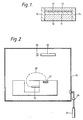
- the apparatus shown in Figure 2 comprises a vacuum chamber 19 which is connected to evacuation pumps (not shown).
- the chamber 19 contains the target 20 and a source 21 which is a hafnium oxide contained in a suitable crucible.
- the target 20 is heated to 300°C.
- the source is heated and thereby caused to evaporate by an electron beam 23 which is generated by an electron gun 22.
- a magnetic field (the mode of generation is not shown) is applied to cause the electrons to follow a curved path to impinge on the source 21. Varying the field causes the point of impact to wander so that hafnium oxide is evaporated from different parts of the source. Thus source material is evaporated so that it rises to deposit on target 20.
- the vacuum chamber 19 contains an atmosphere of oxgyen at a pressure between 1x10 ⁇ 4 and 5 x 10 ⁇ 4 mbar.
- oxygen is continuously leaked into the chamber 19 from a cylinder 25 via a leak valve 26.
- the evacuation pumps run continuously and the rate of supply of oxygen is adjusted so that the pressure is steady at the selected value. (Before adding any oxygen, the chamber 19 is evacuated to about 5 x 10 ⁇ 9mbar. Thus the oxygen atmosphere is substantially pure).
- the chamber 19 also contains a piezo-electric crystal 24 which is adjacent to the target 20 so that hafnium oxide deposits on both simultaneously.
- the frequency of oscillation of the crystal 24 is affected by the deposit.
- the crystal is calibrated in known manner and its frequency of oscillation is continuously monitored during deposition whereby the thickness and rate of growth are continuously available.
- the final thickness of the coating should be about 0.25 to 0.27, preferably 0.26, of a wavelength (as measured inside the coating) of the intended signals. (Note. If the wavelength of the intended signals is measured in vacuo the thickness is 0.12 to 0.14 of the wavelength). Thus for signals with wavelengths of 1.3 ⁇ m to 1.5 ⁇ m in vacuo, coating thicknesses of about 186nm to 220nm are suitable. We recommend about 186nm for 1.3 ⁇ m and 215 for 1.5 ⁇ m. The quartz crystal 24 detects the end point when the coating on the target has achieved the appropriate thickness.
- targets which contain several devices, eg about 30 devices, at one time. After coating (both facets) the target is cut into individual devices which are mounted for use. During coating the target is held in a conventional holder.
- oxygenated coatings of hafnium oxide were applied to semiconductor devices.
- hafnium oxide is substantially affected by the conditions under which it was deposited and conditions which favour substantially complete oxygenation appear to favour the lowest (most desirable) reflectivities.
- oxygen in the vacuum chamber 19 appears to exert a disadvantageous effect on the other properties of the coating, eg the coating may be slightly porous and hence its refractive index may change after deposition.
- the coating In order to take account of both effects we prefer to deposit the coating slowly, eg at a rate of less than 2nm/s, eg 0.1 to 1 nm/s, under a low oxygen pressure, eg 2 to 5x10 ⁇ 4mbar.
- the degree of oxidation can be measured by the refractive index of the coating and the target values are 1.87 to 2.00 measured at 632.8nm.
- the degree of porosity can be measured by the change of refractive index after very prolonged storage in air saturated with water vapour at 25°C.
- N H is measured first and the sample is dried, eg by heating at 300°C for 30 minutes in vacuo, and N o is measured second.
- a target in the form of a strip of 30 devices designed for operation at 1.5 ⁇ m was heated to 300°C and exposed to hafnium oxide vapour in the presence of oxygen at 3.4x10 ⁇ 4mbar.
- a coating 218nm thick was grown at 1.0nm/s. The target was treated twice so that two facets were coated.
- the refractive index was 1.941 and after saturation with water vapour (by exposure to saturated air for 3000 hrs at 30°C) the index rose to 1.971. This implies a packing density of 0.91 and that the refractive index of the hafnium oxide itself was 2.035. (All the refractive indices were measured at wavelength 632.8nm).
- the strip of 30 devices was cut into individual amplifiers and a gain of 28dB was achieved without oscillation. This implies a reflectivity below 0.2% for the coatings.
- a target in the form of a strip of 30 devices designed for operation at 1.5 ⁇ m was heated to 300°C and exposed to hafnium oxide vapour in the presence of oxygen at 3.1x10 ⁇ 4mbar.
- a coating 182nm thick was grown at 0.2nm/s. The target was treated twice so that two facets were coated.
- the refractive index was 1.916 and after saturation with water vapour (by exposure to saturated air at 30°C) the index rose to 1.943. This implies a packing density of 0.915 and that the refractive index of the hafnium oxide itself was 2.000.
- the strip of 30 devices was cut into individual amplifiers and a gain of 28dB was achieved without oscillation. This implies a reflectivity below 0.2% for the coatings.
- Examples 1 and 2 describe coatings wherein the hafnium oxide itself has a refractive index of 2.034 and 2.000 respectively.
- the value 2.034 is above the target range of 2.00 to 1.87 whereas the value 2.000 is at the top end of the range. Since the refractive index tends to decrease as the degree of oxidation increases, it appears that the oxidation conditions employed in Example 2 are more efficatious.
- the deposition methods also produce pores in the coatings and the presence of the pores reduces the refractive index.
- the pores provide a valuable control in reducing the refractive index to values which would be difficult to achieve by oxidation.
- the coating as a whole has a refractive index of 1.916 (because the packing density is 0.915) and this lower value is better than the "oxide" value of 2.000.
- the pores also represent a source of instability because impurities, eg water vapour, can diffuse into them.
- impurities eg water vapour
- this is not a serious disadvantage because the amplifier is encapsulated during use and in any case the total volume of the pores is small when the packing density is greater than 0.9.
- the fibres are placed close to the coatings so that the actual interface is air/hafnium oxide.
- the encapsulating material surrounds the ends of the fibre and the amplifier and it does not intrude into the path of the radiation.
Landscapes
- Physics & Mathematics (AREA)
- General Physics & Mathematics (AREA)
- Optics & Photonics (AREA)
- Condensed Matter Physics & Semiconductors (AREA)
- Electromagnetism (AREA)
- Chemical & Material Sciences (AREA)
- Inorganic Chemistry (AREA)
- Semiconductor Lasers (AREA)
Applications Claiming Priority (2)
| Application Number | Priority Date | Filing Date | Title |
|---|---|---|---|
| GB878729104A GB8729104D0 (en) | 1987-12-14 | 1987-12-14 | Anti-reflection coatings |
| GB8729104 | 1987-12-14 |
Publications (1)
| Publication Number | Publication Date |
|---|---|
| EP0321087A1 true EP0321087A1 (de) | 1989-06-21 |
Family
ID=10628453
Family Applications (1)
| Application Number | Title | Priority Date | Filing Date |
|---|---|---|---|
| EP88310495A Withdrawn EP0321087A1 (de) | 1987-12-14 | 1988-11-08 | Antireflektions-Schichten |
Country Status (3)
| Country | Link |
|---|---|
| EP (1) | EP0321087A1 (de) |
| JP (1) | JPH01287986A (de) |
| GB (1) | GB8729104D0 (de) |
Cited By (6)
| Publication number | Priority date | Publication date | Assignee | Title |
|---|---|---|---|---|
| EP0426239A1 (de) * | 1989-10-31 | 1991-05-08 | Koninklijke Philips Electronics N.V. | Optischer Verstärker |
| DE4231007A1 (de) * | 1992-09-16 | 1994-03-17 | Siemens Ag | Lumineszenzdiode und Verfahren zu deren Herstellung |
| US6456429B1 (en) * | 2000-11-15 | 2002-09-24 | Onetta, Inc. | Double-pass optical amplifier |
| US7153586B2 (en) | 2003-08-01 | 2006-12-26 | Vapor Technologies, Inc. | Article with scandium compound decorative coating |
| CN102338899A (zh) * | 2011-09-29 | 2012-02-01 | 中国航空工业第六一八研究所 | 一种低损耗高可靠性反射镜 |
| US8123967B2 (en) | 2005-08-01 | 2012-02-28 | Vapor Technologies Inc. | Method of producing an article having patterned decorative coating |
Families Citing this family (1)
| Publication number | Priority date | Publication date | Assignee | Title |
|---|---|---|---|---|
| JP3699842B2 (ja) * | 1998-12-04 | 2005-09-28 | 三菱化学株式会社 | 化合物半導体発光素子 |
Citations (4)
| Publication number | Priority date | Publication date | Assignee | Title |
|---|---|---|---|---|
| EP0168165A1 (de) * | 1984-06-06 | 1986-01-15 | BRITISH TELECOMMUNICATIONS public limited company | Optoelektronische und elektrooptische Vorrichtungen |
| JPS61159602A (ja) * | 1984-12-30 | 1986-07-19 | Olympus Optical Co Ltd | 多層反射防止膜 |
| EP0204540A2 (de) * | 1985-06-04 | 1986-12-10 | BRITISH TELECOMMUNICATIONS public limited company | Optoelektronische Vorrichtungen |
| EP0259919A1 (de) * | 1986-09-01 | 1988-03-16 | Koninklijke Philips Electronics N.V. | Laser mit verteilter Rückkopplung und Antireflextionsschicht |
-
1987
- 1987-12-14 GB GB878729104A patent/GB8729104D0/en active Pending
-
1988
- 1988-11-08 EP EP88310495A patent/EP0321087A1/de not_active Withdrawn
- 1988-12-14 JP JP63316065A patent/JPH01287986A/ja active Pending
Patent Citations (4)
| Publication number | Priority date | Publication date | Assignee | Title |
|---|---|---|---|---|
| EP0168165A1 (de) * | 1984-06-06 | 1986-01-15 | BRITISH TELECOMMUNICATIONS public limited company | Optoelektronische und elektrooptische Vorrichtungen |
| JPS61159602A (ja) * | 1984-12-30 | 1986-07-19 | Olympus Optical Co Ltd | 多層反射防止膜 |
| EP0204540A2 (de) * | 1985-06-04 | 1986-12-10 | BRITISH TELECOMMUNICATIONS public limited company | Optoelektronische Vorrichtungen |
| EP0259919A1 (de) * | 1986-09-01 | 1988-03-16 | Koninklijke Philips Electronics N.V. | Laser mit verteilter Rückkopplung und Antireflextionsschicht |
Non-Patent Citations (1)
| Title |
|---|
| PATENT ABSTRACTS OF JAPAN, vol. 10, no. 364 (P-524)[2421], 5th December 1986; & JP-A-61 159 602 (OLYMPUS OPTICAL CO. LTD) 19-07-1986 * |
Cited By (9)
| Publication number | Priority date | Publication date | Assignee | Title |
|---|---|---|---|---|
| EP0426239A1 (de) * | 1989-10-31 | 1991-05-08 | Koninklijke Philips Electronics N.V. | Optischer Verstärker |
| US5196958A (en) * | 1989-10-31 | 1993-03-23 | U.S. Philips Corporation | Optical amplifier having gain at two separated wavelengths |
| DE4231007A1 (de) * | 1992-09-16 | 1994-03-17 | Siemens Ag | Lumineszenzdiode und Verfahren zu deren Herstellung |
| DE4231007C2 (de) * | 1992-09-16 | 1998-08-20 | Siemens Ag | Verfahren zum Herstellen von Lumineszenzdioden |
| US6456429B1 (en) * | 2000-11-15 | 2002-09-24 | Onetta, Inc. | Double-pass optical amplifier |
| US7153586B2 (en) | 2003-08-01 | 2006-12-26 | Vapor Technologies, Inc. | Article with scandium compound decorative coating |
| US8123967B2 (en) | 2005-08-01 | 2012-02-28 | Vapor Technologies Inc. | Method of producing an article having patterned decorative coating |
| CN102338899A (zh) * | 2011-09-29 | 2012-02-01 | 中国航空工业第六一八研究所 | 一种低损耗高可靠性反射镜 |
| CN102338899B (zh) * | 2011-09-29 | 2013-10-23 | 中国航空工业第六一八研究所 | 一种低损耗高可靠性反射镜 |
Also Published As
| Publication number | Publication date |
|---|---|
| JPH01287986A (ja) | 1989-11-20 |
| GB8729104D0 (en) | 1988-01-27 |
Similar Documents
| Publication | Publication Date | Title |
|---|---|---|
| US6618409B1 (en) | Passivation of semiconductor laser facets | |
| US4749255A (en) | Coating for optical devices | |
| EP0674017B1 (de) | Galliumoxid-Beschichtung für optoelektronische Bauelemente | |
| US5056099A (en) | Rugate filter on diode laser for temperature stabilized emission wavelength | |
| US20050127383A1 (en) | Laser diode and manufacturing method thereof | |
| US5040186A (en) | InP-based quantum-well laser | |
| EP0321087A1 (de) | Antireflektions-Schichten | |
| US5440575A (en) | Article comprising a semiconductor laser with stble facet coating | |
| GB2379795A (en) | Method of manufacturing an optical device | |
| EP1037343A2 (de) | Halbleiterlaser mit verteilter Rückkoppelung | |
| Katagiri et al. | Ion beam sputtered (SiO2) x (Si3N4) 1− x antireflection coatings on laser facets produced using O2–N2 discharges | |
| US5025451A (en) | Two-dimensional integrated laser array | |
| EP0259919A1 (de) | Laser mit verteilter Rückkopplung und Antireflextionsschicht | |
| JPH06125149A (ja) | 半導体素子及びその製造方法 | |
| Deppe et al. | Room‐temperature photopumped operation of an InGaAs‐InP vertical cavity surface‐emitting laser | |
| EP0168165A1 (de) | Optoelektronische und elektrooptische Vorrichtungen | |
| JPH1098231A (ja) | 半導体光集積素子とその製造方法 | |
| Fronen | Facet reflectivity and low-frequency noise in the light output of LED and superradiant diodes | |
| Baba et al. | Continuous wave GaInAsP/InP surface emitting lasers with a thermally conductive MgO/Si mirror | |
| EP0447096B1 (de) | Quantenstruktur-Laser mit einer InGaAsP-Begrenzungsschicht und Verfahren zur Herstellung des Lasers | |
| EP0845819A1 (de) | Yttrium-Aluminium-Oxid-Beschichtung für aktive optische Halbleiterbauelemente | |
| EP4492592A1 (de) | Lichtemittierendes halbleiterelement und lasermodul mit externem resonator | |
| Fernier et al. | Design and realization of polarisation insensitive semiconductor optical amplifiers with low forward current | |
| Motoda et al. | Multi-wafer growth of highly uniform and high-quality AlGaInP/GaInP structure using high-speed rotating disk metalorganic chemical vapor deposition | |
| JPS6066484A (ja) | 半導体レ−ザ装置及びその製造方法 |
Legal Events
| Date | Code | Title | Description |
|---|---|---|---|
| PUAI | Public reference made under article 153(3) epc to a published international application that has entered the european phase |
Free format text: ORIGINAL CODE: 0009012 |
|
| AK | Designated contracting states |
Kind code of ref document: A1 Designated state(s): AT BE CH DE ES FR GB GR IT LI LU NL SE |
|
| STAA | Information on the status of an ep patent application or granted ep patent |
Free format text: STATUS: THE APPLICATION IS DEEMED TO BE WITHDRAWN |
|
| 18D | Application deemed to be withdrawn |
Effective date: 19891222 |