EP0316753B1 - Verfahren zur Herstellung von wasserverdünnbaren Bindemittelzusammensetzungen für heisssiegelbare Überzüge auf Aluminiumfolien und mit diesen Bindemitteln formulierte Heisssiegellacke - Google Patents
Verfahren zur Herstellung von wasserverdünnbaren Bindemittelzusammensetzungen für heisssiegelbare Überzüge auf Aluminiumfolien und mit diesen Bindemitteln formulierte Heisssiegellacke Download PDFInfo
- Publication number
- EP0316753B1 EP0316753B1 EP88118701A EP88118701A EP0316753B1 EP 0316753 B1 EP0316753 B1 EP 0316753B1 EP 88118701 A EP88118701 A EP 88118701A EP 88118701 A EP88118701 A EP 88118701A EP 0316753 B1 EP0316753 B1 EP 0316753B1
- Authority
- EP
- European Patent Office
- Prior art keywords
- weight
- meth
- heat
- copolymer
- process according
- Prior art date
- Legal status (The legal status is an assumption and is not a legal conclusion. Google has not performed a legal analysis and makes no representation as to the accuracy of the status listed.)
- Expired - Lifetime
Links
- 239000000203 mixture Substances 0.000 title claims description 17
- 239000011230 binding agent Substances 0.000 title claims description 9
- 238000000576 coating method Methods 0.000 title claims description 7
- 238000002360 preparation method Methods 0.000 title claims description 3
- 239000005030 aluminium foil Substances 0.000 title claims 2
- 239000004920 heat-sealing lacquer Substances 0.000 title description 3
- 239000003232 water-soluble binding agent Substances 0.000 title 1
- 229920001577 copolymer Polymers 0.000 claims description 20
- HEDRZPFGACZZDS-UHFFFAOYSA-N Chloroform Chemical compound ClC(Cl)Cl HEDRZPFGACZZDS-UHFFFAOYSA-N 0.000 claims description 18
- 239000002904 solvent Substances 0.000 claims description 18
- 238000000034 method Methods 0.000 claims description 16
- 238000006243 chemical reaction Methods 0.000 claims description 15
- 239000000178 monomer Substances 0.000 claims description 13
- CERQOIWHTDAKMF-UHFFFAOYSA-N Methacrylic acid Chemical compound CC(=C)C(O)=O CERQOIWHTDAKMF-UHFFFAOYSA-N 0.000 claims description 8
- 125000004432 carbon atom Chemical group C* 0.000 claims description 6
- 239000007795 chemical reaction product Substances 0.000 claims description 6
- NIXOWILDQLNWCW-UHFFFAOYSA-M Acrylate Chemical compound [O-]C(=O)C=C NIXOWILDQLNWCW-UHFFFAOYSA-M 0.000 claims description 5
- 239000003960 organic solvent Substances 0.000 claims description 5
- SOGAXMICEFXMKE-UHFFFAOYSA-N Butylmethacrylate Chemical compound CCCCOC(=O)C(C)=C SOGAXMICEFXMKE-UHFFFAOYSA-N 0.000 claims description 4
- 239000002253 acid Substances 0.000 claims description 4
- 125000003055 glycidyl group Chemical group C(C1CO1)* 0.000 claims description 4
- 230000009477 glass transition Effects 0.000 claims description 3
- 239000003112 inhibitor Substances 0.000 claims description 3
- 125000000466 oxiranyl group Chemical group 0.000 claims description 3
- 229920001169 thermoplastic Polymers 0.000 claims description 3
- 239000004416 thermosoftening plastic Substances 0.000 claims description 3
- RUMACXVDVNRZJZ-UHFFFAOYSA-N 2-methylpropyl 2-methylprop-2-enoate Chemical compound CC(C)COC(=O)C(C)=C RUMACXVDVNRZJZ-UHFFFAOYSA-N 0.000 claims description 2
- VVQNEPGJFQJSBK-UHFFFAOYSA-N Methyl methacrylate Chemical compound COC(=O)C(C)=C VVQNEPGJFQJSBK-UHFFFAOYSA-N 0.000 claims description 2
- 229920006243 acrylic copolymer Polymers 0.000 claims description 2
- 125000005907 alkyl ester group Chemical group 0.000 claims description 2
- 125000001495 ethyl group Chemical group [H]C([H])([H])C([H])([H])* 0.000 claims description 2
- VOZRXNHHFUQHIL-UHFFFAOYSA-N glycidyl methacrylate Chemical compound CC(=C)C(=O)OCC1CO1 VOZRXNHHFUQHIL-UHFFFAOYSA-N 0.000 claims description 2
- RPQRDASANLAFCM-UHFFFAOYSA-N oxiran-2-ylmethyl prop-2-enoate Chemical compound C=CC(=O)OCC1CO1 RPQRDASANLAFCM-UHFFFAOYSA-N 0.000 claims description 2
- 230000001105 regulatory effect Effects 0.000 claims description 2
- 150000001252 acrylic acid derivatives Chemical class 0.000 claims 3
- 125000000217 alkyl group Chemical group 0.000 claims 2
- 229920000642 polymer Polymers 0.000 description 10
- XLYOFNOQVPJJNP-UHFFFAOYSA-N water Substances O XLYOFNOQVPJJNP-UHFFFAOYSA-N 0.000 description 10
- YXFVVABEGXRONW-UHFFFAOYSA-N Toluene Chemical compound CC1=CC=CC=C1 YXFVVABEGXRONW-UHFFFAOYSA-N 0.000 description 9
- 238000012360 testing method Methods 0.000 description 8
- XAGFODPZIPBFFR-UHFFFAOYSA-N aluminium Chemical compound [Al] XAGFODPZIPBFFR-UHFFFAOYSA-N 0.000 description 7
- 229910052782 aluminium Inorganic materials 0.000 description 7
- 239000011888 foil Substances 0.000 description 7
- 239000003973 paint Substances 0.000 description 7
- LFQSCWFLJHTTHZ-UHFFFAOYSA-N Ethanol Chemical compound CCO LFQSCWFLJHTTHZ-UHFFFAOYSA-N 0.000 description 6
- NIXOWILDQLNWCW-UHFFFAOYSA-N Acrylic acid Chemical compound OC(=O)C=C NIXOWILDQLNWCW-UHFFFAOYSA-N 0.000 description 5
- 239000000047 product Substances 0.000 description 5
- 239000007787 solid Substances 0.000 description 5
- QGZKDVFQNNGYKY-UHFFFAOYSA-N Ammonia Chemical compound N QGZKDVFQNNGYKY-UHFFFAOYSA-N 0.000 description 4
- KFZMGEQAYNKOFK-UHFFFAOYSA-N Isopropanol Chemical compound CC(C)O KFZMGEQAYNKOFK-UHFFFAOYSA-N 0.000 description 4
- 125000003178 carboxy group Chemical group [H]OC(*)=O 0.000 description 4
- 239000004922 lacquer Substances 0.000 description 4
- 238000004519 manufacturing process Methods 0.000 description 4
- 238000004806 packaging method and process Methods 0.000 description 4
- 238000006116 polymerization reaction Methods 0.000 description 4
- 238000007789 sealing Methods 0.000 description 4
- SMZOUWXMTYCWNB-UHFFFAOYSA-N 2-(2-methoxy-5-methylphenyl)ethanamine Chemical compound COC1=CC=C(C)C=C1CCN SMZOUWXMTYCWNB-UHFFFAOYSA-N 0.000 description 3
- CTQNGGLPUBDAKN-UHFFFAOYSA-N O-Xylene Chemical compound CC1=CC=CC=C1C CTQNGGLPUBDAKN-UHFFFAOYSA-N 0.000 description 3
- 239000004793 Polystyrene Substances 0.000 description 3
- 150000001242 acetic acid derivatives Chemical class 0.000 description 3
- 239000011248 coating agent Substances 0.000 description 3
- 238000001035 drying Methods 0.000 description 3
- 238000009472 formulation Methods 0.000 description 3
- 239000003999 initiator Substances 0.000 description 3
- 150000002576 ketones Chemical class 0.000 description 3
- 229920002223 polystyrene Polymers 0.000 description 3
- 239000000243 solution Substances 0.000 description 3
- 239000008096 xylene Substances 0.000 description 3
- QIGBRXMKCJKVMJ-UHFFFAOYSA-N Hydroquinone Chemical compound OC1=CC=C(O)C=C1 QIGBRXMKCJKVMJ-UHFFFAOYSA-N 0.000 description 2
- 125000005396 acrylic acid ester group Chemical group 0.000 description 2
- 150000001298 alcohols Chemical class 0.000 description 2
- 229910021529 ammonia Inorganic materials 0.000 description 2
- 229940072049 amyl acetate Drugs 0.000 description 2
- PGMYKACGEOXYJE-UHFFFAOYSA-N anhydrous amyl acetate Natural products CCCCCOC(C)=O PGMYKACGEOXYJE-UHFFFAOYSA-N 0.000 description 2
- 239000008367 deionised water Substances 0.000 description 2
- 229910021641 deionized water Inorganic materials 0.000 description 2
- CATSNJVOTSVZJV-UHFFFAOYSA-N heptan-2-one Chemical compound CCCCCC(C)=O CATSNJVOTSVZJV-UHFFFAOYSA-N 0.000 description 2
- MNWFXJYAOYHMED-UHFFFAOYSA-M heptanoate Chemical compound CCCCCCC([O-])=O MNWFXJYAOYHMED-UHFFFAOYSA-M 0.000 description 2
- 239000008267 milk Substances 0.000 description 2
- 210000004080 milk Anatomy 0.000 description 2
- 235000013336 milk Nutrition 0.000 description 2
- 238000006386 neutralization reaction Methods 0.000 description 2
- 230000003472 neutralizing effect Effects 0.000 description 2
- LQNUZADURLCDLV-UHFFFAOYSA-N nitrobenzene Chemical compound [O-][N+](=O)C1=CC=CC=C1 LQNUZADURLCDLV-UHFFFAOYSA-N 0.000 description 2
- BDERNNFJNOPAEC-UHFFFAOYSA-N propan-1-ol Chemical class CCCO BDERNNFJNOPAEC-UHFFFAOYSA-N 0.000 description 2
- 230000001954 sterilising effect Effects 0.000 description 2
- 238000004659 sterilization and disinfection Methods 0.000 description 2
- 238000003860 storage Methods 0.000 description 2
- RIOQSEWOXXDEQQ-UHFFFAOYSA-N triphenylphosphine Chemical compound C1=CC=CC=C1P(C=1C=CC=CC=1)C1=CC=CC=C1 RIOQSEWOXXDEQQ-UHFFFAOYSA-N 0.000 description 2
- 239000004743 Polypropylene Substances 0.000 description 1
- 239000002174 Styrene-butadiene Substances 0.000 description 1
- 239000007864 aqueous solution Substances 0.000 description 1
- 239000003849 aromatic solvent Substances 0.000 description 1
- 229920005601 base polymer Polymers 0.000 description 1
- MTAZNLWOLGHBHU-UHFFFAOYSA-N butadiene-styrene rubber Chemical compound C=CC=C.C=CC1=CC=CC=C1 MTAZNLWOLGHBHU-UHFFFAOYSA-N 0.000 description 1
- 239000003054 catalyst Substances 0.000 description 1
- 239000008199 coating composition Substances 0.000 description 1
- 208000012839 conversion disease Diseases 0.000 description 1
- 238000007334 copolymerization reaction Methods 0.000 description 1
- 238000010790 dilution Methods 0.000 description 1
- 239000012895 dilution Substances 0.000 description 1
- 238000004821 distillation Methods 0.000 description 1
- 238000009826 distribution Methods 0.000 description 1
- 230000032050 esterification Effects 0.000 description 1
- 238000005886 esterification reaction Methods 0.000 description 1
- 230000002349 favourable effect Effects 0.000 description 1
- 239000007888 film coating Substances 0.000 description 1
- 238000009501 film coating Methods 0.000 description 1
- 235000013305 food Nutrition 0.000 description 1
- 238000010528 free radical solution polymerization reaction Methods 0.000 description 1
- 239000012442 inert solvent Substances 0.000 description 1
- 229920003145 methacrylic acid copolymer Polymers 0.000 description 1
- 125000005397 methacrylic acid ester group Chemical group 0.000 description 1
- 239000003505 polymerization initiator Substances 0.000 description 1
- 229920001155 polypropylene Polymers 0.000 description 1
- -1 polypropylenes Polymers 0.000 description 1
- 239000012429 reaction media Substances 0.000 description 1
- 239000011347 resin Substances 0.000 description 1
- 229920005989 resin Polymers 0.000 description 1
- 238000000518 rheometry Methods 0.000 description 1
- 239000011115 styrene butadiene Substances 0.000 description 1
- 229920003048 styrene butadiene rubber Polymers 0.000 description 1
- 230000002087 whitening effect Effects 0.000 description 1
Classifications
-
- C—CHEMISTRY; METALLURGY
- C08—ORGANIC MACROMOLECULAR COMPOUNDS; THEIR PREPARATION OR CHEMICAL WORKING-UP; COMPOSITIONS BASED THEREON
- C08F—MACROMOLECULAR COMPOUNDS OBTAINED BY REACTIONS ONLY INVOLVING CARBON-TO-CARBON UNSATURATED BONDS
- C08F299/00—Macromolecular compounds obtained by interreacting polymers involving only carbon-to-carbon unsaturated bond reactions, in the absence of non-macromolecular monomers
- C08F299/02—Macromolecular compounds obtained by interreacting polymers involving only carbon-to-carbon unsaturated bond reactions, in the absence of non-macromolecular monomers from unsaturated polycondensates
- C08F299/026—Macromolecular compounds obtained by interreacting polymers involving only carbon-to-carbon unsaturated bond reactions, in the absence of non-macromolecular monomers from unsaturated polycondensates from the reaction products of polyepoxides and unsaturated monocarboxylic acids, their anhydrides, halogenides or esters with low molecular weight
-
- C—CHEMISTRY; METALLURGY
- C09—DYES; PAINTS; POLISHES; NATURAL RESINS; ADHESIVES; COMPOSITIONS NOT OTHERWISE PROVIDED FOR; APPLICATIONS OF MATERIALS NOT OTHERWISE PROVIDED FOR
- C09J—ADHESIVES; NON-MECHANICAL ASPECTS OF ADHESIVE PROCESSES IN GENERAL; ADHESIVE PROCESSES NOT PROVIDED FOR ELSEWHERE; USE OF MATERIALS AS ADHESIVES
- C09J7/00—Adhesives in the form of films or foils
- C09J7/20—Adhesives in the form of films or foils characterised by their carriers
- C09J7/22—Plastics; Metallised plastics
-
- C—CHEMISTRY; METALLURGY
- C09—DYES; PAINTS; POLISHES; NATURAL RESINS; ADHESIVES; COMPOSITIONS NOT OTHERWISE PROVIDED FOR; APPLICATIONS OF MATERIALS NOT OTHERWISE PROVIDED FOR
- C09J—ADHESIVES; NON-MECHANICAL ASPECTS OF ADHESIVE PROCESSES IN GENERAL; ADHESIVE PROCESSES NOT PROVIDED FOR ELSEWHERE; USE OF MATERIALS AS ADHESIVES
- C09J7/00—Adhesives in the form of films or foils
- C09J7/30—Adhesives in the form of films or foils characterised by the adhesive composition
- C09J7/35—Heat-activated
Definitions
- the invention relates to a process for the production of water-dilutable binder compositions based on thermoplastic copolymers for heat-sealable coatings on aluminum foils, and to the heat-sealing lacquer formulated with these binders.
- coated aluminum foils are used to cover various containers, e.g. B. polystyrene cups for portioned packaging of milk products etc., used in large quantities.
- the coating is used for "sealing", ie. H. for airtight connection of the container with the film under the influence of heat.
- the coating compositions that have been used mainly in practice to date are polymers which are dissolved in organic solvents and, because of the high molecular weight required for the application, are only processed with a relatively low solid resin content. These are polymers based on methacrylic acid esters, styrene-butadiene, vinyl acetate-vinyl chloride copolymers or polypropylenes.
- binders For ecological and economic reasons, it was desirable to develop water-based binders for this purpose. Since the binders must have extremely divergent properties, such as good water solubility with a high molecular weight and particular water resistance, as well as no taste and good sealability, a new one was necessary Building system for the polymers to find.
- the task was accomplished on the one hand by a three-stage process for the production of the binders and on the other hand a targeted selection of the auxiliary solvents used.
- the invention further relates to the copolymers prepared by this process.
- the invention further relates to heat-sealing lacquers based on the copolymers prepared according to the invention, consisting essentially of 20 to 30% by weight of the copolymer, 15 to 20% by weight of a solvent from the group (a) the C2-C3 alkanols, (b) the C5-C6 alkanol acetates, (c) the ketones with at least one C5C6 alkyl radical or (d) toluene or xylene or mixtures of these solvents, and 50 to 65% by weight % Water, which contains the amount of ammonia required to achieve water dilutability by partially or completely neutralizing the carboxyl groups, and, if appropriate, the customary paint auxiliaries.
- a solvent from the group (a) the C2-C3 alkanols, (b) the C5-C6 alkanol acetates, (c) the ketones with at least one C5C6 alkyl radical or (d) toluene or
- the invention relates to the use of heat seal lacquers for coating aluminum foils for covering packaging, in particular for foods such as milk products.
- the products produced according to the invention have practical processing properties, ie the rheology required for continuous film coating, rapid physical drying, good heat-sealing properties and, of course, the resistance (sterilization resistance) and freedom from taste necessary for packaging.
- the copolymer produced in stage (A) consists essentially of methacrylic acid alkyl esters, the alkyl radicals having 1 to 4 carbon atoms.
- the corresponding acrylic acid esters can be used up to an amount of about 20 wt .-%, based on the monomer weight in step (A).
- What is essential for this base polymer is a content of glycidyl (meth) acrylate in an amount which corresponds to 0.3 to 1.0% by weight, based on the sum of the monomers used in this stage.
- the copolymer In order to achieve the required product properties, the copolymer must have an intrinsic viscosity, measured in chloroform at 20 ° C, of 30 to 50 ml / g.
- the glass transition temperature calculated from the monomer composition should be between 30 and 60 ° C.
- the monomers in the following composition are preferably selected for these stages, the sum of the percentages by weight in each case having to be 100: 20 to 45 wt .-% methyl methacrylate 5 to 20% by weight of ethyl (meth) acrylate 40 to 60% by weight butyl methacrylate 5 to 20% by weight of isobutyl methacrylate 0.5 to 0.8% by weight of glycidyl acrylate and / or glycidyl methacrylate
- the monomers are copolymerized in solution in organic solvents. In this case, those solvents are advantageously selected as the polymerization medium which are also needed later in the paint formulation.
- the solvents used in this stage can also be removed by distillation in the further course of the process and partially or completely replaced by others.
- Solvents which are favorable for this process stage and the subsequent paint formulation are aromatic solvents, such as toluene or xylene, lower alcohols, such as ethanol or the propanols, the acetates of alcohols with more than 4 C atoms, preferably amyl acetate, or ketones with at least one C5-C6 -Alkylrest, such as the methyl amyl ketone and mixtures of these solvents.
- aromatic solvents such as toluene or xylene
- lower alcohols such as ethanol or the propanols
- the acetates of alcohols with more than 4 C atoms preferably amyl acetate
- ketones with at least one C5-C6 -Alkylrest such as the methyl amyl ketone and mixtures of these solvents.
- the copolymerization is carried out in a known manner in the presence of initiators, which are selected according to the desired reaction temperature.
- the reaction is carried out up to a polymerization conversion of at least 99%.
- step (B) of the process the oxirane groups of the copolymer are reacted with the equivalent amount of acrylic acid and / or methacrylic acid.
- the acrylic acid is stabilized with inhibitors such as hydroquinone or nitrobenzene and added in the form of a solution in an inert solvent. The addition takes place at approx. 60 ° C.
- the temperature is then increased to 130 to 140 ° C., preferably with air being blown in.
- the reaction is preferably carried out in the presence of an esterification catalyst, such as triphenylphosphine.
- the polymer now has polymerizable points at which copolymer chains which have the carboxyl groups necessary for water dilutability after partial or complete neutralization are polymerized on in the third process stage.
- copolymer chains are said to represent a relatively low molecular weight fraction.
- care must be taken to ensure that the proportion of copolymer fractions not linked to the polymers is kept as low as possible; a greater drop in the intrinsic viscosity indicates such an undesirable reaction.
- the monomers are therefore advantageously added continuously over the course of several hours; repeated addition of initiator has also proven to be useful.
- this process step is advantageously carried out in the presence of a regulating solvent, such as ethanol or isopropanol.
- the main monomers, in addition to (meth) acrylic acid, are also methacrylic acid C1-C4-alkyl esters in this stage.
- the corresponding acrylic acid esters can also be used in minor amounts in this stage.
- the amount of acrylic acid and / or methacrylic acid used should give an acid number of 30 to 60 mg KOH / g for the end product.
- the intrinsic viscosity (CHCl3, 20 ° C) should not have dropped below 25 ml / g after this reaction stage. This value for the end product is preferably 30 to 40 ml / g.
- the copolymer can be adjusted to the desired solids content using a further auxiliary solvent. However, care should be taken to ensure that the content of organic solvents in the processable clearcoat at a solids content of 20 to 30% is not higher than 20% by weight.
- heat-sealable clearcoats must have a selected solvent composition which ensures both rapid physical drying and the necessary flow.
- the solvents are essentially introduced during the manufacture of the binders.
- the paints consist essentially of 20 to 30 wt .-% of the copolymer, 15 to 20 wt .-% of a solvent from group (a) of C2-C3 alkanols, d. H. Ethanol and / or a propanol, preferably isopropanol, (b) the C5-C6-alkanol acetates, preferably commercially available amyl acetate, (c) the ketones with at least one C5-C6-alkyl radical, such as methyl amyl ketone or (d) toluene or xylene or mixtures thereof Solvent, and 50 to 65 wt .-% water, which contains the amount of ammonia necessary to achieve water dilutability by partially or completely neutralizing the carboxyl groups.
- the paints can optionally contain other paint aids.
- the lacquers are applied, for example, with an outlet viscosity according to DIN 53211/20 ° C of approx. 30 seconds with a solids content of approx. 25%. Under these conditions, a grammage of approx. 5 g (dry) per m2 of film is achieved. Further details on the testing of the paints can be found in the following examples.
- the specified intrinsic viscosity (GVZ) are determined in chloroform at 20 ° C.
- the polymers are prepared in a reaction vessel suitable for carrying out solution polymerization.
- the polymer in stage (A) is prepared under the conditions given in the table. After a polymerization conversion of more than 99% has been reached, the batch is kept at the reaction temperature for a further 3 hours.
- the polymerization initiator (also in step (C)) is added in solution, using 10 parts of the solvent used as the reaction medium.
- process stage (B) a slight air stream is continuously passed through the reaction mass to activate the inhibitor.
- process stage (C) the initiator is added several times in order to achieve complete reaction conversion.
- Suitable heat seal lacquer is applied by, based on the acid number found, 80 to 100% neutralization of the carboxyl groups of the polymer and dilution with deionized water to a solids content of approx. 25% with a viscosity corresponding to a run-out time according to DIN 53 211/20 ° C of approx . 30 seconds.
- An aluminum foil coated with 30 ⁇ m wet film and baked for 10 seconds at 250 ° C. in the format 12 ⁇ 5 cm is treated at a temperature of 121 ° C. and a pressure of 1.4 bar for 1 hour in a corresponding sterilizer charged with deionized water.
- the film is compared immediately after the end of the test with regard to a change (whitening, blistering) with an unloaded test piece.
- Seal strength (seal seam strength):
Landscapes
- Chemical & Material Sciences (AREA)
- Organic Chemistry (AREA)
- Health & Medical Sciences (AREA)
- Chemical Kinetics & Catalysis (AREA)
- Medicinal Chemistry (AREA)
- Polymers & Plastics (AREA)
- Paints Or Removers (AREA)
- Addition Polymer Or Copolymer, Post-Treatments, Or Chemical Modifications (AREA)
Description
- Die Erfindung betrifft ein Verfahren zur Herstellung von wasserverdünnbaren Bindemittelzusammensetzungen auf der Basis von thermoplastischen Copolymerisaten für heißsiegelbare Überzüge auf Aluminiumfolien, sowie die mit diesen Bindemitteln formulierten Heißsiegellacke.
- In der Verpackungsindustrie werden beschichtete Aluminiumfolien für die Abdeckung diverser Behälter, z. B. Polystyrolbecher zur portionierten Verpackung von Milchprodukten etc., in großer Menge eingesetzt. Die Beschichtung dient dabei zur "Versiegelung", d. h. zum luftdichten Verbinden des Behälters mit der Folie unter Hitzeeinwirkung.
- Die bisher hauptsächlich in der Praxis eingesetzten Beschichtungsmittel sind Polymere, die in organischen Lösemitteln gelöst sind und aufgrund des für den Anwendungszweck notwendigen hohen Molekulargewichts nur bei relativ niedrigem Festharzgehalt verarbeitet werden. Es handelt sich dabei um Polymerisate auf der Basis von Methacrylsäureestern, Styrol-Butadien-, Vinylacetat-Vinylchlorid-copolymeren oder Polypropylenen.
- Aus ökologischen und wirtschaftlichen Gründen war es wünschenswert, Bindemittel auf Wasserbasis für diesen Einsatzzweck zu entwickeln. Da die Bindemittel äußerst divergierende Eigenschaften, wie gute Wasserlöslichkeit bei hohem Molekulargewicht und besonderer Wasserfestigkeit, sowie Geschmacksfreiheit und gute Siegelfähigkeit aufweisen müssen, war es notwendig, ein neues Aufbausystem für die Polymeren zu finden.
- Die gestellte Aufgabe wurde einerseits durch ein dreistufiges Verfahren zur Herstellung der Bindemittel und andererseits eine gezielte Auswahl der eingesetzten Hilfslösemitteln erfüllt.
- Die Erfindung betrifft demgemäß ein Verfahren zur Herstellung von wasserverdünnbaren Bindemittelzusammensetzungen für heißsiegelbare Überzüge auf Aluminiumfolien auf der Basis von thermoplastischen Acrylcopolymeren, welches dadurch gekennzeichnet ist, daß man
- (A) in einem organischen Lösemittel ein weitgehend radikalfreies Copolymer aus (Meth)acrylsäurealkylestern, deren Alkylreste 1 bis 4 C-Atome aufweisen, und 0,3 bis 1,0 Gew.-% (bezogen auf die Summe der eingesetzten Monomeren) Glycidyl(meth)acrylat herstellt, wobei das Copolymer eine Grenzviskositätszahl (CHCl₃, 20°C) von 30 bis 50 ml/g und eine aus der Monomerenzusammensetzung berechnete Glasübergangstemperatur von 30 bis 60° aufweist,
- (B) die Oxirangruppen des Copolymers mit der äquivalenten Menge (Meth)acrylsäure umsetzt und,
- (C) gegebenenfalls nach Zugabe eines die Molekularmasse regelnden Lösemittels, eine weitere Monomerenmischung, bestehend aus (Meth)acrylsäurealkylestern, deren Alkylreste 1 bis 4 C-Atome aufweisen, und einer Menge (Meth)acrylsäure, die einer Säurezahl für das Endprodukt von 30 bis 60 mg KOH/g entspricht, copolymerisiert, mit der Maßgabe, daß die Grenzviskositätszahl (CHCl₃, 20°C) des Endproduktes nicht unter 25 ml/g, vorzugsweise bei 30 bis 40 ml/g liegt.
- Die Erfindung betrifft weiters die gemäß diesem Verfahren hergestellten Copolymerisate.
- Weiters betrifft die Erfindung Heißsiegellacke auf der Basis der erfindungsgemäß hergestellten Copolymerisate, bestehend im wesentlichen aus 20 bis 30 Gew.-% des Copolymeren, 15 bis 20 Gew.-% eines Lösemittels aus der Gruppe
(a) der C₂-C₃-Alkanole, (b) der C₅-C₆-Alkanolacetate, (c) der Ketone mit mindestens einem C₅C₆-Alkylrest oder (d) Toluol oder Xylol oder Mischungen dieser Lösemittel, und 50 bis 65 Gew.-% Wasser, welches die für die Erzielung der Wasserverdünnbarkeit durch teilweise oder vollständige Neutralisation der Carboxylgruppen notwendige Menge Ammoniak enthält, sowie gegebenenfalls den üblichen Lackhilfsmitteln. - Weiters betrifft die Erfindung die Verwendung der Heißsiegellacke zur Beschichtung von Aluminiumfolien für die Abdeckung von Verpackungen, insbesonders für Lebensmittel, wie Milchprodukte.
- Die erfindungsgemäß hergestellten Produkte zeigen praxisgerechte Verarbeitungseigenschaften, d. h. die für eine kontinuierliche Folienbeschichtung notwendige Rheologie, rasche physikalische Antrocknung, gute Heißsiegelfähigkeit und selbstverständlich die für Verpakkungen notwendige Beständigkeit (Sterilisationsfestigkeit) und Geschmacksfreiheit.
- Das in der Stufe (A) hergestellte Copolymer besteht im wesentlichen aus Methacrylsäurealkylestern, wobei die Alkylreste 1 bis 4 C-Atome aufweisen. Die entsprechenden Acrylsäureester können bis zu einer Menge von etwa 20 Gew.-%, bezogen auf das Monomerengewicht in der Stufe (A) mitverwendet werden. Wesentlich für dieses Basispolymer ist ein Gehalt von Glycidyl(meth)acrylat in einer Menge, die 0,3 bis 1,0 Gew.-%, bezogen auf die Summe der in dieser Stufe eingesetzten Monomeren, entspricht. Zur Erzielung der geforderten Produkteigenschaften muß das Copolymer eine Grenzviskositätszahl, gemessen in Chloroform bei 20°C, von 30 bis 50 ml/g aufweisen. Die aus der Monomerenzusammensetzung berechnete Glasübergangstemperatur soll zwischen 30 und 60°C liegen.
- Bevorzugt werden für diese Stufen die Monomeren in folgender Zusammensetzung ausgewählt, wobei die Summe der Gewichtsprozente jeweils 100 ergeben muß:
20 bis 45 Gew.-% Methylmethacrylat
5 bis 20 Gew.-% Ethyl(meth)acrylat
40 bis 60 Gew.-% Butylmethacrylat
5 bis 20 Gew.-% Isobutylmethacrylat
0,5 bis 0,8 Gew.-% Glycidylacrylat und/oder Glycidylmethacrylat
Die Copolymerisation der Monomeren erfolgt in Lösung in organischen Lösemitteln. Dabei werden vorteilhafterweise solche Lösemittel als Polymerisationsmedium ausgewählt, die auch später in der Lackformulierung benötigt werden. Die in dieser Stufe eingesetzten Lösemittel können auch im weiteren Verlauf des Verfahrens destillativ entfernt und teilweise oder vollständig durch andere ersetzt werden. - Für diese Verfahrensstufe und die spätere Lackformulierung günstige Lösemittel sind aromatische Lösemittel, wie Toluol oder Xylol, niedere Alkohole, wie Ethanol oder die Propanole, die Acetate von Alkoholen mit mehr als 4 C-Atomen, vorzugsweise Amylacetat, oder Ketone mit mindestens einem C₅-C₆-Alkylrest, wie das Methylamylketon sowie Mischungen dieser Lösemittel.
- Die Copolymerisation erfolgt in bekannter Weise in Gegenwart von Initiatoren, die entsprechend der gewünschten Reaktionstemperatur ausgewählt werden. Die Reaktion wird bis zu einem Polymerisationsumsatz von mindestens 99 % geführt. Für die zweite Reaktionsstufe ist es von wesentlicher Bedeutung, daß ein weitgehend radikalfreies Polymer vorliegt, was in einfacher Weise durch eine Nachreaktionszeit von mindestens 3 Stunden erreicht wird.
- In der Stufe (B) des Verfahrens werden die Oxirangruppen des Copolymers mit der äquivalenten Menge Acrylsäure und/oder Methacrylsäure reagiert. Zur Vermeidung einer Homopolymerisation der (Meth)acrylsäure wird die Acrylsäure mit Inhibitoren, wie Hydrochinon oder Nitrobenzol stabilisiert und in Form einer Lösung in einem inerten Lösemittel zugegeben. Die Zugabe erfolgt bei ca. 60°C. Die Temperatur wird dann, vorzugsweise unter Einblasen von Luft, auf 130 bis 140°C gesteigert. Vorzugsweise erfolgt die Reaktion in Gegenwart eines Veresterungskatalysators, wie Triphenylphosphin.
- Das Polymer verfügt nun über polymerisationsfähige Stellen, an welche in der 3. Verfahrensstufe Copolymerketten, die die für die Wasserverdünnbarkeit nach teilweiser oder vollständiger Neutralisation notwendigen Carboxylgruppen aufweisen, aufpolymerisiert werden.
- Diese Copolymerketten sollen einen relativ niedrigmolekularen Anteil darstellen. Es ist jedoch darauf zu achten, daß der Anteil an nicht mit den Polymeren verknüpften Copolymeranteilen möglichst niedrig gehalten wird; ein stärkeres Absinken der Grenzviskositätszahl deutet auf eine solche unerwünschte Reaktion hin.
- Vorteilhafterweise erfolgt daher die Zugabe der Monomeren kontinuierlich innerhalb von mehreren Stunden; eine mehrmalige Nachgabe von Initiator hat sich ebenfalls als zweckdienlich erwiesen. Zur Erzielung der entsprechenden Molekularmassenverteilung erfolgt diese Verfahrensstufe vorteilhafterweise in Gegenwart eines regelnden Lösemittels, wie Ethanol oder Isopropanol.
- Als Hauptmonomere, neben der (Meth)acrylsäure, dienen auch in dieser Stufe Methacrylsäure C₁-C₄-alkylester. Daneben können auch in dieser Stufe die entsprechenden Acrylsäureester in untergeordneten Mengen eingesetzt werden. Die eingesetzte Menge an Acrylsäure und/oder Methacrylsäure soll für das Endprodukt eine Säurezahl von 30 bis 60 mg KOH/g ergeben. Die Grenzviskositätszahl (CHCl₃, 20°C) soll nach dieser Reaktionsstufe nicht unter 25 ml/g abgesunken sein. Vorzugsweise liegt dieser Wert für das Endprodukt bei 30 bis 40 ml/g. Nach Erreichen eines Polymerisationsumsatzes von angenähert 100 % kann das Copolymer mit weiterem Hilfslösemittel auf den gewünschten Festkörpergehalt eingestellt werden. Es ist jedoch darauf zu achten, daß der Gehalt an organischen Lösemitteln im verarbeitungsfähigen Klarlack bei einem Festkörpergehalt von 20 bis 30% nicht höher als bei 20 Gew.-% liegt.
- Die Formulierung von heißsiegelfähigen Klarlacken muß zur Erzielung von praxisgerechten Ergebnissen eine ausgewählte Lösemittelzusammensetzung aufweisen, durch welche sowohl eine rasche physikalische Trocknung als auch der notwendige Verlauf gewährleistet wird. Die Lösemittel werden im wesentlichen bereits bei der Herstellung der Bindemittel eingebracht.
- Die Lacke bestehen im wesentlichen aus 20 bis 30 Gew.-% des Copolymeren, 15 bis 20 Gew.-% eines Lösemittels aus der Gruppe (a) der C₂-C₃-Alkanole, d. h. Ethanol und/oder ein Propanol, vorzugsweise Isopropanol, (b) der C₅-C₆-Alkanolacetate, vorzugsweise handelsübliches Amylacetat, (c) der Ketone mit mindestens einem C₅-C₆-Alkylrest, wie Methylamylketon oder (d) Toluol oder Xylol oder Mischungen dieser Lösemittel, und 50 bis 65 Gew.-% Wasser, welches die für die Erzielung der Wasserverdünnbarkeit durch teilweise oder vollständige Neutralisation der Carboxylgruppen notwendige Menge Ammoniak enthält. Daneben können die Lacke gegebenenfalls weitere Lackhilfsmittel enthalten.
- Der Auftrag der Lacke erfolgt beispielsweise mit einer Auslaufviskosität nach DIN 53211/20°C von ca 30 Sekunden bei einem Festkörpergehalt von ca. 25 %. Unter diesen Bedingungen wird eine Grammatur von ca. 5 g (trocken) pro m² Folie erreicht. Weitere Einzelheiten über die Prüfung der Lacke sind den folgenden Beispielen zu entnehmen.
- Die folgenden Beispiele erläutern die Erfindung, ohne sie in ihrem Umfang zu beschränken. Alle Angaben in Teilen und Prozenten, beziehen sich soferne nichts anderes angegeben ist, auf Gewichtseinheiten.
- Die angegebenen Grenzviskositätszahlen (GVZ) werden in Chloroform bei 20°C bestimmt.
- Alle Angaben betreffend die Mengenverhältnisse, die Reaktionsbedingungen sowie Kenn- und Prüfwerte für die einzelnen Beispiele sind in der nachfolgenden Tabelle zusammengefaßt.
- Die Herstellung der Polymeren erfolgt in einem zur Durchführung einer Lösungspolymerisation geeigneten Reaktionsgefäß.
- Die Herstellung des Polymeren in Stufe (A) erfolgt unter den in der Tabelle angegebenen Bedingungen. Nach Erreichen eines Polymerisationsumsatzes von mehr als 99 % wird der Ansatz weitere 3 Stunden bei der Reaktionstemperatur gehalten.
- Der Polymerisationsinitiator wird (auch in der Stufe (C)) in Lösung, unter Verwendung von jeweils 10 Tlen des als Reaktionsmedium dienenden Lösemittels, zugegeben.
- In der Verfahrensstufe (B) wird zur Aktivierung des Inhibitors dauernd ein leichter Luftstrom durch die Reaktionsmasse geleitet.
- In der Verfahrensstufe (C) erfolgt zum Erreichen eines vollständigen Reaktionsumsatzes eine mehrmalige Nachgabe des Initiators.
- Die Herstellung eines zur Beschichtung von Aluminiumfolien geeigneten Heißsiegellackes erfolgt durch, bezogen auf die gefundene Säurezahl, 80 bis 100 %ige Neutralisation der Carboxylgruppen des Polymeren und Verdünnung mit deionisiertem Wasser auf einen Festkörpergehalt von ca. 25 % bei einer Viskosität entsprechend einer Auslaufzeit nach DIN 53 211/20°C von ca. 30 Sekunden.
- Die Prüfung der Produkte erfolgt in folgender Weise:
- Lagerung einer l0%igen wäßrigen Lösung des zu 100 % neutralisierten Polymeren bei 25 bis 40°C (1 Monat/40°C entspricht mehr als 24 Monate/25°C).
- Eine mit 30 µm Naßfilm beschichtete und 10 Sekunden bei 250°C eingebrannte Aluminiumfolie im Format 12 x 5 cm wird bei einer Temperatur von 121°C und einem Druck von 1,4 bar 1 Stunde in einem entsprechenden mit deionisiertem Wasser beschickten Sterilisator behandelt.
- Die Folie wird unmittelbar nach Ende des Tests hinsichtlich einer Veränderung (Weißanlaufen, Bläschenbildung) mit einem nicht belasteten Teststück verglichen.
- Eine entsprechend vorbehandelte Aluminiumfolie, wie sie für den Verschluß von Polystyrolbechern verwendet wird, wird durch Spindelauftrag (30 µm) mit dem Klarlack beschichtet. Nach einer Trockenzeit von 10 Sekunden bei 250°C wird die beschichtete Folie mit einem Druck von 30 N/cm², 1 Sekunde bei 220°C/240°C gegen Polystyrol gesiegelt (Ringsiegelung). Nach der Siegelung werden aus jedem Probestück 4 Probestreifen von 15 mm Breite auf einem Zugmeßgerät auf die Siegelnahtfestigkeit geprüft. Der Prüfwert wird in Newton als N/15 mm angegeben.
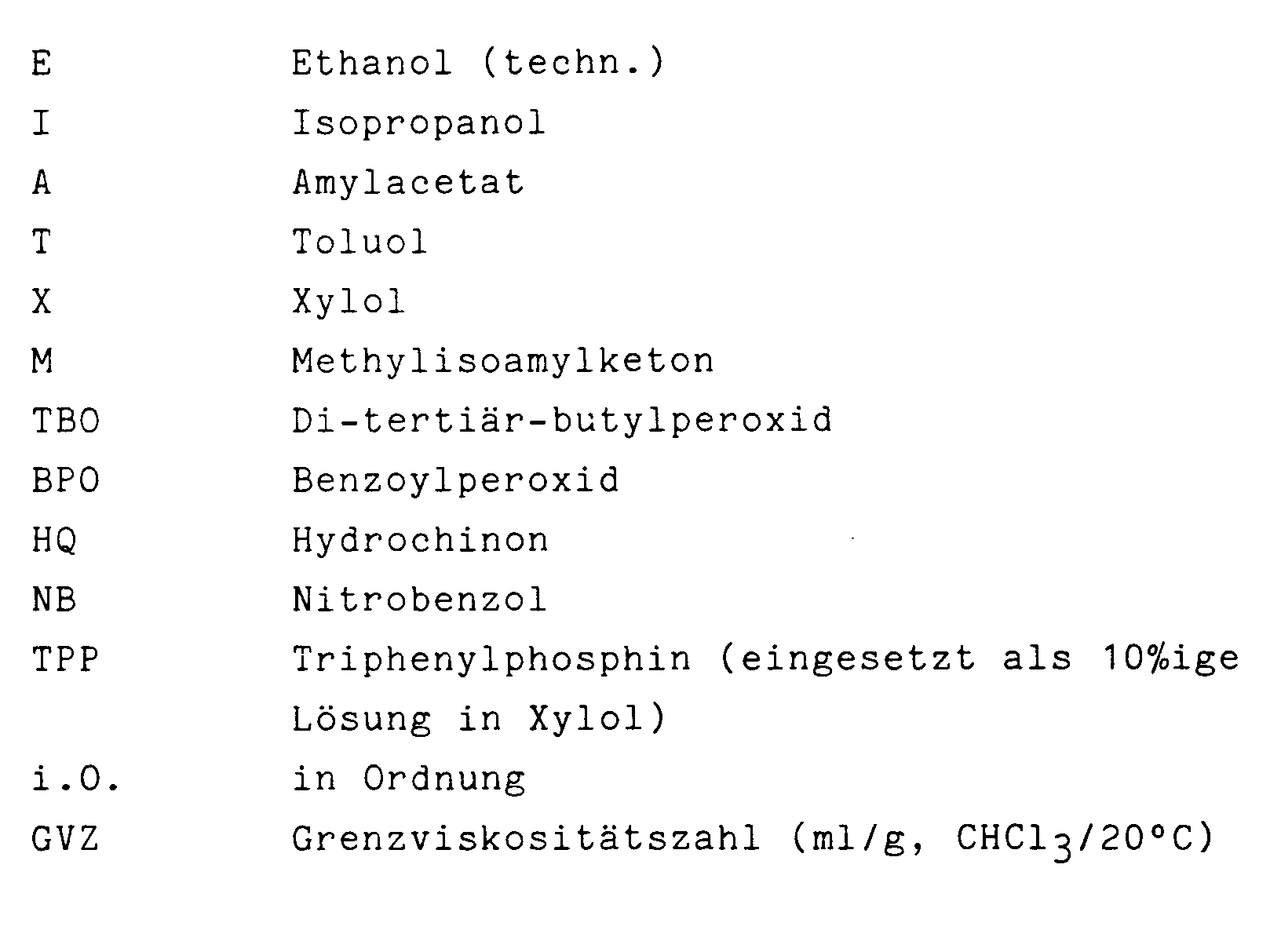
- In der Tabelle werden folgende Abkürzungen verwendet:


Claims (8)
- Verfahren zur Herstellung von wasserverdünnbaren Bindemittelzusammensetzungen für heißsiegelbare Überzüge auf Aluminiumfolien auf Basis von thermoplastischen Acrylcopolymeren, dadurch gekennzeichnet, daß man(A) in einem organischen Lösemittel ein weitgehend radikalfreies Copolymer aus (Meth)acrylsäurealkylestern, deren Alkylreste 1 bis 4 C-Atome aufweisen, und 0,3 bis 1,0 Gew.-% (bezogen auf die Summe der eingesetzten Monomeren) Glycidyl(meth)acrylat herstellt, wobei das Copolymer eine Grenzviskositätszahl(CHCl₃, 20°C) von 30 bis 50 ml/g und eine aus der Monomerenzusammensetzung berechnete Glasübergangstemperatur von 30 bis 60°C aufweist,(B) die Oxirangruppen des Copolymers mit der äquivalenten Menge (Meth)acrylsäure umsetzt und,(C) gegebenenfalls nach Zugabe eines die Molekularmasse regelnden Lösemittels, eine weitere Monomerenmischung, bestehend aus (Meth)acrylsäurealkylestern, deren Alkylreste 1 bis 4 C-Atome aufweisen, und einer Menge (Meth)acrylsäure, die einer Säurezahl für das Endprodukt von 30 bis 60 mg KOH/g entspricht, copolymerisiert, mit der Maßgabe, daß die Grenzviskositätszahl (CHCl₃, 20°C) des Endproduktes nicht unter 25 ml/g, vorzugsweise bei 30 bis 40 ml/l liegt.
- Verfahren nach Anspruch 1, dadurch gekennzeichnet, daß man in der Stufe (A) und der Stufe (C), bezogen auf die Menge der jeweils in dieser Stufe eingesetzten Alkylester, bis zu 20 Gew.-% Acrylsäureester einsetzt.
- Verfahren nach den Ansprüchen 1 und 2, dadurch gekennzeichnet, daß man für die Komponente (A)
20 bis 45 Gew.-% Methylmethacrylat
5 bis 20 Gew.-% Ethyl(meth)acrylat
40 bis 60 Gew.-% Butylmethacrylat
5 bis 20 Gew.-% Isobutylmethacrylat
0,5 bis 0,8 Gew.-% Glycidylacrylat und/oder Glycidylmethacrylat
einsetzt, wobei die Summe der Gewichtsprozente jeweils 100 beträgt. - Verfahren nach den Ansprüchen 1 bis 3, dadurch gekennzeichnet, daß man in der Stufe (B) die Umsetzung in Gegenwart eines Polymerisationsinhibitors vornimmt.
- Verfahren nach den Ansprüchen 1 bis 4, dadurch gekennzeichnet, daß man in der Stufe (C) C₂-C₃-Alkanole als regelnde Lösemittel einsetzt.
Applications Claiming Priority (2)
| Application Number | Priority Date | Filing Date | Title |
|---|---|---|---|
| AT0304087A AT391476B (de) | 1987-11-18 | 1987-11-18 | Verfahren zur herstellung von wasserverduennbaren bindemittelzusammensetzungen, mit diesen bindemitteln formulierte heisssiegellacke und deren verwendung fuer aluminiumfolien |
| AT3040/87 | 1987-11-18 |
Publications (3)
| Publication Number | Publication Date |
|---|---|
| EP0316753A2 EP0316753A2 (de) | 1989-05-24 |
| EP0316753A3 EP0316753A3 (de) | 1991-07-03 |
| EP0316753B1 true EP0316753B1 (de) | 1992-12-23 |
Family
ID=3544374
Family Applications (1)
| Application Number | Title | Priority Date | Filing Date |
|---|---|---|---|
| EP88118701A Expired - Lifetime EP0316753B1 (de) | 1987-11-18 | 1988-11-10 | Verfahren zur Herstellung von wasserverdünnbaren Bindemittelzusammensetzungen für heisssiegelbare Überzüge auf Aluminiumfolien und mit diesen Bindemitteln formulierte Heisssiegellacke |
Country Status (3)
| Country | Link |
|---|---|
| EP (1) | EP0316753B1 (de) |
| AT (1) | AT391476B (de) |
| DE (1) | DE3876954D1 (de) |
Families Citing this family (3)
| Publication number | Priority date | Publication date | Assignee | Title |
|---|---|---|---|---|
| DE4218663A1 (de) * | 1992-06-05 | 1993-12-09 | Wacker Chemie Gmbh | Beschichtungsmittel zur Beschichtung von Aluminium |
| AT407875B (de) * | 1996-10-02 | 2001-07-25 | Teich Ag | Wasserdispergierbares beschichtungssystem auf basis von pfropfcopolymeren sowie dessen verwendung, insbesondere als haftvermittler für polyolefine |
| DE19644176A1 (de) * | 1996-10-24 | 1998-04-30 | Belland Ag | Packung, enthaltend einen trockenen alkalischen Feststoff |
Family Cites Families (2)
| Publication number | Priority date | Publication date | Assignee | Title |
|---|---|---|---|---|
| FR1543042A (fr) * | 1967-10-25 | 1968-10-18 | Ver Ne Metall Halbzeugwerke He | Procédé de production de feuilles et de bandes d'aluminium pouvant être scelléesà la chaleur, pouvant servir en particulier à l'emballage dans l'industrie des produits alimentaires |
| US4657983A (en) * | 1984-12-05 | 1987-04-14 | Interez, Inc. | Phosphate esters of acrylated glycidyl ester copolymers |
-
1987
- 1987-11-18 AT AT0304087A patent/AT391476B/de active
-
1988
- 1988-11-10 EP EP88118701A patent/EP0316753B1/de not_active Expired - Lifetime
- 1988-11-10 DE DE8888118701T patent/DE3876954D1/de not_active Expired - Fee Related
Also Published As
| Publication number | Publication date |
|---|---|
| EP0316753A3 (de) | 1991-07-03 |
| AT391476B (de) | 1990-10-10 |
| EP0316753A2 (de) | 1989-05-24 |
| ATA304087A (de) | 1990-04-15 |
| DE3876954D1 (de) | 1993-02-04 |
Similar Documents
| Publication | Publication Date | Title |
|---|---|---|
| EP0370299B1 (de) | Wässriges Beschichtungsmittel, ein Verfahren zu seiner Herstellung und seine Verwendung | |
| EP1193299A2 (de) | Verlaufmittel für Oberflächenbeschichtungen | |
| DE4337481A1 (de) | Radikalisch vernetzbare Copolymerisate | |
| AT400719B (de) | Verfahren zur herstellung von wasserverdünnbaren lufttrocknenden lackbindemitteln und deren verwendung | |
| EP2291413A1 (de) | Verfahren zur herstellung einer wässrigen polymerisatdispersion | |
| DE2422043A1 (de) | Verfahren zur herstellung von copolymerisaten | |
| DE4311128A1 (de) | Wasserverdünnbare Dispersionen von Acrylatcopolymerisaten | |
| EP0416360B1 (de) | Sekundäre Aminogruppen aufweisende Copolymerisate, ein Verfahren zu ihrer Herstellung und ihre Verwendung als Bindemittel oder Bindemittelkomponente | |
| DE3888774T2 (de) | Nichtwässrige Dispersion, Verfahren zu deren Herstellung und Anwendung. | |
| AT391476B (de) | Verfahren zur herstellung von wasserverduennbaren bindemittelzusammensetzungen, mit diesen bindemitteln formulierte heisssiegellacke und deren verwendung fuer aluminiumfolien | |
| EP0573037B1 (de) | Beschichtungsmittel zur Beschichtung von Aluminium | |
| EP0096237B1 (de) | Alkoholgelöste Druckfarbe oder Lack | |
| AT409638B (de) | Haftungsverbesserer für lackschichten | |
| DE102012218108A1 (de) | Wässrige Bindemittel für Heißsiegelanwendungen | |
| DE3048881C2 (de) | Verfahren zur Herstellung einer nicht-wäßrigen, flüssigen Polymerdispersion aus polymeren Peroxiden | |
| DE3050850C2 (de) | Verfahren zur Herstellung einer wäßrigen Polymerdispersion | |
| DE2556111C3 (de) | Verfahren zur Herstellung von Dispersionen von Hydroxylgruppen enthaltenden Copolymerisaten | |
| DE69113633T2 (de) | Verfahren zur herstellung von ethanolischen lösungen von alkyl-halbestern von copolymeren aus maleinsäureanhydrid und einem c 1-c 4 alkylvinylether. | |
| EP0496079A2 (de) | Wasserverdünnbare Lackbindemittel auf der Basis von Acrylatcopolymerisaten | |
| EP0024666A1 (de) | Lufttrocknende, fettsäuremodifizierte Lackbindemittel auf der Grundlage von Fumar- bzw. Maleinsäurebisglycidylestercopolymerisaten | |
| DE69119134T2 (de) | Wässrige Emulsionspolymere, hergestellt mit vernetzbaren nichtionischen Emulgiermitteln | |
| EP2467410B1 (de) | Statistisch verzweigte copolymere, deren herstellung und verwendung als verlaufmittel in beschichtungsstoffen | |
| DE3782320T2 (de) | Nicht-waesserige polymer-dispersion und verfahren zu ihrer herstellung. | |
| EP0380006B1 (de) | Niedermolekulare Polymerisate von Acrylsäureestern | |
| EP0547504A2 (de) | Verfahren zur Heissversiegelung mit einem heisssiegelfähigen Beschichtungsmittel |
Legal Events
| Date | Code | Title | Description |
|---|---|---|---|
| PUAI | Public reference made under article 153(3) epc to a published international application that has entered the european phase |
Free format text: ORIGINAL CODE: 0009012 |
|
| 17P | Request for examination filed |
Effective date: 19881110 |
|
| AK | Designated contracting states |
Kind code of ref document: A2 Designated state(s): BE CH DE ES FR GB GR IT LI NL SE |
|
| PUAL | Search report despatched |
Free format text: ORIGINAL CODE: 0009013 |
|
| AK | Designated contracting states |
Kind code of ref document: A3 Designated state(s): BE CH DE ES FR GB GR IT LI NL SE |
|
| 17Q | First examination report despatched |
Effective date: 19920331 |
|
| GRAA | (expected) grant |
Free format text: ORIGINAL CODE: 0009210 |
|
| AK | Designated contracting states |
Kind code of ref document: B1 Designated state(s): BE CH DE ES FR GB GR IT LI NL SE |
|
| PG25 | Lapsed in a contracting state [announced via postgrant information from national office to epo] |
Ref country code: SE Effective date: 19921223 Ref country code: BE Effective date: 19921223 Ref country code: ES Free format text: THE PATENT HAS BEEN ANNULLED BY A DECISION OF A NATIONAL AUTHORITY Effective date: 19921223 Ref country code: FR Effective date: 19921223 Ref country code: GB Effective date: 19921223 Ref country code: GR Free format text: LAPSE BECAUSE OF FAILURE TO SUBMIT A TRANSLATION OF THE DESCRIPTION OR TO PAY THE FEE WITHIN THE PRESCRIBED TIME-LIMIT Effective date: 19921223 Ref country code: NL Effective date: 19921223 Ref country code: IT Free format text: LAPSE BECAUSE OF FAILURE TO SUBMIT A TRANSLATION OF THE DESCRIPTION OR TO PAY THE FEE WITHIN THE PRE;WARNING: LAPSES OF ITALIAN PATENTS WITH EFFECTIVE DATE BEFORE 2007 MAY HAVE OCCURRED AT ANY TIME BEFORE 2007. THE CORRECT EFFECTIVE DATE MAY BE DIFFERENT FROM THE ONE RECORDED.SCRIBED TIME-LIMIT Effective date: 19921223 |
|
| REF | Corresponds to: |
Ref document number: 3876954 Country of ref document: DE Date of ref document: 19930204 |
|
| EN | Fr: translation not filed | ||
| NLV1 | Nl: lapsed or annulled due to failure to fulfill the requirements of art. 29p and 29m of the patents act | ||
| GBV | Gb: ep patent (uk) treated as always having been void in accordance with gb section 77(7)/1977 [no translation filed] |
Effective date: 19921223 |
|
| PLBE | No opposition filed within time limit |
Free format text: ORIGINAL CODE: 0009261 |
|
| STAA | Information on the status of an ep patent application or granted ep patent |
Free format text: STATUS: NO OPPOSITION FILED WITHIN TIME LIMIT |
|
| 26N | No opposition filed | ||
| PGFP | Annual fee paid to national office [announced via postgrant information from national office to epo] |
Ref country code: DE Payment date: 19941024 Year of fee payment: 7 |
|
| PGFP | Annual fee paid to national office [announced via postgrant information from national office to epo] |
Ref country code: CH Payment date: 19941025 Year of fee payment: 7 |
|
| PG25 | Lapsed in a contracting state [announced via postgrant information from national office to epo] |
Ref country code: CH Effective date: 19951130 Ref country code: LI Effective date: 19951130 |
|
| REG | Reference to a national code |
Ref country code: CH Ref legal event code: PL |
|
| PG25 | Lapsed in a contracting state [announced via postgrant information from national office to epo] |
Ref country code: DE Effective date: 19960801 |