EP0314166B1 - Verfahren zur Herstellung von monodispersen keramischen Pulvern - Google Patents
Verfahren zur Herstellung von monodispersen keramischen Pulvern Download PDFInfo
- Publication number
- EP0314166B1 EP0314166B1 EP88118004A EP88118004A EP0314166B1 EP 0314166 B1 EP0314166 B1 EP 0314166B1 EP 88118004 A EP88118004 A EP 88118004A EP 88118004 A EP88118004 A EP 88118004A EP 0314166 B1 EP0314166 B1 EP 0314166B1
- Authority
- EP
- European Patent Office
- Prior art keywords
- process according
- compound
- complexing agent
- hydrolyzable
- stabilizer
- Prior art date
- Legal status (The legal status is an assumption and is not a legal conclusion. Google has not performed a legal analysis and makes no representation as to the accuracy of the status listed.)
- Expired - Lifetime
Links
Images



Classifications
-
- C—CHEMISTRY; METALLURGY
- C01—INORGANIC CHEMISTRY
- C01B—NON-METALLIC ELEMENTS; COMPOUNDS THEREOF; METALLOIDS OR COMPOUNDS THEREOF NOT COVERED BY SUBCLASS C01C
- C01B13/00—Oxygen; Ozone; Oxides or hydroxides in general
- C01B13/14—Methods for preparing oxides or hydroxides in general
- C01B13/32—Methods for preparing oxides or hydroxides in general by oxidation or hydrolysis of elements or compounds in the liquid or solid state or in non-aqueous solution, e.g. sol-gel process
-
- C—CHEMISTRY; METALLURGY
- C01—INORGANIC CHEMISTRY
- C01F—COMPOUNDS OF THE METALS BERYLLIUM, MAGNESIUM, ALUMINIUM, CALCIUM, STRONTIUM, BARIUM, RADIUM, THORIUM, OR OF THE RARE-EARTH METALS
- C01F7/00—Compounds of aluminium
- C01F7/02—Aluminium oxide; Aluminium hydroxide; Aluminates
- C01F7/34—Preparation of aluminium hydroxide by precipitation from solutions containing aluminium salts
-
- C—CHEMISTRY; METALLURGY
- C01—INORGANIC CHEMISTRY
- C01F—COMPOUNDS OF THE METALS BERYLLIUM, MAGNESIUM, ALUMINIUM, CALCIUM, STRONTIUM, BARIUM, RADIUM, THORIUM, OR OF THE RARE-EARTH METALS
- C01F7/00—Compounds of aluminium
- C01F7/02—Aluminium oxide; Aluminium hydroxide; Aluminates
- C01F7/34—Preparation of aluminium hydroxide by precipitation from solutions containing aluminium salts
- C01F7/36—Preparation of aluminium hydroxide by precipitation from solutions containing aluminium salts from organic aluminium salts
-
- C—CHEMISTRY; METALLURGY
- C01—INORGANIC CHEMISTRY
- C01G—COMPOUNDS CONTAINING METALS NOT COVERED BY SUBCLASSES C01D OR C01F
- C01G23/00—Compounds of titanium
- C01G23/04—Oxides; Hydroxides
- C01G23/047—Titanium dioxide
- C01G23/053—Producing by wet processes, e.g. hydrolysing titanium salts
-
- C—CHEMISTRY; METALLURGY
- C01—INORGANIC CHEMISTRY
- C01G—COMPOUNDS CONTAINING METALS NOT COVERED BY SUBCLASSES C01D OR C01F
- C01G23/00—Compounds of titanium
- C01G23/04—Oxides; Hydroxides
- C01G23/047—Titanium dioxide
- C01G23/053—Producing by wet processes, e.g. hydrolysing titanium salts
- C01G23/0536—Producing by wet processes, e.g. hydrolysing titanium salts by hydrolysing chloride-containing salts
-
- C—CHEMISTRY; METALLURGY
- C01—INORGANIC CHEMISTRY
- C01G—COMPOUNDS CONTAINING METALS NOT COVERED BY SUBCLASSES C01D OR C01F
- C01G25/00—Compounds of zirconium
- C01G25/02—Oxides
-
- C—CHEMISTRY; METALLURGY
- C01—INORGANIC CHEMISTRY
- C01P—INDEXING SCHEME RELATING TO STRUCTURAL AND PHYSICAL ASPECTS OF SOLID INORGANIC COMPOUNDS
- C01P2004/00—Particle morphology
- C01P2004/01—Particle morphology depicted by an image
- C01P2004/03—Particle morphology depicted by an image obtained by SEM
-
- C—CHEMISTRY; METALLURGY
- C01—INORGANIC CHEMISTRY
- C01P—INDEXING SCHEME RELATING TO STRUCTURAL AND PHYSICAL ASPECTS OF SOLID INORGANIC COMPOUNDS
- C01P2004/00—Particle morphology
- C01P2004/30—Particle morphology extending in three dimensions
- C01P2004/32—Spheres
-
- C—CHEMISTRY; METALLURGY
- C01—INORGANIC CHEMISTRY
- C01P—INDEXING SCHEME RELATING TO STRUCTURAL AND PHYSICAL ASPECTS OF SOLID INORGANIC COMPOUNDS
- C01P2004/00—Particle morphology
- C01P2004/50—Agglomerated particles
-
- C—CHEMISTRY; METALLURGY
- C01—INORGANIC CHEMISTRY
- C01P—INDEXING SCHEME RELATING TO STRUCTURAL AND PHYSICAL ASPECTS OF SOLID INORGANIC COMPOUNDS
- C01P2004/00—Particle morphology
- C01P2004/51—Particles with a specific particle size distribution
- C01P2004/52—Particles with a specific particle size distribution highly monodisperse size distribution
-
- C—CHEMISTRY; METALLURGY
- C01—INORGANIC CHEMISTRY
- C01P—INDEXING SCHEME RELATING TO STRUCTURAL AND PHYSICAL ASPECTS OF SOLID INORGANIC COMPOUNDS
- C01P2004/00—Particle morphology
- C01P2004/60—Particles characterised by their size
- C01P2004/61—Micrometer sized, i.e. from 1-100 micrometer
-
- C—CHEMISTRY; METALLURGY
- C01—INORGANIC CHEMISTRY
- C01P—INDEXING SCHEME RELATING TO STRUCTURAL AND PHYSICAL ASPECTS OF SOLID INORGANIC COMPOUNDS
- C01P2004/00—Particle morphology
- C01P2004/60—Particles characterised by their size
- C01P2004/62—Submicrometer sized, i.e. from 0.1-1 micrometer
Definitions
- the present invention relates to a process for the production of monodisperse ceramic powders and, in particular, to a process for the production of particulate oxides or hydroxides of certain elements which, after suitable further processing, provide monodisperse ceramic powders.
- Steric stabilization can be achieved, for example, by the addition of surface-active polymers, for example hydroxypropyl cellulose (HPC), as described, for example, in Ceramic Bulletin, Volume 65, No. 12, 1986, pages 1574 to 1577 for the case of the production of monodisperse titanium oxide powders is.
- HPC hydroxypropyl cellulose
- EP-A-125 507 describes a process for producing an inorganic composite material which has particles with a size of not more than 1 ⁇ m, in which a solution which contains at least one (optionally oligomeric) metal alkoxide and at least one metal chelate or a chelating agent , is decomposed.
- GB-A-2 170 189 describes a process for the preparation of an inorganic material in a selected physical configuration by hydrolysis, in the presence of a protective colloid, an organic compound containing one or more elements suitable for the inorganic material to be produced, wherein the organic compound is in a physical configuration during hydrolysis that is suitable for the physical configuration to be produced.
- EP-A-177 198 is directed to a process for making an amorphous metal oxide composite in which hydrolyzable organic metal compounds are converted to a sol which is then left to stand until it converts to a gelled coagulum.
- FR-A-2 585 973 describes the production of monolithic gels by reacting (in alcoholic solution) a carboxylic acid with an organometallic compound.
- FR-A-2 593 166 relates to the production of metal oxide powders for ceramic materials by hydrolysis of metal alkoxides, in which the average particle size of the powders is essentially controlled by the nature of the carboxylic acid used.
- the object of the present invention is to provide a method with which it is possible to monodisperse To produce oxide or hydroxide particles in a reproducible manner and to control the particle size essentially by varying a parameter.
- this object can be achieved by a process for the preparation of monodisperse particulate oxides or hydroxides, in which hydrolyzable compounds of Al, V, Ti, Zr, Hf, Sn, U, B or Si, preferably of Al, Ti or Zr, in the presence of a compound which has at least two atoms from the group O, N and S, as a complexing agent which coordinates with the central atoms of the hydrolyzable compounds, a stabilizer which is able to agglomerate from growing To prevent germination, and an inorganic or organic acid can be reacted with water in an organic solvent.
- Suitable compounds preferably have the general formula: MR n (I) in which M represents the central atom, n is equal to the valence of M and the groups R, which may be the same or different, can be split off by water.
- the groups R are removed in any case during the hydrolysis, it is desirable from an economic point of view that they have the simplest possible structure, for example halogen, alkyl, alkoxy or acyloxy groups, although groups with a more complex structure are also possible according to the invention , such as hydrocarbon radicals, branched or unbranched, which contain one or more multiple bonds and / or are substituted by substituents such as halogen, alkoxy, nitro and dialkylamino.
- These Groups can be bound to the metal atom as such or, for example, via an oxygen atom, a nitrogen atom, a carbonyl group or an oxycarbonyl group.
- radicals R in formula (I) above are halogen atoms (fluorine, chlorine, bromine and iodine, in particular Cl and Br); alkyl groups with 1 to 8, preferably 1 to 4, carbon atoms, e.g. Methyl, ethyl, n-propyl, i-propyl, n-butyl, i-butyl and sec-butyl; Alkoxy groups with 1 to 8, preferably 1 to 4 carbon atoms, e.g.
- the above alkoxy groups are the most preferred.
- any compound of the desired element that reacts with water and dissolves satisfactorily in the solvent is suitable.
- particularly preferred compounds are: AlCl3, Al (OC2H5) 3, Al (OC3H7) 3; TiCl4, Ti (OC2H5) 4, Ti (OC3H7) 4, Ti (Oi-C3H7) 4, Ti (OC4H9) 4, Ti (2-ethylhexoxy) 4, Ti (acetylacetonato) 2 (Oi-C3H7) 2; ZrCl4, Zr (OC2H5) 4, Zr (OC3H7) 4, Zr (Oi- (C3H7) 4, Zr (OC4H9) 4, Zr (2-ethylhexoxy) 4; VOCl3, V (OC2H5) 3, VO (OC2H5) 3; SnCl4; B (OCH3) 3, B (OC2H5) 3; SiCl4, Si (OCH3) 4, Si (OC2H5) 4, Si (OC3H7) 4.
- the solvent for the process according to the invention must dissolve the components, but at least must not react with them in such a way that the hydrolysis is inhibited or prevented.
- Solvents which do not have a too high boiling point e.g. have such a temperature below 100 ° C, since the solvent must later be removed from the precipitated oxide or hydroxide.
- Polar organic solvents are preferred, although non-polar solvents can also be used.
- Alcohols, in particular methanol, ethanol, n-propanol, i-propanol, butanol and mixtures thereof, are particularly preferred. Further solvents which can be used according to the invention are e.g.
- Suitable as complexing agents for the process according to the invention in principle all compounds which are able to form a complex with the hydrolyzable compound present in the solvent.
- the complexing agent coordinates, for example, via an atom with free electron pairs to the central atom of the hydrolyzable compound.
- the suitable complexing agents are compounds which have at least 2 atoms from the groups O, N and S. Complexing agents which coordinate to the central atom via oxygen atoms are particularly preferred according to the invention.
- This group of compounds includes, for example, the ⁇ -dicarbonyl compounds.
- particularly suitable complexing agents are compounds of the general formula in which R1 and R4 each represent alkyl groups with 1 to 4 carbon atoms, especially methyl or ethyl, or alkoxy groups with 1 to 4 carbon atoms, especially methoxy and ethoxy, and R2 and R3, which may be the same or different, are hydrogen, halogen and alkyl with 1 to 4 carbon atoms, in particular hydrogen.
- Particularly preferred representatives of compounds with the general formula (II) are acetylacetone and ethyl acetoacetate.
- Typical complexing agents which can be used successfully in the process according to the invention are ethylenediamine, S-methylmercaptoacetic acid, N, N-diethylcarbamic acid, oxalic acid, salicylaldehyde, 2,2'-bipyridyl, 1,10-phenantroline, diethylenetriamine, triethylenetetramine, Nitrilotriacetic acid, ethylenediaminetetraacetic acid, pyrocatechol and related compounds.
- the complexing agent is not limited to the compounds mentioned, but other compounds can also act as complexing agents, for example Dimethylformamide and dimethylacetamide.
- the process is carried out in the presence of a stabilizer.
- All compounds which are able to prevent agglomeration, ie the sticking together of the growing germs in the solution, can be used as stabilizer.
- Such compounds exert a protective colloid effect, ie the particles surrounded by the stabilizers are not able, due to steric or electrostatic repulsion, to approach one another to such an extent that fusion is possible.
- the stabilizer can, if necessary, also increase the viscosity of the solution to such an extent that the particles can only move towards one another at a significantly reduced speed and the probability of collisions is thereby reduced.
- anionic, cationic and neutral surfactants and protective colloids are suitable for the process according to the invention, as long as they dissolve in the system and do not interact or react undesirably with the other components of the system.
- common stabilizers are gelatin, casein, gum arabic, lysalbic acid, starch, polyvinyl alcohol, polyvinyl pyrrolidone and poly (meth) acrylates. Further examples can be found, for example, in Ullmann's Encyclopedia of Industrial Chemistry, 4th edition, volume 22, pages 455 to 500. Cellulose derivatives, in particular cellulose esters and cellulose ethers, are particularly preferred according to the invention.
- the molecular weight of the stabilizer can vary within a wide range and is generally between 10,000 and 2,000,000, in particular between 20,000 and 1,000,000. It should be borne in mind that with increasing molecular weight the solubility normally decreases and the viscosity of the solution increases. It can too two or more different stabilizers or the same type of stabilizers with different molecular weights can be used. It is only important that the stabilizer serves its purpose, namely to prevent agglomeration. As a particularly preferred example of a stabilizer, hydroxypropyl cellulose, in particular hydroxypropyl cellulose with a molecular weight between 50,000 and 100,000, can be mentioned.
- the hydrolysis is carried out in the presence of an acid. This is particularly important if no acidic compound is generated in the course of the hydrolysis (e.g. hydrolysis of the halides leads to the formation of hydrohalic acids). Without the addition of acid, it can happen that either the hydrolysis products remain in solution during the hydrolysis (e.g. in the presence of large amounts of complexing agents) or that spontaneous, random precipitation occurs (only small amounts of complexing agents are present).
- inorganic and organic acids that dissolve in the solvent can serve as the acid.
- suitable acids are nitric acid, sulfuric acid and hydrohalic acids as well as formic acid, acetic acid and propionic acid.
- Nitric acid is particularly preferred.
- concentrations of the abovementioned compounds which are used in the process according to the invention are of course dependent on many factors, for example the solvent, the hydrolyzable compound, the concentration of the other components present, etc. However, the person skilled in the art can easily determine the optimum concentrations for the desired purpose by means of a few orientation tests. Below are also a specific embodiment of the method according to the invention also numerically defined concentration ratios are given.
- the hydrolyzable compound can be present in the solvent in any desired concentration as long as it dissolves in it.
- a lower limit of the concentration is set by the fact that the resulting hydrolysates must not be soluble in the reaction mixture to a noticeable extent, since otherwise the yield is reduced.
- the concentration of the complexing agent is the size which essentially determines the size of the resulting hydrolyzate particles in the process according to the invention. Accordingly, the particle size can be controlled via the amount of complexing agent added, the particle size increasing with increasing complexing agent concentration. Although there is no generally applicable upper limit for the amount of complexing agent added, a molar ratio of complexing agent to hydrolyzable compound than 1: 1 is not appropriate due to economic considerations. Too large an amount of complexing agent can lead to the fact that no more precipitation occurs. On the other hand, if too little complexing agent is added, gel formation can occur.
- the presence or absence of acid also plays a role in the precipitation behavior of the hydrolysates in the solvent.
- the stabilizer concentration must be sufficient to stabilize the suspension, ie to prevent agglomeration of the growing and already finished hydrolyzate particles as completely as possible with a given stabilizer.
- the upper limit of the stabilizer concentration is determined by the viscosity of the resulting solution and thus determined in particular by the molecular weight of the stabilizer and the type of solvent used.
- the stabilizer must also be soluble in the amounts used.
- the most favorable acid concentration depends on the concentration of the complexing agent.
- the acid concentration In contrast to the complexing agent concentration, the acid concentration has no noticeable influence on the particle size.
- the acid concentration must be at least so high that there is no spontaneous precipitation, but at the same time it still ensures oversaturation of the solution.
- the amount of water used for the hydrolysis should generally be sufficient to bring about a complete hydrolysis, but should not be so high that the hydrolysates already dissolve noticeably. It is preferred if the sum of water, acid and complexing agent is not yet sufficient to replace all of the group present on the central metal atom. This means that e.g. in the case of a compound MR4 per mole of this compound less than 4 moles, preferably about 3 moles of water + acid + complexing agent should be present.
- the zirconium propylate is preferably in the form of 0.1 to 2, in particular 0.5 to 1, molar solutions. If the concentration is too high, agglomerates are increasingly formed during hydrolysis.
- the addition of about 15 g of hydroxypropyl cellulose per mole of zirconium is already sufficient to enable a disrupted particle growth and to stabilize the resulting suspension.
- the mean diameter of the particles varies depending on the amount of acetylacetone added.
- acetylacetone concentration between 0.7 to 1.0 moles per mole Zirconium compound leads to the best results. Amounts that are well below this range, depending on the test conditions, lead to clear solutions (with high acetylacetone concentration and small amounts of water), gel formation (medium complexing agent concentration, large amount of water) or random precipitation (low complexing agent concentration and large amounts of water). Amounts of water in the range from 1.5 to 2.5 moles of water per mole of zirconium compounds are particularly favorable for the course of the reaction; Higher water quantities result in an increasing grain size and agglomeration or even a decreasing yield (due to the redissolution of the particles).
- the process according to the invention is preferably carried out by dissolving the hydrolyzable compound, complexing agent and stabilizer in the solvent and then adding the water and the acid with vigorous stirring.
- the water can be added in one or more portions, but the addition in one portion is more advantageous since this can lead to the simultaneous formation of all germs, which can affect the.
- Manufacture of a monodisperse system usually has favorable effects.
- the reaction temperature is of no great importance for the process according to the invention. It is basically limited only by the freezing point of the solvent or by the viscosity of the solution at low temperatures, while the boiling point of the solvent is a natural limit.
- the process according to the invention is carried out at room temperature or at a slightly elevated temperature, an increase in temperature having a favorable effect on the reaction rate.
- the start time to the start of the precipitation at room temperature is about 2 hours, but at 40 to 60 ° C. it is only a few minutes. Be accordingly at room temperature also takes several hours until the precipitation is complete, while a slight increase in temperature enables complete precipitation in 15 to 30 minutes.
- the precipitate can then be processed in a manner known per se, e.g. by centrifugation or filtration. This is usually followed by cleaning of the precipitate by washing in a solvent that does not dissolve the precipitate.
- Non-polar solvents such as e.g. low-boiling gasoline fractions, petroleum ether, hexane, etc.
- the liquid still adhering to the precipitate is removed in a known manner, e.g. by heating, removed.
- the procedure can also be such that the precipitate is first redispersed and then subjected to spray drying. Finally, by heating to higher temperatures, e.g. > 400 ° C, the undesirable residues still present in the monodisperse metal oxide particles, e.g. can originate from the complexing agent, stabilizer or the acid, are decomposed or volatilized.
- the monodisperse ceramic powders produced according to the invention are particularly suitable for the production of ceramic components to which they impart better sintering behavior. In addition, better powder compaction leads to a more homogeneous pore distribution in the green body. Non-agglomerated metal oxide powders with defined porosity are also suitable as a support material for catalysts.
- the precipitates were isolated by adding 50 ml of petroleum ether to the suspensions while stirring. The particles were then centrifuged and redispersed in a mixture of 25 ml of ethanol and 20 ml of petroleum ether. A further 30 ml of petroleum ether were then added in an ultrasonic bath. The subsequent spray drying of the suspensions resulted in agglomerate-free powders. These powders were characterized by thermal analysis and electron microscopic examinations.
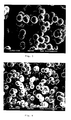
- FIGS. 1 to 8 show SEM microscope images of the zirconium oxide powder dried at 100 ° C. or calcined at 700 ° C. While Figures 1, 3, 5 and 7 show the particles Zr 30, Zr 40, Zr 50 and Zr 60 after drying at 100 ° C, Figures 2, 4, 6 and 8 refer to the corresponding particles after calcination at 700 ° C. As can be seen from these figures, the mean diameter of the particles increases with increasing acetylacetone concentration, so that after drying at 100 ° C. particles with an average diameter of 0.6, 1.0, 1.5 and 2.5 ⁇ m were obtained. The calcination at 700 ° C. led to a linear shrinkage of the particles by up to 40%, so that the mean diameters were in the range between 0.4 and 1.5 ⁇ m.
Landscapes
- Chemical & Material Sciences (AREA)
- Organic Chemistry (AREA)
- Inorganic Chemistry (AREA)
- Life Sciences & Earth Sciences (AREA)
- Geology (AREA)
- General Life Sciences & Earth Sciences (AREA)
- Environmental & Geological Engineering (AREA)
- Inorganic Compounds Of Heavy Metals (AREA)
- Oxygen, Ozone, And Oxides In General (AREA)
- Emulsifying, Dispersing, Foam-Producing Or Wetting Agents (AREA)
- Polysaccharides And Polysaccharide Derivatives (AREA)
- Catalysts (AREA)
- Silicon Compounds (AREA)
- Compounds Of Alkaline-Earth Elements, Aluminum Or Rare-Earth Metals (AREA)
Description
- Die vorliegende Erfindung betrifft ein Verfahren zur Herstellung monodisperser keramischer Pulver und insbesondere ein Verfahren zur Herstellung von teilchenförmigen Oxiden bzw. Hydroxiden bestimmter Elemente, die nach geeigneter Weiterverarbeitung monodisperse keramische Pulver liefern.
- Ein Schwerpunkt der keramischen Forschung der letzten Jahre ist die chemische Synthese von feinen Pulvern. Bekannte Verfahren bedienen sich zu diesem Zweck z.B. der Pyrolyse von Metallalkoxiden, der hydrothermalen Behandlung von Metalloxid-Gelen und der Hydrolyse von Metallalkoxiden. Je nach Verfahren und angewendeten Reaktionsbedingungen lassen sich dadurch monodisperse Teilchen mit mittleren Durchmessern in unterschiedlichen Größenbereichen herstellen. Problematisch ist jedoch die reproduzierbare Herstellung von monodispersen Metalloxidpulvern unterschiedlicher Partikelgrößen. Im Falle der Hydrolyse von z.B. Metallalkoxiden ist es für das Wachstum monodisperser Partikel in einer Lösung wesentlich, daß eine homogene Keimbildung erfolgt und beim Wachstum der Keime keine großen Übersättigungen auftreten. Das bedeutet, daß einerseits dafür Sorge getragen werden muß, daß sich überhaupt Keime bilden, daß aber andererseits auch die spontane Präzipitation bei Wasserzugabe verhindert werden muß.
- Eine weitere Bedingung für das Wachstum monodisperser Partikel ist die Verhinderung der Agglomeration von im Wachstum begriffenen Teilchen. Eine sterische Stabilisation kann dabei z.B. durch den Zusatz von oberflächenaktiven Polymeren, z.B. Hydroxypropylcellulose (HPC) erreicht werden, wie dies z.B. in Ceramic Bulletin, Band 65, Nr. 12, 1986, Seiten 1574 bis 1577 für den Fall der Herstellung von monodispersen Titanoxidpulvern beschrieben ist.
- Die EP-A-125 507 beschreibt ein Verfahren zur Herstellung eines anorganischen Kompositmaterials, das Teilchen mit einer Größe von nicht mehr als 1 µm aufweist, bei dem eine Lösung, die wenigstens ein (gegebenenfalls oligomeres) Metallalkoxid und wenigstens ein Metallchelat oder ein Chelatisierungsmittel enthält, zersetzt wird.
- Die GB-A-2 170 189 beschreibt ein Verfahren zur Herstellung eines anorganischen Materials in einer ausgewählten körperlichen Konfiguration durch Hydrolyse, in Anwesenheit eines Schutzkolloids, einer organischen Verbindung, die ein oder mehrere Elemente enthält, die für das herzustellende anorganische Material geeignet sind, wobei die organische Verbindung während der Hydrolyse in einer körperlichen Konfiguration vorliegt, die für die herzustellende körperliche Konfiguration geeignet ist.
- Das American Ceramic Society Bulletin, Band 66, Nr. 10, Okt. 1987, S. 1517-1520, beschreibt die kontinuierliche Herstellung von nicht-agglomerierten TiO₂-Pulvern mit enger Teilchengrössenverteilung mit Hilfe bestimmter apparativer Maßnahmen.
- Die EP-A-177 198 ist auf ein Verfahren zur Herstellung eines amorphen Metalloxid-Verbundmaterials gerichtet, bei dem hydrolysierbare organische Metallverbindungen in ein Sol überführt werden, das dann stehengelassen wird, bis es sich in ein geliertes Koagulum umwandelt.
- Die FR-A-2 585 973 beschreibt die Herstellung monolithischer Gele durch Umsetzung (in alkoholischer Lösung) einer Carbonsäure mit einer organometallischen Verbindung.
- Die FR-A-2 593 166 betrifft die Herstellung von Metalloxidpulvern für keramische Materialien durch Hydrolyse von Metallalkoxiden, bei der die mittlere Teilchengröße der Pulver im wesentlichen über die Natur der zwingend verwendeten Carbonsäure gesteuert wird.
- Aufgabe der vorliegenden Erfindung ist es, ein Verfahren zur Verfügung zu stellen, mit dem es möglich ist, monodisperse Oxid- bzw. Hydroxidteilchen in reproduzierbarer Weise herzustellen und dabei die Teilchengröße im wesentlichen durch Variation eines Parameters zu steuern.
- Überraschenderweise wurde gefunden, daß diese Aufgabe gelöst werden kann durch ein Verfahren zur Herstellung von monodispersen teilchenförmigen Oxiden bzw. Hydroxiden, bei dem hydrolysierbare Verbindungen von Al, V, Ti, Zr, Hf, Sn, U, B oder Si, vorzugsweise von Al, Ti oder Zr, in Anwesenheit einer Verbindung, die über mindestens zwei Atome aus der Gruppe O, N und S verfügt, als Komplexbildner, der sich an die Zentralatome der hydrolysierbaren Verbindungen koordiniert, eines Stabilisators, der in der Lage ist, eine Agglomerierung von wachsenden Keimen zu verhindern, und einer anorganischen oder organischen Säure in einem organischen Lösungsmittel mit Wasser umgesetzt werden.
- Die Ausgangsverbindungen müssen gegenüber Wasser instabil, d.h. hydrolysierbar, sein und sich außerdem in größeren Konzentrationen im verwendeten Lösungsmittel lösen. Geeignete Verbindungen haben vorzugsweise die allgemeine Formel:
MRn (I)
in welcher M das Zentralatom darstellt, n gleich der Wertigkeit von M ist und die Gruppen R, die gleich oder verschieden sein können, sich durch Wasser abspalten lassen. Da die Gruppen R bei der Hydrolyse ohnehin entfernt werden, ist es vom wirtschaftlichen Standpunkt aus erwünscht, daß diese eine möglichst einfache Struktur aufweisen, z.B. Halogen-, Alkyl-, Alkoxy- oder Acyloxygruppen sind, obwohl erfindungsgemäß auch Gruppen mit komplexerer Struktur in Betracht kommen, wie z.B. Kohlenwasserstoffreste, verzweigt oder unverzweigt, die ein oder mehrere Mehrfachbindungen enthalten und/oder durch Substituenten wie z.B. Halogen, Alkoxy, Nitro und Dialkylamino substituiert sind. Diese Gruppen können z.B. als solche oder z.B. über ein Sauerstoffatom, ein Stickstoffatom, eine Carbonylgruppe oder eine Oxycarbonylgruppe an das Metallatom gebunden sein. - Besonders bevorzugte Reste R in der obigen Formel (I) sind Halogenatome (Fluor, Chlor, Brom und Jod, insbesondere Cl und Br);Alkylgruppen mit 1 bis 8, vorzugsweise 1 bis 4 Kohlenstoffatomen, z.B. Methyl, Ethyl, n-Propyl, i-Propyl, n-Butyl, i-Butyl und sec-Butyl; Alkoxygruppen mit 1 bis 8, vorzugsweise 1 bis 4 Kohlenstoffatomen, z.B. Methoxy, Ethoxy, i-Propoxy, n-Propoxy, n-Butoxy, i-Butoxy, sec-Butoxy, Pentoxy und 2-Ethylhexyloxy; und Acyloxyreste mit 2 bis 8, vorzugsweise 2 bis 4 Kohlenstoffatomen, z.B. Acetoxy. Unter diesen Resten sind die obigen Alkoxygruppen die am meisten bevorzugten.
- Verbindungen von Titan und insbesondere Zirkonium sind für das erfindungsgemäße Verfahren besonders bevorzugt, insbesondere dann, wenn in der obigen Formel (I) die vier Reste R identisch sind und für Alkoxyreste mit 1 bis 4 Kohlenstoffatomen stehen.
- Selbstverständlich ist es auch möglich, bereits teilhydrolysierte bzw. zum Teil vorkondensierte Ausgangsverbindungen einzusetzen, solange sich diese noch in nennenswertem Umfang im Lösungsmittel lösen. Ebenso können Gemische von Verbindungen, die sich von einem einzigen oder mehreren Elementen, z.B. Metallen, ableiten, verwendet werden. Für Dotierungszwecke kann es wünschenswert sein, die Hydrolyse der Ausgangsverbindung in Anwesenheit einer kleinen Menge einer gegebenenfalls hydrolysierbaren Verbindung eines anderen Elements, z.B. Ca, Mg, Ba, Y, Nb, Ta usw. durchzuführen. Ebenso ist es möglich, den Komplexbildner nicht als solchen, sondern als Komplex mit dem entsprechenden Element einzusetzen. So kann z.B. ein Teil oder die Gesamtmenge an hydrolysierbarer Ausgangsverbindung in Form einer Komplex-Verbindung eingesetzt werden.
- In Abhängigkeit vom Element, das in das Oxid bzw. Hydroxid umgewandelt werden soll, kann es sich auch als vorteilhaft erweisen, anstatt oder zusätzlich zu den bereits oben erwähnten Verbindungen andere hydrolysierbare Verbindungen einzusetzen, z.B. Oxychloride und Nitrate. Ganz allgemein ist, wie bereits oben erwähnt, jedoch jede Verbindung des gewünschten Elements geeignet, die mit Wasser reagiert und sich im Lösungsmittel zufriedenstellend löst.
- Konkrete Beispiele für besonders bevorzugte Verbindungen sind:
AlCl₃, Al(OC₂H₅)₃, Al(OC₃H₇)₃;
TiCl₄, Ti(OC₂H₅)₄, Ti(OC₃H₇)₄, Ti(O-i-C₃H₇)₄, Ti(OC₄H₉)₄, Ti(2-ethylhexoxy)₄, Ti(acetylacetonato)₂(O-i-C₃H₇)₂;
ZrCl₄, Zr(OC₂H₅)₄, Zr(OC₃H₇)₄, Zr(O-i-(C₃H₇)₄, Zr(OC₄H₉)₄, Zr(2-ethylhexoxy)₄;
VOCl₃, V(OC₂H₅)₃,VO(OC₂H₅)₃;
SnCl₄; B(OCH₃)₃, B(OC₂H₅)₃; SiCl₄, Si(OCH₃)₄, Si(OC₂H₅)₄, Si(OC₃H₇)₄. - Das Lösungsmittel für das erfindungsgemäße Verfahren muß die Komponenten lösen, darf aber zumindest nicht in der Weise mit ihnen reagieren, daß die Hydrolyse be- oder verhindert wird. Bevorzugt werden Lösungsmittel, die keinen allzu hohen Siedepunkt, z.B. einen solchen unter 100°C, aufweisen, da das Lösungsmittel später vom ausgefällten Oxid bzw. Hydroxid entfernt werden muß. Polare organische Lösungsmittel werden bevorzugt, obwohl auch unpolare Lösungsmittel eingesetzt werden können. Besonders bevorzugt werden Alkohole, insbesondere Methanol, Ethanol, n-Propanol, i-Propanol, Butanol und Gemische derselben. Weitere erfindungsgemäß verwendbare Lösungsmittel sind z.B. Methylenchlorid, Chloroform, Tetrachlorkohlenstoff, Ether, insbesondere Diethylether und Tetrahydrofuran, Ketone, z.B. Aceton und Butanon, Ester, z.B. Ethylacetat, Pentan, Hexan, Cyclohexan, Benzol sowie Gemische dieser Lösungsmittel.
- Als Komplexbildner für das erfindungsgemäße Verfahren eignen sich prinzipiell alle Verbindungen, die in der Lage sind, mit der im Lösungsmittel vorhandenen hydrolysierbaren Verbindung einen Komplex zu bilden. Der Komplexbildner koordiniert sich z.B. über ein Atom mit freien Elektronenpaaren an das Zentralatom der hydrolysierbaren Verbindung. Demnach sind die geeigneten Komplexbildner Verbindungen, die über mindestens 2 Atome aus der Gruppe O, N und S verfügen. Erfindungsgemäße werden Komplexbildner, die sich über Sauerstoffatome an das Zentralatom koordinieren, besonders bevorzugt. Zu dieser Gruppe von Verbindungen gehören z.B. die β-Dicarbonylverbindungen. Besonders geeignete Komplexbildner sind demgemäß Verbindungen der allgemeinen Formel

in welcher R¹ und R⁴ jeweils für Alkylgruppen mit 1 bis 4 Kohlenstoffatomen, insbesondere Methyl oder Ethyl, oder Alkoxygruppen mit 1 bis 4 Kohlenstoffatomen, insbesondere Methoxy und Ethoxy, stehen und R² und R³, die gleich oder verschieden sein können, Wasserstoff, Halogen und Alkyl mit 1 bis 4 Kohlenstoffatomen, insbesondere Wasserstoff, bedeuten. - Besonders bevorzugte Vertreter von Verbindungen mit der allgemeinen Formel (II) sind Acetylaceton und Acetessigsäureethylester.
- Weitere Beispiele für gängige Komplexbildner, die im erfindungsgemäßen Verfahren mit Erfolg eingesetzt werden können, sind Ethylendiamin, S-Methylmercaptoessigsäure, N,N-Diethylcarbaminsäure, Oxalsäure, Salicylaldehyd, 2,2'-Bipyridyl, 1,10-Phenantrolin, Diethylentriamin, Triethylentetramin, Nitrilotriessigsäure, Ethylendiamintetraessigsäure, Brenzkatechin und verwandte Verbindungen.
- Der Komplexbildner ist jedoch nicht auf die genannten Verbindungen beschränkt, sondern es können auch andere Verbindungen als Komplexbildner wirken, wie z.B. Dimethylformamid und Dimethylacetamid.
- Gemäß der vorliegenden Erfindung wird das Verfahren in Anwesenheit eines Stabilisators durchgeführt. Als Stabilisator können alle Verbindungen verwendet werden, die in der Lage sind, eine Agglomerierung, d.h. das Zusammenkleben der wachsenden Keime in der Lösung, zu verhindern. Derartige Verbindungen üben eine Schutzkolloid-Wirkung aus, d.h., die von den Stabilisatoren umgebenen Teilchen sind infolge sterischer oder elektrostatischer Abstoßung nicht in der Lage, sich einander soweit anzunähern, daß eine Verschmelzung möglich wird. Der Stabilisator kann gegebenenfalls die Viskosität der Lösung auch soweit erhöhen, daß die Teilchen sich nur mit wesentlich verminderter Geschwindigkeit aufeinander zubewegen können und dadurch die Wahrscheinlichkeit von Zusammenstößen geringer wird. Für das erfindungsgemäße Verfahren sind demnach alle denkbaren anionischen, kationischen und neutralen Tenside und Schutzkolloide geeignet, solange sie sich im System lösen und nicht in unerwünschter Weise mit den anderen Komponenten des Systems wechselwirken bzw. reagieren. Beispiele für gängige Stabilisatoren sind Gelatine, Casein, Gummi arabicum, Lysalbinsäure, Stärke, Polyvinylalkohol, Polyvinylpyrrolidon und Poly(meth)acrylate. Weitere Beispiele finden sich z.B. in Ullmanns Enzyklopädie der technischen Chemie, 4. Auflage, Band 22, S. 455 bis 500. Erfindungsgemäß als Stabilisatoren besonders bevorzugt sind Cellulosederivate, insbesondere Celluloseester und Celluloseether. Konkrete Beispiele für derartige Verbindungen sind Benzylcellulose, Ethylcellulose, Methylcellulose, Hydroxyethylcellulose, Hydroxypropylcellulose und Carboxymethylcellulose. Das Molekulargewicht des Stabilisators kann im weiten Bereich schwanken und liegt im allgemeinen zwischen 10.000 und 2.000.000, insbesondere zwischen 20.000 und 1.000.000. Zu bedenken ist dabei, daß mit steigendem Molekulargewicht normalerweise die Löslichkeit abnimmt und die Viskosität der Lösung zunimmt. Es können auch zwei oder mehrere unterschiedliche Stabilisatoren oder der Art nach gleiche Stabilisatoren mit unterschiedlichen Molekulargewichten verwendet werden. Wichtig ist lediglich, daß der Stabilisator seinen Zweck, nämlich eine Verhinderung der Agglomeration, erfüllt. Als besonders bevorzugtes Beispiel eines Stabilisators kann Hydroxypropylcellulose, insbesondere Hydroxypropylcellulose mit einem Molekulargewicht zwischen 50.000 und 100.000, erwähnt werden.
- Erfindungsgemäß wird, die Hydrolyse in Gegenwart einer Säure durchgeführt. Dies ist besonders wichtig, wenn im Laufe der Hydrolyse keine saure Verbindung erzeugt wird (die Hydrolyse der Halogenide führt z.B. zur Bildung von Halogenwasserstoffsäuren). Ohne Zusatz von Säure kann es geschehen, daß entweder bei der Hydrolyse die Hydrolyseprodukte in Lösung bleiben (z.B. in Anwesenheit großer Mengen an Komplexbildner) oder daß eine spontane, regellose Präzipitation erfolgt (nur geringe Mengen an Komplexbildner anwesend).
- Als Säure können prinzipiell alle anorganischen und organischen Säuren dienen, die sich im Lösungsmittel lösen. Es sollte jedoch darauf geachtet werden, daß das Säureanion später leicht aus dem Niederschlag oder dem keramischen Pulver entfernt werden kann, z.B. durch thermische Zersetzung. Beispiele für geeignete Säuren sind Salpetersäure, Schwefelsäure und Halogenwasserstoffsäuren sowie Ameisensäure, Essigsäure und Propionsäure. Besonders bevorzugt wird Salpetersäure.
- Die Konzentrationen der vorstehend genannten Verbindungen, die im erfindungsgemäßen Verfahren verwendet werden, sind naturgemäß von vielen Faktoren, so z.B. von dem Lösungsmittel, von der hydrolysierbaren Verbindung, der Konzentration der anderen anwesenden Komponenten etc. abhängig. Der Fachmann kann jedoch durch einige orientierende Versuche ohne weiteres die für den gewünschten Zweck optimalen Konzentrationen ermitteln. Weiter unten werden außerdem für eine konkrete Ausführungsform des erfindungsgemäßen Verfahrens auch zahlenmäßig definierte Konzentrationsverhältnisse angegeben.
- Ganz allgemein kann festgestellt werden, daß die hydrolysierbare Verbindung in beliebig hoher Konzentration im Lösungsmittel vorhanden sein kann, solange sie sich darin löst. Eine Untergrenze der Konzentration ist dadurch gesetzt, daß die resultierenden Hydrolysate nicht im merklichen Ausmaß im Reaktionsgemisch löslich sein dürfen da sonst die Ausbeute verringert wird.
- Die Konzentration des Komplexbildners ist diejenige Größe, die im erfindungsgemäßen Verfahren die Größe der resultierenden Hydrolysatteilchen wesentlich bestimmt. Demgemäß kann über die Menge an zugesetztem Komplexbildnern die Teilchengröße gesteuert werden, wobei mit zunehmender Komplexbildnerkonzentration die Teilchengröße zunimmt. Obwohl es eine allgemeingültige Obergrenze für die Menge an zugesetztem Komplexbildner nicht gibt, ist schon aufgrund wirtschaftlicher Überlegungen ein höheres Molverhältnis von Komplexbildner zu hydrolysierbarer Verbindung als 1:1 nicht angezeigt. Zu große Mengen an Komplexbildner können im übrigen dazu führen, daß keine Niederschlagsbildung mehr erfolgt. Wenn hingegen zuwenig Komplexbildner zugesetzt wird, kann es zu einer Gelbildung kommen.
- Wie bereits oben erwähnt, spielt für das Ausfällungsverhalten der Hydrolysate im Lösungsmittel neben der Komplexbildnerkonzentration auch die An- oder Abwesenheit von Säure eine Rolle.
- Die Stabilisatorkonzentration muß ausreichen, um die Suspension zu stabilisieren, d.h. um bei einem gegebenen Stabilisator ein Agglomerieren der wachsenden und der bereits fertigen Hydrolysatteilchen möglichst vollständig zu verhindern. Die Obergrenze der Stabilisatorkonzentration wird durch die Viskosität der resultierenden Lösung und damit insbesondere durch das Molekulargewicht des Stabilisators und die Art des verwendeten Lösungsmittels bestimmt. Der Stabilisator muß außerdem in den eingesetzten Mengen löslich sein.
- Die günstigste Säurekonzentration hängt, wie oben erwähnt, von der Konzentration des Komplexbildners ab. Im Gegensatz zur Komplexbildnerkonzentration übt die Säurekonzentration aber keinen merklichen Einfluß auf die Teilchengröße aus. Die Säurekonzentration muß mindestens so hoch sein, daß keine spontane Präzipitation erfolgt, gleichzeitig aber immer noch eine Übersättigung der Lösung gewährleisten.
- Die zur Hydrolyse verwendete Wassermenge sollte in der Regel ausreichen, um eine vollständige Hydrolyse zu bewirken, aber nicht so hoch sein, daß sich die Hydrolysate bereits wieder merklich lösen. Bevorzugt wird es, wenn die Summe aus Wasser, Säure und Komplexbildner noch nicht ausreicht, um alle am zentralen Metallatom vorhandenen Gruppe zu ersetzen. Das bedeutet, daß z.B. im Fall einer Verbindung MR₄ pro Mol dieser Verbindung weniger als 4 Mol, vorzugsweise ungefähr 3 Mol Wasser + Säure + Komplexbildner vorhanden sein sollten.
- Für den konkreten Fall der Hydrolyse einer ethanolischen Lösung von Zirkoniumtetrapropylat in Gegenwart von Hydroxypropylcellulose als Stabilisator, Acetylaceton als Komplexbildner und Salpetersäure als Säure liegt das Zirkoniumpropylat vorzugsweise in Form von 0,1 bis 2, insbesondere 0,5 bis 1 molaren Lösungen vor. Bei zu hohen Konzentrationen kommt es bei der Hydrolyse zunehmend zur Bildung von Agglomeraten. Die Zugabe von etwa 15 g Hydroxypropylcellulose pro Mol Zirkonium ist dabei bereits ausreichend, um ein umgestörtes Partikelwachstum zu ermöglichen und die entstehende Suspension zu stabilisieren. Je nach Menge an zugesetztem Acetylaceton variiert der mittlere Durchmesser der Teilchen. Je höher die Acetylacetonkonzentration desto größer die Partikel. Eine Salpetersäurekonzentration zwischen 0,7 bis 1,0 Mol pro Mol Zirkoniumverbindung führt dabei zu den besten Ergebnissen. Mengen, die weit unterhalb dieses Bereichs liegen, führen je nach Versuchsbedingungen zu klaren Lösungen (bei hoher Acetylacetonkonzentration und geringen Wassermengen), Gelbildung (mittlere Komplexbildnerkonzentration, große Wassermenge) oder regelloser Niederschlagsbildung (niedrige Komplexbildnerkonzentration und große Wassermengen). Wassermengen im Bereich von 1,5 bis 2,5 Mol Wasser pro Mol Zirkoniumverbindungen sind für den Reaktionsverlauf besonders günstig; höhere Wassermengen ziehen eine zunehmende Korngröße und Agglomeration bzw. sogar eine abnehmende Ausbeute (bedingt durch Wiederauflösung der Teilchen) nach sich.
- Das erfindungsgemäße Verfahren wird vorzugsweise so durchgeführt, daß man hydrolysierbare Verbindung, Komplexbildner und Stabilisator im Lösungsmittel löst und danach das Wasser und die Säure unter kräftigem Rühren zugibt. Die Wasserzugabe kann in einer oder in mehreren Portionen erfolgen, wobei jedoch die Zugabe in einer Portion vorteilhafter ist, da es dadurch zur gleichzeitigen Bildung aller Keime kommen kann, was sich auf die. Herstellung eines monodispersen Systems in der Regel günstig auswirkt.
- Die Reaktionstemperatur ist für das erfindungsgemäße Verfahren ohne große Bedeutung. Sie wird nach unten grundsätzlich nur durch den Gefrierpunkt des Lösungsmittels bzw. durch die Viskosität der Lösung bei tiefen Temperaturen begrenzt, während nach oben der Siedepunkt des Lösungsmittels eine natürliche Grenze darstellt. In der Regel wird das erfindungsgemäße Verfahren bei Raumtemperatur oder leicht erhöhter Temperatur durchgeführt, wobei eine Temperaturerhöhung sich günstig auf die Reaktionsgeschwindigkeit auswirkt. So wurde z.B. gefunden, daß im oben erwähnten Fall der Hydrolyse von Zirkoniumtetrapropylat die Startzeit bis zum Beginn der Präzipitation bei Raumtemperatur ca. 2 Stunden, bei 40 bis 60°C dagegen nur wenige Minuten beträgt. Entsprechend werden bei Raumtemperatur auch mehrere Stunden benötigt, bis die Ausfällung vollständig ist, während bereits eine leichte Temperaturerhöhung eine vollständige Ausfällung in 15 bis 30 Minuten ermöglicht.
- Der Niederschlag kann dann in an sich bekannter Weise, z.B. durch Zentrifugation oder Filtration,abgetrennt werden. Daran schließt sich in aller Regel eine Reinigung der Niederschlags durch Waschen in einem Lösungsmittel, das den Niederschlag nicht löst, an. Als derartige Lösungsmittel eignen sich besonders unpolare Lösungsmittel, wie z.B. niedrig siedende Benzinfraktionen, Petrolether, Hexan, usw. Danach wird die noch am Niederschlag haftende Flüssigkeit in bekannter Weise, z.B. durch Erhitzen, entfernt. Man kann dabei auch so vorgehen, daß man den Niederschlag zunächst wieder redispergiert und dann einer Sprühtrocknung unterwirft. Schließlich können durch Erhitzen auf höhere Temperaturen, z.B. >400°C, die in den monodispersen Metalloxidteilchen noch vorhandenen unerwünschten Rückstände, die z.B. vom Komplexbildner, Stabilisator oder der Säure herrühren können, zersetzt bzw. verflüchtigt werden.
- Die erfindungsgemäß hergestellten monodispersen keramischen Pulver eignen sich insbesondere zur Herstellung von keramischen Bauteilen, denen sie ein besseres Sinterverhalten verleihen. Darüberhinaus führt eine bessere Pulververdichtung zu einer homogeneren Porenverteilung im Grünkörper. Nichtagglomerierte Metalloxidpulver mit definierter Porosität sind überdies auch als Trägermaterial für Katalysatoren geeignet.
- Das folgende Beispiel dient zur Erläuterung der vorliegenden Erfindung.
- 40 ml einer ethanolischen Zr(i-OPr)₄-Lösung mit einer Konzentration von einem Mol pro Liter wurden mit 20 ml einer 5 %-igen ethanolischen Lösung von Hydroxypropylcellulose und 10 ml Ethanol gemischt. Anschließend wurden in vier getrennten Ansätzen 1,2, 1,6, 2,0 oder 2,4 g Acetylaceton, entsprechend einer Konzentration von 0,30, 0,40, 0,50 und 0,60 Mol Acetylaceton pro Mol Zr, und eine Mischung aus 2,1 ml 65 %-iger HNO₃ und 0,6 ml Wasser zugegeben. Die Reaktionslösungen wurden zum Homogenisieren gerührt und dann im Wasserbad 1 Stunde auf 40°C temperiert. Die ausgefällten Pulver wurden entsprechend der Acetylacetonkonzentration als Zr 30, Zr 40, Zr 50 und Zr 60 bezeichnet.
- Die Isolierung der Niederschläge erfolgte, indem man 50 ml Petrolether unter Rühren zu den Suspensionen tropfte. Die Teilchen wurden dann zentrifugiert und in einer Mischung von 25 ml Ethanol und 20 ml Petrolether redispergiert. Daraufhin wurden weitere 30 ml Petrolether im Ultraschallbad zugegeben. Die anschließende Sprühtrocknung der Suspensionen führte zu agglomeratfreien Pulvern. Diese Pulver wurden durch Thermoanalyse und elektronenmikroskopische Untersuchungen charakterisiert.
- Beim Erhitzen auf Temperaturen zwischen 200 und 400°C trat ein Gewichtsverlust von ca. 40 % ein, der auf die Zersetzung der Nitrate und der flüchtigen organischen Verbindungen zurückzuführen ist. Der durch die thermische Zersetzung des Zirkonium-Acetylaceton-Komplexes gebildete Kohlenstoff wurde durch Erhitzen auf Temperaturen über 650°C in Luft entfernt.
- Die beiliegenden Figuren 1 bis 8 zeigen SEM-Mikroskopaufnahmen der bei 100°C getrockneten bzw. bei 700°C calcinierten Zirkoniumoxidpulver. Während die Figuren 1, 3, 5 und 7 die Teilchen Zr 30, Zr 40, Zr 50 und Zr 60 nach einer Trocknung bei 100°C zeigen, beziehen sich die Figuren 2, 4, 6 und 8 auf die entsprechenden Teilchen nach der Calcinierung bei 700°C. Wie aus diesen Figuren ersichtlich, nimmt mit zunehmender Acetylaceton-Konzentration der mittlere Durchmesser der Teilchen zu, so daß nach einer Trocknung bei 100°C Teilchen mit einem durchschnittlichen Durchmesser von 0,6, 1,0, 1,5 und 2,5 µm erhalten wurden. Die Calcinierung bei 700°C führte zu einer linearen Schrumpfung der Teilchen um bis zu 40 %, so daß die mittleren Durchmesser im Bereich zwischen 0,4 und 1,5 µm lagen.
Claims (11)
- Verfahren zur Herstellung von monodispersen teilchenförmigen Oxiden bzw. Hydroxiden, bei dem hydrolysierbare Verbindungen von Al, V, Ti, Zr, Hf, Sn, U, B oder Si in Anwesenheit einer Verbindung, die über mindestens zwei Atome aus der Gruppe O, N und S verfügt, als Komplexbildner, der sich an die Zentralatome der hydrolysierbaren Verbindungen koordiniert, eines Stabilisators, der in der Lage ist, eine Agglomerierung von wachsenden Keimen zu verhindern, und einer anorganischen oder organischen Säure in einem organischen Lösungsmittel mit Wasser umgesetzt werden.
- Verfahren nach Anspruch 1, dadurch gekennzeichnet, daß die Umsetzung in Anwesenheit eines Celluloseethers oder -esters als Stabilisator durchgeführt wird.
- Verfahren nach Anspruch 2, dadurch gekennzeichnet, daß als Stabilisator Hydroxypropylcellulose verwendet wird.
- Verfahren nach einem der Ansprüche 1 bis 3, dadurch gekennzeichnet, daß die Umsetzung in Anwesenheit von Salpetersäure durchgeführt wird.
- Verfahren nach einem der Ansprüche 1 bis 4, dadurch gekennzeichnet, daß es sich bei der hydrolysierbaren Verbindung um eine Verbindung von Al, Ti oder Zr handelt.
- Verfahren nach einem der Ansprüche 1 bis 5, dadurch gekennzeichnet, daß die hydrolysierbare Verbindung eine solche der allgemeinen Formel
MRn (I)
ist, worin M das Zentralatom darstellt, n gleich der Wertigkeit von M ist und die Gruppen R, die gleich oder verschieden sein können, Halogen, insbesondere Cl und Br, Alkyl mit 1 bis 8 Kohlenstoffatomen, Alkoxy mit 1 bis 8 Kohlenstoffatomen und Acyloxy mit 2 bis 8 Kohlenstoffatomen bedeuten. - Verfahren nach Anspruch 6, dadurch gekennzeichnet, daß in der Formel (I) M für Ti oder Zr steht, n gleich 4 ist und die Gruppen R identische Alkoxyreste mit 1 bis 4 Kohlenstoffatomen bedeuten.
- Verfahren nach einem der Ansprüche 1 bis 7, dadurch gekennzeichnet, daß als organisches Lösungsmittel Methanol, Ethanol, n-Propanol, i-Propanol oder Gemische derselben eingesetzt werden.
- Verfahren nach einem der Ansprüche 1 bis 8, dadurch gekennzeichnet, daß als Komplexbildner eine β-Dicarbonylverbindung, vorzugsweise eine solche der allgemeinen Formel

- Verfahren nach einem der Ansprüche 1 bis 9, dadurch gekennzeichnet, daß als Komplexbildner Acetylaceton und/oder Acetessigsäureethylester verwendet wird.
- Verfahren zur Herstellung von keramischen Pulvern, umfassend die folgenden Stufen:a) Umsetzung einer hydrolysierbaren Verbindung von Al, V, Ti, Zr, Hf, Sn, U, B oder Si mit Wasser in einem organischen Lösungsmittel gemäß dem Verfahren von Anspruch 1;b) Antrennung und gegebenenfalls Reinigung der resultierenden monodispersen teilchenförmigen Oxide bzw. Hydroxide; undc) Calcinierung dieser Oxide bzw. Hydroxide.
Priority Applications (1)
| Application Number | Priority Date | Filing Date | Title |
|---|---|---|---|
| AT88118004T ATE88983T1 (de) | 1987-10-29 | 1988-10-28 | Verfahren zur herstellung von monodispersen keramischen pulvern. |
Applications Claiming Priority (2)
| Application Number | Priority Date | Filing Date | Title |
|---|---|---|---|
| DE3736686 | 1987-10-29 | ||
| DE19873736686 DE3736686A1 (de) | 1987-10-29 | 1987-10-29 | Verfahren zur herstellung von monodispersen keramischen pulvern |
Publications (2)
| Publication Number | Publication Date |
|---|---|
| EP0314166A1 EP0314166A1 (de) | 1989-05-03 |
| EP0314166B1 true EP0314166B1 (de) | 1993-05-05 |
Family
ID=6339366
Family Applications (1)
| Application Number | Title | Priority Date | Filing Date |
|---|---|---|---|
| EP88118004A Expired - Lifetime EP0314166B1 (de) | 1987-10-29 | 1988-10-28 | Verfahren zur Herstellung von monodispersen keramischen Pulvern |
Country Status (5)
| Country | Link |
|---|---|
| US (1) | US5049371A (de) |
| EP (1) | EP0314166B1 (de) |
| JP (1) | JPH0222105A (de) |
| AT (1) | ATE88983T1 (de) |
| DE (2) | DE3736686A1 (de) |
Cited By (1)
| Publication number | Priority date | Publication date | Assignee | Title |
|---|---|---|---|---|
| US6261700B1 (en) | 1998-12-30 | 2001-07-17 | 3M Innovative Properties Co | Ceramer containing a brominated polymer and inorganic oxide particles |
Families Citing this family (28)
| Publication number | Priority date | Publication date | Assignee | Title |
|---|---|---|---|---|
| JP2698131B2 (ja) * | 1988-11-24 | 1998-01-19 | 株式会社日本触媒 | 導電性無機粒子及びその製造法 |
| DE3925462A1 (de) * | 1989-08-01 | 1991-02-07 | Fraunhofer Ges Forschung | Verfahren zur photoinitiierten steuerung der anorganischen netzwerkbildung beim sol-gel-prozess |
| DE3939953A1 (de) * | 1989-12-02 | 1991-06-06 | Bayer Ag | Verfahren zur herstellung feinteiliger keramischer oxid-pulver aus vorlaeuferverbindungen |
| US5455019A (en) * | 1992-12-25 | 1995-10-03 | Chemical Company, Limited Sumitomo | Continuous process for preparing aluminum hydroxide |
| TW288044B (de) * | 1993-05-12 | 1996-10-11 | Sumitomo Chemical Co | |
| DE4337643C1 (de) * | 1993-11-04 | 1995-08-03 | Rwe Dea Ag | Verfahren zur Herstellung von in Wasser dispergierbaren Tonerdehydraten böhmitischer Struktur und Verwendung derselben |
| US5874374A (en) * | 1995-03-17 | 1999-02-23 | Institute Of Gas Technology | Method for producing engineered materials from salt/polymer aqueous solutions |
| US5698483A (en) * | 1995-03-17 | 1997-12-16 | Institute Of Gas Technology | Process for preparing nanosized powder |
| WO1997015526A1 (en) * | 1995-10-27 | 1997-05-01 | E.I. Du Pont De Nemours And Company | Hydrothermal process for making ultrafine metal oxide powders |
| US6290735B1 (en) * | 1997-10-31 | 2001-09-18 | Nanogram Corporation | Abrasive particles for surface polishing |
| US7226966B2 (en) * | 2001-08-03 | 2007-06-05 | Nanogram Corporation | Structures incorporating polymer-inorganic particle blends |
| US6099798A (en) * | 1997-10-31 | 2000-08-08 | Nanogram Corp. | Ultraviolet light block and photocatalytic materials |
| JP4184487B2 (ja) * | 1997-08-15 | 2008-11-19 | 昭和電工株式会社 | 二酸化チタン微粒子の製造方法 |
| DE69827166T2 (de) * | 1998-07-30 | 2006-02-23 | Minnesota Mining & Manufacturing Company, St. Paul | Metalloxid teilchen im nano-bereich für die herstellung von metalloxidkolloiden und ceramers |
| US6329058B1 (en) | 1998-07-30 | 2001-12-11 | 3M Innovative Properties Company | Nanosize metal oxide particles for producing transparent metal oxide colloids and ceramers |
| DE19845291A1 (de) * | 1998-10-01 | 2000-04-13 | Fraunhofer Ges Forschung | Verfahren zur Abscheidung von Titanoxid-Schichten unter Verwendung von löslichen Pulvern |
| IT1312119B1 (it) * | 1999-06-25 | 2002-04-04 | Italcementi Spa | Uso di preparazioni fotocatalitiche di titanio biossido colloidale per conservare l'aspetto originario di manufatti camentizi,lapidei o |
| DE19943789A1 (de) * | 1999-09-13 | 2001-03-15 | Fraunhofer Ges Forschung | Verfahren zur Abscheidung von Zirkonoxid-Schichten unter Verwendung von löslichen Pulvern |
| US6458462B1 (en) | 2000-12-13 | 2002-10-01 | 3M Innovative Properties Company | Sporting goods having a ceramer coating |
| US7066977B2 (en) * | 2001-05-02 | 2006-06-27 | Fu-Kuo Huang | Flame synthesis and non-vacuum physical evaporation |
| WO2004058639A1 (ja) * | 2002-12-25 | 2004-07-15 | E-Tec Co., Ltd. | 金属酸化物微粒子、金属酸化物マイクロカプセル、金属水酸化物微粒子、及び金属水酸化物マイクロカプセル、並びにそれらの製造方法 |
| JPWO2006077890A1 (ja) * | 2005-01-19 | 2008-06-19 | 国立大学法人京都大学 | 単分散した球状の金属酸化物微粒子の製造方法および金属酸化物微粒子 |
| JP2007063100A (ja) * | 2005-09-02 | 2007-03-15 | Fujifilm Corp | Bi12MO20粉体の製造方法および放射線撮像パネルを構成する光導電層 |
| US7972691B2 (en) * | 2006-12-22 | 2011-07-05 | Nanogram Corporation | Composites of polymers and metal/metalloid oxide nanoparticles and methods for forming these composites |
| US8119233B2 (en) * | 2007-02-17 | 2012-02-21 | Nanogram Corporation | Functional composites, functional inks and applications thereof |
| CN102272218B (zh) | 2009-01-08 | 2014-07-16 | 纳克公司 | 聚硅氧烷聚合物与无机纳米颗粒的复合物 |
| JP2012206980A (ja) * | 2011-03-30 | 2012-10-25 | Daito Kasei Kogyo Kk | 球状チタン微粒子粉体及びそれを含有する化粧料 |
| WO2013161735A1 (ja) * | 2012-04-25 | 2013-10-31 | 東ソー・ファインケム株式会社 | 複合酸化物薄膜製造用組成物及びこの組成物を用いた薄膜の製造方法、並びに複合酸化物薄膜 |
Family Cites Families (19)
| Publication number | Priority date | Publication date | Assignee | Title |
|---|---|---|---|---|
| SU674990A1 (ru) * | 1977-11-24 | 1979-07-25 | Предприятие П/Я А-7815 | Способ получени двуокиси титана |
| JPS6049137B2 (ja) * | 1981-05-18 | 1985-10-31 | 三菱鉱業セメント株式会社 | 錫酸塩の製造方法 |
| JPS58110427A (ja) * | 1981-12-17 | 1983-07-01 | Matsumoto Seiyaku Kogyo Kk | 透明錫酸化膜の製造法 |
| CA1217927A (en) * | 1983-04-15 | 1987-02-17 | Tsutomu Nanao | Inorganic composite material and process for preparing the same |
| US4520114A (en) * | 1983-09-26 | 1985-05-28 | Celanese Corporation | Production of metastable tetragonal zirconia |
| DE3337098A1 (de) * | 1983-10-12 | 1985-05-02 | Dynamit Nobel Ag, 5210 Troisdorf | Neue titanchelate und zubereitungen, die diese chelate enthalten |
| US4543341A (en) * | 1983-12-23 | 1985-09-24 | Massachusetts Institute Of Technology | Synthesis and processing of monosized oxide powders |
| JPS6183603A (ja) * | 1984-09-07 | 1986-04-28 | Agency Of Ind Science & Technol | 非晶質複合金属酸化物の製造方法 |
| US4619908A (en) * | 1984-12-24 | 1986-10-28 | Stauffer Chemical Company | Non-aged inorganic oxide-containing aerogels and their preparation |
| GB8501882D0 (en) * | 1985-01-25 | 1985-02-27 | Atomic Energy Authority Uk | Materials |
| US4724134A (en) * | 1985-06-10 | 1988-02-09 | Aluminum Company Of America | Production of tailor-made particle size distributions of substantially spherical metal hydroxide/oxide particles comprising single or multiple hydroxides by hydrolysis of one or more metal alkoxide aerosols |
| US4792539A (en) * | 1985-06-20 | 1988-12-20 | Kao Corporation | Process for producing clay derivatives having a porous structure and novel clay derivatives obtained by the process |
| FR2585973A1 (fr) * | 1985-08-06 | 1987-02-13 | Centre Nat Rech Scient | Gel monolithique et poudre d'oxydes d'elements de transition, procede de fabrication du gel et procede de preparation de couches minces de ces oxydes |
| US4610866A (en) * | 1985-10-11 | 1986-09-09 | Battelle Memorial Institute | Method for producing beta-aluminas |
| FR2593166A1 (fr) * | 1986-01-20 | 1987-07-24 | Solvay | Procede de fabrication d'une poudre d'oxyde metallique pour materiaux ceramiques et poudre de zircone obtenue par ce procede. |
| US4898842A (en) * | 1986-03-03 | 1990-02-06 | International Business Machines Corporation | Organometallic-derived cordierite and other compounds comprising oxides of silicon |
| US4719091A (en) * | 1986-07-01 | 1988-01-12 | Corning Glass Works | Preparation of mono-sized zirconia powders by forced hydrolysis |
| US4778671A (en) * | 1986-07-14 | 1988-10-18 | Corning Glass Works | Preparation of unagglomerated metal oxide particles with uniform particle size |
| US4732750A (en) * | 1986-08-11 | 1988-03-22 | Allied-Signal Inc. | Preparation of monodisperse titania by titanium alkoxide hydrolysis |
-
1987
- 1987-10-29 DE DE19873736686 patent/DE3736686A1/de not_active Withdrawn
-
1988
- 1988-10-25 JP JP63267310A patent/JPH0222105A/ja active Pending
- 1988-10-28 DE DE8888118004T patent/DE3880785D1/de not_active Expired - Fee Related
- 1988-10-28 AT AT88118004T patent/ATE88983T1/de not_active IP Right Cessation
- 1988-10-28 US US07/263,883 patent/US5049371A/en not_active Expired - Fee Related
- 1988-10-28 EP EP88118004A patent/EP0314166B1/de not_active Expired - Lifetime
Cited By (1)
| Publication number | Priority date | Publication date | Assignee | Title |
|---|---|---|---|---|
| US6261700B1 (en) | 1998-12-30 | 2001-07-17 | 3M Innovative Properties Co | Ceramer containing a brominated polymer and inorganic oxide particles |
Also Published As
| Publication number | Publication date |
|---|---|
| US5049371A (en) | 1991-09-17 |
| DE3880785D1 (de) | 1993-06-09 |
| JPH0222105A (ja) | 1990-01-25 |
| DE3736686A1 (de) | 1989-05-11 |
| ATE88983T1 (de) | 1993-05-15 |
| EP0314166A1 (de) | 1989-05-03 |
Similar Documents
| Publication | Publication Date | Title |
|---|---|---|
| EP0314166A1 (de) | Verfahren zur Herstellung von monodispersen keramischen Pulvern | |
| DE69124282T2 (de) | Anorganische Oxydaerogel-Perlen mit einer schmalen Porendurchmesser-Verteilung | |
| EP0395912B1 (de) | Sinterfähiges Zirkonoxidpulver und Verfahren zu seiner Herstellung | |
| EP2367762B1 (de) | Nanopartikuläre titandioxid-partikel mit kristallinem kern, einer schale aus einem metalloxid und einer aussenhaut, die organische gruppen trägt, sowie verfahren zu deren herstellung | |
| DE69510477T2 (de) | Verfahren zur Herstellung von hoch verstreuten Metall-Kolloiden und von auf einem Substrat gebundenen Metall-Clusters durch elektrochemische Reduktion von Metallsalzen | |
| EP0318111B1 (de) | Verfahren zur Herstellung von Bariumtitanat in Pulverform | |
| EP0920912B1 (de) | Palladium-Cluster und ihre Verwendung als Katalysatoren | |
| DE69014379T2 (de) | Verfahren zur Herstellung von anorganischen Oxydteilchen. | |
| EP2519471B1 (de) | Synthese von nanopartikeln mittels ionischer flüssigkeiten | |
| EP1360344B1 (de) | Elektrochemische herstellung von nanoskaligen metall(misch)oxiden | |
| EP2373414A2 (de) | Katalysator für oxidationsreaktionen in gegenwart von chlorwasserstoff und/oder chlor und verfahren zu dessen herstellung, sowie dessen verwendung | |
| DE3874821T2 (de) | Verfahren zur gewinnung eines seltenerdoxids und gewonnenes produkt. | |
| DE19840842A1 (de) | Elektrochemische Herstellung amorpher oder kristalliner Metalloxide mit Teilchengrößen im Nanometerbereich | |
| DE69008412T2 (de) | Mikroporöses Zirkoniumoxid und Verfahren zu dessen Herstellung. | |
| WO2008006566A2 (de) | Stabile suspensionen von kristallinen tio2-partikeln aus hydrothermal behandelten sol-gel-vorstufenpulvern | |
| EP0318101B1 (de) | Verfahren zur Herstellung von Titandioxid-Pulver | |
| DE4116523C2 (de) | Verfahren und Mittel zur Herstellung von alpha-Al¶2¶O¶3¶ | |
| WO1999035083A1 (de) | Verfahren zur herstellung einer homogenen und stabilen suspension aus oxidvorprodukten | |
| WO1992021611A1 (de) | Verfahren zur herstellung nanoskaliger oxidteilchen | |
| EP1880979A2 (de) | Stabile Suspensionen von kristallinen ZrO2-Partikeln aus hydrothermal behandelten Sol-Gel-Vorstufenpulvern | |
| DE102010030216A1 (de) | Zirkondioxid-Aluminiumoxid-Kompositpulver und Verfahren zu dessen Herstellung | |
| DE102007036998A1 (de) | Verfahren zur Herstellung von amorphen metallorganischen Makromolekülen, mit diesem Verfahren erhaltenes Material und seine Verwendung | |
| WO2007033815A2 (de) | Elektrochemisches verfahren zur herstellung von nanoskaligen metallverbindungen | |
| WO2009013187A1 (de) | Mikrowellen-induziertes verfahren zur herstellung von nanopartikulären metalloxiden | |
| EP4527980A2 (de) | Mit elementarem silber und elementarem ruthenium ausgestattetes partikelförmiges anorganisches material |
Legal Events
| Date | Code | Title | Description |
|---|---|---|---|
| PUAI | Public reference made under article 153(3) epc to a published international application that has entered the european phase |
Free format text: ORIGINAL CODE: 0009012 |
|
| AK | Designated contracting states |
Kind code of ref document: A1 Designated state(s): AT BE CH DE ES FR GB GR IT LI LU NL SE |
|
| 17P | Request for examination filed |
Effective date: 19890717 |
|
| 17Q | First examination report despatched |
Effective date: 19910515 |
|
| GRAA | (expected) grant |
Free format text: ORIGINAL CODE: 0009210 |
|
| AK | Designated contracting states |
Kind code of ref document: B1 Designated state(s): AT BE CH DE ES FR GB GR IT LI LU NL SE |
|
| PG25 | Lapsed in a contracting state [announced via postgrant information from national office to epo] |
Ref country code: IT Free format text: LAPSE BECAUSE OF FAILURE TO SUBMIT A TRANSLATION OF THE DESCRIPTION OR TO PAY THE FEE WITHIN THE PRE;WARNING: LAPSES OF ITALIAN PATENTS WITH EFFECTIVE DATE BEFORE 2007 MAY HAVE OCCURRED AT ANY TIME BEFORE 2007. THE CORRECT EFFECTIVE DATE MAY BE DIFFERENT FROM THE ONE RECORDED.SCRIBED TIME-LIMIT Effective date: 19930505 Ref country code: SE Effective date: 19930505 Ref country code: NL Effective date: 19930505 Ref country code: GR Free format text: LAPSE BECAUSE OF FAILURE TO SUBMIT A TRANSLATION OF THE DESCRIPTION OR TO PAY THE FEE WITHIN THE PRESCRIBED TIME-LIMIT Effective date: 19930505 Ref country code: ES Free format text: THE PATENT HAS BEEN ANNULLED BY A DECISION OF A NATIONAL AUTHORITY Effective date: 19930505 |
|
| REF | Corresponds to: |
Ref document number: 88983 Country of ref document: AT Date of ref document: 19930515 Kind code of ref document: T |
|
| REF | Corresponds to: |
Ref document number: 3880785 Country of ref document: DE Date of ref document: 19930609 |
|
| ET | Fr: translation filed | ||
| GBT | Gb: translation of ep patent filed (gb section 77(6)(a)/1977) |
Effective date: 19930809 |
|
| NLV1 | Nl: lapsed or annulled due to failure to fulfill the requirements of art. 29p and 29m of the patents act | ||
| PG25 | Lapsed in a contracting state [announced via postgrant information from national office to epo] |
Ref country code: LU Free format text: LAPSE BECAUSE OF NON-PAYMENT OF DUE FEES Effective date: 19931031 |
|
| PLBE | No opposition filed within time limit |
Free format text: ORIGINAL CODE: 0009261 |
|
| STAA | Information on the status of an ep patent application or granted ep patent |
Free format text: STATUS: NO OPPOSITION FILED WITHIN TIME LIMIT |
|
| 26N | No opposition filed | ||
| PGFP | Annual fee paid to national office [announced via postgrant information from national office to epo] |
Ref country code: FR Payment date: 19961011 Year of fee payment: 9 |
|
| PGFP | Annual fee paid to national office [announced via postgrant information from national office to epo] |
Ref country code: AT Payment date: 19961018 Year of fee payment: 9 Ref country code: BE Payment date: 19961018 Year of fee payment: 9 |
|
| PGFP | Annual fee paid to national office [announced via postgrant information from national office to epo] |
Ref country code: GB Payment date: 19961019 Year of fee payment: 9 |
|
| PGFP | Annual fee paid to national office [announced via postgrant information from national office to epo] |
Ref country code: CH Payment date: 19961024 Year of fee payment: 9 |
|
| PGFP | Annual fee paid to national office [announced via postgrant information from national office to epo] |
Ref country code: DE Payment date: 19961028 Year of fee payment: 9 |
|
| PG25 | Lapsed in a contracting state [announced via postgrant information from national office to epo] |
Ref country code: GB Free format text: LAPSE BECAUSE OF NON-PAYMENT OF DUE FEES Effective date: 19971028 Ref country code: AT Free format text: LAPSE BECAUSE OF NON-PAYMENT OF DUE FEES Effective date: 19971028 |
|
| PG25 | Lapsed in a contracting state [announced via postgrant information from national office to epo] |
Ref country code: FR Free format text: THE PATENT HAS BEEN ANNULLED BY A DECISION OF A NATIONAL AUTHORITY Effective date: 19971031 Ref country code: BE Free format text: LAPSE BECAUSE OF NON-PAYMENT OF DUE FEES Effective date: 19971031 Ref country code: CH Free format text: LAPSE BECAUSE OF NON-PAYMENT OF DUE FEES Effective date: 19971031 Ref country code: LI Free format text: LAPSE BECAUSE OF NON-PAYMENT OF DUE FEES Effective date: 19971031 |
|
| BERE | Be: lapsed |
Owner name: FRAUNHOFER-GESELLSCHAFT ZUR FORDERUNG DER ANGEWAN Effective date: 19971031 |
|
| REG | Reference to a national code |
Ref country code: CH Ref legal event code: PL |
|
| GBPC | Gb: european patent ceased through non-payment of renewal fee |
Effective date: 19971028 |
|
| PG25 | Lapsed in a contracting state [announced via postgrant information from national office to epo] |
Ref country code: DE Free format text: LAPSE BECAUSE OF NON-PAYMENT OF DUE FEES Effective date: 19980701 |
|
| REG | Reference to a national code |
Ref country code: FR Ref legal event code: ST |