EP0312293A2 - Fühlervorrichtung für die Analyse - Google Patents
Fühlervorrichtung für die Analyse Download PDFInfo
- Publication number
- EP0312293A2 EP0312293A2 EP88309486A EP88309486A EP0312293A2 EP 0312293 A2 EP0312293 A2 EP 0312293A2 EP 88309486 A EP88309486 A EP 88309486A EP 88309486 A EP88309486 A EP 88309486A EP 0312293 A2 EP0312293 A2 EP 0312293A2
- Authority
- EP
- European Patent Office
- Prior art keywords
- glass
- tip
- porous
- optical fiber
- fiber means
- Prior art date
- Legal status (The legal status is an assumption and is not a legal conclusion. Google has not performed a legal analysis and makes no representation as to the accuracy of the status listed.)
- Withdrawn
Links
Images

Classifications
-
- G—PHYSICS
- G01—MEASURING; TESTING
- G01N—INVESTIGATING OR ANALYSING MATERIALS BY DETERMINING THEIR CHEMICAL OR PHYSICAL PROPERTIES
- G01N21/00—Investigating or analysing materials by the use of optical means, i.e. using sub-millimetre waves, infrared, visible or ultraviolet light
- G01N21/62—Systems in which the material investigated is excited whereby it emits light or causes a change in wavelength of the incident light
- G01N21/63—Systems in which the material investigated is excited whereby it emits light or causes a change in wavelength of the incident light optically excited
- G01N21/64—Fluorescence; Phosphorescence
- G01N21/6428—Measuring fluorescence of fluorescent products of reactions or of fluorochrome labelled reactive substances, e.g. measuring quenching effects, using measuring "optrodes"
- G01N21/643—Measuring fluorescence of fluorescent products of reactions or of fluorochrome labelled reactive substances, e.g. measuring quenching effects, using measuring "optrodes" non-biological material
-
- A—HUMAN NECESSITIES
- A61—MEDICAL OR VETERINARY SCIENCE; HYGIENE
- A61B—DIAGNOSIS; SURGERY; IDENTIFICATION
- A61B5/00—Measuring for diagnostic purposes; Identification of persons
- A61B5/145—Measuring characteristics of blood in vivo, e.g. gas concentration or pH-value ; Measuring characteristics of body fluids or tissues, e.g. interstitial fluid or cerebral tissue
- A61B5/1455—Measuring characteristics of blood in vivo, e.g. gas concentration or pH-value ; Measuring characteristics of body fluids or tissues, e.g. interstitial fluid or cerebral tissue using optical sensors, e.g. spectral photometrical oximeters
- A61B5/1459—Measuring characteristics of blood in vivo, e.g. gas concentration or pH-value ; Measuring characteristics of body fluids or tissues, e.g. interstitial fluid or cerebral tissue using optical sensors, e.g. spectral photometrical oximeters invasive, e.g. introduced into the body by a catheter
-
- G—PHYSICS
- G01—MEASURING; TESTING
- G01N—INVESTIGATING OR ANALYSING MATERIALS BY DETERMINING THEIR CHEMICAL OR PHYSICAL PROPERTIES
- G01N21/00—Investigating or analysing materials by the use of optical means, i.e. using sub-millimetre waves, infrared, visible or ultraviolet light
- G01N21/62—Systems in which the material investigated is excited whereby it emits light or causes a change in wavelength of the incident light
- G01N21/63—Systems in which the material investigated is excited whereby it emits light or causes a change in wavelength of the incident light optically excited
- G01N21/64—Fluorescence; Phosphorescence
- G01N21/6428—Measuring fluorescence of fluorescent products of reactions or of fluorochrome labelled reactive substances, e.g. measuring quenching effects, using measuring "optrodes"
- G01N2021/6434—Optrodes
Definitions
- the present invention relates to a sensing device for use in the manufacture of an optic probe apparatus for quantitative determination of the chemical properties of a medium in situ , to a process for making such device, to said apparatus incorporating such device and to optical fibers for use therein.
- glass surfaces may only immobilize a relatively small amount of material (in the present invention the relevant material is adsorbed on internal surfaces of the glass, optimally in a single layer) is to be regarded as an advantage and not a disadvantage.
- the fluorescent molecules under excitation may tend to react physically with each other, the effect of which will be to substantially reduce the number of excited molecules which give the desired information.
- the present invention provides an optical probe device, of which the essential elements are (except for an optional surface polymeric film) virtually completely fabricated from glass without the aid of adhesive, and which it is believed, when having adsorbed on the internal surface thereof one or more light-sensitive substances, are more sensitive than comparable prior art sensors.
- the sensor element is also much smaller than hitherto, and this enables the device to be used in situations, especially in relation to monitoring the chemical properties of the human blood stream in vivo , which it is believed were not from a practical standpoint possible before the advent of the present invention.
- parent glasses substantially non-porous glasses
- porous glasses are well known in the art.
- parent glasses which may be certain borosilicate glasses
- Composition ranges for parent glasses which are to be regarded as illustrative only, are:
- a gas detector for measuring or monitoring the partial pressure of a gas (in particular, oxygen), containing a matrix support for luminescent material.
- the matrix which in practice is used in the form of a thin film or disc, may be made of "porous Vycor-type glass". No details are provided of how such glass is obtained.
- a sintered metal cylinder contains the matrix, an ultraviolet glow lamp, filters and photoelectric cells. The atmosphere to be monitored either diffuses through the wall of the cylinder, or is led through the apparatus by inlet and outlet pipes.
- This patent is not concerned with the use of fiber optics, with a detector element of such a size that it may constitute or be attached to the top of a fiber optic, or with monitoring the chemical properties of the human blood stream in vivo .
- the invention thus provides in one aspect a sensing device for use in the manufacture of an optic probe apparatus for quantitative determination of the chemical properties of a medium in situ .
- this device comprises essentially at least one glass optical fiber means, to each of which is attached by fusion at an open end thereof a discrete glass tip, the glass of said tip being selected from substantially non-porous glasses convertible to porous glasses.
- the discrete glass tip may be converted to a porous glass tip, and the latter may be treated so as to adsorb on the internal surface thereof at least one substance selected from fluorescent and other light sensitive substances.
- the sensing device comprises essentially at least one glass optical fiber means fabricated from a substantially non-porous glass convertible to a porous glass, each of which at an open end thereof has been treated to convert the tip thereof to a porous glass tip integral with said optical fiber means.
- the present invention also relates to glass optical fiber means for use in the manufacture of optic probe apparatus characterized by the fact that it is fabricated from a substantially non-porous glass convertible to a porous glass.
- the sensing device of the invention may be made, e.g., by a process comprising the step of attaching by fusion a glass tip to an open end of each one of at least one glass optical fiber means, and wherein the glass of said tip is selected from substantially non-porous glasses convertible to porous glasses, or alternatively by a process comprising the step of treating an open end at the tip thereof of each one of at least one glass optical fiber means fabricated from a substantially non-porous glass convertible to a porous glass, thereby to convert the or each tip to a porous glass tip.
- an apparatus for quantitative determination of the chemical properties of a medium in situ characterized by the fact that it comprises as an optic probe a sensing device as described above, in which the or each porous glass tip has been treated so as to adsorb on the internal surface thereof at least one substance selected from fluorescent and other light sensitive substances.
- the term "adsorb" in connection with the description of the attachment of the fluorescent or other light sensitive substances to the internal surfaces of the or each porous glass tip, it is to be understood that the present invention is not to be limited to any particular manner of attachment of these substances. From a practical point of view, these substances must be securely held to the internal surfaces when the sensing apparatus is in use; thus, it is contemplated that the fluorescent or other light sensitive substances may be either physically or chemically attached to the internal surfaces, so long as the attachment is secure.
- the device of the invention comprises in one embodiment a glass tip either fused to or integral with an open end of glass optical fiber means (or a plurality of glass tips fused to or integral with respective open ends of a plurality of glass optical fiber means), which when used as the sensor of an optic probe will have been made porous, and will then have adsorbed on the internal surface thereof at least one light sensitive substance.
- the glass optical fibers utilized to make the sensors of the present invention according to the embodiment in which the or each porous glass tip is integral with the optical fibers constitute in themselves a novel and inventive article of manufacture.
- This embodiment of the invention which enables for the first time a sensor integral with a glass optical fiber to be manufactured, represents for this very reason a major step forward in the art of optic sensors.
- a "light sensitive substance” in the present context means a substance which will react to incident light by emitting a light signal. It is presently preferred that this substance is an agent which imparts information exclusively by means of the internally unmodified intensity of the light emitted therefrom. In other words, it is preferred not to add any substance, such as the absorber of EP 0214768, which will vary the intensity of the emitted light signal. The intensity of the emitted signal will of course be modified by an external agent, namely, by the particular chemical property of the medium, the determination of which is desired.
- the sensitivity of such substance (which may be a fluorescent substance) to light, e.g. visible or ultraviolet light, will be affected by the chemical properties of the medium in which the sensor is inserted. While it is presently contemplated that the device of the present invention will be applicable to the quantitative determination of the chemical properties of any medium, as e.g. a reaction medium of a chemical industrial process, nevertheless it is believed that it will be especially useful in respect of such determinations made on blood or blood cells, and more particularly for the determination in vivo of chemical properties of blood, such as pH and the partial pressure of oxygen and of carbon dioxide. In other words, the intensity of the light emitted from the substance or substances adsorbed on the internal surface of the sensor, will be a function of such chemical properties.
- the device of the invention is not confined to the instance where the glass tip is porous and is sensitized, but also includes the case in which a fused glass tip is non-porous but is convertible to a porous tip, as well as the case in which a fused or integral porous glass tip is porous but is not yet sensitized by having adsorbed on its internal surface one or more light-sensitive substances.
- At least one glass optical fiber means it is intended to convey that the invention includes, on the one hand, either one or a plurality of glass optical fiber means, and on the other hand that what is termed “glass optical fiber means” may assume a number of configurations of glass optical fibers.
- each glass optical fiber means may be constituted in one or other of the following modes (a), (b) and (c), namely, where: (a) the glass optical fiber means comprises one unbranched glass optical fiber; (b) the glass optical fiber means comprises at least two glass optical fibers all of which are attached to, or are fused together to form, a single glass tip; (c) the glass optical fiber means is Y-shaped, and the glass tip (which is porous or is to be made porous) is located at an open end of one of the arms of the Y. In mode (a), it is evident that both the light directed to the sensor and that emitted therefrom will be channelled along the same optical fiber.
- the device of the invention may comprise one or a plurality of such glass optical fiber means.
- the device of the invention comprises a single glass optical fiber means
- the "at least one glass optical fiber means” comprises in fact a plurality of glass optical fiber means, each of which has attached thereto or integral therewith a different porous glass tip, then that at least two of the tips may have adsorbed thereon different light sensitive substances, respectively, thereby facilitating the determination of at least two different chemical properties of the medium.
- the (at least one) attached or integral tip will be subjected to a process step whereby the substantially non-porous glass of the tip is converted to a porous glass.
- This step will normally comprise acid treatment, using e.g. hydrochloric acid, the acid treatment being preceded by a heat treatment.
- the porous tip or tips thus produced may then be treated so as to adsorb on the internal surface thereof at least one light-sensitive composition, e.g. a fluorescent composition.
- porous discrete glass tip it is advantageous, for a number of reasons, for the thus-treated porous discrete glass tip to be coated with a porous polymeric film prior to actual use.
- a porous polymeric film would protect the external glass surface thereof from nicks and scratches, and especially if extended somewhat over the adjacent part of the glass fiber means which is either integral with it or to which it is attached, would also have a safety function in preventing any light sensitive substance, from contaminating the medium under test.
- any light sensitive substance will become detached from the internal surface of glass on which it has been adsorbed.
- porosity of the polymeric film will necessarily be such as to allow the ingress of the medium or at least the components thereof which are the subject of quantitative determination.
- a suitable material for the film would appear to be an RTV silicone such as that marketed under the trade name "Dow Silastic Corning 890 (or 891)", which incidentally has been approved by the FDA for body implants.
- the invention provides in a further aspect a process for making a sensing device in accordance with the details already described above.
- the invention provides an apparatus for quantitative determination of the chemical properties of a medium in situ , characterized by the fact that it comprises as an optic probe a sensing device in accordance with the details already described above.
- the concept of the present invention resides principally in the device comprising glass fiber optic means having integral therewith or fused thereto a glass tip convertible to a porous glass tip, for practical application as a sensor rendering this tip porous, and thereafter treating it with at least one light-sensitive material, so as to adsorb the latter on the internal surface of the porous glass tip. It will therefore be appreciated that in the apparatus aspect of the invention, such features as the means for sensing the light to the sensor, receiving light emitted therefrom, and calculating the desired properties from the intensity of the emitted light, will in principle be known, and per se form no part of the present inventive concept.
- suitable materials which fluoresce when subjected to ultraviolet light and which may be useful as the light-sensitive substances for being adsorbed on the internal surfaces of the porous glass tips of the sensing device of the invention, when used for in vivo or in vitro determinations in the blood (or in industrial applications) are as follows: O2 - pyrene and other polycyclic aromatic compounds; pH and CO2 - coumarin derivatives, such as 7-hydroxycoumarin. Materials fluorescing in light other than UV are also operable.
- Fig. 1 shows a single unbranched glass optical fiber 2, to which is attached at the end 4 thereof, in one embodiment, by fusion, substantially non-porous (but convertible to porous) glass tip 6.
- 2 is a single unbranched glass optical fiber fabricated from substantially non-porous glass convertible to porous glass, which at the end denoted 4 may potentially be treated as described herein to render the tip porous, e.g. in region denoted 6, up to the broken line .
- tip 6 of the device of Fig. 1 (either embodiment) has been made porous in the manner described herein, and thus now incorporated pores such as those denoted by reference numeral 8. Following adsorption of active substance on the inner surfaces of pores 8, tip 6 as well as at least part of the adjacent portion 4 of glass optical fiber 2 may optionally be coated with porous polymeric film 10.
- Fig. 3 two glass optical fibers 12 and 14 are fused together in the vicinity of one end, at region 16; in one embodiment, this end of the fused-together pair of fibers is attached by fusion in region 18′ to a single substantially non-porous glass tip 18, whereas in another embodiment, when the fibers are fabricated from substantially non-porous glass convertible porous glass, the structure already contains a non-porous tip 18, convertible to a porous tip.
- tip 18 of the device of Fig. 3 (either embodiment) has been made porous in the manner described herein, and thus now incorporates pores such as those denoted by reference numeral 8. Following adsorption of active substance on the inner surfaces of pores 8, tip 18, and at least part of the adjacent portion 18′, of the glass optical fiber, may optionally be coated with porous polymeric film 20.
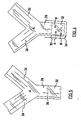
- a glass fiber continuum including Y-shaped junction A from which extends respective arms 24 and 26, is, in one embodiment, attached at end 28 to a substantially non-porous glass tip 32 at fusion region 30; in another embodiment, in which the glass fiber continuum is fabricated from substantially non-porous glass convertible to porous glass, 32 represents a region (bounded e.g. by broken line 30) which may potentially be made porous.
- tip 32 of the device of Fig. 5 (either embodiment) has been made porous in the manner described herein, and thus now incorporates pores such as those denoted by reference numeral 8.
- tip 32 as well as part of the adjacent portion 28 (inclusive of region 30) of the glass optical fiber may optionally be coated with porous polymeric film 12.
- arm 28 may be replaced by a plurality of separate arms attached (e.g. by fusion) to the apex of the V formed by arms 24 and 26; these separate arms, with respective sensitized tips which are as described either attached thereto or integral therewith, may be used as separate sensors, or as a bundle as described below with reference to Fig.8.
- both the light directed to the sensitized tip 6 and that emitted therefrom will be channelled along the same optical fiber 2.
- the light directed to sensitized tip 6 will be channelled along one of optical fibers 12 and 14, and that the emitted light will be mainly channelled along the other of these optical fibers.
- the light directed to the sensor will be channelled along one arm (24 or 26) of the Y to the junction A and thereafter to the sensitized tip 32, and that the emitted light will be channelled therefrom to junction A and thereafter (mainly) along the other of arms 24 and 26.
- Fig. 7 depicts the adsorption of active substance at a number of sites 22 on the inner surface of a typical pore 8.
- Fig. 8 shows a bundle of individual glass optical fibers 40, 42, 44 and 46.
- the fibers there are attached by fusion in respective regions 60, 62, 64 and 66, individual tips 50, 52, 54 and 56; according to another embodiment in which the fibers are fabricated from substantially non-porous glass convertible to porous glass, regions 50, 52, 54 and 56, bounded respectively by (e.g.) lines 60, 62, 64 and 66, may be made porous and thereafter sensitized as described herein.
- the bundle of fibers may in either embodiment be held together by insertion in a flexible sleeve (not shown).
- the fusion is effected individually with non-porous glass tips convertible to porous glass tips, and the steps of making the tips porous, adsorption of sensitive material and (if desired) coating with a porous polymeric material, are effected as described herein.
- the optional coating step may of course also be carried out in the case of the second mentioned embodiment.
- each tip which has been made porous may be sensitized by adsorption of a different substance, thereby making possible the simultaneous analysis of different properties of the medium in which the sensor is inserted. While a bundle of four sensors is shown in Fig. 8, alternatively a bundle of two, three or of more than four sensors, may be course also be utilized.
- Fluorogelb a 10 ⁇ 4M chloroform solution of perylene-3,9,-dicarboxylic acid diisobutyl ester, known commercially as "Fluorogelb”.
- the duration of adsorption may be up to say 45 hours, and a more dilute solution e.g. 10 ⁇ 5M may be used.
- a higher concentration such as 10 ⁇ 3M causes decay of the fluorescence, while a lower concentration of the order of 10 ⁇ 6M does not afford sufficient sensitivity.
- Unadsorbed solution was drained off.
- the tip was air-dried, washed in a physiological serum, then vacuum-dried for 1 hour at 45°C.
- the required serum was prepared by dissolving in 1000 ml. of double distilled water NaCl (8 g.), KCl (0.2 g.), disodium hydrogen phosphate (1.15 g.) and potassium dihydrogen phosphate (0.2 g.).
- the product was stable, and no evidence of bleeding of the fluorescent material therefrom has been observed. It may be kept in the dry or wet state.
- the wavelengths of excitation and emission of the sensor thus prepared were 468 and about 515 nm, respectively.
- Porous glass tips fused to glass optical fibers and having a different light-sensitive material adsorbed thereon, e.g. pyrene, can be prepared similarly.
- the relevant wavelengths are: excitation 345 and 350 nm, emission 398 nm.
- a solution of 1 g. RTV silicone marketed under the trade name "Dow Corning Silastic 890 (or 891)" in 150 ml. toluene was prepared.
- the product of the preceding example was dipped therein and curing was effected at room temperature over a 48 hour period.
- the porous polymeric film extended over the sensitized porous tip and about 10 cm. along the adjacent fiber.
- the device was now ready for determination of the partial pressure of oxygen.
- Example 3 The product of Example 3 was set up with the sensitized tip in a chamber and in such manner that incident light was led through the fiber to the sensor and emitted light was conducted through the fiber from the sensor to a photomultiplier and means for recording the intensity of the emitted light. 100% nitrogen was led through the chamber at a rate of about 300 c.c./min. and the intensity of the light emitted from the sensor was noted. At approximately 10 second intervals, the composition of the feed gas was changed so as to increase its oxygen content initially from 0 to about 6.67% by volume and thereafter in steps of about 6.67% by volume, so that after 2.5 minutes the gas contained 100% oxygen. The intensity of the light emitted from the sensor was noted at each step of increasing the oxygen content.
- Such are compatible fibers are the fused silica optical fibers obtainable from such suppliers as Fiberguide Industries, Polymicro Technologies and Ensign-Bickford Optics Company (U.S.A.). Preliminary experiments by the present inventors have shown that the substitution of such fused silica optical fibers for the glass optical fibers give products which appear to give less background noise and therefore possess potentially even more sensitivity than the glass fiber products.
- the invention is therefore not to be construed as limited by the embodiments particularly described herein, but the principles thereof may be practised within the spirit of the invention as will be apparent to those skilled in the art.
Landscapes
- Health & Medical Sciences (AREA)
- Life Sciences & Earth Sciences (AREA)
- Physics & Mathematics (AREA)
- General Health & Medical Sciences (AREA)
- Molecular Biology (AREA)
- Chemical & Material Sciences (AREA)
- Immunology (AREA)
- Optics & Photonics (AREA)
- Pathology (AREA)
- Spectroscopy & Molecular Physics (AREA)
- Surgery (AREA)
- Analytical Chemistry (AREA)
- General Physics & Mathematics (AREA)
- Nuclear Medicine, Radiotherapy & Molecular Imaging (AREA)
- Chemical Kinetics & Catalysis (AREA)
- Biophysics (AREA)
- Engineering & Computer Science (AREA)
- Biomedical Technology (AREA)
- Heart & Thoracic Surgery (AREA)
- Medical Informatics (AREA)
- Biochemistry (AREA)
- Animal Behavior & Ethology (AREA)
- Public Health (AREA)
- Veterinary Medicine (AREA)
- Investigating Or Analysing Materials By The Use Of Chemical Reactions (AREA)
- Measurement Of The Respiration, Hearing Ability, Form, And Blood Characteristics Of Living Organisms (AREA)
- Investigating Or Analyzing Non-Biological Materials By The Use Of Chemical Means (AREA)
- Investigating, Analyzing Materials By Fluorescence Or Luminescence (AREA)
- Investigating Or Analysing Biological Materials (AREA)
- Optical Fibers, Optical Fiber Cores, And Optical Fiber Bundles (AREA)
Applications Claiming Priority (8)
| Application Number | Priority Date | Filing Date | Title |
|---|---|---|---|
| IL84182 | 1987-10-16 | ||
| IL84182A IL84182A (en) | 1987-10-16 | 1987-10-16 | Sensing device for analysis of medium such as blood in situ |
| IL84181A IL84181A (en) | 1987-10-16 | 1987-10-16 | Sensing device for analysis of a medium such as blood |
| IL84181 | 1987-10-16 | ||
| IL84531A IL84531A0 (en) | 1987-11-19 | 1987-11-19 | Glass fibre optical means |
| IL84533 | 1987-11-19 | ||
| IL84531 | 1987-11-19 | ||
| IL84533A IL84533A (en) | 1987-11-19 | 1987-11-19 | Fused optical fiber optical sensing device |
Publications (2)
| Publication Number | Publication Date |
|---|---|
| EP0312293A2 true EP0312293A2 (de) | 1989-04-19 |
| EP0312293A3 EP0312293A3 (de) | 1990-03-14 |
Family
ID=27452313
Family Applications (1)
| Application Number | Title | Priority Date | Filing Date |
|---|---|---|---|
| EP88309486A Withdrawn EP0312293A3 (de) | 1987-10-16 | 1988-10-11 | Fühlervorrichtung für die Analyse |
Country Status (4)
| Country | Link |
|---|---|
| US (1) | US5045282A (de) |
| EP (1) | EP0312293A3 (de) |
| JP (1) | JPH01134252A (de) |
| CA (1) | CA1319831C (de) |
Cited By (6)
| Publication number | Priority date | Publication date | Assignee | Title |
|---|---|---|---|---|
| EP0381612A1 (de) * | 1989-02-02 | 1990-08-08 | O.C.T. Optical Chemical Technologies Limited | Medizinische Sonde |
| WO1993014399A1 (en) * | 1992-01-09 | 1993-07-22 | Johnson & Johnson Professional Products Ltd. | Carbon dioxide detector |
| EP0633465A1 (de) * | 1993-07-06 | 1995-01-11 | Consiglio Nazionale Delle Ricerche | Verfahren zum Anbringen glasartiger Trägerteilchen am Ende eines faseroptischen Chemosensors, und so hergestellte Sensoren |
| WO2001048461A1 (de) * | 1999-12-24 | 2001-07-05 | Roche Diagnostics Gmbh | Testelement-analysesystem |
| US6719691B2 (en) * | 2001-07-26 | 2004-04-13 | Common Sense Ltd. | Method, device and kit for obtaining biological samples |
| NL2016260B1 (nl) * | 2016-02-15 | 2017-08-22 | Saint-Gobain Cultilène B V | Inrichting voor het optisch meten van een parameter van het materiaal van een substraat voor een plant. |
Families Citing this family (22)
| Publication number | Priority date | Publication date | Assignee | Title |
|---|---|---|---|---|
| DE3941162A1 (de) * | 1989-12-13 | 1991-06-20 | Biotechnolog Forschung Gmbh | Sensoranordnung fuer die fliessinjektionsanalyse |
| US5315673A (en) * | 1992-03-09 | 1994-05-24 | Transducer Research, Inc. | Optical waveguide vapor sensor |
| AT399402B (de) * | 1992-07-09 | 1995-05-26 | Avl Verbrennungskraft Messtech | Sensormembran eines optischen sensors zur bestimmung eines physikalischen oder chemischen parameters einer probe |
| DE4227678A1 (de) * | 1992-08-21 | 1994-02-24 | Boehringer Mannheim Gmbh | Lichtleitendes Analyseelement zur Bestimmung eines Analyten |
| US5583051A (en) * | 1993-02-03 | 1996-12-10 | The United States Of America As Represented By The Department Of Energy | Use of a fiber optic probe for organic species determination |
| US5489536A (en) * | 1993-02-23 | 1996-02-06 | The United States Of America As Represented By The Department Of Energy | Detection of chlorinated aromatic compounds |
| US5483958A (en) * | 1994-01-25 | 1996-01-16 | United States Of America As Represented By The Secretary Of The Department Of Health And Human Services | Fluorescent-tipped dosimeter probe |
| US5577137A (en) * | 1995-02-22 | 1996-11-19 | American Research Corporation Of Virginia | Optical chemical sensor and method using same employing a multiplicity of fluorophores contained in the free volume of a polymeric optical waveguide or in pores of a ceramic waveguide |
| US5854863A (en) * | 1996-03-15 | 1998-12-29 | Erb; Judith | Surface treatment and light injection method and apparatus |
| US7335164B2 (en) | 1996-07-15 | 2008-02-26 | Ntc Technology, Inc. | Multiple function airway adapter |
| US6815211B1 (en) | 1998-08-04 | 2004-11-09 | Ntc Technology | Oxygen monitoring methods and apparatus (I) |
| US6325978B1 (en) | 1998-08-04 | 2001-12-04 | Ntc Technology Inc. | Oxygen monitoring and apparatus |
| CA2298459A1 (en) * | 1997-06-10 | 1999-01-14 | Howard P. Groger | Detection of chemical agent materials using a sorbent polymer and fluorescent probe |
| US6051437A (en) * | 1998-05-04 | 2000-04-18 | American Research Corporation Of Virginia | Optical chemical sensor based on multilayer self-assembled thin film sensors for aquaculture process control |
| US6300638B1 (en) | 1998-11-12 | 2001-10-09 | Calspan Srl Corporation | Modular probe for total internal reflection fluorescence spectroscopy |
| US20050267326A1 (en) * | 2001-10-02 | 2005-12-01 | Alfred E. Mann Institute For Biomedical Eng. At The University Of Southern California | Percutaneous chemical sensor based on fluorescence resonant energy transfer (FRET) |
| AU2002367906A1 (en) | 2001-10-02 | 2003-12-12 | Alfred E. Mann Institute For Biomedical Engineering At The University Of Southern California | Internal biochemical sensing device |
| US20070010726A1 (en) * | 2002-10-02 | 2007-01-11 | Alfred E. Mann Inst. For Biomedical Engineering At The University Of Southern California | Internal biochemical sensing device |
| US7927883B2 (en) * | 2007-11-09 | 2011-04-19 | The Regents Of The University Of California | In-situ soil nitrate ion concentration sensor |
| US20120129268A1 (en) * | 2010-11-19 | 2012-05-24 | Mayer Daniel W | Photoluminescent oxygen probe with reduced cross-sensitivity to humidity |
| CA2911035C (en) | 2013-05-02 | 2022-05-10 | Atonarp Inc. | Monitor and system for monitoring an organism |
| TWI673497B (zh) * | 2014-08-29 | 2019-10-01 | 亞多納富有限公司 | 監視生物體的監視器及其控制方法及健康管理系統 |
Family Cites Families (30)
| Publication number | Priority date | Publication date | Assignee | Title |
|---|---|---|---|---|
| GB1190583A (en) * | 1966-10-19 | 1970-05-06 | Mini Of Power | Improvements in or relating to Gas Detectors |
| DE2508637C3 (de) * | 1975-02-28 | 1979-11-22 | Max-Planck-Gesellschaft Zur Foerderung Der Wissenschaften E.V., 3400 Goettingen | Anordnung zur optischen Messung von Blutgasen |
| DE2628790C2 (de) * | 1976-06-26 | 1978-07-06 | Draegerwerk Ag, 2400 Luebeck | Gasmeß- und Warnvorrichtung mit einem von dem nachzuweisenden Gas durchströmten Prüfröhrchen |
| US4201222A (en) * | 1977-08-31 | 1980-05-06 | Thomas Haase | Method and apparatus for in vivo measurement of blood gas partial pressures, blood pressure and blood pulse |
| US4200110A (en) * | 1977-11-28 | 1980-04-29 | United States Of America | Fiber optic pH probe |
| US4194877A (en) * | 1977-11-28 | 1980-03-25 | United States Of America | Dye-containing polymer composition |
| DE2833356A1 (de) * | 1978-07-29 | 1980-02-14 | Max Planck Gesellschaft | Verfahren zur optischen messung von stoffkonzentrationen |
| US4344438A (en) * | 1978-08-02 | 1982-08-17 | The United States Of America As Represented By The Department Of Health, Education And Welfare | Optical sensor of plasma constituents |
| DE2856251A1 (de) * | 1978-12-27 | 1980-07-17 | Max Planck Gesellschaft | Fuellungen fuer indikatorraeume |
| USRE31832E (en) * | 1979-09-10 | 1985-02-12 | Temperature probe | |
| GB2103786A (en) * | 1981-08-14 | 1983-02-23 | Ici Plc | Fibre optic sensor |
| EP0074055A3 (de) * | 1981-09-03 | 1984-09-12 | Honeywell Inc. | Druckfühler mit Fiber-Lichtleiter |
| US4476870A (en) * | 1982-03-30 | 1984-10-16 | The United States Of America As Represented By The Department Of Health And Human Services | Fiber optic PO.sbsb.2 probe |
| US4557900A (en) * | 1982-09-28 | 1985-12-10 | Cardiovascular Devices, Inc. | Optical sensor with beads |
| US4599901A (en) * | 1982-09-30 | 1986-07-15 | University Of California | Pressure-sensitive optrode |
| US4509370A (en) * | 1982-09-30 | 1985-04-09 | Regents Of The University Of California | Pressure-sensitive optrode |
| EP0105870B1 (de) * | 1982-10-06 | 1987-02-11 | Avl Ag | Messeinrichtung zur Bestimmung des CO2-Gehaltes einer Probe |
| AT379688B (de) * | 1982-11-22 | 1986-02-10 | List Hans | Sensorelement zur bestimmung des o2-gehaltes einer probe |
| AT377095B (de) * | 1982-11-23 | 1985-02-11 | List Hans | Sensorelement zur bestimmung des o2-gehaltes einer probe sowie verfahren zur herstellung desselben |
| AT380957B (de) * | 1982-12-06 | 1986-08-11 | List Hans | Sensorelement fuer fluoreszenzoptische messungen, sowie verfahren zu seiner herstellung |
| AT380572B (de) * | 1982-12-28 | 1986-06-10 | List Hans | Optischer sensor |
| DE3313047A1 (de) * | 1983-04-12 | 1984-10-18 | Max Planck Gesellschaft zur Förderung der Wissenschaften e.V., 3400 Göttingen | Anordnung zur messung von diffundierenden partikeln |
| AT390840B (de) * | 1983-06-08 | 1990-07-10 | Avl Verbrennungskraft Messtech | Verfahren zur fluorimetrischen bestimmung der konzentration von in einer substanz enthaltenen stoffen und anordnung zur durchfuehrung dieses verfahrens |
| US4544231A (en) * | 1983-06-29 | 1985-10-01 | The United States Of America As Represented By The Secretary Of The Department Of Health & Human Services | Method of joining plastic optical fibers and connections obtained |
| DE3328576A1 (de) * | 1983-08-08 | 1985-02-28 | Siemens Ag | Verfahren zum schnellen bearbeiten von vergaengen mittels einer unterbrechungssteuerung eines mikrorechners |
| US4640820A (en) * | 1983-10-28 | 1987-02-03 | Cardiovascular Devices, Inc. | Flow-through housing with blood gas sensors |
| EP0205232A1 (de) * | 1985-04-08 | 1986-12-17 | Kelsius, Inc. | Signalverstärkung von optischen Fasern |
| US4929561A (en) * | 1985-08-08 | 1990-05-29 | Regents Of The University Of California | Absorption-emission optrode and methods of use thereof |
| US4706677A (en) * | 1985-09-23 | 1987-11-17 | Spectramed, Inc. | Multiple sensor bundle |
| US4919891A (en) * | 1986-04-18 | 1990-04-24 | Minnesota Mining And Manufacturing Company | Sensor with overcoating and process for making same |
-
1988
- 1988-10-11 EP EP88309486A patent/EP0312293A3/de not_active Withdrawn
- 1988-10-14 US US07/257,929 patent/US5045282A/en not_active Expired - Fee Related
- 1988-10-14 JP JP63257381A patent/JPH01134252A/ja active Pending
- 1988-10-17 CA CA000580384A patent/CA1319831C/en not_active Expired - Fee Related
Cited By (12)
| Publication number | Priority date | Publication date | Assignee | Title |
|---|---|---|---|---|
| EP0381612A1 (de) * | 1989-02-02 | 1990-08-08 | O.C.T. Optical Chemical Technologies Limited | Medizinische Sonde |
| WO1993014399A1 (en) * | 1992-01-09 | 1993-07-22 | Johnson & Johnson Professional Products Ltd. | Carbon dioxide detector |
| US5480611A (en) * | 1992-01-09 | 1996-01-02 | Mills; Andrew | Carbon dioxide detector |
| EP0633465A1 (de) * | 1993-07-06 | 1995-01-11 | Consiglio Nazionale Delle Ricerche | Verfahren zum Anbringen glasartiger Trägerteilchen am Ende eines faseroptischen Chemosensors, und so hergestellte Sensoren |
| WO2001048461A1 (de) * | 1999-12-24 | 2001-07-05 | Roche Diagnostics Gmbh | Testelement-analysesystem |
| US7262061B2 (en) | 1999-12-24 | 2007-08-28 | Roche Diagnostics Gmbh | Test element analysis system |
| US8119069B2 (en) | 1999-12-24 | 2012-02-21 | Roche Diagnostics Gmbh | Test element analysis system |
| US8535609B2 (en) | 1999-12-24 | 2013-09-17 | Roche Diagnostics Gmbh | Test element analysis system |
| USRE44788E1 (en) | 1999-12-24 | 2014-03-04 | Roche Diagnostics Gmbh | Test element analysis system |
| US6719691B2 (en) * | 2001-07-26 | 2004-04-13 | Common Sense Ltd. | Method, device and kit for obtaining biological samples |
| NL2016260B1 (nl) * | 2016-02-15 | 2017-08-22 | Saint-Gobain Cultilène B V | Inrichting voor het optisch meten van een parameter van het materiaal van een substraat voor een plant. |
| WO2017142398A1 (en) * | 2016-02-15 | 2017-08-24 | Saint-Gobain Cultilène B.V. | Device for optical measurement of a parameter of the material of a plant substrate |
Also Published As
| Publication number | Publication date |
|---|---|
| EP0312293A3 (de) | 1990-03-14 |
| JPH01134252A (ja) | 1989-05-26 |
| US5045282A (en) | 1991-09-03 |
| CA1319831C (en) | 1993-07-06 |
Similar Documents
| Publication | Publication Date | Title |
|---|---|---|
| US5045282A (en) | Optical fiber sensing device for analysis | |
| US5640470A (en) | Fiber-optic detectors with terpolymeric analyte-permeable matrix coating | |
| Munkholm et al. | A fiber-optic sensor for CO2 measurement | |
| Rosenzweig et al. | Analytical properties of miniaturized oxygen and glucose fiber optic sensors | |
| CA2231771C (en) | Simultaneous dual excitation/single emission fluorescent sensing method for ph and pco2 | |
| Schultz et al. | Affinity sensor: a new technique for developing implantable sensors for glucose and other metabolites | |
| US4974929A (en) | Fiber optical probe connector for physiologic measurement devices | |
| US5037615A (en) | Tethered pair fluorescence energy transfer indicators, chemical sensors, and method of making such sensors | |
| US4568518A (en) | Sensor element for fluorescence-optical measurement | |
| JPS62217146A (ja) | 気体検知用オプトロ−ド | |
| JPS5877641A (ja) | 光学繊維センサ− | |
| EP0731664A1 (de) | Sensor mit verbesserter driftstabilität | |
| US4892640A (en) | Sensor for the determination of electrolyte concentrations | |
| CN101710074A (zh) | 用于检测生物体内一氧化氮浓度的微型光纤生物传感器 | |
| JPH11505923A (ja) | アナライト濃度測定用高感度単層システム製造方法、およびこの方法によって形成されるシステム | |
| JPS6312940A (ja) | 光ファイバ装置及びその装置によるパラメ−タの測定方法 | |
| EP0309214A2 (de) | Anschlussstück einer faseroptischen Sonde für physiologische Messgeräte | |
| Narayanaswamy et al. | An optical fibre probe for the determination of glucose based on immobilized glucose dehydrogenase | |
| CA2048860A1 (en) | Optical fiber sensor and method of manufacture | |
| CN201060167Y (zh) | 微结构光纤传感探头 | |
| Opitz et al. | Oxygen sensor for the temperature range 300 to 500 K based on fluorescence quenching of indicator-treated silicone rubber membranes | |
| JP3305398B2 (ja) | 光ファイバセンサ | |
| EP0381612A1 (de) | Medizinische Sonde | |
| Wolfbeis et al. | Recent progress in optical oxygen sensing | |
| IL88967A (en) | Probe incorporating detector materials |
Legal Events
| Date | Code | Title | Description |
|---|---|---|---|
| PUAI | Public reference made under article 153(3) epc to a published international application that has entered the european phase |
Free format text: ORIGINAL CODE: 0009012 |
|
| AK | Designated contracting states |
Kind code of ref document: A2 Designated state(s): AT BE CH DE ES FR GB GR IT LI LU NL SE |
|
| PUAL | Search report despatched |
Free format text: ORIGINAL CODE: 0009013 |
|
| AK | Designated contracting states |
Kind code of ref document: A3 Designated state(s): AT BE CH DE ES FR GB GR IT LI LU NL SE |
|
| 17P | Request for examination filed |
Effective date: 19900913 |
|
| 17Q | First examination report despatched |
Effective date: 19921008 |
|
| RAP1 | Party data changed (applicant data changed or rights of an application transferred) |
Owner name: O.C.T. OPTICAL CHEMICAL TECHNOLOGIES LIMITED |
|
| STAA | Information on the status of an ep patent application or granted ep patent |
Free format text: STATUS: THE APPLICATION IS DEEMED TO BE WITHDRAWN |
|
| 18D | Application deemed to be withdrawn |
Effective date: 19940820 |