EP0309750B1 - Zementzusammensetzungen auf Basis von Aluminiumphosphat und diese enthaltende Lampenverbindungen - Google Patents
Zementzusammensetzungen auf Basis von Aluminiumphosphat und diese enthaltende Lampenverbindungen Download PDFInfo
- Publication number
- EP0309750B1 EP0309750B1 EP88114119A EP88114119A EP0309750B1 EP 0309750 B1 EP0309750 B1 EP 0309750B1 EP 88114119 A EP88114119 A EP 88114119A EP 88114119 A EP88114119 A EP 88114119A EP 0309750 B1 EP0309750 B1 EP 0309750B1
- Authority
- EP
- European Patent Office
- Prior art keywords
- aluminum phosphate
- cement
- particle size
- parts
- aluminum
- Prior art date
- Legal status (The legal status is an assumption and is not a legal conclusion. Google has not performed a legal analysis and makes no representation as to the accuracy of the status listed.)
- Expired - Lifetime
Links
- 239000004568 cement Substances 0.000 title claims description 72
- 239000000203 mixture Substances 0.000 title claims description 50
- ILRRQNADMUWWFW-UHFFFAOYSA-K aluminium phosphate Chemical compound O1[Al]2OP1(=O)O2 ILRRQNADMUWWFW-UHFFFAOYSA-K 0.000 title claims description 43
- 238000000429 assembly Methods 0.000 title description 4
- 230000000712 assembly Effects 0.000 title description 4
- NBIIXXVUZAFLBC-UHFFFAOYSA-N Phosphoric acid Chemical compound OP(O)(O)=O NBIIXXVUZAFLBC-UHFFFAOYSA-N 0.000 claims description 60
- 239000002245 particle Substances 0.000 claims description 32
- 229910000147 aluminium phosphate Inorganic materials 0.000 claims description 29
- 239000000945 filler Substances 0.000 claims description 28
- 239000000463 material Substances 0.000 claims description 23
- PNEYBMLMFCGWSK-UHFFFAOYSA-N aluminium oxide Inorganic materials [O-2].[O-2].[O-2].[Al+3].[Al+3] PNEYBMLMFCGWSK-UHFFFAOYSA-N 0.000 claims description 21
- XLYOFNOQVPJJNP-UHFFFAOYSA-N water Substances O XLYOFNOQVPJJNP-UHFFFAOYSA-N 0.000 claims description 20
- WNROFYMDJYEPJX-UHFFFAOYSA-K aluminium hydroxide Chemical compound [OH-].[OH-].[OH-].[Al+3] WNROFYMDJYEPJX-UHFFFAOYSA-K 0.000 claims description 19
- 229910001868 water Inorganic materials 0.000 claims description 19
- 239000002002 slurry Substances 0.000 claims description 16
- 229910052736 halogen Inorganic materials 0.000 claims description 10
- 229910052782 aluminium Inorganic materials 0.000 claims description 8
- XAGFODPZIPBFFR-UHFFFAOYSA-N aluminium Chemical compound [Al] XAGFODPZIPBFFR-UHFFFAOYSA-N 0.000 claims description 8
- 239000011362 coarse particle Substances 0.000 claims description 8
- 238000000034 method Methods 0.000 claims description 8
- 239000004615 ingredient Substances 0.000 claims description 7
- JRPBQTZRNDNNOP-UHFFFAOYSA-N barium titanate Chemical compound [Ba+2].[Ba+2].[O-][Ti]([O-])([O-])[O-] JRPBQTZRNDNNOP-UHFFFAOYSA-N 0.000 claims description 6
- 229910002113 barium titanate Inorganic materials 0.000 claims description 6
- 229910019142 PO4 Inorganic materials 0.000 claims description 5
- QXJJQWWVWRCVQT-UHFFFAOYSA-K calcium;sodium;phosphate Chemical compound [Na+].[Ca+2].[O-]P([O-])([O-])=O QXJJQWWVWRCVQT-UHFFFAOYSA-K 0.000 claims description 5
- NBIIXXVUZAFLBC-UHFFFAOYSA-K phosphate Chemical compound [O-]P([O-])([O-])=O NBIIXXVUZAFLBC-UHFFFAOYSA-K 0.000 claims description 5
- 239000010452 phosphate Substances 0.000 claims description 5
- DGAQECJNVWCQMB-PUAWFVPOSA-M Ilexoside XXIX Chemical compound C[C@@H]1CC[C@@]2(CC[C@@]3(C(=CC[C@H]4[C@]3(CC[C@@H]5[C@@]4(CC[C@@H](C5(C)C)OS(=O)(=O)[O-])C)C)[C@@H]2[C@]1(C)O)C)C(=O)O[C@H]6[C@@H]([C@H]([C@@H]([C@H](O6)CO)O)O)O.[Na+] DGAQECJNVWCQMB-PUAWFVPOSA-M 0.000 claims description 3
- 238000010276 construction Methods 0.000 claims description 3
- 238000010438 heat treatment Methods 0.000 claims description 3
- 229910052708 sodium Inorganic materials 0.000 claims description 3
- 239000011734 sodium Substances 0.000 claims description 3
- 239000011888 foil Substances 0.000 claims 2
- 239000007864 aqueous solution Substances 0.000 claims 1
- 239000007795 chemical reaction product Substances 0.000 claims 1
- 239000000243 solution Substances 0.000 claims 1
- 235000011007 phosphoric acid Nutrition 0.000 description 29
- 239000011521 glass Substances 0.000 description 15
- 230000035882 stress Effects 0.000 description 10
- 239000002253 acid Substances 0.000 description 7
- 239000010453 quartz Substances 0.000 description 5
- VYPSYNLAJGMNEJ-UHFFFAOYSA-N silicon dioxide Inorganic materials O=[Si]=O VYPSYNLAJGMNEJ-UHFFFAOYSA-N 0.000 description 5
- OAICVXFJPJFONN-UHFFFAOYSA-N Phosphorus Chemical compound [P] OAICVXFJPJFONN-UHFFFAOYSA-N 0.000 description 4
- 239000010419 fine particle Substances 0.000 description 4
- 239000011574 phosphorus Substances 0.000 description 4
- 229910052698 phosphorus Inorganic materials 0.000 description 4
- 230000008646 thermal stress Effects 0.000 description 4
- 229910021502 aluminium hydroxide Inorganic materials 0.000 description 3
- 229910001679 gibbsite Inorganic materials 0.000 description 3
- 229910052721 tungsten Inorganic materials 0.000 description 3
- 239000010937 tungsten Substances 0.000 description 3
- -1 tungsten halogen Chemical class 0.000 description 3
- 229910052783 alkali metal Inorganic materials 0.000 description 2
- 150000001340 alkali metals Chemical class 0.000 description 2
- 230000007797 corrosion Effects 0.000 description 2
- 238000005260 corrosion Methods 0.000 description 2
- 229910052593 corundum Inorganic materials 0.000 description 2
- 230000000694 effects Effects 0.000 description 2
- 238000002474 experimental method Methods 0.000 description 2
- 238000009472 formulation Methods 0.000 description 2
- 230000003287 optical effect Effects 0.000 description 2
- 239000011236 particulate material Substances 0.000 description 2
- 239000012254 powdered material Substances 0.000 description 2
- 239000007787 solid Substances 0.000 description 2
- 229910001845 yogo sapphire Inorganic materials 0.000 description 2
- ZOKXTWBITQBERF-UHFFFAOYSA-N Molybdenum Chemical compound [Mo] ZOKXTWBITQBERF-UHFFFAOYSA-N 0.000 description 1
- BPQQTUXANYXVAA-UHFFFAOYSA-N Orthosilicate Chemical compound [O-][Si]([O-])([O-])[O-] BPQQTUXANYXVAA-UHFFFAOYSA-N 0.000 description 1
- 239000004111 Potassium silicate Substances 0.000 description 1
- 230000002411 adverse Effects 0.000 description 1
- 238000013019 agitation Methods 0.000 description 1
- 238000007906 compression Methods 0.000 description 1
- 230000006835 compression Effects 0.000 description 1
- 238000005336 cracking Methods 0.000 description 1
- 230000001351 cycling effect Effects 0.000 description 1
- 230000003247 decreasing effect Effects 0.000 description 1
- 239000008367 deionised water Substances 0.000 description 1
- 229910021641 deionized water Inorganic materials 0.000 description 1
- 230000001419 dependent effect Effects 0.000 description 1
- 238000007865 diluting Methods 0.000 description 1
- 239000006185 dispersion Substances 0.000 description 1
- 238000010304 firing Methods 0.000 description 1
- 239000012530 fluid Substances 0.000 description 1
- 238000007654 immersion Methods 0.000 description 1
- 238000005259 measurement Methods 0.000 description 1
- 229910052750 molybdenum Inorganic materials 0.000 description 1
- 239000011733 molybdenum Substances 0.000 description 1
- NNHHDJVEYQHLHG-UHFFFAOYSA-N potassium silicate Chemical compound [K+].[K+].[O-][Si]([O-])=O NNHHDJVEYQHLHG-UHFFFAOYSA-N 0.000 description 1
- 229910052913 potassium silicate Inorganic materials 0.000 description 1
- 235000019353 potassium silicate Nutrition 0.000 description 1
- 239000000843 powder Substances 0.000 description 1
- 230000000063 preceeding effect Effects 0.000 description 1
- 230000035484 reaction time Effects 0.000 description 1
- 239000011369 resultant mixture Substances 0.000 description 1
- 238000000518 rheometry Methods 0.000 description 1
- 239000012798 spherical particle Substances 0.000 description 1
Images
Classifications
-
- H—ELECTRICITY
- H01—ELECTRIC ELEMENTS
- H01J—ELECTRIC DISCHARGE TUBES OR DISCHARGE LAMPS
- H01J17/00—Gas-filled discharge tubes with solid cathode
-
- C—CHEMISTRY; METALLURGY
- C04—CEMENTS; CONCRETE; ARTIFICIAL STONE; CERAMICS; REFRACTORIES
- C04B—LIME, MAGNESIA; SLAG; CEMENTS; COMPOSITIONS THEREOF, e.g. MORTARS, CONCRETE OR LIKE BUILDING MATERIALS; ARTIFICIAL STONE; CERAMICS; REFRACTORIES; TREATMENT OF NATURAL STONE
- C04B28/00—Compositions of mortars, concrete or artificial stone, containing inorganic binders or the reaction product of an inorganic and an organic binder, e.g. polycarboxylate cements
- C04B28/34—Compositions of mortars, concrete or artificial stone, containing inorganic binders or the reaction product of an inorganic and an organic binder, e.g. polycarboxylate cements containing cold phosphate binders
- C04B28/346—Compositions of mortars, concrete or artificial stone, containing inorganic binders or the reaction product of an inorganic and an organic binder, e.g. polycarboxylate cements containing cold phosphate binders the phosphate binder being present in the starting composition as a mixture of free acid and one or more phosphates
-
- C—CHEMISTRY; METALLURGY
- C04—CEMENTS; CONCRETE; ARTIFICIAL STONE; CERAMICS; REFRACTORIES
- C04B—LIME, MAGNESIA; SLAG; CEMENTS; COMPOSITIONS THEREOF, e.g. MORTARS, CONCRETE OR LIKE BUILDING MATERIALS; ARTIFICIAL STONE; CERAMICS; REFRACTORIES; TREATMENT OF NATURAL STONE
- C04B12/00—Cements not provided for in groups C04B7/00 - C04B11/00
- C04B12/02—Phosphate cements
- C04B12/022—Al-phosphates
-
- C—CHEMISTRY; METALLURGY
- C04—CEMENTS; CONCRETE; ARTIFICIAL STONE; CERAMICS; REFRACTORIES
- C04B—LIME, MAGNESIA; SLAG; CEMENTS; COMPOSITIONS THEREOF, e.g. MORTARS, CONCRETE OR LIKE BUILDING MATERIALS; ARTIFICIAL STONE; CERAMICS; REFRACTORIES; TREATMENT OF NATURAL STONE
- C04B22/00—Use of inorganic materials as active ingredients for mortars, concrete or artificial stone, e.g. accelerators or shrinkage compensating agents
- C04B22/08—Acids or salts thereof
- C04B22/16—Acids or salts thereof containing phosphorus in the anion, e.g. phosphates
-
- C—CHEMISTRY; METALLURGY
- C04—CEMENTS; CONCRETE; ARTIFICIAL STONE; CERAMICS; REFRACTORIES
- C04B—LIME, MAGNESIA; SLAG; CEMENTS; COMPOSITIONS THEREOF, e.g. MORTARS, CONCRETE OR LIKE BUILDING MATERIALS; ARTIFICIAL STONE; CERAMICS; REFRACTORIES; TREATMENT OF NATURAL STONE
- C04B28/00—Compositions of mortars, concrete or artificial stone, containing inorganic binders or the reaction product of an inorganic and an organic binder, e.g. polycarboxylate cements
- C04B28/02—Compositions of mortars, concrete or artificial stone, containing inorganic binders or the reaction product of an inorganic and an organic binder, e.g. polycarboxylate cements containing hydraulic cements other than calcium sulfates
- C04B28/06—Aluminous cements
-
- F—MECHANICAL ENGINEERING; LIGHTING; HEATING; WEAPONS; BLASTING
- F21—LIGHTING
- F21V—FUNCTIONAL FEATURES OR DETAILS OF LIGHTING DEVICES OR SYSTEMS THEREOF; STRUCTURAL COMBINATIONS OF LIGHTING DEVICES WITH OTHER ARTICLES, NOT OTHERWISE PROVIDED FOR
- F21V19/00—Fastening of light sources or lamp holders
-
- H—ELECTRICITY
- H01—ELECTRIC ELEMENTS
- H01J—ELECTRIC DISCHARGE TUBES OR DISCHARGE LAMPS
- H01J5/00—Details relating to vessels or to leading-in conductors common to two or more basic types of discharge tubes or lamps
- H01J5/50—Means forming part of the tube or lamps for the purpose of providing electrical connection to it
- H01J5/54—Means forming part of the tube or lamps for the purpose of providing electrical connection to it supported by a separate part, e.g. base
- H01J5/58—Means for fastening the separate part to the vessel, e.g. by cement
Definitions
- This invention relates to aluminum phosphate refractory cement compositions. More particularly, this invention relates to aluminum phosphate refractory cement compositions useful for cementing tungsten-halogen lamps into glass reflectors wherein the cement composition comprises a mixture of aluminum phosphate containing excess phosphoric acid, relatively small particle size alumina and a mixture of relatively medium and coarse particle size filler.
- refractory cement that has been successfully used commercially for this application has been a silica-reinforced potassium silicate type of cement. Although these cements have good heat resistance with low thermal and electrical conductivity, their use with such lamp-reflector assemblies can result in corrosion problems in storage. Such cement compositions are alkaline, having a pH above 7, and, under very humid conditions and over extended periods of time, their use has resulted in corrosion of the molybdenum inlead construction in the pinch seal area of the lamp envelope which results in an inoperative lamp. Further, such cements gradually lose their strength over a period of time. Consequently, a need exists for a cement that will not adversely effect the reflector-lamp assembly.
- the present invention relates to an aluminum phosphate cement composition
- an aluminum phosphate cement composition comprising on a parts by volume basis a mixture of (i) 10 to 25 parts of aluminum phosphate wherein the mole ratio of phosphate to aluminum is greater than 3, (ii) 4 to 15 parts of alumina having a mean particle size ranging between 1-4 micrometers, (iii) 5 to 30 parts of a medium particle size inert refractrory filler material having a mean particle size ranging from 7 to 15 micrometers, and (iv) 40 to 75 parts of a coarse particle size inert refractrory filler material having a mean particle size ranging from 16 to 46 micrometers.
- This cement is prepared by mixing an aqueous aluminum phosphate solution containing excess phosphoric acid with an aggregate mixture of said alumina particles and said inert filler particles to form a paste, followed by heating said paste at a temperature of at least 250°C for a time sufficient to form said cement.
- This cement composition is a bondable cement composition which has been found useful for cementing tungsten-halogen incandescent lamps having a vitreous envelope into glass reflectors to produce a lamp-reflector assembly of the type disclosed in U.S-A- 4,021,659.
- the aluminum phosphate solution is formed by reacting aluminum hydroxide with phosphoric acid.
- the aluminum phosphate solution will contain excess phosphoric acid so that the atomic ratio of phosphorus to aluminum is greater than 3.
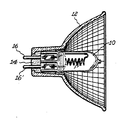
- the Figure is a view of a glass reflector and tungsten halogen lamp assembly wherein the lamp is cemented into the reflector employing the aluminum phosphate cement of the present invention.
- the present invention relates to an aluminum phosphate cement composition
- an aluminum phosphate cement composition comprising on a parts by volume basis a mixture of (i) 10 to 25 parts of aluminum phosphate wherein the mole ratio of phosphate to aluminum is greater than 3, (ii) 4 to 15 parts of alumina having a mean article size ranging between 1-4 micrometers, (iii) 5 to 30 parts of a medium particle size inert refractory filler material having a mean particle size ranging from 7 to 15 micrometers, and (iv) 40 to 75 parts of a coarse particle size inert refractory filler material having a mean particle size ranging from 16 to 46 micrometers.
- This cement is prepared by mixing an aqueous aluminum phosphate solution containing excess phosphoric acid with an aggregate mixture of said alumina and said inert filler material to form a paste or slurry, followed by heating said paste or slurry at a temperature of at least 250°C for a time sufficient to form said cement.
- aluminum hydroxide is reacted with phosphoric acid merely by mixing the phosphoric acid and aluminum hydroxide. It is preferred that the acid employed for this reaction be chilled to a temperature below room temperature (i.e., (about 40°F) 4°C) due to the exothermic nature of the reaction. This helps to control the reaction and to avoid clumping of the Al(OH)3.
- the phosphoric acid may be employed in the form of 85% phosphoric acid which is commercially available. Further, the phosphoric acid may be mixed with water prior to reacting same with the aluminum hydroxide. Alternatively, the aluminum hydroxide may be slurried in water and the cool phosphoric acid added to the so-formed slurry.
- the aluminum phosphate cement of the present invention is formed employing an aluminum phosphate solution containing excess phosphoric acid.
- the excess phosphoric acid may be added to the aluminum phosphate solution.
- excess phosphoric acid is meant phosphoric acid in an amount such that the atomic or mole ratio of phosphorus or phosphate to aluminum exceeds 3.
- the excess phosphoric acid may range from 10-30 mole percent and more preferably from 12-20 percent.
- An optimum ratio of phosphorus from the phosphoric acid to the aluminum of the aluminum hydroxide has been found to be about 3.6.
- the aluminum hydroxide may be reacted with phosphoric acid in the presence of such an excess amount of acid.
- the aluminum hydroxide may be reacted with the phosphoric acid in an amount such that the ratio of phosphorus from the acid to the aluminum in the aluminum hydroxide is 3.
- the excess phosphoric acid may then be subsequently incorporated into the aluminum phosphate solution or may be mixed with one or more of the other ingredients of the composition which will be added to or to which will be added the aluminum phosphate solution. While not wishing to be held to any particular theory, it is believed that the excess phosphoric acid reacts with the alumina particles when at elevated temperature.
- the pre-cement paste or slurry will be unstable as reflected in low cement strength and decreased shelf life.
- too much phosphoric acid is employed the reaction time at elevated temperature required to form the cement will increase excessively.
- the aluminum phosphate solution will be slurried with the alumina particles and the mixture of coarse and medium particle size inert filler material. This may be accomplished in any convenient manner. The particular mixing sequence employed is not believed to be critical to forming the final slurry or paste which is subsequently heated to form the cement. Thus the particulate alumina and filler materials may be premixed in a dry state and added, with agitation, to the aluminum phosphate solution to form a paste or slurry. Alternatively, the aluminum phosphate solution may be added to one or more of the particulate materials.
- the rheology of the final slurry or paste will, of course, be determined by the amount of excess acid present, the amount of water present, the amount of the aluminum phosphate solution present with respect to the powdered or particulate materials, the relative particle size of the powdered materials, etc.
- the actual amounts of the various ingredients with respect to eachother employed in forming the aluminum phosphate cement of this invention may vary.
- the following Table, based on 100 volumes of total slurry or paste composition, illustrates the general and preferred ranges of the various ingredients to each other employed in forming the cement composition of this invention.
- the aluminum phosphate solution will be incorporated or mixed with relatively fine, medium and coarse particle size materials.
- the alumina will preferably comprise all or substantially all of the fine particle size material, although a small portion (i.e. less than 20 volume percent) may be comprised of medium size particles.
- the broad and preferred particle size ranges expressed as mean particle size for the fine, medium and coarse particles are set forth in the Table below.
- a more spherical particle size is important in achieving a more densely close-packed particle structure which has been found to be particularly useful in the cement composition of the present invention.
- the medium and coarse particle size filler materials should be inert in the sense that they do not react at room temperature with the other ingredients of the slurry or paste from which the cement is formed. If the cement is to be employed in cementing a quartz lamp or quartz containing article into a reflector or other fixture, it is also preferred that all of the ingredients of the cement composition be relatively low in alkali metal content such as sodium. In such applications it is preferred that the sodium content be below about 2 wt. % of the final cement.
- the filler materials should also be refractory in the sense that they are not affected by the relatively high temperatures of 350-600°C which may be encountered in some lamp applications.
- the filler materials must also be relatively electrically non-conducting.
- the particular choice of filler materials employed will be determined by a number of factors, among which includes cost and thermal conductivity.
- the choice of the inert filler materials will be selected so as to achieve thermal conductivity characteristics of the cement which do not result in excessive thermal stresses to the reflector when the lamp is energized which would ultimately result in cracking of the glass reflector. Thus a balance of thermal conductivity is required.
- the thermal conductivity of the cement is too low, the temperature of the seal area of the lamp will be too high. Conversely, if the thermal conductivity is too high the glass reflector may crack.
- materials that have been found useful in forming the cement composition of the present invention are included spheres made up of alumina silicate materials, solid and hollow glass spheres having a relatively low alkali metal content and barium titanate. Barium titanate has been found to be useful for adjusting the thermal conductivity of the final cement composition.
- other inert filler materials may be employed in the spirit of the present invention.
- the paste or slurry of the present invention be cured at a temperature of at least 240°C in order to achieve a cement having satisfactory strength and which achieves a cure in a reasonable period of time.
- the cure temperature for the cement composition of the present invention may broadly range from 240 to 380°C and more preferably from 280-340°C. The optimum temperature will depend upon the particular composition used.
- the cure time will be greater than 5 minutes and preferably greater than 7 minutes. Cement compositions of the present invention have been cured employing cure times ranging from 5-20 minutes and preferably 7-15 minutes at these temperatures.
- a high intensity type tungsten-halogen lamp 10 having a quartz envelope is shown cemented into glass reflector 12 with an aluminum phosphate cement composition 14 of the present invention.
- Ferrules 16 and 16' extend from the end of the lamp through the cement composition.
- the lamp is cemented into the reflector employing a procedure which comprises first placing the lamp into the elongated rear portion of the reflector and securing same therein by introducing a first portion of cement paste or slurry into said rear portion using a syringe type of device.
- the initial fill of cement is then dried for about 1 minute in flowing hot air to dry the paste and achieve a slight degree of cure sufficient to set up the cement enough to permit further handling of the lamp-reflector assembly without dislodging or misaligning the lamp.
- a second fill of the same cement is applied to completely fill up the nose portion of the reflector.
- the assembly is placed in an oven at 110°C and then heated up to a temperature of between 300-325°C over a time period of about 30 minutes and held at said 300-325°C temperature for a period of time of from 7-15 minutes in order to cure the cement.
- the cement formulation employed is set forth in the Table below. Vol. % Wt.
- % mean particle size, micrometers Aluminum phosphate solution (basis of 85% H3PO4 with no water added) 15.8 11.3 Zeeospheres 850 (coarse filler) 47.2 18.8 42 Zeeospheres 800 (medium filler) 23.6 37.7 12 Barium titanate (medium filler) 8.4 24.1 10 Vol. % Wt. % mean particle size, micrometers Fired alumina water (fine particle size) 5.1 8.1 2 100% 100% Water is added to the above formulation in an amount of 49 volumes of water per 100 volumes of paste or 19.6 parts by weight per 100 parts by weight of paste.
- the aluminum phosphate solution is prepared by diluting chilled, 85% phosphoric acid with chilled, deionized water to which is added aluminum hydroxide with the resultant mixture agitated until the aluminum hydroxide is dispersed. The solution is then permitted to warm up to room temperature before being mixed with the other ingredients of the cement in order to effect reaction of the acid with the aluminum hydroxide.
- the following Table gives the components of the aluminum phosphate solution. Wt. % Vol. % Al(OH)3 12.6 8.1 85% H3PO4 67.3 60.8 H2O 20.1 31.1 To this solution is added the mixture of the particular materials set forth in the immediately preceeding Table to form the cement paste which is used to cement the lamp into the reflector.
- the lamps were cycled for 7 1/2 minutes on and 7 1/2 minutes off for 200 cycles, after which they were removed from their reflectors.
- the reflector nose was saw cut at approximately the top of the cement line and the saw cut piece placed face-up in immersion fluid and examined in a polyscope.
- the amount of tensile stress built up along the inside of the nose surface was calculated from the following formula:
- the composition of the aluminum phosphate solution (without the water) was the same as that given previously on page 10 and was prepared in the same manner.
- the Zeeospheres are hollow silica-alumina ceramic spheres available from Zeelan Industries, Inc. of St. Paul, Minn. The fired alumina was obtained by firing aluminum hydroxide.
- the so-formed pre-cement paste was employed to cement twenty of the 350 watt lamps into all glass reflectors as shown in the Figure employing the two-step process of injecting cement followed by curing set forth previously. Accelerated life tests were conducted employing the procedure set forth above for the stress test, but with cycles of 15 minutes on and 15 minutes off for a total burning time of 75 hours or total test time of about 150 hours.
- This cement paste was used with the same lamps and reflectors and following the same procedure as in Example 1. The results of the life tests with 20 lamps were that 15% of the reflectors cracked. The stress level was not measured.
- the glass spheres are solid glass spheres and were obtained from Potters Industries, Inc. of Hasbrouck Hts., N.J.
Landscapes
- Chemical & Material Sciences (AREA)
- Engineering & Computer Science (AREA)
- Ceramic Engineering (AREA)
- Structural Engineering (AREA)
- Materials Engineering (AREA)
- Organic Chemistry (AREA)
- Inorganic Chemistry (AREA)
- Chemical Kinetics & Catalysis (AREA)
- General Engineering & Computer Science (AREA)
- Curing Cements, Concrete, And Artificial Stone (AREA)
- Vessels And Coating Films For Discharge Lamps (AREA)
- Fastening Of Light Sources Or Lamp Holders (AREA)
- Joining Of Glass To Other Materials (AREA)
- Dental Preparations (AREA)
- Compositions Of Oxide Ceramics (AREA)
Claims (8)
- Aluminiumphosphatzement-Zusammensetzung umfassend auf der Grundlage von Volumenteilen eine Mischung aus(i) 10 bis 25 Teile Aluminiumphosphat, bei dem das Mol-Verhältnis von Phosphat zu Aluminium größer als 3 ist,(ii) 4 bis 15 Teile Aluminiumoxid mit einer mittleren Teilchengröße im Bereich zwischen 1 und 4 µm,(iii) 5 bis 30 Teile eines inerten hochschmelzenden Füllstoffmaterials mittlerer Teilchengröße, wobei das Material eine mittlere Teilchengröße im Bereich von 7 bis 15 µm aufweist,(iv) 40 bis 75 Teile eines inerten hochschmelzenden Füllstoffmaterials grober Teilchengröße mit einer mittleren Teilchengröße im Bereich von 16 bis 46 µm,
- Zusammensetzung nach Anspruch 1, worin die 10 bis 25 Teile des Aluminiumphosphats als Gesamtreaktionsprodukt der Umsetzung von Aluminiumhydroxid mit einer 85 %igen wässrigen Lösung von Phosphorsäure ohne Zugabe von Wasser genommen sind.
- Zusammensetzung nach Anspruch 1 oder 2, worin das Aluminiumoxid geglühtes Aluminiumoxid umfaßt.
- Zusammensetzung nach irgendeinem der vorhergehenden Ansprüche, worin das inerte Füllstoffmaterial mindestens eine Komponente umfaßt, ausgewählt aus der Gruppe bestehend aus hohen Glaskugeln, Bariumtitanat und deren Mischungen.
- Zusammensetzung nach irgendeinem der vorhergehenden Ansprüche, worin der Natriumgehalt weniger als 2 Gew.-% beträgt.
- Verfahren zum Herstellen einer Aluminiumphosphatzement-Zusammensetzung nach irgendeinem in den Ansprüchen 1 bis 5 umfassend das Vermischen einer wässrigen Aluminiumphosphatlösung mit einer Aggegatmischung aus dem genannten Aluminiumoxid und den inerten Füllstoffmaterialien zur Bildung einer Aufschlämmung oder Paste, in der die Mengen der verschiedenen Bestandteile die in den Ansprüchen 1 bis 5 genannten sind und Erhitzen der so gebildeten Aufschlämmung oder Paste bei einer Temperatur von mindestens 250°C für eine ausreichende Zeit, um den Zement zu bilden und worin die Paste oder Aufschlämmung Phosphorsäure in einer Menge enthält, die einen Überschuß von 10 bis 30 Mol-% über die Menge hinaus aufweist, die ausreicht, daß das Mol-Verhältnis des Phosphats zum Aluminium im Aluminiumphosphat 3 beträgt.
- Verfahren nach Anspruch 6, umfassend die Zugabe von 10 bis 75 Teilen Wasser zur Bildung der Aufschlämmung oder Paste.
- Kombination aus Reflektor und Lampe umfassend(a) ein glasartiges Reflektorteil mit einem vorderen reflektierenden Abschnitt, der in einem langgestreckten Hohlraumteil endet, der sich vom Reflektorteil aus nach rückwärts erstreckt, und(b) eine Wolframhalogenlampe, die mit einem Aluminiumphosphatzement permanent in dem Hohlraumteil befestigt ist, wobei die Wolframhalogenlampe einen Glaskolben umfaßt, der eine Zuleitungskonstruktion aufweist, die sich durch eine im Kolben erstreckende Öffnung in diesen Kolben hinein erstreckt, wobei die Zuleitungskonstruktion eine äußere Anschlußleitung, eine Zwischenfolie und eine innere Leitung umfaßt, die sich in den Kolben erstreckt und die innere und äußere Leitung mit den gegenüberliegenden Enden der Folie verbunden sind und der Aluminiumphosphatzement der nach irgendeinem der Ansprüche 1 bis 5 ist.
Applications Claiming Priority (2)
| Application Number | Priority Date | Filing Date | Title |
|---|---|---|---|
| US101929 | 1987-09-29 | ||
| US07/101,929 US4833576A (en) | 1987-09-29 | 1987-09-29 | Aluminum phosphate cement compositions and lamp assemblies containing same |
Publications (3)
| Publication Number | Publication Date |
|---|---|
| EP0309750A2 EP0309750A2 (de) | 1989-04-05 |
| EP0309750A3 EP0309750A3 (en) | 1989-11-29 |
| EP0309750B1 true EP0309750B1 (de) | 1991-12-04 |
Family
ID=22287221
Family Applications (1)
| Application Number | Title | Priority Date | Filing Date |
|---|---|---|---|
| EP88114119A Expired - Lifetime EP0309750B1 (de) | 1987-09-29 | 1988-08-30 | Zementzusammensetzungen auf Basis von Aluminiumphosphat und diese enthaltende Lampenverbindungen |
Country Status (7)
| Country | Link |
|---|---|
| US (1) | US4833576A (de) |
| EP (1) | EP0309750B1 (de) |
| JP (1) | JPH0725584B2 (de) |
| KR (1) | KR930002668B1 (de) |
| AU (1) | AU619485B2 (de) |
| CA (1) | CA1326941C (de) |
| DE (1) | DE3866658D1 (de) |
Families Citing this family (25)
| Publication number | Priority date | Publication date | Assignee | Title |
|---|---|---|---|---|
| US4959583A (en) * | 1989-03-31 | 1990-09-25 | General Electric Company | Reflective lamps having an improved light source mounting arrangement |
| US5176441A (en) * | 1989-09-22 | 1993-01-05 | Tungsram Reszvenytarsasag | Lamp with a reflector envelope |
| EP0420214A3 (en) * | 1989-09-27 | 1991-08-28 | Toshiba Lighting & Technology Corporation | Lamp device and method of bonding mirror reflector to lamp |
| US5143445A (en) * | 1989-10-10 | 1992-09-01 | General Electric Company | Glass reflectors lpcvd coated with optical interference film |
| IT1248422B (it) * | 1989-12-06 | 1995-01-16 | Franco Berti | Faretto a lampada alogena, provvisto di un paraboloide riflettente in materiale ceramico |
| US5272408A (en) * | 1991-05-09 | 1993-12-21 | Gte Products Corporation | Lamp and reflector assembly |
| USD336963S (en) | 1991-04-03 | 1993-06-29 | Gte Products Corporation | Reflector lamp |
| ES1019067Y (es) * | 1991-11-08 | 1992-10-01 | Lamparas Halogenas, S.A. | Proteccion para electrodos de lampara halogena. |
| US5536686A (en) * | 1992-10-20 | 1996-07-16 | The Research Foundation Of State University Of New York At Buffalo | Phosphate binders for metal-matrix composites |
| US5362690A (en) * | 1992-12-16 | 1994-11-08 | Ceram Sna Inc. | Refractory castable composition and process for its manufacture |
| FR2702757B1 (fr) * | 1993-03-17 | 1995-06-16 | Rhone Poulenc Chimie | Nouveau phosphate d'aluminium, son procede de preparation et son utilisation dans la preparation de materiaux comprenant un liant et de pieces ceramiques . |
| US5723937A (en) * | 1993-03-22 | 1998-03-03 | General Electric Company | Light-scattering coating, its preparation and use |
| DE4413370A1 (de) * | 1994-04-19 | 1995-10-26 | Patent Treuhand Ges Fuer Elektrische Gluehlampen Mbh | Reflektorglühlampe |
| USD433166S (en) * | 1996-12-10 | 2000-10-31 | Osram Gmbh | Halogen lamp-reflector combination |
| US6258742B1 (en) * | 1999-06-10 | 2001-07-10 | George F. Carini | Method of manufacture of phosphate-bonded refractories |
| US6168293B1 (en) | 1999-08-09 | 2001-01-02 | General Electric Company | Spot par reflector lamp |
| US6471376B1 (en) | 2000-08-17 | 2002-10-29 | General Electric Company | Increased life reflector lamps |
| US6740299B2 (en) | 2001-05-16 | 2004-05-25 | George F. Carini | Method of manufacture of phosphate-bonded refractories |
| US7628951B1 (en) * | 2005-10-21 | 2009-12-08 | Ceramatec, Inc. | Process for making ceramic insulation |
| US8349111B2 (en) * | 2006-08-14 | 2013-01-08 | Ceramatec, Inc. | Method for joining ceramic components |
| TW200833534A (en) * | 2006-12-13 | 2008-08-16 | Koninkl Philips Electronics Nv | A lamp with power supply wires reaching outside the lamp |
| WO2009046750A1 (de) * | 2007-10-02 | 2009-04-16 | Osram Gesellschaft mit beschränkter Haftung | Sockel für eine entladungslampe und verfahren zum herstellen eines sockels für eine entladungslampe |
| US20100053974A1 (en) * | 2008-09-04 | 2010-03-04 | Sterling Vaughn C | Silicate cement composition and lamp assemblies comprising same |
| US9611147B2 (en) * | 2012-04-16 | 2017-04-04 | Bunge Amorphic Solutions Llc | Aluminum phosphates, compositions comprising aluminum phosphate, and methods for making the same |
| CN108609878A (zh) * | 2018-05-29 | 2018-10-02 | 福建鼎盛元环保科技有限公司 | 一种利用白泥制备磷铝酸盐胶凝材料的生产线及其工艺 |
Family Cites Families (18)
| Publication number | Priority date | Publication date | Assignee | Title |
|---|---|---|---|---|
| JPS5024968B1 (de) * | 1969-07-26 | 1975-08-20 | ||
| US3725698A (en) * | 1971-03-02 | 1973-04-03 | Gen Motors Corp | Moisture barrier for sealed beam headlamp construction |
| US4147823A (en) * | 1975-03-06 | 1979-04-03 | General Electric Company | Lamp glass envelope containing marking thereon |
| JPS5222015A (en) * | 1975-08-12 | 1977-02-19 | Taki Chemical | Refractory composition |
| US4021659A (en) * | 1975-10-30 | 1977-05-03 | General Electric Company | Projector lamp reflector |
| US4262055A (en) * | 1979-01-08 | 1981-04-14 | Republic Steel Corporation | Fire protection materials and methods of making them |
| US4403276A (en) * | 1980-12-03 | 1983-09-06 | GTE Products Corporation_ | Front loading projection unit with snap in capsule |
| US4366255A (en) * | 1981-03-23 | 1982-12-28 | Wahl Refractory Products, Company | Highly reinforced refractory concrete with 4-20 volume % steel fibers |
| US4390935A (en) * | 1981-04-13 | 1983-06-28 | Gte Products Corporation | Projection unit with separable lamp capsule and means for ejecting same |
| US4395387A (en) * | 1981-10-13 | 1983-07-26 | Pennwalt Corporation | Method for manufacturing water glass cement hardeners |
| US4419133A (en) * | 1981-11-27 | 1983-12-06 | Quadco Component Systems, Inc. | Bonded aggregate structures and production thereof |
| US4440865A (en) * | 1982-03-08 | 1984-04-03 | Salazar Paul V | Refractory compositions and method |
| US4394174A (en) * | 1982-06-01 | 1983-07-19 | E. I. Du Pont De Nemours & Co. | Phosphate cement and mortar |
| SU1079632A1 (ru) * | 1982-07-16 | 1984-03-15 | Уральский научно-исследовательский и проектный институт строительных материалов | Сырьева смесь дл изготовлени жаростойкого газобетона |
| JPS5950081A (ja) * | 1982-09-14 | 1984-03-22 | ハリマセラミック株式会社 | キヤスタブル耐火物 |
| US4522926A (en) * | 1983-03-10 | 1985-06-11 | Combustion Engineering, Inc. | Aluminum resistant refractory composition |
| US4608624A (en) * | 1985-01-22 | 1986-08-26 | Gte Products Corporation | Projection lamp unit with separable lamp capsule |
| JPS61194901U (de) * | 1985-05-29 | 1986-12-04 |
-
1987
- 1987-09-29 US US07/101,929 patent/US4833576A/en not_active Expired - Lifetime
-
1988
- 1988-08-30 DE DE8888114119T patent/DE3866658D1/de not_active Expired - Lifetime
- 1988-08-30 EP EP88114119A patent/EP0309750B1/de not_active Expired - Lifetime
- 1988-09-01 CA CA000576341A patent/CA1326941C/en not_active Expired - Fee Related
- 1988-09-22 AU AU22488/88A patent/AU619485B2/en not_active Ceased
- 1988-09-28 JP JP63241175A patent/JPH0725584B2/ja not_active Expired - Lifetime
- 1988-09-28 KR KR1019880012543A patent/KR930002668B1/ko not_active Expired - Fee Related
Also Published As
| Publication number | Publication date |
|---|---|
| EP0309750A2 (de) | 1989-04-05 |
| DE3866658D1 (de) | 1992-01-16 |
| AU619485B2 (en) | 1992-01-30 |
| AU2248888A (en) | 1989-04-06 |
| JPH01301552A (ja) | 1989-12-05 |
| US4833576A (en) | 1989-05-23 |
| KR930002668B1 (ko) | 1993-04-07 |
| EP0309750A3 (en) | 1989-11-29 |
| JPH0725584B2 (ja) | 1995-03-22 |
| CA1326941C (en) | 1994-02-15 |
| KR890005805A (ko) | 1989-05-17 |
Similar Documents
| Publication | Publication Date | Title |
|---|---|---|
| EP0309750B1 (de) | Zementzusammensetzungen auf Basis von Aluminiumphosphat und diese enthaltende Lampenverbindungen | |
| US2712533A (en) | Lamp basing cement containing sodium silicate-magnesium oxide bonding mixture | |
| GB2064217A (en) | Incandescent lamp having opaque coating | |
| US4996171A (en) | Silver-filled glass | |
| US4330596A (en) | Bodies composed of at least two parts, sealing glass and method for bonding parts | |
| US4918353A (en) | Reflector and lamp combination | |
| EP0286185A1 (de) | Lichtdurchlässiger Keramikwerkstoff, Verfahren zu seiner Herstellung und Hochdruckentladungslampe, versehen mit diesem Werkstoff | |
| JP2767276B2 (ja) | 封着材料 | |
| US2218058A (en) | Electrically insulating coating | |
| US3088834A (en) | Thermally devitrifiable sealing glasses | |
| JPH0617272B2 (ja) | 窒化珪素−アルミナ系複合セラミツクスおよびその製造方法 | |
| CA1299637C (en) | Reflector and lamp combination | |
| JPS62176943A (ja) | 気密性耐熱板の製造方法 | |
| JPS6115908B2 (de) | ||
| US4879101A (en) | Method for producing a magnesia powder for use as an electrical insulating material | |
| US3973970A (en) | Additive composition for making dental materials | |
| US2975145A (en) | Semi-conductive ceramic composition | |
| SU1249000A1 (ru) | Способ получени штырьковых гермовводов | |
| JPH02276184A (ja) | 赤外線放射用発熱装置 | |
| US20100053974A1 (en) | Silicate cement composition and lamp assemblies comprising same | |
| JPH11116899A (ja) | 放熱性無機接着剤 | |
| KR102093550B1 (ko) | 전기적 절연 특성을 갖는 조성물 및 그의 제조 방법 | |
| SU928672A1 (ru) | Металлокерамический материал дл изготовлени электронагревателей | |
| EP0209715B1 (de) | Magnesiumoxidpulver zur Verwendung als elektrisches Isoliermaterial | |
| JPH02186586A (ja) | SiC発熱体の耐酸化性コーティングの形成方法 |
Legal Events
| Date | Code | Title | Description |
|---|---|---|---|
| PUAI | Public reference made under article 153(3) epc to a published international application that has entered the european phase |
Free format text: ORIGINAL CODE: 0009012 |
|
| AK | Designated contracting states |
Kind code of ref document: A2 Designated state(s): DE FR GB IT NL |
|
| PUAL | Search report despatched |
Free format text: ORIGINAL CODE: 0009013 |
|
| AK | Designated contracting states |
Kind code of ref document: A3 Designated state(s): DE FR GB IT NL |
|
| 17P | Request for examination filed |
Effective date: 19900423 |
|
| 17Q | First examination report despatched |
Effective date: 19900828 |
|
| GRAA | (expected) grant |
Free format text: ORIGINAL CODE: 0009210 |
|
| AK | Designated contracting states |
Kind code of ref document: B1 Designated state(s): DE FR GB IT NL |
|
| ITF | It: translation for a ep patent filed | ||
| ET | Fr: translation filed | ||
| REF | Corresponds to: |
Ref document number: 3866658 Country of ref document: DE Date of ref document: 19920116 |
|
| PLBE | No opposition filed within time limit |
Free format text: ORIGINAL CODE: 0009261 |
|
| STAA | Information on the status of an ep patent application or granted ep patent |
Free format text: STATUS: NO OPPOSITION FILED WITHIN TIME LIMIT |
|
| 26N | No opposition filed | ||
| PGFP | Annual fee paid to national office [announced via postgrant information from national office to epo] |
Ref country code: FR Payment date: 20010801 Year of fee payment: 14 |
|
| PGFP | Annual fee paid to national office [announced via postgrant information from national office to epo] |
Ref country code: NL Payment date: 20010807 Year of fee payment: 14 |
|
| REG | Reference to a national code |
Ref country code: GB Ref legal event code: IF02 |
|
| PGFP | Annual fee paid to national office [announced via postgrant information from national office to epo] |
Ref country code: DE Payment date: 20020830 Year of fee payment: 15 |
|
| PG25 | Lapsed in a contracting state [announced via postgrant information from national office to epo] |
Ref country code: NL Free format text: LAPSE BECAUSE OF NON-PAYMENT OF DUE FEES Effective date: 20030301 |
|
| PG25 | Lapsed in a contracting state [announced via postgrant information from national office to epo] |
Ref country code: FR Free format text: LAPSE BECAUSE OF NON-PAYMENT OF DUE FEES Effective date: 20030430 |
|
| NLV4 | Nl: lapsed or anulled due to non-payment of the annual fee |
Effective date: 20030301 |
|
| REG | Reference to a national code |
Ref country code: FR Ref legal event code: ST |
|
| PG25 | Lapsed in a contracting state [announced via postgrant information from national office to epo] |
Ref country code: DE Free format text: LAPSE BECAUSE OF NON-PAYMENT OF DUE FEES Effective date: 20040302 |
|
| PG25 | Lapsed in a contracting state [announced via postgrant information from national office to epo] |
Ref country code: IT Free format text: LAPSE BECAUSE OF NON-PAYMENT OF DUE FEES;WARNING: LAPSES OF ITALIAN PATENTS WITH EFFECTIVE DATE BEFORE 2007 MAY HAVE OCCURRED AT ANY TIME BEFORE 2007. THE CORRECT EFFECTIVE DATE MAY BE DIFFERENT FROM THE ONE RECORDED. Effective date: 20050830 |
|
| PGFP | Annual fee paid to national office [announced via postgrant information from national office to epo] |
Ref country code: GB Payment date: 20070830 Year of fee payment: 20 |
|
| REG | Reference to a national code |
Ref country code: GB Ref legal event code: PE20 Expiry date: 20080829 |
|
| PG25 | Lapsed in a contracting state [announced via postgrant information from national office to epo] |
Ref country code: GB Free format text: LAPSE BECAUSE OF EXPIRATION OF PROTECTION Effective date: 20080829 |