EP0308087A2 - Schrittdatenprozessor für 180X- und 90X-Kompassdrehmelderdaten - Google Patents
Schrittdatenprozessor für 180X- und 90X-Kompassdrehmelderdaten Download PDFInfo
- Publication number
- EP0308087A2 EP0308087A2 EP88307807A EP88307807A EP0308087A2 EP 0308087 A2 EP0308087 A2 EP 0308087A2 EP 88307807 A EP88307807 A EP 88307807A EP 88307807 A EP88307807 A EP 88307807A EP 0308087 A2 EP0308087 A2 EP 0308087A2
- Authority
- EP
- European Patent Office
- Prior art keywords
- synchro
- step data
- output
- data
- data code
- Prior art date
- Legal status (The legal status is an assumption and is not a legal conclusion. Google has not performed a legal analysis and makes no representation as to the accuracy of the status listed.)
- Withdrawn
Links
Images

Classifications
-
- H—ELECTRICITY
- H03—ELECTRONIC CIRCUITRY
- H03M—CODING; DECODING; CODE CONVERSION IN GENERAL
- H03M7/00—Conversion of a code where information is represented by a given sequence or number of digits to a code where the same, similar or subset of information is represented by a different sequence or number of digits
-
- H—ELECTRICITY
- H03—ELECTRONIC CIRCUITRY
- H03M—CODING; DECODING; CODE CONVERSION IN GENERAL
- H03M1/00—Analogue/digital conversion; Digital/analogue conversion
- H03M1/12—Analogue/digital converters
- H03M1/64—Analogue/digital converters with intermediate conversion to phase of sinusoidal or similar periodical signals
- H03M1/645—Analogue/digital converters with intermediate conversion to phase of sinusoidal or similar periodical signals for position encoding, e.g. using resolvers or synchros
-
- H—ELECTRICITY
- H03—ELECTRONIC CIRCUITRY
- H03M—CODING; DECODING; CODE CONVERSION IN GENERAL
- H03M1/00—Analogue/digital conversion; Digital/analogue conversion
- H03M1/12—Analogue/digital converters
- H03M1/34—Analogue value compared with reference values
Definitions
- the invention pertains to compass data converters particularly with respect to converting 180X and 90X compass synchro data into 1/6 degree resolution digital step data.
- the invention may be utilised in commercial marine radar displays requiring compass heading data to be utilised to provide a north or course stabilised display mode.
- Gyro compasses provide a wide variety of heading data output format.
- Gyro compasses traditionally provide output data in 360X synchro, 180X synchro, 90X synchro and 1/6 degree step formats.
- the synchro formats are utilised to enhance accuracy and resolution.
- a synchro is geared to the compass output shaft to effect one mechanical revolution for each compass spacial degree. In such a configuration the gear ratio is 360:1.
- the synchro is geared to effect one mechanical revolution for two compass spacial degrees.
- the 90X synchro is geared to effect one mechanical revolution for four spacial degrees.
- the 1/6 degree step data output is generally utilised in a 360X system and provides a standard 3 digit grey code representing the 1/6 degree steps.
- Apparatus is known in the prior art for providing 1/6 degree step data from 180X or 90X synchro-type compass systems but such apparatus is electromechanical and hence bulky, unreliable, and expensive.
- One such prior art system utilises the synchro-type compass data to position a synchro servo system having an output linked through a gear train to a 1.6 degree step motor to provide the 1.6 degree compass step data.
- Another prior art system utilises the synchro-type compass data to position a synchro servo system having an output linked through a gear train to an optical disc and decoder to provide the 1/6 degree compass step information. Because of the requirements of the synchro servo systems and the gear trains, each type of compass data output format requires a unique assembly. Additionally, the apparatus requires an excessive amount of space because of the synchro servo systems and the gear trains.
- Synchro-to-digital converters for the various synchro data output formats are known which interface to the desired compass synchro data formats. Such converters, however, tend to be excessively expensive. The use of such converters in a low cost commercial compass systems or commercial radar system would tend to be prohibitive.
- the present invention is defined in the appended claims and overcomes the disadvantages of the prior art by providing simple, low cost and low power apparatus that provides 1/6 degree step data from a 180X or a 90X synchro-type compass.
- 180X synchro data is converted by utilising a 360X to 1.6 degree step data converter that divides the synchro rotation into six 60° sectors providing a digital step data code representative thereof.
- Means responsive to the step data code and the 180X synchro output generates a first additional step data code digit representative of 30 degree subsectors of the 60 degree sectors.
- the step data code selects an appropriate synchro output and the polarity thereof is monitored with respect to ground to provide the first additional step data code digit.
- the 90X synchro data is converted in response to the step data code, the first additional step data code digit and the synchro output by dividing the 30 degree subsectors into 15 degree subsectors and generating a second additional step data code digit representative thereof.
- the step data code and the first additional step data code digit selects the synchro output selected by the 180X conversion and a further synchro outpput which is scaled so that the scaled synchro output and the first selected synchro output are equal at the appropriate 15 degree points.
- a comparison between the scaled synchro output and the unscaled synchro output generates the second additional step data code digit.
- the 360X to 1/6 degree step data converter utilises constant current sources for rectifying the synchro output signals into constant current levels.
- the output of a synchro device such as utilised in a synchro-type compass comprises three synchro lines S1, S2, and S3 and two reference lines R1 and R2.
- the reference signal is typically a 60Hz or 400Hz sine wave applied to the synchro rotor.
- Each of the three synchro lines provides an amplitude modulation of the reference sine wave where the amplitude modulation envelope is a sine wave generated in accordance with the angular position of the synchro.
- the output of a synchro line may either be in phase with the reference signal or 180° out of phase with the reference signal.
- each of the three synchro lines encodes the compass heading as an amplitude modulated sine wave.
- the sinusoidal amplitude envelopes with respect to the three synchro lines are illustrated where K is defined to be unity.
- the reference signal, sin(wt), is omitted for clarity.
- the amplitude envelope curves of Fig. 1 are provided across pairs of the synchro output lines.
- the synchro output device in a 360X compass executes one mechanical revolution for each spacial compass degree.
- the mechanical-to-spacial degree gearing therefore provides a 360:1 ratio.
- one mechanical revolution of the synchro device is divided into six equal intervals of 60 degrees each providing 1/6 spacial degree resolution.
- the six equal intervals are expressed in a 3-bit step data grey code G3, G2, G1.
- G3 represents the most significant step line 1
- G2 represents the step line 2
- G1 represents the least significant step line 3.
- Figure 1 illustrates the methodology of US-A-4,031,531 for dividing the one mechanical revolution of the synchro device into six equal intervals to obtain the 1/6 spacial degree resolution.
- the curve denoted as G3 is obtained across the synchro output lines S2-S1.
- the curve denoted as G2 is obtained across the synchro output lines S3-S2, and the curve denoted as G1 is obtained across the synchro output lines S1-S3.
- G3 is positive
- G2 and G1 are negative.
- the step data code for this sector therefore is 100 where binary one denotes a positive voltage and binary zero denotes a negative voltage. It is observed that at each 60 degree boundary only one fo the synchro output curves changes polarity.
- a 3-bit grey code denoting the step data is therefore defined as illustrated.
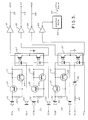
- FIG. 3 a schematic wiring diagram of a 360X synchro data-to-1/6 degree step data converter is illustrated.
- the converter of Fig. 3 utilises the teachings of US-A-4,031,531.
- the synchro lines S1-S3 are rectified by a constant current half wave rectifier 10 comprised of diodes 11 and 12, transistors 13 and 14 and resistors 15 and 16.
- the synchro signal applied to the rectifier 10 is half wave rectified during the positive half cycles thereof.
- the transistors 13 and 14 with the resistors 15 and 16 comprise a constant current source which is turned on during these positive half cycles.
- the constant current rectified synchro signal is optocoupled by 1/2 of a dual optocoupler 17 to an inverting amplifier 18.
- the output of the inverting amplifier 18 provides the G1 signal on a line 19.
- the G1 signal on the line 19 is a square wave output at the frequency of the synchro reference signal and either in phase or 180 degrees out of phase therewith depending on the angular position of the synchro device output.
- the polarity information contained in the square wave signal on the line 19 with respect to the phase of the reference signal is utilised to provide the G1 digit of the step data code output as illustrated in Figure 1 in a manner to be further described.
- the S3-S2 synchro lines are rectified by a constant current rectifier 20 comprised of diodes 21 and 22, transistors 23 and 24 and resistors 25 and 26.
- the rectified synchro signal is optocoupled by the other half of the dual optocoupler 17 to an inverting amplifier 28 to provide the G2 step data digit on a line 29.
- the S2-S1 synchro lines are rectified by a constant current rectifier 30 comprised of diodes 31 and 32, transistors 33 and 34 and resistors 35 and 36.
- the rectified synchro signal is optocoupled by 1/2 of a dual optocoupler 37 to an inverting amplifier 38 to provide the G3 digit of the step data code on a line 39.
- the square wave outputs on the lines 19, 29 and 39 are sampled at the reference frequency by applying R1-R2 to the second half of the optocoupler 37 through a resistor 40 and a diode 41.
- the reference frequency signal from the optocoupler 37 is applied through an inverting amplifier 42 to a sample data circuit 43.
- the sample data circuit 43 provides Latch Data sampling pulses on a line 44 synchronous with respect to the synchro reference signal at a phase appropriate for sampling the signals on the lines 19, 29, and 39.
- the Latch Data pulses on the line 44 are utilised to sample the synchro output square wave signals on the lines 19, 29, and 39, in a manner to be described, so as to provide the step data code G1, G2 and G3 in sampled data format.
- the components 37 and 40-44 synchronously demodulate the signals on the lines 19, 29 and 39 to provide the polarity information contained therein.
- the code is tabulated as follows: TABLE 1 MECH DEG SPAT DEG G3 G2 G1 0-60 0 to 1/6 1 0 0 60-120 1/6 to 1/3 1 1 0 120-180 1/3 to 1/2 0 1 0 180-240 1/2 to 2/3 0 1 1 240-300 2/3 to 5/6 0 0 1 300-360 5/6 to 1 1 0 1
- the 3-bit code G3, G2, G1 is the same code as that generated by a 1/6 degree step-type compass. With a 1/6 degree step-type compass there are 6 steps per mechanical revolution, each step defined by the 3-bit code. Thus each step represents 1/6 spacial degree.
- the synchro output device of a 180X compass effects one mechanical revolution per two spacial degrees.
- the gear ratio in such a system is 180:1. If the 360X processor of Fig. 3 is utilised in a 180X compass, a spacial resolution of only 1/3 degree would be provided (2 spacial degrees per revolution X one-sixth revolution / step).
- obtaining 1/6 degree steps from the 180X compass utilises the data provided by the 360X compass processor of Fig. 3.
- Each 60 degree interval defined by the 360X processor is divided in half into two 30 degree sectors to obtain the required resolution of 1/6 spacial degree/step.
- Fig. 2 illustrates that at each odd multiple of 30 degrees, one of the synchro-to-ground lines crosses through zero. Therefore, in accordance with the invention, the appropriate synchro-to-ground line is selected and compared with ground potential to indicate whether the mechanical angle is prior, or subsequent, to the sub-interval boundary.
- a binary result is obtained and appended to the three digit step code from the 360X processor to provide a four digit code. The four digit code defines 12 intervals/mechanical revolution or 1/6 spacial degree/step.
- the data from the 360X processor is utilised to determine which one of the three synchro lines to compare to ground in each 60 degree sector.
- This data is tabulated as follows: TABLE 2 G3 G2 G1 INPUT TO COMPARATOR 1 0 0 S3-G 1 1 0 S2-G (INVERT) 0 1 0 S1-G 0 1 1 S3-G (INVERT) 0 0 1 S2-G 1 0 1 S1-G (INVERT)
- S3-G is selected since this signal crosses zero at 30 degrees.
- S3-G is negative and in the 30-60 degrees sub sector S3-G is positive.
- the negative state of S3-G may be denoted by binary zero.
- the positive S3-G may be denoted by binary one.
- each of the curves S1-G, S2-G, and S3-G represent the envelope of an amplitude modulated sinusoidal signal at the frequency of the synchro reference signal.
- the portions of the curves above the zero voltage axis represent the amplitude modulated sinusoidal signals in phase with the reference.
- the portions of the curve below the zero axis represent the amplitude modulated sinusoidal signals 180 degrees out of phase with the reference.
- S3-G is out of phase with the reference prior to 30 degrees and in phase with the reference after 30 degrees.
- S2-G is in phase with the reference prior to 90 degrees and out of phase with the reference subsequent thereto.
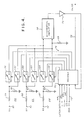
- FIG. 4 a schematic block diagram of apparatus for processing 180X synchro data and 90X synchro data is illustrated.
- the synchro lines S1, S2 and S3 are applied at terminals 50, 51, 52, respectively.
- the S1 input at the terminal 50 is applied to a voltage divider 53 consisting of resistors 54 and 55.
- the output of the voltage divider 53 is applied as inputs to selector switches 56 and 57.
- the output of the selector switch 56 is applied to the non-inverting input of a differential amplifier comparator 58.
- the output of the selector switch 57 is applied to the inverting input of the differential amplifier comparator 58.
- S2 is coupled to selector switches 59 and 60 via a voltage divider 61 comprised of resistors 62 and 63.
- the output of the selector switch 59 is coupled to the non-inverting input of the differential amplifier comparator 58 and the output of the selector switch 60 is coupled to the inverting input thereof.
- the synchro output signal S3 is coupled to selector switches 64 and 65 via a voltage divider 66 comprised of resistors 67 and 68.
- the output from the selector switch 64 is coupled to the non-inverting input of the differential amplifier comparator 58 and the output of the selector switch 65 is coupled to the inverting input thereof.
- the inverting input of the differential amplifier comparator 58 is coupled to ground through a resistor 69 for reasons to be described.
- the resistors 55, 63 and 68 of the voltage dividers 53, 61, and 66 respectively are also connected to ground.
- the output of the comparator 58 is applied to a decoder 70 via an inverting amplifier 71.
- the decoder 70 receives as inputs the Latch Data signal on the line 44 and the 360X step data signals, G1, G2, and G3 on the lines 19, 29, and 39 respectively from Fig. 3.
- the decoder 70 also receives an enable 90X signal (EN90X) on a line 72. This signal controls the processor of Fig. 4 in accordance with whether the synchro input data S1, S2, and S3 are from a 180X compass or a 90X compass.
- the decoder 70 In the 180X mode the decoder 70 utilises the output of the comparator 58 to generate a fourth step data bit G4 on a line 73 to provide the desired 1/6 spacial degree resolution in a manner to be described.
- the line 72 In the 90X mode, the line 72 is enabled and the decoder 70 first generates the bit G4 pursuant to the 180X procedure and then generates a fifth bit G5 on the line 73 to provide the desired 1/6 degree resolution in the 90X mode in a manner to be described.
- the decoder 70 drives the selector switches 56, 57, 59, 60, 64, and 65 via lines 74 to connect the appropriate synchro signals to the inputs of the comparator 58.
- the Latch Data signal on the line 44 provides sampling signals in synchronism with the synchro reference signal.
- the Latch Data signal is utilised by the decoder 70 to determine whether the output from the comparator 58 is in phase or out of phase with the synchro reference in determining the G4 and G5 bits.
- the EN90X signal on the line 72 is pulled low.
- the Latch Data signal on the line 44 samples G1, G2 and G3 to provide the 360X step data information to the decoder 70 as delineated in Table 2.
- the decoder 70 controls the selector switches 57, 60, and 65 to remain in the open condition irrespective of the input bits G1, G2, and G3. the inverting input of the comparator 58 is thus held at ground potential through the resistor 69.
- the synchro-to-ground line signals S1-G, S2-G, and S3-G (Fig. 2) are generated by the voltage dividers 53, 61, and 66 respectively.
- the decoder 70 is configured to activate the appropriate one of the selector switches 56, 59, and 64 in accordance with the latched 360X data bits G1, G2, and G3 so as to select the appropriate one of the synchro lines for connection to the non-inverting input of the comparator 58.
- the connections effected are delineated in Table 2 above.
- the decoder 70 also includes conventional circuitry to utilise the Latch Data signal on the line 44 to examine the output of the comparator 58 to determine if it is in phase or out of phase with the reference. Accordingly, the decoder 70 generates the G4 bit which is output on the line 73.
- the decoder 70 also utilises the G1, G2, and G3 bits to determine whether or not G4 should be inverted as delineated in Table 2.
- the decoder 70 closes the selected switch 64 to couple S3-G to the non-inverting input of the comparator 58 in response to the 100 input to the decoder 70 for the G3, G2, and G1 bits, respectively.
- the selected synchro signal S3-G is negative (out of phase with the reference) so that the decoder 70 provides G4 equal to binary zero on the line 73.
- the Latch Data signal on the line 44 is utilised to effect this phase discrimination. If the mechanical synchro position is in the second half of the 60 degree sector, the selected synchro signal S3-G is positive (in phase with the reference) and the decoder 70 provides binary one on the line 73 as the G4 bit.
- S2-G is selected and, accordingly, the decoder 70 closes the selector switch 59. Since S2-G is positive (in phase with the reference) in the first half of the sector, and negative (out of phase with the reference) in the second half of the sector, the decoder 70 effects an inversion in providing the G4 bit for this sector.
- the processor of Figure 4 operates to obtain 1/6 spacial degree resolution from a 180X compass as follows.
- the 1/3 spacial degree interval is determined from the 3-bit grey code provided by the 360X processor of Fig. 3.
- the decoder 70 drives the appropriate selector switches, as described above, so as to compare the selected synchro-to-ground line to ground in the comparator 58.
- the output of the comparator 58 identifies the first or second 1/6 spacial degree sub interval and the decoder 70 utilises this information to generate the data bit G4 on the line 73.
- the 180X conversion is tabulated as follows: TABLE 3 MECH DEG SPAT DEG G3 G2 G1 G4 0-30 0 to 1/6 1 0 0 0 30-60 1/6 to 1/3 1 0 0 1 60-90 1/3 to 1/2 1 1 0 0 90-120 1/2 to 2/3 1 1 0 1 120-150 2/3 to 5/6 0 1 0 0 150-180 5/6 to 1 0 1 0 1 180-210 1 to 7/6 0 1 1 0 210-240 7/6 to 4/3 0 1 1 1 240-270 4/3 to 3/2 0 0 1 0 270-300 3/2 to 5/3 0 0 1 1 300-330 5/3 to 11/6 1 0 1 0 330-360 11/6 to 2 1 0 1 1 1 1
- the EN90X signal enables the line 72, reconfiguring the selector switch logic of the decoder 70 in a manner to be described.
- the processor of Fig. 4 first performs the 180X conversion described above providing the G4 bit on the line 73. In the 90X mode the G4 bit is latched internally in the decoder 70 and the line 73 is thereafter utilised to provide a G5 bit.
- the 90X compass effects one mechanical revolution per four spacial degrees.
- the processor of Fig. 4 divides the mechanical revolution into 24 intervals (6 steps per spacial degree x 4 spacial degrees per revolution) in order to obtain the desired spacial resolution of 1/6 degree.
- a unique 5 bit code therefore, must be generated every 15 mechanical degrees.
- the apparatus for generating the 1/6 spacial degree steps from the 90X compass data utilizes the results from the 180X conversion employing the same concept utilized for the 180X conversion.
- the 60 degree intervals are divided in half into 30 degree sub-intervals by comparing selected synchro lines to ground.
- the 30 degrees sub-intervals are divided in half and a relative magnitude comparison of selected synchro lines is performed to determine in which half of the sub-interval the mechanical angle resides.
- each 30 degree sub-interval defined by the 180X process is an odd multiple of 15 degrees.
- the synchro lines S1-G, S2-G, and S3-G do not provide a convenient procedure for distinguishing the odd multiple 15 degree points. There does not exist a crossover at these points as there does at the 30 degree odd multiple points.
- the same synchro line selected in the 180X mode is selected for a 90X comparison.
- One of the other synchro lines is also selected and scaled by a value so that the two signals will be equal at the 15 degree points.
- the unscaled synchro line signal and the scaled synchro line signal selected for each of the 30 degree sub-intervals are illustrated.
- the synchro line S3-G is selected in the interval 0-60 degrees to divide this interval into sub-intervals.
- S3-G is also selected as one of the two synchro lines to be compared for the 0-60 degrees interval.
- S1-G is scaled by the scale factor f yielding curve 80. It will be observed that the curve 80 equals the curve S3-G at the 15 degree point. In the interval 0-15 degrees the curve 80 is more positive than the curve S3-G.
- the S3-G curve is selected and the S2-G curve is scaled to provide a curve 81.
- the same comparisons are made in the interval 30-60 degrees as described above with respect to the interval 0-30 degrees.
- the scale factor f is obtained by selecting the value of the resistor 69 such that the voltage provided by each of the voltage dividers 53, 61, and 66 through the switches 57, 60 and 65, respectively, to the inverting input of the comparator 58 will be 0.3660 times the voltage that would be provided by the voltage dividers 53, 61, and 66 through the switches 57, 60 and 65 in the absence of the resistor 69.
- the resistance of the selector switches are taken into account in determining the appropriate value for the resistor 69.
- the resistors 54, 62 and 67 are selected to be 33kohms
- the resistors 55, 63, and 68 are selected to be 5.6kohms
- the resistor 69 is selected to be 1.6kohms.
- the decoder 70 selects synchro-to-ground line for application to the non-inverting input of the comparator 58 pursuant to the 180X mode, internally latches the resultant G4 bit and outputs the G4 bit on the line 73.
- the decoder 70 selects the line to be multiplied by the scale factor pursuant to the 3-bit grey code from the 360X processor and the internally latched G4 bit from the 180X processor.
- the selected scaled line is applied to the inverting input of the comparator 58 modifying the output thereof to provide the fifth bit G5 on the line 73.
- the comparator 58 provides a signal to the decoder 70 that is out of phase with the synchro reference signal. As described above, the Latch Data signal on the line 44 detects this state producing a binary zero as the G5 bit. In the sub-interval 15-30 degrees the comparison provides an in-phase signal resulting in a binary one for the G5 bit. In the sub-interval 30-60 degrees the switches 60 and 64 are closed to provide the G5 bit pursuant to the curve 81 (Fig. 2) as discussed above. In the interval 60-120 similar procedures are utilized except that the binary result is inverted to provide G5. Table 4 above delineates the sub sectors requiring inversion.
- the 90X processor operates as follows.
- the 3-bit grey code is obtained from the 360X processor resolving the spacial angle to 2/3 degree (60 mechanical degrees).
- the 180X processor sub divides the interval in half, resolving the spacial angle to 1/3 degree.
- the 90X processor then sub divides the sub-interval into halves utilizing the scale factor f obtained from the resistor 69, resolving the spacial angle to 1/6 degree.
- the 5-bit code is tabulated in Table 5 where G4 is the result of the first comparison from the 180X processor and G5 is the result of the second comparison from the 90X processor.
- G4 is the result of the first comparison from the 180X processor and G5 is the result of the second comparison from the 90X processor.
- G5 is the result of the second comparison from the 90X processor.
- Table 5 MECH DEG SPAT DEG G3 G2 G1 G4 G5 0-15 0 to 1/6 1 0 0 0 0 15-30 1/6 to 1/3 1 0 0 1 30-45 1/3 to 1/2 1 0 0 1 0 45-60 1/2 to 2/3 1 0 0 1 1 60-75 2/3 to 5/6 1 1 0 0 0 75-90 5/6 to 1 1 1 0 0 1 90-105 1 to 7/6 1 1 0 1 0 105-120 7/6 to 4/3 1 1 0 1 1 120-135 4/3 to 3/2 0 1 0 0 0 135-150 3/2 to 5/3
- the Latch Data signal on the line 44 generated by the 360X processor of Figure 3 provides sampling pulses synchronous with the synchro reference signal for providing samples of the G1, G2, and G3 signals for the decoder 70.
- the Latch Data signal is also utilised within the decoder 70 for examining the output of the comparator 58 to generate the G4 and G5 bits.
- An output utilisation device (not shown) may also be included to gather the 3-bit code G1, G2, and G3; the 4-bit code G1, G2, G3 and G4; or the 5-bit code G1, G2, G3. G4 and G5 in accordance with whether 360X, 180X or 90X data, respectively, is being converted.
- the Latch Data signal may be utilised to strobe these bits into the utilisation device.
- step data is available from a 180X compass or a 90X compass the apparatus of Figs. 3 and 4 is utilised to provide the additional required bits with the step data applied to the rectifiers 10, 20 and 30.
- the S3 step data may be applied to the upper leg of rectifier 10 through a suitable coupling device, such as a zener diode, with the lower leg of rectifier 10 suitably terminated.
- the S2 and S1 positive compass step data may be applied to the upper legs, respectively, of the rectifiers 20 and 30 with the lower legs thereof suitably terminated.
- Negative step data is applied to the lower legs of the rectifiers with the upper legs suitably terminated.
- the negative compass step date S3, S2 and S1 are so applied to the rectifiers 10, 20 and 30 respectively.
- 1/6 degree step data effects transitions from logic one to logic zero and logic zero to logic one at the same angular positions as the envelope of the 360X synchro data.
- 1/6 degree step data and 360X synchro data appear to the circuit of Fig. 3 as the same signal.
- the described transformations are performed by turning on and off the constant current sources at the same times for both types of data. Since the steps represented by the 4-bit 180X code and the 5-bit 90X code are electronically generated rather than mechanically or electromechanically generated, the present invention may be considered as a "pseudo" step compass processor.
- the present invention utilises constant current sources, as described above with respect to Fig. 3, to buffer 1/6 degree step data into digital levels.
- the use of constant current souces to buffer the data enables the present invention to accept a wide variety of compass input voltages.
- the present invention accepts 360X synchro data, 180X synchro data, 90X synchro data, and 1/6 degree step data.
- the constant current sources are utilized in the circuit of Fig. 3 to convert the 360X synchro data into 1/6 degree steps.
- the relative amplitude of one, or two, of the three synchro lines are compared for the 180X and 90X synchro compass data formats, respectively.
- the synchro lines are selected by logic controlled switches.
Landscapes
- Engineering & Computer Science (AREA)
- Theoretical Computer Science (AREA)
- Transmission And Conversion Of Sensor Element Output (AREA)
- Analogue/Digital Conversion (AREA)
Applications Claiming Priority (2)
| Application Number | Priority Date | Filing Date | Title |
|---|---|---|---|
| US07/097,975 US4890105A (en) | 1987-09-17 | 1987-09-17 | Step data processor for 180X and 90X compass synchro data |
| US97975 | 1998-06-16 |
Publications (2)
| Publication Number | Publication Date |
|---|---|
| EP0308087A2 true EP0308087A2 (de) | 1989-03-22 |
| EP0308087A3 EP0308087A3 (de) | 1991-11-06 |
Family
ID=22266009
Family Applications (1)
| Application Number | Title | Priority Date | Filing Date |
|---|---|---|---|
| EP19880307807 Withdrawn EP0308087A3 (de) | 1987-09-17 | 1988-08-24 | Schrittdatenprozessor für 180X- und 90X-Kompassdrehmelderdaten |
Country Status (5)
| Country | Link |
|---|---|
| US (1) | US4890105A (de) |
| EP (1) | EP0308087A3 (de) |
| JP (1) | JPH01100419A (de) |
| KR (1) | KR890006001A (de) |
| DK (1) | DK519888A (de) |
Families Citing this family (4)
| Publication number | Priority date | Publication date | Assignee | Title |
|---|---|---|---|---|
| US5034743A (en) * | 1989-08-07 | 1991-07-23 | Flight Visions Incorporated | AC encoded signal to digital converter |
| DE4324197C2 (de) * | 1992-08-04 | 1998-07-09 | Asm Automation Sensorik Messte | Anordnung zur Analog/Digital-Wandlung und zur seriellen Übertragung der Meßwerte wenigstens eines Sensorelements |
| US5435070A (en) * | 1993-07-26 | 1995-07-25 | Honeywell Inc. | Simplified compass with multiple segment display capability |
| US5844393A (en) * | 1997-06-30 | 1998-12-01 | Seiberco Inc | Stepper drive control using variable step angle |
Family Cites Families (9)
| Publication number | Priority date | Publication date | Assignee | Title |
|---|---|---|---|---|
| US3493960A (en) * | 1966-03-14 | 1970-02-03 | James H Doyle | Synchro-to-digital converter |
| JPS51118464A (en) * | 1975-04-10 | 1976-10-18 | Yaskawa Electric Mfg Co Ltd | Multi-functional detector of position, velocity and direction |
| US4031531A (en) * | 1976-01-12 | 1977-06-21 | Sperry Rand Corporation | Synchro-to-digital converter |
| EP0006492B1 (de) * | 1978-06-26 | 1981-11-25 | Contraves Ag | Verfahren zur digitalen Interpolation einer Periode eines dreiphasigen Analogsignals |
| US4401932A (en) * | 1981-01-29 | 1983-08-30 | Sperry Corporation | Synchro-to-step data converter |
| US4430640A (en) * | 1981-01-29 | 1984-02-07 | Sperry Corporation | Step data to synchro converter |
| US4398353A (en) * | 1981-11-06 | 1983-08-16 | Sperry Corporation | Compass data converter |
| JPS597210A (ja) * | 1982-07-06 | 1984-01-14 | Kawaguchiko Seimitsu Kk | 信号分割装置 |
| JPS6233527A (ja) * | 1985-08-05 | 1987-02-13 | Shinryo Air Conditioning Co Ltd | 排ガス処理方法 |
-
1987
- 1987-09-17 US US07/097,975 patent/US4890105A/en not_active Expired - Lifetime
-
1988
- 1988-08-23 KR KR1019880010691A patent/KR890006001A/ko not_active Withdrawn
- 1988-08-24 EP EP19880307807 patent/EP0308087A3/de not_active Withdrawn
- 1988-09-13 JP JP63229701A patent/JPH01100419A/ja active Pending
- 1988-09-16 DK DK519888A patent/DK519888A/da not_active Application Discontinuation
Also Published As
| Publication number | Publication date |
|---|---|
| JPH01100419A (ja) | 1989-04-18 |
| DK519888D0 (da) | 1988-09-16 |
| US4890105A (en) | 1989-12-26 |
| KR890006001A (ko) | 1989-05-18 |
| EP0308087A3 (de) | 1991-11-06 |
| DK519888A (da) | 1989-03-18 |
Similar Documents
| Publication | Publication Date | Title |
|---|---|---|
| KR950013873B1 (ko) | 부범위(subranging) 아나로그 대 디지탈 변환기 장치 | |
| US4511884A (en) | Programmable limit switch system using a resolver-to-digital angle converter | |
| US4933674A (en) | Method and apparatus for correcting resolver errors | |
| US4623831A (en) | Rotor position sensing apparatus for motors | |
| US5912638A (en) | Direct resolver to digital converter | |
| EP0787973A1 (de) | Verfahren und gerät zur verarbeitung von winkeldaten eines kodierers | |
| EP0308087A2 (de) | Schrittdatenprozessor für 180X- und 90X-Kompassdrehmelderdaten | |
| US4160245A (en) | Apparatus for converting digital angular data into analog sine and cosine components | |
| US6169504B1 (en) | Device and method for converting analog signal to digital signal using interleaving sampling | |
| US5034743A (en) | AC encoded signal to digital converter | |
| US4777602A (en) | Digital autopilot controller for marine vessels | |
| US4804899A (en) | Antenna rotator controllers and conversion systems therefor | |
| US4428053A (en) | Adaptive compass and north stabilization drive system | |
| US3508252A (en) | Analog to digital and digital to analog signal converters | |
| US3696407A (en) | Digital to synchro converter | |
| JPS61278712A (ja) | 角度位置/直線電圧変換装置 | |
| JP2711277B2 (ja) | 三角波エンコーダによる非接触型ポテンショメータ | |
| US4401932A (en) | Synchro-to-step data converter | |
| EP0762699A3 (de) | Verfahren zur Auflösung der Phasenvieldeutigkeit bei trelliscodierter Modulation | |
| US4430640A (en) | Step data to synchro converter | |
| US4583079A (en) | Multiplexed tracking converter | |
| JPS62142220A (ja) | デコ−ダを用いる内插回路 | |
| SU1515365A1 (ru) | Преобразователь угла поворота вала в код | |
| JP2501228B2 (ja) | エンコ―ダの内挿回路 | |
| JPS6059776B2 (ja) | パルス幅変調回路 |
Legal Events
| Date | Code | Title | Description |
|---|---|---|---|
| PUAI | Public reference made under article 153(3) epc to a published international application that has entered the european phase |
Free format text: ORIGINAL CODE: 0009012 |
|
| AK | Designated contracting states |
Kind code of ref document: A2 Designated state(s): BE DE FR GB IT NL |
|
| RAP3 | Party data changed (applicant data changed or rights of an application transferred) |
Owner name: SPERRY MARINE INC. |
|
| PUAL | Search report despatched |
Free format text: ORIGINAL CODE: 0009013 |
|
| AK | Designated contracting states |
Kind code of ref document: A3 Designated state(s): BE DE FR GB IT NL |
|
| STAA | Information on the status of an ep patent application or granted ep patent |
Free format text: STATUS: THE APPLICATION HAS BEEN WITHDRAWN |
|
| 17P | Request for examination filed |
Effective date: 19920326 |
|
| 18W | Application withdrawn |
Withdrawal date: 19920519 |