EP0307855B1 - Gelatin-grafted polymer particles - Google Patents
Gelatin-grafted polymer particles Download PDFInfo
- Publication number
- EP0307855B1 EP0307855B1 EP88114939A EP88114939A EP0307855B1 EP 0307855 B1 EP0307855 B1 EP 0307855B1 EP 88114939 A EP88114939 A EP 88114939A EP 88114939 A EP88114939 A EP 88114939A EP 0307855 B1 EP0307855 B1 EP 0307855B1
- Authority
- EP
- European Patent Office
- Prior art keywords
- gelatin
- polymer particles
- group
- layer
- particles
- Prior art date
- Legal status (The legal status is an assumption and is not a legal conclusion. Google has not performed a legal analysis and makes no representation as to the accuracy of the status listed.)
- Expired - Lifetime
Links
- 239000002245 particle Substances 0.000 title claims description 117
- 229920000578 graft copolymer Polymers 0.000 title description 11
- 229920000159 gelatin Polymers 0.000 claims description 118
- 239000008273 gelatin Substances 0.000 claims description 118
- 108010010803 Gelatin Proteins 0.000 claims description 117
- 235000019322 gelatine Nutrition 0.000 claims description 117
- 235000011852 gelatine desserts Nutrition 0.000 claims description 117
- 229920000642 polymer Polymers 0.000 claims description 76
- 239000000178 monomer Substances 0.000 claims description 18
- 239000011324 bead Substances 0.000 claims description 10
- 229920001577 copolymer Polymers 0.000 claims description 7
- AFOSIXZFDONLBT-UHFFFAOYSA-N divinyl sulfone Chemical group C=CS(=O)(=O)C=C AFOSIXZFDONLBT-UHFFFAOYSA-N 0.000 claims description 4
- LUYAMNYBNTVQJG-UHFFFAOYSA-N 1-chloro-2-(2-chloroethylsulfonyl)ethane Chemical group ClCCS(=O)(=O)CCCl LUYAMNYBNTVQJG-UHFFFAOYSA-N 0.000 claims description 3
- 125000003172 aldehyde group Chemical group 0.000 claims description 3
- 125000003277 amino group Chemical group 0.000 claims description 3
- 125000005843 halogen group Chemical group 0.000 claims description 3
- 125000001570 methylene group Chemical group [H]C([H])([*:1])[*:2] 0.000 claims description 3
- 125000002843 carboxylic acid group Chemical group 0.000 claims 2
- 125000003700 epoxy group Chemical group 0.000 claims 2
- IQPQWNKOIGAROB-UHFFFAOYSA-N isocyanate group Chemical group [N-]=C=O IQPQWNKOIGAROB-UHFFFAOYSA-N 0.000 claims 2
- 239000010410 layer Substances 0.000 description 81
- 239000006224 matting agent Substances 0.000 description 49
- 239000000839 emulsion Substances 0.000 description 25
- 238000000576 coating method Methods 0.000 description 19
- 239000011248 coating agent Substances 0.000 description 18
- 239000006185 dispersion Substances 0.000 description 17
- HEMHJVSKTPXQMS-UHFFFAOYSA-M Sodium hydroxide Chemical compound [OH-].[Na+] HEMHJVSKTPXQMS-UHFFFAOYSA-M 0.000 description 15
- 238000000034 method Methods 0.000 description 15
- -1 poly(methyl methacrylate) Polymers 0.000 description 15
- XLYOFNOQVPJJNP-UHFFFAOYSA-N water Substances O XLYOFNOQVPJJNP-UHFFFAOYSA-N 0.000 description 13
- 239000000243 solution Substances 0.000 description 12
- 239000007864 aqueous solution Substances 0.000 description 11
- 239000012153 distilled water Substances 0.000 description 11
- 238000004132 cross linking Methods 0.000 description 10
- 239000000203 mixture Substances 0.000 description 10
- 238000012545 processing Methods 0.000 description 10
- PPBRXRYQALVLMV-UHFFFAOYSA-N Styrene Chemical compound C=CC1=CC=CC=C1 PPBRXRYQALVLMV-UHFFFAOYSA-N 0.000 description 9
- 239000003431 cross linking reagent Substances 0.000 description 9
- 210000000988 bone and bone Anatomy 0.000 description 8
- 150000001875 compounds Chemical class 0.000 description 8
- 238000001035 drying Methods 0.000 description 8
- 230000000694 effects Effects 0.000 description 7
- 239000000463 material Substances 0.000 description 7
- 238000002360 preparation method Methods 0.000 description 7
- 239000000725 suspension Substances 0.000 description 6
- MYRTYDVEIRVNKP-UHFFFAOYSA-N 1,2-Divinylbenzene Chemical compound C=CC1=CC=CC=C1C=C MYRTYDVEIRVNKP-UHFFFAOYSA-N 0.000 description 5
- VYPSYNLAJGMNEJ-UHFFFAOYSA-N Silicium dioxide Chemical compound O=[Si]=O VYPSYNLAJGMNEJ-UHFFFAOYSA-N 0.000 description 5
- 230000003746 surface roughness Effects 0.000 description 5
- IJGRMHOSHXDMSA-UHFFFAOYSA-N Atomic nitrogen Chemical compound N#N IJGRMHOSHXDMSA-UHFFFAOYSA-N 0.000 description 4
- CERQOIWHTDAKMF-UHFFFAOYSA-N Methacrylic acid Chemical compound CC(=C)C(O)=O CERQOIWHTDAKMF-UHFFFAOYSA-N 0.000 description 4
- 239000004848 polyfunctional curative Substances 0.000 description 4
- 238000011160 research Methods 0.000 description 4
- 239000007787 solid Substances 0.000 description 4
- WSFSSNUMVMOOMR-UHFFFAOYSA-N Formaldehyde Chemical compound O=C WSFSSNUMVMOOMR-UHFFFAOYSA-N 0.000 description 3
- 239000003795 chemical substances by application Substances 0.000 description 3
- 238000007720 emulsion polymerization reaction Methods 0.000 description 3
- 229920003229 poly(methyl methacrylate) Polymers 0.000 description 3
- 239000004926 polymethyl methacrylate Substances 0.000 description 3
- 239000004332 silver Substances 0.000 description 3
- 229910052709 silver Inorganic materials 0.000 description 3
- 238000010557 suspension polymerization reaction Methods 0.000 description 3
- SMZOUWXMTYCWNB-UHFFFAOYSA-N 2-(2-methoxy-5-methylphenyl)ethanamine Chemical compound COC1=CC=C(C)C=C1CCN SMZOUWXMTYCWNB-UHFFFAOYSA-N 0.000 description 2
- NIXOWILDQLNWCW-UHFFFAOYSA-N 2-Propenoic acid Natural products OC(=O)C=C NIXOWILDQLNWCW-UHFFFAOYSA-N 0.000 description 2
- IWTYTFSSTWXZFU-UHFFFAOYSA-N 3-chloroprop-1-enylbenzene Chemical compound ClCC=CC1=CC=CC=C1 IWTYTFSSTWXZFU-UHFFFAOYSA-N 0.000 description 2
- HGINCPLSRVDWNT-UHFFFAOYSA-N Acrolein Chemical compound C=CC=O HGINCPLSRVDWNT-UHFFFAOYSA-N 0.000 description 2
- VTYYLEPIZMXCLO-UHFFFAOYSA-L Calcium carbonate Chemical compound [Ca+2].[O-]C([O-])=O VTYYLEPIZMXCLO-UHFFFAOYSA-L 0.000 description 2
- QIGBRXMKCJKVMJ-UHFFFAOYSA-N Hydroquinone Chemical compound OC1=CC=C(O)C=C1 QIGBRXMKCJKVMJ-UHFFFAOYSA-N 0.000 description 2
- BAPJBEWLBFYGME-UHFFFAOYSA-N Methyl acrylate Chemical compound COC(=O)C=C BAPJBEWLBFYGME-UHFFFAOYSA-N 0.000 description 2
- VVQNEPGJFQJSBK-UHFFFAOYSA-N Methyl methacrylate Chemical compound COC(=O)C(C)=C VVQNEPGJFQJSBK-UHFFFAOYSA-N 0.000 description 2
- FAPWRFPIFSIZLT-UHFFFAOYSA-M Sodium chloride Chemical compound [Na+].[Cl-] FAPWRFPIFSIZLT-UHFFFAOYSA-M 0.000 description 2
- GWEVSGVZZGPLCZ-UHFFFAOYSA-N Titan oxide Chemical compound O=[Ti]=O GWEVSGVZZGPLCZ-UHFFFAOYSA-N 0.000 description 2
- TZCXTZWJZNENPQ-UHFFFAOYSA-L barium sulfate Chemical compound [Ba+2].[O-]S([O-])(=O)=O TZCXTZWJZNENPQ-UHFFFAOYSA-L 0.000 description 2
- 230000004888 barrier function Effects 0.000 description 2
- 235000013351 cheese Nutrition 0.000 description 2
- 230000015271 coagulation Effects 0.000 description 2
- 238000005345 coagulation Methods 0.000 description 2
- 238000011161 development Methods 0.000 description 2
- 239000000975 dye Substances 0.000 description 2
- 150000002148 esters Chemical class 0.000 description 2
- 238000001704 evaporation Methods 0.000 description 2
- 230000008020 evaporation Effects 0.000 description 2
- 239000004744 fabric Substances 0.000 description 2
- 238000007756 gravure coating Methods 0.000 description 2
- 239000007788 liquid Substances 0.000 description 2
- 238000005259 measurement Methods 0.000 description 2
- 229910052757 nitrogen Inorganic materials 0.000 description 2
- 239000003960 organic solvent Substances 0.000 description 2
- 150000002924 oxiranes Chemical class 0.000 description 2
- KMUONIBRACKNSN-UHFFFAOYSA-N potassium dichromate Chemical compound [K+].[K+].[O-][Cr](=O)(=O)O[Cr]([O-])(=O)=O KMUONIBRACKNSN-UHFFFAOYSA-N 0.000 description 2
- OENLEHTYJXMVBG-UHFFFAOYSA-N pyridine;hydrate Chemical compound [OH-].C1=CC=[NH+]C=C1 OENLEHTYJXMVBG-UHFFFAOYSA-N 0.000 description 2
- 230000002441 reversible effect Effects 0.000 description 2
- 238000007761 roller coating Methods 0.000 description 2
- 150000003839 salts Chemical class 0.000 description 2
- 239000000377 silicon dioxide Substances 0.000 description 2
- 235000012239 silicon dioxide Nutrition 0.000 description 2
- 238000001228 spectrum Methods 0.000 description 2
- 238000003756 stirring Methods 0.000 description 2
- 239000004094 surface-active agent Substances 0.000 description 2
- 238000012360 testing method Methods 0.000 description 2
- DDKMFQGAZVMXQV-UHFFFAOYSA-N (3-chloro-2-hydroxypropyl) 2-methylprop-2-enoate Chemical compound CC(=C)C(=O)OCC(O)CCl DDKMFQGAZVMXQV-UHFFFAOYSA-N 0.000 description 1
- HNSDLXPSAYFUHK-UHFFFAOYSA-N 1,4-bis(2-ethylhexyl) sulfosuccinate Chemical compound CCCCC(CC)COC(=O)CC(S(O)(=O)=O)C(=O)OCC(CC)CCCC HNSDLXPSAYFUHK-UHFFFAOYSA-N 0.000 description 1
- ZVEMLYIXBCTVOF-UHFFFAOYSA-N 1-(2-isocyanatopropan-2-yl)-3-prop-1-en-2-ylbenzene Chemical compound CC(=C)C1=CC=CC(C(C)(C)N=C=O)=C1 ZVEMLYIXBCTVOF-UHFFFAOYSA-N 0.000 description 1
- KKLSEIIDJBCSRK-UHFFFAOYSA-N 1-(chloromethyl)-2-ethenylbenzene Chemical compound ClCC1=CC=CC=C1C=C KKLSEIIDJBCSRK-UHFFFAOYSA-N 0.000 description 1
- QEDJMOONZLUIMC-UHFFFAOYSA-N 1-tert-butyl-4-ethenylbenzene Chemical compound CC(C)(C)C1=CC=C(C=C)C=C1 QEDJMOONZLUIMC-UHFFFAOYSA-N 0.000 description 1
- OZAIFHULBGXAKX-UHFFFAOYSA-N 2-(2-cyanopropan-2-yldiazenyl)-2-methylpropanenitrile Chemical compound N#CC(C)(C)N=NC(C)(C)C#N OZAIFHULBGXAKX-UHFFFAOYSA-N 0.000 description 1
- IBDVWXAVKPRHCU-UHFFFAOYSA-N 2-(2-methylprop-2-enoyloxy)ethyl 3-oxobutanoate Chemical compound CC(=O)CC(=O)OCCOC(=O)C(C)=C IBDVWXAVKPRHCU-UHFFFAOYSA-N 0.000 description 1
- JAHNSTQSQJOJLO-UHFFFAOYSA-N 2-(3-fluorophenyl)-1h-imidazole Chemical compound FC1=CC=CC(C=2NC=CN=2)=C1 JAHNSTQSQJOJLO-UHFFFAOYSA-N 0.000 description 1
- WYGWHHGCAGTUCH-UHFFFAOYSA-N 2-[(2-cyano-4-methylpentan-2-yl)diazenyl]-2,4-dimethylpentanenitrile Chemical compound CC(C)CC(C)(C#N)N=NC(C)(C#N)CC(C)C WYGWHHGCAGTUCH-UHFFFAOYSA-N 0.000 description 1
- QLIBJPGWWSHWBF-UHFFFAOYSA-N 2-aminoethyl methacrylate Chemical compound CC(=C)C(=O)OCCN QLIBJPGWWSHWBF-UHFFFAOYSA-N 0.000 description 1
- GPOGMJLHWQHEGF-UHFFFAOYSA-N 2-chloroethyl 2-methylprop-2-enoate Chemical compound CC(=C)C(=O)OCCCl GPOGMJLHWQHEGF-UHFFFAOYSA-N 0.000 description 1
- WHBAYNMEIXUTJV-UHFFFAOYSA-N 2-chloroethyl prop-2-enoate Chemical compound ClCCOC(=O)C=C WHBAYNMEIXUTJV-UHFFFAOYSA-N 0.000 description 1
- DHEJIZSVHGOKMJ-UHFFFAOYSA-N 2-ethenylbenzaldehyde Chemical compound C=CC1=CC=CC=C1C=O DHEJIZSVHGOKMJ-UHFFFAOYSA-N 0.000 description 1
- WDQMWEYDKDCEHT-UHFFFAOYSA-N 2-ethylhexyl 2-methylprop-2-enoate Chemical compound CCCCC(CC)COC(=O)C(C)=C WDQMWEYDKDCEHT-UHFFFAOYSA-N 0.000 description 1
- OMIGHNLMNHATMP-UHFFFAOYSA-N 2-hydroxyethyl prop-2-enoate Chemical compound OCCOC(=O)C=C OMIGHNLMNHATMP-UHFFFAOYSA-N 0.000 description 1
- DPNXHTDWGGVXID-UHFFFAOYSA-N 2-isocyanatoethyl prop-2-enoate Chemical compound C=CC(=O)OCCN=C=O DPNXHTDWGGVXID-UHFFFAOYSA-N 0.000 description 1
- GWYGDRVXRFSTPY-UHFFFAOYSA-N 3-(2-chloroethylsulfonyl)prop-1-enylbenzene Chemical compound ClCCS(=O)(=O)CC=CC1=CC=CC=C1 GWYGDRVXRFSTPY-UHFFFAOYSA-N 0.000 description 1
- GDFSPVCGPYQJDG-UHFFFAOYSA-N 3-ethenylsulfonylprop-1-enylbenzene Chemical compound C=CS(=O)(=O)CC=CC1=CC=CC=C1 GDFSPVCGPYQJDG-UHFFFAOYSA-N 0.000 description 1
- SJSJAWHHGDPBOC-UHFFFAOYSA-N 4,4-dimethyl-1-phenylpyrazolidin-3-one Chemical compound N1C(=O)C(C)(C)CN1C1=CC=CC=C1 SJSJAWHHGDPBOC-UHFFFAOYSA-N 0.000 description 1
- NLHHRLWOUZZQLW-UHFFFAOYSA-N Acrylonitrile Chemical compound C=CC#N NLHHRLWOUZZQLW-UHFFFAOYSA-N 0.000 description 1
- 241000283690 Bos taurus Species 0.000 description 1
- 229920008347 Cellulose acetate propionate Polymers 0.000 description 1
- XZMCDFZZKTWFGF-UHFFFAOYSA-N Cyanamide Chemical compound NC#N XZMCDFZZKTWFGF-UHFFFAOYSA-N 0.000 description 1
- 229920002085 Dialdehyde starch Polymers 0.000 description 1
- 239000001856 Ethyl cellulose Substances 0.000 description 1
- ZZSNKZQZMQGXPY-UHFFFAOYSA-N Ethyl cellulose Chemical compound CCOCC1OC(OC)C(OCC)C(OCC)C1OC1C(O)C(O)C(OC)C(CO)O1 ZZSNKZQZMQGXPY-UHFFFAOYSA-N 0.000 description 1
- WOBHKFSMXKNTIM-UHFFFAOYSA-N Hydroxyethyl methacrylate Chemical compound CC(=C)C(=O)OCCO WOBHKFSMXKNTIM-UHFFFAOYSA-N 0.000 description 1
- YIVJZNGAASQVEM-UHFFFAOYSA-N Lauroyl peroxide Chemical compound CCCCCCCCCCCC(=O)OOC(=O)CCCCCCCCCCC YIVJZNGAASQVEM-UHFFFAOYSA-N 0.000 description 1
- OFOBLEOULBTSOW-UHFFFAOYSA-N Propanedioic acid Natural products OC(=O)CC(O)=O OFOBLEOULBTSOW-UHFFFAOYSA-N 0.000 description 1
- DBMJMQXJHONAFJ-UHFFFAOYSA-M Sodium laurylsulphate Chemical compound [Na+].CCCCCCCCCCCCOS([O-])(=O)=O DBMJMQXJHONAFJ-UHFFFAOYSA-M 0.000 description 1
- 241000519995 Stachys sylvatica Species 0.000 description 1
- PCSMJKASWLYICJ-UHFFFAOYSA-N Succinic aldehyde Chemical compound O=CCCC=O PCSMJKASWLYICJ-UHFFFAOYSA-N 0.000 description 1
- SJOOOZPMQAWAOP-UHFFFAOYSA-N [Ag].BrCl Chemical compound [Ag].BrCl SJOOOZPMQAWAOP-UHFFFAOYSA-N 0.000 description 1
- 239000006096 absorbing agent Substances 0.000 description 1
- 239000002253 acid Substances 0.000 description 1
- 239000003513 alkali Substances 0.000 description 1
- 150000001336 alkenes Chemical class 0.000 description 1
- 150000001412 amines Chemical class 0.000 description 1
- 238000003491 array Methods 0.000 description 1
- 150000001541 aziridines Chemical class 0.000 description 1
- 230000015572 biosynthetic process Effects 0.000 description 1
- 238000012662 bulk polymerization Methods 0.000 description 1
- CQEYYJKEWSMYFG-UHFFFAOYSA-N butyl acrylate Chemical compound CCCCOC(=O)C=C CQEYYJKEWSMYFG-UHFFFAOYSA-N 0.000 description 1
- 229910000019 calcium carbonate Inorganic materials 0.000 description 1
- 150000001718 carbodiimides Chemical class 0.000 description 1
- 125000003178 carboxy group Chemical group [H]OC(*)=O 0.000 description 1
- 150000001735 carboxylic acids Chemical class 0.000 description 1
- 229920002678 cellulose Polymers 0.000 description 1
- 229920003086 cellulose ether Polymers 0.000 description 1
- 238000006243 chemical reaction Methods 0.000 description 1
- 238000004581 coalescence Methods 0.000 description 1
- 229910052681 coesite Inorganic materials 0.000 description 1
- 238000013270 controlled release Methods 0.000 description 1
- 229910052906 cristobalite Inorganic materials 0.000 description 1
- 238000007766 curtain coating Methods 0.000 description 1
- 230000003247 decreasing effect Effects 0.000 description 1
- 230000003292 diminished effect Effects 0.000 description 1
- 238000004090 dissolution Methods 0.000 description 1
- 238000007606 doctor blade method Methods 0.000 description 1
- XJELOQYISYPGDX-UHFFFAOYSA-N ethenyl 2-chloroacetate Chemical compound ClCC(=O)OC=C XJELOQYISYPGDX-UHFFFAOYSA-N 0.000 description 1
- SUPCQIBBMFXVTL-UHFFFAOYSA-N ethyl 2-methylprop-2-enoate Chemical compound CCOC(=O)C(C)=C SUPCQIBBMFXVTL-UHFFFAOYSA-N 0.000 description 1
- 229920001249 ethyl cellulose Polymers 0.000 description 1
- 235000019325 ethyl cellulose Nutrition 0.000 description 1
- STVZJERGLQHEKB-UHFFFAOYSA-N ethylene glycol dimethacrylate Chemical compound CC(=C)C(=O)OCCOC(=O)C(C)=C STVZJERGLQHEKB-UHFFFAOYSA-N 0.000 description 1
- 230000001747 exhibiting effect Effects 0.000 description 1
- 239000011521 glass Substances 0.000 description 1
- VOZRXNHHFUQHIL-UHFFFAOYSA-N glycidyl methacrylate Chemical compound CC(=C)C(=O)OCC1CO1 VOZRXNHHFUQHIL-UHFFFAOYSA-N 0.000 description 1
- 238000000227 grinding Methods 0.000 description 1
- 238000010438 heat treatment Methods 0.000 description 1
- MEFJMBSAHDEPGF-UHFFFAOYSA-N hexanedioic acid;2-(2-hydroxyethylamino)ethanol Chemical compound OCCNCCO.OC(=O)CCCCC(O)=O MEFJMBSAHDEPGF-UHFFFAOYSA-N 0.000 description 1
- 230000002401 inhibitory effect Effects 0.000 description 1
- 230000016507 interphase Effects 0.000 description 1
- 230000009545 invasion Effects 0.000 description 1
- 230000001788 irregular Effects 0.000 description 1
- 239000012948 isocyanate Substances 0.000 description 1
- 150000002513 isocyanates Chemical class 0.000 description 1
- 238000002955 isolation Methods 0.000 description 1
- 239000004816 latex Substances 0.000 description 1
- 229920000126 latex Polymers 0.000 description 1
- 239000000395 magnesium oxide Substances 0.000 description 1
- CPLXHLVBOLITMK-UHFFFAOYSA-N magnesium oxide Inorganic materials [Mg]=O CPLXHLVBOLITMK-UHFFFAOYSA-N 0.000 description 1
- AXZKOIWUVFPNLO-UHFFFAOYSA-N magnesium;oxygen(2-) Chemical compound [O-2].[Mg+2] AXZKOIWUVFPNLO-UHFFFAOYSA-N 0.000 description 1
- VZCYOOQTPOCHFL-UPHRSURJSA-N maleic acid Chemical compound OC(=O)\C=C/C(O)=O VZCYOOQTPOCHFL-UPHRSURJSA-N 0.000 description 1
- 239000011976 maleic acid Substances 0.000 description 1
- FPYJFEHAWHCUMM-UHFFFAOYSA-N maleic anhydride Chemical compound O=C1OC(=O)C=C1 FPYJFEHAWHCUMM-UHFFFAOYSA-N 0.000 description 1
- 239000012528 membrane Substances 0.000 description 1
- FQPSGWSUVKBHSU-UHFFFAOYSA-N methacrylamide Chemical compound CC(=C)C(N)=O FQPSGWSUVKBHSU-UHFFFAOYSA-N 0.000 description 1
- 125000005397 methacrylic acid ester group Chemical group 0.000 description 1
- 125000005395 methacrylic acid group Chemical group 0.000 description 1
- RBQRWNWVPQDTJJ-UHFFFAOYSA-N methacryloyloxyethyl isocyanate Chemical compound CC(=C)C(=O)OCCN=C=O RBQRWNWVPQDTJJ-UHFFFAOYSA-N 0.000 description 1
- LVHBHZANLOWSRM-UHFFFAOYSA-N methylenebutanedioic acid Natural products OC(=O)CC(=C)C(O)=O LVHBHZANLOWSRM-UHFFFAOYSA-N 0.000 description 1
- 238000003801 milling Methods 0.000 description 1
- OMNKZBIFPJNNIO-UHFFFAOYSA-N n-(2-methyl-4-oxopentan-2-yl)prop-2-enamide Chemical compound CC(=O)CC(C)(C)NC(=O)C=C OMNKZBIFPJNNIO-UHFFFAOYSA-N 0.000 description 1
- XHIRWEVPYCTARV-UHFFFAOYSA-N n-(3-aminopropyl)-2-methylprop-2-enamide;hydrochloride Chemical compound Cl.CC(=C)C(=O)NCCCN XHIRWEVPYCTARV-UHFFFAOYSA-N 0.000 description 1
- RPQRDASANLAFCM-UHFFFAOYSA-N oxiran-2-ylmethyl prop-2-enoate Chemical compound C=CC(=O)OCC1CO1 RPQRDASANLAFCM-UHFFFAOYSA-N 0.000 description 1
- TWNQGVIAIRXVLR-UHFFFAOYSA-N oxo(oxoalumanyloxy)alumane Chemical compound O=[Al]O[Al]=O TWNQGVIAIRXVLR-UHFFFAOYSA-N 0.000 description 1
- 239000005020 polyethylene terephthalate Substances 0.000 description 1
- 229920000139 polyethylene terephthalate Polymers 0.000 description 1
- 238000006116 polymerization reaction Methods 0.000 description 1
- 229920002689 polyvinyl acetate Polymers 0.000 description 1
- 239000011118 polyvinyl acetate Substances 0.000 description 1
- 229920000915 polyvinyl chloride Polymers 0.000 description 1
- HJWLCRVIBGQPNF-UHFFFAOYSA-N prop-2-enylbenzene Chemical compound C=CCC1=CC=CC=C1 HJWLCRVIBGQPNF-UHFFFAOYSA-N 0.000 description 1
- 230000001681 protective effect Effects 0.000 description 1
- 239000011241 protective layer Substances 0.000 description 1
- 238000010926 purge Methods 0.000 description 1
- JUJWROOIHBZHMG-UHFFFAOYSA-O pyridinium Chemical compound C1=CC=[NH+]C=C1 JUJWROOIHBZHMG-UHFFFAOYSA-O 0.000 description 1
- 230000005855 radiation Effects 0.000 description 1
- 238000009877 rendering Methods 0.000 description 1
- 238000006748 scratching Methods 0.000 description 1
- 230000002393 scratching effect Effects 0.000 description 1
- 230000035945 sensitivity Effects 0.000 description 1
- 230000001235 sensitizing effect Effects 0.000 description 1
- 239000011780 sodium chloride Substances 0.000 description 1
- APSBXTVYXVQYAB-UHFFFAOYSA-M sodium docusate Chemical compound [Na+].CCCCC(CC)COC(=O)CC(S([O-])(=O)=O)C(=O)OCC(CC)CCCC APSBXTVYXVQYAB-UHFFFAOYSA-M 0.000 description 1
- 159000000000 sodium salts Chemical class 0.000 description 1
- 239000012798 spherical particle Substances 0.000 description 1
- 229910052682 stishovite Inorganic materials 0.000 description 1
- 150000003440 styrenes Chemical class 0.000 description 1
- 150000003871 sulfonates Chemical class 0.000 description 1
- 239000004408 titanium dioxide Substances 0.000 description 1
- VZCYOOQTPOCHFL-UHFFFAOYSA-N trans-butenedioic acid Natural products OC(=O)C=CC(O)=O VZCYOOQTPOCHFL-UHFFFAOYSA-N 0.000 description 1
- 229910052905 tridymite Inorganic materials 0.000 description 1
- 125000000391 vinyl group Chemical group [H]C([*])=C([H])[H] 0.000 description 1
- 229920002554 vinyl polymer Polymers 0.000 description 1
- 230000000007 visual effect Effects 0.000 description 1
- 238000011179 visual inspection Methods 0.000 description 1
Images
Classifications
-
- G—PHYSICS
- G03—PHOTOGRAPHY; CINEMATOGRAPHY; ANALOGOUS TECHNIQUES USING WAVES OTHER THAN OPTICAL WAVES; ELECTROGRAPHY; HOLOGRAPHY
- G03C—PHOTOSENSITIVE MATERIALS FOR PHOTOGRAPHIC PURPOSES; PHOTOGRAPHIC PROCESSES, e.g. CINE, X-RAY, COLOUR, STEREO-PHOTOGRAPHIC PROCESSES; AUXILIARY PROCESSES IN PHOTOGRAPHY
- G03C1/00—Photosensitive materials
- G03C1/76—Photosensitive materials characterised by the base or auxiliary layers
- G03C1/95—Photosensitive materials characterised by the base or auxiliary layers rendered opaque or writable, e.g. with inert particulate additives
-
- Y—GENERAL TAGGING OF NEW TECHNOLOGICAL DEVELOPMENTS; GENERAL TAGGING OF CROSS-SECTIONAL TECHNOLOGIES SPANNING OVER SEVERAL SECTIONS OF THE IPC; TECHNICAL SUBJECTS COVERED BY FORMER USPC CROSS-REFERENCE ART COLLECTIONS [XRACs] AND DIGESTS
- Y10—TECHNICAL SUBJECTS COVERED BY FORMER USPC
- Y10S—TECHNICAL SUBJECTS COVERED BY FORMER USPC CROSS-REFERENCE ART COLLECTIONS [XRACs] AND DIGESTS
- Y10S430/00—Radiation imagery chemistry: process, composition, or product thereof
- Y10S430/151—Matting or other surface reflectivity altering material
-
- Y—GENERAL TAGGING OF NEW TECHNOLOGICAL DEVELOPMENTS; GENERAL TAGGING OF CROSS-SECTIONAL TECHNOLOGIES SPANNING OVER SEVERAL SECTIONS OF THE IPC; TECHNICAL SUBJECTS COVERED BY FORMER USPC CROSS-REFERENCE ART COLLECTIONS [XRACs] AND DIGESTS
- Y10—TECHNICAL SUBJECTS COVERED BY FORMER USPC
- Y10T—TECHNICAL SUBJECTS COVERED BY FORMER US CLASSIFICATION
- Y10T428/00—Stock material or miscellaneous articles
- Y10T428/29—Coated or structually defined flake, particle, cell, strand, strand portion, rod, filament, macroscopic fiber or mass thereof
- Y10T428/2982—Particulate matter [e.g., sphere, flake, etc.]
- Y10T428/2991—Coated
- Y10T428/2998—Coated including synthetic resin or polymer
Definitions
- This invention relates to polymer particles and to coated polymer particles.
- Matting agents are often used in photographic elements to provide a rough surface to the element, which is often desirable. Matting agents can provide an irregular surface to a photographic element, thereby permitting sufficient surface roughness to allow retouching or writing on the surface of the element. Surface roughness can also be desirable to prevent the surface of the photographic material from sticking to an adjacent surface and can provide a desired coefficient of friction to allow for use in apparatus for rapid handling and transport of the photographic material. Additionally, matting agents can help prevent the formation of Newton's rings when printing and enlarging because the area of contact of the surface of the photographic material with another material is relatively small due to the spacing effect of the matting agent.
- Matting agents are usually present in a separate, overcoat layer of a photographic element, although they can be incorporated in a lower layer such as an emulsion layer as long as they impart roughness to the element.
- organic matting agents are particles, often in the form of beads, of polymers such as polymeric esters of acrylic and methacrylic acid, e.g., poly(methyl methacrylate), cellulose esters such as cellulose acetate propionate, cellulose ethers, ethyl cellulose, polyvinyl resins such as poly(vinyl acetate), styrene polymers and copolymers.
- inorganic matting agents are particles of glass, silicon dioxide, titanium dioxide, magnesium oxide, aluminum oxide, barium sulfate, calcium carbonate. Matting agents and the way they are used are further described in U.S Patents 3,411,907 and 3,754,924.
- GB-A-2 079 992 describes the use of polymer particles as matting agents in photographic materials. These particles are covered to be linked to a gelatin through the use of a cross-linking agent and are not removed during processing. Also the combination of these particles with hardeners which apparently can act as cross-linking agents and gelatin in one layer is suggested. There is, however, not any incentive to provide a cross-linking between polymer and gelatin.
- drying proceeds from the surface inward, which tends to force the matting agent particles from the overcoat layer into the underlying emulsion layer.
- rapid drying of the layer is desirable to improve the dimensional stability of the element. This rapid drying, however, aggrevates the problem of forcing matting agent particles into the emulsion layer of the element.
- the image density in the area underlying a matting agent particle that has invaded the emulsion layer is diminished compared to other areas of the emulsion that have received equivalent exposure. These areas of decreased image density appear as small white spots in the image.
- the resulting visual effect has been called the "starry night” effect due to the similarity in appearance to a starry night sky.
- the present invention provides polymer particles that are individually covered with a layer of gelatin that is covalently bonded thereto, whereby the particles have a mean diameter of 0.01 to 15 micrometers and the gelatin layer has a mean diameter of 20 to 60 nm in the hydrated state.
- These particles can be used as a matting agent in a photographic element.
- the gelatin layer covalently bonded to the particles can be covalently bonded (i.e., cross-linked) with gelatin in an adjacent layer of the element.
- the matting agent can then be applied to the surface of a gelatin-containing layer after the layer has been partially or fully dried, without subjecting the element to wash-off of the matting agent during processing.
- the matting agent also tends not to be forced into any underlying emulsion layers, thus reducing the problem of the starry night effect.
- Polymer particles useful in the present invention include any polymer that is capable of covalently bonding with gelatin, either directly or with the aid of a cross-linking agent.
- US-A-3 507 661 describes materials with a layer comprising a continuous phase of gelatin and a discontinuos phase of a polymer which is covalently bonded to said gelatin at the interphase between these phases.
- the advantages of these materials are improved flexibility of the layer or resistance to curl , embrittlement and scratching. There is, however, no disclosure of the polymer particles of the invention.
- Monomers the polymers or copolymers of which covalently bond with gelatin directly, include monomers with an active halogen atom such as vinylchloroacetate, vinyl halogenated aromatics (e.g., chloromethylstyrene such as, 2-chloromethylstyrene), chloroalkyl acrylic or methacrylic esters (e.g., chloroethyl methacrylate, 3-chloro-2-hydroxypropyl-methacrylate, or chloroethyl acrylate), isocyanates (e.g., isocyanatoethyl acrylate, isocyanatoethyl methacrylate, or ⁇ , ⁇ -dimethylmetaisopropenylbenzyl isocyanate), epoxides (e.g., glycidyl acrylate or glycidyl methacrylate), and compounds containing aldehyde groups (e.g., vinyl benzaldehyde and
- Monomers the polymers and copolymers of which are capable of covalently bonding with gelatin through the use of a crosslinking agent, include carboxylic acids (e.g., acrylic acid, methacrylic acid, itaconic acid, and maleic acid or anhydride), amine-containing monomers (e.g., 2-aminoethyl methacrylate and N-(3-aminopropyl) methacrylamide hydrochloride), and active methylene group-containing monomers (e.g., 2-acetoacetoxyethyl methacrylate and diacetone acrylamide).
- carboxylic acids e.g., acrylic acid, methacrylic acid, itaconic acid, and maleic acid or anhydride
- amine-containing monomers e.g., 2-aminoethyl methacrylate and N-(3-aminopropyl) methacrylamide hydrochloride
- active methylene group-containing monomers e.g., 2-ace
- Polymers useful in the invention preferably comprise at least 0.1 mole percent and more preferably at least 1 mole percent of monomers, the polymers or copolymers of which are capable of covalently bonding with gelatin, either directly or with the aid of a cross-linking agent.
- the polymer useful in the present invention is represented by the formula: wherein A represents recurring units derived from one or more of the monomers described above that are capable of covalently bonding with gelatin, and B represents recurring units derived from one or more other ethylenically unsaturated monomers.
- Monomers represented by B include essentially any monomer capable of copolymerizing with the above-described without rendering them incapable of covalently bonding with gelatin.
- monomers include ethylenically unsaturated monomers such as styrene and styrene derivatives (e.g., vinyltoluene, vinylbenzene, divinylbenzene, 4- t -butylstyrene) and acrylic and methacrylic acid esters (e.g., methyl methacrylate, methyl acrylate, ethyl methacrylate, n -butyl acrylate, 2-ethylhexyl methacrylate, 2-hydroxyethyl methacrylate, 2-hydroxyethyl acrylate, ethylene dimethacrylate, methacrylamide, and acrylonitrile).
- the amount of copolymers that are capable of covalently bonding with gelatin should be sufficient to bind a contig
- x represents from 0.1 to 100 mole percent and preferably from 1 to 20 mole percent.
- Polymer particles of the present invention can be any size or shape depending on the use for which they are intended.
- a preferred mean diameter for particles to be used as matting agents in photographic elements is in the range of 1 to 15 micrometers.
- Especially preferred matting agent particles are those having a mean diameter of from 4 to 8 micrometers.
- Mean diameter of a particle is defined as the diameter of a spherical particle of identical mass.
- the gelatin layer to be covalently bound to the polymer particles can be any of the types of gelatin known in the photographic art. These include, for example, alkali-treated gelatin (cattle bone or hide gelatin), acid-treated gelatin (pigskin or bone gelatin), and gelatin derivatives such as partially phthalated gelatin, acetylated gelatin.
- the gelatin may be hardened, as is known in the art.
- the gelatin may be cross-linked through the use of a conventional cross-linking agent.
- the gelatin layer can vary according to conditions under which it is covalently bound to the polymer particle, but it is from 20 to 60 nm in the hydrated state and 2 to 6 nm in the dry state.
- the polymer particles can be prepared by techniques well-known in the art, such as by polymerization followed by grinding or milling to obtain the desired particle size, or more preferably by emulsion or suspension polymerization procedures whereby the desired particle size can be produced directly as stable dispersions.
- Emulsion polymerization techniques can be employed to produce particle sizes ranging from 0.01 to 5 ⁇ m (preferably 0.1 to 2.5 ⁇ m) as stable aqueous dispersions that can be coated directly without isolation. Larger size particles, i.e., over 3 ⁇ m are preferably prepared by suspension polymerization, often in an organic solvent system from which the particles are isolated and resuspended in water for most economic coating procedures, or most preferably by "limited coalescence" procedures taught by U.S.
- Patent 3,614,972 The bulk, emulsion, and suspension polymerization procedures are well-known to those skilled in the polymer art and are taught in such text books as W.P. Sorenson and T.W. Campbell, Preparation Methods of Polymer Chemistry , 2nd ed., Wiley (1968) and M.P. Stevens, Polymer Chemistry - An Introduction , Addison Wesley Publishing Co. (1975).
- the polymer particles may be covalently bonded with gelatin simply by contacting the particles with gelatin under conditions as described below. If the polymer is of the type that utilizes a cross-linking agent to bond with gelatin, the polymer particles are preferably first contacted with the cross-linking agent and then with gelatin, so as that the gelatin preferentially reacts with the polymer particles, instead of gelatin-gelatin cross-linking.
- Carbomoyl pyridinium cross-linking agents are advantageously utilized in the practice of this invention because they tend to first bond to a carboxyl group on a polymer particle and then with an amino group on the gelatin molecule.
- the contacting of the polymer particles and gelatin is preferably performed in an aqueous dispersion of the particles.
- concentration of polymer particles in the aqueous dispersion is preferably less than 25% and more preferably less than 15% by weight.
- concentration of gelatin in the aqueous dispersion is preferably less than 25% and more preferably less than 15% by weight.
- the pH of the aqueous dispersion and the concentration of the particles and gelatin should be adjusted to prevent bridging of gelatin molecules between polymer particles, or coagulation.
- the pH of the gelatin is preferably maintained above the isoelectric pH of the gelatin (e.g., above 5.8 and preferably between 8 and 10 for lime-processed bone gelatin). Under such conditions, both the particles and the gelatin should have the same charge, preferably negative, in order to minimize coagulation.
- These particles can be utilized in a variety of applications. These include use as a matting agent in photographic elements exhibiting improved adhesion to the photographic element without subjecting the element to the starry night effect, in an adhering subbing layer in multilayer elements such as photographic elements, in a protective overcoat layer for multilayer elements, as a shock-absorbing agent in photographic elements to relieve pressure sensitivity, in color filter arrays, as a cross-linking water-swellable membrane that can be used for any of a number of purposes such as artificial skin or a semi-permeable barrier layer for controlled release of compounds (e.g., transdermal pharmaceutical patches).
- Polymer particles having gelatin covalently bonded thereto are advantageously utilized as a matting agent in photographic elements.
- the polymer core provides the particles with the necessary size, hardness, and inertness to effectively function as matting agents while the gelatin shell allows the particles to be cross-linked with gelatin layers in the element so that they are not washed off during processing.
- the gel-grafted polymer particles of the invention can be located any place in the photographic element where there is gelatin with which the gelatin covalently bound to the particle can cross-link, and where it is desirable to have a matting agent.
- the particles can be incorporated in an overcoat layer that is the outermost layer of the photographic element or they can be incorporated in an underlying layer such as an emulsion layer as long as the particle sizes and layer thicknesses are such that the matting agent performs its function of imparting roughness to the surface of the element.
- Elements containing matting agents are described in further detail in U.S. Patent 4,172,731 and Research Disclosure 17643, December, 1978.
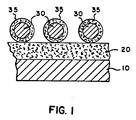
- the gel-grafted polymer particles are utilized as a matting agent on the outermost surface of a photographic element, as shown in FIG. 1.
- a support 10 having thereon a gelatin-containing layer 20, which may be, for example, a silver halide emulsion layer.
- Polymer particles 30 having gelatin 35 covalently bonded thereto are positioned on top of layer 20. The gelatin 35 is cross-linked with the gelatin in layer 20.
- a photographic element such as the one described in FIG. 1 is prepared by coating the gelatin-containing layer onto a support, at least partically drying the layer, applying the gel-grafted polymer particles to the surface of the layer, and hardening the gelatin in the layer so as to cause cross-linking between the gelatin in the layer and the gelatin covalently bonded to the polymer particles.
- the gelatin-containing layer and other layers in the element may be coated by any of the known coating methods, such as curtain coating, roller coating, bead coating, doctor blade coating, gravure coating, reverse gravure coating.
- the layer is generally dried by simple evaporation, which may be accelerated by known techniques such as convection heating.
- Known coating and drying methods are described in more detail in the above-referenced Research Disclosure 17643.
- the polymer particles can be applied by a variety of methods, such as with an air jet or simply dropped onto the surface of the gelatin-containing layer.
- the gelatin-containing layer may have been dried sufficiently to prevent invasion of the emulsion layer by the particles during subsequent drying, but left still somewhat tacky so as to prevent the particles from being dislocated before the gelatin covalently bonded to them cross-links with the gelatin in the layer.
- a preferred method of applying the polymer particles to the gelatin-containing layer is to coat a dispersion of the particles in a liquid medium such as an organic solvent or water, which may optionally contain a small amount of gelatin (e.g., on the order of the same weight concentration as the polymer particles, preferably less than 25%, based on total weight of the dispersion), onto the gelatin-containing layer.
- a coating dispersion would generally have a weight ratio of polymer particles to liquid of between 1:99 and 5:95.
- the cross-linking of the gelatin in that gelatin-containing layer and the gelatin that is covalently bound to the polymer particles may be carried out with any of the compounds known to cross-link, or harden, gelatin. These include, for example, free dialdehydes such as succinaldehyde, blocked dialdehydes, sulfonate esters, active esters, epoxides, aziridines, blocked active olefins, carbodiimides, carbamoylpyridiniums, vinyl sulfones, polymeric hardeners such as dialdehyde starches or poly(acrolein-methacrylic acid), and many others.
- the cross-linking is generally carried out by simply applying solutions of these hardeners to the photographic element.
- the cross-linking compound can be applied to either the particles or the gelatin-containing layer before the particles are contacted with the layer if such contacting is done while there is still enough residual cross-linking compound present to cross-link the gelatin in the layer to the gelatin on the particles when they are brought into contact.
- the cross-linking compound can be applied after the particles are brought into contact with the gelatin-containing layer. Further disclosure of cross-linking hardeners is given in the above-referenced Research Disclosure 17643.
- Photographic elements in which the particles of the invention can be utilized generally comprise at least one light-sensitive layer, such as a silver halide emulsion layer.
- This layer may be sensitized to a particular spectrum of radiation with, for example, a sensitizing dye, as is known in the art.
- Additional light-sensitive layers may be sensitized to other portions of the spectrum.
- the light sensitive layers may contain or have associated therewith dye-forming compounds or couplers. For example, a red-sensitive emulsion would generally have a cyan coupler associated therewith, a green-sensitive emulsion would be associated with a magenta coupler, and a blue-sensitive emulsion would be associated with a yellow coupler.
- Step 2 Covalent binding of gelatin to the particles
- the suspension from step 1 was placed in a 12 liter three-neck flask fitted with an air-driven stirrer and a condenser. The suspension was heated to 60°C and the pH was adjusted to 8.0. Lime-processed bone gelatin (745 g dry weight) was added to 2683 g of distilled water and heated to 60°C to cause dissolution. The pH of the gelatin solution was adjusted to 8.0, the solution was added to the flask containing the suspension, and the mixture was stirred for 2 hours to yield a suspension of gel-grafted polymer particles.
- Example 2 Preparation of a photographic element having gel-grafted polymer particles as a matting agent.
- a silver chlorobromide emulsion was coated onto a poly(ethylene terephthalate) support.
- the components of the emulsion were as follows: lime-processed bone gelatin 2.69 g/m2 silver halide 3.34 g/m2 polymer latex as described in U.S. Patent 3,411,911 0.70 g/m2
- an overcoat layer containing 0.48 g/m2 of gelatin was coated over the emulsion layer.
- the coating was hardened using formaldehyde at a concentration of 2.5 weight percent based on the total weight of gelatin in the coating, then chill set and dried.
- the coating was then overcoated using reverse gravure roller coating with an aqueous solution of the particles prepared in Example 1 having a mean diameter of 2 ⁇ m at coverages as described in Table I below.
- elements 2a-2d and 3 were prepared as above except that the final overcoat contained either poly(styrene-co-methacrylic acid-co-divinylbenzene) (39:50:11) beads with no gelatin covalently bonded thereto having a mean diameter of 6 ⁇ m for element 2, or with no matte coating at all for element 3.
- element 4 was prepared as above, but with poly(methyl methacrylate) beads with no gelatin bonded thereto having a mean diameter of 3.5 ⁇ m and with the chill setting and drying occurring after simultaneous coating of the emulsion layer and the bead-containing layer.
- the starry night effect for each element was determined by a visual inspection of areas of the processed element having the highest image density. A starry night rating was then assigned based on the number of light spots observed. The starry night rating is based on an arbitrary scale of 1 to 8 with 1 representing no spots observed, 8 representing a large number of spots, and 5 representing a marginally acceptable rating for typical graphic arts photographic films. The results are shown below in Table I.
- photographic elements such as element 1, having polymer particles of the invention as matting agents offer significantly improved matting agent adhesion, as evidenced by short vacuum draw-down times for processed film, as compared to elements having a polymer particle matting agent with no gelatin covalently bonded thereto that is coated onto a chill set and dried emulsion layer such as elements 2 and 3.
- the elements having polymer particles of the invention as matting agents offer significantly improved starry night performance over elements such as element 4 having a polymer particle matting agent with no gelatin covalently bonded thereto that is simultaneously coated with a wet emulsion layer.
- the resulting emulsion was placed in a reaction vessel, which was sealed.
- the emulsion was heated to 50°C while being stirred at 80 rpm and held at that temperature for approximately 20 hours.
- the mixture was then heated to 75°C and held at that temperature for 3 hours, cooled to room temperature, and filtered through a double layer of cheese cloth.
- the polymer particles were then filtered out of the dispersion using a Buchner funnel with 230 grade filter paper and redispersed in a solution of 11.5 kg distilled water, 1200 g 50% sodium hydroxide, and 8.34 g sodium dodecyl sulfate, and stirred vigorously for 15 minutes.
- the polymer particles were filtered out using the same filter apparatus, redispersed in a solution of 11.66 kg distilled water and 600 g 50% sodium hydroxide, filtered out again, and washed with distilled water.
- the polymer particles had a mean diameter of 6.4 ⁇ m.
- Step 2 Covalent binding of gelatin to the particles
- a gelatin solution was prepared by dissolving 1099 g of lime-processed bone gelatin in 6.9 kg of distilled water. 67 g of 2N sodium hydroxide was added to the solution, which was then filtered. The particles of step 1 were dispersed in distilled water at a pH of between 8 and 9 to yield 1035 g of a dispersion with a solids content of 29 weight percent. This dispersion was diluted with 1 kg distilled water and the pH adjusted to between 8 and 9 with 2N sodium hydroxide. The dispersion was stirred and heated to 60°C, and 10.4 g of 1-(4-morpholinocarbonyl)-4-(2-sulfoethyl) pyridinium hydroxide, inner salt was added.
- the mixture was stirred for 15 minutes, then 2343 g of the above-described gelatin solution heated to 60°C was added. After 20 minutes of stirring, essentially all the gelatin had covalently bonded to the particles (weight ratio of polymer to gelatin of 1:1, mean diameter of 6.9 ⁇ m).
- Two additional sets of gel-grafted polymer particles were prepared in the same manner as those above, except that the weight ratios of polymer particles to gelatin were 2:1 (prepared using 1172 g of gelatin solution, mean diameter of 6.8 ⁇ m) and 2:3 (prepared using 3516 g of gelatin solution, mean diameter of 6.6 ⁇ m), respectively.
- Example 4 Preparation of photographic elements having gel-grafted polymer particles as a grafting agent
- Example 2 A series of photographic elements were prepared as in Example 2. Element 5 was overcoated with an aqueous solution of 1.0% by weight of the 1:1 polymer:gelatin particles from Step 2 and 1.0% by weight of gelatin. Element 6 was overcoated with an aqueous solution of 1.0% by weight of the 2:1 polymer:gelatin particles from Step 2 and 0.5% by weight of gelatin. Element 7 was overcoated with an aqueous solution of 1.0% by weight of 2:3 polymer:gelatin particles from Step 2 and 1.5% by weight of gelatin. For comparison, element 8 was overcoated with an aqueous solution of 1.0% by weight of polymer particles from Example 3 and 1.5% by weight of gelatin.
- element 9 was overcoated with an aqueous solution of 1.0% by weight of polymer particles from Example 3 and 3.0% by weight of gelatin.
- the final comparison element, 10, was overcoated with an aqueous solution of 9.1% by weight lime-processed bone gelatin and 0.4% by weight of poly(methyl methacrylate) particles having no gelatin bonded thereto.
- Example 2 The elements exposed and processed as in Example 2. Vacuum draw-down time and starry night rating were determined before and after processing as in Example 2. In addition to the vacuum draw-down time, the adhesion of the matting agent was also determined by measuring the surface roughness and the maximum peak excursion and average peak height on the surface of the element. These measurements were made with a Gould Micro-Topographer 200. Higher numbers for these measurements show that the presence of matting agent is causing surface roughness and high peaks on the surface of the element. The results are shown in Table II.
- the elements having polymer particle matting agents of the invention exhibit greater adhesion than prior art elements having matting agent with no gelatin covalently bonded thereto that is coated onto a chill set and dried emulsion layer. They show improved starry night performance over elements having matting agent with no gelatin covalently bonded thereto that is coated onto a wet emulsion layer.
- Methyl methacrylate (380 g), methacrylic acid (20 g), di(2-ethylhexyl) sulfosuccinate, sodium salt (5 g), lauroyl peroxide (5 g), and distilled water (800 g) were blended together for 90 seconds. The mixture was deoxygenated with a nitrogen purge and maintained at 62°C for 20 hours while stirring at 100 rpm. The resulting dispersion of polymer particles was determined to have a solids content of 33.2% by weight.
- Step 2 Covalent binding of gelatin to the particles
- 1140 g of the aqueous dispersion from Step 1 was adjusted to a pH of 8.0 with sodium hydroxide, headed to 60°C while being stirred.
- 1-(4-morpholino carbonyl)-4-(2-sulfoethyl) pyridinium hydroxide, inner salt (13.2 g) dissolved in 200 g distilled water was then added to the dispersion and stirred for 15 minutes.
- 1514 g of a 12.5 weight percent solution of lime-processed bone gelatin at 60°C was added and stirred for 15 minutes.
- the dispersion was then filtered through a course screen, and found to have a solids content of 19.2% by weight.
- the mean particle diameter was found to be 5.5 ⁇ m, with a polymer:gelatin weight ratio of 2:1.
- Example 6 Preparation of photographic elements having gel-grafted polymer particles as a grafting agent.
- Photographic elements were prepared as described in Example 2.
- Element 11 was overcoated with an aqueous solution of 1.0% by weight of gel-grafted particles from Step 2 and 0.5% by weight of gelatin.
- Element 12 was overcoated with an aqueous solution of 1.0% by weight of gel-grafted particles from Step 2 and 1.5% by weight of gelatin.
- Element 13 was overcoated with an aqueous solution of 1.0% by weight of gel-grafted particles from Step 2 and 3.0% by weight of gelatin.
Landscapes
- Chemical & Material Sciences (AREA)
- Engineering & Computer Science (AREA)
- Materials Engineering (AREA)
- Physics & Mathematics (AREA)
- General Physics & Mathematics (AREA)
- Ink Jet Recording Methods And Recording Media Thereof (AREA)
- Compositions Of Macromolecular Compounds (AREA)
- Processes Of Treating Macromolecular Substances (AREA)
- Coating Of Shaped Articles Made Of Macromolecular Substances (AREA)
Applications Claiming Priority (2)
| Application Number | Priority Date | Filing Date | Title |
|---|---|---|---|
| US9824587A | 1987-09-18 | 1987-09-18 | |
| US98245 | 1987-09-18 |
Publications (3)
| Publication Number | Publication Date |
|---|---|
| EP0307855A2 EP0307855A2 (en) | 1989-03-22 |
| EP0307855A3 EP0307855A3 (en) | 1990-01-17 |
| EP0307855B1 true EP0307855B1 (en) | 1993-07-14 |
Family
ID=22268319
Family Applications (1)
| Application Number | Title | Priority Date | Filing Date |
|---|---|---|---|
| EP88114939A Expired - Lifetime EP0307855B1 (en) | 1987-09-18 | 1988-09-13 | Gelatin-grafted polymer particles |
Country Status (4)
| Country | Link |
|---|---|
| US (1) | US4920004A (enExample) |
| EP (1) | EP0307855B1 (enExample) |
| JP (1) | JP2831003B2 (enExample) |
| DE (1) | DE3882310T2 (enExample) |
Families Citing this family (25)
| Publication number | Priority date | Publication date | Assignee | Title |
|---|---|---|---|---|
| DE3700551A1 (de) * | 1987-01-10 | 1988-08-04 | Du Pont Deutschland | Mattierte photographische aufzeichnungsmaterialien |
| US5055379A (en) * | 1990-03-19 | 1991-10-08 | Eastman Kodak Company | Photoresist dichromate composition containing gelatin coated particles |
| US5066572A (en) * | 1990-03-22 | 1991-11-19 | Eastman Kodak Company | Control of pressure-fog with gelatin-grafted and case-hardened gelatin-grafted soft polymer latex particles |
| US5248558A (en) * | 1990-03-22 | 1993-09-28 | Eastman Kodak Company | Case-hardened gelatin-grafted polymer particles |
| US5026632A (en) * | 1990-03-22 | 1991-06-25 | Eastman Kodak Company | Use of gelatin-grafted and case-hardened gelatin-grafted polymer particles for relief from pressure sensitivity of photographic products |
| JP2981926B2 (ja) | 1991-02-13 | 1999-11-22 | コニカ株式会社 | ハロゲン化銀写真感光材料 |
| US5213934A (en) * | 1991-01-07 | 1993-05-25 | Xerox Corporation | Microcapsule toner compositions |
| EP0520394B1 (en) * | 1991-06-25 | 1997-10-01 | EASTMAN KODAK COMPANY (a New Jersey corporation) | Photographic element containing stress absorbing intermediate layer |
| EP0520393B1 (en) * | 1991-06-25 | 1996-11-27 | EASTMAN KODAK COMPANY (a New Jersey corporation) | Photographic element containing stress absorbing protective layer |
| US5380637A (en) * | 1992-10-20 | 1995-01-10 | Fuji Photo Film Co., Ltd. | Silver halide photographic material |
| US5300411A (en) * | 1992-10-30 | 1994-04-05 | Eastman Kodak Company | Photographic light-sensitive elements |
| US5610002A (en) * | 1992-11-12 | 1997-03-11 | Eastman Kodak Company | Photographic composition containing a thickening agent |
| US5441865A (en) * | 1993-01-07 | 1995-08-15 | Eastman Kodak Company | Gelatin-grafted-polymer particles as peptizer for silver halide emulsions |
| US5279934A (en) * | 1993-06-09 | 1994-01-18 | Eastman Kodak Company | Photographic light-sensitive elements |
| US5426020A (en) * | 1993-08-31 | 1995-06-20 | Eastman Kodak Company | Pressure sensitivity relief for photographic products |
| US5399480A (en) * | 1993-09-14 | 1995-03-21 | Eastman Kodak Company | Attachment of gelatin-grafted polymer particles to pre-precipitated silver halide grains |
| US5395748A (en) * | 1993-12-08 | 1995-03-07 | Eastman Kodak Company | Ballasted optical brighteners |
| DE19716350A1 (de) * | 1997-04-18 | 1998-10-22 | Wacker Chemie Gmbh | Redispergierbare Pulverzusammensetzungen zur Herstellung von fotografischen Aufzeichnungsmateralien |
| EP0992845A1 (en) * | 1998-10-08 | 2000-04-12 | Agfa-Gevaert N.V. | Light-sensitive silver halide material providing improved surface characteristics after processing |
| US6218094B1 (en) | 1998-10-08 | 2001-04-17 | Agfa-Gevaert | Light-sensitive silver halide material providing improved surface characteristics after processing |
| DE29900874U1 (de) | 1999-01-20 | 1999-07-22 | Knoll AG, 67061 Ludwigshafen | Organprotektive Lösungen |
| GB0028268D0 (en) * | 2000-11-20 | 2001-01-03 | Norske Stats Oljeselskap | Well treatment |
| FR2836066B1 (fr) * | 2002-02-21 | 2004-11-26 | Centre Nat Rech Scient | Chaines colloidales irreversibles porteuses de sites de reconnaissance, leur procede de preparation et application a des fins de detection d'especes |
| JP6687184B2 (ja) | 2015-09-15 | 2020-04-22 | エルジー・ケム・リミテッド | 偏光子保護フィルム、これを含む偏光板、および前記偏光板を含む液晶ディスプレイ装置 |
| WO2017048079A1 (ko) * | 2015-09-15 | 2017-03-23 | 주식회사 엘지화학 | 편광자 보호필름, 이를 포함하는 편광판 및 상기 편광판을 포함하는 액정 디스플레이 장치 |
Citations (1)
| Publication number | Priority date | Publication date | Assignee | Title |
|---|---|---|---|---|
| EP0307856A2 (en) * | 1987-09-18 | 1989-03-22 | EASTMAN KODAK COMPANY (a New Jersey corporation) | Photographic element having polymer particles covalently bonded to gelatin |
Family Cites Families (14)
| Publication number | Priority date | Publication date | Assignee | Title |
|---|---|---|---|---|
| BE544350A (enExample) * | 1955-01-17 | |||
| US3287289A (en) * | 1962-06-11 | 1966-11-22 | Eastman Kodak Co | Plasticizers for radiation sensitive systems |
| FR1556218A (enExample) * | 1966-08-03 | 1969-02-07 | ||
| US3853987A (en) * | 1971-09-01 | 1974-12-10 | W Dreyer | Immunological reagent and radioimmuno assay |
| US3767448A (en) * | 1971-11-29 | 1973-10-23 | Eastman Kodak Co | Photographic process |
| US4070296A (en) * | 1974-08-26 | 1978-01-24 | Xerox Corporation | Triboelectrically controlled covalently dyed toner materials |
| US4161407A (en) * | 1977-10-06 | 1979-07-17 | Eastman Kodak Company | Crosslinkable polymers having vinylsulfonyl groups or styrylsulfonyl groups and their use as hardeners for gelatin |
| DE2800466C3 (de) * | 1978-01-05 | 1981-12-03 | Agfa-Gevaert Ag, 5090 Leverkusen | Photographisches Material |
| US4172731A (en) * | 1978-04-03 | 1979-10-30 | Eastman Kodak Company | Photographic element containing a light absorbing matting agent |
| US4328301A (en) * | 1979-10-12 | 1982-05-04 | Ciba-Geigy Ag | Stripping layers in diffusion transfer film |
| JPS5714835A (en) * | 1980-07-01 | 1982-01-26 | Fuji Photo Film Co Ltd | Photographic sensitive silver halide material |
| DE3265276D1 (en) * | 1981-11-23 | 1985-09-12 | Agfa Gevaert Nv | Method for the preparation of stable aqueous dispersions of polymer beads and the use of these dispersions in photographic elements |
| JPS60133443A (ja) * | 1983-12-21 | 1985-07-16 | Konishiroku Photo Ind Co Ltd | ハロゲン化銀写真感光材料 |
| JPH0642052B2 (ja) * | 1985-07-16 | 1994-06-01 | コニカ株式会社 | 写真感光材料 |
-
1988
- 1988-09-13 DE DE88114939T patent/DE3882310T2/de not_active Expired - Fee Related
- 1988-09-13 EP EP88114939A patent/EP0307855B1/en not_active Expired - Lifetime
- 1988-09-17 JP JP63231518A patent/JP2831003B2/ja not_active Expired - Fee Related
-
1989
- 1989-02-07 US US07/307,393 patent/US4920004A/en not_active Expired - Lifetime
Patent Citations (1)
| Publication number | Priority date | Publication date | Assignee | Title |
|---|---|---|---|---|
| EP0307856A2 (en) * | 1987-09-18 | 1989-03-22 | EASTMAN KODAK COMPANY (a New Jersey corporation) | Photographic element having polymer particles covalently bonded to gelatin |
Also Published As
| Publication number | Publication date |
|---|---|
| US4920004A (en) | 1990-04-24 |
| EP0307855A2 (en) | 1989-03-22 |
| EP0307855A3 (en) | 1990-01-17 |
| DE3882310T2 (de) | 1994-01-27 |
| JPH01158427A (ja) | 1989-06-21 |
| JP2831003B2 (ja) | 1998-12-02 |
| DE3882310D1 (de) | 1993-08-19 |
Similar Documents
| Publication | Publication Date | Title |
|---|---|---|
| EP0307856B1 (en) | Photographic element having polymer particles covalently bonded to gelatin | |
| US4920004A (en) | Gelatin-grafted polymer particles | |
| EP0476102B1 (en) | Control of pressure-fog with gelatin-grafted and case-hardened gelatin-grafted soft polymer latex particles | |
| EP0520393A1 (en) | Photographic element containing stress absorbing protective layer | |
| EP0729063B1 (en) | Photographic element and photographic film base therefore | |
| EP0114868B1 (en) | Vinyl acetate copolymers, latex compositions containing same and their use | |
| US4396709A (en) | Method of improving adhesion resistance of silver halide photographic light-sensitive medium for use in printing | |
| US4544723A (en) | Vinyl acetate polymers and latex compositions containing same | |
| US6165702A (en) | Imaging element containing polymer particles and lubricant | |
| EP0595275B1 (en) | Photographic light-sensitive elements | |
| JP2000338626A (ja) | 写真要素用の耐引掻ききず性、耐水性オーバーコート | |
| US5550011A (en) | Photographic elements containing matte particles of bimodal size distribution | |
| EP0640871B1 (en) | Pressure sensitivity relief for photographic products | |
| JPH0915791A (ja) | 画像形成要素 | |
| US4940655A (en) | Photographic antistatic element having a backing layer with improved adhesion and antistatic properties | |
| US5128233A (en) | Element having improved adhesion of auxiliary layers to film supports containing antistatic layers | |
| EP0353626B1 (en) | Stripping layers for imaging elements | |
| EP1050780B1 (en) | Photographic element with a layer improving the adhesion to the support | |
| JPH10171066A (ja) | 画像形成要素 | |
| EP0749039B1 (en) | A method of forming an imaging element comprising an auxiliary layer containing solvent- dispersible polymer particles | |
| JP2547536B2 (ja) | 写真感光材料 | |
| JPH06258762A (ja) | ハロゲン化銀写真感光材料 | |
| JPS61285446A (ja) | ハロゲン化銀写真感光材料 | |
| EP0439181A2 (en) | Element having improved adhesion of auxiliary layers to film supports containing antistatic layers | |
| JPH0554100B2 (enExample) |
Legal Events
| Date | Code | Title | Description |
|---|---|---|---|
| PUAI | Public reference made under article 153(3) epc to a published international application that has entered the european phase |
Free format text: ORIGINAL CODE: 0009012 |
|
| AK | Designated contracting states |
Kind code of ref document: A2 Designated state(s): CH DE FR GB LI NL |
|
| PUAL | Search report despatched |
Free format text: ORIGINAL CODE: 0009013 |
|
| AK | Designated contracting states |
Kind code of ref document: A3 Designated state(s): CH DE FR GB LI NL |
|
| 17P | Request for examination filed |
Effective date: 19900112 |
|
| 17Q | First examination report despatched |
Effective date: 19920116 |
|
| GRAA | (expected) grant |
Free format text: ORIGINAL CODE: 0009210 |
|
| AK | Designated contracting states |
Kind code of ref document: B1 Designated state(s): CH DE FR GB LI NL |
|
| REF | Corresponds to: |
Ref document number: 3882310 Country of ref document: DE Date of ref document: 19930819 |
|
| ET | Fr: translation filed | ||
| PLBE | No opposition filed within time limit |
Free format text: ORIGINAL CODE: 0009261 |
|
| STAA | Information on the status of an ep patent application or granted ep patent |
Free format text: STATUS: NO OPPOSITION FILED WITHIN TIME LIMIT |
|
| 26N | No opposition filed | ||
| PGFP | Annual fee paid to national office [announced via postgrant information from national office to epo] |
Ref country code: CH Payment date: 19950913 Year of fee payment: 8 |
|
| PGFP | Annual fee paid to national office [announced via postgrant information from national office to epo] |
Ref country code: NL Payment date: 19950929 Year of fee payment: 8 |
|
| PG25 | Lapsed in a contracting state [announced via postgrant information from national office to epo] |
Ref country code: LI Effective date: 19960930 Ref country code: CH Effective date: 19960930 |
|
| PG25 | Lapsed in a contracting state [announced via postgrant information from national office to epo] |
Ref country code: NL Effective date: 19970401 |
|
| REG | Reference to a national code |
Ref country code: CH Ref legal event code: PL |
|
| NLV4 | Nl: lapsed or anulled due to non-payment of the annual fee |
Effective date: 19970401 |
|
| REG | Reference to a national code |
Ref country code: GB Ref legal event code: IF02 |
|
| PGFP | Annual fee paid to national office [announced via postgrant information from national office to epo] |
Ref country code: GB Payment date: 20040812 Year of fee payment: 17 |
|
| PGFP | Annual fee paid to national office [announced via postgrant information from national office to epo] |
Ref country code: FR Payment date: 20040902 Year of fee payment: 17 |
|
| PGFP | Annual fee paid to national office [announced via postgrant information from national office to epo] |
Ref country code: DE Payment date: 20040930 Year of fee payment: 17 |
|
| PG25 | Lapsed in a contracting state [announced via postgrant information from national office to epo] |
Ref country code: GB Free format text: LAPSE BECAUSE OF NON-PAYMENT OF DUE FEES Effective date: 20050913 |
|
| PG25 | Lapsed in a contracting state [announced via postgrant information from national office to epo] |
Ref country code: DE Free format text: LAPSE BECAUSE OF NON-PAYMENT OF DUE FEES Effective date: 20060401 |
|
| GBPC | Gb: european patent ceased through non-payment of renewal fee |
Effective date: 20050913 |
|
| PG25 | Lapsed in a contracting state [announced via postgrant information from national office to epo] |
Ref country code: FR Free format text: LAPSE BECAUSE OF NON-PAYMENT OF DUE FEES Effective date: 20060531 |
|
| REG | Reference to a national code |
Ref country code: FR Ref legal event code: ST Effective date: 20060531 |