EP0304886B1 - Oligomere Benzilketale und ihre Verwendung als Photoinitiatoren - Google Patents
Oligomere Benzilketale und ihre Verwendung als Photoinitiatoren Download PDFInfo
- Publication number
- EP0304886B1 EP0304886B1 EP88113779A EP88113779A EP0304886B1 EP 0304886 B1 EP0304886 B1 EP 0304886B1 EP 88113779 A EP88113779 A EP 88113779A EP 88113779 A EP88113779 A EP 88113779A EP 0304886 B1 EP0304886 B1 EP 0304886B1
- Authority
- EP
- European Patent Office
- Prior art keywords
- phenyl
- radical
- formula
- compounds
- ch2ch2
- Prior art date
- Legal status (The legal status is an assumption and is not a legal conclusion. Google has not performed a legal analysis and makes no representation as to the accuracy of the status listed.)
- Expired - Lifetime
Links
- WURBFLDFSFBTLW-UHFFFAOYSA-N benzil Chemical compound C=1C=CC=CC=1C(=O)C(=O)C1=CC=CC=C1 WURBFLDFSFBTLW-UHFFFAOYSA-N 0.000 title description 7
- -1 cyano, hydroxyl Chemical group 0.000 claims description 38
- 150000001875 compounds Chemical class 0.000 claims description 36
- 239000000203 mixture Substances 0.000 claims description 35
- 125000001997 phenyl group Chemical group [H]C1=C([H])C([H])=C(*)C([H])=C1[H] 0.000 claims description 32
- 125000002496 methyl group Chemical group [H]C([H])([H])* 0.000 claims description 20
- 125000004178 (C1-C4) alkyl group Chemical group 0.000 claims description 15
- 238000006243 chemical reaction Methods 0.000 claims description 12
- 125000002887 hydroxy group Chemical group [H]O* 0.000 claims description 10
- 238000000034 method Methods 0.000 claims description 10
- 125000004432 carbon atom Chemical group C* 0.000 claims description 9
- 125000000113 cyclohexyl group Chemical group [H]C1([H])C([H])([H])C([H])([H])C([H])(*)C([H])([H])C1([H])[H] 0.000 claims description 9
- 229910052736 halogen Chemical group 0.000 claims description 9
- 150000002367 halogens Chemical group 0.000 claims description 8
- 230000008569 process Effects 0.000 claims description 8
- 125000000229 (C1-C4)alkoxy group Chemical group 0.000 claims description 7
- 125000001797 benzyl group Chemical group [H]C1=C([H])C([H])=C(C([H])=C1[H])C([H])([H])* 0.000 claims description 7
- 229910052739 hydrogen Inorganic materials 0.000 claims description 7
- 125000003944 tolyl group Chemical group 0.000 claims description 7
- 125000003118 aryl group Chemical group 0.000 claims description 6
- 238000002360 preparation method Methods 0.000 claims description 6
- 125000003236 benzoyl group Chemical group [H]C1=C([H])C([H])=C(C([H])=C1[H])C(*)=O 0.000 claims description 5
- 125000001495 ethyl group Chemical group [H]C([H])([H])C([H])([H])* 0.000 claims description 5
- 125000000951 phenoxy group Chemical group [H]C1=C([H])C([H])=C(O*)C([H])=C1[H] 0.000 claims description 5
- 125000000068 chlorophenyl group Chemical group 0.000 claims description 4
- 125000000623 heterocyclic group Chemical group 0.000 claims description 4
- 239000001257 hydrogen Substances 0.000 claims description 4
- 125000004642 (C1-C12) alkoxy group Chemical group 0.000 claims description 3
- 125000002777 acetyl group Chemical group [H]C([H])([H])C(*)=O 0.000 claims description 3
- 125000001231 benzoyloxy group Chemical group C(C1=CC=CC=C1)(=O)O* 0.000 claims description 3
- 125000002837 carbocyclic group Chemical group 0.000 claims description 3
- 125000005425 toluyl group Chemical group 0.000 claims description 3
- 229910003849 O-Si Inorganic materials 0.000 claims description 2
- 229910003872 O—Si Inorganic materials 0.000 claims description 2
- 125000004799 bromophenyl group Chemical group 0.000 claims description 2
- 125000004573 morpholin-4-yl group Chemical group N1(CCOCC1)* 0.000 claims description 2
- 125000000587 piperidin-1-yl group Chemical group [H]C1([H])N(*)C([H])([H])C([H])([H])C([H])([H])C1([H])[H] 0.000 claims description 2
- 125000004435 hydrogen atom Chemical group [H]* 0.000 claims 2
- 239000003377 acid catalyst Substances 0.000 claims 1
- 229920001855 polyketal Polymers 0.000 description 13
- 150000002009 diols Chemical class 0.000 description 12
- 150000003254 radicals Chemical class 0.000 description 11
- ZIBGPFATKBEMQZ-UHFFFAOYSA-N triethylene glycol Chemical compound OCCOCCOCCO ZIBGPFATKBEMQZ-UHFFFAOYSA-N 0.000 description 10
- 229920001451 polypropylene glycol Polymers 0.000 description 9
- 239000000047 product Substances 0.000 description 9
- VEXZGXHMUGYJMC-UHFFFAOYSA-M Chloride anion Chemical compound [Cl-] VEXZGXHMUGYJMC-UHFFFAOYSA-M 0.000 description 8
- OKKJLVBELUTLKV-UHFFFAOYSA-N Methanol Chemical compound OC OKKJLVBELUTLKV-UHFFFAOYSA-N 0.000 description 6
- 150000001252 acrylic acid derivatives Chemical class 0.000 description 6
- 238000000576 coating method Methods 0.000 description 6
- 239000003999 initiator Substances 0.000 description 6
- 239000010410 layer Substances 0.000 description 6
- 238000004519 manufacturing process Methods 0.000 description 6
- 239000002904 solvent Substances 0.000 description 6
- 239000000758 substrate Substances 0.000 description 6
- KWVGIHKZDCUPEU-UHFFFAOYSA-N 2,2-dimethoxy-2-phenylacetophenone Chemical compound C=1C=CC=CC=1C(OC)(OC)C(=O)C1=CC=CC=C1 KWVGIHKZDCUPEU-UHFFFAOYSA-N 0.000 description 5
- PPBRXRYQALVLMV-UHFFFAOYSA-N Styrene Chemical compound C=CC1=CC=CC=C1 PPBRXRYQALVLMV-UHFFFAOYSA-N 0.000 description 5
- MTHSVFCYNBDYFN-UHFFFAOYSA-N diethylene glycol Chemical compound OCCOCCO MTHSVFCYNBDYFN-UHFFFAOYSA-N 0.000 description 5
- 229910052757 nitrogen Inorganic materials 0.000 description 5
- 125000000954 2-hydroxyethyl group Chemical group [H]C([*])([H])C([H])([H])O[H] 0.000 description 4
- QIGBRXMKCJKVMJ-UHFFFAOYSA-N Hydroquinone Chemical compound OC1=CC=C(O)C=C1 QIGBRXMKCJKVMJ-UHFFFAOYSA-N 0.000 description 4
- 239000002253 acid Substances 0.000 description 4
- 239000000654 additive Substances 0.000 description 4
- IISBACLAFKSPIT-UHFFFAOYSA-N bisphenol A Chemical compound C=1C=C(O)C=CC=1C(C)(C)C1=CC=C(O)C=C1 IISBACLAFKSPIT-UHFFFAOYSA-N 0.000 description 4
- WERYXYBDKMZEQL-UHFFFAOYSA-N butane-1,4-diol Chemical compound OCCCCO WERYXYBDKMZEQL-UHFFFAOYSA-N 0.000 description 4
- 239000003795 chemical substances by application Substances 0.000 description 4
- 238000001723 curing Methods 0.000 description 4
- 229910052751 metal Inorganic materials 0.000 description 4
- 239000002184 metal Substances 0.000 description 4
- CRVGTESFCCXCTH-UHFFFAOYSA-N methyl diethanolamine Chemical compound OCCN(C)CCO CRVGTESFCCXCTH-UHFFFAOYSA-N 0.000 description 4
- 238000000016 photochemical curing Methods 0.000 description 4
- 238000007639 printing Methods 0.000 description 4
- 230000005855 radiation Effects 0.000 description 4
- XLYOFNOQVPJJNP-UHFFFAOYSA-N water Substances O XLYOFNOQVPJJNP-UHFFFAOYSA-N 0.000 description 4
- BPXVHIRIPLPOPT-UHFFFAOYSA-N 1,3,5-tris(2-hydroxyethyl)-1,3,5-triazinane-2,4,6-trione Chemical compound OCCN1C(=O)N(CCO)C(=O)N(CCO)C1=O BPXVHIRIPLPOPT-UHFFFAOYSA-N 0.000 description 3
- UHOVQNZJYSORNB-UHFFFAOYSA-N Benzene Chemical compound C1=CC=CC=C1 UHOVQNZJYSORNB-UHFFFAOYSA-N 0.000 description 3
- OKTJSMMVPCPJKN-UHFFFAOYSA-N Carbon Chemical compound [C] OKTJSMMVPCPJKN-UHFFFAOYSA-N 0.000 description 3
- PEDCQBHIVMGVHV-UHFFFAOYSA-N Glycerine Chemical compound OCC(O)CO PEDCQBHIVMGVHV-UHFFFAOYSA-N 0.000 description 3
- YXFVVABEGXRONW-UHFFFAOYSA-N Toluene Chemical compound CC1=CC=CC=C1 YXFVVABEGXRONW-UHFFFAOYSA-N 0.000 description 3
- GSEJCLTVZPLZKY-UHFFFAOYSA-N Triethanolamine Chemical compound OCCN(CCO)CCO GSEJCLTVZPLZKY-UHFFFAOYSA-N 0.000 description 3
- ZMANZCXQSJIPKH-UHFFFAOYSA-N Triethylamine Chemical compound CCN(CC)CC ZMANZCXQSJIPKH-UHFFFAOYSA-N 0.000 description 3
- 239000007983 Tris buffer Substances 0.000 description 3
- YIMQCDZDWXUDCA-UHFFFAOYSA-N [4-(hydroxymethyl)cyclohexyl]methanol Chemical compound OCC1CCC(CO)CC1 YIMQCDZDWXUDCA-UHFFFAOYSA-N 0.000 description 3
- 150000007513 acids Chemical class 0.000 description 3
- 150000003926 acrylamides Chemical class 0.000 description 3
- 239000011248 coating agent Substances 0.000 description 3
- 125000004386 diacrylate group Chemical group 0.000 description 3
- 238000010438 heat treatment Methods 0.000 description 3
- 239000000976 ink Substances 0.000 description 3
- 229920000647 polyepoxide Polymers 0.000 description 3
- 229920000728 polyester Polymers 0.000 description 3
- 229920000642 polymer Polymers 0.000 description 3
- 230000009257 reactivity Effects 0.000 description 3
- 229920005989 resin Polymers 0.000 description 3
- 239000011347 resin Substances 0.000 description 3
- 230000035943 smell Effects 0.000 description 3
- 239000000243 solution Substances 0.000 description 3
- VZCYOOQTPOCHFL-UHFFFAOYSA-N trans-butenedioic acid Natural products OC(=O)C=CC(O)=O VZCYOOQTPOCHFL-UHFFFAOYSA-N 0.000 description 3
- 150000004072 triols Chemical class 0.000 description 3
- 125000006702 (C1-C18) alkyl group Chemical group 0.000 description 2
- MYRTYDVEIRVNKP-UHFFFAOYSA-N 1,2-Divinylbenzene Chemical compound C=CC1=CC=CC=C1C=C MYRTYDVEIRVNKP-UHFFFAOYSA-N 0.000 description 2
- DSLRVRBSNLHVBH-UHFFFAOYSA-N 2,5-furandimethanol Chemical compound OCC1=CC=C(CO)O1 DSLRVRBSNLHVBH-UHFFFAOYSA-N 0.000 description 2
- XFCMNSHQOZQILR-UHFFFAOYSA-N 2-[2-(2-methylprop-2-enoyloxy)ethoxy]ethyl 2-methylprop-2-enoate Chemical compound CC(=C)C(=O)OCCOCCOC(=O)C(C)=C XFCMNSHQOZQILR-UHFFFAOYSA-N 0.000 description 2
- INQDDHNZXOAFFD-UHFFFAOYSA-N 2-[2-(2-prop-2-enoyloxyethoxy)ethoxy]ethyl prop-2-enoate Chemical compound C=CC(=O)OCCOCCOCCOC(=O)C=C INQDDHNZXOAFFD-UHFFFAOYSA-N 0.000 description 2
- KUDUQBURMYMBIJ-UHFFFAOYSA-N 2-prop-2-enoyloxyethyl prop-2-enoate Chemical compound C=CC(=O)OCCOC(=O)C=C KUDUQBURMYMBIJ-UHFFFAOYSA-N 0.000 description 2
- 125000003903 2-propenyl group Chemical group [H]C([*])([H])C([H])=C([H])[H] 0.000 description 2
- VVBLNCFGVYUYGU-UHFFFAOYSA-N 4,4'-Bis(dimethylamino)benzophenone Chemical compound C1=CC(N(C)C)=CC=C1C(=O)C1=CC=C(N(C)C)C=C1 VVBLNCFGVYUYGU-UHFFFAOYSA-N 0.000 description 2
- NIXOWILDQLNWCW-UHFFFAOYSA-M Acrylate Chemical compound [O-]C(=O)C=C NIXOWILDQLNWCW-UHFFFAOYSA-M 0.000 description 2
- XKRFYHLGVUSROY-UHFFFAOYSA-N Argon Chemical compound [Ar] XKRFYHLGVUSROY-UHFFFAOYSA-N 0.000 description 2
- KAKZBPTYRLMSJV-UHFFFAOYSA-N Butadiene Chemical compound C=CC=C KAKZBPTYRLMSJV-UHFFFAOYSA-N 0.000 description 2
- FBPFZTCFMRRESA-FSIIMWSLSA-N D-Glucitol Natural products OC[C@H](O)[C@H](O)[C@@H](O)[C@H](O)CO FBPFZTCFMRRESA-FSIIMWSLSA-N 0.000 description 2
- FBPFZTCFMRRESA-JGWLITMVSA-N D-glucitol Chemical compound OC[C@H](O)[C@@H](O)[C@H](O)[C@H](O)CO FBPFZTCFMRRESA-JGWLITMVSA-N 0.000 description 2
- LFQSCWFLJHTTHZ-UHFFFAOYSA-N Ethanol Chemical compound CCO LFQSCWFLJHTTHZ-UHFFFAOYSA-N 0.000 description 2
- LYCAIKOWRPUZTN-UHFFFAOYSA-N Ethylene glycol Chemical compound OCCO LYCAIKOWRPUZTN-UHFFFAOYSA-N 0.000 description 2
- VZCYOOQTPOCHFL-OWOJBTEDSA-N Fumaric acid Chemical compound OC(=O)\C=C\C(O)=O VZCYOOQTPOCHFL-OWOJBTEDSA-N 0.000 description 2
- RRHGJUQNOFWUDK-UHFFFAOYSA-N Isoprene Chemical compound CC(=C)C=C RRHGJUQNOFWUDK-UHFFFAOYSA-N 0.000 description 2
- CERQOIWHTDAKMF-UHFFFAOYSA-M Methacrylate Chemical compound CC(=C)C([O-])=O CERQOIWHTDAKMF-UHFFFAOYSA-M 0.000 description 2
- ALQSHHUCVQOPAS-UHFFFAOYSA-N Pentane-1,5-diol Chemical compound OCCCCCO ALQSHHUCVQOPAS-UHFFFAOYSA-N 0.000 description 2
- 239000004952 Polyamide Substances 0.000 description 2
- OFOBLEOULBTSOW-UHFFFAOYSA-N Propanedioic acid Natural products OC(=O)CC(O)=O OFOBLEOULBTSOW-UHFFFAOYSA-N 0.000 description 2
- WQDUMFSSJAZKTM-UHFFFAOYSA-N Sodium methoxide Chemical compound [Na+].[O-]C WQDUMFSSJAZKTM-UHFFFAOYSA-N 0.000 description 2
- KKEYFWRCBNTPAC-UHFFFAOYSA-N Terephthalic acid Chemical compound OC(=O)C1=CC=C(C(O)=O)C=C1 KKEYFWRCBNTPAC-UHFFFAOYSA-N 0.000 description 2
- WYURNTSHIVDZCO-UHFFFAOYSA-N Tetrahydrofuran Chemical compound C1CCOC1 WYURNTSHIVDZCO-UHFFFAOYSA-N 0.000 description 2
- NIXOWILDQLNWCW-UHFFFAOYSA-N acrylic acid group Chemical group C(C=C)(=O)O NIXOWILDQLNWCW-UHFFFAOYSA-N 0.000 description 2
- 125000000217 alkyl group Chemical group 0.000 description 2
- VSCWAEJMTAWNJL-UHFFFAOYSA-K aluminium trichloride Chemical compound Cl[Al](Cl)Cl VSCWAEJMTAWNJL-UHFFFAOYSA-K 0.000 description 2
- 239000011230 binding agent Substances 0.000 description 2
- 125000000484 butyl group Chemical group [H]C([*])([H])C([H])([H])C([H])([H])C([H])([H])[H] 0.000 description 2
- 229910052799 carbon Inorganic materials 0.000 description 2
- 239000003054 catalyst Substances 0.000 description 2
- MVPPADPHJFYWMZ-UHFFFAOYSA-N chlorobenzene Chemical compound ClC1=CC=CC=C1 MVPPADPHJFYWMZ-UHFFFAOYSA-N 0.000 description 2
- 239000011521 glass Substances 0.000 description 2
- 150000002431 hydrogen Chemical group 0.000 description 2
- 125000002768 hydroxyalkyl group Chemical group 0.000 description 2
- 239000003112 inhibitor Substances 0.000 description 2
- LVHBHZANLOWSRM-UHFFFAOYSA-N itaconic acid Chemical class OC(=O)CC(=C)C(O)=O LVHBHZANLOWSRM-UHFFFAOYSA-N 0.000 description 2
- 239000007788 liquid Substances 0.000 description 2
- VZCYOOQTPOCHFL-UPHRSURJSA-N maleic acid Chemical compound OC(=O)\C=C/C(O)=O VZCYOOQTPOCHFL-UPHRSURJSA-N 0.000 description 2
- 239000011976 maleic acid Substances 0.000 description 2
- QSHDDOUJBYECFT-UHFFFAOYSA-N mercury Chemical compound [Hg] QSHDDOUJBYECFT-UHFFFAOYSA-N 0.000 description 2
- 150000002734 metacrylic acid derivatives Chemical class 0.000 description 2
- 238000013508 migration Methods 0.000 description 2
- 230000005012 migration Effects 0.000 description 2
- 239000000178 monomer Substances 0.000 description 2
- 125000004433 nitrogen atom Chemical group N* 0.000 description 2
- 125000004430 oxygen atom Chemical group O* 0.000 description 2
- 125000001037 p-tolyl group Chemical group [H]C1=C([H])C(=C([H])C([H])=C1*)C([H])([H])[H] 0.000 description 2
- 239000000123 paper Substances 0.000 description 2
- 229920002120 photoresistant polymer Polymers 0.000 description 2
- 229920002647 polyamide Polymers 0.000 description 2
- 229920001223 polyethylene glycol Polymers 0.000 description 2
- 238000006116 polymerization reaction Methods 0.000 description 2
- 229920005862 polyol Polymers 0.000 description 2
- 150000003077 polyols Chemical class 0.000 description 2
- 125000001436 propyl group Chemical group [H]C([*])([H])C([H])([H])C([H])([H])[H] 0.000 description 2
- 239000000600 sorbitol Substances 0.000 description 2
- 239000007858 starting material Substances 0.000 description 2
- 125000004434 sulfur atom Chemical group 0.000 description 2
- FYSNRJHAOHDILO-UHFFFAOYSA-N thionyl chloride Chemical compound ClS(Cl)=O FYSNRJHAOHDILO-UHFFFAOYSA-N 0.000 description 2
- XFNJVJPLKCPIBV-UHFFFAOYSA-N trimethylenediamine Chemical compound NCCCN XFNJVJPLKCPIBV-UHFFFAOYSA-N 0.000 description 2
- HVLLSGMXQDNUAL-UHFFFAOYSA-N triphenyl phosphite Chemical compound C=1C=CC=CC=1OP(OC=1C=CC=CC=1)OC1=CC=CC=C1 HVLLSGMXQDNUAL-UHFFFAOYSA-N 0.000 description 2
- RIOQSEWOXXDEQQ-UHFFFAOYSA-N triphenylphosphine Chemical compound C1=CC=CC=C1P(C=1C=CC=CC=1)C1=CC=CC=C1 RIOQSEWOXXDEQQ-UHFFFAOYSA-N 0.000 description 2
- 229920006305 unsaturated polyester Polymers 0.000 description 2
- 125000000391 vinyl group Chemical group [H]C([*])=C([H])[H] 0.000 description 2
- 125000004400 (C1-C12) alkyl group Chemical group 0.000 description 1
- ZXHDVRATSGZISC-UHFFFAOYSA-N 1,2-bis(ethenoxy)ethane Chemical compound C=COCCOC=C ZXHDVRATSGZISC-UHFFFAOYSA-N 0.000 description 1
- KOMNUTZXSVSERR-UHFFFAOYSA-N 1,3,5-tris(prop-2-enyl)-1,3,5-triazinane-2,4,6-trione Chemical compound C=CCN1C(=O)N(CC=C)C(=O)N(CC=C)C1=O KOMNUTZXSVSERR-UHFFFAOYSA-N 0.000 description 1
- 150000005208 1,4-dihydroxybenzenes Chemical class 0.000 description 1
- ALVZNPYWJMLXKV-UHFFFAOYSA-N 1,9-Nonanediol Chemical compound OCCCCCCCCCO ALVZNPYWJMLXKV-UHFFFAOYSA-N 0.000 description 1
- VKWZWOKLRQWMPC-UHFFFAOYSA-N 1-(2-hydroxybutoxy)butan-2-ol Chemical compound CCC(O)COCC(O)CC VKWZWOKLRQWMPC-UHFFFAOYSA-N 0.000 description 1
- XKQMKMVTDKYWOX-UHFFFAOYSA-N 1-[2-hydroxypropyl(methyl)amino]propan-2-ol Chemical compound CC(O)CN(C)CC(C)O XKQMKMVTDKYWOX-UHFFFAOYSA-N 0.000 description 1
- VNXJRBGZIXAZRZ-UHFFFAOYSA-N 1-n,4-n-bis(2-hydroxyethyl)benzene-1,4-dicarboxamide Chemical compound OCCNC(=O)C1=CC=C(C(=O)NCCO)C=C1 VNXJRBGZIXAZRZ-UHFFFAOYSA-N 0.000 description 1
- OEPOKWHJYJXUGD-UHFFFAOYSA-N 2-(3-phenylmethoxyphenyl)-1,3-thiazole-4-carbaldehyde Chemical compound O=CC1=CSC(C=2C=C(OCC=3C=CC=CC=3)C=CC=2)=N1 OEPOKWHJYJXUGD-UHFFFAOYSA-N 0.000 description 1
- WHYNPZNWIJZXHX-UHFFFAOYSA-N 2-(prop-2-enoylamino)ethyl prop-2-enoate Chemical compound C=CC(=O)NCCOC(=O)C=C WHYNPZNWIJZXHX-UHFFFAOYSA-N 0.000 description 1
- GFIWSSUBVYLTRF-UHFFFAOYSA-N 2-[2-(2-hydroxyethylamino)ethylamino]ethanol Chemical compound OCCNCCNCCO GFIWSSUBVYLTRF-UHFFFAOYSA-N 0.000 description 1
- LCZVSXRMYJUNFX-UHFFFAOYSA-N 2-[2-(2-hydroxypropoxy)propoxy]propan-1-ol Chemical compound CC(O)COC(C)COC(C)CO LCZVSXRMYJUNFX-UHFFFAOYSA-N 0.000 description 1
- BYACHAOCSIPLCM-UHFFFAOYSA-N 2-[2-[bis(2-hydroxyethyl)amino]ethyl-(2-hydroxyethyl)amino]ethanol Chemical compound OCCN(CCO)CCN(CCO)CCO BYACHAOCSIPLCM-UHFFFAOYSA-N 0.000 description 1
- FLJXWORIHUVFMB-UHFFFAOYSA-N 2-[4-(2-hydroxyethoxy)butoxy]ethanol Chemical compound OCCOCCCCOCCO FLJXWORIHUVFMB-UHFFFAOYSA-N 0.000 description 1
- VARKIGWTYBUWNT-UHFFFAOYSA-N 2-[4-(2-hydroxyethyl)piperazin-1-yl]ethanol Chemical compound OCCN1CCN(CCO)CC1 VARKIGWTYBUWNT-UHFFFAOYSA-N 0.000 description 1
- FCDKGTXZKZEBPA-UHFFFAOYSA-N 2-[4-(2-hydroxyethylamino)anilino]ethanol Chemical compound OCCNC1=CC=C(NCCO)C=C1 FCDKGTXZKZEBPA-UHFFFAOYSA-N 0.000 description 1
- TXBCBTDQIULDIA-UHFFFAOYSA-N 2-[[3-hydroxy-2,2-bis(hydroxymethyl)propoxy]methyl]-2-(hydroxymethyl)propane-1,3-diol Chemical compound OCC(CO)(CO)COCC(CO)(CO)CO TXBCBTDQIULDIA-UHFFFAOYSA-N 0.000 description 1
- GVNHOISKXMSMPX-UHFFFAOYSA-N 2-[butyl(2-hydroxyethyl)amino]ethanol Chemical compound CCCCN(CCO)CCO GVNHOISKXMSMPX-UHFFFAOYSA-N 0.000 description 1
- HHPDFYDITNAMAM-UHFFFAOYSA-N 2-[cyclohexyl(2-hydroxyethyl)amino]ethanol Chemical compound OCCN(CCO)C1CCCCC1 HHPDFYDITNAMAM-UHFFFAOYSA-N 0.000 description 1
- OJPDDQSCZGTACX-UHFFFAOYSA-N 2-[n-(2-hydroxyethyl)anilino]ethanol Chemical compound OCCN(CCO)C1=CC=CC=C1 OJPDDQSCZGTACX-UHFFFAOYSA-N 0.000 description 1
- XHJGXOOOMKCJPP-UHFFFAOYSA-N 2-[tert-butyl(2-hydroxyethyl)amino]ethanol Chemical compound OCCN(C(C)(C)C)CCO XHJGXOOOMKCJPP-UHFFFAOYSA-N 0.000 description 1
- OMIGHNLMNHATMP-UHFFFAOYSA-N 2-hydroxyethyl prop-2-enoate Chemical compound OCCOC(=O)C=C OMIGHNLMNHATMP-UHFFFAOYSA-N 0.000 description 1
- 125000004204 2-methoxyphenyl group Chemical group [H]C1=C([H])C(*)=C(OC([H])([H])[H])C([H])=C1[H] 0.000 description 1
- UFFYQSOLZWNGSO-UHFFFAOYSA-N 2-methyl-n-[3-[1-[3-(2-methylprop-2-enoylamino)propoxy]ethoxy]propyl]prop-2-enamide Chemical compound CC(=C)C(=O)NCCCOC(C)OCCCNC(=O)C(C)=C UFFYQSOLZWNGSO-UHFFFAOYSA-N 0.000 description 1
- 150000004786 2-naphthols Chemical class 0.000 description 1
- WRMNZCZEMHIOCP-UHFFFAOYSA-N 2-phenylethanol Chemical compound OCCC1=CC=CC=C1 WRMNZCZEMHIOCP-UHFFFAOYSA-N 0.000 description 1
- PYSRRFNXTXNWCD-UHFFFAOYSA-N 3-(2-phenylethenyl)furan-2,5-dione Chemical compound O=C1OC(=O)C(C=CC=2C=CC=CC=2)=C1 PYSRRFNXTXNWCD-UHFFFAOYSA-N 0.000 description 1
- IUMKOMWPZOJZKN-UHFFFAOYSA-N 3-[3,5-bis(3-hydroxypropyl)cyclohexyl]propan-1-ol Chemical compound OCCCC1CC(CCCO)CC(CCCO)C1 IUMKOMWPZOJZKN-UHFFFAOYSA-N 0.000 description 1
- QOXOZONBQWIKDA-UHFFFAOYSA-N 3-hydroxypropyl Chemical group [CH2]CCO QOXOZONBQWIKDA-UHFFFAOYSA-N 0.000 description 1
- MZXNOAWIRQFYDB-UHFFFAOYSA-N 4-(4-hydroxycyclohexyl)cyclohexan-1-ol Chemical compound C1CC(O)CCC1C1CCC(O)CC1 MZXNOAWIRQFYDB-UHFFFAOYSA-N 0.000 description 1
- QEIVGWKJBMRISK-UHFFFAOYSA-N 4-[3,5-bis(4-hydroxybutyl)phenyl]butan-1-ol Chemical compound OCCCCC1=CC(CCCCO)=CC(CCCCO)=C1 QEIVGWKJBMRISK-UHFFFAOYSA-N 0.000 description 1
- 125000004800 4-bromophenyl group Chemical group [H]C1=C([H])C(*)=C([H])C([H])=C1Br 0.000 description 1
- 125000001255 4-fluorophenyl group Chemical group [H]C1=C([H])C(*)=C([H])C([H])=C1F 0.000 description 1
- 125000004172 4-methoxyphenyl group Chemical group [H]C1=C([H])C(OC([H])([H])[H])=C([H])C([H])=C1* 0.000 description 1
- RYKMMKCOJJHUHD-UHFFFAOYSA-N 8-[3,5-bis(8-hydroxyoctyl)cyclohexyl]octan-1-ol Chemical compound OCCCCCCCCC1CC(CCCCCCCCO)CC(CCCCCCCCO)C1 RYKMMKCOJJHUHD-UHFFFAOYSA-N 0.000 description 1
- HRPVXLWXLXDGHG-UHFFFAOYSA-N Acrylamide Chemical compound NC(=O)C=C HRPVXLWXLXDGHG-UHFFFAOYSA-N 0.000 description 1
- 239000004925 Acrylic resin Substances 0.000 description 1
- 229920000178 Acrylic resin Polymers 0.000 description 1
- NLHHRLWOUZZQLW-UHFFFAOYSA-N Acrylonitrile Chemical compound C=CC#N NLHHRLWOUZZQLW-UHFFFAOYSA-N 0.000 description 1
- UUAGPGQUHZVJBQ-UHFFFAOYSA-N Bisphenol A bis(2-hydroxyethyl)ether Chemical compound C=1C=C(OCCO)C=CC=1C(C)(C)C1=CC=C(OCCO)C=C1 UUAGPGQUHZVJBQ-UHFFFAOYSA-N 0.000 description 1
- MIUUNYUUEFHIHM-UHFFFAOYSA-N Bisphenol A bis(2-hydroxypropyl) ether Chemical compound C1=CC(OCC(O)C)=CC=C1C(C)(C)C1=CC=C(OCC(C)O)C=C1 MIUUNYUUEFHIHM-UHFFFAOYSA-N 0.000 description 1
- NLZUEZXRPGMBCV-UHFFFAOYSA-N Butylhydroxytoluene Chemical compound CC1=CC(C(C)(C)C)=C(O)C(C(C)(C)C)=C1 NLZUEZXRPGMBCV-UHFFFAOYSA-N 0.000 description 1
- 229920001634 Copolyester Polymers 0.000 description 1
- RYGMFSIKBFXOCR-UHFFFAOYSA-N Copper Chemical compound [Cu] RYGMFSIKBFXOCR-UHFFFAOYSA-N 0.000 description 1
- 239000005749 Copper compound Substances 0.000 description 1
- XDTMQSROBMDMFD-UHFFFAOYSA-N Cyclohexane Chemical compound C1CCCCC1 XDTMQSROBMDMFD-UHFFFAOYSA-N 0.000 description 1
- 239000004641 Diallyl-phthalate Substances 0.000 description 1
- 229920001174 Diethylhydroxylamine Polymers 0.000 description 1
- SNRUBQQJIBEYMU-UHFFFAOYSA-N Dodecane Natural products CCCCCCCCCCCC SNRUBQQJIBEYMU-UHFFFAOYSA-N 0.000 description 1
- VEXZGXHMUGYJMC-UHFFFAOYSA-N Hydrochloric acid Chemical compound Cl VEXZGXHMUGYJMC-UHFFFAOYSA-N 0.000 description 1
- UFHFLCQGNIYNRP-UHFFFAOYSA-N Hydrogen Chemical compound [H][H] UFHFLCQGNIYNRP-UHFFFAOYSA-N 0.000 description 1
- AVXURJPOCDRRFD-UHFFFAOYSA-N Hydroxylamine Chemical compound ON AVXURJPOCDRRFD-UHFFFAOYSA-N 0.000 description 1
- 239000002841 Lewis acid Substances 0.000 description 1
- AFVFQIVMOAPDHO-UHFFFAOYSA-N Methanesulfonic acid Chemical compound CS(O)(=O)=O AFVFQIVMOAPDHO-UHFFFAOYSA-N 0.000 description 1
- OKIZCWYLBDKLSU-UHFFFAOYSA-M N,N,N-Trimethylmethanaminium chloride Chemical compound [Cl-].C[N+](C)(C)C OKIZCWYLBDKLSU-UHFFFAOYSA-M 0.000 description 1
- WHNWPMSKXPGLAX-UHFFFAOYSA-N N-Vinyl-2-pyrrolidone Chemical compound C=CN1CCCC1=O WHNWPMSKXPGLAX-UHFFFAOYSA-N 0.000 description 1
- CTQNGGLPUBDAKN-UHFFFAOYSA-N O-Xylene Chemical compound CC1=CC=CC=C1C CTQNGGLPUBDAKN-UHFFFAOYSA-N 0.000 description 1
- NBIIXXVUZAFLBC-UHFFFAOYSA-N Phosphoric acid Chemical compound OP(O)(O)=O NBIIXXVUZAFLBC-UHFFFAOYSA-N 0.000 description 1
- 239000002202 Polyethylene glycol Substances 0.000 description 1
- 239000004372 Polyvinyl alcohol Substances 0.000 description 1
- 229920000147 Styrene maleic anhydride Polymers 0.000 description 1
- QAOWNCQODCNURD-UHFFFAOYSA-N Sulfuric acid Chemical compound OS(O)(=O)=O QAOWNCQODCNURD-UHFFFAOYSA-N 0.000 description 1
- UWHCKJMYHZGTIT-UHFFFAOYSA-N Tetraethylene glycol, Natural products OCCOCCOCCOCCO UWHCKJMYHZGTIT-UHFFFAOYSA-N 0.000 description 1
- DTQVDTLACAAQTR-UHFFFAOYSA-N Trifluoroacetic acid Chemical compound OC(=O)C(F)(F)F DTQVDTLACAAQTR-UHFFFAOYSA-N 0.000 description 1
- SLINHMUFWFWBMU-UHFFFAOYSA-N Triisopropanolamine Chemical compound CC(O)CN(CC(C)O)CC(C)O SLINHMUFWFWBMU-UHFFFAOYSA-N 0.000 description 1
- ZJCCRDAZUWHFQH-UHFFFAOYSA-N Trimethylolpropane Chemical compound CCC(CO)(CO)CO ZJCCRDAZUWHFQH-UHFFFAOYSA-N 0.000 description 1
- XTXRWKRVRITETP-UHFFFAOYSA-N Vinyl acetate Chemical compound CC(=O)OC=C XTXRWKRVRITETP-UHFFFAOYSA-N 0.000 description 1
- BZHJMEDXRYGGRV-UHFFFAOYSA-N Vinyl chloride Chemical compound ClC=C BZHJMEDXRYGGRV-UHFFFAOYSA-N 0.000 description 1
- GTVHYMGRLVPCJJ-UHFFFAOYSA-N [3,5-bis(hydroxymethyl)cyclohexyl]methanol Chemical compound OCC1CC(CO)CC(CO)C1 GTVHYMGRLVPCJJ-UHFFFAOYSA-N 0.000 description 1
- SQAMZFDWYRVIMG-UHFFFAOYSA-N [3,5-bis(hydroxymethyl)phenyl]methanol Chemical compound OCC1=CC(CO)=CC(CO)=C1 SQAMZFDWYRVIMG-UHFFFAOYSA-N 0.000 description 1
- KDJOOHBQJRVMIX-UHFFFAOYSA-N [4-(hydroxymethyl)-2,3,5,6-tetramethylphenyl]methanol Chemical compound CC1=C(C)C(CO)=C(C)C(C)=C1CO KDJOOHBQJRVMIX-UHFFFAOYSA-N 0.000 description 1
- BWVAOONFBYYRHY-UHFFFAOYSA-N [4-(hydroxymethyl)phenyl]methanol Chemical compound OCC1=CC=C(CO)C=C1 BWVAOONFBYYRHY-UHFFFAOYSA-N 0.000 description 1
- YCZZQSFWHFBKMU-UHFFFAOYSA-N [5-(hydroxymethyl)oxolan-2-yl]methanol Chemical compound OCC1CCC(CO)O1 YCZZQSFWHFBKMU-UHFFFAOYSA-N 0.000 description 1
- 239000006096 absorbing agent Substances 0.000 description 1
- 125000004423 acyloxy group Chemical group 0.000 description 1
- 239000002318 adhesion promoter Substances 0.000 description 1
- 150000001298 alcohols Chemical class 0.000 description 1
- 125000004450 alkenylene group Chemical group 0.000 description 1
- 229910052782 aluminium Inorganic materials 0.000 description 1
- XAGFODPZIPBFFR-UHFFFAOYSA-N aluminium Chemical compound [Al] XAGFODPZIPBFFR-UHFFFAOYSA-N 0.000 description 1
- 150000001412 amines Chemical class 0.000 description 1
- 238000004458 analytical method Methods 0.000 description 1
- PYKYMHQGRFAEBM-UHFFFAOYSA-N anthraquinone Natural products CCC(=O)c1c(O)c2C(=O)C3C(C=CC=C3O)C(=O)c2cc1CC(=O)OC PYKYMHQGRFAEBM-UHFFFAOYSA-N 0.000 description 1
- 150000004056 anthraquinones Chemical class 0.000 description 1
- 229910052786 argon Inorganic materials 0.000 description 1
- 230000008901 benefit Effects 0.000 description 1
- 150000001555 benzenes Chemical class 0.000 description 1
- RWCCWEUUXYIKHB-UHFFFAOYSA-N benzophenone Chemical compound C=1C=CC=CC=1C(=O)C1=CC=CC=C1 RWCCWEUUXYIKHB-UHFFFAOYSA-N 0.000 description 1
- 239000012965 benzophenone Substances 0.000 description 1
- QRUDEWIWKLJBPS-UHFFFAOYSA-N benzotriazole Chemical compound C1=CC=C2N[N][N]C2=C1 QRUDEWIWKLJBPS-UHFFFAOYSA-N 0.000 description 1
- 239000012964 benzotriazole Substances 0.000 description 1
- KXHPPCXNWTUNSB-UHFFFAOYSA-M benzyl(trimethyl)azanium;chloride Chemical compound [Cl-].C[N+](C)(C)CC1=CC=CC=C1 KXHPPCXNWTUNSB-UHFFFAOYSA-M 0.000 description 1
- ZPOLOEWJWXZUSP-WAYWQWQTSA-N bis(prop-2-enyl) (z)-but-2-enedioate Chemical compound C=CCOC(=O)\C=C/C(=O)OCC=C ZPOLOEWJWXZUSP-WAYWQWQTSA-N 0.000 description 1
- QUDWYFHPNIMBFC-UHFFFAOYSA-N bis(prop-2-enyl) benzene-1,2-dicarboxylate Chemical compound C=CCOC(=O)C1=CC=CC=C1C(=O)OCC=C QUDWYFHPNIMBFC-UHFFFAOYSA-N 0.000 description 1
- WTEOIRVLGSZEPR-UHFFFAOYSA-N boron trifluoride Chemical compound FB(F)F WTEOIRVLGSZEPR-UHFFFAOYSA-N 0.000 description 1
- CDQSJQSWAWPGKG-UHFFFAOYSA-N butane-1,1-diol Chemical compound CCCC(O)O CDQSJQSWAWPGKG-UHFFFAOYSA-N 0.000 description 1
- 125000004063 butyryl group Chemical group O=C([*])C([H])([H])C([H])([H])C([H])([H])[H] 0.000 description 1
- 125000001589 carboacyl group Chemical group 0.000 description 1
- 239000000969 carrier Substances 0.000 description 1
- 229920002678 cellulose Polymers 0.000 description 1
- 229920002301 cellulose acetate Polymers 0.000 description 1
- 229920003086 cellulose ether Polymers 0.000 description 1
- 239000000919 ceramic Substances 0.000 description 1
- 239000007795 chemical reaction product Substances 0.000 description 1
- 238000004587 chromatography analysis Methods 0.000 description 1
- PMMYEEVYMWASQN-IMJSIDKUSA-N cis-4-Hydroxy-L-proline Chemical compound O[C@@H]1CN[C@H](C(O)=O)C1 PMMYEEVYMWASQN-IMJSIDKUSA-N 0.000 description 1
- 238000003776 cleavage reaction Methods 0.000 description 1
- 239000008199 coating composition Substances 0.000 description 1
- 238000004040 coloring Methods 0.000 description 1
- 229920001577 copolymer Polymers 0.000 description 1
- 229910052802 copper Inorganic materials 0.000 description 1
- 239000010949 copper Substances 0.000 description 1
- 150000001880 copper compounds Chemical class 0.000 description 1
- 229940120693 copper naphthenate Drugs 0.000 description 1
- SEVNKWFHTNVOLD-UHFFFAOYSA-L copper;3-(4-ethylcyclohexyl)propanoate;3-(3-ethylcyclopentyl)propanoate Chemical compound [Cu+2].CCC1CCC(CCC([O-])=O)C1.CCC1CCC(CCC([O-])=O)CC1 SEVNKWFHTNVOLD-UHFFFAOYSA-L 0.000 description 1
- VNZQQAVATKSIBR-UHFFFAOYSA-L copper;octanoate Chemical compound [Cu+2].CCCCCCCC([O-])=O.CCCCCCCC([O-])=O VNZQQAVATKSIBR-UHFFFAOYSA-L 0.000 description 1
- 230000007797 corrosion Effects 0.000 description 1
- 238000005260 corrosion Methods 0.000 description 1
- 150000001893 coumarin derivatives Chemical class 0.000 description 1
- 229920006037 cross link polymer Polymers 0.000 description 1
- 238000004132 cross linking Methods 0.000 description 1
- 239000012043 crude product Substances 0.000 description 1
- 125000004122 cyclic group Chemical group 0.000 description 1
- 125000002704 decyl group Chemical group [H]C([H])([H])C([H])([H])C([H])([H])C([H])([H])C([H])([H])C([H])([H])C([H])([H])C([H])([H])C([H])([H])C([H])([H])* 0.000 description 1
- 239000012024 dehydrating agents Substances 0.000 description 1
- 238000011161 development Methods 0.000 description 1
- ZBCBWPMODOFKDW-UHFFFAOYSA-N diethanolamine Chemical compound OCCNCCO ZBCBWPMODOFKDW-UHFFFAOYSA-N 0.000 description 1
- LVTYICIALWPMFW-UHFFFAOYSA-N diisopropanolamine Chemical compound CC(O)CNCC(C)O LVTYICIALWPMFW-UHFFFAOYSA-N 0.000 description 1
- 238000004821 distillation Methods 0.000 description 1
- 125000003438 dodecyl group Chemical group [H]C([H])([H])C([H])([H])C([H])([H])C([H])([H])C([H])([H])C([H])([H])C([H])([H])C([H])([H])C([H])([H])C([H])([H])C([H])([H])C([H])([H])* 0.000 description 1
- 238000001035 drying Methods 0.000 description 1
- 239000000975 dye Substances 0.000 description 1
- 230000000694 effects Effects 0.000 description 1
- 238000009713 electroplating Methods 0.000 description 1
- 238000000921 elemental analysis Methods 0.000 description 1
- 239000003822 epoxy resin Substances 0.000 description 1
- AFSIMBWBBOJPJG-UHFFFAOYSA-N ethenyl octadecanoate Chemical compound CCCCCCCCCCCCCCCCCC(=O)OC=C AFSIMBWBBOJPJG-UHFFFAOYSA-N 0.000 description 1
- 150000002170 ethers Chemical class 0.000 description 1
- 229940052303 ethers for general anesthesia Drugs 0.000 description 1
- SUPCQIBBMFXVTL-UHFFFAOYSA-N ethyl 2-methylprop-2-enoate Chemical compound CCOC(=O)C(C)=C SUPCQIBBMFXVTL-UHFFFAOYSA-N 0.000 description 1
- 238000011156 evaluation Methods 0.000 description 1
- 239000000945 filler Substances 0.000 description 1
- 239000000706 filtrate Substances 0.000 description 1
- 239000001530 fumaric acid Substances 0.000 description 1
- 238000005227 gel permeation chromatography Methods 0.000 description 1
- 230000005802 health problem Effects 0.000 description 1
- SXCBDZAEHILGLM-UHFFFAOYSA-N heptane-1,7-diol Chemical compound OCCCCCCCO SXCBDZAEHILGLM-UHFFFAOYSA-N 0.000 description 1
- XXMIOPMDWAUFGU-UHFFFAOYSA-N hexane-1,6-diol Chemical compound OCCCCCCO XXMIOPMDWAUFGU-UHFFFAOYSA-N 0.000 description 1
- 125000004051 hexyl group Chemical group [H]C([H])([H])C([H])([H])C([H])([H])C([H])([H])C([H])([H])C([H])([H])* 0.000 description 1
- WGCNASOHLSPBMP-UHFFFAOYSA-N hydroxyacetaldehyde Natural products OCC=O WGCNASOHLSPBMP-UHFFFAOYSA-N 0.000 description 1
- WTDHULULXKLSOZ-UHFFFAOYSA-N hydroxylamine hydrochloride Substances Cl.ON WTDHULULXKLSOZ-UHFFFAOYSA-N 0.000 description 1
- WCYJQVALWQMJGE-UHFFFAOYSA-M hydroxylammonium chloride Chemical compound [Cl-].O[NH3+] WCYJQVALWQMJGE-UHFFFAOYSA-M 0.000 description 1
- 238000003384 imaging method Methods 0.000 description 1
- 239000012442 inert solvent Substances 0.000 description 1
- 125000000959 isobutyl group Chemical group [H]C([H])([H])C([H])(C([H])([H])[H])C([H])([H])* 0.000 description 1
- 125000001449 isopropyl group Chemical group [H]C([H])([H])C([H])(*)C([H])([H])[H] 0.000 description 1
- 238000005907 ketalization reaction Methods 0.000 description 1
- 150000007517 lewis acids Chemical class 0.000 description 1
- 239000004611 light stabiliser Substances 0.000 description 1
- 238000002844 melting Methods 0.000 description 1
- 229910052753 mercury Inorganic materials 0.000 description 1
- 150000002739 metals Chemical class 0.000 description 1
- FQPSGWSUVKBHSU-UHFFFAOYSA-N methacrylamide Chemical compound CC(=C)C(N)=O FQPSGWSUVKBHSU-UHFFFAOYSA-N 0.000 description 1
- 125000005395 methacrylic acid group Chemical class 0.000 description 1
- 125000000956 methoxy group Chemical group [H]C([H])([H])O* 0.000 description 1
- YDKNBNOOCSNPNS-UHFFFAOYSA-N methyl 1,3-benzoxazole-2-carboxylate Chemical compound C1=CC=C2OC(C(=O)OC)=NC2=C1 YDKNBNOOCSNPNS-UHFFFAOYSA-N 0.000 description 1
- 238000002156 mixing Methods 0.000 description 1
- IZRZMBCKGLWYSC-UHFFFAOYSA-N n'-(2-aminoethyl)ethane-1,2-diamine;2-methylprop-2-enamide Chemical compound CC(=C)C(N)=O.CC(=C)C(N)=O.CC(=C)C(N)=O.NCCNCCN IZRZMBCKGLWYSC-UHFFFAOYSA-N 0.000 description 1
- FTWUXYZHDFCGSV-UHFFFAOYSA-N n,n'-diphenyloxamide Chemical compound C=1C=CC=CC=1NC(=O)C(=O)NC1=CC=CC=C1 FTWUXYZHDFCGSV-UHFFFAOYSA-N 0.000 description 1
- ZIUHHBKFKCYYJD-UHFFFAOYSA-N n,n'-methylenebisacrylamide Chemical compound C=CC(=O)NCNC(=O)C=C ZIUHHBKFKCYYJD-UHFFFAOYSA-N 0.000 description 1
- SXKYANNECXFDFM-UHFFFAOYSA-N n,n-bis(2-hydroxyethyl)-1-phenylmethanesulfonamide Chemical compound OCCN(CCO)S(=O)(=O)CC1=CC=CC=C1 SXKYANNECXFDFM-UHFFFAOYSA-N 0.000 description 1
- CSSWCWIUAZSBHV-UHFFFAOYSA-N n,n-bis(2-hydroxyethyl)acetamide Chemical compound OCCN(C(=O)C)CCO CSSWCWIUAZSBHV-UHFFFAOYSA-N 0.000 description 1
- LOTWRKOXHCMWDB-UHFFFAOYSA-N n,n-bis(2-hydroxyethyl)benzamide Chemical compound OCCN(CCO)C(=O)C1=CC=CC=C1 LOTWRKOXHCMWDB-UHFFFAOYSA-N 0.000 description 1
- DQHSFCBOCSEJGK-UHFFFAOYSA-N n,n-bis(2-hydroxyethyl)benzenesulfonamide Chemical compound OCCN(CCO)S(=O)(=O)C1=CC=CC=C1 DQHSFCBOCSEJGK-UHFFFAOYSA-N 0.000 description 1
- 125000004108 n-butyl group Chemical group [H]C([H])([H])C([H])([H])C([H])([H])C([H])([H])* 0.000 description 1
- 238000006386 neutralization reaction Methods 0.000 description 1
- 238000000655 nuclear magnetic resonance spectrum Methods 0.000 description 1
- 125000003261 o-tolyl group Chemical group [H]C1=C([H])C(*)=C(C([H])=C1[H])C([H])([H])[H] 0.000 description 1
- QIQXTHQIDYTFRH-UHFFFAOYSA-N octadecanoic acid Chemical compound CCCCCCCCCCCCCCCCCC(O)=O QIQXTHQIDYTFRH-UHFFFAOYSA-N 0.000 description 1
- OEIJHBUUFURJLI-UHFFFAOYSA-N octane-1,8-diol Chemical compound OCCCCCCCCO OEIJHBUUFURJLI-UHFFFAOYSA-N 0.000 description 1
- 125000002347 octyl group Chemical group [H]C([*])([H])C([H])([H])C([H])([H])C([H])([H])C([H])([H])C([H])([H])C([H])([H])C([H])([H])[H] 0.000 description 1
- 229920002601 oligoester Polymers 0.000 description 1
- 230000003287 optical effect Effects 0.000 description 1
- 239000003960 organic solvent Substances 0.000 description 1
- KJIFKLIQANRMOU-UHFFFAOYSA-N oxidanium;4-methylbenzenesulfonate Chemical compound O.CC1=CC=C(S(O)(=O)=O)C=C1 KJIFKLIQANRMOU-UHFFFAOYSA-N 0.000 description 1
- 125000003854 p-chlorophenyl group Chemical group [H]C1=C([H])C(*)=C([H])C([H])=C1Cl 0.000 description 1
- NWVVVBRKAWDGAB-UHFFFAOYSA-N p-methoxyphenol Chemical compound COC1=CC=C(O)C=C1 NWVVVBRKAWDGAB-UHFFFAOYSA-N 0.000 description 1
- 238000004806 packaging method and process Methods 0.000 description 1
- 239000003973 paint Substances 0.000 description 1
- 125000000913 palmityl group Chemical group [H]C([*])([H])C([H])([H])C([H])([H])C([H])([H])C([H])([H])C([H])([H])C([H])([H])C([H])([H])C([H])([H])C([H])([H])C([H])([H])C([H])([H])C([H])([H])C([H])([H])C([H])([H])C([H])([H])[H] 0.000 description 1
- FZUGPQWGEGAKET-UHFFFAOYSA-N parbenate Chemical compound CCOC(=O)C1=CC=C(N(C)C)C=C1 FZUGPQWGEGAKET-UHFFFAOYSA-N 0.000 description 1
- HVAMZGADVCBITI-UHFFFAOYSA-M pent-4-enoate Chemical compound [O-]C(=O)CCC=C HVAMZGADVCBITI-UHFFFAOYSA-M 0.000 description 1
- WXZMFSXDPGVJKK-UHFFFAOYSA-N pentaerythritol Chemical compound OCC(CO)(CO)CO WXZMFSXDPGVJKK-UHFFFAOYSA-N 0.000 description 1
- 150000002989 phenols Chemical class 0.000 description 1
- DHFYLDMPSGAGTP-UHFFFAOYSA-N phenoxymethanol Chemical compound OCOC1=CC=CC=C1 DHFYLDMPSGAGTP-UHFFFAOYSA-N 0.000 description 1
- 235000011007 phosphoric acid Nutrition 0.000 description 1
- 150000003018 phosphorus compounds Chemical class 0.000 description 1
- 239000003504 photosensitizing agent Substances 0.000 description 1
- 239000000049 pigment Substances 0.000 description 1
- 229920003023 plastic Polymers 0.000 description 1
- 239000004033 plastic Substances 0.000 description 1
- 239000006223 plastic coating Substances 0.000 description 1
- 229920000058 polyacrylate Polymers 0.000 description 1
- 229920001225 polyester resin Polymers 0.000 description 1
- 239000004645 polyester resin Substances 0.000 description 1
- 229920000570 polyether Polymers 0.000 description 1
- 229940113116 polyethylene glycol 1000 Drugs 0.000 description 1
- 229940113115 polyethylene glycol 200 Drugs 0.000 description 1
- 229940068886 polyethylene glycol 300 Drugs 0.000 description 1
- 229940068918 polyethylene glycol 400 Drugs 0.000 description 1
- 229940057847 polyethylene glycol 600 Drugs 0.000 description 1
- 229920001296 polysiloxane Polymers 0.000 description 1
- 229920002635 polyurethane Polymers 0.000 description 1
- 239000004814 polyurethane Substances 0.000 description 1
- 229920002451 polyvinyl alcohol Polymers 0.000 description 1
- 229920001290 polyvinyl ester Polymers 0.000 description 1
- 239000011148 porous material Substances 0.000 description 1
- 239000002243 precursor Substances 0.000 description 1
- 230000002028 premature Effects 0.000 description 1
- KCTAWXVAICEBSD-UHFFFAOYSA-N prop-2-enoyloxy prop-2-eneperoxoate Chemical compound C=CC(=O)OOOC(=O)C=C KCTAWXVAICEBSD-UHFFFAOYSA-N 0.000 description 1
- FBCQUCJYYPMKRO-UHFFFAOYSA-N prop-2-enyl 2-methylprop-2-enoate Chemical compound CC(=C)C(=O)OCC=C FBCQUCJYYPMKRO-UHFFFAOYSA-N 0.000 description 1
- 125000001501 propionyl group Chemical group O=C([*])C([H])([H])C([H])([H])[H] 0.000 description 1
- 230000001681 protective effect Effects 0.000 description 1
- 239000011241 protective layer Substances 0.000 description 1
- 238000000425 proton nuclear magnetic resonance spectrum Methods 0.000 description 1
- 238000000746 purification Methods 0.000 description 1
- 150000003856 quaternary ammonium compounds Chemical class 0.000 description 1
- 230000035484 reaction time Effects 0.000 description 1
- 230000007017 scission Effects 0.000 description 1
- 238000007650 screen-printing Methods 0.000 description 1
- 238000000926 separation method Methods 0.000 description 1
- 239000007787 solid Substances 0.000 description 1
- 238000003860 storage Methods 0.000 description 1
- 229920003048 styrene butadiene rubber Polymers 0.000 description 1
- 235000011149 sulphuric acid Nutrition 0.000 description 1
- 125000000999 tert-butyl group Chemical group [H]C([H])([H])C(*)(C([H])([H])[H])C([H])([H])[H] 0.000 description 1
- 238000012360 testing method Methods 0.000 description 1
- YLQBMQCUIZJEEH-UHFFFAOYSA-N tetrahydrofuran Natural products C=1C=COC=1 YLQBMQCUIZJEEH-UHFFFAOYSA-N 0.000 description 1
- 238000004809 thin layer chromatography Methods 0.000 description 1
- YRHRIQCWCFGUEQ-UHFFFAOYSA-N thioxanthen-9-one Chemical compound C1=CC=C2C(=O)C3=CC=CC=C3SC2=C1 YRHRIQCWCFGUEQ-UHFFFAOYSA-N 0.000 description 1
- 150000004992 toluidines Chemical class 0.000 description 1
- 238000012546 transfer Methods 0.000 description 1
- KKFOMYPMTJLQGA-UHFFFAOYSA-N tribenzyl phosphite Chemical compound C=1C=CC=CC=1COP(OCC=1C=CC=CC=1)OCC1=CC=CC=C1 KKFOMYPMTJLQGA-UHFFFAOYSA-N 0.000 description 1
- TUQOTMZNTHZOKS-UHFFFAOYSA-N tributylphosphine Chemical compound CCCCP(CCCC)CCCC TUQOTMZNTHZOKS-UHFFFAOYSA-N 0.000 description 1
- BDZBKCUKTQZUTL-UHFFFAOYSA-N triethyl phosphite Chemical compound CCOP(OCC)OCC BDZBKCUKTQZUTL-UHFFFAOYSA-N 0.000 description 1
- QXJQHYBHAIHNGG-UHFFFAOYSA-N trimethylolethane Chemical compound OCC(C)(CO)CO QXJQHYBHAIHNGG-UHFFFAOYSA-N 0.000 description 1
- XHGIFBQQEGRTPB-UHFFFAOYSA-N tris(prop-2-enyl) phosphate Chemical compound C=CCOP(=O)(OCC=C)OCC=C XHGIFBQQEGRTPB-UHFFFAOYSA-N 0.000 description 1
- 229920006337 unsaturated polyester resin Polymers 0.000 description 1
- 125000003774 valeryl group Chemical group O=C([*])C([H])([H])C([H])([H])C([H])([H])C([H])([H])[H] 0.000 description 1
- 239000002966 varnish Substances 0.000 description 1
- 229920002554 vinyl polymer Polymers 0.000 description 1
- 239000000080 wetting agent Substances 0.000 description 1
- 239000002023 wood Substances 0.000 description 1
- 229910052724 xenon Inorganic materials 0.000 description 1
- FHNFHKCVQCLJFQ-UHFFFAOYSA-N xenon atom Chemical compound [Xe] FHNFHKCVQCLJFQ-UHFFFAOYSA-N 0.000 description 1
- 239000008096 xylene Substances 0.000 description 1
- 238000004383 yellowing Methods 0.000 description 1
Classifications
-
- C—CHEMISTRY; METALLURGY
- C08—ORGANIC MACROMOLECULAR COMPOUNDS; THEIR PREPARATION OR CHEMICAL WORKING-UP; COMPOSITIONS BASED THEREON
- C08G—MACROMOLECULAR COMPOUNDS OBTAINED OTHERWISE THAN BY REACTIONS ONLY INVOLVING UNSATURATED CARBON-TO-CARBON BONDS
- C08G4/00—Condensation polymers of aldehydes or ketones with polyalcohols; Addition polymers of heterocyclic oxygen compounds containing in the ring at least once the grouping —O—C—O—
-
- C—CHEMISTRY; METALLURGY
- C07—ORGANIC CHEMISTRY
- C07C—ACYCLIC OR CARBOCYCLIC COMPOUNDS
- C07C45/00—Preparation of compounds having >C = O groups bound only to carbon or hydrogen atoms; Preparation of chelates of such compounds
- C07C45/51—Preparation of compounds having >C = O groups bound only to carbon or hydrogen atoms; Preparation of chelates of such compounds by pyrolysis, rearrangement or decomposition
- C07C45/511—Preparation of compounds having >C = O groups bound only to carbon or hydrogen atoms; Preparation of chelates of such compounds by pyrolysis, rearrangement or decomposition involving transformation of singly bound oxygen functional groups to >C = O groups
- C07C45/515—Preparation of compounds having >C = O groups bound only to carbon or hydrogen atoms; Preparation of chelates of such compounds by pyrolysis, rearrangement or decomposition involving transformation of singly bound oxygen functional groups to >C = O groups the singly bound functional group being an acetalised, ketalised hemi-acetalised, or hemi-ketalised hydroxyl group
-
- C—CHEMISTRY; METALLURGY
- C07—ORGANIC CHEMISTRY
- C07C—ACYCLIC OR CARBOCYCLIC COMPOUNDS
- C07C45/00—Preparation of compounds having >C = O groups bound only to carbon or hydrogen atoms; Preparation of chelates of such compounds
- C07C45/61—Preparation of compounds having >C = O groups bound only to carbon or hydrogen atoms; Preparation of chelates of such compounds by reactions not involving the formation of >C = O groups
- C07C45/67—Preparation of compounds having >C = O groups bound only to carbon or hydrogen atoms; Preparation of chelates of such compounds by reactions not involving the formation of >C = O groups by isomerisation; by change of size of the carbon skeleton
- C07C45/68—Preparation of compounds having >C = O groups bound only to carbon or hydrogen atoms; Preparation of chelates of such compounds by reactions not involving the formation of >C = O groups by isomerisation; by change of size of the carbon skeleton by increase in the number of carbon atoms
- C07C45/70—Preparation of compounds having >C = O groups bound only to carbon or hydrogen atoms; Preparation of chelates of such compounds by reactions not involving the formation of >C = O groups by isomerisation; by change of size of the carbon skeleton by increase in the number of carbon atoms by reaction with functional groups containing oxygen only in singly bound form
- C07C45/71—Preparation of compounds having >C = O groups bound only to carbon or hydrogen atoms; Preparation of chelates of such compounds by reactions not involving the formation of >C = O groups by isomerisation; by change of size of the carbon skeleton by increase in the number of carbon atoms by reaction with functional groups containing oxygen only in singly bound form being hydroxy groups
-
- C—CHEMISTRY; METALLURGY
- C07—ORGANIC CHEMISTRY
- C07C—ACYCLIC OR CARBOCYCLIC COMPOUNDS
- C07C49/00—Ketones; Ketenes; Dimeric ketenes; Ketonic chelates
- C07C49/76—Ketones containing a keto group bound to a six-membered aromatic ring
- C07C49/84—Ketones containing a keto group bound to a six-membered aromatic ring containing ether groups, groups, groups, or groups
-
- Y—GENERAL TAGGING OF NEW TECHNOLOGICAL DEVELOPMENTS; GENERAL TAGGING OF CROSS-SECTIONAL TECHNOLOGIES SPANNING OVER SEVERAL SECTIONS OF THE IPC; TECHNICAL SUBJECTS COVERED BY FORMER USPC CROSS-REFERENCE ART COLLECTIONS [XRACs] AND DIGESTS
- Y10—TECHNICAL SUBJECTS COVERED BY FORMER USPC
- Y10S—TECHNICAL SUBJECTS COVERED BY FORMER USPC CROSS-REFERENCE ART COLLECTIONS [XRACs] AND DIGESTS
- Y10S522/00—Synthetic resins or natural rubbers -- part of the class 520 series
- Y10S522/904—Monomer or polymer contains initiating group
Definitions
- the present invention relates to oligomeric benzil ketals, a process for their preparation and photocurable compositions containing such benzil ketals as photoinitiators.
- photoinitiators are added to the substrates to be polymerized, which accelerate the polymerization and thus the hardening of the substrate.
- These initiators and their cleavage products remain in the hardened substrate after photopolymerization and can migrate to the surface thereof. In certain cases, this can lead to health problems, e.g. in coatings of food packaging. This can also cause unpleasant smells, e.g. protective varnishes for books or record sleeves.
- EP-A-161.463 describes the use of polymers of the formula wherein X, OH, NH2, SH or a derivative of these groups or halogen, SCN or N3, Ar is an arylene radical and n is 2 to 106.
- Ar is an arylene radical and n is 2 to 106.
- the production of these products requires a relatively great effort and their effect as photoinitiators is insufficient for many applications.
- DE-A-3,534,645 describes the use of acrylic unsaturated photoinitiators which can copolymerize with the substrate during photopolymerization. However, the shelf life of such initiators is limited.
- oligomeric to polymeric photoinitiators which are polyketals of aromatic 1,2-diketones.
- Monoketals of aromatic 1,2-diketones (benzil ketals) are known to be effective photoinitiators, e.g. from US-A-3,715,293, DE-A-2,232,365 and DE-A-2,337,813, and as such in industrial use.
- the polyketals according to the invention have the advantage of less migration tendency, less extractability, less odor nuisance and less yellowing of the photopolymerized substrate.
- Ar1 and Ar2 as substituted phenyl can e.g. 4-tolyl, 2-tolyl, 4-tert-butylphenyl, 2-methoxyphenyl, 4-methoxyphenyl, 4-ethoxyphenyl, 4-isopropoxyphenyl, 4-chlorophenyl, 4-bromophenyl or 4-fluorophenyl.
- Ar 1 and Ar 2 are preferably phenyl.
- R1 and R2 as C1-C4 alkyl can e.g. Be methyl, ethyl, propyl, isopropyl, n-butyl or isobutyl.
- R1 is preferably methyl.
- R is a divalent radical resulting from the removal of the two hydroxyl groups from a diol. Possible diols for this are listed later. If R is a polymethylene radical which is interrupted by one or more carbocyclic or heterocyclic rings, the ring can be 5- to 8-membered and 3-8 C atoms, 1-3 N atoms, 1-3 O atoms and / or contain 1-2 S atoms. If R is a cycloaliphatic radical, it can be mononuclear or binuclear and contain 5-20 C atoms.
- Z is a cycloaliphatic, aromatic or heterocyclic
- the rest is, it can be mononuclear or dinuclear, contain 4-15 C atoms, 1-3 N atoms, 1-2 O atoms and / or 1-2 S atoms and the individual rings can be 5- to Be 8-membered.
- R2 as C2-C5 alkanoyl can e.g. Acetyl, propionyl, butyryl, isobutyryl or valeryl.
- R5 as C1-C16 alkyl can e.g. Methyl, ethyl, propyl, butyl, tert-butyl, hexyl, octyl, decyl, dodecyl or hexadecyl.
- R5 as C7-C20 alkylphenyl can e.g. 4-tolyl, 4-butylphenyl, 4-octylphenyl, 4-dodecylphenyl or 4-tetradecylphenyl.
- the index n is an integer. Usually, however, they are mixtures of compounds with different n and in these mixtures n represents an average value, which is usually not an integer.
- Ar1 and Ar2 are independently phenyl, tolyl, chlorophenyl or bromophenyl
- R is a polymethylene radical with 4-30 C atoms, which can be interrupted one or more times by -O-, -S-, -N (R2) - or by a group and which can be substituted one or more times by C1-C4-alkyl, cyclohexyl, phenyl, halogen, C1-C4-alkoxy, phenoxy, C7-C9-phenylalkyl, C2-C8-dialkylamino, morpholino or piperidino
- R1 is methyl or ethyl
- R2 is hydrogen, C1-C4-alkyl, cyclohexyl, phenyl, tolyl, benzyl, acetyl, benzoyl, or a group -CH2CH2R6 or -
- dialkyl ketals of the formula II used as starting material are known compounds and are described, for example, in US Pat. Nos. 3,715,293, DE-A-2,232,365 and DE-A-2,337,813. Benzil dimethyl ketal and benzil diethyl ketal are commercially available.
- diols of formula III required as starting material are also known compounds. Many of them are commercially available. These can also be technical mixtures.
- Examples of diols of the formula III which can be used according to the invention are: 1,4-butanediol, 1,5-pentanediol, 1,6-hexanediol, 1,7-heptanediol, 1,8-octanediol, 1,9-nonanediol, 1-decanediol, 10, dodecanediol-1,12,3-methylpentanediol-1,5, pentanediol-1,4, hexanediol-2,5,2-trans-butenediol-1,4,2-butynediol-1,4,3-hexindiol 2,5, cyclohexanediol-1,3 and -1,4, cyclopentanediol-1,3, cyclooct
- triols and tetrols which can be used are tris (hydroxyalkyl) benzenes, such as 1,3,5-tris (hydroxymethyl) benzene, 1,3,5-tris (2-hydroxyethyl-benzene or 1,3,5-tris (4-hydroxybutyl) benzene; tris (hydroxyalkyl) cyclohexane such as 1,3,5-tris (hydroxymethyl) cyclohexane, 1,3,5-tris (3-hydroxypropyl) cyclohexane or 1,3,5-tris (8-hydroxyoctyl) cyclohexane; 3- (2nd -Hydroxyethyl) -pentanediol-1,5; 3- (2-hydroxyethyl) -3-methylpentanediol-1,5
- Transketalization is catalyzed by acids. These can either be protonic acids or Lewis acids. Examples include HCl, H2SO4, H3PO4, CH3SO3H, CH3-C6H4SO3H, CF3COOH, BF3 or AlCl3. Basic diols or triols are neutralized with an acid before the reaction.
- the reaction can be carried out in an inert solvent such as e.g. Benzene, xylene or chlorobenzene, but is preferably carried out without a solvent.
- the alcohol R1OH formed during the transketalization can be distilled off and shows the progress of the reaction.
- the reaction is completed by heating. It is preferably heated to 60-130 ° C, especially 70-90 ° C.
- the catalyst is removed, for example by distillation or by neutralization with a base.
- the crude product thus obtained can be used for most purposes without further purification.
- the products (polyketals) are viscous-liquid masses or low-melting resin-like solids and are readily soluble in organic solvents.
- a second method for the preparation of the compounds of the formula I consists in the direct ketalization of aromatic 1,2-diketones of the formula IV with the diols of the formula III:
- the molecular weight and the end groups of the products can be varied within wide limits by the molar ratio x: y.
- Acids are also used as the catalyst and the process is preferably carried out without a solvent.
- the reaction is preferably carried out at 0 to 120 ° C., in particular at 0 to 80 ° C.
- the water formed in the reaction can be removed by adding a dehydrating agent.
- a special variant of this process is to carry out the reaction in the presence of at least molar amounts of thionyl chloride in analogy to the process of DE-B-2,337,813.
- Mixtures of compounds of the formula I with different n are generally obtained by the above processes. These are usually used as such (see below). However, the individual components can also be obtained in pure form by conventional physical separation methods, e.g. by chromatographic methods.
- the products of the formula I can be used as photoinitiators for the photopolymerization of ethylenically unsaturated compounds.
- This can be mono- or polyunsaturated compounds and can be a single unsaturated compound or a mixture of unsaturated compounds.
- monounsaturated compounds are acrylates or methacrylates of monohydric alcohols, acrylamides and similar acrylic acid derivatives, e.g. Methyl, ethyl, butyl, isooctyl or hydroxyethyl acrylate, methyl or ethyl methacrylate, acrylonitrile, acrylamide, N-butyl (methacrylamide); as well as vinyl and allyl compounds such as Vinyl acetate, vinyl stearate, N-vinyl pyrrolidone, vinylidene chloride, vinyl benzene or allyl acetate.
- polyunsaturated compounds are acrylates, methacrylates or itaconates of polyols, such as, for example, ethylene glycol diacrylate, diethylene glycol dimethacrylate, triethylene glycol diacrylate, butanediol 1,4-diacrylate, Propanediol-1,2-diacrylate, butanediol-1,3-dimethacrylate, neopentylglycol diacrylate, trimethylolpropane di (meth) acrylate, trimethylolethane di (meth) acrylate, glycerol di- and triacrylate, pentaerythritol di-, - tri- and tetraacrylate or methacrylate, dipentaerythritol tetra, penta and hexaacrylate or methacrylate or itaconate, sorbitol tetraacrylate, sorbitol hexamethacrylate, di
- Acrylamides such as methylene bisacrylamide, hexamethylene-1,6-bisacrylamide, diethylenetriamine trismethacrylamide, bis (methacrylamidopropoxy) ethane or 2-acrylamidoethyl acrylate can also be used as polyunsaturated monomers.
- polyunsaturated vinyl and allyl compounds are divinylbenzene, ethylene glycol divinyl ether, diallyl phthalate, allyl methacrylate, diallyl maleate, triallyl isocyanurate or triallyl phosphate.
- Polymeric or oligomeric polyunsaturated compounds can also be photopolymerized with crosslinking, e.g. unsaturated polyesters and copolyesters of maleic acid and fumaric acid, (meth) acrylates of polyvinyl alcohol or homo- or copolymers of butadiene or isoprene.
- crosslinking e.g. unsaturated polyesters and copolyesters of maleic acid and fumaric acid, (meth) acrylates of polyvinyl alcohol or homo- or copolymers of butadiene or isoprene.
- Further polyunsaturated components that can be used are the reaction products of polyepoxides with acrylic or methacrylic acids.
- the commercially available epoxy resin precursors which are available in various molecular weights, are predominantly used as polyepoxides.
- Mixtures of such unsaturated compounds are usually used for photopolymerization in order to be able to vary the properties of the polymers for the desired intended use.
- examples of these are mixtures of diacrylates with polyester acrylates or with polyurethane acrylates, mixtures of mono-, di- and triacrylates, mixtures of unsaturated polyesters of maleic acid with styrene or other mixtures of polymer-oligomerically unsaturated compounds with di-, tri- or tetraacrylates.
- the mixtures can consist of two, three or even more unsaturated components.
- photocurable compositions as used for the various purposes usually contain a number of other additives. It is therefore common practice to add thermal inhibitors which are intended to protect against premature polymerization, especially during the preparation of the mixtures, by mixing the components. Hydroquinone, hydroquinone derivatives, p-methoxyphenol, ⁇ -naphthols or sterically hindered phenols such as e.g. 2,6-di (tert-butyl) -p-cresol used. Small amounts of UV absorbers can also be added, e.g. those of the benzotriazole, benzophenone or oxalanilide type. Sterile hindered amine (HALS) light stabilizers can also be added.
- HALS Sterile hindered amine
- copper compounds such as copper naphthenate, stearate or octoate, phosphorus compounds such as triphenylphosphine, tributylphosphine, triethylphosphite, triphenylphosphite or tribenzylphosphite, quaternary ammonium compounds such as tetramethylammonium chloride or trimethylbenzylammonium chloride or hydroxylamine aminium chloride or hydroxylamonium chloride or hydroxylamonium chloride or hydroxylamonium chloride or hydroxylamonium chloride or hydroxylammonium chloride or hydroxylamonium chloride or hydroxylamonium chloride or hydroxylamino derivative, for example or N-diethylhydroxylamine can be added.
- phosphorus compounds such as triphenylphosphine, tributylphosphine, triethylphosphite, triphenylphosphite or tribenzylphos
- the photocurable compositions can also contain polymeric binders that are not unsaturated compounds.
- polymeric binders that are not unsaturated compounds. Examples include polyacrylates, cellulose esters and ethers, polyvinyl esters, vinyl chloride polymers, polyamides, polyesters, polyethers or styrene-maleic anhydride copolymers.
- Other common additives are pigments, dyes, fillers, corrosion inhibitors, adhesion promoters, wetting agents or leveling agents. Solvents can also be added for certain applications. However, solvents are preferably not used.
- photosensitizers which absorb in certain wavelengths and pass on the absorbed energy to the initiators or themselves act as an additional initiator. Examples of these are above all thioxanthone, anthraquinone and coumarin derivatives.
- amine-type accelerators which are particularly important in pigmented preparations, since they act as chain transfer agents. Examples include N-methyldiethanolamine, triethylamine, ethyl p-dimethylaminobenzoate or Michler's ketone.
- the invention therefore also relates to photocurable compositions comprising at least one ethylenically unsaturated compound and 0.5 to 20% by weight, in particular 1-5% by weight, of at least one compound of the formula I.
- the photocurable compositions according to the invention are suitable as coating compositions for substrates of all kinds, e.g. Wood, paper, ceramics, plastics such as polyester and cellulose acetate films and metals such as copper and aluminum, in which a protective layer or an image is to be applied by photopolymerization.
- substrates of all kinds e.g. Wood, paper, ceramics, plastics such as polyester and cellulose acetate films and metals such as copper and aluminum, in which a protective layer or an image is to be applied by photopolymerization.
- Photocuring is of great importance for printing inks, since the drying time of the binder is a decisive factor for the production speed of graphic products and should be on the order of fractions of a second. UV-curable printing inks are particularly important for screen printing.
- the photocurable mixtures according to the invention are also very suitable for the production of printing plates.
- Mixtures of soluble linear polyamides or of styrene-butadiene rubber with photopolymerizable monomers, for example acrylamides, and a photoinitiator are used. Films and plates from these systems are exposed via the negative (or positive) of the artwork and the uncured portions are then eluted with a solvent.
- metal coating for example in the coating of sheet metal for tubes, cans or bottle closures, as well as the photo curing of plastic coatings, for example floor or wall coverings based on PVC.
- Examples of the photocuring of paper coatings are the colorless coating of labels, record sleeves or book covers.
- the exposed areas are cross-linked polymer and therefore insoluble and remain on the support. With appropriate coloring, visible images are created.
- the carrier is a metallized layer, the metal can, after exposure and development, be etched away at the unexposed areas or reinforced by electroplating. In this way, printed circuits and photoresists can be produced.
- Light sources with a high proportion of short-wave light are suitable for exposure.
- Corresponding technical devices and various types of lamps are available for this today. Examples are carbon arc lamps, xenon arc lamps, mercury vapor lamps, metal-halogen lamps, fluorescent lamps, argon incandescent lamps or photographic floodlight lamps.
- Laser light sources have also recently been used. These can also be used without photomasks; the controlled laser beam then writes directly on the photocurable layer. When used as an exterior paint, curing by sunlight is also possible.
- samples are applied in a layer thickness of 100 ⁇ m on white cardboard and exposed in a PPG radiation device with 2 medium-pressure mercury lamps at 80 W / cm.
- the sample is run at a belt speed of 10 m / min. run through the device until the surface is smudge-proof.
- the number of runs required for this is a measure of the reactivity of the resin. The fewer runs required, the more reactive the sample.
- samples are applied to glass plates in a layer thickness of 100 ⁇ m and in three passes at 10 m / min. exposed in the PPG radiation device. After 30 minutes, the pendulum hardness of the cured film is determined using the König method (DIN 53 157). This is a measure of the hardening of the film.
- White cartons are coated with the resin samples by means of a 6 ⁇ m squeegee and irradiated with 2 UV lamps of 80 W / cm each at different throughput speeds in the PPG radiation device.
- the highest speed in which a smudge-proof surface is achieved in one pass is indicated as the curing rate and is a measure of the reactivity of the initiator.
Landscapes
- Chemical & Material Sciences (AREA)
- Organic Chemistry (AREA)
- Chemical Kinetics & Catalysis (AREA)
- Health & Medical Sciences (AREA)
- Medicinal Chemistry (AREA)
- Polymers & Plastics (AREA)
- Organic Low-Molecular-Weight Compounds And Preparation Thereof (AREA)
- Polymerisation Methods In General (AREA)
- Paints Or Removers (AREA)
- Phenolic Resins Or Amino Resins (AREA)
Description
- Die vorliegende Erfindung betrifft oligomere Benzilketale, ein Verfahren zu ihrer Herstellung und photohärtbare Zusammensetzungen enthaltend solche Benzilketale als Photoinitiatoren.
- Die Photopolymerisation ungesättigter Verbindungen hat heute für verschiedene industrielle Sektoren erhebliche Bedeutung erlangt, so z.B. für Lackierungen, für Druckfarben, für die Herstellung von Photoresists und andere Anwendungen in der Elektronik. Hierbei setzt man den zu polymerisierenden Substraten Photoinitiatoren zu, die die Polymerisation und damit die Härtung des Substrates beschleunigen. Diese Initiatoren und ihre Spaltprodukte verbleiben nach der Photopolymerisation im gehärteten Substrat und können an dessen Oberfläche migrieren. Dies kann in gewissen Fällen zu gesundheitlichen Problemen führen, z.B. in Ueberzügen von Lebensmittelverpackungen. Auch können dadurch Geruchsbelästigungen auftreten, z.B. bei Schutzlacken für Bücher oder Schallplattenhüllen.
- Um Migration und Verflüchtigung zu unterbinden hat man auch schon die Verwendung polymerer Photoinitiatoren vorgeschlagen. So beschreibt die EP-A-161.463 die Verwendung von Polymeren der Formel

worin X, OH, NH₂, SH oder ein Derivat dieser Gruppen oder Halogen, SCN oder N₃ bedeutet, Ar einen Arylenrest bedeutet und n 2 bis 10⁶ ist. Die Herstellung dieser Produkte erfordert einen relativ grossen Aufwand und ihre Wirkung als Photoinitiatoren ist für viele Anwendungen ungenügend. - In der DE-A-3,534,645 wird die Verwendung acrylisch ungesättigter Photoinitiatoren beschrieben, die bei der Photopolymerisation mit dem Substrat copolymerisieren können. Die Lagerfähigkeit solcher Initiatoren ist jedoch begrenzt.
- Es wurde jetzt eine neue Klasse von oligomeren bis polymeren Photoinitiatoren gefunden, die Polyketale von aromatischen 1,2-Diketonen darstellen. Monoketale von aromatischen 1,2-Diketonen (Benzilketale) sind als wirkungsvolle Photoinitiatoren bekannt, z.B. aus den US-A-3,715,293, DE-A-2,232,365 und DE-A-2,337,813, und als solche in industrieller Verwendung. Gegenüber diesen monomeren Benzilketalen haben die erfindungsgemässen Polyketale den Vorteil der geringeren Migrationstendenz, geringeren Extrahierbarkeit, geringeren Geruchsbelästigung und der geringeren Vergilbung des photopolymerisierten Substrates.
- Gegenstand der Erfindung sind Polyketale der allgemeinen Formel I und deren Gemische,

worin X eine Gruppe R¹ oder HO-R- bedeutet,
Y eine Gruppe -OH oder
bedeutet,
n ein Wert von 1 bis 30 ist,
Ar¹ und Ar² unabhängig voneinander Phenyl oder durch C₁-C₄-Alkyl, C₁-C₄-Alkoxy oder Halogen substituiertes Phenyl bedeuten,
R ein zweiwertiger Rest ist und zwar entweder - a) ein C₄-C₅₀-Polymethylenrest, der einmal oder mehrmals unterbrochen sein kann durch -O-, -S-, -SO-, -SO₂-, -CO-, -CONH-, -N(R²)-, -O-Si(R³)(R⁴)-O- oder durch einen oder mehrere carbocyclische oder heterocyclische Ringe,
und der einfach oder mehrfach substituiert sein kann durch C₁-C₁₈-Alkyl, C₃-C₅-Alkenyl, C₅-C₆-Cycloalkyl, Phenyl, Halogen, Cyan, Hydroxy, C₁-C₁₂-Alkoxy, C₁-C₁₂-Alkylthio, Phenoxy, C₂-C₁₂-Alkanoyloxy, Benzoyloxy, C₂-C₅-Alkoxycarbonyl, C₂-C₈-Dialkylamino, Morpholino, Piperidino, Trimethylsiloxy oder durch eine der Gruppen
- oder b) ein C₄-C₈-Alkenylen- oder -Alkinylenrest
- oder c) ein zweiwertiger cycloaliphatischer Rest mit 6-20 C-Atomen
- oder d) ein Rest -CH₂-Z-CH₂- ist,
- Ar¹ und Ar² als substituiertes Phenyl können z.B. 4-Tolyl, 2-Tolyl, 4-tert.Butylphenyl, 2-Methoxyphenyl, 4-Methoxyphenyl, 4-Ethoxyphenyl, 4-Isopropoxyphenyl, 4-Chlorphenyl, 4-Bromphenyl oder 4-Fluorphenyl sein. Bevorzugt ist Ar¹ und Ar² Phenyl. R¹ und R² als C₁-C₄-Alkyl können z.B. Methyl, Ethyl, Propyl, Isopropyl, n-Butyl oder Isobutyl sein. Bevorzugt ist R¹ Methyl.
- R ist ein durch Entfernung der beiden Hydroxylgruppen aus einem Diol entstehender zweiwertiger Rest. Dafür in Frage kommende Diole werden später aufgeführt. Wenn R ein Polymethylenrest ist, der durch einen oder mehrere carbocyclische oder heterocyclische Ringe unterbrochen ist, so kann der Ring 5- bis 8-gliedrig sein und 3-8 C-Atomen, 1-3 N-Atome, 1-3 O-Atome und/oder 1-2 S-Atome enthalten. Wenn R ein cycloaliphatischer Rest ist, so kann dieser einkernig oder zweikernig sein und 5-20 C-Atome enthalten. Wenn Z ein cycloaliphatischer, aromatischer oder heterocyclischer Rest ist, so kann dieser ein- oder zweikernig sein, 4-15 C-Atome, 1-3 N-Atome, 1-2 O-Atome und/oder 1-2 S-Atome enthalten und die einzelnen Ringe können 5- bis 8-gliedrig sein.
- R² als C₂-C₅-Alkanoyl kann z.B. Acetyl, Propionyl, Butyryl, Isobutyryl oder Valeryl sein.
- R⁵ als C₁-C₁₆-Alkyl kann z.B. Methyl, Ethyl, Propyl, Butyl, tert.Butyl, Hexyl, Octyl, Decyl, Dodecyl oder Hexadecyl sein. R⁵ als C₇-C₂₀-Alkylphenyl kann z.B. 4-Tolyl, 4-Butylphenyl, 4-Octylphenyl, 4-Dodecylphenyl oder 4-Tetradecylphenyl sein.
- Sofern es sich um eine einzelne Verbindung der Formel I handelt, ist der Index n eine ganze Zahl. Meist handelt es sich jedoch um Gemische von Verbindungen mit verschiedenen n und in diesen Gemischen stellt n einen Durchschnittswert dar, der meist keine ganze Zahl ist.
- Bevorzugt sind Polyketale der Formel I, worin n 2-20 ist,
Ar¹ und Ar² unabhängig voneinander Phenyl, Tolyl, Chlorphenyl oder Bromphenyl sind,
R ein Polymethylenrest mit 4-30 C-Atomen ist, der einmal oder mehrmals unterbrochen sein kann durch -O-, -S-, -N(R²)- oder durch eine Gruppe
und der ein- oder mehrmals substituiert sein kann durch C₁-C₄-Alkyl, Cyclohexyl, Phenyl, Halogen, C₁-C₄-Alkoxy, Phenoxy, C₇-C₉-Phenylalkyl, C₂-C₈-Dialkylamino, Morpholino oder Piperidino,
R¹ Methyl oder Ethyl ist,
R² Wasserstoff, C₁-C₄-Alkyl, Cyclohexyl, Phenyl, Tolyl, Benzyl, Acetyl, Benzoyl, oder eine Gruppe -CH₂CH₂R⁶ oder -SO₂-R⁵ ist,
R⁵ C₁-C₁₂-Alkyl, Phenyl oder C₇-C₁₈-Alkylphenyl bedeutet,
R⁶ Hydroxy oder
bedeutet und
X und Y die oben gegebene Bedeutung haben. - Besonders bevorzugt sind Polyketale der Formel I, worin n 2-10 ist,
Ar¹ und Ar² Phenyl sind,
R entweder ein Rest -(CH₂)m- mit m = 5-10 ist oder ein Rest -(CH₂CH₂O)pCH₂CH₂- mit p = 1-14 ist oder ein Rest -CH₂CH₂-N(R²)-CH₂CH₂-ist,
R¹ Methyl ist, R² C₁-C₄-Alkyl, Cyclohexyl, Phenyl oder Benzyl ist und X und Y die oben gegebene Bedeutung haben, insbesonders Polyketale der Formel I, worin n 2-10 ist, Ar¹ und Ar² Phenyl sind, R ein Rest -(CH₂CH₂O)pCH₂CH₂- mit p = 1-10 oder ein Rest -(CH₂)₆- ist und R¹ Methyl ist. - Die erfindungsgemässen Polyketale können hergestellt werden durch eine Transketalisierung von Benzil-dialkylketalen der Formel II mit Diolen der Formel III:

wobei das molare Verhältnis der Komponenten x:y im Bereich von 0,5 bis 2 liegt.
Ist das molare Verhältnis x:y nahe bei 0,5, so entstehen Polyketale mit niedrigem n und Hydroxylendgruppen (X = HO-R-, Y = -OH). Ist das molare Verhältnis x:y 1 oder nahe 1, so entstehen Polyketale, die sowohl Hydroxyl- wie Ketal-Endgruppen haben. Ist das molare Verhältnis x:y nahe 2, so entstehen Polyketale mit vorwiegend Ketal-Endgruppen (X = R¹, Y = -O-C(Ar¹)(COAr²)-OR¹). Man hat es also durch Variation des Molverhältnisses in der Hand, die Eigenschaften der Produkte zu variieren. Auch durch die Reaktionsdauer kann das Molekulargewicht und können damit die Eigenschaften der Produkte variiert werden. - Die als Ausgangsmaterial verwendeten Dialkylketale der Formel II sind bekannte Verbindungen und z.B. in den US-A-3,715,293, DE-A-2,232,365 und DE-A-2,337,813 beschrieben. Benzil-dimethylketal und Benzil-diethylketal sind kommerziell erhältlich.
- Die als Ausgangsmaterial benötigten Diole der Formel III sind ebenfalls bekannte Verbindungen. Viele davon sind im Handel erhältlich. Es kann sich dabei auch um technische Gemische handeln. Beispiele für erfindungsgemäss verwendbare Diole der Formel III sind: Butandiol-1,4, Pentandiol-1,5, Hexandiol-1,6, Heptandiol-1,7, Octandiol-1,8, Nonandiol-1,9, Decandiol-1,10, Dodecandiol-1,12, 3-Methylpentandiol-1,5, Pentandiol-1,4, Hexandiol-2,5, 2-trans-Butendiol-1,4, 2-Butindiol-1,4, 3-Hexindiol-2,5, Cyclohexandiol-1,3 und -1,4, Cyclopentandiol-1,3, Cyclooctandiol-1,5 und -1,4, Decahydronaphthalin-1,4 und -1,5, Dicyclohexyl-4,4′-diol, 1,2- und 1,4-Bis(hydroxymethyl)-cyclohexan, 1,3- und 1,4-Bis(hydroxymethyl)-benzol, 1,4-Bis(hydroxymethyl)-2,3,5,6-tetramethylbenzol, 2,5-Bis(hydroxymethyl)-furan, 2,5-Bis(hydroxymethyl)-tetrahydrofuran, 1,4-Bis(2-hydroxymethoxy)-benzol, Di-, Tri- und Tetraethylenglykol, Polyethylenglykol vom Molekulargewicht 200, 300, 400, 600, 1000 oder 1500, Di- und Tripropylenglykol, Polypropylenglykol vom Molekulargewicht 400, 750 oder 1200, Poly(tetramethylenglykol) vom Molekulargewicht 650 oder 1000, 3,8-Dioxadecan-1,10-diol, 4,10-Dioxadecan-2,11-diol, 5-Oxanonan-3,7-diol, Isopropyliden-dicyclohexanol-4,4′, 2,2-Bis[4-(2-hydroxyethoxy)-phenyl]-propan, 2,2-Bis-[4-(2-hydroxypropoxy)-phenyl]-propan, Terephthalsäure-bis(2-hydroxyethylester), Terephthalsäure-bis(2-hydroxyethylamid), 3-Thiapentandiol-1,5, 4-Thiaheptandiol-1,7, 3,6-Dithiaoctandiol-1,8, Diethanolamin, N-Methyldiethanolamin, N-Butyldiethanolamin, N-tert-Butyldiethanolamin, N-Cyclohexyldiethanolamin, N,N-bis(2-hydroxyethyl)-anilin, N,N-Bis(2-hydroxyethyl)-toluidin, N,N-Bis(2-hydroxethyl)-m-chloranilin, N,N′-Bis(2-hydroxyethyl)-1,4-phenylendiamin, N,N′-Bis(2-hydroxyethyl)-piperazin, Bis(2-hydroxypropyl)-amin, Bis(2-hydroxypropyl)-methylamin, N,N′-Bis(2-hydroxyethyl)-ethylendiamin, N,N′-(2-hydroxethyl)-trimethylendiamin, N,N-Bis(2-hydroxyethyl)-acetamid, N,N-Bis(2-hydroxyethyl)-benzamid, N,N-Bis(2-hydroxyethyl)-toluolsulfonamid, N,N-Bis(2-hydroxyethyl)-benzolsulfonamid oder N,N-Bis(2-hydroxyethyl)-menthansulfonamid.
- Es können auch Gemische mehrerer Diole verwendet werden oder Gemische von Diolen mit solchen Triolen oder Polyolen, die keine cyclischen Ketale bilden. Beispiele für mitverwendbare Triole und Tetrole sind Tris-(hydroxyalkyl)-benzole, wie z.B. 1,3,5-Tris(hydroxymethyl)-benzol, 1,3,5-Tris(2-hydroxyethyl-benzol oder 1,3,5-Tris(4-hydroxybutyl)-benzol; Tris(hydroxyalkyl)-cyclohexane, wie z.B. 1,3,5-Tris(hydroxymethyl)-cyclohexan, 1,3,5-Tris(3-hydroxypropyl)-cyclohexan oder 1,3,5-Tris(8-hydroxyoctyl)-cyclohexan; 3-(2-Hydroxyethyl)-pentandiol-1,5; 3-(2-Hydroxyethyl)-3-methylpentandiol-1,5; 3,3-Bis(2-hydroxyethyl)pentandiol-1,5; 4,4-Bis(3-hydroxypropyl)-heptandiol-1,5; Tris(2-hydroxyethyl)-isocyanurat; Triethanolamin; Tris(2-hydroxypropyl)-amin oder N,N,N′,N′-Tetrakis(2-hydroxyethyl)-ethylendiamin.
- Die Transketalisierung wird katalysiert durch Säuren. Dies können entweder Protonensäuren sein oder Lewis-Säuren. Beispiele hierfür sind HCl, H₂SO₄, H₃PO₄, CH₃SO₃H, CH₃-C₆H₄SO₃H, CF₃COOH, BF₃ oder AlCl₃. Basische Diole oder Triole werden vor der Reaktion mit einer Säure neutralisiert.
- Die Reaktion kann in einem inerten Lösungsmittel wie z.B. Benzol, Xylol oder Chlorbenzol, ausgeführt werden, wird jedoch vorzugsweise ohne Lösungsmittel ausgeführt. Der bei der Transketalisierung entstehende Alkohol R¹OH kann abdestilliert werden und zeigt den Fortschritt der Reaktion an.
- Die Reaktion wird durch Erwärmen vervollständigt. Vorzugsweise erwärmt man auf 60-130°C, insbesondere auf 70-90°C.
Wenn die Reaktion beendet ist, entfernt man den Katalysator, beispielsweise durch Abdestillieren oder durch Neutralisation mit einer Base. Das so erhaltene Rohprodukt kann für die meisten Zwecke ohne weitere Reinigung verwendet werden. Die Produkte (Polyketale) sind viskos-flüssige Massen oder niedrig schmelzende harzartige Festkörper und sind in organischen Lösungsmitteln gut löslich. - Eine zweite Methode zur Herstellung der Verbindungen der Formel I besteht in der direkten Ketalisierung von aromatischen 1,2-Diketonen der Formel IV mit den Diolen der Formel III:

Auch hierbei sind das Molekulargewicht und die Endgruppen der Produkte durch das Molverhältnis x:y in weiten Grenzen variierbar. Als Katalysator werden auch hier Säuren verwendet und man arbeitet vorzugsweise ohne Lösungsmittel. Bevorzugt führt man die Reaktion bei 0 bis 120°C durch, insbesondere bei 0 bis 80°C. Das bei der Reaktion entstehende Wasser kann durch Zusatz eines wasserentziehenden Mittels entfernt werden. Eine besondere Variante dieses Verfahrens ist die Ausführung der Reaktion in Gegenwart mindestens molarer Mengen von Thionylchlorid in Analogie zum Verfahren der DE-B-2,337,813. - Nach den obigen Verfahren werden in der Regel Gemische von Verbindungen der Formel I mit verschiedenem n erhalten. Diese werden in der Regel als solche eingesetzt (siehe unten). Die Einzelkomponenten können aber auch in reiner Form erhalten werden durch übliche physikalische Trennungsmethoden, z.B. durch chromatographische Methoden.
- Die Produkte der Formel I sind als Photoinitiatoren für die Photopolymerisation ethylenisch ungesättigter Verbindungen verwendbar. Hierbei kann es sich im einfach oder mehrfach ungesättigte Verbindungen handeln und es kann sich um eine einzelne ungesättigte Verbindung oder um ein Gemisch von ungesättigten Verbindungen handeln.
- Beispiele von einfach ungesättigten Verbindungen sind Acrylate oder Methacrylate von einwertigen Alkoholen, Acrylamide und ähnliche Acrylsäurederivate, wie z.B. Methyl-, Ethyl-, Butyl-, Isooctyl- oder Hydroxyethylacrylat, Methyl- oder Ethylmethacrylat, Acrylnitril, Acrylamid, N-Butyl(methacrylamid); sowie Vinyl- und Allylverbindungen wie z.B. Vinylacetat, Vinylstearat, N-Vinylpyrrolidon, Vinylidenchlorid, Vinylbenzol oder Allylacetat.
- Beispiele mehrfach ungesättigter Verbindungen sind Acrylate, Methacrylate oder Itaconate von Polyolen wie z.B. Ethylenglykoldiacrylat, Diethylenglykol-dimethacrylat, Triethylenglykol-diacrylat, Butandiol-1,4-diacrylat, Propandiol-1,2-diacrylat, Butandiol-1,3-dimethacrylat, Neopentylglykol-diacrylat, Trimethylolpropan-di(meth)acrylat, Trimethylolethan-di(meth)acrylat, Glycerin-di- und -triacrylat, Pentaerythrit-di-, -tri- und -tetraacrylat oder -methacrylat, Dipentaerythrit-tetra, -penta- und -hexaacrylat oder -methacrylat oder -itaconat, Sorbit-tetraacrylat, Sorbit-hexamethacrylat, Diacrylate oder Dimethacrylate von 1,4-Cyclohexandiol, 1,4-Dimethylolcyclohexan, Bisphenol A, 2,2-Bis(4-hydroxyphenyl)propan von Polyethylenglykolen oder von Oligoestern oder Oligourethanen mit endständigen Hydroxylgruppen. Als mehrfach ungesättigte Monomere können auch Acrylamide verwendet werden wie z.B. Methylenbisacrylamid, Hexamethylen-1,6-bisacrylamid, Diethylentriamin-trismethacrylamid, Bis(methacrylamidopropoxy)ethan oder 2-Acrylamido-ethylacrylat. Beispiele für mehrfach ungesättigte Vinyl- und Allylverbindungen sind Divinylbenzol, Ethylenglykoldivinylether, Diallylphthalat, Allylmethacrylat, Diallylmaleat, Triallylisocyanurat oder Triallylphosphat.
- Auch polymere oder oligomere mehrfach ungesättigte Verbindungen lassen sich unter Vernetzung photopolymerisieren wie z.B. ungesättigte Polyester und Copolyester der Maleinsäure und Fumarsäure, (Meth)acrylate von Polyvinylalkohol oder Homo- oder Copolymerisate von Butadien oder Isopren. Weitere verwendbare mehrfach ungesättigte Komponenten sind die Umsetzungsprodukte von Polyepoxiden mit Acryl-oder Methacrylsäuren. Als Polyepoxide werden dabei vorwiegend die im Handel erhältlichen Epoxidharz-Vorprodukte verwendet, die in verschiedenen Molekulargewichten erhältlich sind.
- Meist werden zur Photopolymerisation Gemische solcher ungesättigter Verbindungen verwendet, um die Eigenschaften der Polymerisate für den gewünschten Verwendungszweck variieren zu können. Beispiele hierfür sind Gemische von Diacrylaten mit Polyester-acrylaten oder mit Polyurethanacrylaten, Gemische von Mono-, Di- und Triacrylaten, Gemische von ungesättigten Polyestern der Maleinsäure mit Styrol oder andere Gemische von polymer-oligomeren ungesättigten Verbindungen mit Di-, Tri- oder Tetraacrylaten. Die Gemische können aus zwei, drei oder auch mehreren ungesättigten Komponenten bestehen.
- Photohärtbare Zusammensetzungen, wie sie für die verschiedenen Zwecke verwendet werden, enthalten meist ausser den photopolymerisierbaren Verbindungen und den Photoinitiatoren eine Reihe sonstiger Zusätze. So ist es vielfach üblich, thermische Inhibitoren zuzusetzen, die vor allem während der Herstellung der Gemische durch Mischen der Komponenten vor einer vorzeitigen Polymerisation schützen sollen. Hierzu werden beispielsweise Hydrochinon, Hydrochinonderivate, p-Methoxyphenol, β-Naphthole oder sterisch gehinderte Phenole wie z.B. 2,6-Di(tert-butyl)-p-kresol verwendet. Weiter können geringe Mengen von UV-Absorbern zugesetzt werden wie z.B. solche vom Benztriazol-, Benzophenon- oder Oxalanilid-Typ. Ebenso lassen sich Lichtschutzmittel vom Typus sterisch gehinderter Amine (HALS) zusetzen.
- Zur Erhöhung der Dunkellagerstabilität können Kupferverbindungen wie Kupfernaphthenat, -stearat, oder-octoat, Phosphorverbindungen wie Triphenylphosphin, Tributylphosphin, Triäthylphosphit, Triphenylphosphit oder Tribenzylphosphit, quaternäre Ammoniumverbindungen wie Tetramethylammoniumchlorid oder Trimethyl-benzylammoniumchlorid oder Hydroxylaminderivate, wie z.B. N-Diäthylhydroxylamin, zugesetzt werden.
- Die photohärtbaren Zusammensetzungen können auch polymere Bindemittel enthalten, die keine ungesättigten Verbindungen sind. Beispiele hierfür sind Polyacrylate, Celluloseester und -ether, Polyvinylester, Vinylchlorid-polymerisate, Polyamide, Polyester, Polyether oder Styrol-Maleinsäureanhydrid-Copolymere. Weitere übliche Zusatzstoffe sind Pigmente, Farbstoffe, Füllstoffe, Korrosionsinhibitoren, Haftvermittler, Netzmittel oder Verlaufsmittel. Für bestimmte Applikationen können auch Lösungsmittel zugesetzt werden. Vorzugsweise werden jedoch keine Lösungsmittel verwendet.
- Weitere übliche Zusätze sind Photosensibilisatoren, welche in bestimmten Wellenlängen absorbieren und die absorbierte Energie an die Initiatoren weitergeben oder selbst als zusätzlicher Initiator fungieren. Beispiele hierfür sind vor allem Thioxanthon-, Anthrachinon- und Cumarinderivate.
- Weitere übliche Zusätze sind Beschleuniger vom Amin-Typ, die vor allem in pigmentierten Zubereitungen von Bedeutung sind, da sie als Kettenüberträger wirken. Beispiele hierfür sind N-Methyldiethanolamin, Triethylamin, p-Dimethylaminobenzoesäureethylester oder Michler's Keton.
- Gegenstand der Erfindung sind daher auch photohärtbare Zusammensetzungen enthaltend mindestens eine ethylenisch ungesättigte Verbindung und 0,5 bis 20 Gew.-%, insbesondere 1-5 Gew.-%, mindestens einer Verbindung der Formel I.
- Die erfindungsgemässen photohärtbaren Zusammensetzungen eignen sich als Beschichtungsmittel für Substrate aller Art, z.B. Holz, Papier, Keramik, Kunststoffe wie Polyester- und Celluloseacetatfilme und Metalle wie Kupfer und Aluminium, bei denen durch Photopolymerisation eine Schutzschicht oder eine Abbildung aufgebracht werden soll.
- Grosse Bedeutung hat die Photohärtung für Druckfarben, da die Trocknungszeit des Bindemittels ein massgeblicher Faktor für die Produktionsgeschwindigkeit graphischer Erzeugnisse ist und in der Grössenordnung von Bruchteilen von Sekunden liegen soll. Insbesondere für den Siebdruck sind UV-härtbare Druckfarben von Bedeutung.
- Gut geeignet sind die erfindungsgemässen photohärtbaren Gemische auch zur Herstellung von Druckplatten. Hierbei werden z.B. Gemische von löslichen linearen Polyamiden oder von Styrol-Butadien-Kautschuk mit photopolymerisierbaren Monomeren, beispielsweise Acrylamiden, und einem Photoinitiator verwendet. Filme und Platten aus diesen Systemen werden über das Negativ (oder Positiv) der Druckvorlage belichtet und die ungehärteten Anteile anschliessend mit einem Lösungsmittel eluiert.
- Ein weiteres Einsatzgebiet der Photohärtung ist die Metallbeschichtung, beispielsweise bei der Lackierung von Blechen für Tuben, Dosen oder Flaschenverschlüssen, sowie die Photohärtung von Kunststoffbeschichtungen, beispielsweise von Fussboden- oder Wandbelägen auf PVC-Basis.
- Beispiele für die Photohärtung von Papierbeschichtungen sind die farblose Lackierung von Etiketten, Schallplatten-Hüllen oder Buchumschlägen.
- Wichtig ist auch die Verwendung der photohärtbaren Zusammensetzungen für Abbildungsverfahren und zur optischen Herstellung von Informationsträgern. Hierbei wird die auf dem Träger aufgebrachte Schicht durch eine Photomaske mit kurzwelligem Licht bestrahlt und die unbelichteten Stellen der Schicht durch Behandlung mit einem Lösungsmittel (= Entwickler) entfernt. Die belichteten Stellen sind vernetzt-polymer und dadurch unlöslich und bleiben auf dem Träger stehen. Bei entsprechender Anfärbung entstehen sichtbare Bilder. Ist der Träger eine metallisierte Schicht, so kann das Metall nach dem Belichten und Entwickeln an den unbelichteten Stellen weggeätzt oder durch Galvanisieren verstärkt werden. Auf diese Weise lassen sich gedruckte Schaltungen und Photoresists herstellen.
- Zur Belichtung eignen sich Lichtquellen mit hohem Anteil an kurzwelligem Licht. Hierfür stehen heute entsprechende technische Vorrichtungen und verschiedene Lampenarten zur Verfügung. Beispiele sind Kohlelichtbogenlampen, Xenonlichtbogenlampen, Quecksilberdampflampen, Metall-Halogenlampen, Fluoreszenzlampen, Argonglühlampen oder photographische Flutlichtlampen. Neuerdings werden auch Laserlichtquellen verwendet. Diese lassen sich auch ohne Photomasken einsetzen; der gesteuerte Laserstrahl schreibt dann direkt auf die photohärtbare Schicht. Bei Verwendung als Aussenanstrich ist auch eine Härtung durch Sonnenlicht möglich.
- Die folgenden Beispiele erläutern die Herstellung und die Verwendung der neuen Initiatoren. Teile und Prozent beziehen sich darin auf das Gewicht, sofern nichts anderes angegeben wird.
- Ein Gemisch von 153,8 g (0,6 Mol) Benzildimethylketal, 90,1 g (0,6 Mol) Triethylenglykol und 3,9 Toluol-4-sulfonsäure-Monohydrat wird unter Wasserstrahlvakuum (20-30 mbar) auf 75-85°C erwärmt. Bei ca. 63°C ist alles gelöst. Der Reaktionsverlauf wird dünnschichtchromatographisch verfolgt. Die Reaktion wird beendet, wenn im Gemisch weniger als 1 % Benzildimethylketal vorhanden ist oder wenn die Menge an entstehendem Benzil grösser wird als die noch vorhandene Menge an Benzildimethylketal. Dies ist nach 2-3 Stunden der Fall. Die gelbe Lösung wird nun gekühlt und mit 3,8 g einer 30%-igen Lösung von Natriummethylat in Methanol neutralisiert. Dann wird eine Stunde unter Wasserstrahlvakuum auf 60°C erwärmt und das Methanol abdestilliert. Der flüssige Rückstand wird mit 500 ml Toluol verdünnt, mit 10 g Aktivkohle verrührt und über ein Hyflobett filtriert. Das Filtrat wird im Vakuum eingedampft. Es resultieren 208,8 g eines gelben, zähflüssigen Oels (Photoinitiator Nr. 1).
- Die Auswertung des 100 Mhz ¹H-NMR-Spektrums des Produktes ergab für die einzelnen Integralbereiche Aromat A (δ 8,3-7,0, 3m, 10H), Diol D (δ 4,0-3,3, m, 12H) und Methoxy M (δ 3,2, 2s, 3H) die Verhältnisse 5:5:1. Diese Werte entsprechend etwa folgender durchschnittlicher Formel:

Dies entspricht einer Bruttoformel C₁₀₁H₁₁₄O₂₆ mit einem Molekulargewicht von 1744.Elementaranalyse: ber. C 69,56 % H 6,59 % gef. C 69,54 % H 6,60 % - Eine Molekulargewichtsbestimmung durch Gelpermeationschromatographie aus Tetrahydrofuranlösung an Ultrastyragel®-Säulen (Water Ass, Milford, USA) von 1000, 500 und 100 Å Porenwerte ergab ein Zahlenmittel
M n von 1060 und ein GewichtsmittelM w von 2010. - In analoger Weise wird Benzildimethylketal mit den folgenden Diolen oder Alkoholgemischen im angegebenen Molverhältnis umgesetzt:
PI Nr. Aequivalente Diol (pro Aequiv. BDMK) Verhältnis A:D:M gemäss NMR-Spektrum Analyse M nM w%C %H 2 0,8 Triethylenglykol 20:16:9 70,82 6,68 960 2120 3 1,25 Triethylenglykol 8:10:1 67,84 6,87 1020 1840 4 0,55 Triethylenglykol 7:4:6 72,53 6,49 560 1080 5 1 Diethylenglykol 6:6:1 72,15 6,29 730 1970 6 1 Polyethylenglykol 400 8:8:1 63,39 7,51 2560 9080 7 1 Polyethylenglykol 600 5:5:1 61,10 7,91 3200 9150 8 1 Polyethylenglykol 1000 3:3:1 57,71 8,27 2270 5870 9 1 Polytetramethylenglykol 650 8:8:1 70,03 9,40 6000 21400 10 1 Hexandiol-1,6 8:8:1 77,22 7,31 1470 3490 11 1 Hydrochinon-bis(2-hydroxyethylether) 5:5:1 73,24 5,97 1350 3170 12 1 Polypropylenglykol 400 4:4:3 67,19 8,52 640 1530 13 1 Polypropylenglykol 425 1:1:1 67,05 8,69 720 1520 14 1 Polypropylenglykol 750 1:1:1 64,90 9,22 850 1940 15 1 Polypropylenglykol 1200 1:1:1 63,77 9,63 660 2200 16 1 Polyethylenglykol 200 4:4:1 67,51 6,98 1190 2720 17 1 Polyethylenglykol 300 3:3:1 64,30 7,42 1400 3060 18 0,8 Hexandiol-1,6 20:16:9 76,76 6,92 1010 2240 19 1 1,4-Bis(hydroxymethyl)-cyclohexan 3:3:1 77,75 7,24 686 1191 20 0,5 Triethylenglykol und 0,5 Hexandiol-1,6 3:3:1 73,45 7,06 1015 2389 21 0,8 Triethylenglykol und 0,2 N-Methyldiethanolamin 5:5:2 69,61 6,68 744 1330 22 1 N-Methyldiethanolamin 3:4:1 67,53 7,41 291 318 23 0,80 Triethylenglykol und 0,133 Triethanolamin 15:14:6 69,01 6,66 507 693 24 0,867 Triethylenglykol und 0,133 Triethanolamin 3:3:1 69,67 6,77 514 724 25 0,80 Triethylenglykol und 0,133 Tris(2-hydroxyethyl)-isocyanurat 15:14:4 68,80 6,40 1098 2542 26 1 Tris(2-hydroxyethyl)-isocyanurat 4:3:2 58,71 6,75 1026 1908 - 99,5 Teile eines in Styrol gelösten ungesättigten Polyesterharzes (Roskydal®UV502A, Bayer AG) werden mit 0,5 Teilen eines Verlaufshilfsmittels (Byketol®300, Byk-Mallinckrodt) und 2 Teilen des in der Tabelle aufgeführten Polyketal-Photoinitiators unter Erwärmen auf 40-50°C gemischt.
- Zur Prüfung der Härtungsgeschwindigkeit (Reaktivität) werden Proben in einer Schichtdicke von 100 µm auf weissen Karton aufgetragen und in einem PPG-Bestrahlungsgerät mit 2 Quecksilber-Mitteldrucklampen à 80 W/cm belichtet. Die Probe wird bei einer Bandgeschwindigkeit von 10 m/min. so oft durch das Gerät durchlaufen gelassen bis die Oberfläche wischfest ist. Die hierfür benötigte Zahl der Durchläufe ist ein Mass für die Reaktivität des Harzes. Je weniger Durchläufe nötig sind, desto reaktiver ist die Probe.
- Zur Ermittlung der Durchhärtung werden Proben in einer Schichtdicke von 100 µm auf Glasplatten aufgetragen und in drei Durchläufen bei 10 m/min. im PPG-Bestrahlungsgerät belichtet. Nach 30 Minuten wird die Pendelhärte des gehärteten Films nach der Methode von König (DIN 53 157) bestimmt. Diese ist ein Mass für die Durchhärtung des Filmes.
- Der bei der Belichtung der Proben auftretende Geruch wird nach einer 5-stufigen Skala beurteilt. Hierbei bedeutet 1 absolute Geruchsfreiheit und 5 sehr starken unangenehmen Geruch.
Photoinitiator Nr. Durchläufe bis Wischfestigkeit Pendelhärte (sec.) nach 3 Durchläufen Geruch 1 2 132 2 2 1 126 1-2 3 2 122 1-2 4 1 131 1-2 5 1 136 1-2 6 2 113 2 7 2 83 2 10 2 136 2 11 2 133 2 12 2 94 2 13 2 80 2 16 2 131 2 17 2 123 2 18 2 139 2 19 2 148 2 20 2 144 3 21 2 139 3 22 2 138 3 24 2 138 3 25 2 142 3 26 2 126 2 - 69 Teile eines Epoxiacrylates (Ebecryl®608, UCB), 30 Teile eines oligomeren Triacrylates (OTA 480, UCB) und 1 Teil eines Silicondiacrylates (Ebecryl®350, UCB) werden vermischt und in dieser Mischung werden 2 Teile des in der Tabelle angeführten Polyketal-Photoinitiators unter Erwärmen auf ca. 50°C gelöst.
- Weisse Kartons werden mittels einer 6 µm-Spaltrakel mit den Harzproben beschichtet und bei verschiedenen Durchlaufgeschwindigkeiten im PPG-Bestrahlungsgerät mit 2 UV-Lampen à 80 W/cm bestrahlt. Die höchste Geschwindigkeit, bei der in einem Durchgang eine wischfeste Oberfläche erzielt wird, wird als Härtungsgeschwindigkeit angegeben und ist ein Mass für die Reaktivität des Initiators.
- Ausserdem werden Glasplatten mittels einer 100 µm-Spaltrakel mit den Proben beschichtet und in einem Durchgang bei einer Geschwindigkeit von 10 m/min im PPG-Bestrahlungsgerät gehärtet. Von diesen Proben wird die Pendelhärte nach König (DIN 53157) bestimmt, was ein Mass für die erfolgte Durchhärtung des Harzes darstellt.
Photoinitiator Nr. Härtungsgeschwindigkeit (m/min) Pendelhärte (sec) 2 5 132 6 4 88 7 2,8 66 11 4 92 12 3,3 85 16 5 153 18 5 146 19 5 153 20 5 148
R¹ C₁-C₄-Alkyl bedeutet,
R² Wasserstoff, C₁-C₄-Alkyl, Cyclohexyl, Phenyl, Chlorphenyl, Tolyl, Benzyl, C₂-C₅-Alkanoyl, Benzoyl, Toluyl oder eine Gruppe -SO₂-R⁵, -CH₂CH₂-R⁶ oder -CH₂-CH(CH₃)-R⁶ bedeutet,
R³ und R⁴ unabhängig voneinander Methyl oder Phenyl bedeutet
R⁵ C₁-C₁₆-Alkyl, Phenyl oder C₇-C₂₀-Alkylphenyl bedeutet und
R⁶ Hydroxy, C₁-C₄-Alkoxy, C₂-C₄-Alkanoyloxy oder

bedeutet.
Claims (9)
- Eine Verbindung oder ein Gemisch von Verbindungen der Formel I,
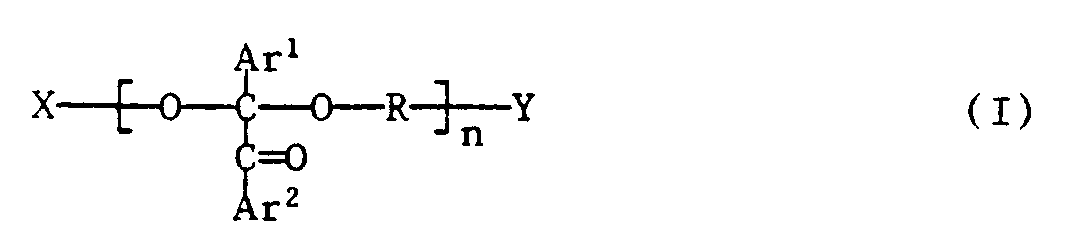
Y eine Gruppe -OH oder
n ein Wert von 1 bis 30 ist,
Ar¹ und Ar² unabhängig voneinander Phenyl oder durch C₁-C₄-Alkyl, C₁-C₄-Alkoxy oder Halogen substituiertes Phenyl bedeuten,
R ein zweiwertiger Rest ist und zwar entwedera) ein C₄-C₅₀-Polymethylenrest, der einmal oder mehrmals unterbrochen sein kann durch -O-, -S-, -SO-, -SO₂-, -CO-, -CONH-, -N(R²)-, -O-Si(R³)(R⁴)-O- oder durch einen oder mehrere carbocyclische oder heterocyclische Ringe,
und der einfach oder mehrfach substituiert sein kann durch C₁-C₁₈-Alkyl,
C₃-C₅-Alkenyl, C₅-C₆-Cycloalkyl, Phenyl, Halogen, Cyan, Hydroxy, C₁-C₁₂-Alkoxy, C₁-C₁₂-Alkylthio, Phenoxy, C₂-C₁₂-Alkanoyloxy, Benzoyloxy, C₂-C₅-Alkoxycarbonyl, C₂-C₈-Dialkylamino, Morpholino, Piperidino, Trimethylsiloxy oder durch eine der Gruppen oder b) ein C₄-C₈-Alkenylen- oder -Alkinylenrestoder c) ein zweiwertiger cycloaliphatischer Rest mit 6-20 C-Atomenoder d) ein Rest -CH₂-Z-CH₂- ist,worin Z ein zweiwertiger cycloaliphatischer, aromatischer oder heterocyclischer Rest mit 4-15 C-Atomen ist,
R¹ C₁-C₄-Alkyl bedeutet,
R² Wasserstoff, C₁-C₄-Alkyl, Cyclohexyl, Phenyl, Chlorphenyl, Tolyl, Benzyl, C₂-C₅-Alkanoyl, Benzoyl, Toluyl oder eine Gruppe -SO₂-R⁵, -CH₂CH₂-R⁶ oder CH₂-CH(CH₃)-R⁶ bedeutet,
R³ und R⁴ unabhängig voneinander Methyl oder Phenyl bedeutet
R⁵ C₁-C₁₆-Alkyl, Phenyl oder C₇-C₂₀-Alkylphenyl bedeutet und R⁶ Hydroxy, C₁-C₄-Alkoxy, C₂-C₄-Alkanoyloxy oder
- Eine Verbindung oder ein Verbindungsgemisch gemäss Anspruch 1 der Formel I, worin n 2-20 ist,
Ar¹ und Ar² unabhängig voneinander Phenyl, Tolyl, Chlorphenyl oder Bromphenyl sind,
R ein Polymethylenrest mit 4-30 C-Atomen ist, der einmal oder mehrmals unterbrochen sein kann durch -O-, -S-, -N(R²)- oder durch eine Gruppe
R¹ Methyl oder Ethyl ist,
R² Wasserstoff, C₁-C₄-Alkyl, Cyclohexyl, Phenyl, Tolyl, Benzyl, Acetyl, Benzoyl oder eine Gruppe -CH₂CH₂R⁶ oder -SO₂-R⁵ ist,
R⁵ C₁-C₁₂-Alkyl, Phenyl oder C₇-C₁₈-Alkylphenyl bedeutet,
R⁶ Hydroxy oder
X and Y die in Anspruch 1 gegebene Bedeutung haben. - Eine Verbindung oder ein Verbindungsgemisch gemäss Anspruch 1 der Formel I, worin n 2-10 ist, Ar¹ und Ar² Phenyl sind, R entweder ein Rest -(CH₂)m- mit m = 5-10 ist oder ein Rest -(CH₂CH₂O)pCH₂CH₂- mit p = 1-14 ist oder ein Rest -CH₂CH₂-N(R²)-CH₂CH₂- ist, R¹ Methyl ist, R² C₁-C₄-Alkyl, Cyclohexyl, Phenyl oder Benzyl ist und X und Y die in Anspruch 1 gegebene Bedeutung haben.
- Eine Verbindung oder ein Verbindungsgemisch gemäss Anspruch 1 der Formel I, worin n 2-10 ist, Ar¹ und Ar² Phenyl sind, R ein Rest -(CH₂CH₂O)pCH₂CH₂- mit p = 1-10 oder ein Rest -(CH₂)₆- ist, R¹ Methyl ist und X und Y die in Anspruch 1 gegebene Bedeutung haben.
- Verfahren zur Herstellung von Verbindungen der Formel I und deren Mischungen gemäss Anspruch 1 durch Umsetzung von x Molen einer Verbindung der Formel II

- Verfahren gemäss Anspruch 5, dadurch gekennzeichnet, dass man die Reaktion bei 60-130°C ausführt.
- Photohärtbare Zusammensetzung, enthaltend mindestens eine ethylenisch ungesättigte Verbindung und 0,5 bis 20 Gew.-% mindestens einer Verbindung der Formel I des Anspruchs 1.
- Photohärtbare Zusammensetzung gemäss Anspruch 7, enthaltend 1 bis 5 Gew.-% mindestens einer Verbindung des Anspruchs 1.
- Verwendung von Verbindungen der Formel I des Anspruches 1 als Photoinitiatoren für die Photopolymerisation ethylenisch ungesättigter Verbindungen.
Applications Claiming Priority (2)
| Application Number | Priority Date | Filing Date | Title |
|---|---|---|---|
| CH328587 | 1987-08-27 | ||
| CH3285/87 | 1987-08-27 |
Publications (3)
| Publication Number | Publication Date |
|---|---|
| EP0304886A2 EP0304886A2 (de) | 1989-03-01 |
| EP0304886A3 EP0304886A3 (de) | 1991-04-17 |
| EP0304886B1 true EP0304886B1 (de) | 1993-12-08 |
Family
ID=4252676
Family Applications (1)
| Application Number | Title | Priority Date | Filing Date |
|---|---|---|---|
| EP88113779A Expired - Lifetime EP0304886B1 (de) | 1987-08-27 | 1988-08-24 | Oligomere Benzilketale und ihre Verwendung als Photoinitiatoren |
Country Status (6)
| Country | Link |
|---|---|
| US (1) | US4950795A (de) |
| EP (1) | EP0304886B1 (de) |
| JP (1) | JP2732080B2 (de) |
| KR (1) | KR970010748B1 (de) |
| CA (1) | CA1304372C (de) |
| DE (1) | DE3886139D1 (de) |
Families Citing this family (13)
| Publication number | Priority date | Publication date | Assignee | Title |
|---|---|---|---|---|
| US5298361A (en) * | 1991-08-30 | 1994-03-29 | Minnesota Mining And Manufacturing Company | Light-sensitive article containing migration-resistant halomethyl-1,3,5-triazine photoinitiator |
| USRE35060E (en) * | 1991-12-11 | 1995-10-10 | Alliedsignal Inc. | Fluorinated photoinitiators and their application in UV curing of fluorinated monomers |
| US5274179A (en) * | 1993-04-06 | 1993-12-28 | Alliedsignal Inc. | Fluorinated photoinitiators and their application in UV curing of fluorinated monomers |
| DE59310066D1 (de) * | 1992-11-04 | 2000-08-03 | Clariant Gmbh | Verfahren zur Herstellung fluorierter Benzile |
| JP2001049077A (ja) * | 1999-08-12 | 2001-02-20 | Jsr Corp | 樹脂組成物及びその硬化物 |
| DE10049669A1 (de) * | 2000-10-06 | 2002-04-11 | Tesa Ag | Verfahren zur Herstellung von vernetzten Acrylatschmelzhaftklebemassen |
| WO2006122223A2 (en) * | 2005-05-10 | 2006-11-16 | Emory University | Strategies for delivery of active agents using micelles and particles |
| US20070077498A1 (en) * | 2005-09-30 | 2007-04-05 | Fuji Photo Film Co., Ltd. | Optical recording composition, optical recording medium and production method thereof, optical recording method and optical recording apparatus |
| JP5098397B2 (ja) * | 2007-03-29 | 2012-12-12 | コニカミノルタホールディングス株式会社 | インクジェットインク、及びインクジェット記録方法 |
| WO2012050179A1 (ja) | 2010-10-14 | 2012-04-19 | シャープ株式会社 | 液晶表示装置の製造方法 |
| US9798179B2 (en) * | 2010-10-14 | 2017-10-24 | Merck Patent Gmbh | Liquid crystal display device |
| KR102407603B1 (ko) * | 2020-04-20 | 2022-06-13 | 엘지전자 주식회사 | 압축기 |
| KR102331606B1 (ko) * | 2020-04-20 | 2021-11-30 | 엘지전자 주식회사 | 압축기 |
Family Cites Families (9)
| Publication number | Priority date | Publication date | Assignee | Title |
|---|---|---|---|---|
| US3878169A (en) * | 1971-04-19 | 1975-04-15 | James Edwin Guillet | Photodegradable polyesters prepared from ketonic dicarboxylic acids |
| US3715293A (en) * | 1971-12-17 | 1973-02-06 | Union Carbide Corp | Acetophenone-type photosensitizers for radiation curable coatings |
| DE2232365C2 (de) * | 1972-07-01 | 1982-06-09 | Basf Ag, 6700 Ludwigshafen | Durch UV-Bestrahlung polymerisierbare Gemische |
| FI60194C (fi) * | 1972-07-28 | 1981-12-10 | Ciba Geigy Ag | Foerfarande foer framstaellning av bensil-monoketaler |
| US3978133A (en) * | 1974-03-28 | 1976-08-31 | Sun Chemical Corporation | Photopolymerization initiators |
| US4093709A (en) * | 1975-01-28 | 1978-06-06 | Alza Corporation | Drug delivery devices manufactured from poly(orthoesters) and poly(orthocarbonates) |
| US4144156A (en) * | 1976-04-14 | 1979-03-13 | Basf Aktiengesellschaft | Manufacture of unsymmetric monoacetals of aromatic 1,2-diketones employable as photoiniatiators |
| IT1176018B (it) * | 1984-04-12 | 1987-08-12 | Lamberti Flli Spa | Chetoni aromatico alifatici polimerici o polimerizzabili adatti all'impiego come fotoiniziatori di polimerizzazione |
| DE3534645A1 (de) * | 1985-09-28 | 1987-04-02 | Merck Patent Gmbh | Copolymerisierbare fotoinitiatoren |
-
1988
- 1988-08-18 US US07/233,399 patent/US4950795A/en not_active Expired - Lifetime
- 1988-08-24 EP EP88113779A patent/EP0304886B1/de not_active Expired - Lifetime
- 1988-08-24 DE DE88113779T patent/DE3886139D1/de not_active Expired - Fee Related
- 1988-08-25 CA CA000575667A patent/CA1304372C/en not_active Expired - Lifetime
- 1988-08-27 KR KR1019880010976A patent/KR970010748B1/ko not_active Expired - Fee Related
- 1988-08-27 JP JP63213516A patent/JP2732080B2/ja not_active Expired - Fee Related
Also Published As
| Publication number | Publication date |
|---|---|
| KR890003862A (ko) | 1989-04-18 |
| US4950795A (en) | 1990-08-21 |
| CA1304372C (en) | 1992-06-30 |
| JP2732080B2 (ja) | 1998-03-25 |
| EP0304886A3 (de) | 1991-04-17 |
| JPH0196145A (ja) | 1989-04-14 |
| KR970010748B1 (ko) | 1997-06-30 |
| DE3886139D1 (de) | 1994-01-20 |
| EP0304886A2 (de) | 1989-03-01 |
Similar Documents
| Publication | Publication Date | Title |
|---|---|---|
| EP0108037B1 (de) | Propiophenonderivate als Photoinitiatoren für die Photopolymerisation | |
| EP0141110B1 (de) | Photopolymerisierbare Mischungen, enthaltend tertiäre Amine als Photaktivatoren | |
| EP0003002B1 (de) | Verwendung von aromatisch-aliphatischen Ketonen als Photoinitiatoren, photopolymerisierbare Systeme enthaltend solche Ketone und neue aromatisch-aliphatische Ketone | |
| US4022674A (en) | Photopolymerizable compounds and compositions comprising the product of the reaction of a monomeric ester and a polycarboxy-substituted benzophenone | |
| US4004998A (en) | Photopolymerizable compounds and compositions comprising the product of the reaction of a hydroxy-containing ester and a monocarboxy-substituted benzophenone | |
| EP0255486B1 (de) | Titanocene und deren Verwendung | |
| US4739052A (en) | Phenyl ketone derivatives | |
| US3926641A (en) | Photopolymerizable compositions comprising polycarboxysubstituted benzophenone reaction products | |
| US4239866A (en) | Curable coating composition | |
| EP0269573B1 (de) | Flüssige Photoinitiatorgemische | |
| JP5223365B2 (ja) | 光重合開始剤、重合性組成物、および重合物の製造方法。 | |
| JP2009191179A (ja) | 光重合開始剤、重合性組成物、および重合物の製造方法。 | |
| DE19753655A1 (de) | Neue alpha-Aminoacetophenon-Photostarter | |
| EP0495751A1 (de) | Bisacylphosphine | |
| CH649997A5 (de) | Dialkylthioxanthon-verbindungen. | |
| DE3126433A1 (de) | "neue gemische auf basis von substituierten dialkoxyacetophenonen, ihre verwendung als photoinitiatoren sowie photopolymerisierbare systeme enthaltend solche gemische" | |
| EP0304886A2 (de) | Oligomere Benzilketale und ihre Verwendung als Photoinitiatoren | |
| JP5481856B2 (ja) | 光重合開始剤、重合性組成物、および重合物の製造方法 | |
| KR20020091285A (ko) | 중합성 조성물 | |
| EP0341560B1 (de) | Fotoinitiator Copolymere | |
| US4251341A (en) | Photoinitiators for UV-curable systems | |
| DE2808931A1 (de) | Verfahren zum beschichten oder bedrucken eines substrates | |
| EP1140761B1 (de) | Benzophenone und ihre verwendung als photoinitiatoren | |
| EP0242330A1 (de) | Flüssige Photoinitiatorgemische | |
| DE4102173A1 (de) | Lagerstabile loesung eines carboxylgruppenhaltigen copolymerisats sowie verfahren zur herstellung von photoempfindlichen lacken und offsetdruckplatten |
Legal Events
| Date | Code | Title | Description |
|---|---|---|---|
| PUAI | Public reference made under article 153(3) epc to a published international application that has entered the european phase |
Free format text: ORIGINAL CODE: 0009012 |
|
| 17P | Request for examination filed |
Effective date: 19880824 |
|
| AK | Designated contracting states |
Kind code of ref document: A2 Designated state(s): BE DE FR GB IT NL |
|
| PUAL | Search report despatched |
Free format text: ORIGINAL CODE: 0009013 |
|
| AK | Designated contracting states |
Kind code of ref document: A3 Designated state(s): BE DE FR GB IT NL |
|
| 17Q | First examination report despatched |
Effective date: 19920911 |
|
| GRAA | (expected) grant |
Free format text: ORIGINAL CODE: 0009210 |
|
| AK | Designated contracting states |
Kind code of ref document: B1 Designated state(s): BE DE FR GB IT NL |
|
| ITF | It: translation for a ep patent filed | ||
| REF | Corresponds to: |
Ref document number: 3886139 Country of ref document: DE Date of ref document: 19940120 |
|
| GBT | Gb: translation of ep patent filed (gb section 77(6)(a)/1977) |
Effective date: 19940120 |
|
| ET | Fr: translation filed | ||
| PLBE | No opposition filed within time limit |
Free format text: ORIGINAL CODE: 0009261 |
|
| STAA | Information on the status of an ep patent application or granted ep patent |
Free format text: STATUS: NO OPPOSITION FILED WITHIN TIME LIMIT |
|
| 26N | No opposition filed | ||
| PGFP | Annual fee paid to national office [announced via postgrant information from national office to epo] |
Ref country code: BE Payment date: 19961009 Year of fee payment: 9 |
|
| BECN | Be: change of holder's name |
Effective date: 19961129 |
|
| NLS | Nl: assignments of ep-patents |
Owner name: CIBA SC HOLDING AG |
|
| REG | Reference to a national code |
Ref country code: GB Ref legal event code: 732E |
|
| NLT1 | Nl: modifications of names registered in virtue of documents presented to the patent office pursuant to art. 16 a, paragraph 1 |
Owner name: CIBA SPECIALTY CHEMICALS HOLDING INC. |
|
| PG25 | Lapsed in a contracting state [announced via postgrant information from national office to epo] |
Ref country code: BE Free format text: LAPSE BECAUSE OF NON-PAYMENT OF DUE FEES Effective date: 19970831 |
|
| BERE | Be: lapsed |
Owner name: CIBA SPECIALTY CHEMICALS HOLDING INC. Effective date: 19970831 |
|
| REG | Reference to a national code |
Ref country code: FR Ref legal event code: TP |
|
| REG | Reference to a national code |
Ref country code: GB Ref legal event code: IF02 |
|
| PGFP | Annual fee paid to national office [announced via postgrant information from national office to epo] |
Ref country code: NL Payment date: 20020723 Year of fee payment: 15 |
|
| PG25 | Lapsed in a contracting state [announced via postgrant information from national office to epo] |
Ref country code: NL Free format text: LAPSE BECAUSE OF NON-PAYMENT OF DUE FEES Effective date: 20040301 |
|
| NLV4 | Nl: lapsed or anulled due to non-payment of the annual fee |
Effective date: 20040301 |
|
| PGFP | Annual fee paid to national office [announced via postgrant information from national office to epo] |
Ref country code: FR Payment date: 20040714 Year of fee payment: 17 |
|
| PGFP | Annual fee paid to national office [announced via postgrant information from national office to epo] |
Ref country code: GB Payment date: 20040720 Year of fee payment: 17 |
|
| PGFP | Annual fee paid to national office [announced via postgrant information from national office to epo] |
Ref country code: DE Payment date: 20040722 Year of fee payment: 17 |
|
| PG25 | Lapsed in a contracting state [announced via postgrant information from national office to epo] |
Ref country code: IT Free format text: LAPSE BECAUSE OF NON-PAYMENT OF DUE FEES Effective date: 20050824 Ref country code: GB Free format text: LAPSE BECAUSE OF NON-PAYMENT OF DUE FEES Effective date: 20050824 |
|
| PG25 | Lapsed in a contracting state [announced via postgrant information from national office to epo] |
Ref country code: DE Free format text: LAPSE BECAUSE OF NON-PAYMENT OF DUE FEES Effective date: 20060301 |
|
| GBPC | Gb: european patent ceased through non-payment of renewal fee |
Effective date: 20050824 |
|
| PG25 | Lapsed in a contracting state [announced via postgrant information from national office to epo] |
Ref country code: FR Free format text: LAPSE BECAUSE OF NON-PAYMENT OF DUE FEES Effective date: 20060428 |
|
| REG | Reference to a national code |
Ref country code: FR Ref legal event code: ST Effective date: 20060428 |