EP0303731A1 - Kommutator für eine elektrische Maschine - Google Patents
Kommutator für eine elektrische Maschine Download PDFInfo
- Publication number
- EP0303731A1 EP0303731A1 EP87112585A EP87112585A EP0303731A1 EP 0303731 A1 EP0303731 A1 EP 0303731A1 EP 87112585 A EP87112585 A EP 87112585A EP 87112585 A EP87112585 A EP 87112585A EP 0303731 A1 EP0303731 A1 EP 0303731A1
- Authority
- EP
- European Patent Office
- Prior art keywords
- contact material
- commutator
- commutator according
- insert
- groove
- Prior art date
- Legal status (The legal status is an assumption and is not a legal conclusion. Google has not performed a legal analysis and makes no representation as to the accuracy of the status listed.)
- Granted
Links
Images

Classifications
-
- H—ELECTRICITY
- H02—GENERATION; CONVERSION OR DISTRIBUTION OF ELECTRIC POWER
- H02K—DYNAMO-ELECTRIC MACHINES
- H02K13/00—Structural associations of current collectors with motors or generators, e.g. brush mounting plates or connections to windings; Disposition of current collectors in motors or generators; Arrangements for improving commutation
- H02K13/10—Arrangements of brushes or commutators specially adapted for improving commutation
- H02K13/105—Spark suppressors associated with the commutator
-
- H—ELECTRICITY
- H01—ELECTRIC ELEMENTS
- H01R—ELECTRICALLY-CONDUCTIVE CONNECTIONS; STRUCTURAL ASSOCIATIONS OF A PLURALITY OF MUTUALLY-INSULATED ELECTRICAL CONNECTING ELEMENTS; COUPLING DEVICES; CURRENT COLLECTORS
- H01R39/00—Rotary current collectors, distributors or interrupters
- H01R39/02—Details for dynamo electric machines
- H01R39/04—Commutators
Definitions
- the invention relates to a commutator for an electrical machine with mutually insulated metal lamellae for voltage or current draw or supply by means of brushes, the lamellae being additionally provided with a contact material to improve sliding contact with the brushes.
- Such commutators are known to be used in generators and motors. In measurement, control and regulation technology, they are used, for example, in direct current tachometer dynamos as measured variable converters. Due to the high terminating resistance of the downstream evaluation unit, the current density in the brushes and the thermal load on the commutator are very low. It is in the range of a few milliamps. For this reason, different criteria for the dimensioning of the commutator and carbon brushes apply to DC tachometer dynamos than, for example, to power machines.
- the lamellae are also electroplated with a noble metal, only a very small layer thickness can be achieved, which is of the order of a few micrometers. This precludes subsequent machining of the commutator running surface, which can only be achieved, for example, by turning to achieve high concentricity. Therefore, the galvanization must be carried out as the last step on the fully assembled armature of the tachometer dynamo, which is very complex and costly. There is also a risk that the galvanic precious metal coating is partially or completely removed by mechanical damage or abrasion during operation.
- the invention has for its object to provide a commutator of the type mentioned, the service life is significantly extended even under unfavorable environmental conditions with good electrical properties and simple manufacture.
- the lamellae are each provided with at least one recess within the running surface of the commutator and that a contact material insert which is flush with the lamella surface is fastened in each recess.
- the invention has the advantage that graphite brushes with good conductivity and lubricity can be used without the risk of disruptive oxide and sulfite layer formation on the collector surface, since neither the noble metal nor the graphite is adversely affected by aggressive environmental influences.
- the groove can be produced in a simple manner, for example by turning, milling or sawing.
- the inlays can be made from prefabricated yard goods.
- the contact material insert has a height of approximately 0.5 mm.
- a preferred embodiment of the invention is that the recess is designed as a groove running in the circumferential direction of the commutator.
- the recess is designed as a groove running in the axial direction of the commutator.
- the groove can be produced and the contact material insert can be introduced in a simple manner.
- the choice of a brush is recommended, the contact area of which in the circumferential direction is greater than the distance between two adjacent contact material inserts, so that the brush is in constant engagement with at least one contact material insert when the commutator is rotated. A change between the contact material insert and the remaining lamella material is prevented in this way.
- the recess is designed as an oblique or arrow-shaped groove. This has the advantage that the entire width of the brush comes into contact with the contact material insert when the slats are swept over and that the commutator is nevertheless provided with the contact material inserts as far as possible in the circumferential direction.
- the recess may also be appropriate for the recess to be designed as a radially extending, round opening, preferably as a blind hole.
- a preferred development is that there are two parallel grooves with contact material inserts in the circumferential direction. This results in multiple direct sliding contact between the brushes and the inserts, or in the case of twin brushes each brush is provided with its own insert. To simplify production, the two inserts can also be designed as a (wider) single insert.
- the contact material insert is designed as a noble metal insert.
- the formation of the groove and the insertion and fastening of the insert is particularly simple if the cross section of the groove and the insert is rectangular or square. Commercial precious metal strips or graphite rods can be used to manufacture the inserts. There are also other groove cross sections, e.g. triangular, trapezoidal and the like, possible.
- the groove and the insert can also be expedient for the groove and the insert to have a cross-section in the form of a segment of a circle.
- the inlays are preferably obtained from round wires or rods, which are twisted to the appropriate cross-section after assembly.
- the insert is particularly easy to produce in the groove by means of a conductive adhesive.
- An alternative attachment can be that the insert is held by soldering, welding or flanging.
- the precious metal insert can also be introduced by flame spraying.
- a particularly simple manufacturing process for the commutator according to the invention consists in that contact material is introduced in one piece into the grooves of a plurality of collector lamellae and then separated between the lamellae.
- the commutator consists of a plurality of lamellae 1 made of copper or a copper alloy. They are held by a cylindrical support 7 made of insulating plastic. In the outer peripheral region, the lamellae 1 are electrically insulated from one another by radially extending slots 8.
- the commutator is placed with a hub 9 together with a rotor on a shaft (not shown) and connected to it in a rotationally fixed manner.
- Each of the fins 1 is connected via winding connections 10 with a corresponding number of rotor windings (not shown posed) connected. For reasons of clarity, only a single winding connection 10 of this type is shown schematically.
- a noble metal insert 2 is introduced into the individual lamellae 1, the effective surface of which occupies only part of the entire running surface.
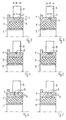
- FIG. 2 shows a cross section along the section line A-A for a first example.
- the same parts as in FIG. 1 are provided with the same reference numerals, as in the figures described below.
- At least one groove 4 extending in the circumferential direction is formed in the lamellae 1, in which the noble metal inserts 2 are inserted and fastened flush with the surface.
- the precious metal inserts 2 lie within the commutator running surface, which is determined by the width of a carbon brush 3.
- the width X of the inserts is expediently smaller than the width B of the commutator running surface; however, it can also be larger.
- the depth T of the groove 4, which corresponds to the height of the noble metal insert 2 is selected so that the commutator can be machined or the like in order to achieve a high concentricity. This ensures that a sufficient amount of the precious metal insert 2 is guaranteed at all times. In practice, a height of the noble metal insert 2 of approximately 0.5 mm has proven itself.
- electrographite is also suitable for the insert in the lamellae 1.
- FIG. 4 shows a triangular and FIG. 5 shows a trapezoidal cross section of the insert 2 and the groove 4.
- FIG. 3 illustrates an example in which the width X of the noble metal insert 2 is significantly smaller than the width B of the tread.
- a dovetail cross section 5 of the noble metal insert 2 is also shown by way of example, with which a particularly firm anchoring in the lamella 1 is achieved.
- FIG. 6 A further variant is shown in FIG. 6, in which two precious metal inserts 2 lying next to one another are incorporated into the lamella 1 within the running surfaces.
- FIG. 7 shows an example of a cross-section in the shape of a segment of a circle of two precious metal inserts 2 arranged next to one another and the associated grooves 4.
- each lamella 1 is provided with a groove 11 which runs in the axial direction of the commutator and which is filled flush with a noble metal insert 2.
- the thickness S of the brush is dimensioned somewhat larger than the distance between the two noble metal inserts 2.
- the noble metal inserts 2 extend over the entire width of the slats 1 extend.
- the noble metal inlays 2 can also be shorter than the width B of the brush 3, corresponding to FIGS. 2 to 5.
- 9 and 10 each show a further arrangement for the noble metal inserts 2 in a top view of a lamella 1.
- 8 illustrates an arrow-shaped groove 12 with the noble metal insert 2.
- the noble metal insert 2 is fastened in a round blind hole 13.
Landscapes
- Engineering & Computer Science (AREA)
- Power Engineering (AREA)
- Motor Or Generator Current Collectors (AREA)
- Rotary Switch, Piano Key Switch, And Lever Switch (AREA)
Abstract
Description
- Die Erfindung betrifft einen Kommutator für eine elektrische Maschine mit voneinander isolierten Metall-Lamellen zur Spannungs- bzw. Stromabnahme oder Zuführung mittels Bürsten, wobei die Lamellen zur Verbesserung des Gleitkontaktes mit den Bürsten zusätzlich mit einem Kontaktmaterial versehen sind.
- Derartige Kommutatoren werden bekanntlich bei Generatoren und Motoren eingesetzt. In der Meß-, Steuer- und Regeltechnik finden sie beispielsweise bei Gleichstrom-Tachometer-Dynamos als Meßgrößen-Umformer Verwendung. Hierbei ist bedingt durch den hohen Abschlußwiderstand der nachgeschalteten Auswerteeinheit die Stromdichte in den Bürsten sowie die thermische Belastung des Kommutators sehr gering. Sie liegt im Bereich von wenigen Milliampere. Deshalb gelten bei Gleichstrom-Tachometer-Dynamos andere Kriterien für die Dimensionierung von Kommutator und Kohlebürsten als beispielsweise bei Leistungsmaschinen.
- Bei der Kommutierung von Gleichstrom-Tachometer-Dynamos sind einige Varianten bekannt. Wird ein Kupferkommutator zusammen mit Graphitbürsten verwendet, so kann besonders im niedrigen Drehzahlbereich häufig eine hohe Oberwelligkeit des Gleichspannungssignals bei schwankenden Spannungsgradienten beobachtet werden, da sich unvermeidlich Oxid- und Sulfitschichten auf der Oberfläche des Kupferkommutators bilden. In vielen Anwendungsfallen bewähren sich da her silbergraphithaltige Kohlebürsten. Durch den Silberanteil der Kohlebürste bildet sich auf der Lauffläche des Kupferkommutators eine schützende Silbergraphitschicht, die als Patina bezeichnet wird. Diese bewirkt einerseits einen geringen Verschleiß der Kohlebürsten und des Kommutators und andererseits durch ihre hohe elektrische Leitfähigkeit einen guten, gleichmäßigen Kontaktwiderstand. Die Standzeit ist allerdings stark von den Umluftbedingungen abhängig. Bei aggressiver Atmosphäre oder beim Einfluß von Öl oder Fett kommt es zu erhöhtem Abrieb und die Bildung der Patina wird verhindert. Es kann somit wegen der aufgarauhten Oberfläche die Funktionsfähigkeit verstärkt beeinträchtigt werden.
- Es ist auch bekannt, die Lamellen des Kommutators aus einem Edelmetall oder einer Edelmetall-Legierung herzustellen. Hierbei müssen sehr hohe Materialkosten wegen des großen Gewichtsanteils des Edelmetalls in Kauf genommen werden.
- Des weiteren ist auch bekannt, auf die Lamellen eine Edelmetallschicht aufzuwalzen. Nachteilig sind hierbei die hohen Material- und Herstellungskosten des Bi-Metalls. Da die Edelmetallschicht die gesamte Oberfläche der Kommutator-Lamellen bedeckt, ist der Edelmetallanteil relativ hoch.
- Bei seiner ebenfalls angewendeten galvanischen Beschichtung der Lamellen mit einem Edelmetall kann nur eine sehr geringe Schichtdicke erreicht werden, die in der Größenordnung von einigen Mikrometern liegt. Dies schließt eine nachträgliche Bearbeitung der Kommutatorlauffläche aus, die beispielsweise zur Erzielung einer hohen Rundlaufgenauigkeit nur durch Abdrehen erreicht werden kann. Daher muß die Galvanisierung als letzter Arbeitsgang am fertig montierten Anker des Tachometer-Dynamos erfolgen, was sehr aufwendig und kostenträchtig ist. Außerdem besteht die Gefahr, daß die galvanische Edelmetallbeschichtung durch mechanische Beschädigung bzw. Abrieb während des Betriebes teilweise oder vollständig entfernt wird.
- Der Erfindung liegt die Aufgabe zugrunde, einen Kommutator der eingangs genannten Art anzugeben, dessen Standzeit auch unter ungünstigen Umweltbedingungen bei gleichzeitig guten elektrischen Eigenschaften und bei einfacher Herstellung wesentlich verlängert ist.
- Diese Aufgabe wird dadurch gelöst, daß die Lamellen innerhalb der Lauffläche des Kommutators jeweils mit mindestens einer Ausnehmung versehen sind und daß in jeder Ausnehmung eine mit der Lamellenoberfläche bündige Kontaktmaterial-Einlage befestigt ist.
- Die Erfindung hat den Vorteil, daß gut leit- und gleitfähige Graphitbürsten Verwendung finden können, ohne daß die Gefahr von störenden Oxid- und Sulfitschichtbildungen auf der Kollektoroberfläche besteht, da weder das Edelmetall noch der Graphit von aggressiven Umwelteinflüssen beeinträchtigt wird. Durch die Begrenzung der Nut auf die wirksame Kommutatorlauffläche oder auch nur einen Teil davon sind relativ geringe Edelmetallmengen erforderlich. Trotzdem ist eine nachträgliche Bearbeitung der Edelmetallstücke zur Erzielung einer großen Rundlaufgenauigkeit möglich, da das Edelmetall in der Nut ausreichend tief eingebettet ist. Die Herstellung der Nut kann auf einfache Weise, beispielsweise durch Drehen, Fräsen oder Sägen folgen. Die Einlagen können aus vorgefertigter Meterware hergestellt werden.
- Es ist besonders vorteilhaft, daß die Kontaktmaterial-Einlage eine Höhe von etwa 0,5 mm hat.
- Eine bevorzugte Ausführungsform der Erfindung besteht darin, daß die Ausnehmung als in Umfangsrichtung des Kommutators verlaufende Nut ausgebildet ist.
- Es kann alternativ auch vorteilhaft sein, daß die Ausnehmung als in Achsrichtung des Kommutators verlaufende Nut ausgebildet ist. Insbesondere wenn die Lamellen zunächst als Meterware hergestellt werden, von der die einzelnen Lamellen in der gewünschten Breite abgeschnitten werden, kann das Herstellen der Nut und das Einbringen der Kontaktmaterialeinlage auf einfache Weise erfolgen. Bei dieser Variante ist die Wahl einer Bürste zu empfehlen, deren Kontaktbereich in Umfangsrichtung größer ist als der Abstand zweier benachbarter Kontaktmaterialeinlagen, so daß die Bürste bei einer Drehung des Kommutators ständig zumindest mit einer Kontaktmaterialeinlage in Eingriff ist. Ein Wechsel zwischen der Kontaktmaterialeinlage und dem übrigen Lamellenmaterial wird auf diese Weise verhindert. Eine andere alternative Weiterbildung besteht darin, daß die Ausnehmung als schräg- oder pfeilförmig verlaufende Nut ausgebildet ist. Dies hat den Vorteil, daß die gesamte Breite der Bürste beim Überstreichen der Lamellen in Kontakt mit der Kontaktmaterialeinlage gelangt und daß der Kommutator trotzdem in Umfangsrichtung soweit wie möglich mit den Kontaktmaterialeinlagen versehen ist.
- Es kann auch zweckmäßig sein, daß die Ausnehmung als radial verlaufenden, runde Öffnung - bevorzugt als Sackloch - ausgebildet ist.
- Eine bevorzugte Weiterbildung besteht darin, daß in Umfangsrichtung zwei parallele Nuten mit Kontaktmaterialeinlagen vorhanden sind. Hierdurch wird ein mehrfacher unmittelbarer Gleitkontakt zwischen den Bürsten und den Einlagen erreicht, oder aber bei Zwillingsbürsten jeder Bürste eine eigene Einlage zur Verfügung gestellt. Zur Vereinfachung der Herstellung können die beiden Einlagen auch als eine (breitere) einzelne Einlage ausgebildet sein.
- Besonders gute Ergebnisse erhält man, wenn die Kontaktmaterialeinlage als Edelmetalleinlage ausgebildet ist.
- Eine Alternative besteht darin, daß eine Elektrographiteinlage in den Nuten befestigt ist.
- Die Ausbildung der Nut und das Einbringen und Befestigen der Einlage ist besonders einfach, wenn der Querschnitt der Nut und der Einlage rechteckig oder quadratisch ist. Handelsübliche Edelmetallbänder oder Graphitstäbe können hierbei zur Herstellung der Einlagen Verwendung finden. Es sind auch andere Nut-Querschnitte, wie z.B. dreieckig, trapezförmig und ähnliches,möglich.
- Eine besonders feste Verbindung liegt dann vor, wenn der Querschnitt der Nut und der Einlage schwalbenschwanzförmig ist.
- Alternativ dazu kann es auch zweckmäßig sein, daß die Nut und die Einlage einen kreissegmentförmigen Querschnitt aufweisen. Die Einlagen erhält man hierbei bevorzugt aus Runddrähten oder Rundstäben, die nach der Montage auf den entsprechenden Querschnitt abgedreht werden.
- Eine besonders einfach herstellbare Befestigung der Einlage in der Nut erfolgt mittels eines leitfähigen Klebers.
- Eine alternative Befestigung kann darin bestehen, daß die Einlage durch Löten, Schweißen oder Bördeln gehalten ist. Die Einbringung der Edelmetalleinlage kann auch durch Flammspritzen erfolgen.
- Ein besonders einfaches Herstellungsverfahren für den erfindungsgemäßen Kommutator besteht darin, daß Kontaktmaterial einstückig in die Nuten mehrerer Kollektor-Lamellen eingebracht und anschließend zwischen den Lamellen aufgetrennt wird.
- Alternativ dazu kann es im Hinblick auf die zwischen den Lamellen befindliche Isolierung zweckdienlich sein, daß paßgenau vorgefertigte Einlagen in die betreffenden Nuten eingebracht werden.
- Nachfolgend wird die Erfindung anhand von mehreren, in Figuren dargestellten Ausführungsbeispielen weiter beschrieben.
- Fig. 1 zeigt schematisch in perspektivischer Ansicht einen Kommutator und
- Fig. 2 bis 10 zeigen jeweils ein Beispiel für unterschiedliche Ausführungsformen eines Kommutators.
- Gemäß Fig. 1 besteht der Kommutator aus einer Vielzahl von Lamellen 1 aus Kupfer oder einer Kupferlegierung. Sie werden von einem zylinderförmigen Träger 7 aus isolierendem Kunststoff gehalten. Im äußeren Umfangsbereich sind die Lamellen 1 gegeneinander durch radial verlaufende Schlitze 8 elektrisch voneinander isoliert. Der Kommutator wird mit einer Nabe 9 zusammen mit einem Läufer auf eine Welle (nicht dargestellt) aufgesetzt und mit diesem drehfest verbunden. Jeder der Lamellen 1 ist über Wicklungsanschlüsse 10 mit einer entsprechenden Zahl von Läuferwicklungen (nicht dar gestellt) verbunden. Aus Gründen der Übersichtlichkeit ist lediglich ein einziger derartiger Wicklungsanschluß 10 schematisch wiedergegeben.
- In der Lauffläche des Kommutators ist in dem in Fig. 1 dargestellten Beispiel in die einzelnen Lamellen 1 jeweils eine Edelmetalleinlage 2 eingebracht, deren wirksame Oberfläche nur einen Teil der gesamten Lauffläche einnimmt.
- In Fig. 2 ist ein Querschnitt entlang der Schnittlinie A-A für ein erstes Beispiel veranschaulicht. Gleiche Teile wie in Fig. 1 sind hierbei - ebenso wie in den nachfolgend beschriebenen Figuren - mit gleichen Bezugszeichen versehen.
- Allen Beispielen ist gemeinsam, daß in den Lamellen 1 mindestens eine in Umfangsrichtung verlaufende Nut 4 ausgebildet ist, in welcher die Edelmetalleinlagen 2 oberflächenbündig eingelegt und befestigt sind.
- Die Edelmetalleinlagen 2 liegen innerhalb der Kommutatorlauffläche, welche durch die Breite einer Kohlebürste 3 bestimmt ist. Die Breite X der Einlagen ist zweckmäßigerweise kleiner als die Breite B der Kommutatorlauffläche; sie kann jedoch auch größer sein. Die Tiefe T der Nut 4, die der Höhe der Edelmetalleinlage 2 entspricht, ist so gewählt, daß der Kommutator einer spanenden Bearbeitung oder ähnlichem zur Erzielung einer großen Rundlaufeigenschaft aufgesetzt werden kann. Es ist hierbei sichergestellt, daß jederzeit eine ausreichende Höhe der Edelmetalleinlage 2 gewährleistet ist. In der Praxis bewährt sich eine Höhe der Edelmetalleinlage 2 von etwa 0,5 mm.
- Anstelle eines Edelmetalls, wie Gold, Silber oder einer Legierung ist auch Elektrographit für die Einlage in die Lamellen 1 geeignet.
- Die Fig. 4 zeigt einen dreieckigen und die Fig. 5 einen trapezförmigen Querschnitt der Einlage 2 und der Nut 4.
- Fig. 3 veranschaulicht ein Beispiel, bei welchem die Breite X der Edelmetalleinlage 2 deutlich kleiner ist als die Breite B der Lauffläche. Es ist ferner beispielhaft ein schwalbenschwanzförmiger Querschnitt 5 der Edelmetalleinlage 2 gezeigt, mit welchem eine besonders feste Verankerung in der Lamelle 1 erreicht wird.
- In Fig. 6 ist eine weitere Variante dargestellt, bei welcher innerhalb der Laufflächen zwei nebeneinanderliegende Edelmetalleinlagen 2 in die Lamelle 1 eingearbeitet sind.
- Fig. 7 zeigt beispielhaft einen kreissegmentförmigen Querschnitt zweier nebeneinander angeordneter Edelmetalleinlagen 2 und der zugehörigen Nuten 4.
- In Fig. 2 bis 7 ist jeweils nur eine Bürste 3 dargestellt, obwohl in der Praxis auch zwei oder mehr nebeneinander liegende Bürsten verwendet werden können.
- Fig. 8 veranschaulicht einen Bogensegmentausschnitt des Kommutators mit zwei benachbarten Lamellen 1. Aus dieser Seitenansicht ist ersichtlich, daß jede Lamelle 1 mit einer in Achsrichtung des Kommutators verlaufenden Nut 11 versehen ist, die flächenbündig mit einer Edelmetalleinlage 2 ausgefüllt ist. Um einen Metallwechsel zwischen den Edelmetalleinlagen 2 und dem Kupfer, in das sie eingebettet sind, zu vermeiden, ist die Stärke S der Bürste etwas grösser bemessen als der Abstand der beiden Edelmetalleinlagen 2.
- Die Fig. 8 zeigt ein Beispiel, in welchem sich die Edelmetalleinlagen 2 über die gesamte Breite der Lamellen 1 erstrecken. Um Material einzusparen, können die Edelmetalleinlagen 2 auch in sinngemäßer Entsprechung zu den Fig 2 bis 5 kürzer sein als die Breite B der Bürste 3.
- In Fig. 9 und 10 sind jeweils in einer Aufsicht auf eine Lamelle 1 weitere Anordnungen für die Edelmetalleinlagen 2 gezeigt. Dabei veranschaulicht die Fig. 8 eine pfeilförmige Nut 12 mit der Edelmetalleinlage 2. Gemäß Fig. 9 ist die Edelmetalleinlage 2 in einem runden Sackloch 13 befestigt.
Claims (19)
dadurch gekennzeichnet,
daß die Lamellen (1) innerhalb der Lauffläche des Kommutators jeweils mit einer Ausnehmung versehen sind und daß in jeder Ausnehmung eine mit der Lamellen-Oberfläche bündige Kontaktmaterialeinlage (2) befestigt ist.
dadurch gekennzeichnet,
daß die Kontaktmaterialeinlage (2) eine Höhe von etwa 0,5 mm hat.
dadurch gekennzeichnet,
daß die Breite (X) der Kontaktmaterialeinlage (2) kleiner als die Breite (B) der Bürsten ist.
dadurch gekennzeichnet,
daß die Kontaktmaterialeinlage (2) als Edelmetalleinlage ausgebildet ist.
dadurch gekennzeichnet,
daß die Kontaktmaterialeinlage (2) als Elektrographit-Einlage ausgebildet ist.
dadurch gekennzeichnet,
daß die Ausnehmung als in Umfangsrichtung des Kommutators verlaufende Nut (4) ausgebildet ist.
dadurch gekennzeichnet,
daß in Umfangsrichtung zwei parallele Nuten (4) mit Kontaktmaterialeinlagen (2) vorhanden sind.
dadurch gekennzeichnet,
daß die Ausnehmung als in Achsrichtung des Kommutators verlaufende Nut (11) ausgebildet ist.
dadurch gekennzeichnet,
daß die Ausnehmung als schräg- oder pfeilförmig verlaufende Nut (12) ausgebildet ist.
dadurch gekennzeichnet,
daß der Querschnitt der Nut (4,11,12) und der Kontaktmaterialeinlage (2) rechteckig ist.
dadurch gekennzeichnet,
daß der Querschnitt der Nut (4,11,12) und der Kontaktmaterialeinlage (2) quadratisch, dreieckig oder trapezförmig ist.
dadurch gekennzeichnet,
daß der Querschnitt der Nut (4,11,12) und der Kontaktmaterialeinlage (2) schwalbenschwanzförmig ist.
dadurch gekennzeichnet,
daß die Nut (4,11,12) und die Kontaktmaterialeinlage (2) einen kreissegmentförmigen Querschnitt aufweisen.
dadurch gekennzeichnet,
daß die Ausnehmung als radial verlaufende Öffnung ausgebildet ist.
dadurch gekennzeichnet,
daß die Kontaktmaterialeinlage (2) mittels eines leitfähigen Klebers befestigt ist.
dadurch gekennzeichnet,
daß die Kontaktmaterialeinlage (2) durch Löten, Schweißen oder Bördeln gehalten ist.
dadurch gekennzeichnet,
daß die Kontaktmaterialeinlage (2) durch Flammspritzen hergestellt ist.
dadurch gekennzeichnet,
daß zur Herstellung der Kontaktmaterialeinlage (2) Kontaktmaterial einstückig in die Nuten (4,11,12) mehrerer Kollektor-Lamellen eingebracht wird und daß es anschließend zwischen den Lamellen aufgetrennt wird.
dadurch gekennzeichnet,
daß paßgenau vorgefertigte Kontaktmaterialeinlagen (2) in die betreffenden Nuten (4,11,12) eingebracht werden.
Priority Applications (3)
| Application Number | Priority Date | Filing Date | Title |
|---|---|---|---|
| AT87112585T ATE93099T1 (de) | 1987-08-19 | 1987-08-28 | Kommutator fuer eine elektrische maschine. |
| JP19594788A JPH01126144A (ja) | 1987-08-19 | 1988-08-05 | 電気機械用整流子 |
| DD31895788A DD274307A5 (de) | 1987-08-28 | 1988-08-15 | Kommutator fuer eine elektrische maschine |
Applications Claiming Priority (2)
| Application Number | Priority Date | Filing Date | Title |
|---|---|---|---|
| EP87112050 | 1987-08-19 | ||
| EP87112050 | 1987-08-19 |
Publications (2)
| Publication Number | Publication Date |
|---|---|
| EP0303731A1 true EP0303731A1 (de) | 1989-02-22 |
| EP0303731B1 EP0303731B1 (de) | 1993-08-11 |
Family
ID=8197213
Family Applications (1)
| Application Number | Title | Priority Date | Filing Date |
|---|---|---|---|
| EP87112585A Expired - Lifetime EP0303731B1 (de) | 1987-08-19 | 1987-08-28 | Kommutator für eine elektrische Maschine |
Country Status (4)
| Country | Link |
|---|---|
| US (1) | US4851728A (de) |
| EP (1) | EP0303731B1 (de) |
| DE (1) | DE3787018D1 (de) |
| ES (1) | ES2044885T3 (de) |
Families Citing this family (7)
| Publication number | Priority date | Publication date | Assignee | Title |
|---|---|---|---|---|
| US5175463A (en) * | 1989-08-07 | 1992-12-29 | Kirkwood Industries | Carbon commutator |
| JP3313509B2 (ja) * | 1994-04-25 | 2002-08-12 | 株式会社ミツバ | コミテータ |
| DE19910130B4 (de) * | 1999-03-01 | 2008-07-03 | Baumer Hübner GmbH | Drehimpulsgeber |
| DE20108461U1 (de) * | 2001-05-19 | 2002-10-02 | Schunk Kohlenstofftechnik GmbH, 35452 Heuchelheim | Kommutator sowie Herstellung eines solchen |
| WO2011004924A1 (ko) * | 2009-07-09 | 2011-01-13 | Lee Moon Hyun | 은 상감 제품 및 이의 제조 방법 |
| DE102010064321A1 (de) * | 2010-12-29 | 2012-07-05 | Robert Bosch Gmbh | Kommutator und Herstellungsverfahren dafür und elektrische Maschine |
| CN104682632A (zh) * | 2013-11-29 | 2015-06-03 | 贵州航天林泉电机有限公司 | 提高直流测速发电机电刷与换向器接触可靠性的方法、结构及装置 |
Citations (2)
| Publication number | Priority date | Publication date | Assignee | Title |
|---|---|---|---|---|
| DE2143708B2 (de) * | 1970-09-18 | 1980-01-03 | N.V. Philips' Gloeilampenfabrieken, Eindhoven (Niederlande) | Kommutator für eine kleine elektrodynamische Maschine |
| US4415635A (en) * | 1980-04-09 | 1983-11-15 | The University Of Virginia | Electric brush |
Family Cites Families (9)
| Publication number | Priority date | Publication date | Assignee | Title |
|---|---|---|---|---|
| US448040A (en) * | 1891-03-10 | Commutator | ||
| US520264A (en) * | 1894-05-22 | Carl hoffmann | ||
| US257566A (en) * | 1882-05-09 | Commutator for magneto-electric machines | ||
| US258022A (en) * | 1882-05-16 | Commutator for dynamo-electric machines | ||
| US866262A (en) * | 1907-01-24 | 1907-09-17 | Hall Signal Co | Commutator. |
| US2037457A (en) * | 1932-12-28 | 1936-04-14 | Ford Instr Co Inc | Silver faced slip ring |
| US3911303A (en) * | 1971-08-19 | 1975-10-07 | Ibm | Copper commutator-aluminum winding armature |
| US4399383A (en) * | 1978-01-26 | 1983-08-16 | Mitsuba Electric Mfg. Co., Ltd. | Gasoline resistant commutator |
| US4283841A (en) * | 1978-01-26 | 1981-08-18 | Mitsuba Electric Mfg. Co., Ltd. | Method of manufacturing a commutator |
-
1987
- 1987-08-28 ES ES87112585T patent/ES2044885T3/es not_active Expired - Lifetime
- 1987-08-28 EP EP87112585A patent/EP0303731B1/de not_active Expired - Lifetime
- 1987-08-28 DE DE8787112585T patent/DE3787018D1/de not_active Expired - Lifetime
-
1988
- 1988-08-12 US US07/231,877 patent/US4851728A/en not_active Expired - Fee Related
Patent Citations (2)
| Publication number | Priority date | Publication date | Assignee | Title |
|---|---|---|---|---|
| DE2143708B2 (de) * | 1970-09-18 | 1980-01-03 | N.V. Philips' Gloeilampenfabrieken, Eindhoven (Niederlande) | Kommutator für eine kleine elektrodynamische Maschine |
| US4415635A (en) * | 1980-04-09 | 1983-11-15 | The University Of Virginia | Electric brush |
Non-Patent Citations (1)
| Title |
|---|
| PATENT ABSTRACTS OF JAPAN, Band 9, Nr. 143 (E-322)[1866], 18. Juni 1985; & JP - A - 60 26435 (MATSUSHITA) 09.02.1985 * |
Also Published As
| Publication number | Publication date |
|---|---|
| DE3787018D1 (de) | 1993-09-16 |
| ES2044885T3 (es) | 1994-01-16 |
| EP0303731B1 (de) | 1993-08-11 |
| US4851728A (en) | 1989-07-25 |
Similar Documents
| Publication | Publication Date | Title |
|---|---|---|
| DE69414687T2 (de) | Drehender elektrischer Schleifring mit Mehrdrahtbürsten | |
| EP0777312B1 (de) | Stator mit Verschaltungsanordnung für Elektromotoren | |
| DE3744488C2 (de) | ||
| DE3023601C2 (de) | Gleichstrom-Mikromotor | |
| DE2800886A1 (de) | Gleichstrommotor | |
| DE3023108C2 (de) | Verfahren zum Herstellen eines Kommutators | |
| DE2610686C2 (de) | Eisenfreier Rotor für einen Elektromotor | |
| EP0303731A1 (de) | Kommutator für eine elektrische Maschine | |
| DE2903029C2 (de) | Kommutator und Verfahren zu seiner Herstellung | |
| DE3710659A1 (de) | Elektronisch kommutierter, kollektorloser gleichstrommotor | |
| DE3607867C2 (de) | ||
| DE1788164A1 (de) | Kommutatorelemente fuer dynamoelektrische maschinen, wie scheibenlaeufer oder dergleichen | |
| DE4013561A1 (de) | Kleinmotor | |
| EP0358812B1 (de) | Metall-Bürstenköcher für eine Mehrschicht-Bürste | |
| DE4141307C2 (de) | Bürstenführungsanordnung für eine elektrische Maschine | |
| DD274307A5 (de) | Kommutator fuer eine elektrische maschine | |
| DE3614869A1 (de) | Kommutator mit entstoerung | |
| DE3808464A1 (de) | Kommutatorvorrichtung | |
| DE3420995C2 (de) | Gleichstrom-Kommutatormaschine mit achsparallel wirkenden Permanentmagneten und scheibenförmigem Läufer | |
| DE2525416C2 (de) | ||
| EP1171942B1 (de) | Verfahren zur herstellung eines lagerschilds für eine kommutatormaschine und mit solch einem verfahren hergestelltes lagerschild | |
| DE3136471C2 (de) | Drehschalter | |
| DE2949563A1 (de) | Elektrischer kleinmotor | |
| DE102019122348B4 (de) | Gleichstromerregter bürstenbehafteter Motor mit asymmetrischer Teilung aufweisend Dreischichtbürsten | |
| DE102004064289B3 (de) | Gleichstrommotor |
Legal Events
| Date | Code | Title | Description |
|---|---|---|---|
| PUAI | Public reference made under article 153(3) epc to a published international application that has entered the european phase |
Free format text: ORIGINAL CODE: 0009012 |
|
| 17P | Request for examination filed |
Effective date: 19871113 |
|
| AK | Designated contracting states |
Kind code of ref document: A1 Designated state(s): AT CH DE ES FR GB IT LI NL SE |
|
| 17Q | First examination report despatched |
Effective date: 19900813 |
|
| GRAA | (expected) grant |
Free format text: ORIGINAL CODE: 0009210 |
|
| AK | Designated contracting states |
Kind code of ref document: B1 Designated state(s): AT CH DE ES FR GB IT LI NL SE |
|
| REF | Corresponds to: |
Ref document number: 93099 Country of ref document: AT Date of ref document: 19930815 Kind code of ref document: T |
|
| REF | Corresponds to: |
Ref document number: 3787018 Country of ref document: DE Date of ref document: 19930916 |
|
| GBT | Gb: translation of ep patent filed (gb section 77(6)(a)/1977) |
Effective date: 19930819 |
|
| ITF | It: translation for a ep patent filed | ||
| ET | Fr: translation filed | ||
| REG | Reference to a national code |
Ref country code: ES Ref legal event code: FG2A Ref document number: 2044885 Country of ref document: ES Kind code of ref document: T3 |
|
| PLBE | No opposition filed within time limit |
Free format text: ORIGINAL CODE: 0009261 |
|
| STAA | Information on the status of an ep patent application or granted ep patent |
Free format text: STATUS: NO OPPOSITION FILED WITHIN TIME LIMIT |
|
| 26N | No opposition filed | ||
| EAL | Se: european patent in force in sweden |
Ref document number: 87112585.2 |
|
| PGFP | Annual fee paid to national office [announced via postgrant information from national office to epo] |
Ref country code: AT Payment date: 19960822 Year of fee payment: 10 Ref country code: SE Payment date: 19960822 Year of fee payment: 10 |
|
| PGFP | Annual fee paid to national office [announced via postgrant information from national office to epo] |
Ref country code: CH Payment date: 19960823 Year of fee payment: 10 |
|
| PGFP | Annual fee paid to national office [announced via postgrant information from national office to epo] |
Ref country code: NL Payment date: 19960828 Year of fee payment: 10 |
|
| PGFP | Annual fee paid to national office [announced via postgrant information from national office to epo] |
Ref country code: ES Payment date: 19960830 Year of fee payment: 10 |
|
| PG25 | Lapsed in a contracting state [announced via postgrant information from national office to epo] |
Ref country code: AT Free format text: LAPSE BECAUSE OF NON-PAYMENT OF DUE FEES Effective date: 19970828 |
|
| PG25 | Lapsed in a contracting state [announced via postgrant information from national office to epo] |
Ref country code: ES Free format text: LAPSE BECAUSE OF NON-PAYMENT OF DUE FEES Effective date: 19970829 Ref country code: SE Free format text: LAPSE BECAUSE OF NON-PAYMENT OF DUE FEES Effective date: 19970829 |
|
| PG25 | Lapsed in a contracting state [announced via postgrant information from national office to epo] |
Ref country code: CH Free format text: LAPSE BECAUSE OF NON-PAYMENT OF DUE FEES Effective date: 19970831 Ref country code: LI Free format text: LAPSE BECAUSE OF NON-PAYMENT OF DUE FEES Effective date: 19970831 |
|
| PG25 | Lapsed in a contracting state [announced via postgrant information from national office to epo] |
Ref country code: NL Free format text: LAPSE BECAUSE OF NON-PAYMENT OF DUE FEES Effective date: 19980301 |
|
| REG | Reference to a national code |
Ref country code: CH Ref legal event code: PL |
|
| EUG | Se: european patent has lapsed |
Ref document number: 87112585.2 |
|
| NLV4 | Nl: lapsed or anulled due to non-payment of the annual fee |
Effective date: 19980301 |
|
| PGFP | Annual fee paid to national office [announced via postgrant information from national office to epo] |
Ref country code: GB Payment date: 19980810 Year of fee payment: 12 |
|
| PG25 | Lapsed in a contracting state [announced via postgrant information from national office to epo] |
Ref country code: GB Free format text: LAPSE BECAUSE OF NON-PAYMENT OF DUE FEES Effective date: 19990828 |
|
| GBPC | Gb: european patent ceased through non-payment of renewal fee |
Effective date: 19990828 |
|
| REG | Reference to a national code |
Ref country code: ES Ref legal event code: FD2A Effective date: 19980910 |
|
| PG25 | Lapsed in a contracting state [announced via postgrant information from national office to epo] |
Ref country code: IT Free format text: LAPSE BECAUSE OF NON-PAYMENT OF DUE FEES Effective date: 20050828 |
|
| PGFP | Annual fee paid to national office [announced via postgrant information from national office to epo] |
Ref country code: DE Payment date: 20060928 Year of fee payment: 20 |
|
| PGFP | Annual fee paid to national office [announced via postgrant information from national office to epo] |
Ref country code: FR Payment date: 20060831 Year of fee payment: 20 |