EP0302227B1 - 5-Halogen-6-amino-nikotin-säurehalogenide, ihre Herstellung und ihre Verwendung - Google Patents
5-Halogen-6-amino-nikotin-säurehalogenide, ihre Herstellung und ihre Verwendung Download PDFInfo
- Publication number
- EP0302227B1 EP0302227B1 EP88110464A EP88110464A EP0302227B1 EP 0302227 B1 EP0302227 B1 EP 0302227B1 EP 88110464 A EP88110464 A EP 88110464A EP 88110464 A EP88110464 A EP 88110464A EP 0302227 B1 EP0302227 B1 EP 0302227B1
- Authority
- EP
- European Patent Office
- Prior art keywords
- formula
- amino
- nicotinic acid
- alkyl
- acid halides
- Prior art date
- Legal status (The legal status is an assumption and is not a legal conclusion. Google has not performed a legal analysis and makes no representation as to the accuracy of the status listed.)
- Expired - Lifetime
Links
- 0 C/C(/C=C/NC1)=C\C(\C)=C1\N* Chemical compound C/C(/C=C/NC1)=C\C(\C)=C1\N* 0.000 description 3
- NLDDLJBGRZJASZ-UHFFFAOYSA-N Cc(cc1C)cnc1N Chemical compound Cc(cc1C)cnc1N NLDDLJBGRZJASZ-UHFFFAOYSA-N 0.000 description 1
Classifications
-
- C—CHEMISTRY; METALLURGY
- C07—ORGANIC CHEMISTRY
- C07D—HETEROCYCLIC COMPOUNDS
- C07D213/00—Heterocyclic compounds containing six-membered rings, not condensed with other rings, with one nitrogen atom as the only ring hetero atom and three or more double bonds between ring members or between ring members and non-ring members
- C07D213/02—Heterocyclic compounds containing six-membered rings, not condensed with other rings, with one nitrogen atom as the only ring hetero atom and three or more double bonds between ring members or between ring members and non-ring members having three double bonds between ring members or between ring members and non-ring members
- C07D213/04—Heterocyclic compounds containing six-membered rings, not condensed with other rings, with one nitrogen atom as the only ring hetero atom and three or more double bonds between ring members or between ring members and non-ring members having three double bonds between ring members or between ring members and non-ring members having no bond between the ring nitrogen atom and a non-ring member or having only hydrogen or carbon atoms directly attached to the ring nitrogen atom
- C07D213/24—Heterocyclic compounds containing six-membered rings, not condensed with other rings, with one nitrogen atom as the only ring hetero atom and three or more double bonds between ring members or between ring members and non-ring members having three double bonds between ring members or between ring members and non-ring members having no bond between the ring nitrogen atom and a non-ring member or having only hydrogen or carbon atoms directly attached to the ring nitrogen atom with substituted hydrocarbon radicals attached to ring carbon atoms
- C07D213/26—Radicals substituted by halogen atoms or nitro radicals
-
- C—CHEMISTRY; METALLURGY
- C07—ORGANIC CHEMISTRY
- C07D—HETEROCYCLIC COMPOUNDS
- C07D213/00—Heterocyclic compounds containing six-membered rings, not condensed with other rings, with one nitrogen atom as the only ring hetero atom and three or more double bonds between ring members or between ring members and non-ring members
- C07D213/02—Heterocyclic compounds containing six-membered rings, not condensed with other rings, with one nitrogen atom as the only ring hetero atom and three or more double bonds between ring members or between ring members and non-ring members having three double bonds between ring members or between ring members and non-ring members
- C07D213/04—Heterocyclic compounds containing six-membered rings, not condensed with other rings, with one nitrogen atom as the only ring hetero atom and three or more double bonds between ring members or between ring members and non-ring members having three double bonds between ring members or between ring members and non-ring members having no bond between the ring nitrogen atom and a non-ring member or having only hydrogen or carbon atoms directly attached to the ring nitrogen atom
- C07D213/60—Heterocyclic compounds containing six-membered rings, not condensed with other rings, with one nitrogen atom as the only ring hetero atom and three or more double bonds between ring members or between ring members and non-ring members having three double bonds between ring members or between ring members and non-ring members having no bond between the ring nitrogen atom and a non-ring member or having only hydrogen or carbon atoms directly attached to the ring nitrogen atom with hetero atoms or with carbon atoms having three bonds to hetero atoms with at the most one bond to halogen, e.g. ester or nitrile radicals, directly attached to ring carbon atoms
- C07D213/72—Nitrogen atoms
- C07D213/73—Unsubstituted amino or imino radicals
-
- C—CHEMISTRY; METALLURGY
- C07—ORGANIC CHEMISTRY
- C07D—HETEROCYCLIC COMPOUNDS
- C07D211/00—Heterocyclic compounds containing hydrogenated pyridine rings, not condensed with other rings
-
- C—CHEMISTRY; METALLURGY
- C07—ORGANIC CHEMISTRY
- C07D—HETEROCYCLIC COMPOUNDS
- C07D213/00—Heterocyclic compounds containing six-membered rings, not condensed with other rings, with one nitrogen atom as the only ring hetero atom and three or more double bonds between ring members or between ring members and non-ring members
- C07D213/02—Heterocyclic compounds containing six-membered rings, not condensed with other rings, with one nitrogen atom as the only ring hetero atom and three or more double bonds between ring members or between ring members and non-ring members having three double bonds between ring members or between ring members and non-ring members
- C07D213/04—Heterocyclic compounds containing six-membered rings, not condensed with other rings, with one nitrogen atom as the only ring hetero atom and three or more double bonds between ring members or between ring members and non-ring members having three double bonds between ring members or between ring members and non-ring members having no bond between the ring nitrogen atom and a non-ring member or having only hydrogen or carbon atoms directly attached to the ring nitrogen atom
- C07D213/60—Heterocyclic compounds containing six-membered rings, not condensed with other rings, with one nitrogen atom as the only ring hetero atom and three or more double bonds between ring members or between ring members and non-ring members having three double bonds between ring members or between ring members and non-ring members having no bond between the ring nitrogen atom and a non-ring member or having only hydrogen or carbon atoms directly attached to the ring nitrogen atom with hetero atoms or with carbon atoms having three bonds to hetero atoms with at the most one bond to halogen, e.g. ester or nitrile radicals, directly attached to ring carbon atoms
- C07D213/78—Carbon atoms having three bonds to hetero atoms, with at the most one bond to halogen, e.g. ester or nitrile radicals
Definitions
- the present invention relates to new 5-halogen-6-amino-nicotinic acid halides, processes for their preparation and their use for the preparation of the corresponding 3-pyridylalkyl ketones.
- ketones are valuable intermediates for the production of performance-enhancing pyridylethanolamines.
- the ketones and their preparation are generally described in a not prepublished application by the applicant (German patent application P 36 15 293.5). They are obtained by the processes described there, by reacting nicotinic acid alkyl ester with alkyl acetate in a Claisen ester condensation and saponifying and decarboxylating the pyridoyl acetate obtained in this way.
- the 3-pyridylalkyl ketones and, via them, the pyridylethanolamines can be obtained in good yields and starting from inexpensive starting products.
- Inorganic acid chlorides are used as halogenating agents. Examples include: phosphorus oxychloride, phosphorus pentachloride, thionyl chloride.
- the reaction is carried out at temperatures from 20 ° C to 150 ° C, it is preferably carried out at normal pressure.
- process 3 If 5-bromo-6-N-pyrrolonicotinoyl chloride is used as the compound of the formula (I) in process 3) and dimethyl methoxymagnesium malonate is used as the compound of the formula (IV), process 3) can be represented by the following reaction scheme:
- Process 3 is carried out by using equimolar amounts of the compounds of the formulas (I) and (IV) reacted in a diluent and then saponified, the ⁇ -ketodicarboxylic acid decarboxylating.
- All inert organic solvents are used as diluents. These may include halogenated aliphatic and aromatic hydrocarbons such as pentane, hexane, benzene, toluene, dichloromethane, chloroform, chlorobenzene; Ethers such as diethyl ether, tetrahydrofuran; Alcohols such as methanol, ethanol.
- the reaction is carried out at from 20 ° C. to 150 ° C., preferably at the boiling point of the solvent used.
- the saponification is carried out using inorganic acids such as hydrochloric acid or sulfuric acid, organic carboxylic acids such as acetic acid or propionic acid. Mixtures of inorganic and organic acids can also be used.
- the saponification can also be carried out with bases such as alcoholic or aqueous solutions of alkali and alkaline earth metal hydroxides or carbonates e.g. Sodium, potassium, barium hydroxide, sodium, potassium carbonate can be carried out.
- the 2-amino-3-halogen-5-acetylpyridines obtainable by process 3) according to the invention are used for the preparation of pyridineethanolamine derivatives.
- the acetylpyridines are reacted with elemental halogen or with copper halides.
- the halomethylpyridyl ketones obtainable in the process are then reacted with amimes, and the pyridyl aminomethyl ketones obtained are reduced. This reaction can be illustrated by the following formula:
- halomethylpyridyl ketones can also first be reduced to the pyridyl haloethanols and then reacted with amines to pyridylethanolamines.
Landscapes
- Chemical & Material Sciences (AREA)
- Organic Chemistry (AREA)
- Pyridine Compounds (AREA)
- Plural Heterocyclic Compounds (AREA)
Description
- Die vorliegende Erfindung betrifft neue 5-Halogen-6-amino-nikotinsäurehalogenide, Verfahren zu ihrer Herstellung und ihre Verwendung zur Herstellung der entsprechenden 3-Pyridylalkylketone.
- 3-Pyridylalkylketone sind wertvolle Zwischenprodukte zur Herstellung leistungsfördernder Pyridylethanolamine. Die Ketone und ihre Herstellung sind in einer nicht vorveröffentlichten Anmeldung der Anmelderin (Deutsche Patentanmeldung P 36 15 293.5) allgemein beschrieben. Sie werden nach den dort beschriebenen Verfahren erhalten, indem man Nikotinsäurealkylester mit Essigsäurealkylester in einer Claisen'schen Esterkondensation umsetzt und den so erhaltenen Pyridoylessigester verseift und decarboxyliert.
- Es wurde gefunden:
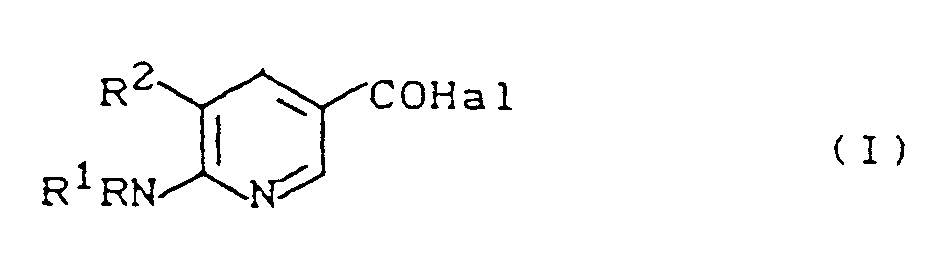
- 1. 5-Halogen-6-amino-nikotinsäurehalogenide der Formel (1)

- R für Wasserstoff oder C1 -3-Alkyl steht,
- R1 für Wasserstoff, C1 -3-Alkyl der C1 -3-Alkanoyl steht,
- R und R1 gemeinsam mit dem Stickstoffatom, an das sie gebunden sind. für einen 5- oder 6- gliedrigen heterocyclischen Rest stehen,
- R 2 für Halogen steht,
- Hal für Halogen steht.
- 2. Verfahren zur Herstellung der 5-Halogen-6-amino-nikotinsäurehalogenide der Formel (I)

- R, R1, R2, Hal die oben angegebene Bedeutung haben,
dadurch gekennzeichnet, daß man 5-Halogen-6-amino-nikotinsäuren der Formel (II)
- R, R1, R2 die oben angegebene Bedeutung haben,
halogeniert. - R, R1, R2, Hal die oben angegebene Bedeutung haben,
- 3. Verwendung von 5-Halogen-6-amino-nikotinsäurehalogeniden der Formel (I)

- R, R1, R2, Hal die oben angegebene Bedeutung haben,
zur Herstellung von 5-Acetylpyridinen der Formel (III)
- R, R1 und R2 die oben angegebene Bedeutung haben,
dadurch gekennzeichnet, daS man 5-Halogen-6-amino-nikotinsäurehalogenide der Formel (I) mit einer Verbindung der Formel (IV)
- R3 für C1-3-Alkyl steht
- R 4 für Wasserstoff steht,
umsetzt und anschließend verseift und decarboxyliert. - R, R1, R2, Hal die oben angegebene Bedeutung haben,
- Mit Hilfe der erfindungsgemäßen 5-Halogen-6-amino-nikotinsäurehalogenide sind die 3-Pyridylalkylketone und über diese die Pyridylethanolamine in guten Ausbeuten und ausgehend von preiswerten Ausgangsprodukten zugänglich.
- Bevorzugt sind Verbindungen der Formel (I), in welcher
- R 2 für Chlor oder Brom steht,
- R für Wasserstoff oder C1-C3-Alkyl steht,
- R1 für Wasserstoff, C1-C3-Alkyl oder C1-C3-Alkanoyl steht,
- Hal für Chlor oder Brom steht.
- Besonders bevorzugt sind Verbindungen der Formel (I), in der
- R2 für Chlor oder Brom steht,
- Hal für Chlor steht,
- R für Wasserstoff oder Methyl steht,
- R1 für Wasserstoff, Methyl oder Acetyl steht
- Im einzelnen seien folgende Verbindungen der Formel (I) genannt:
- 5-Brom-6-aminonikotinsäurechlorid,
- 5-Chlor-6-aminonikotinsäurechlorid,
- 5-Brom-6-methylaminonikotinsäurechlorid,
- 5-Chlor-6-acetaminonikotinsäurechlorid,
- 5-Brom-6-N-pyrrolidino-nikotinsäurechlorid,
- 5-Chlor-6-N-morpholino-nikotinsäurechlorid.
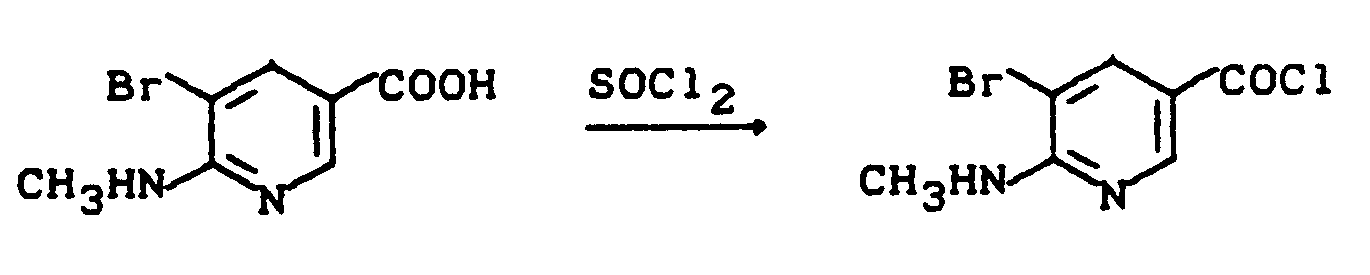
- Setzt man bei Verfahren 2) als 5-Halogen-6-amino-nikotinsäure der Formel (11) 5-Brom-6-methylaminoni- kotinsäure und als Halogenierungsmittel Thionylchlorid ein, läßt sich die Reaktion durch das folgende Schema darstellen:
- Die Verbindungen der Formel (11) sind zum Teil bekannt oder lassen sich analog zu bekannten Verfahren herstellen (Graf, J. prakt. Chem. (2) 138 (1933) S. 244). Bevorzugt sind Verbindungen der Formel (11), in welcher R, R1 und R2 die bei den Verbindungen der Formel (I) angegebenen Bedeutungen besitzen.
- Im einzelnen seien die folgenden Verbindungen der Formel (11) genannt:
- 5-Brom-6-aminonikotinsäure,
- 5-Chlor-6-aminonikotinsäure,
- 5-Brom-6-methylaminonikotinsäure,
- 5-Chlor-6-acetaminonikotinsäure,
- 5-Brom-6-N-pyrrolidino-nikotinsäure,
- 5-Chlor-6-N-morpholino-nikotinsäure.
- Als Halogenierungsmittel werden anorganische Säurechloride verwendet. Beispielhaft seien genannt: Phosphoroxychlorid, Phosphorpentachlorid, Thionylchlorid.
- Die Reaktion wird durchgeführt, indem man eine Verbindung der Formel (II) mit 1 bis 1,5 Äquivalenten des anorganischen Säurechlorids, gegebenenfalls in einem Verdünnungsmittel, behandelt.
- Die Umsetzung wird bei Temperaturen von 20 °C bis 150°C durchgeführt, es wird bevorzugt bei Normaldruck gearbeitet.
- Als Verdünnungsmittel können alle inerten organischen Lösungsmittel verwendet werden. Hierzu zählen insbesondere aliphatische und aromatische gegebenenfalls halogenierte Kohlenwasserstoffe wie Pentan, Hexan, Cyclohexan, Benzol, Toluol, Methylenchlorid, Chloroform, Chlorbenzol; Ether wie Diethylether, Tetrahydrofuran, Dioxan sowie Phosphoroxychlorid.
- Setzt man bei Verfahren 3) als Verbindung der Formel (I) 5-Brom-6-N-pyrrolonikotinsäurechlorid und als Verbindung der Formel (IV) Methoxymagnesiummalonsäuredimethylester ein, läßt sich Verfahren 3) durch das folgende Reaktionsschema darstellen:

- Verbindungen der Formel (IV) sind bekannt (Org. Synth. Coll. Vol. IV (1963), 285; Ber. dt. Chem. Ges. 67 (1934), 935).
- Im einzelnen seien folgende Verbindungen der Formel (IV) genannt:
- Methoxymagnesiummalonsäuredimethylester,
- Ethoxymagnesiummalonsäurediethylester.
- Verfahren 3) wird durchgeführt, indem man äquimolare Mengen der Verbindungen der Formeln (I) und (IV) in einem Verdünnungsmittel zur Reaktion bringt und anschließend verseift, wobei die β-Ketodicarbonsäure decarboxyliert. Als Verdünnungsmittel dienen alle inerten organischen Lösungsmittel. Hierzu zählen gegebenenfalls halogenierte aliphatische und aromatische Kohlenwasserstoffe wie Pentan, Hexan, Benzol, Toluol, Dichlormethan, Chloroform, Chlorbenzol; Ether wie Diethylether, Tetrahydrofuran; Alkohole wie Methanol, Ethanol. Die Reaktion wird bei Temperaturen von 20 ° C bis 150°C, bevorzugt bei der Siedetemperatur des verwendeten Lösungsmittels, durchgeführt.
- Die Verseifung wird mit anorganischen Säuren wie Salzsäure oder Schwefelsäure, organischen Carbonsäuren wie Essigsäure oder Propionsäure durchgeführt. Es können auch Mischungen von anorganischen und organischen Säuren verwendet werden. Die Verseifung kann auch mit Basen wie alkoholischen oder wäßrigen Lösungen von Alkali- und Erdalkalihydroxiden oder -carbonaten z.B. Natrium-, Kalium-, Bariumhydroxid, Natrium-, Kaliumcarbonat durchgeführt werden.
- Die nach dem erfindungsgemäßen Verfahren 3) erhältlichen 2-Amino-3-halogen-5-acetylpyridine werden zur Herstellung von Pyridinethanolaminderivaten verwendet. Dazu werden die Acetylpyridine mit elementarem Halogen oder mit Kupferhalogeniden umgesetzt. Die dabei erhältlichen Halogenmethylpyridylketone werden anschließend mit Amimen umgesetzt, und die dabei erhaltenen Pyridyl-aminomethylketone reduziert. Diese Reaktion läßt sich durch folgendes Formelschema illustrieren:

- Die Halogenmethylpyridylketone können auch zuerst zu den Pyridylhalogenethanolen reduziert und anschließend mit Aminen zu Pyridylethanolaminen umgesetzt werden.
- Die Durchführung dieser Reaktionen ist in der oben erwähnten nicht vorveröffentlichten Anmeldung der Anmelderin Deutsche Patentanmeldung P 36 15 293.5 beschrieben.
- 6,3 g (36 mmol) 5-Chlor-6-amino-nikotinsäure werden in 60 ml Thionylchlorid 4 Stunden unter Rückfluß erhitzt. Nach Abdestillieren der flüchtigen Bestandteile wird der Rückstand mit 50 ml Toluol versetzt und eingedampft. Man erhalt 6,9 g 5-Chlor-6-amino-nikotinsäurechlorid als Kristalle vom Fp.: >250 °C.
- Zur siedenden Lösung von 8,55 g (37,5 mmol) Ethoxymagnesiummalonsäurediethylester (hergestellt nach Org. Synth. Coll. Vo. IV (1963), 285) in 120 ml abs. Tetrahydrofuran werden 7,2 g (37,5 mmol) 5-Chlor-6-aminonikotinsäurechlorid in 10 ml abs. Tetrahydrofuran gegeben, die Mischung wird 2 Stunden unter Rückfluß erhitzt. Nach Neutralisation mit 2N Schwefelsäure wird die organische Phase abgetrennt und eingedampft. Der Rückstand wird in einer Mischung aus 30 ml Eisessig, 20 ml wasser und 5 ml konz. Schwefelsäure 4 Stunden unter Rückfluß erhitzt. Der Ansatz wird in Eiswasser eingerührt, auf pH 4 gestellt und mit Essigester extrahiert. Nach Trocknen und Eindampfen erhält man 5,4 g (85 %) der Titelverbindung, Fp.: 188 ° C.
- Zu einer Lösung von 17,0 g (0,1 mol) 2-Amino-3-chlor-5-acetylpyridin in einer Mischung von 19,3 g Bromwasserstoff (47 %ige wäßrige Lösung; 0,11 mol) und 500 ml Eisessig werden 16 g (0,1 mol) Brom getropft. Man rührt zwei Stunden nach, stellt die Mischung auf pH 8 und extrahiert mit Essigester. Nach Trocknen und Eindampfen erhält man 18,5 g (74 %) der Titelverbindung, Fp. 134°C.
- In eine Lösung von 11,8 g (0,2 mol) Isopropylamin in 150 ml Methanol werden bei 0°C portionsweise 9,98 g (0,04 mol) der unter Beispiel a hergestellten Verbindung eingetragen. Man läßt auf Raumtemperatur kommen, rührt zwei Stunden nach und dampft ein. Der Rückstand wird in Puffer pH 5 aufgenommen und mit Ether gewaschen. Die wäßrige Phase wird auf pH 9 gestellt und mit Essigester extrahiert. Nach Trocknen und Eindampfen werden 6,8 g (75 %) der Titelverbindung als amorphes Pulver erhalten.
- Zur Lösung von 2,28 g (10 mmol) der nach Beispiel b hergestellten Verbindung in 50 ml Methanol werden bei 0 °C portionsweise 0,38 g (10 mmol) Natriumborhydrid gegeben. Man läßt auf Raumtemperatur kommen, stellt mit verdünnter Salzsäure auf pH 1 und dampft ein. Der Rückstand wird in Wasser aufgenommen und mit Ether gewaschen. Dann wird auf pH 10 gestellt und mit Essigester extrahiert. Nach Trocknen und Eindampfen erhält man 2,1 g (92 %) der Titelverbindung, Fp. 146 ° C.
oder R und R1 gemeinsam mit dem Stickstoffatom, an das sie gebunden sind, für einen heterocyclischen Rest stehen,
oder R und R1 gemeinsam mit dem Stickstoffatom, an das sie gebunden sind, für einen 5- oder 6-gliedrigen Ring wie Pyrrolidinyl, Pyrryl, Piperidinyl oder Morpholinyl stehen.
Claims (3)
dadurch gekennzeichnet, daß man 5-Halogen-6-amino-nikotinsäuren der Formel (II)

halogeniert.

zur Herstellung von 5-Acetylpyridinen der Formel (III)

dadurch gekennzeichnet, daß man 5-Halogen-6-amino-nikotinsäurehalogenide der Formel (I) mit einer Verbindung der Formel (IV)

umsetzt und anschließend verseift und decarboxyliert.
Priority Applications (1)
| Application Number | Priority Date | Filing Date | Title |
|---|---|---|---|
| AT88110464T ATE84524T1 (de) | 1987-07-11 | 1988-06-30 | 5-halogen-6-amino-nikotin-saeurehalogenide, ihre herstellung und ihre verwendung. |
Applications Claiming Priority (2)
| Application Number | Priority Date | Filing Date | Title |
|---|---|---|---|
| DE3723069 | 1987-07-11 | ||
| DE19873723069 DE3723069A1 (de) | 1987-07-11 | 1987-07-11 | 5-halogen-6-amino-nikotinsaeurehalogenide, ihre herstellung und ihre verwendung |
Publications (3)
| Publication Number | Publication Date |
|---|---|
| EP0302227A2 EP0302227A2 (de) | 1989-02-08 |
| EP0302227A3 EP0302227A3 (en) | 1989-03-15 |
| EP0302227B1 true EP0302227B1 (de) | 1993-01-13 |
Family
ID=6331447
Family Applications (1)
| Application Number | Title | Priority Date | Filing Date |
|---|---|---|---|
| EP88110464A Expired - Lifetime EP0302227B1 (de) | 1987-07-11 | 1988-06-30 | 5-Halogen-6-amino-nikotin-säurehalogenide, ihre Herstellung und ihre Verwendung |
Country Status (12)
| Country | Link |
|---|---|
| US (1) | US4895950A (de) |
| EP (1) | EP0302227B1 (de) |
| JP (1) | JPS6431768A (de) |
| KR (1) | KR890002011A (de) |
| AT (1) | ATE84524T1 (de) |
| DD (1) | DD274213A5 (de) |
| DE (2) | DE3723069A1 (de) |
| DK (1) | DK384188A (de) |
| ES (1) | ES2053626T3 (de) |
| HU (1) | HU199420B (de) |
| IL (1) | IL87043A (de) |
| ZA (1) | ZA884914B (de) |
Families Citing this family (5)
| Publication number | Priority date | Publication date | Assignee | Title |
|---|---|---|---|---|
| DE4006794A1 (de) * | 1990-03-03 | 1991-09-05 | Bayer Ag | Verfahren zur herstellung von aminoethanolderivaten |
| EP0646566B1 (de) * | 1993-10-05 | 1997-11-19 | Shell Internationale Researchmaatschappij B.V. | Verfahren zur Herstellung von Säurechloriden |
| KR100386086B1 (ko) * | 2000-10-27 | 2003-06-02 | 김병수 | 해조류의 추출물을 이용한 건강식품 및 그의제조방법 |
| US20100016603A1 (en) * | 2007-01-29 | 2010-01-21 | Fujifilm Finechemicals Co., Ltd. | Production process of 2,3'-bipyridyl-6'-one |
| CN105873904B (zh) * | 2013-12-27 | 2018-03-16 | 阿格罗-金正株式会社 | 2‑氨基烟酸苄酯衍生物的制造方法 |
Family Cites Families (3)
| Publication number | Priority date | Publication date | Assignee | Title |
|---|---|---|---|---|
| US4129734A (en) * | 1976-12-03 | 1978-12-12 | The Dow Chemical Company | Substituted pyridine carbonyl halides and derivatives |
| US4596883A (en) * | 1984-07-05 | 1986-06-24 | Ppg Industries, Inc. | Herbicidally active substituted diphenyl ethers |
| DE3615293A1 (de) * | 1986-05-06 | 1987-11-12 | Bayer Ag | Verwendung von heteroarylethylaminen zur leistungsfoerderung bei tieren, heteroarylethylamine und verfahren zu ihrer herstellung |
-
1987
- 1987-07-11 DE DE19873723069 patent/DE3723069A1/de not_active Withdrawn
-
1988
- 1988-06-30 EP EP88110464A patent/EP0302227B1/de not_active Expired - Lifetime
- 1988-06-30 DE DE8888110464T patent/DE3877455D1/de not_active Expired - Fee Related
- 1988-06-30 AT AT88110464T patent/ATE84524T1/de not_active IP Right Cessation
- 1988-06-30 ES ES88110464T patent/ES2053626T3/es not_active Expired - Lifetime
- 1988-07-04 KR KR1019880008248A patent/KR890002011A/ko not_active Ceased
- 1988-07-06 JP JP63167032A patent/JPS6431768A/ja active Pending
- 1988-07-07 US US07/216,047 patent/US4895950A/en not_active Expired - Fee Related
- 1988-07-08 IL IL87043A patent/IL87043A/xx unknown
- 1988-07-08 DD DD88317740A patent/DD274213A5/de not_active IP Right Cessation
- 1988-07-08 ZA ZA884914A patent/ZA884914B/xx unknown
- 1988-07-08 DK DK384188A patent/DK384188A/da not_active Application Discontinuation
- 1988-07-08 HU HU883603A patent/HU199420B/hu not_active IP Right Cessation
Non-Patent Citations (3)
| Title |
|---|
| HOUBEN-WEYL METHODEN DER ORGANISCHEN CHEMIE, 4. Auflage, Band VII/2a, Ketone Teil I, 1973, Georg Thieme Verlag, Stuttgart, DE * |
| HOUBEN-WEYL METHODEN DER ORGANISCHEN CHEMIE, 4. Auflage, Band VII/2b, Ketone Teil II, 1976, Georg Thieme Verlag, Stuttgart, DE * |
| PATENT ABSTRACTS OF JAPAN, Band 10, Nr. 239, 19. August 1986, Seite (C-367)(2295); & JP - A - 61 72 753 * |
Also Published As
| Publication number | Publication date |
|---|---|
| DE3877455D1 (de) | 1993-02-25 |
| US4895950A (en) | 1990-01-23 |
| DK384188A (da) | 1989-01-12 |
| DD274213A5 (de) | 1989-12-13 |
| IL87043A0 (en) | 1988-12-30 |
| KR890002011A (ko) | 1989-04-07 |
| DE3723069A1 (de) | 1989-01-19 |
| EP0302227A3 (en) | 1989-03-15 |
| HU199420B (en) | 1990-02-28 |
| HUT48595A (en) | 1989-06-28 |
| DK384188D0 (da) | 1988-07-08 |
| JPS6431768A (en) | 1989-02-02 |
| IL87043A (en) | 1992-03-29 |
| EP0302227A2 (de) | 1989-02-08 |
| ES2053626T3 (es) | 1994-08-01 |
| ZA884914B (en) | 1989-03-29 |
| ATE84524T1 (de) | 1993-01-15 |
Similar Documents
| Publication | Publication Date | Title |
|---|---|---|
| DE69623532T2 (de) | Verfahren zur Herstellung von 4-Trifluormethylnicotinsäure | |
| DE2655009C2 (de) | ||
| DD280323A5 (de) | Herstellung von zwischenprodukten der oxophthalazinyl-essigsaeuren mit benzothiazol- oder anderen heterocyclischen seitenketten | |
| EP0606065A1 (de) | Verfahren zur Herstellung von Biphenylderivaten | |
| DE69632919T2 (de) | Verfahren zur herstellung von 2-chlor-5-chloromethyl-thiazol | |
| EP0124013B1 (de) | Verfahren zur Herstellung von Oxiranen | |
| EP0299277B1 (de) | Verfahren zur Herstellung von substituierten Pyridylalkylketonen | |
| EP0302227A2 (de) | 5-Halogen-6-amino-nikotin-säurehalogenide, ihre Herstellung und ihre Verwendung | |
| EP0281841A1 (de) | Verfahren zur Herstellung von 5-Amino-4,6-dihalogenpyridinen | |
| EP0454623B1 (de) | Verfahren zur Herstellung von linearen 1,3-Diketonen | |
| DE3871591T2 (de) | Verfahren zur herstellung von 1-propargyl-2,4-dioxoimidazolidin. | |
| CH619955A5 (de) | ||
| DE2627223A1 (de) | Verfahren zur herstellung von 4-benzoylpyrazol-derivaten | |
| EP0341478A2 (de) | Verfahren zur Herstellung von 2,3-Dichlor-5-acetylpyridin | |
| DE1935404B2 (de) | Verfahren zur Herstellung von Chinazolinonen | |
| DE2737481A1 (de) | Verfahren zur herstellung von 2-alkyl- oder 2-cycloalkyl-4-methyl-6-hydroxypyrimidinen | |
| DE3314029C2 (de) | ||
| EP0268964B1 (de) | Verfahren zur Herstellung von 6-Hydroxy-3-pyridincarbonsäureestern | |
| DE3840342A1 (de) | Verfahren zur herstellung von 4-chlorpyrazolen | |
| EP0115811B1 (de) | 2,4-Dichlor-5-thiazolcarboxaldehyd und ein Verfahren zu seiner Herstellung | |
| EP0290903B1 (de) | Beta-Fluoracyl-beta-halogenvinylalkylether | |
| DE69018619T2 (de) | Alpha, beta-ungesättigte ketone und ketoximderivat. | |
| DE69711397T2 (de) | Herstellung von einem hydrazon-beta-ketoester durch reaktion mit einem diazoester | |
| EP0238569B1 (de) | Verfahren zur herstellung von cycloalkancarbonsäuren | |
| DE3808115A1 (de) | Verfahren zur herstellung von 6-acetyl-3-amino-2,4-dihalogen-pyridin |
Legal Events
| Date | Code | Title | Description |
|---|---|---|---|
| PUAI | Public reference made under article 153(3) epc to a published international application that has entered the european phase |
Free format text: ORIGINAL CODE: 0009012 |
|
| PUAL | Search report despatched |
Free format text: ORIGINAL CODE: 0009013 |
|
| 17P | Request for examination filed |
Effective date: 19880707 |
|
| AK | Designated contracting states |
Kind code of ref document: A2 Designated state(s): AT BE CH DE ES FR GB IT LI NL |
|
| AK | Designated contracting states |
Kind code of ref document: A3 Designated state(s): AT BE CH DE ES FR GB IT LI NL |
|
| 17Q | First examination report despatched |
Effective date: 19910702 |
|
| PGFP | Annual fee paid to national office [announced via postgrant information from national office to epo] |
Ref country code: LU Payment date: 19920903 Year of fee payment: 5 |
|
| GRAA | (expected) grant |
Free format text: ORIGINAL CODE: 0009210 |
|
| EPTA | Lu: last paid annual fee | ||
| AK | Designated contracting states |
Kind code of ref document: B1 Designated state(s): AT BE CH DE ES FR GB IT LI NL |
|
| REF | Corresponds to: |
Ref document number: 84524 Country of ref document: AT Date of ref document: 19930115 Kind code of ref document: T |
|
| REF | Corresponds to: |
Ref document number: 3877455 Country of ref document: DE Date of ref document: 19930225 |
|
| GBT | Gb: translation of ep patent filed (gb section 77(6)(a)/1977) |
Effective date: 19930129 |
|
| ITF | It: translation for a ep patent filed | ||
| ET | Fr: translation filed | ||
| ITTA | It: last paid annual fee | ||
| PG25 | Lapsed in a contracting state [announced via postgrant information from national office to epo] |
Ref country code: AT Effective date: 19930630 |
|
| PLBE | No opposition filed within time limit |
Free format text: ORIGINAL CODE: 0009261 |
|
| STAA | Information on the status of an ep patent application or granted ep patent |
Free format text: STATUS: NO OPPOSITION FILED WITHIN TIME LIMIT |
|
| 26N | No opposition filed | ||
| REG | Reference to a national code |
Ref country code: ES Ref legal event code: FG2A Ref document number: 2053626 Country of ref document: ES Kind code of ref document: T3 |
|
| PGFP | Annual fee paid to national office [announced via postgrant information from national office to epo] |
Ref country code: DE Payment date: 19950515 Year of fee payment: 8 |
|
| PGFP | Annual fee paid to national office [announced via postgrant information from national office to epo] |
Ref country code: ES Payment date: 19950608 Year of fee payment: 8 |
|
| PGFP | Annual fee paid to national office [announced via postgrant information from national office to epo] |
Ref country code: CH Payment date: 19950613 Year of fee payment: 8 |
|
| PGFP | Annual fee paid to national office [announced via postgrant information from national office to epo] |
Ref country code: FR Payment date: 19950616 Year of fee payment: 8 |
|
| PGFP | Annual fee paid to national office [announced via postgrant information from national office to epo] |
Ref country code: GB Payment date: 19950619 Year of fee payment: 8 |
|
| PGFP | Annual fee paid to national office [announced via postgrant information from national office to epo] |
Ref country code: NL Payment date: 19950627 Year of fee payment: 8 |
|
| PGFP | Annual fee paid to national office [announced via postgrant information from national office to epo] |
Ref country code: BE Payment date: 19950628 Year of fee payment: 8 |
|
| PG25 | Lapsed in a contracting state [announced via postgrant information from national office to epo] |
Ref country code: LI Effective date: 19960630 Ref country code: GB Effective date: 19960630 Ref country code: CH Effective date: 19960630 Ref country code: BE Effective date: 19960630 |
|
| PG25 | Lapsed in a contracting state [announced via postgrant information from national office to epo] |
Ref country code: ES Free format text: LAPSE BECAUSE OF THE APPLICANT RENOUNCES Effective date: 19960701 |
|
| BERE | Be: lapsed |
Owner name: BAYER A.G. Effective date: 19960630 |
|
| PG25 | Lapsed in a contracting state [announced via postgrant information from national office to epo] |
Ref country code: NL Effective date: 19970101 |
|
| REG | Reference to a national code |
Ref country code: CH Ref legal event code: PL |
|
| GBPC | Gb: european patent ceased through non-payment of renewal fee |
Effective date: 19960630 |
|
| PG25 | Lapsed in a contracting state [announced via postgrant information from national office to epo] |
Ref country code: FR Effective date: 19970228 |
|
| PG25 | Lapsed in a contracting state [announced via postgrant information from national office to epo] |
Ref country code: DE Effective date: 19970301 |
|
| NLV4 | Nl: lapsed or anulled due to non-payment of the annual fee |
Effective date: 19970101 |
|
| REG | Reference to a national code |
Ref country code: FR Ref legal event code: ST |
|
| REG | Reference to a national code |
Ref country code: ES Ref legal event code: FD2A Effective date: 19991007 |
|
| PG25 | Lapsed in a contracting state [announced via postgrant information from national office to epo] |
Ref country code: IT Free format text: LAPSE BECAUSE OF NON-PAYMENT OF DUE FEES;WARNING: LAPSES OF ITALIAN PATENTS WITH EFFECTIVE DATE BEFORE 2007 MAY HAVE OCCURRED AT ANY TIME BEFORE 2007. THE CORRECT EFFECTIVE DATE MAY BE DIFFERENT FROM THE ONE RECORDED. Effective date: 20050630 |