EP0294643B1 - Prüfungssystem für eine Mikrokreisanordnung mit Redundanzkreisanlagen - Google Patents
Prüfungssystem für eine Mikrokreisanordnung mit Redundanzkreisanlagen Download PDFInfo
- Publication number
- EP0294643B1 EP0294643B1 EP88108262A EP88108262A EP0294643B1 EP 0294643 B1 EP0294643 B1 EP 0294643B1 EP 88108262 A EP88108262 A EP 88108262A EP 88108262 A EP88108262 A EP 88108262A EP 0294643 B1 EP0294643 B1 EP 0294643B1
- Authority
- EP
- European Patent Office
- Prior art keywords
- light
- circuit patterns
- die
- lens
- pattern
- Prior art date
- Legal status (The legal status is an assumption and is not a legal conclusion. Google has not performed a legal analysis and makes no representation as to the accuracy of the status listed.)
- Expired - Lifetime
Links
Images


Classifications
-
- G—PHYSICS
- G01—MEASURING; TESTING
- G01N—INVESTIGATING OR ANALYSING MATERIALS BY DETERMINING THEIR CHEMICAL OR PHYSICAL PROPERTIES
- G01N21/00—Investigating or analysing materials by the use of optical means, i.e. using sub-millimetre waves, infrared, visible or ultraviolet light
- G01N21/84—Systems specially adapted for particular applications
- G01N21/88—Investigating the presence of flaws or contamination
- G01N21/95—Investigating the presence of flaws or contamination characterised by the material or shape of the object to be examined
- G01N21/956—Inspecting patterns on the surface of objects
- G01N21/95623—Inspecting patterns on the surface of objects using a spatial filtering method
-
- G—PHYSICS
- G01—MEASURING; TESTING
- G01N—INVESTIGATING OR ANALYSING MATERIALS BY DETERMINING THEIR CHEMICAL OR PHYSICAL PROPERTIES
- G01N21/00—Investigating or analysing materials by the use of optical means, i.e. using sub-millimetre waves, infrared, visible or ultraviolet light
- G01N21/84—Systems specially adapted for particular applications
- G01N21/88—Investigating the presence of flaws or contamination
- G01N21/8806—Specially adapted optical and illumination features
-
- G—PHYSICS
- G01—MEASURING; TESTING
- G01N—INVESTIGATING OR ANALYSING MATERIALS BY DETERMINING THEIR CHEMICAL OR PHYSICAL PROPERTIES
- G01N21/00—Investigating or analysing materials by the use of optical means, i.e. using sub-millimetre waves, infrared, visible or ultraviolet light
- G01N21/84—Systems specially adapted for particular applications
- G01N21/88—Investigating the presence of flaws or contamination
- G01N21/95—Investigating the presence of flaws or contamination characterised by the material or shape of the object to be examined
- G01N21/9501—Semiconductor wafers
Definitions
- the present invention relates to inspection systems for use in the manufacture of microcircuits and, in particular, to a real-time defect inspection system for use in the manufacture of microcircuits of the type that includes an array of dies each having many redundant circuit patterns.
- This task is accomplished by illuminating simultaneously all of the dies of a specimen photomask with collimated coherent light emanating from a laser to develop a composite diffraction pattern whose spatial distribution is the combination of two components.
- the first component is the interference pattern of the array of dies
- the second component is the interference pattern of a single die of the array.
- the first and second components are sometimes called an inter-die interference pattern and an intra-die interference pattern, respectively.
- the light transmitted by the photomask strikes a double-convex lens which distributes the light on a spatial filter positioned a distance equal to one focal length behind the lens.
- the spatial filter comprises a two-dimensional Fourier transform pattern of a known error-free reference photomask against which the specimen photomask is compared.
- the filter is opaque in the areas corresponding to spatial frequency components of the error-free Fourier transform pattern and is transparent in areas not included in the error-free Fourier transform pattern.
- the Mathisen patent specifies the design parameters of the lens. The Mathisen patent states only that the lens is of suitable numerical aperture and magnification power to cover the area of the specimen photomask.
- the spatial frequency components corresponding to the defects in the specimen photomask are largely transmitted through the spatial filter and can be processed in either one of two ways.
- the light transmitted through the spatial filter strikes another double-convex lens that is properly positioned to define an image of the specimen photomask, absent any information blocked by the spatial filter.
- the imaging light not blocked by the spatial filter appears in locations that represent the position in the specimen photomask where defects are present.
- the light transmitted through the spatial filter is sensed by a photodetector that produces an output signal which activates a "no-go" alarm.
- the Watkins and Mathisen patents imply that systems of the type they describe require both inter- and intra-die interference pattern information to determine the presence of defects in the specimen pattern.
- the inter-die interference pattern information is of particular concern because it consists of very closely spaced light spots that are extremely difficult to resolve by a Fourier transform lens.
- the realization of such a lens is further complicated for inspection systems that use an inverse Fourier transform lens to form an image of the specimen pattern from the Fourier transform light pattern.
- the reason is that the design of each of the lenses is compromised to accomplish an overall system design that accomplishes both the Fourier transform pattern and image forming functions. It is, therefore, exceedingly difficult to obtain from such a system design the resolution required to acquire inter-die interference pattern information.
- the above lens design problem is encountered in systems of the type that simultaneously inspects the entire area of each of the dies of a specimen photomask array and, as a consequence, renders such systems unreliable and impracticable for commercial use.
- Iwamoto's system inspects a periodic array of holes, such as in a vidicon or shadow mask, by rotating and translating the specimen during inspection and using a bandpass spatial filter composed of a transparent ring that passes light only between the zeroth and first order maxima.
- a bandpass spatial filter composed of a transparent ring that passes light only between the zeroth and first order maxima.
- Iwamoto's system does not require a highly accurate lens capable of focusing higher orders of the diffraction pattern, because it blocks those orders.
- An object of the present invention is, therefore, to provide a reliable defect inspection system for use in the manufacture of microcircuits.
- Another object of this invention is to provide such a system that applies the techniques of Fourier optics but does not contemplate the use of inter-die interference pattern information to determine the presence of defects in the manufacture of microcircuits of the type that comprises an array of normally identical dies.
- a further object of this invention is to provide such a system that is capable of developing from a microcircuit pattern an essentially aberration-free Fourier transform light pattern from which an accurate image corresponding to defects in the microcircuit pattern can be formed.
- Still another object of this invention is to provide an inspection method that uses intra-die interference pattern information to determine the presence of defects in a microcircuit array pattern of normally identical dies.
- the invention provides a detection method having the features of claim 1.
- the invention provides a detection system having the features of claim 19.
- the present invention relates to a method and system for use in the manufacture of microcircuits and is described herein by way of example only with reference to a real-time inspection system for defects in surfaces of semiconductor wafers of the type that includes an array of circuit dies of which each has many redundant circuit patterns.
- semiconductor wafers include, for example, random access and read only memory devices and digital multipliers.
- Two preferred embodiments of the inspection system employ a Fourier transform lens and an inverse Fourier transform lens positioned along an optic axis to produce from an illuminated area of a patterned specimen wafer a spatial frequency spectrum whose frequency components can be selectively filtered to produce an image pattern of defects in the illuminated area of the wafer.
- the lenses collect light diffracted by a wafer die aligned with the optic axis and light diffracted by other wafer dies proximally located to such die, rather the light diffracted by the entire wafer. This restriction limits the applicability of the inspection system to dies having many redundant circuit patterns but permits the use of lenses that introduce off-axis aberrations that would otherwise alter the character of the Fourier transform pattern and the filtered defect image.
- Such lenses are relatively easy to manufacture because the redundant circuit patterns typically repeat at 50 micron intervals and thereby produce spatial frequency components spaced apart by a distance of about 1.0 millimeter, which is resolvable by conventional optical components.
- the Fourier transform and imaging areas are preferably of sufficient sizes to accommodate light from only the wafer die aligned with the optic axis.
- the spatial filter blocks the spatial frequencies of the error-free Fourier transform of such die, i.e. , the spatial filter contains only intra-die interference pattern information.
- the wafer is positioned in the front focal plane of the Fourier transform lens, and the patterned surface of the wafer is illuminated by a collimated laser beam.
- the Fourier transform pattern of the illuminated wafer surface is formed in the back focal plane of the Fourier transform lens.
- a previously fabricated spatial filter is positioned in the plane of the Fourier transform pattern and effectively stops the light transmission from the redundant circuit patterns of the illuminated dies of the wafer but allows the passage of light originating from possible defects.
- the inverse Fourier transform lens receives the light either transmitted through or reflected by the spatial filter and performs the inverse Fourier transform on the filtered light diffracted by the illuminated wafer area.
- the spatial filter is of a type that transmits or reflects light depends on the embodiment of inspection system in which it is incorporated.
- the filtered image strikes the surface of a two-dimensional photodetector array which detects the presence of light corresponding to defects in only the illuminated on-axis wafer die.
- the photodetector array is centrally positioned about the optic axis and has a light-sensitive surface area of insufficient size to cover the image plane area in which the defect image corresponding to the on-axis die appears.
- the inspection of all possible defects in the portions of the wafer surface having many redundant circuit patterns is accomplished by mounting the wafer onto a two-dimensional translation stage and moving the stage so that the illumination area defined by the laser beam continuously scans across the wafer surface from die to die until the desired portions of the wafer surface have been illuminated.
- the use of a time delay integration technique permits continuous stage movement and inspection of the portions of the wafer surface having many redundant circuit patterns in a stripe-to-stripe raster scan fashion.
- the present invention is advantageous because the spatial filter need not be fabricated with the use of an error-free specimen wafer. The reason is that any defects present in such a wafer would product light of insufficient intensity to expose the spatial filter recording medium.
- the present invention detects defects in a specimen pattern by using only intra-die information corresponding to areas of the specimen pattern having many redundant circuit patterns.
- the premises underlying the inspection method of the present invention are that inter-die interference pattern information is unnecessary if only areas of many redundant patterns are inspected and that inspection of only such areas provides sufficient statistical sampling to determine the defect distribution for the entire specimen pattern.
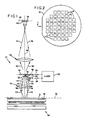
- FIG. 1 is a schematic diagram of the optical components of a first preferred embodiment of the defect inspection system of the present invention.
- FIG. 2 is a diagram of a semiconductor wafer comprising a regular array of normally identical dies of the type suitable for defect inspection by the systems of FIGS. 1 and 6.
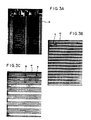
- FIGS. 3A-3C are photographs of an exemplary single die of the semiconductor wafer of FIG. 2 showing within such die a highly redundant circuit pattern for consecutively increasing magnifications.
- FIG. 4 is a simplified diagram showing the asymmetry of the Fourier transform and inverse Fourier transform lens system incorporated in the defect inspection system of FIG. 1.
- FIG. 5 is a diagram showing the optical elements of the lens system of FIG. 4.
- FIG. 6 is a schematic diagram of the optical components of a second preferred embodiment of the defect inspection system of the present invention.
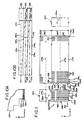
- FIG. 7 is a cross sectional view of the spatial filter employed in the defect inspection system of FIG. 6.
- FIG. 8 shows the optical components of the Fourier transform and the inverse Fourier transform lens system incorporated in the defect inspection system of FIG. 6.
- FIG. 9 is an isometric view of the scanning mechanism for detecting the presence and locations of defects in the semiconductor wafer of FIG. 2.
- FIG. 10A is an enlarged fragmentary view showing three stripe regions in the lower left-hand corner of the semiconductor wafer of FIG. 9.
- FIG. 10B is an enlarged, not-to-scale view of the stripe regions of FIGS. 9 and 10A that shows the raster scan path followed by the scanning mechanism of FIG. 9 relative to a light sensitive detector to detect defect images in a defect image field.
- FIG. 11 is a diagram showing an array of pixel elements in the defect image field under tenfold magnification and an array of light detecting elements of a charge-coupled device used in the present invention.
- FIG. 1 is a schematic diagram of a first preferred embodiment of an inspection system 10 of the present invention that is designed to detect semiconductor wafer defects having a diameter of about one-quarter micron or larger in the presence of a periodic structure comprising many redundant circuit patterns.
- FIG. 2 is a diagram of a semiconductor wafer 12 of the type inspection system 10 is designed to inspect for defects.
- Wafer 12 includes a regular array of normally identical dies 14 of which each has at least about twenty redundant circuit patterns 16 along each of the X-axis 18 and Y-axis 20.
- Each die 14 is typically of square shape with about 3 millimeter sides.
- FIGS. 3A-3C are photographs of an exemplary single die 14 showing highly repetitive circuit pattern within such element for consecutively increasing magnifications. Although they are of rectangular shape as shown in FIGS. 3A-3C, circuit patterns 16 are assumed for purposes of simplifying the following discussion to be of square shape with about 50 micron sides.
- inspection system 10 includes a laser source 22 that provides a nearly collimated beam of 442.5 nanometer monochromatic light rays 24 that strike a lens 26 that converges the light rays to a point 28 located in the back focal plane of lens 26.
- the light rays 30 diverging from focal point 28 strike a small mirror 32 that is positioned a short distance from focal point 28 to reflect a relatively narrow circular beam of light toward a Fourier transform lens section 34, which is shown in FIG. 1 as a single element but which is implemented in five lens elements as will be further described below.
- Mirror 32 obscures a small region in the center of the Fourier transform plane defined by lens section 34. The size of the obscured region is sufficiently small so that defect information, which is located everywhere in the Fourier transform plane, is only insignificantly blocked by mirror 32.
- the effective center of Fourier transform lens section 34 is positioned a distance of slightly less than one focal length away from mirror 32 to provide collimated light rays 36 that strike the patterned surface of wafer 12.
- Wafer 12 is mounted in a chuck 38 that constitutes part of a two-dimensional translation stage 40.
- Wafer 12 is positioned in the object or front focal plane 42 of lens section 34, and the collimated light rays 36 illuminated the patterned surface of wafer 12.
- the collimated light rays 36 illuminate a 20 millimeter diameter area of the surface of wafer 12.
- the light rays 44 diffracted by the illuminated area of wafer 12 pass through lens section 34 and form the Fourier transform pattern of the illuminated wafer surface in the back focal plane 46 of lens section 34.
- the Fourier transform pattern comprises an array of bright spots of light that are distributed in back focal plane 46 in a predictable manner.
- the 20 millimeter diameter illuminated area of wafer 12 provides a Fourier transform pattern of sufficient accuracy because it is formed from many redundant circuit patterns.
- the design of lens section 34 is, however, such that it has only a 3 millimeter object field diameter to form in the image plane 60 an essentially aberration-free image of defects in the semiconductor wafer. An entire die can be inspected for defects because translation stage 40 moves the die through the illuminated area.
- an inverse Fourier transform lens section 54 of relatively small object field diameter collects the light diffracted by the central portion of the illuminated area to minimize the introduction of aberrations into the image as it is formed.
- a previously fabricated spatial filter 50 is positioned in the plane 46 of the Fourier transform pattern.
- Spatial filter 50 can be fabricated in situ by exposing a recording medium, such as a photographic plate, to light diffracted by all of the dies 14 of wafer 12. This can be accomplished with nonerror-free wafer 12 because the defect information carried by light of relatively low intensity would not expose the photographic plate while Fourier transform information carried by relatively high intensity light exposes the photographic plate.
- Spatial filter 50 can also be fabricated in accordance with known computer generation techniques.
- Spatial filter 50 blocks the spatial frequencies of the error-free Fourier transform of the illuminated dies 14 of wafer 12 but allows the passage of light originating from possible defects in, and light diffracted by other wafer dies proximally located to, such dies.
- the defect-carrying light rays 52 not blocked by spatial filter 50 strikes inverse Fourier transform lens section 54, which is shown schematically as a single lens but includes four lens elements as will be further described below.
- Inverse Fourier transform lens section 54 performs the inverse Fourier transform on the filtered light pattern of the illuminated wafer dies 14.
- Lens section 54 is positioned a distance of one focal length away from back focal plane 46 of lens section 34.
- the elements of lens sections 34 and 54 are aligned along the same optic axis 48, and translation stage 40 moves the wafer dies 14 across the optic axis 48.
- a photodetector array 58 is centrally positioned about optic axis 48 in an image plane 60 and receives the image of the defects present in the on-axis portion of wafer die 14.
- Image plane 60 is located in the back focal plane of lens section 54.
- the magnification of lens section 54 is of an amount that approximately matches the resolution limit of the image to the pixel size of photodetector array 58.
- photodetector array 58 has a light sensitive surface 62 whose dimensions are about 10 millimeters x 10 millimeters within the 30 millimeter diameter image area. A tenfold magnification is, therefore, the proper amount to detect defects in the 3 millimeter diameter area of the on-axis wafer die 14.
- translation stage 40 sequentially moves each portion of the die 14 of wafer 12 to optic axis 48 for illumination by the light emanating from the light source 22.
- the area of light sensitive surface 62 of the stationary photodector array 58 limits the amount of light detected to that of a portion of the image corresponding to only the wafer die 14 centered about optic axis 48.
- the image information corresponding to any portion of illuminated off-axis wafer dies 14 cannot, therefore, reach photodetector array 58.
- the movement of translation stage 40 is continuous in a stripe-to-stripe raster fashion to implement a time delay integration technique for collecting the defect image information for each die 14 on the patterned surface of wafer 12.
- the Fourier transform lens section 34 and inverse Fourier transform lens section 54 are designed as part of one optical system 68 and collectively have ten elements as shown in Fig. 4.
- the design of optical system 68 is complicated by the stringent requirements for two important design parameters, namely, the minimum spot diameter "d1" in Fourier transform plane 46 and minimum spot diameter "d2" in image plane 60.
- a small minimum spot diameter in Fourier transform plane 46 is required to resolve the bright spots produced in such plane by circuit patterns 16 of the largest expected size.
- the required spot diameter d1 satisfies the following expression: d1 « ⁇ f1/c, where ⁇ is the wavelength of light emanating from laser source 22, f1 is the effective focal length of lens section 34, and c is the length of a side of the square pattern 16.
- ⁇ is the wavelength of light emanating from laser source 22
- f1 is the effective focal length of lens section 34
- c is the length of a side of the square pattern 16.
- a spot diameter d1 of 20 microns can be realized for c ⁇ 300 microns.
- a small minimum spot diameter in image plane 60 determines the smallest possible detectable defect size.
- the minimum spot diameter d2 is determined by the cooperation of lens sections 34 and 54, and the image magnification "m."
- a defect of a diameter greater than d2/m can be measured from the spatial spread of its image.
- a defect of a diameter less than d2/m i.e. , a subresolution defect, has an image spread that equals d2 but has an image intensity that decreases quadradically with increasing diameter.
- optical system 68 is a near diffraction-limited optical system that accepts light diffracted into a ⁇ 15° - 20° telecentric cone, forms the periodic structure of the Fourier transform of the object (i.e. , the redundant circuit patterns of a wafer die 14), and produces a detectable image of one-quarter micron or larger diameter defects.
- the design of lens section 34 is of asymmetric character to form nearly diffraction-limited light pattern at the Fourier transform plane 46. The reason for the asymmetry is that the diffraction angle of optical system 68 is relatively large ( ⁇ 15° - 20°) and the 3 millimeter diameter of the surface to be imaged is moderately large.
- Lens section 54 requires a relatively long focal length f2 to achieve the 10X image magnification.
- the design of lens section 54 is of asymmetric character and the entrance pupil is positioned closer to the front lens element 72 of lens section 54 to balance residual aberrations introduced by lens section 34 and to minimize the length of optical system 68 and the diameters of the lens elements incorporated in it.
- the plane of lens section 54 is positioned nearly in contact with Fourier transform plane 46 to provide a compact spatial filtering arrangement. Sufficient space is required between lens section 54 and Fourier transform plane 46 to introduce the illuminating beam through the Fourier transform plane, and to accommodate the mechanical structure that supports spatial filter 50.
- Lens section 34 is designed to meet the following two performance requirements.
- the first and most demanding requirement is that light diffracted into a ⁇ 15° - 20° telecentric cone from any point on a 3 millimeter diameter object placed at the object or front focal plane 42 is collimated with sufficiently small light ray aberrations to permit the ultimate formation of a near diffraction-limited image with very little geometric distortion.
- the second requirement is that plane waves propagating through a 20 millimeter object diameter over a range of ⁇ 15° - 20° have minimum vignetting and produce a light pattern at Fourier transform plane 46 of less than 20 micron resolution spot diameter.
- lens section 34 at Fourier transform plane 46 be 1) isoplanatic (i.e. , the aberrations remain constant over a small section of the Fourier transform image field so that the lens is a linear, shift-invariant filter of spatial frequencies), 2) essentially aplanatic ( i.e. , free from spherical and coma aberrations), and 3) essentially anastigmatic ( i.e. , having a flat field with no anastigmatism) for incident plane waves over a ⁇ 15° - 20° diffraction angle and over a 20 millimeter entrance pupil diameter.
- lens section 34 To produce a nearly diffraction-limited image at image plane 60, lens section 34 must also produce a plane wave for a point object placed within a 3 millimeter diameter region in the object or front focal plane 42 of the lens. This requires that the chief rays over the ⁇ 15° - 20° diffraction angle range must be force to be telecentric ( i.e. , parallel to optic axis 48) during the design of lens section 34 so that residual aberrations presented to lens section 54 will be very small and compensatible.
- lens section 34 assumes that it receives light emanating from an infinitely distant object with a ⁇ 15° - 20° subtense and an entrance pupil placed at front focal plane 42.
- the Fourier transform light pattern is, therefore, located at the back focal plane 46 of the lens.
- lens section 34 includes five elements positioned along and centered about optic axis 48.
- Element 72 is a double-convex lens and element 74 is a positive meniscus lens that are positioned close to the entrance pupil of lens system 68 to control spherical aberrations.
- a double-concave lens 76 controls the field curvature, and double-convex lens 78 and positive meniscus lens 80 are positioned in the converging beam to control astigmatism.
- lens section 34 requires the five elements 72, 74, 76, 78, and 80, which are constructed from glass of a high refractive index.
- lens section 54 balances the residual spherical and coma aberrations introduced by lens section 34 when object points are placed at its front focal plane 46 within a 3 millimeter object diameter.
- a double-convex lens element 70 and a double-concave element 84 are positioned close to Fourier transform plane 46 to cancel the residual spherical aberrations introduced by lens section 34.
- a negative meniscus lens element 86 cancels the coma aberrations introduced by lens section 34.
- a positive meniscus lens element 88 of weak positive power distributes the refractive power of lens section 54 so that elements 70, 84, and 86 can introduce the right amount of spherical and coma aberrations to cancel residual aberrations from lens section 34.
- Lens element 88 also helps correct the astigmatism in the image plane 60.
- a plano-convex lens element 90 of weak positive power is positioned reasonably close to image plane 60 to control geometric distortion in the image.
- the positive power of element 90 diminishes, however, the correction of field curvature and astigmatism.
- the image quality at image plane 60 marginally meets the design objectives because of the limitations imposed by such imbalance of field curvature and astigmatism and the existence of higher order residual spherical aberrations introduced by lens section 34.
- Tables I and II summarize the design specifications for and the spacing between adjacent elements of optical system 68.
- Table I includes the prescription for the elements of lens section 34 and spatial filter 50
- Table II includes the prescription for the elements of lens section 54.
- the surfaces a-w correspond in general to lettered surfaces in FIG. 5, in which surface "a" corresponds to the object plane 42 and surface "w" corresponds to the image plane 60.
- Surface l1 and l2 correspond to spatial filter 50. In each instance, the radius and aperture diameter of the surface are given and the shape of each surface is spherical, except for surfaces a, l1, l2, v, and w, which are flat.
- a positive radius for a surface indicates the center of curvature is to the right in the drawing, and a negative radius indicates the center of curvature is to the left in the drawing (FIG. 5). Dimensions are given in millimeters, and the axial distance to the next surface is measured from left to right in FIG. 5.
- FIG. 6 is a schematic diagram of a second preferred embodiment of an inspection system 100 of the present invention that is designed to detect defects in semiconductor wafers of the kind inspected by the above-described inspection system 10.
- Inspection system 100 is designed to meet approximately the same performance specifications as those of inspection system 10.
- Inspection system 100 includes a folded Fourier transform optical system that includes an analytically defined Fourier transform spectral pattern that is inscribed in a liquid crystal layer spatial filter 102.
- the liquid crystal spatial filter 102 scatters light of the spatial frequencies associated with the regular and periodic structure of, and reflects light of spatial frequencies associated with defects in, the patterned surface of semiconductor wafer 12. That spatial filter 102 reflects light originating from possible defects in wafer 12 dictates the folded Fourier optical configuration of inspection system 100.
- inspection system 100 includes a laser source 104 that provides a nearly collimated beam of 442.5 nanometer monochromatic light rays 106 that strike a lens 108 that converges the light rays to a point 110 located at the center of the aperture of a pinhole spatial filter 112.
- the beam of light emitted by laser 104 is linearly polarized in the plane of FIG. 6.
- the light rays 114 diverging from focal point 110 strike a polarizing beam splitter 116 of the plate type which reflects light rays polarized in the plane perpendicular to the plane of FIG. 6 but transmits light rays polarized in the plane of FIG. 6.
- a quarter-wave plate 118 receives and imparts circular polarization to the light rays 114 transmitted through beam splitter 116.
- the circularly polarized light rays 114 exiting quarter-wave plate 118 are confined to a relatively narrow circular beam and propagated toward a Fourier transform lens section 120, which is shown in FIG. 6 as a single element but which is implemented in five lens elements as will be further described below.
- the effective center of Fourier transform lens section 120 is positioned a distance of one focal length away from pinhole spatial filter 112 to provide collimated circularly polarized light rays 122 that strike the patterned surface of wafer 12.
- Wafer 12 is mounted in chuck 38 on translation stage 40, and the collimated light rays 122 illuminate a 20 millimeter diameter of the surface of wafer 12, which is positioned in a front focal or object plane 124 in a manner analogous to that described above for inspection system 10.
- Circularly polarized light rays 126 diffracted by the illuminated area of wafer 12 propagate through lens section 120 and quarter-wave plate 118, which develops linearly polarized light rays 128 in a direction perpendicular to the plane of FIG. 6.
- the light rays 128 reflect off polarizing beam splitter 116 toward a quarter-wave plate 130, which imparts circular polarization to light rays 126.
- the circularly polarized light rays 132 exiting quarter-wave plate 130 strike the laser absorbing layer 134 of spatial filter 102.
- the light rays 132 form the Fourier transform pattern of the illuminated wafer surface in the back focal plane 136 of lens section 120.
- Spatial filter 102 blocks by absorption the spatial frequencies of the error-free Fourier transform of the illuminated dies 14 of wafer 12 but allows by reflection the passage of light originating from possible defects in such die. Spatial filter 102 differs from spatial filter 50 in two major respects. First, the error-free Fourier transform pattern is inscribed in a liquid crystal layer for spatial filter 102 and in a photographic emulsion deposited on a photographic plate for spatial filter 50. Second, spatial filter 102 is of a reflective type, and spatial filter 50 is of a transmissive type.
- the defect-carrying circularly polarized light rays 138 reflected by spatial filter 102 propagate through quarter-wave plate 130, which alters the circular polarization of the light rays and develops linearly polarized light rays 140 whose polarization direction is in the plane of FIG. 6.
- the light rays 140 propagate through beam splitter 116 and strike an inverse transform Fourier lens section 142, which is shown schematically as a single lens but includes five lens elements as will be further described below.
- Inverse Fourier transform lens section 142 performs the inverse Fourier transform on the filtered light pattern of the illuminated wafer dies 14.
- Lens section 142 is positioned a distance of one focal length away from back focal plane 136 of lens section 120.
- lens sections 120 and 142 are aligned along or are decentered relative to the same optic axis 144, which is folded into two sections 146 and 148 at the plane of beam splitter 116.
- Translation stage 40 moves the wafer dies 14 across section 146 of optic axis 144.
- Photodetector array 58 is centrally positioned about optic axis 144 in an image plane 150 and receives the image of the defects present on the on-axis position wafer die 14.
- Image plane 150 is located in the back focal plane of lens section 142.
- the magnification of lens section 54 is the same as that of, and is determined for the same reasons as those described for, lens section 54 of inspection system 10. The inspection of the entire patterned surface of wafer 12 is accomplished in a manner analogous to that described below for inspection system 10.
- FIG. 7 is a cross sectional view of spatial filter 102, which constitutes a laser smectic light valve in which the error-free Fourier transform pattern of wafer 12 is inscribed.
- the laser smectic light valve of the type employed in the present invention is described in Kahn, Frederic J., "LARGE AREA, ENGINEERING DRAWING QUALITY DISPLAYS USING LASER ADDRESSED SMECTIC LIQUID CRYSTAL LIGHT VALVES," Automation Technology Institute Conference , Montreal, Canada, February 1987.
- spatial filter 102 comprises a pair of spaced-apart glass substrates 160 and 162 that capture a smectic liquid crystal material 164 between them.
- a laser absorber layer 166 is applied to the inner surface of glass substrate 160.
- a reflector electrode 168 is applied to the inner surface of laser absorber layer 166, and a transparent electrode 170 is applied to the inner surface of glass substrate 162.
- Director alignment layers 172 are applied to the inner surface of reflector electrode 168 and the inner surface of transparent electrode 170.
- the directors 174 of the liquid crystal material 164 contained within the cell have the layered parallel ordering of the smectic phase.
- the error-free Fourier transform pattern is inscribed in spatial filter 102 in the following way.
- a narrowly focused writing laser beam 176 propagates through glass substrate 160 and is focused on laser absorber layer 166, which absorbs the incident laser light and converts it into heat.
- the heat rapidly diffuses into a localized volume of liquid crystal material 164, raising the temperature of such localized volume by a sufficient amount to heat it above a critical transition temperature.
- the temperature increase is approximately several degrees Centigrade.
- liquid crystal material 164 Whenever the temperature of liquid crystal material 164 exceeds the critical transition temperature, the directors 174 thereof no longer have the layered parallel ordering of the smectic phase shown in FIG. 7 but have a random ordering that is characteristic of an ordinary isotropic liquid. Whenever the focused laser beam is extinguished or moved to another writing location, the previously exposed localized volume cools very rapidly back to its ambient operating temperature, the heat diffusing into glass substrates 160 and 162. Glass substrates 160 and 162 are typically 100 to 500 times thicker than liquid crystal material 164, which forms a layer of approximately 13 microns in thickness. Liquid crystal material 164 cools at a rate such that there is insufficient time for directors 174 to reorient to the uniformly ordered smectic configuration. Directors 174 retain their unordered characteristic until they undergo an erasing or editing procedure.
- the unwritten regions of spatial filter 102 appear to act like a mirror when the surface of spatial filter 102 is illuminated.
- the entire filter pattern can be erased by applying an AC voltage between the transparent electrode 170 on the inner surface of glass substrate 162 and the reflector electrode 168 on laser absorber layer 166.
- the resultant electric field across liquid crystal material 164 causes directors 174 to align parallel to the applied field and hence normal to the surfaces of glass substrates 160 and 162 to provide the light nonscattering surface.
- the error-free Fourier transform can be inscribed into spatial filter 102 by means of a laser-based scanning system that scans laser beam 176 across the surface of glass substrate 160 to illuminate the appropriate areas of laser absorber layer 166 to form the written regions or light scattering spots corresponding to the Fourier transform pattern.
- the Fourier transform lens section 120 and inverse Fourier transform lens section 142 are designed as part of one optical system 200 and collectively have ten elements as shown in FIG. 8.
- Lens section 120 is designed to meet the following two performance requirements. The first requirement is that light diffracted into a ⁇ 15°-20° telecentric cone from any point on a 3 millimeter diameter object placed at object or front focal plane 124 be collimated with sufficiently small light ray aberrations to permit the formation of a near diffraction-limited image with very little geometric distortion. The second requirement is that a long back focal length be used to permit folding the system at the plane of beam splitter 116.
- optical system 200 is complicated by the stringent requirements for the minimum spot diameter "d1" in Fourier transform plane 136 and minimum spot diameter "d2" in image plane 150.
- the design parameters for spot diameters d1 and d2 and for the image magnification "m" are the same as those described for inspection system 10.
- lens section 120 requires the five elements 202, 204, 206, 208, and 210.
- Lens section 120 is of a Berthele eyepiece form because it produces a back focal length of large dimension and accommodates a large relative aperture.
- Elements 204 and 206 are negative meniscus lenses that provide strong negative power required at the input of the Berthele eyepiece.
- Lens section 120 forms the Fourier transform pattern from an incident plane wave and forms in cooperation with lens section 142 an image of tenfold magnification of wafer 12 placed at its front focus 124.
- This dual function places severe constraints on the design of lens section 120 because the chief rays of the ray fans associated with the diffracted energy that produces the Fourier transform pattern become the rays that construct the axial image point of the magnified image. Under these conditions the magnified image will exhibit very strong spherical aberration whenever the chief rays are not exactly parallel to the optic axis 144 ( i.e. , telecentric). If the chief rays do not intercept Fourier transform plane 136 in accordance with the sine relationship ( i.e.
- the intercept height equals the sine of the diffraction angle times the focal length of lens section 120
- the magnified image would exhibit very strong coma aberration.
- the magnitude of the coma and spherical aberrations if uncorrected in lens section 120 would be impossible to compensate in lens section 142.
- the residual spherical aberration is corrected by a flat plate 212 having a spherical aberration correcting surface positioned downstream of beam splitter 116.
- Aspheric corrector plate 212 eliminates nearly all of the spherical aberration, but its location and form introduces a modest amount of coma to the magnified image which is removed by lens section 142.
- Lens section 142 consists of five elements 214, 216, 218, 220, and 222 that are preferably mounted in a long barrel. Elements 214, 216, and 218 operate as a triplet, which is located immediately after aspheric corrector plate 212. The bending of elements 214, 216, and 218 primarily corrects for coma introduced by aspheric corrector plate 212, and their power distribution and glass types are chosen to control the Petzval field curvature. Elements 220 and 222 correct the residual astigmatism in the system.
- Tables III and IV summarize the design specifications for and the spacings between adjacent elements of optical system 200.
- Table III includes the prescription for the elements of lens section 120, quarter-wave plates 118 and 130, beam splitter 116, and spatial filter 102 and aspheric corrector plate 212; and
- Table IV includes the prescription for the elements of lens section 142.
- the surfaces a-ll correspond in general to lettered sections in FIG. 8, in which surface "a" corresponds to the object plane 124 and surface "ll" corresponds to the image plane 150.
- Surfaces l-aa correspond to quarter-wave plates 118 and 130, beam splitter 116, spatial filter 102, and aspheric corrector plate 212.
- Certain surfaces have two letters, one letter representing the surface struck by light propagating toward spatial filter 102 and the other letter representing the surface struck by light reflected by spatial filter 102.
- the radius and aperture diameter of the surface are given and the shape of each surface is spherical, except for surfaces a, l-y, aa, and ll, which are flat, and surface z, which is aspheric.
- a positive radius for a surface indicates the center of curvature is to the right in the drawing and a negative radius indicates the center of curvature is to the left in the drawing (FIG. 8).
- Dimensions are given in millimeters, and the axial distance to the next surface is measured in the positive direction from left to right in FIG. 8.
- Beam splitter 116 undergoes decentering by 45° rotation in a plane perpendicular to that of FIG. 8.
- Aspheric corrector plate 212 undergoes decentering by a -2.1642 millimeter displacement downwardly in the vertical direction in FIG. 8.
- a decenter defines a new coordinate system (displaced and/or rotated) in which subsequent surfaces are defined. Surfaces following a decenter are aligned along the local mechanical axis of the new coordinate system. The new mechanical axis remains in use until changed by another decenter.
- the technique for detecting defects is the same for both of inspection systems 10 and 100; therefore, the following discussion is directed to inspection system 10 only for purposes for illustration.
- the presence of defects in wafer 12 is determined by detecting regions of light of intensities which exceed a predetermined threshold amount and which are positioned within an inspection area 250 of a defect image field in image plane 60.
- Inspection area 250 includes the space contained within the broken outline 252, which is defined by the next adjacent sides of dies 14 to the perimeter of wafer 12 in FIG. 1. Since lens section 54 provides tenfold magnification, the defect image field in image plane 60 has an area that is 100 times that of inspection area 250.
- the determination of the presence of defects in wafer 12 is accomplished by partitioning it into stripe regions 254 of 1.0 millimeter in width and moving translation stage 40 in a raster scan fashion so that the 20 millimeter x 20 millimeter spot emanating from laser 22 illuminates stripe-by-stripe the entire surface of wafer 12. Since it is centrally disposed about optic axis 48 and has a 10 millimeter x 10 millimeter light sensitive surface 62, photodetector array 58 detects only the aberration-free inverse Fourier transform light pattern representing a 1.0 millimeter x 1.0 millimeter on-axis illuminated region of wafer 12. (The tenfold magnification provided by lens section 54 equalizes the dimensions of the 1.0 millimeter x 1.0 millimeter illuminated wafer area and the corresponding 10 millimeter x 10 millimeter detected image area.)
- Translation stage 40 comprises an X-Y positioning table that is capable of positioning wafer 12 in plane 42 for illumination by the 20 millimeter x 20 millimeter beam of light rays 36.
- a top or Y-stage 256 of translation stage 40 supports chuck 38 and moves wafer 12 along the Y direction in plane 42.
- a bottom or X-stage 258 of translation stage 40 moves wafer 12 along the X direction in plane 42.
- One suitable type of X-Y positioning table is a Model 8500 manufactured by Kensington Laboratories, Inc. of Richmond, California.
- a control circuit (not shown) for translation stage 40 keeps wafer 12 moving at a constant speed as it positions each stripe region for illumination at optic axis 48.
- Translation stage 40 provides position coordinate information indicating the position of translation stage 40 and the position of defects in the corresponding defect image in image plane 60 relative to a known location on wafer 12. The detection of image defects is performed in accordance with a time delay integration technique, which is described below.
- FIGS. 10A and 10B are diagrams of, respectively, the outline of the lower left-hand corner of wafer 12 in FIG. 2 and an enlarged portion thereof to show stripe regions 254 and the raster scan path translation stage 40 travels along them.
- FIG. 11 which is an enlarged diagram of the portions of the stripe regions of FIG. 10B, shows the one-to-one correspondence between the dimensions of the light detecting elements 260 comprising light sensitive surface 62 of photodetector array 58 and the pixel elements 262 having the same dimensions of light detecting elements 260 because of the tenfold magnification by lens section 54.
- the photodetector array 58 has 206,336 light detecting elements arranged in 403 rows and 512 columns, as described below.
- photodetector array 58 has an optical window 264 through which light passes to be detected by it.
- Optical window 264 is a rectangle which has sides 266 and 268 that define its length and sides 270 and 272 that define its width.
- Optical window 264 is fixed generally centrally about optic axis 48.
- the motion of wafer 12 moves the defect image field, which represents a magnified version of inspection area 250, past optical window 264. For purposes of clarity, however, the following description is presented as though inspection area 250 of wafer 12 moves past optical window 264.
- translation stage 40 moves wafer 12 past optical window 264 in the X direction so that side 272 of optical window 264 is aligned with the segment 278 of inspection area 250.
- the movement of wafer 12 past optical window 264 defines along stripe 254 a path segment 274a that has an effective start location 276 and extends to the right in FIGS. 10B and 11.
- Sides 266 and 268 of optical window 264 are parallel to the Y direction and define the width 280 of a stripe region 254 (three of which are shown in FIG. 9) which represents the portion of inspection area 250 that moves in the X direction past photodetector array 58.
- translation stage 40 moves wafer 12 such that it describes a retrace path segment 284a which extends to the left in FIGS. 10A and 11 to define a start location 286 for the scan of a second adjacent stripe region 254.
- Y-stage 256 moves wafer 12 a distance equal to width 280 (i.e., 1.0 millimeter) of stripe region 254, and
- X-stage 258 moves wafer 12 a distance equal to the length of path segment 274a.
- translation stage 40 moves wafer 12 along path segment 274b in the X direction from start location 286 to traverse a second stripe region 254 of width 280.
- photodetector array 58 of the preferred embodiment is an RCA Model 6220-004 charge-coupled device that includes an array 288 of light detecting elements 260 arranged in rows 290 and columns 292.
- Array 288 has 403 rows and 512 columns of light detecting elements 260.
- a row 290 is defined as a group of elements 260 arranged in a line perpendicular to the scan direction (i.e., in the Y direction)
- a column 292 is defined as a group of elements 260 arranged in a line parallel to the scan direction (i.e., in the X direction).
- Each row 290 and each column 292 have lengths of 6.45 millimeters and 10.24 millimeters, respectively.
- Each light detecting element 260 is 16 microns in length and 20 microns in width.
- the width of each one of stripe regions 254 is, therefore, equal to the total distance spanned by a row of 403 light detecting elements.
- Each one of light detecting elements 260 receives through optical window 264 light rays that emanate from the portion of inspection area 250 with which it is aligned and stores in its potential well a quantity of charge or measured energy value that corresponds to the intensity of the light rays incident to it.
- Each stripe region 254 of inspection area 250 is divided into an array 294 of pixel elements 262, of which each has the same dimensions as light detecting elements 260 of array 288 by the operation of lens section 54.
- Pixel elements 262 of array 294 are arranged in rows 296 and columns 298, each row having 403 pixel elements and each column having a number of pixel elements dictated by the length of the stripe region 254.
- the presence of light in the stripe regions is detected by moving inspection area 250 past optical window 264 of photodetector array 58 along each one of stripe regions 254 and acquiring the energy value corresponding to the intensity of light in each one of pixel elements 262 in accordance with the following procedure.
- X-stage 258 commences the scanning process by accelerating wafer 12 from start location 276 toward the left in the X direction until side 268 of optical window 54 is collinear with segment 300 of inspection area 250. X-stage 258 then moves wafer 12 at a nominally constant predetermined speed along stripe region 254.
- the light detecting elements in the 256th or last row 290d of array 288 align with the pixel elements 262 in first row 296a of array 294.
- the 255 previously accumulated energy values for each pixel element 262 in first row 296a are added to the 256th energy value acquired by each light detecting element 260 in last row 290d.
- energy values accumulated in the 512 light detecting element 260 corresponding to the pixel elements 262 in row 296a are read out serially by a high-speed data transfer clock signal.
- the accumulated energy values for pixel elements 262 are converted to a digital format and processed by a threshold detector to determine whether the amount of light present in each pixel element 262 indicates the presence of a defect in a corresponding location in wafer 12.
- the 255 previously accumulated energy values for each pixel element 262 in second row 296b are added to the 256th energy value acquired by each light detecting element 260 in last row 290d.
- the contents of the 512 light detecting elements 260 corresponding to the pixel elements 262 in row 296b are read out and processed as described above.
- the scan of stripe region 254 continues such that 256 energy values for each pixel element 262 in a row 296 and a column 298 of array 294 are accumulated in the light detecting element 260 in the corresponding column 292 and row 290d of array 288.
- each one of the light detecting elements 260 in row 290e never accumulates more than one energy value for any one of the pixel elements 262 with which it becomes aligned.
- the light detecting element 260 in a row 290 presently aligned with the pixel element 262 in a particular row 296 always have one more energy value accumulated in them than the light detecting elements 260 in the next adjacent row 290 that was previously aligned with the particular row 296 of pixel elements 262.
- each one of the light detecting elements 260 in row 290d accumulates 256 energy values corresponding to the light present in the pixel element 262 with which it is aligned.
- X-stage 258 decelerates wafer 12 to a stop at stop location 302. (In FIG. 11, optical window 264 is shown in phantom for inspection area 250 in this position.)
- X-stage 258 and Y-stage 256 retrace wafer 12 along path segment 284a to position start location 286 at optical window 264.
- the potential wells of light detecting elements 260 are cleared during this time in preparation for the scan of the next adjacent stripe region 254.
- the scan and retrace of the second and succeeding stripe regions 254 proceed as described above.
- a photomask instead of a semiconductor wafer, can be inspected for defects. Inspection systems 10 and 100 would, however, have to be modified to direct the laser light for transmission through the photomask.
- a polarizing beam splitter of the cube type can be substituted for the plate-type beam splitter 116 employed in inspection system 100.
- a cube type beam splitter would reduce background noise resulting from light reflection but would require a change in the prescription of lens system 200 to reduce spherical aberrations introduced by such a beam splitter.
Landscapes
- Physics & Mathematics (AREA)
- Health & Medical Sciences (AREA)
- Life Sciences & Earth Sciences (AREA)
- Chemical & Material Sciences (AREA)
- Analytical Chemistry (AREA)
- Biochemistry (AREA)
- General Health & Medical Sciences (AREA)
- General Physics & Mathematics (AREA)
- Immunology (AREA)
- Pathology (AREA)
- Investigating Materials By The Use Of Optical Means Adapted For Particular Applications (AREA)
- Length Measuring Devices By Optical Means (AREA)
- Testing Or Measuring Of Semiconductors Or The Like (AREA)
Claims (39)
- Verfahren zum Erkennen nicht-periodischer Fehler in einem Objekt (12) in einem Bildsystem, das entlang einer optischen Achse (48) angeordnete erste und zweite Linsen (34,54) aufweist, wobei die erste Linse (34) von dem Objekt (12), das ein Grundmuster mit vielen redundanten Grundmusterschaltungen (16) aufweist, ein Spatial-Frequenzspektrum erzeugt, dessen Frequenzkomponenten selektiv gefiltert werden kann, und die zweite Linse (54) ein Bild von Fehlern, die in dem Objekt (12) vorliegen, erzeugt, gekennzeichnet durch: Beleuchten einer Mehrzahl der Grundmusterschaltungen (16); Erzeugen eines Lichtmusters, das im wesentlichen das Fourier-Transformationsmuster der beleuchteten Grundmusterschaltungen (16) repräsentiert, wobei das Lichtmuster eine Intra-Grundmuster-Interferenzmuster-Information beinhaltet; Positionieren eines optischen Filters (50) zum Aufnehmen des Lichtmusters und zum Blockieren von dessen Spatial-Frequenzkomponenten, wobei der optische Filter (50) relativ transparente und relativ nicht-transparente Abschnitte aufweist und die relativ nicht-transparenten Abschnitte dem Fourier-Transformationsmuster eines fehlerfreien Bezugsmusters entsprechend den Schaltmustern (16) entsprechen; Sammeln der von dem optischen Filter (50) nicht blockierten Spatial-Frequenzkomponenten zur Bildung eines Bildes der Fehler; Verarbeiten im wesentlichen nur der nicht blockierten spatialen Frequenzkomponenten des Intra-Grundmuster-Schaltmusters, um das Vorhandensein eines nicht-periodischen Fehlers in einem Grundmuster (14) zu bestimmen.
- Verfahren nach Anspruch 1, weiter unter Ändern der Position des Objekts (12) relativ zu der Position auf der optischen Achse (48), so daß unterschiedliche der Grundmuster/Schaltmuster (16) in dem spatialen Bereich, der durch die optische Achse (18) positioniert sind, um so die Intra-Grundmuster-Spatialfrequenzkomponenten der einzelnen unterschiedlichen Schaltmuster zu verarbeiten.
- Verfahren nach Anspruch 1 oder 2, bei dem das Verarbeiten der nicht-geblockten Intra-Grundmuster-Spatialfrequenzkomponenten durch Positionieren einer lichtempfindlichen Detektorfläche (58), im wesentlichen mittig um die optische Achse (48) bewirkt wird, wobei die lichtempfindliche Detektorfläche (58) einen Bereich hat, der kleiner ist als der Flächenbereich des Bildes der Fehler.
- Verfahren nach einem der Ansprüche 1, 2 oder 3, wobei die erste und die zweite Linse (34, 54) zusammenwirken, um Licht aufzunehmen, das von den spatialen Frequenzkomponenten diffraktiert ist zum Bilden eines Bildes aus diesen entsprechend den beleuchteten Grundmustern/Schaltmustern (16).
- Verfahren nach Anspruch 4, wobei die erste Linse (34) einen ersten Linsenabschnitt aus mehreren Elementen aufweist und ein zweiter Linsenabschnitt aus mehreren Elementen besteht, wobei der erste und der zweite Linsenabschnitt ein nahezu diffraktionsbegrenztes Linsensystem (68) von asymmetrischem Charakter bildet.
- Verfahren nach Anspruch 1, wobei das Beleuchtungsmittel (2) im wesentlichen gerichtetes Licht aussendet und das Verfahren weiter aufweist: Definieren benachbarter Streifen (254) bezüglich des Objekts (12) zum Abtasten benachbarter Streifen (254) über viele redundante Grundmuster-Schaltmuster (16); Bewegen des Objekts (12) und des gerichteten Lichts relativ zueinander entlang der Länge jeden Streifens (254) zum Beleuchten von Grundmustern-Schaltmustern (16) in proximaler Position zu der optischen Achse (48); und Verarbeiten der nicht-blockierten Grundmuster-Spatialfrequenzkomponenten entsprechend den Grundmustern-Schaltmustern (16) in proximaler Position zu der optischen Achse (48).
- Verfahren nach Anspruch 6, wobei das Objekt (12) beweglich ist und das gerichtete Licht zu der optischen Achse (48) fixiert und verbleibt.
- Verfahren nach Anspruch 6 oder 7, wobei der Streifen (254) zum Abtasten mehr als einen Bereich der redundanten Grundmuster/Schaltmuster (16) aufweist.
- Verfahren nach Anspruch 6, 7 oder 8, wobei der Streifen (254) zum Abtasten ein oder mehrere Grundmuster (14) quert.
- Verfahren nach einem der vorliegenden Ansprüche, wobei die relativ transparenten und die nichttransparenten Abschnitte des optischen Filters (50) durch Computergenerationsverfahren entwickelt werden.
- Verfahren nach einem der vorliegenden Ansprüche, wobei die relativ transparenten und die nicht-transparenten Abschnitte des optischen Filters (50) durch Positionieren eines Aufzeichnungsmediums an dem Ort des Fourier-Transformationsmusters und Beaufschlagen des Aufzeichnungsmediums mit Licht, das von dem Objekt (12) stammt, belichtet werden.
- Verfahren nach Anspruch 1, wobei die Grundmuster (14) normalerweise im wesentlichen identisch sind und ein Feld bilden, das einen ersten Bereich des Musters (12) und beleuchtete Bereich, der die Grundmuster/Schaltmuster (16) beinhaltet und die optische Achse (48) schneidet, einen zweiten Bereich bildet.
- Verfahren nach Anspruch 12, wobei die Größe des ersten Bereichs von dem des zweiten Bereichs abweicht.
- Verfahren nach Anspruch 13, wobei der zweite Bereich wesentlich kleiner als der erste Bereich ist.
- Verfahren nach Anspruch 13, wobei der zweite Bereich mehr als ein Grundmuster beinhaltet.
- Verfahren nach einem der vorangegangenen Ansprüche, wobei die Anzahl der beleuchteten Grundmuster/Schaltmuster (16) relativ klein gegenüber der Anzahl der Grundmuster/Schaltmuster (16) in dem Objekt (12) ist.
- Verfahren nach einem der vorangegangenen Ansprüche, wobei die gesammelten Spatial-Frequenzkomponenten weniger als allen beleuchteten Grundmuster/Schaltmuster (16) entsprechen.
- Verfahren nach Anspruch 1, wobei die gesammelten Spatial-Frequenzkomponenten innerhalb eines Bereichs, der zu der optischen Achse (48) proximal ist, gesammelt werden und die verarbeiteten Spatial-Frequenzkomponenten einer relativ zu der Anzahl der Grundmuster-Schaltmuster (16) in dem Feld der Grundmuster (14) kleinen Anzahl der Grundmuster-Schaltmuster (16) entsprechen und in einem Spatialbereich, der die optische Achse (48) schneidet, liegen.
- Ein optisches System zum Erkennen nicht-periodischer Fehler in einem Muster eines Objekts (12), wobei das Muster ein Grundmuster (14) mit vielen redundanten Schaltmustern (16), die einen ersten Bereich des Objekts (12) belegen, aufweist, wobei das System gekennzeichnet ist durch: Beleuchtungsmittel (22, 104) zum Beleuchten eines zweiten Bereich des Musters, wobei der zweite Bereich durch eine Mehrzahl redundanten Grundmuster/Schaltmuster (16) belegt ist; Mustererzeugungsmitteln zum Erzeugen von Lichtmusters, die im wesentlichen die Fourier-Transformationsmuster der beleuchteten Grundmuster-Schaltmuster (16) repräsentieren, wobei das Lichtmuster Intra-Interferenzmuster-Information aufweist; optische Filter (50), die das Lichtmuster zum Blockieren von Spatial-Frequenzkomponenten von diesem aufnehmen, wobei der optische Filter (50) relativ transparente und relativ nicht-transparente Abschnitte hat, wobei der relativ nicht-transparente Abschnitt der Fourier-Transformation eines fehlerfreien Bezugsmusters entsprechend den Grundmustern/Schaltmustern (16) aufweist; Sammelmittel (54) zum Sammeln der durch den optischen Filter (50) nicht gesperrten Spatial-Frequenzkomponenten und Verarbeitungsmitteln zum Verarbeiten im wesentlichen nur der nicht geblockten Intra-Grundmuster-Spatial-Frequenz-Komponenten, um das Vorhandensein eines möglichen nicht-periodischen Fehlers in dem Grundmuster (14) zu erkennen.
- Das System von Anspruch 19, das weiter Positionierungsmittel (40) zum Ändern der Position des Objekts aufweist, so daß unterschiedliche der Schaltkreismuster (16) in dem zweiten Bereich positioniert sind, um so die Intra-Grundmuster-Spatial-Frequenzkomponenten der unterschiedlichen der Schaltkreismuster (16) zu verarbeiten.
- Das System von Anspruch 19 oder 20, bei dem die Mustererzeugungsmittel (34) und die Sammelmittel (54) jeweils erste und zweite Linsen (34, 54) aufweisen, die entlang einer optischen Achse (48) angeordnet sind, die den zweiten Bereich des Musters (12), das durch das Beleuchtungsmittel (22) beleuchtet wird, schneidet.
- Das System von Anspruch 19 oder 20, bei dem das Mustererzeugungsmittel (34) und das Sammelmittel (54) jeweils erste und zweite Linsen (34, 54) aufweisen, die zusammenwirken um Licht aufzunehmen, das von den Spatial-Frequenzkomponenten diffraktiert wird und zum Schaffen eines Bildes, das den beleuchteten Schaltmusterlauf (16) entspricht.
- Das System nach Anspruch 21 oder 22, bei dem die erste Linse (34) einen ersten Linsenabschnitt aus mehreren Elementen aufweist und die zweite Linse (54) einen zweiten Linsenabschnitt aus mehreren Elementen aufweist, wobei die ersten und zweiten Linsenabschnitte ein nahezu diffraktionsbegrenztes Linsensystem (68) mit asymmetrischem Charakter bildet.
- Das System nach Anspruch 22 oder 23, bei dem die erste Linse (34) einen ersten Linsenabschnitt aus mehreren Elementen aufweist und die zweite Linse (54) einen zweiten Linsenabschnitt aus mehreren Elementen aufweist, wobei der erste Linsenabschnitt (34) das Fourier-Transformationsmuster bildet und mit dem zweiten Linsenabschnitt (54) zusammenwirkt, um ein Vergrößertes Bild der Fehler in den beleuchteten Grundmustern/Schaltmustern (16) zu schaffen.
- Das System nach Anspruch 19 oder 20, bei dem die Mustererzeugungsmittel und die Sammelmittel ein optisches System 100 zur gefalteten Fourier-Transformation aufweist, das Licht aufnimmt, welches von den Spatial-Frequenzkomponenten diffraktiert ist und von diesem ein Bild entsprechend den beleuchteten Grundmustern/Schaltmustern (16) erzeugt.
- Das System nach Anspruch 19 oder 25, bei dem das Objekt (12) eine Halbleiterscheibe aufwiest.
- Das System nach Anspruch 19,25 oder 26, bei dem das optische Filtermittel (102) eine Flüssigkeitskristallschicht aufweist.
- Das System nach Anspruch 27, bei dem der relativ nicht-transparente Abschnitt der Flüssigkristallschicht (102) das Licht der Spatial-Frequenzen, das auf diese auftrifft, zerstreut.
- Das System nach einem der Ansprüche 19 - 24, bei dem das Mustererzeugungsmittel (34) eine Linsenanordnung aufweist, die eine Apertur von wenigstens +15° hat.
- Das System nach Anspruch 19, bei dem das Fourier-Transformations-Lichtmuster das Fourier-Transformations-Bild darstellt.
- Das System nach einem der Ansprüche 19 - 30, bei dem das Beleuchtungsmittel (22, 104) nahezu gerichtetes Licht aussendet und das Verarbeitungsmittel einen licht-empfindlichen Detektor aufweist, der eine lichtempfindliche Oberfläche (68) hat, die im wesentlichen mittig um die optische Achse (48) positioniert ist, wobei der Lichtdetektor eine Mehrzahl von Lichterkennungselementen aufweist, die in einem ersten Feld von Reihen und Spalten angeordnet sind und in dem Lichtmuster mehrere benachbarte Streifenbereiche (254) definiert, von denen jeder eine Mehrzahl von Pixelelementen aufweist, die in einem zweiten Feld von Reihen und Spalten angeordnet sind, und jedes Lichterkennungselement betätigt werden kann, um einen gemessenen Energiewert entsprechend der Menge des Lichts, die in einem der Pixelelemente vorhanden ist, zu schaffen, und das System weiter aufweist: Positionierungsmittel (40) zum Positionieren des Objekts (12) relativ zu dem gerichteten Licht, um das Lichterkennungsmittel (68) entlang eines Streifenbereichs (254) des Lichtmusters abzutasten, so daß jedes Lichterkennungselement in einer Spalte des ersten Feldes in Abfolge quert und einen Energiewert aufnimmt, der dem Betrag des in einem Pixelelement vorhandenen Lichts in einer Spalte des zweiten Feldes entspricht; Akkumulierungsmittel zum Akkumulieren eines Gesamtenergiewertes proportional zu der Summe der Energiewerte, die für das Pixelelement erforderlich sind durch alle Lichterkennungselemente einer Spalte des ersten Feldes und Mittel zum Bestimmen aus dem Gesamtenergiewert, ob die Menge des Lichts in dem Pixelelement einen Fehler in dem Objekt (12) wiedergibt.
- Das System nach Anspruch 31, wobei der Lichtdetektor (58) ein ladungsgekoppeltes Halbleiterbauelement (CCD) aufweist.
- Das System nach Anspruch 31 oder 32, bei dem das gerichtete Licht ortsfest bleibt und ein Positionierungsmittel (40) jeden der Streifenbereiche (254) über die licht-empfindliche Fläche (58) in serieller Weise abtastet.
- Das System nach Anspruch 33, bei dem das Positionierungsmittel (40) kontinuierlich jeden Streifenbereich (254) über das gerichtete Licht bewegt.
- Das System nach einem der Ansprüche 31 - 34, bei dem das Feld erste Reihen und eine Gesamtzahl von N Reihen hat und weiter Positionserkennungsmittel zum Erkennen der Position des ersten Feldes relativ zu dem Streifenbereich (254) aufweist, wobei die Positionserkennungsmittel mit den Akkumulationsmitteln derart zusammenarbeiten, daß jedes der Lichterkennungsmittel in der ersten Reihe der einen Spalte in die mehr als ein Energiewert für jedes der Pixelelemente des zweiten Feldes, mit dem es ausgerichtet wird, akkumuliert, und jedes der Lichterkennungselemente in der N-ten Reihen der einen Spalte einer Anzahl von N Energiewerten für jedes der Pixelelemente, mit dem es ausgerichtet wird, akkumuliert hat.
- Das System nach Anspruch 19, wobei das Beleuchtungsmittel (22, 104) im wesentlichen gerichtetes Licht ausstrahlt und wobei das Sammelmittel (54) Spatial-Frequenzkomponenten sammelt, die auf einem Spatialbereich beruht, der die optische Achse (48) schneidet, wobei die Spatial-Frequenzkomponenten, die in einer geringeren Anzahl von Schaltmustern (16) relativ zu der Anzahl der beleuchteten Grundmuster/Schaltmuster (16) entsprechen und in proximaler Position zu der optischen Achse (48) sind.
- Das System nach Anspruch 19, wobei das Sammelmittel Spatial-Frequenzkomponenten sammelt, die weniger als allen beleuchteten Grundmuster/Schaltmuster (16) entsprechen.
- Das System nach Anspruch 19, bei dem das Beleuchtungsmittel (22, 104) im wesentlichen gerichtetes Licht aussendet und das Mustererzeugungsmittel (34) und das Sammelmittel (54) jeweilige erste und zweite Linsen (34, 54) aufweisen, die zum Empfangen von Licht zusammenwirken, das von den Spatial-Frequenzkomponenten diffraktiert ist und aus diesen ein Bild schaffen, die auf einem Spatialbereich beruhen, der die optische Achse (48) schneidet und einer geringeren Anzahl der Schaltmuster (16) gegenüber der Anzahl der beleuchteten Grundmuster-Schaltmuster(16) entsprechen und proximal zu der optischen Achse (48) angeordnet sind, beruhen, wobei das System weiter Positionierungsmittel (40) zum Ändern der Position des Objekt (12) relativ zu der Position des gesammelten Lichts aufweisen, um das Objekt (12) in Streifen (254) abzutasten, so daß unterschiedliche der Grundmuster/Schaltmuster (16) seriell den zweiten Bereich belegen.
- Das System in Anspruch 38, wobei das Positionierungsmittel (40) einen Streifen (254) abtastet, der eines oder mehrere Grundmuster (14) einschließlich eines oder mehrere Bereiche, die viele redundante Grundmuster/Schaltmuster (16) beinhalten, abtastet.
Applications Claiming Priority (2)
| Application Number | Priority Date | Filing Date | Title |
|---|---|---|---|
| US07/060,090 US4806774A (en) | 1987-06-08 | 1987-06-08 | Inspection system for array of microcircuit dies having redundant circuit patterns |
| US60090 | 1987-06-08 |
Publications (3)
| Publication Number | Publication Date |
|---|---|
| EP0294643A2 EP0294643A2 (de) | 1988-12-14 |
| EP0294643A3 EP0294643A3 (en) | 1990-07-04 |
| EP0294643B1 true EP0294643B1 (de) | 1994-03-16 |
Family
ID=22027274
Family Applications (1)
| Application Number | Title | Priority Date | Filing Date |
|---|---|---|---|
| EP88108262A Expired - Lifetime EP0294643B1 (de) | 1987-06-08 | 1988-05-24 | Prüfungssystem für eine Mikrokreisanordnung mit Redundanzkreisanlagen |
Country Status (5)
| Country | Link |
|---|---|
| US (1) | US4806774A (de) |
| EP (1) | EP0294643B1 (de) |
| JP (1) | JP2639501B2 (de) |
| KR (1) | KR0132435B1 (de) |
| DE (1) | DE3888395T2 (de) |
Cited By (2)
| Publication number | Priority date | Publication date | Assignee | Title |
|---|---|---|---|---|
| US7463352B2 (en) | 1999-11-17 | 2008-12-09 | Applied Materials, Inc. | Method and apparatus for article inspection including speckle reduction |
| US10495446B2 (en) | 2015-06-29 | 2019-12-03 | Kla-Tencor Corporation | Methods and apparatus for measuring height on a semiconductor wafer |
Families Citing this family (84)
| Publication number | Priority date | Publication date | Assignee | Title |
|---|---|---|---|---|
| US5047625A (en) * | 1987-11-04 | 1991-09-10 | Asahi Kogaku Kogyo Kabushiki Kaisha | Optical system of laser beam reader |
| US5043569A (en) * | 1987-11-04 | 1991-08-27 | Asahi Kogaku Kogyo Kabushiki Kaisha | Optical system of laser beam reader |
| JP2772521B2 (ja) * | 1987-11-04 | 1998-07-02 | 旭光学工業株式会社 | 投光反射型光検出器の光学系 |
| US5131755A (en) * | 1988-02-19 | 1992-07-21 | Chadwick Curt H | Automatic high speed optical inspection system |
| US4877326A (en) | 1988-02-19 | 1989-10-31 | Kla Instruments Corporation | Method and apparatus for optical inspection of substrates |
| JPH01297542A (ja) * | 1988-05-25 | 1989-11-30 | Csk Corp | 欠陥検査装置 |
| JPH0612253B2 (ja) * | 1989-03-01 | 1994-02-16 | 日本碍子株式会社 | ハニカム成形用口金の検査方法 |
| US5179269A (en) * | 1989-03-01 | 1993-01-12 | Asahi Kogaku Kogyo Kabushiki Kaisha | Bar code reader having an automatically actuated visible light laser beam |
| KR920007196B1 (ko) * | 1989-09-18 | 1992-08-27 | 가부시끼가이샤 히다찌세이사꾸쇼 | 이물질 검출방법 및 그 장치 |
| US5085517A (en) * | 1989-10-31 | 1992-02-04 | Chadwick Curt H | Automatic high speed optical inspection system |
| US5274434A (en) * | 1990-04-02 | 1993-12-28 | Hitachi, Ltd. | Method and apparatus for inspecting foreign particles on real time basis in semiconductor mass production line |
| US5076692A (en) * | 1990-05-31 | 1991-12-31 | Tencor Instruments | Particle detection on a patterned or bare wafer surface |
| US5172000A (en) * | 1990-11-02 | 1992-12-15 | Insystems, Inc. | Spatial filter for optically based defect inspection system |
| US5692072A (en) * | 1990-11-06 | 1997-11-25 | Olympus Optical Co., Ltd. | Edge detecting device |
| JPH076923B2 (ja) * | 1990-11-09 | 1995-01-30 | 三菱電機株式会社 | 空間周波数フィルタ、その空間周波数フィルタの製造方法及びパターン欠陥検査装置 |
| IL99823A0 (en) * | 1990-11-16 | 1992-08-18 | Orbot Instr Ltd | Optical inspection method and apparatus |
| DE4107069A1 (de) * | 1991-03-06 | 1992-09-10 | Leuze Electronic Gmbh & Co | Verfahren zum lesen von strichkodierungen auf halbleiteroberflaechen |
| US6411377B1 (en) | 1991-04-02 | 2002-06-25 | Hitachi, Ltd. | Optical apparatus for defect and particle size inspection |
| US5463459A (en) | 1991-04-02 | 1995-10-31 | Hitachi, Ltd. | Method and apparatus for analyzing the state of generation of foreign particles in semiconductor fabrication process |
| US5177559A (en) * | 1991-05-17 | 1993-01-05 | International Business Machines Corporation | Dark field imaging defect inspection system for repetitive pattern integrated circuits |
| US5184021A (en) * | 1991-06-24 | 1993-02-02 | Siscan Systems, Inc. | Method and apparatus for measuring the dimensions of patterned features on a lithographic photomask |
| US5264912A (en) * | 1992-02-07 | 1993-11-23 | Tencor Instruments | Speckle reduction track filter apparatus for optical inspection of patterned substrates |
| US5276498A (en) * | 1992-05-12 | 1994-01-04 | Tencor Instruments | Adaptive spatial filter for surface inspection |
| US5327286A (en) * | 1992-08-31 | 1994-07-05 | Texas Instruments Incorporated | Real time optical correlation system |
| US5719405A (en) * | 1992-09-01 | 1998-02-17 | Nikon Corporation | Particle inspecting apparatus and method using fourier transform |
| JPH06109647A (ja) * | 1992-09-24 | 1994-04-22 | Nikon Corp | 欠陥検査装置 |
| FR2698457B1 (fr) * | 1992-11-24 | 1995-02-03 | Sagem | Filtre coloré transflectif et procédé de fabrication d'un tel filtre. |
| US5448364A (en) * | 1993-03-22 | 1995-09-05 | Estek Corporation | Particle detection system with reflective line-to-spot collector |
| US5463462A (en) * | 1993-03-31 | 1995-10-31 | Ngk Insulators, Ltd. | Method of and apparatus for inspecting honeycomb-shaped object having plural through holes |
| US5537669A (en) * | 1993-09-30 | 1996-07-16 | Kla Instruments Corporation | Inspection method and apparatus for the inspection of either random or repeating patterns |
| US5428442A (en) * | 1993-09-30 | 1995-06-27 | Optical Specialties, Inc. | Inspection system with in-lens, off-axis illuminator |
| JP2695600B2 (ja) * | 1993-10-01 | 1997-12-24 | 浜松ホトニクス株式会社 | 光学検査装置 |
| US5617203A (en) * | 1993-10-01 | 1997-04-01 | Hamamatsu Photonics K.K. | Optical detector employing an optically-addressed spatial light modulator |
| US5506676A (en) * | 1994-10-25 | 1996-04-09 | Pixel Systems, Inc. | Defect detection using fourier optics and a spatial separator for simultaneous optical computing of separated fourier transform components |
| US6437762B1 (en) * | 1995-01-11 | 2002-08-20 | William A. Birdwell | Dynamic diffractive optical transform |
| US5631733A (en) * | 1995-01-20 | 1997-05-20 | Photon Dynamics, Inc. | Large area defect monitor tool for manufacture of clean surfaces |
| US5805278A (en) * | 1995-02-09 | 1998-09-08 | Inspex, Inc. | Particle detection method and apparatus |
| US5659390A (en) * | 1995-02-09 | 1997-08-19 | Inspex, Inc. | Method and apparatus for detecting particles on a surface of a semiconductor wafer having repetitive patterns |
| WO1996039619A1 (en) * | 1995-06-06 | 1996-12-12 | Kla Instruments Corporation | Optical inspection of a specimen using multi-channel responses from the specimen |
| JP3521416B2 (ja) * | 1995-10-06 | 2004-04-19 | 株式会社ニコン | 投影露光装置 |
| US6028671A (en) * | 1996-01-31 | 2000-02-22 | General Scanning, Inc. | Method and system for suppressing unwanted reflections in an optical system |
| US5801824A (en) * | 1996-11-25 | 1998-09-01 | Photon Dynamics, Inc. | Large area defect monitor tool for manufacture of clean surfaces |
| WO1998050779A1 (en) * | 1997-05-06 | 1998-11-12 | Holcomb Matthew J | Surface analysis using gaussian beam profiles |
| US6556703B1 (en) * | 1997-10-24 | 2003-04-29 | Agere Systems Inc. | Scanning electron microscope system and method of manufacturing an integrated circuit |
| US6061135A (en) * | 1998-03-31 | 2000-05-09 | The United States Of America As Represented By The Secretary Of The Navy | Efficient spatial image separator |
| US6020957A (en) * | 1998-04-30 | 2000-02-01 | Kla-Tencor Corporation | System and method for inspecting semiconductor wafers |
| US6603885B1 (en) * | 1998-04-30 | 2003-08-05 | Fuji Photo Film Co., Ltd. | Image processing method and apparatus |
| US6137570A (en) * | 1998-06-30 | 2000-10-24 | Kla-Tencor Corporation | System and method for analyzing topological features on a surface |
| US6324298B1 (en) * | 1998-07-15 | 2001-11-27 | August Technology Corp. | Automated wafer defect inspection system and a process of performing such inspection |
| US6867406B1 (en) * | 1999-03-23 | 2005-03-15 | Kla-Tencor Corporation | Confocal wafer inspection method and apparatus using fly lens arrangement |
| ATE297546T1 (de) * | 2001-02-09 | 2005-06-15 | Hoya Corp | Linsenmesser zur messung der eigenschaft eines brillenglases oder einer kontaktlinse |
| US6743645B2 (en) * | 2001-03-30 | 2004-06-01 | Kabushiki Kaisha Toshiba | Method of inspecting process for manufacturing semiconductor device and method of manufacturing semiconductor device |
| CA2453049C (en) * | 2001-07-06 | 2011-10-25 | Palantyr Research, Llc. | Imaging system and methodology employing reciprocal space optical design |
| TW522405B (en) * | 2001-08-24 | 2003-03-01 | United Microelectronics Corp | Method for redundancy repair correction analysis of DRAM |
| US6903446B2 (en) | 2001-10-23 | 2005-06-07 | Cree, Inc. | Pattern for improved visual inspection of semiconductor devices |
| US7525659B2 (en) * | 2003-01-15 | 2009-04-28 | Negevtech Ltd. | System for detection of water defects |
| US7041998B2 (en) * | 2003-03-24 | 2006-05-09 | Photon Dynamics, Inc. | Method and apparatus for high-throughput inspection of large flat patterned media using dynamically programmable optical spatial filtering |
| IL156856A (en) * | 2003-07-09 | 2011-11-30 | Joseph Shamir | Method for particle size and concentration measurement |
| JP4564728B2 (ja) * | 2003-07-25 | 2010-10-20 | 株式会社日立ハイテクノロジーズ | 回路パターンの検査装置 |
| US7228034B2 (en) * | 2003-11-03 | 2007-06-05 | Intel Corporation | Interference patterning |
| WO2006006148A2 (en) * | 2004-07-12 | 2006-01-19 | Negevtech Ltd. | Multi mode inspection method and apparatus |
| US20060012781A1 (en) * | 2004-07-14 | 2006-01-19 | Negevtech Ltd. | Programmable spatial filter for wafer inspection |
| US7813541B2 (en) * | 2005-02-28 | 2010-10-12 | Applied Materials South East Asia Pte. Ltd. | Method and apparatus for detecting defects in wafers |
| US7804993B2 (en) * | 2005-02-28 | 2010-09-28 | Applied Materials South East Asia Pte. Ltd. | Method and apparatus for detecting defects in wafers including alignment of the wafer images so as to induce the same smear in all images |
| JP4797593B2 (ja) * | 2005-03-10 | 2011-10-19 | 富士ゼロックス株式会社 | 光沢測定装置及びプログラム |
| JP4713185B2 (ja) * | 2005-03-11 | 2011-06-29 | 株式会社日立ハイテクノロジーズ | 異物欠陥検査方法及びその装置 |
| US8031931B2 (en) * | 2006-04-24 | 2011-10-04 | Applied Materials South East Asia Pte. Ltd. | Printed fourier filtering in optical inspection tools |
| DE102006035512A1 (de) | 2006-07-31 | 2008-02-07 | Evonik Goldschmidt Gmbh | Neuartige Polysiloxane mit quaternären Ammoniumgruppen, Verfahren zu deren Herstellung und deren Verwendung in reinigenden und pflegenden Formulierungen |
| US7719674B2 (en) * | 2006-11-28 | 2010-05-18 | Applied Materials South East Asia Pte. Ltd. | Image splitting in optical inspection systems |
| US7714998B2 (en) * | 2006-11-28 | 2010-05-11 | Applied Materials South East Asia Pte. Ltd. | Image splitting in optical inspection systems |
| JP5004659B2 (ja) * | 2007-05-22 | 2012-08-22 | 株式会社日立ハイテクノロジーズ | 荷電粒子線装置 |
| SG164292A1 (en) * | 2009-01-13 | 2010-09-29 | Semiconductor Technologies & Instruments Pte | System and method for inspecting a wafer |
| SG163442A1 (en) | 2009-01-13 | 2010-08-30 | Semiconductor Technologies & Instruments | System and method for inspecting a wafer |
| US8907691B2 (en) * | 2009-06-24 | 2014-12-09 | Applied Micro Circuits Corporation | Integrated circuit thermally induced noise analysis |
| DE102010002180A1 (de) | 2010-02-22 | 2011-08-25 | Evonik Goldschmidt GmbH, 45127 | Stickstoffhaltige silizium-organische Pfropfmischpolymere |
| JP5581282B2 (ja) * | 2011-08-31 | 2014-08-27 | 株式会社日立ハイテクノロジーズ | 表面形状計測装置 |
| KR102104987B1 (ko) | 2011-12-01 | 2020-04-28 | 파티클 머슈어링 시스템즈, 인크. | 입자 크기 및 농도 측정을 위한 검출 스킴 |
| FR2986337B1 (fr) * | 2012-01-31 | 2014-09-05 | Jean-Pierre Lauret | Systeme optique destine a mesurer la brdf, bsdf et bdtf |
| US9404873B2 (en) * | 2012-03-09 | 2016-08-02 | Kla-Tencor Corp. | Wafer inspection with multi-spot illumination and multiple channels |
| CN108507909B (zh) * | 2017-02-28 | 2021-04-09 | 上海微电子装备(集团)股份有限公司 | 一种平板颗粒度检测装置 |
| US11781965B2 (en) | 2017-10-26 | 2023-10-10 | Particle Measuring Systems, Inc. | System and method for particles measurement |
| US11237095B2 (en) | 2019-04-25 | 2022-02-01 | Particle Measuring Systems, Inc. | Particle detection systems and methods for on-axis particle detection and/or differential detection |
| US11988593B2 (en) | 2019-11-22 | 2024-05-21 | Particle Measuring Systems, Inc. | Advanced systems and methods for interferometric particle detection and detection of particles having small size dimensions |
| CN113325006B (zh) | 2021-08-02 | 2021-10-29 | 中科慧远视觉技术(北京)有限公司 | 一种超微缺陷检测装置及其检测方法 |
Family Cites Families (6)
| Publication number | Priority date | Publication date | Assignee | Title |
|---|---|---|---|---|
| US3614232A (en) * | 1968-11-25 | 1971-10-19 | Ibm | Pattern defect sensing using error free blocking spacial filter |
| US4000949A (en) * | 1969-09-15 | 1977-01-04 | Western Electric Company, Inc. | Photomask inspection by optical spatial filtering |
| JPS55124117A (en) * | 1979-03-19 | 1980-09-25 | Toshiba Corp | Pattern inspecting apparatus |
| US4370024A (en) * | 1980-05-06 | 1983-01-25 | The United States Of America As Represented By The Secretary Of The Air Force | Dynamic binary fourier filtered imaging system |
| JPS5887530A (ja) * | 1981-11-20 | 1983-05-25 | Dainippon Printing Co Ltd | 規則性パタ−ンの欠陥検査装置 |
| DE3689279T2 (de) * | 1985-09-12 | 1994-05-19 | Insystems Inc | Verfahren und Vorrichtung zum Nachweis einer Fehlerinformation in einem holografischen Bildmuster. |
-
1987
- 1987-06-08 US US07/060,090 patent/US4806774A/en not_active Ceased
-
1988
- 1988-05-24 EP EP88108262A patent/EP0294643B1/de not_active Expired - Lifetime
- 1988-05-24 DE DE3888395T patent/DE3888395T2/de not_active Expired - Fee Related
- 1988-06-08 KR KR1019880006826A patent/KR0132435B1/ko not_active Expired - Lifetime
- 1988-06-08 JP JP63139577A patent/JP2639501B2/ja not_active Expired - Lifetime
Cited By (2)
| Publication number | Priority date | Publication date | Assignee | Title |
|---|---|---|---|---|
| US7463352B2 (en) | 1999-11-17 | 2008-12-09 | Applied Materials, Inc. | Method and apparatus for article inspection including speckle reduction |
| US10495446B2 (en) | 2015-06-29 | 2019-12-03 | Kla-Tencor Corporation | Methods and apparatus for measuring height on a semiconductor wafer |
Also Published As
| Publication number | Publication date |
|---|---|
| EP0294643A3 (en) | 1990-07-04 |
| JPH01158308A (ja) | 1989-06-21 |
| DE3888395D1 (de) | 1994-04-21 |
| KR0132435B1 (ko) | 1998-04-11 |
| KR890001175A (ko) | 1989-03-18 |
| US4806774A (en) | 1989-02-21 |
| EP0294643A2 (de) | 1988-12-14 |
| DE3888395T2 (de) | 1994-06-23 |
| JP2639501B2 (ja) | 1997-08-13 |
Similar Documents
| Publication | Publication Date | Title |
|---|---|---|
| US4806774A (en) | Inspection system for array of microcircuit dies having redundant circuit patterns | |
| USRE33956E (en) | Inspection system for array of microcircuit dies having redundant circuit patterns | |
| US5428442A (en) | Inspection system with in-lens, off-axis illuminator | |
| JP4030815B2 (ja) | 同時のまたは連続的な多重の斜視的な試料欠陥検査のためのシステムおよび方法 | |
| US5805278A (en) | Particle detection method and apparatus | |
| KR0127686B1 (ko) | 결함용 레티클 검사장치 및 방법 | |
| US5098191A (en) | Method of inspecting reticles and apparatus therefor | |
| US6392793B1 (en) | High NA imaging system | |
| JP3452141B2 (ja) | 表面検査のための適応型空間フィルタ | |
| US5172000A (en) | Spatial filter for optically based defect inspection system | |
| JP5249015B2 (ja) | 広帯域のウェーハ検査用反射光学システム | |
| EP0787289B1 (de) | Verfahren und Vorrichtung zur automatisierten Prüfung von Photomasken | |
| KR20140042781A (ko) | Euv 이미징을 위한 장치 및 이의 이용 방법 | |
| JP4713185B2 (ja) | 異物欠陥検査方法及びその装置 | |
| JP2008534963A5 (de) | ||
| WO1993016373A1 (en) | Apparatus for optical inspection of patterned substrates | |
| US7173694B2 (en) | Method and system for detecting defects | |
| TW201531798A (zh) | 極紫外光(euv)檢測系統 | |
| US7940384B2 (en) | Systems and methods for blocking specular reflection and suppressing modulation from periodic features on a specimen | |
| JP3803109B2 (ja) | 欠陥検査方法及び欠陥検査装置 | |
| Novotny et al. | Automated photomask inspection | |
| JP2639501C (de) | ||
| JP2005268823A (ja) | 欠陥検査方法及び装置 |
Legal Events
| Date | Code | Title | Description |
|---|---|---|---|
| PUAI | Public reference made under article 153(3) epc to a published international application that has entered the european phase |
Free format text: ORIGINAL CODE: 0009012 |
|
| AK | Designated contracting states |
Kind code of ref document: A2 Designated state(s): DE FR GB IT NL |
|
| PUAL | Search report despatched |
Free format text: ORIGINAL CODE: 0009013 |
|
| AK | Designated contracting states |
Kind code of ref document: A3 Designated state(s): DE FR GB IT NL |
|
| 17P | Request for examination filed |
Effective date: 19901227 |
|
| 17Q | First examination report despatched |
Effective date: 19920824 |
|
| GRAA | (expected) grant |
Free format text: ORIGINAL CODE: 0009210 |
|
| RAP1 | Party data changed (applicant data changed or rights of an application transferred) |
Owner name: OPTICAL SPECIALITIES, INC. |
|
| AK | Designated contracting states |
Kind code of ref document: B1 Designated state(s): DE FR GB IT NL |
|
| ITF | It: translation for a ep patent filed | ||
| REF | Corresponds to: |
Ref document number: 3888395 Country of ref document: DE Date of ref document: 19940421 |
|
| ET | Fr: translation filed | ||
| PLBE | No opposition filed within time limit |
Free format text: ORIGINAL CODE: 0009261 |
|
| STAA | Information on the status of an ep patent application or granted ep patent |
Free format text: STATUS: NO OPPOSITION FILED WITHIN TIME LIMIT |
|
| 26N | No opposition filed | ||
| NLS | Nl: assignments of ep-patents |
Owner name: APPLIED MATERIALS, INC. |
|
| REG | Reference to a national code |
Ref country code: GB Ref legal event code: 732E |
|
| REG | Reference to a national code |
Ref country code: FR Ref legal event code: TP |
|
| REG | Reference to a national code |
Ref country code: GB Ref legal event code: IF02 |
|
| PGFP | Annual fee paid to national office [announced via postgrant information from national office to epo] |
Ref country code: FR Payment date: 20020527 Year of fee payment: 15 |
|
| PGFP | Annual fee paid to national office [announced via postgrant information from national office to epo] |
Ref country code: NL Payment date: 20020529 Year of fee payment: 15 Ref country code: GB Payment date: 20020529 Year of fee payment: 15 Ref country code: DE Payment date: 20020529 Year of fee payment: 15 |
|
| PG25 | Lapsed in a contracting state [announced via postgrant information from national office to epo] |
Ref country code: GB Free format text: LAPSE BECAUSE OF NON-PAYMENT OF DUE FEES Effective date: 20030524 |
|
| PG25 | Lapsed in a contracting state [announced via postgrant information from national office to epo] |
Ref country code: NL Free format text: LAPSE BECAUSE OF NON-PAYMENT OF DUE FEES Effective date: 20031201 |
|
| PG25 | Lapsed in a contracting state [announced via postgrant information from national office to epo] |
Ref country code: DE Free format text: LAPSE BECAUSE OF NON-PAYMENT OF DUE FEES Effective date: 20031202 |
|
| GBPC | Gb: european patent ceased through non-payment of renewal fee |
Effective date: 20030524 |
|
| PG25 | Lapsed in a contracting state [announced via postgrant information from national office to epo] |
Ref country code: FR Free format text: LAPSE BECAUSE OF NON-PAYMENT OF DUE FEES Effective date: 20040130 |
|
| NLV4 | Nl: lapsed or anulled due to non-payment of the annual fee |
Effective date: 20031201 |
|
| REG | Reference to a national code |
Ref country code: FR Ref legal event code: ST |
|
| PG25 | Lapsed in a contracting state [announced via postgrant information from national office to epo] |
Ref country code: IT Free format text: LAPSE BECAUSE OF NON-PAYMENT OF DUE FEES Effective date: 20050524 |