EP0288763A2 - Wässrige Sekundärdispersionen - Google Patents
Wässrige Sekundärdispersionen Download PDFInfo
- Publication number
- EP0288763A2 EP0288763A2 EP88105039A EP88105039A EP0288763A2 EP 0288763 A2 EP0288763 A2 EP 0288763A2 EP 88105039 A EP88105039 A EP 88105039A EP 88105039 A EP88105039 A EP 88105039A EP 0288763 A2 EP0288763 A2 EP 0288763A2
- Authority
- EP
- European Patent Office
- Prior art keywords
- obtainable
- aqueous secondary
- und
- acrylic acid
- oder
- Prior art date
- Legal status (The legal status is an assumption and is not a legal conclusion. Google has not performed a legal analysis and makes no representation as to the accuracy of the status listed.)
- Granted
Links
Classifications
-
- C—CHEMISTRY; METALLURGY
- C08—ORGANIC MACROMOLECULAR COMPOUNDS; THEIR PREPARATION OR CHEMICAL WORKING-UP; COMPOSITIONS BASED THEREON
- C08F—MACROMOLECULAR COMPOUNDS OBTAINED BY REACTIONS ONLY INVOLVING CARBON-TO-CARBON UNSATURATED BONDS
- C08F8/00—Chemical modification by after-treatment
- C08F8/44—Preparation of metal salts or ammonium salts
Definitions
- Aqueous anionically stabilized secondary dispersions as binders for a wide variety of applications in the coating sector have long been state of the art.
- polymers with built-in carboxyl groups or carboxylic anhydride groups are generally partially or completely neutralized with monoamines or ammonia and dispersed with water.
- the reverse dispersion is also often carried out, i.e. the polymers are dispersed in water, and the amines can be present in the polymer or in the water.
- Such secondary dispersions have the advantage over the primary dispersions that they can be prepared without the emulsifiers or protective colloids which are troublesome for many applications.
- the disadvantage is that they must contain a fairly high proportion of carboxyl groups in order to form stable dispersions which are also compatible with pigments or crosslinking agents.
- acrylate resins for secondary dispersions generally require approx. 7 up to 10% by weight of acrylic acid. This acid requires correspondingly high amounts of neutralizing agent, which causes environmental problems when it dries. Even when stoving and especially with purely physical drying, some of the carboxyl groups remain in the film and undesirably increase the hydrophilicity.
- EP-A 0 133 949 describes water-dilutable coating compositions which consist of a water-emulsifiable combination of a solution of a physically drying polymer in organic solvents, a polymer which is water-soluble by salt formation and, if appropriate, a plasticizer. These combinations have the advantages of good wet grip, fast drying and low sensitivity to alkali. However, they also require pigment wetting agents and / or pigment distributors to make the pigments and fillers past. They also contain significant amounts of organic solvents, which is undesirable from an environmental perspective.
- EP 0 225 612 describes a process for the preparation of stable physically drying aqueous polymer dispersions, in which two different copolymers are gradually prepared in organic solution, which are then dispersed in water with the addition of ammonia.
- the object of the present invention was to provide stable aqueous dispersions for hydrophobic coatings.
- Monoesters of acrylic acid, methacrylic acid or ethyl acrylic acid with 2- to 6-valent C2-C18 alcohols, preferably C2-C8 alcohols are also suitable, such as ⁇ -hydroxyethyl acrylate, ⁇ -hydroxyethyl methacrylate, propylene glycol monoacrylate, propylene glycol monomethacrylate, butanediol 1,4- monoacrylate, butanediol-1,4-monomethyl acrylate, pentanediol-1,5-monoacrylate, pentanediol-1,5-monomethacrylate, hexanediol-1,6-monoacrylate, hexanediol-1,6-monomethacrylate, glycerol monoacrylate, glycerol monomethacrylate, trimethylolpropane monoacrylate, trimethylolpropanate Pentaerythritol monoacrylate, pentaerythrito
- Methyl methacrylate, n-butyl acrylate, n-butyl methacrylate, tert-butyl acrylate, tert-butyl methacrylate, isobutyl acrylate, isobutyl methacrylate, ethylhexyl acrylate, ethylhexyl methacrylate and hydroxyethyl acrylate are preferably used.
- Component (A) is used in an amount of 30 to 95% by weight, preferably 50 to 80% by weight.
- Suitable structural components for the preparation of the copolymers (B) are vinyl aromatics such as styrene, ⁇ -methylstyrene, chlorostyrene, vinyltoluene, tert-butylstyrene; Acrylic acid, methacrylic acid, ethyl acrylic acid and esters of these acids with C1-C20 alcohols, as described for example in component (A), monoesters of these acids with 2- to 6-valent alcohols, as described for example in component (A) are, maleic acid, fumaric acid and their C1-C4 mono- and dialkyl esters, acrylonitrile, methacrylonitrile, acrylamide methylol ether, methacrylamide methylol ether, acrylamide, methacrylamide, glycidyl acrylate and glycidyl methacrylate, vinyl esters of C2-C4 carboxylic acids and vinyl, such as vinyl ionate, such as vinylionate up to 10 carbon atoms, vinyl
- Preferred monomers are styrene, acrylic acid, methacrylic acid, methyl methacrylate, butyl acrylate, t-butyl acrylate, t-butyl methacrylate and 2-ethylhexyl acrylate.
- Component (B) is prepared by known bulk polymerization or solution polymerization methods, such as those e.g. are described in DE-OS 32 25 875, at temperatures of 180 to 400 ° C, preferably 200 to 350 ° C, particularly preferably 200 to 300 ° C, at pressures between 1 and 200 bar, preferably 20 to 50 bar in the absence or the presence of high-boiling solvents such as aromatic mixtures with a boiling range from 155 to 185 ° C and aromatic / aliphate / cycloaliphate mixtures with a boiling range from 120 to 250 ° C and, if appropriate, in the presence of polymerization initiators and regulators.
- the copolymers (B) have average molecular weights (number average) of 500 to 20,000, preferably 1000 to 10,000 and hydrogenation iodine numbers (DIN 53 241) of 1.3 to 51, preferably 2.5 to 25.4.
- the copolymer (B) is generally dissolved in the other monomers before the reaction. This can be done in the solvent used for the polymerization, but also in a monomer or mixture of monomers.
- Component (B) is used in amounts of 5 to 70% by weight, preferably 20 to 50% by weight.
- styrene As component (C) styrene, ⁇ -methylstyrene, chlorostyrene, vinyltoluene, tert-butylstyrene, acrylamide methylol ether, methacrylamide methylol ether, acrylic acid, methacrylic acid, ethyl acrylic acid, furthermore maleic acid, fumaric acid and their C1-C4 mono- and dialkyl esters, maleic anhydride, Acrylonitrile, acrylamide or methacrylamide can be used in amounts of 0 to 50% by weight. In the case of concomitant use, 5 to 50% by weight, preferably 10 to 40% by weight, have proven successful.
- copolymerizable aldehydes and / or ketones can be used as component (C), such as acrolein, methacrolein, vinyl alkyl ketones with 1 to 20 carbons in the alkyl radical, formylstyrene, acryloxyalkanals and alkanols, methacryloxyalkanals and alkanols, their preparation e.g. is described in DE-OS 27 22 097, N-oxoalkylacrylamides, N-oxoalkylmethacrylamides, as u.a. in U.S. Patent 4,266,007, DE-OS 20 61 213 or DE-OS 22 07 209, e.g.
- component (C) such as acrolein, methacrolein, vinyl alkyl ketones with 1 to 20 carbons in the alkyl radical, formylstyrene, acryloxyalkanals and alkanols, methacryloxyalkanals and alkanols
- N-3-oxobutyl acrylamide and methacrylamide N-1,1-dimethyl-3-oxobutylacrylamide, N-1,1-dimethyl-3-oxobutyl methacrylamide, diacetone acrylamide, diacetone methacrylamide and N-3-oxo-1,1-dibutyl -2-propylhexylacrylamide, furthermore copolymerized acetonyl and diacetone acrylate, diacetone methacrylate, acrylamidopivalinaldehyde or mixtures of these comonomers.
- the 3-oxoalkyl acrylates, 3-oxoalkyl methacrylates and N-3-oxoalkyl acrylamides, N-3-oxoalkyl methacrylamides and also methyl vinyl ketone, methacrolein, acrolein, diacetone acrylamide, diacetone methacrylamide, 2-ketobutyl acrylate and 2-ketobutyl methacrylate are preferred.
- the copolymers (I) generally contain 1 to 10% by weight of carboxylic acids, preferably 1 to 5% by weight, particularly preferably 2 to 3% by weight.
- the copolymers (I) are prepared by known polymerization methods, preferably in solvents such as aromatic mixtures with a boiling range from 120 to 250 ° C. and aromatic / aliphatic / cycloaliphate mixtures with a boiling range from 120 to 250 ° C. at temperatures from 60 to 180 ° C. , preferably 140 to 160 ° C, at normal pressure to 10 bar with polymerization initiators such as cumene hydroperoxide, tert-butyl perbenzoate, benzoyl peroxide and optionally regulators such as dodecyl mercaptan or mercaptoethanol.
- solvents such as aromatic mixtures with a boiling range from 120 to 250 ° C. and aromatic / aliphatic / cycloaliphate mixtures with a boiling range from 120 to 250 ° C. at temperatures from 60 to 180 ° C. , preferably 140 to 160 ° C, at normal pressure to 10 bar
- polymerization initiators such as cumene hydroperoxid
- copolymers (I) can also be prepared in two stages by first preparing component (B) in a solvent or solvent mixture, which is then reacted further with components (A) and (C).
- the copolymers (I) can be uncrosslinked to crosslinked.
- Crosslinking generally occurs when using, for example, glycidyl acrylate, glycidyl methacrylate and acrylamide methylol ether as comonomers.
- inorganic or organic bases such as ammonia, triethylamine, ethanolamine, triethanolamine, dimethylethanolamine, diisopropylethanolamine are used for the neutralization of the carboxyl groups and / or carboxylic anhydride groups of the copolymer (I).
- the neutralization can be carried out with a degree of neutralization of 5 to 200%, preferably 20 to 120%, particularly preferably 50 to 110%.
- the copolymers (I) can be dispersed in such a way that - That the inorganic or organic bases are mixed with the copolymers (I) at 20 to 100 ° C, preferably 30 to 70 ° C and water or water / solvent mixtures are dispersed into this mixture or - That the inorganic or organic bases are mixed with the copolymers (I) at 20 to 100 ° C, preferably 30 to 70 ° C and this mixture is dispersed in water or water / solvent mixtures or - That the copolymers (I) are not or only partially neutralized with the inorganic or organic bases and dispersed in water or water / solvent mixtures which contain the total or partial amount of inorganic or organic bases required for neutralization.
- the solvents can be removed completely or partially by distillation at atmospheric pressure or under vacuum.
- copolymerizable aldehydes and / or ketones are also used as component (C)
- polyhydrazides as mentioned, for example, in EP-A 219 046, can be used as crosslinkers.
- Suitable polyhydrazides are, for example, dihydrazides of organic di- and oligocarboxylic acids. Examples include: malonic, succinic, glutaric, adipic, pimelic, suberic, azelaic, sebacic, undecanedioic, dodecanedioic, tridecanedioic, tetradecanedioic, pentadecanedioic, hexadecanedioic -tetradecane diacid dihydrazide, also methyl, ethyl, propyl, butyl, hexyl, heptyl, octyl, 2-ethylhexyl, nonyl, decyl, undecyl and dodecylmalonic acid dihydrazide, methyl, ethyl, propyl , Butyl-, hexyl-, heptyl-, oc
- the polyhydrazides are generally combined with the copolymers (I) in amounts such that the hydrazide groups to carbonyl groups of the copolymers (I) are used in an equivalent ratio of 0.1: 2, preferably 0.1: 1, for the reaction.
- stabilizers from the class of the monoketones and / or monoaldehydes can also be used, preferably those with boiling points of 30 to 200 ° C, e.g. aliphatic, cycloaliphatic, aromatic and / or araliphatic ketones and aldehydes, such as acetaldehyde, propionaldehyde, butyraldehyde, benzaldehyde, phenylacetaldehyde and terpene aldehydes; or as ketones e.g.
- Dialkyl ketones such as acetone, methyl ethyl ketone, diethyl ketone, i-propyl methyl ketone, n-propyl methyl ketone, di-i and di-n-propyl ketone, t-butyl methyl ketone, i-butyl methyl ketone, sec-butyl methyl ketone, di-isobutyl ketone, cycloaliphatic ketone ketone and aromatic aliphatic ketones such as acetophenone. Dialkyl ketones with boiling points of 50 to 150 ° C. are preferably used.
- the stabilizers can be omitted.
- the solids content of the secondary dispersions is 10 to 80% by weight, preferably 25 to 70% by weight.
- crosslinkers from the group of the polyisocyanates, partially to completely blocked polyisocyanates, epoxy resins or aminoplast resins and suitable catalysts and auxiliaries can also be used in the production of paints, coatings and adhesives.
- the aqueous secondary dispersions are stable on storage and, after application to substrates, give hydrophobic coatings with high water resistance.
- Corrosion protection paints and road marking paints come into consideration as preferred areas of application.
- Examples 1, 2, 3 and Comparative Example 2 formed stable, very finely divided, milky white dispersions.
- Comparative Example 1 formed a coarse flake suspension that coagulated on standing.
- the solids content of the dispersions was approximately 50% by weight.
- Plate A was stored for 1 week at room temperature
- plate B was dried for 5 hours at room temperature and then baked at 110 ° C. for 20 minutes.
- Half of the plates were then stored in fully demineralized water at room temperature.
Landscapes
- Chemical & Material Sciences (AREA)
- General Chemical & Material Sciences (AREA)
- Health & Medical Sciences (AREA)
- Chemical Kinetics & Catalysis (AREA)
- Medicinal Chemistry (AREA)
- Polymers & Plastics (AREA)
- Organic Chemistry (AREA)
- Paints Or Removers (AREA)
- Adhesives Or Adhesive Processes (AREA)
- Addition Polymer Or Copolymer, Post-Treatments, Or Chemical Modifications (AREA)
- Organic Low-Molecular-Weight Compounds And Preparation Thereof (AREA)
- Compositions Of Macromolecular Compounds (AREA)
Abstract
- I Polymerisation in organischen Lösungsmitteln oder Lösungsmittelgemischen von
- A) 30 bis 95 Gew.% Estern der Acrylsäure und/oder Methacrylsäure und/oder Ethylacrylsäure mit C₁-C₂₀-Alkoholen in Gegenwart von
- B) 5 bis 70 Gew.% carboxylgruppen- und/oder carbonsäureanhydridgruppenhaltigen Copolymerisaten mit einem mittleren Molekulargewicht von 500 bis 20.000, erhältlich durch Masse- oder Lösungspolymerisaten von monoolefinisch ungesättigten Monomeren bei Temperaturen von 180 bis 400°C und Drücken zwischen 1 und 200 bar.
- II Neutralisation der Carboxylgruppen und/oder Carbonsäureanhydridgruppen des Copolymerisates (I) mit organischen Basen und Dispergierung in Wasser oder Wasser/Lösemittel-Gemischen
Description
- Die vorliegende Erfindung betrifft wäßrige Sekundärdispersionen, erhältlich im wesentlichen durch
- I Polymerisation in organischen Lösungsmitteln oder Lösungsmittelgemischen von
- A) 30 bis 95 Gew.% Estern der Acrylsäure und/oder Methacrylsäure und/oder Ethylacrylsäure mit C₁-C₂₀-Alkoholen in Gegenwart von
- B) 5 bis 70 Gew.% carboxylgruppen- und/oder carbonsäureanhydridgruppenhaltigen Copolymerisaten mit einem mittleren Molekulargewicht von 500 bis 20.000, erhältlich durch Masse- oder Lösungspolymerisation von monoolefinisch ungesättigten Monomeren bei Temperaturen von 180 bis 400°C und Drücken zwischen 1 und 200 bar.
- II Neutralisation der Carboxylgruppen und/oder Carbonsäureanhydridgruppen des Copolymerisates (I) mit organischen Basen und Dispergierung in Wasser oder Wasser/Lösemittel-Gemischen
- Wäßrige anionisch stabilisierte Sekundärdispersionen als Bindemittel für die verschiedensten Anwendungsgebiete auf dem Beschichtungssektor zählen seit langem zum Stand der Technik. Zu deren Herstellung werden Polymere mit eingebauten Carboxylgruppen oder Carbonsäureanhydridgruppen im allgemeinen mit Monoaminen oder Ammoniak teilweise oder vollständig neutralisiert und mit Wasser dispergiert. Häufig wird auch die umgekehrte Dispergierung durchgeführt, d.h. die Polymere werden in Wasser eindispergiert, wobei die Amine im Polymer oder im Wasser enthalten sein können.
- Solche Sekundärdispersionen besitzen gegenüber den Primärdispersionen den Vorteil, daß sie ohne die für viele Anwendungen störenden Emulgatoren oder Schutzkolloide hergestellt werden können. Nachteilig ist, daß sie einen recht hohen Anteil an Carboxylgruppen enthalten müssen, um stabile Dispersionen zu bilden, die auch mit Pigmenten oder Vernetzern verträglich sind. Acrylatharze für Sekundärdispersionen benötigen im allgemeinen, in Abhängigkeit vom Aufbau aus hydrophilen oder hydrophoben Bausteinen, ca. 7 bis 10 Gew.% Acrylsäure. Diese Säure benötigt entsprechend hohe Mengen an Neutralisationsmittel, das beim Antrocknen Umweltprobleme bereitet. Auch beim Einbrennen und besonders bei rein physikalischer Trocknung verbleibt ein Teil der Carboxylgruppen im Film und erhöht unerwünscht die Hydrophilie.
- In der EP-A 0 133 949 werden wasserverdünnbare Beschichtungsmittel beschrieben, die aus einer mit Wasser emulgierbaren Kombination aus einer Lösung eines physikalisch trocknenden Polymeren in organischen Lösungsmitteln, einem durch Salzbildung wasserlöslichen Polymeren und gegebenenfalls einem Weichmachungsmittel bestehen. Diese Kombinationen weisen die Vorteile guter Naßhaftung, schneller Trocknung und geringer Alkaliempfindlichkeit auf. Jedoch benötigen auch sie Pigmentnetzmittel und/oder Pigmentverteiler zum Anteigen der Pigmente und Füllstoffe. Außerdem enthalten sie beträchtliche Anteile organischer Lösungsmittel, was im Hinblick auf den Umweltschutz nicht erwünscht ist.
- Zur Senkung des Säuregehalts wurden spezielle Zweistufen-Polymerisate vorgeschlagen. So wird in der EP 0 225 612 ein Verfahren zur Herstellung stabiler physikalisch trocknender wäßriger Polymerdispersionen beschrieben, bei dem stufenweise zwei verschiedene Copolymere in organischer Lösung hergestellt werden, die dann unter Zusatz von Ammoniak in Wasser dispergiert werden.
- Aufgabe der vorliegenden Erfindung war es, stabile wäßrige Dispersionen für hydrophobe Beschichtungen bereitzustellen.
- Es wurde nun gefunden, daß diese Aufgabe mit wäßrigen Polymerdispersionen gelöst werden kann, erhältlich im wesentlichen durch
- I Polymerisation in organischen Lösungsmitteln oder Lösungsmittelgemischen von
- A) 30 bis 95 Gew.% Estern der Acrylsäure und/oder Methacrylsäure und/oder Ethylacrylsäure mit C₁-C₂₀-Alkoholen in Gegenwart von
- B) 5 bis 70 Gew.% carboxylgruppen- und/oder carbonsäureanhydridgruppenhaltigen Copolymerisaten mit einem mittleren Molekulargewicht von 500 bis 20.000, erhältlich durch Masse- oder Lösungspolymerisation von monoolefinisch ungesättigten Monomeren bei Temperaturen von 180 bis 400°C und Drücken zwischen 1 und 200 bar.
- II Neutralisation der Carboxylgruppen und/oder Carbonsäureanhydridgruppen des Copolymerisates (I) mit organischen Basen und Dispergierung in Wasser oder Wasser/Lösemittel-Gemischen.
- Als Komponente (A) können Ester der Acrylsäure, Methacrylsäure oder Ethylacrylsäure mit aliphatischen C₁-C₂₀-Alkoholen, bevorzugt C₁-C₈-Alkoholen verwendet werden, wie Methylacrylat, Methylmethacrylat, Methylethacrylat, Ethylacrylat, Ethylmethacrylat, Propylacrylat, Propylmethacrylat, n-Butylacrylat, sek.-Butylacrylat, iso-Butylacrylat, tert.-Butylacrylat, n-Butylmethacrylat, sek.-Butylmethacrylat, iso-Butylmethacrylat, tert.-Butylmethacrylat, n-Butylethacrylat, 2-Ethylhexylacrylat, 2-Ethylhexylmethacrylat, Laurylacrylat, Laurylmethacrylat, Octadecylacrylat, Octadecylmethacrylat, Methylglykolacrylat, Methylglykolmethacrylat, Ethylglykolacrylat, Ethylglykolmethacrylat, n-Propylglykolacrylat, n-Propylglykolmethacrylat, iso-Propylglykolacrylat, iso-Propylglykolmethacrylat, n-Butylglykolacrylat, n-Butylglykolmethacrylat, sek.-Butylglykolacrylat, iso-Butylglykolacrylat, tert.-Butylglykolacrylat, sek.-Butylglykolmethacrylat, iso-Butylglykolmethacrylat und tert.-Butylglykolmethacrylat, sowie mit cycloaliphatischen C₆-C₂₀-Alkoholen, bevorzugt C₆-C₁₀-Alkoholen wie Cyclohexylacrylat, Cyclohexylmethacrylat, 4-tert.-Butylcyclohexyl-1-acrylat, 2-Decalylacrylat und Tetrahydrofurfurylacrylat sowie mit aromatischen C₆-C₂₀-Alkoholen, wie Phenylacrylat, Phenylmethacrylat, Anisylacrylat und araliphatischen C₇-C₂₀-Alkoholen, wie Benzylacrylat, Benzylmethacrylat, β-Phenylethylacrylat und β-Phenoxyethylacrylat.
- Weiterhin sind Monoester der Acrylsäure, Methacrylsäure oder Ethylacrylsäure mit 2- bis 6-wertigen C₂-C₁₈-Alkoholen, bevorzugt C₂-C₈-Alkoholen, geeignet, wie β-Hydroxyethylacrylat, β-Hydroxyethylmethacrylat, Propylenglykolmonoacrylat, Propylenglykolmonomethacrylat, Butandiol-1,4-monoacrylat, Butandiol-1,4-monomethylacrylat, Pentandiol-1,5-monoacrylat, Pentandiol-1,5-monomethacrylat, Hexandiol-1,6-monoacrylat, Hexandiol-1,6-monomethacrylat, Glycerinmonoacrylat, Glycerinmonomethacrylat, Trimethylolpropanmonoacrylat, Trimethylolpropanmonomethacrylat, Pentaerythritmonoacrylat, Pentaerythritmonomethacrylat, 1,4-Cyclohexan-dimethanolmonoacrylat und 1,4-Cyclohexan-dimethanolmonomethacrylat.
- Bevorzugt werden Methylmethacrylat, n-Butylacrylat, n-Butylmethacrylat, tert.-Butylacrylat, tert.-Butylmethacrylat, iso-Butylacrylat, iso-Butylmethacrylat, Ethylhexylacrylat, Ethylhexylmethacrylat und Hydroxyethylacrylat eingesetzt.
- Die Komponente (A) wird in einer Menge von 30 bis 95 Gew.%, bevorzugt 50 bis 80 Gew.% eingesetzt.
- Geeignete Aufbaukomponenten für die Herstellung der Copolymerisate (B) sind Vinylaromaten wie Styrol, α-Methylstyrol, Chlorstyrol, Vinyltoluol, tert.-Butylstyrol; Acrylsäure, Methacrylsäure, Ethylacrylsäure sowie Ester dieser Säuren mit C₁-C₂₀-Alkoholen, wie sie beispielsweise bei der Komponente (A) beschrieben sind, Monoester dieser Säuren mit 2- bis 6-wertigen Alkoholen, wie sie beispielsweise bei der Komponente (A) beschrieben sind, Maleinsäure, Fumarsäure sowie deren C₁-C₄-Mono- und -Dialkylester, Acrylnitril, Methacrylnitril, Acrylamidmethylolether, Methacrylamidmethylolether, Acrylamid, Methacrylamid, Glycidylacrylat und Glycidylmethacrylat, Vinylester von C₂-C₄-Carbonsäuren, wie Vinylacetat und Vinylpropionat, sowie Vinylether mit 3 bis 10 Kohlenstoffatomen, Vinylhalogenide wie Vinylchlorid und Vinylidenchlorid sowie mehrfach olefinisch ungesättigte Verbindungen wie Butadien und Isopren.
- Bevorzugte Monomere sind Styrol, Acrylsäure, Methacrylsäure, Methylmethacrylat, Butylacrylat, t-Butylacrylat, t-Butylmethacrylat und 2-Ethylhexylacrylat.
- Die Herstellung der Komponente (B) erfolgt nach bekannten Methoden der Massepolymerisation oder Lösungspolymerisation wie sie z.B. in der DE-OS 32 25 875 beschrieben sind, bei Temperaturen von 180 bis 400°C, bevorzugt 200 bis 350°C, besonders bevorzugt 200 bis 300°C, bei Drücken zwischen 1 und 200 bar, bevorzugt 20 bis 50 bar in Abwesenheit oder Gegenwart von hochsiedenden Lösungsmitteln wie Aromatengemischen mit einem Siedebereich von 155 bis 185°C sowie Aromaten-/Aliphaten-/Cycloaliphatengemischen mit einem Siedebereich von 120 bis 250°C und gegebenenfalls in Anwesenheit von Polymerisationsinitiatoren und Reglern. Die Copolymerisate (B) haben mittlere Molekulargewichte (Zahlenmittel) von 500 bis 20000, bevorzugt 1000 bis 10000 und Hydrierjodzahlen (DIN 53 241) vo 1,3 bis 51, vorzugsweise 2,5 bis 25,4.
- Bei der Herstellung der Polymeren (I) wird das Copolymerisat (B) im allgemeinen vor der Reaktion in den anderen Monomeren gelöst. Dies kann in dem zur Polymerisation verwendeten Lösungsmittel geschehen, aber auch in einem Monomeren oder Monomerengemisch.
- Die Komponente (B) wird in Mengen von 5 bis 70 Gew.%, bevorzugt 20 bis 50 Gew.% eingesetzt.
- Als Komponente (C) können Styrol, α-Methylstyrol, Chlorstyrol, Vinyltoluol, tert.-Butylstyrol, Acrylamidmethylolether, Methacrylamidmethylolether, Acrylsäure, Methacrylsäure, Ethylacrylsäure weiterhin Maleinsäure, Fumarsäure sowie deren C₁-C₄-Mono- und -Dialkylester, Maleinsäureanhydrid, Acrylnitril, Acrylamid oder Methacrylamid in Mengen von 0 bis 50 Gew.% mitverwendet werden. Für den Fall der Mitverwendung haben sich 5 bis 50 Gew.%, bevorzugt 10 bis 40 Gew.% bewährt.
- Weiterhin können als Komponente (C) copolymerisierbare Aldehyde und/oder Ketone verwendet werden wie Acrolein, Methacrolein, Vinylalkylketone mit 1 bis 20 Kohlenstoffen im Alkylrest, Formylstyrol, Acryloxyalkanale und -alkanole, Methacryloxyalkanale und -alkanole, deren Herstellung z.B. in der DE-OS 27 22 097 beschrieben ist, N-Oxoalkylacrylamide, N-Oxoalkylmethacrylamide, wie sie u.a. in der US-PS 4 266 007, der DE-OS 20 61 213 oder der DE-OS 22 07 209 beschrieben sind, z.B. N-3-oxobutyl-acrylamid und -methacrylamid, N-1,1-dimethyl-3-oxobutylacrylamid, N-1,1-dimethyl-3-oxobutylmethacrylamid, Diacetonacrylamid, Diacetonmethacrylamid sowie N-3-oxo-1,1-dibutyl-2-propylhexylacrylamid, ferner Acetonyl- und Diacetonacrylat, Diacetonmethacrylat, Acrylamidopivalinaldehyd oder Gemische dieser Comonomeren einpolymerisiert enthalten. Bevorzugt werden die 3-Oxoalkylacrylate, 3-Oxoalkylmethacrylate und N-3-oxoalkyl-acrylamide, N-3-oxoalkyl-methacrylamide sowie Methylvinylketon, Methacrolein, Acrolein, Diacetonacrylamid, Diacetonmethacrylamid, 2-Ketobutyl-acrylat und 2-Ketobutyl-methacrylat.
- Die Copolymeren (I) enthalten im allgemeinen 1 bis 10 Gew.% Carbonsäuren, bevorzugt 1 bis 5 Gew.%, besonders bevorzugt 2 bis 3 Gew.%.
- Die Herstellung der Copolymeren (I) erfolgt nach bekannten Polymerisationsmethoden bevorzugt in Lösungsmitteln wie Aromatengemischen mit einem Siedebereich von 120 bis 250°C sowie Aromaten-/Aliphaten-/Cycloaliphatengemisch mit einem Siedebereich von 120 bis 250°C bei Temperaturen von 60 bis 180°C, bevorzugt 140 bis 160°C, bei Normaldruck bis 10 bar mit Polymerisationsinitiatoren wie Cumolhydroperoxid, tert.-Butylperbenzoat, Benzoylperoxid und gegebenenfalls Reglern wie Dodecylmercaptan oder Mercaptoethanol.
- Die Herstellung der Copolymeren (I) kann auch zweistufig erfolgen, indem zunächst in einem Lösungsmittel oder Lösungsmittelgemisch die Komponente (B) hergestellt wird, die dann mit den Komponenten (A) und (C) weiter umgesetzt wird.
- Die Copolymere (I) können je nach eingesetzten Comonomeren unvernetzt bis vernetzt sein. Vernetzung tritt im allgemeinen bei Verwendung von beispielsweise Glycidylacrylat, Glycidylmethacrylat und Acrylamidmethylolether als Comonomere auf.
- Für die Neutralisation der Carboxylgruppen und/oder Carbonsäureanhydridgruppen des Copolymerisats (I) finden im allgemeinen anorganische oder organische Basen wie Ammoniak, Triethylamin, Ethanolamin, Triethanolamin, Dimethylethanolamin, Diisopropylethanolamin Verwendung. Die Neutralisation kann mit einem Neutralisationsgrad 5 bis 200 %, bevorzugt 20 bis 120 %, besonders bevorzugt 50 bis 110 % durchgeführt werden.
- Die Dispergierung der Copolymerisate (I) kann so erfolgen,
- daß die anorganischen oder organischen Basen mit den Copolymerisaten (I) bei 20 bis 100°C, bevorzugt 30 bis 70°C gemischt werden und in diese Mischung Wasser oder Wasser/Lösungsmittelgemische eindispergiert werden oder
- daß die anorganischen oder organischen Basen mit den Copolymerisaten (I) bei 20 bis 100°C, bevorzugt 30 bis 70°C gemischt werden und diese Mischung in Wasser oder Wasser/Lösungsmittelgemische eindispergiert werden oder
- daß die Copolymerisate (I) nicht oder nur teilweise mit den anorganischen oder organischen Basen neutralisiert werden und in Wasser oder Wasser/Lösungsmittelgemische, die die zur Neutralisation benötigte Gesamtmenge bzw. Teilmenge an anorganischen oder organischen Basen enthalten, eindispergiert werden. - Nach der Dispergierung können die Lösungsmittel bei Normaldruck oder unter Vakuum ganz oder teilweise destillativ entfernt werden.
- Werden als Komponente (C) copolymerisierbare Aldehyde und/oder Ketone mitverwendet, so können als Vernetzer Polyhydrazide, wie sie beispielsweise in der EP-A 219 046 genannt sind, eingesetzt werden.
- Geeignete Polyhydrazide sind z.B. Dihydrazide organischer Di- und Oligocarbonsäuren. Als Beispiele seien genannt: Malonsäure-, Bernsteinsäure-, Glutarsäure-, Adipinsäure-, Pimelinsäure-, Korksäure-, Azelainsäure-, Sebacinsäure-, Undecandisäure-, Dodecandisäure-, Tridecandisäure-, Tetradecandisäure-, Pentadecandisäure-, Hexadecandisäure-, 2-Methyl-tetradecan disäure-dihydrazid, ferner Methyl-, Ethyl-, Propyl-, Butyl-, Hexyl-, Heptyl-, Octyl-, 2-Ethylhexyl-, Nonyl-, Decyl-, Undecyl- und Dodecylmalonsäuredihydrazid, Methyl-, Ethyl-, Propyl-, Butyl-, Hexyl-, Heptyl-, Octylbernsteinsäuredihydrazid, 2-Ethyl-3-propyl-bernstein- und -glutarsäuredihydrazid, Cyclohexandicarbonsäure- und Cyclohexylmethylmalonsäuredihydrazid, Terephthalsäure-, Phenylbernsteinsäure-, Cinnamylmalonsäure- und Benzylmalonsäuredihydrazid, Pentan-1,3,5-tricarbonsäuretrihydrazid, Hex-4-en-1,2,6-tricarbonsäuretrihydrazid, 3-Cyan-pentan-1,3,5-tricarbonsäuretrihydrazid, Dicyanfumarsäuredihydrazid, ferner die Di- bzw. Oligohydrazide von dimerisierten bzw. oligomerisierten ungesättigten Fettsäuren.
- Die Polyhydrazide werden mit den Copolymerisaten (I) im allgemeinen in solchen Mengen kombiniert, daß die Hydrazidgruppen zu Carbonylgruppen der Copolymerisate (I) im Äquivalentverhältnis von 0,1:2, vorzugsweise 0,1:1 zur Umsetzung eingesetzt werden.
- Bei der Verwendung von Polyhydraziden als Vernetzungsmittel können Stabilisatoren aus der Klasse der Monoketone und/oder Monoaldehyde mitverwendet werden, vorzugsweise solchen mit jeweils Siedepunkten von 30 bis 200°C, z.B. aliphatische, cycloaliphatische, aromatische und/oder araliphatische Ketone und Aldehyde, wie Acetaldehyd, Propionaldehyd, Butyraldehyd, Benzaldehyd, Phenylacetaldehyd und Terpenaldehyde; oder als Ketone z.B. Dialkylketone, wie Aceton, Methylethylketon, Diethylketon, i-Propylmethylketon, n-Propylmethylketon, Di-i- und Di-n-propylketon, t-Butylmethylketon, i-Butylmethylketon, sec.-Butylmethylketon, Di-isobutylketon, cycloaliphatische Ketone, wie Cyclohexanon und aromatisch-aliphatische Ketone, wie Acetophenon. Bevorzugt werden Dialkylketone mit Siedepunkten von 50 bis 150°C verwendet.
- Bei sehr stabilen Sekundärdispersionen mit geringen Anteilen an Lösungsmitteln kann auf die Zugabe der Stabilisatoren verzichtet werden.
- Der Feststoffgehalt der Sekundärdispersionen beträgt 10 bis 80 Gew.%, bevorzugt 25 bis 70 Gew.%.
- Außer den Polyhydraziden können auch Vernetzer aus der Gruppe der Polyisocyanate, teilweise bis vollständig geblockte Polyisocyanate, Epoxidharze oder Aminoplastharze sowie geeignete Katalysatoren und Hilfsstoffe bei der Herstellung von Lacken, Beschichtungs- und Klebemitteln mitverwendet werden.
- Die wäßrigen Sekundärdispersionen sind lagerstabil und ergeben nach dem Auftrag auf Substrate hydrophobe Beschichtungen mit hoher Wasserfestigkeit.
- Als bevorzugte Anwendungsgebiete kommen die Korrosionsschutzanstriche und die Straßenmarkierungsfarben in Frage.
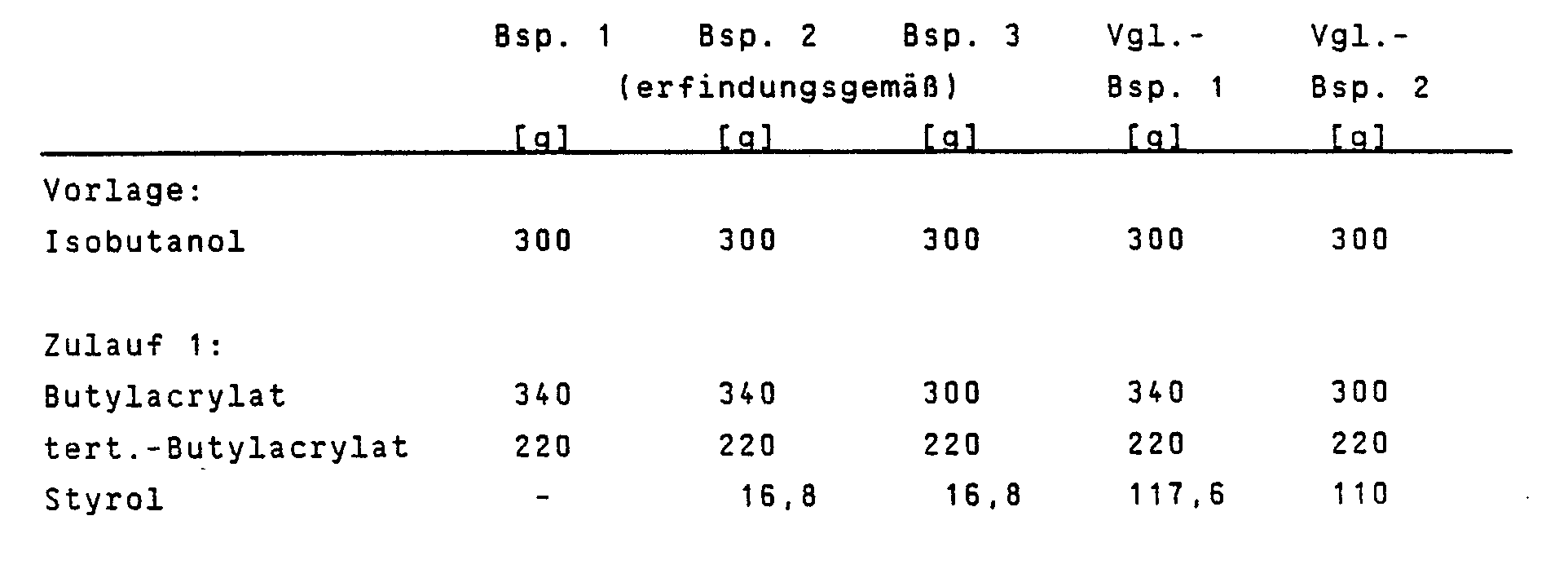
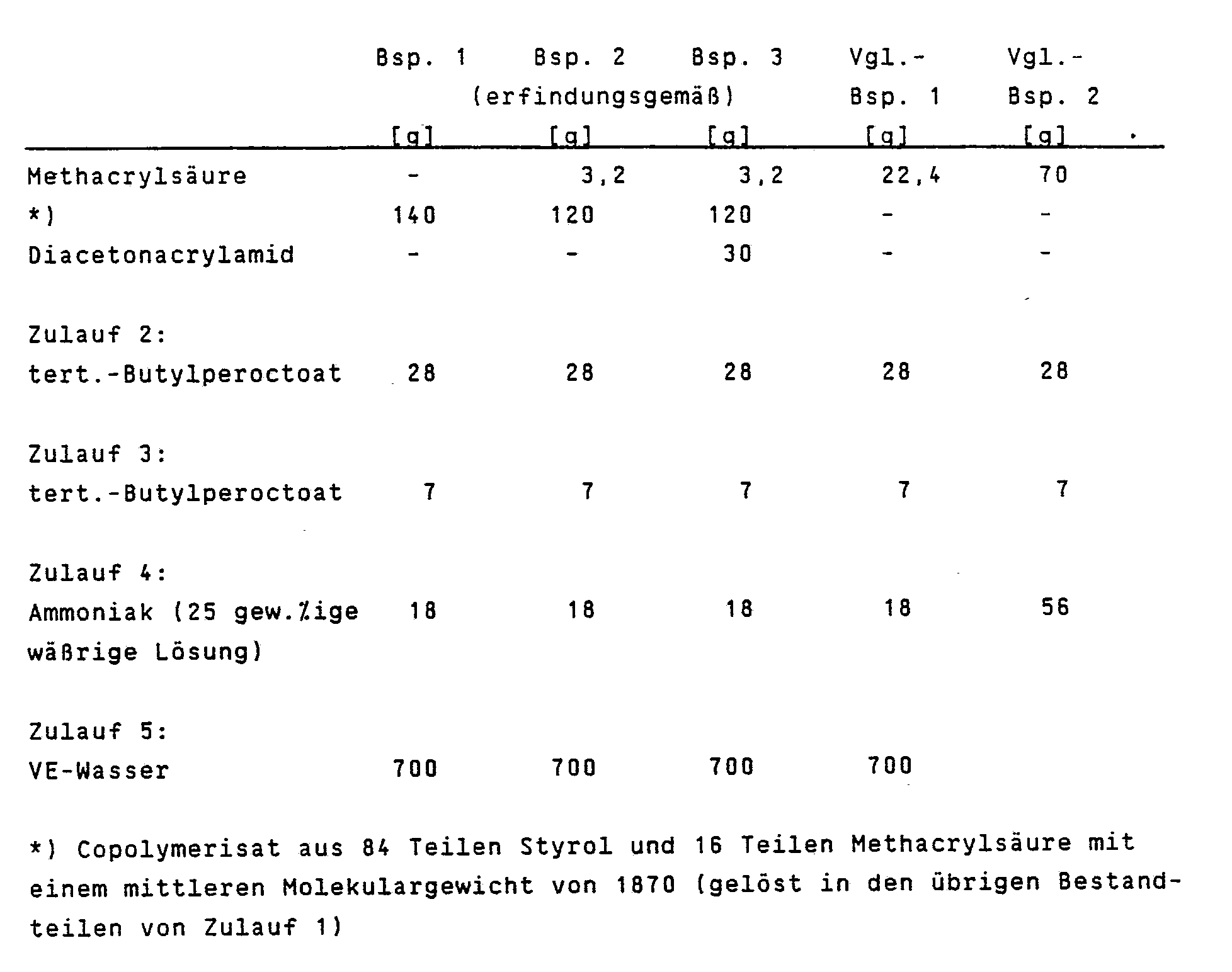
- In einem Reaktionsgefäß wurden die jeweils in den Beispielen 1 bis 5 aufgeführten Vorlagen auf 80°C erhitzt und die Zuläufe 1 und 2 in 2 Stunden zugegeben. 1 Stunde nach Zulaufende wurde Zulauf 3 in 10 Minuten zugegeben und noch 1 Stunde auf 80°C gehalten.
- Es wurde auf 35°C abgekühlt, Zulauf 4 einlaufen lassen und bei 35°C 1 Stunde gerührt. Danach wurde Zulauf 5 in 2 Stunden zugegeben und gleichzeitig unter leichtem Vakuum ca. 160 g Isobutanol/Wasser-Gemisch abdestilliert.
- Beispiele 1, 2, 3 und Vergleichsbeispiel 2 bildeten stabile, sehr feinteilige, milchig weiße Dispersionen.
- Zur Dispersion nach Beispiel 3 wurden noch 16 g Adipinsäurebishydrazid 1 Stunde eingerührt.
- Vergleichsbeispiel 1 bildete eine grobflockige Suspension, die beim Stehen koagulierte.
- Der Feststoffanteil der Dispersionen betrug ca. 50 Gew.%.
- Es wurden von den Dispersionen auf je 2 Glasplatten (6 × 25 cm) mit einer Rakel Filme aufgezogen. Platte A wurde 1 Woche bei Raumtemperatur gelagert, Platte B wurde 5 Stunden bei Raumtemperatur getrocknet und dann 20 min bei 110°C eingebrannt. Die Platten wurden dann zur Hälfte in VE-Wasser (vollentsalzt) bei Raumtemperatur gelagert.

Claims (11)
A) 30 bis 95 Gew.% Estern der Acrylsäure und/oder Methacrylsäure und/oder Ethylacrylsäure mit C₁-C₂₀-Alkoholen in Gegenwart von
B) 5 bis 70 Gew.% carboxylgruppen- und/oder carbonsäureanhydridgruppenhaltigen Copolymerisaten mit einem mittleren Molekulargewicht von 500 bis 20.000, erhältlich durch Masse- oder Lösungspolymerisation von monoolefinisch ungesättigten Monomeren bei Temperaturen von 180 bis 400°C und Drücken zwischen 1 und 200 bar.
A) 30 bis 90 Gew.% Estern der Acrylsäure und/oder Methacrylsäure und/oder Ethylacrylsäure mit C₁-C₂₀-Alkoholen in Gegenwart von
B) 5 bis 70 Gew.% carboxylgruppen- und/oder carbonsäureanhydridgruppenhaltigen Copolymerisaten mit einem mittleren Molekulargewicht von 500 bis 20.000, erhältlich durch Masse- oder Lösungspolymerisation von monoolefinisch ungesättigten Monomeren bei Temperaturen von 180 bis 400°C und Drücken zwischen 1 und 200 bar, mit
C) 5 bis 50 Gew.% sonstigen Comonomeren
Priority Applications (1)
| Application Number | Priority Date | Filing Date | Title |
|---|---|---|---|
| AT88105039T ATE63565T1 (de) | 1987-04-09 | 1988-03-29 | Waessrige sekundaerdispersionen. |
Applications Claiming Priority (2)
| Application Number | Priority Date | Filing Date | Title |
|---|---|---|---|
| DE3712016 | 1987-04-09 | ||
| DE19873712016 DE3712016A1 (de) | 1987-04-09 | 1987-04-09 | Waessrige sekundaerdispersionen |
Publications (3)
| Publication Number | Publication Date |
|---|---|
| EP0288763A2 true EP0288763A2 (de) | 1988-11-02 |
| EP0288763A3 EP0288763A3 (en) | 1989-05-10 |
| EP0288763B1 EP0288763B1 (de) | 1991-05-15 |
Family
ID=6325236
Family Applications (1)
| Application Number | Title | Priority Date | Filing Date |
|---|---|---|---|
| EP88105039A Expired - Lifetime EP0288763B1 (de) | 1987-04-09 | 1988-03-29 | Wässrige Sekundärdispersionen |
Country Status (4)
| Country | Link |
|---|---|
| EP (1) | EP0288763B1 (de) |
| AT (1) | ATE63565T1 (de) |
| DE (2) | DE3712016A1 (de) |
| ES (1) | ES2022505B3 (de) |
Cited By (10)
| Publication number | Priority date | Publication date | Assignee | Title |
|---|---|---|---|---|
| EP0523993A1 (de) * | 1991-07-17 | 1993-01-20 | Cargill, Incorporated | Wässrige Acrylpolymer-Dispersion mit Co-Solvens |
| DE4123739A1 (de) * | 1991-07-17 | 1993-01-21 | Beiersdorf Ag | Loesungsmittelmilder alleskleber |
| US5319019A (en) * | 1991-07-17 | 1994-06-07 | Cargill Incorporated | Acrylic polymer aqueous dispersion with co-solvent |
| EP0758007A2 (de) | 1995-08-07 | 1997-02-12 | Bayer Ag | Wässrige, vernetzbare Bindemitteldispersionen mit niedrigem Lösemittelgehalt |
| EP1270619A3 (de) * | 2001-06-21 | 2003-04-23 | Bayer Ag | Wässrige Sekundärdispersionen |
| EP1702954A2 (de) | 2005-03-09 | 2006-09-20 | Bayer MaterialScience AG | Wässrige Copolymerisatdispersionen mit Reaktivverdünner |
| US7199178B2 (en) | 2004-01-27 | 2007-04-03 | Martin Melchiors | Low-solvent, OH-functional dispersions |
| WO2012069460A1 (en) * | 2010-11-25 | 2012-05-31 | Basf Se | Finely divided, cationic or amphoteric, aqueous polymer dispersions, process for their preparation, their use, cationic or amphoteric protective colloids and their preparation |
| WO2013087461A1 (de) * | 2011-12-15 | 2013-06-20 | Basf Se | Verwendung wässriger polymerisatdispersionen zur verbesserung der resistenz gegenüber chemischen einflüssen |
| US20130172483A1 (en) * | 2011-12-15 | 2013-07-04 | Sebastian Roller | Use of aqueous polymer dispersions for improving resistance to chemical influences |
Families Citing this family (2)
| Publication number | Priority date | Publication date | Assignee | Title |
|---|---|---|---|---|
| GB9408725D0 (en) * | 1994-05-03 | 1994-06-22 | Zeneca Resins Bv | Production of aqueous polymer compositions |
| DE10361274A1 (de) | 2003-12-24 | 2005-07-28 | Bayer Materialscience Ag | Lösemittelarme, OH-funktionelle Dispersionen |
Family Cites Families (5)
| Publication number | Priority date | Publication date | Assignee | Title |
|---|---|---|---|---|
| BE526413A (de) * | 1953-02-12 | |||
| GB1343278A (en) * | 1970-05-28 | 1974-01-10 | Ici Ltd | Copolymers of alpha,beta-unsaturated dicarboxylic acids |
| US4071669A (en) * | 1976-06-24 | 1978-01-31 | The Goodyear Tire & Rubber Company | Metal salts of modified anhydride resin |
| US4417028A (en) * | 1981-05-11 | 1983-11-22 | Loctite Corporation | Preapplied plastic film adhesive composition |
| EP0133949B1 (de) * | 1983-08-11 | 1987-07-08 | Vianova Kunstharz Aktiengesellschaft | Wasserverdünnbare Beschichtungsmittel für mineralische und bituminöse Untergründe und Verfahren zur Herstellung der Beschichtungsmittel |
-
1987
- 1987-04-09 DE DE19873712016 patent/DE3712016A1/de not_active Withdrawn
-
1988
- 1988-03-29 EP EP88105039A patent/EP0288763B1/de not_active Expired - Lifetime
- 1988-03-29 AT AT88105039T patent/ATE63565T1/de not_active IP Right Cessation
- 1988-03-29 DE DE8888105039T patent/DE3862798D1/de not_active Expired - Lifetime
- 1988-03-29 ES ES88105039T patent/ES2022505B3/es not_active Expired - Lifetime
Cited By (16)
| Publication number | Priority date | Publication date | Assignee | Title |
|---|---|---|---|---|
| EP0523993A1 (de) * | 1991-07-17 | 1993-01-20 | Cargill, Incorporated | Wässrige Acrylpolymer-Dispersion mit Co-Solvens |
| DE4123739A1 (de) * | 1991-07-17 | 1993-01-21 | Beiersdorf Ag | Loesungsmittelmilder alleskleber |
| US5319019A (en) * | 1991-07-17 | 1994-06-07 | Cargill Incorporated | Acrylic polymer aqueous dispersion with co-solvent |
| US5356988A (en) * | 1991-07-17 | 1994-10-18 | Cargill, Incorporated | Acrylic polymer aqueous dispersion made through a micro dispersion |
| US5380771A (en) * | 1991-07-17 | 1995-01-10 | Cargill Incorporated | Aqueous dispersion of amine salts of an acrylic polymer |
| EP0758007A2 (de) | 1995-08-07 | 1997-02-12 | Bayer Ag | Wässrige, vernetzbare Bindemitteldispersionen mit niedrigem Lösemittelgehalt |
| US5750613A (en) * | 1995-08-07 | 1998-05-12 | Bayer Aktiengesellschaft | Aqueous, crosslinkable binder dispersions having a low solvent content |
| US6962953B2 (en) | 2001-06-21 | 2005-11-08 | Bayer Aktiengesellschaft | Aqueous secondary dispersions |
| EP1270619A3 (de) * | 2001-06-21 | 2003-04-23 | Bayer Ag | Wässrige Sekundärdispersionen |
| US7199178B2 (en) | 2004-01-27 | 2007-04-03 | Martin Melchiors | Low-solvent, OH-functional dispersions |
| EP1702954A2 (de) | 2005-03-09 | 2006-09-20 | Bayer MaterialScience AG | Wässrige Copolymerisatdispersionen mit Reaktivverdünner |
| WO2012069460A1 (en) * | 2010-11-25 | 2012-05-31 | Basf Se | Finely divided, cationic or amphoteric, aqueous polymer dispersions, process for their preparation, their use, cationic or amphoteric protective colloids and their preparation |
| US9481785B2 (en) | 2010-11-25 | 2016-11-01 | Basf Se | Finely divided, cationic or amphoteric, aqueous polymer dispersions, process for their preparation, their use, cationic or amphoteric protective colloids and their preparation |
| WO2013087461A1 (de) * | 2011-12-15 | 2013-06-20 | Basf Se | Verwendung wässriger polymerisatdispersionen zur verbesserung der resistenz gegenüber chemischen einflüssen |
| US20130172483A1 (en) * | 2011-12-15 | 2013-07-04 | Sebastian Roller | Use of aqueous polymer dispersions for improving resistance to chemical influences |
| US9169380B2 (en) | 2011-12-15 | 2015-10-27 | Basf Se | Use of aqueous polymer dispersions for improving resistance to chemical influences |
Also Published As
| Publication number | Publication date |
|---|---|
| EP0288763B1 (de) | 1991-05-15 |
| DE3712016A1 (de) | 1988-10-27 |
| EP0288763A3 (en) | 1989-05-10 |
| DE3862798D1 (de) | 1991-06-20 |
| ES2022505B3 (es) | 1991-12-01 |
| ATE63565T1 (de) | 1991-06-15 |
Similar Documents
| Publication | Publication Date | Title |
|---|---|---|
| DE1769495C3 (de) | ||
| EP0184091A2 (de) | Verfahren zur Herstellung von Polymer-Dispersionen, die blockfeste Filme bilden | |
| EP0288763B1 (de) | Wässrige Sekundärdispersionen | |
| EP0296491A1 (de) | Lagerstabile wässrige Polymerdispersionen | |
| DE3536261A1 (de) | Vernetzbare, in waessriger loesung oder dispersion lagerstabile polymere zusammensetzungen, deren herstellung und verwendung | |
| DE1178161B (de) | Bindemittel in waessriger Verteilung enthaltendes UEberzugsmittel | |
| EP0296487B1 (de) | Lagerstabile wässrige Polymerdispersionen | |
| DE1238215B (de) | Verfahren zur Herstellung von Copolymerisaten | |
| EP0271033B1 (de) | Klebstoffe für Verklebungen mit erhöhter Wärmestandfestigkeit | |
| DE2314983C2 (de) | Hitzehärtbare Überzugsmittel | |
| EP0650985A1 (de) | Vernetzbare Pulverbindemittel | |
| EP0219046B1 (de) | Lagerstabile, in organischem Lösemittel gelöste oder dispergierte vernetzbare Zusammensetzungen, ihre Herstellung und Verwendung | |
| EP0276213B1 (de) | Lösliches, vernetzbares acrylatcopolymerisat, verfahren zu seiner herstellung und überzugsmittel auf der basis des acrylatcopolymerisats | |
| EP0168870B1 (de) | Verfahren zur Herstellung eines für Beschichtungsmittel geeigneten Bindemittels und dessen Verwendung | |
| DE2350654B2 (de) | Wärmehärtbare Polymerisatlösungen | |
| DE3534910A1 (de) | Haertbare zusammensetzung | |
| EP0000608A1 (de) | Verfahren zur Herstellung von in organischen Lösungsmitteln löslichen, hydroxylgruppenhaltigen Copolymerisaten sowie Überzugsmasse bzw. Bindemittel für Lacke | |
| EP0134490B1 (de) | Selbstvernetzende Überzugs-, Imprägnier- und Klebemittel | |
| DE2658118A1 (de) | Waessrige harzdispersionen und daraus hergestellte hitzehaertbare ueberzugsmittel | |
| DE2317578B2 (de) | Pulverisierförmige Acrylharzbindemittelmischungen | |
| EP0262376B1 (de) | Wässrige Bindemitteldispersionen für die Herstellung von Anstrich- und Beschichtungsmitteln | |
| EP0301420A2 (de) | Wässrige Kunststoffdispersion | |
| EP0447999B1 (de) | Wässrige Bindemitteldispersion | |
| EP0285973A2 (de) | Nichtwässrige Polymerdispersionen | |
| DE2420771B2 (de) | Waessrige dispersionsmischung aus einem additionspolymerisat und einem phenol-aldehyd-kondensations- produkt |
Legal Events
| Date | Code | Title | Description |
|---|---|---|---|
| PUAI | Public reference made under article 153(3) epc to a published international application that has entered the european phase |
Free format text: ORIGINAL CODE: 0009012 |
|
| AK | Designated contracting states |
Kind code of ref document: A2 Designated state(s): AT BE CH DE ES FR GB IT LI LU NL SE |
|
| PUAL | Search report despatched |
Free format text: ORIGINAL CODE: 0009013 |
|
| AK | Designated contracting states |
Kind code of ref document: A3 Designated state(s): AT BE CH DE ES FR GB IT LI LU NL SE |
|
| 17P | Request for examination filed |
Effective date: 19890524 |
|
| 17Q | First examination report despatched |
Effective date: 19900917 |
|
| GRAA | (expected) grant |
Free format text: ORIGINAL CODE: 0009210 |
|
| AK | Designated contracting states |
Kind code of ref document: B1 Designated state(s): AT BE CH DE ES FR GB IT LI LU NL SE |
|
| REF | Corresponds to: |
Ref document number: 63565 Country of ref document: AT Date of ref document: 19910615 Kind code of ref document: T |
|
| ITF | It: translation for a ep patent filed | ||
| REF | Corresponds to: |
Ref document number: 3862798 Country of ref document: DE Date of ref document: 19910620 |
|
| GBT | Gb: translation of ep patent filed (gb section 77(6)(a)/1977) | ||
| ET | Fr: translation filed | ||
| PLBE | No opposition filed within time limit |
Free format text: ORIGINAL CODE: 0009261 |
|
| STAA | Information on the status of an ep patent application or granted ep patent |
Free format text: STATUS: NO OPPOSITION FILED WITHIN TIME LIMIT |
|
| 26N | No opposition filed | ||
| EPTA | Lu: last paid annual fee | ||
| EAL | Se: european patent in force in sweden |
Ref document number: 88105039.7 |
|
| REG | Reference to a national code |
Ref country code: CH Ref legal event code: NV Representative=s name: SCHMAUDER & PARTNER AG PATENTANWALTSBUERO |
|
| NLS | Nl: assignments of ep-patents |
Owner name: BASF COATINGS AKTIENGESELLSCHAFT |
|
| REG | Reference to a national code |
Ref country code: GB Ref legal event code: IF02 |
|
| PGFP | Annual fee paid to national office [announced via postgrant information from national office to epo] |
Ref country code: GB Payment date: 20020227 Year of fee payment: 15 |
|
| PGFP | Annual fee paid to national office [announced via postgrant information from national office to epo] |
Ref country code: ES Payment date: 20020312 Year of fee payment: 15 |
|
| PGFP | Annual fee paid to national office [announced via postgrant information from national office to epo] |
Ref country code: FR Payment date: 20020322 Year of fee payment: 15 |
|
| PGFP | Annual fee paid to national office [announced via postgrant information from national office to epo] |
Ref country code: AT Payment date: 20020325 Year of fee payment: 15 |
|
| PGFP | Annual fee paid to national office [announced via postgrant information from national office to epo] |
Ref country code: NL Payment date: 20020326 Year of fee payment: 15 |
|
| PGFP | Annual fee paid to national office [announced via postgrant information from national office to epo] |
Ref country code: LU Payment date: 20020329 Year of fee payment: 15 |
|
| PGFP | Annual fee paid to national office [announced via postgrant information from national office to epo] |
Ref country code: SE Payment date: 20020402 Year of fee payment: 15 Ref country code: DE Payment date: 20020402 Year of fee payment: 15 |
|
| PGFP | Annual fee paid to national office [announced via postgrant information from national office to epo] |
Ref country code: BE Payment date: 20020404 Year of fee payment: 15 |
|
| PG25 | Lapsed in a contracting state [announced via postgrant information from national office to epo] |
Ref country code: LU Free format text: LAPSE BECAUSE OF NON-PAYMENT OF DUE FEES Effective date: 20030329 Ref country code: GB Free format text: LAPSE BECAUSE OF NON-PAYMENT OF DUE FEES Effective date: 20030329 Ref country code: AT Free format text: LAPSE BECAUSE OF NON-PAYMENT OF DUE FEES Effective date: 20030329 |
|
| PG25 | Lapsed in a contracting state [announced via postgrant information from national office to epo] |
Ref country code: SE Free format text: LAPSE BECAUSE OF NON-PAYMENT OF DUE FEES Effective date: 20030330 |
|
| PG25 | Lapsed in a contracting state [announced via postgrant information from national office to epo] |
Ref country code: ES Free format text: LAPSE BECAUSE OF NON-PAYMENT OF DUE FEES Effective date: 20030331 Ref country code: BE Free format text: LAPSE BECAUSE OF NON-PAYMENT OF DUE FEES Effective date: 20030331 |
|
| BERE | Be: lapsed |
Owner name: *BASF A.G. Effective date: 20030331 |
|
| PG25 | Lapsed in a contracting state [announced via postgrant information from national office to epo] |
Ref country code: NL Free format text: LAPSE BECAUSE OF NON-PAYMENT OF DUE FEES Effective date: 20031001 Ref country code: DE Free format text: LAPSE BECAUSE OF NON-PAYMENT OF DUE FEES Effective date: 20031001 |
|
| EUG | Se: european patent has lapsed | ||
| GBPC | Gb: european patent ceased through non-payment of renewal fee |
Effective date: 20030329 |
|
| PG25 | Lapsed in a contracting state [announced via postgrant information from national office to epo] |
Ref country code: FR Free format text: LAPSE BECAUSE OF NON-PAYMENT OF DUE FEES Effective date: 20031127 |
|
| NLV4 | Nl: lapsed or anulled due to non-payment of the annual fee |
Effective date: 20031001 |
|
| REG | Reference to a national code |
Ref country code: FR Ref legal event code: ST |
|
| REG | Reference to a national code |
Ref country code: ES Ref legal event code: FD2A Effective date: 20030331 |
|
| PGFP | Annual fee paid to national office [announced via postgrant information from national office to epo] |
Ref country code: CH Payment date: 20040906 Year of fee payment: 17 |
|
| PG25 | Lapsed in a contracting state [announced via postgrant information from national office to epo] |
Ref country code: IT Free format text: LAPSE BECAUSE OF NON-PAYMENT OF DUE FEES;WARNING: LAPSES OF ITALIAN PATENTS WITH EFFECTIVE DATE BEFORE 2007 MAY HAVE OCCURRED AT ANY TIME BEFORE 2007. THE CORRECT EFFECTIVE DATE MAY BE DIFFERENT FROM THE ONE RECORDED. Effective date: 20050329 |
|
| PG25 | Lapsed in a contracting state [announced via postgrant information from national office to epo] |
Ref country code: LI Free format text: LAPSE BECAUSE OF NON-PAYMENT OF DUE FEES Effective date: 20050331 Ref country code: CH Free format text: LAPSE BECAUSE OF NON-PAYMENT OF DUE FEES Effective date: 20050331 |
|
| REG | Reference to a national code |
Ref country code: CH Ref legal event code: PL |