EP0283264B1 - Pyroelectric infrared sensor - Google Patents
Pyroelectric infrared sensor Download PDFInfo
- Publication number
- EP0283264B1 EP0283264B1 EP88302297A EP88302297A EP0283264B1 EP 0283264 B1 EP0283264 B1 EP 0283264B1 EP 88302297 A EP88302297 A EP 88302297A EP 88302297 A EP88302297 A EP 88302297A EP 0283264 B1 EP0283264 B1 EP 0283264B1
- Authority
- EP
- European Patent Office
- Prior art keywords
- pyroelectric
- film
- vinylidene fluoride
- infrared sensor
- temperature
- Prior art date
- Legal status (The legal status is an assumption and is not a legal conclusion. Google has not performed a legal analysis and makes no representation as to the accuracy of the status listed.)
- Expired - Lifetime
Links
Images
Classifications
-
- G—PHYSICS
- G01—MEASURING; TESTING
- G01J—MEASUREMENT OF INTENSITY, VELOCITY, SPECTRAL CONTENT, POLARISATION, PHASE OR PULSE CHARACTERISTICS OF INFRARED, VISIBLE OR ULTRAVIOLET LIGHT; COLORIMETRY; RADIATION PYROMETRY
- G01J5/00—Radiation pyrometry, e.g. infrared or optical thermometry
- G01J5/10—Radiation pyrometry, e.g. infrared or optical thermometry using electric radiation detectors
- G01J5/34—Radiation pyrometry, e.g. infrared or optical thermometry using electric radiation detectors using capacitors, e.g. pyroelectric capacitors
-
- H—ELECTRICITY
- H10—SEMICONDUCTOR DEVICES; ELECTRIC SOLID-STATE DEVICES NOT OTHERWISE PROVIDED FOR
- H10N—ELECTRIC SOLID-STATE DEVICES NOT OTHERWISE PROVIDED FOR
- H10N15/00—Thermoelectric devices without a junction of dissimilar materials; Thermomagnetic devices, e.g. using the Nernst-Ettingshausen effect
- H10N15/10—Thermoelectric devices using thermal change of the dielectric constant, e.g. working above and below the Curie point
- H10N15/15—Thermoelectric active materials
Definitions
- the present invention relates to a polymer pyroelectric infrared sensor with improved sensitivity and heat resistance.
- a pyroelectric infrared sensor generally has a basic structure wherein a pyroelectric element comprising a film or sheet of a pyroelectric material having a spontaneous polarization and electrode films formed on both faces of the pyroelectric material is used as a heat-sensing element, and an electric field generated by a change in spontaneous polarization caused by a temperature change depending on a change in quantity of incident infrared rays is detected after amplification as desired.
- PVDF polyvinylidene fluoride
- PVDF does not show a Curie temperature as a measure of upper limit temperature for stable operation, and the pyroelectricity thereof is irreversibly and rapidly lowered at a temperature close to the temperature (generally, 60 - 120 °C) of polarization for providing the pyroelectricity.
- the utilization of PVDF as a pyroelectric material has been restricted in view of its inferior heat resistance or heat stability.
- an inferior heat-resistance is inherent to a polymer pyroelectric material to some extent, so that an improvement in sensitivity (performance index) compensating the defect and even providing a surplus profit is desired.
- FR-A-7900200 discloses a pyroelectric transducer structure which includes a vinylidene fluoride copolymer film as a transducing element.
- a principal object of the present invention is to provide a pyroelectric infrared sensor using a pyroelectric polymer element having improved sensitivity and heat-resistance.
- a vinylidene fluoride copolymer film having an increased crystallinity through an appropriate heat treatment shows a clear Curie temperature on temperature increase and retains its pyroelectricity up to the vicinity of the Curie temperature, thus showing an improved heat resistance which is not attained by a conventional PVDF pyroelectric film. It has been also found that such a vinylidene fluoride copolymer film having an increased crystallinity shows a remarkable increase in performance index through a remarkable decrease in dielectric constant in a low frequency region where it is used as a pyroelectric material.
- the invention provides a pyroelectric infrared sensor, comprising: a pyroelectric film having electrodes for taking out a pyroelectric output on both sides thereof and disposed to face a window for introducing infrared rays, said pyroelectric film comprising a polarized film of vinylidene fluoride copolymer characterised in that said polarized film of vinylidene fluoride copolymer has a crystallinity of 60% or more and a relative dielectric constant of 10 or below at 25°C and in a frequency region of 0.1 - 10 H z , and wherein said pyroelectric film shows a peak of 0.6 or below in the imaginary part of the complex dielectric constant in the temperature range of -100°C to 0°C.
- the pyroelectric film used in the infrared sensor according to the invention comprises a copolymer of vinylidene fluoride as a predominant component, preferably in a proportion of 37 - 95 mol %, particularly 55 - 90 mol %, and has a crystallinity of 60 % or more, and a relative dielectric constant of 10 or below at 25 °C and in a frequency region of 0.1 - 10 Hz. It is further preferred that the pyroelectric film shows a Curie temperature of 100 °C or higher, particularly 120 °C or higher, on temperature increase.
- the Curie temperature refers to a temperature providing an endothermic peak or shoulder on the lower temperature side than the melting point of the DSC (differential scanning calorimeter) curve on temperature increase at a temperature-increasing rate of 10 °C/min. It is also preferred that the imaginary part of the complex dielectric constant in the temperature range of -100 °C to 0 °C is 0.6 or below.
- the comonomer to be copolymerized with vinylidene fluoride may be any one in principle as far as it is copolymerizable with vinylidene fluoride to provide a copolymer film showing the above-mentioned crystallinity and relative dielectric constant.
- the comonomer may preferably be a fluorine-containing monomer, such as ethylene trifluoride, vinyl fluoride, tetrafluoroethylene, or trifluorochloroethylene. This is because the formation of a stable ⁇ -crystals in a vinylidene fluoride copolymer is largely concerned with the inclusion of a different monomer species.
- a binary or ternary copolymer is preferred but a copolymer of more species may possibly be used containing minor components up to, e.g., about 40 mol %.
- Optional additives such as an inorganic filler, an infrared absorber and a crystal nucleating agent, may be added to the vinylidene fluoride copolymer.
- the vinylidene fluoride copolymer is used in the form of a film having a thickness of, e.g., 0.1 to 1000 microns.
- any process may be applied, inclusive of extrusion, pressing, and rolling.
- a particularly preferred process may be casting.
- the heat treatment may be effected by holding the film at a temperature between the crystallizing temperature and the melting point of the vinylidene fluoride copolymer.
- the melting point refers to the highest temperature providing an endothermic peak on a DSC (differential scanning calorimeter) curve on temperature increase at a temperature-increasing rate of 10 °C/min.
- the crystallizing point refers to the highest temperature providing an exothermic peak on the DSC curve on temperature decrease at a temperature-decreasing rate of 10 °C/min.
- the heat treatment may be effected for 30 minutes or more, preferably 2 hours or more, in order to accomplish the crystallization as completely as possible.
- the upper limit of the time for the heat treatment is determined only from the viewpoint of production efficiency and may ordinarily be two days or shorter.
- a vinylidene fluoride copolymer film having: a crystallinity of 60 % or more, preferably 80 % or more, particularly preferably 90 % or more; a relative dielectric constant at 25 °C (0.1 - 10 Hz) of 10 or below, preferably 9 or below; and preferably a complex dielectric constant having an imaginary part of 0.6 or below, more pareferably 0.4 or below, particularly preferably 0.3 or below, in the temperature range of -100 °C to 0 °C.
- the crystallinity of the vinylidene fluoride copolymer film is determined by analyzing the X-ray diffraction pattern according to the Ruland method. (W. Ruland; Acta Cryst. (1961) 14, 1180-1185).
- the above-mentioned peak in the imaginary part of the complex dielectric constant in the temperature region of -100 °C to 0°C is based on the presence of a non-crystalline portion.
- the complex dielectric constant is based on measured values obtained by using a commercially available apparatus for measuring the complex dielectric constant of polymer films at various temperatures and frequencies, " Rheolograph Solid" available from Toyo Seiki Seisakusho K.K.
- This apparatus is designed for also measuring complex elastic and piezoelectric constants of polymer films. Details thereof are reported by T. Furukawa et. al., Rev. Sci. Instrum. 57 (2), February 1986, p.p. 285 - 292.
- an electric field is applied to the film to effect orientation polarization.
- the conditions for this treatment are substantially the same as those adopted in production of polyvinylidene fluoride piezoelectric films.
- the polarization is effected by applying a voltage of 10 kV/cm or above and below the breakdown voltage for more than switching time (e.g. about 5 ⁇ s (micro-seconds)) of rotation of dipoles in crystal.
- heat-treatment of a vinylidene fluoride copolymer film for increasing the crystallinity has been already carried out in the field of piezoelectric materials.
- a heat-treated vinylidene fluoride copolymer film in order to provide a piezoelectric film for ultrasonic transducers having an increased electromechanical coupling coefficient k t in the direction perpendicular to the film surface in a high frequency region (JP-A (Tokkai Sho) 51-23439, 56-111281, etc.).
- PVDF is not only an excellent piezoelectric material but also a useful pyroelectric material
- no vinylidene fluoride copolymer film as described above has been practically used as a high-sensitivity pyroelectric material. This may be attributable to the following reasons.
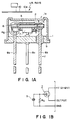
- Figure 1A is a front sectional view in a somewhat schematic form of an embodiment of the infrared sensor according to the present invention wherein such a pyroelectric film as described above is incorporated.
- Figure 1B is an equivalent circuit diagram of the same.
- the infrared sensor comprises a metal case (cap) 1 with a window opening 1a for inroducing infrared rays at its top, in which a window member 2 for passing infrared rays composed of, e.g., of a silicon plate or a polyethylene sheet, is disposed to close the opening 1a.
- a pyroelectric element 5 which comprises a vinylidene fluoride copolymer film having a thickness of, e.g., 0.1 - 1000 ⁇ m (microns) and having thereon a front electrode 3 on the light-receiving side of, e.g., ITO (indium-tin-oxide) or Ni-Cr in a thickness of, e.g., 0.001 - 1 ⁇ m (micron) and a back electrode 4 on the other side of, e.g., a transparent conductor such as ITO or an intransparent conductor such as Al or Ni-Cr having a thickness of, e.g., 0.01 ⁇ m (micron) or more.
- ITO indium-tin-oxide
- Ni-Cr indium- 1 ⁇ m
- a back electrode 4 on the other side of, e.g., a transparent conductor such as ITO or an intransparent conductor such as Al or Ni-Cr having a thickness
- the element 5 is affixed onto a fixing ring 6 by means of an adhesive, etc., the light-receiving side electrode 3 is connected to the gate of an FET 7 (N-type in this embodiment), and the back electrode is grounded through a lead wire 8a.
- a resistor Rg is inserted between the gate and the ground.
- the drain of the FET 7 is connected to a voltage supply of +V (e.g., 2 - 12 v (volts)) through a lead wire 8b, and the source is connected to a lead wire 8c for output.
- the respective parts described above are affixed as by bonding to a base plate 9 by the medium of the lead wires 8b, 8c, etc., and the lower end of the cap 1 is bonded to the base plate 9 to provide a generally closed structure.
- a chopper 10 is generally disposed in front of the window 1a and rotates at a low frequency of 0.1 - 10 Hz.
- Infrared rays incident through an opening 10a in the shape of, e.g., a sector, of the chopper 10 provide the element 5 with a temperature change corresponding to the incident quantity of the rays.
- an electric field is generated between both faces of the element corresponding to a change in polarization due to the temperature change and is subjected to impedance conversion by the FET 7 to be output from the source of the FET.
- a copolymer having a composition substantially equal to that of the polymerization feedstock of 73 mol % of vinylidene fluoride, 22 mol % of ethylene trifluoride and 5 mol % of vinyl fluoride and an ⁇ inh (inherent viscosity as measured in a dimethylformamide solution at a concentration of 0.4 g/dl at 30 °C) of 1.23 dl/g was melt-extruded through a T-die to form a 50 micron-thick film.
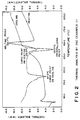
- the DSC chart temperature-raising and cooling rate of 10 °C/min
- Figure 2 shows the presence of a clear Curie temperature.
- the film was heat-treated at 148 °C for 2 hours, followed by orientation polarization for 30 minutes at 90 °C and a field intensity of 100 MV/m, and then cooled to room temperature while the field was continually applied.
- the crystallinity of the film thus obtained was measured to be 82 % as a result of analysis of the X-ray diffraction pattern of the film according to the Ruland method by using a computer.
- a copolymer having a composition substantially equal to that of the polymerization feedstock of 77 mol % of vinylidene fluoride, 21 mol % of ethylene trifluoride and 2 mol % of vinyl fluoride and an ⁇ inh of 3.08 was cast into a 30 microns-thick film.
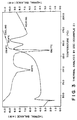
- the DSC chart of the film is given in Figure 3 which shows a clear Curie temperature similarly as the film of Example 1.
- the film was heat-treated at 148 °C for 2 hours and then subjected to orientation polarization in the same manner as in Example 1.
- the crystallinity of the film thus obtained was measured to be 95 % in the same manner as in Example 1.
- the pyroelectric constants, relative dielectric constants at 1 Hz and 50 MHz and performance indexes of the pyroelectric films prepared in the above Examples were measured and are shown in the following Table 2 together with those of a commercially available PVDF pyroelectric film (the one shown in the previous Table 1, Trade Name "Polyvinylidene Fluoride Pyro-Film", available from Kureha Kagaku Kogyo K.K.).
- the pyroelectric film comprising a vinylidene fluoride copolymer according to the present invention has a pyroelectric constant which per se is rather smaller than that of the PVDF pyroelectric film but also has a strikingly smaller relative dielectric constant ⁇ r in the low frequency region, so that it provides a remarkable improvement of 40 - 50 % in performance index as a pyroelectric element.
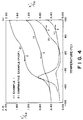
- Figure 4 shows the complex dielectric constants (versus temperature) of the pyroelectric film obtained by Example 1 and the one of Comparative Example (PVDF) measured by Rheolograph Solid (available from Toyo Sokki Seisakusho K.K.).
- the peak on the ⁇ / ⁇ 0 curve and the increase on the ⁇ / ⁇ 0 curve of the comparative Example (PVDF) in the temperature range of -60 °C to 0 °C represent the molecular movement of amorphous portion in a vinylidene fluoride resin.
- the pyroelectric film in Example 1 according to the present invention showed a particularly small peak of ⁇ / ⁇ 0 of below 0.3 (about 0.2) which represents a high crystallinity.
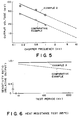
- An infrared sensor having a structure explained with reference to Figures 1A and 1B was prepred by using a 25 ⁇ m (micron)-thick pyroelectric film prepared in the same manner as in the above Example 2 as the element 5.
- the output voltage of the infrared sensor was measured under the condition of an incident energy density of 2.74 ⁇ 10 ⁇ 4 W/cm2 while changing the chopper frequency in the range of 0.16 to 1 Hz.
- Figure 6 shows the results in terms of the sensitivity ratios relative to the respective outputs of the infrared sensors before the heat resistance test.
- an infrared sensor having remarkably improved sensitivity and heat resistance, wherein a pyroelectric film comprising a vinylidene fluoride copolymer having an increased crystallinity and a reduced relative dielectric constant in a low frequency region is incorporated as a pyroelectric element.
Landscapes
- Engineering & Computer Science (AREA)
- Power Engineering (AREA)
- Physics & Mathematics (AREA)
- General Physics & Mathematics (AREA)
- Spectroscopy & Molecular Physics (AREA)
- Photometry And Measurement Of Optical Pulse Characteristics (AREA)
- Manufacture Of Macromolecular Shaped Articles (AREA)
- Compositions Of Macromolecular Compounds (AREA)
- Radiation Pyrometers (AREA)
- Inorganic Insulating Materials (AREA)
Applications Claiming Priority (2)
| Application Number | Priority Date | Filing Date | Title |
|---|---|---|---|
| JP67317/87 | 1987-03-20 | ||
| JP62067317A JPS63233340A (ja) | 1987-03-20 | 1987-03-20 | 焦電型赤外線センサ− |
Publications (3)
| Publication Number | Publication Date |
|---|---|
| EP0283264A2 EP0283264A2 (en) | 1988-09-21 |
| EP0283264A3 EP0283264A3 (en) | 1989-10-04 |
| EP0283264B1 true EP0283264B1 (en) | 1993-10-13 |
Family
ID=13341521
Family Applications (1)
| Application Number | Title | Priority Date | Filing Date |
|---|---|---|---|
| EP88302297A Expired - Lifetime EP0283264B1 (en) | 1987-03-20 | 1988-03-16 | Pyroelectric infrared sensor |
Country Status (4)
| Country | Link |
|---|---|
| US (1) | US4851682A (enExample) |
| EP (1) | EP0283264B1 (enExample) |
| JP (1) | JPS63233340A (enExample) |
| DE (1) | DE3884833T2 (enExample) |
Families Citing this family (16)
| Publication number | Priority date | Publication date | Assignee | Title |
|---|---|---|---|---|
| US5352895A (en) * | 1992-02-19 | 1994-10-04 | Nohmi Bosai Ltd. | Pyroelectric device |
| US5635812A (en) * | 1994-09-29 | 1997-06-03 | Motorola, Inc. | Thermal sensing polymeric capacitor |
| DE19547934A1 (de) * | 1995-12-22 | 1997-06-26 | Deutsche Telekom Ag | Verfahren zur Herstellung einer pyroelektrischen Mischung |
| JP3289677B2 (ja) * | 1998-05-25 | 2002-06-10 | 株式会社村田製作所 | 赤外線センサ |
| JP2004045330A (ja) * | 2002-07-15 | 2004-02-12 | Ricoh Co Ltd | 非接触温度検知装置 |
| KR100870188B1 (ko) * | 2005-11-22 | 2008-11-24 | 파나소닉 덴코 가부시키가이샤 | 적외선 검출기 및 적외선 검출기를 제조하는 공정 |
| US7960776B2 (en) * | 2006-09-27 | 2011-06-14 | Cornell Research Foundation, Inc. | Transistor with floating gate and electret |
| US9000651B2 (en) | 2009-05-14 | 2015-04-07 | The Neothermal Energy Company | Method and apparatus for generating electricity by thermally cycling an electrically polarizable material using heat from various sources and a vehicle comprising the apparatus |
| US9166139B2 (en) | 2009-05-14 | 2015-10-20 | The Neothermal Energy Company | Method for thermally cycling an object including a polarizable material |
| US8344585B2 (en) | 2009-05-14 | 2013-01-01 | The Neothermal Energy Company | Method and apparatus for conversion of heat to electrical energy using a new thermodynamic cycle |
| US8946538B2 (en) | 2009-05-14 | 2015-02-03 | The Neothermal Energy Company | Method and apparatus for generating electricity by thermally cycling an electrically polarizable material using heat from condensers |
| US8350444B2 (en) | 2009-05-14 | 2013-01-08 | The Neothermal Energy Company | Method and apparatus for conversion of heat to electrical energy using polarizable materials and an internally generated poling field |
| US8035274B2 (en) | 2009-05-14 | 2011-10-11 | The Neothermal Energy Company | Apparatus and method for ferroelectric conversion of heat to electrical energy |
| CN102175328B (zh) * | 2010-12-29 | 2014-03-26 | 郑州炜盛电子科技有限公司 | 双通道热释电红外传感器 |
| EP2657588B1 (en) * | 2012-04-27 | 2015-01-28 | Belenos Clean Power Holding AG | Method for obtaining a piezoelectric liner for a high pressure storage vessel |
| DE102015223362A1 (de) * | 2015-11-25 | 2017-06-01 | Minimax Gmbh & Co. Kg | Explosionsgeschütztes Gehäuse für Mittel zum Senden und Empfangen elektromagnetischer Strahlung |
Family Cites Families (8)
| Publication number | Priority date | Publication date | Assignee | Title |
|---|---|---|---|---|
| US3769096A (en) * | 1971-03-12 | 1973-10-30 | Bell Telephone Labor Inc | Pyroelectric devices |
| JPS5651379B1 (enExample) * | 1971-04-07 | 1981-12-04 | ||
| JPS5123439B2 (enExample) * | 1971-11-05 | 1976-07-16 | ||
| US3809920A (en) * | 1972-08-25 | 1974-05-07 | Us Navy | Polymeric pyroelectric detector |
| FR2446045A1 (fr) * | 1979-01-04 | 1980-08-01 | Thomson Csf | Transducteur piezo-electrique a element en polymere et son procede de fabrication |
| EP0118757A3 (en) * | 1983-02-10 | 1987-10-07 | Daikin Kogyo Co., Ltd. | Polymeric ferro-electric material |
| US4577132A (en) * | 1983-07-05 | 1986-03-18 | Toray Industries, Inc. | Ultrasonic transducer employing piezoelectric polymeric material |
| JPS6179124A (ja) * | 1984-09-27 | 1986-04-22 | Nok Corp | 焦電型赤外線センサ |
-
1987
- 1987-03-20 JP JP62067317A patent/JPS63233340A/ja active Granted
-
1988
- 1988-03-16 EP EP88302297A patent/EP0283264B1/en not_active Expired - Lifetime
- 1988-03-16 DE DE88302297T patent/DE3884833T2/de not_active Expired - Fee Related
- 1988-03-18 US US07/168,317 patent/US4851682A/en not_active Expired - Fee Related
Also Published As
| Publication number | Publication date |
|---|---|
| EP0283264A3 (en) | 1989-10-04 |
| JPS63233340A (ja) | 1988-09-29 |
| JPH0529255B2 (enExample) | 1993-04-28 |
| US4851682A (en) | 1989-07-25 |
| DE3884833D1 (de) | 1993-11-18 |
| DE3884833T2 (de) | 1994-02-10 |
| EP0283264A2 (en) | 1988-09-21 |
Similar Documents
| Publication | Publication Date | Title |
|---|---|---|
| EP0283264B1 (en) | Pyroelectric infrared sensor | |
| Ueberschlag | PVDF piezoelectric polymer | |
| Newman et al. | Piezoelectric activity and field‐induced crystal structure transitions in poled poly (vinylidene fluoride) films | |
| Zhao et al. | Electromechanical properties of electrostrictive poly (vinylidene fluoride–trifluoroethylene) copolymer | |
| Holmes-Siedle et al. | PVdF: An electronically-active polymer for industry | |
| Wegener et al. | Ferroelectric polarization in stretched piezo-and pyroelectric poly (vinylidene fluoride-hexafluoropropylene) copolymer films | |
| US4390674A (en) | Uniaxially drawn vinylidene fluoride polymers | |
| CA1106982A (en) | Polarization of a multi-ply stack of piezoelectric- forming resin pellicles | |
| US4147562A (en) | Pyroelectric detector | |
| Roberts et al. | Thermal imaging using organic films | |
| Robinson | Flexible PVF2 film: An exceptional polymer for transducers | |
| US4692285A (en) | Process of preparing nonfibrous, piezoelectric polymer sheet of improved activity | |
| US4055878A (en) | Stabilization of piezoelectric resin elements | |
| Johnson et al. | Thermal piezoelectric stability of poled uniaxially-and biaxially-oriented poly (vinylidene fluoride | |
| Bloss et al. | Polarization and electric field distribution in thermally poled PVDF and FEP | |
| US4486683A (en) | Piezoelectric transducer using electrically poled γ-phase nylon 11 | |
| Herchenröder et al. | Ferroelectricity of poly (vinylidene fluoride): Transition temperature | |
| Marcus | Depth dependence of piezoelectric activity in poly (vinylidene fluoride) transducers: Control and measurement | |
| Marcus | Controlling the piezoelectric activity distribution in poly (vinylidene fluoride) transducers | |
| EP0118757A2 (en) | Polymeric ferro-electric material | |
| JPS58186981A (ja) | 入出力変換素子 | |
| Batra et al. | Dielectric and pyroelectric properties of LiTaO3: P (VDF-TrFE) composite films | |
| Solnyshkin et al. | Pyroelectric effect in composites based on copolymer P (VDF-TrFE) and ferroelectric ceramics BPZT | |
| JPS62252978A (ja) | 感圧材料 | |
| Neumann et al. | Application of pyroelectric P (VDF/TrFE) thin films in integrated sensors and arrays |
Legal Events
| Date | Code | Title | Description |
|---|---|---|---|
| PUAI | Public reference made under article 153(3) epc to a published international application that has entered the european phase |
Free format text: ORIGINAL CODE: 0009012 |
|
| AK | Designated contracting states |
Kind code of ref document: A2 Designated state(s): CH DE FR GB IT LI NL |
|
| PUAL | Search report despatched |
Free format text: ORIGINAL CODE: 0009013 |
|
| AK | Designated contracting states |
Kind code of ref document: A3 Designated state(s): CH DE FR GB IT LI NL |
|
| 17P | Request for examination filed |
Effective date: 19891221 |
|
| 17Q | First examination report despatched |
Effective date: 19920409 |
|
| GRAA | (expected) grant |
Free format text: ORIGINAL CODE: 0009210 |
|
| AK | Designated contracting states |
Kind code of ref document: B1 Designated state(s): CH DE FR GB IT LI NL |
|
| PG25 | Lapsed in a contracting state [announced via postgrant information from national office to epo] |
Ref country code: IT Free format text: LAPSE BECAUSE OF FAILURE TO SUBMIT A TRANSLATION OF THE DESCRIPTION OR TO PAY THE FEE WITHIN THE PRESCRIBED TIME-LIMIT;WARNING: LAPSES OF ITALIAN PATENTS WITH EFFECTIVE DATE BEFORE 2007 MAY HAVE OCCURRED AT ANY TIME BEFORE 2007. THE CORRECT EFFECTIVE DATE MAY BE DIFFERENT FROM THE ONE RECORDED. Effective date: 19931013 Ref country code: FR Effective date: 19931013 |
|
| REF | Corresponds to: |
Ref document number: 3884833 Country of ref document: DE Date of ref document: 19931118 |
|
| EN | Fr: translation not filed | ||
| PLBE | No opposition filed within time limit |
Free format text: ORIGINAL CODE: 0009261 |
|
| STAA | Information on the status of an ep patent application or granted ep patent |
Free format text: STATUS: NO OPPOSITION FILED WITHIN TIME LIMIT |
|
| 26N | No opposition filed | ||
| PGFP | Annual fee paid to national office [announced via postgrant information from national office to epo] |
Ref country code: GB Payment date: 19970307 Year of fee payment: 10 |
|
| PGFP | Annual fee paid to national office [announced via postgrant information from national office to epo] |
Ref country code: CH Payment date: 19970320 Year of fee payment: 10 |
|
| PGFP | Annual fee paid to national office [announced via postgrant information from national office to epo] |
Ref country code: DE Payment date: 19970321 Year of fee payment: 10 |
|
| PGFP | Annual fee paid to national office [announced via postgrant information from national office to epo] |
Ref country code: NL Payment date: 19970327 Year of fee payment: 10 |
|
| PG25 | Lapsed in a contracting state [announced via postgrant information from national office to epo] |
Ref country code: GB Free format text: LAPSE BECAUSE OF NON-PAYMENT OF DUE FEES Effective date: 19980316 |
|
| PG25 | Lapsed in a contracting state [announced via postgrant information from national office to epo] |
Ref country code: CH Free format text: LAPSE BECAUSE OF NON-PAYMENT OF DUE FEES Effective date: 19980331 Ref country code: LI Free format text: LAPSE BECAUSE OF NON-PAYMENT OF DUE FEES Effective date: 19980331 |
|
| PG25 | Lapsed in a contracting state [announced via postgrant information from national office to epo] |
Ref country code: NL Free format text: LAPSE BECAUSE OF NON-PAYMENT OF DUE FEES Effective date: 19981001 |
|
| GBPC | Gb: european patent ceased through non-payment of renewal fee |
Effective date: 19980316 |
|
| REG | Reference to a national code |
Ref country code: CH Ref legal event code: PL |
|
| NLV4 | Nl: lapsed or anulled due to non-payment of the annual fee |
Effective date: 19981001 |
|
| PG25 | Lapsed in a contracting state [announced via postgrant information from national office to epo] |
Ref country code: DE Free format text: LAPSE BECAUSE OF NON-PAYMENT OF DUE FEES Effective date: 19981201 |