EP0280145A2 - Erdalkalimetallsalze vicinal hydroxy, alkoxy-substituierter C16-C22-Fettsäuren, Verfahren zu ihrer Herstellung und ihre Verwendung als Alkoxylierungskatalysatoren - Google Patents
Erdalkalimetallsalze vicinal hydroxy, alkoxy-substituierter C16-C22-Fettsäuren, Verfahren zu ihrer Herstellung und ihre Verwendung als Alkoxylierungskatalysatoren Download PDFInfo
- Publication number
- EP0280145A2 EP0280145A2 EP88102175A EP88102175A EP0280145A2 EP 0280145 A2 EP0280145 A2 EP 0280145A2 EP 88102175 A EP88102175 A EP 88102175A EP 88102175 A EP88102175 A EP 88102175A EP 0280145 A2 EP0280145 A2 EP 0280145A2
- Authority
- EP
- European Patent Office
- Prior art keywords
- earth metal
- alkaline earth
- metal salts
- general formula
- fatty acids
- Prior art date
- Legal status (The legal status is an assumption and is not a legal conclusion. Google has not performed a legal analysis and makes no representation as to the accuracy of the status listed.)
- Withdrawn
Links
Images

Classifications
-
- C—CHEMISTRY; METALLURGY
- C07—ORGANIC CHEMISTRY
- C07C—ACYCLIC OR CARBOCYCLIC COMPOUNDS
- C07C59/00—Compounds having carboxyl groups bound to acyclic carbon atoms and containing any of the groups OH, O—metal, —CHO, keto, ether, groups, groups, or groups
- C07C59/125—Saturated compounds having only one carboxyl group and containing ether groups, groups, groups, or groups
Definitions
- the invention further relates to processes for the preparation of the alkaline earth metal salts of the formula (I) and the use thereof as catalysts for the ethoxylation or propoxylation of compounds having active H atoms, e.g. of fatty alcohols, fatty acids and amines.
- Fatty alcohol ethoxylates and propoxylates are widely used as non-ionic detergents. They are produced by reacting fatty alcohols with usually 10 to 18 carbon atoms with ethylene oxide or propylene oxide in the presence of catalysts, the fatty alcohols reacting with several molecules of ethylene oxide or propylene oxide.
- the aforementioned catalysts have i.a. the disadvantage that they are difficult to incorporate into the reaction system and / or are difficult to manufacture.
- a narrow range of the degree of polyalkoxylation is of particular importance for fatty alcohol polyalkoxylates, cf. JAOCS, Vol. 63, 691-695 (1986) and HAPPI, 52-54 (1986).
- the so-called "narrow-range" alkoxylates therefore have the following advantages in particular: - low pour points - higher smoke points - fewer moles of alkoxide to achieve water solubility - fewer hydrotopes for incorporation into HDL's - a lower odor due to the presence of free (unreacted) fatty alcohols - Less haze formation when spray drying.
- the range or homolog distribution of the fatty alcohol polyalkoxylates depends essentially on the type of catalyst used.
- a large Q value therefore means a narrow range of homolog distribution.
- the alkaline earth metal salts of the invention have the advantage that they enable short reaction times, are liquid or waxy at ambient temperature and are therefore easier to dose, and, finally, unlike, for example, alkaline earth metal salts according to the prior art, are soluble in the reaction system.
- the alkaline earth metal salts of the invention are used as catalysts for the ethoxylation or propoxylation of other compounds with active H atoms, for example fatty acids and amines.
- the basic structure of the alkaline earth metal salts of the invention is derived from mono-unsaturated fatty acids with 16, 18, 20 or 22 carbon atoms, in particular from palmitoleic acid (9-hexadecenoic acid), petroselinic acid (6-octadecenoic acid), oleic acid (9-octadecenoic acid), vaccenic acid (11 -Octadecenoic acid), 11-octadecenoic acid, gadoleic acid (9-eicosenoic acid), 11-eicosenoic acid, cetoleic acid (11-docosenoic acid) and erucic acid (13-docosenoic acid).
- saturated or polyunsaturated fatty acids or fatty acids with a lower or higher carbon number or hydroxy substituted fatty acids such as ricinoleic acid do not interfere.
- pure C16-C22 fatty acids can also be used; however, in most cases this is impractical for cost reasons.
- fatty acids can be epoxidized in the usual way in the form of their esters with C1-C üb alcohols, for example according to US Pat. No. 2,485,160 and Chemical Week, April 1963, pages 55-60 and 64.
- the vicinal hydroxy, alkoxy-substituted C16-C22 fatty acids on which the alkaline earth metal salts of the invention are based are ring-opening products of the abovementioned epoxides with hydroxy compounds of the formula ROH, it being impossible, due to the structure, to specify the carbon atom of the oxirane group on which the alkoxy radical attacks.
- the group R can be a straight-chain or branched alkyl group with 1 to 22 carbon atoms, in particular a methyl, ethyl, propyl, butyl, pentyl, hexyl, heptyl or octyl group, furthermore one of fatty alcohols with 10 to 22 Carbon atom derived alkyl group.
- R can also be an alkyl group derived from the corresponding straight-chain or branched mono-unsaturated alkanols having 3 to 22 carbon atoms. To this extent, methyl, butyl and octyl groups and C1 C / C18 cuts of fatty alcohols, made from natural products, derived alkyl groups are preferred.
- the group R can be a hydroxyalkyl group with 2 to 10 carbon atoms and 1 to 5 hydroxyl groups, in particular derived from that of ethylene glycol, propylene glycol, butylene glycol, glycerol, diglycerol, triglycerol, trimethylolpropane, di-trimethylolpropane, pentaerythritol, dipentaerythritol , Neopentyl glycol, mannitol and sorbitol formed group of polyhydric alcohols. In the case of such ring opening products, the radical R thus has free hydroxyl groups.
- one mole of the polyhydric alcohol can react with 2 moles of the epoxidized C16-C22 carboxylic acid ester.
- compounds of the general formula (I), in the R is the residue of a polyfunctional alcohol, which in turn is alkylated with a residue of a hydroxy-substituted C16-C22-carboxylic acid of the general formula (II), it again not being possible to state on which carbon atom of the carboxylic acid the ring opening of the oxirane ring he follows.
- Preferred alkaline earth metal salts of the invention are the calcium or barium salts, which can also be used in the form of a mixture thereof.
- the invention is further directed to a process for the preparation of the alkaline earth metal salts of the invention which is based on an epoxide of the general formula (III) starts, where m and n are as defined above and R1 is an alkyl group having 1 to 4 carbon atoms.
- the epoxide of the general formula (III) is subjected to a ring opening reaction in the presence of acidic or alkaline catalysts with the hydroxy compound of the general formula R-OH (IV) in which R is defined as above.
- This reaction is generally known, cf. Bull. Jap. Petrol. Ind. 7, 25-30 (1965), in particular pages 26 and 27.
- Typical representatives of commercially available epoxidized oleic acid methyl esters which can preferably be used in the process of the invention have the chain length distribution shown in Table I.
- an epoxidized oleic acid methyl ester was used, which was prepared from an oleic acid methyl ester with a chain length distribution according to Table II.
- Alcohol and sulfuric acid are placed in the reaction vessel and brought to the respective reaction temperature.
- the epoxidized fatty acid ester is then allowed to run in within one hour and to react within a further hour. Then it is cooled to about 50 ° C. and neutralized with sodium methylate.
- step B Saponification of the vicinal hydroxy, alkoxy-substituted stearic acid obtained in step A.
- Example 1 to 4 The products of Examples 1 to 4 according to Table III are mixed with an excess of aqueous sodium hydroxide solution at 40 ° C. and left at 90 to 100 ° C. for 3 hours. After saponification is complete, the mixture is cooled to 70 ° C. and acidified to a pH of about 2 with concentrated hydrochloric acid. The aqueous phase is separated off hot and the product is washed twice with water at 60 ° C. and then dried in vacuo.
- the stearic acids according to Examples 1 to 4 of Table IV are dissolved or slurried in a mixture of water and isopropanol (1: 1) and reacted at 90 ° C. with equimolar amounts of barium or calcium acetate (amount calculated from the acid number). The released acetic acid is distilled off with the solvent.
- alkaline earth metal salts according to Examples 1 to 4 are summarized in Table V below together with other alkaline earth metal salts of the invention prepared.
- the catalyst is dissolved in the substance with active hydrogen, the catalyst concentration preferably being 0.5 to 1.5% by weight, based on the end product.
- the solution is transferred to an autoclave suitable for the alkoxylation. It is flushed with nitrogen and evaluated for 30 minutes at a temperature of 100 ° C. The temperature is then increased to 180 ° C. and the desired amount of ethylene oxide is pressed in at a pressure of 5 bar. After the reaction has ended, the mixture is left to react for 30 minutes.
Landscapes
- Chemical & Material Sciences (AREA)
- Organic Chemistry (AREA)
- Organic Low-Molecular-Weight Compounds And Preparation Thereof (AREA)
- Low-Molecular Organic Synthesis Reactions Using Catalysts (AREA)
- Catalysts (AREA)
Abstract
Description
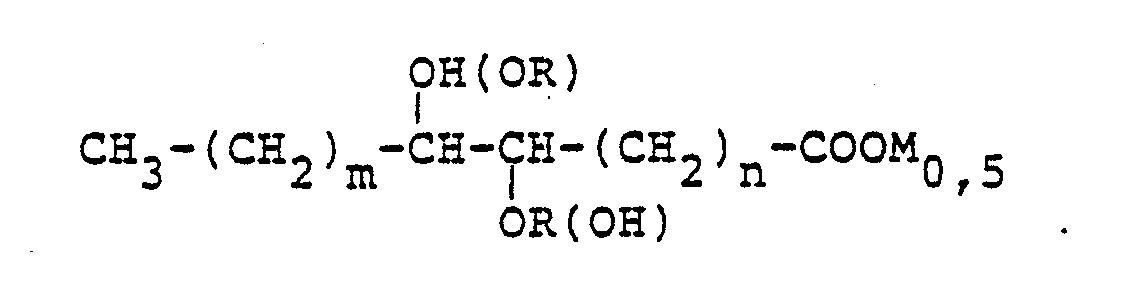
- Die Erfindung betrifft Erdalkalisalze vicinal hydroxy,alkoxy-substituierter C₁₆-C₂₂-Fettsäuren der allgemeinen Formel I

M ein Erdalkalimetall aus der von Mg, Ca, Sr und Ba gebildeten Gruppe ist, und
R aus einer der folgenden Gruppen ausgewählt ist: - a) geradkettige oder verzweigte Alkylgruppen mit 1 bis 22 Kohlenstoffatomen,
- b) geradkettige oder verzweigte mono-ungesättigte Alkenylgruppen mit 3 bis 22 Kohlenstoffatomen,
- c) Hydroxyalkylgruppen mit 2 bis 10 Kohlenstoffatomen und 1 bis 5 Hydroxylgruppen, und
- d) Hydroxyalkylgruppen mit 2 bis 10 Kohlenstoffatomen und 1 bis 5 Hydroxylgruppen, bei denen eine Hydroxylgruppe mit dem Rest einer hydroxy-substituierten C₁₆-C₂₂-Carbonsäure der allgemeinen Formel (II)

- Die Erfindung betrifft weiterhin Verfahren zur Herstellung der Erdalkalisalze der Formel (I) sowie die Verwendung derselben als Katalysatoren für die Ethoxylierung bzw. Propoxylierung von Verbindungen mit aktiven H-Atomen, z.B. von Fettalkoholen, Fettsäuren und Aminen.
- Fettalkoholethoxylate und -propoxylate finden breite Verwendung als nicht-ionische Detergentien. Sie werden hergestellt, indem man Fettalkohole mit üblicherweise 10 bis 18 Kohlenstoffatomen mit Ethylenoxid oder Propylenoxid in Gegenwart von Katalysatoren umsetzt, wobei die Fettalkohole mit mehreren Molekülen Ethylenoxid oder Propylenoxid reagieren.
- Als Katalysatoren für die vorgenannte Polyalkoxylierung sind hierfür u.a. die folgenden eingesetzt worden:
Calcium- und Strontiumhydroxide, -alkoxide und -phenoxide (EP-A 00 92 256),
Calciumalkoxide (EP-A 00 91 146),
Bariumhydroxid (EP-B 01 15 083),
basische Magnesiumverbindungen, z.B. Alkoxide (EP-A 00 82 569),
Magnesium- und Calciumfettsäuresalze (EP-A 0 85 167). - Gebräuchliche Polyalkoxylierungskatalysatoren sind weiterhin Kaliumhydroxid und Natriummethylat.
- Die vorgenannten Katalysatoren weisen u.a. den Nachteil auf, daß sie schlecht in das Reaktionssystem einarbeitbar und/oder schwierig herstellbar sind.
- Für Fettalkoholpolyalkoxylate ist eine enge Bandbreite des Polyalkoxylierungsgrades von besonderer Bedeutung, vgl. JAOCS, Vol. 63, 691-695 (1986), und HAPPI, 52-54 (1986). Die sogenannten "narrow-range"-Alkoxylate weisen demnach insbesondere die folgenden Vorteile auf:
- niedrige Fließpunkte
- höhere Rauchpunkte
- weniger Mole Alkoxid zum Erreichen der Wasserlöslichkeit
- weniger Hydrotope für das Einbringen in HDL's
- ein geringerer, durch Anwesenheit freier (nicht umgesetzter) Fettalkohole bedingter Geruch
- geringere Dunstbildung beim Sprühtrocknen. - Die Bandbreite bzw. Homologenverteilung der Fettalkoholpolyalkoxylate hängt wesentlich von der Art des verwendeten Katalysators ab. Als Maß für die Homologenverteilung gilt der sogenannte Q-Wert gemäß der Beziehung
Q =· p²
in derdie durchschnittliche Adduktzahl (mittlerer Ethoxylierungsgrad) und p den Prozentsatz des Adduktes mit bestimmtem EO-Grad, das überwiegend gebildet wird, bedeuten. Ein großer Q-Wert bedeutet somit eine enge Bandbreite der Homologenverteilung.
- Es wurde nun gefunden, daß man ebenfalls zu polyethoxylierten bzw. polypropoxylierten Fettalkoholen mit hohem Q-Wert kommt, wenn man die Erdalkalisalze der Erfindung als Ethoxylierungs- bzw. Propoxylierungskatalysatoren einsetzt. Gegenüber den vorbekannten Katalysatoren weisen die Erdalkalisalze der Erfindung den Vorteil auf, daß sie kurze Reaktionszeiten ermöglichen, bei Umgebungstemperatur flüssig oder wachsartig und somit besser dosierbar sind und schließlich im Reaktionssystem, anders als z.B. Erdalkalisalze gemäß dem Stand der Technik, löslich sind. Die gleichen Vorteile werden erhalten, wenn man die Erdalkalisalze der Erfindung als Katalysatoren zur Ethoxylierung bzw. Propoxylierung von anderen Verbindungen mit aktiven H-Atomen, z.B. von Fettsäuren und Aminen einsetzt.
- Zwar sind aus der EP-A 00 22 236 Lithiumseifen bekannt, die zum Teil formal unter die allgemeine Formel (I) (M = Li) fallen, wobei der Rest R von geradkettigen oder verzweigten, gegebenenfalls ungesättigten Monoalkoholen mit bis zu 18 Kohlenstoffatomen gebildet ist; diese Lithiumseifen werden jedoch als Verdickungsmittel für Schmierfette eingesetzt und eignen sich nicht als Katalysatoren für die narrow-range-Polyalkoxylierung.
- Das Grundgerüst der Erdalkalisalze der Erfindung leitet sich von mono-ungesättigten Fettsäuren mit 16, 18, 20 oder 22 Kohlenstoffatomen ab, insbesondere von Palmitoleinsäure (9-Hexadecensäure), Petroselinsäure (6-Octadecensäure), Ölsäure (9-Octadecensäure), Vaccensäure (11-Octadecensäure), 11-Octadecensäure, Gadoleinsäure (9-Eicosensäure), 11-Eicosensäure, Cetoleinsäure (11-Docosensäure) und Erucasäure (13-Docosensäure). Üblicherweise werden diese Fettsäuren aus Naturstoffen wie Talg und/oder pflanzlichen oder tierischen einschließlich seetierischen Ölen in Form von technischen Gemischen enthaltene kleinere Mengen an gesättigten oder mehrfach ungesättigten Fettsäuren oder Fettsäuren mit kleinerer oder größerer Kohlenstoffzahl oder hydroxysubstituierten Fettsäuren wie Ricinolsäure stören nicht. Selbstverständlich lassen sich auch reine C₁₆-C₂₂-Fettsäuren einsetzen; dies ist aus Kostengründen in den meisten Fällen jedoch unzweckmäßig.
- Die vorgenannten Fettsäuren lassen sich in Form ihrer Ester mit C₁-C₄-Alkoholen in üblicher Weise epoxidieren, z.B. gemäß US-PS 2 485 160 sowie Chemical Week, April 1963, Seiten 55-60 und 64.
- Die den Erdalkalisalzen der Erfindung zugrunde liegenden vicinal hydroxy, alkoxy-substituierten C₁₆-C₂₂-Fettsäuren sind Ringöffnungsprodukte der vorgenannten Epoxide mit Hydroxyverbindungen der Formel ROH, wobei sich durch die Struktur bedingt nicht angeben läßt, an welchem Kohlenstoffatom der Oxirangruppierung der Alkoxyrest angreift. Die Gruppe R kann dabei eine geradkettige oder verzweigte Alkylgruppe mit 1 bis 22 Kohlenstoffatomen sein, insbesondere eine Methyl-, Ethyl-, Propyl-, Butyl-, Pentyl-, Hexyl-, Heptyl- oder Octylgruppe, weiterhin eine von Fettalkoholen mit 10 bis 22 Kohlenstoffatomen abgeleitete Alkylgruppe. Weiterhin kann R auch eine von den entsprechenden geradkettigen oder verzweigten mono-ungesättigten Alkanolen mit 3 bis 22 Kohlenstoffatomen abgeleitete Alkylgruppe sein. Insoweit bevorzugt sind Methyl-, Butyl-, und Octyl-gruppen sowie von C₁₆/C₁₈-Schnitten von Fettalkoholen, hergestellt aus Naturprodukten, abgeleitete Alkylgruppen.
- Gemäß einer weiteren Ausführungsform der Erfindung kann die Gruppe R eine Hydroxyalkylgruppe mit 2 bis 10 Kohlenstoffatomen und 1 bis 5 Hydroxylgruppen sein, insbesondere abgeleitet aus der von Ethylenglykol, Propylenglykol, Butylenglykol, Glycerin, Diglycerin, Triglycerin, Trimethylolpropan, Di-trimethylolpropan, Pentaerythrit, Dipentaerythrit, Neopentylglykol, Mannit und Sorbit gebildeten Gruppe von mehrwertigen Alkoholen. Bei derartigen Ringöffnungsprodukten weist der Rest R somit freie Hydroxylgruppen auf. Bei geeigneter Reaktionsführung (Molverhältnis von Epoxid zu mehrwertigem Alkohol von mindestens 2 : 1) kann ein Mol des mehrwertigen Alkohols mit 2 Mol des epoxidierten C₁₆-C₂₂-Carbonsäureesters reagieren. Man erhält dann nach Verseifung und Umsetzung zu den Erdalkalisalzen Verbindungen der allgemeinen Formel (I), in der R der Rest eines mehrfunktionellen Alkohols ist, welcher seinerseits mit einem Rest einer hydroxy-substituierten C₁₆-C₂₂-Carbonsäure der allgemeinen Formel (II) alkyliert ist, wobei sich wiederum nicht angeben läßt, an welchem C-Atom der Carbonsäure die Ringöffnung des Oxiranringes erfolgt.
- Als Erdalkalisalze der Erfindung sind die Calcium- oder Bariumsalze bevorzugt, die im übrigen auch in Form eines Gemisches derselben eingesetzt werden können.
- Die Erfindung ist weiterhin auf ein Verfahren zur Herstellung der Erdalkalisalze der Erfindung gerichtet, das von einem Epoxid der allgemeinen Formel (III)


- Die Erfindung wird im folgenden anhand bevorzugter Ausführungsbeispiele näher erläutert.
- Typische Vertreter handelsüblicher epoxidierter Ölsäuremethylester, die bevorzugt in dem Verfahren der Erfindung eingesetzt werden können, weisen die in Tabelle I wiedergegebene Kettenlängenverteilung auf.

- In den Ausführungsbeispielen wurde speziell ein epoxidierter Ölsäuremethylester eingesetzt, der aus einem Ölsäuremethylester mit einer Kettenlängenverteilung gemäß Tabelle II hergestellt wurde.
- Alkohol und Schwefelsäure werden im Reaktionsgefäß vorgelegt und auf die jeweilige Reaktionstemperatur gebracht. Danach läßt man den epoxidierten Fettsäureester innerhalb von einer Stunde zulaufen und innerhalb einer weiteren Stunde abreagieren. Danach kühlt man auf ca. 50°C und neutralisiert mit Natriummethylat.
- Eingesetzte Mengen, Reaktionstemperaturen und Kennzahlen der erhaltenen hydroxy, alkoxy-Stearinsäureester sind in Tabelle III zusammengefaßt.
- Die Produkte der Beispiele 1 bis 4 gemäß Tabelle III werden bei 40°C mit einem Überschuß wässriger Natriumhydroxidlösung versetzt und 3 Stunden bei 90 bis 100°C belassen. Nach vollendeter Verseifung wird auf 70°C abgekühlt und mit konzentrierter Salzsäure auf einen pH von ca. 2 angesäuert. Die wässrige Phase wird heiß abgetrennt und das Produkt zweimal mit 60°C warmen Wasser gewaschen sowie anschließend im Vakuum getrocknet.
- Einsatzmengen und Kennzahlen der erhaltenen Produkte sind in Tabelle IV zusammengefaßt.


- Die Stearinsäuren gemäß den Beispielen 1 bis 4 der Tabelle IV werden in einem Gemisch von Wasser und Isopropanol (1 : 1) gelöst bzw. aufgeschlämmt und bei 90°C mit äquimolaren Mengen Barium- bzw. Calciumacetat (Menge berechnet über die Säurezahl) umgesetzt. Die frei werdende Essigsäure wird mit dem Lösemittel abdestilliert.
- Die Erdalkalisalze gemäß den Beispielen 1 bis 4 sind in der folgenden Tabelle V zusammen mit weiteren hergestellten Erdalkalisalzen der Erfindung zusammengefaßt.
- Der Katalysator wird in der Substanz mit aktivem Wasserstoff gelöst, wobei die Katalysatorkonzentration vorzugsweise 0,5 bis 1,5 Gew.-%, bezogen auf das Endprodukt, beträgt. Die Lösung wird in einen für die Alkoxylierung geeigneten Autoklaven überführt. Man spült mit Stickstoff und evaluiert 30 Minuten lang bei einer Temperatur von 100°C. Anschließend wird die Temperatur auf 180°C gesteigert und bei einem Druck von 5 bar wird die gewünschte Menge Ethylenoxid aufgedrückt. Nach Beendigung der Reaktion läßt man 30 Minuten nachreagieren.
- Die nach dieser Arbeitsvorschrift mit den Katalysatoren der Erfindung bei der Ethoxylierung eines handelsüblichen Laurylalkohols (Lorol® C₁₂) erhaltenen Ergebnisse sind in Tabelle VI zusammengefaßt. Es bedeuten:
Q = der obengenannte Q-Wert
nmax = Ethoxylierungsgrad des Homologen, das im Produkt mengenmäßig am häufigsten auftritt.
OH-Zahl, ist/soll = OH-Zahlen der als Endprodukt erhaltenen polyethoxylierten Laurylalkohole
Kat-% = Katalysatorkonzentration, bezogen auf das Endprodukt
FFA = Gehalt des Endproduktes an freien Fettalkoholen in Flächen-% (GC-Analyse)
t = Reaktionszeit der Polyethoxylierung. - In Tabelle VII sind die Ergebnisse von Vergleichsversuchen mit bekannten Katalysatoren zusammengefaßt. Es wird ebenfalls ein handelsüblicher Laurylalkohol polyethoxyliert. Der Vergleich zeigt, daß die Verbindungen der Erfindung bessere Homologenverteilungen (größere Q-Werte) als Kaliumhydroxid, Natriummethylat und Calciumhydroxid ergeben. Sie liefern weiterhin ähnlich gute Ergebnisse wie Bariumhydroxid, Calciumoleat und Calciumstearat, sind im Gegensatz zu diesen jedoch in dem Reaktionsgemisch löslich. Calciummethylat, das ebenfalls ähnlich gute Ergebnisse liefert, ist wesentlich schwerer herzustellen und nur unter Schwierigkeiten handhabbar.
- Schließlich wird in Figur 1 die mit der Verbindung des Beispiels 12 bei der Polyethoxylierung von Laurylalkohol erreichte enge Homologenverteilung der Polyethoxylierungsprodukte im Vergleich zu der mit Natriummethylat erzielten grafisch dargestellt.


Claims (8)

M ein Erdalkalimetall aus der von Mg, Ca, Sr, und Ba gebildeten Gruppe ist, und
R aus einer der folgenden Gruppen ausgewählt ist:
a) geradkettige oder verzweigte Alkylgruppen mit 1 bis 22 Kohlenstoffatomen,
b) geradkettige oder verzweigte mono-ungesättigte Alkenylgruppen mit 3 bis 22 Kohlenstoffatomen,
c) Hydroxyalkylgruppen mit 2 bis 10 Kohlenstoffatomen und 1 bis 5 Hydroxylgruppen, und
d) Hydroxyalkylgruppen mit 2 bis 10 Kohlenstoffatomen und 1 bis 5 Hydroxylgruppen, bei denen eine Hydroxylgruppe mit dem Rest einer hydroxy-substituierten C₁₆-C₂₂-Carbonsäure der allgemeinen Formel (II)

alkyliert ist.

R-OH (IV)
in der R wie oben definiert ist,
umsetzt und den erhaltenen, vicinal hydroxy,alkoxy-substituierten Ester der allgemeinen Formel (V)

Applications Claiming Priority (2)
| Application Number | Priority Date | Filing Date | Title |
|---|---|---|---|
| DE3706047 | 1987-02-25 | ||
| DE19873706047 DE3706047A1 (de) | 1987-02-25 | 1987-02-25 | Erdalkalimetallsalze vicinal hydroxy, alkoxy-substituierter c(pfeil abwaerts)1(pfeil abwaerts)(pfeil abwaerts)6(pfeil abwaerts)-c(pfeil abwaerts)2(pfeil abwaerts)(pfeil abwaerts)2(pfeil abwaerts)-fettsaeuren, verfahren zu ihrer herstellung und ihre verwendung als alkoxylierungskatalysatoren |
Publications (2)
| Publication Number | Publication Date |
|---|---|
| EP0280145A2 true EP0280145A2 (de) | 1988-08-31 |
| EP0280145A3 EP0280145A3 (de) | 1990-07-04 |
Family
ID=6321744
Family Applications (1)
| Application Number | Title | Priority Date | Filing Date |
|---|---|---|---|
| EP88102175A Withdrawn EP0280145A3 (de) | 1987-02-25 | 1988-02-15 | Erdalkalimetallsalze vicinal hydroxy, alkoxy-substituierter C16-C22-Fettsäuren, Verfahren zu ihrer Herstellung und ihre Verwendung als Alkoxylierungskatalysatoren |
Country Status (5)
| Country | Link |
|---|---|
| US (1) | US5164124A (de) |
| EP (1) | EP0280145A3 (de) |
| JP (1) | JPS63225333A (de) |
| BR (1) | BR8800767A (de) |
| DE (1) | DE3706047A1 (de) |
Cited By (1)
| Publication number | Priority date | Publication date | Assignee | Title |
|---|---|---|---|---|
| WO1991001291A1 (de) * | 1989-07-14 | 1991-02-07 | Henkel Kommanditgesellschaft Auf Aktien | Alkoxilierungsprodukte von oh-gruppenhaltigen carbonsäurederivaten und/oder carbonsäuren |
Families Citing this family (10)
| Publication number | Priority date | Publication date | Assignee | Title |
|---|---|---|---|---|
| DE3817415A1 (de) * | 1988-05-21 | 1989-11-30 | Henkel Kgaa | Verdickte waessrige tensidloesungen |
| US5442082A (en) * | 1990-01-26 | 1995-08-15 | Henkel Kommanditgesellschaft Auf Aktien | Alkoxylated compounds produced from epoxidized carboxylic acid derivatives |
| DE19546946A1 (de) | 1995-12-15 | 1997-06-19 | Hoechst Ag | Precursor für Alkoxylierungskatalysatoren |
| US6201144B1 (en) * | 1996-05-29 | 2001-03-13 | The United States Of America As Represented By The Secretary Of Agriculture | Preparation of secondary ether fatty acids and esters from their hydroxy fatty acid equivalents |
| US6583302B1 (en) | 2002-01-25 | 2003-06-24 | The United States Of America As Represented By The Secretary Of Agriculture | Chemically modified vegetable oil-based industrial fluid |
| US8293808B2 (en) * | 2003-09-30 | 2012-10-23 | Cargill, Incorporated | Flexible polyurethane foams prepared using modified vegetable oil-based polyols |
| MX2007000022A (es) | 2004-06-25 | 2007-05-23 | Pittsburg State University | Polioles basados en aceite vegetal modificado. |
| JP2008539314A (ja) | 2005-04-25 | 2008-11-13 | カーギル インコーポレイテッド | オリゴマーポリオールを含むポリウレタン発泡体 |
| US9284401B2 (en) * | 2006-11-13 | 2016-03-15 | Bayer Materialscience Llc | Process for the preparation of polyether-ester polyols |
| US20090287007A1 (en) * | 2008-05-13 | 2009-11-19 | Cargill, Incorporated | Partially-hydrogenated, fully-epoxidized vegetable oil derivative |
Family Cites Families (9)
| Publication number | Priority date | Publication date | Assignee | Title |
|---|---|---|---|---|
| US2443280A (en) * | 1946-05-29 | 1948-06-15 | Us Agriculture | Hydroxylation process |
| US2485160A (en) * | 1948-10-23 | 1949-10-18 | Rohm & Haas | Process for the epoxidation of esters of oleic and linoleic acids |
| DE2927686A1 (de) * | 1979-07-09 | 1981-02-05 | Henkel Kgaa | Neue lithiumseifen und ihre verwendung als dickungsmittel in schmieroelen bzw. schmierfetten |
| CA1185993A (en) * | 1981-12-23 | 1985-04-23 | Shell Canada Limited | Process for preparing alkanol alkoxylates |
| EP0085167A1 (de) * | 1981-12-24 | 1983-08-10 | Conoco Phillips Company | Alkoxylierung mit Calcium- und Magnesiumsalzen |
| US4396779A (en) * | 1982-04-07 | 1983-08-02 | Shell Oil Company | Alkanol alkoxylate preparation |
| US4453022A (en) * | 1982-04-21 | 1984-06-05 | Union Carbide Corporation | Process for preparing nonionic surfactants-oxyalkylation with calcium and/or strontium catalysts |
| CA1247649A (en) * | 1982-12-30 | 1988-12-28 | James H. Mccain | Barium hydroxide/lower alcohol catalysts for oxyalkylation reactions |
| DE3318596A1 (de) * | 1983-05-21 | 1984-11-22 | Henkel KGaA, 4000 Düsseldorf | Neue hydroxyalkoxycarbonsaeuren und deren salze, ihre herstellung und verwendung |
-
1987
- 1987-02-25 DE DE19873706047 patent/DE3706047A1/de not_active Withdrawn
-
1988
- 1988-02-15 EP EP88102175A patent/EP0280145A3/de not_active Withdrawn
- 1988-02-24 BR BR8800767A patent/BR8800767A/pt unknown
- 1988-02-24 US US07/160,465 patent/US5164124A/en not_active Expired - Fee Related
- 1988-02-25 JP JP63045688A patent/JPS63225333A/ja active Pending
Cited By (1)
| Publication number | Priority date | Publication date | Assignee | Title |
|---|---|---|---|---|
| WO1991001291A1 (de) * | 1989-07-14 | 1991-02-07 | Henkel Kommanditgesellschaft Auf Aktien | Alkoxilierungsprodukte von oh-gruppenhaltigen carbonsäurederivaten und/oder carbonsäuren |
Also Published As
| Publication number | Publication date |
|---|---|
| EP0280145A3 (de) | 1990-07-04 |
| JPS63225333A (ja) | 1988-09-20 |
| DE3706047A1 (de) | 1988-09-08 |
| BR8800767A (pt) | 1988-10-04 |
| US5164124A (en) | 1992-11-17 |
Similar Documents
| Publication | Publication Date | Title |
|---|---|---|
| EP0474644B1 (de) | Verwendung von calcinierten hydrotalciten als katalysatoren für die ethoxylierung bzw. propoxylierung von fettsäureestern | |
| EP0339426B1 (de) | Verwendung von calcinierten Hydrotalciten als Katalysatoren für die Ethoxylierung bzw. Propoxylierung | |
| EP0523089B1 (de) | Verwendung von hydrophobierten hydrotalciten als katalysatoren für die ethoxylierung bzw. propoxylierung | |
| DE4341576A1 (de) | Verfahren zur Herstellung von Alkoxylaten unter Verwendung von Esterverbindungen als Katalysator | |
| EP1061064B1 (de) | Verfahren zur Herstellung von Ethercarbonsäuren mit niedrigem Restalkoholgehalt | |
| EP0600958B1 (de) | Epoxidringöffnungsprodukte und Verfahren zur Herstellung | |
| DE3706047A1 (de) | Erdalkalimetallsalze vicinal hydroxy, alkoxy-substituierter c(pfeil abwaerts)1(pfeil abwaerts)(pfeil abwaerts)6(pfeil abwaerts)-c(pfeil abwaerts)2(pfeil abwaerts)(pfeil abwaerts)2(pfeil abwaerts)-fettsaeuren, verfahren zu ihrer herstellung und ihre verwendung als alkoxylierungskatalysatoren | |
| EP0295578B1 (de) | Verwendung von Erdalkalisalzen von Ethercarbonsäuren als Katalysatoren für die Alkoxylierung | |
| EP1156994B1 (de) | Verfahren zur herstellung alkoxylierter nichtionischer tenside | |
| WO1994013618A1 (de) | Verfahren zur herstellung hellfarbiger, lagerstabiler nichtionischer tenside | |
| DE19807991A1 (de) | Alkoxylierungskatalysator | |
| EP0432208B1 (de) | Verfahren zur herstellung von fettalkoholderivaten | |
| DE3928397A1 (de) | Verfahren zur herstellung von salzfreien estern von fettsaeuren mit oligoglycerinen bzw. mit anlagerungsprodukten von ethylenoxid und/oder propylenoxid an oligoglycerine | |
| EP0337239A2 (de) | Verwendung von Erdalkalisalzen von Polycarbonsäuremonoestern als Katalysatoren für die Alkoxylierung | |
| DE3829743A1 (de) | Verfahren zur herstellung von fettalkoholderivaten | |
| DE2853064C2 (de) | Verfahren zur Herstellung von Oxalkylierungsprodukten | |
| DE4005338A1 (de) | Verwendung von strontium- und/oder bariumacetylacetonaten als katalysatoren fuer die ethoxylierung bzw. propoxylierung von verbindungen mit aktiven h-atomen | |
| DE4004379A1 (de) | Verwendung von erdalkalisalzen von acylcyanamiden als katalysatoren fuer die ethoxylierung bzw. propoxylierung von verbindungen mit aktiven h-atomen | |
| WO2000003969A1 (de) | Verfahren zur herstellung alkoxylierter carbonsäureester | |
| DE10161352A1 (de) | Verfahren zur Herstellung von Alkoxylaten | |
| DE3719968A1 (de) | Verwendung von erdalkalisalzen von ethercarbonsaeuren als katalysatoren fuer die alkoxylierung | |
| WO2003053898A1 (de) | Verfahren zur herstellung alkoxylierter verbindungen |
Legal Events
| Date | Code | Title | Description |
|---|---|---|---|
| PUAI | Public reference made under article 153(3) epc to a published international application that has entered the european phase |
Free format text: ORIGINAL CODE: 0009012 |
|
| AK | Designated contracting states |
Kind code of ref document: A2 Designated state(s): AT BE CH DE ES FR GB GR IT LI LU NL SE |
|
| PUAL | Search report despatched |
Free format text: ORIGINAL CODE: 0009013 |
|
| AK | Designated contracting states |
Kind code of ref document: A3 Designated state(s): AT BE CH DE ES FR GB GR IT LI LU NL SE |
|
| 17P | Request for examination filed |
Effective date: 19900726 |
|
| STAA | Information on the status of an ep patent application or granted ep patent |
Free format text: STATUS: THE APPLICATION IS DEEMED TO BE WITHDRAWN |
|
| 17Q | First examination report despatched |
Effective date: 19911209 |
|
| 18D | Application deemed to be withdrawn |
Effective date: 19910903 |