EP0269102A2 - Durch Protonierung mit Säure wasserverdünnbare Bindemittel - Google Patents
Durch Protonierung mit Säure wasserverdünnbare Bindemittel Download PDFInfo
- Publication number
- EP0269102A2 EP0269102A2 EP87117466A EP87117466A EP0269102A2 EP 0269102 A2 EP0269102 A2 EP 0269102A2 EP 87117466 A EP87117466 A EP 87117466A EP 87117466 A EP87117466 A EP 87117466A EP 0269102 A2 EP0269102 A2 EP 0269102A2
- Authority
- EP
- European Patent Office
- Prior art keywords
- groups
- acid esters
- binder
- acid
- water
- Prior art date
- Legal status (The legal status is an assumption and is not a legal conclusion. Google has not performed a legal analysis and makes no representation as to the accuracy of the status listed.)
- Granted
Links
- 239000011230 binding agent Substances 0.000 title claims abstract description 40
- 239000002253 acid Substances 0.000 claims abstract description 13
- 238000004070 electrodeposition Methods 0.000 claims abstract description 11
- 125000003710 aryl alkyl group Chemical group 0.000 claims abstract description 8
- 125000000753 cycloalkyl group Chemical group 0.000 claims abstract description 8
- 230000005588 protonation Effects 0.000 claims abstract description 7
- 125000001424 substituent group Chemical group 0.000 claims abstract description 5
- 125000006702 (C1-C18) alkyl group Chemical group 0.000 claims abstract description 4
- 125000002947 alkylene group Chemical group 0.000 claims abstract description 4
- 239000003431 cross linking reagent Substances 0.000 claims description 10
- 125000002924 primary amino group Chemical group [H]N([H])* 0.000 claims description 10
- 239000003822 epoxy resin Substances 0.000 claims description 7
- 229920000647 polyepoxide Polymers 0.000 claims description 7
- 238000002360 preparation method Methods 0.000 claims description 7
- 239000006185 dispersion Substances 0.000 claims description 5
- 239000000049 pigment Substances 0.000 claims description 5
- ZTWTYVWXUKTLCP-UHFFFAOYSA-N vinylphosphonic acid Chemical class OP(O)(=O)C=C ZTWTYVWXUKTLCP-UHFFFAOYSA-N 0.000 claims description 5
- LNEPOXFFQSENCJ-UHFFFAOYSA-N haloperidol Chemical compound C1CC(O)(C=2C=CC(Cl)=CC=2)CCN1CCCC(=O)C1=CC=C(F)C=C1 LNEPOXFFQSENCJ-UHFFFAOYSA-N 0.000 claims description 4
- 125000000467 secondary amino group Chemical group [H]N([*:1])[*:2] 0.000 claims description 4
- NLVXSWCKKBEXTG-UHFFFAOYSA-N vinylsulfonic acid Chemical class OS(=O)(=O)C=C NLVXSWCKKBEXTG-UHFFFAOYSA-N 0.000 claims description 4
- 238000000034 method Methods 0.000 claims description 3
- 238000006845 Michael addition reaction Methods 0.000 claims description 2
- 239000003960 organic solvent Substances 0.000 claims 2
- OAICVXFJPJFONN-UHFFFAOYSA-N Phosphorus Chemical compound [P] OAICVXFJPJFONN-UHFFFAOYSA-N 0.000 claims 1
- NINIDFKCEFEMDL-UHFFFAOYSA-N Sulfur Chemical compound [S] NINIDFKCEFEMDL-UHFFFAOYSA-N 0.000 claims 1
- 230000002378 acidificating effect Effects 0.000 claims 1
- 238000007334 copolymerization reaction Methods 0.000 claims 1
- 229910052698 phosphorus Inorganic materials 0.000 claims 1
- 239000011574 phosphorus Substances 0.000 claims 1
- 229910052717 sulfur Inorganic materials 0.000 claims 1
- 239000011593 sulfur Substances 0.000 claims 1
- 125000001302 tertiary amino group Chemical group 0.000 claims 1
- XLYOFNOQVPJJNP-UHFFFAOYSA-N water Substances O XLYOFNOQVPJJNP-UHFFFAOYSA-N 0.000 abstract description 10
- 150000007513 acids Chemical class 0.000 abstract description 4
- 125000000217 alkyl group Chemical group 0.000 abstract description 4
- -1 ester compounds Chemical class 0.000 description 11
- 125000004433 nitrogen atom Chemical group N* 0.000 description 11
- QTBSBXVTEAMEQO-UHFFFAOYSA-N Acetic acid Chemical compound CC(O)=O QTBSBXVTEAMEQO-UHFFFAOYSA-N 0.000 description 10
- 229920003180 amino resin Polymers 0.000 description 10
- CSCPPACGZOOCGX-UHFFFAOYSA-N Acetone Chemical compound CC(C)=O CSCPPACGZOOCGX-UHFFFAOYSA-N 0.000 description 9
- 150000001412 amines Chemical class 0.000 description 9
- 238000006243 chemical reaction Methods 0.000 description 9
- 239000011248 coating agent Substances 0.000 description 9
- 229920001568 phenolic resin Polymers 0.000 description 9
- 150000001875 compounds Chemical class 0.000 description 8
- NAQMVNRVTILPCV-UHFFFAOYSA-N hexane-1,6-diamine Chemical compound NCCCCCCN NAQMVNRVTILPCV-UHFFFAOYSA-N 0.000 description 8
- 239000000203 mixture Substances 0.000 description 8
- 229920005989 resin Polymers 0.000 description 8
- 239000011347 resin Substances 0.000 description 8
- WSFSSNUMVMOOMR-UHFFFAOYSA-N Formaldehyde Chemical compound O=C WSFSSNUMVMOOMR-UHFFFAOYSA-N 0.000 description 6
- 229920000877 Melamine resin Polymers 0.000 description 6
- LRHPLDYGYMQRHN-UHFFFAOYSA-N N-Butanol Chemical compound CCCCO LRHPLDYGYMQRHN-UHFFFAOYSA-N 0.000 description 6
- YXFVVABEGXRONW-UHFFFAOYSA-N Toluene Chemical compound CC1=CC=CC=C1 YXFVVABEGXRONW-UHFFFAOYSA-N 0.000 description 6
- 150000004985 diamines Chemical class 0.000 description 6
- 229920002521 macromolecule Polymers 0.000 description 6
- 239000000047 product Chemical group 0.000 description 6
- LSNNMFCWUKXFEE-UHFFFAOYSA-M Bisulfite Chemical compound OS([O-])=O LSNNMFCWUKXFEE-UHFFFAOYSA-M 0.000 description 5
- OKKJLVBELUTLKV-UHFFFAOYSA-N Methanol Chemical compound OC OKKJLVBELUTLKV-UHFFFAOYSA-N 0.000 description 5
- ABLZXFCXXLZCGV-UHFFFAOYSA-N Phosphorous acid Chemical group OP(O)=O ABLZXFCXXLZCGV-UHFFFAOYSA-N 0.000 description 5
- 238000000576 coating method Methods 0.000 description 5
- 150000003008 phosphonic acid esters Chemical class 0.000 description 5
- 229920000642 polymer Polymers 0.000 description 5
- IKHGUXGNUITLKF-UHFFFAOYSA-N Acetaldehyde Chemical compound CC=O IKHGUXGNUITLKF-UHFFFAOYSA-N 0.000 description 4
- CERQOIWHTDAKMF-UHFFFAOYSA-N Methacrylic acid Chemical compound CC(=C)C(O)=O CERQOIWHTDAKMF-UHFFFAOYSA-N 0.000 description 4
- NBBJYMSMWIIQGU-UHFFFAOYSA-N Propionic aldehyde Chemical compound CCC=O NBBJYMSMWIIQGU-UHFFFAOYSA-N 0.000 description 4
- 229960000583 acetic acid Drugs 0.000 description 4
- 150000001299 aldehydes Chemical class 0.000 description 4
- IISBACLAFKSPIT-UHFFFAOYSA-N bisphenol A Chemical compound C=1C=C(O)C=CC=1C(C)(C)C1=CC=C(O)C=C1 IISBACLAFKSPIT-UHFFFAOYSA-N 0.000 description 4
- 239000008199 coating composition Substances 0.000 description 4
- 150000002148 esters Chemical class 0.000 description 4
- 239000000178 monomer Substances 0.000 description 4
- 239000005011 phenolic resin Substances 0.000 description 4
- 239000000126 substance Substances 0.000 description 4
- 239000000758 substrate Substances 0.000 description 4
- BDHFUVZGWQCTTF-UHFFFAOYSA-M sulfonate Chemical compound [O-]S(=O)=O BDHFUVZGWQCTTF-UHFFFAOYSA-M 0.000 description 4
- 239000004593 Epoxy Substances 0.000 description 3
- 229910000831 Steel Inorganic materials 0.000 description 3
- XSQUKJJJFZCRTK-UHFFFAOYSA-N Urea Chemical compound NC(N)=O XSQUKJJJFZCRTK-UHFFFAOYSA-N 0.000 description 3
- 239000007795 chemical reaction product Substances 0.000 description 3
- 238000004132 cross linking Methods 0.000 description 3
- GYZLOYUZLJXAJU-UHFFFAOYSA-N diglycidyl ether Chemical class C1OC1COCC1CO1 GYZLOYUZLJXAJU-UHFFFAOYSA-N 0.000 description 3
- 238000004519 manufacturing process Methods 0.000 description 3
- 125000000466 oxiranyl group Chemical group 0.000 description 3
- 150000002989 phenols Chemical class 0.000 description 3
- 239000007787 solid Substances 0.000 description 3
- 239000002904 solvent Substances 0.000 description 3
- 239000010959 steel Substances 0.000 description 3
- 150000003459 sulfonic acid esters Chemical class 0.000 description 3
- NKTOLZVEWDHZMU-UHFFFAOYSA-N 2,5-xylenol Chemical compound CC1=CC=C(C)C(O)=C1 NKTOLZVEWDHZMU-UHFFFAOYSA-N 0.000 description 2
- POAOYUHQDCAZBD-UHFFFAOYSA-N 2-butoxyethanol Chemical compound CCCCOCCO POAOYUHQDCAZBD-UHFFFAOYSA-N 0.000 description 2
- YCOXTKKNXUZSKD-UHFFFAOYSA-N 3,4-xylenol Chemical compound CC1=CC=C(O)C=C1C YCOXTKKNXUZSKD-UHFFFAOYSA-N 0.000 description 2
- QGZKDVFQNNGYKY-UHFFFAOYSA-N Ammonia Chemical compound N QGZKDVFQNNGYKY-UHFFFAOYSA-N 0.000 description 2
- ROSDSFDQCJNGOL-UHFFFAOYSA-N Dimethylamine Chemical compound CNC ROSDSFDQCJNGOL-UHFFFAOYSA-N 0.000 description 2
- LFQSCWFLJHTTHZ-UHFFFAOYSA-N Ethanol Chemical compound CCO LFQSCWFLJHTTHZ-UHFFFAOYSA-N 0.000 description 2
- YNAVUWVOSKDBBP-UHFFFAOYSA-N Morpholine Chemical compound C1COCCN1 YNAVUWVOSKDBBP-UHFFFAOYSA-N 0.000 description 2
- ISWSIDIOOBJBQZ-UHFFFAOYSA-N Phenol Chemical compound OC1=CC=CC=C1 ISWSIDIOOBJBQZ-UHFFFAOYSA-N 0.000 description 2
- NBIIXXVUZAFLBC-UHFFFAOYSA-N Phosphoric acid Chemical compound OP(O)(O)=O NBIIXXVUZAFLBC-UHFFFAOYSA-N 0.000 description 2
- NQRYJNQNLNOLGT-UHFFFAOYSA-N Piperidine Chemical compound C1CCNCC1 NQRYJNQNLNOLGT-UHFFFAOYSA-N 0.000 description 2
- PPBRXRYQALVLMV-UHFFFAOYSA-N Styrene Chemical compound C=CC1=CC=CC=C1 PPBRXRYQALVLMV-UHFFFAOYSA-N 0.000 description 2
- GWEVSGVZZGPLCZ-UHFFFAOYSA-N Titan oxide Chemical compound O=[Ti]=O GWEVSGVZZGPLCZ-UHFFFAOYSA-N 0.000 description 2
- 150000001252 acrylic acid derivatives Chemical class 0.000 description 2
- 150000001298 alcohols Chemical class 0.000 description 2
- 125000001931 aliphatic group Chemical group 0.000 description 2
- ZTQSAGDEMFDKMZ-UHFFFAOYSA-N butyric aldehyde Natural products CCCC=O ZTQSAGDEMFDKMZ-UHFFFAOYSA-N 0.000 description 2
- 235000013877 carbamide Nutrition 0.000 description 2
- 125000004432 carbon atom Chemical group C* 0.000 description 2
- 230000003197 catalytic effect Effects 0.000 description 2
- 239000003795 chemical substances by application Substances 0.000 description 2
- 229920001577 copolymer Polymers 0.000 description 2
- 238000000151 deposition Methods 0.000 description 2
- 230000008021 deposition Effects 0.000 description 2
- 150000001991 dicarboxylic acids Chemical class 0.000 description 2
- 235000014113 dietary fatty acids Nutrition 0.000 description 2
- 230000000694 effects Effects 0.000 description 2
- 150000002118 epoxides Chemical class 0.000 description 2
- 125000003700 epoxy group Chemical group 0.000 description 2
- 125000001495 ethyl group Chemical group [H]C([H])([H])C([H])([H])* 0.000 description 2
- 229930195729 fatty acid Natural products 0.000 description 2
- 239000000194 fatty acid Substances 0.000 description 2
- 239000012362 glacial acetic acid Substances 0.000 description 2
- 125000002768 hydroxyalkyl group Chemical group 0.000 description 2
- ZXEKIIBDNHEJCQ-UHFFFAOYSA-N isobutanol Chemical compound CC(C)CO ZXEKIIBDNHEJCQ-UHFFFAOYSA-N 0.000 description 2
- JVTAAEKCZFNVCJ-UHFFFAOYSA-N lactic acid Chemical compound CC(O)C(O)=O JVTAAEKCZFNVCJ-UHFFFAOYSA-N 0.000 description 2
- RLSSMJSEOOYNOY-UHFFFAOYSA-N m-cresol Chemical compound CC1=CC=CC(O)=C1 RLSSMJSEOOYNOY-UHFFFAOYSA-N 0.000 description 2
- JDSHMPZPIAZGSV-UHFFFAOYSA-N melamine Chemical compound NC1=NC(N)=NC(N)=N1 JDSHMPZPIAZGSV-UHFFFAOYSA-N 0.000 description 2
- BDAGIHXWWSANSR-UHFFFAOYSA-N methanoic acid Natural products OC=O BDAGIHXWWSANSR-UHFFFAOYSA-N 0.000 description 2
- WSFSSNUMVMOOMR-NJFSPNSNSA-N methanone Chemical compound O=[14CH2] WSFSSNUMVMOOMR-NJFSPNSNSA-N 0.000 description 2
- 238000002156 mixing Methods 0.000 description 2
- 238000006386 neutralization reaction Methods 0.000 description 2
- QJGQUHMNIGDVPM-UHFFFAOYSA-N nitrogen group Chemical group [N] QJGQUHMNIGDVPM-UHFFFAOYSA-N 0.000 description 2
- 229920003986 novolac Polymers 0.000 description 2
- QWVGKYWNOKOFNN-UHFFFAOYSA-N o-cresol Chemical compound CC1=CC=CC=C1O QWVGKYWNOKOFNN-UHFFFAOYSA-N 0.000 description 2
- IWDCLRJOBJJRNH-UHFFFAOYSA-N p-cresol Chemical compound CC1=CC=C(O)C=C1 IWDCLRJOBJJRNH-UHFFFAOYSA-N 0.000 description 2
- 239000003973 paint Substances 0.000 description 2
- 125000001918 phosphonic acid ester group Chemical group 0.000 description 2
- 229920000058 polyacrylate Polymers 0.000 description 2
- 239000002994 raw material Substances 0.000 description 2
- UMGDCJDMYOKAJW-UHFFFAOYSA-N thiourea Chemical compound NC(N)=S UMGDCJDMYOKAJW-UHFFFAOYSA-N 0.000 description 2
- JOXIMZWYDAKGHI-UHFFFAOYSA-N toluene-4-sulfonic acid Chemical compound CC1=CC=C(S(O)(=O)=O)C=C1 JOXIMZWYDAKGHI-UHFFFAOYSA-N 0.000 description 2
- XFNJVJPLKCPIBV-UHFFFAOYSA-N trimethylenediamine Chemical compound NCCCN XFNJVJPLKCPIBV-UHFFFAOYSA-N 0.000 description 2
- RBACIKXCRWGCBB-UHFFFAOYSA-N 1,2-Epoxybutane Chemical compound CCC1CO1 RBACIKXCRWGCBB-UHFFFAOYSA-N 0.000 description 1
- DREPONDJUKIQLX-UHFFFAOYSA-N 1-[ethenyl(ethoxy)phosphoryl]oxyethane Chemical compound CCOP(=O)(C=C)OCC DREPONDJUKIQLX-UHFFFAOYSA-N 0.000 description 1
- OSSNTDFYBPYIEC-UHFFFAOYSA-N 1-ethenylimidazole Chemical compound C=CN1C=CN=C1 OSSNTDFYBPYIEC-UHFFFAOYSA-N 0.000 description 1
- JOLVYUIAMRUBRK-UHFFFAOYSA-N 11',12',14',15'-Tetradehydro(Z,Z-)-3-(8-Pentadecenyl)phenol Natural products OC1=CC=CC(CCCCCCCC=CCC=CCC=C)=C1 JOLVYUIAMRUBRK-UHFFFAOYSA-N 0.000 description 1
- KUFFULVDNCHOFZ-UHFFFAOYSA-N 2,4-xylenol Chemical compound CC1=CC=C(O)C(C)=C1 KUFFULVDNCHOFZ-UHFFFAOYSA-N 0.000 description 1
- 125000005999 2-bromoethyl group Chemical group 0.000 description 1
- 125000001340 2-chloroethyl group Chemical group [H]C([H])(Cl)C([H])([H])* 0.000 description 1
- 125000000954 2-hydroxyethyl group Chemical group [H]C([*])([H])C([H])([H])O[H] 0.000 description 1
- BNCADMBVWNPPIZ-UHFFFAOYSA-N 2-n,2-n,4-n,4-n,6-n,6-n-hexakis(methoxymethyl)-1,3,5-triazine-2,4,6-triamine Chemical compound COCN(COC)C1=NC(N(COC)COC)=NC(N(COC)COC)=N1 BNCADMBVWNPPIZ-UHFFFAOYSA-N 0.000 description 1
- 125000003903 2-propenyl group Chemical group [H]C([*])([H])C([H])=C([H])[H] 0.000 description 1
- KGIGUEBEKRSTEW-UHFFFAOYSA-N 2-vinylpyridine Chemical compound C=CC1=CC=CC=N1 KGIGUEBEKRSTEW-UHFFFAOYSA-N 0.000 description 1
- YLKVIMNNMLKUGJ-UHFFFAOYSA-N 3-Delta8-pentadecenylphenol Natural products CCCCCCC=CCCCCCCCC1=CC=CC(O)=C1 YLKVIMNNMLKUGJ-UHFFFAOYSA-N 0.000 description 1
- YOOSAIJKYCBPFW-UHFFFAOYSA-N 3-[4-(3-aminopropoxy)butoxy]propan-1-amine Chemical compound NCCCOCCCCOCCCN YOOSAIJKYCBPFW-UHFFFAOYSA-N 0.000 description 1
- VPWNQTHUCYMVMZ-UHFFFAOYSA-N 4,4'-sulfonyldiphenol Chemical class C1=CC(O)=CC=C1S(=O)(=O)C1=CC=C(O)C=C1 VPWNQTHUCYMVMZ-UHFFFAOYSA-N 0.000 description 1
- OSWFIVFLDKOXQC-UHFFFAOYSA-N 4-(3-methoxyphenyl)aniline Chemical compound COC1=CC=CC(C=2C=CC(N)=CC=2)=C1 OSWFIVFLDKOXQC-UHFFFAOYSA-N 0.000 description 1
- YHFUWFAPNGZQSV-UHFFFAOYSA-N 4-hydroxy-1,3-diazinan-2-one Chemical compound OC1CCNC(=O)N1 YHFUWFAPNGZQSV-UHFFFAOYSA-N 0.000 description 1
- QHPQWRBYOIRBIT-UHFFFAOYSA-N 4-tert-butylphenol Chemical compound CC(C)(C)C1=CC=C(O)C=C1 QHPQWRBYOIRBIT-UHFFFAOYSA-N 0.000 description 1
- GZVHEAJQGPRDLQ-UHFFFAOYSA-N 6-phenyl-1,3,5-triazine-2,4-diamine Chemical compound NC1=NC(N)=NC(C=2C=CC=CC=2)=N1 GZVHEAJQGPRDLQ-UHFFFAOYSA-N 0.000 description 1
- HRPVXLWXLXDGHG-UHFFFAOYSA-N Acrylamide Chemical compound NC(=O)C=C HRPVXLWXLXDGHG-UHFFFAOYSA-N 0.000 description 1
- NIXOWILDQLNWCW-UHFFFAOYSA-M Acrylate Chemical compound [O-]C(=O)C=C NIXOWILDQLNWCW-UHFFFAOYSA-M 0.000 description 1
- NOWKCMXCCJGMRR-UHFFFAOYSA-N Aziridine Chemical compound C1CN1 NOWKCMXCCJGMRR-UHFFFAOYSA-N 0.000 description 1
- 229930185605 Bisphenol Natural products 0.000 description 1
- JOLVYUIAMRUBRK-UTOQUPLUSA-N Cardanol Chemical compound OC1=CC=CC(CCCCCCC\C=C/C\C=C/CC=C)=C1 JOLVYUIAMRUBRK-UTOQUPLUSA-N 0.000 description 1
- FAYVLNWNMNHXGA-UHFFFAOYSA-N Cardanoldiene Natural products CCCC=CCC=CCCCCCCCC1=CC=CC(O)=C1 FAYVLNWNMNHXGA-UHFFFAOYSA-N 0.000 description 1
- RYGMFSIKBFXOCR-UHFFFAOYSA-N Copper Chemical compound [Cu] RYGMFSIKBFXOCR-UHFFFAOYSA-N 0.000 description 1
- RPNUMPOLZDHAAY-UHFFFAOYSA-N Diethylenetriamine Chemical compound NCCNCCN RPNUMPOLZDHAAY-UHFFFAOYSA-N 0.000 description 1
- 235000009161 Espostoa lanata Nutrition 0.000 description 1
- 240000001624 Espostoa lanata Species 0.000 description 1
- PIICEJLVQHRZGT-UHFFFAOYSA-N Ethylenediamine Chemical compound NCCN PIICEJLVQHRZGT-UHFFFAOYSA-N 0.000 description 1
- 239000004640 Melamine resin Substances 0.000 description 1
- VGGLHLAESQEWCR-UHFFFAOYSA-N N-(hydroxymethyl)urea Chemical compound NC(=O)NCO VGGLHLAESQEWCR-UHFFFAOYSA-N 0.000 description 1
- CTQNGGLPUBDAKN-UHFFFAOYSA-N O-Xylene Chemical compound CC1=CC=CC=C1C CTQNGGLPUBDAKN-UHFFFAOYSA-N 0.000 description 1
- BPQQTUXANYXVAA-UHFFFAOYSA-N Orthosilicate Chemical compound [O-][Si]([O-])([O-])[O-] BPQQTUXANYXVAA-UHFFFAOYSA-N 0.000 description 1
- 229920001807 Urea-formaldehyde Polymers 0.000 description 1
- 235000011054 acetic acid Nutrition 0.000 description 1
- NJYZCEFQAIUHSD-UHFFFAOYSA-N acetoguanamine Chemical compound CC1=NC(N)=NC(N)=N1 NJYZCEFQAIUHSD-UHFFFAOYSA-N 0.000 description 1
- 125000004018 acid anhydride group Chemical group 0.000 description 1
- 239000000654 additive Substances 0.000 description 1
- 150000007933 aliphatic carboxylic acids Chemical class 0.000 description 1
- 125000005011 alkyl ether group Chemical group 0.000 description 1
- XYLMUPLGERFSHI-UHFFFAOYSA-N alpha-Methylstyrene Chemical compound CC(=C)C1=CC=CC=C1 XYLMUPLGERFSHI-UHFFFAOYSA-N 0.000 description 1
- 229910052782 aluminium Inorganic materials 0.000 description 1
- XAGFODPZIPBFFR-UHFFFAOYSA-N aluminium Chemical compound [Al] XAGFODPZIPBFFR-UHFFFAOYSA-N 0.000 description 1
- 229910000147 aluminium phosphate Inorganic materials 0.000 description 1
- 150000001408 amides Chemical class 0.000 description 1
- 150000001414 amino alcohols Chemical class 0.000 description 1
- 229910021529 ammonia Inorganic materials 0.000 description 1
- 150000008064 anhydrides Chemical group 0.000 description 1
- 239000003963 antioxidant agent Substances 0.000 description 1
- 239000008346 aqueous phase Substances 0.000 description 1
- 125000003118 aryl group Chemical group 0.000 description 1
- 230000015572 biosynthetic process Effects 0.000 description 1
- 125000000484 butyl group Chemical group [H]C([*])([H])C([H])([H])C([H])([H])C([H])([H])[H] 0.000 description 1
- 239000004202 carbamide Substances 0.000 description 1
- 239000006229 carbon black Substances 0.000 description 1
- 125000003178 carboxy group Chemical group [H]OC(*)=O 0.000 description 1
- PTFIPECGHSYQNR-UHFFFAOYSA-N cardanol Natural products CCCCCCCCCCCCCCCC1=CC=CC(O)=C1 PTFIPECGHSYQNR-UHFFFAOYSA-N 0.000 description 1
- 230000000052 comparative effect Effects 0.000 description 1
- 238000009833 condensation Methods 0.000 description 1
- 230000005494 condensation Effects 0.000 description 1
- 238000001816 cooling Methods 0.000 description 1
- 229910052802 copper Inorganic materials 0.000 description 1
- 239000010949 copper Substances 0.000 description 1
- 230000007797 corrosion Effects 0.000 description 1
- 238000005260 corrosion Methods 0.000 description 1
- 230000007547 defect Effects 0.000 description 1
- 125000004985 dialkyl amino alkyl group Chemical group 0.000 description 1
- HPNMFZURTQLUMO-UHFFFAOYSA-N diethylamine Chemical compound CCNCC HPNMFZURTQLUMO-UHFFFAOYSA-N 0.000 description 1
- 239000000539 dimer Substances 0.000 description 1
- BGXRJLLPQWKPIH-UHFFFAOYSA-N dimethoxymethylurea Chemical compound COC(OC)NC(N)=O BGXRJLLPQWKPIH-UHFFFAOYSA-N 0.000 description 1
- 150000002009 diols Chemical class 0.000 description 1
- AFOSIXZFDONLBT-UHFFFAOYSA-N divinyl sulfone Chemical compound C=CS(=O)(=O)C=C AFOSIXZFDONLBT-UHFFFAOYSA-N 0.000 description 1
- 239000000975 dye Substances 0.000 description 1
- 238000006735 epoxidation reaction Methods 0.000 description 1
- 125000004185 ester group Chemical group 0.000 description 1
- 150000002170 ethers Chemical class 0.000 description 1
- LYCAIKOWRPUZTN-UHFFFAOYSA-N ethylene glycol Natural products OCCO LYCAIKOWRPUZTN-UHFFFAOYSA-N 0.000 description 1
- 150000004665 fatty acids Chemical class 0.000 description 1
- 239000000945 filler Substances 0.000 description 1
- 239000010408 film Substances 0.000 description 1
- SLGWESQGEUXWJQ-UHFFFAOYSA-N formaldehyde;phenol Chemical compound O=C.OC1=CC=CC=C1 SLGWESQGEUXWJQ-UHFFFAOYSA-N 0.000 description 1
- 235000019253 formic acid Nutrition 0.000 description 1
- 125000003055 glycidyl group Chemical group C(C1CO1)* 0.000 description 1
- 125000004051 hexyl group Chemical group [H]C([H])([H])C([H])([H])C([H])([H])C([H])([H])C([H])([H])C([H])([H])* 0.000 description 1
- 238000000265 homogenisation Methods 0.000 description 1
- 230000007062 hydrolysis Effects 0.000 description 1
- 238000006460 hydrolysis reaction Methods 0.000 description 1
- 125000002887 hydroxy group Chemical group [H]O* 0.000 description 1
- WGCNASOHLSPBMP-UHFFFAOYSA-N hydroxyacetaldehyde Natural products OCC=O WGCNASOHLSPBMP-UHFFFAOYSA-N 0.000 description 1
- YAMHXTCMCPHKLN-UHFFFAOYSA-N imidazolidin-2-one Chemical compound O=C1NCCN1 YAMHXTCMCPHKLN-UHFFFAOYSA-N 0.000 description 1
- 150000002576 ketones Chemical class 0.000 description 1
- 239000004922 lacquer Substances 0.000 description 1
- 239000004310 lactic acid Substances 0.000 description 1
- 235000014655 lactic acid Nutrition 0.000 description 1
- 239000000463 material Substances 0.000 description 1
- 150000007974 melamines Chemical class 0.000 description 1
- 229910052751 metal Inorganic materials 0.000 description 1
- 239000002184 metal Substances 0.000 description 1
- 125000002496 methyl group Chemical group [H]C([H])([H])* 0.000 description 1
- 238000003801 milling Methods 0.000 description 1
- 150000007522 mineralic acids Chemical class 0.000 description 1
- 150000002763 monocarboxylic acids Chemical class 0.000 description 1
- KKFHAJHLJHVUDM-UHFFFAOYSA-N n-vinylcarbazole Chemical compound C1=CC=C2N(C=C)C3=CC=CC=C3C2=C1 KKFHAJHLJHVUDM-UHFFFAOYSA-N 0.000 description 1
- 230000006855 networking Effects 0.000 description 1
- 229910052757 nitrogen Inorganic materials 0.000 description 1
- 150000007524 organic acids Chemical class 0.000 description 1
- 150000002917 oxazolidines Chemical class 0.000 description 1
- 239000002245 particle Substances 0.000 description 1
- 125000001147 pentyl group Chemical group C(CCCC)* 0.000 description 1
- 235000011007 phosphoric acid Nutrition 0.000 description 1
- 239000004033 plastic Substances 0.000 description 1
- 229920003023 plastic Polymers 0.000 description 1
- 229920005862 polyol Polymers 0.000 description 1
- 150000003077 polyols Chemical class 0.000 description 1
- 230000002028 premature Effects 0.000 description 1
- 150000003141 primary amines Chemical class 0.000 description 1
- HJWLCRVIBGQPNF-UHFFFAOYSA-N prop-2-enylbenzene Chemical compound C=CCC1=CC=CC=C1 HJWLCRVIBGQPNF-UHFFFAOYSA-N 0.000 description 1
- 125000001436 propyl group Chemical group [H]C([*])([H])C([H])([H])C([H])([H])[H] 0.000 description 1
- 238000012552 review Methods 0.000 description 1
- 150000003335 secondary amines Chemical class 0.000 description 1
- 239000007858 starting material Substances 0.000 description 1
- 238000003860 storage Methods 0.000 description 1
- 238000003786 synthesis reaction Methods 0.000 description 1
- 239000010409 thin film Substances 0.000 description 1
- 239000004408 titanium dioxide Substances 0.000 description 1
- LENZDBCJOHFCAS-UHFFFAOYSA-N tris Chemical compound OCC(N)(CO)CO LENZDBCJOHFCAS-UHFFFAOYSA-N 0.000 description 1
- 150000003672 ureas Chemical class 0.000 description 1
- 125000000391 vinyl group Chemical group [H]C([*])=C([H])[H] 0.000 description 1
- 229920002554 vinyl polymer Polymers 0.000 description 1
- 239000008096 xylene Substances 0.000 description 1
Classifications
-
- C—CHEMISTRY; METALLURGY
- C09—DYES; PAINTS; POLISHES; NATURAL RESINS; ADHESIVES; COMPOSITIONS NOT OTHERWISE PROVIDED FOR; APPLICATIONS OF MATERIALS NOT OTHERWISE PROVIDED FOR
- C09D—COATING COMPOSITIONS, e.g. PAINTS, VARNISHES OR LACQUERS; FILLING PASTES; CHEMICAL PAINT OR INK REMOVERS; INKS; CORRECTING FLUIDS; WOODSTAINS; PASTES OR SOLIDS FOR COLOURING OR PRINTING; USE OF MATERIALS THEREFOR
- C09D5/00—Coating compositions, e.g. paints, varnishes or lacquers, characterised by their physical nature or the effects produced; Filling pastes
- C09D5/44—Coating compositions, e.g. paints, varnishes or lacquers, characterised by their physical nature or the effects produced; Filling pastes for electrophoretic applications
- C09D5/4419—Coating compositions, e.g. paints, varnishes or lacquers, characterised by their physical nature or the effects produced; Filling pastes for electrophoretic applications with polymers obtained otherwise than by polymerisation reactions only involving carbon-to-carbon unsaturated bonds
- C09D5/443—Polyepoxides
-
- C—CHEMISTRY; METALLURGY
- C08—ORGANIC MACROMOLECULAR COMPOUNDS; THEIR PREPARATION OR CHEMICAL WORKING-UP; COMPOSITIONS BASED THEREON
- C08G—MACROMOLECULAR COMPOUNDS OBTAINED OTHERWISE THAN BY REACTIONS ONLY INVOLVING UNSATURATED CARBON-TO-CARBON BONDS
- C08G59/00—Polycondensates containing more than one epoxy group per molecule; Macromolecules obtained by polymerising compounds containing more than one epoxy group per molecule using curing agents or catalysts which react with the epoxy groups
- C08G59/18—Macromolecules obtained by polymerising compounds containing more than one epoxy group per molecule using curing agents or catalysts which react with the epoxy groups ; e.g. general methods of curing
- C08G59/40—Macromolecules obtained by polymerising compounds containing more than one epoxy group per molecule using curing agents or catalysts which react with the epoxy groups ; e.g. general methods of curing characterised by the curing agents used
- C08G59/50—Amines
- C08G59/56—Amines together with other curing agents
-
- C—CHEMISTRY; METALLURGY
- C09—DYES; PAINTS; POLISHES; NATURAL RESINS; ADHESIVES; COMPOSITIONS NOT OTHERWISE PROVIDED FOR; APPLICATIONS OF MATERIALS NOT OTHERWISE PROVIDED FOR
- C09D—COATING COMPOSITIONS, e.g. PAINTS, VARNISHES OR LACQUERS; FILLING PASTES; CHEMICAL PAINT OR INK REMOVERS; INKS; CORRECTING FLUIDS; WOODSTAINS; PASTES OR SOLIDS FOR COLOURING OR PRINTING; USE OF MATERIALS THEREFOR
- C09D151/00—Coating compositions based on graft polymers in which the grafted component is obtained by reactions only involving carbon-to-carbon unsaturated bonds; Coating compositions based on derivatives of such polymers
- C09D151/08—Coating compositions based on graft polymers in which the grafted component is obtained by reactions only involving carbon-to-carbon unsaturated bonds; Coating compositions based on derivatives of such polymers grafted on to macromolecular compounds obtained otherwise than by reactions only involving carbon-to-carbon unsaturated bonds
Definitions
- the present invention relates to protonation with acid water-thinnable and in the presence of acids thermally crosslinkable binder for cathodic electrocoating, containing the groups -SO2-OR (Ia) or in covalent bond in which R represents a C2-C18 alkyl, a cycloalkyl or aralkyl group which carries one or more electronegative substituents and where R ⁇ represents one of the radicals R or a C1-C18 alkyl, a cycloalkyl or aralkyl group and R ⁇ for is a C2-C4 alkylene group.
- R represents a C2-C18 alkyl, a cycloalkyl or aralkyl group which carries one or more electronegative substituents
- R ⁇ represents one of the radicals R or a C1-C18 alkyl, a cycloalkyl or aralkyl group and R ⁇ for is a C2-C4 alkylene group.
- Binder systems for cathodic electrocoating which are amenable to an acid-catalyzed curing reaction, in particular those which are combined with amino and phenoplasts as curing agents, have until now not found the range of applications which would be expected due to the large number of inexpensive amino and phenolic resins.
- a major reason for this is the difficulty in effecting a sufficiently effective hardening, in particular acid-catalyzed hardening, in the basic environment of the deposited binder.
- p-toluenesulfonic acid as a curing accelerator has the disadvantage that it only partially reaches the substrate with the coating agent, accumulates in the electrodeposition bath and leads to defects in the coating.
- DE-OS 34 22 509 describes binders which contain sulfonate and / or phosphonate groups or the esters of this group.
- binders which contain sulfonate and / or phosphonate groups or the esters of this group.
- the sulfonic acid and phosphonic acid ester groups are practically completely hydrolyzed to the sulfonate and phosphonate groups when the binder is transferred into the aqueous phase, but binders with sulfonic acid esters and phosphonic acid esters have been found to be contrary the explanations of DE-OS 34 22 509 as stable to hydrolysis and showed only very little catalytic activity.
- the present invention was therefore based on the object of providing storage-stable binder dispersions for catalytic electrocoating which are thermally curable when amino and phenoplasts are used as crosslinking agents.
- water-thinnable and thermally cross-linkable binders for cathodic electrocoating were found by protonation with acid and containing the groups in a covalent bond in which R is a C2-C18 alkyl, a cycloalkyl or aralkyl group which carries one or more electronegative substituents and where R ⁇ is one of the radicals R or a C1-C18 alkyl, a cycloalkyl or aralkyl group and R und for is a C2-C4 alkylene group.
- the invention further relates to a process for the preparation of the binders containing sulfonic acid and / or phosphonic acid esters by adding binders containing primary and / or secondary amino groups to vinylsulfone or vinylphoshonic acid ester compounds.
- the present invention also relates to the use of these coating compositions for the cathodic electrocoating of electrically conductive substrates.
- Suitable radicals R for the sulfonic acid and phosphonic acid ester groups (Ia) and (Ib) preferably have an electronegative substituent in the 2-position to the ester group, and are e.g. 2-hydroxyethyl, 2-hydroxypropyl, 2-hydroxybutyl, 2-phenoxyethyl, 2-chloroethyl and 2-bromoethyl
- Suitable radicals R ⁇ are R or, for example, ethyl, propyl, butyl, pentyl, hexyl.
- R ⁇ of the cyclic phosphonic acid esters are ethylene, 1,2-propylene and 2,3-butylene.
- water-thinnable binders by protonation with acid are polymers with primary, secondary, tertiary and quaternary nitrogen atoms, products with primary and / or secondary nitrogen atoms being preferred
- the most important group of starting materials for the production of polymers with basic nitrogen atoms are compounds containing epoxy groups, which are reacted with amines.
- the best-known raw materials containing epoxy groups are the glycidyl ethers of phenols, in particular 2,2 ⁇ -bis -4- (hydroxyphenyl) propane.
- the glycidyl ethers of phenol-formaldehyde condensates of the novolak type glycidyl esters of aliphatic, aromatic or cycloaliphatic mono- or polycarboxylic acids, glycidyl ethers of aliphatic or cycloaliphatic diols or polyols, copolymers of the (meth) acrylic acid glycidyl allyl or aliphatic cyclic aliphatic or epoxidation products to call.
- a detailed description of this class of substances can be found at H.M. Paquin, epoxy compounds and epoxy resins, Verlag Springer 1958.
- Amines suitable for addition to oxirane rings are, for example, primary and secondary amines, and their higher homologs or isomers, such as, for example, dimethylamine, diethylamine, etc. Particularly suitable are primary and secondary alkanolamines, such as, for example, dialjanolamine and diisopropanolamines, and also aminoalkylalkanolamines. Cyclic amines such as ethyleneimine, morpholine and piperidine may also be mentioned.
- the compounds which lead to polymeric epoxide / amine adducts also include, for example, ammonia (cf.
- diamines such as, for example, ethylenediamine, propane-1,3-diamine , Hexamethylene diamine, 4,9-dioxadodecane-1,12-diamine and diethylene triamine (cf. DE-OS 27 37 375).
- diamines which are suitable for the reaction are primary-tertiary or secondary-secondary diamines (cf. DE-OS 28 05 936). If amines, in particular the amines with primary amino groups, are used in excess, the compound containing oxirane groups being metered in and the excess amine subsequently being distilled off, epoxy resin derivatives having primary and / or secondary amino groups are formed.
- the resulting epoxy resin derivatives have NH groups, they can be reacted with mono- and / or dicarboxylic acids or their esters, with polyacrylates or with mono- and / or di-epoxy compounds after the introduction of the basic groups.
- Another group of macromolecules with basic nitrogen atoms is prepared by copolymerizing suitable basic monomers with hydroxyalkyl (meth) acrylates, preferably in the presence of further copolymerizable compounds.
- suitable basic monomers include e.g. to the group of (meth) acrylic acid esters or amides, such as N, N-dimethylaminoethyl (meth) acrylate and dialkylaminoalkyl (meth) acrylamide with 1 to 10 carbon atoms in the alkyl groups.
- suitable monomers with basic nitrogen atoms are e.g. Vinyl pyridine, N-vinyl imidazole and N-vinyl carbazole.
- These compounds are also present as a copolymer with hydroxyalkyl (meth) acrylates and preferably with further (meth) acrylic acid esters, (meth) acrylic acid amides, vinyl aromatics such as styrene, vinyl toluene, ⁇ -methyl styrene or mixtures of these monomers.
- Another group of macromolecules with primary and secondary nitrogen atoms are the reaction products of diamines, e.g. Hexamethylene diamine with epoxy resins and dicarboxylic acids or polyacrylates, such as those e.g. DE-OS 34 22 472 and DE-OS 34 22 473 can be found.
- diamines e.g. Hexamethylene diamine with epoxy resins and dicarboxylic acids or polyacrylates, such as those e.g. DE-OS 34 22 472 and DE-OS 34 22 473 can be found.
- Suitable macromolecules with basic nitrogen atoms are substituted oxazolidines, e.g. can be obtained by cyclizing condensation of amino alcohols such as tris-hydroxymethlaminomethane or 2-amino-2-hydroxymethyl-1,3-propanediol with aliphatic carboxylic acids or macromolecules containing carboxyl groups (see e.g. DE-OS 22 49 378).
- amino alcohols such as tris-hydroxymethlaminomethane or 2-amino-2-hydroxymethyl-1,3-propanediol
- aliphatic carboxylic acids or macromolecules containing carboxyl groups see e.g. DE-OS 22 49 378.
- Another group of macromolecules with basic nitrogen atoms provides the reaction of substances containing anhydride groups Alkanolamines with tertiary nitrogen atoms or the reaction of acid anhydride groups or their half-esters with diamines which contain a primary and a tertiary nitrogen atom (see, for example, DE-OS 28 05 936).
- the introduction of the sulfonate or phosphonate groups into basic binders can be done in different ways, it depends on the structure and the composition of the binders.
- esters of vinylphosphonic acid or vinylsulfonic acid with the radicals R, R ⁇ and R ⁇ described above are examples of polymers with NH groups, e.g. on epoxy / diamine adducts, as already mentioned, in the manner of a Michael addition.
- the amount of basic component is advantageously chosen so that the basicity of the binder after neutralization by acids e.g. Acetic acid has sufficient water dilutability at pH values of 5 to 9, preferably 6.8 to 8.5.
- the binders have an amine number of up to 20 to 150, preferably 30 to 140 mg KOH / g.
- Such crosslinking agents are preferably amino and phenoplasts.
- Suitable aminoplasts are, for example, the reaction products of ureas or melamines with aldehydes, which can be etherified with an alcohol.
- suitable aminoplast resin starting components are urea, ethylene urea, thiourea, melamine, benzoguanamine, Acetoguanamine and 2-oxo-4-hydroxy-hexahydropyrimidine.
- aldehydes which can be used to prepare suitable aminoplast resins are formaldehyde, acetaldehyde and propionaldehyde, preferably formaldehyde.
- the aminoplast resins can be used in the alkylol form; however, these resins are preferably used in the form of their ethers, the etherifying agent being a monohydric alcohol having 1 to 10, preferably 1 to 4, carbon atoms.
- suitable aminoplast resins are methylolurea, dimethoxymethylurea, urea-formaldehyde resins etherified with butanol, hexamethoxymethylmelamine, melamine-formaldehyde resins etherified with methanol and melamine-formaldehyde resins etherified with butanol. Low-methylolated, highly etherified product types are particularly suitable.
- Aminoplast resins and methods for their preparation are described, for example, in "Encyclopedia of Polymer Science and Technology", Volume 2 (1965), pages 1 to 91, Interscience Publishers.
- Phenolic resins are the reaction products of phenols with aldehydes which have reactive methylol groups.
- phenols which can be used to prepare the phenolic resins are phenol, o-, m- or p-cresol, 2,4-xylenol, 3,4-xylenol, 2,5-xylenol, cardanol and p-tert-butylphenol, bisphenols such as bisphenol A and novolaks.
- Aldehydes which can be used for this reaction are formaldehyde, acetaldehyde and propionaldehyde, preferably formaldehyde.
- Particularly useful phenolic resins are polymethylolphenols in which the hydroxyl group is etherified with an alkyl radical (e.g. a methyl or ethyl group). Products which have alkyl ether groups or products whose methylol groups have at least partially been etherified with C1 to C10 alcohols are preferred. Phenoplastic resins and their production methods are described, for example, in “Encyclopedia of Polymer Science and Technology", Volume 10 (1969), pages 1 to 68, Interscience Publishers.
- the proportion of amino and / or phenoplastic resin to be used for the binder according to the invention can be up to 45% by weight of the total solid weight of the coating agent.
- the crosslinking agents can also contain sulfonic acid esters or phosphonic acid esters.
- sulfonic acid esters or phosphonic acid esters can be used in the manufacture of phenoplasts or can be retrofitted.
- the coating compositions used for cathodic electrocoating are either produced by mixing the binders with the crosslinking agents at temperatures at which perfect homogenization is ensured, or by a partial reaction between the binders and the crosslinking agents at temperatures up to 150 ° C, preferably 70 to 120 ° C.
- the mixing or reaction is advantageously carried out in solvents such as alcohols, glycol ethers, ketones or mixtures thereof.
- the basic nitrogen atoms of the binders according to the invention are partially or completely mixed with organic and / or inorganic acids, e.g. Neutralized formic acid, acetic acid, lactic acid or phosphoric acid.
- organic and / or inorganic acids e.g. Neutralized formic acid, acetic acid, lactic acid or phosphoric acid.
- the degree of neutralization depends in each case on the respective binder.
- enough acid is added that the coating agent in the processing form can be diluted with water at a pH of 5 to 9, preferably 6.8 to 8.5.
- the concentration of the binder in water is generally in the range from 5 to 25% by weight, preferably from 10 to 20% by weight.
- the preparation of the coating composition which is to be processed can also contain other binders containing basic nitrogen groups and customary additives, such as pigments, dyes, fillers, solvents, antioxidants and / or other paint auxiliaries.
- the coating agents are particularly suitable for the cathodic electrocoating of metal parts.
- an aqueous bath of the coating agent containing the binder according to the invention is brought into contact with an electrically conductive anode and an electrically conductive cathode, the surface of the cathode being coated with the coating agent.
- electrically conductive substrates can be coated, in particular metallic substrates such as steel, aluminum, copper and the like, but also metallized plastics or other materials provided with a conductive coating, in particular so-called phosphated steel sheets.
- the coating is optionally rinsed with water and hardened at an elevated temperature. Temperatures of 110 to 200 ° C, preferably 130 to 190 ° C used. The curing time is 5 to 30 minutes, preferably 10 to 25 minutes.
- the resulting coatings have excellent properties. Surprisingly, especially in combination with melamine resins as crosslinking agents, light-colored coatings can be obtained with the binders according to the invention. The presence of built-in sulfonate or phosphonate groups surprisingly does not have a negative effect on the corrosion data.
- the epoxy-amine adduct had an amine number of 169 mg KOH / g and a softening point of 95 ° C.
- 200 g of the epoxy-amine adduct, 30 g of dimer fatty acid (dimerized C10-C24 fatty acid) and 20 g of xylene were gradually heated to 190 ° C. with the removal of water and kept at this temperature for one hour. After cooling to 130 ° C., the mixture was diluted first with 9 g of butyl glycol and then with 70 g of isobutanol. The product had a solids content of 70% by weight.
- 2142 g of the binder described under B were diluted with 680 g of butylglycol, 2400 g of water and 70 g of glacial acetic acid. Then 3500 g of titanium dioxide, 100 g of basic lead silicate and 100 g of carbon black were added.
- Milling was carried out on a ball mill to a particle size of ⁇ 9 ⁇ m. A solids content of 50% by weight was then established with water.
- the acetone strength was determined by rubbing a cotton ball impregnated with acetone back and forth on the paint 50 times.
Landscapes
- Chemical & Material Sciences (AREA)
- Chemical Kinetics & Catalysis (AREA)
- Life Sciences & Earth Sciences (AREA)
- Organic Chemistry (AREA)
- Engineering & Computer Science (AREA)
- Materials Engineering (AREA)
- Wood Science & Technology (AREA)
- Health & Medical Sciences (AREA)
- Molecular Biology (AREA)
- Medicinal Chemistry (AREA)
- Polymers & Plastics (AREA)
- Paints Or Removers (AREA)
- Organic Low-Molecular-Weight Compounds And Preparation Thereof (AREA)
- Addition Polymer Or Copolymer, Post-Treatments, Or Chemical Modifications (AREA)
- Medicines Containing Material From Animals Or Micro-Organisms (AREA)
- Acyclic And Carbocyclic Compounds In Medicinal Compositions (AREA)
- Cosmetics (AREA)
- Polyethers (AREA)
- Dental Preparations (AREA)
Abstract
Description
- Die vorliegende Erfindung betrifft durch Protonierung mit Säure wasserverdünnbare und in Gegenwart von Säuren thermisch vernetzbare Bindemittel für die kathodische Elektrotauchlackierung, enthaltend in kovalenter Bindung die Gruppen -SO₂-OR (Ia) oder
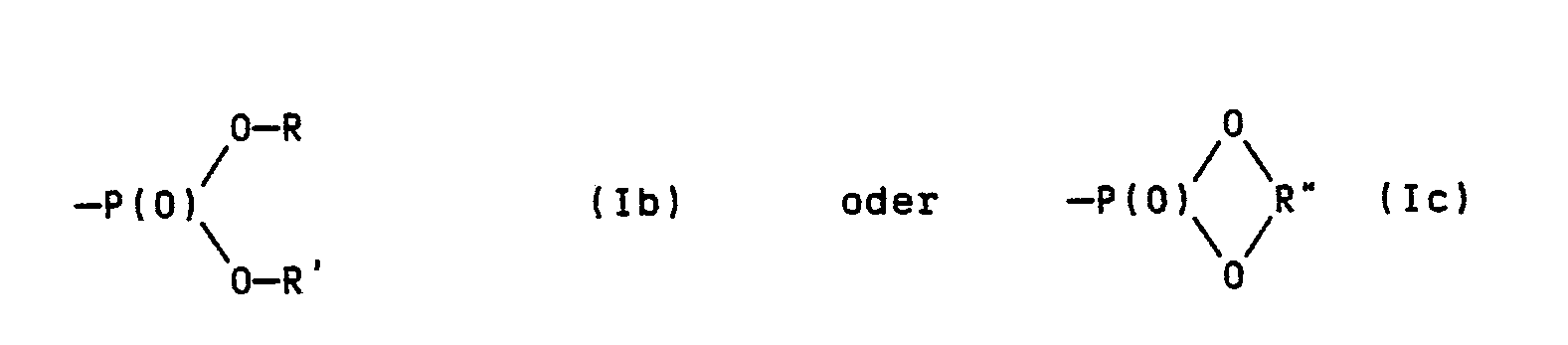
- Bindemittelsysteme für die kathodische Elektrotauchlackierung, die einer säurekatalysierten Härtungsreaktion zugänglich sind, insbesondere solche, die mit Amino- und Phenoplasten als Härtungsmittel kombiniert sind, haben bischer nicht die Anwendungsbreite gefunden, die aufgrung der großen Zahl preisgünstig vorhandener Amino- und Phenoplastharze zu erwarten wäre.
- Ein wesentlicher Grund dafür ist die Schwierigkeit, im basischen Milieu des abgeschiedenen Bindemittels eine ausreichend wirksame Härtung, inbesondere säurekatalysierte Härtung zu bewirken.
- Die Verwendung von p-Toluolsulfonsäure als Härtungsbeschleuniger hat den Nachteil, daß sie nur partiell mit dem Überzugsmittel auf das Substrat gelangt, sich im Elektrotauchbad anreichert und zu Störungen bei der Lackierung führt.
- In der DE-OS 34 22 509 werden Bindemittel beschrieben, die Sulfonat- und/oder Phosphonatgruppen bzw. die Ester dieser Gruppierung eingebaut enthalten. Auf Seite 7, Zeile 28 bis 31 wird ausgeführt, daß die Sulfonsäure- und Phosphonsäureestergruppierungen bei der Überführung des Bindemittels in die wäßrige Phase praktisch vollständig zu den Sulfonat- und Phosphonatgruppen hydrolysiert werden, jedoch erwiesen sich Bindemittel mit Sulfonsäureestern und Phosphonsäureestern im Gegensatz zu den Ausführungen der DE-OS 34 22 509 als hydrolysestabil und zeigten nur sehr geringe katalytische Wirkung.
- Es zeigte sich weiterhin, daß die katalytisch wirksamen Sulfonsäure- und Phosphonsäuregruppen die Lagerstabilität der Dispersionen durch vorzeitige langsame Vernetzungsreaktion negativ beeinflussen.
- Der vorliegenden Erfindung lag daher die Aufgabe zugrunde, lagerstabile Bindemitteldispersionen für die katalytische Elektrotauchlackierung bereitzustellen, die bei der Verwendung von Amino- und Phenoplasten als Vernetzer thermisch härtbar sind.
- Demgemäß wurden durch Protonierung mit Säure wasserverdünnbare und in Gegenwart von sauer katalysierbaren Vernetzern thermisch vernetzbare Bindemittel für die kathodische Elektrotauchlackierung gefunden, enthaltend in kovalenter Bindung die Gruppen

- Gegenstand der Erfindung ist weiterhin ein Verfahren zur Herstellung der Sulfonsäure- und/oder Phosphonsäureester enthaltenden Bindemittel durch Addition von primäre und/oder sekundäre Aminogruppen enthaltenden Bindemitteln an Vinylsulfon- bzw. Vinylphoshonsäureesterverbindungen. Gegenstand der vorliegenden Erfindung ist außerdem die Verwendung dieser Überzugsmittel für die kathodische Elektrotauchlackierung von elektrisch leitenden Substraten.
- Geeignete Reste R für die Sulfonsäure- und Phosphonsäureester-Gruppen (Ia) und (Ib) weisen bevorzugt in 2-Stellung zur Estergruppe einen elektronegativen Substituenten auf, und sind z.B. 2-Hydroxyethyl, 2-Hydroxpropyl, 2-Hydroxybutyl, 2-Phenoxyethyl, 2-Chlorethyl und 2-Bromethyl
- Geeignete Reste Rʹ sind R oder z.B. Ethyl, Propyl, Butyl, Pentyl, Hexyl. Beispiele für Rʺ der cyclischen Phosphonsäureester sind Ethylen, Propylen-1,2 und Butylen-2,3.
- Durch Protonierung mit Säure wasserverdünnbare Bindemittel im Sinne der Erfindung sind Polymere mit primären, sekundären, tertiären und quaternären Stickstoffatomen, wobei Produkte mit primären und/oder sekundären Stickstoffatomen bevorzugt sind
- Aus der Literatur sind viele Synthesemöglichkeiten mit verschiedenen Rohstoffen bekannt geworden, um basische Stickstoffgruppierungen aufweisende Makromoleküle aufzubauen. Im folgenden werden verschiedene Synthesemöglichkeiten angeführt, wobei es sich jedoch im wesentlichen nur um eine beispielhafte Aufzählung handeln soll.
- Die wichtigste Gruppe von Ausgangsmaterialien zur Herstellung von Polymeren mit basischen Stickstoffatomen sind Epoxidgruppen tragende Verbindungen, die mit Aminen umgestzt werden, Die bekanntesten epoxidgruppenhaltigen Rohstoffe, deren gemeinsame Kennzeichen des Vorhandensein eines Oxiranringes ist, sind die Glycidylether von Phenolen, insbesondere von 2,2ʹ-Bis-4-(hydroxyphenyl)propan. Ebenso sind die Glycidylether von Phenol-Formaldehydkondensaten des Novolak-Typs, Glycidylester von aliphatischen, aromatischen oder cycloaliphatischen Mono- bzw. Polycarbonsäuren, Glycidylether von aliphatischen oder cycloaliphatischen Diolen bzw. Polyolen, Copolymerisate des (Meth)acrylsäureglycidylesters oder Epoxidierungsprodukte von aliphatischen bzw. cycloaliphatischen Olefinen zu nennen. Eine ausführliche Beschreibung dieser Stoffklasse findet sich bei H.M. Paquin, Epoxidverbindungen und Epoxidharze, Verlag Springer 1958.
- Zur Addition an Oxiranringe geeignete Amine sind z.B. primäre und sekundäre Amine, sowie deren höhere Homologe bzw. Isomere, wie z.B. Dimethylamin, Diethylamin usw. Besonders geeignet sind primäre und sekundäre Alkanolamine wie z.B. Dialjanolamin und Diisopropanolamine, außerdem Aminoalkylalkanolamine. Weiter erwähnt seien cyclische Amine wie Ethylenimin, Morpholin und Piperidin. Zu den Verbindungen, die zu polymeren Epoxid/Amin-Addukten führen, gehören beispielsweise auch Ammoniak (vgl. DE-OS 29 14 297, DE-OS 30 08 810) und insbesondere Diamine, wie z.B. Ethylendiamin, Propan-1,3-diamin, Hexamethylendiamin, 4,9-Dioxadodekan-1,12-diamin sowie Diethylentriamin (vgl. DE-OS 27 37 375).
- Andere Diamine, die zur Umsetzung geeignet sind, sind primär-tertiäre oder sekundär-sekundäre Diamine (vgl. DE-OS 28 05 936). Werden Amine, insbesondere die Amine mit primären Aminogruppen, im Überschuß eingesetzt, wobei die oxirangruppenhaltige Verbindung zudosiert und das überschüssige Amin anschließend abdestilliert wird, so kommt es zur Bildung von Epoxidharzderivaten mit primären und/oder sekundären Aminogruppen.
- Sofern die resultierenden Epoxidharzderivate NH-Gruppen aufweisen, können sie im Anschluß an die Einführung der basischen Gruppen noch mit Monound/oder Dicarbonsäuren bzw. ihren Estern, mit Polyacrylaten oder auch Mono- und/oder Di-Epoxidverbindungen umgesetzt werden.
- Eine andere Gruppe von Makromolekülen mit basischen Stickstoffatomen wird durch Copolymerisation von geeigneten basischen Monomeren mit Hydroxyalkyl-(meth)-acrylaten, vorzugsweise in Anwesenheit weiterer copolymerisierbarer Verbindungen hergestellt. Derartige basische Monomere gehören z.B. zur Gruppe der (Meth)acrylsäureester bzw. Amide, wie N,N-Dimethylaminoethyl(meth)acrylat und Dialkylaminoalkyl(meth)acrylamid mit 1 bis 10 Kohlenstoffatomen in den Alkylgruppen. Andere geeignete Monomere mit basischen Stickstoffatomen sind z.B. Vinylpyridin, N-Vinylimidazol und N-Vinylcarbazol. Auch diese Verbindungen liegen als Copolymerisat mit Hydroxyalkyl(meth)acrylaten und bevorzugt mit weiteren (Meth)acrylsäureestern, (Meth)acrylsäureamiden, Vinylaromaten wie Styrol, Vinyltoluol, α-Methylstyrol oder Gemischen dieser Monomeren vor.
- Eine weitere Gruppe von Makromollekülen mit primären und sekundären Stickstoffatomen sind die Umsetzungsprodukte von Diaminen, z.B. Hexamethylendiamin mit Epoxidharzen und Dicarbonsäuren bzw. Polyacrylaten, wie sie z.B. der DE-OS 34 22 472 und der DE-OS 34 22 473 zu entnehmen sind.
- Andere geeignete Makromoleküle mit basischen Stickstoffatomen sind substituierte Oxazolidine, die z.B. durch cyclisierende Kondensation von Aminoalkoholen, wie Tris-hydroxymethlaminomethan oder 2-Amino-2-hydroxymethyl-1,3-propandiol mit aliphatischen Carbonsäuren oder carboxylgruppenhaltigen Makromolekülen erhalten werden (vgl. z.B. DE-OS 22 49 378). Eine zusammenfassende Darstellung dieser Stoffklasse findet sich in Chemical Reviews, 1971, Vol. 71, Nr. 5, Seiten 483 bis 505.
- Eine weitere Gruppe von Makromolekülen mit basischen Stickstoffatomen liefert die Reaktion von anhydridgruppenhaltigen Substanzen mit Alkanolaminen mit tertiären Stickstoffatomen bzw. die Reaktion von Säureanhydridgruppen oder deren Halbestern mit Diaminen, die ein primäres und ein tertiäres Stickstoffatom enthalten (vgl. z.B. DE-OS 28 05 936).
- Die Einführung der Sulfonat- oder Phosphonatgruppen in basische Bindemittel, kann auf verschiedene Weise erfolgen, sie hängt von Aufbau und der Zusammensetzung der Bindemittel ab.
- Eine Möglichkeit der Einführung von Sulfonsäureester und Phosphonsäureester besteht in der direkten Addition von Estern der Vinylphosphonsäure oder Vinylsulfonsäure mit den oben beschriebenen RestenR, Rʹ und Rʺ an Polymere mit NH-Gruppierungen z.B. an Epoxid/Diamin-Addukte, wie sie bereits genannt wurden, nach Art einer Michael-Addition.
- Die Menge an basischer Komponente wird vorteilhafterweise so gewählt, daß die Basizität des Bindemittels nach Neutralisation durch Säuren z.B. Essigsäure eine ausreichende Wasserverdünnbarkeit bei pH-Werten von 5 bis 9, vorzugsweise 6,8 bis 8,5 ergibt. Im allgemeinen haben die Bindemittel eine Aminzahl von bis 20 bis 150, bevorzugt 30 bis 140 mg KOH/g.
- Zur Vernetzung der basischen Bindemittel werden, wenn diese nicht schon selbst in ausreichendem Maße über säurekatalysierbare Vernetzungsgruppierungen verfügen, entsprechende säurekatalysierbare Vernetzungsmittel zugesetzt.
- Solche Vernetzungsmittel sind bevorzugt Amino- und Phenoplaste. Geeignete Aminoplaste sind z.B. die Reaktionsprodukte von Harnstoffen oder Melaminen mit Aldehyden, die mit einem Alkohol verethert sein können. Spezielle Beispiele für geeignete Aminoplastharzausgangskomponenten sind Harnstoff, Ethylenharnstoff, Thioharnstoff, Melamin, Benzoguanamin, Acetoguanamin und 2-Oxo-4-hydroxy-hexahydropyrimidin. Spezielle Beispiele für zur Herstellung geeigneter Aminoplastharze verwendbare Aldehyde sind Formaldehyd, Acetaldehyd und Propionaldehyd, vorzugsweise Formaldehyd. Die Aminoplastharze können in der Alkylolform eingesetzt werden; vorzugsweise werden diese Harze jedoch in Form ihrer Ether verwendet, wobei das Veretherungsmittel ein einwertiger Alkohol mit 1 bis 10, vorzugsweise 1 bis 4 Kohlenstoffatomen ist. Beispiele für geeignete Aminoplastharze sind Methylolharnstoff, Dimethoxymethylharnstoff, mit Butanol veretherte Harnstoff-Formaldehyd-Harze, Hexamethoxymethylmelamin, mit Methanol veretherte Melamin-Formaldehyd-Harze und mit Butanol veretherte Melamin-Formaldehyd-Harze. Besonders gut geeignet sind z.B. niedrigmethylolierte hochveretherte Produkttypen. Aminoplastharze und Methoden zu deren Herstellung sind beispielsweise in "Encyclopedia of Polymer Science and Technology", Band 2 (1965), Seiten 1 bis 91, Interscience Publishers, beschrieben.
- Phenoplastharze sind die Reaktionsprodukte von Phenolen mit Aldehyden, welche reaktive Methylolgruppen aufweisen. Spezielle Beispiele für zur Herstellung der Phenoplastharze verwendbare Phenole sind Phenol, o-, m- oder p-Kresol, 2,4-Xylenol, 3,4-Xylenol, 2,5-Xylenol, Cardanol und p-tert.-Butylphenol, Bisphenole, wie Bisphenol A und Novolake. Für diese Reaktion einsetzbare Aldehyde sind Formaldehyd, Acetaldehyd und Propionaldehyd, vorzugsweise Formaldehyd. Besonders gut brauchbare Phenoplastharze sind Polymethylolphenole, bei denen die Hydroxylgruppe mit einem Alkylrest (z.B. einer Methyl- oder Ethylgruppe) verethert ist. Bevorzugt zu verwenden sind Produkte, die Alkylethergruppen aufweisen bzw. solche Produkte, deren Methylolgruppen mindestens partiell mit C₁- bis C₁₀- Alkoholen verethert worden sind. Phenoplastharze und ihre Herstellungsmethoden sind beispielsweise in "Encyclopedia of Polymer Science and Technology", Band 10 (1969), Seiten 1 bis 68, Interscience Publishers, beschrieben.
- Der für das erfindungsgemäße Bindemittel zu verwendende Anteil an Amino- und/oder Phenoplastharz kann bis zu 45 Gew.% des Gesamtfeststoffgewichtes des Überzugsmittels betragen.
- Gegebenenfalls können auch die Vernetzungsmittel Sulfonsäureester bzw. Phosphonsäureester enthalten. Beispielsweise können Verbindungen, die neben Sulfonsäure- und Phosphonsäureestern noch andere reaktionsfähige zur Cokondensation geeignete Gruppierungen enthalten (basische oder amidische NH-Gruppen) bei der Herstellung von Phenoplasten mitverwendet oder nachträglich eingebaut werden.
- Die Herstellung der für die kathodische Elektrotauchlackierung verwendeten Überzugsmittel erfolgt entweder durch Mischen der Bindemittel mit den Vernetzungsmitteln bei Temperaturen, bei welchen eine einwandfreie Homogenisierung gewährleistet ist, oder durch eine partielle Reaktion zwischen den Bindemitteln und den Vernetzungsmitteln bei Temperaturen bis 150°C, vorzugsweise 70 bis 120°C. Die Mischung bzw. Umsetzung erfolgt vorteilhafterweise in Lösungsmitteln, wie Alkoholen, Glykolethern, Ketonen oder deren Gemischen.
- Um die Überzugsmittel wasserverdünnbar zu machen, werden die basischen Stickstoffatome der erfindungsgemäßen Bindemittel partiell oder vollständig mit organischen und/oder anorganischen Säuren, z.B. Ameisensäure, Essigsäure, Milchsäure oder Phosphorsäure neutralisiert. Der Neutralisationsgrad hängt im Einzelfall vom jeweiligin Bindemittel ab. Im allgemeinen wird so viel Säure zugegeben, daß das Überzugsmittel in der Verarbeitungsform bei einem pH-Wert von 5 bis 9, vorzugsweise 6,8 bis 8,5 mit Wasser verdünnt werden kann.
- Die Konzentration des Bindemittels in Wasser liegt im allgemeinen im Bereich von 5 bis 25 Gew.%, vorzugsweise bei 10 bis 20 Gew.%. Die zur Verarbeitung gelangende Zubereitung des Überzugsmittels kann neben dem Bindemittel und den gegebenenfalls eingesetzten Vernetzungskomponenten auch weitere basische Stickstoffgruppen enthaltende Bindemittel sowie übliche Zusatozstoffe, Wie Pigmente, Farbstoffe, Füllstoffe, Lösungsmittel, Antioxydantien und/oder sonstige Lackhilfsmittel enthalten.
- Die Überzugsmittel eignen sich insbesondere für die kathodische Elektrotauchlackierung von Metallteilen.
- Bei der Abscheidung wird ein das erfindungsgemäße Bindemittel enthaltende wäßrige Bad des Überzugsmittels in Kontakt mit einer elektrisch leitenden Anode und einer elektrisch leitenden Kathode gebracht, wobei die Oberfläche der Kathode mit dem Überzugsmittel beschichtet wird. Man kann verschiedene elektrisch leitende Substrate beschichten, insbesondere metallische Substrate, wie Stahl, Aluminium, Kupfer und dergleichen, jedoch auch metallisierte Kunstoffe oder andere mit einem leitfähigen Überzug versehene Stoffe, insbesondere sog. phosphatierte Stahbleche.
- Nach der Abscheidung wird der Überzug gegebenenfalls mit Wasser gespült und bei erhöhter Temperatur gehärtet. Zum Härten werden Temperaturen von 110 bis 200°C, vorzugsweiser 130 bis 190°C verwendet. Die Härtungszeit beträgt 5 bis 30 Minuten, vorzugsweise 10 bis 25 Minuten. Die resultierenden Beschichtungen weisen ausgezeichnete Eigenschaften auf. Überraschenderweise lassen sich besonders in Kombination mit Melaminharzen als Vernetzungsmittel mit den erfindungsgemäßen Bindemitteln hellfarbige Beschichtungen erhalten. Die Anwesenheit von eingebauten Sulfonat- bzw. Phosphonatgruppen wirkt sich überraschenderweise auf die Korrosionsdaten nicht negativ aus.
- 54,2 g Vinylphosphonsäure in 81 g Aceton wurden auf -30°C gekühlt. Bei dieser Temperatur wurden 216,3 g n-Butylenoxid-1,2 in 30 Minuten zugetropft. Danach ließ man langsam auf Raumtemperatur aufwärmen. Das Lösemittel wurde anschließend am Rotationsverdampfer bei 40°C Außentemperatur abdestilliert. Die Ausbeute betrug 160 g (99 %).
- 400 g Hexamethylendiamin wurden auf 80°C erwärmt. Anschließend wurde eine 80 gew.%ige Lösung von 400 g eines handelsüblichen Epoxidharzes auf Basis von 2,2-Bis-(4-hydroxyphenyl)-propan mit einem Epoxidäquivalentgewicht von 500 in Toluol zugefügt. Nach Abklingen der anfänglich exothermen Reaktion ließ man 30 Minuten bei 100°C ausreagieren. Dann wurde überschüssiges Hexamethylendiamin und Toluol im Vakuum abdestilliert, wobei eine Innentemperatur von 180°C erreicht wurde. Anschließend wurden in einem Dünnschichtverdampfer bei 0,5 mbar und 180°C die verbliebenen Spuren von freiem Amin abgezogen. Das Epoxid-Aminaddukt wies eine Aminzahl von 169 mg KOH/g und einen Erweichungspunkt von 95°C auf.
200 g des Epoxid-Aminadduktes, 30 g Dimerfettsäure (dimerisierte C₁₀-C₂₄-Fettsäure) und 20 g Xylol wurden allmählich unter Auskreisen von Wasser auf 190°C erhitzt und eine Stunde bei dieser Temperatur gehalten. Nach dem Abkühlen auf 130°C wurde zunächst mit 9 g Butylglykol und danach mit 70 g Isobutanol verdünnt. Das Produkt hatte einen Feststoffgehalt von 70 Gew.%. - 2142 g des unter B beschriebenen Bindemittels wurden mit 680 g Butylglykol, 2400 g Wasser und 70 g Eisessig verdünnt. Dann setzte man 3500 g Titandioxid, 100 g basisches Bleisilicat und 100 g Ruß hinzu.
- Auf einer Kugelmühle wurde bis zu einer Korngröße von <9µm gemahlen. Anschließend stellte man mit Wasser einen Feststoffgehalt von 50 Gew.% ein.
- 810 g des unter B beschriebenen Bindemittels wurden mit der in der Tabelle aufgeführten Menge des unter A) beschriebenen Vinylphosphonsäureesters 2 Stunden bei 40°C gerührt.

- 810 g des unter B beschriebenen Bindemittels wurden mit 61 g Vinylphosphonsäurediethylester (0,37 mol) 2 Stunden bei 40°C gerührt.
- Die Bindemittel wurden mit 324 g eines methylolierten, partiell mit Butanol veretherten Melaminharzes (FG = 70 Gew.%) vermischt. Man gab 16,2 g Eisessig hinzu und dispergierte in 1186 g Wasser.
- Zu 2160 g dieser Dispersion gab man 749 g der Pigmentpaste (C), rührte innig und füllte mit Wasser auf 5000 g auf. Die Bäder wurden 120 Stunden bei 28°C gerührt. An kathodisch geschalteten, zinkphosphatierten Prüftafeln aus Stahl wurden Lackfilme innerhalb 120 Sekunden bei der angegebenen Spannung abgeschieden und 20 Minuten bei 160°C, 140°C und 130°C eingebrannt.

- Die Acetonfestigkeit wurden durch 50faches Hin- und Herreiben eines mit Aceton getränkten Wattebausches auf dem Lack bestimmt.
- Vernetzung = Benotung 1-5, wobei 5 = sehr gut und 1 = mangelhaft ist.

Claims (8)


Priority Applications (1)
| Application Number | Priority Date | Filing Date | Title |
|---|---|---|---|
| AT87117466T ATE61376T1 (de) | 1986-11-28 | 1987-11-26 | Durch protonierung mit saeure wasserverduennbare bindemittel. |
Applications Claiming Priority (2)
| Application Number | Priority Date | Filing Date | Title |
|---|---|---|---|
| DE3640804 | 1986-11-28 | ||
| DE19863640804 DE3640804A1 (de) | 1986-11-28 | 1986-11-28 | Durch protonierung mit saeure wasserverduennbare bindemittel |
Publications (3)
| Publication Number | Publication Date |
|---|---|
| EP0269102A2 true EP0269102A2 (de) | 1988-06-01 |
| EP0269102A3 EP0269102A3 (en) | 1988-09-07 |
| EP0269102B1 EP0269102B1 (de) | 1991-03-06 |
Family
ID=6315074
Family Applications (1)
| Application Number | Title | Priority Date | Filing Date |
|---|---|---|---|
| EP87117466A Expired - Lifetime EP0269102B1 (de) | 1986-11-28 | 1987-11-26 | Durch Protonierung mit Säure wasserverdünnbare Bindemittel |
Country Status (5)
| Country | Link |
|---|---|
| EP (1) | EP0269102B1 (de) |
| JP (1) | JPS63142074A (de) |
| AT (1) | ATE61376T1 (de) |
| DE (2) | DE3640804A1 (de) |
| ES (1) | ES2020545B3 (de) |
Cited By (2)
| Publication number | Priority date | Publication date | Assignee | Title |
|---|---|---|---|---|
| US8361301B2 (en) | 2009-03-31 | 2013-01-29 | Ppg Industries Ohio, Inc. | Electrocoating composition comprising a crater control additive |
| US10329437B2 (en) | 2016-06-30 | 2019-06-25 | Ppg Industries Ohio, Inc. | Electrodepositable coating composition having improved crater control |
Families Citing this family (2)
| Publication number | Priority date | Publication date | Assignee | Title |
|---|---|---|---|---|
| DE102006027762A1 (de) * | 2006-06-16 | 2007-12-20 | Basf Coatings Ag | Seitenständige saure Phosphonsäureestergruppen enthaltende Copolymerisate olefinisch ungesättigter Monomere, Verfahren zu ihrer Herstellung und ihre Verwendung |
| US9534074B2 (en) | 2012-06-25 | 2017-01-03 | Ppg Industries Ohio, Inc. | Aqueous resinous dispersions that include a zinc (II) amidine complex and methods for the manufacture thereof |
Family Cites Families (2)
| Publication number | Priority date | Publication date | Assignee | Title |
|---|---|---|---|---|
| BE795359A (fr) * | 1972-02-15 | 1973-05-29 | Du Pont | Depot electrolytique acide de zinc ou de nickel |
| DE3422509A1 (de) * | 1984-06-16 | 1985-12-19 | Basf Ag, 6700 Ludwigshafen | Ueberzugsmittel, ihre herstellung und verwendung |
-
1986
- 1986-11-28 DE DE19863640804 patent/DE3640804A1/de not_active Withdrawn
-
1987
- 1987-11-25 JP JP62295426A patent/JPS63142074A/ja active Pending
- 1987-11-26 AT AT87117466T patent/ATE61376T1/de not_active IP Right Cessation
- 1987-11-26 DE DE8787117466T patent/DE3768433D1/de not_active Expired - Lifetime
- 1987-11-26 ES ES87117466T patent/ES2020545B3/es not_active Expired - Lifetime
- 1987-11-26 EP EP87117466A patent/EP0269102B1/de not_active Expired - Lifetime
Cited By (3)
| Publication number | Priority date | Publication date | Assignee | Title |
|---|---|---|---|---|
| US8361301B2 (en) | 2009-03-31 | 2013-01-29 | Ppg Industries Ohio, Inc. | Electrocoating composition comprising a crater control additive |
| US10329437B2 (en) | 2016-06-30 | 2019-06-25 | Ppg Industries Ohio, Inc. | Electrodepositable coating composition having improved crater control |
| US10717883B2 (en) | 2016-06-30 | 2020-07-21 | Ppg Industries Ohio, Inc. | Electrodepositable coating composition having improved crater control |
Also Published As
| Publication number | Publication date |
|---|---|
| DE3768433D1 (de) | 1991-04-11 |
| EP0269102A3 (en) | 1988-09-07 |
| ATE61376T1 (de) | 1991-03-15 |
| DE3640804A1 (de) | 1988-06-09 |
| EP0269102B1 (de) | 1991-03-06 |
| ES2020545B3 (es) | 1991-08-16 |
| JPS63142074A (ja) | 1988-06-14 |
Similar Documents
| Publication | Publication Date | Title |
|---|---|---|
| DE3027037C2 (de) | Gemische von Estern von Diglycidylpolyäthern und deren Verwendung | |
| DE3601560A1 (de) | Waessriges, hitzehaertbares ueberzugsmittel, dessen verwendung und damit beschichtete gegenstaende | |
| DE69502506T2 (de) | N-acylaminomethylenphosphonate und verwendung in wässrigen beschichtungszusammensetzungen | |
| EP0041619B1 (de) | Verfahren zur Herstellung von härtbaren stickstoffbasische Gruppen tragenden Polyadditionsprodukten und deren Verwendung | |
| EP0165558B1 (de) | Überzugsmittel, ihre Herstellung und Verwendung | |
| DE2942488A1 (de) | Polyadditionsprodukt und seine verwendung | |
| DE2737375C2 (de) | ||
| EP0165556B1 (de) | Hitzehärtbares Überzugsmittel, seine Verwendung, bzw. Verfahren zu seiner Herstellung | |
| DE3026823A1 (de) | Stickstoffbasische gruppen tragendes polyadditions/polykondensationsprodukt, verfahren zu dessen herstellung und dessen verwendung | |
| DE60007664T2 (de) | Elektroabscheidbare tauchlack zusammensetzung enthaltend ein carbamathaltiges harz mit mindestens einer quaternären ammoniumgruppe und mindestens einer carbamatgruppe | |
| DE2339398A1 (de) | Elektrisch-ablagerbare zusammensetzungen | |
| US4363710A (en) | Polyadducts of ammonia and epoxide compounds, processes for their modification, and their use | |
| EP0039425B1 (de) | Wasserverdünnbare Bindemittel, ihre Herstellung und Verwendung | |
| EP0269102B1 (de) | Durch Protonierung mit Säure wasserverdünnbare Bindemittel | |
| DE69923349T2 (de) | Kathodische tauchlack-zusammensetzung | |
| EP0319792B1 (de) | Hitzehärtbares wässriges Überzugsmittel für die kathodische Elektrotauchlackierung | |
| EP0210471B1 (de) | Umsetzungsprodukte und Kondensationsprodukte auf Basis substituierter Propylenharnstoffe, deren Herstellung und Verwendung | |
| EP0123879A1 (de) | Verfahren zur Herstellung von Harnstoffkondensationsprodukten und deren Verwendung | |
| EP0385300B1 (de) | Durch Protonieren mit Säure wasserverdünnbare polymere Umsetzungsprodukte | |
| DE2949401A1 (de) | Produkte aus einem polyepoxid und zweikernigen hydantoinverbindungen | |
| EP0179273B1 (de) | Verfahren zur Herstellung von Harnstoffkondensationsprodukten und deren Verwendung | |
| DE4214964A1 (de) | Mehrwertige Epoxidverbindungen | |
| EP0551641A1 (de) | Aminomethylen-Gruppen tragendes Epoxiharz | |
| DE2602227A1 (de) | Epoxidharz verfahren zur herstellung und verwendung desselben | |
| DE2537387A1 (de) | Waessrige kunstharzzusammensetzung |
Legal Events
| Date | Code | Title | Description |
|---|---|---|---|
| PUAI | Public reference made under article 153(3) epc to a published international application that has entered the european phase |
Free format text: ORIGINAL CODE: 0009012 |
|
| AK | Designated contracting states |
Kind code of ref document: A2 Designated state(s): AT BE CH DE ES FR GB IT LI NL SE |
|
| PUAL | Search report despatched |
Free format text: ORIGINAL CODE: 0009013 |
|
| AK | Designated contracting states |
Kind code of ref document: A3 Designated state(s): AT BE CH DE ES FR GB IT LI NL SE |
|
| 17P | Request for examination filed |
Effective date: 19880905 |
|
| 17Q | First examination report despatched |
Effective date: 19890914 |
|
| GRAA | (expected) grant |
Free format text: ORIGINAL CODE: 0009210 |
|
| AK | Designated contracting states |
Kind code of ref document: B1 Designated state(s): AT BE CH DE ES FR GB IT LI NL SE |
|
| REF | Corresponds to: |
Ref document number: 61376 Country of ref document: AT Date of ref document: 19910315 Kind code of ref document: T |
|
| ITF | It: translation for a ep patent filed | ||
| GBT | Gb: translation of ep patent filed (gb section 77(6)(a)/1977) | ||
| REF | Corresponds to: |
Ref document number: 3768433 Country of ref document: DE Date of ref document: 19910411 |
|
| ET | Fr: translation filed | ||
| PGFP | Annual fee paid to national office [announced via postgrant information from national office to epo] |
Ref country code: FR Payment date: 19911014 Year of fee payment: 5 |
|
| PGFP | Annual fee paid to national office [announced via postgrant information from national office to epo] |
Ref country code: SE Payment date: 19911018 Year of fee payment: 5 Ref country code: CH Payment date: 19911018 Year of fee payment: 5 Ref country code: AT Payment date: 19911018 Year of fee payment: 5 |
|
| PGFP | Annual fee paid to national office [announced via postgrant information from national office to epo] |
Ref country code: GB Payment date: 19911115 Year of fee payment: 5 Ref country code: BE Payment date: 19911115 Year of fee payment: 5 |
|
| PGFP | Annual fee paid to national office [announced via postgrant information from national office to epo] |
Ref country code: DE Payment date: 19911122 Year of fee payment: 5 |
|
| PGFP | Annual fee paid to national office [announced via postgrant information from national office to epo] |
Ref country code: ES Payment date: 19911128 Year of fee payment: 5 |
|
| PGFP | Annual fee paid to national office [announced via postgrant information from national office to epo] |
Ref country code: NL Payment date: 19911130 Year of fee payment: 5 |
|
| PLBE | No opposition filed within time limit |
Free format text: ORIGINAL CODE: 0009261 |
|
| STAA | Information on the status of an ep patent application or granted ep patent |
Free format text: STATUS: NO OPPOSITION FILED WITHIN TIME LIMIT |
|
| 26N | No opposition filed | ||
| PG25 | Lapsed in a contracting state [announced via postgrant information from national office to epo] |
Ref country code: GB Effective date: 19921126 Ref country code: AT Effective date: 19921126 |
|
| PG25 | Lapsed in a contracting state [announced via postgrant information from national office to epo] |
Ref country code: SE Effective date: 19921127 Ref country code: ES Free format text: LAPSE BECAUSE OF EXPIRATION OF PROTECTION Effective date: 19921127 |
|
| PG25 | Lapsed in a contracting state [announced via postgrant information from national office to epo] |
Ref country code: LI Effective date: 19921130 Ref country code: CH Effective date: 19921130 Ref country code: BE Effective date: 19921130 |
|
| BERE | Be: lapsed |
Owner name: BASF LACKE + FARBEN A.G. Effective date: 19921130 |
|
| PG25 | Lapsed in a contracting state [announced via postgrant information from national office to epo] |
Ref country code: NL Effective date: 19930601 |
|
| NLV4 | Nl: lapsed or anulled due to non-payment of the annual fee | ||
| GBPC | Gb: european patent ceased through non-payment of renewal fee |
Effective date: 19921126 |
|
| PG25 | Lapsed in a contracting state [announced via postgrant information from national office to epo] |
Ref country code: FR Effective date: 19930730 |
|
| REG | Reference to a national code |
Ref country code: CH Ref legal event code: PL |
|
| PG25 | Lapsed in a contracting state [announced via postgrant information from national office to epo] |
Ref country code: DE Effective date: 19930803 |
|
| REG | Reference to a national code |
Ref country code: FR Ref legal event code: ST |
|
| EUG | Se: european patent has lapsed |
Ref document number: 87117466.0 Effective date: 19930610 |
|
| REG | Reference to a national code |
Ref country code: ES Ref legal event code: FD2A Effective date: 20010301 |
|
| PG25 | Lapsed in a contracting state [announced via postgrant information from national office to epo] |
Ref country code: IT Free format text: LAPSE BECAUSE OF NON-PAYMENT OF DUE FEES;WARNING: LAPSES OF ITALIAN PATENTS WITH EFFECTIVE DATE BEFORE 2007 MAY HAVE OCCURRED AT ANY TIME BEFORE 2007. THE CORRECT EFFECTIVE DATE MAY BE DIFFERENT FROM THE ONE RECORDED. Effective date: 20051126 |