EP0264909B1 - Schlag-Drucker - Google Patents
Schlag-Drucker Download PDFInfo
- Publication number
- EP0264909B1 EP0264909B1 EP87115345A EP87115345A EP0264909B1 EP 0264909 B1 EP0264909 B1 EP 0264909B1 EP 87115345 A EP87115345 A EP 87115345A EP 87115345 A EP87115345 A EP 87115345A EP 0264909 B1 EP0264909 B1 EP 0264909B1
- Authority
- EP
- European Patent Office
- Prior art keywords
- characters
- pitch
- hammers
- hammer
- Prior art date
- Legal status (The legal status is an assumption and is not a legal conclusion. Google has not performed a legal analysis and makes no representation as to the accuracy of the status listed.)
- Expired
Links
- 239000000872 buffer Substances 0.000 description 9
- 230000000593 degrading effect Effects 0.000 description 2
- 238000000034 method Methods 0.000 description 2
- 239000002253 acid Substances 0.000 description 1
- 238000010420 art technique Methods 0.000 description 1
- 238000010586 diagram Methods 0.000 description 1
- 238000010304 firing Methods 0.000 description 1
- 238000004519 manufacturing process Methods 0.000 description 1
Images


Classifications
-
- B—PERFORMING OPERATIONS; TRANSPORTING
- B41—PRINTING; LINING MACHINES; TYPEWRITERS; STAMPS
- B41J—TYPEWRITERS; SELECTIVE PRINTING MECHANISMS, i.e. MECHANISMS PRINTING OTHERWISE THAN FROM A FORME; CORRECTION OF TYPOGRAPHICAL ERRORS
- B41J9/00—Hammer-impression mechanisms
- B41J9/02—Hammers; Arrangements thereof
- B41J9/133—Construction of hammer body or tip
-
- B—PERFORMING OPERATIONS; TRANSPORTING
- B41—PRINTING; LINING MACHINES; TYPEWRITERS; STAMPS
- B41J—TYPEWRITERS; SELECTIVE PRINTING MECHANISMS, i.e. MECHANISMS PRINTING OTHERWISE THAN FROM A FORME; CORRECTION OF TYPOGRAPHICAL ERRORS
- B41J1/00—Typewriters or selective printing mechanisms characterised by the mounting, arrangement or disposition of the types or dies
- B41J1/20—Typewriters or selective printing mechanisms characterised by the mounting, arrangement or disposition of the types or dies with types or dies mounted on endless bands or the like
Definitions
- the invention relates to an impact printer with a continuously rotating print band.
- Computer output printers either use engraved type elements or they produce each character from a series of dots.
- condensed print can easily be accommodated by merely controlling the mechanism which prints the dots so that the resulting characters have the desired spacing and shape.
- engraved type printers one generally must mechanically change print elements to change from standard to condensed print. In some engraved type printers such as with band printers, the task of providing condensed print is more difficult.
- band printers such as those marketed by international Business Machines Corporation under the type number designation 3262, 4245 and 4248 (or for example see IBM Technical Disclosure Bulletin, June 1978, Vol. 21 No 1 page 101) one cannot do condensed print because the print hammers are physically spaced for standard pitch printing. If one tried to use a band in these printers which had condensed print characters engraved thereon, some of the print positions would fall between print hammers.
- Printers which have double wide print hammers. With an appropriate print band and appropriate control circuitry such printers can print condensed print and with a different print band and appropriate control circuitry such printers can print standard pitch characters. For example, see IBM Technical Disclosure Bulletin, September 1974, Vol. 17 No. 4 page 1012. Another technique for printing condensed print characters is shown in U.S. Patent 4 055 117 (Munday). These and other prior art techniques for printing condensed print characters suffer degraded throughput. In printers with double wide hammers throughput is degraded because the pitch of the characters on the band must of necessity be greater than the width of the hammers with the result that it takes longer for a complete character array to pass in front of each hammer.
- printers require additional hammer settle out time before adjacent characters can be printed, thereby further degrading the performance.
- printers such as that shown in U.S. Patent 4 055 117 (Munday) additional cycles of the print band are required thereby degrading performance.
- Another technique for printing standard and condensed characters is shown in Japan Patent Abstracts, Vol. 7, No. 221, p. 101 M246 (JP-A 58 114 957). This printer has two rows of differently shaped hammers with standard and narrow spacings. The corresponding print band is bisected, consisting of standardn acid condensed characters, respectively.
- the invention as claimed is intended to remedy this drawback. It solves the problem of providing a high speed printer which can print both standard and condensed print and which prints standard pitch printing at high speed.
- the advantages of the invention are achieved by providing a print hammer face which has a single wide section for standard pitch characters and a double wide section for printing condensed pitch characters. Using this hammer face one obtains the advantage of high speed when printing standard pitch characters and yet one is able to print condensed pitch characters with the same printer.
- each hammer is divided into two sections.
- the first section of each hammer face is identical to the hammer face in a conventional single width hammer.
- the second section of each hammer face spans the width of t wo condensed pitch characters.
- the hammers are divided into two groups.
- the first group of hammers has the single width section on the top of the hammer face and the second group of hammers has the single width section on the bottom of the hammer face.
- Hammers in the first and second groups alternate along the print line and the hammers are aligned so that single width section of all the hammer faces are in a straight line.
- the double width sections of the hammer faces alternate between being above and below this line.
- the print band has two sections. One section has standard pitch characters and the second section has two rows of condensed print characters. (Alternately, there can be separate print bands, one with standard pitch characters and one with condensed characters.)
- the standard pitch characters on the print band are aligned with the single wide section of the hammer faces.
- One row of condensed pitch characters on the print band is aligned with the double wide section of the hammer faces in the first group of hammers and the second row of condensed pitch characters on the print band is aligned with the double wide section of the hammmer faces in the second group of hammers.
- the section of the print band which has standard pitch characters is used and the single width portion of each hammer face is used to print characters. Printing proceeds in a normal manner.
- the section of the print band which has condensed print characters is used and the double wide portion of each hammer face is used to print characters.
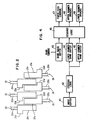
- FIG. 1 The overall structure of a printer built in accordance with the present invention is shown in Figure 1. This printer is designed to print either standard ten pitch characters (10 characters per 2,54 cm) or condensed fifteen pitch characters (fifteen characters per 2,54 cm).
- a print band 10 moves in front of a bank of hammers 20.
- the hammers 20 can be conventional in design except for the shape of the hammer faces.
- hammers 20 can be of the type shown in U.S. Patent 4 269 117.
- the hammers 20 are spaced on 2,54 cm centers as is conventional when printing standard 10 pitch characters.
- the bank of hammers is designated 20 and the individual hammers arc designated 20-1, 20-2, 20-3, etc.
- a conventional paper feed mechanism 30 moves paper 31 between hammers 20 and backing plate or platen 34.
- Paper feed mechanism 30 includes tractors 30a and 30b which are driven in a conventional manner.
- a conventional ribbon (not shown) is positioned between the paper 31 and the print band 10.
- Print band 10 has a conventional backing plate 34.
- the print band 10 has a first section designated 10a which has standard pitch characters engraved thereon. These characters are spaced on 3,38 mm centers. This is the conventional spacing used for ten pitch characters so as to avoid shadow printing.
- the print band 10 has a second section designated 10b which has two rows on condensed characters. The condensed characters are spaced on 4,23 mm centers for printing 15 pitch characters with double wide hammers.
- Print band 10 has a row of conventional timing marks 10c. These timing marks are positioned to coincide with the position and spacing of the characters on print band 10.
- the print band 10 and paper 31 are cut away to show the print hammers 20.
- the shape and relative position of the hammer faces are shown in the expanded portion of Figure 1. If the hammer faces were not shown in expanded fashion, they would not be visible in the scale of Figure 1.
- the hammer face of hammer 20-1 is designated 21
- the hammer face of hammer 20-2 is designated 22, etc.
- FIG. 2 shows the detail shape of six print hammer faces designated 21, 22, 23, 24, 25 and 26.
- Hammer face 21 has a single wide section 21 s, a double wide section 21 d and a stem 21 a.
- Hammer face 22 has a single wide section 22s, a double wide section 22d and a stem 22a.
- Hammers 23 to 26 have similar parts with similar designations.
- the dimensions of the various parts of hammer 21 are given below.
- Stem 21 a of hammer 21 is connected to a conventional actuating element (not shown).
- the actuating element can be of the type shown in U.S. Patent 4,269,117.
- the stem of each of the other hammers is connected to a similar actuating element.
- Figure 3A shows how the double wide portion 22d on the bottom of hammer face 22 is aligned with the lower line of compressed type on band portion 10b.
- Figure 3B shows how the double wide portion 23d on the top of hammer face 23 is aligned with the upper row of compressed type characters on print band 10b. It is noted that when the double wide sections 22d and 23d of hammers 22 and 23 are in position to print a character, the single wide sections 22s and 23s of hammers 22 and 23 are positioned so that they are not aligned with any characters on band 10.
- Figures 3C and 3D show how single wide sections 22s and 23s of hammers 22 and 23 are aligned with standard pitch characters on section 10a of print band 10. It is noted that when single wide sections 22s and 23s are aligned with characters on band section 1 Oa, the double wide sections 22d and 23d of these hammers are not in a position to print a character.
- the paper 31, printer ribbon, and backing plate 34 are not shown in Figures 3A to 3D as these are positioned conventionally.
- the single wide sections 21 s, 22s, etc. of all the hammers are aligned along a single print line and there is one hammer at each print position of a standard pitch character. That is, hammer face sections 21s, 22s, 23s, etc are spaced at 2,54 mm so that there is a hammer face at each possible print position and an entire line of type can be printed while the paper 31 is in one position. This is conventional.
- the double wide sections 21d, 23d, etc. of the upper group of hammers 21, 23 etc are aligned along one print line and the double wide sections 22d, 24d, etc. of lower group of hammers 22, 24, etc are aligned along a different print line. Furthermore, as shown by the following table the upper group of hammers 21, 23, 25, etc. covers one group print positions for condensed print and the lower group of hammers 22, 24, 26, etc covers a different group of print positions for condensed print:
- Input Buffer 41 holds the line of data received to be printed. This data originated from a computer or other source of input (which is not shown). This is a conventional buffer. Steering Logic 42 receives the line of characters to be printed from buffer 41 and it sends any characters to be printed in print positions 1, 2, 5, 8, 11, 14, etc to the Upper Hammer Bank Buffer 45 and it sends any characters to be printed in print positions 6,7,8,10,12,13,15, etc to the Lower Hammer Bank Buffer 44.
- Band Image Buffer 43 receives signals from band timing marks 10c and in a conventional manner keeps track of which characters on band 10 are in front of each hammer position.
- Sequence logic 46 first compares the characters which buffer 43 indicates can be printed at any time with the characters in lower hammer bank buffer 44 and as the band 10 passes the appropriate positions, these characters are printed. This is conventional.
- the Sequence Logic 46 activates Paper Feed Control 47 to increment the paper so that the paper is positioned such that the upper group of hammers 21, 23, 25, etc are positioned to print on the same line on the paper.
- Sequence logic 46 then compares the characters which can be printed at any time to the characters in upper hammer bank buffer 45 and activates the upper hammer bank drivers 48 at the appropriate time.
- the amount that the paper is incremented between the time that the lower hammers print a line of characters and the time that the upper hammers print a line of characters is equal to the space between lines of print.
- the logic in Figure 4 could include a microprocessor which calculates the optimum way in which to divide characters between the upper and lower bank of hammers. Such a microprocessor could be programmed to take into account the required settle time of the hammers and the location of the various characters on print band 10.
- print band 10 has two sections, one section for standard pitch printing, and one section for condensed pitch printing.
- the disadvantage of using two print bands is that the band would have to be physically changed in order to change from standard pitch printing to condensed pitch printing.
Landscapes
- Impact Printers (AREA)
- Accessory Devices And Overall Control Thereof (AREA)
Claims (6)
Applications Claiming Priority (2)
| Application Number | Priority Date | Filing Date | Title |
|---|---|---|---|
| US06/921,509 US4759647A (en) | 1986-10-22 | 1986-10-22 | Dual pitch impact printer |
| US921509 | 1986-10-22 |
Publications (2)
| Publication Number | Publication Date |
|---|---|
| EP0264909A1 EP0264909A1 (de) | 1988-04-27 |
| EP0264909B1 true EP0264909B1 (de) | 1990-12-27 |
Family
ID=25445537
Family Applications (1)
| Application Number | Title | Priority Date | Filing Date |
|---|---|---|---|
| EP87115345A Expired EP0264909B1 (de) | 1986-10-22 | 1987-10-20 | Schlag-Drucker |
Country Status (4)
| Country | Link |
|---|---|
| US (1) | US4759647A (de) |
| EP (1) | EP0264909B1 (de) |
| JP (1) | JPS63111071A (de) |
| DE (1) | DE3767120D1 (de) |
Families Citing this family (1)
| Publication number | Priority date | Publication date | Assignee | Title |
|---|---|---|---|---|
| US8172363B2 (en) * | 2006-06-22 | 2012-05-08 | Electronics For Imaging, Inc. | Apparatus and methods for full-width wide format inkjet printing |
Family Cites Families (8)
| Publication number | Priority date | Publication date | Assignee | Title |
|---|---|---|---|---|
| US3715978A (en) * | 1970-09-03 | 1973-02-13 | Ibm | Printer hammer mechanism |
| US3919933A (en) * | 1973-10-05 | 1975-11-18 | Potter Instrument Co Inc | High speed printer |
| AU510456B2 (en) * | 1976-10-04 | 1980-06-26 | Stauffer Chemical Company | Preparation of esters of thiolcarbamic acids |
| DE2654569C2 (de) * | 1976-12-02 | 1987-02-05 | Ibm Deutschland Gmbh, 7000 Stuttgart | Drucker für unterschiedliche Zeichendichten |
| JPS5791269A (en) * | 1980-11-28 | 1982-06-07 | Fujitsu Ltd | Print controller |
| US4399748A (en) * | 1981-12-21 | 1983-08-23 | International Business Machines Corp. | Multiplexed hammer dot band matrix printer |
| JPS58114957A (ja) * | 1981-12-28 | 1983-07-08 | Fujitsu Ltd | 印刷装置 |
| DE3511298A1 (de) * | 1985-02-12 | 1986-08-14 | Alfred Neuchatel Bauer | Vorrichtung, um durch schlagen schriftzeichen auf einen schrifttraeger zu drucken |
-
1986
- 1986-10-22 US US06/921,509 patent/US4759647A/en not_active Expired - Lifetime
-
1987
- 1987-07-01 JP JP62162542A patent/JPS63111071A/ja active Granted
- 1987-10-20 DE DE8787115345T patent/DE3767120D1/de not_active Expired - Lifetime
- 1987-10-20 EP EP87115345A patent/EP0264909B1/de not_active Expired
Also Published As
| Publication number | Publication date |
|---|---|
| DE3767120D1 (de) | 1991-02-07 |
| EP0264909A1 (de) | 1988-04-27 |
| JPH0519915B2 (de) | 1993-03-18 |
| US4759647A (en) | 1988-07-26 |
| JPS63111071A (ja) | 1988-05-16 |
Similar Documents
| Publication | Publication Date | Title |
|---|---|---|
| US3556002A (en) | Hammer block assembly for line printer | |
| US5007748A (en) | Printer for bar code using thin and thick bar code fonts | |
| US5190382A (en) | Print element arrangement in serial matrix printer | |
| EP0264909B1 (de) | Schlag-Drucker | |
| US3715978A (en) | Printer hammer mechanism | |
| US4068583A (en) | Hammer actuated dot matrix pattern printer | |
| US6196662B1 (en) | Method to utilize a fixed element print head to print various dot spacings | |
| US4255062A (en) | Matrix print head | |
| US4596479A (en) | Dot matrix printer | |
| US5876132A (en) | Method and system for high character density printing utilizing low pel density characters | |
| US5330276A (en) | Divisional step dot printing device | |
| JP3306653B2 (ja) | ドットラインプリンタ | |
| WO1992018948A1 (en) | Dot-matrix printer | |
| US4540296A (en) | Bar band intersectional matrix printer | |
| EP0097780A1 (de) | Punktmatrixdrucker | |
| CA1179891A (en) | Multiplexed hammer dot band matrix printer | |
| KR930011864B1 (ko) | 분할 스텝 도트 프린팅 장치 | |
| EP0310583A1 (de) | Matrixdrucker und Verfahren zum Drucken mit einem Matrixdrucker | |
| JPS58153665A (ja) | ドツトプリンタの横ケイ線印字方式 | |
| US3401781A (en) | Printer employing parallel printer bars, and improved mounting means therefor | |
| EP0267720A2 (de) | Flexible Drahtführung für Punktmatrixdrucker | |
| JPH05131656A (ja) | インパクト式ドツトプリンタの印字方法 | |
| EP0082332A2 (de) | Punktmatrixdrucker | |
| JPH01208139A (ja) | ラインプリンタ | |
| JPH082009A (ja) | シリアルプリンタ |
Legal Events
| Date | Code | Title | Description |
|---|---|---|---|
| PUAI | Public reference made under article 153(3) epc to a published international application that has entered the european phase |
Free format text: ORIGINAL CODE: 0009012 |
|
| AK | Designated contracting states |
Kind code of ref document: A1 Designated state(s): DE FR GB |
|
| 17P | Request for examination filed |
Effective date: 19880823 |
|
| 17Q | First examination report despatched |
Effective date: 19891128 |
|
| GRAA | (expected) grant |
Free format text: ORIGINAL CODE: 0009210 |
|
| AK | Designated contracting states |
Kind code of ref document: B1 Designated state(s): DE FR GB |
|
| REF | Corresponds to: |
Ref document number: 3767120 Country of ref document: DE Date of ref document: 19910207 |
|
| ET | Fr: translation filed | ||
| PLBE | No opposition filed within time limit |
Free format text: ORIGINAL CODE: 0009261 |
|
| STAA | Information on the status of an ep patent application or granted ep patent |
Free format text: STATUS: NO OPPOSITION FILED WITHIN TIME LIMIT |
|
| 26N | No opposition filed | ||
| PGFP | Annual fee paid to national office [announced via postgrant information from national office to epo] |
Ref country code: GB Payment date: 19950926 Year of fee payment: 9 |
|
| PGFP | Annual fee paid to national office [announced via postgrant information from national office to epo] |
Ref country code: FR Payment date: 19951009 Year of fee payment: 9 |
|
| PGFP | Annual fee paid to national office [announced via postgrant information from national office to epo] |
Ref country code: DE Payment date: 19951030 Year of fee payment: 9 |
|
| PG25 | Lapsed in a contracting state [announced via postgrant information from national office to epo] |
Ref country code: GB Effective date: 19961020 |
|
| GBPC | Gb: european patent ceased through non-payment of renewal fee |
Effective date: 19961020 |
|
| PG25 | Lapsed in a contracting state [announced via postgrant information from national office to epo] |
Ref country code: FR Effective date: 19970630 |
|
| PG25 | Lapsed in a contracting state [announced via postgrant information from national office to epo] |
Ref country code: DE Effective date: 19970701 |
|
| REG | Reference to a national code |
Ref country code: FR Ref legal event code: ST |