EP0264268B1 - Hydrophobic inorganic structures - Google Patents
Hydrophobic inorganic structures Download PDFInfo
- Publication number
- EP0264268B1 EP0264268B1 EP19870309066 EP87309066A EP0264268B1 EP 0264268 B1 EP0264268 B1 EP 0264268B1 EP 19870309066 EP19870309066 EP 19870309066 EP 87309066 A EP87309066 A EP 87309066A EP 0264268 B1 EP0264268 B1 EP 0264268B1
- Authority
- EP
- European Patent Office
- Prior art keywords
- cavities
- range
- silylating agent
- diameters
- inorganic
- Prior art date
- Legal status (The legal status is an assumption and is not a legal conclusion. Google has not performed a legal analysis and makes no representation as to the accuracy of the status listed.)
- Expired - Lifetime
Links
- 230000002209 hydrophobic effect Effects 0.000 title claims abstract description 14
- 239000003795 chemical substances by application Substances 0.000 claims abstract description 34
- 239000011148 porous material Substances 0.000 claims abstract description 30
- VYPSYNLAJGMNEJ-UHFFFAOYSA-N Silicium dioxide Chemical compound O=[Si]=O VYPSYNLAJGMNEJ-UHFFFAOYSA-N 0.000 claims abstract description 23
- 239000000203 mixture Substances 0.000 claims abstract description 15
- 239000000377 silicon dioxide Substances 0.000 claims abstract description 11
- GWEVSGVZZGPLCZ-UHFFFAOYSA-N Titan oxide Chemical compound O=[Ti]=O GWEVSGVZZGPLCZ-UHFFFAOYSA-N 0.000 claims abstract description 8
- MCMNRKCIXSYSNV-UHFFFAOYSA-N Zirconium dioxide Chemical compound O=[Zr]=O MCMNRKCIXSYSNV-UHFFFAOYSA-N 0.000 claims abstract description 8
- PNEYBMLMFCGWSK-UHFFFAOYSA-N aluminium oxide Inorganic materials [O-2].[O-2].[O-2].[Al+3].[Al+3] PNEYBMLMFCGWSK-UHFFFAOYSA-N 0.000 claims abstract description 5
- 238000009826 distribution Methods 0.000 claims abstract description 4
- 239000007764 o/w emulsion Substances 0.000 claims abstract description 4
- 238000000034 method Methods 0.000 claims description 23
- OKTJSMMVPCPJKN-UHFFFAOYSA-N Carbon Chemical compound [C] OKTJSMMVPCPJKN-UHFFFAOYSA-N 0.000 claims description 16
- 229910052799 carbon Inorganic materials 0.000 claims description 15
- 239000000839 emulsion Substances 0.000 claims description 15
- 125000002887 hydroxy group Chemical group [H]O* 0.000 claims description 8
- 239000007864 aqueous solution Substances 0.000 claims description 7
- 239000003995 emulsifying agent Substances 0.000 claims description 7
- 239000012071 phase Substances 0.000 claims description 7
- 239000002243 precursor Substances 0.000 claims description 7
- BPQQTUXANYXVAA-UHFFFAOYSA-N Orthosilicate Chemical compound [O-][Si]([O-])([O-])[O-] BPQQTUXANYXVAA-UHFFFAOYSA-N 0.000 claims description 6
- 239000012530 fluid Substances 0.000 claims description 6
- 229910010272 inorganic material Inorganic materials 0.000 claims description 4
- 239000011147 inorganic material Substances 0.000 claims description 4
- 238000004519 manufacturing process Methods 0.000 claims description 4
- -1 siloxanes Chemical class 0.000 claims description 4
- 229910000323 aluminium silicate Inorganic materials 0.000 claims description 2
- 239000008346 aqueous phase Substances 0.000 claims description 2
- HNPSIPDUKPIQMN-UHFFFAOYSA-N dioxosilane;oxo(oxoalumanyloxy)alumane Chemical compound O=[Si]=O.O=[Al]O[Al]=O HNPSIPDUKPIQMN-UHFFFAOYSA-N 0.000 claims description 2
- 239000003349 gelling agent Substances 0.000 claims description 2
- 238000001035 drying Methods 0.000 claims 1
- 239000011800 void material Substances 0.000 claims 1
- 229910052809 inorganic oxide Inorganic materials 0.000 abstract description 2
- OKKJLVBELUTLKV-UHFFFAOYSA-N Methanol Chemical compound OC OKKJLVBELUTLKV-UHFFFAOYSA-N 0.000 description 15
- UQEAIHBTYFGYIE-UHFFFAOYSA-N hexamethyldisiloxane Chemical compound C[Si](C)(C)O[Si](C)(C)C UQEAIHBTYFGYIE-UHFFFAOYSA-N 0.000 description 14
- 229940073561 hexamethyldisiloxane Drugs 0.000 description 14
- XDTMQSROBMDMFD-UHFFFAOYSA-N Cyclohexane Chemical compound C1CCCCC1 XDTMQSROBMDMFD-UHFFFAOYSA-N 0.000 description 11
- 229910052681 coesite Inorganic materials 0.000 description 7
- 229910052906 cristobalite Inorganic materials 0.000 description 7
- 239000004033 plastic Substances 0.000 description 7
- 235000012239 silicon dioxide Nutrition 0.000 description 7
- 229910052682 stishovite Inorganic materials 0.000 description 7
- 229910052905 tridymite Inorganic materials 0.000 description 7
- 239000000243 solution Substances 0.000 description 6
- XLYOFNOQVPJJNP-UHFFFAOYSA-N water Substances O XLYOFNOQVPJJNP-UHFFFAOYSA-N 0.000 description 6
- 239000004115 Sodium Silicate Substances 0.000 description 5
- 239000002253 acid Substances 0.000 description 5
- 238000004626 scanning electron microscopy Methods 0.000 description 5
- NTHWMYGWWRZVTN-UHFFFAOYSA-N sodium silicate Chemical compound [Na+].[Na+].[O-][Si]([O-])=O NTHWMYGWWRZVTN-UHFFFAOYSA-N 0.000 description 5
- 229910052911 sodium silicate Inorganic materials 0.000 description 5
- QAOWNCQODCNURD-UHFFFAOYSA-N Sulfuric acid Chemical compound OS(O)(=O)=O QAOWNCQODCNURD-UHFFFAOYSA-N 0.000 description 4
- 235000011149 sulphuric acid Nutrition 0.000 description 4
- 238000007792 addition Methods 0.000 description 3
- 239000002245 particle Substances 0.000 description 3
- ATRRKUHOCOJYRX-UHFFFAOYSA-N Ammonium bicarbonate Chemical compound [NH4+].OC([O-])=O ATRRKUHOCOJYRX-UHFFFAOYSA-N 0.000 description 2
- IAYPIBMASNFSPL-UHFFFAOYSA-N Ethylene oxide Chemical compound C1CO1 IAYPIBMASNFSPL-UHFFFAOYSA-N 0.000 description 2
- 239000001099 ammonium carbonate Substances 0.000 description 2
- 235000012501 ammonium carbonate Nutrition 0.000 description 2
- QSHDDOUJBYECFT-UHFFFAOYSA-N mercury Chemical compound [Hg] QSHDDOUJBYECFT-UHFFFAOYSA-N 0.000 description 2
- 229910052753 mercury Inorganic materials 0.000 description 2
- 238000002459 porosimetry Methods 0.000 description 2
- 239000002904 solvent Substances 0.000 description 2
- 239000001117 sulphuric acid Substances 0.000 description 2
- NLXLAEXVIDQMFP-UHFFFAOYSA-N Ammonium chloride Substances [NH4+].[Cl-] NLXLAEXVIDQMFP-UHFFFAOYSA-N 0.000 description 1
- VHUUQVKOLVNVRT-UHFFFAOYSA-N Ammonium hydroxide Chemical compound [NH4+].[OH-] VHUUQVKOLVNVRT-UHFFFAOYSA-N 0.000 description 1
- 229910000503 Na-aluminosilicate Inorganic materials 0.000 description 1
- KKCBUQHMOMHUOY-UHFFFAOYSA-N Na2O Inorganic materials [O-2].[Na+].[Na+] KKCBUQHMOMHUOY-UHFFFAOYSA-N 0.000 description 1
- BLRPTPMANUNPDV-UHFFFAOYSA-N Silane Chemical compound [SiH4] BLRPTPMANUNPDV-UHFFFAOYSA-N 0.000 description 1
- 229910011006 Ti(SO4)2 Inorganic materials 0.000 description 1
- GJEAMHAFPYZYDE-UHFFFAOYSA-N [C].[S] Chemical compound [C].[S] GJEAMHAFPYZYDE-UHFFFAOYSA-N 0.000 description 1
- 125000000217 alkyl group Chemical group 0.000 description 1
- 229940037003 alum Drugs 0.000 description 1
- 235000011114 ammonium hydroxide Nutrition 0.000 description 1
- 229910052593 corundum Inorganic materials 0.000 description 1
- 230000001186 cumulative effect Effects 0.000 description 1
- 239000003792 electrolyte Substances 0.000 description 1
- 238000004945 emulsification Methods 0.000 description 1
- 238000001879 gelation Methods 0.000 description 1
- 238000007429 general method Methods 0.000 description 1
- MTNDZQHUAFNZQY-UHFFFAOYSA-N imidazoline Chemical compound C1CN=CN1 MTNDZQHUAFNZQY-UHFFFAOYSA-N 0.000 description 1
- 239000007788 liquid Substances 0.000 description 1
- 125000000956 methoxy group Chemical group [H]C([H])([H])O* 0.000 description 1
- 238000002156 mixing Methods 0.000 description 1
- 230000007935 neutral effect Effects 0.000 description 1
- 230000002028 premature Effects 0.000 description 1
- 238000002360 preparation method Methods 0.000 description 1
- 150000003839 salts Chemical class 0.000 description 1
- 238000001878 scanning electron micrograph Methods 0.000 description 1
- 229910000077 silane Inorganic materials 0.000 description 1
- 150000004756 silanes Chemical class 0.000 description 1
- RMAQACBXLXPBSY-UHFFFAOYSA-N silicic acid Chemical compound O[Si](O)(O)O RMAQACBXLXPBSY-UHFFFAOYSA-N 0.000 description 1
- 239000000429 sodium aluminium silicate Substances 0.000 description 1
- 235000012217 sodium aluminium silicate Nutrition 0.000 description 1
- URGAHOPLAPQHLN-UHFFFAOYSA-N sodium aluminosilicate Chemical compound [Na+].[Al+3].[O-][Si]([O-])=O.[O-][Si]([O-])=O URGAHOPLAPQHLN-UHFFFAOYSA-N 0.000 description 1
- 239000007787 solid Substances 0.000 description 1
- 239000004094 surface-active agent Substances 0.000 description 1
- HDUMBHAAKGUHAR-UHFFFAOYSA-J titanium(4+);disulfate Chemical compound [Ti+4].[O-]S([O-])(=O)=O.[O-]S([O-])(=O)=O HDUMBHAAKGUHAR-UHFFFAOYSA-J 0.000 description 1
- 229910001845 yogo sapphire Inorganic materials 0.000 description 1
Images

Classifications
-
- C—CHEMISTRY; METALLURGY
- C04—CEMENTS; CONCRETE; ARTIFICIAL STONE; CERAMICS; REFRACTORIES
- C04B—LIME, MAGNESIA; SLAG; CEMENTS; COMPOSITIONS THEREOF, e.g. MORTARS, CONCRETE OR LIKE BUILDING MATERIALS; ARTIFICIAL STONE; CERAMICS; REFRACTORIES; TREATMENT OF NATURAL STONE
- C04B38/00—Porous mortars, concrete, artificial stone or ceramic ware; Preparation thereof
- C04B38/0022—Porous mortars, concrete, artificial stone or ceramic ware; Preparation thereof obtained by a chemical conversion or reaction other than those relating to the setting or hardening of cement-like material or to the formation of a sol or a gel, e.g. by carbonising or pyrolysing preformed cellular materials based on polymers, organo-metallic or organo-silicon precursors
-
- C—CHEMISTRY; METALLURGY
- C04—CEMENTS; CONCRETE; ARTIFICIAL STONE; CERAMICS; REFRACTORIES
- C04B—LIME, MAGNESIA; SLAG; CEMENTS; COMPOSITIONS THEREOF, e.g. MORTARS, CONCRETE OR LIKE BUILDING MATERIALS; ARTIFICIAL STONE; CERAMICS; REFRACTORIES; TREATMENT OF NATURAL STONE
- C04B2111/00—Mortars, concrete or artificial stone or mixtures to prepare them, characterised by specific function, property or use
- C04B2111/20—Resistance against chemical, physical or biological attack
- C04B2111/27—Water resistance, i.e. waterproof or water-repellent materials
Definitions
- This invention relates to a new hydrophobic, highly porous, three-dimensional, inorganic structure having a myriad of cavities interconnected by holes.
- a three dimensional hydrophobic substantially inorganic porous structure comprising a myriad of cavities interconnected by holes in which the diameters of cavities are in the range of from 0.5 to 100 ⁇ m and the diameters of the holes are in the range of from 0.1 to 20 ⁇ m, the porosity of the Structure having a narrow pore size distribution with the cavities having a pore volume of at least 2cc/g for a predetermined 10 ⁇ m range of sizes.
- the diameters of the cavities are in the range of from to 0.5 to 50 ⁇ m, the diameters of the holes are in the range of from 0.5 to 10 ⁇ m and the cavities have a pore volume of at least 2 cm3/g for cavities having diameter within the range 0.5 to 10 ⁇ m. More preferably the diameters of the cavities are in the range of from 1 to 50 ⁇ m, the diameters of the holes are in the range of from 1 to 10 ⁇ m and the cavities have a pore volume of at least 2 cm3/g for cavities having diameters within the range 1 to 10 ⁇ m.
- hydrophobic inorganic porous structures having a narrow pore size distribution can allow their employment in specific end users.
- the proportion of cavities having a pore volume in the predetermined range of sizes can amount to at least 90% v/v with respect to the sum total of the cavity pore volume present.
- the cavities can for example have a pore volume of up to 8 cm3/g for the said predertermined range of pore sizes.
- Porosity of the structures can be measured by mercury porosimetry.
- the inorganic material comprising the structure can be selected from the group comprising alumina, silica, titania, zirconia and mixtures thereof.
- the structure is rendered hydrophobic by the use of a silylating agent.
- a silylating agent replaces the equivalent of at least 5 molar percent available hydroxy groups in the inorganic structure.
- An upper limit to the level of silylating agent may be determined by the make-up at the structure, but can be the equivalent of up to 40 molar per cent available hydroxy groups in the inorganic structure.
- silylating agent employed is suitably selected from the group comprising siloxanes, silazanes, oxysilanes, alkylhalosilanes, arylhalosilanes, alkyhalo-oxysilanes, arylhalo-oxysilanes, substituted derivatives and mixtures thereof.
- the silylating agent selected and its amount will depend on the system required and the degree of hydrophobicity desired.
- the present structures can however have a carbon content within the range 0.5 to 10% by weight with respect to the total weight of the structure. The actual proportion of carbon present will depend not only on the molar proportion of silylating groups present, but also their carbon chain length.
- the present invention there is provided a process for preparing a three-dimensional hydrophobic substantially inorganic structure according to the first aspect of the present invention, the process comprising:
- the inorganic structure is an inorganic oxide selected from alumina, silica, titania, zirconia and mixtures thereof.
- the amount of silylating agent employed is preferably effective to replace the equivalent of at least 5 molar percent available hydroxy groups and up to the equivalent of 40 molar percent available hydroxy groups.
- the aqueous solution of the precursors of the inorganic structure is contacted with an effective amount of a reactive silylating agent.
- the precursors are for example appropriate inorganic salts and lower oxides suitable for forming the desired inorganic structure.
- Contact between the precursors and the silylating agent thus occurs prior to causing the emulsion to set or gel.
- Contact with the silylating agent in such a manner can for a given structure lead to a higher degree of silylating agent being incorporated than contacting the ready formed structure with a silylating agent.
- the "oil" phase in the emulsion by which is meant a water-immiscible fluid, consists at least partially of the silylating agent employed.
- the silylating agent can constitute the entirety of the "oil" phase or it can be diluted by use of or dissolved in an appropriate water-immiscible solvent, for example cyclohexane.
- the silylating agent can thus be solid or liquid.
- the ratio of silylating agent to solvent employed will depend on both the degree of hydrophobicity and the overall porosity of the structure required.
- the amount of silylating agent is preferably between 2 and 50% by weight with respect to the weight of the emulsion.
- porous inorganic structures can be provided which are hydrophobic both on the exterior surface and on the internal cavities and pores, providing sufficient silylating agent is employed.
- Suitable reactive silylating agents for use in the present process are essentially those which are not hydrolysed or otherwise deactivated in the process. Likewise, the silylating agents should not, under the conditions of the process, trigger premature gelation of the inorganic material.
- the reactive silylating agent is selected from the group comprising siloxanes, silazanes, oxysilanes, alkylhalosilates, arylhalosilanes and alkylhalo-oxysilanes, arylhalo-oxysilanes, substituted derivatives and mixtures thereof.
- silanes examples include: R-Si-0-Si-R and R-Si-NH-Si-R where R is -CH3 or -C2H5; and R′-Si-X m where R′ is -C n H 2n+1′ is l to 22) or -C6H5, m is 1 to 3 and -X is -Cl, -Br, -I, -OMe, -OEt.
- the waterimmiscible fluid, together with any unreacted silylating agent is removed from the structure and, optionally, any electrolytes can be washed out and the structure dried.
- 0.05 g of 106-250 ⁇ particle size of the dried product was placed on the surface of 15 mls water in 100 ml beaker. Methanol was titrated onto the sample in small amounts. The beaker was shaken between additions of methanol. 28 mls of methanol were required for all the sample to be completely wetted and descend to the bottom of the beaker. A sample with similar particle size but made without the addition of any HMDS in the dispersed phase required less than 1 ml methanol to be completely wetted and sent to the bottom of the beaker.
- Example 1 The procedure of Example 1 was repeated except that 114 mls of cyclohexane and 30 mls of HMDS were used.
- the dried product had a pore volume of 4.4 cm3/g between 1 to 10 ⁇ m and a carbon content of 2.7%.
- SEM of the product showed a three-dimensional network structure with cavities interconnected by holes as shown in Figure 2 of the accompanying drawings.
- Example 1 The procedure of Example 1 was repeated excepted that 72 mls of cyclohexane and 72 mls of HMDS were used.
- the pore volume of the dried product between 1 to 10m was 4.3 cm3/g and the carbon content was 6.5%.
- 36 mls of methanol was required to wet and sink completely 0.05 g of 106-250 ⁇ particle size of the product to the bottom of a beaker containing 15 mls of water.
- Scanning electron microscopy (SEM) of the product showed a three-dimensional network structure with cavities interconnected by holes.
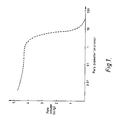
- Figure 1 is a porosity trace of the product of Example 3 which is a graph of cumulative pore volume in cm3/g on the ordinate and pore diameter in log scale in microns on the abscicca.
- Example 1 The procedure of Example 1 was repeated except that 36 mls of cyclohexane and 108 mls of HMDS were used.
- the dried product had a pore volume of 4 cm3/g between 1 to 10 ⁇ m and a carbon content of 9.1%.
- SEM of the product showed a three-dimensional network structure with cavities interconnected by holes.
- Example 1 The procedure of Example 1 was repeated except that 144 mls of HMDS was used.
- the dried product had a pore volume of 3.7 cm3/g between 1 to 10 ⁇ m and a carbon content of 9.8%.
- SEM of the product showed a three-dimensional network structure with cavities interconnected by holes as shown in Figure 3 of the accompanying drawings.
- the pore volume of the dried product was 3.4 cm3/g between 1 and 10 ⁇ m.
- the product had an overall porosity of 4.93 cm3/g and contained 13.6wt% carbon.
- Example 6 The procedure of Example 6 was followed employing 63g sodium silicate solution (20% SiO2), 0.6g Miranol, 0.52g Crodateric C, 141 mls cyclohexane and 3mls HMDS.
- the product had an overall porosity of 5.78 cm3/g and a porosity between 0.5 and 5 ⁇ m of 5.23 cm3/g.
- the carbon content of the product was 1.6 wt.%.
- Example 6 The procedure of Example 6 was followed employing 63g of aqueous solution of sodium silicate (20% SiO2), 0.63g Miranol, 0.52g Crodateric C, 138mls cyclohexane and 6mls HMDS.
- the product had an overall porosity of 5.28cc/g and a porosity between 0.5 and 5 ⁇ m of 3.3 cm3/g and a carbon content of 2.65 wt.%.
- Example 6 The procedure of Example 6 was followed employing 160g aqueous sodium silicate solution (containing 20% by weight SiO2), 1.6g Miranol, 1.3g Crodateric C, 348mls cyclohexane and 18mls HMDS.
- the product had an overall porosity of 5.19 cm3/g and a porosity between 0.5 and 5 ⁇ m of 3 cm3/g.
- the product contained 8.08 wt% carbon.
- the product had an overall Porosity of 6.08 cm3/g and a pore volume between 1 and 10 ⁇ m of 3.9 cm3/g.
- the product contained 6.7wt% carbon.
- sodium aluminosilicate sol prepared by mixing 53g acid alum [2.76% Al2O3, 20% H2SO4 and 77.24% H2O] and 165g sodium silicate [10.4% SiO2 by weight]
- aluminosilicate sol prepared by mixing 53g acid alum [2.76% Al2O3, 20% H2SO4 and 77.24% H2O] and 165g sodium silicate [10.4% SiO2 by weight]
- 130mls cyclohexane were added to the aluminosilicate/ emulsifying agent mixture followed by 14mls HMDS.
- the mixture was stirred using a vibro mixer for 10 minutes and the resulting emulsion was left to stand for 15 minutes.
- the emulsion was gelled by dropping into 1M ammonium carbonate using a plastic dropping pipette. The gel was left in the ammonium carbonate for 2 hours, then separated off and rinsed, air-dried, washed and oven-dried in the manner described for Example
- the overall porosity of the product was 4.16 cm3/g and the pore volume between 0.5 and 10 ⁇ m was 2.2 cm3/g.
- the product contained 1.7wt% carbon.
- the overall porosity of the product was 3.18 cm3/g and the pore volume between 1 and 10 ⁇ m was 2.0 cm3/g
- the product contained 2.8wt% carbon.
Landscapes
- Chemical & Material Sciences (AREA)
- Engineering & Computer Science (AREA)
- Ceramic Engineering (AREA)
- Chemical Kinetics & Catalysis (AREA)
- Dispersion Chemistry (AREA)
- Materials Engineering (AREA)
- Structural Engineering (AREA)
- Organic Chemistry (AREA)
- Solid-Sorbent Or Filter-Aiding Compositions (AREA)
- Silicon Compounds (AREA)
- Catalysts (AREA)
- Silicon Polymers (AREA)
- Porous Artificial Stone Or Porous Ceramic Products (AREA)
- Materials Applied To Surfaces To Minimize Adherence Of Mist Or Water (AREA)
- Processing Or Creating Images (AREA)
- Cosmetics (AREA)
- Inorganic Compounds Of Heavy Metals (AREA)
Priority Applications (1)
| Application Number | Priority Date | Filing Date | Title |
|---|---|---|---|
| AT87309066T ATE76633T1 (de) | 1986-10-16 | 1987-10-14 | Wasserabweisende anorganische produkte. |
Applications Claiming Priority (2)
| Application Number | Priority Date | Filing Date | Title |
|---|---|---|---|
| GB8624872 | 1986-10-16 | ||
| GB08624872A GB2199541A (en) | 1986-10-16 | 1986-10-16 | Production of engineering drawings |
Publications (3)
| Publication Number | Publication Date |
|---|---|
| EP0264268A2 EP0264268A2 (en) | 1988-04-20 |
| EP0264268A3 EP0264268A3 (en) | 1989-07-19 |
| EP0264268B1 true EP0264268B1 (en) | 1992-05-27 |
Family
ID=10605875
Family Applications (1)
| Application Number | Title | Priority Date | Filing Date |
|---|---|---|---|
| EP19870309066 Expired - Lifetime EP0264268B1 (en) | 1986-10-16 | 1987-10-14 | Hydrophobic inorganic structures |
Country Status (11)
| Country | Link |
|---|---|
| US (1) | US4888309A (OSRAM) |
| EP (1) | EP0264268B1 (OSRAM) |
| JP (1) | JPS63190774A (OSRAM) |
| AT (1) | ATE76633T1 (OSRAM) |
| AU (1) | AU602924B2 (OSRAM) |
| CA (1) | CA1270498A (OSRAM) |
| DE (1) | DE3779393D1 (OSRAM) |
| ES (1) | ES2033320T3 (OSRAM) |
| GB (1) | GB2199541A (OSRAM) |
| GR (1) | GR3005514T3 (OSRAM) |
| ZA (1) | ZA877796B (OSRAM) |
Families Citing this family (25)
| Publication number | Priority date | Publication date | Assignee | Title |
|---|---|---|---|---|
| GB8511048D0 (en) * | 1985-05-01 | 1985-06-12 | Unilever Plc | Inorganic structures |
| GB2199541A (en) * | 1986-10-16 | 1988-07-13 | Rig Design Services | Production of engineering drawings |
| US5171720A (en) * | 1988-09-20 | 1992-12-15 | Asahi Kogaku Kogyo K.K. | Porous ceramic sinter and process for producing same |
| GB9122481D0 (en) * | 1991-10-23 | 1991-12-04 | Roberts Robert G | Method and apparatus for representing articles of furniture |
| DE69304695T2 (de) * | 1992-05-20 | 1997-03-20 | Du Pont | Verfahren zur herstellung anorganischer gele |
| GB2287459B (en) * | 1992-06-02 | 1996-02-14 | British Gas Plc | Porous amorphous silica-alumina refractory oxides,their preparation and use as separation membranes |
| US5871646A (en) * | 1992-06-02 | 1999-02-16 | British Gas Plc | Porous amorphous silica-alumina refractory oxides, their preparation and use as separation membranes |
| DK0711261T3 (da) * | 1993-07-28 | 2002-08-12 | Univ Monash | Zirconiumoxidpartikler |
| JP2580537B2 (ja) * | 1994-06-27 | 1997-02-12 | 工業技術院長 | シリカ球状粒子からなる三次元網状構造体 |
| DE19648798C2 (de) * | 1996-11-26 | 1998-11-19 | Hoechst Ag | Verfahren zur Herstellung von organisch modifizierten Aerogelen durch Oberflächenmodifikation des wäßrigen Gels (ohne vorherigen Lösungsmitteltausch) und anschließender Trocknung |
| WO1998052869A1 (en) * | 1997-05-22 | 1998-11-26 | Trustees Of Princeton University | Lyotropic liquid crystalline l3 phase silicated nanoporous monolithic composites and their production |
| US6048908A (en) | 1997-06-27 | 2000-04-11 | Biopore Corporation | Hydrophilic polymeric material |
| US7247379B2 (en) | 1997-08-28 | 2007-07-24 | E Ink Corporation | Electrophoretic particles, and processes for the production thereof |
| US7002728B2 (en) | 1997-08-28 | 2006-02-21 | E Ink Corporation | Electrophoretic particles, and processes for the production thereof |
| DE59811774D1 (de) * | 1998-06-05 | 2004-09-09 | Cabot Corp | Nanoporöse interpenetrierende organisch-anorganische netzwerke |
| JP4198999B2 (ja) | 2001-03-13 | 2008-12-17 | イー インク コーポレイション | 図面を表示するための装置 |
| US7230750B2 (en) | 2001-05-15 | 2007-06-12 | E Ink Corporation | Electrophoretic media and processes for the production thereof |
| US6580545B2 (en) * | 2001-04-19 | 2003-06-17 | E Ink Corporation | Electrochromic-nanoparticle displays |
| EP1393122B1 (en) | 2001-05-15 | 2018-03-28 | E Ink Corporation | Electrophoretic particles |
| ITTO20120753A1 (it) | 2012-08-30 | 2014-03-01 | St Microelectronics Srl | Dispositivo incapsulato esposto all'aria ambiente e a liquidi e relativo processo di fabbricazione |
| ITUB20153550A1 (it) * | 2015-09-11 | 2017-03-11 | Signa Labs S R L | Materiale, uso e metodo di realizzazione di tale materiale |
| WO2017214531A1 (en) | 2016-06-10 | 2017-12-14 | Chevron U.S.A. Inc. | Hydrophobic adsorbents and mercury removal processes therewith |
| FR3065651B1 (fr) | 2017-04-28 | 2020-05-29 | IFP Energies Nouvelles | Procede de preparation d'un monolithe a porosite multimodale |
| FR3065649B1 (fr) | 2017-04-28 | 2020-05-29 | IFP Energies Nouvelles | Monolithe poreux contenant du tio2 et son procede de preparation |
| JP7391667B2 (ja) * | 2017-06-15 | 2023-12-05 | サソール(ユーエスエイ)コーポレーシヨン | 疎水性表面改質アルミナ及びその製造方法 |
Family Cites Families (12)
| Publication number | Priority date | Publication date | Assignee | Title |
|---|---|---|---|---|
| FR1326386A (fr) * | 1962-01-30 | 1963-05-10 | Pechiney Saint Gobain | Nouveaux produits poreux à base d'alumine |
| US3301635A (en) * | 1965-07-01 | 1967-01-31 | Du Pont | Molded amorphous silica bodies and molding powders for manufacture of same |
| FR1583791A (OSRAM) * | 1968-03-29 | 1969-12-05 | ||
| DE2155045B2 (de) * | 1971-11-05 | 1976-05-06 | Sebestian, Imrich, Dr., 6000 Frankfurt; Halasz, Istvan, Prof. Dr., 6600 Saarbrücken | Verfahren zur herstellung von kugelfoermigen poroesen sio tief 2-teilchen |
| US3892580A (en) * | 1973-03-26 | 1975-07-01 | Corning Glass Works | Method of making porous inorganic bodies |
| JPS51115298A (en) * | 1975-04-03 | 1976-10-09 | Agency Of Ind Science & Technol | Process for production of spherical silica gel |
| US4011096A (en) * | 1975-06-10 | 1977-03-08 | E. I. Du Pont De Nemours And Company | Vesiculated silica microspheres |
| US4190457A (en) * | 1978-06-09 | 1980-02-26 | Phillips Petroleum Co. | Preparation of inorganic xerogels |
| DE3151374A1 (de) * | 1981-12-24 | 1983-07-14 | Bayer Ag, 5090 Leverkusen | Waessrige zubereitung und ihre verwendung bei der herstellung keramischer massen |
| US4654314A (en) * | 1983-07-09 | 1987-03-31 | Sumitomo Cement Co., Ltd. | Porous ceramic material and processes for preparing same |
| GB8511048D0 (en) * | 1985-05-01 | 1985-06-12 | Unilever Plc | Inorganic structures |
| GB2199541A (en) * | 1986-10-16 | 1988-07-13 | Rig Design Services | Production of engineering drawings |
-
1986
- 1986-10-16 GB GB08624872A patent/GB2199541A/en not_active Withdrawn
-
1987
- 1987-10-13 AU AU79595/87A patent/AU602924B2/en not_active Ceased
- 1987-10-14 ES ES198787309066T patent/ES2033320T3/es not_active Expired - Lifetime
- 1987-10-14 AT AT87309066T patent/ATE76633T1/de not_active IP Right Cessation
- 1987-10-14 EP EP19870309066 patent/EP0264268B1/en not_active Expired - Lifetime
- 1987-10-14 DE DE8787309066T patent/DE3779393D1/de not_active Expired - Lifetime
- 1987-10-14 CA CA000549299A patent/CA1270498A/en not_active Expired - Fee Related
- 1987-10-15 JP JP62260740A patent/JPS63190774A/ja active Pending
- 1987-10-16 US US07/109,179 patent/US4888309A/en not_active Expired - Lifetime
- 1987-10-16 ZA ZA877796A patent/ZA877796B/xx unknown
-
1992
- 1992-08-25 GR GR920401859T patent/GR3005514T3/el unknown
Also Published As
| Publication number | Publication date |
|---|---|
| JPS63190774A (ja) | 1988-08-08 |
| GB8624872D0 (en) | 1986-11-19 |
| CA1270498A (en) | 1990-06-19 |
| ATE76633T1 (de) | 1992-06-15 |
| EP0264268A2 (en) | 1988-04-20 |
| DE3779393D1 (de) | 1992-07-02 |
| GB2199541A (en) | 1988-07-13 |
| US4888309A (en) | 1989-12-19 |
| EP0264268A3 (en) | 1989-07-19 |
| ES2033320T3 (es) | 1993-03-16 |
| AU602924B2 (en) | 1990-11-01 |
| AU7959587A (en) | 1988-04-21 |
| ZA877796B (en) | 1989-06-28 |
| GR3005514T3 (OSRAM) | 1993-06-07 |
Similar Documents
| Publication | Publication Date | Title |
|---|---|---|
| EP0264268B1 (en) | Hydrophobic inorganic structures | |
| CA1248146A (en) | Inorganic structures | |
| RU2169131C2 (ru) | Комбинированный материал, содержащий аэрогель, и способ его изготовления | |
| US6080475A (en) | Composite material containing aerogel, process for manufacturing the same and the use thereof | |
| US4102703A (en) | Water-repellent coating compositions and method for their preparation | |
| US4112032A (en) | Silica-containing porous bodies of controlled pore size | |
| Wu et al. | Synthesis of cellular inorganic materials by foaming sol-gels | |
| US2886460A (en) | Organophilic and hydrophilic composition | |
| KR880002967A (ko) | 소포제 | |
| KR102071966B1 (ko) | 낮은 점유도의 일작용성 단위를 포함하는 소수성 에어로겔 | |
| RU2003137233A (ru) | Высокоэффективный фотолюминесцентный материал и способ его производства | |
| CN101633505A (zh) | 微波反应制得的具有气凝胶特性的SiO2纳米级多孔材料及其制备方法 | |
| Murakata et al. | Control of pore size distribution of silica gel through sol-gel process using inorganic salts and surfactants as additives | |
| Oh et al. | Distribution of macropores in silica particles prepared by using multiple emulsions | |
| Caruso | Nanocasting and nanocoating | |
| AU2003274663B2 (en) | Gypsum product and method therefor | |
| KR910005122B1 (ko) | 균일 크기 다공성 실리카 구의 제조방법 | |
| Lecloux et al. | High-temperature catalysts through sol–gel synthesis | |
| JP4958439B2 (ja) | メソポーラスシリカ前駆体溶液、その製造方法及びメソポーラスシリカ | |
| CA1059975A (en) | Silica-containing porous bodies of controlled pore size | |
| CN113060739A (zh) | 氧化硅气凝胶微球及其制备方法和应用 | |
| Hashimoto et al. | Strengthening of sol-gel-derived SiO2 glass fibers by incorporating colloidal silica particles | |
| US3057744A (en) | Film forming composition | |
| EP0243166A2 (en) | Silica platelets | |
| JP7089762B2 (ja) | ファインバブル含有固化体の製造方法 |
Legal Events
| Date | Code | Title | Description |
|---|---|---|---|
| PUAI | Public reference made under article 153(3) epc to a published international application that has entered the european phase |
Free format text: ORIGINAL CODE: 0009012 |
|
| AK | Designated contracting states |
Kind code of ref document: A2 Designated state(s): AT BE CH DE ES FR GB GR IT LI NL SE |
|
| PUAL | Search report despatched |
Free format text: ORIGINAL CODE: 0009013 |
|
| AK | Designated contracting states |
Kind code of ref document: A3 Designated state(s): AT BE CH DE ES FR GB GR IT LI NL SE |
|
| 17P | Request for examination filed |
Effective date: 19890711 |
|
| 17Q | First examination report despatched |
Effective date: 19910204 |
|
| GRAA | (expected) grant |
Free format text: ORIGINAL CODE: 0009210 |
|
| AK | Designated contracting states |
Kind code of ref document: B1 Designated state(s): AT BE CH DE ES FR GB GR IT LI NL SE |
|
| REF | Corresponds to: |
Ref document number: 76633 Country of ref document: AT Date of ref document: 19920615 Kind code of ref document: T |
|
| REF | Corresponds to: |
Ref document number: 3779393 Country of ref document: DE Date of ref document: 19920702 |
|
| ITF | It: translation for a ep patent filed | ||
| ET | Fr: translation filed | ||
| RAP4 | Party data changed (patent owner data changed or rights of a patent transferred) |
Owner name: UNILEVER N.V. Owner name: UNILEVER PLC |
|
| REG | Reference to a national code |
Ref country code: ES Ref legal event code: FG2A Ref document number: 2033320 Country of ref document: ES Kind code of ref document: T3 |
|
| REG | Reference to a national code |
Ref country code: GR Ref legal event code: FG4A Free format text: 3005514 |
|
| PLBE | No opposition filed within time limit |
Free format text: ORIGINAL CODE: 0009261 |
|
| STAA | Information on the status of an ep patent application or granted ep patent |
Free format text: STATUS: NO OPPOSITION FILED WITHIN TIME LIMIT |
|
| 26N | No opposition filed | ||
| PGFP | Annual fee paid to national office [announced via postgrant information from national office to epo] |
Ref country code: AT Payment date: 19930914 Year of fee payment: 7 |
|
| PGFP | Annual fee paid to national office [announced via postgrant information from national office to epo] |
Ref country code: CH Payment date: 19930920 Year of fee payment: 7 Ref country code: SE Payment date: 19930920 Year of fee payment: 7 |
|
| PGFP | Annual fee paid to national office [announced via postgrant information from national office to epo] |
Ref country code: BE Payment date: 19930927 Year of fee payment: 7 |
|
| PGFP | Annual fee paid to national office [announced via postgrant information from national office to epo] |
Ref country code: GR Payment date: 19931013 Year of fee payment: 7 |
|
| PGFP | Annual fee paid to national office [announced via postgrant information from national office to epo] |
Ref country code: ES Payment date: 19931014 Year of fee payment: 7 |
|
| PG25 | Lapsed in a contracting state [announced via postgrant information from national office to epo] |
Ref country code: AT Effective date: 19941014 |
|
| PG25 | Lapsed in a contracting state [announced via postgrant information from national office to epo] |
Ref country code: SE Effective date: 19941015 Ref country code: ES Free format text: LAPSE BECAUSE OF THE APPLICANT RENOUNCES Effective date: 19941015 |
|
| PG25 | Lapsed in a contracting state [announced via postgrant information from national office to epo] |
Ref country code: BE Effective date: 19941031 Ref country code: CH Effective date: 19941031 Ref country code: LI Effective date: 19941031 |
|
| EAL | Se: european patent in force in sweden |
Ref document number: 87309066.6 |
|
| BERE | Be: lapsed |
Owner name: UNILEVER N.V. Effective date: 19941031 |
|
| PG25 | Lapsed in a contracting state [announced via postgrant information from national office to epo] |
Ref country code: GR Free format text: THE PATENT HAS BEEN ANNULLED BY A DECISION OF A NATIONAL AUTHORITY Effective date: 19950430 |
|
| REG | Reference to a national code |
Ref country code: CH Ref legal event code: PL Ref country code: GR Ref legal event code: MM2A Free format text: 3005514 |
|
| EUG | Se: european patent has lapsed |
Ref document number: 87309066.6 |
|
| REG | Reference to a national code |
Ref country code: ES Ref legal event code: FD2A Effective date: 19991007 |
|
| REG | Reference to a national code |
Ref country code: GB Ref legal event code: IF02 |
|
| PGFP | Annual fee paid to national office [announced via postgrant information from national office to epo] |
Ref country code: NL Payment date: 20061024 Year of fee payment: 20 |
|
| PGFP | Annual fee paid to national office [announced via postgrant information from national office to epo] |
Ref country code: GB Payment date: 20061025 Year of fee payment: 20 |
|
| PGFP | Annual fee paid to national office [announced via postgrant information from national office to epo] |
Ref country code: IT Payment date: 20061031 Year of fee payment: 20 |
|
| PGFP | Annual fee paid to national office [announced via postgrant information from national office to epo] |
Ref country code: DE Payment date: 20061130 Year of fee payment: 20 |
|
| REG | Reference to a national code |
Ref country code: GB Ref legal event code: PE20 |
|
| NLV7 | Nl: ceased due to reaching the maximum lifetime of a patent |
Effective date: 20071014 |
|
| PG25 | Lapsed in a contracting state [announced via postgrant information from national office to epo] |
Ref country code: NL Free format text: LAPSE BECAUSE OF EXPIRATION OF PROTECTION Effective date: 20071014 |
|
| PG25 | Lapsed in a contracting state [announced via postgrant information from national office to epo] |
Ref country code: GB Free format text: LAPSE BECAUSE OF EXPIRATION OF PROTECTION Effective date: 20071013 |
|
| PGFP | Annual fee paid to national office [announced via postgrant information from national office to epo] |
Ref country code: FR Payment date: 20061017 Year of fee payment: 20 |