EP0263716A2 - Verfahren zur Herstellung von 5'-guanilsäure und Expressionsvektoren zur Verwendung dazu - Google Patents
Verfahren zur Herstellung von 5'-guanilsäure und Expressionsvektoren zur Verwendung dazu Download PDFInfo
- Publication number
- EP0263716A2 EP0263716A2 EP87308957A EP87308957A EP0263716A2 EP 0263716 A2 EP0263716 A2 EP 0263716A2 EP 87308957 A EP87308957 A EP 87308957A EP 87308957 A EP87308957 A EP 87308957A EP 0263716 A2 EP0263716 A2 EP 0263716A2
- Authority
- EP
- European Patent Office
- Prior art keywords
- escherichia coli
- acid
- strain
- temperature
- guanylic acid
- Prior art date
- Legal status (The legal status is an assumption and is not a legal conclusion. Google has not performed a legal analysis and makes no representation as to the accuracy of the status listed.)
- Withdrawn
Links
Images

Classifications
-
- C—CHEMISTRY; METALLURGY
- C12—BIOCHEMISTRY; BEER; SPIRITS; WINE; VINEGAR; MICROBIOLOGY; ENZYMOLOGY; MUTATION OR GENETIC ENGINEERING
- C12N—MICROORGANISMS OR ENZYMES; COMPOSITIONS THEREOF; PROPAGATING, PRESERVING, OR MAINTAINING MICROORGANISMS; MUTATION OR GENETIC ENGINEERING; CULTURE MEDIA
- C12N9/00—Enzymes; Proenzymes; Compositions thereof; Processes for preparing, activating, inhibiting, separating or purifying enzymes
- C12N9/93—Ligases (6)
-
- C—CHEMISTRY; METALLURGY
- C12—BIOCHEMISTRY; BEER; SPIRITS; WINE; VINEGAR; MICROBIOLOGY; ENZYMOLOGY; MUTATION OR GENETIC ENGINEERING
- C12P—FERMENTATION OR ENZYME-USING PROCESSES TO SYNTHESISE A DESIRED CHEMICAL COMPOUND OR COMPOSITION OR TO SEPARATE OPTICAL ISOMERS FROM A RACEMIC MIXTURE
- C12P19/00—Preparation of compounds containing saccharide radicals
- C12P19/26—Preparation of nitrogen-containing carbohydrates
- C12P19/28—N-glycosides
- C12P19/30—Nucleotides
- C12P19/32—Nucleotides having a condensed ring system containing a six-membered ring having two N-atoms in the same ring, e.g. purine nucleotides, nicotineamide-adenine dinucleotide
Definitions
- the present invention relates to a process for the preparation of 5 ⁇ -guanylic acid (hereinafter referred to as GMP) and to expression vectors prepared by means of genetic recombination of DNA for use therein. More particularly, the present invention relates to a process for the preparation of GMP by the enzymatic reaction, in which a transformant is cultured in a medium to obtain a fermented liquor, microbial cells or materials which are obtained by treating said fermented liquor or microbial cells, and then said fermented liquor, microbial cells or material is used as the source of enzyme for the reaction to convert 5 ⁇ -xanthylic acid (hereinafter referred to as XMP) into GMP, said transformant being obtained by the use of DNA which is prepared by recombination of a DNA fragment carrying a gene of guanylic acid-synthetase (hereinafter designated as GMP synthetase) capable of synthesizing GMP from XMP, adenosine-5 ⁇ -
- Examples of the known processes for the preparation of GMP include the decomposition of ribo-nucleic acid, the production of a precursor such as, for example, guanosine, from which GMP is obtained by chemical phophorylation, and the direct production of GMP by fermentation of microorganism.
- the present inventors have studied the preparaation of GMP from XMP and have disclosed in Japanese Patent Application laid open to public inspection as 192597/85 that a transformed microorganism exhibits a high ability to produce GMP from XMP, said microorganism being prepared by the steps of cloning a gene of GMP synthetase which is an enzyme capable of producing GMP from XMP (in some cases hereinafter referred to to as guaA ) by using a plasmid vector pBR322, thereafter forming a recombinant plasmid by recombining the plasmid vector with a DNA fragment carrying a promoter of tryptophan operon of Escherichia coli (hereinafter referred to as trp promoter or Ptrp ) located upstream of guaA , and transforming a microorganism by the use of said recombinant DNA.
- trp promoter or Ptrp transforming a microorganism
- a microorganism having a higher ability to convert XMP into GMP may be obtained by transformation of Escherichia coli carrying a gene of a temperature-sensitive cI repressor (cI857) by the use of a plasmid vector, into which is inserted a DNA fragment carrying guaA downstream of the P L promoter.
- the present invention provides a process for the preparation of GMP, by which said GMP is produced from XMP, ATP and at least one member selected from ammonia and glutamine by enzymatic reaction, which process comprises preparing a recombinant DNA by inserting a fragment of DNA carrying a gene of GMP synthetase downstream of a P L promoter into a vector DNA, transforming Escherichia coli carrying a temperature-sensitive cl repressor by the use of said recombinant DNA, culturing the transformant in a medium, either carrying out said enzymatic reaction by using as the source of enzyme, one member selected from fermented liquor, microbial cells and materials which are obtained by treating said fermented liquor or said microbial cells, or culturing said transformant in a medium containing XMP, ATP and at least one member selected from ammonia and glutamine, and, if desired, isolating GMP from the resultant reaction solution or fermented liquor.
- an Escherichia coli expression vector carrying the genetic information for an enzyme capable of catalysing the conversion of 5 ⁇ -xanthylic acid into 5 ⁇ -guanylic acid and, upstream thereof, the P L -promoter and Escherichia coli strains transformed with an expression according to the invention.
- DNA fragments carrying a gene of GMP synthetase which may be used for the purpose of the present invention include those derived from prokaryotes, bacteriophages or plasmids, although it is preferred to use DNA fragments carrying guaA originating from Escherichia coli , and examples of plasmids include those carrying such a DNA fragment.
- guaA is a hybrid plasmid formed by recombining a DNA fragment carrying both a gene of inosinic acid-dehydrogenase (hereinafter referred to as guaB ) and guaA (both originating from the chromosome of Escherichia coli ) with colicin E, (hereinafter referred to as ColE,) DNA [all disclosed in Methods in Enzymology, 68 , 296-408 (1979)].
- guaB a gene of inosinic acid-dehydrogenase
- ColE colicin E
- Escherichia coli JA200 which is available from E. coli Genetic Stock Center, Yale University, [cf. L. Clarke & J. Carbon, Cell 9 , 91-99 (1976)] was used to separate and purify the desired plasmid DNA.
- pXAR66 plasmid is preferred, which is produced by the steps of removing a major portion of guaB gene from pLC34-10 and inserting a tryptophan promoter into the upstream of the DNA fragment carrying the remainder of the guaA gene (disclosed in Japanese Patent Application laid open to public inspection as No. 192597/85).
- guaA On the chromosome of E. coli , guaA is located downstream of guaB , and both guaA and guaB form an operon in conjunction with the region of the promoter-operator located upstream of guaB [Molec. Gen. Genet. 147 , 203-208 (1976)]. Where GMP is accumulated in the microbial cells, the expression of guaA and guaB genes may be inhibited. Also, as is known, there is a secondary promotor interposed between guaA and guaB , of which transcription activity is lower than the corresponding activity of the promotor located in the upstream region [J. Bact. 131 , 685-688 (1977)].
- any and all plasmids may be used to prepare the recombinant plasmid according to the present invention provided the expression of the GMP synthetase gene in Escherichia coli is possible.
- those capable of imparting, for example, resistance to antibiotics such as, for example, pPLDI, pP L T4, pP L T20, pPAI and pPLA66 plasmids. which carry p L -promoter and which are derived from pBR322 [Gene. 2 , 95 (1977)] and pBR325 [Gene. 4 , 121 (1978)].
- the preparation of recominant plasmid from a DNA fragment carrying the gene and the vector DNA may be effected in vitro in conventional manner, for example, by the steps of physical or enzymatic cleavage of a DNA carrying a desired gene and vector DNA, followed by recombination using a ligase.
- the desired recombinant may be separated from the solution of the ligase reaction by the steps of direct transformation of Escherichia coli in a solution of the DNA mixture, and selecting a microorganism imparted with the characteristics originating from the genetic information of the desired genes.
- the desired recombinant may be obtained by the steps of transformation, selection of the desired resistant strain and separation of the strain to which the transformed characteristics originating from the genetic information of the desired genes are imparted.
- any and all strains of Escherichia coli may be used sofaras they carry a mutant gene having a temperature-sensitive cl repressor of ⁇ -phage, for example, cl857.
- Examples of preferred host strains include Escherichia coli MP 347 (FERM BP-408) and E. coli Nr 69.
- a recombinant carrying guaA which is capable of being manifested in the host cell may be obtained by the steps of transformation, selection of a ampicillin-resistant strains and further selection of a strain which is imparted with a higher activity of GMP synthetase.
- Culturing may be effected in a medium containing sources of carbon, nitrogen, inorganic substances, amino acids, vitamins and the like under aerobic conditions at adjusted temperature, pH and the like.
- carbon source examples include glucose, fructose, sucrose, maltose, mannitol, sorbitol and other carbohydrates : sugar alcohols, glycerol, starch hydrolyzate solution, molasses and the like, although it is possible to use organic acid such as, for example, pyruvic acid, lactic acid, citric acid, and amino acids such as, for example, glutamic acid, methionine and the like.
- nitrogen source examples include ammonia, ammonium chloride, ammonium sulfate, ammonium carbonate, ammonium acetate and other organic and inorganic salts of ammonium: glutamic acid, glutamine, methionine and other amino acids; pepton, NZ-amine, corn steep liquor, meat extract, yeast extract, casein hydrolyzate, fish meal and its digested products, chrysalis hydrolyzate and other nitrogen-containing organic substances.
- inorganic substances include potassium dihydrogen phosphate, sodium hydrogen phosphate, magnesium sulfate, sodium chloride, potassium chloride, iron chloride, copper sulfate, manganese chloride, ammonium molybdate, zinc sulfate and the like, which may, if desired be added to the medium. If vitamins, amino acids and various other substances required for the growth of the microorganism are contained in the above-mentioned components, it is not necessary to add them to the medium additionally.
- Culturing may be effected under aerobic conditions with shaking or with aeration and agitation at a temperature of from 20 to 50°C (preferably 30-45°C).
- aeration and agitation at a temperature of from 20 to 50°C (preferably 30-45°C).
- the resultant fermented product may be used, with or without after-treatment for placing in contact with XMP, ATP and at least one member selected from ammonia and glutamine.
- the materials obtained by treating said fermented products are exemplified by concentrated or dried fermented broth, filtrate obtained by centrifugation of the product treated with acetone, surfactants, organic solvents, bacteriolytic enzymes and the like; immobilized cells, and enzyme extracted from the cells.
- the enzymatic reation may be carried out in an aqueous solution by placing the starting materials into contact with the fermented product which may be used with or without after-treatment.
- the microorganism in a medium containing XMP, ATP and at least one member selected from ammonia and glutamine to accumulate GMP in the fermented liquor.
- a surfactant and/or an organic solvent in the medium.
- XMP, ATP and at least one member selected from ammonia and glutamine may be added to the fermented liquor, microbial cells or materials obtained by treating the fermented product.
- the reaction may be effected at a temperature of from 20 to 50°C for a period of from 1 to 48 hours to accumulate GMP in the reaction solution.
- a surfactant and/or an organic solvent may be added to the reaction solution.
- the reaction may usually be effected at a pH of 6-10.
- the medium and the reaction solution may contain, for example, XMP (1-100), ATP (1-100), MgSO4 ⁇ 7H2O (1-50), (NH4)2 SO4 ⁇ 7H2O (1-25) and glutamine (1-25) [unit: g/l].
- Preferred examples of XMP which may be used for the purpose of the present invention include samples having a high purity, and products obtained by fermentation of XMP which may be used without aftertreatment or with the following concentration or partial purification. They may be used sofaras they contain XMP and do not give any adverse effect upon the accumulation of GMP.
- Preferred examples of ATP which may be used for the purpose of the present invention include samples having high purity, solutions containing ATP which may be obtained by placing adenine into contact with microbial cells in the presence of a substance capable of supplying energy (disclosed in Japanese Patent Application laid open to public inspection as No. 51799/84), ATP-containing solution, from which microbial cells are removed, and its concentrate.
- polyoxyethylene stearylamine for example, Naimin S-215, commercially available from Nihon Yushi K.K., Japan
- cetyltrimethylammonium bromide and other cationic surfactants for example, sodium oleylamide sulfonic acid and other anionic surfactants
- polyoxyethylenesorbitan monostearate for example, Nonion ST221, commercial product of Nihon Ushi K.K., Japan
- lauryl betaine for example, Anon BF, commercial product of Nihon Yushi K.K., Japan
- amphoteric surfactants may be used.
- these surfactants may be used at a concentration of 0.1-50 g/l (preferably 1-20 g/l).
- organic solvents it is possible to use, for example, toluene, xylene, aliphatic alcohols, benzene and ethyl acetate at a concentration of 0.1-50 ml/l (preferably 1-20 ml/l).
- GMP accumulated in aqueous solution may be collected in conventional manner such as, for example, by the use of active carbon, ion exchange resins and the like.
- Fig. 1 shows schematically the preparation of plasmid pPLD 1.
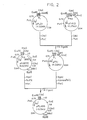
- Fig. 2 shows schematically the preparation of plasmid pPLA 66.
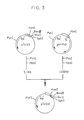
- Fig. 3 shows schematically the preparation of plasmid pTrS 10.
- Escherichia coli 1P L T4 (FERM-BP 406) containing a pP L T4 plasmid vector, of which promoter portion had a P L promoter linked with tryptophan promoter (disclosed in Japanese Patent Application as laid open to public inspection as No. 126086/85), was inoculated to a medium (referred to as L medium) containing Bactotryptone (Difco., U.S.A.; 10 g/l). yeast extract (Difco.: 5 g/l), NaCl (5 g/l) and having a pH of 7.2 for culturing at 30 °C for 18 hours. From the resultant fermented liquor, plasmid pP L T4 was separated and purified in a conventional manner as set forth.
- L medium containing Bactotryptone (Difco., U.S.A.; 10 g/l).
- yeast extract (Difco.: 5 g/l), NaCl (5 g/l) and
- L medium was used for culturing and maintaining the microorganism unless otherwise specified.
- the resultant pP L T4 plasmid DNA (about 5 ⁇ g) was dissolved in a buffered solution (50 ⁇ l) composed of tris-HCl (10 mM; pH 7.5), NaCl (100 mM), MgCl2 (7mM) and 2-mercaptoethanol (6 mM).
- This buffer solution is designated as Y-100 buffer solution.
- Buffer solutions of a similar composition except 50 mM and 0 mM of NaCl are designated as Y-50 and Y-0 buffer solutions respectively.
- a restriction enzyme (20 units of Bgl II; all restriction enzymes used herein are commercial products of Takara Shuzo K.K., Japan) to carry out the digestion at a temperature of 37 °C for 2 hours.
- Bal 31 buffer solution (20 ⁇ l; concentration X5) composed of tris-HCl (100 mM; pH 8.1), MgCl2 (60 mM), CaCl2 (60 mM) and NaCl (3 M), 48 ⁇ l of of distilled water and one unit of Bal 31 (commercial product of Bethesda Research Laboratories, U.S.A.) for digestion at a temperature of 30°C for 10 seconds.
- the mixture was treated at 4 °C for 18 hours to obtain a recombinant plasmid DNA which was then used to transform Escherichia coli MP347 by the method of Cohen et al , as set forth.
- the resultant transformed strain was resistant to ampicillin (50 ⁇ g/ml).
- Plasmid was recovered from this strain and was digested by means of restriction enzymes such as Xho I and Bgl II to analyze its structure. As a result, it was noted that the Xho I and Bgl II sites located upstream of the P L promoter were lost. This plasmid was designated as pP L T20.
- pP L T20 DNA (about 5 ⁇ g) was dissolved in 50 ⁇ l of Y-100 buffered solution, followed by adding Xho I restriction enzyme (20 units) for digestion at a temperature of 37 °C for 2 hours.
- Xho I restriction enzyme (20 units) for digestion at a temperature of 37 °C for 2 hours.
- 20 ⁇ l of Bal 31 buffered solution (concentration X5), 48 ml of distilled water and one unit of Bal 31 to the solution (30 ⁇ l) of Xho I digestion
- the mixture was subjected to digestion reaction carried out at a temperature of 30 °C for 3 minutes.
- the reaction solution was extracted with a mixture of phenol and chloroform (1:1 v/v) and precipitated by addition of ethanol.
- the resultant precipitates were added to 20 ⁇ l of T4DNA ligase-buffered solution to carry out the recirularisation reaction using 2 units of T4DNA ligase at a temperature of 4
- Escherichia coli MP347 was transformed to obtain an ampicillin-resistant strain by using the resultant recominant plasmid DNA.
- a strain resistant to 20 ⁇ g/ml of tetracycline was selected and plasmid vector was collected from the selected strain.
- the base sequence of a fragment of Eco RI- Hind III including the P L promoter was determined by the method of Maxam-Gilbert [Proc.Natl. Acad. Sci., 74 , 560 (1977)] to observe that the dimension of this fragment was 220 base pairs, in which only the portion of tryptophan promoter was digested and P L promoter was retained.
- This plasmid which was designated as pPLD1 is shown in Fig. 1.
- pTrS10 DNA carrying an initiation codon ATG was prepared by the method of Reference 1 described hereinafter, and was then dissolved in 50 ⁇ l of Y-0 buffered solution (hereinbefore defined). To this solution was added 15 units of Cla I to carry out the digestion at a temperature of 37°C for 2 hours. To the reaction solution were added 0.5 ⁇ l of NaCl (5 M) and 15 units of Pst I to carry out the digestion at a temperature of 37°C for 2 hours.
- LGT method Low gelling temperature agarose gel electrophoresis (hereinafter referred to as the LGT method) described e.g. in Analytical Biochemistry, 98 , 305 (1979) was used to purify DNA fragments hereinafter. In this manner, a DNA fragment of 3. 05 Kb including ATG portion was purified.
- Plasmid collected from the resultant strain was purified and digested by the use of restriction enzymes such as, for example, Sph I, Cla I and Pst I to analyze its structure.
- restriction enzymes such as, for example, Sph I, Cla I and Pst I to analyze its structure.
- a P L -ATG vector of 4. 02 Kb including ATG portion in the downstream of P L promoter was noted, which was designated as pPA 1 and is shown in Fig. 2.
- pPA 1 DNA was dissolved in 50 ⁇ l of Y-50 buffered solution. To this solution was added 20 units of Sph I to carry out the digestion at 37 °C for 2 hours. After extraction with a mixture of phenol and chloroform (1:1 v/v) and precipitation with ethanol, a fragment of DNA was dissolved in 50 ⁇ l in total of DNA polymerase I buffered solution in 50 ⁇ l in total of tris-HCl (pH 7.6: 50 mM), MgCl2 (7 mM), 2-mercaptoethanol (6 mM), dATP (0.25 mM), dCTP (0.25 mM), dGTP (0.25 mM), and dTTP (0.25 mM).
- E. coli DNA polymerase I ⁇ Klenow fragment commercial product of Bethesda Research Laboratories, U.S.A
- Extraction with chloroform was performed to discontinue the reaction.
- the DNA fragment was dissolved in 50 ⁇ l of Y-50 buffered solution. To the solution was added 20 units of Pst I to carry out the digestion at a temperature of 37 °C for 2 hours. After heat-treatment at 65 °C for 10 minutes, the solution was subjected to the LGT method to purify a fragment of DNA of 0.97 Kb including P L promoter portion and ATG portion.
- the DNA fragment was dissolved in 30 ⁇ l of Y-50 buffered solution. To this solution was added 15 units of Pst I to carry out the digestion at a temperature of 37 °C for 2 hours. After heat-treatment at a tempeature of 65 °C for 10 minutes, the solution was subjected to the LGT method to purify a fragment of DNA of about 5.5 Kb, of which guaA was digested on the side of the N-terminal.
- the fragment of DNA originating from pPA 1 (about 0.2 ⁇ g) and the fragment of DNA originating from pXAR 33 (about 0.5 ⁇ g) were recombined by treating with T4DNA ligase (20 ⁇ l) at a temperature of 4°C for 18 hours to obtain a recombinant plasmid DNA which was then used to transform Escherichia coli MP347.
- pPLA 66 was collected from a strain E. coli A-66 exhibiting the highest activity. Its structure was analyzed to observe that the P L -ATG sequence was inserted upstream of the guaA gene.
- M9 medium having the following composition: NH4Cl 1 ; Na2HPO4 6 ; KH2PO4 3 ; NaCl 5; MgSO4 ⁇ 7H2O 0.25 ; glucose 3 ; vitamin B1 0. 004 ; casamino acid 2 (unit g/l).
- strains MP 347 and MP347/ P PLA 66 were cultured respectively at a temperature of 30 °C overnight by using L medium.
- 1 % of the seed culture was transferred to L medium for culturing at a temperature of 30°C for 4 hours and further at 40°C for 3hours.
- the resultant fermented liquors were diluted with distilled water.
- the solution was shaken at a temperature of 37°C for 20 minutes. Then the solution was diluted with water (X 1 ⁇ 100) according to the GMP synthetase acitivty.
- the thus-treated culture liquor was added to a reaction solution having the following composition: tris-HCl (160 mM; pH 8. 6) , ATP (12 mM) , XMP (25mM) , MgSO4 ⁇ 7H2O (16 mM) and (NH4)2SO4 (40 mM).
- the reaction solution was shaken at a temperature of 42 °C to convert XMP into GMP.
- the reaction solution was sampled periodically to determine the formation of GMP by mixing a sample with perchloric acid (3.5 %; amount X40), centrifuging the mixture to collect the supernatant, and measuring its absorbancy at 290 nm.
- Table 1 indicates GMP synthetase activities of the strains used or prepared by the process of the present invention, in which 1 unit denotes an activity capable of producing 1 ⁇ mol of GMP per minutes.
- strain A-66 carrying plasmid pPLA 66 was deposited as Escherichia coli MP347/pPLA66 (FERM-BP 1200) with the Fermentation Research Institute, Agency of Industrial Science and Technology in Japan on 6th November 1986.
- the fermented liquor of a strain (hereinafter referred to as PLA66) carrying pPLA 66 produced by the method of Example 1 was concentrated to 20 times by centrifugation, to which was then added toluene to a final concentration of 20 ml/l.
- the mixture was shaken at a temperature of 37°C for 20 minutes.
- This cell suspension (0. 2 ml) was added to a reaction solution (30 ml) containing XMP ⁇ Na2 ⁇ 7H2O (20 mg/ml), ATP ⁇ Na2 ⁇ 3H2) (20 mg/ml) and (NH4 ) 2SO4 (10mg/ml) and having an adjusted pH of 8.
- Strain PLA 66 was inoculated in L medium (30 ml) put in a 300 ml Erlenmeyer flask for culturing with shaking at a temperature of 30°C for 4 hours and further at 40 °C for 3 hours.
- To the fermented liquor were added toluene (20 ⁇ l/ml), XMP ⁇ Na2 ⁇ 7H 2O (20 mg/ml), ATP ⁇ Na2 ⁇ 3H2O ( 20 mg/ml) and (NH4 ) 2SO4 (10 mg/ml), followed by further culturing at a temperature of 42 °C for 10 hours with shaking, while the pH was adjusted to 8. 6 with caustic soda.
- toluene (20 ⁇ l/ml)
- ATP ⁇ Na2 ⁇ 3H2O 20 mg/ml
- (NH4 ) 2SO4 10 mg/ml
- ATG vector pTrS10 was prepared in the manner described hereinafter.
- the resultant vector had a portable Ptrp fragment of a dimension of 370 base pairs, and the interval between SD sequence and ATG intiation codon was 13 bases. Sph I site was located immediately after the ATG initiation codon.
- pKYP 10 prepared by the method disclosed in Japanese Patent Application laid open to public inspection as No. 110600/83 was dissolved in Y- 100 buffered solution (30 ⁇ l). To this solution were added 6 units each of restriction enzymes Pst I and Hpa I to carry out cleavage reaction at a temperature of 37 °C for 3 hours. The LGT method was applied to obtain about 0. 5 ⁇ g of a fragment of DNA of about 1. 08 Kb (fragment of Pst I-Hpa I) from the reaction solution.
- Plasmid DNA was prepared from a culture of the colonies and analyzed by the use of restriction enzymes Pst I, Hpa I, Ban III, Nsi I and Sph I to note that the desired plasmid was obtained.
Landscapes
- Life Sciences & Earth Sciences (AREA)
- Chemical & Material Sciences (AREA)
- Organic Chemistry (AREA)
- Health & Medical Sciences (AREA)
- Engineering & Computer Science (AREA)
- Zoology (AREA)
- Wood Science & Technology (AREA)
- Genetics & Genomics (AREA)
- Bioinformatics & Cheminformatics (AREA)
- Biotechnology (AREA)
- Microbiology (AREA)
- Biochemistry (AREA)
- General Engineering & Computer Science (AREA)
- General Health & Medical Sciences (AREA)
- Molecular Biology (AREA)
- General Chemical & Material Sciences (AREA)
- Chemical Kinetics & Catalysis (AREA)
- Medicinal Chemistry (AREA)
- Biomedical Technology (AREA)
- Preparation Of Compounds By Using Micro-Organisms (AREA)
- Micro-Organisms Or Cultivation Processes Thereof (AREA)
Applications Claiming Priority (4)
| Application Number | Priority Date | Filing Date | Title |
|---|---|---|---|
| JP240558/86 | 1986-10-09 | ||
| JP24055886 | 1986-10-09 | ||
| JP61281589A JPS63233798A (ja) | 1986-10-09 | 1986-11-26 | 5′−グアニル酸の製造法 |
| JP281589/86 | 1986-11-26 |
Publications (2)
| Publication Number | Publication Date |
|---|---|
| EP0263716A2 true EP0263716A2 (de) | 1988-04-13 |
| EP0263716A3 EP0263716A3 (de) | 1988-12-28 |
Family
ID=26534779
Family Applications (1)
| Application Number | Title | Priority Date | Filing Date |
|---|---|---|---|
| EP87308957A Withdrawn EP0263716A3 (de) | 1986-10-09 | 1987-10-09 | Verfahren zur Herstellung von 5'-guanilsäure und Expressionsvektoren zur Verwendung dazu |
Country Status (1)
| Country | Link |
|---|---|
| EP (1) | EP0263716A3 (de) |
Cited By (3)
| Publication number | Priority date | Publication date | Assignee | Title |
|---|---|---|---|---|
| KR100629773B1 (ko) * | 2005-01-04 | 2006-09-28 | 씨제이 주식회사 | 대장균에서 발현가능한 guaA 유전자를 포함하는 벡터,이를 포함하는 에스케리키아 속 미생물, 및 상기 미생물을이용하여 5'-구아닐산 합성효소를 배지 중에축적시키는 방법 |
| US20110033898A1 (en) * | 2009-08-10 | 2011-02-10 | Hiroaki Fukada | Method for producing 5'-guanylic acid |
| US8058037B2 (en) | 2005-11-29 | 2011-11-15 | Kyowa Hakko Bio Co., Ltd. | Protein and DNA encoding the protein |
Family Cites Families (2)
| Publication number | Priority date | Publication date | Assignee | Title |
|---|---|---|---|---|
| DE185092T1 (de) * | 1984-03-12 | 1986-11-27 | Kyowa Hakko Kogyo Co., Ltd., Tokio/Tokyo | Verfahren zur herstellung von 5'-guanylsaeure. |
| US4743546A (en) * | 1985-02-13 | 1988-05-10 | Biotechnica International, Inc. | Controlled gene excision |
-
1987
- 1987-10-09 EP EP87308957A patent/EP0263716A3/de not_active Withdrawn
Cited By (4)
| Publication number | Priority date | Publication date | Assignee | Title |
|---|---|---|---|---|
| KR100629773B1 (ko) * | 2005-01-04 | 2006-09-28 | 씨제이 주식회사 | 대장균에서 발현가능한 guaA 유전자를 포함하는 벡터,이를 포함하는 에스케리키아 속 미생물, 및 상기 미생물을이용하여 5'-구아닐산 합성효소를 배지 중에축적시키는 방법 |
| US8058037B2 (en) | 2005-11-29 | 2011-11-15 | Kyowa Hakko Bio Co., Ltd. | Protein and DNA encoding the protein |
| US20110033898A1 (en) * | 2009-08-10 | 2011-02-10 | Hiroaki Fukada | Method for producing 5'-guanylic acid |
| US9200304B2 (en) * | 2009-08-10 | 2015-12-01 | Ajinomoto Co., Inc. | Method for producing 5′-guanylic acid |
Also Published As
| Publication number | Publication date |
|---|---|
| EP0263716A3 (de) | 1988-12-28 |
Similar Documents
| Publication | Publication Date | Title |
|---|---|---|
| JPS63233798A (ja) | 5′−グアニル酸の製造法 | |
| EP0136359B1 (de) | Herstellungsverfahren für l-histidin | |
| KR0177841B1 (ko) | 시티딘 디인산 콜린의 제조방법 | |
| USRE34851E (en) | Biosynthesis of 2 keto-L-gulonic acid | |
| WO2021162189A1 (ko) | L-글루탐산 생산능이 향상된 코리네박테리움 글루타미쿰 변이주 및 이를 이용한 l-글루탐산의 생산 방법 | |
| KR20080067145A (ko) | 이노신을 생산하는 미생물 및 그를 이용한 이노신 제조방법 | |
| EP0555475B1 (de) | Verfahren zur herstellung von 4-hydroxy-l-prolin | |
| US5281531A (en) | Host and vector for producing D-ribose | |
| JPH0716431B2 (ja) | 5′−グアニル酸の製造法 | |
| US5589355A (en) | Process for producing riboflavin | |
| EP0263716A2 (de) | Verfahren zur Herstellung von 5'-guanilsäure und Expressionsvektoren zur Verwendung dazu | |
| JP3369236B2 (ja) | シチジンジリン酸コリンの製造法 | |
| EP0465132A2 (de) | DNA und seine Verwendung | |
| WO2022196919A1 (ko) | L-시트룰린 생산능이 향상된 코리네박테리움 글루타미쿰 변이주 및 이를 이용한 l-시트룰린의 생산 방법 | |
| EP0259858A2 (de) | Verfahren zur Herstellung von Aminosäuren | |
| EP0071486B1 (de) | Mikroorganismen des Genus Escherichia, Hybride DNS zur Verwendung in deren Herstellung und die Verwendung dieser Mikroorganismen zur Herstellung von Glutathion | |
| EP0233581A2 (de) | Verfahren zur Herstellung von L-Threonin oder L-Isoleucin | |
| EP0183006B1 (de) | Rekombinantes DNS-Molekül, rekombinante DNS enthaltende, coryneforme Bakterien, und Verfahren zur Herstellung einer aromatischen Aminosäure, unter Verwendung derselben | |
| EP0385415B1 (de) | Verfahren zur Herstellung von NADH-Oxydase | |
| EP0185092B1 (de) | Verfahren zur herstellung von 5'-guanylsäure | |
| EP0180192B1 (de) | Plasmide | |
| JPH0630583B2 (ja) | Dνaおよびその用途 | |
| US5854035A (en) | Enzyme with leuDH activity, nucleotide sequence coding therefor and process for the prepartion of the enzyme | |
| KR100237091B1 (ko) | 플라빈 뉴클레오타이드의 제조방법 | |
| EP0417953A1 (de) | Verfahren zur Herstellung von Thiamin-Phosphaten |
Legal Events
| Date | Code | Title | Description |
|---|---|---|---|
| PUAI | Public reference made under article 153(3) epc to a published international application that has entered the european phase |
Free format text: ORIGINAL CODE: 0009012 |
|
| AK | Designated contracting states |
Kind code of ref document: A2 Designated state(s): DE FR GB |
|
| PUAL | Search report despatched |
Free format text: ORIGINAL CODE: 0009013 |
|
| AK | Designated contracting states |
Kind code of ref document: A3 Designated state(s): DE FR GB |
|
| 17P | Request for examination filed |
Effective date: 19890102 |
|
| STAA | Information on the status of an ep patent application or granted ep patent |
Free format text: STATUS: THE APPLICATION IS DEEMED TO BE WITHDRAWN |
|
| 18D | Application deemed to be withdrawn |
Effective date: 19910503 |
|
| RIN1 | Information on inventor provided before grant (corrected) |
Inventor name: ITO, SEIGA Inventor name: NISHI, TATSUNARI Inventor name: FUJIO, TATSURO Inventor name: MARUYAMA, AKIHIKO |