EP0262902A2 - Procédé de développement pour l'électrophotographie - Google Patents
Procédé de développement pour l'électrophotographie Download PDFInfo
- Publication number
- EP0262902A2 EP0262902A2 EP87308569A EP87308569A EP0262902A2 EP 0262902 A2 EP0262902 A2 EP 0262902A2 EP 87308569 A EP87308569 A EP 87308569A EP 87308569 A EP87308569 A EP 87308569A EP 0262902 A2 EP0262902 A2 EP 0262902A2
- Authority
- EP
- European Patent Office
- Prior art keywords
- toner
- developer
- image
- original
- image density
- Prior art date
- Legal status (The legal status is an assumption and is not a legal conclusion. Google has not performed a legal analysis and makes no representation as to the accuracy of the status listed.)
- Granted
Links
Images
Classifications
-
- G—PHYSICS
- G03—PHOTOGRAPHY; CINEMATOGRAPHY; ANALOGOUS TECHNIQUES USING WAVES OTHER THAN OPTICAL WAVES; ELECTROGRAPHY; HOLOGRAPHY
- G03G—ELECTROGRAPHY; ELECTROPHOTOGRAPHY; MAGNETOGRAPHY
- G03G9/00—Developers
- G03G9/08—Developers with toner particles
- G03G9/09—Colouring agents for toner particles
- G03G9/0902—Inorganic compounds
- G03G9/0904—Carbon black
-
- G—PHYSICS
- G03—PHOTOGRAPHY; CINEMATOGRAPHY; ANALOGOUS TECHNIQUES USING WAVES OTHER THAN OPTICAL WAVES; ELECTROGRAPHY; HOLOGRAPHY
- G03G—ELECTROGRAPHY; ELECTROPHOTOGRAPHY; MAGNETOGRAPHY
- G03G13/00—Electrographic processes using a charge pattern
- G03G13/06—Developing
- G03G13/08—Developing using a solid developer, e.g. powder developer
-
- G—PHYSICS
- G03—PHOTOGRAPHY; CINEMATOGRAPHY; ANALOGOUS TECHNIQUES USING WAVES OTHER THAN OPTICAL WAVES; ELECTROGRAPHY; HOLOGRAPHY
- G03G—ELECTROGRAPHY; ELECTROPHOTOGRAPHY; MAGNETOGRAPHY
- G03G15/00—Apparatus for electrographic processes using a charge pattern
- G03G15/06—Apparatus for electrographic processes using a charge pattern for developing
- G03G15/08—Apparatus for electrographic processes using a charge pattern for developing using a solid developer, e.g. powder developer
- G03G15/0822—Arrangements for preparing, mixing, supplying or dispensing developer
- G03G15/0848—Arrangements for testing or measuring developer properties or quality, e.g. charge, size, flowability
- G03G15/0849—Detection or control means for the developer concentration
- G03G15/0855—Detection or control means for the developer concentration the concentration being measured by optical means
-
- G—PHYSICS
- G03—PHOTOGRAPHY; CINEMATOGRAPHY; ANALOGOUS TECHNIQUES USING WAVES OTHER THAN OPTICAL WAVES; ELECTROGRAPHY; HOLOGRAPHY
- G03G—ELECTROGRAPHY; ELECTROPHOTOGRAPHY; MAGNETOGRAPHY
- G03G15/00—Apparatus for electrographic processes using a charge pattern
- G03G15/50—Machine control of apparatus for electrographic processes using a charge pattern, e.g. regulating differents parts of the machine, multimode copiers, microprocessor control
- G03G15/5033—Machine control of apparatus for electrographic processes using a charge pattern, e.g. regulating differents parts of the machine, multimode copiers, microprocessor control by measuring the photoconductor characteristics, e.g. temperature, or the characteristics of an image on the photoconductor
- G03G15/5041—Detecting a toner image, e.g. density, toner coverage, using a test patch
Definitions
- the present invention relates to a development process in the electrophotography. More particularly, the present invention relates to an improvement in the process for controlling the toner concentration in a developer appropriately based on the optical density of a toner image formed on a photosensitive plate in correspondence to an imitation original.
- This toner concentration should be detected for supplying a toner to the developer, and as means for detecting the toner concentration, there have been practically adopted the process in which the toner level in a development tank is detected, and the process in which the permeability of the developer is detected.
- these processes are defective in that the image density (optical density) of the toner image formed by the development is not well in agreement with the toner concentration in the developer.
- the object of maintaining the image density of the toner image on a photosensitive plate at a certain level can be attained, but it was found that the object of maintaining the toner concentration in the developer within an optimum range is not satisfactorily attained.
- the image density of the toner image on the photosensitive plate is seriously influenced by the toner concentration in the developer.
- the toner concentration in the developer is controlled based on the detected image density, scattering of toner or tailing in the formed image often takes place.
- a development process in the electrophotography which comprises developing electrostatic latent images formed on a photosenstivie plate in correspondence to an imitation original and an original with a two-component type developer comprising a toner and a magnetic carrier, detecting the image density of a toner image corresponding to the imitation original and controlling the toner concentration in the developer based on the detected image density, wherein an electroscopic fixable toner containing, as the coloring pigment, carbon black having a coloring power (DIN 53234) of 100 to 120 is used as the toner.
- DIN 53234 coloring power
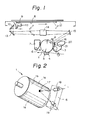
- a charging charger 2 a developing device 3, a blank lamp 16, a transfer charger 4, a separating charger 5, a reflection type sensor 6 for detecting the toner concentration and a cleaner 7 are arranged in this order around a photosensitive drum 1.
- Referential numeral 8 represents a contact glass for supporting an original, and an imitation original 9 is attached to the contact glass 8 at a predetermined position located on the home position side apart from the exposure zone.
- An optical system comprising a light source 10, reflecing mirros 11, 12 and 13, a lens 14 and a reflecting mirror 15 is arranged between the contact glass 8 and the photosensitive drum 1.
- the original supported on the contact glass 8 is exposed to light and is guided to the surface of the photosensitive drum 1.
- the photosensitive drum 1 is rotated in one direction, and with rotation of the photosensitive drum 1, charging by the charging charger 2, formation of an electrostatic latent image by irradiation with reflected light from the original through the above-mentioned optical system, development of the latent image with a two-component type developer by the developing device 3, transfer of the toner image to a copy sheet by the transfer charger 4, peeling of the copy sheet by the separating charger 5, detection of the density of the toner image by the reflection type sensor 6 and recovery of the residual toner by the cleaner 7 are carried out.
- an electrostatic latent image corresponding to the imitation original 9 is formed on the photosensitive drum 1, and by controlling lighting of the blank lamp 16, the latent image can be visualized to a toner image only once at a predetermined number of the operations.
- the photosensitive drum 1 has a copied image-forming portion 1a and a blank portion 1b not used for the reproduction of the original, and a toner image 17 corresponding to the above-mentioned imitation original 9 is formed on this blank portion 1b.
- the reflection type sensor 6 comprises an infrared ray-emitting luminescent element (luminescent diode) 18 and a light-receiving element (phototransistor) 19 for receiving reflected light through the toner image 17, and by the combination of these elements, the toner density of the toner image 17 corresponding to the imitation original 9 is detected as an electric signal.
- the developing device 3 comprises a toner supply tank 20 and a toner supply roller 21, and by performing on-off control of the toner supply roller 21 based on the above-mentioned detection signal, the toner concentration in the developer is controlled so that the image density of the toner iamge is maintained within a certain range.
- the toner concentration can be maintained at an optimum value by using an electroscopic toner containing, as the coloring pigment, carbon black having a coloring power (DIN 53234) of 100 to 120.
- the coloring power referred to in the instant specification and appended claims is a characteristic value determined by mixing a certain amount of carbon black into a certain amount of stipulated zinc flower and measuring reflected light, and a larger value of the coloring power is obtained when the blackness is low.
- the reason why the coloring power of carbon black is restricted to 10 to 120 in the present invention is as follows.
- the image density of the toner image on the drum is detected as a smaller value, with the result that the toner is excessively supplied into the developer, the toner concentration in the developer becomes too high from the viewpoint of the electroscopic characteristics and scattering of the toner is increased.
- a toner comprising carbon black having a coloring power larger than 120 is used, the image density of the toner image on the drum is detected as a larger value, with the result that the toner is not sufficiently supplied into the developer, the toner concentration in the developer becomes too low from the viewpoint of the electric characteristics of the entire developer and troubles such as tailing are caused.
- the present invention by selecting and using carbon black having a coloring power of 100 to 120 as the carbon black to be incorporated into the toner, a strict correspondence relation between the detected image density and the actual image density of the toner image can be established and the toner concentration in the developer can be strictly set relatively to the image denisty of the toner image. Accordingly, the image density of the toner image can always be maintained at a certain level while preventing scattering of the toner or tailing in the image.
- the toner used in the present invention can be obtained according to the known recipe by the known preparation process except that carbon black having a coloring power of 100 to 120 is used.
- Carbon blacks of this type are available under the tradenames of High Color Channel (HCC), Medium Color Channel (MCC), Regular Color Channel (RCC), Medium Color Furnace (MCF) and Regular Color Furnace (RCF).
- High Color Furnace (HCF) has a coloring power exceeding the range specified in the present invention and Low Color Furnace (LCF) has a coloring power smaller than the range specified in the present invention, and these carbon blacks are not suitable for attaining the object of the present invention.
- thermoplastic resins there can be used thermoplastic resins, and uncured thermosetting resins and precondensates of thermosetting resins.
- thermosetting resins there can be mentioned a vinyl aromatic resin, an acrylic resin, a polyvinyl acetal resin, a polyester resin, an epoxy resin, a phenolic resin, a petroleum resin and an olefin resin in an order of the importance.
- the amount incorporated of carbon black in the toner be 4 to 15% by weight, especially 6 to 10% by weight, based on the toner.
- a charge controlling agent there can be used oil-soluble dyes such as Nigrosine Base (CI 5045), Oil Black (CI 26150) and Spiron Black, and metal salts of naphthenic acid, metal soaps of fatty acids, resin soaps and metalcontaining azo dyes.
- parting agents such as a low-molecular-weight polypropylene resin and a silicone oil are added to prevent occurrence of the offset phenomenon at the hot roll fixing step.
- silane-treated gas-phase method silica or the like can be applied to the surfaces of the toner particles to improve the flowability of the toner particles.
- the particle size of the toner particles by 5 to 25 ⁇ m, especially 8 to 20 ⁇ m.
- the electric resistance of the toner particles be 1 x 10¹³ to 5 x 10¹⁵ ⁇ -cm.
- the magnetic carrier there can be mentioned an iron powder carrier of a sperical or indeterminate (irregular) shape and a ferrite carrier of a spherical shape.
- a magnetic carrier having a coating layer of an acrylic resin or fluorine resin can be used.
- the mixing ratio between the magnetic toner and the toner is adjusted so that the image density of the toner image corresponding to the imitation original is within a certain range, as pointed out hereinbefore.
- Various standards can be adopted for setting this image density.
- the electric resistance between the sleeve of the developing magnetic brush and the phososensitive drum is used as the standard. More specifically, if this electric resistance of the magnetic brush of the developer (a voltage of 200 V is applied) is lower than 2.0 x 10⁸ ⁇ , tailing is caused, and if this electric resistance is higher than 4.0 x 10⁸ ⁇ ,scattering of the toner is easily caused. Accordingly, the toner concentration in the developer can be set based on the image density of a toner image formed by a developer having an electric resistance within the above-mentioned range of 2.0 x 10⁸ to 4.0 x 10⁸ ⁇ .
- the optimum toner concentration (Ct) in the developer can be represented by the following formula: wherein Sc stands for the specific surface area (cm2/g) of the magnetic carrier, St stands for the specific surface area (cm2/g) of the toner, and k is a number of from 0.8 to 1.2, the toner concentration can be set based on the image density obtained at this toner concentration.
- the above-mentioned materials were pre-mixed for 15 minutes by a Henschel mixer and heat-kneaded by a biaxial extruder to obtain a toner.
- a developer having a toner concentration of 5% by weight was prepared from this toner and an acrylic resin-coated carrier.
- the image test was carried out by using the soobtained developer in an electrophotographic copying machine (Mita DC-513Z). Either at the initial stage or after 50,000 prints had been obtained, tailing was not observed in the formed image. In any of 50,000 prints, influences of scattering of the toner on the formed prints were not observed. After 50,000 prints had been obtained, the toner concentration in the developer was 3.2% by weight.
- a toner was prepared in the same manner as described in Example 1 except that Printex 45 having a coloring power (DIN 53234) of 117 was used instead of Printex L, and a developer having the same toner concentration (5% by weight) as in Example 1 was prepared.
- Printex 45 having a coloring power (DIN 53234) of 117 was used instead of Printex L, and a developer having the same toner concentration (5% by weight) as in Example 1 was prepared.
- the image test was carried out in DC-513Z in the same manner as described in Example 1. Either at the initial stage or after 50,000 prints had been obtained, an image free of tailing was obtained as in Example 1. Moreover, influence of scattering of the toner were not obtained in 50,000 prints as in Example 1. After 50,000 prints had been obtained, the toner concentration in the developer was 2.5% by weight.
- a toner was prepared in the same manner as described in Example 1 except that Printex 25 having a coloring power (DIN 53234) of 88 was used instead of Printex L, and a developer having the same toner concentration (5% by weight) as in Example 1 was prepared.
- Printex 25 having a coloring power (DIN 53234) of 88 was used instead of Printex L, and a developer having the same toner concentration (5% by weight) as in Example 1 was prepared.
- the image test was carried out in DC-513Z in the same manner as described in Example 1. Either at the initial stage or after 50,000 prints had been obtained, an image free of tailing was obtained. However, contamination of the image by scattering of the toner was observed after 50,000 prints had been obtained. After 50,000 prints had been obtained, the toner, concentration in the developer was 4.6% by weight.
- a toner was prepared in the same manner as described in Example 1 except that Printex 80 having a coloring power (DIN 53234) of 125 was prepared instead of Printex L, and a developer having the same toner concentration (5% by weight) as in Example 1 was prepared.
- the image test was carried out in DC-513Z in the same manner as described in Example 1. An image free of tailing was obtained at the initial stage, but after 50,000 prints had been obtained, tailing was caused in the formed image. After 50,000 prints had been obtained, the toner concentration in the developer was 2.0% by weight.
Landscapes
- Physics & Mathematics (AREA)
- General Physics & Mathematics (AREA)
- Chemical & Material Sciences (AREA)
- Inorganic Chemistry (AREA)
- Developing Agents For Electrophotography (AREA)
- Dry Development In Electrophotography (AREA)
Applications Claiming Priority (2)
| Application Number | Priority Date | Filing Date | Title |
|---|---|---|---|
| JP61229981A JPS6385650A (ja) | 1986-09-30 | 1986-09-30 | 電子写真法における現像方法 |
| JP229981/86 | 1986-09-30 |
Publications (3)
| Publication Number | Publication Date |
|---|---|
| EP0262902A2 true EP0262902A2 (fr) | 1988-04-06 |
| EP0262902A3 EP0262902A3 (en) | 1989-12-27 |
| EP0262902B1 EP0262902B1 (fr) | 1993-06-09 |
Family
ID=16900728
Family Applications (1)
| Application Number | Title | Priority Date | Filing Date |
|---|---|---|---|
| EP87308569A Expired - Lifetime EP0262902B1 (fr) | 1986-09-30 | 1987-09-28 | Procédé de développement pour l'électrophotographie |
Country Status (4)
| Country | Link |
|---|---|
| US (1) | US4826750A (fr) |
| EP (1) | EP0262902B1 (fr) |
| JP (1) | JPS6385650A (fr) |
| DE (1) | DE3786135T2 (fr) |
Families Citing this family (1)
| Publication number | Priority date | Publication date | Assignee | Title |
|---|---|---|---|---|
| JPH0459455U (fr) * | 1990-09-28 | 1992-05-21 |
Family Cites Families (11)
| Publication number | Priority date | Publication date | Assignee | Title |
|---|---|---|---|---|
| CA1035988A (fr) * | 1973-11-02 | 1978-08-08 | Robert Mermelstein | Toner a base de suie |
| US3916064A (en) * | 1974-01-21 | 1975-10-28 | Xerox Corp | Developer material |
| JPS5461938A (en) * | 1977-10-27 | 1979-05-18 | Konishiroku Photo Ind Co Ltd | Copy concentration controller/paper clogging detector |
| JPS5497038A (en) * | 1978-01-17 | 1979-07-31 | Konishiroku Photo Ind Co Ltd | Image density controller for zerographic copier |
| JPS57495A (en) * | 1980-06-03 | 1982-01-05 | Sumitomo Electric Ind Ltd | Manufacture of heat exchanger |
| DE3149908A1 (de) * | 1980-12-19 | 1982-09-02 | Minolta Camera K.K., Osaka | Verfahren zum steuern der tonerkonzentration fuer elektrofotografische kopiergeraete |
| JPS59826A (ja) * | 1982-06-25 | 1984-01-06 | 株式会社東芝 | 真空バルブ |
| JPS5990857A (ja) * | 1982-11-16 | 1984-05-25 | Konishiroku Photo Ind Co Ltd | 二成分系現像剤用正帯電性トナ− |
| US4513074A (en) * | 1983-06-06 | 1985-04-23 | Xerox Corporation | Stable conductive developer compositions |
| JPS6010617A (ja) * | 1983-06-30 | 1985-01-19 | Canon Inc | プラズマcvd装置における基体加熱方法 |
| JPS59218463A (ja) * | 1984-05-08 | 1984-12-08 | Konishiroku Photo Ind Co Ltd | 静電荷像現像剤 |
-
1986
- 1986-09-30 JP JP61229981A patent/JPS6385650A/ja active Pending
-
1987
- 1987-09-28 DE DE8787308569T patent/DE3786135T2/de not_active Expired - Fee Related
- 1987-09-28 EP EP87308569A patent/EP0262902B1/fr not_active Expired - Lifetime
- 1987-09-30 US US07/102,679 patent/US4826750A/en not_active Expired - Lifetime
Also Published As
| Publication number | Publication date |
|---|---|
| JPS6385650A (ja) | 1988-04-16 |
| EP0262902B1 (fr) | 1993-06-09 |
| EP0262902A3 (en) | 1989-12-27 |
| DE3786135T2 (de) | 1993-09-16 |
| DE3786135D1 (de) | 1993-07-15 |
| US4826750A (en) | 1989-05-02 |
Similar Documents
| Publication | Publication Date | Title |
|---|---|---|
| US5194356A (en) | Toner compositions | |
| US5256507A (en) | Method of fusing electrostatographic toners to provide differential gloss | |
| US5258256A (en) | Method of fusing electrostatographic toners to provide enhanced gloss | |
| US4949127A (en) | Magnetic brush development process | |
| US4609603A (en) | Process for achieving consistent high quality images with magnetic developer composition | |
| US4788123A (en) | Process for minimizing image de-enhancement in flash fusing systems | |
| EP0154433B1 (fr) | Méthode de développement des images électrostatiques | |
| EP0262902B1 (fr) | Procédé de développement pour l'électrophotographie | |
| EP0371734B1 (fr) | Procédé de développement à brosse magnétique | |
| US4324851A (en) | Positive color toners | |
| US4695524A (en) | Process for ultra high quality images with magnetic developer composition | |
| GB2195790A (en) | Electrophotographic reproduction | |
| JPH0830909B2 (ja) | 静電荷像現像用トナー | |
| US4789615A (en) | Toner compositions with nicotinate charge enhancing additives | |
| EP0414442A1 (fr) | Développateur et son procédé de préparation | |
| JP3233220B2 (ja) | 像形成方法 | |
| US5139916A (en) | Processes for the preparation of toner compositions | |
| US4737434A (en) | Process for colored toners with selected triboelectric characteristics | |
| EP0371737B1 (fr) | Procédé de développement pour la formation d'images à haute qualité | |
| EP0367265B1 (fr) | Développateur sec électrophotographique | |
| JPH05197206A (ja) | 改良されたトナーおよび2色像の形成方法 | |
| JP3148942B2 (ja) | カラー画像形成方法 | |
| EP0253560B1 (fr) | Méthode de copiage électrophotographique et papier isolant pour l'utilisation dans cette méthode | |
| US4480023A (en) | Radiant assist pressure fixing process with polyamide toner compositions | |
| EP0429294B1 (fr) | Toneur pour le développement à pleine couleur |
Legal Events
| Date | Code | Title | Description |
|---|---|---|---|
| PUAI | Public reference made under article 153(3) epc to a published international application that has entered the european phase |
Free format text: ORIGINAL CODE: 0009012 |
|
| AK | Designated contracting states |
Kind code of ref document: A2 Designated state(s): DE FR GB IT NL |
|
| PUAL | Search report despatched |
Free format text: ORIGINAL CODE: 0009013 |
|
| AK | Designated contracting states |
Kind code of ref document: A3 Designated state(s): DE FR GB IT NL |
|
| 17P | Request for examination filed |
Effective date: 19900530 |
|
| 17Q | First examination report despatched |
Effective date: 19920213 |
|
| GRAA | (expected) grant |
Free format text: ORIGINAL CODE: 0009210 |
|
| AK | Designated contracting states |
Kind code of ref document: B1 Designated state(s): DE FR GB IT NL |
|
| ET | Fr: translation filed | ||
| REF | Corresponds to: |
Ref document number: 3786135 Country of ref document: DE Date of ref document: 19930715 |
|
| ITF | It: translation for a ep patent filed | ||
| PLBE | No opposition filed within time limit |
Free format text: ORIGINAL CODE: 0009261 |
|
| STAA | Information on the status of an ep patent application or granted ep patent |
Free format text: STATUS: NO OPPOSITION FILED WITHIN TIME LIMIT |
|
| 26N | No opposition filed | ||
| PGFP | Annual fee paid to national office [announced via postgrant information from national office to epo] |
Ref country code: FR Payment date: 19970909 Year of fee payment: 11 |
|
| PGFP | Annual fee paid to national office [announced via postgrant information from national office to epo] |
Ref country code: GB Payment date: 19970919 Year of fee payment: 11 |
|
| PGFP | Annual fee paid to national office [announced via postgrant information from national office to epo] |
Ref country code: NL Payment date: 19970929 Year of fee payment: 11 |
|
| PGFP | Annual fee paid to national office [announced via postgrant information from national office to epo] |
Ref country code: DE Payment date: 19971010 Year of fee payment: 11 |
|
| PG25 | Lapsed in a contracting state [announced via postgrant information from national office to epo] |
Ref country code: GB Free format text: LAPSE BECAUSE OF NON-PAYMENT OF DUE FEES Effective date: 19980928 |
|
| PG25 | Lapsed in a contracting state [announced via postgrant information from national office to epo] |
Ref country code: NL Free format text: LAPSE BECAUSE OF NON-PAYMENT OF DUE FEES Effective date: 19990401 |
|
| GBPC | Gb: european patent ceased through non-payment of renewal fee |
Effective date: 19980928 |
|
| PG25 | Lapsed in a contracting state [announced via postgrant information from national office to epo] |
Ref country code: FR Free format text: LAPSE BECAUSE OF NON-PAYMENT OF DUE FEES Effective date: 19990531 |
|
| NLV4 | Nl: lapsed or anulled due to non-payment of the annual fee |
Effective date: 19990401 |
|
| PG25 | Lapsed in a contracting state [announced via postgrant information from national office to epo] |
Ref country code: DE Free format text: LAPSE BECAUSE OF NON-PAYMENT OF DUE FEES Effective date: 19990701 |
|
| REG | Reference to a national code |
Ref country code: FR Ref legal event code: ST |
|
| PG25 | Lapsed in a contracting state [announced via postgrant information from national office to epo] |
Ref country code: IT Free format text: LAPSE BECAUSE OF NON-PAYMENT OF DUE FEES;WARNING: LAPSES OF ITALIAN PATENTS WITH EFFECTIVE DATE BEFORE 2007 MAY HAVE OCCURRED AT ANY TIME BEFORE 2007. THE CORRECT EFFECTIVE DATE MAY BE DIFFERENT FROM THE ONE RECORDED. Effective date: 20050928 |