EP0262496A2 - Verfahren zur Herstellung von Pigmentpasten für wasserverdünnbare Lacke für die Elektrotauchlackierung. - Google Patents
Verfahren zur Herstellung von Pigmentpasten für wasserverdünnbare Lacke für die Elektrotauchlackierung. Download PDFInfo
- Publication number
- EP0262496A2 EP0262496A2 EP87113364A EP87113364A EP0262496A2 EP 0262496 A2 EP0262496 A2 EP 0262496A2 EP 87113364 A EP87113364 A EP 87113364A EP 87113364 A EP87113364 A EP 87113364A EP 0262496 A2 EP0262496 A2 EP 0262496A2
- Authority
- EP
- European Patent Office
- Prior art keywords
- water
- parts
- pigment
- component
- pigment pastes
- Prior art date
- Legal status (The legal status is an assumption and is not a legal conclusion. Google has not performed a legal analysis and makes no representation as to the accuracy of the status listed.)
- Ceased
Links
- 239000000049 pigment Substances 0.000 title claims abstract description 41
- 238000004519 manufacturing process Methods 0.000 title description 4
- 239000002966 varnish Substances 0.000 title 1
- 229920005989 resin Polymers 0.000 claims abstract description 26
- 239000011347 resin Substances 0.000 claims abstract description 26
- 239000011230 binding agent Substances 0.000 claims abstract description 25
- XLYOFNOQVPJJNP-UHFFFAOYSA-N water Substances O XLYOFNOQVPJJNP-UHFFFAOYSA-N 0.000 claims abstract description 20
- 238000000034 method Methods 0.000 claims abstract description 16
- 239000000654 additive Substances 0.000 claims abstract description 15
- 238000004070 electrodeposition Methods 0.000 claims abstract description 9
- 239000003054 catalyst Substances 0.000 claims abstract description 8
- 238000000576 coating method Methods 0.000 claims description 14
- 239000011248 coating agent Substances 0.000 claims description 13
- 239000003973 paint Substances 0.000 claims description 13
- 239000000463 material Substances 0.000 claims description 12
- 238000000227 grinding Methods 0.000 claims description 10
- 238000006386 neutralization reaction Methods 0.000 claims description 7
- 239000002904 solvent Substances 0.000 claims description 3
- 238000002360 preparation method Methods 0.000 claims description 2
- 239000004922 lacquer Substances 0.000 abstract description 11
- 238000003860 storage Methods 0.000 abstract description 2
- 238000006243 chemical reaction Methods 0.000 description 15
- IISBACLAFKSPIT-UHFFFAOYSA-N bisphenol A Chemical compound C=1C=C(O)C=CC=1C(C)(C)C1=CC=C(O)C=C1 IISBACLAFKSPIT-UHFFFAOYSA-N 0.000 description 12
- 239000007787 solid Substances 0.000 description 12
- 239000004593 Epoxy Substances 0.000 description 10
- BDAGIHXWWSANSR-UHFFFAOYSA-N methanoic acid Natural products OC=O BDAGIHXWWSANSR-UHFFFAOYSA-N 0.000 description 10
- 239000000203 mixture Substances 0.000 description 9
- 239000002253 acid Substances 0.000 description 8
- YXFVVABEGXRONW-UHFFFAOYSA-N Toluene Chemical compound CC1=CC=CC=C1 YXFVVABEGXRONW-UHFFFAOYSA-N 0.000 description 6
- 239000006185 dispersion Substances 0.000 description 6
- QOHMWDJIBGVPIF-UHFFFAOYSA-N n',n'-diethylpropane-1,3-diamine Chemical compound CCN(CC)CCCN QOHMWDJIBGVPIF-UHFFFAOYSA-N 0.000 description 6
- OSWFIVFLDKOXQC-UHFFFAOYSA-N 4-(3-methoxyphenyl)aniline Chemical compound COC1=CC=CC(C=2C=CC(N)=CC=2)=C1 OSWFIVFLDKOXQC-UHFFFAOYSA-N 0.000 description 5
- 239000008367 deionised water Substances 0.000 description 5
- 229910021641 deionized water Inorganic materials 0.000 description 5
- 239000003822 epoxy resin Substances 0.000 description 5
- 235000019253 formic acid Nutrition 0.000 description 5
- 229920000647 polyepoxide Polymers 0.000 description 5
- YIWUKEYIRIRTPP-UHFFFAOYSA-N 2-ethylhexan-1-ol Chemical compound CCCCC(CC)CO YIWUKEYIRIRTPP-UHFFFAOYSA-N 0.000 description 4
- WYNCHZVNFNFDNH-UHFFFAOYSA-N Oxazolidine Chemical compound C1COCN1 WYNCHZVNFNFDNH-UHFFFAOYSA-N 0.000 description 4
- 150000001412 amines Chemical class 0.000 description 4
- 230000000052 comparative effect Effects 0.000 description 4
- 238000001816 cooling Methods 0.000 description 4
- 239000002184 metal Substances 0.000 description 4
- 229910052751 metal Inorganic materials 0.000 description 4
- 238000012360 testing method Methods 0.000 description 4
- WSFSSNUMVMOOMR-UHFFFAOYSA-N Formaldehyde Chemical compound O=C WSFSSNUMVMOOMR-UHFFFAOYSA-N 0.000 description 3
- 239000005062 Polybutadiene Substances 0.000 description 3
- 125000001931 aliphatic group Chemical group 0.000 description 3
- 238000009835 boiling Methods 0.000 description 3
- 239000007795 chemical reaction product Substances 0.000 description 3
- JGFBRKRYDCGYKD-UHFFFAOYSA-N dibutyl(oxo)tin Chemical compound CCCC[Sn](=O)CCCC JGFBRKRYDCGYKD-UHFFFAOYSA-N 0.000 description 3
- 239000003921 oil Substances 0.000 description 3
- 229920002857 polybutadiene Polymers 0.000 description 3
- 238000004062 sedimentation Methods 0.000 description 3
- 238000003756 stirring Methods 0.000 description 3
- KFYRJJBUHYILSO-YFKPBYRVSA-N (2s)-2-amino-3-dimethylarsanylsulfanyl-3-methylbutanoic acid Chemical compound C[As](C)SC(C)(C)[C@@H](N)C(O)=O KFYRJJBUHYILSO-YFKPBYRVSA-N 0.000 description 2
- DAFHKNAQFPVRKR-UHFFFAOYSA-N (3-hydroxy-2,2,4-trimethylpentyl) 2-methylpropanoate Chemical compound CC(C)C(O)C(C)(C)COC(=O)C(C)C DAFHKNAQFPVRKR-UHFFFAOYSA-N 0.000 description 2
- MMEDJBFVJUFIDD-UHFFFAOYSA-N 2-[2-(carboxymethyl)phenyl]acetic acid Chemical compound OC(=O)CC1=CC=CC=C1CC(O)=O MMEDJBFVJUFIDD-UHFFFAOYSA-N 0.000 description 2
- POAOYUHQDCAZBD-UHFFFAOYSA-N 2-butoxyethanol Chemical compound CCCCOCCO POAOYUHQDCAZBD-UHFFFAOYSA-N 0.000 description 2
- QIGBRXMKCJKVMJ-UHFFFAOYSA-N Hydroquinone Chemical compound OC1=CC=C(O)C=C1 QIGBRXMKCJKVMJ-UHFFFAOYSA-N 0.000 description 2
- 241000357437 Mola Species 0.000 description 2
- 229910000831 Steel Inorganic materials 0.000 description 2
- UKLDJPRMSDWDSL-UHFFFAOYSA-L [dibutyl(dodecanoyloxy)stannyl] dodecanoate Chemical compound CCCCCCCCCCCC(=O)O[Sn](CCCC)(CCCC)OC(=O)CCCCCCCCCCC UKLDJPRMSDWDSL-UHFFFAOYSA-L 0.000 description 2
- 230000000996 additive effect Effects 0.000 description 2
- 238000013459 approach Methods 0.000 description 2
- 239000012736 aqueous medium Substances 0.000 description 2
- 238000010533 azeotropic distillation Methods 0.000 description 2
- 239000003795 chemical substances by application Substances 0.000 description 2
- 150000001875 compounds Chemical class 0.000 description 2
- 238000004132 cross linking Methods 0.000 description 2
- 238000000151 deposition Methods 0.000 description 2
- 230000008021 deposition Effects 0.000 description 2
- 239000012975 dibutyltin dilaurate Substances 0.000 description 2
- 238000009826 distribution Methods 0.000 description 2
- 230000000694 effects Effects 0.000 description 2
- 230000002349 favourable effect Effects 0.000 description 2
- 238000010348 incorporation Methods 0.000 description 2
- 239000003112 inhibitor Substances 0.000 description 2
- VQPKAMAVKYTPLB-UHFFFAOYSA-N lead;octanoic acid Chemical compound [Pb].CCCCCCCC(O)=O VQPKAMAVKYTPLB-UHFFFAOYSA-N 0.000 description 2
- 239000000693 micelle Substances 0.000 description 2
- 230000003472 neutralizing effect Effects 0.000 description 2
- 150000002917 oxazolidines Chemical class 0.000 description 2
- 229920001451 polypropylene glycol Polymers 0.000 description 2
- 238000012545 processing Methods 0.000 description 2
- 239000000047 product Substances 0.000 description 2
- 239000010959 steel Substances 0.000 description 2
- VZXPHDGHQXLXJC-UHFFFAOYSA-N 1,6-diisocyanato-5,6-dimethylheptane Chemical compound O=C=NC(C)(C)C(C)CCCCN=C=O VZXPHDGHQXLXJC-UHFFFAOYSA-N 0.000 description 1
- LHENQXAPVKABON-UHFFFAOYSA-N 1-methoxypropan-1-ol Chemical compound CCC(O)OC LHENQXAPVKABON-UHFFFAOYSA-N 0.000 description 1
- SMZOUWXMTYCWNB-UHFFFAOYSA-N 2-(2-methoxy-5-methylphenyl)ethanamine Chemical compound COC1=CC=C(C)C=C1CCN SMZOUWXMTYCWNB-UHFFFAOYSA-N 0.000 description 1
- HZAXFHJVJLSVMW-UHFFFAOYSA-N 2-Aminoethan-1-ol Chemical compound NCCO HZAXFHJVJLSVMW-UHFFFAOYSA-N 0.000 description 1
- NIXOWILDQLNWCW-UHFFFAOYSA-N 2-Propenoic acid Natural products OC(=O)C=C NIXOWILDQLNWCW-UHFFFAOYSA-N 0.000 description 1
- ZNQVEEAIQZEUHB-UHFFFAOYSA-N 2-ethoxyethanol Chemical compound CCOCCO ZNQVEEAIQZEUHB-UHFFFAOYSA-N 0.000 description 1
- SVONRAPFKPVNKG-UHFFFAOYSA-N 2-ethoxyethyl acetate Chemical compound CCOCCOC(C)=O SVONRAPFKPVNKG-UHFFFAOYSA-N 0.000 description 1
- LTHNHFOGQMKPOV-UHFFFAOYSA-N 2-ethylhexan-1-amine Chemical compound CCCCC(CC)CN LTHNHFOGQMKPOV-UHFFFAOYSA-N 0.000 description 1
- ZCYVEMRRCGMTRW-UHFFFAOYSA-N 7553-56-2 Chemical compound [I] ZCYVEMRRCGMTRW-UHFFFAOYSA-N 0.000 description 1
- NLZUEZXRPGMBCV-UHFFFAOYSA-N Butylhydroxytoluene Chemical compound CC1=CC(C(C)(C)C)=C(O)C(C(C)(C)C)=C1 NLZUEZXRPGMBCV-UHFFFAOYSA-N 0.000 description 1
- 239000004215 Carbon black (E152) Substances 0.000 description 1
- AVXURJPOCDRRFD-UHFFFAOYSA-N Hydroxylamine Chemical compound ON AVXURJPOCDRRFD-UHFFFAOYSA-N 0.000 description 1
- NTIZESTWPVYFNL-UHFFFAOYSA-N Methyl isobutyl ketone Chemical compound CC(C)CC(C)=O NTIZESTWPVYFNL-UHFFFAOYSA-N 0.000 description 1
- UIHCLUNTQKBZGK-UHFFFAOYSA-N Methyl isobutyl ketone Natural products CCC(C)C(C)=O UIHCLUNTQKBZGK-UHFFFAOYSA-N 0.000 description 1
- UTGQNNCQYDRXCH-UHFFFAOYSA-N N,N'-diphenyl-1,4-phenylenediamine Chemical compound C=1C=C(NC=2C=CC=CC=2)C=CC=1NC1=CC=CC=C1 UTGQNNCQYDRXCH-UHFFFAOYSA-N 0.000 description 1
- 229920002292 Nylon 6 Polymers 0.000 description 1
- 229930040373 Paraformaldehyde Natural products 0.000 description 1
- LGRFSURHDFAFJT-UHFFFAOYSA-N Phthalic anhydride Natural products C1=CC=C2C(=O)OC(=O)C2=C1 LGRFSURHDFAFJT-UHFFFAOYSA-N 0.000 description 1
- ATJFFYVFTNAWJD-UHFFFAOYSA-N Tin Chemical compound [Sn] ATJFFYVFTNAWJD-UHFFFAOYSA-N 0.000 description 1
- 238000010521 absorption reaction Methods 0.000 description 1
- -1 acetylene alcohol Chemical compound 0.000 description 1
- 239000002318 adhesion promoter Substances 0.000 description 1
- 150000001338 aliphatic hydrocarbons Chemical class 0.000 description 1
- HSFWRNGVRCDJHI-UHFFFAOYSA-N alpha-acetylene Natural products C#C HSFWRNGVRCDJHI-UHFFFAOYSA-N 0.000 description 1
- 150000004945 aromatic hydrocarbons Chemical class 0.000 description 1
- 230000015572 biosynthetic process Effects 0.000 description 1
- JHIWVOJDXOSYLW-UHFFFAOYSA-N butyl 2,2-difluorocyclopropane-1-carboxylate Chemical compound CCCCOC(=O)C1CC1(F)F JHIWVOJDXOSYLW-UHFFFAOYSA-N 0.000 description 1
- 125000003178 carboxy group Chemical group [H]OC(*)=O 0.000 description 1
- 150000001735 carboxylic acids Chemical class 0.000 description 1
- 238000004040 coloring Methods 0.000 description 1
- 230000006735 deficit Effects 0.000 description 1
- 238000000502 dialysis Methods 0.000 description 1
- ZBCBWPMODOFKDW-UHFFFAOYSA-N diethanolamine Chemical compound OCCNCCO ZBCBWPMODOFKDW-UHFFFAOYSA-N 0.000 description 1
- SBZXBUIDTXKZTM-UHFFFAOYSA-N diglyme Chemical compound COCCOCCOC SBZXBUIDTXKZTM-UHFFFAOYSA-N 0.000 description 1
- 238000001035 drying Methods 0.000 description 1
- 238000001962 electrophoresis Methods 0.000 description 1
- 125000003700 epoxy group Chemical group 0.000 description 1
- 238000009472 formulation Methods 0.000 description 1
- 125000003055 glycidyl group Chemical group C(C1CO1)* 0.000 description 1
- 239000008240 homogeneous mixture Substances 0.000 description 1
- 238000000265 homogenisation Methods 0.000 description 1
- 229930195733 hydrocarbon Natural products 0.000 description 1
- 150000002430 hydrocarbons Chemical class 0.000 description 1
- 229910052500 inorganic mineral Inorganic materials 0.000 description 1
- 239000011630 iodine Substances 0.000 description 1
- 229910052740 iodine Inorganic materials 0.000 description 1
- IQPQWNKOIGAROB-UHFFFAOYSA-N isocyanate group Chemical group [N-]=C=O IQPQWNKOIGAROB-UHFFFAOYSA-N 0.000 description 1
- 239000010410 layer Substances 0.000 description 1
- 239000007788 liquid Substances 0.000 description 1
- FPYJFEHAWHCUMM-UHFFFAOYSA-N maleic anhydride Chemical compound O=C1OC(=O)C=C1 FPYJFEHAWHCUMM-UHFFFAOYSA-N 0.000 description 1
- 239000011707 mineral Substances 0.000 description 1
- 238000002156 mixing Methods 0.000 description 1
- SWVGZFQJXVPIKM-UHFFFAOYSA-N n,n-bis(methylamino)propan-1-amine Chemical compound CCCN(NC)NC SWVGZFQJXVPIKM-UHFFFAOYSA-N 0.000 description 1
- 239000003960 organic solvent Substances 0.000 description 1
- 229920002866 paraformaldehyde Polymers 0.000 description 1
- 230000005588 protonation Effects 0.000 description 1
- 238000010992 reflux Methods 0.000 description 1
- 238000006798 ring closing metathesis reaction Methods 0.000 description 1
- 150000003839 salts Chemical class 0.000 description 1
- 239000004576 sand Substances 0.000 description 1
- 239000002356 single layer Substances 0.000 description 1
- 235000015096 spirit Nutrition 0.000 description 1
- 239000007921 spray Substances 0.000 description 1
- 239000000758 substrate Substances 0.000 description 1
- 239000003760 tallow Substances 0.000 description 1
- DVKJHBMWWAPEIU-UHFFFAOYSA-N toluene 2,4-diisocyanate Chemical compound CC1=CC=C(N=C=O)C=C1N=C=O DVKJHBMWWAPEIU-UHFFFAOYSA-N 0.000 description 1
- 238000007056 transamidation reaction Methods 0.000 description 1
- 238000005809 transesterification reaction Methods 0.000 description 1
- 229920002554 vinyl polymer Polymers 0.000 description 1
- 239000000080 wetting agent Substances 0.000 description 1
Classifications
-
- C—CHEMISTRY; METALLURGY
- C09—DYES; PAINTS; POLISHES; NATURAL RESINS; ADHESIVES; COMPOSITIONS NOT OTHERWISE PROVIDED FOR; APPLICATIONS OF MATERIALS NOT OTHERWISE PROVIDED FOR
- C09D—COATING COMPOSITIONS, e.g. PAINTS, VARNISHES OR LACQUERS; FILLING PASTES; CHEMICAL PAINT OR INK REMOVERS; INKS; CORRECTING FLUIDS; WOODSTAINS; PASTES OR SOLIDS FOR COLOURING OR PRINTING; USE OF MATERIALS THEREFOR
- C09D5/00—Coating compositions, e.g. paints, varnishes or lacquers, characterised by their physical nature or the effects produced; Filling pastes
- C09D5/44—Coating compositions, e.g. paints, varnishes or lacquers, characterised by their physical nature or the effects produced; Filling pastes for electrophoretic applications
-
- C—CHEMISTRY; METALLURGY
- C09—DYES; PAINTS; POLISHES; NATURAL RESINS; ADHESIVES; COMPOSITIONS NOT OTHERWISE PROVIDED FOR; APPLICATIONS OF MATERIALS NOT OTHERWISE PROVIDED FOR
- C09D—COATING COMPOSITIONS, e.g. PAINTS, VARNISHES OR LACQUERS; FILLING PASTES; CHEMICAL PAINT OR INK REMOVERS; INKS; CORRECTING FLUIDS; WOODSTAINS; PASTES OR SOLIDS FOR COLOURING OR PRINTING; USE OF MATERIALS THEREFOR
- C09D17/00—Pigment pastes, e.g. for mixing in paints
Definitions
- the invention relates to pigment pastes for water-thinnable lacquers, in particular for the two-component subsequent process in electrocoating.
- the coloring material in the aqueous medium is deposited on the substrate as a high-solids coating and removed from the bath with the painted object. In order to avoid depletion of the bath material, the corresponding material must be returned to the bath. This can - as has been the case for a long time.
- aqueous pigment pastes with clear lacquer dispersions are described, inter alia, in US Pat. Nos. 4,035,275, 4,081,343 or 4,186,124.
- DE 30 40 419 an aqueous catalyst paste is also used as a further component. This is a grinding of dibutyltin oxide in the resin used to grind the pigments.
- materials introduced with the pigment component such as crosslinking catalysts, leveling agents or defoamers etc., which are intended to be effective in combination with the main binder, are insufficiently brought up to the resin micelles of the main binder.
- the present invention accordingly relates to a process for the production of pigment pastes for water-dilutable paints, in particular for the two-component post-coating process in electrocoating with catalyzed paint systems, which is characterized in that all or part of the pigment paste resin (A) used for the paint system the necessary catalysts and / or other additives (C) and part of the main binder (B) used for the coating system, before or after grinding with the pigments (D) or before or after the partial or complete neutralization of the salt-forming groups, homogeneously interferes.
- the invention further relates to the pigment pastes produced by this process and to their use in electrocoat materials, in particular in cathodically depositable electrocoat materials.
- the additives are mixed into the resin components which have not yet been diluted with water and that the resin components are also mixed before they are substantially diluted with water.
- the main binder component which has already been largely diluted with water for the addition contains insufficiently water-compatible additives.
- Typical binders of this type are e.g. B. in European patent applications 00 12 463, 00 40 867, 01 62 613, 01 65 799, 01 78 531, 01 79 184 and 01 80 051 and US 4,174,332 respectively.
- paste resins are distinguished by their high pigment absorption capacity and favorable viscosity and solubility parameters. Examples of such paste resins are described in AT-PS 377 270, AT-PS 378 963, DE 22 52 536, 25 31 960, 26 34 211, 26 34 229, EU 00 28 402, 00 49 369, 00 76 955, 01 35 651 and the US 4,035 275 to find.
- the additives incorporated into the pigment component according to the invention can be catalysts such as tin, lead or cobalt octoate or dibutyltin dilaurate and the like. ⁇ . But also water-incompatible solvents such as Texanol (2,2,4-trimethylpentane-1,3-diolmonoisobutyrate), aliphatic or aromatic hydrocarbons, or paint aids, such as defoamers, adhesion promoters, etc.
- catalysts such as tin, lead or cobalt octoate or dibutyltin dilaurate and the like.
- water-incompatible solvents such as Texanol (2,2,4-trimethylpentane-1,3-diolmonoisobutyrate), aliphatic or aromatic hydrocarbons, or paint aids, such as defoamers, adhesion promoters, etc.
- the bath materials for cathodic electrocoating usually contain main binders and paste resin in a ratio between 4: 1 and 2: 1 and have a pigment / binder ratio of 0.1: 1 to 0.7: 1.
- the pigment components of the invention contain the resin components in a ratio of 70 to 30% by weight pigment paste resin ("pigment grinding vehicle") to 30 to 70% by weight of the main binder used for the coating system.
- the components are preferably used in a ratio of 70 to 50% by weight to 30 to 50% by weight.
- the paste resin combination according to the invention contains the pigments usually used for the electrocoat materials in a pigment binder ratio of 8: 1 to 1: 1 (for pure black lacquers) or 12: 1 to 5: 1 (for conventional primers and single-layer lacquers).
- the type of pigments is known to the person skilled in the art and can be found in the relevant literature.
- the mixing and grinding units customary in the coating industry can be used to produce the paste resin combinations.
- the formulation and processing of electrocoat materials are known to the person skilled in the art and do not require any further explanation.
- (A1) In a suitable reaction vessel, 74 parts of PSA are reacted with 162 parts of an oxazolidine derivative at 75 to 80 ° C. up to an acid number of 120 mg KOH / g.
- the oxazolidine derivative is produced by ring closure from a hydroxyamine of 24 parts MOLA and 100 parts CE with 33 parts PF 91 at 60 to 120 ° C. with azeotropic removal of approx. 8 parts reaction water.
- the Harz has the following key figures: Viscosity: 1500 mPa.s / 25 ° C Oxazolidine equivalent (calc.): 574 Amine number: 141 mg KOH / g Aliphatic content: 86% Molecular weight (calc.): 1034 Solubility (see above): soluble without added acid
- the Harz has the following key figures: Viscosity: 2600 mPa.s / 25 ° C Oxazolidine equivalent (calc.): 604 Amine number: 185 mg KOH / g Aliphatic content: 80% Molecular weight (calc.): 1632 Solubility (see above): 25 mmol formic acid per 100 g solid resin
- the polyhydroxyl compound used is water-soluble after protonation and has an OH equivalent weight of about 145. It is a reaction product prepared in a known manner from 1 mol of an epoxy resin based on bisphenol A (epoxy equivalent weight approx. 475) with 2 mol DOLA, 70% in methoxypropanol.
- an epoxy resin based on bisphenol A epoxy equivalent approx. 500
- the basic monoisocyanate is a reaction product of 1 mol TDI and 1 mol DOLA, 70% in methyl isobutyl ketone.
- DBZ double bond number: corresponds to the number of terminal ethylenic double bonds per 1000 molecular weight units
- BNZ base number: corresponds to the number of basic N groupings per 1000 molecular weight units
- the polybutadiene oil used is liquid and has about 75% 1.4 cis, about 24% 1,4-trans and about 1% vinyl double bonds; the molecular weight is approx. 1500 ⁇ 15%, the iodine number approx. 450 g / 1000 g.
- the main binder dissolved in the organic solvent (component B) is thoroughly mixed with the additional component (component C) for about 30 minutes at room temperature or, if necessary, at elevated temperature (max. 80 ° C).
- the pigment paste resin (component A) and any further additives, such as defoamers or other paint auxiliaries, are then mixed in for a further 30 minutes.
- the neutralizing acid and then deionized water are stirred in, so that an aqueous clear lacquer with the desired solids content and viscosity is formed.
- the homogenized batch is ground on a suitable grinding unit, preferably a pearl or sand mill.
- the preparation of the pastes can also be varied in the manner specified in the description, without any significant change being found in the test.
- Table 2 shows the composition of comparative examples (V1) to (V3).
- the additives in the diluted in (C) form with the same amount of ethylene glycol monobutyl ether and added to the aqueous pigmented paint bath.
- the insoluble dibutyltin oxide present as a solid is ground together with the pigments in a conventional manner.
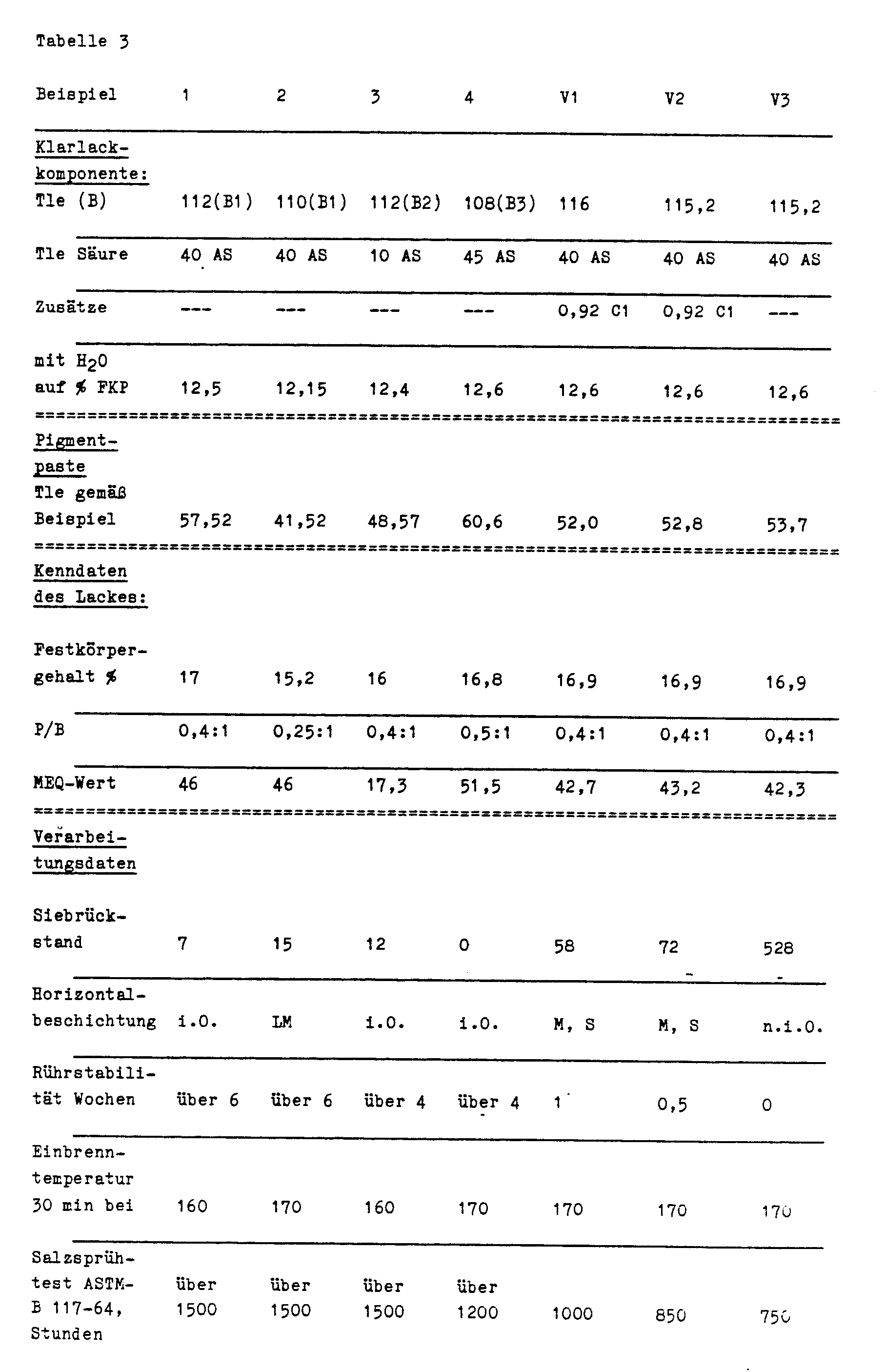
- Table 3 shows the composition of the ETL baths as they are obtained when the pigment paste component and the clear lacquer components (main binder) are mixed.
- Table 3 also shows the processing properties, stability properties and effects on the film quality or film resistance.
- Sieve residue 1 liter of the diluted lacquer solution is poured through a weighed perlon sieve (mesh size 28 ⁇ m). The sieve is rinsed with deionized water and weighed after drying (1 hour / 110 ° C). The result is given in mg of residue.
- a zinc-phosphated steel sheet (approx. 10 x 20 cm) is bent at right angles in the middle.
- the sheet is suspended in the coating bath so that one leg of the bent sheet is horizontally 15 cm below the surface of the paint bath.
- the coating is carried out with the stirring turned off and with a coating time of 4 minutes. After the coating has ended, the sheet remains in the bath for 2 minutes.
- the sheet is then removed from the bath, rinsed with water after another 2 minutes and baked. The sheet is assessed visually for its course, gloss and sedimentation.
- Salt spray test according to ASTM -B 117-64. A film is deposited which has been electrodeposited on zinc-phosphated steel sheet with a layer thickness of 22 ⁇ 2 ⁇ m and which has been baked under the conditions given in the table.
Landscapes
- Chemical & Material Sciences (AREA)
- Life Sciences & Earth Sciences (AREA)
- Engineering & Computer Science (AREA)
- Materials Engineering (AREA)
- Wood Science & Technology (AREA)
- Organic Chemistry (AREA)
- Health & Medical Sciences (AREA)
- Molecular Biology (AREA)
- Paints Or Removers (AREA)
Abstract
Description
- Die Erfindung betrifft Pigmentpasten für wasserverdünnbare Lacke, insbesonders für das 2-Komponenten-Nachsetzverfahren bei der Elektrotauchlackierung.
- Bei der Elektrotauchlackierung wird das im wäßrigen Medium befindliche Farbmaterial als festkörperreicher Überzug auf das Substrat niedergeschlagen und mit dem lackierten Objekt aus dem Bad entfernt. Um eine Verarmung des Badmaterials zu vermeiden, muß entsprechendes Material wieder dem Bad zugeführt werden. Dies kann - wie bereits seit langem z. B. aus WEIGEL, Elektrophoreselacke, Wissenschaftl. VerlagsgesmbH., Stuttgart, 1967, oder YEATES, Electropainting, R. Draper LTD, Teddington, 1970, bekannt ist - entweder durch Nachgabe von unterneutralisierter, konzentrierter Pigment-Bindemittelpaste oder, unter Verwendung von Dialyseeinrichtungen zur Entfernung des freigesetzten Neutralisationsmittels und des überschüssigen wäßrigen Mediums, durch Nachgabe verdünnter Lackmaterialien erfolgen.
- Bei der Führung von Elektrotauchlackieranlagen, insbesonders im Falle der kathodischen Abscheidung, hat es sich als vorteilhaft erwiesen, die Zugabe des Nachsetzmaterials mit zwei getrennten Komponenten, nämlich einer höherpigmentierten Farbkomponente und einer Klarlackkomponente, durchzuführen. Eine gegebenenfalls automatische Steuerung der Badführung wird dadurch wesentlich erleichtert.
- Kombinationen wäßriger Pigmentpasten mit Klarlackdispersionen werden u. a. in den US-PSS 4,035,275, 4,081,343 oder 4,186,124 beschrieben. In der DE 30 40 419 wird zusätzlich als weitere Komponente eine wäßrige Katalysatorpaste eingesetzt. Dabei handelt es sich um eine Vermahlung von Dibutylzinnoxid in dem auch für die Anreibung der Pigmente verwendeten Harz.
- Bei diesem sogenannten 2-Komponenten-Nachsetzverfahren hat es sich jedoch gezeigt, daß auch bei guter Verträglichkeit des Pastenharzes mit dem Hauptbindemittel die Bildung homogener Mischungen selbst unter Verwendung spezieller Rühr- oder Vormischeinrichtungen nicht in optimaler Weise erfolgt.
- Insbesondere werden mit der Pigmentkomponente eingebrachte Materialien, wie Vernetzungskatalysatoren, Verlaufmittel oder Entschäumungsmittel etc., welche in Kombination mit dem Hauptbindemittel wirksam werden sollen, in ungenügender Weise an die Harzmicellen des Hauptbindemittels herangebracht.
- Die unmittelbare Einarbeitung der in den meisten Fällen wasserunlöslichen Zusatzstoffe in das Hauptbindemittel führt sehr oft zu einer Beeinträchtigung der Lagerstabilität der in verdünnter Form vorliegenden Dispersion dieser Badkomponente, sowie zu einer Verringerung der Wirkamkeit der Zusätze.
- Es wurde nun gefunden, daß diese Schwierigkeiten überwunden werden können, wenn man einen oder mehrere dieser Zusatzstoffe mit einem Teil des Hauptbindemittels in die Pigmentkomponente einbringt. Da sich in diesem Fall der Zusatzstoff bereits in den Micellen des Hauptbindemittels befindet, erfolgt auch die homogene Verteilung des Zusatzstoffes in der Klarlackkomponente in wesentlich günstigerer Weise.
- Insbesonders bei der Nachgabe der Komponenten in lösungsmittelarmer Dispersionsform, wie sie bei "low-VOC"-Forderungen (volatile organic composition) seitens der Verbraucher bzw. der Gesetzgebung in verschiedenen Ländern erfolgen muß, ist nur auf diese Weise eine entsprechende Verteilung zu erreichen.
- Die vorliegende Erfindung betrifft demgemäß ein Verfahren zur Herstellung von Pigmentpasten für wasserverdünnbare Lacke, insbesondere für das Zweikomponenten-Nachsetzverfahren bei der Elektrotauchlackierung mit katalysierten Lacksystemen, welches dadurch gekennzeichnet ist, daß man in das für das Lacksystem eingesetzte Pigmentpastenharz (A) die Gesamtmenge oder einen Teil der notwendigen Katalysatoren und/oder anderer Zusatzstoffe (C) und einen Teil des für das Lacksystem eingesetzten Hauptbindemittels (B), vor oder nach der Vermahlung mit den Pigmenten (D) bzw. vor oder nach der teilweisen oder vollständigen Neutralisation der salzbildenden Gruppen, homogen einmischt.
- Die Erfindung betrifft weiters die nach diesem Verfahren hergestellten Pigmentpasten, sowie deren Einsatz in Elektrotauchlacken insbesonders in kathodisch abscheidbaren Elektrotauchlacken.
- Eine bevorzugte Ausführungsform zur Erzielung der für die erfindungsgemäßen Pigmentkomponenten charackteristischen Effekte ist dadurch gekennzeichnet, daß man
- (A) 70 bis 30, vorzugsweise 70 bis 50 Gew.-% eines Pigmentpastenharzes (A) mit (B) 30 bis 70, vorzugsweise 30 bis 50 Gew.-% des für das Lacksystem eingesetzten Hauptbindemittels (B), welches mit der Gesamtmenge oder einem Teil der für das Lacksystem erforderlichen Zusatzkomponenten (C) homogen vermischt ist, mischt und nach vollständiger oder teilweiser Neutralisation der salzbildenden Gruppen soweit mit Wasser verdünnt, daß nach Zugabe der Pigmente (D) für die nachfolgende Vermahlung eine für das Mahlaggregat optimale Viskosität erreicht wird.
- Gegebenenfalls kann aber die Mischung der Komponenten auch in anderer Reihenfolge beispielsweise in der nachfolgend schematisch dargestellten Weise erfolgen (N = Neutralisation, W = Wasserzugabe):
(A + N) + (B + C) + W + D oder
(A + C) + N + B + W + D oder
(A + B) + N + C + W + D - Es ist in allen Fällen wesentlich, daß die Zusatzstoffe in die noch nicht mit Wasser verdünnten Harzkomponenten eingemischt werden und auch die Mischung der Harzkomponenten vor einer wesentlichen Verdünnung mit Wasser erfolgt. Überdies wird auch bei allen Varianten der erfindungsgemäßen Arbeitsweise vermieden, daß die bereits für die Nachgabe weitgehend mit Wasser verdünnte Hauptbindemittelkomponente unzureichend wasserverträgliche Zusatzstoffe enthält.
- Die Art der Hauptbindemittel bzw. der für die Herstellung von Pigmentpasten bevorzugten Bindemitteltypen sind aus der Literatur bekannt. Die Arbeitsweise unter Verwendung der erfindungsgemäßen Pigmentpasten eignet sich insbesondere für Lacksysteme, deren Vernetzung bei erhöhter Temperatur durch Umesterung, Umamidierung, Umurethanisierung oder durch Reaktion endständiger Doppelbindungen erfolgt, da gerade diese Reaktionen durch Katalysatoren wesentlich beeinflußt werden können und daher die optimale Einarbeitung des Katalysators von großer Bedeutung ist. Typische Bindemittel dieser Art sind z. B. in den Europäischen Patentanmeldungen 00 12 463, 00 40 867, 01 62 613, 01 65 799, 01 78 531, 01 79 184 und 01 80 051 bzw. der US 4,174 332 beschrieben.
- Pastenharze sind ihrerseits durch ein hohes Pigmentaufnahmevermögen, sowie günstige Viskositäts- und Löslichkeitsparameter ausgezeichnet. Beispiele für solche Pastenharze sind in der AT-PS 377 270, AT-PS 378 963, DE 22 52 536, 25 31 960, 26 34 211, 26 34 229, EU 00 28 402, 00 49 369, 00 76 955, 01 35 651 bzw. der US 4,035 275 zu finden.
- Die in der erfindungsgemäßen Pigmentkomponente eingearbeiteten Zusatzstoffe können Katalysatoren, wie Zinn-, Blei- oder Cobaltoctoat oder Dibutylzinndilaurat u. ä. aber auch wasserunverträgliche Lösemittel wie Texanol (2,2,4-Trimethylpentan-1,3-diolmonoisobutyrat), aliphatische oder aromatische Kohlenwasserstoffe, oder Lackhilfsmittel, wie Entschäumer, Haftvermittler etc. sein.
- Üblicherweise enthalten die Badmaterialien für die kathodische Elektrotauchlackierung Hauptbindemittel und Pastenharz in einem Verhältnis zwischen 4 : 1 und 2 : 1 und weisen ein Pigment-Bindemittelverhältnis von 0,1 : 1 bis 0,7 : 1 auf.
- Die erfindungsgemäßen Pigmentkomponenten enthalten die Harzkomponenten in einem Verhältnis von 70 bis 30 Gew.-% Pigmentpastenharz ("pigment grinding vehicle") zu 30 bis 70 Gew.-% des für das Lacksystem eingesetzten Hauptbindemittels. Vorzugsweise werden die Komponenten in einem Verhältnis von 70 bis 50 Gew.-% zu 30 bis 50 Gew.-% eingesetzt.
- Die erfindungsgemäße Pastenharzkombination enthält die für die Elektrotauchlacke üblicherweise eingesetzten Pigmente in einem Pigmentbindemittelverhältnis von 8:1 bis 1:1 (für reine Schwarzlacke) bzw. 12:1 bis 5:1 (für übliche Grundierungen und Einschichtlacke). Die Art der Pigmente ist dem Fachmann bekannt und der einschlägigen Literatur zu entnehmen.
- Für die Herstellung der Pastenharzkombinationen können die in der Lackindustrie üblichen Misch- und Mahlaggregate verwendet werden. Die Formulierung und Verarbeitung von Elektrotauchlacken sind dem Fachmann bekannt und bedürfen keiner weiteren Erläuterungen.
- Die nachstehenden Beispiele erläutern die Erfindung, ohne sie in ihrem Umfang zu beschränken. Alle Angaben in Teilen oder Prozenten beziehen sich, soferne nichts anderes angegeben ist, auf Gewichtseinheiten.
- Folgende Abkürzungen werden in den Beispielen verwendet:
BUGL Ethylenglykolmonobutylether
CE technisches Gemisch aus Glycidylestern von 1,1-Dimethyl-(C₇-C₉)carbonsäuren
DGME Diethylenglykoldimethylether
DEAPA N,N-Diethylaminopropylamin
DMAPA N,N-Dimethylaminopropylamin
MOLA Monoethanolamin
PF 91 Paraformaldehyd, 91 %
PSA Phthalsäureanhydrid
TDI Toluylendiisocyanat (80/20)
THMDI Trimethylhexamethylendiisocyanat
DOLA Diethanolamin - Als Einzelkomponenten kommen in den Beispielen folgende Produkte zum Einsatz:
- (A1) In einem geeigneten Reaktionsgefäß werden 74 Tle PSA mit 162 Tlen eines Oxazolidinderivates bei 75 bis 80°C bis zu einer Säurezahl von 120 mg KOH/g umgesetzt. Das Oxazolidinderivat wird durch Ringschluß aus einem Hydroxyamin aus 24 Tlen MOLA und 100 Tlen CE mit 33 Tlen PF 91 bei 60 bis 120°C unter azeotroper Entfernung von ca 8 Tlen Reaktionswassers hergestellt.
- Dem Ansatz werden 320 Tle eines Epoxidharzes auf Basis Polypropylenglykol (Epoxidäquivalent ca. 320) zugegeben und die Mischung bei 120°C bis zu einer Säurezahl von weniger als 3 mg KOH/g verestert. Nach Kühlen auf 70°C werden 52 Tle DEAPA zugesetzt und die Temperatur bis zu einem Epoxidwert von 0 gehalten. Nach Zugabe von 13 Tlen PF 91 werden mit Hilfe von Spezialbenzin (Siedebereich 80 bis 120°C) als Schleppmittel 8 Tle Reaktionswasser azeotrop entfernt. Anschließend wird der Ansatz mit 125 Tlen des wie oben hergestellten Oxazolidins gemischt und auf 30 bis 35°C gekühlt. Dann werden 84 Tle THMDI portionsweise zugesetzt und so lange bei 50°C reagiert, bis alle Isocyanatgruppen verbraucht sind. Nach Entfernen des Schleppmittels wird der Ansatz in 200 Tlen BUGL gelöst. Folgende Kennzahlen wurden ermittelt:
Viskosität : 21.000 mPa.s / 25°C
Oxazolidinäquivalent (ber.) : 624
Aminzahl : 116 mg KOH/g
Aliphatischer Anteil : 59 %
Molekulargewicht (ber.) : 1650
Löslichkeit (1) : 15 mMol Ameisensäure pro 100 g Festharz - (A2) In einem geeigneten Reaktionsgefäß werden 320 Tle eines Epoxidharzes auf Basis von Polypropylenglykol (Äquivalentgewicht ca. 320) bei 75 bis 80°C mit 134 Tlen Talgfettamin und 52 Tlen DEAPA bis zu einem Epoxidwert von 0 umgesetzt. Nach Zugabe von 30 Tlen PF 91 werden mit Spezialbenzin (Siedebereich 80 - 120°C) 19 Tle Reaktionswasser azeotrop entfernt. Das Schleppmittel wird anschließend im Vakuum abdestilliert. Das Harz weist folgende Kennzahlen auf:
Viskosität : 1500 mPa.s / 25°C
Oxazolidinäquivalent (ber.) : 574
Aminzahl : 141 mg KOH/g
Aliphatischer Anteil : 86 %
Molekulargewicht (ber.) : 1034
Löslichkeit (s.o.) : ohne Säurezusatz löslich - (A3) In einem geeigneten Reaktionsgefäß werden 440 Tle eines epoxidierten Polybutadienöles (Molekulargewicht ca. 1400, Epoxidäquivalent ca. 440) mit 92 Tlen DMAPA (0,9 Mol) in Anwesenheit von 0,5 Tlen 2,6-Ditert.-butyl-4-methylphenol (Inhibitor) bei 160 bis 200°C umgesetzt, bis alle Epoxidgruppen verbraucht sind. Nach Kühlen auf 80°C werden 30 Tle PF 91 (0,9 Mol) zugegeben und mit Spezialbenzin (Siedebereich 80 - 120°C) bei dieser Temperatur 18 Tle Reaktionswasser azeotrop entfernt. Nach Abziehen des Schleppmittels unter Vakuum wird der Ansatz in 59 Tlen BUGL gelöst. Das Harz weist folgende Kennzahlen auf:
Viskosität : 2600 mPa.s / 25°C
Oxazolidinäquivalent (ber.) : 604
Aminzahl : 185 mg KOH/g
Aliphatischer Anteil : 80 %
Molekulargewicht (ber.) : 1632
Löslichkeit (s.o.) : 25 mMol Ameisensäure pro 100 g Festharz - (B 1) In einem geeigneten Reaktionsgefäß werden 228 Tle Bisphenol A (1 Mol) mit 260 Tlen DEAPA (2 Mol) in Gegenwart von 131 Tlen Toluol auf 75°C erwärmt und dem Ansatz anschließend unter leichtem Kühlen 66 Tle PF 91 (2 Mol) zugefügt. Die Temperatur wird langsam gesteigert, bis sich eine zügige azeotrope Destillation einstellt. Nach Abtrennen von 42 Tlen Reaktionswasser wird das Toluol im Vakuum abdestilliert und das Produkt in 152 Tlen DGME gelöst. Nach Kühlen auf 30°C werden innerhalb von 45 Minuten 608 Tle eines mit 2-Ethylhexanol halbblockierten TDI (2 Mol) zugegeben. Nach Erreichen eines NCO-Wertes von praktisch 0 werden 1400 Tle dieser Lösung mit einer Lösung von 190 Tlen eines Epoxidharzes auf Basis von Bisphenol A (Epoxidäquivalentgewicht ca. 190) und 250 Tlen CE (1 Mol) in 389 Tlen DGME versetzt und bei 95 bis 100°C bis zu einem Epoxidwert von 0 umgesetzt.
- 75 Tle Festharz dieser Lösung werden mit 25 Tlen (Festharz) der unten angeführten Polyhydroxylverbindung gründlich vermischt und 35 mMol Ameisensäure versetzt. Anschließend wird mit deionisiertem Wasser eine 40%ige Dispersion hergestellt.
- Die eingesetzte Polyhydroxylverbindung ist nach Protonierung wasserlöslich und weist ein OH-Äquivalentgewicht von ca. 145 auf. Sie ist ein in bekannter Weise hergestelltes Umsetzungsprodukt aus 1 Mol eines Epoxidharzes auf Basis von Bisphenol A (Epoxidäquivalentgewicht ca. 475) mit 2 Mol DOLA, 70%ig in Methoxypropanol.
- (B 2): In einem mit Rührer, Thermometer und Rückflußkühler ausgestatteten Reaktionsgefäß werden 1000 Tle eines Epoxidharzes auf Bisphenol A-Basis (Epoxidäquivalent ca. 500) in 492 Tlen Ethylglykolacetat bei 60 bis 70°C gelöst, 0,2 Tle Hydrochinon und 144 Tle Acrylsäure zugegeben und die Temperatur auf 100 bis 110°C gesteigert. Die Reaktion wird bei dieser Temperatur bis zu einer Säurezahl von unter 5 mg KOH/g geführt (DBZ = 1,75). Anschließend wird das Reaktionsprodukt bei 60 bis 70°C mit 652 Tlen einer 70%igen Lösung eines basischen Monoisocyanates versetzt und bis zu einem NCO-Wert von praktisch Null reagiert (DBZ = 1,25, BNZ = 1,1). Nach Zusatz von 60 Millimol Ameisensäure pro 100 g Festharz wird mit deionisiertem Wasser eine 35%ige Dispersion hergestellt.
- Das basische Monoisocyanat ist ein Umsetzungprodukt aus 1 Mol TDI und 1 Mol DOLA, 70%ig in Methylisobutylketon.
- DBZ: Doppelbindungszahl: entspricht der Anzahl der endständigen ethylenischen Doppelbindungen pro 1000 Molekulargewichtseinheiten
- BNZ: Basenzahl: entspricht der Anzahl der basischen N-Gruppierungen pro 1000 Molekulargewichtseinheiten
- (B 3): 700 Tle eines handelsüblichen Polybutadienöls werden in bekannter Weise in Gegenwart von 0,5 Tlen Diphenylparaphenylendiamin (Inhibitor) bei 200°C mit 100 Tlen Maleinsäureanhydrid so lange reagiert, bis dieses vollständig gebunden ist. Nach Kühlen auf 100°C werden 130 Tle 2-Ethylhexanol zugesetzt und bei 120°C bis zum Erreichen der theoretischen Säurezahl des Halbesters verestert.
- 110 Tle dieses Vorprodukts (entsprechend ca. 0,12 COOH-Gruppen) werden mit 212 Tlen eines Bisphenol A-Diepoxidharzes (Epoxidäquivalent ca. 190) in 80%iger Lösung in DGME bei 120°C bis zu einer Säurezahl von praktisch Null umgesetzt. Nach Zusatz von 108 Tlen DGME, 59 Tlen DEAPA (0,45 Mol) und 59 Tlen 2-Ethylhexylamin (0,45 Mol) wird der Ansatz bei 65 bis 70°C bis zu einem Epoxidwert von praktisch Null reagiert. Nach Erreichen dieses Wertes werden 114 Tle Bisphenol A (0,5 Mol) und 50 Tle PF 91 (1,5 Mol) zugegeben und die Reaktion bei 60°C bis zum Erreichen eines Gehaltes an freiem Formaldehyd von 0,5 bis 1 % geführt. Der Ansatz wird nach Zusatz von 40 Millimol Ameisensäure pro 100 g Festharz mit deionisiertem Wasser auf einen Festkörpergehalt von 45% verdünnt.
- Das eingesetzte Polybutadienöl ist flüssig und weist ca. 75 % 1,4 cis-, ca. 24 % 1,4-trans- und ca. 1 % Vinyl-Doppelbindungen auf; das Molekulargewicht beträgt ca. 1500 ± 15 %, die Jodzahl ca. 450 g / 1000 g.
-
- (C1) Dibutylzinndilaurat: in lösemittelfreier Form mit einem Metallgehalt von ca 18%;
- (C2) Dibutylzinnoxid: in fester Form; Metallgehalt ca 48%;
- (C3) Bleioctoat : als 90%ige Lösung in einem Kohlenwasserstoffgemisch (Metallgehalt ca 31%);
- (C4) Cobaltoctoat: als 80%ige Lösung in Lackbenzin (Metallgehalt ca 11%);
- (C5) Netzmittel auf Basis eines Acetylenalkohols; eingesetzt als 50%ige Lösung in Ethylenglykolmonoethylether
- Das im organischen Lösemittel gelöste Hauptbindemittel (Komponente B) wird bei Raumtemperatur oder gegebenenfallls bei erhöhter Temperatur (max. 80°C) mit der Zusatzkomponente (Komponente C) ca. 30 Minuten gründlich vermischt. Anschließend wird das Pigmentpastenharz (Komponente A) sowie gegebenenfalls weitere Zusätze, wie Entschäumer oder andere Lackhilfsmittel weitere 30 Minuten eingemischt. Als nächstes wird die Neutralisationssäure und anschließend deionisiertes Wasser eingerührt, sodaß ein wäßriger Klarlack mit dem gewünschten Festkörpergehalt und Viskosität ensteht. Nach Zugabe der Pigmente wird der homogenisierte Ansatz auf einem geeigneten Mahlaggregat, vorzugsweise einer Perl- oder Sandmühle vermahlen.
- Die Ansätze sind in der folgenden Tabelle zusammengefaßt. Alle Angaben in Teilen beziehen sich auf Feststoff.

- Die Herstellung der Pasten kann auch in der in der Beschreibung angegebenen Weise variiert werden, ohne daß eine wesentliche Änderung bei der Prüfung festzustellen ist.
- In der Tabelle 2 ist die Zusammensetzung der Vergleichsbeispiele (V1) bis (V3) angegeben. Bei den Vergleichsbeispielen (V1) und (V2) werden die Zusatzstoffe in der bei (C) angegebenen Form mit der gleichen Menge Ethylenglykolmonobutylether verdünnt und dem wäßrigen pigmentierten Lackbad zugesetzt. Beim Vergleichsbeispiel (V3) wird das als Feststoff vorliegende unlösliche Dibutylzinnoxid zusammen mit den Pigmenten in üblicher Weise vermahlen.

- In der Tabelle 3 wird die Zusammensetzung der ETL-Bäder angegeben, wie sie beim Vermischen der Pigmentpastenkomponente und der Klarlackkomponenten (Hauptbindemittel) erhalten werden.
- In der Tabelle 3 werden weiters die Verarbeitungseigenschaften, Stabilitätseigenschaften und Auswirkungen auf die Filmbeschaffenheit bzw. Filmbeständigkeit angegeben.
- Durchführung der Prüfungen:
- Siebrückstand: 1 Liter der verdünnten Lacklösung wird durch ein gewogenes Perlonsieb (Maschenweite 28 µm) gegossen. Das Sieb wird mit deionisiertem Wasser nachgespühlt und nach Trocknung (1 Stunde/110°C) gewogen. Das Ergebnis wird in mg Rückstand angegeben.
- Horizontalbeschichtung: Ein zinkphosphatiertes Stahlblech (ca. 10 x 20 cm) wird in der Mitte rechtwinkelig gebogen. Das Blech wird im Beschichtungbad so eingehängt, das sich ein Schenkel des gebogenen Bleches horizontal 15 cm unter der Oberfläche des Lackbades befindet. Die Beschichtung erfolgt bei abgestellter Rührung und mit einer Beschichtungsdauer von 4 Minuten. Nach Ende der Beschichtung verbleibt das Blech noch 2 Minuten im Bad. Anschließend wird das Blech aus dem Bad genommen, nach weiteren 2 Minuten mit Wasser gespült und eingebrannt. Das Blech wird visuell hinsichtlich Verlauf, Glanz und Sedimentationserscheinungen beurteilt.
- Rührstabilität: Das Bad wird im offenen Gefäß bei 25 ± 2°C ständig gerührt. Nach der angegebenen Zeit zeigen die elektrische Abscheidung und die abgeschiedenen Filme keine wesentliche Veränderung gegenüber dem Frischzustand (nach 24 Stunden Homogenisierung).
- Die Abkürzungen in der Tabelle 3 haben folgende Bedeutung:
i.O. Beschichtung in Ordnung, keine Sedimentationserscheinungen
LM leichte Mattierung
M Film matt, noch keine Verlaufstörungen
S deutliche Sedimentationserscheinungen
n.i.O. Film unbrauchbar - Salzsprühtest nach ASTM -B 117-64. Geprüft wird ein auf zinkphosphatiertem Stahlblech mit einer Schichtstärke von 22 ±2 µm elektrisch abgeschiedener Film, welcher bei den in der Tabelle angegebenen Bedingungen eingebrannt wurde.

Claims (7)
(A + N) + (B + C) + W + D oder
(A + C) + N + B + W + D oder
(A + B) + N + C + W + D
mischt, wobei A - D die im Hauptanspruch genannten Komponenten, N die Neutralisation und W die Wasserzugabe bedeuten.
Applications Claiming Priority (2)
| Application Number | Priority Date | Filing Date | Title |
|---|---|---|---|
| AT2538/86 | 1986-09-23 | ||
| AT253886A AT386001B (de) | 1986-09-23 | 1986-09-23 | Pigmentpasten fuer wasserverduennbare lacke, verfahren zu deren herstellung und deren verwendung |
Publications (2)
| Publication Number | Publication Date |
|---|---|
| EP0262496A2 true EP0262496A2 (de) | 1988-04-06 |
| EP0262496A3 EP0262496A3 (de) | 1989-12-13 |
Family
ID=3536069
Family Applications (1)
| Application Number | Title | Priority Date | Filing Date |
|---|---|---|---|
| EP87113364A Ceased EP0262496A3 (de) | 1986-09-23 | 1987-09-12 | Verfahren zur Herstellung von Pigmentpasten für wasserverdünnbare Lacke für die Elektrotauchlackierung. |
Country Status (2)
| Country | Link |
|---|---|
| EP (1) | EP0262496A3 (de) |
| AT (1) | AT386001B (de) |
Cited By (1)
| Publication number | Priority date | Publication date | Assignee | Title |
|---|---|---|---|---|
| WO1996017023A1 (de) * | 1994-11-30 | 1996-06-06 | Herberts Gesellschaft mit beschränkter Haftung | Lagerstabiles, einkomponentiges konzentrat, seine herstellung und verwendung zur herstellung kathodisch abscheidbarer elektrotauchlackbäder |
Family Cites Families (2)
| Publication number | Priority date | Publication date | Assignee | Title |
|---|---|---|---|---|
| GB1370914A (en) * | 1971-07-06 | 1974-10-16 | Ici Ltd | Paint compositions |
| AT380264B (de) * | 1984-10-22 | 1986-05-12 | Vianova Kunstharz Ag | Verfahren zur herstellung von bindemitteln fuer pigmentpasten fuer wasserverduennbare lacke |
-
1986
- 1986-09-23 AT AT253886A patent/AT386001B/de not_active IP Right Cessation
-
1987
- 1987-09-12 EP EP87113364A patent/EP0262496A3/de not_active Ceased
Cited By (1)
| Publication number | Priority date | Publication date | Assignee | Title |
|---|---|---|---|---|
| WO1996017023A1 (de) * | 1994-11-30 | 1996-06-06 | Herberts Gesellschaft mit beschränkter Haftung | Lagerstabiles, einkomponentiges konzentrat, seine herstellung und verwendung zur herstellung kathodisch abscheidbarer elektrotauchlackbäder |
Also Published As
| Publication number | Publication date |
|---|---|
| AT386001B (de) | 1988-06-27 |
| EP0262496A3 (de) | 1989-12-13 |
| ATA253886A (de) | 1987-11-15 |
Similar Documents
| Publication | Publication Date | Title |
|---|---|---|
| EP0082291B1 (de) | Wärmehärtbare kationische wasserverdünnbare Bindemittel | |
| EP0183025B1 (de) | Verfahren zur Herstellung von Bindemitteln für Pigmentpasten für wasserverdünnbare Lacke | |
| EP0049369B1 (de) | Bindemittelkombination für kathodisch abscheidbare Lacke | |
| EP0121837A1 (de) | In der Hitze selbstvernetzende Lackbindemittel, ihre Herstellung und Verwendung | |
| EP0209857B1 (de) | Verfahren zur Herstellung von selbstvernetzenden kationischen Lackbindemitteln | |
| EP0288942A2 (de) | Verfahren zur Herstellung von kationischen Harzen auf Basis von phosphorsäuremodifizierten Epoxidharzen | |
| EP0032554B1 (de) | Bindemittelkombinationen für korrosionsfeste Lacke | |
| EP0179184B1 (de) | Verfahren zur Herstellung kathodisch abscheidbarer Elektrotauchlack-Bindemittel | |
| EP0158128B1 (de) | Verfahren zur Herstellung kathodisch abscheidbarer Elektrotauchlack-Bindemittel | |
| EP0136411A1 (de) | Hitzehärtbare Bindemittelmischung | |
| EP0167029B1 (de) | Bindemittel für die kathodische Elektrotauchlackierung, die nicht-tertiäre basische Aminogruppen neben phenolischen Mannichbasen enthalten | |
| AT394197B (de) | Verfahren zur herstellung von bindemitteln fuer kathodisch abscheidbare lacke | |
| EP0220440A1 (de) | Verfahren zur Herstellung selbstvernetzender kationischer Lackbindemittel | |
| EP0461566A1 (de) | Kathodisch abscheidbare Elektrotauchlackbäder mit Additiven zur Oberflächenverbesserung sowie die Verwendung letzterer für Beschichtungsverfahren | |
| AT390451B (de) | Kathodisch abscheidbare elektrotauchlacke und verfahren zu ihrer herstellung | |
| AT393510B (de) | Verfahren zur herstellung von kationischen lackbindemitteln zur formulierung von pigmentpasten fuer kathodisch abscheidbare elektrotauchlacke | |
| EP0262496A2 (de) | Verfahren zur Herstellung von Pigmentpasten für wasserverdünnbare Lacke für die Elektrotauchlackierung. | |
| DE3705013A1 (de) | Beschichtungsmasse fuer die kathodische elektrobeschichtung | |
| DE3545205C1 (de) | Kathodisch abscheidbares waessriges Elektrotauchlack-UEberzugsmittel und dessen Verwendung zum Beschichten von Gegenstaenden | |
| EP0102496A1 (de) | Selbstvernetzendes, hitzehärtbares Bindemittel | |
| EP0273170B1 (de) | Kathodisch abscheidbare wasserverdünnbare Überzugszusammensetzungen und Verfahren zur Herstellung von kathodisch abscheidbaren wasserverdünnbaren Bindemitteln | |
| EP0193103B1 (de) | Verfahren zur Herstellung einer Vernetzungskomponente für kationische Lackbindemittel | |
| EP0653467A2 (de) | Wässriger kathodisch abscheidbarer Elektrotauchlack und Beschichtungsverfahren unter dessen Verwendung | |
| AT378537B (de) | Verfahren zur herstellung kathodisch abscheidbarer elektrotauchlack-bindemittel | |
| EP0213626A2 (de) | Verfahren zur Herstellung von modifizierten Epoxidharzen |
Legal Events
| Date | Code | Title | Description |
|---|---|---|---|
| PUAI | Public reference made under article 153(3) epc to a published international application that has entered the european phase |
Free format text: ORIGINAL CODE: 0009012 |
|
| 17P | Request for examination filed |
Effective date: 19870923 |
|
| AK | Designated contracting states |
Kind code of ref document: A2 Designated state(s): DE ES FR GB IT |
|
| PUAL | Search report despatched |
Free format text: ORIGINAL CODE: 0009013 |
|
| AK | Designated contracting states |
Kind code of ref document: A3 Designated state(s): DE ES FR GB IT |
|
| 17Q | First examination report despatched |
Effective date: 19910515 |
|
| RTI1 | Title (correction) | ||
| STAA | Information on the status of an ep patent application or granted ep patent |
Free format text: STATUS: THE APPLICATION HAS BEEN REFUSED |
|
| 18R | Application refused |
Effective date: 19920917 |
|
| RIN1 | Information on inventor provided before grant (corrected) |
Inventor name: PAAR, WILLIBALD, DR. Inventor name: SODIN, CLEMENS |