EP0260291B1 - Verfahren zur durchführung der behandlung eines flüssigen produktes, nämlich eines nahrungsmittels - Google Patents
Verfahren zur durchführung der behandlung eines flüssigen produktes, nämlich eines nahrungsmittels Download PDFInfo
- Publication number
- EP0260291B1 EP0260291B1 EP87901510A EP87901510A EP0260291B1 EP 0260291 B1 EP0260291 B1 EP 0260291B1 EP 87901510 A EP87901510 A EP 87901510A EP 87901510 A EP87901510 A EP 87901510A EP 0260291 B1 EP0260291 B1 EP 0260291B1
- Authority
- EP
- European Patent Office
- Prior art keywords
- treatment
- temperature
- soiling
- fluid
- efficiency
- Prior art date
- Legal status (The legal status is an assumption and is not a legal conclusion. Google has not performed a legal analysis and makes no representation as to the accuracy of the status listed.)
- Expired - Lifetime
Links
Images

Classifications
-
- A—HUMAN NECESSITIES
- A23—FOODS OR FOODSTUFFS; TREATMENT THEREOF, NOT COVERED BY OTHER CLASSES
- A23B—PRESERVATION OF FOODS, FOODSTUFFS OR NON-ALCOHOLIC BEVERAGES; CHEMICAL RIPENING OF FRUIT OR VEGETABLES
- A23B11/00—Preservation of milk or dairy products
- A23B11/10—Preservation of milk or milk preparations
- A23B11/12—Preservation of milk or milk preparations by heating
- A23B11/13—Preservation of milk or milk preparations by heating the materials being loose unpacked
- A23B11/133—Preservation of milk or milk preparations by heating the materials being loose unpacked and progressively transported through the apparatus
-
- A—HUMAN NECESSITIES
- A23—FOODS OR FOODSTUFFS; TREATMENT THEREOF, NOT COVERED BY OTHER CLASSES
- A23B—PRESERVATION OF FOODS, FOODSTUFFS OR NON-ALCOHOLIC BEVERAGES; CHEMICAL RIPENING OF FRUIT OR VEGETABLES
- A23B2/00—Preservation of foods or foodstuffs, in general
- A23B2/40—Preservation of foods or foodstuffs, in general by heating loose unpacked materials
- A23B2/42—Preservation of foods or foodstuffs, in general by heating loose unpacked materials while they are progressively transported through the apparatus
- A23B2/46—Preservation of foods or foodstuffs, in general by heating loose unpacked materials while they are progressively transported through the apparatus with transport through tubes
Definitions
- the present invention relates to the conduct of the treatment of fluid products circulating continuously, and in particular of food products. It applies more precisely to the conduct of the treatment of such a product when the latter circulates in an organ, the cross section of which varies due to its fouling during treatment.
- the treatment temperature can be chosen in an apparatus in which the residence time of the product is fixed.
- the residence time of the product can be modified when the treatment temperature is fixed.
- French patents No. 2,454,141 and German No. 2,929,833 a method is known for determining the fouling of a treatment device of the type in question, and for controlling its cleaning when the fouling has reached a determined threshold.
- This process as described in French Patent No. 2,454,141, comprises measuring the flow rate of the treated fluid, the continuous measurement or calculation of a characteristic quantity of the current or of the course of the treatment, this characteristic quantity possibly being a pressure drop in all or part of an area of the appliance, the overall heat exchange coefficient, etc., then the comparison of the measured or calculated value with a theoretical value corresponding to the same flow measured in the absence of fouling, the comparison allowing a determination of the degree of fouling of the device.
- the invention relates to a method which optimizes the treatments of the fluid products which circulate continuously in an organ having a passage section which varies by fouling during the treatment.
- the degree of fouling of the device is determined and the heating is adjusted to a value such that, for the determined degree of fouling, the treatment has the desired predetermined effectiveness.
- the treatment is not carried out with excessive efficiency, so that the fouling of the device is slowed down.
- the treatment can therefore be carried out over a longer period, without the effectiveness being reduced.
- the invention relates to a method according to claim 1
- the degree of fouling is advantageously measured by implementing the method described in the aforementioned French patent No. 2,454,141.
- the treatment according to the invention is a heat treatment of a fluid and the determination of at least one parameter of the treatment includes: the measurement of at least one temperature and a flow rate, the calculation, according to the degree of fouling, of the temperature profile in a treatment zone, the calculation, according to the temperature profile, the flow rate and data specific to the food product, the residence times of the product in the various parts of the treatment zone, the calculation of the corresponding efficiency, and the comparison of the calculated efficiency with the predetermined efficiency.
- the parameter of the treatment is the temperature of this heating fluid.
- This second parameter can be the temperature of the product treated at a location in the treatment area. It can also be the temperature of the heating fluid.
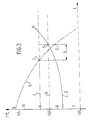
- the treatment temperature is determined beforehand so that it gives the desired efficiency. This temperature is then maintained throughout the duration of the treatment, as indicated by curve A. Since this temperature is relatively high, fouling of the device is favored so that the transfer of heat to the fluid to be treated decreases proportionately and the passage section also decreases. As the flow rate is kept at a constant value, the residence time also decreases. As a result, the effectiveness of the treatment gradually decreases, as curve B indicates this. At point C of curve B, this efficiency has fallen, for example, to a value equal to 9 which is the desired value. Normally, treatment should be stopped at point C. However, most of the time it is continued for some time, up to point D at which the effectiveness has been reduced and is, for example, only 8. In zone E between points C and D, the risk of manufacturing a non-sterile product therefore increases. After point D, the efficacy decreases too quickly for treatment to be continued.
- the parameter set is the treatment efficiency, as indicated by curve F.
- the parameter which is regulated so that this efficiency is maintained is the treatment temperature indicated by curve G. It is noted that, during most of the treatment, this temperature remains significantly lower than the temperature used in the conventional treatment and represented by curve A. Consequently, the fouling of the device is significantly less and is much more gradual. Of course, the efficiency is lower than that obtained in conventional treatment, but it is sufficient since it corresponds to the nominal value fixed at the start. When curve G reaches point I, the temperature of the treatment according to the invention is equal to that which is used in conventional treatment. However, the fouling of the device is much more reduced and gives an efficiency still equal to 9 whereas, in the conventional method, this efficiency has already fallen to 8 for example.
- the treatment can be continued for example up to point H.
- the fouling of the device is substantially equivalent to that which corresponds to point D of conventional treatment.
- the treatment time and consequently the quantity of fluid treated have been increased by the entire range between points D and H.
- the treated product has always undergone a treatment having an efficiency equal to 9 and is therefore completely sterile, while the product treated up to point D in the conventional process underwent only a reduced efficiency treatment towards the end of the process.
- the reference 10 schematically designates the apparatus or installation for treating the fluid which circulates by forming a direct current.
- Sensors 12, associated with the installation carry out a measurement 14 of various parameters such as pressure, temperatures, flow rate, etc.
- the results 16 are transmitted to a member 18.
- This as described in more detail with reference to Figure 2, first determines a degree of fouling. It then determines the temperature profile in the device, based on the temperature measured at several points and the fouling. It then calculates the distribution of the residence times as a function of data specific to the product treated, for example the viscosity thereof, this distribution of the residence times being a function of the temperature and the fouling. Finally, it determines the effectiveness of the treatment obtained as a function of the results obtained, taking into account the action of temperature on the microorganisms to be destroyed.
- the various parameters obtained 20 can be transmitted to a display device 22 available to an operator.
- the circuit When the efficiency determined by the circuit 18 deviates from the set value, the circuit transmits an order 24 to a control member 26 which, by an action 28, modifies a parameter of the treatment in the installation 10, in order to that the efficiency returns to the set value.
- FIG. 2 represents an example of an apparatus implementing the method according to the invention. It is a milk sterilization device, bearing the general reference 30.
- the fluid to be treated is transmitted at 32 to a series of sensors described below, and enters a zone 34 for heat recovery.
- the milk introduced is heated by the milk which has undergone the treatment.
- the milk reaches a heating zone 36 in which the treatment is carried out, by heat exchange with a heating circuit 38.
- the milk then leaves this zone and enters a zone 40 chambering.
- it is transmitted to the heat recovery zone 34 in which it restores heat to the stream of milk introduced.
- the milk reaches a cooling zone 42 in which the milk exchanges heat with a circuit 44 of a cooling fluid.
- the milk transmitted through outlet 46 is sterilized and can be placed in sterile containers.
- the installation which, until now, is entirely conventional, comprises a certain number of sensors allowing its implementation according to the invention.
- the installation comprises four temperature sensors placed at the inlet of the product 48, between the heat recovery and heating zones 50, between the heating and holding zones 52 and in the heating circuit 54.
- pressure sensors are placed at the inlet 56, between the heat recovery and heating areas 58, between the heating and holding areas 60 and at the outlet of the holding area 62.
- a flow sensor 64 is mounted at the entrance of the installation.
- control member 26 acts on the heating circuit 38, that is to say on the temperature of the heating fluid, determined by the sensor 54.
- the circuit 18 determines the fouling in each of the zones which are most sensitive thereto, that is to say the zone 34 for heat recovery, the zone 36 for heating and the zone 40 for holding.
- the sensors 56 and 58, 58 and 60, 60 and 62 taken in pairs, allow the determination of the pressure drop in each of the treatment zones and consequently of the variation in the degree of fouling of each of these zones.
- the temperatures measured at the inlet, between the heat recovery and heating zones and at the outlet from the heating zone allow the determination of the temperature profile and consequently the calculation of the efficiency, taking into account the degree of fouling and residence time, determined according to the flow rate given by the sensor 64. Consequently, all the sensors, except the sensor 54, give information to the circuit 18 so that it can process the control signal for the organ 26 which varies the temperature of the heating circuit 38. This temperature is therefore the regulated parameter. This regulation is checked using the temperature sensor 54.
- the degree of fouling of the various parts of the device is determined by comparison, as described in the aforementioned French patent No. 2,454,141.
- the temperature profile is determined simply by means of the measurements of the sensors 48, 50 and 52
- the calculation of the residence times is carried out using information relating to the device, previously introduced into circuit 18, and information relating to the product treated, the milk in the example considered. Important information is notably the viscosity of milk.
- the invention has significant advantages over the prior art. Firstly, since the treatment temperature is reduced as much as possible, the installation allows savings in heating, that is to say in energy. Then, the fouling of the devices is slowed down, so that the cleaning which is difficult and expensive, can be spaced. Finally, in the case of food products, the use of a lower temperature significantly reduces organoleptic changes (odor, color, taste, aroma, texture) and nutritious heated products.
Landscapes
- Life Sciences & Earth Sciences (AREA)
- Engineering & Computer Science (AREA)
- Wood Science & Technology (AREA)
- Zoology (AREA)
- Chemical & Material Sciences (AREA)
- Food Science & Technology (AREA)
- Polymers & Plastics (AREA)
- Food Preservation Except Freezing, Refrigeration, And Drying (AREA)
- Dairy Products (AREA)
Claims (8)

Priority Applications (1)
| Application Number | Priority Date | Filing Date | Title |
|---|---|---|---|
| AT87901510T ATE76559T1 (de) | 1986-03-07 | 1987-03-04 | Verfahren zur durchfuehrung der behandlung eines fluessigen produktes, naemlich eines nahrungsmittels. |
Applications Claiming Priority (2)
| Application Number | Priority Date | Filing Date | Title |
|---|---|---|---|
| FR8603281A FR2595208B1 (fr) | 1986-03-07 | 1986-03-07 | Procede de conduite du traitement d'un produit fluide, notamment d'un produit alimentaire |
| FR8603281 | 1986-03-07 |
Publications (2)
| Publication Number | Publication Date |
|---|---|
| EP0260291A1 EP0260291A1 (de) | 1988-03-23 |
| EP0260291B1 true EP0260291B1 (de) | 1992-05-27 |
Family
ID=9332897
Family Applications (1)
| Application Number | Title | Priority Date | Filing Date |
|---|---|---|---|
| EP87901510A Expired - Lifetime EP0260291B1 (de) | 1986-03-07 | 1987-03-04 | Verfahren zur durchführung der behandlung eines flüssigen produktes, nämlich eines nahrungsmittels |
Country Status (4)
| Country | Link |
|---|---|
| EP (1) | EP0260291B1 (de) |
| JP (1) | JPS63500844A (de) |
| FR (1) | FR2595208B1 (de) |
| WO (1) | WO1987005189A1 (de) |
Cited By (1)
| Publication number | Priority date | Publication date | Assignee | Title |
|---|---|---|---|---|
| CN104023545A (zh) * | 2011-12-22 | 2014-09-03 | 利乐拉瓦尔集团及财务有限公司 | 用于监测液体食品处理系统的操作的方法 |
Families Citing this family (2)
| Publication number | Priority date | Publication date | Assignee | Title |
|---|---|---|---|---|
| FR2659196A1 (fr) * | 1990-03-07 | 1991-09-13 | Marceron Thierry | Mini laiterie mobile a petite capacite de traitement de pasteurisation. |
| AT395367B (de) * | 1991-03-25 | 1992-12-10 | Prugner Siegfried | Einrichtung zum pasteurisieren von fluessigkeiten mit einem waermeaustauscher |
Family Cites Families (5)
| Publication number | Priority date | Publication date | Assignee | Title |
|---|---|---|---|---|
| FR2454141B1 (fr) * | 1979-04-13 | 1982-10-22 | Agronomique Inst Nat Rech | Procede de controle de l'encrassement et de decrassage d'un materiel |
| DE2929823A1 (de) * | 1979-07-23 | 1981-01-29 | Vnii Kompleksnych Mash Dlja Sc | Verfahren zur bestimmung der menge des zubrandes eines fluessigen produktes, das in einer pasteurisier- und kuehlanlage behandelt wird, sowie steuersystem fuer eine nach diesem verfahren arbeitende anlage |
| JPS6037891Y2 (ja) * | 1981-07-02 | 1985-11-12 | 富士重工業株式会社 | 自動車用チルト式ステアリング装置 |
| GB2131673B (en) * | 1982-12-08 | 1986-06-25 | Apv Int Ltd | High-temperature treatment of liquids |
| NL8300061A (nl) * | 1983-01-07 | 1984-08-01 | Stork Amsterdam | Inrichting voor het met warmte behandelen van een vloeibaar produkt, alsmede een werkwijze voor het bedrijven en voor het reinigen van een dergelijke inrichting. |
-
1986
- 1986-03-07 FR FR8603281A patent/FR2595208B1/fr not_active Expired - Lifetime
-
1987
- 1987-03-04 JP JP62501526A patent/JPS63500844A/ja active Pending
- 1987-03-04 EP EP87901510A patent/EP0260291B1/de not_active Expired - Lifetime
- 1987-03-04 WO PCT/FR1987/000053 patent/WO1987005189A1/fr not_active Ceased
Cited By (1)
| Publication number | Priority date | Publication date | Assignee | Title |
|---|---|---|---|---|
| CN104023545A (zh) * | 2011-12-22 | 2014-09-03 | 利乐拉瓦尔集团及财务有限公司 | 用于监测液体食品处理系统的操作的方法 |
Also Published As
| Publication number | Publication date |
|---|---|
| FR2595208A1 (fr) | 1987-09-11 |
| EP0260291A1 (de) | 1988-03-23 |
| WO1987005189A1 (fr) | 1987-09-11 |
| JPS63500844A (ja) | 1988-03-31 |
| FR2595208B1 (fr) | 1990-10-12 |
Similar Documents
| Publication | Publication Date | Title |
|---|---|---|
| EP0348298A1 (de) | Verfahren und Vorrichtung zur thermischen Regulierung eines Heizgerätes und mit dieser Vorrichtung versehenes Heizgerät | |
| FR2614403A1 (fr) | Appareil regulateur de la temperature de surchauffe de l'evaporateur d'une installation de pompage frigorifique ou thermique | |
| CA2239097C (fr) | Procede de determination de la recirculation du sang dans un acces vasculaire et systeme pour sa mise en oeuvre | |
| US8970829B2 (en) | Fouling detection setup and method to detect fouling | |
| EP0260291B1 (de) | Verfahren zur durchführung der behandlung eines flüssigen produktes, nämlich eines nahrungsmittels | |
| EP0291421A1 (de) | Verfahren zum Feststellen der Naträmie eines Patienten und dieses Verfahren verwendende künstliche Niere | |
| FR2662067A1 (fr) | Appareil pour traiter et maintenir des aliments a une temperature et une humidite relative predeterminees pendant un temps fini et procede de reglage de la temperature et de l'humidite relative d'un espace d'emmagasinage. | |
| EP0126111A1 (de) | Verfahren und vorrichtung zur wärmebehandlung einer flüssigkeit, welche eine schnelle dampfkondensierung aufweist. | |
| FR2589332A1 (fr) | Procede et dispositif de pasteurisation de produits alimentaires contenus dans des recipients | |
| WO2015177434A1 (fr) | Dispositif et procédé de production et de distribution de liquide en ébullition et appareil de préparation de boisson équipé d'un tel dispositif | |
| FR2608344A1 (fr) | Dispositif pour evaluer l'instant de deconnexion de la plaque chauffant une marmite, afin d'influer sur le temps de cuisson des aliments contenus dans ce recipient | |
| WO1992006369A1 (fr) | Methode de detection des changements d'etat d'un milieu liquide ou gelifie et dispositif capteur pour la mise en ×uvre de cette methode | |
| CH655781A5 (fr) | Procede et dispositif de surveillance et de commande d'un evaporateur. | |
| FR3121212A1 (fr) | Procédé de prédiction du risque de gel d’un liquide | |
| EP1613908B1 (de) | Verfahren und anlage zur produktaufbereitung (abkühlung / kühlung / gefrieren ) | |
| WO2004042301A1 (fr) | Procede pour traiter une charge de matiere ligneuse d'elements empiles, notamment une charge de bois par traitement thermique a haute temperature | |
| EP0545768B1 (de) | Verfahren und Vorrichtung zur automatischen Steuerung von mit Strahlrohren beheizten Durchlauföfen | |
| FR2631510A1 (fr) | Dispositif utilise pour refroidir des armoires de distribution electrique | |
| EP1083389B1 (de) | Steuerung von Pyrolyse-Zeit | |
| FR2468309A1 (fr) | Appareil de traitement thermique du lait et d'autres produits | |
| EP1754005B1 (de) | Verfahren zum hydraulischen Abgleich von Heizkörpern in einem Heizungssystem | |
| EP0210887B1 (de) | Vorrichtungen, bestimmt für thermische Behandlung bei hoher Temperatur von Ernährungsflüssigkeiten, wie Milch, um denselben eine lange Konservierung zu verleihen | |
| JPS6398349A (ja) | 流動型加熱装置を用いた熱処理方法 | |
| FR2674010A1 (fr) | Procede pour enclencher le degivrage d'un echangeur thermique. | |
| FR2773872A1 (fr) | Procede de commande d'un four electrique et dispositif pour sa mise en oeuvre |
Legal Events
| Date | Code | Title | Description |
|---|---|---|---|
| PUAI | Public reference made under article 153(3) epc to a published international application that has entered the european phase |
Free format text: ORIGINAL CODE: 0009012 |
|
| 17P | Request for examination filed |
Effective date: 19871015 |
|
| AK | Designated contracting states |
Kind code of ref document: A1 Designated state(s): AT BE CH DE FR GB IT LI LU NL SE |
|
| 17Q | First examination report despatched |
Effective date: 19900727 |
|
| GRAA | (expected) grant |
Free format text: ORIGINAL CODE: 0009210 |
|
| AK | Designated contracting states |
Kind code of ref document: B1 Designated state(s): AT BE CH DE FR GB IT LI LU NL SE |
|
| REF | Corresponds to: |
Ref document number: 76559 Country of ref document: AT Date of ref document: 19920615 Kind code of ref document: T |
|
| REF | Corresponds to: |
Ref document number: 3779379 Country of ref document: DE Date of ref document: 19920702 |
|
| GBT | Gb: translation of ep patent filed (gb section 77(6)(a)/1977) | ||
| ITF | It: translation for a ep patent filed | ||
| PLBE | No opposition filed within time limit |
Free format text: ORIGINAL CODE: 0009261 |
|
| STAA | Information on the status of an ep patent application or granted ep patent |
Free format text: STATUS: NO OPPOSITION FILED WITHIN TIME LIMIT |
|
| 26N | No opposition filed | ||
| PGFP | Annual fee paid to national office [announced via postgrant information from national office to epo] |
Ref country code: FR Payment date: 19940215 Year of fee payment: 8 |
|
| PGFP | Annual fee paid to national office [announced via postgrant information from national office to epo] |
Ref country code: SE Payment date: 19940317 Year of fee payment: 8 |
|
| PGFP | Annual fee paid to national office [announced via postgrant information from national office to epo] |
Ref country code: CH Payment date: 19940324 Year of fee payment: 8 |
|
| PGFP | Annual fee paid to national office [announced via postgrant information from national office to epo] |
Ref country code: NL Payment date: 19940331 Year of fee payment: 8 |
|
| EPTA | Lu: last paid annual fee | ||
| EAL | Se: european patent in force in sweden |
Ref document number: 87901510.5 |
|
| PGFP | Annual fee paid to national office [announced via postgrant information from national office to epo] |
Ref country code: LU Payment date: 19950201 Year of fee payment: 9 |
|
| PGFP | Annual fee paid to national office [announced via postgrant information from national office to epo] |
Ref country code: GB Payment date: 19950222 Year of fee payment: 9 |
|
| PGFP | Annual fee paid to national office [announced via postgrant information from national office to epo] |
Ref country code: BE Payment date: 19950303 Year of fee payment: 9 |
|
| PG25 | Lapsed in a contracting state [announced via postgrant information from national office to epo] |
Ref country code: SE Effective date: 19950305 |
|
| PGFP | Annual fee paid to national office [announced via postgrant information from national office to epo] |
Ref country code: AT Payment date: 19950324 Year of fee payment: 9 |
|
| PG25 | Lapsed in a contracting state [announced via postgrant information from national office to epo] |
Ref country code: LI Effective date: 19950331 Ref country code: CH Effective date: 19950331 |
|
| PGFP | Annual fee paid to national office [announced via postgrant information from national office to epo] |
Ref country code: DE Payment date: 19950412 Year of fee payment: 9 |
|
| PG25 | Lapsed in a contracting state [announced via postgrant information from national office to epo] |
Ref country code: NL Effective date: 19951001 |
|
| PG25 | Lapsed in a contracting state [announced via postgrant information from national office to epo] |
Ref country code: FR Free format text: LAPSE BECAUSE OF NON-PAYMENT OF DUE FEES Effective date: 19951130 |
|
| REG | Reference to a national code |
Ref country code: CH Ref legal event code: PL |
|
| NLV4 | Nl: lapsed or anulled due to non-payment of the annual fee |
Effective date: 19951001 |
|
| EUG | Se: european patent has lapsed |
Ref document number: 87901510.5 |
|
| PG25 | Lapsed in a contracting state [announced via postgrant information from national office to epo] |
Ref country code: LU Free format text: LAPSE BECAUSE OF NON-PAYMENT OF DUE FEES Effective date: 19960304 Ref country code: GB Effective date: 19960304 Ref country code: AT Effective date: 19960304 |
|
| REG | Reference to a national code |
Ref country code: FR Ref legal event code: ST |
|
| PG25 | Lapsed in a contracting state [announced via postgrant information from national office to epo] |
Ref country code: BE Effective date: 19960331 |
|
| BERE | Be: lapsed |
Owner name: INSTITUT NATIONAL DE LA RECHERCHE AGRONOMIQUE Effective date: 19960331 |
|
| GBPC | Gb: european patent ceased through non-payment of renewal fee |
Effective date: 19960304 |
|
| PG25 | Lapsed in a contracting state [announced via postgrant information from national office to epo] |
Ref country code: DE Effective date: 19961203 |
|
| PG25 | Lapsed in a contracting state [announced via postgrant information from national office to epo] |
Ref country code: IT Free format text: LAPSE BECAUSE OF NON-PAYMENT OF DUE FEES Effective date: 20050304 |