EP0257653B1 - High dielectric constant ceramic material and method of manufacturing the same - Google Patents
High dielectric constant ceramic material and method of manufacturing the same Download PDFInfo
- Publication number
- EP0257653B1 EP0257653B1 EP87112546A EP87112546A EP0257653B1 EP 0257653 B1 EP0257653 B1 EP 0257653B1 EP 87112546 A EP87112546 A EP 87112546A EP 87112546 A EP87112546 A EP 87112546A EP 0257653 B1 EP0257653 B1 EP 0257653B1
- Authority
- EP
- European Patent Office
- Prior art keywords
- dielectric constant
- ceramic material
- high dielectric
- batio3
- constant ceramic
- Prior art date
- Legal status (The legal status is an assumption and is not a legal conclusion. Google has not performed a legal analysis and makes no representation as to the accuracy of the status listed.)
- Expired - Lifetime
Links
- 229910010293 ceramic material Inorganic materials 0.000 title claims description 28
- 238000004519 manufacturing process Methods 0.000 title claims description 15
- 229910002113 barium titanate Inorganic materials 0.000 claims description 59
- 239000000203 mixture Substances 0.000 claims description 42
- 238000005245 sintering Methods 0.000 claims description 23
- 239000000843 powder Substances 0.000 claims description 21
- 150000001875 compounds Chemical class 0.000 claims description 19
- 239000002245 particle Substances 0.000 claims description 19
- GWEVSGVZZGPLCZ-UHFFFAOYSA-N Titan oxide Chemical compound O=[Ti]=O GWEVSGVZZGPLCZ-UHFFFAOYSA-N 0.000 claims description 16
- JRPBQTZRNDNNOP-UHFFFAOYSA-N barium titanate Chemical compound [Ba+2].[Ba+2].[O-][Ti]([O-])([O-])[O-] JRPBQTZRNDNNOP-UHFFFAOYSA-N 0.000 claims description 14
- 229910019653 Mg1/3Nb2/3 Inorganic materials 0.000 claims description 12
- AYJRCSIUFZENHW-UHFFFAOYSA-L barium carbonate Chemical compound [Ba+2].[O-]C([O-])=O AYJRCSIUFZENHW-UHFFFAOYSA-L 0.000 claims description 10
- 239000003985 ceramic capacitor Substances 0.000 claims description 10
- 238000002156 mixing Methods 0.000 claims description 8
- 229910052712 strontium Inorganic materials 0.000 claims description 8
- 229910052788 barium Inorganic materials 0.000 claims description 7
- 239000011230 binding agent Substances 0.000 claims description 7
- 229910052719 titanium Inorganic materials 0.000 claims description 6
- 238000005303 weighing Methods 0.000 claims description 6
- 238000001354 calcination Methods 0.000 claims description 5
- 229910052749 magnesium Inorganic materials 0.000 claims description 5
- 239000002002 slurry Substances 0.000 claims description 5
- 239000002003 electrode paste Substances 0.000 claims description 4
- 229910052745 lead Inorganic materials 0.000 claims description 4
- 238000005266 casting Methods 0.000 claims description 3
- 229910052758 niobium Inorganic materials 0.000 claims description 3
- 229910052725 zinc Inorganic materials 0.000 claims description 3
- 239000002904 solvent Substances 0.000 claims description 2
- 238000010030 laminating Methods 0.000 claims 1
- 239000000919 ceramic Substances 0.000 description 18
- 239000000463 material Substances 0.000 description 16
- 239000000047 product Substances 0.000 description 13
- 239000011701 zinc Substances 0.000 description 12
- 238000009413 insulation Methods 0.000 description 9
- 230000000052 comparative effect Effects 0.000 description 8
- XEEYBQQBJWHFJM-UHFFFAOYSA-N Iron Chemical compound [Fe] XEEYBQQBJWHFJM-UHFFFAOYSA-N 0.000 description 7
- 239000003989 dielectric material Substances 0.000 description 7
- 239000003990 capacitor Substances 0.000 description 6
- 230000008859 change Effects 0.000 description 6
- 238000000034 method Methods 0.000 description 6
- ZKATWMILCYLAPD-UHFFFAOYSA-N niobium pentoxide Chemical compound O=[Nb](=O)O[Nb](=O)=O ZKATWMILCYLAPD-UHFFFAOYSA-N 0.000 description 6
- 239000002994 raw material Substances 0.000 description 6
- 238000006467 substitution reaction Methods 0.000 description 6
- 239000011777 magnesium Substances 0.000 description 5
- 229910052684 Cerium Inorganic materials 0.000 description 4
- MCMNRKCIXSYSNV-UHFFFAOYSA-N Zirconium dioxide Chemical compound O=[Zr]=O MCMNRKCIXSYSNV-UHFFFAOYSA-N 0.000 description 4
- 229910052791 calcium Inorganic materials 0.000 description 4
- 230000000694 effects Effects 0.000 description 4
- 239000007772 electrode material Substances 0.000 description 4
- 239000007858 starting material Substances 0.000 description 4
- 238000012360 testing method Methods 0.000 description 4
- 229910052726 zirconium Inorganic materials 0.000 description 4
- 238000010304 firing Methods 0.000 description 3
- BASFCYQUMIYNBI-UHFFFAOYSA-N platinum Substances [Pt] BASFCYQUMIYNBI-UHFFFAOYSA-N 0.000 description 3
- ODINCKMPIJJUCX-UHFFFAOYSA-N Calcium oxide Chemical compound [Ca]=O ODINCKMPIJJUCX-UHFFFAOYSA-N 0.000 description 2
- BVKZGUZCCUSVTD-UHFFFAOYSA-L Carbonate Chemical compound [O-]C([O-])=O BVKZGUZCCUSVTD-UHFFFAOYSA-L 0.000 description 2
- MUBZPKHOEPUJKR-UHFFFAOYSA-N Oxalic acid Chemical compound OC(=O)C(O)=O MUBZPKHOEPUJKR-UHFFFAOYSA-N 0.000 description 2
- VYPSYNLAJGMNEJ-UHFFFAOYSA-N Silicium dioxide Chemical compound O=[Si]=O VYPSYNLAJGMNEJ-UHFFFAOYSA-N 0.000 description 2
- 229910010252 TiO3 Inorganic materials 0.000 description 2
- 239000000654 additive Substances 0.000 description 2
- 238000006073 displacement reaction Methods 0.000 description 2
- 239000012535 impurity Substances 0.000 description 2
- 229910052742 iron Inorganic materials 0.000 description 2
- NUJOXMJBOLGQSY-UHFFFAOYSA-N manganese dioxide Chemical compound O=[Mn]=O NUJOXMJBOLGQSY-UHFFFAOYSA-N 0.000 description 2
- 150000002894 organic compounds Chemical class 0.000 description 2
- 239000003960 organic solvent Substances 0.000 description 2
- 229910052697 platinum Inorganic materials 0.000 description 2
- 230000008569 process Effects 0.000 description 2
- 239000011347 resin Substances 0.000 description 2
- 229920005989 resin Polymers 0.000 description 2
- 150000003839 salts Chemical class 0.000 description 2
- 239000000126 substance Substances 0.000 description 2
- 229910052718 tin Inorganic materials 0.000 description 2
- 239000010936 titanium Substances 0.000 description 2
- FYYHWMGAXLPEAU-UHFFFAOYSA-N Magnesium Chemical compound [Mg] FYYHWMGAXLPEAU-UHFFFAOYSA-N 0.000 description 1
- 229910003781 PbTiO3 Inorganic materials 0.000 description 1
- XUIMIQQOPSSXEZ-UHFFFAOYSA-N Silicon Chemical compound [Si] XUIMIQQOPSSXEZ-UHFFFAOYSA-N 0.000 description 1
- BQCADISMDOOEFD-UHFFFAOYSA-N Silver Chemical compound [Ag] BQCADISMDOOEFD-UHFFFAOYSA-N 0.000 description 1
- RTAQQCXQSZGOHL-UHFFFAOYSA-N Titanium Chemical compound [Ti] RTAQQCXQSZGOHL-UHFFFAOYSA-N 0.000 description 1
- GHPGOEFPKIHBNM-UHFFFAOYSA-N antimony(3+);oxygen(2-) Chemical compound [O-2].[O-2].[O-2].[Sb+3].[Sb+3] GHPGOEFPKIHBNM-UHFFFAOYSA-N 0.000 description 1
- 230000003416 augmentation Effects 0.000 description 1
- 150000004649 carbonic acid derivatives Chemical class 0.000 description 1
- 230000015556 catabolic process Effects 0.000 description 1
- 238000006243 chemical reaction Methods 0.000 description 1
- IVMYJDGYRUAWML-UHFFFAOYSA-N cobalt(II) oxide Inorganic materials [Co]=O IVMYJDGYRUAWML-UHFFFAOYSA-N 0.000 description 1
- 229910052681 coesite Inorganic materials 0.000 description 1
- 238000011109 contamination Methods 0.000 description 1
- 229910052906 cristobalite Inorganic materials 0.000 description 1
- 238000001035 drying Methods 0.000 description 1
- 238000007429 general method Methods 0.000 description 1
- 239000008187 granular material Substances 0.000 description 1
- XLYOFNOQVPJJNP-UHFFFAOYSA-M hydroxide Chemical compound [OH-] XLYOFNOQVPJJNP-UHFFFAOYSA-M 0.000 description 1
- 150000004679 hydroxides Chemical class 0.000 description 1
- 230000006872 improvement Effects 0.000 description 1
- 229910052747 lanthanoid Inorganic materials 0.000 description 1
- 150000002602 lanthanoids Chemical class 0.000 description 1
- MRELNEQAGSRDBK-UHFFFAOYSA-N lanthanum oxide Inorganic materials [O-2].[O-2].[O-2].[La+3].[La+3] MRELNEQAGSRDBK-UHFFFAOYSA-N 0.000 description 1
- JQJCSZOEVBFDKO-UHFFFAOYSA-N lead zinc Chemical compound [Zn].[Pb] JQJCSZOEVBFDKO-UHFFFAOYSA-N 0.000 description 1
- 238000009766 low-temperature sintering Methods 0.000 description 1
- DJZHPOJZOWHJPP-UHFFFAOYSA-N magnesium;dioxido(dioxo)tungsten Chemical compound [Mg+2].[O-][W]([O-])(=O)=O DJZHPOJZOWHJPP-UHFFFAOYSA-N 0.000 description 1
- GNRSAWUEBMWBQH-UHFFFAOYSA-N nickel(II) oxide Inorganic materials [Ni]=O GNRSAWUEBMWBQH-UHFFFAOYSA-N 0.000 description 1
- 239000010955 niobium Substances 0.000 description 1
- 239000003921 oil Substances 0.000 description 1
- KTUFCUMIWABKDW-UHFFFAOYSA-N oxo(oxolanthaniooxy)lanthanum Chemical compound O=[La]O[La]=O KTUFCUMIWABKDW-UHFFFAOYSA-N 0.000 description 1
- ZBSCCQXBYNSKPV-UHFFFAOYSA-N oxolead;oxomagnesium;2,4,5-trioxa-1$l^{5},3$l^{5}-diniobabicyclo[1.1.1]pentane 1,3-dioxide Chemical compound [Mg]=O.[Pb]=O.[Pb]=O.[Pb]=O.O1[Nb]2(=O)O[Nb]1(=O)O2 ZBSCCQXBYNSKPV-UHFFFAOYSA-N 0.000 description 1
- 229910052763 palladium Inorganic materials 0.000 description 1
- 229910002077 partially stabilized zirconia Inorganic materials 0.000 description 1
- 230000035699 permeability Effects 0.000 description 1
- 239000011148 porous material Substances 0.000 description 1
- 238000011160 research Methods 0.000 description 1
- 229910052710 silicon Inorganic materials 0.000 description 1
- 239000010703 silicon Substances 0.000 description 1
- 239000000377 silicon dioxide Substances 0.000 description 1
- 235000012239 silicon dioxide Nutrition 0.000 description 1
- 229910052709 silver Inorganic materials 0.000 description 1
- 239000004332 silver Substances 0.000 description 1
- 229940071182 stannate Drugs 0.000 description 1
- 125000005402 stannate group Chemical group 0.000 description 1
- 229910052682 stishovite Inorganic materials 0.000 description 1
- 239000013589 supplement Substances 0.000 description 1
- 230000007704 transition Effects 0.000 description 1
- 229910052905 tridymite Inorganic materials 0.000 description 1
- PBYZMCDFOULPGH-UHFFFAOYSA-N tungstate Chemical compound [O-][W]([O-])(=O)=O PBYZMCDFOULPGH-UHFFFAOYSA-N 0.000 description 1
Images


Classifications
-
- C—CHEMISTRY; METALLURGY
- C04—CEMENTS; CONCRETE; ARTIFICIAL STONE; CERAMICS; REFRACTORIES
- C04B—LIME, MAGNESIA; SLAG; CEMENTS; COMPOSITIONS THEREOF, e.g. MORTARS, CONCRETE OR LIKE BUILDING MATERIALS; ARTIFICIAL STONE; CERAMICS; REFRACTORIES; TREATMENT OF NATURAL STONE
- C04B35/00—Shaped ceramic products characterised by their composition; Ceramics compositions; Processing powders of inorganic compounds preparatory to the manufacturing of ceramic products
- C04B35/01—Shaped ceramic products characterised by their composition; Ceramics compositions; Processing powders of inorganic compounds preparatory to the manufacturing of ceramic products based on oxide ceramics
- C04B35/46—Shaped ceramic products characterised by their composition; Ceramics compositions; Processing powders of inorganic compounds preparatory to the manufacturing of ceramic products based on oxide ceramics based on titanium oxides or titanates
- C04B35/462—Shaped ceramic products characterised by their composition; Ceramics compositions; Processing powders of inorganic compounds preparatory to the manufacturing of ceramic products based on oxide ceramics based on titanium oxides or titanates based on titanates
- C04B35/465—Shaped ceramic products characterised by their composition; Ceramics compositions; Processing powders of inorganic compounds preparatory to the manufacturing of ceramic products based on oxide ceramics based on titanium oxides or titanates based on titanates based on alkaline earth metal titanates
- C04B35/468—Shaped ceramic products characterised by their composition; Ceramics compositions; Processing powders of inorganic compounds preparatory to the manufacturing of ceramic products based on oxide ceramics based on titanium oxides or titanates based on titanates based on alkaline earth metal titanates based on barium titanates
- C04B35/4682—Shaped ceramic products characterised by their composition; Ceramics compositions; Processing powders of inorganic compounds preparatory to the manufacturing of ceramic products based on oxide ceramics based on titanium oxides or titanates based on titanates based on alkaline earth metal titanates based on barium titanates based on BaTiO3 perovskite phase
- C04B35/4684—Shaped ceramic products characterised by their composition; Ceramics compositions; Processing powders of inorganic compounds preparatory to the manufacturing of ceramic products based on oxide ceramics based on titanium oxides or titanates based on titanates based on alkaline earth metal titanates based on barium titanates based on BaTiO3 perovskite phase containing lead compounds
-
- C—CHEMISTRY; METALLURGY
- C04—CEMENTS; CONCRETE; ARTIFICIAL STONE; CERAMICS; REFRACTORIES
- C04B—LIME, MAGNESIA; SLAG; CEMENTS; COMPOSITIONS THEREOF, e.g. MORTARS, CONCRETE OR LIKE BUILDING MATERIALS; ARTIFICIAL STONE; CERAMICS; REFRACTORIES; TREATMENT OF NATURAL STONE
- C04B35/00—Shaped ceramic products characterised by their composition; Ceramics compositions; Processing powders of inorganic compounds preparatory to the manufacturing of ceramic products
- C04B35/01—Shaped ceramic products characterised by their composition; Ceramics compositions; Processing powders of inorganic compounds preparatory to the manufacturing of ceramic products based on oxide ceramics
- C04B35/46—Shaped ceramic products characterised by their composition; Ceramics compositions; Processing powders of inorganic compounds preparatory to the manufacturing of ceramic products based on oxide ceramics based on titanium oxides or titanates
- C04B35/462—Shaped ceramic products characterised by their composition; Ceramics compositions; Processing powders of inorganic compounds preparatory to the manufacturing of ceramic products based on oxide ceramics based on titanium oxides or titanates based on titanates
- C04B35/472—Shaped ceramic products characterised by their composition; Ceramics compositions; Processing powders of inorganic compounds preparatory to the manufacturing of ceramic products based on oxide ceramics based on titanium oxides or titanates based on titanates based on lead titanates
-
- H—ELECTRICITY
- H01—ELECTRIC ELEMENTS
- H01G—CAPACITORS; CAPACITORS, RECTIFIERS, DETECTORS, SWITCHING DEVICES, LIGHT-SENSITIVE OR TEMPERATURE-SENSITIVE DEVICES OF THE ELECTROLYTIC TYPE
- H01G4/00—Fixed capacitors; Processes of their manufacture
- H01G4/002—Details
- H01G4/018—Dielectrics
- H01G4/06—Solid dielectrics
- H01G4/08—Inorganic dielectrics
- H01G4/12—Ceramic dielectrics
- H01G4/1209—Ceramic dielectrics characterised by the ceramic dielectric material
- H01G4/1218—Ceramic dielectrics characterised by the ceramic dielectric material based on titanium oxides or titanates
- H01G4/1227—Ceramic dielectrics characterised by the ceramic dielectric material based on titanium oxides or titanates based on alkaline earth titanates
-
- H—ELECTRICITY
- H01—ELECTRIC ELEMENTS
- H01G—CAPACITORS; CAPACITORS, RECTIFIERS, DETECTORS, SWITCHING DEVICES, LIGHT-SENSITIVE OR TEMPERATURE-SENSITIVE DEVICES OF THE ELECTROLYTIC TYPE
- H01G4/00—Fixed capacitors; Processes of their manufacture
- H01G4/002—Details
- H01G4/018—Dielectrics
- H01G4/06—Solid dielectrics
- H01G4/08—Inorganic dielectrics
- H01G4/12—Ceramic dielectrics
- H01G4/1209—Ceramic dielectrics characterised by the ceramic dielectric material
- H01G4/1254—Ceramic dielectrics characterised by the ceramic dielectric material based on niobium or tungsteen, tantalum oxides or niobates, tantalates
Definitions
- the present invention relates to a high dielectric constant ceramic material, and a method of manufacturing the same, and more specifically to a high dielectric constant ceramic material having a small temperature dependence of dielectric constant over a wide temperature range in particular, and the method of manufacturing the same.
- dielectric material As characteristic items required for dielectric material, there are high dielectric constant, low dielectric constant vs. temperature dependence, low dielectric loss (dissipation factor) small bias voltage dependence of dielectric constant, high capacitance - resistance product, etc.
- a sufficiently high capacitance-resistance product is required.
- Standards of the Electronic Industries Association of Japan prescribes the CR product as high as 500 Mohm. ⁇ F at room temperature in the Standards RC-3698B entitled Multilayer Ceramic Chip Capacitors for Electronic Applications.
- MIL-C-55681 prescribes high CR product values even at high temperature such as 125°C.
- capacitance change is prescribed as ⁇ 15% or less within a temperature range of -55 to +125°C in X7R characteristics in the Standards of Electronic Industries Association (EIA), U. S. A., as shown in Fig. 1.
- EIA Standards of Electronic Industries Association
- barium titanate (BaTiO3) is generally used as a base material, and stannate, zirconate, titanate, etc. are solid-soluted thereinto.
- the sintering temperature of the barium titanate based material is as high as 1300 to 1400°C, high-temperature resistant high-costly material such as platinum or paradium should be used for the internal electrodes, thus resulting in cost augmentation.
- JPUP Japanese Published Unexamined (Kokai) Pat.
- JPUP No. 57-57204 discloses a ceramic dielectric composition mainly composed of lead iron niobate
- JPUP No. 55-51759 discloses the one mainly composed of lead magnesium niobate
- JPUP. No. 55-144609 discloses the one mainly composed of lead magnesium tungstate
- JPUP No. 58-217462 discloses the one mainly composed of lead magnesium/iron/tungstate.
- JPUP No. 59-203759 discloses a mixture of Pb(Mg 1/3 Nb 2/3 )O3 - Pb(Mn 1/2 W 1/2 )O3 based material, and Pb(Mg 1.3 Nb 2/3 O3 - PbTiO3 - Pb(Fe 2/3 W 1/3 )O3 based material.
- this mixture has large temperature coefficient of dielectric constant (T.C.C.) and is insufficient in temperature characteristics.
- Japanese Journal of Applied Physics, vol.24(1985)Supplement 24-2, pp.427-429 discloses a mixture of Pb(Fe 1/2 Nb 1/2 )O3 and Pb(Fe 2/3 W 1/3 )O3.
- the CR product which is important as a capacitor material is not considered; the T.C.C. thereof is high and the temperature characteristics are insufficient.
- a high dielectric constant ceramic material comprises a ceramic composition expressed by the following formula as (1-x)(Pb 1-a-b Ba a Sr b ) ⁇ (Zn 1/3 Nb 2/3 ) 1-c-d (Mg 1/3 Nb 2/3 ) c Ti d ⁇ O3.xBaTiO3 where 0 ⁇ a ⁇ 0.35 0 ⁇ b ⁇ 0.35 0.01 ⁇ a+b ⁇ 0.35 0 ⁇ c ⁇ 0.9 0 ⁇ d 0.5 0 ⁇ c+d ⁇ 1.0 0.3 ⁇ x ⁇ 0.65 obtainable by sintering a mixture containing BaTiO3, wherein at least 50 wt% of the barium titanate (BaTiO3) powder is 0.7 to 3 ⁇ m in particle size.
- part of Ti of BaTiO3 can be substituted for by Zr as expressed by the following formula as (1-x)(Pb 1-a-b Ba a Sr b ) ⁇ (Zn 1/3 Nb 2/3 ) 1-c-d (Mg 1/3 Nb 2/3 ) c Ti d ⁇ O3.xBa(Ti 1-e Zr e )O3 where 0 ⁇ a ⁇ 0.35 0 ⁇ b ⁇ 0.35 0.01 ⁇ a+b ⁇ 0.35 0 ⁇ c ⁇ 0.9 0 ⁇ d 0.5 0 ⁇ e ⁇ 0.06 0.3 ⁇ x ⁇ 0.65 0 ⁇ c+d ⁇ 1.0 Or else, part of Ti of BaTiO3 can be substituted for by Sn.
- part of Ba of BaTiO3 can be substituted for by Sr, Ca or Ce.
- the method of manufacturing a high dielectric constant ceramic material comprises the following steps of: (a) weighing BaCO3 and TiO2 at a ratio in order that barium titanate can be formed; (b) mixing and calcining the weighed BaCO3 and TiO2 at 1000 to 1350°C; (c) crushing the calcined barium titanate in such a way that at least 50 wt% of the barium titanate is 0.7 to 3 ⁇ m in particle size, to obtain a first compound based on barium titanate; (d) weighing oxides of Pb, Ba, Sr, Zr, Nb, Mg, and Ti at a predetermined mixture ratio; (e) mixing and calcining the weighed oxides at 700 to 900°C; (f) crushing the calcined oxides into powder having particle size smaller than 0.7 ⁇ m, to obtain a second compound of lead perovskite relaxor with perovskite structure with a Curie point of 125°C
- Fig. 3 shows the features of the high dielectric constant ceramic material of the present invention in the form of illustration.
- a first compound expressed by Ba(Ti 1-e Zr e )O3 is provided with a high dielectric constant, a high sintering temperature and a large dielectric constant temperature dependence as shown by the right-side graph.
- the second compound expressed by (Pb 1-a-b Ba a Sr b ) ⁇ (Zn 1/3 Nb 2/3 ) 1-c-d (Mg 1/3 Nb 2/3 ) c Ti d ⁇ O3 is provided with a high dielectric constant, a high insulation resistance and a low sintering temperature and a large dielectric temperature dependence as shown by the left-side graph.
- the particle size of the first compound is determined within a range of 0.7 to 3 ⁇ m.
- these two compounds are mixed at a mixture ratio x as (1st compound) x (2nd compound) 1-x and sintered simultaneously, it is possible to obtain a mixed sintered body provided with a high dielectric constant K, a high CR value, a low sintering temperature and a flat dielectric temperature dependence as shown by the middle graph.
- the mixture ratio is 0.5 ⁇ x ⁇ 0.65.
- the low sintering temperature is important, it is preferable to determine the mixture ratio as 0.3 ⁇ x ⁇ 0.5.
- a high dielectric constant ceramic material can be obtained in accordance with the following steps: oxides of Pb, Ba, Sr, Zn, Mg, Nb, Ti, etc. (raw material), salt such as carbonate or oxalate changeable into oxide by firing, hydroxides or organic compounds also changeable into oxides by firing are weighed by a balance at predetermined proportion; mixed sufficiently; calcinated; and crushed into raw material powder. The material powder thus obtained is formed into a desired shape and then sintered to obtain a high dielectric constant ceramics.
- a raw material including at least BaTiO3 powder as raw material powder and other component are mixed before sintering in the present invention.
- the high dielectric constant ceramic composition manufactured as described above can reduce the temperature dependence of dielectric constant.
- the manufacturing method of the present invention comprises the following steps of: oxides of Ba and Ti constituting BaTiO3 as starting materials, salts such as carbonate or oxalate, hydroxide or organic compound which are changeable to oxide by firing, are previously prepared so as to satisfy a chemical formula of BaTiO3, and then calcined at 1000 to 1350°C. In this step, little mismatching can be permitted in stoichiometric ratios of the components.
- the calcined powder and the second starting materials are weighed at predetermined proportions, mixed sufficiently, and crushed. In this process, it is preferable to use resin-coated balls to prevent BaTiO3 powder from being crushed excessively.
- Powder sufficiently mixed and crushed is formed into a desired shape, and then sintered into a high dielectric constant ceramic composition.
- balls such as partially stabilized zirconia balls having high hardness and rigidity in mixing and crushing the calcined powder and the second starting materials to prevent impurities contamination from being mixed therewith.
- resin coated balls it is preferable to use resin coated balls to prevent the over-crushing of BaTiO3.
- the ceramic composition thus obtained is a mixed sintered body of a first component mainly composed of BaTiO3 and a second component with perovskite structure mainly composed of Pb. Since the first compound of BaTiO3 has a Curie point of about 125°C, and due to a multiplication effect in relation to the second component mainly composed of Pb, excellent temperature characteristics or small temperature dependence in the present ceramic composition can be obtained. Further, the present ceramic composition is high in dielectric constant and CR product, and therefore suitable for use in capacitors.
- the BaTiO3 powder is excessively fine, first and second components are excessively diffused in sintering, thus resulting in obstruction of an improvement in temperature characteristics. If excessively coarse, pore cracks excessively increase in the sintered body, thus resulting in low CR product, low mechanical strength, and low production yield due to non-uniform composition especially when multilayer capacitors are fabricated.
- 50 wt% or more BaTiO3 powder is 0.7 to 3 ⁇ m, preferably 0.8 to 2 ⁇ m in particle size.
- the method of controlling the particle size is as follows: when the particle size is large, for instance, the crushing conditions by ball mill is modified. When the particle size is small, the calcining or prefiring condition is adjusted.
- the Curie point of the second component is determined as 125°C or less under consideration of the temperature characteristics of BaTiO3, and further as room temperature to 80°C under consideration of the mutual reaction of the first and the second components. Further, it is preferable to use the second component with a Curie point lower than room temperature when the sintering temperature is required to be lowered (e.g. 1100°C or lower).
- composition of the present invention will be described hereinbelow.
- the composition can be expressed by the following general formula (1-x)(Pb 1-a-b Ba a Sr b ) ⁇ (Zn 1/3 Nb 2/3 ) 1-c-d (Mg 1/3 Nb 2/3 ) c Ti d ⁇ O3.xBaTiO3
- composition of the present invention is mainly composed of (1-x)(Pb 1-a-b Ba a Sr b ) ⁇ (Zn 1/3 Nb 2/3 ) 1-c-d (Mg 1/3 Nb 2/3 ) c Ti d ⁇ O3.xBaTiO3, the above stoichiometric component ratios are not so severe.
- the above oxides can be calculated in terms of weight percentage as follows: PbO 26.49 to 53.33 wt% BaO 15.01 to 39.48 wt% SrO 0.00 to 9.71 wt% ZnO 0.49 to 6.86 wt% MgO 0.00 to 3.14 wt% Nb2O5 8.00 to 23.03 wt% TiO2 7.81 to 23.64 wt%.
- composition in which part of Ti is substituted with Zr is preferable, because a drop in dielectric constant near the Curie point is small. Therefore, Ba(Ti 1-e Zr e ) can be used instead of BaTiO3. In this case, however, the substitution amount of Zr is 6 mol% (0 ⁇ e ⁇ 0.06) at the most. This is because T.C.C. (temperature coefficient of dielectric constant) increases at high temperature when ceramics composed of the mixed sintered body is formed, if beyond 6 mol%.
- Impurities and additives may be includes as far as the effect of the present invention is not degraded.
- the content of additives such as transition elements, lanthanoid elements of CaO, La2O3, MnO2, CoO, NiO, Sb2O3, ZrO2, and SiO2 may be 1 wt% at the most.
- a binder, a solvent, etc. are mixed with the above-mentioned raw material powder or the mixed and crushed powder to obtain a slurry.
- the slurry is formed into a green sheet; an internal electrode paste is printed on the green sheet; a predetermined number of sheets are laminated, pressurized and sintered.
- the dielectric material of the present invention can be sintered at low temperature, it is possible to use a low-costly material mainly composed of Ag as the internal electrode material.
- the dielectric material can be sintered at low temperature, it is possible to effectively use this material as a thick film dielectric paste material printed and baked onto a printed circuit board.
- the ceramic composition of the present invention is high in dielectric constant and small in temperature coefficient, large in CR product even at high temperature, and therefore excellent in reliability at high temperature.
- the bias voltage dependence upon the dielectric constant is excellent as low as 10% or less in 2 kV/mm.
- the material of the present invention is usable as dielectric material for high voltage, and further for alternating current circuits and for high frequency circuit, because the dielectric loss (dissipation factor (DF) or tan ⁇ ) is quite small.
- the breakdown voltage is also high.
- the mechanical strength of the material is also excellent as well as the above electric characteristics.
- the starting raw materials of BaCO3 and TiO2 for constituting BaTiO3 are both weighed by a balance so as to form a chemical formula BaTiO3, mixed by a ball mill, calcined at 1000 to 1350°C, and then crushed by the ball mill.
- particle size of BaTiO3 powder thus obtained was controlled by modifying the crushing conditions of the ball mill. Further, mean particle size was measured in accordance with Blaine method with a Blaine air permeability apparatus prescribed in Testing Method of Japanese Industrial Standard R-5201-1964.
- oxides or hydrooxides or carbonates of Pb, Ba, Sr, Zn, Ti, Mg, etc. other than BaTiO3 were mixed by another ball mill, calcined at 700 to 900°C, and crushed.
- these calcined bodies were weighed by a balance so as to provide a predetermined proportion, and mixed in a pot mill. After drying, a binder was mixed to form granule, and the material was pressed to form a disk-shaped element with a diameter of 17 mm and a thickness of about 2 mm.
- the element was sintered in air at 1000 to 1250°C for 2 hours.
- Examples 1 to 6 and Comparative Examples 1 to 2 were sintered at 1000 to 1100°C, while Examples 7 to 15 and Comparative Examples 3 to 5 were sintered at 1200 to 1250°C.
- Silver electrodes were baked onto both the main surfaces to measure various characteristics.
- the dielectric loss (dissipation factor) and the capacitance were measured by an LCR meter at 1 kHz, 1 Vrms, and 25°C.
- the dielectric constants were calculated on the basis of these values.
- the insulation resistances were calculated on the basis of values measured with an insulation resistance meter after a voltage of 100 V had been applied for 2 minutes.
- the temperature characteristics (dependence) of the dielectric constant were expressed as the maximum change rate within a temperature range of -55 to +125°C with reference to 25°C.
- the capacitance and resistance product (CR product) was obtained on the basis of (relative dielectric constant) ⁇ (insulation resistance) ⁇ (dielectric constant in a vacuum) at 25 and 125°C.
- the insulation resistance was measured in a silicon oil to eliminate the moisture effect induced in air.
- Table 1 shows the test results of Examples 1 to 5 and 7 to 12 having composition expressed by the general formula: (1-x)(Pb 1-a-b Ba a Sr b ) ⁇ (Zn 1/3 Nb 2/3 ) 1-c-d (Mg 1/3 Nb 2/3 ) c Ti d ⁇ O3.xBaTiO3 or (Pb (1-x)(1-a-b) Ba (1-x)a+x Sr (1-x)b ) ⁇ (Zn 1/3 Nb 2/3 ) (1-x)(1-c-d) (Mg 1/3 Nb 2/3 ) (1-x)c Ti (1-x)d+x ⁇ O3.
- Table 1 lists the test results of Comparative Example 1 (BaTiO3 of small particle size), Comparative Example 2 (BaTiO3 of large particle size), and a special Example 6 (BaTiO3 is replaced with (Ba 0.9 Sr 0.1 )TiO3 having a Curie point 10 to 30°C lower than that of pure BaTiO3).
- Table 2 shows the test results of Examples 13 to 15 of the composition expressed by the following formula as (1-x)(Pb 1-a-b Ba a Sr b ) ⁇ (Zn 1/3 Nb 2/3 ) 1-c-d (Mg 1/3 Nb 2/3 ) c Ti d ⁇ O3.xBa(Ti 1-e Zr e )O3 or (Pb (1-x)(1-a-b) Ba (1-x)a+x Sr (1-x)b ) ⁇ (Zn 1/3 Nb 2/3 ) (1-x)(1-c-d) (Mg 1/3 Nb 2/3 ) (1-x)c Ti (1-x)d+x(1-e) Zr x.e ⁇ O3 which includes Ba(Ti 1-e Zr e )O3 having a Curie point 10 to 30 degrees lower than that of pure BaTiO3, together with Comparative Example 5.
- Table 1 indicates that the Comparative Example 1 of BaTiO3 with small particle size has a small dielectric constant and a wide temperature change rate. Further, in the Comparative Example 2 of BaTiO3 with large particle size, the CR product is reduced markedly.
- the CR value is also as large as 8000 ohm F (25°C), and further 2500 ohm F or more at 125°C in particular, thus indicating excellent reliability at high temperature.
- the Comparative Example 5 is a composition using Ba(Ti 0.88 Zr 0.12 )O3 in which part of Ti is substituted with 12 mol% Zr in stead of BaTiO3.
- the change rate of the dielectric constant exceeds ⁇ 10% at high temperature. Therefore, it is preferable that the substitution rate of Zr lies within the range of the present invention. Further, the same results have been obtained by use of the composition having a Curie point 10 to 30°C lower due to substitution of part of Ti with Sn or part of Ba with Sr, Ca, Ce, without substituting BaTiO3 with Zr.
- BaTiO3 having the composition as described above and other calcined powder were weighed by a balance at predetermined proportion, mixed into slurry by adding an organic solvent and a binder, and formed into a 30 ⁇ m thick green sheet with a doctor blade casting machine.
- a 70Ag/30Pd electrode paste was printed into a predetermined pattern and 20 sheets having the above electrode pattern were stacked and laminated. Thereafter, the laminated sheet was cut off into a predetermined shape, heated to burn out the binder and sintered at 1080°C for 2 H. After sintering, an Ag paste was baked as external electrodes to manufacture multilayer ceramic capacitors.
- Table 3 The electric characteristics are listed in Table 3 below.
- the dielectric constant of the obtained multilayer ceramic capacitor was about 5700.
- Table 3 indicates that the characteristics are sufficiently excellent. In particular, the temperature characteristics lie within ⁇ 22% or less between -55 and +125°C, which satisfies X7S characteristics in EIA Standards.
- BaTi 0.95 Zr 0.05 O3 having the composition as described above and other calcined powder were weighed by a balance at predetermined proportion, mixed into slurry by adding an organic solvent and a binder, and formed into a 30 ⁇ m thick green sheet with a doctor blade casting machine.
- a 70Pd/30Ag electrode paste was printed into a predetermined pattern and 20 sheets having the above electrode pattern were stacked and laminated. Thereafter, the laminated sheet was cut off into a predetermined shape, heated to burn out the binder and sintered at 1220°C for 2 H. After sintering, an Ag paste was baked as external electrodes to manufacture multilayer ceramic capacitors.
- the electric characteristics are listed in Table 4 below.
- the dielectric constant of the obtained multilayer ceramic capacitor was about 2700.
- Table 4 indicates that the characteristics are sufficiently excellent. In particular, the temperature characteristics lie within ⁇ 7.5% or less between -55 and +125°C, which satisfies X7S characteristics in EIA Standards.
- the method of manufacturing high dielectric constant ceramic material of the present invention can provide high dielectric constant ceramic composition excellent in various characteristics such that the dielectric constant is high and dielectric constant change rate is small over a wide temperature range, the method is effective in manufacturing multilayer ceramic capacitors, in particular. Further, in the manufacturing method of the present invention, lead zinc niobate and barium titanate have been used as the main components; however, there exist some cases where the similar effects as those in the present invention can be obtained by use of other components.
- the ceramic omposition and the method of the present invention it is possible to obtain a high dielectric constant ceramic material having high insulation resistance and excellent temperature characteristics.
- the ceramic material of the present invention is well applied to multilayer ceramic elements such as multilayer ceramic capacitors, multilayer ceramic displacement element, etc.
Landscapes
- Engineering & Computer Science (AREA)
- Chemical & Material Sciences (AREA)
- Ceramic Engineering (AREA)
- Manufacturing & Machinery (AREA)
- Power Engineering (AREA)
- Materials Engineering (AREA)
- Inorganic Chemistry (AREA)
- Microelectronics & Electronic Packaging (AREA)
- Structural Engineering (AREA)
- Organic Chemistry (AREA)
- Compositions Of Oxide Ceramics (AREA)
- Inorganic Insulating Materials (AREA)
Description
- The present invention relates to a high dielectric constant ceramic material, and a method of manufacturing the same, and more specifically to a high dielectric constant ceramic material having a small temperature dependence of dielectric constant over a wide temperature range in particular, and the method of manufacturing the same.
- As characteristic items required for dielectric material, there are high dielectric constant, low dielectric constant vs. temperature dependence, low dielectric loss (dissipation factor) small bias voltage dependence of dielectric constant, high capacitance - resistance product, etc.
- Among these items, in particular, a sufficiently high capacitance-resistance product (CR product) is required. For instance, Standards of the Electronic Industries Association of Japan prescribes the CR product as high as 500 Mohm.µF at room temperature in the Standards RC-3698B entitled Multilayer Ceramic Chip Capacitors for Electronic Applications. Further, MIL-C-55681 prescribes high CR product values even at high temperature such as 125°C.
- Furthermore, stable temperature characteristics (dependence) are required over a wide temperature range. For instance, capacitance change is prescribed as ±15% or less within a temperature range of -55 to +125°C in X7R characteristics in the Standards of Electronic Industries Association (EIA), U. S. A., as shown in Fig. 1.
- In the case of multilayer-type elements, since the internal electrode layers and the dielectric layers are sintered simultaneously (cofired) in the form as shown in Fig. 2, it is necessary to use an electrode material stable in the sintering temperature of the dielectric material. Therefore, when the sintering temperature of the dielectric material is high, expensive electrode material as Pt, Pd, etc. should be used. In other words, there exists a need of dielectric material sinterable at relatively low temperature of 1100°C or less so that low-cost material such as Ag is usable as internal electrode material.
- In the conventional high dielectric constant ceramic materials, barium titanate (BaTiO₃) is generally used as a base material, and stannate, zirconate, titanate, etc. are solid-soluted thereinto.
- However, since the sintering temperature of the barium titanate based material is as high as 1300 to 1400°C, high-temperature resistant high-costly material such as platinum or paradium should be used for the internal electrodes, thus resulting in cost augmentation.
- To improve the above-mentioned disadvantages involved in barium titanate, various compositions have been developed. For instance, Japanese Published Unexamined (Kokai) Pat. (referred to as JPUP) No. 57-57204 discloses a ceramic dielectric composition mainly composed of lead iron niobate; JPUP No. 55-51759 discloses the one mainly composed of lead magnesium niobate; JPUP. No. 55-144609 discloses the one mainly composed of lead magnesium tungstate; and JPUP No. 58-217462 discloses the one mainly composed of lead magnesium/iron/tungstate.
- However, no high dielectric constant ceramic material has so far been obtained such that the dielectric constant is high; the temperature dependence is small over a wide temperature range as -55 to +125°C; the insulation resistance is high; that is, various electric characteristics are excellent and further low temperature sintering is enabled.
- On the other hand, some researches have been made to obtain flat temperature characteristics by mixing compositions having different dielectric constant temperature characteristics. For instance, JPUP No. 59-203759 discloses a mixture of Pb(Mg1/3Nb2/3)O₃ - Pb(Mn1/2W1/2)O₃ based material, and Pb(Mg1.3Nb2/3O₃ - PbTiO₃ - Pb(Fe2/3W1/3)O₃ based material. However, this mixture has large temperature coefficient of dielectric constant (T.C.C.) and is insufficient in temperature characteristics. Further, Japanese Journal of Applied Physics, vol.24(1985)Supplement 24-2, pp.427-429 discloses a mixture of Pb(Fe1/2Nb1/2)O₃ and Pb(Fe2/3W1/3)O₃. However, the CR product which is important as a capacitor material is not considered; the T.C.C. thereof is high and the temperature characteristics are insufficient.
- With these problems in mind, therefore, it is the primary object of the present invention to provide a high dielectric constant ceramic material high in dielectric constant and insulation resistance, small in temperature dependence, and sinterable at low temperature, which is suitable for use in high-performance low-cost ceramic capacitors.
- To achieve the above-mentioned object, a high dielectric constant ceramic material according to the present invention comprises a ceramic composition expressed by the following formula as
(1-x)(Pb1-a-bBaaSrb)
{(Zn1/3Nb2/3)1-c-d(Mg1/3Nb2/3)cTid}O₃.xBaTiO₃
where
0 ≦ a ≦ 0.35
0 ≦ b ≦ 0.35
0.01 ≦ a+b ≦ 0.35
0 ≦ c ≦ 0.9
0 < d ≦ 0.5
0 < c+d < 1.0
0.3 ≦ x ≦ 0.65
obtainable by sintering a mixture containing BaTiO₃, wherein at least 50 wt% of the barium titanate (BaTiO₃) powder is 0.7 to 3 µm in particle size. - Further, part of Ti of BaTiO₃ can be substituted for by Zr as expressed by the following formula as
(1-x)(Pb1-a-bBaaSrb)
{(Zn1/3Nb2/3)1-c-d(Mg1/3Nb2/3)cTid}O₃.xBa(Ti1-eZre)O₃
where
0 ≦ a ≦ 0.35
0 ≦ b ≦ 0.35
0.01 ≦ a+b ≦ 0.35
0 ≦ c ≦ 0.9
0 < d ≦ 0.5
0 < e ≦ 0.06
0.3 ≦ x ≦ 0.65
0 < c+d < 1.0
Or else, part of Ti of BaTiO₃ can be substituted for by Sn. - Furthermore, part of Ba of BaTiO₃ can be substituted for by Sr, Ca or Ce.
- It is the other object of the present invention to provide a method of manufacturing a high dielectric constant ceramic material provided with the above features.
- To achieve the above-mentioned object, the method of manufacturing a high dielectric constant ceramic material comprises the following steps of: (a) weighing BaCO₃ and TiO₂ at a ratio in order that barium titanate can be formed; (b) mixing and calcining the weighed BaCO₃ and TiO₂ at 1000 to 1350°C; (c) crushing the calcined barium titanate in such a way that at least 50 wt% of the barium titanate is 0.7 to 3 µm in particle size, to obtain a first compound based on barium titanate; (d) weighing oxides of Pb, Ba, Sr, Zr, Nb, Mg, and Ti at a predetermined mixture ratio; (e) mixing and calcining the weighed oxides at 700 to 900°C; (f) crushing the calcined oxides into powder having particle size smaller than 0.7 µm, to obtain a second compound of lead perovskite relaxor with perovskite structure with a Curie point of 125°C or lower; (g) weighing the first and second compounds at a predetermined ratio; (h) mixing the weighed first and second compounds; (i) forming the mixed compound into a predetermined shape; and (j) sintering the formed composition at a low temperature from 1000 to 1250°C.
-
- Fig. 1 is a graphical representation showing temperature characteristics or dependences of capacitors prescribed by X7R and Y5U in the Standards of Electronic Industries Association. U. S. A.;
- Fig. 2 is a perspective partially cut-out view showing a typical prior-art capacitor made of dielectric ceramic material; and
- Fig. 3 is an illustration for assistance in explaining the features of the high dielectric constant ceramic material of the present invention, in which a first compound of lead perovskite relaxor with perovskite structure is mixed with a second compound based on barium titanate powder where particle size of at least 50 wt% thereof lies from 0.7 to 3 µm.
- Fig. 3 shows the features of the high dielectric constant ceramic material of the present invention in the form of illustration. In the illustration, a first compound expressed by Ba(Ti1-eZre)O₃ is provided with a high dielectric constant, a high sintering temperature and a large dielectric constant temperature dependence as shown by the right-side graph. The second compound expressed by (Pb1-a-bBaaSrb){(Zn1/3Nb2/3)1-c-d(Mg1/3Nb2/3)cTid}O₃ is provided with a high dielectric constant, a high insulation resistance and a low sintering temperature and a large dielectric temperature dependence as shown by the left-side graph.
- Here, it should be noted that the particle size of the first compound is determined within a range of 0.7 to 3 µm. When these two compounds are mixed at a mixture ratio x as (1st compound)x (2nd compound)1-x and sintered simultaneously, it is possible to obtain a mixed sintered body provided with a high dielectric constant K, a high CR value, a low sintering temperature and a flat dielectric temperature dependence as shown by the middle graph.
- Further, where the small temperature dependence is important, it is preferable to determine the mixture ratio as 0.5 < x ≦ 0.65. On the other hand, where the low sintering temperature is important, it is preferable to determine the mixture ratio as 0.3 ≦ x ≦ 0.5.
- The material of the present invention will be described in further detail hereinbelow.
- In general, a high dielectric constant ceramic material can be obtained in accordance with the following steps: oxides of Pb, Ba, Sr, Zn, Mg, Nb, Ti, etc. (raw material), salt such as carbonate or oxalate changeable into oxide by firing, hydroxides or organic compounds also changeable into oxides by firing are weighed by a balance at predetermined proportion; mixed sufficiently; calcinated; and crushed into raw material powder. The material powder thus obtained is formed into a desired shape and then sintered to obtain a high dielectric constant ceramics.
- In stead of the above-mentioned general method, a raw material including at least BaTiO₃ powder as raw material powder and other component are mixed before sintering in the present invention. The high dielectric constant ceramic composition manufactured as described above can reduce the temperature dependence of dielectric constant.
- In more detail, the manufacturing method of the present invention comprises the following steps of: oxides of Ba and Ti constituting BaTiO₃ as starting materials, salts such as carbonate or oxalate, hydroxide or organic compound which are changeable to oxide by firing, are previously prepared so as to satisfy a chemical formula of BaTiO₃, and then calcined at 1000 to 1350°C. In this step, little mismatching can be permitted in stoichiometric ratios of the components. The calcined powder and the second starting materials are weighed at predetermined proportions, mixed sufficiently, and crushed. In this process, it is preferable to use resin-coated balls to prevent BaTiO₃ powder from being crushed excessively. Further, it is preferable to mix the second starting materials mainly composed of Pb (Ba and Ti can be included) and to calcinate them separately at 700 to 900°C. Further, there exists no problem even if a few other elements are included in powder which constitutes BaTiO₃.
- Powder sufficiently mixed and crushed is formed into a desired shape, and then sintered into a high dielectric constant ceramic composition.
- Further, it is preferable to use balls such as partially stabilized zirconia balls having high hardness and rigidity in mixing and crushing the calcined powder and the second starting materials to prevent impurities contamination from being mixed therewith. Further, when a first component mainly composed of BaTiO₃ and a second component with perovskite structure mainly composed of Pb are mixed, it is preferable to use resin coated balls to prevent the over-crushing of BaTiO₃.
- The ceramic composition thus obtained is a mixed sintered body of a first component mainly composed of BaTiO₃ and a second component with perovskite structure mainly composed of Pb. Since the first compound of BaTiO₃ has a Curie point of about 125°C, and due to a multiplication effect in relation to the second component mainly composed of Pb, excellent temperature characteristics or small temperature dependence in the present ceramic composition can be obtained. Further, the present ceramic composition is high in dielectric constant and CR product, and therefore suitable for use in capacitors.
- If the BaTiO₃ powder is excessively fine, first and second components are excessively diffused in sintering, thus resulting in obstruction of an improvement in temperature characteristics. If excessively coarse, pore cracks excessively increase in the sintered body, thus resulting in low CR product, low mechanical strength, and low production yield due to non-uniform composition especially when multilayer capacitors are fabricated.
- Therefore, it is desirable that 50 wt% or more BaTiO₃ powder is 0.7 to 3 µm, preferably 0.8 to 2 µm in particle size. The method of controlling the particle size is as follows: when the particle size is large, for instance, the crushing conditions by ball mill is modified. When the particle size is small, the calcining or prefiring condition is adjusted.
- Further, the Curie point of the second component is determined as 125°C or less under consideration of the temperature characteristics of BaTiO₃, and further as room temperature to 80°C under consideration of the mutual reaction of the first and the second components. Further, it is preferable to use the second component with a Curie point lower than room temperature when the sintering temperature is required to be lowered (e.g. 1100°C or lower).
- Further, in order to change the Curie point, it is possible to substitute a part of Ba with Sr, Ca or Ce or a part of Ti with Zr or Sn in the BaTiO₃ powder.
- The composition of the present invention will be described hereinbelow. The composition can be expressed by the following general formula
(1-x)(Pb1-a-bBaaSrb)
{(Zn1/3Nb2/3)1-c-d(Mg1/3Nb2/3)cTid}O₃.xBaTiO₃
- In the above formula, only a small amount of substitution for the Pb by Ba and Sr can form a perovskite structure. However, when (a+b) is 0.01 or less, perovskite structure is not easily formed and therefore the dielectric constant is lowered. When (a+b) is 0.35 or more, the sintering temperature increases. If c and d are out of the above ranges, the temperature dependence of the dielectric constant increases. Further, it is preferable that (Zn1/3Nb2/3) component is included to some extent, c+d ≦ 0.9 is preferable. If x exceeds 0.65, the sintering temperature rises; if below 0.3, the temperature dependence of the dielectric constant increases. In particular, when the temperature dependence is much accounted, 0.5 < x ≦ 0.65 is preferable; when the sintered temperature is much accounted, 0.3 ≦ x ≦ 0.5 is preferable.
- When the constants a, b, c, d, and x are restricted within the above ranges, it is possible to obtain a ceramic composition which is large in dielectric constant, small in dielectric constant temperature dependence over a wide temperature range, high in insulation resistance, and, for example as low as 1150°C in sintering temperature.
- As though the composition of the present invention is mainly composed of
(1-x)(Pb1-a-bBaaSrb)
{(Zn1/3Nb2/3)1-c-d(Mg1/3Nb2/3)cTid}O₃.xBaTiO₃,
the above stoichiometric component ratios are not so severe. - The above oxides can be calculated in terms of weight percentage as follows:
PbO 26.49 to 53.33 wt% BaO 15.01 to 39.48 wt% SrO 0.00 to 9.71 wt% ZnO 0.49 to 6.86 wt% MgO 0.00 to 3.14 wt% Nb₂O₅ 8.00 to 23.03 wt% TiO₂ 7.81 to 23.64 wt%.
More preferably,PbO 26.49 to 52.58 wt% BaO 15.01 to 39.07 wt% SrO 0.00 to 9.57 wt% ZnO 0.49 to 6.86 wt% MgO 0.00 to 3.14 wt% Nb₂O₅ 8.00 to 23.03 wt% TiO₂ 7.81 to 23.39 wt%. - Among these, composition in which part of Ti is substituted with Zr is preferable, because a drop in dielectric constant near the Curie point is small. Therefore, Ba(Ti1-eZre) can be used instead of BaTiO₃. In this case, however, the substitution amount of Zr is 6 mol% (0 ≦ e ≦ 0.06) at the most. This is because T.C.C. (temperature coefficient of dielectric constant) increases at high temperature when ceramics composed of the mixed sintered body is formed, if beyond 6 mol%.
- Further, when the above composition can be calculated in terms of weight percentage of oxides,
PbO 19.28 to 40.35 wt% BaO 26.73 to 46.73 wt% SrO 0.00 to 7.15 wt% ZnO 0.36 to 5.11 wt% MgO 0.00 to 2.33 wt% Nb₂O₅ 5.84 to 17.11 wt% TiO₂ 13.08 to 26.64 wt% ZrO₂ 0.00 to 1.93 wt%. - Impurities and additives may be includes as far as the effect of the present invention is not degraded. However, the content of additives such as transition elements, lanthanoid elements of CaO, La₂O₃, MnO₂, CoO, NiO, Sb₂O₃, ZrO₂, and SiO₂ may be 1 wt% at the most.
- In manufacturing the multilayer-type element, a binder, a solvent, etc. are mixed with the above-mentioned raw material powder or the mixed and crushed powder to obtain a slurry. The slurry is formed into a green sheet; an internal electrode paste is printed on the green sheet; a predetermined number of sheets are laminated, pressurized and sintered. In the sintering process, since the dielectric material of the present invention can be sintered at low temperature, it is possible to use a low-costly material mainly composed of Ag as the internal electrode material.
- Further, since the dielectric material can be sintered at low temperature, it is possible to effectively use this material as a thick film dielectric paste material printed and baked onto a printed circuit board.
- The ceramic composition of the present invention is high in dielectric constant and small in temperature coefficient, large in CR product even at high temperature, and therefore excellent in reliability at high temperature.
- Further, the bias voltage dependence upon the dielectric constant is excellent as low as 10% or less in 2 kV/mm. Thus, the material of the present invention is usable as dielectric material for high voltage, and further for alternating current circuits and for high frequency circuit, because the dielectric loss (dissipation factor (DF) or tan δ) is quite small.
- Since the temperature characteristics of the dielectric constant is excellent, when applied to an electrostrictive element, it is possible to obtain an element having a small temperature dependence relative to displacement.
- Further, since the particle size can be arranged uniformly within 0.7 to 3 µm, the breakdown voltage is also high.
- The mechanical strength of the material is also excellent as well as the above electric characteristics.
- Examples of the high dielectric constant material of the present invention will be described below.
- The starting raw materials of BaCO₃ and TiO₂ for constituting BaTiO₃ are both weighed by a balance so as to form a chemical formula BaTiO₃, mixed by a ball mill, calcined at 1000 to 1350°C, and then crushed by the ball mill.
- In this case, particle size of BaTiO₃ powder thus obtained was controlled by modifying the crushing conditions of the ball mill. Further, mean particle size was measured in accordance with Blaine method with a Blaine air permeability apparatus prescribed in Testing Method of Japanese Industrial Standard R-5201-1964.
- On the other hand, oxides or hydrooxides or carbonates of Pb, Ba, Sr, Zn, Ti, Mg, etc. other than BaTiO₃ were mixed by another ball mill, calcined at 700 to 900°C, and crushed.
- Succeedingly, these calcined bodies were weighed by a balance so as to provide a predetermined proportion, and mixed in a pot mill. After drying, a binder was mixed to form granule, and the material was pressed to form a disk-shaped element with a diameter of 17 mm and a thickness of about 2 mm.
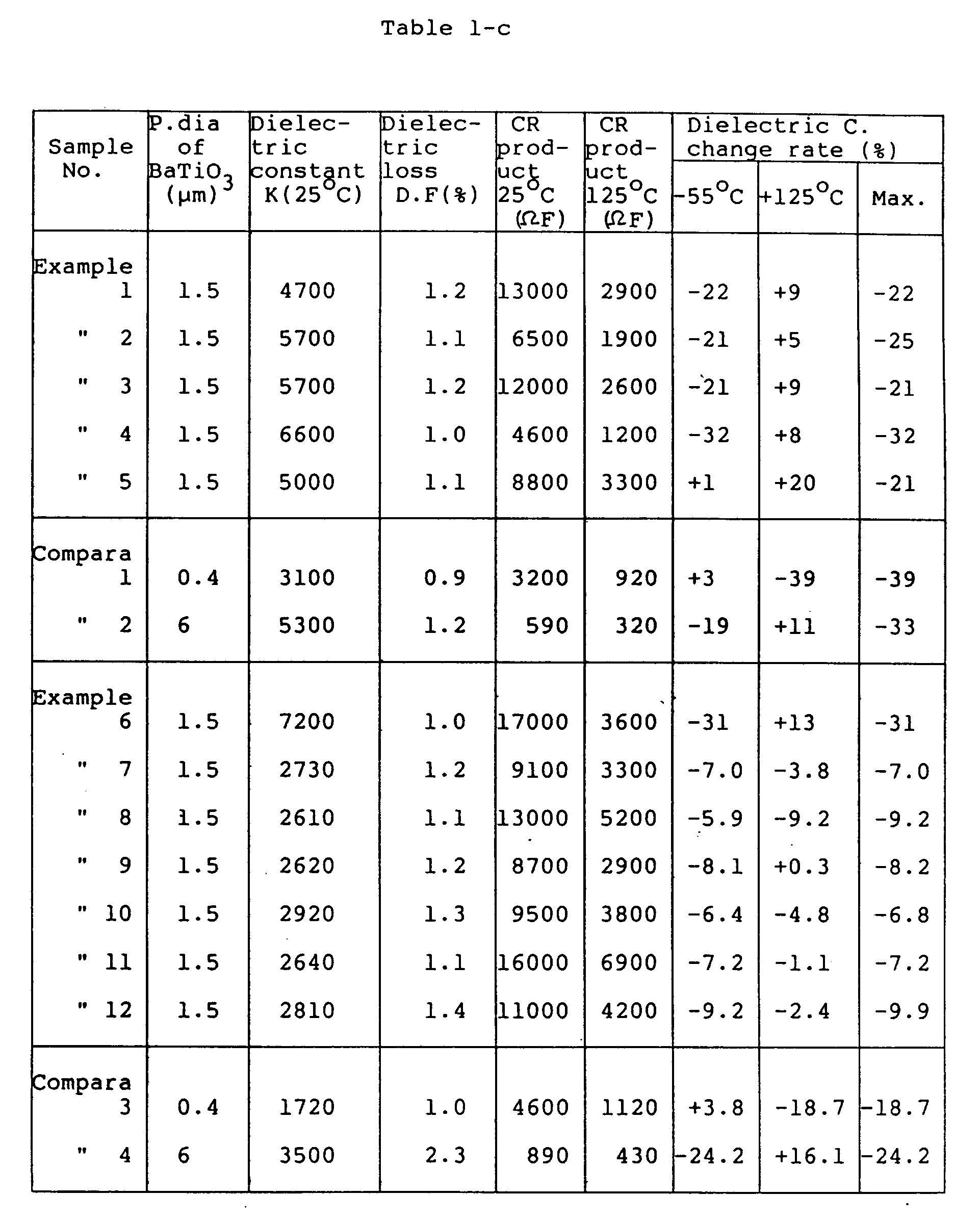
- The element was sintered in air at 1000 to 1250°C for 2 hours. (Examples 1 to 6 and Comparative Examples 1 to 2 were sintered at 1000 to 1100°C, while Examples 7 to 15 and Comparative Examples 3 to 5 were sintered at 1200 to 1250°C.) Silver electrodes were baked onto both the main surfaces to measure various characteristics. The dielectric loss (dissipation factor) and the capacitance were measured by an LCR meter at 1 kHz, 1 Vrms, and 25°C. The dielectric constants were calculated on the basis of these values. Further, the insulation resistances were calculated on the basis of values measured with an insulation resistance meter after a voltage of 100 V had been applied for 2 minutes. Further, the temperature characteristics (dependence) of the dielectric constant were expressed as the maximum change rate within a temperature range of -55 to +125°C with reference to 25°C. The capacitance and resistance product (CR product) was obtained on the basis of (relative dielectric constant) × (insulation resistance) × (dielectric constant in a vacuum) at 25 and 125°C. The insulation resistance was measured in a silicon oil to eliminate the moisture effect induced in air.
- Table 1 shows the test results of Examples 1 to 5 and 7 to 12 having composition expressed by the general formula:
(1-x)(Pb1-a-bBaaSrb)
{(Zn1/3Nb2/3)1-c-d(Mg1/3Nb2/3)cTid}O₃.xBaTiO₃
or
(Pb(1-x)(1-a-b)Ba(1-x)a+xSr(1-x)b)
{(Zn1/3Nb2/3)(1-x)(1-c-d)(Mg1/3Nb2/3)(1-x)cTi(1-x)d+x}O₃.
- For comparison, Table 1 lists the test results of Comparative Example 1 (BaTiO₃ of small particle size), Comparative Example 2 (BaTiO₃ of large particle size), and a special Example 6 (BaTiO₃ is replaced with (Ba0.9Sr0.1)TiO₃ having a Curie point 10 to 30°C lower than that of pure BaTiO₃).


- Further, Table 2 shows the test results of Examples 13 to 15 of the composition expressed by the following formula as
(1-x)(Pb1-a-bBaaSrb)
{(Zn1/3Nb2/3)1-c-d(Mg1/3Nb2/3)cTid}O₃.xBa(Ti1-eZre)O₃
or
(Pb(1-x)(1-a-b)Ba(1-x)a+xSr(1-x)b){(Zn1/3Nb2/3)(1-x)(1-c-d)
(Mg1/3Nb2/3)(1-x)cTi(1-x)d+x(1-e)Zrx.e}O₃
which includes Ba(Ti1-eZre)O₃ having a Curie point 10 to 30 degrees lower than that of pure BaTiO₃, together with Comparative Example 5.

- Table 1 indicates that the ceramic composition of the present invention have high dielectric constant (K = 4000 or more) and good temperature characteristics (+22 and -33% or less between -55 and +125°C). Further, the CR product is as large as 5000 ohm.F (25°C) or more, in particular 1000 ohm.F or more even at 125°C, being excellent in reliability at high temperature.
- Table 1 indicates that the Comparative Example 1 of BaTiO₃ with small particle size has a small dielectric constant and a wide temperature change rate. Further, in the Comparative Example 2 of BaTiO₃ with large particle size, the CR product is reduced markedly.
- Further, in the Example 6 of Ba0.9Sr0.1TiO₃ having a Curie point of about 100°C in place of BaTiO₃, excellent characteristics have also been obtained. In addition to the substitution of BaTiO₃ with Sr, compositions having a Curie point 10 to 30°C lower due to the substitution of BaTiO₃ with Ca, Ce, Zr and Sn have also shown excellent characteristics.
- Further, Tables 1 and 2 indicate that Examples 7 to 15 are high in dielectric constant (K=2300 or more) and good in temperature characteristics (within ±10% at -55 to +125°C). Further, in the Examples 13 to 15 using Ba(Ti0.95Zr0.05)O₃ in place of BaTiO₃, in particular, excellent temperature characteristics as ±7.5% or less within temperature range of -55 to +125°C can be obtained. The CR value is also as large as 8000 ohm F (25°C), and further 2500 ohm F or more at 125°C in particular, thus indicating excellent reliability at high temperature.
- The Comparative Example 5 is a composition using Ba(Ti0.88Zr0.12)O₃ in which part of Ti is substituted with 12 mol% Zr in stead of BaTiO₃. However, the change rate of the dielectric constant exceeds ±10% at high temperature. Therefore, it is preferable that the substitution rate of Zr lies within the range of the present invention. Further, the same results have been obtained by use of the composition having a Curie point 10 to 30°C lower due to substitution of part of Ti with Sn or part of Ba with Sr, Ca, Ce, without substituting BaTiO₃ with Zr.
- Further, a multilayer ceramic capacitor formed by use of composition obtained by adding 0.25 mol MnO and CoO to the Example 3 will be described hereinbelow.
- First, BaTiO₃ having the composition as described above and other calcined powder were weighed by a balance at predetermined proportion, mixed into slurry by adding an organic solvent and a binder, and formed into a 30 µm thick green sheet with a doctor blade casting machine. On this green sheet, a 70Ag/30Pd electrode paste was printed into a predetermined pattern and 20 sheets having the above electrode pattern were stacked and laminated. Thereafter, the laminated sheet was cut off into a predetermined shape, heated to burn out the binder and sintered at 1080°C for 2 H. After sintering, an Ag paste was baked as external electrodes to manufacture multilayer ceramic capacitors. The electric characteristics are listed in Table 3 below.

- The dielectric constant of the obtained multilayer ceramic capacitor was about 5700. Table 3 indicates that the characteristics are sufficiently excellent. In particular, the temperature characteristics lie within ±22% or less between -55 and +125°C, which satisfies X7S characteristics in EIA Standards.
- Further, a multilayer ceramic capacitor formed by use of composition obtained by adding 0.1 mol MnO and CoO to the Example 15 will be described hereinbelow.
- First, BaTi0.95Zr0.05O₃ having the composition as described above and other calcined powder were weighed by a balance at predetermined proportion, mixed into slurry by adding an organic solvent and a binder, and formed into a 30 µm thick green sheet with a doctor blade casting machine. On this green sheet, a 70Pd/30Ag electrode paste was printed into a predetermined pattern and 20 sheets having the above electrode pattern were stacked and laminated. Thereafter, the laminated sheet was cut off into a predetermined shape, heated to burn out the binder and sintered at 1220°C for 2 H. After sintering, an Ag paste was baked as external electrodes to manufacture multilayer ceramic capacitors. The electric characteristics are listed in Table 4 below.

- The dielectric constant of the obtained multilayer ceramic capacitor was about 2700. Table 4 indicates that the characteristics are sufficiently excellent. In particular, the temperature characteristics lie within ±7.5% or less between -55 and +125°C, which satisfies X7S characteristics in EIA Standards.
- As described above, since the method of manufacturing high dielectric constant ceramic material of the present invention can provide high dielectric constant ceramic composition excellent in various characteristics such that the dielectric constant is high and dielectric constant change rate is small over a wide temperature range, the method is effective in manufacturing multilayer ceramic capacitors, in particular. Further, in the manufacturing method of the present invention, lead zinc niobate and barium titanate have been used as the main components; however, there exist some cases where the similar effects as those in the present invention can be obtained by use of other components.
- According to the ceramic omposition and the method of the present invention, it is possible to obtain a high dielectric constant ceramic material having high insulation resistance and excellent temperature characteristics. In particular, since it is possible to obtain ceramics improving the temperature characteristics over a wide temperature range the ceramic material of the present invention is well applied to multilayer ceramic elements such as multilayer ceramic capacitors, multilayer ceramic displacement element, etc.
Claims (12)
- A high dielectric constant ceramic material, comprising a composition expressed by the following formula as
(1-x)(Pb1-a-bBaaSrb)
{(Zn1/3Nb2/3)1-c-d(Mg1/3Nb2/3)cTid}O₃.xBaTiO₃
where
0 ≦ a ≦ 0.35
0 ≦ b ≦ 0.35
0.01 ≦ a+b ≦ 0.35
0 ≦ c ≦ 0.9
0 < d ≦ 0.5
0 < c+d < 1.0
0.3 ≦ x ≦ 0.65
obtainable by sintering a mixture containing BaTiO₃ wherein at least 50 wt% BaTiO₃ is 0.7 to 3 µm in particle size. - The high dielectric constant ceramic material as set forth in claim 1, wherein 0.3 ≦ x ≦ 0.5 and 0 < c ≦ 0.9 for providing a lower sintering temperature.
- The high dielectric constant ceramic material as set forth in claim 1, wherein 0.5 ≦ x ≦ 0.65 for providing a smaller temperature dependence upon dielectric constant.
- The high dielectric constant ceramic material as set forth in claim 1, wherein part of Ti of BaTiO₃ is substituted for by Zr as expressed by the following formula as
(1-x)(Pb1-a-bBaaSrb)
{(Zn1/3Nb2/3)1-c-d(Mg1/3Nb2/3)cTid}O₃.xBa(Tii-eZre)O₃
where
0 ≦ a ≦ 0.35
0 ≦ b ≦ 0.35
0.01 ≦ a+b ≦ 0.35
0 ≦ c ≦ 0.9
0 < d ≦ 0.5
0 < e ≦ 0.06
0.3 ≦ x ≦ 0.65
0 < c+d < 1.0 - The high dielectric constant ceramic material as set forth in claim 4, wherein 0.3 ≦ x ≦ 0.5 and 0 < c ≦ 0.9 for providing a lower sintering temperature.
- The high dielectric constant ceramic material as set forth in claim 4, wherein 0.5 ≦ x ≦ 0.65 for providing a smaller temperature dependence upon dielectric constant.
- The high dielectric constant ceramic material as set forth in claim 1, wherein part of Ti of BaTiO₃ is substituted for by Sn.
- The high dielectric constant ceramic material as set forth in claim 1, wherein part of Ba of BaTiO₃ is substituted for by Sr.
- The high dielectric constant ceramic material as set forth in claim 1, wherein part of Ba of BaTiO₃ is substituted for by Ca.
- The high dielectric constant ceramic material as set forth in claim 1, wherein part of Ba of BaTiO₃ is substituted for by Ce.
- A method of manufacturing a high dielectric constant ceramic material according to claim 1, which comprises the following steps of:(a) weighing BaCO₃ and TiO₂ at a ratio in order that barium titanate can be formed;(b) mixing and calcining the weighed BaCO₃ and TiO₂ at 1000 to 1350°C;(c) crushing the calcined barium titanate in such a way that at least 50 wt% of the barium titanate is 0.7 to 3 µm in particle size, to obtain a first compound based on barium titanate;(d) weighing oxides of Pb, Ba, Sr, Zn, Nb, Mg, and Ti at a predetermined mixture ratio;(e) mixing and calcining the weighed oxides at 700 to 900°C;(f) crushing the calcined oxides into powder having particle size smaller than 0.7 µm, to obtain a second compound of lead perovskite relaxor with perovskite structure with a Curie point of 125°C or lower;(g) weighing the first and second compounds at a predetermined ratio;(h) mixing the weighed first and second compounds;(i) forming the mixed compound into a predetermined shape; and(j) sintering the formed composition at a low temperature from 1000 to 1250°C.
- The method of manufacturing a high dielectric constant ceramic material as set forth in claim 11, which further comprises the following steps of:(a) adding a binder and a solvent to the mixed composition into a slurry;(b) casting to form a green sheet;(c) printing 70Ag/30Pd to 70Pd/30Ag electrode paste on the formed green sheet;(d) stacking and laminating the green sheets before sintering;(e) baking Ag paste or Ag/Pd paste onto the sintered body as an external electrode to fabricate a ceramic capacitor.
Applications Claiming Priority (4)
| Application Number | Priority Date | Filing Date | Title |
|---|---|---|---|
| JP199963/86 | 1986-08-28 | ||
| JP19996386 | 1986-08-28 | ||
| JP167034/87 | 1987-07-06 | ||
| JP62167034A JPS63156062A (en) | 1986-08-28 | 1987-07-06 | High permittivity ceramic composition and manufacture |
Publications (3)
| Publication Number | Publication Date |
|---|---|
| EP0257653A2 EP0257653A2 (en) | 1988-03-02 |
| EP0257653A3 EP0257653A3 (en) | 1989-07-12 |
| EP0257653B1 true EP0257653B1 (en) | 1992-11-04 |
Family
ID=26491200
Family Applications (1)
| Application Number | Title | Priority Date | Filing Date |
|---|---|---|---|
| EP87112546A Expired - Lifetime EP0257653B1 (en) | 1986-08-28 | 1987-08-28 | High dielectric constant ceramic material and method of manufacturing the same |
Country Status (3)
| Country | Link |
|---|---|
| US (1) | US4767732A (en) |
| EP (1) | EP0257653B1 (en) |
| DE (1) | DE3782470T2 (en) |
Cited By (3)
| Publication number | Priority date | Publication date | Assignee | Title |
|---|---|---|---|---|
| DE102007054212A1 (en) | 2007-11-12 | 2009-05-14 | Grochowski, Horst, Dr. | Fluid treatment assembly, e.g. for cleaning large volumes of exhaust gases, has neighboring material beds working in parallel with a common charging channel and moving charging trolley |
| DE202008015019U1 (en) | 2008-05-15 | 2009-09-24 | Grochowski, Horst, Dr. | Fluid treatment plant with counterflow operated bulk beds |
| CN109180178A (en) * | 2018-10-10 | 2019-01-11 | 中国科学院上海硅酸盐研究所 | A kind of barium-strontium titanate-based unleaded relaxation ferroelectric ceramic of high energy storage density and preparation method thereof |
Families Citing this family (27)
| Publication number | Priority date | Publication date | Assignee | Title |
|---|---|---|---|---|
| US5032558A (en) * | 1987-10-09 | 1991-07-16 | Martin Marietta Corporation | Electrostrictive ceramic material including a process for the preparation thereof and applications thereof |
| US5023032A (en) * | 1987-10-09 | 1991-06-11 | Martin Marietta Corporation | Electrostrictive ceramic material including a process for the preparation thereof and applications therefor |
| JP2681214B2 (en) * | 1988-05-11 | 1997-11-26 | 堺化学工業株式会社 | Composition for ceramic dielectric, ceramic dielectric obtained by using the same, and method for producing the same |
| JPH0692268B2 (en) * | 1988-06-03 | 1994-11-16 | 日本油脂株式会社 | Reduction-reoxidation type semiconductor ceramic capacitor element |
| US5016137A (en) * | 1988-12-05 | 1991-05-14 | Matsushita Electric Industrial Co., Ltd. | Multi-layer ceramic capacitor |
| US4988651A (en) * | 1989-10-27 | 1991-01-29 | Murata Manufacturing Co., Ltd. | Temperature compensating dielectric ceramic composition |
| US5202814A (en) * | 1990-03-13 | 1993-04-13 | Murata Manufacturing Co., Ltd. | Nonreducing dielectric ceramic composition |
| US5130281A (en) * | 1990-07-10 | 1992-07-14 | Murata Manufacturing Co., Ltd. | Dielectric ceramic compositions and manufacturing method of dielectric ceramics |
| US5106796A (en) * | 1991-09-13 | 1992-04-21 | E. I. Du Pont De Nemours And Company | Low-firing capacitors dielectrics |
| EP0571949A1 (en) * | 1992-05-29 | 1993-12-01 | Texas Instruments Incorporated | Pb rich perovskites for thin film dielectrics |
| US5721043A (en) * | 1992-05-29 | 1998-02-24 | Texas Instruments Incorporated | Method of forming improved thin film dielectrics by Pb doping |
| JP3479324B2 (en) * | 1993-08-19 | 2003-12-15 | 日本特殊陶業株式会社 | Microwave dielectric porcelain composition and method for producing the same |
| JP3784427B2 (en) * | 1994-01-21 | 2006-06-14 | 株式会社村田製作所 | Manufacturing method of ceramic capacitor |
| US5704810A (en) * | 1994-02-03 | 1998-01-06 | Nippon Carbide Kogyo Kabushiki Kaisha | Electrical connector with filter |
| KR970001682B1 (en) * | 1994-07-19 | 1997-02-13 | 한국과학기술연구원 | High Frequency Dielectric Self Composition and Manufacturing Method Thereof |
| US5504330A (en) * | 1994-11-22 | 1996-04-02 | Texas Instruments Incorporated | Lead substitured perovskites for thin-film pyroelectric devices |
| US5519278A (en) * | 1994-12-23 | 1996-05-21 | The United States Of America As Represented By The Secretary Of The Navy | Actuators with graded activity |
| JP2001167904A (en) | 1999-12-09 | 2001-06-22 | Murata Mfg Co Ltd | Semiconductor ceramic and electronic device using the same |
| KR100401942B1 (en) | 2000-11-17 | 2003-10-17 | 홍국선 | Dielectric Ceramic Compositions and Manufacturing Process the same |
| US6517931B1 (en) * | 2001-10-15 | 2003-02-11 | Ferro Corporation | Silver ink for forming electrodes |
| JP4700332B2 (en) * | 2003-12-05 | 2011-06-15 | イビデン株式会社 | Multilayer printed circuit board |
| US20080238803A1 (en) * | 2007-03-30 | 2008-10-02 | Yang Tsai-Yi | Extremely miniaturized fm frequency band antenna |
| CN103172363B (en) * | 2012-09-10 | 2014-08-13 | 常州大学 | Preparation method of a high dielectric constant perovskite-like CaCu3Ti4O12 (CCTO) pressure-sensitive material |
| CN112299845B (en) * | 2020-11-24 | 2023-08-04 | 厦门三行电子有限公司 | High-performance ceramic dielectric material and preparation method thereof |
| CN112479709A (en) * | 2020-12-28 | 2021-03-12 | 江苏江佳电子股份有限公司 | Ceramic with ultrahigh dielectric constant, preparation method thereof and method for preparing insulated electrode by using ceramic |
| CN113012939B (en) * | 2021-02-22 | 2022-09-09 | 四川大学 | High withstand voltage and low loss silicon-based film capacitor and preparation method thereof |
| CN115304368B (en) * | 2022-08-26 | 2023-05-12 | 广东康荣高科新材料股份有限公司 | Microwave dielectric ceramic material for positioning antenna and preparation method thereof |
Family Cites Families (7)
| Publication number | Priority date | Publication date | Assignee | Title |
|---|---|---|---|---|
| US2563307A (en) * | 1944-06-14 | 1951-08-07 | Sprague Electric Co | High dielectric ceramic material and method of making |
| JPS5551759A (en) * | 1978-10-06 | 1980-04-15 | Tdk Electronics Co Ltd | High dielectric constance ceramic composition |
| JPS55144609A (en) * | 1979-04-28 | 1980-11-11 | Tdk Electronics Co Ltd | High dielectric series porcelain composition |
| JPS5757204A (en) * | 1980-09-24 | 1982-04-06 | Showa Koji Kk | Method of measuring thickness of film formed on surface of ferromagnetic substance |
| JPS58217462A (en) * | 1982-06-08 | 1983-12-17 | 松下電器産業株式会社 | High dielectric constant ceramic composition |
| US4500942A (en) * | 1982-11-12 | 1985-02-19 | Ferro Corporation | Temperature stable monolithic capacitors and ceramic compositions for producing same |
| JPS59203759A (en) * | 1983-04-30 | 1984-11-17 | 松下電器産業株式会社 | Method for manufacturing high dielectric constant ceramic composition |
-
1987
- 1987-08-28 EP EP87112546A patent/EP0257653B1/en not_active Expired - Lifetime
- 1987-08-28 DE DE8787112546T patent/DE3782470T2/en not_active Expired - Fee Related
- 1987-08-28 US US07/090,605 patent/US4767732A/en not_active Expired - Fee Related
Cited By (3)
| Publication number | Priority date | Publication date | Assignee | Title |
|---|---|---|---|---|
| DE102007054212A1 (en) | 2007-11-12 | 2009-05-14 | Grochowski, Horst, Dr. | Fluid treatment assembly, e.g. for cleaning large volumes of exhaust gases, has neighboring material beds working in parallel with a common charging channel and moving charging trolley |
| DE202008015019U1 (en) | 2008-05-15 | 2009-09-24 | Grochowski, Horst, Dr. | Fluid treatment plant with counterflow operated bulk beds |
| CN109180178A (en) * | 2018-10-10 | 2019-01-11 | 中国科学院上海硅酸盐研究所 | A kind of barium-strontium titanate-based unleaded relaxation ferroelectric ceramic of high energy storage density and preparation method thereof |
Also Published As
| Publication number | Publication date |
|---|---|
| DE3782470D1 (en) | 1992-12-10 |
| US4767732A (en) | 1988-08-30 |
| EP0257653A2 (en) | 1988-03-02 |
| EP0257653A3 (en) | 1989-07-12 |
| DE3782470T2 (en) | 1993-04-15 |
Similar Documents
| Publication | Publication Date | Title |
|---|---|---|
| EP0257653B1 (en) | High dielectric constant ceramic material and method of manufacturing the same | |
| JP3046436B2 (en) | Ceramic capacitors | |
| KR100313234B1 (en) | Dielectric Ceramic Composition and Laminated Ceramic Capacitor | |
| JP4491794B2 (en) | Dielectric ceramic and multilayer ceramic capacitor | |
| US6310761B1 (en) | Dielectric ceramic composition and monolithic ceramic capacitor | |
| US6225250B1 (en) | Dielectric ceramic composition | |
| US5296425A (en) | Ceramic materials of improved dielectric constants, and capacitors fabricated therefrom | |
| EP0780349A2 (en) | Dielectric ceramic composition and use thereof for a monolithic capacitor | |
| EP0534378A1 (en) | Non-reducible dielectric ceramic composition | |
| EP0905724B1 (en) | Dielectric ceramic composition and monolithic ceramic capacitor using the composition | |
| US6734127B2 (en) | Ceramic materials for capacitors with a high dielectric constant and a low capacitance change with temperature | |
| JPH0785460B2 (en) | Multilayer porcelain capacitor | |
| JP3634930B2 (en) | Dielectric porcelain composition | |
| KR890002696B1 (en) | High dielectric constant ceramic material and manufacturing method | |
| JPH05190376A (en) | Ceramic capacitors | |
| EP0631996B1 (en) | Dielectric ceramic composition | |
| US4700267A (en) | Low temperature sintered ceramic capacitor with a temperature compensating capability, and method of manufacture | |
| JPH0987014A (en) | Method for producing high dielectric constant porcelain composition | |
| JP2872513B2 (en) | Dielectric porcelain and porcelain capacitor | |
| JP3228649B2 (en) | Dielectric porcelain composition | |
| JP2694975B2 (en) | Method for producing high dielectric constant porcelain composition | |
| JP3389947B2 (en) | Dielectric ceramic composition and thick film capacitor using the same | |
| KR100568279B1 (en) | Reducing Resistance Dielectric Self Composition, Multilayer Ceramic Capacitor Using the Same and Method for Manufacturing the Same | |
| JPH0684691A (en) | Dielectric ceramic and ceramic capacitor | |
| JPH0589723A (en) | Dielectric porcelain composition |
Legal Events
| Date | Code | Title | Description |
|---|---|---|---|
| PUAI | Public reference made under article 153(3) epc to a published international application that has entered the european phase |
Free format text: ORIGINAL CODE: 0009012 |
|
| AK | Designated contracting states |
Kind code of ref document: A2 Designated state(s): DE FR GB |
|
| 17P | Request for examination filed |
Effective date: 19880205 |
|
| PUAL | Search report despatched |
Free format text: ORIGINAL CODE: 0009013 |
|
| AK | Designated contracting states |
Kind code of ref document: A3 Designated state(s): DE FR GB |
|
| 17Q | First examination report despatched |
Effective date: 19910515 |
|
| GRAA | (expected) grant |
Free format text: ORIGINAL CODE: 0009210 |
|
| AK | Designated contracting states |
Kind code of ref document: B1 Designated state(s): DE FR GB |
|
| PG25 | Lapsed in a contracting state [announced via postgrant information from national office to epo] |
Ref country code: FR Effective date: 19921104 |
|
| REF | Corresponds to: |
Ref document number: 3782470 Country of ref document: DE Date of ref document: 19921210 |
|
| EN | Fr: translation not filed | ||
| PLBE | No opposition filed within time limit |
Free format text: ORIGINAL CODE: 0009261 |
|
| STAA | Information on the status of an ep patent application or granted ep patent |
Free format text: STATUS: NO OPPOSITION FILED WITHIN TIME LIMIT |
|
| 26N | No opposition filed | ||
| PGFP | Annual fee paid to national office [announced via postgrant information from national office to epo] |
Ref country code: DE Payment date: 19960906 Year of fee payment: 10 |
|
| PG25 | Lapsed in a contracting state [announced via postgrant information from national office to epo] |
Ref country code: DE Free format text: LAPSE BECAUSE OF NON-PAYMENT OF DUE FEES Effective date: 19980501 |
|
| PGFP | Annual fee paid to national office [announced via postgrant information from national office to epo] |
Ref country code: GB Payment date: 19980819 Year of fee payment: 12 |
|
| REG | Reference to a national code |
Ref country code: GB Ref legal event code: 746 Effective date: 19981026 |
|
| PG25 | Lapsed in a contracting state [announced via postgrant information from national office to epo] |
Ref country code: GB Free format text: LAPSE BECAUSE OF NON-PAYMENT OF DUE FEES Effective date: 19990828 |
|
| GBPC | Gb: european patent ceased through non-payment of renewal fee |
Effective date: 19990828 |