EP0257541B1 - Chemilumineszierende Acridin-derivate und ihre Verwendung in Lumineszenzimmunoassays - Google Patents
Chemilumineszierende Acridin-derivate und ihre Verwendung in Lumineszenzimmunoassays Download PDFInfo
- Publication number
- EP0257541B1 EP0257541B1 EP87112022A EP87112022A EP0257541B1 EP 0257541 B1 EP0257541 B1 EP 0257541B1 EP 87112022 A EP87112022 A EP 87112022A EP 87112022 A EP87112022 A EP 87112022A EP 0257541 B1 EP0257541 B1 EP 0257541B1
- Authority
- EP
- European Patent Office
- Prior art keywords
- conjugate
- group
- formula
- sample
- antibody
- Prior art date
- Legal status (The legal status is an assumption and is not a legal conclusion. Google has not performed a legal analysis and makes no representation as to the accuracy of the status listed.)
- Expired - Lifetime
Links
Images


Classifications
-
- C—CHEMISTRY; METALLURGY
- C07—ORGANIC CHEMISTRY
- C07D—HETEROCYCLIC COMPOUNDS
- C07D401/00—Heterocyclic compounds containing two or more hetero rings, having nitrogen atoms as the only ring hetero atoms, at least one ring being a six-membered ring with only one nitrogen atom
- C07D401/02—Heterocyclic compounds containing two or more hetero rings, having nitrogen atoms as the only ring hetero atoms, at least one ring being a six-membered ring with only one nitrogen atom containing two hetero rings
- C07D401/12—Heterocyclic compounds containing two or more hetero rings, having nitrogen atoms as the only ring hetero atoms, at least one ring being a six-membered ring with only one nitrogen atom containing two hetero rings linked by a chain containing hetero atoms as chain links
-
- C—CHEMISTRY; METALLURGY
- C07—ORGANIC CHEMISTRY
- C07D—HETEROCYCLIC COMPOUNDS
- C07D219/00—Heterocyclic compounds containing acridine or hydrogenated acridine ring systems
- C07D219/04—Heterocyclic compounds containing acridine or hydrogenated acridine ring systems with hetero atoms or with carbon atoms having three bonds to hetero atoms with at the most one bond to halogen, e.g. ester or nitrile radicals, directly attached to carbon atoms of the ring system
-
- G—PHYSICS
- G01—MEASURING; TESTING
- G01N—INVESTIGATING OR ANALYSING MATERIALS BY DETERMINING THEIR CHEMICAL OR PHYSICAL PROPERTIES
- G01N33/00—Investigating or analysing materials by specific methods not covered by groups G01N1/00 - G01N31/00
- G01N33/48—Biological material, e.g. blood, urine; Haemocytometers
- G01N33/50—Chemical analysis of biological material, e.g. blood, urine; Testing involving biospecific ligand binding methods; Immunological testing
- G01N33/53—Immunoassay; Biospecific binding assay; Materials therefor
- G01N33/531—Production of immunochemical test materials
- G01N33/532—Production of labelled immunochemicals
- G01N33/533—Production of labelled immunochemicals with fluorescent label
-
- G—PHYSICS
- G01—MEASURING; TESTING
- G01N—INVESTIGATING OR ANALYSING MATERIALS BY DETERMINING THEIR CHEMICAL OR PHYSICAL PROPERTIES
- G01N33/00—Investigating or analysing materials by specific methods not covered by groups G01N1/00 - G01N31/00
- G01N33/48—Biological material, e.g. blood, urine; Haemocytometers
- G01N33/50—Chemical analysis of biological material, e.g. blood, urine; Testing involving biospecific ligand binding methods; Immunological testing
- G01N33/58—Chemical analysis of biological material, e.g. blood, urine; Testing involving biospecific ligand binding methods; Immunological testing involving labelled substances
- G01N33/582—Chemical analysis of biological material, e.g. blood, urine; Testing involving biospecific ligand binding methods; Immunological testing involving labelled substances with fluorescent label
Definitions
- Luminescent compounds are already used in a variety of ways. They are used as indicators in bioassays, enzyme immunoassays and luminescence immunoassays (cf. WP Collins “Alternative Immunoassays", published by John Wiley & Sons Ltd., Chichester, 1985), but are also used in nucleic acid hybridization assays (cf. JA Matthews et al. "Analytical Biochemistry", 151, 205-209, 1985). In addition, chemiluminescent compounds are used in flow injection analysis, in post-column detectors in liquid chromatography, in flow research and in artificial light sources.
- acridinium ester compounds have also been used as chemiluminescent labeling substances found.
- Such acridinium esters are known from US Pat. No. 3,352,791, British Patents 1,316,363 and 1,461,877 and from European Patent Application 82,636.
- the use of acridinium esters as labeling substances in immunoassays is described in Weeks et al., Clin. Chem. 29/8 (1983), 1474-1479.
- the use of phenanthridinium esters as labeling substances in luminescence immunoassays is also already known from European patent application 170 415.
- chemiluminescence of acridinium esters can be started by adding an alkaline H2O2 solution.
- F. McCapra Acc. Chem. Res. 9, 201, 1976, gave a convincing explanation.
- the nature of the leaving group is obviously decisive both for the light quantum yield and for the hydrolytic stability.
- acridinium esters have the advantage over the luminol and isoluminol compounds of a higher light quantum yield, which is also not impaired by proteins bound to the indicator (cf. Weeks et al., Clin. Chem. 29/8 (1983), 1474- 1479).
- the acridinium phenyl esters known from European patent application 82 636 are characterized by a high sensitivity of detection when chemiluminescence is stimulated by mild oxidizing agents, they have disadvantages which are disruptive for practical use. Above all, the phenyl ester bond in aqueous systems is very unstable even at room temperature. In addition, under the oxidation conditions specified there, the acridinium phenyl esters show a light emission which has largely decayed, ie more than 95%, only after about 10 seconds. In comparison, other non-isotopic assay methods have much shorter measuring times and thus enable a higher sample throughput.
- R1 is hydrogen, an alkyl, alkenyl or alkynyl radical with 1 to 10 carbon atoms, a benzyl, phenyl or naphthyl group
- R2 and R3 is hydrogen, an alkyl group with 1 to 4 carbon atoms, an unsubstituted amino group or a C1-C4 Is alkyl or a C1-C4 dialkylamino group, where the alkyl radicals can be monosubstituted with hydroxy and cyclic amines, such as.
- R4 is a substituted sulfonamide group of formula V.
- Thyolalkyl- or Thioarylrest of formula II - S - X - R5 (II) is, wherein X is a branched or unbranched C1-C Alk alkylene group or a phenylene or naphthylene group, which may also contain heteroatoms, and R5 is a reactive group which is selective with amino, carboxy, thiol or other under mild conditions functional groups in substances of biological interest can form a bond, and A Chem is an anion which does not impair chemiluminescence, and R6 in the formula V is an alkyl or alkenyl radical having 1 to 10 carbon atoms, one with C1-C4-alkyl mono- or is a disubstituted amino group, a morpholino, a benzyl or a phenyl or naphthyl group, which can also be substituted with hydroxyl, amino, alkoxy having 1 to 4 carbon atoms or
- the substances of biological interest are primarily antigens. This term also includes hormones, steroids, drugs, drug metabolites, toxins, alkaloids and also antibodies.
- the anion not affecting the chemiluminescence can be a tetrafluoroborate, perchlorate, halide, alkyl sulfate, halosulfonate, alkyl sulfonate or aryl sulfonate anion. Any other anion can also be used, provided it does not quench or weaken chemiluminescence.
- Aryl is understood to mean aromatic hydrocarbons, especially phenyl and naphthyl.
- Aromatic groups containing heteroatoms are understood to mean aromatic hydrocarbons which contain a nitrogen or oxygen atom, in particular quinoline, indole, pyrrole and pyridine.
- Halogens are fluorine, chlorine, bromine and iodine.
- the substituted amino groups are preferably C1-C4-alkyl or C1-C4-dialkylamines, where the alkyl radicals can in turn be monosubstituted, for example, with hydroxy.
- the substituted amines can be a morpholine residue.
- the alkoxy radicals given for R2 and R3 are preferably those with 1-4 C atoms in the alkyl part.
- the branched or unbranched aliphatic groups indicated for X are preferably C1-C5 alkylene groups.
- Acridinium derivatives are generally chosen in which X is a methylene, ethylene, propylene or an ortho, meta or para-phenylene group. To improve the water solubility of the acridinium derivatives, these groups can also carry hydrophilic substituents containing heteroatoms.
- Acridinium compounds in which R 1 is a methyl group are also preferred.
- Acridinium compounds according to the invention which have the formula IV correspond in which A and X have the meanings given above.
- the present invention thus provides two new classes of acridinium compounds, one class being distinguished by a thiolester grouping and the other by a sulfonamide structure.
- the acridinium acylsulfonamide derivatives have a higher stability, the thiolesters have a faster kinetics than the previously known acridinium phenyl ester compounds.
- Both classes of compounds are also characterized by a higher luminous efficacy.
- acridinium compounds according to the invention with thiolester-containing leaving groups over the acridinium phenyl esters known from European patent application 82 636 is the substantially faster reaction kinetics of light emission.
- the acridinium thioester according to the invention (compound 6) prepared according to Example 1 delivers a factor of 10 higher light output under the same oxidation conditions at a measurement time of 1 second. This high luminous efficiency combined with short measuring times enables a significantly higher sample throughput in the luminometer.
- FIG. 1 shows the kinetics of the light emission of an antibody conjugate of the acridinium thioester (compound 6) prepared according to Example 1 and FIG. 2 shows that of the antibody conjugate of 4- (2-succinimidyl-oxycarbonylethyl) phenyl-10-methylacridinium-9-carboxylate.
- methosulfate European patent application 82 636, page 10
- 100 ⁇ l of the respective tracer solutions are excited to chemiluminescence by adding 350 ⁇ l 0.05 m KCl / NaOH buffer pH 13 + 0.1% H2O2 and recorded over a period of 10 seconds.
- acridinium-9-carboxylic acid thioesters can be prepared in the following way:
- R2 / R3-substituted acridine derivatives can be easily synthesized by methods known from the literature. Such syntheses are described, for example, in: Comprehensive Heterocyclic Chemistry; Editors A. Katritzky, CW Rees, Vol. 2, pp. 395ff, Pergamon Press, 1984 or Heterocyclic Compounds, Vol. 9, Acridines and Cond. 2 nd Edition, RM Acheson, John Wiley and Sons., 1973
- the acid chloride (VIII) is then reacted with a thiolcarboxylic acid of the formula IX, HS - X - COOH (IX) reacted, for example, with 2-mercaptobenzoic acid under alkaline conditions to give thiolestercarboxylic acid, which is then esterified with a compound suitable for the preparation of the remainder R5, for example with N-hydroxysuccinimide.
- the acridine compound is then alkylated in the 10-position by methods known from the literature.
- Trimethyloxonium tetrafluoroborate is particularly suitable for methylation, but good yields of the chemiluminescent acridinium compound are also obtained with dimethyl sulfate, methyl fluorosulfonate, methyl toluenesulfonate or methyl trifluoromethanesulfonate.
- Acridine-9-carboxylic acid chloride (VIII) is also used to prepare the acridinium sulfonamide derivatives according to the invention.
- This compound is then mixed with a primary or secondary sulfonamide, preferably with a protected sulfonamide carboxylic acid of the formula X. or the formula XI implemented, in which X and R6 have the meanings given above and Z is a radical protecting the carboxy group, which is then split off.
- the N-benzenesulfonylglycine benzyl ester can be used as a protective group for this reaction.
- the acid which is formed after the protective group has been removed is then converted into the remainder of R5 with a suitable compound, for example with N-hydroxysuccinimide.
- a suitable compound for example with N-hydroxysuccinimide.
- the chemiluminescent acridinium compound is obtained by processes known from the literature by alkylation on nitrogen in the 10-position.
- the acridinium compounds obtained can then be mixed with a substance of biological interest, e.g. convert an antigen, an antibody, a hormone, a drug, a drug metabolite, a toxin or an alkaloid into a luminescent compound.
- a substance of biological interest e.g. convert an antigen, an antibody, a hormone, a drug, a drug metabolite, a toxin or an alkaloid into a luminescent compound.
- the acridinium derivative is bound either directly or via a bridging molecule such as polylysine, polyglutamic acid or polyvinylamine to the biologically interesting substance to form a stable, immunologically active conjugate.
- This conjugate is also called a tracer and is used in the luminescence immunoassays described below.
- the luminescence immunoassay according to the invention for the determination of an antigenic substance in a liquid sample according to a competitive or a sandwich method, at least one immunologically active component is required which is immobilized on a solid phase and also the luminescent tracer.
- the luminescence immunoassay can now be carried out in various ways.
- the immobilized antibody reacting specifically with the antigen is incubated with a sample of the liquid to be examined and a conjugate of the antigen and a chemiluminescent acridinium derivative (antigen tracer), the sample and the unbound tracer are separated, the bound Matches the tracer with an oxidant to cause light emission, and then from the measured one Strength of light emission determines the amount of antigen present.
- luminescence immunoassay Another possibility for carrying out the luminescence immunoassay is that an immobilized antibody reacting specifically with the antigen is incubated with a sample of the liquid to be examined, with a conjugate of a second, specifically reacting antibody and a chemiluminescent acridinium derivative, the sample and separates the unbound, labeled conjugate, combines the bound, labeled conjugate with an oxidizing agent to produce light emission, and determines the amount of antigen present from the measured strength of the light emission.
- the above-mentioned luminescence immunoassays can also be carried out by separating the liquid to be examined from the immobilized antibody before adding the labeled conjugate.
- luminescence immunoassays that can be carried out according to the invention, it is not the antibody but the antigen that is immobilized.
- an immobilized antigen reacting specifically with the antibody can be incubated with a sample of the liquid to be examined and a solution of a conjugate of the antibody and a chemiluminescent acridinium derivative, then the sample and the unbound labeled conjugate can be separated and then the bound, labeled conjugate can also be separated an oxidizing agent are brought together. Then a light emission occurs, from the strength of which the amount of antigen present can be determined.
- Another variant consists in that an immobilized antigen reacting specifically with the antibody incubated with a solution of a conjugate of the antibody and a chemiluminescent acridinium derivative which separates the unreacted, labeled conjugate, adds a sample to the liquid to be examined, then separates the sample again, brings the bound, labeled conjugate together with an oxidizing agent to produce light emission and from this then determines the amount of antigen present.
- the luminescence immunoassay can also be carried out by incubating an immobilized antigen specifically reacting with the antibody with a solution of a conjugate of the antibody and a chemiluminescent acridinium derivative, adding a sample of the liquid to be examined, the sample and the unbound conjugate separates, combines the bound, labeled conjugate with an oxidizing agent and then determines the amount of antigen present from the measured light emission.
- N-hydroxysuccinimide 3.2 g are added at 0 ° C. to the suspension of 10 g of thiolestercarboxylic acid in 190 ml of dry tetrahydrofuran, then 6.9 g of dicyclohexylcarbodiimide (DCC) at ⁇ 20 ° C., and the mixture is left at ⁇ 20 ° C. for 2 hours, then stir overnight at room temperature. After adding 0.28 ml of glacial acetic acid, the mixture is stirred for 1 hour, then ethyl acetate (25 ml) is added and the precipitate is filtered off.
- DCC dicyclohexylcarbodiimide
- N-hydroxysuccinimide ester ( 5 ) 3 g are heated for 8 hours at 80 ° C. with 7.8 g of trimethyloxonium tetrafluoroborate in 40 ml of 1,2-dichloroethane and the mixture is stirred overnight at room temperature. The precipitate is filtered off and with Boiled 1,2-dichloroethane. The combined organic phases are concentrated and recrystallized from acetone-diisopropyl ether.
- Succinimidoyloxycarbonylmethyl-10-methylacridinium-9-thiocarboxylate tetrafluoroborate is prepared from acid chloride ( 3 ) and thioglycolic acid analogously to the synthesis of ( 6 ).
- the yields of the individual synthesis steps and the spectroscopic characterization of products ( 7 ) to ( 9 ) are given below:
- N- (4-methoxyphenyl) -N- (4-succinimidoyloxycarbonylbenzenesulfonyl) -10-methylacridinium-9-carboxamide-fluorosulfonate (21) starting from 4- [N- (4 ⁇ -methoxyphenyl) sulfamido] benzoic acid benzyl ester and acridine- 9-carboxylic acid chloride hydrochloride (3) is carried out analogously to the synthesis of (17) (see Example 4). The yields of the individual synthesis steps and the spectroscopic characterization are given below.
- the individual fractions are tested for their chemiluminescent activity after suitable dilution (350 ul oxidizing agent: 0.1% H2O2 in 0.1 N NaOH).
- the tracer fractions (1st activity peak) are pooled and stored at 4 ° C.
- FIG. 3 shows the typical course of a standard curve of an immuno-chemiluminometric assay (ICMA) for the alpha-fetoprotein (AFP).
- ICMA immuno-chemiluminometric assay
Landscapes
- Health & Medical Sciences (AREA)
- Chemical & Material Sciences (AREA)
- Life Sciences & Earth Sciences (AREA)
- Immunology (AREA)
- Organic Chemistry (AREA)
- Engineering & Computer Science (AREA)
- Molecular Biology (AREA)
- Biomedical Technology (AREA)
- Urology & Nephrology (AREA)
- Hematology (AREA)
- Medicinal Chemistry (AREA)
- Cell Biology (AREA)
- Food Science & Technology (AREA)
- Biotechnology (AREA)
- Physics & Mathematics (AREA)
- Analytical Chemistry (AREA)
- Biochemistry (AREA)
- General Health & Medical Sciences (AREA)
- General Physics & Mathematics (AREA)
- Pathology (AREA)
- Microbiology (AREA)
- Plural Heterocyclic Compounds (AREA)
- Investigating Or Analysing Materials By The Use Of Chemical Reactions (AREA)
- Luminescent Compositions (AREA)
- Pyridine Compounds (AREA)
- Pharmaceuticals Containing Other Organic And Inorganic Compounds (AREA)
- Saccharide Compounds (AREA)
- Pyrane Compounds (AREA)
- Investigating Or Analyzing Non-Biological Materials By The Use Of Chemical Means (AREA)
- Enzymes And Modification Thereof (AREA)
- Liquid Crystal Substances (AREA)
Description
- Lumineszierende Verbindungen finden bereits vielseitige Anwendung. Sie werden als Indikatoren in Bioassays, Enzymimmunoassays und Lumineszenzimmunoassays eingesetzt (vgl. W.P. Collins "Alternative Immunoassays", Verlag John Wiley & Sons Ltd., Chichester, 1985), werden aber auch in Nukleinsäure-Hybridisierungsassays verwendet (vgl. J.A. Matthews et al. "Analytical Biochemistry", 151, 205-209, 1985). Außerdem werden chemilumineszierende Verbindungen bei der "flow injection analysis", in post-column-Detektoren in der Flüssigkeitschromatographie, in der Strömungsforschung und in künstlichen Lichtquellen eingesetzt.
- Bei den Chemilumineszenzimmunoassays haben insbesondere zwei Strukturtypen von chemilumineszierenden Markierungssubstanzen größere Bedeutung erlangt. Es handelt sich hierbei einerseits um die Luminol- bzw. Isoluminolderivate, die bei H.R. Schroeder et al., "Methods in Enzymology", Academic Press Inc., New York, Vol. LVII, 1978, 424 ff sowie in den britischen Patenten 2 008 247 und 2 041 920, den deutschen Patentschriften 26 18 419 und 26 18 511, sowie in der europäischen Patentanmeldung 135 071 beschrieben sind. Einen Überblick über die praktische Anwendung der Isoluminolverbindungen als Lumineszenzindikatoren findet man bei W.G. Wood, J. Clin.Chem. Clin. Biochem. 22, 1984 905-918.
- Andererseits haben auch Acridiniumesterverbindungen als chemilumineszierende Markierungssubstanzen Anwendung gefunden. Derartige Acridiniumester sind aus dem US-Patent 3 352 791, den britischen Patenten 1 316 363 und 1 461 877 sowie aus der europäischen Patentanmeldung 82 636 bekannt. Die Anwendung der Acridiniumester als Markierungssubstanzen in Immunoassays ist bei Weeks et al., Clin. Chem. 29/8 (1983), 1474-1479, beschrieben. Auch die Verwendung von Phenanthridiniumestern als Markierungssubstanz in Lumineszenzimmunoassays ist aus der europäischen Patentanmeldung 170 415 bereits bekannt.
- Die Chemilumineszenz von Acridiniumestern kann durch Zugabe von Alkalischer H₂O₂-Lösung gestartet werden. Für den Mechanismus der Chemilumineszenz hat F. McCapra, Acc.Chem. Res. 9, 201, 1976, eine überzeugende Erklärung gegeben. Dabei ist offensichtlich die Art der Abgangsgruppe sowohl für die Lichtquantenausbeute als auch für die hydrolytische Stabilität entscheidend.
- Die bisher schon bekannten Acridiniumester haben gegenüber den Luminol- und Isoluminolverbindungen den Vorteil einer höheren Lichtquantenausbeute, die auch durch an den Indikator gebundene Proteine nicht beeinträchtigt wird (vgl. Weeks et al., Clin. Chem. 29/8 (1983), 1474-1479).
- Obwohl die aus der europäischen Patentanmeldung 82 636 bekannten Acridiniumphenylester bei Anregung der Chemilumineszenz durch milde Oxidationsmittel sich durch eine hohe Nachweisempfindlichkeit auszeichnen, weisen sie für die praktische Anwendung störende Nachteile auf. Vor allem ist die Phenylesterbindung in wäßrigen Systemen auch schon bei Raumtemperatur sehr labil. Hinzu kommt, daß unter den dort angegebenen Oxidationsbedingungen die Acridiniumphenylester eine Lichtemission zeigen, die erst nach etwa 10 Sekunden weitgehend, d.h. zu über 95 %, abgeklungen ist. Im Vergleich dazu haben andere nicht isotopische Assayverfahren weitaus kürzere Meßzeiten und ermöglichen dadurch einen höheren Probendurchsatz.
- Aufgabe der vorliegenden Erfindung war es deshalb, neue Acridiniumderivate zur Verfügung zu stellen, die bei hoher Lichtquantenausbeute eine schnellere Reaktionskinetik aufweisen und damit kurze Meßzeiten für einen Lumineszenzimmunoassay ermöglichen
Es wurde nun gefunden, daß diese Anforderungen erfüllt werden von chemilumineszierenden Acridiniumderivaten der Formel I
in der R¹ Wasserstoff, ein Alkyl-, Alkenyl- oder Alkinylrest mit 1 bis 10 Kohlanstoffatomen, eine Benzyl-, Phenyl- oder Naphthylgruppe ist, R² und R³ Wasserstoff, eine Alkylgruppe mit 1 bis 4 Kohlenstoffatomen, eine unsubstituierte Aminogruppe oder eine C₁-C₄ Alkyl- oder eine C₁-C₄ Dialkylaminogruppe ist, wobei die Alkylreste mit Hydroxy monosubstituiert sein können sowie zyklische Amine, wie z. B. Morpholin, eine Carboxy-, Alkoxy-, Cyano-, Nitrogruppe oder Halogen sind, R⁴ eine substituierte Sulfonamidgruppe der Formel V
oder der Formel VI
ist, oder ein Thyolalkyl- oder Thioarylrest der Formel II
- S - X - R⁵ (II)
ist, wobei X eine verzweigte oder unverzweigte C₁-C₅-Alkylengruppe oder eine Phenylen- oder Naphthylengruppe ist, die auch Heteroatome enthalten kann, und R⁵ eine reaktive Gruppe ist, die unter schonenden Bedingungen selektiv mit Amino-, Carboxy-, Thiol- oder anderen funktionellen Gruppen in Substanzen von biologischem Interesse eine Bindung eingehen kann, und A⊖ ein die Chemolumineszenz nicht beeinträchtigendes Anion ist, und R⁶ in der Formel V ein Alkyl- oder Alkenylrest mit 1 bis 10 Kohlenstoffatomen, eine mit C₁-C₄-Alkyl mono- oder disubstituierte Aminogruppe, eine Morpholino-, eine Benzyl- oder eine Phenyl- oder Naphthylgruppe ist, die auch mit Hydroxy, Amino, Alkoxy mit 1 bis 4 Kohlenstoffatomen oder Phenoxy- oder Naphthoxygruppen substituiert sein können und R⁶ in der Formel VI zusätzlich zu den genannten Substituenten auch noch Wasserstoff bedeuten kann. - Unter den Substanzen von biologischem Interesse sind vor allem Antigene zu verstehen. Unter diesen Begriff fallen auch Hormone, Steroide, Arzneimittel, Arzneimittelmetabolite Toxine, Alkaloide und auch Antikörper.
- Das die Chemilumineszenz nicht beeinträchtigende Anion kann ein Tetrafluoroborat-, Perchlorat-, Halogenid-, Alkylsulfat-, Halosulfonat-, Alkylsulfonat- oder Arylsulfonat-Anion sein. Auch jedes andere Anion kann eingesetzt werden, sofern es die Chemilumineszenz nicht löscht oder abschwächt.
- Unter Aryl werden aromatische Kohlenwasserstoffe verstanden, insbesondere Phenyl und Naphthyl. Unter Heteroatome enthaltenden aromatischen Gruppen werden aromatische Kohlenwasserstoffe verstanden, die ein Stickstoff- oder Sauerstoffatom enthalten, insbesondere Chinolin, Indol, Pyrrol und Pyridin.
Unter Halogenen werden Fluor, Chlor, Brom und Jod verstanden. - Die substituierten Aminogruppen sind bevorzugt C₁-C₄-Alkyl-oder C₁-C₄-Dialkylamine, wobei die Alkylreste ihrerseits beispielsweise mit Hydroxy monosubstituiert sein können. Ebenso kann es sich bei den substituierten Aminen um einen Morpholinrest handeln. Die für R² und R³ angegebenen Alkoxyreste sind bevorzugt solche mit 1-4 C-Atomen im Alkylteil.
- Die für X angegebenen verzweigten oder unverzweigten aliphatischen Gruppen sind bevorzugt C₁-C₅-Alkylengruppen.
- Im allgemeinen werden Acridiniumderivate gewählt, in denen X eine Methylen-, Äthylen-, Propylen- oder eine ortho-, meta- oder para-Phenylengruppe ist. Zur Verbesserung der Wasserlöslichkeit der Acridiniumderivate können diese Gruppen auch Heteroatome enthaltende, hydrophile Substituenten tragen.
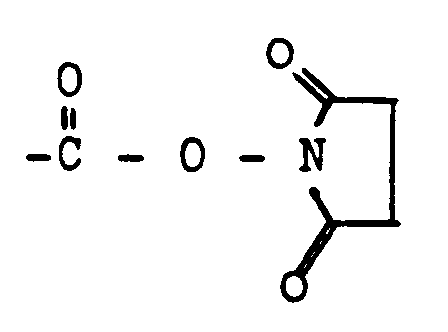
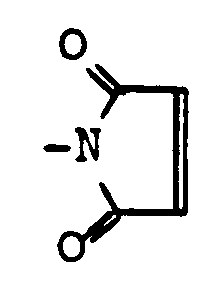
- Von besonderer Bedeutung für die Einsatzmöglichkeiten der erfindungsgemäßen Acridiniumderivate ist der Substituent R⁵. Durch die geeignete Auswahl dieser Gruppe erhält das Acridinderivat eine so hohe Reaktivität, daß es schon unter milden Bedingungen selektiv mit einer funktionellen Gruppe der nachzuweisenden biologischen Substanz eine Bindung eingehen kann. Geeignete reaktive Gruppen sind aus der folgenden Zusammenstellung zu ersehen:
- a)
- b)

- c)

- d) -SO₂ - CH = CH₂
- e)

- f) -N = C = S
- g)

- h)

- i)
- k)

- l)

- m)

- n)

- Außerdem werden auch Acridiniumverbindungen bevorzugt, in denen R¹ eine Methylgruppe ist. Besonders häufig werden deshalb erfindungsgemäße Acridiniumverbindungen eingesetzt, die der Formel IV

entsprechen, in denen A und X die vorstehend genannten Bedeutungen haben. - Typische Vertreter dieser erfindungsgemäßen Klasse von Acridiniumderivaten entsprechen der Formel VII

in der A und X die obengenannten Bedeutungen haben. - Durch die vorliegende Erfindung werden also zwei neue Klassen von Acridiniumverbindungen zur Verfügung gestellt, wobei die eine Klasse durch eine Thiolestergruppierung und die andere durch eine Sulfonamidstruktur sich auszeichnen. Die Acridiniumacylsulfonamid-Derivate weisen eine höhere Stabilität, die Thiolester eine schnellere Kinetik als die bisher bekannten Acridiniumphenylester-Verbindungen auf. Beide Verbindungsklassen zeichnen sich außerdem durch eine höhere Lichtausbeute aus.
- Ein bedeutender Vorteil der erfindungsgemäßen Acridiniumverbindungen mit thiolesterhaltigen Abgangsgruppen gegenüber den aus der Europäischen Patentanmeldung 82 636 bekannten Acridiniumphenylestern liegt in der wesentlichen schnelleren Reaktionskinetik der Lichtemission. So liefert der nach Beispiel 1 hergestellte erfindungsgemäße Acridiniumthioester (Verbindung 6) bei 1 Sekunde Meßzeit eine um den Faktor 10 höhere Lichtausbeute unter den gleichen Oxidationsbedingungen. Diese hohe Lichtausbeute bei gleichzeitig kurzen Meßzeiten ermöglicht einen wesentlich höheren Probendurchsatz im Luminometer.
- So zeigt Fig. 1 die Kinetik der Lichtemission eines Antikörperkonjugates des nach Beispiel 1 hergestellten Acridiniumthioesters (Verbindung 6)) und Fig. 2 die des Antikörperkonjugates des 4-(2-Succinimidyl-oxycarbonylethyl)-phenyl-10-methylacridinium-9-carboxylat-methosulfats (Europäische Patentanmeldung 82 636, Seite 10). 100 µl der jeweiligen Tracerlösungen werden durch Zugabe von 350 µl 0.05 m KCl/NaOH-Puffer pH 13 + 0.1 % H₂O₂ zur Chemilumineszenz angeregt und über einen Zeitraum von 10 Sekunden aufgezeichnet.
- In Fig. 1 wird die maximale Lichtemission schon nach 0,66 Sekunden erreicht und ist nach 0,88 Sekunden schon wieder auf die Hälfte abgefallen. Demgegenüber wird in Fig. 2 die maximale Lichtemission erst nach 1,77 Sekunden erreicht und ist nach 2,88 Sekunden erst wieder auf die Hälfte abgefallen.
- Völlig unerwartet ist, daß am Amidstickstoff sulfonylsubstituierte Acridinium-9-carbonsäureamide eine ausgezeichnete Chemilumineszenz aufweisen, denn es ist bekannt, daß Acridinium-9-carbonsäureamid in Gegensatz zu den Acridinium-9-carbonsäureestern keinerlei Chemilumineszenz zeigt (vgl. F. McCapra in W. Carruthers und J.K. Sutherland: Progress in Organic Chem., Vol. 8, 231-277, 1973, Butterworth, London).
Die erfindungsgemäßen Acridinium-9-carbonsäurethioester lassen sich auf folgendem Wege herstellen: - Acridin oder dessen Derivate mit R² und/oder R³ in den ankondensierten Phenylringen werden nach dem von Lehmstedt und Hundertmark in Ber. 63, 1229 (1930) angegebenen Verfahren in Ethanol/Eisessig und Kaliumcyanid zum 9-Cyanacridin umgesetzt. Hieraus wird nach Umkristallisation durch Umsetzung mit Schwefelsäure und Natriumnitrit entsprechend dem von Lehmstedt und Wirth in Ber. 61, 2044 (1928) beschriebenen Verfahren die Acridin-9-carbonsäure bzw. R²/R³ substituierte Acridin-9-carbonsäure gewonnen. Durch Umsetzung der Acridin-9-carbonsäure bzw. R²/R³ substituierten Acridin-9-carbonsäure mit Thionylchlorid wird die Verbindung der Formel VIII

gewonnen, in der Y die Bedeutung von Chlor hat. Anstelle eines Halogens kann in die Verbindung VIII für Y auch eine Oxycarbonyl-C₁-C₅-alkyl-, Oxycarbonylaryl- oder Imidazolidgruppe eingeführt werden. - Die R²/R³-substituierten Acridinderivate können nach literaturbekannten Verfahren einfach synthetisiert werden. Solche Synthesen sind beispielsweise beschrieben in: Comprehensive Heterocyclic Chemistry; Editors A. Katritzky, C.W. Rees, Vol. 2, S. 395ff, Pergamon Press, 1984 oder Heterocyclic Compounds, Vol. 9, Acridines and Cond. 2nd Edition, R.M. Acheson, John Wiley and Sons, 1973.
- Das Säurechlorid (VIII) wird dann mit einer Thiolcarbonsäure der Formel IX,
HS - X - COOH (IX)
z.B. mit der 2-Mercaptobenzoesäure unter alkalischen Bedingungen zur Thiolestercarbonsäure umgesetzt, die anschließend mit einer zur Herstellung des Restes R⁵ geeigneten Verbindung, beispielsweise mit N-Hydroxysuccinimid, verestert wird. Anschließend wird die Acridinverbindung nach literaturbekannten Verfahren in 10-Stellung alkyliert. Für eine Methylierung eignet sich vor allem Trimethyloxoniumtetrafluoroborat, jedoch werden auch mit Dimethylsulfat, Methylfluorsulfonat, Toluolsulfonsäuremethylester oder Trifluoromethansulfonsäuremethylester gute Ausbeuten der chemilumineszierenden Acridiniumverbindung erhalten. - Zur Herstellung der erfindungsgemäßen Acridinium-Sulfonamidderivate wird ebenfalls vom Acridin-9-carbonsäurechlorid (VIII) ausgegangen. Diese Verbindung wird dann mit einem primären oder sekundären Sulfonamid, vorzugsweise mit einer geschützten Sulfonamidcarbonsäure der Formel X

oder der Formel XI
umgesetzt, in denen X und R⁶ die vorstehend genannten Bedeutungen haben und Z ein die Carboxygruppe schützender Rest ist, der anschließend abgespalten wird. Beispielsweise kann für diese Reaktion der N-Benzolsulfonylglycinbenzylester als Schutzgruppe eingesetzt werden. Die nach Abspaltung der Schutzgruppe entstehende Säure wird dann mit einer geeigneten Verbindung beispielsweise mit N-Hydroxysuccinimid, in den Rest R⁵ überführt. Hieraus wird die chemilumineszierende Acridiniumverbindung nach literaturbekannten Verfahren durch Alkylierung am Stickstoff in 10-Stellung gewonnen. - Die erhaltenen Acridiniumverbindungen lassen sich dann mit einer Substanz von biologischem Interesse, z.B. einem Antigen, einem Antikörper, einem Hormon, einem Arzneimittel, einem Arzneimittelmetaboliten, einem Toxin oder einem Alkaloid zu einer lumineszierenden Verbindung umsetzen. Dabei wird das Acridiniumderivat entweder direkt oder über ein Brückenmolekül wie Polylysin, Polyglutaminsäure oder Polyvinylamin an die biologisch interessante Substanz unter Ausbildung eines stabilen, immunologisch aktiven Konjugates gebunden. Dieses Konjugat wird auch als Tracer bezeichnet und wird in den nachfolgend beschriebenen Lumineszenzimmunoassays eingesetzt. Für den erfindungsgemäßen Lumineszenzimmunoassay zur Bestimmung einer antigenen Substanz in einer Flüssigkeitsprobe nach einem kompetitiven oder einem Sandwich-Verfahren wird mindestens eine immunologisch aktive Komponente benötigt, die auf einer festen Phase immobilisiert ist und außerdem der lumineszierende Tracer. Der Lumineszenzimmunoassay kann nun in verschiedener Weise durchgeführt werden.
- Eine Möglichkeit besteht darin, daß man den mit dem Antigen spezifisch reagierenden immobilisierten Antikörper mit einer Probe der zu untersuchenden Flüssigkeit und einem Konjugat aus dem Antigen und einem chemilumineszierenden Acridiniumderivat (Antigen-Tracer) inkubiert, die Probe und den nicht gebundenen Tracer abtrennt, den gebundenen Tracer mit einem Oxidationsmittel zusammenbringt, um eine Lichtemission hervorzurufen, und dann aus der gemessenen Stärke der Lichtemission die Menge des vorhandenen Antigens bestimmt.
- Eine andere Möglichkeit für die Durchführung des Lumineszenzimmunoassays besteht darin, daß man einen mit dem Antigen spezifisch reagierenden immobilisierten Antikörper mit einer Probe der zu untersuchenden Flüssigkeit, mit einem Konjugat aus einem zweiten, spezifisch reagierenden Antikörper und einem chemilumineszierenden Acridinium-Derivat inkubiert, die Probe und das nicht gebundene, markierte Konjugat abtrennt, das gebundene, markierte Konjugat mit einem Oxidationsmittel zusammenbringt, um eine Lichtemission hervorzurufen, und aus der gemessenen Stärke der Lichtemission die Menge des vorhandenen Antigens bestimmt.
- Die vorstehend genannten Lumineszenzimmunoassays können auch in der Weise durchgeführt werden, das man vor der Zugabe des markierten Konjugats die zu untersuchende Flüssigkeit vom immobilisierten Antikörper abtrennt.
- In anderen erfindungsgemäß durchführbaren Lumineszenzimmunoassays ist nicht der Antikörper, sondern das Antigen immobilisiert. So kann ein mit dem Antikörper spezifisch reagierendes immobilisiertes Antigen mit einer Probe der zu untersuchenden Flüssigkeit und einer Lösung eines Konjugats aus dem Antikörper und einem chemilumineszierenden Acridiniumderivat inkubiert werden, dann die Probe und das nicht gebundene markierte Konjugat abgetrennt und dann das gebundene, markierte Konjugat mit einem Oxidationsmittel zusammengebracht werden. Dann tritt eine Lichtemission auf, aus deren Stärke die Menge des vorhandenen Antigens bestimmt werden kann.
- Eine weitere Variante besteht darin, daß man ein mit dem Antikörper spezifisch reagierendes, immobilisiertes Antigen mit einer Lösung eines Konjugats aus dem Antikörper und einem chemilumineszierenden Acridiniumderivat inkubiert, das nicht umgesetzte, markierte Konjugat abtrennt, eine Probe der zu untersuchenden Flüssigkeit zufügt, die Probe anschließend wieder abtrennt, das gebundene, markierte Konjugat mit einem Oxidationsmittel zusammenbringt, um eine Lichtemission hervorzurufen und aus dieser dann die Menge des vorhandenen Antigens bestimmt.
- Schließlich ist der Lumineszenzimmunoassay auch in der Weise durchführbar, daß man ein mit dem Antikörper spezifisch reagierendes, immobilisiertes Antigen mit einer Lösung eines Konjugats aus dem Antikörper und einem chemilumineszierenden Acridiniumderivat inkubiert, eine Probe der zu untersuchenden Flüssigkeit zufügt, die Probe und das nicht gebundene Konjugat abtrennt, das gebundene, markierte Konjugat mit einem Oxidationsmittel zusammenbringt und dann aus der gemessenen Lichtemission die Menge des vorhandenen Antigens bestimmt.
- Die Herstellung der erfindungsgemäßen Acridiniumverbindungen wird durch die Beispiele 1 bis 3 gezeigt.
- Zu Acridin (10 g) in 45 ml Ethanol gibt man 3,3 ml Eisessig und tropfenweise eine Lösung von 5,25 g Kaliumcyanid in 8 ml Wasser, erhitzt die Reaktionsmischung 2 Stunden am Rückfluß, kühlt ab und zieht die flüchtigen Bestandteile im Vakuum ab. Der Rückstand wird mit 30 ml 2 N NaOH verrührt, abgesaugt und nach zweimaligem Waschen mit 2 N NaOH und Wasser einige Zeit feucht an der Luft stehengelassen. Das Rohprodukt wird in Methylenchlorid verrührt, ungelöste Substanz wird abgesaugt, und mit Methylenchlorid gewaschen, die vereinigten organischen Phasen werden eingeengt und das rohe 9-Cyanacridin wird aus n-Butylacetat umkristallisiert.
Ausbeute: 50 % Schmelzpkt.: 183-5°C
IR: 2230 cm⁻¹ - 9-Cyanacridin (5 g) wird langsam portionsweise zu 40 ml konz. H₂SO₄ gegeben und die Mischung 2 Stunden auf 90-95°C erhitzt, nach Zugabe von 8,5 g NaNO₂ wird weitere 2 Stunden bei dieser Temperatur gerührt. Die heiße Lösung wird unter schnellem Rühren auf 620 ml Eiswasser gegeben, der Niederschlag abgesaugt und in möglichst wenig 2 N NaOH gelöst. Die Lösung wird filtriert und mit 50 %iger H₂SO₄ angesäuert, die ausfallende Acridin-9-carbonsäure abgesaugt und im Vakuum betrocknet.
Ausbeute: 95 % Schmelzpkt.: 288-9°C
IR: 3440(br), 3200(br), 2600-2500(br), 1980; 1650; 1605; 1420 cm⁻¹ - Acridin-9-carbonsäure (5 g) wird portionsweise zu 50 ml frisch destilliertem SOCl₂ gegeben und 5 h am Rückfluß erhitzt; die dann klare Lösung wird durch Destillation bis zum beginnenden Niederschlag konzentriert, die Fällung wird durch Cyclohexanzugabe und Abkühlen vervollständigt. Absaugen des Niederschlages und Trocknung im Vakuum ergibt Acridin-9-carbonsäurechloridhydrochlorid.
Ausbeute: 90 % Schmelzpkt.: 223°CElementaranalyse (berechnet als C₁₄H₉ClNO x HCl) ber. C 60,5 H 2,8 N 5,0 Cl 25,5 gef. C 59,4 H 3,3 N 5,0 Cl 25,2 - Acridin-9-carbonsäurechlorid-hydrochlorid (30 g) wird in 720 ml Methylenchlorid suspendiert, Thiosalicylsäure (17,7 g) und 50 ml Triethylamin zugegeben, die klar werdende Lösung rührt man 10 Minuten bei Raumtemperatur nach. Nach Abziehen des Lösungsmittels wird der Rückstand mit 35 g Soda und 1400 ml Wasser versetzt, die resultierende Lösung bis zum Auftreten eines Niederschlags eingeengt, dieser wird abgesaugt. Das Filtrat wird mit NaCl gesättigt und der dabei ausfallende Niederschlag ebenfalls abgesaugt, Die wäßrige Lösung der vereinigten Niederschläge wird bei 80°C mit Eisessig angesäuert, das ausfallende Produkt abgesaugt und im Vakuum getrocknet.
Ausbeute: 80 % Schmelzpkt.: 261-5°C
NMR (DMSO, 100 MHz): δ= 7,6-8,4 ppm, komplexes Multiplett
IR: 1680 cm⁻¹ (s), 1720 (m) 1260 (s) - Zur Suspension von 10 g Thiolestercarbonsäure im 190 ml trockenen Tetrahydrofuran gibt man bei 0°C 3,2 g N-Hydroxysuccinimid, dann bei -20°C 6,9 g Dicyclohexylcarbodiimid (DCC) zu und läßt bei -20°C 2 Stunden, dann über Nacht bei Raumtemperatur nachrühren. Nach Zugabe von 0,28 ml Eisessig wird 1 Stunde gerührt, dann Essigester (25 ml) zugegeben und vom Niederschlag abfiltriert. Das Filtrat wird eingeengt und ergibt nach Umkristallisation aus Chlorbenzol blaßgelbes 2ʹ-(Succinimidoyloxycarbonyl)phenylacridin-9-thiocarboxylat.
Ausbeute: 80 % Schmelzpkt.: 198-200°C
IR: 1810 cm⁻¹, 1780, 1745, 1225, 1205
NMR (DMSO), 100 MHz : δ= 2,95 ppm (s, 4H), 7,7-8,4 ppm (m, 12H) - 3 g N-Hydroxysuccinimidester (5) werden mit 7,8 g Trimethyloxoniumtetrafluoroborat in 40 ml 1,2-Dichlorethan 8 Stunden auf 80°C erhitzt und über Nacht bei Raumtemperatur nachgerührt. Der Niederschlag wird abfiltriert und mit 1,2-Dichlorethan ausgekocht. Die vereinigten organischen Phasen werden eingeengt und aus Aceton-Diisopropylether umkristallisiert.
Ausbeute: 40 % Schmelzpkt.: 245°C
IR: 3440 cm⁻¹ (br), 1800, 1780, 1740(s), 1670, 1065(s)
NMR (DMSO, 100 MHz); δ= 3,0 ppm (s, 4H), 4,95 ppm (s, leicht verbreitert, 3H), 7,9-8,6 (m, 10H), 9,9 ppm (d, 2H) - Die Darstellung von Succinimidoyloxycarbonylmethyl-10-methylacridinium-9-thiocarboxylat-tetrafluoroborat, ausgehend vom Säurechlorid (3) und Thioglykolsäure erfolgt analog der Synthese von (6). Die Ausbeuten der einzelnen Syntheseschritte sowie die spektroskopische Charakterisierung der Produkte (7) bis (9) sind nachfolgend angegeben:
- Ausbeute: 60 % Schmelzpkt.: 218°C (unter Zersetzung)
IR: 3440 cm⁻¹ (br), 2400(br), 1950(br), 1710(m), 1660(s), 1070(m)
NMR (DMSO, 100 MHz): δ= 4,25 ppm (s, 2H); 7,6-8,4 (m, 8H) - Ausbeute: 80 %
IR: 3440 cm⁻¹ (br), 2930, 1820, 1785, 1740(s), 1205, 1165
NMR (DMSO, 100 MHz); δ= 2,95 ppm (s, 4H), 4,77 ppm (s, 2H), 7,6-8,3 ppm (m, 8H) - Ausbeute: 40 % Schmelzpkt.: 250°C
IR: 3440 cm⁻¹ (br), 1810, 1780, 1735(s), 1538, 1350, 1060
NMR (DMSO, 100 MHz): δ= 2,9 ppm (s, 4H), 4,8 (s, 2H), 4,9 ppm, (s, 3H), 7,7-9,0 (m, 8H) - 3,3 g N-Benzolsulfonylglycinbenzylester werden in 110 ml Tetrahydrofuran mit 130 mg 4-(Dimethylamino)-Pyridin und 6 ml Triethylamin versetzt, nach 10 Minuten gibt man 3 g Acridin-9-carbonsäurechlorid-hydrochlorid zu und erhitzt die entstehende Suspension 6 Stunden zum Rückfluß. Der Niederschlag wird abgesaugt, das Lösungsmittel abgezogen, der Rückstand in Methylenchlorid aufgenommen und kurz mit 2 N NaOH verrührt. Die organische Phase wird nach Trocknen über MgSO₄ eingeengt und der resultierende Rückstand aus Toluol/Heptan umkristallisiert.
Ausbeute: 70 % Schmelzpkt.: 58°C
IR: 3440 cm⁻¹ (br), 1735, 1680, 1357, 1165
NMR (DMSO, 100 MHz): δ= 5,2 ppm (s, 2H), 5,3 ppm (s, 2H), 7,0-8,4 ppm (m, 18H) - 1 g N-Benzolsulfonyl-N(benzyloxycarbonylmethyl)acridin-9-carbonsäureamid in 60 ml Eisessig wird unter Zusatz von 2 ml konzentrierter HCl und Pd/C (10 %) bei Raumtemperatur und Normaldruck hydriert; nach Beendigung der Reaktion wird der Katalysator abgesaugt, aus dem Filtrat erhält man bei Einengen die Carbonsäure als gelben Feststoff.
NMR (DMSO, 100 MHz): δ= 5,0 ppm (s, 2H), 7,1-8,5 ppm (m, 13H)
Die Verbindung (11) wird mit N-Hydroxysuccinimid analog zur Darstellung von (5) zu N-Benzolsulfonyl-N-(succinimidoyloxycarbonylmethylacridin-9-carbonsäureamid (12) umgesetzt. (12) wird mit Trimethyloxoniumtetrafluoroborat, wie bei (6) beschrieben, zu N-Benzolsulfonyl-N-(succinimidoyloxycarbonylmethyl)-10-methylacridinium-9-carbonsäureamidtetrafluoroborat (13) quaternisiert. - 11 g 4(N-Phenylsulfamido)benzoesäurebenzylester werden in 300 ml Methylenchlorid mit 360 mg 4-(Dimethylamino)pyridin und 16.6 ml Triethylamin versetzt, nach 10 Minuten gibt man 8.34 g Acridin-9-carbonsäurechlorid-hydrochlorid (3) zu und erhitzt 16 Stunden zum Rückfluß. Die abgekühlte Lösung wird kurz mit 2N NaOH verrührt, die abgetrennte organische Phase mit Wasser gewaschen, über Na₂SO₄ getrocknet und eingeengt. Der Rückstand wird aus Toluol/Heptan umkristallisiert.
Ausbeute: 70 % Schmelzpunkt 161 - 163°C
NMR(DMSO, 100 MHz): δ= 5,5 ppm (s,2H), δ= 6.8-8.6 ppm (m,22H) - 8,58g N-Phenyl-N-(4-benzyloxycarbonylbenzolsulfonyl)acridin-9-carbonsäureamid (14) werden in 30 ml 33 % HBr in Eisessig 2 Stunden auf 60° C erhitzt, nach Abkühlen fügt man 60 ml Diisopropylether hinzu, saugt den Niederschlag ab und trocknet im Vakuum.
Ausbeute: 95 % Schmelzpunkt: 255°C
NMR(DMSO, 100 MHz): δ= 6.8-9 ppm (m) - 5,63 g N-Phenyl-N-(4-carboxybenzolsulfonyl)acridin-9-carbonsäureamid-hydrobromid (15) in 250 ml Tetrahydrofuran werden mit 2,8 ml Triethylamin versetzt, auf -15°C abgekühlt und mit 0,96 ml Chlorameisensäureethylester versetzt. Man rührt 20 Minuten nach, gibt 1, 15 g N-Hydroxysuccinimid zu, rührt 3 Stunden bei -15°C, läßt auf Raumtemperatur auftauen und über Nacht nachrühren. Vom Niederschlag wird abgesaugt, das Filtrat eingeengt, der Rückstand mit Methylenchlorid aufgenommen, die resultierende Lösung mit Wasser, NaHCO₃-Lösung und Wasser gewaschen und über Na₂SO₄ getrocknet. Die organische Phase wird eingeengt und der Rückstand aus Toluol umkristallisiert.
Ausbeute: 50 % Schmelzpunkt 226° (Zersetzung)
NMR(DMSO, 100 MHz): δ= 2,95 ppm (s,4H), δ= 6.8-8.7 ppm (m, 17H) - 1,16 g N-Phenyl-N-(4-succinimidoyloxycarbonylbenzolsulfonyl)acridin-9-carbonsäureamid (16) werden in 60 ml 1,2-Dichlorethan mit 0.3 ml Methylfluorosulfonat 24 Stunden bei Raumtemperatur gerührt, der ausfallende Niederschlag wird abgesaugt und im Vakuum getrocknet.
Ausbeute: 65 %
IR: 3420 cm⁻¹ (br), 3100(br), 1805(w), 1770(m) 1745(s), 1700(m), 1385(m), 1280(m), 1255(s), 1230(s), 1205(s)
NMR(DMSO, 100 MHz): δ= 2,95 ppm (s,4H), δ= 4.75 ppm (s,br,3H), δ= 7.0-9.0 ppm (m,17H)
Massenspektrum: m/z = 594 : M⁺ (Kation) - Die Darstellung von N-(4-Methoxyphenyl)-N-(4-succinimidoyloxycarbonylbenzolsulfonyl)-10-methylacridinium-9-carbonsäureamid-fluorosulfonat (21) ausgehend von 4-[N-(4ʹ-Methoxyphenyl)sulfamido]-benzoesäurebenzylester und Acridin-9-carbonsäurechlorid-hydrochlorid (3) erfolgt analog der Synthese von (17) (s. Beispiel 4). Die Ausbeuten der einzelnen Syntheseschritte sowie die spektroskopische Charakterisierung sind nachfolgend angegeben.
- Ausbeute: 70 % Schmelzpunkt: 182-183°C
NMR(DMSO, 100 MHz): δ= 3,5 ppm (s, 3H), δ= 5,5 ppm (s,2H), δ= 6.35-6.63 ppm (d,br,2H), δ= 7.05-7.2 ppm (d,br,2H), δ= 7.35-8.5 ppm (m,17H) - Ausbeute: 95 % Schmelzpunkt: 273°C (Zersetzung)
NMR(DMSO, 100 MHz): δ= 3.5 ppm (s,3H), δ= 6.4-6.6 ppm (d,br,2H), δ= 7.05-7.2 ppm (d,br,2H), δ= 7.7-8.5 ppm (m,12H) - Ausbeute: 50 % Schmelzpunkt: 232-234°C
NMR(DMSO,100 MHz): δ= 2,95 ppm (s,4H), δ= 3.5 ppm (s,3H), δ= 6.4-6.6 ppm (d,br,2H), δ=7.05-7.25 ppm (d,br,2H), δ= 7.8-8.6 ppm (m,12H) IR: 3050 cm⁻¹ 1805(w), 1780(m), 1740(s), 1700(m), 1505(m), 1370(m), 1250(m), 1200(s), 1185 - Die Substanz fällt bei der Reaktion nicht aus, sie wird durch Einengen der Lösung und Verrühren des Rückstandes mit Diisopropylether gewonnen.
Ausbeute: 80 %
NMR(DMSO, 100 MHz): δ= 2,95 ppm (s,4H), δ= 3,5 ppm (s,3H), δ= 4.8 ppm (s,br,3H), δ= 6.45-6.7 ppm (d,br,2H), δ= 7.2-7.4 ppm (d,br,2H), δ= 7.7-9 ppm (m,12H)
Massenspektrum: m/z= 624 M⁺ (Kation)
IR: 3440 cm⁻¹ (br), 3100, 2950, 1805(w), 1775(m), 1740(s), 1695(m), 1610(m), 1505(m), 1375(m), 1280(m), 1250(s), 1205(s). - Die Darstellung von N-(4-Methoxyphenyl)-N-(3-succinimidoyloxycarbonyl-benzolsulfonyl)-10-methylacridinium-9-carbonsäureamid-fluorosulfonat(25) ausgehend vom 3-[N-(4ʹ-Methoxyphenyl)sulfamido]-benzoesäurebenzylester und Acridin-9-carbonsäurechlorid-hydrochlorid (3) erfolgt analog zur Synthes von (17) (s. Beispiel 4). Die Ausbeute der einzelnen Syntheseschritte sowie die spektroskopische Charakterisierung sind nachfolgend angegeben.
- Ausbeute: 70 % Schmelzpunkt 168-170°C
NMR(DMSO, 100 MHz): δ= 3.5 ppm (s,3H), δ=5.45 ppm (s,2H), δ= 6.5 ppm (s,br,2H), δ= 7.1 ppm (br,2H), δ= 7.3-8.8 ppm (m,17H) - Ausbeute: 90 % Schmelzpunkt: 264°C
NMR(DMSO, 100 MHz): δ= 3.5 ppm (s,3H), δ= 6.4-6.6 ppm (d,br,2H), δ=7.0-7.2 ppm (d,br,2H), δ= 7.6-8.8 ppm (m,12H) - Ausbeute: 50 % Schmelzpunkt: 223-225°C
NMR (DMSO, 100 MHz): δ= 2.95 ppm (s,4H), δ= 3.5 ppm (s,3H), δ=6.4-6.6 ppm (d,br,2H), δ= 7.0-7.2 ppm (d,br,2H), δ= 7.4-8.9 ppm (m,12H)
IR: 3500 cm⁻¹ (br), 3060, 2950, 2840, 1805(w), 1785(m), 1740(s), 1700(m), 1510(m), 1380(m), 1250(m), 1205(m), 1165(m) - Ausbeute: 90 %
NMR(DMSO, 100 MHz): δ= 2.95 ppm (s, 4H), δ= 3.55 ppm (s,3H), δ= 4.8 ppm (s,br,3H), δ= 6.45-6.7 (d,br,2H), δ= 7.05-7.3 ppm (d,br,2H), δ= 7.5-8.9 ppm (m,12H)
IR: 3500 cm⁻¹ (br), 3080, 2950, 1805(w), 1780(m), 1740(s),35 1700(m), 1610(m), 1510(m), 1380(m), 1250(s), 1205(s), 1170(s)
Masse: m/z= 624 M⁺ (Kation) - 100 µl Antikörper (1 mg/ml), 11,5 µl des nach Beispiel 1 hergestellten Acridiniumthioesters (Verbindung (6)) (1 mg/ml in DMSO und 600 µl Konjugationspuffer (0.01 M Phosphat, pH 8.0)) werden 15 Minuten inkubiert. Danach werden 200 µl Lysin (10 mg/ml) zugefügt und weitere 15 Minuten inkubiert. Dieser Ansatz wird auf eine PD 10-Säule (Sephadex G 25 Medium, 0.1 M Phosphat, pH 6.3 als Fließmittel) transferiert. 10 Tropfen/Fraktion werden gesammelt. Die einzelnen Fraktionen werden nach geeigneter Verdünnung auf ihre Chemilumineszenzaktivität getestet (350 µl Oxidationsmittel: 0.1 % H₂O₂ in 0.1 N NaOH). Die Tracerfraktionen (1. Aktivitätspeak) werden gepoolt und bei 4°C gelagert.
- 50 µl Standard/Probe und 150 µl Puffer (Phosphat; 0.1 M pH 6.3, 1 % Tween 20, 0.1 % Rinderserumalbumin, 0.1 M NaCl, 0.01 % NaN₃) werden 15 Minuten in mit monoklonalem Anti-AFP-Antikörper beschichteten Röhrchen geschüttelt. Danach wird 2 x mit 1 ml Puffer gewaschen.
200 µl Tracer werden in geeigneter Verdünnung zugeführt und 15 Minuten geschüttelt. Erneut wird 2 x mit 1 ml Puffer gewaschen. Die Chemilumeszenz-Messung wird mit 350 µl Oxidationsmittel (0.1 % H₂O₂ in 0.1 N NaOH, 2 sec. Meßzeit) gestartet. - Figur 3 zeigt den typischen Verlauf einer Standardkurve eines Immuno-chemiluminometrischen Assays (ICMA) für das Alfa-Fetoprotein (AFP).
In vielen Fällen haben sich erfindungsgemäße Acridiniumderivate als geeignet erwiesen, bei denen R⁵ eine Gruppe der Formel III

ist.
Claims (16)
- Chemilumineszierendes Acridiniumderivat der Formel I

R² und R³ Wasserstoff, eine Alkylgruppe mit 1 bis 4 Kohlenstoffatomen, eine unsubstituierte Aminogruppe oder eine C₁-C₄ Alkyl- oder eine C₁-C₄ Dialkylaminogruppe ist, wobei die Alkylreste mit Hydroxy monosubstituiert sein können sowie zyklische Amine, wie z. B. Morpholin, eine Carboxy-, C₁-C₄-Alkoxy-, Cyano-, Nitrogruppe oder Halogen sind,
R⁴ eine substituierte Sulfonamidgruppe der Formel V

- S - X - R⁵ (II)
ist, wobei X eine verzweigte oder unverzweigte C₁-C₅-Alkylengruppe oder eine Phenylen- oder Naphthylengruppe ist oder Chinol, Indol, Pyrrol oder Pyridin ist.
R⁵ eine reaktive Gruppe ist, die unter schonenden Bedingungen selektiv mit Amino-, Carboxy-, Thiol- oder anderen funktionellen Gruppen in Substanzen von biologischem Interesse eine Bindung eingehen kann, und A⁰ ein die Chemolumineszenz nicht beeinträchtigendes Anion ist, und
R⁶ in der Formel V ein Alkyl- oder Alkenylrest mit 1 bis 10 Kohlenstoffatomen, eine mit C₁-C₄-Alkyl mono- oder disubstituierte Aminogruppe, eine Morpholino-, eine Benzyl- oder eine Phenyl- oder Naphtylgruppe ist, die ggf. mit Hydroxy, Amino, Alkoxy mit 1 bis 4 Kohlenstoffatomen oder Phenoxy- oder Naphtoxygruppen substituiert ist, und
R⁶ in der Formel VI zusätzlich zu den genannten Substituenten auch noch Wasserstoff bedeuten kann. - Acridiniumderivat nach Anspruch 1, dadurch gekennzeichnet, daß X eine Methylen-, Ethylen-, Propylen-Gruppe oder eine ortho-, meta- oder para-Phenylgruppe ist.
- Acridiniumderivat nach Anspruch 1, dadurch gekennzeichnet, daß R⁵ eine Gruppe der Formel III

- Acridiniumderivat nach Anspruch 3, gekennzeichnet durch die Formel IV

- Acridiniumderivat nach Anspruch 4, gekennzeichnet durch die Formel VII

- Verfahren zur Herstellung von Acridiniumderivaten gemäß Anspruch 1, dadurch gekennzeichnet, daß man eine Acridinverbindung der Formel VIII

HS-X-COOH (IX)
umsetzt, wobei X die in Anspruch 1 genannten Bedeutungen hat, und dann die erhaltene Säure zum den Rest R⁵ enthaltenden, gewünschten Acridinderivat umsetzt, das anschließend noch am Stickstoff des Acridingerüstes quarternisiert wird. - Verfahren zur Herstellung von Verbindungen mit substituierten Sulfonamidgruppen der Formel V gemäß Anspruch 1, dadurch gekennzeichnet, daß man eine Verbindung der Formel VIII mit einer geschützten Sulfonamid-carbonsäure der Formel X


- Lumineszente Verbindung, dadurch gekennzeichnet, daß ein Acridiniumderivat gemäß Anspruch 1 direkt oder über ein Brückenmolekül an ein Protein, ein Polypeptid oder an eine andere Substanz von biologischem Interesse unter Ausbildung eines stabilen, immunologisch aktiven Konjugates gebunden ist.
- Lumineszenzimmunoassay zur Bestimmung einer antigenen Substanz in einer Flüssigkeitsprobe, bei dem in einem kompetitiven- oder einem Sandwich-Verfahren mindestens eine immunologisch aktive Komponente auf einer festen Phase immobilisiert ist und mindestens eine weitere Komponente, der Tracer, eine lumineszente Verbindung entsprechend Anspruch 8 darstellt.
- Lumineszenzimmunoassay nach Anspruch 9, dadurch gekennzeichnet, daß mana) einen mit einem Antigen spezifisch reagierenden, immobilisierten Antikörper mit einer Probe der zu untersuchenden Flüssigkeit und einem Konjugat aus dem Antigen und einem chemilumineszierenden Acridiniumderivat nach Anspruch 1 inkubiert;b) die Probe und das nichtgebundene, markierte Konjugat abtrennt;c) das gebundene, markierte Konjugat mit einem Oxidationsmittel zusammenbringt, um eine Lichtemission hervorzurufen undd) aus der gemessenen Stärke der Lichtemission die Menge des vorhandenen Antigens bestimmt.
- Lumineszenzimmunoassay nach Anspruch 10, dadurch gekennzeichnet, daß vor der Zugabe des markierten Konjugates die zu untersuchende Flüssigkeit von immobilisiertem Antikörper abgetrennt wird.
- Lumineszenzimmunoassay nach Anspruch 9, dadurch gekennzeichnet, daß mana) einen mit dem Antigen spezifisch reagierenden, immobilisierten Antikörper mit einer Probe der zu untersuchenden Flüssigkeit und einem Konjugat aus einem zweiten, spezifisch reagierenden Antikörper und einem chemilumineszierenden Acridiniumderivat nach Anspruch 1 inkubiert;b) die Probe und das nichtgebundene, markierte Konjugat abtrennt;c) das gebundene, markierte Konjugat mit einem Oxidationsmittel zusammenbringt, um eine Lichtemission hervorzurufen undd) aus der gemessenen Stärke der Lichtemission die Menge des vorhandenen Antigens bestimmt.
- Lumineszenzimmunoassay nach Anspruch 12, dadurch gekennzeichnet, daß vor der Zugabe des markierten Konjugates die zu untersuchende Flüssigkeit vom immobilisierten Antikörper abgetrennt wird.
- Lumineszenzimmunoassay nach Anspruch 9, dadurch gekennzeichnet, daß mana) ein mit dem Antikörper spezifisch reagierendes, immobilisiertes Antigen mit einer Probe der zu untersuchenden Flüssigkeit und einer Lösung eines Konjugats aus dem Antikörper und einem chemilumineszierenden Acridiniumderivat nach Anspruch 1 inkubiert;b) die Probe und das nichtgebundene, markierte Konjugat abtrennt;c) das gebundene, markierte Konjugat mit einem Oxidationsmittel zusammenbringt, um eine Lichtemission hervorzurufen undd) aus der gemessenen Stärke der Lichtemission die Menge des vorhandenen Antigens bestimmt.
- Lumineszenzimmunoassay nach Anspruch 9, dadurch gekennzeichnet, daß mana) ein mit dem Antikörper spezifisch reagierendes, immobilisiertes Antigen mit einer Lösung eines Konjugats aus dem Antikörper und einem chemilumineszierenden Acridiniumderivat nach Anspruch 1 inkubiert;b) das nicht umgesetzte, markierte Konjugat abtrennt;c) eine Probe der zu untersuchenden Flüssigkeit zufügt;d) die Probe anschließend wieder abtrennt;e) das gebundene, markierte Konjugat mit einem Oxidationsmittel zusammenbringt, um eine Lichtemission hervorzurufen undf) aus der gemessenen Stärke der Lichtemission die Menge des vorhandenen Antigens bestimmt.
- Lumineszenzimmunoassay nach Anspruch 9, dadurch gekennzeichnet, daß mana) ein mit dem Antikörper spezifisch reagierendes, immobilisiertes Antigen mit einer Lösung eines Konjugats aus dem Antikörper und einem chemilumineszierenden Acridiniumderivat nach Anspruch 1 inkubiert;b) eine Probe der zu untersuchenden Flüssigkeit zufügt;c) die Probe und das nichtgebundene Konjugat abtrennt;d) das gebundene, markierte Konjugat mit einem Oxidationsmittel zusammenbringt, um eine Lichtemission hervorzurufen unde) aus der gemessenen Stärke der Lichtemission die Menge des vorhandenen Antigens bestimmt.
Priority Applications (1)
| Application Number | Priority Date | Filing Date | Title |
|---|---|---|---|
| EP94119395A EP0647628B1 (de) | 1986-08-22 | 1987-08-19 | Acridiniumderivate und ihre Verwendung in Lumineszenzimmunoassays |
Applications Claiming Priority (2)
| Application Number | Priority Date | Filing Date | Title |
|---|---|---|---|
| DE3628573 | 1986-08-22 | ||
| DE3628573A DE3628573C2 (de) | 1986-08-22 | 1986-08-22 | Chemilumineszierende Acridinderivate, Verfahren zu deren Herstellung und ihre Verwendung in Lumineszenzimmunoassays |
Related Child Applications (2)
| Application Number | Title | Priority Date | Filing Date |
|---|---|---|---|
| EP94119395A Division EP0647628B1 (de) | 1986-08-22 | 1987-08-19 | Acridiniumderivate und ihre Verwendung in Lumineszenzimmunoassays |
| EP94119395.5 Division-Into | 1987-08-19 |
Publications (3)
| Publication Number | Publication Date |
|---|---|
| EP0257541A2 EP0257541A2 (de) | 1988-03-02 |
| EP0257541A3 EP0257541A3 (en) | 1988-11-30 |
| EP0257541B1 true EP0257541B1 (de) | 1996-01-03 |
Family
ID=6307971
Family Applications (2)
| Application Number | Title | Priority Date | Filing Date |
|---|---|---|---|
| EP94119395A Expired - Lifetime EP0647628B1 (de) | 1986-08-22 | 1987-08-19 | Acridiniumderivate und ihre Verwendung in Lumineszenzimmunoassays |
| EP87112022A Expired - Lifetime EP0257541B1 (de) | 1986-08-22 | 1987-08-19 | Chemilumineszierende Acridin-derivate und ihre Verwendung in Lumineszenzimmunoassays |
Family Applications Before (1)
| Application Number | Title | Priority Date | Filing Date |
|---|---|---|---|
| EP94119395A Expired - Lifetime EP0647628B1 (de) | 1986-08-22 | 1987-08-19 | Acridiniumderivate und ihre Verwendung in Lumineszenzimmunoassays |
Country Status (12)
| Country | Link |
|---|---|
| EP (2) | EP0647628B1 (de) |
| JP (2) | JPH0699401B2 (de) |
| AT (2) | ATE223903T1 (de) |
| CA (1) | CA1341402C (de) |
| DE (4) | DE3645292C2 (de) |
| DK (1) | DK171437B1 (de) |
| ES (2) | ES2083949T3 (de) |
| FI (1) | FI90542C (de) |
| GR (1) | GR3019470T3 (de) |
| IE (1) | IE74678B1 (de) |
| NO (1) | NO171725C (de) |
| PT (1) | PT85563B (de) |
Cited By (1)
| Publication number | Priority date | Publication date | Assignee | Title |
|---|---|---|---|---|
| US7262306B2 (en) | 2003-07-08 | 2007-08-28 | Roche Diagnostics Operations, Inc. | Chemiluminescent compounds and their use |
Families Citing this family (27)
| Publication number | Priority date | Publication date | Assignee | Title |
|---|---|---|---|---|
| GB2112779B (en) * | 1981-12-11 | 1986-10-15 | Welsh Nat School Med | Aryl acridinium esters as luminescent labelling materials |
| US4745181A (en) * | 1986-10-06 | 1988-05-17 | Ciba Corning Diagnostics Corp. | Polysubstituted aryl acridinium esters |
| ES2063735T3 (es) * | 1986-10-22 | 1995-01-16 | Abbott Lab | Sales de acridinio quimioluminiscentes. |
| NZ227506A (en) * | 1987-12-31 | 1992-06-25 | London Diagnostics Inc | Specific binding assays using chemiluminescent compounds |
| FR2625565A1 (fr) * | 1987-12-31 | 1989-07-07 | London Diagnostics Inc | Esters, thioesters et amides chimioluminescents perfectionnes, et analyses les utilisant |
| DE3844954C2 (de) * | 1988-02-20 | 1998-07-16 | Hoechst Ag | Spezielle chemilumineszierende Acridinderivate und ihre Verwendung in Lumineszenzimmunoassays |
| US6002007A (en) * | 1988-02-20 | 1999-12-14 | Dade Behring Marburg Gmbh | Special chemiluminescent acridine derivatives and the use thereof in luminescence immunoassays |
| US4950613A (en) * | 1988-02-26 | 1990-08-21 | Gen-Probe Incorporated | Proteted chemiluminescent labels |
| US5227489A (en) * | 1988-08-01 | 1993-07-13 | Ciba Corning Diagnostics Corp. | Stable hydrophilic acridinium esters suitable for liposome encapsulation |
| AU634716B2 (en) * | 1988-08-01 | 1993-03-04 | Ciba Corning Diagnostics Corp. | Method for detection of an analyte using acridinium esters and liposomes |
| US5241070A (en) * | 1988-09-26 | 1993-08-31 | Ciba Corning Diagnostics Corp. | Nucleophilic polysubstituted aryl acridinium esters and uses thereof |
| US5663074A (en) * | 1988-09-26 | 1997-09-02 | Chiron Diagnostics Corporation | Nucleophilic polysubstituted aryl acridinium ester conjugates and syntheses thereof |
| WO1992009580A1 (en) * | 1990-11-21 | 1992-06-11 | Beckman Instruments, Inc. | Chemiluminescent compounds |
| DE4041080A1 (de) | 1990-12-21 | 1992-06-25 | Behringwerke Ag | Verfahren zur bestimmung eines analyten |
| DE4228839A1 (de) | 1992-08-29 | 1994-03-03 | Behringwerke Ag | Verfahren zum Nachweis und zur Bestimmung von Mediatoren |
| US5491072A (en) * | 1993-05-17 | 1996-02-13 | Lumigen, Inc. | N-alkylacridan carboxyl derivatives useful for chemiluminescent detection |
| BE1008216A4 (fr) * | 1994-01-25 | 1996-02-20 | Biocode Sa | Derives chemoluminescents heterocycliques. |
| CA2193082C (en) * | 1994-06-24 | 2007-08-28 | Stephan Neuenhofer | A method for stabilizing hydrolysis-sensitive molecules or molecular moieties |
| CA2191613A1 (en) * | 1994-07-15 | 1996-02-01 | Adrian John Murray | Chemiluminescent signal enhancement |
| WO1996027785A1 (en) * | 1995-03-03 | 1996-09-12 | Abbott Laboratories | Article and method for conducting chemiluminescent reaction |
| US5731148A (en) * | 1995-06-07 | 1998-03-24 | Gen-Probe Incorporated | Adduct protection assay |
| EP0761652A1 (de) * | 1995-08-01 | 1997-03-12 | Mochida Pharmaceutical Co., Ltd. | Acridiniumverbindung mit mehreren lumineszierenden Gruppen und Bindungsgruppen und Konjugate derselben |
| CA2221306A1 (en) * | 1996-03-15 | 1997-09-18 | Kazuhiro Imai | Reagents for labeling sh groups, process for the preparation of them, and method for labeling with them |
| US6030803A (en) * | 1996-07-16 | 2000-02-29 | De Staat Der Nederlanden, Vertegenwoordigd Door De Minister Van Welzijn, Volksgeszonheid En Cultuur | Dibenzodihydropyridinecarboxylic esters and their use in chemiluminescent assay methods |
| BE1011206A4 (fr) * | 1997-06-11 | 1999-06-01 | Biocode Sa | Derives chimioluminescents heterocycliques. |
| DE602004027737D1 (de) | 2003-07-30 | 2010-07-29 | Roche Diagnostics Gmbh | Neue chemilumineszenzverbindungen und ihre verwendung |
| WO2005015214A1 (en) | 2003-07-30 | 2005-02-17 | Roche Diagnostics Gmbh | Novel chemiluminescent compounds and their use |
Family Cites Families (3)
| Publication number | Priority date | Publication date | Assignee | Title |
|---|---|---|---|---|
| GB1461877A (en) * | 1974-02-12 | 1977-01-19 | Wellcome Found | Assay method utilizing chemiluminescence |
| GB2008247B (en) * | 1977-11-17 | 1982-12-15 | Welsh Nat School Med | Detecting or quantifying substances using labelling techniques |
| GB2112779B (en) * | 1981-12-11 | 1986-10-15 | Welsh Nat School Med | Aryl acridinium esters as luminescent labelling materials |
-
1986
- 1986-08-22 DE DE3645292A patent/DE3645292C2/de not_active Expired - Lifetime
- 1986-08-22 DE DE3628573A patent/DE3628573C2/de not_active Expired - Lifetime
-
1987
- 1987-08-19 DE DE3751659T patent/DE3751659D1/de not_active Expired - Lifetime
- 1987-08-19 AT AT94119395T patent/ATE223903T1/de not_active IP Right Cessation
- 1987-08-19 EP EP94119395A patent/EP0647628B1/de not_active Expired - Lifetime
- 1987-08-19 AT AT87112022T patent/ATE132490T1/de not_active IP Right Cessation
- 1987-08-19 DE DE3752357T patent/DE3752357D1/de not_active Expired - Lifetime
- 1987-08-19 ES ES87112022T patent/ES2083949T3/es not_active Expired - Lifetime
- 1987-08-19 EP EP87112022A patent/EP0257541B1/de not_active Expired - Lifetime
- 1987-08-19 ES ES94119395T patent/ES2182835T3/es not_active Expired - Lifetime
- 1987-08-20 PT PT85563A patent/PT85563B/pt unknown
- 1987-08-20 FI FI873609A patent/FI90542C/fi not_active IP Right Cessation
- 1987-08-20 NO NO873520A patent/NO171725C/no not_active IP Right Cessation
- 1987-08-21 IE IE224587A patent/IE74678B1/en not_active IP Right Cessation
- 1987-08-21 CA CA000545036A patent/CA1341402C/en not_active Expired - Lifetime
- 1987-08-21 DK DK437187A patent/DK171437B1/da not_active IP Right Cessation
- 1987-08-21 JP JP62206622A patent/JPH0699401B2/ja not_active Expired - Lifetime
-
1994
- 1994-06-14 JP JP6131617A patent/JP2766780B2/ja not_active Expired - Lifetime
-
1996
- 1996-03-29 GR GR960400849T patent/GR3019470T3/el unknown
Cited By (1)
| Publication number | Priority date | Publication date | Assignee | Title |
|---|---|---|---|---|
| US7262306B2 (en) | 2003-07-08 | 2007-08-28 | Roche Diagnostics Operations, Inc. | Chemiluminescent compounds and their use |
Also Published As
| Publication number | Publication date |
|---|---|
| FI90542B (fi) | 1993-11-15 |
| PT85563A (de) | 1987-09-01 |
| JP2766780B2 (ja) | 1998-06-18 |
| ATE223903T1 (de) | 2002-09-15 |
| IE960911L (en) | 1988-02-22 |
| JPS6357572A (ja) | 1988-03-12 |
| ATE132490T1 (de) | 1996-01-15 |
| NO873520L (no) | 1988-02-23 |
| NO171725B (no) | 1993-01-18 |
| ES2182835T3 (es) | 2003-03-16 |
| GR3019470T3 (en) | 1996-06-30 |
| DE3751659D1 (de) | 1996-02-15 |
| DK437187D0 (da) | 1987-08-21 |
| IE872245L (en) | 1988-02-22 |
| NO873520D0 (no) | 1987-08-20 |
| NO171725C (no) | 1993-04-28 |
| EP0647628A1 (de) | 1995-04-12 |
| DE3628573A1 (de) | 1988-02-25 |
| DK437187A (da) | 1988-02-23 |
| PT85563B (pt) | 1990-05-31 |
| IE74678B1 (en) | 1997-07-30 |
| DK171437B1 (da) | 1996-10-28 |
| DE3628573C2 (de) | 1994-10-13 |
| EP0257541A2 (de) | 1988-03-02 |
| FI873609A0 (fi) | 1987-08-20 |
| FI873609A7 (fi) | 1988-02-23 |
| DE3645292C2 (de) | 1997-12-11 |
| EP0257541A3 (en) | 1988-11-30 |
| EP0647628B1 (de) | 2002-09-11 |
| CA1341402C (en) | 2002-11-26 |
| JPH0699401B2 (ja) | 1994-12-07 |
| JPH07179428A (ja) | 1995-07-18 |
| DE3752357D1 (de) | 2002-10-17 |
| ES2083949T3 (es) | 1996-05-01 |
| FI90542C (fi) | 1994-02-25 |
Similar Documents
| Publication | Publication Date | Title |
|---|---|---|
| EP0647628B1 (de) | Acridiniumderivate und ihre Verwendung in Lumineszenzimmunoassays | |
| EP0209875B1 (de) | Resorufin-Derivate sowie Verfahren zu deren Herstellung | |
| US5532171A (en) | Phenothiazine derivatives, their production and use | |
| DE3851216T2 (de) | Akridinium-Verbindungen als chemilumineszierende Bezeichnungen. | |
| DE3750503T2 (de) | Chemilumineszierende Acridinium- und Phenantridiniumsalze. | |
| DE3844954C2 (de) | Spezielle chemilumineszierende Acridinderivate und ihre Verwendung in Lumineszenzimmunoassays | |
| DE2928048C2 (de) | ||
| DE3881735T2 (de) | Diagnostischer Fluoreszenztest, Testbestandteile und Konjugate. | |
| EP0618231A1 (de) | Immunologisch aktive Konjugate und ein Verfahren zu ihrer Herstellung | |
| EP0632810B1 (de) | Neues biotinylierungsreagenz | |
| DE2921782C2 (de) | ||
| US4171311A (en) | Imides of thyroxin and triiodothyronine | |
| DE2914842C2 (de) | N-(ω-Diphenylhydantoinyl-alkyl)-7-β-D-galactosyl-cumarin-3-carboxamide | |
| EP0378203A2 (de) | Neue Cobalamin-Säurehydrazide und davon abgeleitete Cobalamin-Konjugate | |
| DE69720589T2 (de) | Carbodiimidverbindungen die eine fluoreszierende Gruppe enthalten | |
| US5783696A (en) | Special chemiluminescent acridine derivatives | |
| DE3805318C2 (de) | Spezielle chemilumineszierende Acridinderivate und ihre Verwendung in Lumineszenzimmunoassays | |
| DK173875B1 (da) | Luminescerende forbindelse og luminescensimmunanalyse, hvor den anvendes | |
| US4789742A (en) | Isomaleimide and isophthalimide derivatives of chromophors | |
| EP0613880A1 (de) | Mittel und Verfahren zur immunologischen Bestimmung von Diphenhydramin und dessen Metaboliten | |
| EP0313919A2 (de) | Synthese von chemilumineszenten Markierungszeichen für Immunbestimmungen | |
| EP3019575B1 (de) | Hydrophile acridiniumester mit höher quantenausbeute und mit verbesserter stabilität und schneller lichtemission | |
| IE83772B1 (en) | Acridinium derivatives and their use in luminescence immunoassays | |
| IE19960911A1 (en) | Acridinium derivatives and their use in luminescence immunoassays |
Legal Events
| Date | Code | Title | Description |
|---|---|---|---|
| PUAI | Public reference made under article 153(3) epc to a published international application that has entered the european phase |
Free format text: ORIGINAL CODE: 0009012 |
|
| AK | Designated contracting states |
Kind code of ref document: A2 Designated state(s): AT BE CH DE ES FR GB GR IT LI LU NL SE |
|
| PUAL | Search report despatched |
Free format text: ORIGINAL CODE: 0009013 |
|
| AK | Designated contracting states |
Kind code of ref document: A3 Designated state(s): AT BE CH DE ES FR GB GR IT LI LU NL SE |
|
| 17P | Request for examination filed |
Effective date: 19890216 |
|
| 17Q | First examination report despatched |
Effective date: 19901012 |
|
| GRAA | (expected) grant |
Free format text: ORIGINAL CODE: 0009210 |
|
| AK | Designated contracting states |
Kind code of ref document: B1 Designated state(s): AT BE CH DE ES FR GB GR IT LI LU NL SE |
|
| REF | Corresponds to: |
Ref document number: 132490 Country of ref document: AT Date of ref document: 19960115 Kind code of ref document: T |
|
| XX | Miscellaneous (additional remarks) |
Free format text: TEILANMELDUNG 94119395.5 EINGEREICHT AM 19/08/87. |
|
| REF | Corresponds to: |
Ref document number: 3751659 Country of ref document: DE Date of ref document: 19960215 |
|
| ITF | It: translation for a ep patent filed | ||
| GBT | Gb: translation of ep patent filed (gb section 77(6)(a)/1977) |
Effective date: 19960326 |
|
| ET | Fr: translation filed | ||
| REG | Reference to a national code |
Ref country code: ES Ref legal event code: FG2A Ref document number: 2083949 Country of ref document: ES Kind code of ref document: T3 |
|
| REG | Reference to a national code |
Ref country code: GR Ref legal event code: FG4A Free format text: 3019470 |
|
| PLBE | No opposition filed within time limit |
Free format text: ORIGINAL CODE: 0009261 |
|
| STAA | Information on the status of an ep patent application or granted ep patent |
Free format text: STATUS: NO OPPOSITION FILED WITHIN TIME LIMIT |
|
| 26N | No opposition filed | ||
| REG | Reference to a national code |
Ref country code: CH Ref legal event code: PL |
|
| REG | Reference to a national code |
Ref country code: CH Ref legal event code: AEN Free format text: WEITERBEHANDLUNG GUTGEHEISSEN |
|
| REG | Reference to a national code |
Ref country code: CH Ref legal event code: PUE Owner name: HOECHST AKTIENGESELLSCHAFT TRANSFER- DADE BEHRING |
|
| NLS | Nl: assignments of ep-patents |
Owner name: BEHRING DIAGNOSTICS GMBH |
|
| NLT1 | Nl: modifications of names registered in virtue of documents presented to the patent office pursuant to art. 16 a, paragraph 1 |
Owner name: DADE BEHRING MARBURG GMBH |
|
| REG | Reference to a national code |
Ref country code: FR Ref legal event code: TP |
|
| REG | Reference to a national code |
Ref country code: ES Ref legal event code: PC2A |
|
| REG | Reference to a national code |
Ref country code: FR Ref legal event code: CD |
|
| REG | Reference to a national code |
Ref country code: GB Ref legal event code: IF02 |
|
| REG | Reference to a national code |
Ref country code: GB Ref legal event code: 732E |
|
| PGFP | Annual fee paid to national office [announced via postgrant information from national office to epo] |
Ref country code: AT Payment date: 20060802 Year of fee payment: 20 |
|
| PGFP | Annual fee paid to national office [announced via postgrant information from national office to epo] |
Ref country code: NL Payment date: 20060824 Year of fee payment: 20 |
|
| PGFP | Annual fee paid to national office [announced via postgrant information from national office to epo] |
Ref country code: GB Payment date: 20060825 Year of fee payment: 20 |
|
| PGFP | Annual fee paid to national office [announced via postgrant information from national office to epo] |
Ref country code: ES Payment date: 20060828 Year of fee payment: 20 |
|
| PGFP | Annual fee paid to national office [announced via postgrant information from national office to epo] |
Ref country code: CH Payment date: 20060829 Year of fee payment: 20 |
|
| PGFP | Annual fee paid to national office [announced via postgrant information from national office to epo] |
Ref country code: FR Payment date: 20060831 Year of fee payment: 20 Ref country code: GR Payment date: 20060831 Year of fee payment: 20 Ref country code: LU Payment date: 20060831 Year of fee payment: 20 Ref country code: IT Payment date: 20060831 Year of fee payment: 20 |
|
| PGFP | Annual fee paid to national office [announced via postgrant information from national office to epo] |
Ref country code: BE Payment date: 20060918 Year of fee payment: 20 |
|
| PGFP | Annual fee paid to national office [announced via postgrant information from national office to epo] |
Ref country code: DE Payment date: 20061002 Year of fee payment: 20 |
|
| REG | Reference to a national code |
Ref country code: GB Ref legal event code: PE20 |
|
| REG | Reference to a national code |
Ref country code: CH Ref legal event code: PL |
|
| NLV7 | Nl: ceased due to reaching the maximum lifetime of a patent |
Effective date: 20070819 |
|
| EUG | Se: european patent has lapsed | ||
| REG | Reference to a national code |
Ref country code: ES Ref legal event code: FD2A Effective date: 20070820 |
|
| PG25 | Lapsed in a contracting state [announced via postgrant information from national office to epo] |
Ref country code: GB Free format text: LAPSE BECAUSE OF EXPIRATION OF PROTECTION Effective date: 20070818 |
|
| BE20 | Be: patent expired |
Owner name: *DADE BEHRING MARBURG G.M.B.H. Effective date: 20070819 |
|
| PG25 | Lapsed in a contracting state [announced via postgrant information from national office to epo] |
Ref country code: NL Free format text: LAPSE BECAUSE OF EXPIRATION OF PROTECTION Effective date: 20070819 Ref country code: ES Free format text: LAPSE BECAUSE OF EXPIRATION OF PROTECTION Effective date: 20070820 |
|
| PGFP | Annual fee paid to national office [announced via postgrant information from national office to epo] |
Ref country code: SE Payment date: 20060829 Year of fee payment: 20 |