EP0256830A2 - Machines for forming configurations on a rotary workpiece - Google Patents
Machines for forming configurations on a rotary workpiece Download PDFInfo
- Publication number
- EP0256830A2 EP0256830A2 EP87307072A EP87307072A EP0256830A2 EP 0256830 A2 EP0256830 A2 EP 0256830A2 EP 87307072 A EP87307072 A EP 87307072A EP 87307072 A EP87307072 A EP 87307072A EP 0256830 A2 EP0256830 A2 EP 0256830A2
- Authority
- EP
- European Patent Office
- Prior art keywords
- tool
- machine
- clamping
- lever device
- support surfaces
- Prior art date
- Legal status (The legal status is an assumption and is not a legal conclusion. Google has not performed a legal analysis and makes no representation as to the accuracy of the status listed.)
- Granted
Links
Images

Classifications
-
- B—PERFORMING OPERATIONS; TRANSPORTING
- B21—MECHANICAL METAL-WORKING WITHOUT ESSENTIALLY REMOVING MATERIAL; PUNCHING METAL
- B21H—MAKING PARTICULAR METAL OBJECTS BY ROLLING, e.g. SCREWS, WHEELS, RINGS, BARRELS, BALLS
- B21H5/00—Making gear wheels, racks, spline shafts or worms
- B21H5/02—Making gear wheels, racks, spline shafts or worms with cylindrical outline, e.g. by means of die rolls
- B21H5/027—Making gear wheels, racks, spline shafts or worms with cylindrical outline, e.g. by means of die rolls by rolling using reciprocating flat dies, e.g. racks
-
- B—PERFORMING OPERATIONS; TRANSPORTING
- B21—MECHANICAL METAL-WORKING WITHOUT ESSENTIALLY REMOVING MATERIAL; PUNCHING METAL
- B21H—MAKING PARTICULAR METAL OBJECTS BY ROLLING, e.g. SCREWS, WHEELS, RINGS, BARRELS, BALLS
- B21H3/00—Making helical bodies or bodies having parts of helical shape
- B21H3/02—Making helical bodies or bodies having parts of helical shape external screw-threads ; Making dies for thread rolling
- B21H3/06—Making by means of profiled members other than rolls, e.g. reciprocating flat dies or jaws, moved longitudinally or curvilinearly with respect to each other
Definitions
- the invention relates to machines for forming configurations on or in a rotary workpiece, and particularly relates to apparatus for holding a forming tool of such a machine.
- the machines may be pressure forming machines, used for forming grooves, splines or gear teeth on a rotary shaft such as a gear or crank shaft of an internal combustion engine.
- the machines may be broach turning or cutting machines, in which a rack-like cutter is moved over a rotary workpiece to form a desired shape therein, for example a surface channel.
- the invention provides apparatus for holding a tool of a machine for forming configurations of a rotary workpiece, comprising an elongate member on which a tool is mountable and which member has a plurality of support surfaces, and means to engage and urge the tool bodily against the support surfaces whereby to clamp the tool in an operative position.
- the means may comprise a rotatable lever device having a part which engages a complementary part of the tool.
- the part may have a gear-tooth surface profile.
- the lever device may be mounted for rotation on a spindle with a further part projecting away from the first-mentioned part and being engageable by a slide means to rotate the lever device.
- the slide may have a wedge profile engaging the further part.
- biasing means connected to the lever device to bias said device for rotation in a direction to disengage from the tool.
- the biasing means may comprise a coil spring.
- the slide means may be carried by an elongate carrier which may be reciprocable longitudinally by actuating means.
- the actuating means may comprise a hydraulic piston and cylinder arrangement.
- clamping means driven by the hydraulic cylinder which is a double-acting piston and cylinder arrangement having two coaxial carriers extending on either side of the cylinder to actuate the two clamping devices.
- a tool for forming configurations of a rotary workpiece comprising a surface profile for forming a desired configuration on a workpiece, surfaces for abutting support surfaces of a machine, and a clamping surface complementary to a device of the machine having a clamping surface so that when the complementary clamping surfaces are engaged, the tool is clamped in an operative position.
- the clamping surface may be part of a channel which is adapted to receive the device of the machine in a direction substantially at 90° to a bed of the machine.
- the invention also extends to a machine including apparatus and a tool as defined hereinbefore, in combination.
- apparatus 1 for holding a tool (not shown) of a rotary workpiece (that is one which rotates during the forming operation, though it could also rotate in use) comprising an elongate member 2 on which the tool is mountable and which member has a plurality of support surfaces 3 and 4, and means 5 to engage and urge the tool bodily against the support surfaces 3 and whereby to clamp the tool in an operative position.
- the means 5 in the embodiment shown is a rotatable lever device 6.
- lever devices 6 for each tool, and there are two tools in line, at 7 and 8, in upper and lower elongate members, of which the lower member 2 only is shown in the drawings.
- the devices 6 are identical and so only one will be described in detail.
- the elongate member 2 in which each tool is mounted is identical in having a bed 9, which is inclined, with a heel 10 and toe plate 11 and heel/toe plate 12 which provide support surfaces 3 and 4 which rise at substantially 90° to one other from the bed 9.
- the lever device 6 is mounted in a recess 13 and has a part 14 which has a gear tooth surface profile or configuration 14a and in use engages a complementary part of the tool.
- the lever device 6 is mounted on a spindle or shaft 15 for rotation, and has a further part 16 projecting away from the first-mentioned part 14 and which further part 16 is of bull-nose shape and is engageable by a slide means in the form of a wedge 17 to rotate the lever device 6.
- the wedge 17 is carried by an elongate carrier 18 which is reciprocable longitudinally by an actuating means in the form of a double acting piston and cylinder arrangement 19.
- the piston 19 is a hydraulic piston situated between the two respective lever devices 6 for each tool, the carriers 18 being carried by the piston rods 20.
- the devices 6 include biasing means 21 in the form of coil tension springs which bias the levers to the position shown in Figure 1.
- a tool for forming a configuration such as gear profiles in the surface of a rotary workpiece, such as a metal shaft, is an elongate metal block with transverse surface grooves in it so that it is in the form of a rack, and is known as such or as a rack cassette.
- the grooved surface would be uppermost when the rack is on the lower bed 2 shown.
- the rack is of generally square cross-section and in the rear (as considered in use) surface there are two channel-shaped blind slots, terminating at a position remote from the grooved surface, in other words adjacent the in use lower surface 9, in an enlarged part so that the channel is effectively of T-shape.
- the enlarged part has an angled and tapered surface profile which is effectively a camming surface of complementary shape to that of the gear tooth configuration 14a of the projecting part 14 of the lever device 6.
- the piston and cylinder arrangement 19 is actuated to move the wedge 17 to rotate the lever device 6 so that that device is effectively at right angles to the surface 4.
- the tool is then offered up to the bed, above it, with the channels aligned with a respective part 14, and is then lowered to rest on the bed 9.
- the piston and cylinder arrangement 19 is then actuated to move the piston to the right as viewed in Figure 1.
- the female parts have non-return valves which are normally closed, but which are opened by the male parts, or drogues, to complete the hydraulic circuit so that there is thus a "solid" hydraulic connection throughout the system and it is therefore unnecessary to maintain hydraulic force and the wedges 17, which are effectively self-locking, remain in position to clamp the tool via the lever devices 6.
- a forming operation can then be carried out, usually by reciprocating the upper tools in unison longitudinally in an opposite direction to the lower tools while a workpiece between them is rotated. As many passes as are necessary are carried out to form the desired configuration.
- the operation is then repeated on a succeeding workpiece, and so on. If it is necessary to change a tool, for example because a different configuration is to be formed on a workpiece, or because a tool is worn, it is merely necessary to pressurize the cylinder of the piston and cylinder arrangement 19 to move the lever devices 6 to the substantially 90° position, when the tool can simply be slid clear and replaced by another one using the sequence already described.
- the apparatus thus provides a simple yet efficient method of interchangeability of tools in machines of the kind described.
Landscapes
- Engineering & Computer Science (AREA)
- Mechanical Engineering (AREA)
- Jigs For Machine Tools (AREA)
- Gripping On Spindles (AREA)
- Workshop Equipment, Work Benches, Supports, Or Storage Means (AREA)
Abstract
Description
- The invention relates to machines for forming configurations on or in a rotary workpiece, and particularly relates to apparatus for holding a forming tool of such a machine.
- The machines may be pressure forming machines, used for forming grooves, splines or gear teeth on a rotary shaft such as a gear or crank shaft of an internal combustion engine. Again, the machines may be broach turning or cutting machines, in which a rack-like cutter is moved over a rotary workpiece to form a desired shape therein, for example a surface channel.
- In such machines metal workpieces are formed between a pair of opposed, substantially parallel reciprocating dies, tools or tool members. As the tools reciprocate (in opposite directions usually) they apply pressure to the workpiece and form or shape it. One disadvantage of these machines is that the tools (mounted on supports) have to be mounted and dismounted from the machines using a time consuming manual operation, which is also the case when the tools are required to be adjusted in position relative to one another.
- It is thus among the objects of the invention to seek to mitigate these disadvantages of the prior art.
- According to a first aspect, the invention provides apparatus for holding a tool of a machine for forming configurations of a rotary workpiece, comprising an elongate member on which a tool is mountable and which member has a plurality of support surfaces, and means to engage and urge the tool bodily against the support surfaces whereby to clamp the tool in an operative position.
- The means may comprise a rotatable lever device having a part which engages a complementary part of the tool.
- The part may have a gear-tooth surface profile. The lever device may be mounted for rotation on a spindle with a further part projecting away from the first-mentioned part and being engageable by a slide means to rotate the lever device.
- The slide may have a wedge profile engaging the further part.
- There may be biasing means connected to the lever device to bias said device for rotation in a direction to disengage from the tool.
- The biasing means may comprise a coil spring.
- The slide means may be carried by an elongate carrier which may be reciprocable longitudinally by actuating means.
- The actuating means may comprise a hydraulic piston and cylinder arrangement.
- There may be two spaced apart clamping means driven by the hydraulic cylinder which is a double-acting piston and cylinder arrangement having two coaxial carriers extending on either side of the cylinder to actuate the two clamping devices.
- According to a second aspect of the invention there is provided a tool for forming configurations of a rotary workpiece, comprising a surface profile for forming a desired configuration on a workpiece, surfaces for abutting support surfaces of a machine, and a clamping surface complementary to a device of the machine having a clamping surface so that when the complementary clamping surfaces are engaged, the tool is clamped in an operative position.
- The clamping surface may be part of a channel which is adapted to receive the device of the machine in a direction substantially at 90° to a bed of the machine.
- The invention also extends to a machine including apparatus and a tool as defined hereinbefore, in combination.
- Using the invention it is possible to provide a simple, yet efficient and effective, way in which to achieve rapid interchangeability of tools used in the machine.
- Apparatus embodying the invention is hereinafter described, by way of example, with reference to the accompanying drawings.
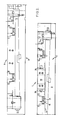
- Figure 1 is a plan view, partly in section, of the apparatus, with a tool used in the apparatus removed for clarity; and
- Figure 2 is a front elevational view of the apparatus.
- Referring to the drawings, there is shown
apparatus 1 for holding a tool (not shown) of a rotary workpiece (that is one which rotates during the forming operation, though it could also rotate in use) comprising an elongate member 2 on which the tool is mountable and which member has a plurality ofsupport surfaces support surfaces 3 and whereby to clamp the tool in an operative position. - The means 5 in the embodiment shown is a
rotatable lever device 6. There are in the embodiment shown twolever devices 6 for each tool, and there are two tools in line, at 7 and 8, in upper and lower elongate members, of which the lower member 2 only is shown in the drawings. Thedevices 6 are identical and so only one will be described in detail. Also, the elongate member 2 in which each tool is mounted is identical in having abed 9, which is inclined, with aheel 10 and toe plate 11 and heel/toe plate 12 which providesupport surfaces bed 9. In the embodiment shown there are two tools 24" (60.96cm) long though there could be one tool 48" (121.92cm) long or indeed as many tools as are desired along a bed of the machine. - The
lever device 6 is mounted in arecess 13 and has apart 14 which has a gear tooth surface profile or configuration 14ª and in use engages a complementary part of the tool. Thelever device 6 is mounted on a spindle orshaft 15 for rotation, and has afurther part 16 projecting away from the first-mentionedpart 14 and whichfurther part 16 is of bull-nose shape and is engageable by a slide means in the form of awedge 17 to rotate thelever device 6. Thewedge 17 is carried by anelongate carrier 18 which is reciprocable longitudinally by an actuating means in the form of a double acting piston andcylinder arrangement 19. Thepiston 19 is a hydraulic piston situated between the tworespective lever devices 6 for each tool, thecarriers 18 being carried by thepiston rods 20. Thedevices 6 include biasing means 21 in the form of coil tension springs which bias the levers to the position shown in Figure 1. - A tool for forming a configuration such as gear profiles in the surface of a rotary workpiece, such as a metal shaft, is an elongate metal block with transverse surface grooves in it so that it is in the form of a rack, and is known as such or as a rack cassette. In use, the grooved surface would be uppermost when the rack is on the lower bed 2 shown. The rack is of generally square cross-section and in the rear (as considered in use) surface there are two channel-shaped blind slots, terminating at a position remote from the grooved surface, in other words adjacent the in use
lower surface 9, in an enlarged part so that the channel is effectively of T-shape. The enlarged part has an angled and tapered surface profile which is effectively a camming surface of complementary shape to that of the gear tooth configuration 14ª of the projectingpart 14 of thelever device 6. - In use to mount a tool in the machine, the piston and
cylinder arrangement 19 is actuated to move thewedge 17 to rotate thelever device 6 so that that device is effectively at right angles to thesurface 4. The tool is then offered up to the bed, above it, with the channels aligned with arespective part 14, and is then lowered to rest on thebed 9. The piston andcylinder arrangement 19 is then actuated to move the piston to the right as viewed in Figure 1. This action results in thewedges 17 moving to the right and they in turn rotate theirrespective lever devices 6 clockwise, as viewed, against the bias of thesprings 21 so that the parts engage in the enlarged parts of the tool channels, ride over the camming surfaces and force the tool to the left as viewed, and to the rear, to abut thesupport surfaces cylinder arrangement 19 and moving with the piston rods automatically engage in a leak proof manner with fixed male hydraulic connectors which are mounted on the frame of the machine and which are also part of the hydraulic circuit. The female parts have non-return valves which are normally closed, but which are opened by the male parts, or drogues, to complete the hydraulic circuit so that there is thus a "solid" hydraulic connection throughout the system and it is therefore unnecessary to maintain hydraulic force and thewedges 17, which are effectively self-locking, remain in position to clamp the tool via thelever devices 6. This saves on energy as a pump for the system can be closed down, and meanwhile thelever devices 6 remain in position to maintain the tool clamped, as described. A forming operation can then be carried out, usually by reciprocating the upper tools in unison longitudinally in an opposite direction to the lower tools while a workpiece between them is rotated. As many passes as are necessary are carried out to form the desired configuration. The operation is then repeated on a succeeding workpiece, and so on. If it is necessary to change a tool, for example because a different configuration is to be formed on a workpiece, or because a tool is worn, it is merely necessary to pressurize the cylinder of the piston andcylinder arrangement 19 to move thelever devices 6 to the substantially 90° position, when the tool can simply be slid clear and replaced by another one using the sequence already described. The apparatus thus provides a simple yet efficient method of interchangeability of tools in machines of the kind described. - In a modification, it is possible to mount and dismount a tool with the lever devices in the position shown. Also, other means than hydraulic means for the piston and cylinder arrangement may be used, for example pneumatic, mechanical or electro-mechanical.
Claims (15)
Applications Claiming Priority (2)
| Application Number | Priority Date | Filing Date | Title |
|---|---|---|---|
| GB8619554A GB2193669B (en) | 1986-08-11 | 1986-08-11 | Machines for forming configurations on a rotary workpiece |
| GB8619554 | 1986-08-11 |
Publications (3)
| Publication Number | Publication Date |
|---|---|
| EP0256830A2 true EP0256830A2 (en) | 1988-02-24 |
| EP0256830A3 EP0256830A3 (en) | 1990-01-24 |
| EP0256830B1 EP0256830B1 (en) | 1995-02-22 |
Family
ID=10602558
Family Applications (1)
| Application Number | Title | Priority Date | Filing Date |
|---|---|---|---|
| EP87307072A Expired - Lifetime EP0256830B1 (en) | 1986-08-11 | 1987-08-10 | Machines for forming configurations on a rotary workpiece |
Country Status (4)
| Country | Link |
|---|---|
| EP (1) | EP0256830B1 (en) |
| DE (1) | DE3751079T2 (en) |
| ES (1) | ES2070821T3 (en) |
| GB (1) | GB2193669B (en) |
Family Cites Families (10)
| Publication number | Priority date | Publication date | Assignee | Title |
|---|---|---|---|---|
| US2392747A (en) * | 1943-08-23 | 1946-01-08 | American Broach & Machine Co | Pull head for broaching machines |
| DE898436C (en) * | 1950-12-23 | 1953-11-30 | Westfaelische Metall Ind G M B | Rolling dies for thread rolling machines |
| US3183697A (en) * | 1962-01-02 | 1965-05-18 | Michigan Tool Co | Locating fixture |
| US3791257A (en) * | 1972-03-27 | 1974-02-12 | Ind Inc | Machine tool tooling |
| US3793866A (en) * | 1972-04-04 | 1974-02-26 | Anderson Cook Inc | Gear forming machines |
| US3818736A (en) * | 1972-10-10 | 1974-06-25 | Caterpillar Tractor Co | Tooth forming machine |
| DE2552441C2 (en) * | 1975-11-22 | 1982-07-22 | Kutscher, Hans-Werner, 3300 Braunschweig | Quick clamping device for clamping tools or workpieces |
| US4028921A (en) * | 1976-02-13 | 1977-06-14 | Caterpillar Tractor Co. | Tooth forming rack with replaceable inserts |
| US4574605A (en) * | 1984-08-29 | 1986-03-11 | Ex-Cell-O Corporation | Forming machine with multiple work stations |
| GB8428220D0 (en) * | 1984-11-08 | 1984-12-19 | Gaston E Marbaix Ltd | Pressure forming surface configurations on rotary workpiece |
-
1986
- 1986-08-11 GB GB8619554A patent/GB2193669B/en not_active Expired - Lifetime
-
1987
- 1987-08-10 DE DE19873751079 patent/DE3751079T2/en not_active Expired - Fee Related
- 1987-08-10 ES ES87307072T patent/ES2070821T3/en not_active Expired - Lifetime
- 1987-08-10 EP EP87307072A patent/EP0256830B1/en not_active Expired - Lifetime
Also Published As
| Publication number | Publication date |
|---|---|
| GB2193669A (en) | 1988-02-17 |
| EP0256830B1 (en) | 1995-02-22 |
| GB2193669B (en) | 1991-01-16 |
| GB8619554D0 (en) | 1986-09-24 |
| DE3751079T2 (en) | 1995-10-19 |
| ES2070821T3 (en) | 1995-06-16 |
| EP0256830A3 (en) | 1990-01-24 |
| DE3751079D1 (en) | 1995-03-30 |
Similar Documents
| Publication | Publication Date | Title |
|---|---|---|
| US4160372A (en) | Transfer press having quick change die sets | |
| DE2805532C2 (en) | ||
| EP0287986B1 (en) | Punching device for thin plates and punching units used with punching device | |
| EP0224792B1 (en) | Tool-changing arrangement for a multistage metal-forming machine tool | |
| US4629384A (en) | Transfer and locator of workpieces for a gang machine | |
| AT400823B (en) | REVOLVER PUNCHING PRESS AND METHOD FOR POSITIONING STAMPS IN A REVOLVER PUNCHING PRESS | |
| DE2204034B2 (en) | Device for machining disc-shaped workpieces | |
| DE3806116A1 (en) | DEVICE FOR POSITIONING ARC-SHAPED CROSSBODY FRAME PARTS AND MILLING KEYSTONE EXCEPTIONS IN THESE FRAME PARTS | |
| EP4266559A1 (en) | Processing device for conductor arrangements on a laminated motor core | |
| EP0258594B1 (en) | Clamping device for the bearing rings of wheel flange hubs | |
| EP0256830B1 (en) | Machines for forming configurations on a rotary workpiece | |
| CN87105415A (en) | A method and device for processing a workpiece and a fixture for clamping the workpiece | |
| DE202004020654U1 (en) | Folding bending press esp. for sheet metal profiles e.g. shelf boards has hold- down strips of different lengths on rotating roller above bending table, for easy adjustment to different profile widths | |
| US3834217A (en) | Pivotal clamping mechanism for die sets | |
| EP0623420B1 (en) | Transporting and locating device | |
| EP1331061A1 (en) | Clamping device | |
| DE20313816U1 (en) | Center tensioning device | |
| EP1329283A2 (en) | Clamping system | |
| EP1334803B1 (en) | Clamping device, in particular a vice | |
| EP0038199B1 (en) | Turret punch press | |
| DE3925452C1 (en) | ||
| EP2958694A1 (en) | Indexing chuck | |
| US5374041A (en) | Vise | |
| CN115889854B (en) | Drilling tooling plate for processing civil air defense door leaf panel | |
| DE3425317A1 (en) | Numerically controlled hole punching machine for tubes |
Legal Events
| Date | Code | Title | Description |
|---|---|---|---|
| PUAI | Public reference made under article 153(3) epc to a published international application that has entered the european phase |
Free format text: ORIGINAL CODE: 0009012 |
|
| AK | Designated contracting states |
Kind code of ref document: A2 Designated state(s): DE ES FR GB IT |
|
| RAP1 | Party data changed (applicant data changed or rights of an application transferred) |
Owner name: MARBAIX LAPOINTE LIMITED |
|
| PUAL | Search report despatched |
Free format text: ORIGINAL CODE: 0009013 |
|
| RHK1 | Main classification (correction) |
Ipc: B21H 3/06 |
|
| AK | Designated contracting states |
Kind code of ref document: A3 Designated state(s): DE ES FR GB IT |
|
| RAP1 | Party data changed (applicant data changed or rights of an application transferred) |
Owner name: MARBAIX LAPOINTE LIMITED |
|
| 17P | Request for examination filed |
Effective date: 19900612 |
|
| 17Q | First examination report despatched |
Effective date: 19911018 |
|
| GRAA | (expected) grant |
Free format text: ORIGINAL CODE: 0009210 |
|
| AK | Designated contracting states |
Kind code of ref document: B1 Designated state(s): DE ES FR GB IT |
|
| REF | Corresponds to: |
Ref document number: 3751079 Country of ref document: DE Date of ref document: 19950330 |
|
| ITF | It: translation for a ep patent filed | ||
| ET | Fr: translation filed | ||
| REG | Reference to a national code |
Ref country code: ES Ref legal event code: FG2A Ref document number: 2070821 Country of ref document: ES Kind code of ref document: T3 |
|
| PLBE | No opposition filed within time limit |
Free format text: ORIGINAL CODE: 0009261 |
|
| STAA | Information on the status of an ep patent application or granted ep patent |
Free format text: STATUS: NO OPPOSITION FILED WITHIN TIME LIMIT |
|
| 26N | No opposition filed | ||
| PGFP | Annual fee paid to national office [announced via postgrant information from national office to epo] |
Ref country code: GB Payment date: 19960801 Year of fee payment: 10 |
|
| PGFP | Annual fee paid to national office [announced via postgrant information from national office to epo] |
Ref country code: FR Payment date: 19960809 Year of fee payment: 10 |
|
| PGFP | Annual fee paid to national office [announced via postgrant information from national office to epo] |
Ref country code: DE Payment date: 19960816 Year of fee payment: 10 |
|
| PGFP | Annual fee paid to national office [announced via postgrant information from national office to epo] |
Ref country code: ES Payment date: 19960830 Year of fee payment: 10 |
|
| PG25 | Lapsed in a contracting state [announced via postgrant information from national office to epo] |
Ref country code: GB Free format text: LAPSE BECAUSE OF NON-PAYMENT OF DUE FEES Effective date: 19970810 |
|
| PG25 | Lapsed in a contracting state [announced via postgrant information from national office to epo] |
Ref country code: ES Free format text: LAPSE BECAUSE OF THE APPLICANT RENOUNCES Effective date: 19970811 |
|
| GBPC | Gb: european patent ceased through non-payment of renewal fee |
Effective date: 19970810 |
|
| PG25 | Lapsed in a contracting state [announced via postgrant information from national office to epo] |
Ref country code: FR Free format text: LAPSE BECAUSE OF NON-PAYMENT OF DUE FEES Effective date: 19980430 |
|
| PG25 | Lapsed in a contracting state [announced via postgrant information from national office to epo] |
Ref country code: DE Free format text: LAPSE BECAUSE OF NON-PAYMENT OF DUE FEES Effective date: 19980501 |
|
| REG | Reference to a national code |
Ref country code: FR Ref legal event code: ST |
|
| REG | Reference to a national code |
Ref country code: ES Ref legal event code: FD2A Effective date: 20001102 |
|
| PG25 | Lapsed in a contracting state [announced via postgrant information from national office to epo] |
Ref country code: IT Free format text: LAPSE BECAUSE OF NON-PAYMENT OF DUE FEES;WARNING: LAPSES OF ITALIAN PATENTS WITH EFFECTIVE DATE BEFORE 2007 MAY HAVE OCCURRED AT ANY TIME BEFORE 2007. THE CORRECT EFFECTIVE DATE MAY BE DIFFERENT FROM THE ONE RECORDED. Effective date: 20050810 |