EP0255898A2 - Verfahren zur Isolierung der Bestandteile in einer multikomponentigen Zusammensetzung - Google Patents
Verfahren zur Isolierung der Bestandteile in einer multikomponentigen Zusammensetzung Download PDFInfo
- Publication number
- EP0255898A2 EP0255898A2 EP87110699A EP87110699A EP0255898A2 EP 0255898 A2 EP0255898 A2 EP 0255898A2 EP 87110699 A EP87110699 A EP 87110699A EP 87110699 A EP87110699 A EP 87110699A EP 0255898 A2 EP0255898 A2 EP 0255898A2
- Authority
- EP
- European Patent Office
- Prior art keywords
- components
- part composition
- composition according
- component
- support plate
- Prior art date
- Legal status (The legal status is an assumption and is not a legal conclusion. Google has not performed a legal analysis and makes no representation as to the accuracy of the status listed.)
- Withdrawn
Links
Images


Classifications
-
- C—CHEMISTRY; METALLURGY
- C08—ORGANIC MACROMOLECULAR COMPOUNDS; THEIR PREPARATION OR CHEMICAL WORKING-UP; COMPOSITIONS BASED THEREON
- C08J—WORKING-UP; GENERAL PROCESSES OF COMPOUNDING; AFTER-TREATMENT NOT COVERED BY SUBCLASSES C08B, C08C, C08F, C08G or C08H
- C08J3/00—Processes of treating or compounding macromolecular substances
- C08J3/24—Crosslinking, e.g. vulcanising, of macromolecules
- C08J3/241—Preventing premature crosslinking by physical separation of components, e.g. encapsulation
Definitions
- the present invention relates to a method for isolating components in a multi-part composition, wherein prior to use, the components are preserved in an isolated relation and then intended to be used, they are mixed together and placed into service and particularly, in use, the individual components can be easily picked up and mixed at a predetremined ratio.
- Adhesives, coatings, casting materials, etc. are principally placed into service by mixing a primary component such as epoxy, unsaturated polyester, vinylester, polyurethane, silicone and polymercapto resins, with a curing agent as a secondary component and further a cure accelerator as a third component, and then causing a curing phenomenon through a chemical reaction to cure them.
- a primary component such as epoxy, unsaturated polyester, vinylester, polyurethane, silicone and polymercapto resins
- a curing agent as a secondary component and further a cure accelerator as a third component
- this vessel or container 1 is constructed with its interior being divided into a space 3 and a space 4 by a partition 2.
- a primary component such as an epoxy resin is filled into the space 3 and a curing agent is filled into the space 4.
- the vessel is shielded with a cover layer 5 through a heat sealing treatment, so that the primary component and the curing agent are contained in a separately isolated relation.
- the cover layer 5 is stripped and then, the section of the space 3 is depressed down to deform the vessel 1 into a shape as shown in Fig.13(b), thereby mixing the primary component with the curing agent.
- the above object is accomplished by providing a method for isolating components in a multi-part composition, the components being preserved in an isolated relation, and when intended to be used, the components being mixed together and then placed into service, wherein the components each contain a consistency imparting agent added thereto and are applied onto a support plate in such a manner that the different components are disposed in close vicinity to one another.
- multi-part compositions are preserved with individual components isolated prior to use, and when intended to be used, the components are mixed together and placed into service.
- Such multi-part compositions are those such as adhesives, sealants, coatings, casting materials, etc., each comprising a primary component and a curing agent and further containing a cure accelerator as a third component if desired.
- Specific examples of the primary components are epoxy, unsaturated polyester, acrylic, silicone, polyurethane and polymercapto resins.
- the above-described multi-part composition is usually in the form of a liquid, but may be in the form of a powder or the like.
- each of the components in the multi-part composition contains a consistency imparting agent added thereto.
- the consistency imparting agent which may be used include those commercially available, and specific examples of them are benzylidene sorbitol, lauroylglutamic dibutylamide, organo-bentonites, asbestos powders, silica powders, hydrogenated caster oils, etc.
- the amount of consistency imparting agent added may be of any level depending upon the type and viscosities of the components, but should be in a range sufficient to provide a consistency, i.e., a jellied condition, sufficient so that the consistency imparting agent cannot be mixed with the other liquid component.
- the individual components containing the above-described type of a consistency imparting agent added thereto are applied onto a support plate in such a manner that the different components are disposed in close vicinity to one another.
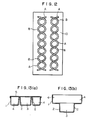
- FIG.1 Examples of applied patterns are illustrated in Figs.1 to 12. Amoung these Figures, Figs.1 and 2 illustrate examples of patterns of three-part composition applied, Fig.1 illustrating an example where components A, B and C are applied respectively in the form of laterally arranged dots on a support plate 10 by an injector, and Fig.2 illustrating an example where the components A, B and C are applied in groups of dots, each of groups consisting of three different components and the groups being arranged longitudinally and laterally on the support plate 10.
- Figs. 3 to 12 illustrate examples of patterns of two-part composition applied, Fig.3 illustrating an example where two components A and B are applied respectively in the form of dots in an adjacently arranged relation on the support plate 10 by the injector.
- Fig.4 illustrates an example where the component A is applied in the form of a large number of dots arranged on the support plate 10, with the component B applied in a ring-like configuration around each of the dots of component A.
- Fig.5 illustrates an example where the components A and B are applied respectively in the form of curved lines alternately arranged on the support plate 10.
- Fig.6 illustrates an example where the components A and B are applied respectively in the form of obliquely straight lines alternately arranged on the support plate 10.
- Fig.7 illustrates an example where the component A is applied in the form of arrays of obliquely rectilinearly arranged dots, and the component B is applied in the form of obliquely rectilinear bands arranged alternately with each obliquely rectilinear dot array of the component A.
- Fig.8 illustrates an example where the component B is applied in an U-shaped configuration, with the component A applied in a bar-shaped configuration within the U shape of the component B, with a large number of such units being arranged on the support plate 10.
- Fig.9 illustrates an example where the components A and B are applied respectively in the form of folded lines in an alternately arranged relation to each other.
- Fig.10 illustrates an example where the components A and B are applied in the form of the same band-like curved lines arranged in parallel on the support plate 10.
- Fig.11 illustrates an example where the component B is applied in the form of curved lines, and the component A is applied in the form of dots each of which is within each of recesses defined by such curved lines.
- Fig.12 illustrate an example where the component A is applied in the form of a curved line, and the component B is applied in the form of the similarly shaped but oppositely curved line in an overlapped relation to the curved line of the component A.
- the support plates 10 used in the present invention include any flat plates which are chemically non-reactive with each of components in a multi-part composition to be applied thereon and have an impervious property and a heat resistance.
- gelatinization is referred to indicate a condition where the consistency of a liquid is increased.
- the viscosity is at most 10,000 to 15,000 poises or less. Therefore, such condition is such that components cannot be mixed with each other by merely contacting them, but if they are squashed by a spatula or the like for mixing, they may be easily mixed.
- each of components is gelatinizated by addition of a consistency imparting agent into a condition where each component is not mixed with another liquid component. Accordingly, the individual components in a multi-part composition are isolated from one another on a support plate.
- the individual components in the multi-part composition may be squashed on the support plate by a spatula or the like and thereby easily mixed. In this way, they are placed in service.
- the individual components are applied in close vicinity to one another and hence, the individual components may be automatically picked up and mixed at a predetermined ratio by squashing them in any aera on the support plate by use of the spatula or the like to mix them.
- the ratio of the individual components can be set at any level by employing any applying method such as those shown in Figs.3 to 12.
- the following epoxy resins were prepared for a two-part composition.
- Epicoat #828 (Bisphenol type epoxy resin available from Oil Shell, Co., ltd.)
- Curing agent TB2106B (Modified alicyclic polyamine available from Three Bond, Co. Ltd.)
- Coregurane GP-1 (lauroylglutamic dibutylamide available from Ajinomoto, Co. Ltd.) was added as a consistency imparting agent to each of the primary component (liquid A) and the curing agent (liquid B) in an amount of 5 parts by weight per 100 parts by weight.
- the components A and B were applied and gelatinized or jellied in the form of dots onto a flat plate by an injector, as shown in Fig.3.
- the injector used was PMC-502K made by Nippon Epy Industry Co., Ltd.).
- the components A and B were isolated from each other on the flat plate by the gelatinization.
- jellied or gelatinizated components A and B on the flat plate were squashed and mixed in any area by use of a spatula. They were picked up at a ratio of approximately 1 : 1, mixed and cured.
- the following acrylic resins were prepared for a two-part composition.
- Curing agent (liquid B) TB3926 (a curing agent available from Three Bond, Co., Ltd.)
- Aerozeel #200 (a fine powder of silica available from Aerozyl Co., Ltd.) was added as a consistency imparting agent to each of the primary component (liquid A) and the curing agent (liquid B) in an amount of 4 parts by weight per 100 parts by weight.
- the compnents A and B were applied and gelatinizated onto a flat plate by an injector, as shown in Fig.5.
- the components A and B were isolated from each other on the flat plate by the gelatinization.
- gelatinizated components A and B on the flat plate were squashed and mixed in any area by use of a spatula. They were picked up at a ratio of approximately 1 : 1, mixed and then cured in 1.5 to 2.5 minutes.
Landscapes
- Chemical & Material Sciences (AREA)
- Analytical Chemistry (AREA)
- Health & Medical Sciences (AREA)
- Chemical Kinetics & Catalysis (AREA)
- Medicinal Chemistry (AREA)
- Polymers & Plastics (AREA)
- Organic Chemistry (AREA)
- Adhesives Or Adhesive Processes (AREA)
- Compositions Of Macromolecular Compounds (AREA)
- Casting Or Compression Moulding Of Plastics Or The Like (AREA)
- Adhesive Tapes (AREA)
Applications Claiming Priority (2)
| Application Number | Priority Date | Filing Date | Title |
|---|---|---|---|
| JP61182012A JPS6339979A (ja) | 1986-08-04 | 1986-08-04 | 多成分系物質の成分隔離方法 |
| JP182012/86 | 1986-08-04 |
Publications (2)
| Publication Number | Publication Date |
|---|---|
| EP0255898A2 true EP0255898A2 (de) | 1988-02-17 |
| EP0255898A3 EP0255898A3 (de) | 1988-09-14 |
Family
ID=16110785
Family Applications (1)
| Application Number | Title | Priority Date | Filing Date |
|---|---|---|---|
| EP87110699A Withdrawn EP0255898A3 (de) | 1986-08-04 | 1987-07-23 | Verfahren zur Isolierung der Bestandteile in einer multikomponentigen Zusammensetzung |
Country Status (3)
| Country | Link |
|---|---|
| US (1) | US4865884A (de) |
| EP (1) | EP0255898A3 (de) |
| JP (1) | JPS6339979A (de) |
Families Citing this family (4)
| Publication number | Priority date | Publication date | Assignee | Title |
|---|---|---|---|---|
| GB9314621D0 (en) * | 1993-07-14 | 1993-08-25 | Kodak Ltd | Material supply |
| US8407971B2 (en) * | 2009-07-16 | 2013-04-02 | Dorm-In-A-Box, Llc | Package for supplying student rooms at an educational institution and associated method of use |
| USD658763S1 (en) | 2010-02-02 | 2012-05-01 | 3M Innovative Properties Company | Dental capsule |
| CN113214758B (zh) * | 2021-05-21 | 2022-07-08 | 武汉市科达云石护理材料有限公司 | 一种石材胶粘剂调色膏及其制备方法和应用 |
Family Cites Families (14)
| Publication number | Priority date | Publication date | Assignee | Title |
|---|---|---|---|---|
| DE1115120B (de) * | 1957-02-21 | 1961-10-12 | Willy Hesselmann | Vorrichtung zum Antragen von fluessigen Stoffen, vornehmlich Klebstoff |
| GB1065560A (en) * | 1967-06-26 | 1967-04-19 | Feb Great Britain Ltd | Improvements in the storage of two or more inter-active substances in a single container |
| DE1611929A1 (de) * | 1968-01-30 | 1971-02-25 | Henkel & Cie Gmbh | Verpackung fuer Zweikomponentenklebstoff |
| US3837981A (en) * | 1971-05-10 | 1974-09-24 | T Flint | Epoxy tape |
| GB1546073A (en) * | 1976-05-10 | 1979-05-16 | Ready Seal Ltd | Method of repairing leaks in pipes and pipelines carrying fluent medium under pressure and means for use in the method |
| GB1552417A (en) * | 1975-08-15 | 1979-09-12 | Lingner & Fischer Gmbh | Gel or waxy articles |
| JPS5232028A (en) * | 1975-09-05 | 1977-03-10 | Hitachi Ltd | Method for applying two-component adhesives |
| US4116742A (en) * | 1976-12-06 | 1978-09-26 | Applied Plastics Co., Inc. | Method of packaging mutually reactive substances |
| US4161250A (en) * | 1977-01-18 | 1979-07-17 | Pierce Donald C | Kit for decorating border panel of picture mats |
| US4158073A (en) * | 1978-03-23 | 1979-06-12 | Armstrong Cork Company | Process for producing decorative multi-level embossed surface covering |
| US4278483A (en) * | 1979-08-31 | 1981-07-14 | Congoleum Corporation | Process for producing decorative surface covering |
| US4342613A (en) * | 1979-09-21 | 1982-08-03 | Leary James N O | Method of bonding surfaces with a solid adhesive |
| US4502975A (en) * | 1981-05-26 | 1985-03-05 | New Japan Chemical Co., Ltd. | Compositions for recovering an organic material from an oily layer on a body of water |
| US4680916A (en) * | 1985-01-07 | 1987-07-21 | Ginn Martin E | Staged detergent/fabric treating preparation for use in washing machines |
-
1986
- 1986-08-04 JP JP61182012A patent/JPS6339979A/ja active Pending
-
1987
- 1987-07-23 EP EP87110699A patent/EP0255898A3/de not_active Withdrawn
- 1987-07-31 US US07/080,726 patent/US4865884A/en not_active Expired - Fee Related
Also Published As
| Publication number | Publication date |
|---|---|
| EP0255898A3 (de) | 1988-09-14 |
| JPS6339979A (ja) | 1988-02-20 |
| US4865884A (en) | 1989-09-12 |
Similar Documents
| Publication | Publication Date | Title |
|---|---|---|
| US4811838A (en) | Plate-like container for containing jellied two parts components | |
| DE3276521D1 (en) | Surgical cement composition containing at least one acrylic monomer and one acrylic polymer | |
| DE1470925A1 (de) | Einteilige,bestaendige,hygroskopische,fluessige Polymerzusammensetzung und Verfahrenzu deren Herstellung und Benutzung | |
| US2862616A (en) | Method of packaging epoxy resins | |
| DE1252404B (de) | ||
| AU574516B2 (en) | Catalyst preparation | |
| ES2025153B3 (es) | Resinas epoxi de curado rapido y procedimiento para su preparacion. | |
| DE3573723D1 (en) | Modified fillers for silicone pastes, their use and dental impression materials containing them | |
| EP0255898A2 (de) | Verfahren zur Isolierung der Bestandteile in einer multikomponentigen Zusammensetzung | |
| PT77403B (en) | Process for the preparation of thermo-hardening powder based in unsaturated chrystaline polyesthers | |
| USRE30843E (en) | Epoxy tape | |
| DE3582668D1 (de) | Verfahren zur herstellung von epoxydharzen mit kontrollierter umwandlung. | |
| US1707684A (en) | Face powder | |
| EP0299917B1 (de) | Abdichtverfahren | |
| US3141825A (en) | Cold wave lotion package | |
| KR900004983B1 (ko) | 다성분계 물질의 성분격리 수납방법 | |
| JPS56110772A (en) | Composition for electrodepositing paint | |
| JPS55156378A (en) | Manufacture of raw sheet of lead type piezoelectric material | |
| JPS5678664A (en) | Preventing method for hydrogen brittleness of steel material and steel product | |
| ES407474A1 (es) | Procedimiento de obtencion de un producto de inyeccion paracolmatar o impermeabilizar macizos pequenos y el correspon- diente metodo de aplicacion del mismo. | |
| EP0390737A1 (de) | Füllstoffbeschichtung | |
| ES8304597A1 (es) | Un procedimiento para dotar a substratos de un revestimiento decorativo y-o protector. | |
| JPS578240A (en) | Method of improving melt-flow characteristics of aromatic polyester or composition thereof | |
| ES8106405A1 (es) | Procedimiento para preparar una composicion dental fluida | |
| DD147084A1 (de) | Verfahren zur vorfertigung von schuettfaehigen reaktionsharzchargen |
Legal Events
| Date | Code | Title | Description |
|---|---|---|---|
| PUAI | Public reference made under article 153(3) epc to a published international application that has entered the european phase |
Free format text: ORIGINAL CODE: 0009012 |
|
| AK | Designated contracting states |
Kind code of ref document: A2 Designated state(s): DE FR GB |
|
| PUAL | Search report despatched |
Free format text: ORIGINAL CODE: 0009013 |
|
| AK | Designated contracting states |
Kind code of ref document: A3 Designated state(s): DE FR GB |
|
| 17P | Request for examination filed |
Effective date: 19890303 |
|
| 17Q | First examination report despatched |
Effective date: 19890614 |
|
| STAA | Information on the status of an ep patent application or granted ep patent |
Free format text: STATUS: THE APPLICATION IS DEEMED TO BE WITHDRAWN |
|
| 18D | Application deemed to be withdrawn |
Effective date: 19891228 |
|
| RIN1 | Information on inventor provided before grant (corrected) |
Inventor name: USAMI, IKUZO Inventor name: SATO, YOSHINORI Inventor name: SUMITOMO, MASAKAZU |