EP0254334A2 - Polyesteramid-Hohlfaser und Verfahren zu ihrer Herstellung - Google Patents
Polyesteramid-Hohlfaser und Verfahren zu ihrer Herstellung Download PDFInfo
- Publication number
- EP0254334A2 EP0254334A2 EP87201120A EP87201120A EP0254334A2 EP 0254334 A2 EP0254334 A2 EP 0254334A2 EP 87201120 A EP87201120 A EP 87201120A EP 87201120 A EP87201120 A EP 87201120A EP 0254334 A2 EP0254334 A2 EP 0254334A2
- Authority
- EP
- European Patent Office
- Prior art keywords
- solution
- fibre
- weight
- parts
- polyester
- Prior art date
- Legal status (The legal status is an assumption and is not a legal conclusion. Google has not performed a legal analysis and makes no representation as to the accuracy of the status listed.)
- Granted
Links
- 239000000835 fiber Substances 0.000 title claims abstract description 69
- 229920006149 polyester-amide block copolymer Polymers 0.000 title claims abstract description 31
- 238000004519 manufacturing process Methods 0.000 title claims description 4
- ZMXDDKWLCZADIW-UHFFFAOYSA-N N,N-Dimethylformamide Chemical compound CN(C)C=O ZMXDDKWLCZADIW-UHFFFAOYSA-N 0.000 claims abstract description 35
- KWGKDLIKAYFUFQ-UHFFFAOYSA-M lithium chloride Chemical compound [Li+].[Cl-] KWGKDLIKAYFUFQ-UHFFFAOYSA-M 0.000 claims abstract description 32
- 238000000034 method Methods 0.000 claims abstract description 25
- XLYOFNOQVPJJNP-UHFFFAOYSA-N water Substances O XLYOFNOQVPJJNP-UHFFFAOYSA-N 0.000 claims abstract description 23
- 230000015271 coagulation Effects 0.000 claims abstract description 22
- 238000005345 coagulation Methods 0.000 claims abstract description 22
- 230000035699 permeability Effects 0.000 claims abstract description 17
- 239000002904 solvent Substances 0.000 claims abstract description 17
- FXHOOIRPVKKKFG-UHFFFAOYSA-N N,N-Dimethylacetamide Chemical compound CN(C)C(C)=O FXHOOIRPVKKKFG-UHFFFAOYSA-N 0.000 claims abstract description 15
- BDAGIHXWWSANSR-UHFFFAOYSA-N methanoic acid Natural products OC=O BDAGIHXWWSANSR-UHFFFAOYSA-N 0.000 claims abstract description 10
- 239000000126 substance Substances 0.000 claims abstract description 10
- KKEYFWRCBNTPAC-UHFFFAOYSA-N benzene-dicarboxylic acid Natural products OC(=O)C1=CC=C(C(O)=O)C=C1 KKEYFWRCBNTPAC-UHFFFAOYSA-N 0.000 claims abstract description 7
- 238000000502 dialysis Methods 0.000 claims abstract description 6
- 239000007788 liquid Substances 0.000 claims abstract description 6
- 235000019253 formic acid Nutrition 0.000 claims abstract description 5
- 238000000108 ultra-filtration Methods 0.000 claims abstract description 5
- OSWFIVFLDKOXQC-UHFFFAOYSA-N 4-(3-methoxyphenyl)aniline Chemical compound COC1=CC=CC(C=2C=CC(N)=CC=2)=C1 OSWFIVFLDKOXQC-UHFFFAOYSA-N 0.000 claims abstract description 4
- 230000001112 coagulating effect Effects 0.000 claims abstract description 4
- 239000000243 solution Substances 0.000 claims description 41
- 229920000642 polymer Polymers 0.000 claims description 8
- 125000003178 carboxy group Chemical group [H]OC(*)=O 0.000 claims description 4
- 238000002844 melting Methods 0.000 claims description 4
- 230000008018 melting Effects 0.000 claims description 4
- ACCCMOQWYVYDOT-UHFFFAOYSA-N hexane-1,1-diol Chemical compound CCCCCC(O)O ACCCMOQWYVYDOT-UHFFFAOYSA-N 0.000 claims description 3
- 239000007864 aqueous solution Substances 0.000 claims description 2
- 239000011261 inert gas Substances 0.000 claims description 2
- 239000011877 solvent mixture Substances 0.000 claims description 2
- NAQMVNRVTILPCV-UHFFFAOYSA-N hexane-1,6-diamine Chemical compound NCCCCCCN NAQMVNRVTILPCV-UHFFFAOYSA-N 0.000 claims 2
- 238000001125 extrusion Methods 0.000 abstract description 4
- 238000002360 preparation method Methods 0.000 abstract description 4
- 230000003252 repetitive effect Effects 0.000 abstract description 4
- 238000005406 washing Methods 0.000 abstract description 3
- 238000011084 recovery Methods 0.000 abstract description 2
- IJGRMHOSHXDMSA-UHFFFAOYSA-N Atomic nitrogen Chemical compound N#N IJGRMHOSHXDMSA-UHFFFAOYSA-N 0.000 description 6
- WSFSSNUMVMOOMR-UHFFFAOYSA-N Formaldehyde Chemical compound O=C WSFSSNUMVMOOMR-UHFFFAOYSA-N 0.000 description 6
- 238000009987 spinning Methods 0.000 description 4
- 238000009792 diffusion process Methods 0.000 description 3
- 239000012530 fluid Substances 0.000 description 3
- 229910052757 nitrogen Inorganic materials 0.000 description 3
- 239000011148 porous material Substances 0.000 description 3
- PIICEJLVQHRZGT-UHFFFAOYSA-N Ethylenediamine Chemical compound NCCN PIICEJLVQHRZGT-UHFFFAOYSA-N 0.000 description 2
- PEDCQBHIVMGVHV-UHFFFAOYSA-N Glycerine Chemical compound OCC(O)CO PEDCQBHIVMGVHV-UHFFFAOYSA-N 0.000 description 2
- FAPWRFPIFSIZLT-UHFFFAOYSA-M Sodium chloride Chemical compound [Na+].[Cl-] FAPWRFPIFSIZLT-UHFFFAOYSA-M 0.000 description 2
- XSQUKJJJFZCRTK-UHFFFAOYSA-N Urea Chemical compound NC(N)=O XSQUKJJJFZCRTK-UHFFFAOYSA-N 0.000 description 2
- DDRJAANPRJIHGJ-UHFFFAOYSA-N creatinine Chemical compound CN1CC(=O)NC1=N DDRJAANPRJIHGJ-UHFFFAOYSA-N 0.000 description 2
- 238000009826 distribution Methods 0.000 description 2
- 239000007789 gas Substances 0.000 description 2
- 229920001059 synthetic polymer Polymers 0.000 description 2
- 102000009027 Albumins Human genes 0.000 description 1
- 108010088751 Albumins Proteins 0.000 description 1
- 229920001202 Inulin Polymers 0.000 description 1
- WHXSMMKQMYFTQS-UHFFFAOYSA-N Lithium Chemical compound [Li] WHXSMMKQMYFTQS-UHFFFAOYSA-N 0.000 description 1
- 102000036675 Myoglobin Human genes 0.000 description 1
- 108010062374 Myoglobin Proteins 0.000 description 1
- 239000004372 Polyvinyl alcohol Substances 0.000 description 1
- 229910000831 Steel Inorganic materials 0.000 description 1
- LEHOTFFKMJEONL-UHFFFAOYSA-N Uric Acid Chemical compound N1C(=O)NC(=O)C2=C1NC(=O)N2 LEHOTFFKMJEONL-UHFFFAOYSA-N 0.000 description 1
- TVWHNULVHGKJHS-UHFFFAOYSA-N Uric acid Natural products N1C(=O)NC(=O)C2NC(=O)NC21 TVWHNULVHGKJHS-UHFFFAOYSA-N 0.000 description 1
- 229930003779 Vitamin B12 Natural products 0.000 description 1
- UATOFRZSCHRPBG-UHFFFAOYSA-N acetamide;hydrate Chemical compound O.CC(N)=O UATOFRZSCHRPBG-UHFFFAOYSA-N 0.000 description 1
- 239000004202 carbamide Substances 0.000 description 1
- 229920002678 cellulose Polymers 0.000 description 1
- 239000001913 cellulose Substances 0.000 description 1
- 239000000701 coagulant Substances 0.000 description 1
- FDJOLVPMNUYSCM-WZHZPDAFSA-L cobalt(3+);[(2r,3s,4r,5s)-5-(5,6-dimethylbenzimidazol-1-yl)-4-hydroxy-2-(hydroxymethyl)oxolan-3-yl] [(2r)-1-[3-[(1r,2r,3r,4z,7s,9z,12s,13s,14z,17s,18s,19r)-2,13,18-tris(2-amino-2-oxoethyl)-7,12,17-tris(3-amino-3-oxopropyl)-3,5,8,8,13,15,18,19-octamethyl-2 Chemical compound [Co+3].N#[C-].N([C@@H]([C@]1(C)[N-]\C([C@H]([C@@]1(CC(N)=O)C)CCC(N)=O)=C(\C)/C1=N/C([C@H]([C@@]1(CC(N)=O)C)CCC(N)=O)=C\C1=N\C([C@H](C1(C)C)CCC(N)=O)=C/1C)[C@@H]2CC(N)=O)=C\1[C@]2(C)CCC(=O)NC[C@@H](C)OP([O-])(=O)O[C@H]1[C@@H](O)[C@@H](N2C3=CC(C)=C(C)C=C3N=C2)O[C@@H]1CO FDJOLVPMNUYSCM-WZHZPDAFSA-L 0.000 description 1
- 230000001143 conditioned effect Effects 0.000 description 1
- 229920001577 copolymer Polymers 0.000 description 1
- ZURAKLKIKYCUJU-UHFFFAOYSA-N copper;azane Chemical compound N.[Cu+2] ZURAKLKIKYCUJU-UHFFFAOYSA-N 0.000 description 1
- 229940109239 creatinine Drugs 0.000 description 1
- 239000012153 distilled water Substances 0.000 description 1
- -1 e.g. Substances 0.000 description 1
- 238000001914 filtration Methods 0.000 description 1
- 235000011187 glycerol Nutrition 0.000 description 1
- 238000001631 haemodialysis Methods 0.000 description 1
- JYJIGFIDKWBXDU-MNNPPOADSA-N inulin Chemical compound O[C@H]1[C@H](O)[C@@H](CO)O[C@@]1(CO)OC[C@]1(OC[C@]2(OC[C@]3(OC[C@]4(OC[C@]5(OC[C@]6(OC[C@]7(OC[C@]8(OC[C@]9(OC[C@]%10(OC[C@]%11(OC[C@]%12(OC[C@]%13(OC[C@]%14(OC[C@]%15(OC[C@]%16(OC[C@]%17(OC[C@]%18(OC[C@]%19(OC[C@]%20(OC[C@]%21(OC[C@]%22(OC[C@]%23(OC[C@]%24(OC[C@]%25(OC[C@]%26(OC[C@]%27(OC[C@]%28(OC[C@]%29(OC[C@]%30(OC[C@]%31(OC[C@]%32(OC[C@]%33(OC[C@]%34(OC[C@]%35(OC[C@]%36(O[C@@H]%37[C@@H]([C@@H](O)[C@H](O)[C@@H](CO)O%37)O)[C@H]([C@H](O)[C@@H](CO)O%36)O)[C@H]([C@H](O)[C@@H](CO)O%35)O)[C@H]([C@H](O)[C@@H](CO)O%34)O)[C@H]([C@H](O)[C@@H](CO)O%33)O)[C@H]([C@H](O)[C@@H](CO)O%32)O)[C@H]([C@H](O)[C@@H](CO)O%31)O)[C@H]([C@H](O)[C@@H](CO)O%30)O)[C@H]([C@H](O)[C@@H](CO)O%29)O)[C@H]([C@H](O)[C@@H](CO)O%28)O)[C@H]([C@H](O)[C@@H](CO)O%27)O)[C@H]([C@H](O)[C@@H](CO)O%26)O)[C@H]([C@H](O)[C@@H](CO)O%25)O)[C@H]([C@H](O)[C@@H](CO)O%24)O)[C@H]([C@H](O)[C@@H](CO)O%23)O)[C@H]([C@H](O)[C@@H](CO)O%22)O)[C@H]([C@H](O)[C@@H](CO)O%21)O)[C@H]([C@H](O)[C@@H](CO)O%20)O)[C@H]([C@H](O)[C@@H](CO)O%19)O)[C@H]([C@H](O)[C@@H](CO)O%18)O)[C@H]([C@H](O)[C@@H](CO)O%17)O)[C@H]([C@H](O)[C@@H](CO)O%16)O)[C@H]([C@H](O)[C@@H](CO)O%15)O)[C@H]([C@H](O)[C@@H](CO)O%14)O)[C@H]([C@H](O)[C@@H](CO)O%13)O)[C@H]([C@H](O)[C@@H](CO)O%12)O)[C@H]([C@H](O)[C@@H](CO)O%11)O)[C@H]([C@H](O)[C@@H](CO)O%10)O)[C@H]([C@H](O)[C@@H](CO)O9)O)[C@H]([C@H](O)[C@@H](CO)O8)O)[C@H]([C@H](O)[C@@H](CO)O7)O)[C@H]([C@H](O)[C@@H](CO)O6)O)[C@H]([C@H](O)[C@@H](CO)O5)O)[C@H]([C@H](O)[C@@H](CO)O4)O)[C@H]([C@H](O)[C@@H](CO)O3)O)[C@H]([C@H](O)[C@@H](CO)O2)O)[C@@H](O)[C@H](O)[C@@H](CO)O1 JYJIGFIDKWBXDU-MNNPPOADSA-N 0.000 description 1
- 229940029339 inulin Drugs 0.000 description 1
- 229910052744 lithium Inorganic materials 0.000 description 1
- 239000000463 material Substances 0.000 description 1
- 239000012528 membrane Substances 0.000 description 1
- 239000000203 mixture Substances 0.000 description 1
- 230000000877 morphologic effect Effects 0.000 description 1
- 238000010943 off-gassing Methods 0.000 description 1
- 229920000058 polyacrylate Polymers 0.000 description 1
- 229920002451 polyvinyl alcohol Polymers 0.000 description 1
- CMDGQTVYVAKDNA-UHFFFAOYSA-N propane-1,2,3-triol;hydrate Chemical compound O.OCC(O)CO CMDGQTVYVAKDNA-UHFFFAOYSA-N 0.000 description 1
- 239000004627 regenerated cellulose Substances 0.000 description 1
- 239000011780 sodium chloride Substances 0.000 description 1
- 229960002668 sodium chloride Drugs 0.000 description 1
- 239000007858 starting material Substances 0.000 description 1
- 239000010959 steel Substances 0.000 description 1
- 238000003756 stirring Methods 0.000 description 1
- 238000003860 storage Methods 0.000 description 1
- 239000008399 tap water Substances 0.000 description 1
- 235000020679 tap water Nutrition 0.000 description 1
- 229940045136 urea Drugs 0.000 description 1
- 229940116269 uric acid Drugs 0.000 description 1
- 239000011715 vitamin B12 Substances 0.000 description 1
- 235000019163 vitamin B12 Nutrition 0.000 description 1
Images
Classifications
-
- B—PERFORMING OPERATIONS; TRANSPORTING
- B01—PHYSICAL OR CHEMICAL PROCESSES OR APPARATUS IN GENERAL
- B01D—SEPARATION
- B01D69/00—Semi-permeable membranes for separation processes or apparatus characterised by their form, structure or properties; Manufacturing processes specially adapted therefor
- B01D69/08—Hollow fibre membranes
-
- B—PERFORMING OPERATIONS; TRANSPORTING
- B01—PHYSICAL OR CHEMICAL PROCESSES OR APPARATUS IN GENERAL
- B01D—SEPARATION
- B01D71/00—Semi-permeable membranes for separation processes or apparatus characterised by the material; Manufacturing processes specially adapted therefor
- B01D71/06—Organic material
- B01D71/56—Polyamides, e.g. polyester-amides
-
- D—TEXTILES; PAPER
- D01—NATURAL OR MAN-MADE THREADS OR FIBRES; SPINNING
- D01D—MECHANICAL METHODS OR APPARATUS IN THE MANUFACTURE OF ARTIFICIAL FILAMENTS, THREADS, FIBRES, BRISTLES OR RIBBONS
- D01D5/00—Formation of filaments, threads, or the like
- D01D5/24—Formation of filaments, threads, or the like with a hollow structure; Spinnerette packs therefor
Definitions
- the present invention relates to a hollow fibre of polyester-amide and to the process for preparing it.
- hollow fibres are known, which are used in the processes of dialysis and ultrafiltration, and are obtained by starting from such synthetic polymers as polyvinyl alcohol and acrylic polymers, or from regenerated cellulose or from cellulose derivatives, such as disclosed, e.g., in U.S. patents 3,888,771, 3,962,158, and in French patents 2,314,215, 2,324,337 and 2,396,106.
- the process for the preparation of hollow fibres from cellulosic materials, based on the copper-ammonium method, is burdensome, and the so-obtained hollow fibres display a good permeability for the substances having a relatively low molecular weight, but not completely satisfactory permability values for the substances having an average or relatively high molecular weight, and this constitutes a drawback in their application, in particular in the haemodialysis processes.
- hollow fibres endowed with good characteristics of permeability for substances having a molecular weight comprised within a wide range of values by means of a simple and convenient process, which uses a particular polyester-amide as the starting material.
- Said hollow fibres have furthermore a controlled distribution of the pores, they are mechanically strong, and do not give rise to haemocompatibility problems, thus overcoming, or at least greatly reducing, the problems involved by the hollow fibres of the known art.
- the present invention relates to a hollow fibre of polyester-amide, useful in the processes of dialysis and in general in the ultrafiltration processes, formed by a polyester-amide with repetitive unit (TATE) n (wherein T is the radical of terephthalic acid; A is the radical of ethylenediamine; and E is the radical of hexanediol), said hollow fibre having an outer diameter of from 200 to 1000 ⁇ m, a wall thickness of from 20 to 200 ⁇ m, a water permeability value of up to 7.5 litres/m2/hour, for a ⁇ P of 300 mm Hg and being endowed with a good permeability for substances having a molecular weight of up to about 17,000.
- TATE polyester-amide with repetitive unit
- the present invention relates to the process for preparing said hollow fibre, said process comprising the following steps, carried out sequentially: - preparation of a solution of polyester-amide (TATE) n in a solvent constituted by formic acid at a concentration higher than about 99%, or constituted by a solution of lithium chloride in dimethylformamide or dimethylacetamide; - extrusion of said solution through a spinnerette having a cross section of annular shape and coagulation of the fibre in an aqueous coagulation bath, with the possible introduction of an aqueous coagulating liquid to the interior of the annular opening of the spinnerette; - washing with water and recovery of the so-obtained hollow fibre.
- TATE polyester-amide
- polyester-amide which comprises the repetitive unit (TATE) n , wherein: T represents the radical of terephthalic acid; A represents the radical of ethylenediamine; and E represents the radical of hexanediol).
- T represents the radical of terephthalic acid
- A represents the radical of ethylenediamine
- E represents the radical of hexanediol
- polyester-amides are useful, which have the above-indicated repetitive unit, and which are endowed with the following characteristics: - relative viscosity: from 2 to 2.5 (measured at 25°C, with 1% by weight of polymer in a 1:1 by volume phenol-tetrachloroethane solvent mixture); - content of free carboxy groups: from 15 to 25 meq/kg; - melting point: from 252 to 260°C.
- polyester-amides which have the following characteristics: - relative viscosity: about 23; - content of free carboxy groups: about 22 meq/kg; - melting point: about 255°C.
- a solution is prepared of the polyester-amide in a solvent selected from: - formic acid at a concentration higher than about 99%; - dimethylformamide containing dissolved lithium chloride; - dimethylacetamide containing dissolved lithium choride.
- the solvent consisting of formic acid at a concentration higher than 99%, it is possible to prepare solutions containing up to about 35 parts by weight of polyester-amide, per each 100 parts by weight of solvent, operating at temperatures of up to about 100°C.
- the amount of dissolved lithium chloride is normally varying within the range of from 2 to 7 parts by weight per each 100 parts by weight of dimethylformamide or of dimethylacetamide.
- a solvent containing from 4 to 6 parts by weight of dimethylformamide or of dimethylacetamide it is possible to prepare solutions containing up to about 35 parts by weight of polyester-amide per each 100 parts by weight of the same solvent, at temperatures up to about 100°C-120°C.
- the solvent for polyesteramide a solution of 4 to 6 parts by weight of lithium chloride in dimethylformamide or dimethylacetaide and the polyesteramide is dissolved in such solvent up to a concentration of from 15 to 35 parts by weight per 100 parts by weight of the solvent concerned.
- the so-obtained polymer solution is submitted to an outgassing step and to a filtration step, and is then extruded into the coagulation bath through a spinnerette of annular cross-section.
- the spinning process is advantageously carried out with a temperature of the polymer solution comprised within the range of from 40°C to 90°C and with an aqueous coagulation bath kept at temperature values close to room (20°C-25°C) or nearly room temperature.
- the spinnerette suitable to that purpose is a spinnerette for hollow fibres of the "tube in orifice" type, constituted by an annuls, through which the polymer solution is extruded, and which is additionally provided with a central bore, through which the aqueous liquid for the inner fibre coagulation can be fed.
- the spinnerette has an outer diameter of the annular cross section of the order of 1 mm, an inner diameter of the annular cross section of the order of 0.6 mm, and has a central bore with a diameter of the order of 0.2 mm.
- the coagulated hollow fibre is then submitted to a washing step with water, and is finally collected as a skein.
- a washing step with water giving a certain degree of draft to the fibre is possible, by making the rollers for fibre drawing from the coagulation bath, and the rollers for collection of the washed fibre rotate at different speeds.
- the eventually obtained hollow fibre is conveniently stored in a glycerol-water bath (typically at 70:30 by volume), containing formaldehyde (typically, 100 ppm).
- the so-obtained hollow fibre generally shows an outer diameter of from 200 to 1000 ⁇ m and preferably of from 200 to 400 ⁇ m, and a wall thickness of from 20 to 200 ⁇ m and preferably of from 20 to 100 ⁇ m.
- Said hollow fibre is endowed with values of permeability to water generally ranging from 2.5 to 7.5 litres/m2/hour, for a ⁇ P of 300 mm Hg and with good values of permeability for substances having a molecular weight of up to about 17,000, and that as a function of the conditions under which the same fibre is obtained.
- the wall of the hollow fibre results constituted by two thick and compact outer layers, and by a porous inner layer, possibly with different porosity, as a function of the coagulation process used, but however with the pores having a uniform size and being evenly distributed.
- Such a hollow fibre is particularly useful in the dialysis processes, in particular in the dialysis processes and in the ultrafiltration processes in general.
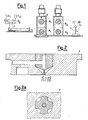
- the hollow fibre is prepared by using the equipment as illustrated in Figures 1 and 2.
- Figure 1 with C1 the vessel for the storage of the solution of polyester-amide, and with P1 the supply pump for feeding the polymeric solution to the spinnerette F is indicated.
- the vessel C1, the pump P1 and the spinnerette F are provided with a special temperature-controlling system.
- the spinnerette F is of the "tube in orifice" type, and is illustrated in detail in Figure 2.
- the orifice for the extrusion of the polymeric solution is constituted by an annulus having an outer diameter ⁇ 3 of 1 mm, and with an inner diameter ⁇ 2 of 0.6 mm.
- a fluid is fed which performs a coagulating function for the polymeric solution, and/or acts as a support for the fibrous structure.
- said fluid contained inside the vessel C2, is fed to the spinnerette by means of pump P2.
- the vessel C2 and the pump P2 are replaced by a gas cylinder and a flowmeter.
- the coagulation of the fibre takes place inside the coagulation bath V, according to the process known as the "phase reversal", and consisting in the gelling of the polymeric solution by means of the diffusion of a non-solvent inside the solution, contemporaneously to the diffusion, to the opposite direction, of the solvent in the coagulant.
- the hollow fibre On its exit from the coagulation bath V, the hollow fibre is drawn by the pair of rollers R1, is washed with water by means of the shower D, is drawn by means of a second pair of rollers R2 and is finally collected by the skeiner M.
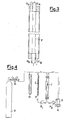
- the hollow fibre is positioned inside the container illustrated in Figure 3, wherein with F the fibre is shown, and with EA the inlet and with UA the outlet of the fibres-comprising loop are shown. With EB and UB, the inlet and the outlet of the loop external to the fibres are indicated.
- This container is used on the equipment illustrated in Figure 4, to the purpose of determining the coefficient of diffusion, through the same fibre, of the following substances: sodium chloride, urea, creatinine, uric acid, vitamin B12, inulin, myoglobin and albumin, and that according to the methodology as described by E. Klein, F. Holland, A. Leboef, A. Donnaud and J.H. Smith in Journal of Membrane Science, 1 , 371-396 (1976).
- the solution containing the substance under examination is recycled through the fibre F by means of the pump P1.
- the changes in volume can be monitored and, if necessary, the loop can be pressurized by the nitrogen contained inside the cylinder C, under the pressure as indicated by the pressure gauge X.
- Distilled water is recycled, through the pump P2, through a second loop comprising the vessel volume external relatively to the hollow fibre F and the collection tank S, the contents of which are kept stirred by means of stirrer A. From the tank S, samples are periodically drawn to the purpose of determining the amount of the substance under examination, diffused through the hollow fibre.
- Polyester-amide (TATE) n having the following characteristics: - relative viscosity: 2.3; - content of free carboxy groups: 22 meq/kg; - melting point: 255°C; (15 parts by weight) is dissolved in a solution of lithium chloride (5 parts by weight) in dimethylacetamide (80 parts by weight), by operating at 100°C and with stirring, until a clear solution is obtained. The so-obtained solution is cooled to 45-50°C, is vacuum-outgassed for 6 hours and is filtered through a 500-mesh steel net.
- the solution at 50°C, is then extruded through the spinnerette, with a flowrate of 390 ml/hour, while water is injected, through the central bore of the spinnerette, at a flowrate of 450 ml/hour.
- the coagulation of the fibre takes place inside the coagulation bath, containing 5 litres of water, at the temperature of about 20°C
- the coagulated fibre is then washed with water and is collected on the skeiner, at a rate of 20 m/minute.
- bundles are obtained of hollow fibres which, after the inner liquid being drained off, are washed with tap water for 24 hours.
- the fibre is subsequently conditioned with a water/glycerin solution (70/30 by volume) containing 100 ppm of formaldehyde.
- the fibre permeability to water is of 4.3 litres/m2/hour, for a ⁇ P of 300 mm Hg .
- the dimensions of the fibre are: - outer diameter: 800 ⁇ m; - wall thickness: 130 ⁇ m.
- Example 2 20 Parts by weight of the polyester-amide of Example 1 is dissolved in a solution constituted by 75 parts by weight of dimethylacetamide and 5 parts by weight of lithium chloride. The spinning process is carried out as in Example 1 and a hollow fibre is obtained, which has the characteristics as reported in following Table 2.
- the fibre permeability to water is of 3.8 litres/m2/hour, for a ⁇ P of 300 mm Hg .
- the dimensions of the fibre are: - outer diameter: 830 ⁇ m; - wall thickness: 170 ⁇ m.
- Example 1 25 Parts by weight of the polyester-amide of Example 1 is dissolved in a solution constituted by 70 parts by weight of dimethylacetamide and 5 parts by weight of lithium chloride. The process is carried out as in Example 1 and a hollow fibre is obtained, which has the characteristics as reported in following Table 3.
- the fibre permeability to water is of 2.7 litres/m2/hour, for a ⁇ P of 300 mm Hg .
- the dimensions of the fibre are: - outer diameter: 870 ⁇ m; - wall thickness: 170 ⁇ m.
- Example 4 15 Parts by weight of the polyester-amide of Example 1 is dissolved in a solution constituted by 80 parts by weight of dimethylformamide and 5 parts by weight of lithium chloride (Example 4) and further 20 parts by weight of polyester-amide are dissolved in a solution constituted by 75 parts by weight of dimethylformamide and 5 parts by weight of lithium chloride.
- the two so-obtained polymeric solutions are filtered, outgassed and extruded at 85°C.
- the fibre permeability to water is of 2.7 litres/m2/hour (Example 4) and 2.1 litres/m2/hour (Example 5), for a ⁇ P of 300 mm Hg .
- Example 4 outer diameter: 890 ⁇ m; - wall thickness: 150 ⁇ m.
- Example 5 outer diameter: 870 ⁇ m; - wall thickness: 160 ⁇ m.
- Example 15 Parts by weight of the polyester-amide of Example 1 is dissolved in a solution constituted by 80 parts by weight of dimethylacetamide and 5 parts by weight of lithium chloride.
- the process is carried out as in Example 1, with the following variations: - inside the fibre, nitrogen is injected (200 ml/hour); - the extrusion rate of the polymeric solution if of 340 ml/hour; - in the scheme of Figure 1 a third pair of rollers is inserted, and the collection speed of the three pairs of rollers is differentiated as follows: 1st pair, collection rate 24 m/minute; 2nd pair, collection rate 34 m/minute; 3rd pair, collection rate 36 m/minute.
- the fibre permeability to water is of 7.2 litres/m2/hour, for a ⁇ P of 300 mm Hg .
- the dimensions of the fibre are: - outer diameter: 450 ⁇ m; - wall thickness: 80 ⁇ m.
- Example 15 Parts by weight of the polyester-amide of Example 1 is dissolved in a solution constituted by 80 parts by weight of dimethylacetamide and 5 parts by weight of lithium chloride.
- the process is carried out as in Example 1, with the following variations: - the polymeric solution is extruded at a flowrate of 340 ml/hour; - inside the fibre, water is injected at a flowrate of 150 ml/hour; - the spinnerette is kept above the coagulation bath, at such a distance that the solution runs along a vertical path of 1.5 m before entering the coagulation bath; - the collection of the fibre is carried out by using three pairs of rollers, at the following rates: 1st pair, collection rate 18 m/minute; 2nd pair, collection rate 26 m/minute; 3rd pair, collection rate 28 m/minute.
- the fibre permeability to water is of 7.5 litres/m2/hour, for a ⁇ P of 300 mm Hg .
- the dimensions of the fibre are: - outer diameter: 400 ⁇ m; - wall thickness: 110 ⁇ m.
- the spinning process is carried out as in Example 7, with the exception that the fibre is kept immersed inside the coagulation bath and the liquid fed to the interior of the fibre is a water/dimethylacetamide (2/1 by volume) mixture.
- the fibre permeability to water is of 6.5 litres/m2/hour, for a ⁇ P of 300 mm Hg .
- the dimensions of the fibre are: - outer diameter: 490 ⁇ m; - wall thickness: 110 ⁇ m.
Landscapes
- Chemical & Material Sciences (AREA)
- Chemical Kinetics & Catalysis (AREA)
- Engineering & Computer Science (AREA)
- Mechanical Engineering (AREA)
- Textile Engineering (AREA)
- Artificial Filaments (AREA)
- Separation Using Semi-Permeable Membranes (AREA)
- External Artificial Organs (AREA)
- Polyamides (AREA)
- Compositions Of Macromolecular Compounds (AREA)
Priority Applications (1)
| Application Number | Priority Date | Filing Date | Title |
|---|---|---|---|
| AT87201120T ATE66830T1 (de) | 1986-06-20 | 1987-06-12 | Polyesteramid-hohlfaser und verfahren zu ihrer herstellung. |
Applications Claiming Priority (2)
| Application Number | Priority Date | Filing Date | Title |
|---|---|---|---|
| IT20863/86A IT1190137B (it) | 1986-06-20 | 1986-06-20 | Fibra cava di poliestere ammide e procedimento per la sua preparazione |
| IT2086386 | 1986-06-20 |
Publications (3)
| Publication Number | Publication Date |
|---|---|
| EP0254334A2 true EP0254334A2 (de) | 1988-01-27 |
| EP0254334A3 EP0254334A3 (en) | 1989-02-01 |
| EP0254334B1 EP0254334B1 (de) | 1991-09-04 |
Family
ID=11173211
Family Applications (1)
| Application Number | Title | Priority Date | Filing Date |
|---|---|---|---|
| EP87201120A Expired EP0254334B1 (de) | 1986-06-20 | 1987-06-12 | Polyesteramid-Hohlfaser und Verfahren zu ihrer Herstellung |
Country Status (8)
| Country | Link |
|---|---|
| US (1) | US4830796A (de) |
| EP (1) | EP0254334B1 (de) |
| JP (1) | JPS636111A (de) |
| AT (1) | ATE66830T1 (de) |
| DE (1) | DE3772658D1 (de) |
| ES (1) | ES2026898T3 (de) |
| GR (1) | GR3002786T3 (de) |
| IT (1) | IT1190137B (de) |
Cited By (3)
| Publication number | Priority date | Publication date | Assignee | Title |
|---|---|---|---|---|
| EP0375004A1 (de) * | 1988-12-22 | 1990-06-27 | Lyonnaise Des Eaux - Dumez | Verfahren zur Herstellung eines porösen organischen Materials, insbesondere einer halbdurchlässigen organischen Membran mit einer Vielzahl getrennter Längskanäle |
| US5002922A (en) * | 1989-02-04 | 1991-03-26 | Basf Aktiengesellschaft | Catalyst for the amination of alcohols under hydrogenating conditions |
| EP0277834B1 (de) * | 1987-02-04 | 1998-05-13 | Hydranautics | Verfahren zur Herstellung von stabilen Umkehrosmose-Membranen aus sulfonierten Polyaryläthern |
Families Citing this family (3)
| Publication number | Priority date | Publication date | Assignee | Title |
|---|---|---|---|---|
| JPH02265956A (ja) * | 1989-04-07 | 1990-10-30 | Nippon Oil & Fats Co Ltd | 複合膜の製造方法および複合膜 |
| EP0747112B1 (de) * | 1995-06-06 | 2002-01-16 | Water Research Commission | Verfahren zur Herstellung einer Hohlfasermembran |
| AU2011215668A1 (en) * | 2010-02-12 | 2012-09-06 | Dow Global Technologies Llc | Separation of acidic constituents by self assembling polymer membranes |
Family Cites Families (12)
| Publication number | Priority date | Publication date | Assignee | Title |
|---|---|---|---|---|
| US3728428A (en) * | 1969-12-03 | 1973-04-17 | Allied Chem | Process for producing hollow filaments |
| YU36144B (en) * | 1970-10-13 | 1982-02-25 | Anic Spa | Process for obtaining diester diamides |
| US3888771A (en) * | 1972-06-02 | 1975-06-10 | Asahi Chemical Ind | Hollow fibers of cuprammonium cellulose and a process of the manufacture of same |
| JPS5241797B2 (de) * | 1974-04-05 | 1977-10-20 | ||
| DE2625681C3 (de) * | 1975-06-10 | 1986-05-28 | Kuraray Co., Ltd., Kurashiki, Okayama | Trennmembran aus einem Äthylen/Vinylalkohol-Copolymeren |
| JPS5237830A (en) * | 1975-09-19 | 1977-03-24 | Kuraray Co Ltd | Polyvinyl alcohol hollow fibers for dialysis |
| FR2345476A1 (fr) * | 1976-03-22 | 1977-10-21 | Rhone Poulenc Textile | Nouveaux polyesteramides |
| US4080744A (en) * | 1976-06-22 | 1978-03-28 | E. I. Du Pont De Nemours And Company | Gas separation membrane drying with water replacement liquid |
| JPS5411322A (en) * | 1977-06-29 | 1979-01-27 | Asahi Chem Ind Co Ltd | Hollow cellulose fibers and their production |
| JPS57167414A (en) * | 1981-04-03 | 1982-10-15 | Ube Ind Ltd | Production of polyimide hollow fiber |
| DE3138525A1 (de) * | 1981-09-28 | 1983-04-14 | Akzo Gmbh, 5600 Wuppertal | Verfahren zur herstellung einer asymmetrischen hohlfadenmembran aus polyamid |
| JPS58132111A (ja) * | 1982-01-29 | 1983-08-06 | Asahi Chem Ind Co Ltd | ポリスルホン中空糸 |
-
1986
- 1986-06-20 IT IT20863/86A patent/IT1190137B/it active
-
1987
- 1987-06-09 US US07/060,247 patent/US4830796A/en not_active Expired - Fee Related
- 1987-06-12 AT AT87201120T patent/ATE66830T1/de not_active IP Right Cessation
- 1987-06-12 EP EP87201120A patent/EP0254334B1/de not_active Expired
- 1987-06-12 DE DE8787201120T patent/DE3772658D1/de not_active Expired - Lifetime
- 1987-06-12 ES ES198787201120T patent/ES2026898T3/es not_active Expired - Lifetime
- 1987-06-19 JP JP62151538A patent/JPS636111A/ja active Pending
-
1991
- 1991-09-25 GR GR91401428T patent/GR3002786T3/el unknown
Cited By (4)
| Publication number | Priority date | Publication date | Assignee | Title |
|---|---|---|---|---|
| EP0277834B1 (de) * | 1987-02-04 | 1998-05-13 | Hydranautics | Verfahren zur Herstellung von stabilen Umkehrosmose-Membranen aus sulfonierten Polyaryläthern |
| EP0375004A1 (de) * | 1988-12-22 | 1990-06-27 | Lyonnaise Des Eaux - Dumez | Verfahren zur Herstellung eines porösen organischen Materials, insbesondere einer halbdurchlässigen organischen Membran mit einer Vielzahl getrennter Längskanäle |
| FR2641708A1 (fr) * | 1988-12-22 | 1990-07-20 | Lyonnaise Eaux | Procede pour la fabrication d'un materiau poreux organique, notamment d'une membrane semi-permeable organique, comportant une pluralite de canaux longitudinaux separes |
| US5002922A (en) * | 1989-02-04 | 1991-03-26 | Basf Aktiengesellschaft | Catalyst for the amination of alcohols under hydrogenating conditions |
Also Published As
| Publication number | Publication date |
|---|---|
| EP0254334B1 (de) | 1991-09-04 |
| DE3772658D1 (de) | 1991-10-10 |
| ES2026898T3 (es) | 1992-05-16 |
| JPS636111A (ja) | 1988-01-12 |
| IT8620863A0 (it) | 1986-06-20 |
| EP0254334A3 (en) | 1989-02-01 |
| ATE66830T1 (de) | 1991-09-15 |
| IT8620863A1 (it) | 1987-12-20 |
| IT1190137B (it) | 1988-02-10 |
| GR3002786T3 (en) | 1993-01-25 |
| US4830796A (en) | 1989-05-16 |
Similar Documents
| Publication | Publication Date | Title |
|---|---|---|
| US4666607A (en) | Porous shaped bodies, and method and apparatus for the production thereof | |
| US4439322A (en) | Polymethyl methacrylate membrane | |
| US5240614A (en) | Process for removing unwanted materials from fluids and for producing biological products | |
| US4808315A (en) | Porous hollow fiber membrane and a method for the removal of a virus by using the same | |
| CA1236956A (en) | Porous cuprammonium cellulose fibre produced with annular orifice and central coagulating stream | |
| EP0504686B1 (de) | Verfahren zum kontinuierlichen Spinnen von Hohlfasermembranen unter Verwendung eines Lösungsmittelgemisches als Fällungsmedium | |
| EP0201604B1 (de) | Hohlfasermembran mit selektiver durchlässigkeit, deren herstellung und verfahren zur scheidung von plasmakomponenten sowie plasmakomponentabscheider | |
| JPH02151636A (ja) | 等方性の微孔性ポリスルホン膜の製造法 | |
| US4980063A (en) | Compositions useful for preparing cellulose ester membranes for liquid separations | |
| JPS5865009A (ja) | 非対象ポリアミド中空糸膜の製造方法 | |
| US4722795A (en) | Polyamide hollow fiber filtration membrane having barrier layer | |
| KR100224115B1 (ko) | 고 플럭스 공동 섬유막 | |
| EP0012630B1 (de) | Verfahren zur Herstellung einer selektiv durchlässigen Membran des Zelluloseazetat-Typs, so hergestellte selektiv durchlässige Membran und Anwendung einer derartigen Membran in einer künstlichen Niere | |
| EP0254334B1 (de) | Polyesteramid-Hohlfaser und Verfahren zu ihrer Herstellung | |
| CA1107020A (en) | Cellulose acetate hollow fiber and method for making same | |
| JP2542572B2 (ja) | 中空繊維 | |
| JPH0778288B2 (ja) | 半透過性中空セルロ−ス繊維の製造方法 | |
| US5783124A (en) | Cellulose acetate hemodialysis membrane | |
| CA1184716A (en) | Plasma phoresis membrane | |
| US4808312A (en) | Cellulose ester hollow fiber membrane for plasma separation | |
| EP0824960A1 (de) | Hohlfasermembran aus polysulfon-polymer und verfahren zu ihrer herstellung | |
| US5505859A (en) | Hollow fiber for dialysis and process of manufacturing | |
| IE55578B1 (en) | Hollow fibre useful in blood treating processes | |
| US4879036A (en) | Asymmetrical membrane of polyester-amide and process for preparing it | |
| JP3173617B2 (ja) | セルロースアセテート透析膜用中空糸及び製造方法 |
Legal Events
| Date | Code | Title | Description |
|---|---|---|---|
| PUAI | Public reference made under article 153(3) epc to a published international application that has entered the european phase |
Free format text: ORIGINAL CODE: 0009012 |
|
| AK | Designated contracting states |
Kind code of ref document: A2 Designated state(s): AT BE CH DE ES FR GB GR LI LU NL SE |
|
| PUAL | Search report despatched |
Free format text: ORIGINAL CODE: 0009013 |
|
| AK | Designated contracting states |
Kind code of ref document: A3 Designated state(s): AT BE CH DE ES FR GB GR LI LU NL SE |
|
| 17P | Request for examination filed |
Effective date: 19890420 |
|
| 17Q | First examination report despatched |
Effective date: 19900716 |
|
| GRAA | (expected) grant |
Free format text: ORIGINAL CODE: 0009210 |
|
| AK | Designated contracting states |
Kind code of ref document: B1 Designated state(s): AT BE CH DE ES FR GB GR LI LU NL SE |
|
| REF | Corresponds to: |
Ref document number: 66830 Country of ref document: AT Date of ref document: 19910915 Kind code of ref document: T |
|
| ET | Fr: translation filed | ||
| REF | Corresponds to: |
Ref document number: 3772658 Country of ref document: DE Date of ref document: 19911010 |
|
| REG | Reference to a national code |
Ref country code: ES Ref legal event code: FG2A Ref document number: 2026898 Country of ref document: ES Kind code of ref document: T3 |
|
| PGFP | Annual fee paid to national office [announced via postgrant information from national office to epo] |
Ref country code: SE Payment date: 19920518 Year of fee payment: 6 |
|
| PGFP | Annual fee paid to national office [announced via postgrant information from national office to epo] |
Ref country code: GR Payment date: 19920527 Year of fee payment: 6 |
|
| PGFP | Annual fee paid to national office [announced via postgrant information from national office to epo] |
Ref country code: GB Payment date: 19920602 Year of fee payment: 6 |
|
| PGFP | Annual fee paid to national office [announced via postgrant information from national office to epo] |
Ref country code: AT Payment date: 19920610 Year of fee payment: 6 |
|
| PGFP | Annual fee paid to national office [announced via postgrant information from national office to epo] |
Ref country code: LU Payment date: 19920617 Year of fee payment: 6 Ref country code: ES Payment date: 19920617 Year of fee payment: 6 Ref country code: BE Payment date: 19920617 Year of fee payment: 6 |
|
| PGFP | Annual fee paid to national office [announced via postgrant information from national office to epo] |
Ref country code: FR Payment date: 19920619 Year of fee payment: 6 |
|
| PGFP | Annual fee paid to national office [announced via postgrant information from national office to epo] |
Ref country code: NL Payment date: 19920630 Year of fee payment: 6 |
|
| PLBE | No opposition filed within time limit |
Free format text: ORIGINAL CODE: 0009261 |
|
| STAA | Information on the status of an ep patent application or granted ep patent |
Free format text: STATUS: NO OPPOSITION FILED WITHIN TIME LIMIT |
|
| PGFP | Annual fee paid to national office [announced via postgrant information from national office to epo] |
Ref country code: DE Payment date: 19920730 Year of fee payment: 6 |
|
| 26N | No opposition filed | ||
| PGFP | Annual fee paid to national office [announced via postgrant information from national office to epo] |
Ref country code: CH Payment date: 19920928 Year of fee payment: 6 |
|
| REG | Reference to a national code |
Ref country code: GR Ref legal event code: FG4A Free format text: 3002786 |
|
| EPTA | Lu: last paid annual fee | ||
| PG25 | Lapsed in a contracting state [announced via postgrant information from national office to epo] |
Ref country code: LU Free format text: LAPSE BECAUSE OF NON-PAYMENT OF DUE FEES Effective date: 19930612 Ref country code: GB Effective date: 19930612 Ref country code: AT Effective date: 19930612 |
|
| PG25 | Lapsed in a contracting state [announced via postgrant information from national office to epo] |
Ref country code: SE Effective date: 19930613 |
|
| PG25 | Lapsed in a contracting state [announced via postgrant information from national office to epo] |
Ref country code: ES Free format text: LAPSE BECAUSE OF EXPIRATION OF PROTECTION Effective date: 19930614 |
|
| PG25 | Lapsed in a contracting state [announced via postgrant information from national office to epo] |
Ref country code: LI Effective date: 19930630 Ref country code: CH Effective date: 19930630 Ref country code: BE Effective date: 19930630 |
|
| BERE | Be: lapsed |
Owner name: ENIRICERCHE S.P.A. Effective date: 19930630 |
|
| PG25 | Lapsed in a contracting state [announced via postgrant information from national office to epo] |
Ref country code: GR Free format text: THE PATENT HAS BEEN ANNULLED BY A DECISION OF A NATIONAL AUTHORITY Effective date: 19931231 |
|
| PG25 | Lapsed in a contracting state [announced via postgrant information from national office to epo] |
Ref country code: NL Effective date: 19940101 |
|
| GBPC | Gb: european patent ceased through non-payment of renewal fee |
Effective date: 19930612 |
|
| NLV4 | Nl: lapsed or anulled due to non-payment of the annual fee | ||
| PG25 | Lapsed in a contracting state [announced via postgrant information from national office to epo] |
Ref country code: FR Effective date: 19940228 |
|
| REG | Reference to a national code |
Ref country code: CH Ref legal event code: PL |
|
| PG25 | Lapsed in a contracting state [announced via postgrant information from national office to epo] |
Ref country code: DE Effective date: 19940301 |
|
| REG | Reference to a national code |
Ref country code: FR Ref legal event code: ST |
|
| REG | Reference to a national code |
Ref country code: GR Ref legal event code: MM2A Free format text: 3002786 |
|
| EUG | Se: european patent has lapsed |
Ref document number: 87201120.0 Effective date: 19940110 |
|
| REG | Reference to a national code |
Ref country code: ES Ref legal event code: FD2A Effective date: 19991007 |