EP0252937B1 - Aufnahme und wiedergabe von bildern - Google Patents
Aufnahme und wiedergabe von bildern Download PDFInfo
- Publication number
- EP0252937B1 EP0252937B1 EP87900221A EP87900221A EP0252937B1 EP 0252937 B1 EP0252937 B1 EP 0252937B1 EP 87900221 A EP87900221 A EP 87900221A EP 87900221 A EP87900221 A EP 87900221A EP 0252937 B1 EP0252937 B1 EP 0252937B1
- Authority
- EP
- European Patent Office
- Prior art keywords
- film
- shutter
- filters
- camera
- frame
- Prior art date
- Legal status (The legal status is an assumption and is not a legal conclusion. Google has not performed a legal analysis and makes no representation as to the accuracy of the status listed.)
- Expired - Lifetime
Links
- 239000003086 colorant Substances 0.000 claims abstract description 23
- 238000000034 method Methods 0.000 claims abstract description 20
- 230000007246 mechanism Effects 0.000 claims abstract description 19
- 230000003287 optical effect Effects 0.000 claims abstract description 16
- 230000000694 effects Effects 0.000 claims abstract description 10
- 230000015572 biosynthetic process Effects 0.000 claims description 3
- 230000000295 complement effect Effects 0.000 description 5
- 239000011521 glass Substances 0.000 description 4
- 238000000926 separation method Methods 0.000 description 4
- 230000005540 biological transmission Effects 0.000 description 3
- 230000008859 change Effects 0.000 description 3
- 238000006073 displacement reaction Methods 0.000 description 3
- 230000011514 reflex Effects 0.000 description 3
- 230000008901 benefit Effects 0.000 description 2
- 210000004556 brain Anatomy 0.000 description 2
- 230000006870 function Effects 0.000 description 2
- 210000003128 head Anatomy 0.000 description 2
- 230000000873 masking effect Effects 0.000 description 2
- 230000004048 modification Effects 0.000 description 2
- 238000012986 modification Methods 0.000 description 2
- 238000001454 recorded image Methods 0.000 description 2
- 230000035945 sensitivity Effects 0.000 description 2
- 108010010803 Gelatin Proteins 0.000 description 1
- 239000011248 coating agent Substances 0.000 description 1
- 238000000576 coating method Methods 0.000 description 1
- 210000005069 ears Anatomy 0.000 description 1
- 229920000159 gelatin Polymers 0.000 description 1
- 239000008273 gelatin Substances 0.000 description 1
- 235000019322 gelatine Nutrition 0.000 description 1
- 235000011852 gelatine desserts Nutrition 0.000 description 1
- 239000000463 material Substances 0.000 description 1
- 238000002156 mixing Methods 0.000 description 1
- 230000008447 perception Effects 0.000 description 1
- 230000008569 process Effects 0.000 description 1
- 230000009467 reduction Effects 0.000 description 1
- 238000001429 visible spectrum Methods 0.000 description 1
- 230000000007 visual effect Effects 0.000 description 1
Images





Classifications
-
- G—PHYSICS
- G03—PHOTOGRAPHY; CINEMATOGRAPHY; ANALOGOUS TECHNIQUES USING WAVES OTHER THAN OPTICAL WAVES; ELECTROGRAPHY; HOLOGRAPHY
- G03B—APPARATUS OR ARRANGEMENTS FOR TAKING PHOTOGRAPHS OR FOR PROJECTING OR VIEWING THEM; APPARATUS OR ARRANGEMENTS EMPLOYING ANALOGOUS TECHNIQUES USING WAVES OTHER THAN OPTICAL WAVES; ACCESSORIES THEREFOR
- G03B35/00—Stereoscopic photography
-
- G—PHYSICS
- G03—PHOTOGRAPHY; CINEMATOGRAPHY; ANALOGOUS TECHNIQUES USING WAVES OTHER THAN OPTICAL WAVES; ELECTROGRAPHY; HOLOGRAPHY
- G03B—APPARATUS OR ARRANGEMENTS FOR TAKING PHOTOGRAPHS OR FOR PROJECTING OR VIEWING THEM; APPARATUS OR ARRANGEMENTS EMPLOYING ANALOGOUS TECHNIQUES USING WAVES OTHER THAN OPTICAL WAVES; ACCESSORIES THEREFOR
- G03B35/00—Stereoscopic photography
- G03B35/08—Stereoscopic photography by simultaneous recording
- G03B35/12—Stereoscopic photography by simultaneous recording involving recording of different viewpoint images in different colours on a colour film
-
- G—PHYSICS
- G03—PHOTOGRAPHY; CINEMATOGRAPHY; ANALOGOUS TECHNIQUES USING WAVES OTHER THAN OPTICAL WAVES; ELECTROGRAPHY; HOLOGRAPHY
- G03B—APPARATUS OR ARRANGEMENTS FOR TAKING PHOTOGRAPHS OR FOR PROJECTING OR VIEWING THEM; APPARATUS OR ARRANGEMENTS EMPLOYING ANALOGOUS TECHNIQUES USING WAVES OTHER THAN OPTICAL WAVES; ACCESSORIES THEREFOR
- G03B35/00—Stereoscopic photography
- G03B35/18—Stereoscopic photography by simultaneous viewing
- G03B35/26—Stereoscopic photography by simultaneous viewing using polarised or coloured light separating different viewpoint images
Definitions
- This invention relates to the recording and reproduction of images.
- the invention relates to a method of recording images on cinematographic film and a film camera for carrying out the method.
- Stereoscopic or "3D" moving films have been known for many years.
- the films have been made by simultaneously filming an object from two different aspects, through two lens systems separated horizontally or vertically from one another or by dividing a single lens system using mirrors, prisms etc.
- the usual technique has been to use different colour filters, for example red and green, with the two lens systems, or split lens system so that red and green images are formed simultaneously on the film.
- each member of the audience wears a pair of spectacles with complementarily coloured lenses, so that the two images on the screen are presented separately to the two eyes of the viewer, producing the illusion of a stereoscopic or three dimensional image.
- Another known technique involves the use of polarising filters instead of colour filters, the film being viewed through spectacles with cross-polarising lenses. Disadvantages of the known techniques are that they require specially built or specially adapted cameras which, because of the need for split or separate lens, are bulky and expensive, and that they produce a degraded or double image when the result is viewed without the appropriate spectacles.
- Stereoscopic vision relies on the fact that each eye sees a different aspect of the same object. This stems not only from the different positions occupied by the two eyes, but from the fact that there is usually movement in the scene being viewed, or movement of the eyes themselves.
- a person's head is for a large part of the time in constant movement, as are the eyes within the head, as they constantly scan the scene they are looking at. This causes continuous change in the aspects of the scene being viewed by each eye, which is important in the perception by the brain of the "dimensionality" of objects in the scene. Any movement in the scene, even of a single moving object, will increase the stereoscopic effect, even if the eyes are kept stationary.
- the present invention makes use of this effect in producing stereoscopic images, in contrast to the known techniques, which usually rely on the formation of separate images through split or separate lens systems.
- Swiss patent specification CH-105 935 describes a system for projecting cinematographic films to give an illusion of depth, in which two successive frames of the film are projected simultaneously, through separate projection lenses, onto a screen so that the two frames are overlaid on the screen.
- the two frames are projected through separate polarising elements set at different angles, and each viewer wears a pair of spectacles containing corresponding polarising elements, so that the right and left eyes see images from the two successive frames.
- the difference in the images because of movement between the two frames gives the illusion of depth.
- Such a system requires a specially built projector having two lens systems.
- FR-A-2.544.574 discloses a recopying technique for producing stereoscopic single frames in which different coloured images from a conventional stereo pair are superimposed on the same frame.
- a method of recording and reproducing a stereoscopic movie film which includes recording through a single lens system onto successive frames of cinematographic film an image of an object moving relative to the film, characterised in that the film is a colour film and the recording comprises:
- three successive images are formed, for example in red, blue and green light, or in the complementary colours yellow, cyan and magenta.
- two successive images are formed, for example in combinations of red and blue and of red and green.
- the recorded images are subsequently reproduced, for example on a screen, using conventional projection equipment.
- the images to be viewed stereoscopically they may be viewed through a pair of spectacles, each lens of which comprises a filter allowing transmission of light such that the right and left eyes of the viewer see different ones of the successive images or different combinations of the images.
- each lens may allow transmission of light corresponding to a colour complementary to a different one of the three colours of the images and a proportion of light corresponding to a colour complementary to the third of the three colours of the images.
- the use of three colours enables full-colour stereoscopic images to be produced.
- the method of the invention can be carried out in such a way that the images reproduced, when viewed by the naked eye, i.e., without the spectacles, do not appear as degraded or double images, but as single full-colour images.
- the images, whether viewed with or without the spectacles can be improved by the method of the invention, by improving the sharpness of the image as well as the saturation of colour recorded.
- the invention consists, in another aspect, in a colour film movie camera for carrying out the method of the invention, the camera having a single lens system and a mechanism for interposing a number of different colour filters in the optical path of the camera successively during the exposure of each frame of the film, so that the images formed by light passing through the filters are overlaid on each frame.
- the mechanism comprises a movable member, the filters forming part of, or being carried by, the movable member, and means for rotating the member so that the filters are brought successively into the optical path of the camera during exposure of each frame of the film.
- the movable member may for example be a rotatable member.
- the mechanism may be adapted to be fitted to an existing film camera so that the rotatable member moves in front of, or behind, the camera lens.
- the movable mechanism comprises a rotatable shutter member adapted to replace the mirrored rotary shutter, or the rotary focal plane shutter, the shutter member having an opaque portion and portions formed by the filters so that on rotation of the shutter member the opaque portion and the filters are moved successively into the optical path of the camera. If the mirrored rotary shutter is replaced, the opaque portion of the replacement member can also be mirrored on one surface. If the rotary focal plane shutter is replaced the opaque portion can remain black.
- the filters may form adjacent sectors of the transparent portion of the shutter member, divided by radii of the shutter member.
- the boundaries between adjacent filters may be inclined to the radius of the shutter, for example extending spirally, so that adjacent filters "overlap" one another in the direction of rotation. This overlapping is particularly useful in avoiding "fringing" around the edges of the image which may otherwise occur in certain circumstances when the reproduced film is viewed without spectacles.
- a rotating shutter generally in the form of a sector-shaped or “butterfly” shaped opaque member which may be mirrored on one side, with the axis of rotation set at an angle to the optical axis to allow reflex viewing through the camera eyepiece whilst masking the film during frame advancement.
- a "butterfly" mirrored shutter 14 is mounted in the camera body 12 for rotation about an axis at 45° to the optical axis. The shutter 14 is positioned so that its two opaque portions 15 move alternately into position between the camera lens 16 and the gate 18 through which the film passes.
- the shutter is driven through gearing 20 from the drive motor 22 which also drives the film advancing mechanism 23, so that the shutter is driven in synchronism with the film advancement.
- the shutter 14 is mirrored on the surface 17 facing the lens 16, so that when either of the opaque portions is in position, the light from the lens is reflected to the camera eyepiece 19.
- Figure 4 shows a sector-shaped rotary shutter 24 having a single opaque portion 25, which may be mirrored on one surface and positioned to rotate at an angle to the optical axis, as with the "butterfly" shutter of Figure 2.
- a mirrored rotary shutter allows reflex viewing through the camera eyepiece whilst a separate rotary focal plane shutter, whose axis of rotation is set parallel to the optical axis, performs the function of masking the film during frame advancement, the focal plane shutter being driven in synchronism with the mirrored shutter.
- the rotary focal plane shutter is also generally in the form of a sector-shaped or butterfly-shaped opaque member, though not mirrored on one side.
- the shutter 24 rotates once for each frame of the film (usually 24 or 25 times a second).
- the shutter 14 rotates once for every two frames of the film.
- the opaque portion of the shutter moves to a position between the lens 16 and the film, whilst the camera mechanism 23 advances the film to bring the next frame into position in the gate 18.
- the length of exposure of each frame is governed by the angle occupied by the open portion of the shutter, which is usually 180°, as shown in Figure 4 but can be between about 10° and 230°.
- each open portion is usually 90° but may also be variable.
- the mirrored rotary shutter 14, or the rotary focal plane shutter 44 of the conventional film camera is replaced with a disc shutter designed to give rise to a number of images on each frame of the film.
- the disc shutter 50 is designed to replace a sector-shaped shutter such as that of Figure 4.
- the disc shutter 50 comprises a hub portion 51, an opaque shutter portion 52 and a transparent filter portion 54,56,58.
- the hub portion 51 is designed so that the disc shutter 50 can be fitted in the camera in the same way as the conventional shutter which it replaces. For example, it may be provided wth appropriately positioned holes to receive bolts by means of which it is held in place in the camera.
- the opaque portion 52 occupies a 180° sector of the shutter 50, corresponding to the opaque portion 25 of the conventional shutter 24 of Figure 4, and performs the same function as the opaque portion of the conventional shutter.
- the disc shutter 50 is intended to replace a conventional mirrored rotary shutter, it may be mirrored on one surface so that replacememt of the conventional shutter will not affect the view of the camera operator through the eyepiece. If the disc shutter 50 is intended to replace a rotary focal plane shutter, mirroring of the disc shutter is not necessary, since the additional mirrored rotary shutter providing the view through the eyepiece, remains unchanged.
- the transparent portion of the disc shutter 50 consists of three filters, a red filter 54, a blue filter 56 and a green filter 58, each occupying an equal area or angular portion of the transparent portion.
- each filter occupies a 60° sector of the disc shutter.
- the disc shutter 50 may for example consist of a glass disc, with the opaque portion suitably coated and filters laminated onto the transparent portion.
- the disc shutter 50 is fitted into a conventional camera in place of the conventional sector-shaped shutter.
- the disc shutter 50 is driven to rotate at a constant speed so that the opaque portion 52 and the filters 54,56,58 pass successively between the lens 16 and the film gate 18.
- the film drive mechanism advances the film whilst the opaque portion 51 is passing between the lens 16 and gate 18, and holds each frame of the film stationary in the gate, at a position indicated diagrammatically at 48 in Figure 5, as the filters 54,56 and 58 pass successively between the lens 16 and the gate 18. If the camera operates at 25 frames per second, so that the disc shutter rotates once in 1/25 seconds, the shutter speed, i.e. the period during which each frame of the film is exposed, is 1/50 second.
- Each of the filters 54,56,58 passes between the lens 16 and the film for one third of this time, so that each frame will be exposed to a red image for 1/150 second, a blue image for 1/150 second, and a green image for 1/150 second, in succession. These images are "overlaid" on each frame of the film.
- the three images recorded on each frame will usually represent different aspects of the scene being filmed, either because the camera moves during the 1/50 second exposure time, or because an object in the scene has moved, or a combination of the two.
- the degree of disalignment between the three images caused by movement in the scene or movement of the camera 10 will depend on various interdependent factors, such as the speed of the movement, the closeness of the moving object to the camera 10, the focal length of the camera lens 16, and the angle of the transparent portion 54,56,58 of the shutter 50 i.e. the effective shutter speed.
- the film is processed in the usual way and is projected onto a screen using conventional projection equipment.
- the film can be produced so that when projected it can be viewed without spectacles in the usual way.
- each member of the audience will usually be provided with a pair of spectacles 200 ( Figure 18), each lens of which consists of a colour filter allowing transmission of light corresponding to a colour complementary to one of the colours of the disc shutter in the camera together with part of the colour complementary to the third colour of the disc.
- the lens 201 for the left eye may contain a cyan filter combined with a proportional yellow filter, with the lens 202 for the right eye containing a magenta filter combined with a proportional yellow filter.
- the left eye will then receive only green and blue light through the lens 201 and will see the green image and a partial blue image, but none of the red image.
- the right eye will receive only red and blue light through the lens 202 and will see the red image and a partial blue image but none of the green image.
- Each eye will therefore see a different aspect of the scene, owing to movement in the scene or movement of the camera.
- the brain and eyes will recognise this as "dimensionality" and superimpose the images to constitute a stereoscopic image. Since the colours of the filters 54,56,58 in the disc 50 used in the camera 10, namely red, blue and green are sufficient, as in conventional colour photography, to produce all colours, including white, the combination of the superimposed images will give a full colour image.
- the disalignment between the three colour images depends on various interdependent factors.
- an object passing in front of the camera lens 16 will give rise to a red image, a blue image and a green image.
- the disalignment of these images on the film will be proportionally greater if the images are exposed with a wider shutter angle (e.g. 210°) than with a narrower shutter angle (e.g. 30°). Therefore, for any given speed of movement, by varying the angle of the transparent part of the shutter 50, the degree of disalignment on each frame 48 of the film can be controlled. This gives the possibility of providing the camera operator with a number of different disc shutters with various shutter angles so that the appropriate shutter can be chosen for the kind of scene to be filmed.
- the shutter could be made with a removable filter insert, and provided with a series of inserts with different angles, so that to change the shutter speed it would be necessary only to change the shutter insert.
- a single leafed shutter with a variable shutter angle, as described below.
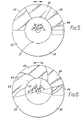
- each of the red, blue and green filters 64;66 and 68 is in the shape of part of an annulus, and extends over an arc of 60° at the inner periphery 63 and over an arc of 60° at the outer periphery 65.
- the arc at the outer periphery 65 is displaced by 30° relative to the arc at the inner periphery 63, so that the shutter opening, whilst remaining effectively 180°, occupies 210° of rotation of the disc shutter.
- the parts of the red and blue filters extend over the common 30° arc of the shutter. There is a similar over-run between the blue filter 66 and the green filter 68.
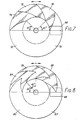
- each of the filters 74,76 and 78 extends over 45° at the inner and outer peripheries, with a displacement of 45° between the inner and outer peripheries, so that the effective shutter opening is 135° occupying 180° of rotation of the shutter member.
- each of the filters 84, 86 and 88 occupies 45° but in this case each boundary between adjacent filters, and between the outermost filters and the opaque portion of the shutter extends first through 45° in one circumferential direction and then through 45° in the opposite circumferential direction.
- the shutter member 90 of Figure 9 is similar to that of Figures 6 and 7, with each of the filters 94,96 and 98 extending over 40° at the inner and outer peripheries with 60° displacement between the inner and outer peripheries, so that the effective shutter opening is 120° occupying 180° of rotation of the shutter member. It will be appreciated that various other configurations of filters could be employed, and that these configurations could be used with any angle of shutter opening, e.g. 144° or 172.8°.
- Figure 10 shows a shutter member 100 similar to that of Figure 6, but in which the three red, blue and green filters are replaced by two filters, 104 and 106, one transmitting red and a portion of blue, the other transmitting green and a portion of blue.
- Figure 11 shows a shutter similar to that of Figure 8, but with a red/blue filter 114 and a blue/green filter 116.
- the colour filters thus arranged will allow equal proportions of red, blue and green light to reach the film on each frame, i.e. with each revolution of the shutter member.
- disc shutters shown in Figures 5 to 11 are designed to replace a conventional sector-shaped shutter such as that shown in Figure 4. It will be appreciated that disc shutters in accordance with the invention can also be designed to replace conventional "butterfly" shutters as shown in Figures 1 and 2, by providing two filter portions corresponding to the two open portions of the butterfly shutter.
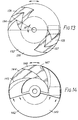
- Figure 12 shows a disc shutter 120 having a hub portion 121, a first set of red, blue and green filters 124 126, 128 forming one of the transparent portions of the shutter, a second set of red, blue and green filters 125, 127 and 129 forming the other transparent portion, and opaque portions 122 separating the transparent portions.
- the two sets of filters are arranged at diametrically opposite locations on the disc.
- each set occupy 22.5°, with a 22.5° displacement between the inner and outer peripheries, so that each transparent portion provides a shutter opening of 67.5° extending over 90° of the shutter.
- the second set of filters could be arranged in the opposite order, i.e, filters 125, 127 and 129 being respectively green, blue and red.
- Figure 13 shows a "butterfly" shutter 130 having two sets of filters, each consisting of a red/blue filter (134 or 135) and a blue/green filter (136 or 137). Each filter occupies 30°, with an "overlapping" of 30°, so that each set of filters occupies 90° of rotation and provides a 60° shutter opening, though other configurations could be provided.
- the stereoscopic effect when viewed with the appropriate spectacles as described above, and produced by disalignment of the images, will also directly be affected by the configuration of the filters.
- the shutter member of Figure 7 when the shutter member 70 rotates anti-clockwise, the right-hand side of the frame 48 receives light of each colour in advance of the left-hand side of the frame. If the shutter member 70 is reversed, or rotated clockwise, the left-hand side of the frame will receive light in advance of the right-hand side.
- the shutter member 80 rotates anti-clockwise, both sides of the frame 48 receive light of each colour in advance of the centre. If the shutter member 80 is reversed, or rotated clockwise, the centre of the frame 48 receives light of each colour in advance of the sides of the frame.
- the disalignment can also be reduced by blending each colour into its adjacent colours at the boundaries between the filters.
- cross-polarising filters for example each comprising 90° of the open side of the shutter, two images of opposing parallel grain can be overlaid on suitable film, the result to be viewed through cross-polarising spectacles.
- the cross-polarising filters can also be arranged in various configurations, as with the colour filters described above.
- the red/blue and blue/green filters could be replaced by cross-polarising filters.
- a single linear polarising filter 164 is used, so that the plane of polarisation effectively rotates as the filter passes the frame 48 of the film, the remainder of the shutter 168 being opaque.
- the reproduced film would be viewed, for example, through spectacles arranged to match the polarisation as points A and B of the filter pass the frame 48 of the film.
- the sharpness of the recorded image is also enhanced due to the effective division of each exposure of the film frame into, for example, three separate exposures, overlaid in different colours.
- the conventional rotating shutter produces a single exposure on each frame of the film. For example, with a shutter opening of 180° and a speed of 25 revolutions per second the shutter exposure on each frame is 1/50 second.
- a rotatable shutter member in accordance with the invention is used, with the open portion equally divided by red, blue and green filters, each frame, at the same shutter speed and shutter angle, effectively receives three separate exposures of 1/150 second each.
- the disc shutter and spectacles could use cyan, magenta and yellow filters, the spectacle lenses having appropriate combinations of red, blue and green filters.
- the different colour filters each occupy equal areas of the transparent part of the disc shutter, it will be appreciated that the different colour filters could occupy different angular portions, for example to compensate for different transmissibilities of the different colour filters.
- the disc shutter could be modified in other ways.
- the disc shutter could be made adjustable, with each of the filters formed of leaves, as well as the opaque part of the disc, so that when the shutter angle is adjusted each filter remains covering the same
- Figure 14 shows one example of such a shutter, in which the disc shutter 140 has an opaque portion 142 and a transparent portion consisting of red/blue filter 144 and blue/green filter 146.
- An opaque leaf 145 is pivotally mounted so that it can be moved across the filter 144 to mask part of the filter as shown.
- opaque leaf 147 is similarly movable to mask part of the filter 146.
- the two leaves 145 and 147 may be coupled so that they move simulataneously to ensure that both filters are masked to the same extent.
- Figure 15 shows a similar arrangement on a "butterfly" disc shutter 150, having two sets of filters 154, 156 and 155, 157. Two sets of opaque leaves 159, 160 and 161, 162 are arranged to move simultaneously to mask portions of each of the filters.
- Suitable mechanisms could be provided for adjusting the position of the leaves.
- the mechanism may be arranged to allow the adjustment to be made whilst the disc shutter is in position in the camera, and possibly whilst the shutter is rotating, to enable the effective shutter speed to be adjusted during filming.
- the described embodiments have the advantage that they use a camera which may be a relatively simple and inexpensive modification of a conventional film camera, avoiding the need for two cameras or two lens systems. Moreover, operation of the camera is the same as that for conventional, non-stereoscopic films.
- the choice and arrangement of filters in the disc shutter can take many forms.
- the transparent part of the disc could be divided into more than two or three sections.
- two sets of the three colour filters could be used, the transparent part of the disc, or each of the two transparent parts of a "butterfly" disc, being divided into six sections with the filter arranged in the sequence red-blue-green-red-blue-green.
- Other multiples or other sequences of the colour filters could be used.
- FIG 17 illustrates an alternative embodiment of the invention, in which, instead of replacing the conventional mirrored rotary shutter or focal plane shutter, an additional disc shutter 170 is provided.
- the disc shutter 170 is mounted in front of the camera lens 16, or at any other suitable point in the optical path at which it will not affect the normal mechanical operation of the camera.
- the shutter 170 is driven by a drive mechanism 172 so that it rotates in synchronism with the camera shutter.
- the drive mechanism may, for example, be coupled to the camera drive mechanism, or may have a separate motor controlled to rotate the disc shutter 170 in synchronism with, though not necessarily at the same speed as the camera shutter.
- shutter 170 may be rotated intermittently, with the transparent portion moving past the lens at a speed which may be varied to vary the effective shutter speed.
- disc shuttter any of the embodiments of disc shuttter shown in the drawings could be used in place of a mirrored shutter, a focal plane shutter, or as an additional shutter driven in synchronism with the camera shutter.
- the disc shutter is an additional shutter, as in Figure 17, the portion of the disc shutter which would otherwise be opaque will usually need to be made transparent, so as not to interfere with the reflex viewing through the camera eyepiece.
- a "butterfly" shutter could be provided with filters arranged in sequence red-blue-green in one filter portion and in the opposition sequence green-blue-red in the other filter portion, so that the sequence of image alternates with alternate frames of the film.
- a disc having a single colour filter occupying part of the transparent portion of the shutter may be used, with the remainder being transparent to white light. More than three colour filters could be used, or a single filter providing a continuous gradation of colour over all or part of the visible spectrum.
- the filters used in the disc shutter could take any suitable form.
- an embodiment has been made employing Kodak Wratten (trade marks) Gelatin filters, mounted on a glass disc.
- the filters used were Nos 24 (red), 38 (blue) and 57 (green).
- Other forms of filter may be used, for example by sandwiching a birefringent material between polarising elements.
- one of the polarising elements could be fixed in position, for example in front of the camera lens.
- both polarising elements could be fixed in position, with a birefringent element rotating between them.
- the filters could be mounted on separate arms movable sequentially into and out of the optical path by a suitable drive mechanism.
- the spectacles may be made in different forms.
- the spectacles may consist of a frame adapted to receive interchangeable lenses.
- the spectacles could be provided with a set of lenses having filters appropriate for viewing stereoscopic films as described above and with an alternative set of darkened lenses to enable the spectacles to be used as sun-glasses.
- the lenses could be provided in a "clip-on" frame to enable them to be attached to ordinary spectacles.
- the filters could be incorporated into corrective lenses.
- the lenses may be coated with a thin metallic layer which acts, by a process of interference, to cause colour separation to occur in the light passing through it. This intensifies the colour separation produced by the filters.
- the coating may also have the effect, when the spectacles are worn in daylight, of providing a reflective surface so that the lenses appear similar to ordinary sun-glasses.
- the spectacles could be provided with audio units positioned in use next to the wearer's ears and adapted to be connected by a flexible cable to an outlet, for example on the cinema seat, so that the spectacles act also as stereophonic headphones.
Landscapes
- Physics & Mathematics (AREA)
- General Physics & Mathematics (AREA)
- Stereoscopic And Panoramic Photography (AREA)
- Liquid Crystal (AREA)
- Apparatus For Radiation Diagnosis (AREA)
- Holo Graphy (AREA)
- Optical Recording Or Reproduction (AREA)
- Electrically Operated Instructional Devices (AREA)
- Ultra Sonic Daignosis Equipment (AREA)
- Facsimile Scanning Arrangements (AREA)
- Exposure And Positioning Against Photoresist Photosensitive Materials (AREA)
- Silver Salt Photography Or Processing Solution Therefor (AREA)
- Television Signal Processing For Recording (AREA)
- Electrochromic Elements, Electrophoresis, Or Variable Reflection Or Absorption Elements (AREA)
- Input Circuits Of Receivers And Coupling Of Receivers And Audio Equipment (AREA)
- Measurement And Recording Of Electrical Phenomena And Electrical Characteristics Of The Living Body (AREA)
- Cameras Adapted For Combination With Other Photographic Or Optical Apparatuses (AREA)
- Non-Silver Salt Photosensitive Materials And Non-Silver Salt Photography (AREA)
- Endoscopes (AREA)
Claims (8)
- Verfahren zum Aufnehmen und Wiedergeben eines stereoskopischen Kinofilms, das die Aufnahme eines Bildes eines Objektes, das sich relativ zu dem Film bewegt, durch ein einziges Linsensystem auf aufeinanderfolgende Einzelbilder eines kinematografischen Films beinhaltet, dadurch gekennzeichnet, daß der Film ein Farbfilm ist und die Wiedergabe umfaßt:a) auf jedes einzelne Einzelbild des Filmes wird durch das einzige Linsensystem eine Anzahl von Teilbildern des Objektes abgebildet, die in aufeinanderfolgenden Zeitintervallen aufgenommen wurden, indem jedes Einzelbild des Filmes durch verschiedene Farbfilter, die nacheinander in den optischen Weg zwischen dem Objekt und dem Film dazwischengebracht werden, belichtet wird, so daß die aufeinanderfolgenden Teilbilder in Licht von verschiedenen Farben aufgenommen werden;b) die Teilbilder werden auf dem Einzelbild überlagert und werden aufgrund der Relativbewegung zwischen dem Objekt und dem Film in dem oder jedem Zeitintervall zwischen der Bildung der aufeinanderfolgenden Teilbilder in der Position relativ zueinander verschoben;c) die verschiedenen Farben werden so ausgewählt, daß sich die überlagerten Teilbilder kombinieren lassen bzw. verbinden, um ein vollfarbiges Bild bei einer Wiedergabe des Filmes zu bilden;wobei das Verfahren außerdem ein Wiedergeben des Bildes beinhaltet, indem das Bild mit Hilfe einer herkömmlichen Einrichtung nach Entwicklung des Filmes auf eine Leinwand bzw. einen Schirm projiziert wird, wobei ein stereoskopischer Effekt erzielt wird, wenn das projizierte Bild durch eine Filterbrille betrachtet wird, die es dem linken und rechten Auge des Betrachters ermöglicht, verschiedene Teilbilder zu betrachten oder verschiedene Kombinationen davon.
- Verfahren nach Anspruch 1, welches das aufeinanderfolgende Belichten jedes Einzelbildes des Filmes mit Licht von drei verschiedenen Farben umfaßt.
- Verfahren nach Anspruch 1, welches das aufeinanderfolgende Belichten jedes Einzelbildes des Filmes mit Licht von zwei verschiedenen Farben umfaßt.
- Farbfilmkamera zur Durchführung des Verfahrens nach Anspruch 1, wobei die Kamera ein einziges Linsensystem aufweist und einen Mechanismus, um nacheinander eine Anzahl von verschiedenen Farbfiltern in den optischen Weg der Kamera während der Belichtung jedes Einzelbildes des Filmes dazwischen zu bringen, so daß die Bilder, die von Licht gebildet werden, das durch die Filter gelangt, auf jedem Einzelbild überlagert werden.
- Filmkamera nach Anspruch 4, bei der der Mechanismus umfaßt:- ein bewegbares Teil, von dem die Filter einen Teil davon darstellen oder von dem sie getragen werden, und- eine Einrichtung, um das Teil so zu bewegen, daß die Filter nacheinander in den optischen Weg der Kamera während der Belichtung jedes Einzelbildes des Filmes eingebracht werden.
- Filmkamera nach Anspruch 5,- bei der die Kamera von der Art ist, die eine verspiegelte Umlaufblende aufweist oder eine verspiegelte Umlaufblende, die mit einem Rotations-Schlitzverschluß verbunden ist, und- der Mechanismus ein drehbar gelagertes Verschlußteil umfaßt, das ausgelegt ist, die verspiegelte Umlaufblende oder den Rotations-Schlitzverschluß zu ersetzen, wobei das Verschlußteil einen lichtundurchlässigen Abschnitt und Abschnitte aufweist, die von den Filtern gebildet werden, so daß bei einer Drehbewegung des Verschlußteils der lichtundurchlässige Abschnitt und die Filter nacheinander in den optischen Weg der Kamera hineingeführt werden.
- Filmkamera nach Anspruch 5 oder 6, bei der die Filter aneinander angrenzende Sektoren des lichtdurchlässigen Abschnitts des Verschlußteiles bilden, die voneinander durch Halbdurchmesser des Verschlußteiles getrennt sind.
- Filmkamera nach Anspruch 5 oder 6, bei der die Filter aneinander angrenzende Sektoren des lichtdurchlässigen Abschnitts des Verschlußteiles einnehmen, wobei die Begrenzungslinien zwischen angrenzenden Filtern sich z. B. spiralförmig erstreckend auf den Halbdurchmesser des Verschlusses abfallen bzw. in Richtung des Halbdurchmessers des Verschlusses geneigt sind.
Applications Claiming Priority (5)
| Application Number | Priority Date | Filing Date | Title |
|---|---|---|---|
| GB858531773A GB8531773D0 (en) | 1985-12-24 | 1985-12-24 | Recording & reproduction of stereoscopic images |
| GB8531773 | 1985-12-24 | ||
| GB868612746A GB8612746D0 (en) | 1985-12-24 | 1986-05-27 | Recording and reproduction of images |
| GB8612746 | 1986-05-27 | ||
| PCT/GB1986/000782 WO1987003972A1 (en) | 1985-12-24 | 1986-12-19 | Recording and reproduction of images |
Publications (2)
| Publication Number | Publication Date |
|---|---|
| EP0252937A1 EP0252937A1 (de) | 1988-01-20 |
| EP0252937B1 true EP0252937B1 (de) | 1997-04-16 |
Family
ID=26290157
Family Applications (1)
| Application Number | Title | Priority Date | Filing Date |
|---|---|---|---|
| EP87900221A Expired - Lifetime EP0252937B1 (de) | 1985-12-24 | 1986-12-19 | Aufnahme und wiedergabe von bildern |
Country Status (20)
| Country | Link |
|---|---|
| US (1) | US4934824A (de) |
| EP (1) | EP0252937B1 (de) |
| CN (1) | CN86108834A (de) |
| AT (1) | ATE151894T1 (de) |
| AU (1) | AU6776187A (de) |
| BR (1) | BR8607059A (de) |
| DE (2) | DE252937T1 (de) |
| DK (1) | DK429587D0 (de) |
| FI (1) | FI873659A0 (de) |
| GR (1) | GR862948B (de) |
| HU (1) | HUT44342A (de) |
| IL (1) | IL80994A0 (de) |
| MA (1) | MA20842A1 (de) |
| MC (1) | MC1827A1 (de) |
| MT (1) | MTP994B (de) |
| NO (1) | NO873515L (de) |
| PL (1) | PL263130A1 (de) |
| PT (1) | PT84019B (de) |
| WO (1) | WO1987003972A1 (de) |
| YU (1) | YU222886A (de) |
Families Citing this family (9)
| Publication number | Priority date | Publication date | Assignee | Title |
|---|---|---|---|---|
| GB8801077D0 (en) * | 1988-01-19 | 1988-02-17 | Aspex Ltd | Photographic camera |
| GB8915468D0 (en) * | 1989-07-06 | 1989-08-23 | Delta System Design Ltd | Cinematographic optical system |
| US5751397A (en) * | 1995-06-06 | 1998-05-12 | Osgood; Alan G. | Color motion depth effect system |
| US6734900B2 (en) * | 1997-11-13 | 2004-05-11 | Christopher Mayhew | Real time camera and lens control system for image depth of field manipulation |
| FI117146B (fi) * | 2001-06-18 | 2006-06-30 | Karri Tapani Palovuori | Suljintoimintoon perustuva laitteisto stereo- tai monikanavakuvan projisoimiseksi |
| DE10311306A1 (de) * | 2003-03-14 | 2004-09-23 | Carl Zeiss | Bildanzeigeeinrichtung |
| US20090316114A1 (en) * | 2008-06-18 | 2009-12-24 | Dolby Laboratories Licensing Corporation | Method and apparatus for light recapture and sequential channel illumination |
| JP5923754B2 (ja) | 2011-08-11 | 2016-05-25 | パナソニックIpマネジメント株式会社 | 3次元撮像装置 |
| JP7799430B2 (ja) * | 2021-10-25 | 2026-01-15 | キヤノン株式会社 | 画像処理装置、制御方法及びプログラム |
Family Cites Families (16)
| Publication number | Priority date | Publication date | Assignee | Title |
|---|---|---|---|---|
| GB191124645A (en) * | 1911-11-06 | 1912-07-11 | John Campbell | Improvements in or relating to Kinematograph Apparatus and Films suitable for the Production of Kinematograph Pictures in Colour. |
| FR477728A (fr) * | 1915-02-19 | 1915-11-05 | William V D Kelley | Procédé pour produire des images photographiques en couleurs |
| US1422527A (en) * | 1920-01-20 | 1922-07-11 | Frederick L Sawyer | Color print viewable by lights of different colors and process of making the same |
| US1558483A (en) * | 1920-11-12 | 1925-10-27 | Prizma Inc | Motion picture |
| CH105953A (fr) * | 1921-08-30 | 1924-08-16 | Pictet Lucien | Procédé pour l'obtention de projections cinématographiques présentant une illusion de relief et installation pour sa mise en oeuvre. |
| US1744459A (en) * | 1925-12-22 | 1930-01-21 | Binocular Stereoscopic Film Co | Method of making stereoscopic film |
| US2194972A (en) * | 1937-05-19 | 1940-03-26 | Jacob Z Deninson | System of scanning or projecting pictures |
| US2360322A (en) * | 1939-10-18 | 1944-10-17 | William H Harrison | Apparatus for producing stereoscopic pictures in color |
| GB555670A (en) * | 1941-11-26 | 1943-09-02 | Edwin Herbert Wright | Improvements in and relating to the projection of sterescopic kinematograph images |
| FR1002902A (fr) * | 1946-10-23 | 1952-03-12 | Perfectionnements à la cinématographie en couleurs | |
| GB701751A (en) * | 1951-03-27 | 1953-12-30 | Pye Ltd | Improvements in or relating to colour television |
| US2729138A (en) * | 1951-07-17 | 1956-01-03 | Synthetic Vision Corp | System and apparatus for projecting three dimensional motion pictures |
| US3232166A (en) * | 1955-02-24 | 1966-02-01 | Matagne Alfred Fulgence | Method of and apparatus for projecting light images |
| US3712199A (en) * | 1970-09-23 | 1973-01-23 | Video West Inc | Three-dimensional color photographic process, apparatus and product |
| FR2544514A1 (fr) * | 1983-04-14 | 1984-10-19 | Corviole Raymond | Procede de realisation de diapositives plates 2d et en relief 3d |
| US4522475A (en) * | 1983-12-27 | 1985-06-11 | Ganson John P | Apparatus and method for showing motion in a single photograph |
-
1986
- 1986-12-16 IL IL80994A patent/IL80994A0/xx unknown
- 1986-12-19 DE DE198787900221T patent/DE252937T1/de active Pending
- 1986-12-19 HU HU87423A patent/HUT44342A/hu unknown
- 1986-12-19 EP EP87900221A patent/EP0252937B1/de not_active Expired - Lifetime
- 1986-12-19 AU AU67761/87A patent/AU6776187A/en not_active Abandoned
- 1986-12-19 WO PCT/GB1986/000782 patent/WO1987003972A1/en not_active Ceased
- 1986-12-19 MC MC86GB8600782D patent/MC1827A1/xx unknown
- 1986-12-19 DE DE3650614T patent/DE3650614D1/de not_active Expired - Lifetime
- 1986-12-19 AT AT87900221T patent/ATE151894T1/de active
- 1986-12-19 BR BR8607059A patent/BR8607059A/pt unknown
- 1986-12-19 PL PL1986263130A patent/PL263130A1/xx unknown
- 1986-12-23 MA MA21075A patent/MA20842A1/fr unknown
- 1986-12-23 PT PT84019A patent/PT84019B/pt not_active IP Right Cessation
- 1986-12-23 GR GR862948A patent/GR862948B/el unknown
- 1986-12-24 YU YU02228/86A patent/YU222886A/xx unknown
- 1986-12-24 MT MT994A patent/MTP994B/xx unknown
- 1986-12-24 CN CN198686108834A patent/CN86108834A/zh active Pending
-
1987
- 1987-08-18 DK DK429587A patent/DK429587D0/da not_active Application Discontinuation
- 1987-08-20 NO NO873515A patent/NO873515L/no unknown
- 1987-08-24 FI FI873659A patent/FI873659A0/fi not_active IP Right Cessation
-
1989
- 1989-03-06 US US07/323,612 patent/US4934824A/en not_active Expired - Lifetime
Non-Patent Citations (1)
| Title |
|---|
| "Kodak Workshop Series", publication no. KW13, R.S. Harris : "The Color of Motion", pp. 32-40. * |
Also Published As
| Publication number | Publication date |
|---|---|
| FI873659A7 (fi) | 1987-08-24 |
| ATE151894T1 (de) | 1997-05-15 |
| DK429587A (da) | 1987-08-18 |
| AU6776187A (en) | 1987-07-15 |
| MA20842A1 (fr) | 1987-07-01 |
| HUT44342A (en) | 1988-02-29 |
| FI873659A0 (fi) | 1987-08-24 |
| MTP994B (en) | 1987-10-21 |
| BR8607059A (pt) | 1988-02-23 |
| WO1987003972A1 (en) | 1987-07-02 |
| PL263130A1 (en) | 1987-10-05 |
| PT84019B (pt) | 1995-03-31 |
| MC1827A1 (fr) | 1988-03-18 |
| DE252937T1 (de) | 1988-05-19 |
| US4934824A (en) | 1990-06-19 |
| DE3650614D1 (de) | 1997-05-22 |
| EP0252937A1 (de) | 1988-01-20 |
| GR862948B (en) | 1987-02-18 |
| NO873515D0 (no) | 1987-08-20 |
| CN86108834A (zh) | 1987-07-08 |
| IL80994A0 (en) | 1987-03-31 |
| DK429587D0 (da) | 1987-08-18 |
| PT84019A (pt) | 1987-08-19 |
| NO873515L (no) | 1987-08-20 |
| YU222886A (en) | 1988-02-29 |
Similar Documents
| Publication | Publication Date | Title |
|---|---|---|
| US4705371A (en) | 3-D method and apparatus | |
| US4893898A (en) | Low differential 3-D viewer glasses and method with spectral transmission properties to control relative intensities | |
| US4971435A (en) | 3-D motion picture projection apparatus | |
| US4303316A (en) | Process for recording visual scenes for reproduction in stereopsis | |
| US4836647A (en) | Low differential 3-D viewer glasses and method with spectral transmission characteristics to control relative intensities | |
| US4695130A (en) | Camera flash attachment for three dimensional imaging systems | |
| EP0252937B1 (de) | Aufnahme und wiedergabe von bildern | |
| US4009951A (en) | Apparatus for stereoscopic photography | |
| US4678298A (en) | Method and apparatus for three-dimensional photography | |
| US3507549A (en) | Method for producing and viewing composite images | |
| US2360322A (en) | Apparatus for producing stereoscopic pictures in color | |
| US2517246A (en) | Method of producing and exhibiting stereoscopic motion pictures in color | |
| US4189210A (en) | Visual effect system | |
| US4963015A (en) | Recording and reproduction of images | |
| US4133602A (en) | Method for producing color structure change through interaction of light sources and application to improved apparatus for stereoscopic photography | |
| JPS63502057A (ja) | 像の記録及び再生 | |
| US2283466A (en) | Process for stereoscopic motion pictures in colors | |
| JPS592012B2 (ja) | 写真装置 | |
| RU2079158C1 (ru) | Способ получения объемного изображения и устройство для его осуществления | |
| US1846054A (en) | Combination shutter and color filter for the motion picture projection arts | |
| US7988296B2 (en) | Apparatus for projecting two-dimensional images as pairs of pseudo-stereoscopic images | |
| GB2206701A (en) | Copying cinematographic film | |
| CA1084754A (en) | Apparatus for stereoscopic and color photography | |
| GB2206703A (en) | Reproduction of cinematographic images | |
| US1997648A (en) | Color cinematography |
Legal Events
| Date | Code | Title | Description |
|---|---|---|---|
| PUAI | Public reference made under article 153(3) epc to a published international application that has entered the european phase |
Free format text: ORIGINAL CODE: 0009012 |
|
| 17P | Request for examination filed |
Effective date: 19870806 |
|
| AK | Designated contracting states |
Kind code of ref document: A1 Designated state(s): AT BE CH DE FR GB IT LI LU NL SE |
|
| ITCL | It: translation for ep claims filed |
Representative=s name: ING. A. GIAMBROCONO & C. S.R.L. |
|
| TCNL | Nl: translation of patent claims filed | ||
| EL | Fr: translation of claims filed | ||
| TCAT | At: translation of patent claims filed | ||
| DET | De: translation of patent claims | ||
| 17Q | First examination report despatched |
Effective date: 19900619 |
|
| RAP1 | Party data changed (applicant data changed or rights of an application transferred) |
Owner name: ASPEX LIMITED |
|
| GRAG | Despatch of communication of intention to grant |
Free format text: ORIGINAL CODE: EPIDOS AGRA |
|
| GRAH | Despatch of communication of intention to grant a patent |
Free format text: ORIGINAL CODE: EPIDOS IGRA |
|
| GRAH | Despatch of communication of intention to grant a patent |
Free format text: ORIGINAL CODE: EPIDOS IGRA |
|
| GRAA | (expected) grant |
Free format text: ORIGINAL CODE: 0009210 |
|
| AK | Designated contracting states |
Kind code of ref document: B1 Designated state(s): AT BE CH DE FR GB IT LI LU NL SE |
|
| PG25 | Lapsed in a contracting state [announced via postgrant information from national office to epo] |
Ref country code: IT Free format text: LAPSE BECAUSE OF FAILURE TO SUBMIT A TRANSLATION OF THE DESCRIPTION OR TO PAY THE FEE WITHIN THE PRE;WARNING: LAPSES OF ITALIAN PATENTS WITH EFFECTIVE DATE BEFORE 2007 MAY HAVE OCCURRED AT ANY TIME BEFORE 2007. THE CORRECT EFFECTIVE DATE MAY BE DIFFERENT FROM THE ONE RECORDED.SCRIBED TIME-LIMIT Effective date: 19970416 Ref country code: CH Effective date: 19970416 Ref country code: NL Effective date: 19970416 Ref country code: FR Effective date: 19970416 Ref country code: AT Effective date: 19970416 Ref country code: BE Effective date: 19970416 Ref country code: LI Effective date: 19970416 |
|
| REF | Corresponds to: |
Ref document number: 151894 Country of ref document: AT Date of ref document: 19970515 Kind code of ref document: T |
|
| RAP2 | Party data changed (patent owner data changed or rights of a patent transferred) |
Owner name: ASPEX LIMITED |
|
| REG | Reference to a national code |
Ref country code: CH Ref legal event code: NV Representative=s name: ISLER & PEDRAZZINI AG Ref country code: CH Ref legal event code: EP |
|
| REF | Corresponds to: |
Ref document number: 3650614 Country of ref document: DE Date of ref document: 19970522 |
|
| NLT2 | Nl: modifications (of names), taken from the european patent patent bulletin |
Owner name: ASPEX LIMITED |
|
| PG25 | Lapsed in a contracting state [announced via postgrant information from national office to epo] |
Ref country code: SE Effective date: 19970716 |
|
| PG25 | Lapsed in a contracting state [announced via postgrant information from national office to epo] |
Ref country code: DE Effective date: 19970717 |
|
| NLV1 | Nl: lapsed or annulled due to failure to fulfill the requirements of art. 29p and 29m of the patents act | ||
| EN | Fr: translation not filed | ||
| REG | Reference to a national code |
Ref country code: CH Ref legal event code: PL |
|
| PG25 | Lapsed in a contracting state [announced via postgrant information from national office to epo] |
Ref country code: LU Free format text: LAPSE BECAUSE OF NON-PAYMENT OF DUE FEES Effective date: 19971219 |
|
| PLBE | No opposition filed within time limit |
Free format text: ORIGINAL CODE: 0009261 |
|
| STAA | Information on the status of an ep patent application or granted ep patent |
Free format text: STATUS: NO OPPOSITION FILED WITHIN TIME LIMIT |
|
| 26N | No opposition filed | ||
| REG | Reference to a national code |
Ref country code: GB Ref legal event code: IF02 |
|
| APAH | Appeal reference modified |
Free format text: ORIGINAL CODE: EPIDOSCREFNO |
|
| PGFP | Annual fee paid to national office [announced via postgrant information from national office to epo] |
Ref country code: GB Payment date: 20051202 Year of fee payment: 20 |
|
| PG25 | Lapsed in a contracting state [announced via postgrant information from national office to epo] |
Ref country code: GB Free format text: LAPSE BECAUSE OF EXPIRATION OF PROTECTION Effective date: 20061218 |
|
| REG | Reference to a national code |
Ref country code: GB Ref legal event code: PE20 |