EP0249694B1 - Occlusive wound care dressing - Google Patents
Occlusive wound care dressing Download PDFInfo
- Publication number
- EP0249694B1 EP0249694B1 EP87104888A EP87104888A EP0249694B1 EP 0249694 B1 EP0249694 B1 EP 0249694B1 EP 87104888 A EP87104888 A EP 87104888A EP 87104888 A EP87104888 A EP 87104888A EP 0249694 B1 EP0249694 B1 EP 0249694B1
- Authority
- EP
- European Patent Office
- Prior art keywords
- backing layer
- barrier
- dressing
- occlusive dressing
- wound
- Prior art date
- Legal status (The legal status is an assumption and is not a legal conclusion. Google has not performed a legal analysis and makes no representation as to the accuracy of the status listed.)
- Expired - Lifetime
Links
- 230000004888 barrier function Effects 0.000 claims description 96
- 239000000416 hydrocolloid Substances 0.000 claims description 31
- 239000006260 foam Substances 0.000 claims description 24
- XLYOFNOQVPJJNP-UHFFFAOYSA-N water Chemical compound O XLYOFNOQVPJJNP-UHFFFAOYSA-N 0.000 claims description 10
- 239000006261 foam material Substances 0.000 claims description 7
- 206010072170 Skin wound Diseases 0.000 claims description 6
- XTXRWKRVRITETP-UHFFFAOYSA-N Vinyl acetate Chemical compound CC(=O)OC=C XTXRWKRVRITETP-UHFFFAOYSA-N 0.000 claims description 6
- 229920000642 polymer Polymers 0.000 claims description 6
- VGGSQFUCUMXWEO-UHFFFAOYSA-N Ethene Chemical compound C=C VGGSQFUCUMXWEO-UHFFFAOYSA-N 0.000 claims description 5
- 239000005977 Ethylene Substances 0.000 claims description 5
- 229920005830 Polyurethane Foam Polymers 0.000 claims description 5
- 239000011496 polyurethane foam Substances 0.000 claims description 5
- 229920000915 polyvinyl chloride Polymers 0.000 claims description 5
- 239000004800 polyvinyl chloride Substances 0.000 claims description 5
- 229920000126 latex Polymers 0.000 claims description 4
- 229920006255 plastic film Polymers 0.000 claims description 4
- 239000002985 plastic film Substances 0.000 claims description 4
- 230000005540 biological transmission Effects 0.000 claims description 3
- 229920006264 polyurethane film Polymers 0.000 claims description 3
- 229920006037 cross link polymer Polymers 0.000 claims description 2
- 229920001198 elastomeric copolymer Polymers 0.000 claims 1
- 206010052428 Wound Diseases 0.000 description 58
- 208000027418 Wounds and injury Diseases 0.000 description 58
- 231100000397 ulcer Toxicity 0.000 description 24
- 239000012530 fluid Substances 0.000 description 23
- 208000025865 Ulcer Diseases 0.000 description 22
- 239000000463 material Substances 0.000 description 21
- 239000000203 mixture Substances 0.000 description 16
- 229920002367 Polyisobutene Polymers 0.000 description 11
- 208000004210 Pressure Ulcer Diseases 0.000 description 11
- 206010042674 Swelling Diseases 0.000 description 11
- 210000003491 skin Anatomy 0.000 description 11
- 230000008961 swelling Effects 0.000 description 11
- 239000012071 phase Substances 0.000 description 10
- 206010011985 Decubitus ulcer Diseases 0.000 description 8
- 239000002250 absorbent Substances 0.000 description 8
- 238000004132 cross linking Methods 0.000 description 8
- 239000010408 film Substances 0.000 description 8
- 230000001965 increasing effect Effects 0.000 description 8
- 230000035882 stress Effects 0.000 description 8
- 239000004615 ingredient Substances 0.000 description 7
- 229920005989 resin Polymers 0.000 description 7
- 239000011347 resin Substances 0.000 description 7
- 238000010521 absorption reaction Methods 0.000 description 6
- 230000002500 effect on skin Effects 0.000 description 6
- 238000009472 formulation Methods 0.000 description 5
- 238000000034 method Methods 0.000 description 5
- 239000004215 Carbon black (E152) Substances 0.000 description 4
- 229920001971 elastomer Polymers 0.000 description 4
- 239000000806 elastomer Substances 0.000 description 4
- 229930195733 hydrocarbon Natural products 0.000 description 4
- 150000002430 hydrocarbons Chemical class 0.000 description 4
- 239000003921 oil Substances 0.000 description 4
- 235000019198 oils Nutrition 0.000 description 4
- 238000012360 testing method Methods 0.000 description 4
- 239000004606 Fillers/Extenders Substances 0.000 description 3
- DPXJVFZANSGRMM-UHFFFAOYSA-N acetic acid;2,3,4,5,6-pentahydroxyhexanal;sodium Chemical compound [Na].CC(O)=O.OCC(O)C(O)C(O)C(O)C=O DPXJVFZANSGRMM-UHFFFAOYSA-N 0.000 description 3
- 239000000499 gel Substances 0.000 description 3
- 230000035876 healing Effects 0.000 description 3
- 230000007794 irritation Effects 0.000 description 3
- 238000002156 mixing Methods 0.000 description 3
- 238000004806 packaging method and process Methods 0.000 description 3
- 235000010987 pectin Nutrition 0.000 description 3
- 229920001277 pectin Polymers 0.000 description 3
- 239000001814 pectin Substances 0.000 description 3
- 229920001495 poly(sodium acrylate) polymer Polymers 0.000 description 3
- 210000001519 tissue Anatomy 0.000 description 3
- 235000012431 wafers Nutrition 0.000 description 3
- NLHHRLWOUZZQLW-UHFFFAOYSA-N Acrylonitrile Chemical compound C=CC#N NLHHRLWOUZZQLW-UHFFFAOYSA-N 0.000 description 2
- 108010010803 Gelatin Proteins 0.000 description 2
- 239000004264 Petrolatum Substances 0.000 description 2
- 239000004820 Pressure-sensitive adhesive Substances 0.000 description 2
- 206010040880 Skin irritation Diseases 0.000 description 2
- 229920002472 Starch Polymers 0.000 description 2
- 239000002131 composite material Substances 0.000 description 2
- 238000007906 compression Methods 0.000 description 2
- 230000006835 compression Effects 0.000 description 2
- 238000010276 construction Methods 0.000 description 2
- 229920001577 copolymer Polymers 0.000 description 2
- 238000005520 cutting process Methods 0.000 description 2
- 230000000694 effects Effects 0.000 description 2
- 210000000416 exudates and transudate Anatomy 0.000 description 2
- 239000008273 gelatin Substances 0.000 description 2
- 229920000159 gelatin Polymers 0.000 description 2
- 235000019322 gelatine Nutrition 0.000 description 2
- 235000011852 gelatine desserts Nutrition 0.000 description 2
- 230000000474 nursing effect Effects 0.000 description 2
- 239000002245 particle Substances 0.000 description 2
- 229940066842 petrolatum Drugs 0.000 description 2
- 235000019271 petrolatum Nutrition 0.000 description 2
- 229920003023 plastic Polymers 0.000 description 2
- 239000004033 plastic Substances 0.000 description 2
- 229920001296 polysiloxane Polymers 0.000 description 2
- 229920002635 polyurethane Polymers 0.000 description 2
- 239000004814 polyurethane Substances 0.000 description 2
- 239000000843 powder Substances 0.000 description 2
- 230000005855 radiation Effects 0.000 description 2
- 229920006395 saturated elastomer Polymers 0.000 description 2
- 238000000926 separation method Methods 0.000 description 2
- 230000036556 skin irritation Effects 0.000 description 2
- 231100000475 skin irritation Toxicity 0.000 description 2
- NNMHYFLPFNGQFZ-UHFFFAOYSA-M sodium polyacrylate Chemical compound [Na+].[O-]C(=O)C=C NNMHYFLPFNGQFZ-UHFFFAOYSA-M 0.000 description 2
- 239000008107 starch Substances 0.000 description 2
- 235000019698 starch Nutrition 0.000 description 2
- GRWFGVWFFZKLTI-UHFFFAOYSA-N α-pinene Chemical compound CC1=CCC2C(C)(C)C1C2 GRWFGVWFFZKLTI-UHFFFAOYSA-N 0.000 description 2
- WTARULDDTDQWMU-RKDXNWHRSA-N (+)-β-pinene Chemical compound C1[C@H]2C(C)(C)[C@@H]1CCC2=C WTARULDDTDQWMU-RKDXNWHRSA-N 0.000 description 1
- WTARULDDTDQWMU-IUCAKERBSA-N (-)-Nopinene Natural products C1[C@@H]2C(C)(C)[C@H]1CCC2=C WTARULDDTDQWMU-IUCAKERBSA-N 0.000 description 1
- HECLRDQVFMWTQS-RGOKHQFPSA-N 1755-01-7 Chemical compound C1[C@H]2[C@@H]3CC=C[C@@H]3[C@@H]1C=C2 HECLRDQVFMWTQS-RGOKHQFPSA-N 0.000 description 1
- GRWFGVWFFZKLTI-IUCAKERBSA-N 1S,5S-(-)-alpha-Pinene Natural products CC1=CC[C@@H]2C(C)(C)[C@H]1C2 GRWFGVWFFZKLTI-IUCAKERBSA-N 0.000 description 1
- 208000035143 Bacterial infection Diseases 0.000 description 1
- 229920002134 Carboxymethyl cellulose Polymers 0.000 description 1
- GUTLYIVDDKVIGB-OUBTZVSYSA-N Cobalt-60 Chemical compound [60Co] GUTLYIVDDKVIGB-OUBTZVSYSA-N 0.000 description 1
- 244000007835 Cyamopsis tetragonoloba Species 0.000 description 1
- 208000035874 Excoriation Diseases 0.000 description 1
- 239000005662 Paraffin oil Substances 0.000 description 1
- 239000004721 Polyphenylene oxide Substances 0.000 description 1
- WTARULDDTDQWMU-UHFFFAOYSA-N Pseudopinene Natural products C1C2C(C)(C)C1CCC2=C WTARULDDTDQWMU-UHFFFAOYSA-N 0.000 description 1
- VYPSYNLAJGMNEJ-UHFFFAOYSA-N Silicium dioxide Chemical compound O=[Si]=O VYPSYNLAJGMNEJ-UHFFFAOYSA-N 0.000 description 1
- 206010048625 Skin maceration Diseases 0.000 description 1
- FAPWRFPIFSIZLT-UHFFFAOYSA-M Sodium chloride Chemical compound [Na+].[Cl-] FAPWRFPIFSIZLT-UHFFFAOYSA-M 0.000 description 1
- 235000015125 Sterculia urens Nutrition 0.000 description 1
- 240000001058 Sterculia urens Species 0.000 description 1
- 206010054880 Vascular insufficiency Diseases 0.000 description 1
- 238000005299 abrasion Methods 0.000 description 1
- 239000006096 absorbing agent Substances 0.000 description 1
- 239000000853 adhesive Substances 0.000 description 1
- 230000001070 adhesive effect Effects 0.000 description 1
- 230000032683 aging Effects 0.000 description 1
- XCPQUQHBVVXMRQ-UHFFFAOYSA-N alpha-Fenchene Natural products C1CC2C(=C)CC1C2(C)C XCPQUQHBVVXMRQ-UHFFFAOYSA-N 0.000 description 1
- MVNCAPSFBDBCGF-UHFFFAOYSA-N alpha-pinene Natural products CC1=CCC23C1CC2C3(C)C MVNCAPSFBDBCGF-UHFFFAOYSA-N 0.000 description 1
- 208000022362 bacterial infectious disease Diseases 0.000 description 1
- 229930006722 beta-pinene Natural products 0.000 description 1
- 238000003490 calendering Methods 0.000 description 1
- 235000010948 carboxy methyl cellulose Nutrition 0.000 description 1
- 239000001768 carboxy methyl cellulose Substances 0.000 description 1
- 239000008112 carboxymethyl-cellulose Substances 0.000 description 1
- 229920006026 co-polymeric resin Polymers 0.000 description 1
- 238000013329 compounding Methods 0.000 description 1
- 238000000748 compression moulding Methods 0.000 description 1
- 230000002079 cooperative effect Effects 0.000 description 1
- 230000007423 decrease Effects 0.000 description 1
- 230000003247 decreasing effect Effects 0.000 description 1
- 210000004207 dermis Anatomy 0.000 description 1
- 201000010099 disease Diseases 0.000 description 1
- 208000037265 diseases, disorders, signs and symptoms Diseases 0.000 description 1
- 239000013013 elastic material Substances 0.000 description 1
- 210000002615 epidermis Anatomy 0.000 description 1
- 229920005676 ethylene-propylene block copolymer Polymers 0.000 description 1
- 238000001125 extrusion Methods 0.000 description 1
- 229910021485 fumed silica Inorganic materials 0.000 description 1
- LCWMKIHBLJLORW-UHFFFAOYSA-N gamma-carene Natural products C1CC(=C)CC2C(C)(C)C21 LCWMKIHBLJLORW-UHFFFAOYSA-N 0.000 description 1
- 229920000578 graft copolymer Polymers 0.000 description 1
- 239000008187 granular material Substances 0.000 description 1
- 239000008240 homogeneous mixture Substances 0.000 description 1
- 230000001939 inductive effect Effects 0.000 description 1
- 238000001746 injection moulding Methods 0.000 description 1
- 238000007689 inspection Methods 0.000 description 1
- 230000009545 invasion Effects 0.000 description 1
- 230000001788 irregular Effects 0.000 description 1
- 208000028867 ischemia Diseases 0.000 description 1
- 239000004816 latex Substances 0.000 description 1
- 230000007774 longterm Effects 0.000 description 1
- 238000004519 manufacturing process Methods 0.000 description 1
- 244000000010 microbial pathogen Species 0.000 description 1
- 239000008188 pellet Substances 0.000 description 1
- 239000002984 plastic foam Substances 0.000 description 1
- 229920002401 polyacrylamide Polymers 0.000 description 1
- 229920002239 polyacrylonitrile Polymers 0.000 description 1
- -1 polybutylene Polymers 0.000 description 1
- 229920001748 polybutylene Polymers 0.000 description 1
- 229920000570 polyether Polymers 0.000 description 1
- 238000002360 preparation method Methods 0.000 description 1
- 230000000750 progressive effect Effects 0.000 description 1
- 230000001681 protective effect Effects 0.000 description 1
- 230000000717 retained effect Effects 0.000 description 1
- 238000007789 sealing Methods 0.000 description 1
- 230000000276 sedentary effect Effects 0.000 description 1
- 229920006268 silicone film Polymers 0.000 description 1
- 239000007790 solid phase Substances 0.000 description 1
- 229920006132 styrene block copolymer Polymers 0.000 description 1
- 238000010998 test method Methods 0.000 description 1
- 239000010409 thin film Substances 0.000 description 1
- 230000036269 ulceration Effects 0.000 description 1
- 208000023577 vascular insufficiency disease Diseases 0.000 description 1
- 235000015112 vegetable and seed oil Nutrition 0.000 description 1
- 239000008158 vegetable oil Substances 0.000 description 1
- 235000013311 vegetables Nutrition 0.000 description 1
- 238000005406 washing Methods 0.000 description 1
- 208000012313 wound discharge Diseases 0.000 description 1
Images

Classifications
-
- A—HUMAN NECESSITIES
- A61—MEDICAL OR VETERINARY SCIENCE; HYGIENE
- A61F—FILTERS IMPLANTABLE INTO BLOOD VESSELS; PROSTHESES; DEVICES PROVIDING PATENCY TO, OR PREVENTING COLLAPSING OF, TUBULAR STRUCTURES OF THE BODY, e.g. STENTS; ORTHOPAEDIC, NURSING OR CONTRACEPTIVE DEVICES; FOMENTATION; TREATMENT OR PROTECTION OF EYES OR EARS; BANDAGES, DRESSINGS OR ABSORBENT PADS; FIRST-AID KITS
- A61F13/00—Bandages or dressings; Absorbent pads
-
- A—HUMAN NECESSITIES
- A61—MEDICAL OR VETERINARY SCIENCE; HYGIENE
- A61F—FILTERS IMPLANTABLE INTO BLOOD VESSELS; PROSTHESES; DEVICES PROVIDING PATENCY TO, OR PREVENTING COLLAPSING OF, TUBULAR STRUCTURES OF THE BODY, e.g. STENTS; ORTHOPAEDIC, NURSING OR CONTRACEPTIVE DEVICES; FOMENTATION; TREATMENT OR PROTECTION OF EYES OR EARS; BANDAGES, DRESSINGS OR ABSORBENT PADS; FIRST-AID KITS
- A61F13/00—Bandages or dressings; Absorbent pads
- A61F13/02—Adhesive bandages or dressings
- A61F13/023—Adhesive bandages or dressings wound covering film layers without a fluid retention layer
-
- A—HUMAN NECESSITIES
- A61—MEDICAL OR VETERINARY SCIENCE; HYGIENE
- A61L—METHODS OR APPARATUS FOR STERILISING MATERIALS OR OBJECTS IN GENERAL; DISINFECTION, STERILISATION OR DEODORISATION OF AIR; CHEMICAL ASPECTS OF BANDAGES, DRESSINGS, ABSORBENT PADS OR SURGICAL ARTICLES; MATERIALS FOR BANDAGES, DRESSINGS, ABSORBENT PADS OR SURGICAL ARTICLES
- A61L15/00—Chemical aspects of, or use of materials for, bandages, dressings or absorbent pads
- A61L15/16—Bandages, dressings or absorbent pads for physiological fluids such as urine or blood, e.g. sanitary towels, tampons
- A61L15/42—Use of materials characterised by their function or physical properties
- A61L15/58—Adhesives
-
- A—HUMAN NECESSITIES
- A61—MEDICAL OR VETERINARY SCIENCE; HYGIENE
- A61L—METHODS OR APPARATUS FOR STERILISING MATERIALS OR OBJECTS IN GENERAL; DISINFECTION, STERILISATION OR DEODORISATION OF AIR; CHEMICAL ASPECTS OF BANDAGES, DRESSINGS, ABSORBENT PADS OR SURGICAL ARTICLES; MATERIALS FOR BANDAGES, DRESSINGS, ABSORBENT PADS OR SURGICAL ARTICLES
- A61L15/00—Chemical aspects of, or use of materials for, bandages, dressings or absorbent pads
- A61L15/16—Bandages, dressings or absorbent pads for physiological fluids such as urine or blood, e.g. sanitary towels, tampons
- A61L15/42—Use of materials characterised by their function or physical properties
- A61L15/60—Liquid-swellable gel-forming materials, e.g. super-absorbents
Definitions
- This invention relates to occlusive dressings for care of fluid-exuding skin wounds such as particularly pressure sores and dermal ulcers.
- occlusive dressings for pressure sores and ulcers has gained increasing acceptance in recent years.
- a number of wound dressings of this kind are available commercially.
- Most of these products are formed from several layers, including at least an inner skin-contacting layer and an outer backing layer.
- the dressing is applied as a cover for the sore or ulcer in a size providing a margin around the wound area which adhesively seals to the skin.
- the inner layer commonly referred to as the barrier layer, contains water-absorptive material, such as hydrocolloids, so that fluid from the wound is absorbed into the barrier, making it possible to keep the dressing in place for at least several days.
- Such occlusive dressings tend to promote healing by maintaining the wound under moist conditions, and serve as a barrier against bacterial infection.
- the occlusive dressing be removable in one piece. This minimizes the need to cleanse the wound between dressing applications. At the same time, stripping of the central portion of the barrier from the wound can damage healing tissue.
- a wound care product in use in the United States utilizes a barrier layer that loses its integrity after absorbing wound fluid.
- the portion of the barrier layer in contact with the wound is converted to a gel-like material.
- this gel material is left in the wound, and must be removed to permit examination and/or before applying another dressing.
- Effective cleansing has required washing out the gel from the wound with saline solution, which must be carried out carefully and gently to avoid damage to the wound bed and newly-formed tissue. This can be a time-consuming procedure for nursing personnel.
- a wound dressing of the decomposing gel-forming type is disclosed in U.S. Patent 4,538,603.
- This dressing utilizes a three-layer composite, also generally described in prior U.S. patent 3,972,328.
- a layer of semi-open cell foam material is interposed between the barrier layer and an outer film layer.
- the barrier layer contains hydrocolloids. Because of the large amount of hydrocolloid used, the barrier material disintegrates into a non-structural gel on absorbing wound fluid.
- Cross-linked barrier material providing improved structural integrity have been described for use in ostomy applications. See, particularly, U.S. Patents 4,477,325 and 4,231,369. The latter patent also suggests the possibility of using a cross-linked barrier material in a wound drainage application, viz. around a wound.
- an occlusive dressing for care of skin wounds comprising a skin contacting barrier layer and an overlying backing layer adhesively united thereto, said barrier layer being composed of an elastomeric phase integrated by a cross-linked polymer network and having a particulate water-absorbing hydrocolloid phase dispersed therein, characterized in that said backing layer is stretchable and formed of either a foam material in sheet form or a plastic film, said foam material sheet or said plastic film being selected to provide stretchability being such that the backing layer will undergo a 50% elongation without rupture on application of a tensioning stress of not over 268 g/cm (1.5 pounds/inch) of width.
- the improved occlusive dressing of the present invention comprises an assembly of a barrier layer and a backing layer which cooperate for increasing fluid absorption without inducing dislodgement and leakage, and which facilitates one-piece removal with minimal wound irritation.
- the backing is formed of a thin elastic sheet which is yieldable as the barrier material swells.
- the hydrocolloid-containing barrier material has a continuous elastomeric phase which is cross-linked to form an integrated network. As the portion of the barrier over the wound area takes up fluid, it swells with relatively little restraint, the overlying portion of the backing stretching upwardly as the central portion of the barrier enlarges.
- the marginal portions of the barrier surrounding the wound remain in fluid-tight sealing engagement with the skin, since the swelling of the central portion of the barrier has little tendency to induce separation of the barrier from the skin.
- the surrounding skin is effectively protected from wound fluid even though the dressing is used for extended time periods.
- water-absorbency of the barrier layer can be safely increased by including more hydrocolloid as desired, and the increased swelling of the central portion of the barrier avoids creating irritating pressure against the surface of the wound.
- the backing is formed of a thin, stretchable foam material, such as foams formed from polyvinyl chloride or polyurethane.
- a closed cell foam may be used to provide a sealed backing, which protects the wound from the surrounding environment.
- the backing layer can cooperate with the barrier layer to, in effect, increase the fluid absorbing capacity of the barrier layer. Water absorbed into the barrier layer is transferred through the backing layer and evaporated into the atmosphere, thereby restoring and maintaining the fluid absorbing capacity of the barrier layer.
- the relative "wet tack" and “dry tack” adherence of the barrier can be controlled or modified as required for optimized results.
- Tackifier polymers increasing dry tack can be included, thereby improving the seal between the barrier and the skin surrounding the wound without at the same time leading to wound irritation.
- the initial wet tack of the barrier and the elasticity of the backing permit the dressing to be formed into the wound on application. In preferred embodiments, however, when the barrier is saturated with water it has substantially no wet tack so that the swollen central portion separates easily and freely from the wound.
- the foregoing features of the invention in combination provide a greatly improved system for management of pressure sores and ulcers.
- the wound dressings need to be changed less frequently because they can be designed to absorb larger amounts of exudate. Leaving the dressings on the wound longer does not result in increased skin irritation around the wound.
- the wound fluid is excluded from contact with the skin, even though the portion of the barrier over the wound has enlarged to many times its original volume.
- the stretchability of the backing tends not only to confine the forces generated by the swelling of the barrier to the area of the wound, but also tends to relieve undue pressure from being exerted on the wound area.
- As the central area of the dressing swells its diameter can be observed and used as an indicator for removing and replacing the barrier. Removal can be carried out easily and quickly, the barrier peeling off in one piece without irritation of the wound area due to adherence of the barrier, and the wound area is left clean and in condition for inspection.
- the occlusive dressing of this invention preferably includes only two layers, a skin-contacting barrier layer and an overlying backing layer adhesively united thereto.
- the backing sheet be formed of an elastic material which is stretchable under the pressure created by the swelling of the barrier material as it absorbs wound exudate.
- the required degree of stretchability can be determined by a standard test procedure, as will subsequently be described in detail.
- the operative criteria is that the sheet of elastic backing material should be stretchable at least to the extent that a 50% elongation without rupture is produced by a tensioning stress of not over 268 g/cm (1.5 pounds per inch) of width.
- the 50% elongation as specified is obtained at a tensioning stress of less than 214 g (1.2 pounds,) for example, at a tensioning stress of not over 179 g (1.0 pounds) per cm (inch) of width, such as from 54 to 161 g/cm (0.3 to 0.9 Ibs/in) width.
- Foam backings can be used which satisfy the foregoing criteria. But many commercially available plastic foams in sheet form do not have the required degree of elasticity. Particularly suitable sheet foams are available from the Norton Company, Granville, New York, being sold under the trademark "Sof-Med” Foams. These foams are made from polyvinyl chloride and are essentially closed cell foams, the closed cell content being over 90%. An excellent backing is the "Sof-Med” sheet foam "V-631 having a thickness of 0,79 mm (1/32 inches). Using the specified stretchability test, the "V-631" foam was found to elongate 50% per cm (inch) of width at around 161 g (0.9 pounds) tensioning stress.
- a partially open cell foam suitable for use in the wound care dressing of this invention is available from Semex Medical, Norristown, PA. This is a polyurethane foam having a thickness of approximately 0,79 mm (1/32"), and a porosity of the order of 50% ⁇ 10%.
- the foam is available in a range of densities from 0,19 to 0,32 g/cm 3 (12 to 20 Ibs./cu. ft),
- one standard product (MU2422-00) has a density of about 0.22 g/cm 3 (13.5 Ibs./cu. ft) and is available in a 0,79 mm (1/32") thickness at approximately a 50% porosity (50% open cell).
- backing for use in the present invention, it was found to have an especially advantageous stretchability criteria, elongating 50% per cm (inch) of width at 57g (0.32 lbs) tensioning stress.
- This backing provides the further advantage that water from the wound fluid absorbed into the barrier layer is transferred through the porous backing and evaporated to the atmosphere. The fluid absorbing capacity of the barrier layer is therefore maintained and, in effect, increased beyond that which would be provided if the backing was non-porous.
- Thin films may also be used as the backing layer, providing they exhibit the required degree of stretchability.
- polyurethane, latex rubber or silicone films can be used. Such films can range in thickness from about 0,013 to 0,127 mm (0.5 to 5.0 mils), In order to provide the desired degree of stretchability such films will usually have a thickness in the range of about 0,013 to 0,038 mm (0.5 to 1.5 mils), such as about 0,025 mm (1 mil), for example, the polyurethane film of 0,025 mm (1 mil) thickness was tested and found to have a 50% elongation per cm (inch) of width at a tensioning stress of about 125 g (0.7 pounds), whereas a latex film of 0,102 mm (4 mil) thickness was tested and found to have a 50% elongation per cm (inch) of width at a tensioning stress of about 54 g (0.3 pounds),
- the composite of the intermediate layer and the backing layer must meet the stretchability criteria set out above. It has therefore been found preferable to have the backing layer in direct contact with the barrier layer, and to utilize a backing of the kinds described above, viz. foam backings of 0,635 to 0,889 mm (25 to 35 mils) thickness, or film backings of 0,013 to 0,038 mm (0.5 to 1.5 mil) thickness.
- foam backings of the character described above are presently believed to be preferred.
- the foam backing may be either non-porous or porous, but where a partially-open cell, porous- type foam backing is employed, an additional method of functioning is provided.
- the barrier layer is formulated from a mixture of elastomers and hydrocolloids.
- polyisobutylene PIB
- polyisobutylene PIB
- polyisobutylene PIB
- cross-linkable resins which blend with polyisobutylene to form a continuous elastomeric phase are the copolymer resins formed from ethylene and vinyl acetate (EVA resins).
- EVA resins ethylene and vinyl acetate
- Suitable formulations of EVA with PIB are disclosed in U.S Patent 4,477,325.
- the proportions of ethylene to vinyl acetate may be varied.
- from 40 to 60 parts of vinyl acetate may be copolymerized with from 60 to 40 parts by weight of ethylene.
- the exact proportions are not critical.
- EVA copolymers can be cross-linked by gamma irradiation.
- a Cobalt-60 radiation source may be used to apply from 1.0 to 8.0 megarads.
- a desirable degree of cross-linking is obtainable with applied gamma irradiation of 2 to 4 megarads.
- U.S. patent 4,477,325. a minor amount of an additional cross-linking resin can be included, such as an acrylamide polymer which reacts with EVA to form cross-links. (See U.S. Patent 4,477,325.)
- the cross-linked network is formed essentially from the EVA polymer by irradiation of the EVA-containing elastomeric phase.
- the barrier material may contain a relatively high proportion of hydrocolloid, and also a super-absorbent type hydrocolloid.
- Super-absorbents can be formed from starch and acrylonitrile, the starch, either gelatinized or in granule form, being reacted with the acrylonitrile under alkaline conditions.
- the resulting products may comprise a starch-polyacrylonitrile graft polymer, as described in U.S. Patents 3,997,484 and 3,661,8]5.
- Synthetic super-absorbents may also be utilized, such as sodium polyacrylates.
- the hydrocolloids which may be employed alone or in combination with the super-absorbent include pectin, carboxymethylcellulose, such as sodium CMC, karaya, gelatin and guar.
- the hydrolloid mixture may include both natural vegetable hydrocolloid gums and synthetic hydrocolloids, for example, a mixture of pectin and sodium CMC has been found to be particularly suitable, especially when used in admixture with a super-absorbent such as sodium polyacrylate.
- the hydrocolloid is dispersed in particulate form in a continuous elastomeric phase, including the polyisobutylene and the cross-linking elastomer. It is desirable to include sufficient water-absorbing hydrocolloids to provide the barrier layer with a water-absorbing capacity of from about 3 to 12 g per g of barrier.
- the barrier provides a water absorbency of at least 4 g per g of barrier, such as a water absorbency in the range of 4 to 8 g of water per g of barrier.
- the EVA preferably contains from 40 to 60 percent by weight of vinyl acetate.
- copolymers containing approximately equal proportions of ethylene and vinyl acetate may be used.
- the dispersed particulate hydrocolloids may comprise a mixture of ordinary hydrocolloids and a super-absorbent hydrocolloid.
- the hydrocolloids comprise pectin, sodium CMC, and sodium polyacrylate.
- the ordinary hydrocolloids, as distinguished from the super-absorbent type may comprise from 30 to 50% by weight of the barrier, in admixture with from 5 to 15% by weight of a super-absorbent. These proportions can be adjusted to give the desired degree of fluid adsorbence.
- the above preferred formula refers to optional ingredients. It may be desirable to include a tackifier resin for improving dry tack of the barrier layer.
- a tackifier resin for improving dry tack of the barrier layer.
- hydrocarbon tackifiers may be used of the kind described in U.S. Patent 4,231,369.
- the hydrocarbon tackifier may comprise a polymer or copolymer of dicyclopentadiene, alpha-pinene and beta-pinene.
- the amount of hydrocarbon tackifier is not critical, but if employed may be used in amounts of from 2 to 8 percent by weight of the barrier.
- oil extender material when it contains a hydrocarbon tackifier.
- oil extenders may include petrolatum, paraffin oil, polybutylene oil or vegetable oils, In general, if an oil extender is employed, amounts ranging from 1 to 7 percent by weight of the barrier may be used.
- the elastomeric phase may be composed of or may contain as the cross-linking polymer such as a styrene-olefin-styrene block copolymer, or an ethylene-propylene block copolymer which is capable of forming physical cross-links, so that the elastomeric in solidified condition inherently provides a cross-linked network.
- the cross-linking polymer such as a styrene-olefin-styrene block copolymer, or an ethylene-propylene block copolymer which is capable of forming physical cross-links, so that the elastomeric in solidified condition inherently provides a cross-linked network.
- Such physically cross-linking elastomeric polymers are described in U.S. Patent 4,231,369.
- the PIB and EVA can be first combined in a kneading-type mixer (or other suitable mixer) and mixed to substantial homogeneity. Mixing may then be continued with the slow addition of the hydrocolloids in powder form, which may be a preblended powder. Mixing is continued until a substantially homogeneous mixture is obtained in which the particulate hydrocolloids are dispersed in the continuous elastomer phase composed of the PIB and the EVA.
- the thus-prepared mixture may be formed into sheets of the desired thickness for the barrier layer by passing the material through a calendar having a pre-set gap, or the barrier sheets may be formed by compression in mold cavities of a desired depth.
- the exact thickness of the barrier layer is not critical.
- the preferred barrier layers will usually have a thickness in the range of about 0,762 to 2,286 mm (30 to 90 mils), such as 1,016 to 1,778 mm (40 to 70 mils),
- the barrier layer may be extruded onto a carrier sheet of releasable material, such as silicone-coated paper.
- the backing layer may be pressed into adhesive union with the top surface of the barrier layer, and the dressing assembly cut to the desired sizes by die-cutting. At the time of use, the release sheet is removed from the dressing, and the barrier layer applied over the wound area.
- the barrier contains EVA or other resin cross-linking by irradiation
- the barrier is irradiated after the dressing has been formed, either before or after packaging.
- the gamma irradiation will also serve to sterilize the dressing. It is therefore convenient to enclose the dressings in flexible wrappers for packaging of the dressing, and then to irradiate the packaged dressing to cross-link the barrier layer.
- FIGS. 1 and 2 the wound dressing D is illustrated applied over a dermal ulcer U surrounded by skin S.
- the dotted lines around the ulcer U suggest an irregular margin of the ulcer area.
- FIGS. 1 and 2 Several descriptive labels have been applied in FIGS. 1 and 2.
- FIG. 3 shows an enlarged sectional view of a cross-section of the dressing barrier.
- the backing layer 10 may be adhesively united to the barrier layer 11 through the dry tack action of the elastomeric phase, or, if desired, the backing may have a pressure-sensitive adhesive on the surface 10a, which is to be attached to the barrier layer 11.
- Backing sheets suitable for use in forming the dressings of the present invention can be obtained with pressure-sensitive adhesives on one surface thereof.
- protective paper 12 such as a silicone-coated paper, is shown being removed from the underside of the barrier layer, as would be done prior to the application of the dressing.
- FIGS. 4 to 7 illustrate the way in which the wound dressing of this invention will function after application to an ulcer or other fluid-exuding skin wound.
- fluid exuded by the ulcer U will be absorbed by the central portion of the barrier material overlying the dressing, the hydrocolloid particles swelling as they absorb the aqueous fluid.
- the applied dressing may appear as shown in the cross-sectional view of FIG. 4.
- the enlarged central portion of the barrier 11 a has stretched the central portion 10b of the backing upwardly into a domed configuration.
- the swelling of the central portion 11 a may appear as shown in the cross-sectional view of FIG. 5.
- FIG. 7 Removal of the dressing is illustrated in FIG. 7.
- the barrier layer although centrally swollen and saturated with wound fluid will remain integrated so that the entire dressing can be removed in one piece.
- FIG. 7 illustrates one side of the dressing being rolled back, and shows the swollen portion 11 as removed from the ulcer U.
- a wound dressing for use in practicing the present invention employs a barrier material prepared according to the following Formula A.
- the ingredients of Formula A can be compounded as follows:
- the thus prepared mixture can be formed into the desired shape by any number of means commonly used for converting plastics and elastomers to such shapes. These means include compression molding and injection molding. Calendering and extrusion of the mixture in sheet form followed by die cutting into the desired shape may also be used.
- the currently preferred mode of preparation consists of extruding a ribbon of the desired width and thickness directly onto release paper. This ribbon can be covered on the exposed side with one of several types of backings, either porous or non-porous films being used.
- the assembly is cut into desired sizes for the wound dressings, such as 10,16 x 10,16 cm (4" x 4") wafers, (20,32 x 20,32 cm (8" x 8") wafers, and 20,32 x 30,48 cm (8" x 12") wafers, or any other desirable shape.
- the completed dressings are packaged in a heat sealed plastic bag.
- the dressings are irradiated at 2.5 Mrad of gamma radiation. The irradiation converts the EVA to a cross-linked network which effectively integrates the barrier layer, and the irradiation also sterilizes the packaged dressings.
- Example 2 is a formulation for decreased absorption (1.5 g water/I g barrier) while Example 12 is a formulation for increasing absorption (10 g water/I g barrier).
- the other examples indicate permissible variations within the broad concept of the invention.
- the barrier formulations of Examples 2 to 12 can be used with the backings described in Example 1, being formed and assembled as described therein to provide the complete occlusive dressings.
- Preferred backings are the closed cell polyvinyl chloride foam (Sof-Med V-631), or the partially open cell polyurethane foam (Semex MU2422-00). The respective advantages of these combinations are as described above.
Landscapes
- Health & Medical Sciences (AREA)
- Public Health (AREA)
- Engineering & Computer Science (AREA)
- Veterinary Medicine (AREA)
- Life Sciences & Earth Sciences (AREA)
- Animal Behavior & Ethology (AREA)
- General Health & Medical Sciences (AREA)
- Chemical & Material Sciences (AREA)
- Hematology (AREA)
- Materials Engineering (AREA)
- Epidemiology (AREA)
- Vascular Medicine (AREA)
- Heart & Thoracic Surgery (AREA)
- Biomedical Technology (AREA)
- Dispersion Chemistry (AREA)
- Materials For Medical Uses (AREA)
Description
- This invention relates to occlusive dressings for care of fluid-exuding skin wounds such as particularly pressure sores and dermal ulcers.
- The management of pressure sores and dermal ulcers presents hospitals and nursing homes with difficult problems. Such skin wounds occur with high frequency on sedentary patients confined to beds and wheelchairs. The contact of the patient's body with the bed or chair can cause skin irritations and abrasions which develop into painful sores. Vascular insufficiency due to aging and disease contribute to localized tissue ischemia and leads to ulceration of the extremities. Such skin wounds once formed tend to be non- healing, or if healed temporarily, they reoccur. Procedures for both short-term and long-term management of pressure sores and ulcers are therefore needed.
- The use of so-called "occlusive" dressings for pressure sores and ulcers has gained increasing acceptance in recent years. A number of wound dressings of this kind are available commercially. Most of these products are formed from several layers, including at least an inner skin-contacting layer and an outer backing layer. The dressing is applied as a cover for the sore or ulcer in a size providing a margin around the wound area which adhesively seals to the skin. The inner layer, commonly referred to as the barrier layer, contains water-absorptive material, such as hydrocolloids, so that fluid from the wound is absorbed into the barrier, making it possible to keep the dressing in place for at least several days. Such occlusive dressings tend to promote healing by maintaining the wound under moist conditions, and serve as a barrier against bacterial infection.
- While previously known occlusive dressings have overcome some of the problems associated with the management of pressure sores and dermal ulcers, they have been found to have certain limitations or disadvantages which have not heretofore been overcome. Absorption of fluid by the portion of the barrier layer in contact with the wound causes the central portion of the applied dressing to swell and push against the wound. Continued swelling can induce separation of the barrier from the skin outside of the wound area. Fluid may enter between the inner surface of the barrier and the surrounding skin, working its way outward until it reaches the periphery of the barrier. A primary concern is that such leakage provides a tract for the invasion of pathogenic microorganisms. Also, such leakage can cause skin maceration, leading to enlargement of the wounds.
- Leakage of the wound fluid is objectionable because of its unpleasant odor. Further, the dressing must be replaced when leakage develops. The more hydrocolloid included in the barrier layer the greater its fluid-absorbing capacity, but too much absorbency can limit the life of the dressing because of induced leakage.
- In the management of pressure sores, it is desirable that the occlusive dressing be removable in one piece. This minimizes the need to cleanse the wound between dressing applications. At the same time, stripping of the central portion of the barrier from the wound can damage healing tissue.
- In an effort to ameliorate some of the foregoing difficulties, a wound care product in use in the United States utilizes a barrier layer that loses its integrity after absorbing wound fluid. The portion of the barrier layer in contact with the wound is converted to a gel-like material. When the dressing is removed, this gel material is left in the wound, and must be removed to permit examination and/or before applying another dressing. Effective cleansing has required washing out the gel from the wound with saline solution, which must be carried out carefully and gently to avoid damage to the wound bed and newly-formed tissue. This can be a time-consuming procedure for nursing personnel.
- A wound dressing of the decomposing gel-forming type is disclosed in U.S. Patent 4,538,603. This dressing utilizes a three-layer composite, also generally described in prior U.S. patent 3,972,328. A layer of semi-open cell foam material is interposed between the barrier layer and an outer film layer. The barrier layer contains hydrocolloids. Because of the large amount of hydrocolloid used, the barrier material disintegrates into a non-structural gel on absorbing wound fluid.
- Cross-linked barrier material providing improved structural integrity have been described for use in ostomy applications. See, particularly, U.S. Patents 4,477,325 and 4,231,369. The latter patent also suggests the possibility of using a cross-linked barrier material in a wound drainage application, viz. around a wound.
- It is the object of the present application to provide a practical and effective occlusive dressing for pressure sores or dermal ulcers which utilizes a cross-linked barrier material in contact with the wound.
- Said object is achieved by an occlusive dressing for care of skin wounds, comprising a skin contacting barrier layer and an overlying backing layer adhesively united thereto, said barrier layer being composed of an elastomeric phase integrated by a cross-linked polymer network and having a particulate water-absorbing hydrocolloid phase dispersed therein, characterized in that said backing layer is stretchable and formed of either a foam material in sheet form or a plastic film, said foam material sheet or said plastic film being selected to provide stretchability being such that the backing layer will undergo a 50% elongation without rupture on application of a tensioning stress of not over 268 g/cm (1.5 pounds/inch) of width.
- The improved occlusive dressing of the present invention comprises an assembly of a barrier layer and a backing layer which cooperate for increasing fluid absorption without inducing dislodgement and leakage, and which facilitates one-piece removal with minimal wound irritation. The backing is formed of a thin elastic sheet which is yieldable as the barrier material swells. The hydrocolloid-containing barrier material has a continuous elastomeric phase which is cross-linked to form an integrated network. As the portion of the barrier over the wound area takes up fluid, it swells with relatively little restraint, the overlying portion of the backing stretching upwardly as the central portion of the barrier enlarges. At the same time, the marginal portions of the barrier surrounding the wound remain in fluid-tight sealing engagement with the skin, since the swelling of the central portion of the barrier has little tendency to induce separation of the barrier from the skin. The surrounding skin is effectively protected from wound fluid even though the dressing is used for extended time periods. Moreover, water-absorbency of the barrier layer can be safely increased by including more hydrocolloid as desired, and the increased swelling of the central portion of the barrier avoids creating irritating pressure against the surface of the wound.
- The backing is formed of a thin, stretchable foam material, such as foams formed from polyvinyl chloride or polyurethane. A closed cell foam may be used to provide a sealed backing, which protects the wound from the surrounding environment. However, by employing a partially open cell foam which is porous to the transmission of moisture vapor, the backing layer can cooperate with the barrier layer to, in effect, increase the fluid absorbing capacity of the barrier layer. Water absorbed into the barrier layer is transferred through the backing layer and evaporated into the atmosphere, thereby restoring and maintaining the fluid absorbing capacity of the barrier layer.
- The relative "wet tack" and "dry tack" adherence of the barrier can be controlled or modified as required for optimized results. Tackifier polymers increasing dry tack can be included, thereby improving the seal between the barrier and the skin surrounding the wound without at the same time leading to wound irritation. The initial wet tack of the barrier and the elasticity of the backing permit the dressing to be formed into the wound on application. In preferred embodiments, however, when the barrier is saturated with water it has substantially no wet tack so that the swollen central portion separates easily and freely from the wound.
- The foregoing features of the invention in combination provide a greatly improved system for management of pressure sores and ulcers. The wound dressings need to be changed less frequently because they can be designed to absorb larger amounts of exudate. Leaving the dressings on the wound longer does not result in increased skin irritation around the wound. The wound fluid is excluded from contact with the skin, even though the portion of the barrier over the wound has enlarged to many times its original volume. The stretchability of the backing tends not only to confine the forces generated by the swelling of the barrier to the area of the wound, but also tends to relieve undue pressure from being exerted on the wound area. As the central area of the dressing swells its diameter can be observed and used as an indicator for removing and replacing the barrier. Removal can be carried out easily and quickly, the barrier peeling off in one piece without irritation of the wound area due to adherence of the barrier, and the wound area is left clean and in condition for inspection.
- A wound dressing embodying the present invention is shown in the accompanying drawings, in which --
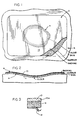
- FIG. 1 is a plan view of the wound dressing as applied to a dermal ulcer, part of the dressing being broken away to show its interior construction;
- FIG. 2 is a side elevational view showing the dressing applied to the ulcer;
- FIG. 3 is a fragmentary enlarged view of the dressing before application;
- FIGS. 4, 5, and 6 are side elevational sectional views illustrating progressive swelling of the portion of the barrier over the ulcer; and
- FIG. 7 is a perspective view illustrating removal of the dressing from the ulcer.
- The occlusive dressing of this invention preferably includes only two layers, a skin-contacting barrier layer and an overlying backing layer adhesively united thereto. For accomplishing the purpose of this invention, it is important that the backing sheet be formed of an elastic material which is stretchable under the pressure created by the swelling of the barrier material as it absorbs wound exudate. The required degree of stretchability can be determined by a standard test procedure, as will subsequently be described in detail. The operative criteria is that the sheet of elastic backing material should be stretchable at least to the extent that a 50% elongation without rupture is produced by a tensioning stress of not over 268 g/cm (1.5 pounds per inch) of width. In preferred embodiments, the 50% elongation as specified is obtained at a tensioning stress of less than 214 g (1.2 pounds,) for example, at a tensioning stress of not over 179 g (1.0 pounds) per cm (inch) of width, such as from 54 to 161 g/cm (0.3 to 0.9 Ibs/in) width.
- Foam backings can be used which satisfy the foregoing criteria. But many commercially available plastic foams in sheet form do not have the required degree of elasticity. Particularly suitable sheet foams are available from the Norton Company, Granville, New York, being sold under the trademark "Sof-Med" Foams. These foams are made from polyvinyl chloride and are essentially closed cell foams, the closed cell content being over 90%. An excellent backing is the "Sof-Med" sheet foam "V-631 having a thickness of 0,79 mm (1/32 inches). Using the specified stretchability test, the "V-631" foam was found to elongate 50% per cm (inch) of width at around 161 g (0.9 pounds) tensioning stress.
- A partially open cell foam suitable for use in the wound care dressing of this invention is available from Semex Medical, Norristown, PA. This is a polyurethane foam having a thickness of approximately 0,79 mm (1/32"), and a porosity of the order of 50% ± 10%. The foam is available in a range of densities from 0,19 to 0,32 g/cm3 (12 to 20 Ibs./cu. ft), For example, one standard product (MU2422-00) has a density of about 0.22 g/cm3 (13.5 Ibs./cu. ft) and is available in a 0,79 mm (1/32") thickness at approximately a 50% porosity (50% open cell). In testing that backing for use in the present invention, it was found to have an especially advantageous stretchability criteria, elongating 50% per cm (inch) of width at 57g (0.32 lbs) tensioning stress. This backing provides the further advantage that water from the wound fluid absorbed into the barrier layer is transferred through the porous backing and evaporated to the atmosphere. The fluid absorbing capacity of the barrier layer is therefore maintained and, in effect, increased beyond that which would be provided if the backing was non-porous.
- Thin films may also be used as the backing layer, providing they exhibit the required degree of stretchability. For example, polyurethane, latex rubber or silicone films can be used. Such films can range in thickness from about 0,013 to 0,127 mm (0.5 to 5.0 mils), In order to provide the desired degree of stretchability such films will usually have a thickness in the range of about 0,013 to 0,038 mm (0.5 to 1.5 mils), such as about 0,025 mm (1 mil), For example, the polyurethane film of 0,025 mm (1 mil) thickness was tested and found to have a 50% elongation per cm (inch) of width at a tensioning stress of about 125 g (0.7 pounds), whereas a latex film of 0,102 mm (4 mil) thickness was tested and found to have a 50% elongation per cm (inch) of width at a tensioning stress of about 54 g (0.3 pounds),
- If an additional layer is included between the fluid-absorbing barrier layer and the backing layer, the composite of the intermediate layer and the backing layer must meet the stretchability criteria set out above. It has therefore been found preferable to have the backing layer in direct contact with the barrier layer, and to utilize a backing of the kinds described above, viz. foam backings of 0,635 to 0,889 mm (25 to 35 mils) thickness, or film backings of 0,013 to 0,038 mm (0.5 to 1.5 mil) thickness.
- Although highly stretchable film backings are commercially available and provide some of the advantages of the present invention, foam backings of the character described above are presently believed to be preferred. The foam backing may be either non-porous or porous, but where a partially-open cell, porous- type foam backing is employed, an additional method of functioning is provided.
- The barrier layer is formulated from a mixture of elastomers and hydrocolloids. For example, polyisobutylene (PIB) may be employed as one elastomeric ingredient. However, since polyisobutylene cannot itself be chemically or physically cross-linked, it will be necessary to also include a cross-linking elastomeric resin. Cross-linkable resins which blend with polyisobutylene to form a continuous elastomeric phase are the copolymer resins formed from ethylene and vinyl acetate (EVA resins). Suitable formulations of EVA with PIB are disclosed in U.S Patent 4,477,325. As therein indicated, the proportions of ethylene to vinyl acetate may be varied. For the purposes of the present invention, from 40 to 60 parts of vinyl acetate may be copolymerized with from 60 to 40 parts by weight of ethylene. However, the exact proportions are not critical.
- These EVA copolymers can be cross-linked by gamma irradiation. For example, a Cobalt-60 radiation source may be used to apply from 1.0 to 8.0 megarads. A desirable degree of cross-linking is obtainable with applied gamma irradiation of 2 to 4 megarads. For further details about such a cross-linking procedure, reference may be had to U.S. patent 4,477,325. Optionally, a minor amount of an additional cross-linking resin can be included, such as an acrylamide polymer which reacts with EVA to form cross-links. (See U.S. Patent 4,477,325.) In the preferred formulations, the cross-linked network is formed essentially from the EVA polymer by irradiation of the EVA-containing elastomeric phase.
- To provide for fluid absorption, the barrier material may contain a relatively high proportion of hydrocolloid, and also a super-absorbent type hydrocolloid. Super-absorbents can be formed from starch and acrylonitrile, the starch, either gelatinized or in granule form, being reacted with the acrylonitrile under alkaline conditions. For example, the resulting products may comprise a starch-polyacrylonitrile graft polymer, as described in U.S. Patents 3,997,484 and 3,661,8]5. Synthetic super-absorbents may also be utilized, such as sodium polyacrylates.
- The hydrocolloids which may be employed alone or in combination with the super-absorbent include pectin, carboxymethylcellulose, such as sodium CMC, karaya, gelatin and guar. The hydrolloid mixture may include both natural vegetable hydrocolloid gums and synthetic hydrocolloids, for example, a mixture of pectin and sodium CMC has been found to be particularly suitable, especially when used in admixture with a super-absorbent such as sodium polyacrylate.
- As a guide to formulating the barrier materials useful in the wound dressings of the present invention, the following general formula is set out:

- In combining the ingredients shown in the above formula, the hydrocolloid is dispersed in particulate form in a continuous elastomeric phase, including the polyisobutylene and the cross-linking elastomer. It is desirable to include sufficient water-absorbing hydrocolloids to provide the barrier layer with a water-absorbing capacity of from about 3 to 12 g per g of barrier. In preferred embodiments, the barrier provides a water absorbency of at least 4 g per g of barrier, such as a water absorbency in the range of 4 to 8 g of water per g of barrier. By the combination of hydrocolloids described above including a superabsorbent- type hydrocolloid, a high degree of water-absorbency can be obtained.
- By way of further illustration, a preferred formula is set out below:

- In the preferred formula, the EVA preferably contains from 40 to 60 percent by weight of vinyl acetate. In particular, copolymers containing approximately equal proportions of ethylene and vinyl acetate may be used. The dispersed particulate hydrocolloids may comprise a mixture of ordinary hydrocolloids and a super-absorbent hydrocolloid. For example, the hydrocolloids comprise pectin, sodium CMC, and sodium polyacrylate. The ordinary hydrocolloids, as distinguished from the super-absorbent type, may comprise from 30 to 50% by weight of the barrier, in admixture with from 5 to 15% by weight of a super-absorbent. These proportions can be adjusted to give the desired degree of fluid adsorbence.
- The above preferred formula refers to optional ingredients. It may be desirable to include a tackifier resin for improving dry tack of the barrier layer. For example, hydrocarbon tackifiers may be used of the kind described in U.S. Patent 4,231,369. The hydrocarbon tackifier may comprise a polymer or copolymer of dicyclopentadiene, alpha-pinene and beta-pinene. The amount of hydrocarbon tackifier is not critical, but if employed may be used in amounts of from 2 to 8 percent by weight of the barrier.
- It may also be desirable, although not essential, to employ an oil extender material when it contains a hydrocarbon tackifier. Such oil extenders may include petrolatum, paraffin oil, polybutylene oil or vegetable oils, In general, if an oil extender is employed, amounts ranging from 1 to 7 percent by weight of the barrier may be used.
- In other embodiments, the elastomeric phase may be composed of or may contain as the cross-linking polymer such as a styrene-olefin-styrene block copolymer, or an ethylene-propylene block copolymer which is capable of forming physical cross-links, so that the elastomeric in solidified condition inherently provides a cross-linked network. Such physically cross-linking elastomeric polymers are described in U.S. Patent 4,231,369.
- In compounding formulas composed essentially of polyisobutylene (PIB), EVA copolymers, and hydrocolloids, the PIB and EVA can be first combined in a kneading-type mixer (or other suitable mixer) and mixed to substantial homogeneity. Mixing may then be continued with the slow addition of the hydrocolloids in powder form, which may be a preblended powder. Mixing is continued until a substantially homogeneous mixture is obtained in which the particulate hydrocolloids are dispersed in the continuous elastomer phase composed of the PIB and the EVA. The thus-prepared mixture may be formed into sheets of the desired thickness for the barrier layer by passing the material through a calendar having a pre-set gap, or the barrier sheets may be formed by compression in mold cavities of a desired depth. For purpose of the present invention, the exact thickness of the barrier layer is not critical. However, the preferred barrier layers will usually have a thickness in the range of about 0,762 to 2,286 mm (30 to 90 mils), such as 1,016 to 1,778 mm (40 to 70 mils), The barrier layer may be extruded onto a carrier sheet of releasable material, such as silicone-coated paper. The backing layer may be pressed into adhesive union with the top surface of the barrier layer, and the dressing assembly cut to the desired sizes by die-cutting. At the time of use, the release sheet is removed from the dressing, and the barrier layer applied over the wound area.
- Where the barrier contains EVA or other resin cross-linking by irradiation, the barrier is irradiated after the dressing has been formed, either before or after packaging. The gamma irradiation will also serve to sterilize the dressing. It is therefore convenient to enclose the dressings in flexible wrappers for packaging of the dressing, and then to irradiate the packaged dressing to cross-link the barrier layer.
- The construction and operation of wound dressings prepared in accordance with this invention are further illustrated by the accompanying drawings. Referring to FIGS. 1 and 2, the wound dressing D is illustrated applied over a dermal ulcer U surrounded by skin S. The dotted lines around the ulcer U suggest an irregular margin of the ulcer area. Several descriptive labels have been applied in FIGS. 1 and 2.
- The dressing D includes the
stretchable backing 10 which overlies the fluid-absorbingbarrier layer 11. In FIG. 1 the lower right hand corner of the backing and the barrier layers are broken away. The borders of the dressing which are outside of the ulcer, as shown more clearly in FIG. 2, are adhesively united to the skin. On initial application, the dressing may be pressed gently into the ulcer area, extending through the epidermis into the dermis. The "dotting" of the barrier layer indicates dispersed particles of hydrocolloids, comprising a particulate solid phase within the continuous elastomeric phase. - FIG. 3 shows an enlarged sectional view of a cross-section of the dressing barrier. The
backing layer 10 may be adhesively united to thebarrier layer 11 through the dry tack action of the elastomeric phase, or, if desired, the backing may have a pressure-sensitive adhesive on thesurface 10a, which is to be attached to thebarrier layer 11. Backing sheets suitable for use in forming the dressings of the present invention can be obtained with pressure-sensitive adhesives on one surface thereof. In FIG. 3,protective paper 12, such as a silicone-coated paper, is shown being removed from the underside of the barrier layer, as would be done prior to the application of the dressing. - FIGS. 4 to 7 illustrate the way in which the wound dressing of this invention will function after application to an ulcer or other fluid-exuding skin wound. As illustrated in FIG. 2, fluid exuded by the ulcer U will be absorbed by the central portion of the barrier material overlying the dressing, the hydrocolloid particles swelling as they absorb the aqueous fluid. After a day or two of such swelling enlargement, the applied dressing may appear as shown in the cross-sectional view of FIG. 4. The enlarged central portion of the barrier 11 a has stretched the
central portion 10b of the backing upwardly into a domed configuration. As the absorption proceeds, after another day or two, the swelling of the central portion 11 a may appear as shown in the cross-sectional view of FIG. 5. The swollen portion of the barrier 11 a has stretched the central portion of thebacking barrier 10b upwardly further permitting continued swelling of the barrier layer over the ulcer. As shown in FIG. 5, the swollen portion 11 a has nearly reached the outer margins of the ulcer U. - When the swollen area 11 a begins to expand beyond the margins of the ulcer U, as shown in FIG. 6, it will usually be desirable to remove and replace the dressing. By observing the extent of swelling of the dressing in relation to the ulcer size, the removal stage can be visually determined.
- Removal of the dressing is illustrated in FIG. 7. The barrier layer although centrally swollen and saturated with wound fluid will remain integrated so that the entire dressing can be removed in one piece.
- FIG. 7 illustrates one side of the dressing being rolled back, and shows the
swollen portion 11 as removed from the ulcer U. - The wound dressings of this invention are further illustrated by the following examples.
- One preferred example of a wound dressing for use in practicing the present invention employs a barrier material prepared according to the following Formula A.

- The ingredients of Formula A can be compounded as follows:
- The hydrocolloids can be first dry blended to form a dry mix for later addition to the other ingredients. The polyisobutylene, EVA and about 60% of the preblended hydrocolloid mix are combined in a kneading-type mixer (or other suitable mixer) and are mixed at 55 C for 5 min after the EVA pellets begin to melt. The rest of the hydrocolloid premix, super absorber, tackifier resin and petrolatum are then added and mixing continues for another 10 min until a substantially homogeneous final mixture is obtained.
- The thus prepared mixture can be formed into the desired shape by any number of means commonly used for converting plastics and elastomers to such shapes. These means include compression molding and injection molding. Calendering and extrusion of the mixture in sheet form followed by die cutting into the desired shape may also be used. The currently preferred mode of preparation consists of extruding a ribbon of the desired width and thickness directly onto release paper. This ribbon can be covered on the exposed side with one of several types of backings, either porous or non-porous films being used.
- This backing can be applied by hand or in conjunction with a compression roller on the production line.
- After uniting the barrier layer to the backing layer, the assembly is cut into desired sizes for the wound dressings, such as 10,16 x 10,16 cm (4" x 4") wafers, (20,32 x 20,32 cm (8" x 8") wafers, and 20,32 x 30,48 cm (8" x 12") wafers, or any other desirable shape. The completed dressings are packaged in a heat sealed plastic bag. Following packaging, the dressings are irradiated at 2.5 Mrad of gamma radiation. The irradiation converts the EVA to a cross-linked network which effectively integrates the barrier layer, and the irradiation also sterilizes the packaged dressings.
- Suitable backing layers for use in forming the dressings comprise:
- (1) The "Sof-Med V-631" closed cell polyvinyl chloride foam (0,79 mm (1/32) in gauge) of Norton Company, Granville, New York;
- (2) MU2422-00 polyurethane foam (0.79 mm (1/32) in gauge, 50% porous) of Semex Medical, Norristown, PA;
- (3) The polyether polyurethane film (0,025 mm (1 mil) thickness) obtained from General Foam Corporation, Paramus, New Jersey; and
- (4) The latex rubber film (0,102 mm (4 mil) thickness) obtained from Hygenic Corporation, Akron, Ohio.
- Samples of these backing materials were tested by pulling 2,54 x 15,24 cm (1 x x 6") test strips on an "Instron" testing machine. The value of tensioning force necessary to stretch each sample by 50% was then recorded, and an average value determined. The following backing materials were selected as suitable for use in producing this invention with respect to their stretchability.

- All of the above materials, with the exception of the Semex polyurethane foam, provide essentially sealed backing layers. By using the Semex foam, which is a partially open-cell foam, a backing layer is provided which has sufficient porosity to permit water vapor to be transferred therethrough from the barrier layer. This combination provides a special cooperative action. During periods in which large amounts of wound fluid are being discharged, the barrier layer can absorb the fluid, enlarging in size, and stretching the backing layer. As the amount of wound discharge decreases, transmission of moisture through the backing layer to the atmosphere reduces the amount of fluid retained in the barrier layer, permitting it to contract in size with reduction in the amount of stretch in the backing layer. In this manner, large and variable amounts of wound fluid can be accommodated. The wound dressing continues to be effective at all times.
- Following the procedure of Example 1 other dressings within the scope of this invention can be prepared as summarized below. The ingredient identifications correspond with those of Formula A. The gelatin and fumed silica are optional additional ingredients. Example 2 is a formulation for decreased absorption (1.5 g water/I g barrier) while Example 12 is a formulation for increasing absorption (10 g water/I g barrier). The other examples indicate permissible variations within the broad concept of the invention. The barrier formulations of Examples 2 to 12 can be used with the backings described in Example 1, being formed and assembled as described therein to provide the complete occlusive dressings. Preferred backings are the closed cell polyvinyl chloride foam (Sof-Med V-631), or the partially open cell polyurethane foam (Semex MU2422-00). The respective advantages of these combinations are as described above.

Claims (9)
characterized in that
said backing layer is stretchable and formed of either a foam material in sheet form or a plastic film, said foam material sheet or said plastic film being selected to provide stretchability being such that the backing layer will undergo a 50% elongation without rupture on application of a tensioning stress of not over 268 g/cm (1.5 pounds/inch) of width.
characterized in that
said barrier layer contains an elastomeric copolymer of ethylene and vinyl acetate which has been cross-linked by gamma irradiation to provide said polymer network.
characterized in that
said backing layer is a foam material which is stretchable to the extent of a 50% elongation without rupture on application of a tensioning stress of not over 179 g/cm (1.0 pounds/inch) of width.
characterized in that
said backing layer is formed of a closed cell foam.
characterized in that
said backing layer is formed of a partially open cell foam which permits the transmission of water vapor therethrough.
characterized in that
said backing layer is a closed cell polyvinyl chloride foam having a thickness of from 0.64 to 0.89 mm (25 to 35 mils).
characterized in that
said backing layer is a partially open cell polyurethane foam having a thickness of from 0.64 to 0.89 mm (25 to 35 mils).
characterized in that
said backing layer is a polyurethane film having a thickness of from 0.01 to 0.04 mm (0.5 to 1.5 mils).
characterized in that
said backing layer is a latex rubber film having a thickness of from 0.05 to 0.38 mm (2 to 15 mils).
Applications Claiming Priority (4)
| Application Number | Priority Date | Filing Date | Title |
|---|---|---|---|
| US87280386A | 1986-06-11 | 1986-06-11 | |
| US872803 | 1986-06-11 | ||
| US907501 | 1986-09-15 | ||
| US06/907,501 US4738257A (en) | 1986-06-11 | 1986-09-15 | Occlusive wound care dressing |
Publications (4)
| Publication Number | Publication Date |
|---|---|
| EP0249694A2 EP0249694A2 (en) | 1987-12-23 |
| EP0249694A3 EP0249694A3 (en) | 1989-03-01 |
| EP0249694B1 true EP0249694B1 (en) | 1992-03-04 |
| EP0249694B2 EP0249694B2 (en) | 1995-03-22 |
Family
ID=27128262
Family Applications (1)
| Application Number | Title | Priority Date | Filing Date |
|---|---|---|---|
| EP87104888A Expired - Lifetime EP0249694B2 (en) | 1986-06-11 | 1987-04-02 | Occlusive wound care dressing |
Country Status (14)
| Country | Link |
|---|---|
| US (1) | US4738257A (en) |
| EP (1) | EP0249694B2 (en) |
| JP (1) | JPS62292160A (en) |
| KR (1) | KR940008957B1 (en) |
| AU (1) | AU585443B2 (en) |
| BR (1) | BR8702587A (en) |
| CA (1) | CA1317175C (en) |
| DE (1) | DE3776975D1 (en) |
| DK (1) | DK168980B1 (en) |
| ES (1) | ES2032771T5 (en) |
| FI (1) | FI89242C (en) |
| GB (1) | GB2191403B (en) |
| IE (1) | IE59761B1 (en) |
| MX (1) | MX167487B (en) |
Families Citing this family (145)
| Publication number | Priority date | Publication date | Assignee | Title |
|---|---|---|---|---|
| US4915102A (en) * | 1988-09-01 | 1990-04-10 | Bertek, Inc. | Hinged dermal applicator |
| AU622935B2 (en) * | 1988-09-26 | 1992-04-30 | Paul Hartmann Ag | Wound dressing |
| US5006401A (en) * | 1988-11-23 | 1991-04-09 | E. R. Squibb & Sons, Inc. | Composite compression and support dressing |
| US5092323A (en) * | 1990-06-29 | 1992-03-03 | Hollister Incorporated | Moisture-absorbing, site-revealing adhesive dressing |
| AU643058B2 (en) * | 1990-08-30 | 1993-11-04 | Terumo Kabushiki Kaisha | Wound-covering materials |
| US5173302A (en) * | 1990-09-28 | 1992-12-22 | Medtronic, Inc. | Hydrophilic pressure sensitive adhesive for topical administration of hydrophobic drugs |
| ES2097217T3 (en) * | 1990-10-01 | 1997-04-01 | Hollister Inc | WOUND DRESSING THAT HAS A CONTAINED LAYER OF ADHESIVE. |
| ATE153849T1 (en) * | 1991-04-08 | 1997-06-15 | Chicopee | ABSORBENT, MOISTURE-PERMEABLE, OCCLUSIVE DRESSING |
| US5109874A (en) * | 1991-07-18 | 1992-05-05 | Bellingham Medical Inc. | Wound patch |
| JPH06154304A (en) * | 1992-07-29 | 1994-06-03 | Nitto Denko Corp | Functional material for external use |
| IL106484A (en) * | 1992-07-31 | 1998-08-16 | Lai John | Compositions for therapeutic and anaesthetic treatment and the use thereof |
| CA2104046C (en) * | 1992-10-05 | 1998-09-15 | Yen-Lane Chen | Adhesive compositions, wound dressings and methods |
| US5344698A (en) * | 1992-11-24 | 1994-09-06 | Malden Mills Industries, Inc. | Composite undergarment fabric |
| AU3795293A (en) * | 1993-01-29 | 1994-08-15 | James A. Mraz Sr. | Non-irritating clothing liner for persons with touch sensitive wounds |
| US5695452A (en) * | 1993-02-16 | 1997-12-09 | Grim; Tracy E. | Formed resilient orthopaedic device |
| US6066773A (en) * | 1993-03-22 | 2000-05-23 | E. R. Squibb & Sons, Inc. | Thin film dressing with absorbent border |
| US5681579A (en) * | 1993-03-22 | 1997-10-28 | E.R. Squibb & Sons, Inc. | Polymeric support wound dressing |
| DK44193D0 (en) * | 1993-04-20 | 1993-04-20 | Euromed I S | SPECIAL CONNECTION AND ADMINISTRATIVE TO A SPECIAL CONNECTION OR SIMILAR |
| US5356372A (en) * | 1993-12-01 | 1994-10-18 | Ludlow Corporation | Occlusive pressure-reducing wound dressing |
| US5429592A (en) * | 1994-03-02 | 1995-07-04 | Euromed I/S | Occlusive dressing with striped precut release sheet |
| US5998694A (en) * | 1994-03-02 | 1999-12-07 | Jensen; Ole R. | Occlusive dressing with release sheet having extended tabs |
| AU1632795A (en) * | 1994-04-08 | 1995-10-19 | Johnson & Johnson Consumer Products, Inc. | Comformable adhesive bandages |
| US5496296A (en) | 1994-06-06 | 1996-03-05 | Dansac A/S | Ostomy appliance with extrudable gasket |
| US5556375A (en) * | 1994-06-16 | 1996-09-17 | Hercules Incorporated | Wound dressing having a fenestrated base layer |
| US5522794A (en) * | 1994-06-16 | 1996-06-04 | Hercules Incorporated | Method of treating human wounds |
| US5607388A (en) * | 1994-06-16 | 1997-03-04 | Hercules Incorporated | Multi-purpose wound dressing |
| JPH0810282A (en) * | 1994-07-01 | 1996-01-16 | Nissho Corp | Adhesive plaster |
| DE4434171A1 (en) * | 1994-09-24 | 1996-03-28 | Basf Ag | Adhesive coatings containing superabsorbent particles |
| US5562653A (en) * | 1994-11-16 | 1996-10-08 | Hercules Incorporated | Medical devices composed of low ceiling temperature polymers |
| US6225523B1 (en) * | 1994-12-07 | 2001-05-01 | Masini Michael A | Invertible wound dressings and method of making the same |
| AU2004233501B2 (en) * | 1995-03-02 | 2006-04-06 | Johnson & Johnson Consumer Products Inc | Structured occlusive dressings |
| US5609585A (en) * | 1995-08-01 | 1997-03-11 | Hollister Incorporated | Wafer having adhesive skin barrier layer |
| US5562107A (en) * | 1995-09-27 | 1996-10-08 | Hollister Incorporated | Reclosable wound cover |
| US5704905A (en) | 1995-10-10 | 1998-01-06 | Jensen; Ole R. | Wound dressing having film-backed hydrocolloid-containing adhesive layer with linear depressions |
| US5827213A (en) * | 1995-10-19 | 1998-10-27 | Ole R. Jensen | Heel and elbow dressing |
| GB9522313D0 (en) * | 1995-11-01 | 1996-01-03 | Bristol Myers Squibb Co | Use of an adhesive composition in the manufacture of a wound dressing |
| US5951505A (en) * | 1996-02-05 | 1999-09-14 | Hollister Incorporated | Wound dressing and delivery system therefor |
| US5618276A (en) | 1996-02-14 | 1997-04-08 | Hollister Incorporated | Ostomy appliance with convex pressure ring |
| US5730736A (en) | 1996-04-30 | 1998-03-24 | Dansac A/S | Ostomy appliance and contoured adhesive wafer therefor |
| US5968001A (en) * | 1996-05-14 | 1999-10-19 | Bristol-Myers Squibb Company | Wound dressings with leak prevention seal |
| SE9602226D0 (en) * | 1996-06-05 | 1996-06-05 | Astra Ab | Biocompatible glue |
| USD410087S (en) | 1996-07-02 | 1999-05-18 | Dunshee Wayne K | Adhesive bandage |
| CA2259370C (en) * | 1996-07-02 | 2007-10-23 | Minnesota Mining And Manufacturing Company | Medical adhesive composite and package |
| US5897516A (en) * | 1996-09-27 | 1999-04-27 | Bristol-Myers Squibb Company | Method of treating a wound by monitoring the swelling of a hydrocolloid layer in a wound dressing |
| SE513490C2 (en) * | 1997-02-20 | 2000-09-18 | Moelnlycke Health Care Ab | Method for attaching a liquid-tight layer to a wound pad and absorbent dressing |
| IL120910A (en) * | 1997-05-26 | 2004-01-04 | Lrr & D Ltd | Multipurpose dynamic occlusive dressing |
| US6077986A (en) * | 1997-06-16 | 2000-06-20 | Avery Dennison Corporation | Process for manufacturing tape products |
| CA2292498C (en) * | 1997-06-16 | 2005-09-20 | Avery Dennison Corporation | Process for manufacturing tape products |
| US20040243045A1 (en) * | 1997-07-01 | 2004-12-02 | Masini Michael A. | Invertible wound dressings and method of making the same |
| DK1007597T3 (en) | 1997-08-29 | 2003-08-18 | Avery Dennison Corp | Absorbent pressure sensitive adhesives for biological fluids |
| GB9719711D0 (en) | 1997-09-16 | 1997-11-19 | Avery Dennison Corp | Hydrocolloid pressure sensitive adhesive |
| US6068852A (en) | 1997-10-11 | 2000-05-30 | Polytherapeutics, Inc. | Polymeric composition for sealing and shielding animal skin |
| USD408541S (en) * | 1998-04-13 | 1999-04-20 | Dunshee Wayne K | Bandage and bandage with carrier |
| USD409754S (en) * | 1998-04-13 | 1999-05-11 | Dunshee Wayne K | Bandage |
| US5961479A (en) * | 1998-06-05 | 1999-10-05 | Dermalabs Inc. | Therapeutic mask |
| US6488643B1 (en) | 1998-10-08 | 2002-12-03 | Kci Licensing, Inc. | Wound healing foot wrap |
| US20010018579A1 (en) | 1998-12-18 | 2001-08-30 | Walter Klemp | Disposable absorbent garment having stretchable side waist regions |
| FR2790763B1 (en) * | 1999-03-09 | 2001-06-01 | Lhd Lab Hygiene Dietetique | NEW HYDROCOLLOID ADHESIVE MASS HAVING BETTER RESISTANCE TO THE DEGRADATION OF ITS ABSORPTION CAPACITY AFTER RADIOSTERILIZATION |
| US7063859B1 (en) | 1999-04-28 | 2006-06-20 | Noven Pharmaceuticals, Inc. | Barrier film lined backing layer composition and method for topical administration of active agents |
| US6264976B1 (en) | 1999-11-29 | 2001-07-24 | 3M Innovative Properties Company | Absorbent pad dressing frame delivery system |
| US6566575B1 (en) | 2000-02-15 | 2003-05-20 | 3M Innovative Properties Company | Patterned absorbent article for wound dressing |
| US7137968B1 (en) * | 2000-03-13 | 2006-11-21 | Nucryst Pharmaceuticals Corp. | Transcutaneous medical device dressings and method of use |
| US6595972B1 (en) | 2000-05-26 | 2003-07-22 | The Procter & Gamble Company | Wearable article having a spacer maintaining a void space |
| WO2002000157A2 (en) | 2000-06-27 | 2002-01-03 | Narula Vinod K | Wound covering pressure relief pads |
| US6803495B2 (en) | 2000-06-28 | 2004-10-12 | World Properties, Inc. | Polyurethane foam composition and method of manufacture thereof |
| US6710100B1 (en) | 2000-10-13 | 2004-03-23 | Avery Dennison Corporation | Fluid absorbing, adhesive hydrocolloid compositions |
| US20020147265A1 (en) * | 2001-01-19 | 2002-10-10 | Scapa North America | Hydrocolloid compositions |
| USD473947S1 (en) | 2001-03-12 | 2003-04-29 | 3M Innovative Properties Company | Notched medical dressing |
| US6642427B2 (en) * | 2001-05-14 | 2003-11-04 | The Procter & Gamble Company | Wearable article having a temperature change element |
| US20050222546A1 (en) * | 2004-04-01 | 2005-10-06 | The Procter & Gamble Company | Disposable absorbent article having refastenable side seams and a wetness sensation member |
| WO2003057485A1 (en) | 2001-12-21 | 2003-07-17 | Avery Dennison Corporation | Process for the manufacture of multi-layered wound dressings |
| US20030125680A1 (en) * | 2002-01-02 | 2003-07-03 | Ding Jian Ling | Hydrocolloid bandage |
| US6787680B2 (en) * | 2002-02-15 | 2004-09-07 | Jeremy D. McGowan | Wound dressing impervious to chemical and biological agents |
| US20030171737A1 (en) * | 2002-03-11 | 2003-09-11 | Leise, Walter F. | Soft convex adhesive wafer |
| US7005143B2 (en) * | 2002-04-12 | 2006-02-28 | 3M Innovative Properties Company | Gel materials, medical articles, and methods |
| US7612248B2 (en) * | 2002-12-19 | 2009-11-03 | 3M Innovative Properties Company | Absorbent medical articles |
| CN100457195C (en) * | 2002-12-31 | 2009-02-04 | Bsn医疗有限责任公司 | wound dressing |
| CA2514078C (en) * | 2002-12-31 | 2012-07-10 | Ossur Hf | Wound dressing |
| US6838589B2 (en) * | 2003-02-19 | 2005-01-04 | 3M Innovative Properties Company | Conformable wound dressing |
| USD503982S1 (en) * | 2003-02-19 | 2005-04-12 | 3M Innovative Properties Company | Wound dressing for heel |
| USD493230S1 (en) | 2003-02-19 | 2004-07-20 | 3M Innovative Properties Company | Wound dressing |
| USD495419S1 (en) | 2003-08-15 | 2004-08-31 | 3M Innovative Properties Company | Bandage |
| EP1675536B1 (en) | 2003-09-17 | 2016-01-20 | BSN medical GmbH | Wound dressing and method for manufacturing the same |
| US7531711B2 (en) * | 2003-09-17 | 2009-05-12 | Ossur Hf | Wound dressing and method for manufacturing the same |
| US7767876B2 (en) | 2003-10-30 | 2010-08-03 | The Procter & Gamble Company | Disposable absorbent article having a visibly highlighted wetness sensation member |
| US20050277860A1 (en) * | 2004-06-14 | 2005-12-15 | Jentec, Inc. | Extended stay-on wound dressing |
| DE502004007444D1 (en) * | 2004-07-16 | 2008-08-07 | Collano Ag | Hotmelt composition with hydrocolloid |
| US7887522B2 (en) | 2005-03-18 | 2011-02-15 | The Procter And Gamble Company | Pull-on wearable article with informational image |
| US7806880B2 (en) * | 2005-03-18 | 2010-10-05 | The Procter & Gamble Company | Pull-on wearable article with informational image |
| US8378166B2 (en) * | 2005-04-04 | 2013-02-19 | The Procter & Gamble Company | Absorbent article with time variable appearing graphics |
| US20060241541A1 (en) * | 2005-04-20 | 2006-10-26 | Sundaram Ravikumar | Therapeutic bandage for the heel of the foot |
| US20060264858A1 (en) * | 2005-05-20 | 2006-11-23 | Roe Donald C | Multi-functional training garment |
| US7432413B2 (en) | 2005-12-16 | 2008-10-07 | The Procter And Gamble Company | Disposable absorbent article having side panels with structurally, functionally and visually different regions |
| WO2007089602A2 (en) * | 2006-01-27 | 2007-08-09 | World Properties, Inc. | Low friction coatings for adhesive dressings and method of manufacture thereof |
| WO2007092289A2 (en) * | 2006-02-02 | 2007-08-16 | H.B. Fuller Licensing & Financing, Inc. | Ostomy article including hot melt superabsorbent polymer composition and method of using the same |
| JP5199993B2 (en) * | 2006-03-16 | 2013-05-15 | ホリスター・インコーポレイテッド | Hydrocolloid-containing adhesive composition having a network of fibrillated polymer fibers |
| US8664467B2 (en) | 2006-03-31 | 2014-03-04 | The Procter & Gamble Company | Absorbent articles with feedback signal upon urination |
| KR100725024B1 (en) * | 2006-06-05 | 2007-06-07 | 주식회사 덕성 | Manufacturing method of super absorbent hydrocolloid |
| USD611156S1 (en) | 2006-06-12 | 2010-03-02 | 3M Innovative Properties Company | Bandage |
| USD604423S1 (en) | 2006-06-12 | 2009-11-17 | 3M Innovative Properties Company | Bandage |
| USD578651S1 (en) | 2006-06-12 | 2008-10-14 | 3M Innovative Properties Company | Bandage |
| USD573260S1 (en) | 2006-06-12 | 2008-07-15 | 3M Innovative Properties Company | Bandage |
| US7858838B2 (en) * | 2006-08-10 | 2010-12-28 | 3M Innovative Properties Company | Conformable wound dressing |
| JP2010502792A (en) * | 2006-09-08 | 2010-01-28 | コロプラスト アクティーゼルスカブ | Two-component sealant containing cross-linked polyalkylene oxide |
| CA2671929C (en) | 2006-12-04 | 2013-03-19 | The Procter & Gamble Company | Absorbent articles comprising graphics |
| US8383549B2 (en) | 2007-07-20 | 2013-02-26 | Bayer Cropscience Lp | Methods of increasing crop yield and controlling the growth of weeds using a polymer composite film |
| CN101754854B (en) * | 2007-07-20 | 2014-05-14 | 拜尔创新有限责任公司 | Polymer composite film with barrier functionality |
| US8021347B2 (en) | 2008-07-21 | 2011-09-20 | Tyco Healthcare Group Lp | Thin film wound dressing |
| US8298200B2 (en) | 2009-06-01 | 2012-10-30 | Tyco Healthcare Group Lp | System for providing continual drainage in negative pressure wound therapy |
| US8257326B2 (en) * | 2008-06-30 | 2012-09-04 | Tyco Healthcare Group Lp | Apparatus for enhancing wound healing |
| EP2300069B1 (en) * | 2008-07-08 | 2017-12-13 | Smith & Nephew, Inc | Portable negative pressure wound therapy device |
| AU2009279525B2 (en) | 2008-08-08 | 2015-04-09 | Smith & Nephew Inc. | Wound dressing of continuous fibers |
| WO2010048078A1 (en) * | 2008-10-24 | 2010-04-29 | 3M Innovative Properties Company | Conformable wound dressing |
| US20100191198A1 (en) * | 2009-01-26 | 2010-07-29 | Tyco Healthcare Group Lp | Wound Filler Material with Improved Nonadherency Properties |
| US20100204752A1 (en) * | 2009-02-10 | 2010-08-12 | Tyco Healthcare Group Lp | Negative Pressure and Electrostimulation Therapy Apparatus |
| KR101019714B1 (en) * | 2009-04-01 | 2011-03-07 | 쓰리디이미징앤시뮬레이션즈(주) | Digital X-Ray Image Acquisition Device |
| US20110270206A1 (en) | 2009-05-21 | 2011-11-03 | Jarl Jensen | Absorptive foam gel lock wound dressing |
| US20110196321A1 (en) | 2009-06-10 | 2011-08-11 | Tyco Healthcare Group Lp | Fluid Collection Canister Including Canister Top with Filter Membrane and Negative Pressure Wound Therapy Systems Including Same |
| US20100318043A1 (en) * | 2009-06-10 | 2010-12-16 | Tyco Healthcare Group Lp | Negative Pressure Wound Therapy Systems Capable of Vacuum Measurement Independent of Orientation |
| US20100318071A1 (en) * | 2009-06-10 | 2010-12-16 | Tyco Healthcare Group Lp | Fluid Collection Canister Including Canister Top with Filter Membrane and Negative Pressure Wound Therapy Systems Including Same |
| US20100316728A1 (en) * | 2009-06-15 | 2010-12-16 | Rreeves William H | Therapeutic mask and Method of Treatment Employing the Same |
| US20100324516A1 (en) | 2009-06-18 | 2010-12-23 | Tyco Healthcare Group Lp | Apparatus for Vacuum Bridging and/or Exudate Collection |
| EP2467081A4 (en) | 2009-08-21 | 2015-05-06 | 3M Innovative Properties Co | METHODS AND PRODUCTS FOR REDUCING TISSUE TRAUMA USING WATER-ABSORBING STRESS REPAIR MATERIALS |
| US10092366B2 (en) | 2009-08-21 | 2018-10-09 | 3M Innovative Properties Company | Products for reducing tissue trauma using water-resistant stress-distributing materials |
| BR112012003745A2 (en) | 2009-08-21 | 2019-09-24 | 3M Innovantive Properties Company | fabric lighting methods and products |
| US20110106027A1 (en) * | 2009-11-05 | 2011-05-05 | Tyco Healthcare Group Lp | Chemically Coated Screen for Use with Hydrophobic Filters |
| BR112012012101B1 (en) * | 2009-11-27 | 2018-04-24 | Coloplast A/S | BODY WASTE COLLECTOR DEVICE |
| US20120199134A1 (en) * | 2011-02-07 | 2012-08-09 | Dawn Carson | Heel offloading apparatus |
| US9302034B2 (en) | 2011-04-04 | 2016-04-05 | Smith & Nephew, Inc. | Negative pressure wound therapy dressing |
| WO2013009848A2 (en) | 2011-07-11 | 2013-01-17 | Luce Donna E | Ostomy appliance guard |
| GB201115182D0 (en) | 2011-09-02 | 2011-10-19 | Trio Healthcare Ltd | Skin contact material |
| DK2773304T3 (en) | 2011-10-31 | 2016-05-02 | Avery Dennison Corp | Adhesive layers, which can be torn apart, to the fluid-activated solution. |
| EP3622971A1 (en) | 2012-02-29 | 2020-03-18 | Hollister Incorporated | Buffered adhesive compositions for skin-adhering medical products |
| WO2013170433A1 (en) | 2012-05-15 | 2013-11-21 | The Procter & Gamble Company | Absorbent article having characteristic waist end |
| EP2909270A1 (en) | 2012-10-22 | 2015-08-26 | Avery Dennison Corporation | Hybrid material of crosslinked microgel particles dispersed in an adhesive |
| CN105246515B (en) | 2013-03-14 | 2017-04-05 | 3M创新有限公司 | Hydrocolloid composition, wound dressing and the method for forming hydrocolloid composition |
| US9271874B2 (en) | 2013-03-15 | 2016-03-01 | Donna E. Luce | Support for an absorbent article |
| US9084696B2 (en) | 2013-03-15 | 2015-07-21 | Donna E. Luce | Absorbent article for an ostomy guard |
| US10617554B2 (en) | 2013-04-30 | 2020-04-14 | Donna E. Luce | Adapter insert for an ostomy guard |
| ES2921990T3 (en) | 2014-09-10 | 2022-09-05 | Bard Inc C R | Protective dressing for a medical device placed on the skin |
| AU2018369903B2 (en) | 2017-11-15 | 2021-04-01 | Hollister Incorporated | Buffered adhesive compositions for skin-adhering medical products |
| US12478708B2 (en) | 2018-05-21 | 2025-11-25 | Milliken & Company | Wound care device having fluid transfer and adhesive properties |
| US12403214B2 (en) | 2018-05-21 | 2025-09-02 | Milliken & Company | Wound care device having fluid transfer and adhesive properties |
| EP3690175A1 (en) * | 2019-01-31 | 2020-08-05 | Bostik SA | Hot melt single-component primary sealant |
| US10966471B1 (en) * | 2020-05-19 | 2021-04-06 | Aslan Medical Equipment, Llc | Soft silicon edged cushion for face masks |
Family Cites Families (17)
| Publication number | Priority date | Publication date | Assignee | Title |
|---|---|---|---|---|
| US447735A (en) * | 1891-03-03 | moesee | ||
| US3339546A (en) * | 1963-12-13 | 1967-09-05 | Squibb & Sons Inc | Bandage for adhering to moist surfaces |
| US3972328A (en) * | 1975-07-28 | 1976-08-03 | E. R. Squibb & Sons, Inc. | Surgical bandage |
| GB1576522A (en) * | 1977-05-24 | 1980-10-08 | Colorplast International A S | Sealing material for ostomy devices |
| US4202925A (en) * | 1978-04-04 | 1980-05-13 | Johnson & Johnson | Paper surgical tape |
| US4253460A (en) * | 1979-07-27 | 1981-03-03 | E. R. Squibb & Sons, Inc. | Ostomy adhesive |
| ZA805066B (en) * | 1979-09-07 | 1981-08-26 | Kingsdown Medical Consultants | Wound dressing |
| US4286592A (en) * | 1980-02-04 | 1981-09-01 | Alza Corporation | Therapeutic system for administering drugs to the skin |
| JPS57115253A (en) * | 1980-07-28 | 1982-07-17 | Advance Kk | Pasturized adhesive drug containing bandage |
| NZ203706A (en) * | 1982-04-22 | 1986-03-14 | Squibb & Sons Inc | Occlusive multi-layer wound dressing and hydrocolloidal granules for wound treatment |
| US4538603A (en) * | 1982-04-22 | 1985-09-03 | E. R. Squibb & Sons, Inc. | Dressings, granules, and their use in treating wounds |
| DE3225555A1 (en) * | 1982-07-08 | 1984-01-12 | Cassella Ag, 6000 Frankfurt | CROSSLINKER FOR WATER SWELLABLE POLYMERS |
| US4477325A (en) * | 1982-07-12 | 1984-10-16 | Hollister Incorporated | Skin barrier composition comprising an irradiated crosslinked ethylene-vinyl acetate copolymer and polyisobutylene |
| US4516571A (en) * | 1983-03-10 | 1985-05-14 | Smith And Nephew Associated Companies P.L.C. | Medical device, its preparation and use |
| EP0122344B1 (en) * | 1983-04-15 | 1987-07-01 | E.R. Squibb & Sons, Inc. | Adhesive composition |
| US4551490A (en) * | 1983-06-27 | 1985-11-05 | E. R. Squibb & Sons, Inc. | Adhesive composition resistant to biological fluids |
| US4484574A (en) * | 1984-01-25 | 1984-11-27 | Keene Corporation | Self-rolled foam tape without release layer and method of making same |
-
1986
- 1986-09-15 US US06/907,501 patent/US4738257A/en not_active Expired - Lifetime
-
1987
- 1987-03-19 IE IE72287A patent/IE59761B1/en not_active IP Right Cessation
- 1987-03-27 CA CA000533138A patent/CA1317175C/en not_active Expired - Fee Related
- 1987-03-31 GB GB8707605A patent/GB2191403B/en not_active Expired - Fee Related
- 1987-04-02 DE DE8787104888T patent/DE3776975D1/en not_active Expired - Fee Related
- 1987-04-02 EP EP87104888A patent/EP0249694B2/en not_active Expired - Lifetime
- 1987-04-02 ES ES87104888T patent/ES2032771T5/en not_active Expired - Lifetime
- 1987-04-28 AU AU72134/87A patent/AU585443B2/en not_active Ceased
- 1987-05-07 MX MX006376A patent/MX167487B/en unknown
- 1987-05-20 BR BR8702587A patent/BR8702587A/en not_active IP Right Cessation
- 1987-06-10 DK DK296787A patent/DK168980B1/en not_active IP Right Cessation
- 1987-06-10 FI FI872587A patent/FI89242C/en not_active IP Right Cessation
- 1987-06-11 JP JP62144212A patent/JPS62292160A/en active Granted
- 1987-06-11 KR KR1019870005947A patent/KR940008957B1/en not_active Expired - Fee Related
Also Published As
| Publication number | Publication date |
|---|---|
| EP0249694B2 (en) | 1995-03-22 |
| CA1317175C (en) | 1993-05-04 |
| AU585443B2 (en) | 1989-06-15 |
| US4738257A (en) | 1988-04-19 |
| FI89242B (en) | 1993-05-31 |
| DK296787A (en) | 1987-12-12 |
| GB2191403A (en) | 1987-12-16 |
| KR940008957B1 (en) | 1994-09-28 |
| FI89242C (en) | 1993-09-10 |
| IE59761B1 (en) | 1994-03-23 |
| GB8707605D0 (en) | 1987-05-07 |
| FI872587L (en) | 1987-12-12 |
| MX167487B (en) | 1993-03-25 |
| BR8702587A (en) | 1988-02-23 |
| KR880000070A (en) | 1988-03-23 |
| DK168980B1 (en) | 1994-07-25 |
| EP0249694A3 (en) | 1989-03-01 |
| DK296787D0 (en) | 1987-06-10 |
| JPH0569543B2 (en) | 1993-10-01 |
| GB2191403B (en) | 1990-11-21 |
| EP0249694A2 (en) | 1987-12-23 |
| FI872587A0 (en) | 1987-06-10 |
| ES2032771T5 (en) | 1995-08-16 |
| ES2032771T3 (en) | 1993-03-01 |
| DE3776975D1 (en) | 1992-04-09 |
| AU7213487A (en) | 1988-03-17 |
| IE870722L (en) | 1987-12-11 |
| JPS62292160A (en) | 1987-12-18 |
Similar Documents
| Publication | Publication Date | Title |
|---|---|---|
| EP0249694B2 (en) | Occlusive wound care dressing | |
| JP3574159B2 (en) | Adhesive, wound dressing and method for producing the same | |
| US4759354A (en) | Wound dressing | |
| JP2662040B2 (en) | Wound dressing system | |
| EP0413251B1 (en) | A continent ostomate bandage | |
| US5827247A (en) | External incontinence device and vapor-absorptive adhesive compositions | |
| JPH07444A (en) | Wound dressing | |
| GB2149412A (en) | Skin barrier composition | |
| EP0980268A1 (en) | An adhesive agent and use of such adhesive agent | |
| EP0279118B1 (en) | Adhesive products | |
| EP0528191A1 (en) | Dressing | |
| JP4550230B2 (en) | Emergency bandage | |
| WO1992004923A1 (en) | Bilayer wound dressing | |
| CA2065487C (en) | Absorbent, moisture transmitive occlusive dressing | |
| JP2001321433A (en) | Patch for skin, emergency bandage using the same, and patch for rubbing shoes | |
| JPH08103490A (en) | Medical water-absorbing polymer, wound dressing using the same, and medical external-use material, and methods for producing the same | |
| JPH0838543A (en) | Compatible plaster | |
| RU203792U1 (en) | Trauma First Aid Device | |
| JPH0838544A (en) | Compatible plaster | |
| AU1553802A (en) | Conformable adhesive bandages |
Legal Events
| Date | Code | Title | Description |
|---|---|---|---|
| PUAI | Public reference made under article 153(3) epc to a published international application that has entered the european phase |
Free format text: ORIGINAL CODE: 0009012 |
|
| AK | Designated contracting states |
Kind code of ref document: A2 Designated state(s): BE DE ES FR IT NL SE |
|
| PUAL | Search report despatched |
Free format text: ORIGINAL CODE: 0009013 |
|
| AK | Designated contracting states |
Kind code of ref document: A3 Designated state(s): BE DE ES FR IT NL SE |
|
| 17P | Request for examination filed |
Effective date: 19890214 |
|
| 17Q | First examination report despatched |
Effective date: 19900420 |
|
| ITF | It: translation for a ep patent filed | ||
| GRAA | (expected) grant |
Free format text: ORIGINAL CODE: 0009210 |
|
| AK | Designated contracting states |
Kind code of ref document: B1 Designated state(s): BE DE ES FR IT NL SE |
|
| REF | Corresponds to: |
Ref document number: 3776975 Country of ref document: DE Date of ref document: 19920409 |
|
| ET | Fr: translation filed | ||
| PLBI | Opposition filed |
Free format text: ORIGINAL CODE: 0009260 |
|
| 26 | Opposition filed |
Opponent name: COLOPLAST A/S Effective date: 19921203 |
|
| NLR1 | Nl: opposition has been filed with the epo |
Opponent name: COLOPLAST A/S. |
|
| EAL | Se: european patent in force in sweden |
Ref document number: 87104888.0 |
|
| PUAH | Patent maintained in amended form |
Free format text: ORIGINAL CODE: 0009272 |
|
| STAA | Information on the status of an ep patent application or granted ep patent |
Free format text: STATUS: PATENT MAINTAINED AS AMENDED |
|
| 27A | Patent maintained in amended form |
Effective date: 19950322 |
|
| AK | Designated contracting states |
Kind code of ref document: B2 Designated state(s): BE DE ES FR IT NL SE |
|
| PGFP | Annual fee paid to national office [announced via postgrant information from national office to epo] |
Ref country code: ES Payment date: 19950406 Year of fee payment: 9 |
|
| NLR2 | Nl: decision of opposition | ||
| ITF | It: translation for a ep patent filed | ||
| ET3 | Fr: translation filed ** decision concerning opposition | ||
| NLR3 | Nl: receipt of modified translations in the netherlands language after an opposition procedure | ||
| REG | Reference to a national code |
Ref country code: ES Ref legal event code: DC2A Kind code of ref document: T5 Effective date: 19950816 |
|
| PGFP | Annual fee paid to national office [announced via postgrant information from national office to epo] |
Ref country code: FR Payment date: 19960311 Year of fee payment: 10 |
|
| PGFP | Annual fee paid to national office [announced via postgrant information from national office to epo] |
Ref country code: SE Payment date: 19960319 Year of fee payment: 10 |
|
| PGFP | Annual fee paid to national office [announced via postgrant information from national office to epo] |
Ref country code: NL Payment date: 19960328 Year of fee payment: 10 |
|
| PGFP | Annual fee paid to national office [announced via postgrant information from national office to epo] |
Ref country code: BE Payment date: 19960409 Year of fee payment: 10 |
|
| PG25 | Lapsed in a contracting state [announced via postgrant information from national office to epo] |
Ref country code: SE Effective date: 19970403 Ref country code: ES Free format text: LAPSE BECAUSE OF NON-PAYMENT OF DUE FEES Effective date: 19970403 |
|
| PG25 | Lapsed in a contracting state [announced via postgrant information from national office to epo] |
Ref country code: BE Effective date: 19970430 |
|
| BERE | Be: lapsed |
Owner name: HOLLISTER INC. Effective date: 19970430 |
|
| PG25 | Lapsed in a contracting state [announced via postgrant information from national office to epo] |
Ref country code: NL Effective date: 19971101 |
|
| PG25 | Lapsed in a contracting state [announced via postgrant information from national office to epo] |
Ref country code: FR Free format text: LAPSE BECAUSE OF NON-PAYMENT OF DUE FEES Effective date: 19971231 |
|
| NLV4 | Nl: lapsed or anulled due to non-payment of the annual fee |
Effective date: 19971101 |
|
| EUG | Se: european patent has lapsed |
Ref document number: 87104888.0 |
|
| REG | Reference to a national code |
Ref country code: FR Ref legal event code: ST |
|
| PGFP | Annual fee paid to national office [announced via postgrant information from national office to epo] |
Ref country code: DE Payment date: 19980323 Year of fee payment: 12 |
|
| REG | Reference to a national code |
Ref country code: ES Ref legal event code: FD2A Effective date: 19990201 |
|
| PG25 | Lapsed in a contracting state [announced via postgrant information from national office to epo] |
Ref country code: DE Free format text: LAPSE BECAUSE OF NON-PAYMENT OF DUE FEES Effective date: 20000201 |
|
| PG25 | Lapsed in a contracting state [announced via postgrant information from national office to epo] |
Ref country code: IT Free format text: LAPSE BECAUSE OF NON-PAYMENT OF DUE FEES;WARNING: LAPSES OF ITALIAN PATENTS WITH EFFECTIVE DATE BEFORE 2007 MAY HAVE OCCURRED AT ANY TIME BEFORE 2007. THE CORRECT EFFECTIVE DATE MAY BE DIFFERENT FROM THE ONE RECORDED. Effective date: 20050402 |