EP0246597A2 - Verfahren zur Wiedergabe von Signalen von optischen Platten - Google Patents
Verfahren zur Wiedergabe von Signalen von optischen Platten Download PDFInfo
- Publication number
- EP0246597A2 EP0246597A2 EP87107210A EP87107210A EP0246597A2 EP 0246597 A2 EP0246597 A2 EP 0246597A2 EP 87107210 A EP87107210 A EP 87107210A EP 87107210 A EP87107210 A EP 87107210A EP 0246597 A2 EP0246597 A2 EP 0246597A2
- Authority
- EP
- European Patent Office
- Prior art keywords
- photodetector
- track groove
- output
- signal
- amplifying
- Prior art date
- Legal status (The legal status is an assumption and is not a legal conclusion. Google has not performed a legal analysis and makes no representation as to the accuracy of the status listed.)
- Granted
Links
- 230000003287 optical effect Effects 0.000 title claims abstract description 32
- 238000000034 method Methods 0.000 title claims abstract description 29
- 230000003321 amplification Effects 0.000 claims description 14
- 238000003199 nucleic acid amplification method Methods 0.000 claims description 14
- 230000007935 neutral effect Effects 0.000 claims 1
- 230000033458 reproduction Effects 0.000 description 15
- 238000009434 installation Methods 0.000 description 5
- 230000002093 peripheral effect Effects 0.000 description 5
- 239000011295 pitch Substances 0.000 description 4
- RYGMFSIKBFXOCR-UHFFFAOYSA-N Copper Chemical compound [Cu] RYGMFSIKBFXOCR-UHFFFAOYSA-N 0.000 description 3
- 229910052802 copper Inorganic materials 0.000 description 3
- 239000010949 copper Substances 0.000 description 3
- 238000002474 experimental method Methods 0.000 description 3
- 239000004065 semiconductor Substances 0.000 description 3
- 230000008878 coupling Effects 0.000 description 2
- 238000010168 coupling process Methods 0.000 description 2
- 238000005859 coupling reaction Methods 0.000 description 2
- 238000001514 detection method Methods 0.000 description 2
- 229910003460 diamond Inorganic materials 0.000 description 2
- 239000010432 diamond Substances 0.000 description 2
- 238000001228 spectrum Methods 0.000 description 2
- 241001422033 Thestylus Species 0.000 description 1
- 230000003292 diminished effect Effects 0.000 description 1
- 230000000694 effects Effects 0.000 description 1
- 238000003672 processing method Methods 0.000 description 1
Images



Classifications
-
- G—PHYSICS
- G11—INFORMATION STORAGE
- G11B—INFORMATION STORAGE BASED ON RELATIVE MOVEMENT BETWEEN RECORD CARRIER AND TRANSDUCER
- G11B7/00—Recording or reproducing by optical means, e.g. recording using a thermal beam of optical radiation by modifying optical properties or the physical structure, reproducing using an optical beam at lower power by sensing optical properties; Record carriers therefor
- G11B7/08—Disposition or mounting of heads or light sources relatively to record carriers
- G11B7/09—Disposition or mounting of heads or light sources relatively to record carriers with provision for moving the light beam or focus plane for the purpose of maintaining alignment of the light beam relative to the record carrier during transducing operation, e.g. to compensate for surface irregularities of the latter or for track following
-
- G—PHYSICS
- G11—INFORMATION STORAGE
- G11B—INFORMATION STORAGE BASED ON RELATIVE MOVEMENT BETWEEN RECORD CARRIER AND TRANSDUCER
- G11B7/00—Recording or reproducing by optical means, e.g. recording using a thermal beam of optical radiation by modifying optical properties or the physical structure, reproducing using an optical beam at lower power by sensing optical properties; Record carriers therefor
- G11B7/004—Recording, reproducing or erasing methods; Read, write or erase circuits therefor
- G11B7/005—Reproducing
-
- G—PHYSICS
- G11—INFORMATION STORAGE
- G11B—INFORMATION STORAGE BASED ON RELATIVE MOVEMENT BETWEEN RECORD CARRIER AND TRANSDUCER
- G11B7/00—Recording or reproducing by optical means, e.g. recording using a thermal beam of optical radiation by modifying optical properties or the physical structure, reproducing using an optical beam at lower power by sensing optical properties; Record carriers therefor
- G11B7/24—Record carriers characterised by shape, structure or physical properties, or by the selection of the material
- G11B7/2407—Tracks or pits; Shape, structure or physical properties thereof
- G11B7/24073—Tracks
- G11B7/24076—Cross sectional shape in the radial direction of a disc, e.g. asymmetrical cross sectional shape
Definitions
- the present invention relates to a method of reproducing or reading, by means of a laser beam, signals which have been recorded in an optical disk.
- a method has been proposed in the specification of United States Patent No. 4,569,038 for recording data at a high density in an optical disk, by making use of V-shaped track grooves. More specifically, in this proposed method, a V-shaped track groove having slant side surfaces is formed in an optical disk at a pitch which is substantially the same as the pitches of recording tracks in conventional optical disks. In this method, signals are recorded in both slant side surfaces so that the recording density is substantially doubled. In the reproduction of the recorded signals, the beam portion reflected by the optical disk is received by a photodetector. However, the reproducing device does not reproduce whole the reflected beam but only the peripheral portion of the reflected beam.
- the reproduction region in the beam By suitably selecting the reproduction region in the beam, it is possible to reduce any crosstalk from the adjacent slant side surface of the V-shaped track groove. This is one of advantageous features offered by the V-shaped track groove.
- the reflected beam involves not only a reproduction with small crosstalk component but also a region which has a large crosstalk component though the light quantity is small. Therefore, the reproduction of signal is preferably conducted by means of a photodetector which is capable of reproducing signals only in the region having small crosstalk component. In order to obtain a sufficiently low level of crosstalk, e.g., -36 dB, it is necessary to ensure high degree of accuracy not only in design but also in installation of the photodetector.
- the photodetector for receiving the beam reflected by the optical disk is composed of a first photodetector and a second photodetector. More specifically, the first photodetector is designed for receiving the reflected beam portion having the small crosstalk component, while the second photodetector is adapted for receiving the reflected beam portion having the large crosstalk component.
- the signal derived from the first photodetector is multiplied with an amplification M1, while the signal derived from the second photodetector is multiplied with an amplification M2.
- the output of the second photodetector after multiplication by M2 is subtracted from the output of the first photodetector after multiplication by M1 and the difference is used as the reproduction signal.
- the magnification factor M1 is greater than the amplification factor M2.
- the V-shaped track groove is formed by mechanically cutting a copper disk by means of a diamond stylus having a V-shaped point while rotating the copper disk.
- the V-shaped point of the diamond stylus has an apex angle of l62° and the stylus is moved radially inwardly by about l.65 ⁇ m per each rotation of the copper disk.
- a mother disk is formed in which a V-shaped spiral track groove, defined by opposing slant surfaces which make an angle of l62° therebetween, is formed at a pitch of l.65 ⁇ m. It is possible to form a stamper and a replica by making use of this mother disk. This method is disclosed also in the specification of United States Patent No. 569,038.
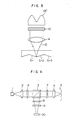
- the optical system includes a semiconductor laser l, a coupling lens 2, a beam splitter 3, an objective lens 4, the V-shaped track groove 5, and a reproducing photodetector l0. Incidence light beam and reflected light beam are designated by numerals ll and l2, respectively.
- Fig. l lacks any illustration of controlling optical system.
- the specification of United States Patent No. 4,569,038 also disclosed a method of reproducing signals from the slant surfaces of the V-shaped track groove.
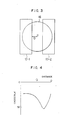
- Fig. 2 illustrates only the beam reflected from a slant surface of a V-shaped track groove.
- slant surfaces of V-shaped track grooves are denoted by numerals 5-l, 5-2, 5-3 and 5-4.
- a curve l3 shows the distribution of intensity of the reflected beam as received by the photodetector. Not whole of this reflected beam but only a peripheral region, e.g., hatched region l4, is reproduced. As explained before, it is one of the critical features of the V-shaped track groove that the crosstalk from the adjacent slant surface is diminished by suitable selection of the region to be reproduced.
- the region opposite to the peripheral region l4, e.g., the hatched area l5, is the region which has a large crosstalk component.
- each reflected beam includes separate portions: namely, a portion having a small crosstalk component and a portion having a large crosstalk component but of a small light quality.
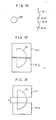
- the reproduction of the signal from the reflected beam therefore essentially necessitates a photodetector of split type composed of two photodetector units l0-l and l0-2 as shown in Fig. 3. More specifically, the photodetector used for the reproduction has first and second photodetector units and which are arranged in symmetry with each other with respect to a line which passes through the center of the reflected light beam and parallel to the track.
- the first photodetector unit receives a beam portion which has a small crosstalk component
- the second photodetector unit receives a beam which has large crosstalk component though the light quantity thereof is small.
- the photodetector unit l0-l is used as the first photodetector unit, while the photodetector unit l0-2 is used as the second photodetector unit, whereas, when the signals from the slant surfaces 5-2, 5-4 and so forth are reproduced, the photodetector units l0-2 and l0-l are used, respectively, as the first and the second photodetector units.
- a reference numeral l6 designates a circle having the same diameter as the reflected beam.
- Fig. 4 shows the amount of crosstalk along the distance Q (see Figs. 2 and 3) between the center axis of the reflected beam and the reproduction boundary. It is assumed here that the incidence light to the objective lens 4 has a Gaussian distribution pattern and that a portion of the reflected beam having the central intensity above l/e is converged through the objective lens. In the case of a variable-density recording in which the signals are recorded in the form of variations in reflection factors the distance Q at which the crosstalk is reduced is about l/4 of the diameter of the reflected beam.
- the variable-density recording is made possible by forming a TeOx recording film on the V-shaped track groove. For the detail of the TeOx recording film, a reference be made to M.
- the distance Q at which the crosstalk is sufficiently reduced is about l/l0 of the diameter of the reflected beam.
- the value of the distance Q will be increased when the intensity of the incident beam coming into the objective lens 4 has a uniform intensity distribution.
- the arrangement may be such that the laser beam spot tracks the bottom of the V-shaped track groove.
- Fig. 5 shows the beam reflected from the bottom of the V-shaped track groove. In this case, the reflected beam is distributed along a curve l3 ⁇ .
- the signals from the slant surface 5-l is received mainly by the photodetector unit l0-2
- the signals from the slant surface 5-2 is received mainly by the photodetector unit l0-l.
- Both the signals received by the photodetector units l0-l and l0-2 have large crosstalk components. In this case, it is impossible to reduce the crosstalk even though the accuracy of the photodetector shown in Fig. 3 is increased.
- the beam reflected from the slant surface of the V-shaped track groove has two separate portions: namely, a portion having a small crosstalk component and a portion having a large crosstalk component.
- the present invention proposes a method which can reduce the strictness for the requirement for accuracy of the design and installation of the photodetector.
- Such a method also enables signals from two slant surfaces of the same V-shaped track groove by means of a single laser beam.
- the beam reflected by a V-shaped track groove is reproduced by means of a photodetector of split type having first and second photodetector units.
- the first photodetector unit produces a detection signal having a small crosstalk component
- the second photodetector unit produces a detection signal having a large crosstalk component.
- a signal obtained by amplifying the output of the second photodetector unit is subtracted from a signal obtained by amplifying the output of the first photodetector unit, thus determining the difference which is used as the reproduction signal.
- the crosstalk component involved by the signal output from the first photodetector unit is negated by the crosstalk component of the output from the second photodetector unit, so that a signal of reduced crosstalk component is obtained while reducing the strictness of the requirement for design and installation of the photodetector.
- Fig. 6 shows an optical system which is incorporated in the first embodiment of the present invention.
- the optical system includes a diffraction grating 6, a quarter-wave plate 7, a lens system 8,9 for effecting astigmatic focus control, and a photo detector 30.
- Other components which are the same as those used in the optical system shown in Fig. l are denoted by the same reference numerals as those in Fig. l.
- the pitch of the V-shaped track groove i.e., the spacing between the adjacent crests, is l.65 ⁇ m, whereas the angle formed between two slant surfaces is l62°.
- the wavelength of the laser beam used is 780 nm, while the NA of the objective lens is 0.6.
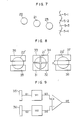
- the photodetector 30 is composed of eight sections. The beams reflected from the spots 2l, 22 and 23 are received by the photodetector as at 2l ⁇ , 22 ⁇ and 23 ⁇ , respectively.
- the spot 2l is restricted by the crest or valley of the V-shaped track groove, and the focus control and tracking control by the respective photodetector units 3l to 34 are effected by making use of the reflected beam 2l ⁇ . More specifically, the focus control is effected in accordance with a signal which is obtained by subtracting the sum of output of the photodetector units 32 and 33 from the sum of the outputs from the photodetector units 3l and 34, while the tracking control is effected in accordance with a signal which is obtained by subtracting the sum of the outputs of the photodetector units 33 and 34 from the sum of the outputs of the photodetector units 3l and 32.
- the spots 22 and 23 are aimed on the centers of the adjacent slant surfaces of the V-shaped track groove, and the beams reflected therefrom include the signals to be reproduced.
- the signals are to be reproduced from the slant surface 5-2.
- the signal Sl from the photodetector 35 has a small crosstalk
- the signal S2 from the photodetector unit 36 has a large crosstalk component although the light quantity of this signal S2 is small.
- the reproduction system includes the following additional function. Namely, means are provided as shown in Fig. 9 for subtracting a signal S4 obtained by amplifying the signal S2 by an amplification factor M2 from a signal S3 obtained by amplifying the signal Sl by a multiplication factor M1.
- amplification factors M1 and M2 it is possible to obtain a signal S5 having a very small crosstalk component.
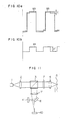
- Examples of such signal S3, S4 and S5 are shown in Figs. l0a and l0b.
- the crosstalk component C of the signal S3 may be increased to an unacceptable level if the designs of the photodetector units and the positions of the photodetector units are not set accurately.
- the crosstalk component C ⁇ of the signal S4 is subtracted from the crosstalk component C of the signal S3, so that the resultant signal S5 has a very small crosstalk component. It is thus possible to obtain the signal S5 which has so small crosstalk component that it can be satisfactorily used as the reproduced signal, even though the signal S3 itself has a large crosstalk component.
- the requirement of strictness for the design of the photodetector, e.g., the distance d shown in Fig. 3, and the positions of the photodetector units can be reduced advantageously.
- the crosstalk component of the signal S5 can be reduced to a satisfactorily low level by setting the amplification factors M1 and M2 to be l00 and 30, respectively. It will be clear to those skilled in the art that the same advantage can be obtained also when the signals are reproduced from the slant surface 5-3, by subtracting a signal obtained by amplifying the output of the photodetector unit 38 from a signal obtained by amplifying the output of the photodetector unit 37.
- Fig. ll shows an optical system which is incorporated in a second embodiment of the present invention.
- This optical system is designed for independently and simultaneously reproducing signals from both slant surfaces of a common V-shaped track groove, by applying the laser beam spot to the valley or bottom of the V-shaped track groove.
- the same reference numerals are used to denote the same parts or members as those used in the optical systems shown in Figs. l and 6.
- the shape of the V-shaped track groove, NA of the objective lens and the wavelength of the laser beam are the same as those used in the first embodiment.
- a lens l7 and a mirror l8 are used in combination so as to effect a focus control by a method generally referred to as "knife edge method", by making use of a split-type photodetector 40.
- the tracking control is conducted by a method generally referred to as “far-sight image push-pull method”, by making use of a photodetector 4l. Both these methods are well known and, hence, are not detailed in this specification.
- the tracking control is conducted to allow the laser beam spot to follow the bottom of the V-shaped track groove as shown in Fig. l2.
- Fig. l3 shows the detail of the photodetector 4l together with the reflected beam l9.
- the photodetector 4l is split into two units: namely, a unit 4l-l and 4l-2.
- the beam received by each photodetector unit is mainly constituted by signals derived from each slant surface.
- the beam also carries a large crosstalk component so that it cannot be used as the reproduced signal.
- the crosstalk component is on the order of -l0 to -l5 dB.
- the second embodiment of the invention therefore, proposes a signal processing method which will be explained hereinunder with reference to Fig. l4. Signals output from the photodetector units 4l-l and 4l-2 are denoted by Sll and Sl2, respectively.
- the signals Sll and Sl2 are amplified by amplification factor M4 so as to become signals Sl3 and Sl4.
- the amplification factor M4 is about l0 or so.
- the signals Sl3 and Sl4 are further amplified by an amplification factor M3 ⁇ so as to become signals Sl5 and Sl6.
- the product of the factors M4 and M3 ⁇ is represented by M3.
- signals Sl7 and Sl8 are obtained in accordance with the following formulae, and are used as the reproduced signals.
- Sl7 Sl5 - Sl4
- Sl8 Sl6 - Sl3
- each reproduction signal is obtained by subtracting, from a signal obtained by amplifying one of the outputs of the photodetector units 4l-l and 4l-2 by an amplification factor M3, a signal obtained by multiplying the output from the other photodetector units by a multiplication factor M4.
- Figs. l5a and l5b show the spectrums of the signals Sl5 and Sl6 obtained in an experiment which was conducted by making use of the photodetector of the type shown in Fig. l3.
- Crosstalk components represented by x and y are on the order of l0 to l5 dB. Therefore, the crosstalk components in the reproduced signals Sl7 and Sl8 can be reduced sufficiently if these signals are formed by using the amplification factor M3 ⁇ ranging between 3 and 4. It is true that the signal component to be reproduced also is reduced as a result of the subtracting operation. However, the amount of reduction of the signal component is about l dB or so which is negligibly small.
- the signals with small crosstalk component are concentrated to the peripheral region of the reflected beam.
- the photodetector shown in Fig. l6 is designed and situated to receive mainly the peripheral region of the beam.
- the crosstalk components x and y see Figs.
- the crosstalk components of the reproduced signals Sl7 and Sl8 can be reduced satisfactorily if the amplification factor M3 ⁇ is selected to be about l0. According to the second embodiment, therefore, it is possible to independently and simultaneously reproduce signals from both slant surfaces of a V-shaped track groove by means of a single laser beam spot.
- the present invention offers the following advantages.
- the photodetector for receiving the reflected beam is split into two parts: namely, first and second photodetector units.
- the reproduced signal is obtained by subtracting, from a signal obtained by amplifying the output of the first photodetector unit, a signal obtained by amplifying the output of the second photodetector unit, so that the crosstalk component in the reproduced signal is reduced remarkably. This in turn reduces the strictness of requirement for accuracy in the design and installation of the photodetector.
- the method of the invention makes it possible to independently and simultaneously reproduce signals from both slant surfaces of a V-shaped track groove by means of a single laser beam spot.
Landscapes
- Optical Recording Or Reproduction (AREA)
- Optical Head (AREA)
Applications Claiming Priority (2)
| Application Number | Priority Date | Filing Date | Title |
|---|---|---|---|
| JP115256/86 | 1986-05-20 | ||
| JP61115256A JPS62271237A (ja) | 1986-05-20 | 1986-05-20 | 光学的再生方法 |
Publications (3)
| Publication Number | Publication Date |
|---|---|
| EP0246597A2 true EP0246597A2 (de) | 1987-11-25 |
| EP0246597A3 EP0246597A3 (en) | 1989-05-31 |
| EP0246597B1 EP0246597B1 (de) | 1993-04-14 |
Family
ID=14658177
Family Applications (1)
| Application Number | Title | Priority Date | Filing Date |
|---|---|---|---|
| EP87107210A Expired - Lifetime EP0246597B1 (de) | 1986-05-20 | 1987-05-18 | Verfahren zur Wiedergabe von Signalen von optischen Platten |
Country Status (5)
| Country | Link |
|---|---|
| US (1) | US4932015A (de) |
| EP (1) | EP0246597B1 (de) |
| JP (1) | JPS62271237A (de) |
| KR (1) | KR910000213B1 (de) |
| DE (1) | DE3785387T2 (de) |
Cited By (1)
| Publication number | Priority date | Publication date | Assignee | Title |
|---|---|---|---|---|
| EP0468468A3 (en) * | 1990-07-24 | 1992-12-09 | Matsushita Electric Industrial Co., Ltd. | Optical disk reproducing method and optical disk reproducing apparatus |
Families Citing this family (6)
| Publication number | Priority date | Publication date | Assignee | Title |
|---|---|---|---|---|
| JP2696938B2 (ja) * | 1988-06-20 | 1998-01-14 | ソニー株式会社 | 光ディスク及び光ディスク再生装置 |
| JPH02161628A (ja) * | 1988-12-14 | 1990-06-21 | Hitachi Ltd | 光学ヘッド,情報記録媒体および光学的情報処理装置 |
| JP2697209B2 (ja) * | 1989-12-14 | 1998-01-14 | 松下電器産業株式会社 | 光ディスクの信号記録方法および光ディスク再生装置 |
| US5530641A (en) * | 1991-05-17 | 1996-06-25 | Olympus Optical Co., Ltd. | Optical recording medium having grooves and lands and/or plural pit lines, and reproducing apparatus therefor |
| JPH11144250A (ja) * | 1997-11-06 | 1999-05-28 | Pioneer Electron Corp | 情報データの記録再生方法 |
| KR100312104B1 (ko) * | 1997-11-28 | 2002-04-06 | 윤종용 | 밸런스게인튜닝장치 |
Family Cites Families (4)
| Publication number | Priority date | Publication date | Assignee | Title |
|---|---|---|---|---|
| NL7907180A (nl) * | 1979-09-27 | 1981-03-31 | Philips Nv | Registratiedrager waarin informatie is aangebracht in een optisch uitleesbare informatiestruktuur, alsmede inrichting voor het uitlezen daarvan. |
| JPS57105828A (en) * | 1980-12-19 | 1982-07-01 | Matsushita Electric Ind Co Ltd | Optical disk recording and reproducing system |
| JPS58125242A (ja) * | 1982-01-22 | 1983-07-26 | Victor Co Of Japan Ltd | 光学的情報信号再生装置のトラツキング誤差検出方式 |
| US4674070A (en) * | 1984-08-11 | 1987-06-16 | Victor Company Of Japan, Ltd. | Optical type disc with V-shaped groove and optical type reproducing apparatus therefor |
-
1986
- 1986-05-20 JP JP61115256A patent/JPS62271237A/ja active Granted
-
1987
- 1987-05-18 DE DE87107210T patent/DE3785387T2/de not_active Expired - Fee Related
- 1987-05-18 US US07/050,427 patent/US4932015A/en not_active Expired - Fee Related
- 1987-05-18 EP EP87107210A patent/EP0246597B1/de not_active Expired - Lifetime
- 1987-05-20 KR KR1019870004989A patent/KR910000213B1/ko not_active Expired
Cited By (2)
| Publication number | Priority date | Publication date | Assignee | Title |
|---|---|---|---|---|
| EP0468468A3 (en) * | 1990-07-24 | 1992-12-09 | Matsushita Electric Industrial Co., Ltd. | Optical disk reproducing method and optical disk reproducing apparatus |
| US5268886A (en) * | 1990-07-24 | 1993-12-07 | Matsushita Electric Industrial Co., Ltd. | Method and apparatus for reproducing signals using an optical disk having V-shaped grooves |
Also Published As
| Publication number | Publication date |
|---|---|
| EP0246597B1 (de) | 1993-04-14 |
| DE3785387T2 (de) | 1993-11-11 |
| EP0246597A3 (en) | 1989-05-31 |
| JPH0512775B2 (de) | 1993-02-18 |
| US4932015A (en) | 1990-06-05 |
| KR910000213B1 (ko) | 1991-01-23 |
| JPS62271237A (ja) | 1987-11-25 |
| DE3785387D1 (de) | 1993-05-19 |
| KR870011587A (ko) | 1987-12-24 |
Similar Documents
| Publication | Publication Date | Title |
|---|---|---|
| EP0216341B1 (de) | Spurnachlaufverfahren für eine optische Speicherplatte | |
| US4959822A (en) | Record-carrier body provided with a relief structure of optically detectable servo-track portions and sector addresses and apparatus for forming said structure | |
| US5084860A (en) | Apparatus for optical disc memory with correction pattern and master disc cutting apparatus | |
| US5553051A (en) | Increased intensity optical recording medium with adjacent grooves of different optical depth and a method and apparatus for reproducing the same | |
| US5428595A (en) | Optical information recording and reproducing device | |
| US6738324B2 (en) | Recording and/or reproduction apparatus | |
| EP0704841A1 (de) | Optisches Informationsaufzeichnungs-/-wiedergabegerät | |
| JPH0481816B2 (de) | ||
| JPH05197968A (ja) | 光ディスク及び光ディスク再生装置 | |
| US4932015A (en) | Method of reproducing signals from optical disk | |
| EP0573021B1 (de) | Wiedergabesystem für eine optische Platte | |
| EP0468468B1 (de) | Verfahren zur Wiedergabe für optische Platten und Wiedergabegerät für optische Platten | |
| EP0324949B1 (de) | Spurnachlaufverfahren für optische Speicherplatte | |
| EP0523334B1 (de) | Optisches Informationsaufzeichnungsmedium und Gerät zur Wiedergabe von Information aus dem Medium | |
| US6426933B1 (en) | Optical pickup apparatus having polarizing phase plates | |
| JPS6260731B2 (de) | ||
| EP0762402B1 (de) | Optischer Wiedergabekopf mit verbesserter Wiedergabe von Medien mit Pits unterschiedlicher Tiefen | |
| JPH0887760A (ja) | 情報記録再生装置 | |
| JP2561253B2 (ja) | トラツク誤差検出装置 | |
| JPH09245356A (ja) | 光学ヘッドおよび光記録装置 | |
| JP2865087B2 (ja) | ランドグルーブ位置検出方式及び方法 | |
| US5612937A (en) | Optical pickup apparatus having a bisected optical receiving element for tracking control | |
| EP0555037B1 (de) | Vorrichtung zur Aufzeichnung/Wiedergabe magnetooptischer Information | |
| JPS62239333A (ja) | トラツキング信号検出方法 | |
| JPH06119647A (ja) | 光スポットのエラー検出方法 |
Legal Events
| Date | Code | Title | Description |
|---|---|---|---|
| PUAI | Public reference made under article 153(3) epc to a published international application that has entered the european phase |
Free format text: ORIGINAL CODE: 0009012 |
|
| AK | Designated contracting states |
Kind code of ref document: A2 Designated state(s): DE FR GB |
|
| PUAL | Search report despatched |
Free format text: ORIGINAL CODE: 0009013 |
|
| AK | Designated contracting states |
Kind code of ref document: A3 Designated state(s): DE FR GB |
|
| RAP1 | Party data changed (applicant data changed or rights of an application transferred) |
Owner name: MATSUSHITA ELECTRIC INDUSTRIAL CO., LTD. |
|
| 17P | Request for examination filed |
Effective date: 19890703 |
|
| 17Q | First examination report despatched |
Effective date: 19910125 |
|
| GRAA | (expected) grant |
Free format text: ORIGINAL CODE: 0009210 |
|
| AK | Designated contracting states |
Kind code of ref document: B1 Designated state(s): DE FR GB |
|
| REF | Corresponds to: |
Ref document number: 3785387 Country of ref document: DE Date of ref document: 19930519 |
|
| ET | Fr: translation filed | ||
| PLBE | No opposition filed within time limit |
Free format text: ORIGINAL CODE: 0009261 |
|
| STAA | Information on the status of an ep patent application or granted ep patent |
Free format text: STATUS: NO OPPOSITION FILED WITHIN TIME LIMIT |
|
| 26N | No opposition filed | ||
| PGFP | Annual fee paid to national office [announced via postgrant information from national office to epo] |
Ref country code: GB Payment date: 19940511 Year of fee payment: 8 Ref country code: FR Payment date: 19940511 Year of fee payment: 8 Ref country code: DE Payment date: 19940511 Year of fee payment: 8 |
|
| PG25 | Lapsed in a contracting state [announced via postgrant information from national office to epo] |
Ref country code: GB Effective date: 19950518 |
|
| GBPC | Gb: european patent ceased through non-payment of renewal fee |
Effective date: 19950518 |
|
| PG25 | Lapsed in a contracting state [announced via postgrant information from national office to epo] |
Ref country code: DE Effective date: 19960201 |
|
| PG25 | Lapsed in a contracting state [announced via postgrant information from national office to epo] |
Ref country code: FR Effective date: 19960229 |
|
| REG | Reference to a national code |
Ref country code: FR Ref legal event code: ST |
|
| REG | Reference to a national code |
Ref country code: FR Ref legal event code: ST |