EP0246580B1 - Procédé pour la préparation de chlorures de 3-méthyl-1-vinyl-imidazolium et leur utilisation pour la préparation de polymérisats - Google Patents
Procédé pour la préparation de chlorures de 3-méthyl-1-vinyl-imidazolium et leur utilisation pour la préparation de polymérisats Download PDFInfo
- Publication number
- EP0246580B1 EP0246580B1 EP87107116A EP87107116A EP0246580B1 EP 0246580 B1 EP0246580 B1 EP 0246580B1 EP 87107116 A EP87107116 A EP 87107116A EP 87107116 A EP87107116 A EP 87107116A EP 0246580 B1 EP0246580 B1 EP 0246580B1
- Authority
- EP
- European Patent Office
- Prior art keywords
- feed
- methyl
- water
- solution
- formula
- Prior art date
- Legal status (The legal status is an assumption and is not a legal conclusion. Google has not performed a legal analysis and makes no representation as to the accuracy of the status listed.)
- Expired - Lifetime
Links
- UHKIGXVNMXYBOP-UHFFFAOYSA-M 1-ethenyl-3-methylimidazol-3-ium;chloride Chemical class [Cl-].C[N+]=1C=CN(C=C)C=1 UHKIGXVNMXYBOP-UHFFFAOYSA-M 0.000 title claims abstract description 12
- 238000002360 preparation method Methods 0.000 title claims abstract description 11
- 238000000034 method Methods 0.000 title claims description 11
- 238000004519 manufacturing process Methods 0.000 title description 6
- NEHMKBQYUWJMIP-UHFFFAOYSA-N chloromethane Chemical compound ClC NEHMKBQYUWJMIP-UHFFFAOYSA-N 0.000 claims abstract description 44
- OSSNTDFYBPYIEC-UHFFFAOYSA-N 1-ethenylimidazole Chemical class C=CN1C=CN=C1 OSSNTDFYBPYIEC-UHFFFAOYSA-N 0.000 claims abstract description 19
- 229940050176 methyl chloride Drugs 0.000 claims abstract description 16
- 239000007864 aqueous solution Substances 0.000 claims abstract description 10
- 229920001577 copolymer Polymers 0.000 claims abstract description 6
- 239000000243 solution Substances 0.000 claims description 48
- XLYOFNOQVPJJNP-UHFFFAOYSA-N water Substances O XLYOFNOQVPJJNP-UHFFFAOYSA-N 0.000 claims description 47
- LFQSCWFLJHTTHZ-UHFFFAOYSA-N Ethanol Chemical compound CCO LFQSCWFLJHTTHZ-UHFFFAOYSA-N 0.000 claims description 10
- 239000002904 solvent Substances 0.000 claims description 7
- 229910052740 iodine Inorganic materials 0.000 claims description 6
- 125000004432 carbon atom Chemical group C* 0.000 claims description 5
- 125000002496 methyl group Chemical group [H]C([H])([H])* 0.000 claims description 5
- 150000001875 compounds Chemical class 0.000 claims description 3
- 229910052739 hydrogen Inorganic materials 0.000 claims 2
- 239000001257 hydrogen Substances 0.000 claims 2
- UFHFLCQGNIYNRP-UHFFFAOYSA-N Hydrogen Chemical compound [H][H] UFHFLCQGNIYNRP-UHFFFAOYSA-N 0.000 claims 1
- 230000001476 alcoholic effect Effects 0.000 claims 1
- 125000004435 hydrogen atom Chemical group [H]* 0.000 claims 1
- 238000010526 radical polymerization reaction Methods 0.000 claims 1
- 229920000642 polymer Polymers 0.000 description 29
- 239000000203 mixture Substances 0.000 description 23
- 239000000178 monomer Substances 0.000 description 23
- KFZMGEQAYNKOFK-UHFFFAOYSA-N Isopropanol Chemical compound CC(C)O KFZMGEQAYNKOFK-UHFFFAOYSA-N 0.000 description 18
- 238000010992 reflux Methods 0.000 description 13
- 239000011521 glass Substances 0.000 description 12
- 238000006243 chemical reaction Methods 0.000 description 11
- WHNWPMSKXPGLAX-UHFFFAOYSA-N N-Vinyl-2-pyrrolidone Chemical compound C=CN1CCCC1=O WHNWPMSKXPGLAX-UHFFFAOYSA-N 0.000 description 10
- 238000010438 heat treatment Methods 0.000 description 10
- 238000005956 quaternization reaction Methods 0.000 description 9
- DGVVWUTYPXICAM-UHFFFAOYSA-N β‐Mercaptoethanol Chemical compound OCCS DGVVWUTYPXICAM-UHFFFAOYSA-N 0.000 description 8
- QMYCJCOPYOPWTI-UHFFFAOYSA-N 2-[(1-amino-1-imino-2-methylpropan-2-yl)diazenyl]-2-methylpropanimidamide;hydron;chloride Chemical compound Cl.NC(=N)C(C)(C)N=NC(C)(C)C(N)=N QMYCJCOPYOPWTI-UHFFFAOYSA-N 0.000 description 6
- OKKJLVBELUTLKV-UHFFFAOYSA-N Methanol Chemical compound OC OKKJLVBELUTLKV-UHFFFAOYSA-N 0.000 description 6
- RAXXELZNTBOGNW-UHFFFAOYSA-N imidazole Natural products C1=CNC=N1 RAXXELZNTBOGNW-UHFFFAOYSA-N 0.000 description 6
- 239000003999 initiator Substances 0.000 description 6
- 238000006116 polymerization reaction Methods 0.000 description 6
- 239000007787 solid Substances 0.000 description 6
- 238000003756 stirring Methods 0.000 description 6
- ZCYVEMRRCGMTRW-UHFFFAOYSA-N 7553-56-2 Chemical compound [I] ZCYVEMRRCGMTRW-UHFFFAOYSA-N 0.000 description 5
- NLXLAEXVIDQMFP-UHFFFAOYSA-N Ammonium chloride Substances [NH4+].[Cl-] NLXLAEXVIDQMFP-UHFFFAOYSA-N 0.000 description 5
- VHUUQVKOLVNVRT-UHFFFAOYSA-N Ammonium hydroxide Chemical compound [NH4+].[OH-] VHUUQVKOLVNVRT-UHFFFAOYSA-N 0.000 description 5
- 235000011114 ammonium hydroxide Nutrition 0.000 description 5
- 238000005984 hydrogenation reaction Methods 0.000 description 5
- 239000011630 iodine Substances 0.000 description 5
- BDHGFCVQWMDIQX-UHFFFAOYSA-N 1-ethenyl-2-methylimidazole Chemical compound CC1=NC=CN1C=C BDHGFCVQWMDIQX-UHFFFAOYSA-N 0.000 description 4
- MHAJPDPJQMAIIY-UHFFFAOYSA-N Hydrogen peroxide Chemical compound OO MHAJPDPJQMAIIY-UHFFFAOYSA-N 0.000 description 4
- -1 hydroxyalkyl acrylates Chemical class 0.000 description 4
- INQOMBQAUSQDDS-UHFFFAOYSA-N iodomethane Chemical compound IC INQOMBQAUSQDDS-UHFFFAOYSA-N 0.000 description 4
- WEVYAHXRMPXWCK-UHFFFAOYSA-N Acetonitrile Chemical compound CC#N WEVYAHXRMPXWCK-UHFFFAOYSA-N 0.000 description 3
- XEKOWRVHYACXOJ-UHFFFAOYSA-N Ethyl acetate Chemical compound CCOC(C)=O XEKOWRVHYACXOJ-UHFFFAOYSA-N 0.000 description 3
- HEMHJVSKTPXQMS-UHFFFAOYSA-M Sodium hydroxide Chemical compound [OH-].[Na+] HEMHJVSKTPXQMS-UHFFFAOYSA-M 0.000 description 3
- 150000001298 alcohols Chemical class 0.000 description 3
- 239000003153 chemical reaction reagent Substances 0.000 description 3
- 229920001519 homopolymer Polymers 0.000 description 3
- OPQYOFWUFGEMRZ-UHFFFAOYSA-N tert-butyl 2,2-dimethylpropaneperoxoate Chemical compound CC(C)(C)OOC(=O)C(C)(C)C OPQYOFWUFGEMRZ-UHFFFAOYSA-N 0.000 description 3
- UWNNZXDNLPNGQJ-UHFFFAOYSA-N tert-butyl 2-ethylhexanoate Chemical compound CCCCC(CC)C(=O)OC(C)(C)C UWNNZXDNLPNGQJ-UHFFFAOYSA-N 0.000 description 3
- RHBSVLZWJMBUBQ-UHFFFAOYSA-N 1-ethenyl-1h-imidazol-1-ium;chloride Chemical class [Cl-].C=C[N+]=1C=CNC=1 RHBSVLZWJMBUBQ-UHFFFAOYSA-N 0.000 description 2
- OMIGHNLMNHATMP-UHFFFAOYSA-N 2-hydroxyethyl prop-2-enoate Chemical compound OCCOC(=O)C=C OMIGHNLMNHATMP-UHFFFAOYSA-N 0.000 description 2
- PMNLUUOXGOOLSP-UHFFFAOYSA-N 2-mercaptopropanoic acid Chemical compound CC(S)C(O)=O PMNLUUOXGOOLSP-UHFFFAOYSA-N 0.000 description 2
- QZPSOSOOLFHYRR-UHFFFAOYSA-N 3-hydroxypropyl prop-2-enoate Chemical compound OCCCOC(=O)C=C QZPSOSOOLFHYRR-UHFFFAOYSA-N 0.000 description 2
- NIXOWILDQLNWCW-UHFFFAOYSA-M Acrylate Chemical compound [O-]C(=O)C=C NIXOWILDQLNWCW-UHFFFAOYSA-M 0.000 description 2
- WOBHKFSMXKNTIM-UHFFFAOYSA-N Hydroxyethyl methacrylate Chemical compound CC(=C)C(=O)OCCO WOBHKFSMXKNTIM-UHFFFAOYSA-N 0.000 description 2
- PPBRXRYQALVLMV-UHFFFAOYSA-N Styrene Chemical compound C=CC1=CC=CC=C1 PPBRXRYQALVLMV-UHFFFAOYSA-N 0.000 description 2
- 150000001347 alkyl bromides Chemical class 0.000 description 2
- 150000001348 alkyl chlorides Chemical class 0.000 description 2
- 150000001350 alkyl halides Chemical class 0.000 description 2
- 150000001351 alkyl iodides Chemical class 0.000 description 2
- 238000009835 boiling Methods 0.000 description 2
- WQAQPCDUOCURKW-UHFFFAOYSA-N butanethiol Chemical compound CCCCS WQAQPCDUOCURKW-UHFFFAOYSA-N 0.000 description 2
- VAYGXNSJCAHWJZ-UHFFFAOYSA-N dimethyl sulfate Chemical compound COS(=O)(=O)OC VAYGXNSJCAHWJZ-UHFFFAOYSA-N 0.000 description 2
- 230000000694 effects Effects 0.000 description 2
- DNJIEGIFACGWOD-UHFFFAOYSA-N ethyl mercaptane Natural products CCS DNJIEGIFACGWOD-UHFFFAOYSA-N 0.000 description 2
- BDAGIHXWWSANSR-UHFFFAOYSA-N methanoic acid Natural products OC=O BDAGIHXWWSANSR-UHFFFAOYSA-N 0.000 description 2
- BDERNNFJNOPAEC-UHFFFAOYSA-N propan-1-ol Chemical compound CCCO BDERNNFJNOPAEC-UHFFFAOYSA-N 0.000 description 2
- 150000003254 radicals Chemical class 0.000 description 2
- 150000003839 salts Chemical class 0.000 description 2
- VZGDMQKNWNREIO-UHFFFAOYSA-N tetrachloromethane Chemical compound ClC(Cl)(Cl)Cl VZGDMQKNWNREIO-UHFFFAOYSA-N 0.000 description 2
- CWERGRDVMFNCDR-UHFFFAOYSA-N thioglycolic acid Chemical compound OC(=O)CS CWERGRDVMFNCDR-UHFFFAOYSA-N 0.000 description 2
- DNIAPMSPPWPWGF-GSVOUGTGSA-N (R)-(-)-Propylene glycol Chemical compound C[C@@H](O)CO DNIAPMSPPWPWGF-GSVOUGTGSA-N 0.000 description 1
- AONKGGMHQHWMSM-UHFFFAOYSA-N 1,1,1-tribromopropane Chemical compound CCC(Br)(Br)Br AONKGGMHQHWMSM-UHFFFAOYSA-N 0.000 description 1
- VXNZUUAINFGPBY-UHFFFAOYSA-N 1-Butene Chemical compound CCC=C VXNZUUAINFGPBY-UHFFFAOYSA-N 0.000 description 1
- BKFRZOZNMWIFLH-UHFFFAOYSA-N 1-decyl-2-methylimidazole Chemical compound CCCCCCCCCCN1C=CN=C1C BKFRZOZNMWIFLH-UHFFFAOYSA-N 0.000 description 1
- WLWHLUQQCLCFNE-UHFFFAOYSA-N 1-ethenyl-3-methyl-2h-imidazole Chemical compound CN1CN(C=C)C=C1 WLWHLUQQCLCFNE-UHFFFAOYSA-N 0.000 description 1
- JWYVGKFDLWWQJX-UHFFFAOYSA-N 1-ethenylazepan-2-one Chemical compound C=CN1CCCCCC1=O JWYVGKFDLWWQJX-UHFFFAOYSA-N 0.000 description 1
- JDIIGWSSTNUWGK-UHFFFAOYSA-N 1h-imidazol-3-ium;chloride Chemical class [Cl-].[NH2+]1C=CN=C1 JDIIGWSSTNUWGK-UHFFFAOYSA-N 0.000 description 1
- SMZOUWXMTYCWNB-UHFFFAOYSA-N 2-(2-methoxy-5-methylphenyl)ethanamine Chemical compound COC1=CC=C(C)C=C1CCN SMZOUWXMTYCWNB-UHFFFAOYSA-N 0.000 description 1
- WYGWHHGCAGTUCH-UHFFFAOYSA-N 2-[(2-cyano-4-methylpentan-2-yl)diazenyl]-2,4-dimethylpentanenitrile Chemical compound CC(C)CC(C)(C#N)N=NC(C)(C#N)CC(C)C WYGWHHGCAGTUCH-UHFFFAOYSA-N 0.000 description 1
- CKSURTJJJBWBOU-UHFFFAOYSA-N 3-[(3-amino-3-imino-2-methylpropyl)diazenyl]-2-methylpropanimidamide;hydrochloride Chemical compound Cl.NC(=N)C(C)CN=NCC(C)C(N)=N CKSURTJJJBWBOU-UHFFFAOYSA-N 0.000 description 1
- VFXXTYGQYWRHJP-UHFFFAOYSA-N 4,4'-azobis(4-cyanopentanoic acid) Chemical compound OC(=O)CCC(C)(C#N)N=NC(C)(CCC(O)=O)C#N VFXXTYGQYWRHJP-UHFFFAOYSA-N 0.000 description 1
- OSWFIVFLDKOXQC-UHFFFAOYSA-N 4-(3-methoxyphenyl)aniline Chemical compound COC1=CC=CC(C=2C=CC(N)=CC=2)=C1 OSWFIVFLDKOXQC-UHFFFAOYSA-N 0.000 description 1
- HMHYBQHINBJJGL-UHFFFAOYSA-N 4-[(4-carboxy-4-cyanobutan-2-yl)diazenyl]-2-cyanopentanoic acid Chemical compound N#CC(C(O)=O)CC(C)N=NC(C)CC(C#N)C(O)=O HMHYBQHINBJJGL-UHFFFAOYSA-N 0.000 description 1
- HRPVXLWXLXDGHG-UHFFFAOYSA-N Acrylamide Chemical compound NC(=O)C=C HRPVXLWXLXDGHG-UHFFFAOYSA-N 0.000 description 1
- OMPJBNCRMGITSC-UHFFFAOYSA-N Benzoylperoxide Chemical compound C=1C=CC=CC=1C(=O)OOC(=O)C1=CC=CC=C1 OMPJBNCRMGITSC-UHFFFAOYSA-N 0.000 description 1
- GAWIXWVDTYZWAW-UHFFFAOYSA-N C[CH]O Chemical group C[CH]O GAWIXWVDTYZWAW-UHFFFAOYSA-N 0.000 description 1
- IAYPIBMASNFSPL-UHFFFAOYSA-N Ethylene oxide Chemical group C1CO1 IAYPIBMASNFSPL-UHFFFAOYSA-N 0.000 description 1
- YIVJZNGAASQVEM-UHFFFAOYSA-N Lauroyl peroxide Chemical compound CCCCCCCCCCCC(=O)OOC(=O)CCCCCCCCCCC YIVJZNGAASQVEM-UHFFFAOYSA-N 0.000 description 1
- CNCOEDDPFOAUMB-UHFFFAOYSA-N N-Methylolacrylamide Chemical compound OCNC(=O)C=C CNCOEDDPFOAUMB-UHFFFAOYSA-N 0.000 description 1
- 239000002202 Polyethylene glycol Substances 0.000 description 1
- XTXRWKRVRITETP-UHFFFAOYSA-N Vinyl acetate Chemical compound CC(=O)OC=C XTXRWKRVRITETP-UHFFFAOYSA-N 0.000 description 1
- 150000001252 acrylic acid derivatives Chemical class 0.000 description 1
- 125000000217 alkyl group Chemical group 0.000 description 1
- 230000002152 alkylating effect Effects 0.000 description 1
- 230000029936 alkylation Effects 0.000 description 1
- 238000005804 alkylation reaction Methods 0.000 description 1
- 125000000751 azo group Chemical group [*]N=N[*] 0.000 description 1
- 235000019400 benzoyl peroxide Nutrition 0.000 description 1
- IAQRGUVFOMOMEM-UHFFFAOYSA-N butene Natural products CC=CC IAQRGUVFOMOMEM-UHFFFAOYSA-N 0.000 description 1
- 150000001732 carboxylic acid derivatives Chemical group 0.000 description 1
- 229920006317 cationic polymer Polymers 0.000 description 1
- 239000003795 chemical substances by application Substances 0.000 description 1
- NEHMKBQYUWJMIP-NJFSPNSNSA-N chloro(114C)methane Chemical compound [14CH3]Cl NEHMKBQYUWJMIP-NJFSPNSNSA-N 0.000 description 1
- 230000003750 conditioning effect Effects 0.000 description 1
- 238000001816 cooling Methods 0.000 description 1
- 230000007423 decrease Effects 0.000 description 1
- 230000006735 deficit Effects 0.000 description 1
- WNAHIZMDSQCWRP-UHFFFAOYSA-N dodecane-1-thiol Chemical compound CCCCCCCCCCCCS WNAHIZMDSQCWRP-UHFFFAOYSA-N 0.000 description 1
- UYMKPFRHYYNDTL-UHFFFAOYSA-N ethenamine Chemical class NC=C UYMKPFRHYYNDTL-UHFFFAOYSA-N 0.000 description 1
- UIWXSTHGICQLQT-UHFFFAOYSA-N ethenyl propanoate Chemical compound CCC(=O)OC=C UIWXSTHGICQLQT-UHFFFAOYSA-N 0.000 description 1
- 239000008394 flocculating agent Substances 0.000 description 1
- 235000019253 formic acid Nutrition 0.000 description 1
- 229910052736 halogen Inorganic materials 0.000 description 1
- 150000002366 halogen compounds Chemical class 0.000 description 1
- 150000002367 halogens Chemical group 0.000 description 1
- 230000017525 heat dissipation Effects 0.000 description 1
- 239000012456 homogeneous solution Substances 0.000 description 1
- 229910001869 inorganic persulfate Inorganic materials 0.000 description 1
- 238000002955 isolation Methods 0.000 description 1
- 238000005259 measurement Methods 0.000 description 1
- FQPSGWSUVKBHSU-UHFFFAOYSA-N methacrylamide Chemical compound CC(=C)C(N)=O FQPSGWSUVKBHSU-UHFFFAOYSA-N 0.000 description 1
- 230000001035 methylating effect Effects 0.000 description 1
- 230000011987 methylation Effects 0.000 description 1
- 238000007069 methylation reaction Methods 0.000 description 1
- DNTMQTKDNSEIFO-UHFFFAOYSA-N n-(hydroxymethyl)-2-methylprop-2-enamide Chemical compound CC(=C)C(=O)NCO DNTMQTKDNSEIFO-UHFFFAOYSA-N 0.000 description 1
- PNLUGRYDUHRLOF-UHFFFAOYSA-N n-ethenyl-n-methylacetamide Chemical compound C=CN(C)C(C)=O PNLUGRYDUHRLOF-UHFFFAOYSA-N 0.000 description 1
- RQAKESSLMFZVMC-UHFFFAOYSA-N n-ethenylacetamide Chemical compound CC(=O)NC=C RQAKESSLMFZVMC-UHFFFAOYSA-N 0.000 description 1
- ZQXSMRAEXCEDJD-UHFFFAOYSA-N n-ethenylformamide Chemical compound C=CNC=O ZQXSMRAEXCEDJD-UHFFFAOYSA-N 0.000 description 1
- LYGJENNIWJXYER-UHFFFAOYSA-N nitromethane Chemical compound C[N+]([O-])=O LYGJENNIWJXYER-UHFFFAOYSA-N 0.000 description 1
- 150000002894 organic compounds Chemical class 0.000 description 1
- 150000001451 organic peroxides Chemical class 0.000 description 1
- YWAKXRMUMFPDSH-UHFFFAOYSA-N pentene Chemical compound CCCC=C YWAKXRMUMFPDSH-UHFFFAOYSA-N 0.000 description 1
- 150000002978 peroxides Chemical class 0.000 description 1
- 239000002798 polar solvent Substances 0.000 description 1
- 229920002006 poly(N-vinylimidazole) polymer Polymers 0.000 description 1
- 229920001223 polyethylene glycol Polymers 0.000 description 1
- WFIZEGIEIOHZCP-UHFFFAOYSA-M potassium formate Chemical compound [K+].[O-]C=O WFIZEGIEIOHZCP-UHFFFAOYSA-M 0.000 description 1
- KOUKXHPPRFNWPP-UHFFFAOYSA-N pyrazine-2,5-dicarboxylic acid;hydrate Chemical compound O.OC(=O)C1=CN=C(C(O)=O)C=N1 KOUKXHPPRFNWPP-UHFFFAOYSA-N 0.000 description 1
- 150000003242 quaternary ammonium salts Chemical class 0.000 description 1
- 239000011541 reaction mixture Substances 0.000 description 1
- 229920005989 resin Polymers 0.000 description 1
- 239000011347 resin Substances 0.000 description 1
- 239000007858 starting material Substances 0.000 description 1
- 150000003464 sulfur compounds Chemical class 0.000 description 1
- 230000007704 transition Effects 0.000 description 1
- 229920001567 vinyl ester resin Polymers 0.000 description 1
- 229920003169 water-soluble polymer Polymers 0.000 description 1
- 239000004711 α-olefin Substances 0.000 description 1
Classifications
-
- C—CHEMISTRY; METALLURGY
- C07—ORGANIC CHEMISTRY
- C07D—HETEROCYCLIC COMPOUNDS
- C07D231/00—Heterocyclic compounds containing 1,2-diazole or hydrogenated 1,2-diazole rings
- C07D231/02—Heterocyclic compounds containing 1,2-diazole or hydrogenated 1,2-diazole rings not condensed with other rings
- C07D231/10—Heterocyclic compounds containing 1,2-diazole or hydrogenated 1,2-diazole rings not condensed with other rings having two or three double bonds between ring members or between ring members and non-ring members
- C07D231/12—Heterocyclic compounds containing 1,2-diazole or hydrogenated 1,2-diazole rings not condensed with other rings having two or three double bonds between ring members or between ring members and non-ring members with only hydrogen atoms, hydrocarbon or substituted hydrocarbon radicals, directly attached to ring carbon atoms
-
- C—CHEMISTRY; METALLURGY
- C07—ORGANIC CHEMISTRY
- C07D—HETEROCYCLIC COMPOUNDS
- C07D233/00—Heterocyclic compounds containing 1,3-diazole or hydrogenated 1,3-diazole rings, not condensed with other rings
- C07D233/54—Heterocyclic compounds containing 1,3-diazole or hydrogenated 1,3-diazole rings, not condensed with other rings having two double bonds between ring members or between ring members and non-ring members
- C07D233/56—Heterocyclic compounds containing 1,3-diazole or hydrogenated 1,3-diazole rings, not condensed with other rings having two double bonds between ring members or between ring members and non-ring members with only hydrogen atoms or radicals containing only hydrogen and carbon atoms, attached to ring carbon atoms
-
- C—CHEMISTRY; METALLURGY
- C07—ORGANIC CHEMISTRY
- C07D—HETEROCYCLIC COMPOUNDS
- C07D249/00—Heterocyclic compounds containing five-membered rings having three nitrogen atoms as the only ring hetero atoms
- C07D249/02—Heterocyclic compounds containing five-membered rings having three nitrogen atoms as the only ring hetero atoms not condensed with other rings
- C07D249/08—1,2,4-Triazoles; Hydrogenated 1,2,4-triazoles
-
- C—CHEMISTRY; METALLURGY
- C08—ORGANIC MACROMOLECULAR COMPOUNDS; THEIR PREPARATION OR CHEMICAL WORKING-UP; COMPOSITIONS BASED THEREON
- C08F—MACROMOLECULAR COMPOUNDS OBTAINED BY REACTIONS ONLY INVOLVING CARBON-TO-CARBON UNSATURATED BONDS
- C08F26/00—Homopolymers and copolymers of compounds having one or more unsaturated aliphatic radicals, each having only one carbon-to-carbon double bond, and at least one being terminated by a single or double bond to nitrogen or by a heterocyclic ring containing nitrogen
- C08F26/06—Homopolymers and copolymers of compounds having one or more unsaturated aliphatic radicals, each having only one carbon-to-carbon double bond, and at least one being terminated by a single or double bond to nitrogen or by a heterocyclic ring containing nitrogen by a heterocyclic ring containing nitrogen
Definitions
- the invention relates to the production of 3-methyl-1-vinyl-imidazolium chlorides by quaternization of N-vinylimidazoles in aqueous solution with methyl chloride and their use for the production of water-soluble homo- or copolymers.
- the quaternization can also be carried out at the monomer stage and the quaternary monomer obtained can be used in the polymerization. Examples of this are also known from the literature. For example, JC Salamone and co-workers describe in a series of papers, ACS Polymer Preprints 15 , 462-467 (1974) and 13 , 271-272 (1972), the conversion of N-vinylimidazoles with methyl iodide or dimethyl sulfate to quaternary ammonium salts. They proceed in such a way that they react the monomers, for example N-vinylimidazole, in ethyl acetate as solvent with the alkylating reagent and isolate the salts formed as solids. For the polymerization, the salts are redissolved together with suitable monomers.
- the object of the present invention is to provide an industrial process for the preparation of 3-methyl-1-vinyl-imidazolium chlorides which is as simple as possible by reaction with methyl chloride in aqueous solution.
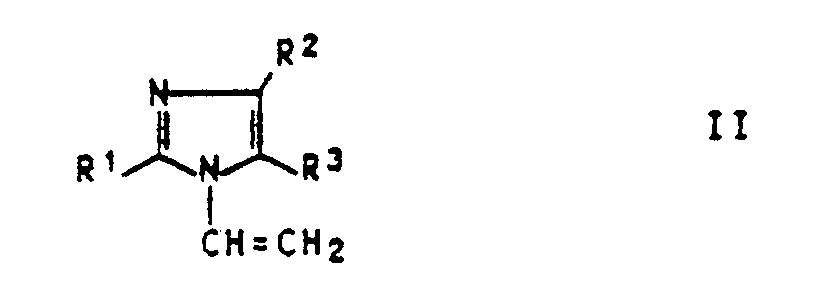
- the invention relates to a process for the preparation of 3-methyl-1-vinyl-imidazolium chlorides of the formula I. in which R1, R2 and R3 are H or methyl, which is characterized in that a 10 to 70% by weight, preferably 25 to 60% by weight, aqueous solution of an N-vinylimidazole of the formula II in which R1, R2 and R3 are H or methyl, at temperatures from 40 to 100 ° C., preferably 50 to 90 ° C., in a closed system with methyl chloride in an amount of 90-110 mol%, preferably 94-100 mol% , implements.
- the preferred starting compounds of formula II are 1-vinylimidazole and 2-methyl-1-vinylimidazole.
- the reaction takes place in a closed apparatus, the methyl chloride being metered into the heated solution of the imidazole of the formula II to be quaternized in such a way that pressures of 15 to 2 bar are established during the reaction at the temperatures indicated.
- methyl chloride is metered in at a corresponding metering rate within the pressure range mentioned.
- work can be carried out at higher pressures and with a correspondingly higher metering of methyl chloride within the pressure range described.
- methyl chloride is 94 to 100 mol% and particularly preferably 94 to 99 mol%. Since the reaction rate decreases noticeably towards the end of the reaction, a more complete conversion of the methyl chloride is generally achieved when a small deficit of methyl chloride is used.
- the aqueous solution used can contain a monohydric aliphatic alcohol with 1-3 C atoms as an additional solvent, advantageously in an amount of 5-30% by weight, based on the water present.
- a monohydric aliphatic alcohol with 1-3 C atoms as an additional solvent, advantageously in an amount of 5-30% by weight, based on the water present.
- methanol, ethanol, n-propanol and in particular isopropanol come into consideration.
- the aqueous solution obtained after the reaction according to the invention can advantageously be used directly for the preparation of correspondingly water-soluble polymers.
- isolation of the 3-methyl-1-vinyl-imidazolium chlorides obtained is therefore not necessary.
- the invention therefore also relates to the use of the solutions obtained according to Claim 1 for the preparation of water-soluble homopolymers or copolymers of 1-vinylimidazolium chlorides of the formula I.
- solutions of the 3-methyl-1-vinyl-imidazolium chlorides obtained are expediently polymerized directly or with other polymerizable monomers using free-radical initiators in a conventional manner in aqueous or aqueous-alcoholic solutions.
- Appropriate comonomers are water-soluble unsaturated monomers, such as, for example, N-vinylimidazoles of the abovementioned formula II, acrylamide and methacrylamide, N-methylolacrylamide and N-methylolmethacrylamide, hydroxyalkyl acrylates and hydroxyalkyl methacrylates having 2 to 4 carbon atoms in the hydroxyalkyl radical, such as hydroxyethyl (meth) acrylate, Hydroxypropyl (meth) acrylate, optionally in the form of their technical mixtures, polyethylene glycol (meth) acrylates with 2 to 50 ethylene oxide units, and in particular N-vinylamides, such as N-vinylpyrrolidone, N-vinylcaprolactam, N-vinylformamide, N-vinylacetamide or N-methyl -N-vinyl acetamide.
- N-vinylimidazoles of the abovementioned formula II acrylamide
- water-insoluble comonomers such as styrene, ⁇ -olefins, such as pentene or butene, acrylic and methacrylic acid alkyl esters having 1 to 18 carbon atoms in the alkyl.
- Carboxylic acid vinyl esters with 2 to 10 carbon atoms in the carboxylic acid residue, such as vinyl acetate or vinyl propionate, are copolymerized with the 3-methyl-1-vinyl-imidazolium chlorides prepared according to the invention. It is advantageous if such an amount of an alcohol has already been added to the quaternization mixture that a homogeneous solution is formed.
- the preparation of homopolymers of 1-vinyl-imidazolium chlorides of the formula I or of water-soluble copolymers of 97 to 10% by weight of a 3-methyl-1-vinyl-imidazolium chloride of the formula I and 3 to 90% by weight of a monomer is very particularly preferred from the group N-vinylpyrrolidone, 2-hydroxyethyl acrylate, 2-hydroxyethyl methacrylate and hydroxypropyl acrylate (technical mixture), based on the total weight of the monomers.
- the polymerizations are expediently carried out in 10 to 50% by weight aqueous or aqueous-alcoholic solutions, preferably aqueous-isopropanol solutions, in the presence of radical-forming initiators in an amount of 0.1 to 2.0, based on the weight of the monomers, and in Temperatures from 40 to 100 ° C.
- Hydrogen peroxide or inorganic persulfates can be used as radical initiators, as can organic compounds of the peroxide or azo type.
- organic peroxides are dicyclohexyl peroxidicarbonate, dibenzoyl peroxide, dilauroyl peroxide, tert-butyl perpivalate, tert-butyl 2-ethylhexanoate and azo compounds 2,2 ⁇ -azobisisobutyrodinitrile, 2,2 ⁇ -azobis (2,4-dimethylvaleronitrile), Azobis (2-amidinopropane) hydrochloride or 4,4'-azobis (4-cyanopentanoic acid).
- a water solubility of the radical generator used is not absolutely necessary.
- Water-insoluble initiators can, for example, in one lower alcohol dissolved or metered in directly without solvent.
- the choice of initiator expediently depends, inter alia, on the polymerization temperatures, which are preferably between 40 and 100.degree.
- the molecular weight of the polymers can be reduced by adding regulators to the reaction mixture.
- Lower alcohols for example, are suitable as regulators. If their use is advantageous, the lower alcohols can expediently be added in the required amount already during the preparation of the imidazolium chlorides.
- other compounds usually used for this purpose such as sulfur compounds, for example 2-mercaptoethanol, butyl mercaptan, dodecyl mercaptan, thioglycolic acid, thioacetic acid, thiolactic acid, halogen compounds, such as carbon tetrachloride, 1,1,1-tribromopropane, or formic acid, can also be used as regulators for the molecular weight their derivatives are used.
- the K value of the polymer obtained which is a measure of the molecular weight, is set by the suitable choice of regulator, initiator, polymerization temperature and monomer concentration.
- the K values of the copolymers obtained are advantageously from 20 to 150 and those of the homopolymers from 15 to 80, the measurements being carried out on a 1% by weight aqueous solution at 25 ° C.
- the polymers obtained can be used in a variety of ways, for example as conductivity resins, as flocculants, as hair conditioning agents, as auxiliaries in oil production and others.
- the hydrogenation iodine number is measured in accordance with DIN specification 53 241 and the K value in each case in a 1% by weight solution in water at 25 ° C. in accordance with Fikentscher.
- a second solution, hereinafter referred to as feed 2 is prepared from 2 g of 2,2′-azobis (2-amidinopropane) hydrochloride and 55 g of water.
- a mixture of 483 g of monomer solution according to Example 3, 15 g of vinyl pyrrolidone and 137 g of water is adjusted to a pH of 7.5 using concentrated ammonia solution (feed 1).
- Feed 2 is prepared from 3 g of 2,2′-azobis (2-amidinopropane) hydrochloride and 75 g of water.
- Feed 1 consists of a mixture of 855 g of a monomer solution according to Example 4, 275 g of water and 40 g of isopropanol.
- Feed 2 is prepared from 4.6 g of tert-butyl 2-ethylhexanoate and 157 g of isopropanol.
- 40 g of water, 120 ml of feed 1 and 20 ml of feed 2 are placed in a 2 l glass vessel which is equipped with a stirrer, heating, reflux condenser and metering devices and heated to reflux until gentle boiling (approx. 83 ° C.).
- the remaining feed 1 is metered in over a period of 6 hours, the remaining feed 2 within 8 hours, and the boiling is then continued for another hour.
- the isopropanol is then expelled by introducing water vapor.
- a clear, viscous polymer solution is obtained.
- the K value of the polymer is 57.8.
- Feed 1 consists of a mixture of 381 g of a monomer solution according to Example 3, 75 g of 2-hydroxyethyl acrylate and 180 g of water.
- Feed 2 is prepared from 3 g of 2,2'-azobis (2-amidinopropane) hydrochloride. 290 g of water, 100 ml of feed 1 and 8 ml of feed 2 are placed in a 2 l glass vessel which is equipped with a stirrer, heating, reflux condenser and metering devices and heated to 65.degree. At this temperature, the remaining feed 1 are metered in within 5 hours and the remaining feed 2 within 7 hours. The mixture is then stirred at this temperature for another hour. A cloudy, viscous polymer solution is obtained. The K value of the polymer is 93.
- Feed 1 consists of a mixture of 203 g of a monomer solution according to Example 3, 280 g of vinyl pyrrolidone, 100 g of water and 1.2 g of 2-mercaptoethanol. A solution of 8 g of hydrogen peroxide (30%, in 75 g of water) is used as feed 2. 320 g of water, 50 ml of feed 1 and 10 ml of feed 2 are placed in a 2 l glass vessel which is equipped with a stirrer, heating, reflux condenser and metering devices and heated to 65.degree. At this temperature, the remaining feed 1 are metered in within 5 hours and the remaining feed 2 within 7 hours. The mixture is stirred at this temperature for another hour. A clear, viscous polymer solution is obtained. The K value of the polymer is 72.5.
- Feed 1 consists of 330 g of a monomer solution according to Example 4, 194 g of vinyl pyrrolidone and 320 g of water, which is adjusted to a pH of 7.5 with concentrated ammonia solution.
- Feed 2 consists of a mixture of 2.8 g of tert-butyl 2-ethylhexanoate in 110 g of isopropanol. 142 g of isopropanol, 88 g of water, 140 ml of feed 1 and 10 ml of feed 2 are placed in a glass vessel which is equipped with a stirrer, heating, reflux condenser and metering devices and heated to a low boil (about 83 ° C.).
- the remaining feed 1 is metered in at this temperature within 8 hours and the remaining feed 2 within 12 hours. After that, boil for a further 2 hours.
- the isopropanol is then distilled off at normal pressure until a transition temperature of 100 ° C. is reached. A clear, viscous polymer solution is obtained.
- the K value of the polymer is 85.0.
- Feed 1 consists of a mixture of 381 g of a monomer solution according to Example 3, 75 g of hydroxypropyl acrylate (technical isomer mixture) and 180 g of water. A solution of 3 g of 2,2'-azobis (2-amidinopropane) hydrochloride in 75 g of water is used as feed 2. 290 g of water, 100 ml of feed 1 and 8 ml of feed 2 are placed in a glass vessel equipped with a stirrer, heater, reflux condenser and metering devices and heated to 65.degree. At this temperature, the remaining feed 1 are metered in within 5 hours and the remaining feed 2 within 7 hours. The mixture is stirred for a further hour at 65 ° C. A slightly cloudy, viscous polymer solution is obtained which becomes clear when diluted to 20% solids. The K value of the polymer is 100.4.
- Feed 1 consists of a mixture of 203 g of a monomer solution according to Example 3, 100 g of water, 280 g of vinyl pyrrolidone and 1.2 g of mercaptoethanol.
- a solution of 2.4 g of azobis (2,4-dimethylvaleronitrile) in 75 g of ethanol is used as feed 2.
- 320 g of water, 50 ml of feed 1 and 7 ml of feed 2 are placed in a 2 l glass vessel which is equipped with a stirrer, heating, reflux condenser and metering devices and heated to 65.degree. At this temperature, the remaining feed 1 is metered in in 4 hours and the remaining feed 2 in 6 hours and then stirred for another hour.
- the ethanol is driven off by introducing water vapor. A clear, viscous polymer solution is obtained.
- the K value of the polymer is 78.3.
- Feed 1 consists of a mixture of 339 g of a monomer solution according to Example 3, 200 g of vinyl pyrrolidone, 96 g of water and 1 g of 2-mercaptoethanol, which is adjusted to a pH of 7.5 with concentrated ammonia solution.
- a solution of 2.4 g of 2,2'-azobis (2-amidinopropane) hydrochloride in 75 g of water is used as feed 2.
- 196 g of water, 106 ml of feed 1 and 5 ml of feed 2 are placed in a 2 l glass vessel which is equipped with a stirrer, heating, reflux condenser and metering devices and heated to 65.degree. Then the remaining feed 1 is metered in at this temperature within 5 hours and the remaining feed 2 within 7 hours and stirred for a further hour.
- a clear, viscous polymer solution is obtained.
- the K value of the polymer is 78.0.
- Feed 1 consists of a mixture of 203 g of a monomer solution according to Example 3, 100 g of water, 280 g of vinyl pyrrolidone and 1.2 g of mercaptoethanol, which is adjusted to pH 7.5 with concentrated ammonia solution.
- 320 g of water, 50 ml of feed 1 and 0.2 g of tert-butyl perpivalate are placed in a 2 l glass vessel which is provided with a stirrer, heating, reflux condenser and metering devices and heated to 65.degree.
- the remaining feed 1 is metered in over the course of 4 hours and, in parallel, 0.2 g of tert-butyl perpivalate are added every 30 minutes, in total 2.4 g over the course of 6 hours. The mixture is then stirred for another hour at this temperature. A clear, viscous polymer solution is obtained. The K value of the polymer is 91.0.
- Feed 1 consists of a mixture of 203 a monomer solution according to Example 1, 125 g of water, 280 g of vinyl pyrrolidone and 12 g of potassium formate.
- feed 2 2 g of 4,4'-azobis (cyanopentanoic acid) are suspended in 50 g of water and brought into solution with about 5 ml of 10% sodium hydroxide solution.
- 338 g of water, 50 ml of feed 1 and 5 ml of feed 2 are placed in a glass vessel which is equipped with a stirrer, heating, reflux condenser and metering devices and heated to a gentle boil (approx. 100 ° C.). At these temperatures, the remaining feed 1 is metered in over 4 hours and the remaining feed 2 within 5 hours and then stirred at this temperature for a further hour. A slightly cloudy, viscous polymer solution is obtained. The K value of the polymer is 81.9.
- Feed 1 consists of a mixture of 381 g of a monomer solution according to Example 3, 75 g of 2-hydroxyethyl methacrylate and 180 g of water.
- a solution of 3 g of 2,2'-azobis (2-amidinopropane) hydrochloride in 75 g of water is used as feed 2.
- 290 g of water, 100 ml of feed 1 and 8 ml of feed 2 are placed in a glass vessel equipped with a stirrer, heater, reflux condenser and metering devices and heated to 65.degree. At this temperature, the remaining feed 1 are metered in within 5 hours and the remaining feed 2 within 7 hours. The mixture is then stirred for another hour at this temperature.
- a cloudy, viscous polymer solution is obtained which, when diluted with water, becomes clear to solids below 5% by weight.
- the K value of the polymer is 96.2.
Landscapes
- Chemical & Material Sciences (AREA)
- Organic Chemistry (AREA)
- Health & Medical Sciences (AREA)
- Chemical Kinetics & Catalysis (AREA)
- Medicinal Chemistry (AREA)
- Polymers & Plastics (AREA)
- Addition Polymer Or Copolymer, Post-Treatments, Or Chemical Modifications (AREA)
- Organic Low-Molecular-Weight Compounds And Preparation Thereof (AREA)
- Organic Insulating Materials (AREA)
- Transition And Organic Metals Composition Catalysts For Addition Polymerization (AREA)
Claims (5)
- Procédé de préparation de chlorures de 3-méthyl-1-vinyl-imidazolium de la formule I

- Procédé suivant la revendication 1, caractérisé en ce que l'on fait réagir une solution aqueuse à 60% d'un N-vinylimidazole de la formule II, à des températures de 50 à 90°C, sur le chlorure de méthyle, en une proportion de 94 à 100% molaires.
- Procédé suivant la revendication 1 ou la revendication 2, caractérisé en ce que la solution aqueuse du N-vinylimidazole de la formule II contient, par rapport au poids de l'eau, complémentairement et à titre de solvant, 5 à 35% en poids d'un alcool monohydroxylé qui comporte de 1 à 3 atomes de carbone.
- Procédé de préparation de composés de la formule I selon la revendication 1, caractérisé en ce que l'on prépare des composés dans lesquels R¹ représente un atome d'hydrogène ou le radical méthyle et R² et R³ représentent chacun un atome d'hydrogène.
- Utilisation de chlorures de 3-méthyl-1-vinylimidazolium de la formule I sous forme des solutions obtenues selon les revendications 1 à 3, en vue de la préparation d'homopolymères ou de copolymères solubles dans l'eau par la polymérisation radicalaire en solution aqueuse ou en solution aqueuse-alcoolique, à des températures de 40 à 100°C.
Priority Applications (1)
| Application Number | Priority Date | Filing Date | Title |
|---|---|---|---|
| AT87107116T ATE64924T1 (de) | 1986-05-21 | 1987-05-16 | Verfahren zur herstellung von 3-methyl-1-vinylimidazoliumchloriden und ihre verwendung zur herstellung von polymerisaten. |
Applications Claiming Priority (2)
| Application Number | Priority Date | Filing Date | Title |
|---|---|---|---|
| DE19863617069 DE3617069A1 (de) | 1986-05-21 | 1986-05-21 | Verfahren zur herstellung von 3-methyl-1-vinyl-imidazoliumchloriden und ihre verwendung zur herstellung von polymerisaten |
| DE3617069 | 1986-05-21 |
Publications (3)
| Publication Number | Publication Date |
|---|---|
| EP0246580A2 EP0246580A2 (fr) | 1987-11-25 |
| EP0246580A3 EP0246580A3 (en) | 1988-12-21 |
| EP0246580B1 true EP0246580B1 (fr) | 1991-07-03 |
Family
ID=6301287
Family Applications (1)
| Application Number | Title | Priority Date | Filing Date |
|---|---|---|---|
| EP87107116A Expired - Lifetime EP0246580B1 (fr) | 1986-05-21 | 1987-05-16 | Procédé pour la préparation de chlorures de 3-méthyl-1-vinyl-imidazolium et leur utilisation pour la préparation de polymérisats |
Country Status (7)
| Country | Link |
|---|---|
| US (1) | US4841066A (fr) |
| EP (1) | EP0246580B1 (fr) |
| JP (1) | JPS62273960A (fr) |
| AT (1) | ATE64924T1 (fr) |
| CA (1) | CA1297115C (fr) |
| DE (2) | DE3617069A1 (fr) |
| ES (1) | ES2022832B3 (fr) |
Families Citing this family (15)
| Publication number | Priority date | Publication date | Assignee | Title |
|---|---|---|---|---|
| DE4138763A1 (de) * | 1991-11-26 | 1993-05-27 | Basf Ag | Verwendung von homo- oder copolymerisaten auf basis von quaternisierten 1-vinylimidazolen als organische polyelektrolyte |
| DE4316023A1 (de) * | 1993-05-13 | 1994-11-17 | Basf Ag | Verfahren zur Herstellung von niedrigmolekularen Polymerisaten des 1-Vinylimidazols |
| JP3019776B2 (ja) * | 1996-07-04 | 2000-03-13 | 三菱化学株式会社 | N−アルキル−n′−メチルイミダゾリニウム有機酸塩の製造方法 |
| DE19731907A1 (de) * | 1997-07-24 | 1999-01-28 | Basf Ag | Vernetzte kationische Copolymere mit N-Vinylimidazolen |
| DE19731764A1 (de) * | 1997-07-24 | 1999-01-28 | Basf Ag | Vernetzte kationische Copolymere |
| DE19745637A1 (de) | 1997-10-16 | 1999-04-22 | Basf Ag | Verwendung von kationischen Copolymerisaten aus ungesättigten Säuren und N-Vinylimidazoliumsalzen in haarkosmetischen Zubereitungen |
| DE19929758A1 (de) | 1999-06-29 | 2001-01-04 | Basf Ag | Verwendung von vernetzten kationischen Polymeren in hautkosmetischen und dermatologischen Zubereitungen |
| DE19949382A1 (de) | 1999-10-13 | 2001-04-19 | Basf Ag | Verwendung feinteiliger, farbstoffhaltiger Polymerisate PF als farbgebenden Bestandteil in kosmetischen Mitteln |
| US6502637B2 (en) * | 2000-03-27 | 2003-01-07 | Clearwater, Inc. | Treating shale and clay in hydrocarbon producing formations |
| US7028771B2 (en) * | 2002-05-30 | 2006-04-18 | Clearwater International, L.L.C. | Hydrocarbon recovery |
| DE10237378A1 (de) * | 2002-08-12 | 2004-03-11 | Basf Ag | Vernetzte kationische Copolymere mit Reglern und ihre Verwendung in haarkosmetischen Zubereitungen |
| US8182581B2 (en) * | 2004-07-23 | 2012-05-22 | Sigma-Aldrich Co. Llc | High stability diionic liquid salts |
| CN101500655B (zh) * | 2006-08-11 | 2013-09-18 | 巴斯夫欧洲公司 | 含胺的丙烯酸酯与n-乙烯基咪唑鎓盐的阳离子共聚物在发用化妆品制剂中的用途 |
| DE502008001256D1 (de) * | 2007-01-31 | 2010-10-14 | Basf Se | Kationisches konditionierungsmittel |
| CN103333289B (zh) * | 2013-07-10 | 2015-09-02 | 中南大学 | 一种基于RVImX与VAc的共聚物凝胶电解质及其制备方法 |
Family Cites Families (4)
| Publication number | Priority date | Publication date | Assignee | Title |
|---|---|---|---|---|
| GB626475A (en) * | 1945-07-14 | 1949-07-15 | Monsanto Chemicals | Improvements in or relating to methods of preparing substituted imidazolium compounds |
| DE2009218C3 (de) * | 1970-02-27 | 1980-07-17 | Roehm Gmbh, 6100 Darmstadt | Verfahren zur Perlpolymerisation von äthylenisch ungesättigten Monomeren |
| DE2829137C2 (de) * | 1978-07-03 | 1982-09-16 | Th. Goldschmidt Ag, 4300 Essen | Verwendung von 1.3-Di-n-decyl-2-methyl-imidazoliumchlorid oder -bromid als Mikrobicide |
| GB2168359B (en) * | 1984-11-08 | 1988-05-05 | Grace W R & Co | A method of inhibiting corrosion in aqueous systems |
-
1986
- 1986-05-21 DE DE19863617069 patent/DE3617069A1/de not_active Withdrawn
-
1987
- 1987-05-13 US US07/049,314 patent/US4841066A/en not_active Expired - Lifetime
- 1987-05-14 JP JP62116032A patent/JPS62273960A/ja active Pending
- 1987-05-16 DE DE8787107116T patent/DE3771123D1/de not_active Expired - Lifetime
- 1987-05-16 EP EP87107116A patent/EP0246580B1/fr not_active Expired - Lifetime
- 1987-05-16 AT AT87107116T patent/ATE64924T1/de not_active IP Right Cessation
- 1987-05-16 ES ES87107116T patent/ES2022832B3/es not_active Expired - Lifetime
- 1987-05-19 CA CA000537425A patent/CA1297115C/fr not_active Expired - Lifetime
Also Published As
| Publication number | Publication date |
|---|---|
| EP0246580A2 (fr) | 1987-11-25 |
| ATE64924T1 (de) | 1991-07-15 |
| ES2022832B3 (es) | 1991-12-16 |
| CA1297115C (fr) | 1992-03-10 |
| DE3617069A1 (de) | 1987-11-26 |
| DE3771123D1 (de) | 1991-08-08 |
| EP0246580A3 (en) | 1988-12-21 |
| JPS62273960A (ja) | 1987-11-28 |
| US4841066A (en) | 1989-06-20 |
Similar Documents
| Publication | Publication Date | Title |
|---|---|---|
| EP0246580B1 (fr) | Procédé pour la préparation de chlorures de 3-méthyl-1-vinyl-imidazolium et leur utilisation pour la préparation de polymérisats | |
| DE69220546T2 (de) | Verfahren zur Herstellung einer Wässrigen Dispersion eines wasserlöslichen kationischen Polymers | |
| EP0173033B1 (fr) | Procédé de préparation de copolymères | |
| EP0009772B1 (fr) | Procédé de préparation de dispersions aqueuses de polyacrylates de comportement rhéologique amélioré | |
| DE4004953C2 (fr) | ||
| EP0638098A1 (fr) | Copolymerisats d'acides carboxyliques et de composes d'ammonium quaternaire et leur application comme epaississants ou comme dispersants. | |
| EP0003235A1 (fr) | Copolymères solubles dans l'eau à base de monomères hydrophiles à insaturation éthylénique, procédé de préparation de ces polymères et leur utilisation | |
| EP0301447B1 (fr) | Polymères de sels insaturés d'ammonium quaternaire alkoxylé, leur préparation et leur utilisation | |
| DE3609829A1 (de) | Verfahren zur herstellung von pulverfoermigen vernetzten copolymerisaten | |
| EP0544158B1 (fr) | Usage de homo- ou copolymères à base de 1-vinylimidazoles quaternisé comme polyélectrolytes organiques | |
| DE69301524T2 (de) | Verwendung von Dienen als Übertragungsmittel während der Herstellung von Polymeren | |
| DE69501762T2 (de) | Lösungspolymerisation von Vinylmonomeren mit wasserlöslichen Initiatoren in nichtwässriger Umgebung | |
| DE3123732A1 (de) | Mahlhilfsmittel und dispergiermittel fuer pigmente | |
| EP0106110A1 (fr) | Procédé de préparation de copolymères d'acides mono- et dicarboxyliques monoéthyléniquement insaturés | |
| DE3709921A1 (de) | Verfahren zur herstellung von perlfoermigen polymerisaten aus wasserloeslichen, ethylenisch ungesaettigten monomeren | |
| DE69311867T2 (de) | Verfahren zur Herstellung von Carboxylgruppen enthaltende vernetzte Polymere | |
| DE2832944A1 (de) | Stabile waessrige loesung von kationische gruppen aufweisenden vinylcopolymerisaten und aniontensiden oder anionischen polyelektrolyten | |
| DE69624817T2 (de) | Carboxylgruppen enthaltende polymerzusammensetzung | |
| EP0733075B1 (fr) | Procede de production de polymeres pulverulents a base de n-vinylcaprolactame | |
| DE1111825B (de) | Verfahren zur Herstellung von hochpolymeren quaternaeren Ammoniumverbindungen | |
| DE60023899T2 (de) | Verfahren zur herstellung einer wässrigen harzdispersion | |
| DE69004294T2 (de) | Polymer-Emulsion. | |
| DE2822423C2 (de) | Vernetzte, carboxylische Polymerisate und deren Verwendung als Verdickungsmittel | |
| DE4343177A1 (de) | Verfahren zur Herstellung von quaternären Copolymerisaten | |
| WO2001029100A1 (fr) | Epaississant pour dispersions aqueuses |
Legal Events
| Date | Code | Title | Description |
|---|---|---|---|
| PUAI | Public reference made under article 153(3) epc to a published international application that has entered the european phase |
Free format text: ORIGINAL CODE: 0009012 |
|
| AK | Designated contracting states |
Kind code of ref document: A2 Designated state(s): AT BE CH DE ES FR GB GR IT LI NL SE |
|
| PUAL | Search report despatched |
Free format text: ORIGINAL CODE: 0009013 |
|
| AK | Designated contracting states |
Kind code of ref document: A3 Designated state(s): AT BE CH DE ES FR GB GR IT LI NL SE |
|
| 17P | Request for examination filed |
Effective date: 19881115 |
|
| 17Q | First examination report despatched |
Effective date: 19900829 |
|
| GRAA | (expected) grant |
Free format text: ORIGINAL CODE: 0009210 |
|
| AK | Designated contracting states |
Kind code of ref document: B1 Designated state(s): AT BE CH DE ES FR GB GR IT LI NL SE |
|
| PG25 | Lapsed in a contracting state [announced via postgrant information from national office to epo] |
Ref country code: SE Effective date: 19910703 Ref country code: GR Free format text: LAPSE BECAUSE OF FAILURE TO SUBMIT A TRANSLATION OF THE DESCRIPTION OR TO PAY THE FEE WITHIN THE PRESCRIBED TIME-LIMIT Effective date: 19910703 |
|
| REF | Corresponds to: |
Ref document number: 64924 Country of ref document: AT Date of ref document: 19910715 Kind code of ref document: T |
|
| ITF | It: translation for a ep patent filed | ||
| REF | Corresponds to: |
Ref document number: 3771123 Country of ref document: DE Date of ref document: 19910808 |
|
| GBT | Gb: translation of ep patent filed (gb section 77(6)(a)/1977) | ||
| ET | Fr: translation filed | ||
| PLBE | No opposition filed within time limit |
Free format text: ORIGINAL CODE: 0009261 |
|
| STAA | Information on the status of an ep patent application or granted ep patent |
Free format text: STATUS: NO OPPOSITION FILED WITHIN TIME LIMIT |
|
| 26N | No opposition filed | ||
| PGFP | Annual fee paid to national office [announced via postgrant information from national office to epo] |
Ref country code: NL Payment date: 19970428 Year of fee payment: 11 |
|
| PGFP | Annual fee paid to national office [announced via postgrant information from national office to epo] |
Ref country code: CH Payment date: 19970501 Year of fee payment: 11 |
|
| PGFP | Annual fee paid to national office [announced via postgrant information from national office to epo] |
Ref country code: AT Payment date: 19970502 Year of fee payment: 11 |
|
| PGFP | Annual fee paid to national office [announced via postgrant information from national office to epo] |
Ref country code: BE Payment date: 19970515 Year of fee payment: 11 |
|
| PG25 | Lapsed in a contracting state [announced via postgrant information from national office to epo] |
Ref country code: AT Free format text: LAPSE BECAUSE OF NON-PAYMENT OF DUE FEES Effective date: 19980516 |
|
| PG25 | Lapsed in a contracting state [announced via postgrant information from national office to epo] |
Ref country code: LI Free format text: LAPSE BECAUSE OF NON-PAYMENT OF DUE FEES Effective date: 19980531 Ref country code: CH Free format text: LAPSE BECAUSE OF NON-PAYMENT OF DUE FEES Effective date: 19980531 Ref country code: BE Free format text: LAPSE BECAUSE OF NON-PAYMENT OF DUE FEES Effective date: 19980531 |
|
| BERE | Be: lapsed |
Owner name: BASF A.G. Effective date: 19980531 |
|
| PG25 | Lapsed in a contracting state [announced via postgrant information from national office to epo] |
Ref country code: NL Free format text: LAPSE BECAUSE OF NON-PAYMENT OF DUE FEES Effective date: 19981201 |
|
| REG | Reference to a national code |
Ref country code: CH Ref legal event code: PL |
|
| NLV4 | Nl: lapsed or anulled due to non-payment of the annual fee |
Effective date: 19981201 |
|
| REG | Reference to a national code |
Ref country code: GB Ref legal event code: IF02 |
|
| PGFP | Annual fee paid to national office [announced via postgrant information from national office to epo] |
Ref country code: GB Payment date: 20060510 Year of fee payment: 20 |
|
| PGFP | Annual fee paid to national office [announced via postgrant information from national office to epo] |
Ref country code: DE Payment date: 20060511 Year of fee payment: 20 |
|
| PGFP | Annual fee paid to national office [announced via postgrant information from national office to epo] |
Ref country code: FR Payment date: 20060515 Year of fee payment: 20 |
|
| PGFP | Annual fee paid to national office [announced via postgrant information from national office to epo] |
Ref country code: IT Payment date: 20060531 Year of fee payment: 20 |
|
| PGFP | Annual fee paid to national office [announced via postgrant information from national office to epo] |
Ref country code: ES Payment date: 20060621 Year of fee payment: 20 |
|
| PG25 | Lapsed in a contracting state [announced via postgrant information from national office to epo] |
Ref country code: ES Free format text: LAPSE BECAUSE OF EXPIRATION OF PROTECTION Effective date: 20070517 |
|
| REG | Reference to a national code |
Ref country code: GB Ref legal event code: PE20 |
|
| REG | Reference to a national code |
Ref country code: ES Ref legal event code: FD2A Effective date: 20070517 |
|
| PG25 | Lapsed in a contracting state [announced via postgrant information from national office to epo] |
Ref country code: GB Free format text: LAPSE BECAUSE OF EXPIRATION OF PROTECTION Effective date: 20070515 |