EP0246311B1 - Wasserdamm - Google Patents
Wasserdamm Download PDFInfo
- Publication number
- EP0246311B1 EP0246311B1 EP19860907191 EP86907191A EP0246311B1 EP 0246311 B1 EP0246311 B1 EP 0246311B1 EP 19860907191 EP19860907191 EP 19860907191 EP 86907191 A EP86907191 A EP 86907191A EP 0246311 B1 EP0246311 B1 EP 0246311B1
- Authority
- EP
- European Patent Office
- Prior art keywords
- particles
- sheet
- adhesive
- layer
- membrane
- Prior art date
- Legal status (The legal status is an assumption and is not a legal conclusion. Google has not performed a legal analysis and makes no representation as to the accuracy of the status listed.)
- Expired - Lifetime
Links
- XLYOFNOQVPJJNP-UHFFFAOYSA-N water Substances O XLYOFNOQVPJJNP-UHFFFAOYSA-N 0.000 title claims abstract description 46
- 230000004888 barrier function Effects 0.000 title description 4
- 239000002245 particle Substances 0.000 claims abstract description 159
- 239000012528 membrane Substances 0.000 claims abstract description 103
- 239000000853 adhesive Substances 0.000 claims abstract description 96
- 230000001070 adhesive effect Effects 0.000 claims abstract description 96
- 238000004078 waterproofing Methods 0.000 claims abstract description 47
- 239000000463 material Substances 0.000 claims abstract description 36
- GUJOJGAPFQRJSV-UHFFFAOYSA-N dialuminum;dioxosilane;oxygen(2-);hydrate Chemical compound O.[O-2].[O-2].[O-2].[Al+3].[Al+3].O=[Si]=O.O=[Si]=O.O=[Si]=O.O=[Si]=O GUJOJGAPFQRJSV-UHFFFAOYSA-N 0.000 claims abstract description 12
- 239000011248 coating agent Substances 0.000 claims abstract description 10
- 238000000576 coating method Methods 0.000 claims abstract description 10
- ONCZQWJXONKSMM-UHFFFAOYSA-N dialuminum;disodium;oxygen(2-);silicon(4+);hydrate Chemical compound O.[O-2].[O-2].[O-2].[O-2].[O-2].[O-2].[O-2].[O-2].[O-2].[O-2].[O-2].[O-2].[Na+].[Na+].[Al+3].[Al+3].[Si+4].[Si+4].[Si+4].[Si+4] ONCZQWJXONKSMM-UHFFFAOYSA-N 0.000 claims abstract description 3
- 229940080314 sodium bentonite Drugs 0.000 claims abstract description 3
- 229910000280 sodium bentonite Inorganic materials 0.000 claims abstract description 3
- 239000000440 bentonite Substances 0.000 claims description 59
- 229940092782 bentonite Drugs 0.000 claims description 59
- 229910000278 bentonite Inorganic materials 0.000 claims description 59
- SVPXDRXYRYOSEX-UHFFFAOYSA-N bentoquatam Chemical compound O.O=[Si]=O.O=[Al]O[Al]=O SVPXDRXYRYOSEX-UHFFFAOYSA-N 0.000 claims description 59
- 239000002131 composite material Substances 0.000 claims description 28
- 238000000034 method Methods 0.000 claims description 21
- 239000007921 spray Substances 0.000 claims description 9
- 238000007789 sealing Methods 0.000 claims description 7
- 229920001903 high density polyethylene Polymers 0.000 claims description 6
- 239000004700 high-density polyethylene Substances 0.000 claims description 6
- 230000008961 swelling Effects 0.000 claims description 6
- 238000000151 deposition Methods 0.000 claims description 4
- 238000004513 sizing Methods 0.000 claims description 4
- 239000007787 solid Substances 0.000 claims description 4
- 229920006397 acrylic thermoplastic Polymers 0.000 claims description 3
- MTAZNLWOLGHBHU-UHFFFAOYSA-N butadiene-styrene rubber Chemical compound C=CC=C.C=CC1=CC=CC=C1 MTAZNLWOLGHBHU-UHFFFAOYSA-N 0.000 claims description 3
- 229920005549 butyl rubber Polymers 0.000 claims description 3
- 150000001720 carbohydrates Chemical class 0.000 claims description 3
- 150000002825 nitriles Chemical class 0.000 claims description 3
- 229920003229 poly(methyl methacrylate) Polymers 0.000 claims description 3
- 125000004805 propylene group Chemical class [H]C([H])([H])C([H])([*:1])C([H])([H])[*:2] 0.000 claims description 3
- 102000004169 proteins and genes Human genes 0.000 claims description 3
- 108090000623 proteins and genes Proteins 0.000 claims description 3
- ISXSCDLOGDJUNJ-UHFFFAOYSA-N tert-butyl prop-2-enoate Chemical compound CC(C)(C)OC(=O)C=C ISXSCDLOGDJUNJ-UHFFFAOYSA-N 0.000 claims description 3
- 125000000391 vinyl group Chemical group [H]C([*])=C([H])[H] 0.000 claims description 3
- 229920002554 vinyl polymer Polymers 0.000 claims description 3
- 239000002174 Styrene-butadiene Substances 0.000 claims description 2
- 239000011236 particulate material Substances 0.000 claims description 2
- 239000004834 spray adhesive Substances 0.000 claims description 2
- 238000005507 spraying Methods 0.000 claims description 2
- 239000011115 styrene butadiene Substances 0.000 claims description 2
- 229920003048 styrene butadiene rubber Polymers 0.000 claims description 2
- 239000010410 layer Substances 0.000 abstract description 91
- 239000002356 single layer Substances 0.000 abstract description 3
- DGAQECJNVWCQMB-PUAWFVPOSA-M Ilexoside XXIX Chemical compound C[C@@H]1CC[C@@]2(CC[C@@]3(C(=CC[C@H]4[C@]3(CC[C@@H]5[C@@]4(CC[C@@H](C5(C)C)OS(=O)(=O)[O-])C)C)[C@@H]2[C@]1(C)O)C)C(=O)O[C@H]6[C@@H]([C@H]([C@@H]([C@H](O6)CO)O)O)O.[Na+] DGAQECJNVWCQMB-PUAWFVPOSA-M 0.000 abstract 1
- 230000002706 hydrostatic effect Effects 0.000 abstract 1
- 229910052708 sodium Inorganic materials 0.000 abstract 1
- 239000011734 sodium Substances 0.000 abstract 1
- -1 polypropylene Polymers 0.000 description 19
- 229920000573 polyethylene Polymers 0.000 description 18
- 239000004698 Polyethylene Substances 0.000 description 17
- 239000012790 adhesive layer Substances 0.000 description 6
- 238000004519 manufacturing process Methods 0.000 description 5
- 238000013508 migration Methods 0.000 description 5
- 230000005012 migration Effects 0.000 description 5
- 229920000642 polymer Polymers 0.000 description 5
- 230000005484 gravity Effects 0.000 description 4
- YXFVVABEGXRONW-UHFFFAOYSA-N Toluene Chemical compound CC1=CC=CC=C1 YXFVVABEGXRONW-UHFFFAOYSA-N 0.000 description 3
- 239000002904 solvent Substances 0.000 description 3
- 239000000758 substrate Substances 0.000 description 3
- CBENFWSGALASAD-UHFFFAOYSA-N Ozone Chemical compound [O-][O+]=O CBENFWSGALASAD-UHFFFAOYSA-N 0.000 description 2
- 239000003086 colorant Substances 0.000 description 2
- 150000001875 compounds Chemical class 0.000 description 2
- 239000002270 dispersing agent Substances 0.000 description 2
- 239000000975 dye Substances 0.000 description 2
- 239000000839 emulsion Substances 0.000 description 2
- 239000012943 hotmelt Substances 0.000 description 2
- 238000009434 installation Methods 0.000 description 2
- 238000000926 separation method Methods 0.000 description 2
- CSCPPACGZOOCGX-UHFFFAOYSA-N Acetone Chemical compound CC(C)=O CSCPPACGZOOCGX-UHFFFAOYSA-N 0.000 description 1
- OKTJSMMVPCPJKN-UHFFFAOYSA-N Carbon Chemical compound [C] OKTJSMMVPCPJKN-UHFFFAOYSA-N 0.000 description 1
- 239000004709 Chlorinated polyethylene Substances 0.000 description 1
- 239000004743 Polypropylene Substances 0.000 description 1
- 238000004026 adhesive bonding Methods 0.000 description 1
- 150000001298 alcohols Chemical class 0.000 description 1
- 150000001299 aldehydes Chemical class 0.000 description 1
- 125000001931 aliphatic group Chemical group 0.000 description 1
- 238000010009 beating Methods 0.000 description 1
- 230000015572 biosynthetic process Effects 0.000 description 1
- 125000000484 butyl group Chemical group [H]C([*])([H])C([H])([H])C([H])([H])C([H])([H])[H] 0.000 description 1
- 229910052799 carbon Inorganic materials 0.000 description 1
- 239000011111 cardboard Substances 0.000 description 1
- 239000000969 carrier Substances 0.000 description 1
- 230000015556 catabolic process Effects 0.000 description 1
- 238000006243 chemical reaction Methods 0.000 description 1
- 239000000084 colloidal system Substances 0.000 description 1
- 230000006835 compression Effects 0.000 description 1
- 238000007906 compression Methods 0.000 description 1
- 239000012141 concentrate Substances 0.000 description 1
- 238000010276 construction Methods 0.000 description 1
- 238000010924 continuous production Methods 0.000 description 1
- 238000007796 conventional method Methods 0.000 description 1
- 229920001577 copolymer Polymers 0.000 description 1
- 238000006731 degradation reaction Methods 0.000 description 1
- 230000032798 delamination Effects 0.000 description 1
- 238000013461 design Methods 0.000 description 1
- 230000006866 deterioration Effects 0.000 description 1
- 230000000694 effects Effects 0.000 description 1
- 235000013601 eggs Nutrition 0.000 description 1
- 229920001971 elastomer Polymers 0.000 description 1
- 239000000806 elastomer Substances 0.000 description 1
- 239000003995 emulsifying agent Substances 0.000 description 1
- 230000007613 environmental effect Effects 0.000 description 1
- 239000000945 filler Substances 0.000 description 1
- 239000008187 granular material Substances 0.000 description 1
- 150000004820 halides Chemical class 0.000 description 1
- 229920001519 homopolymer Polymers 0.000 description 1
- 238000011065 in-situ storage Methods 0.000 description 1
- 150000002576 ketones Chemical class 0.000 description 1
- 239000000203 mixture Substances 0.000 description 1
- 238000004806 packaging method and process Methods 0.000 description 1
- 239000011087 paperboard Substances 0.000 description 1
- 229920001084 poly(chloroprene) Polymers 0.000 description 1
- 229920005597 polymer membrane Polymers 0.000 description 1
- 229920001155 polypropylene Polymers 0.000 description 1
- 229920000915 polyvinyl chloride Polymers 0.000 description 1
- 239000004800 polyvinyl chloride Substances 0.000 description 1
- 239000003755 preservative agent Substances 0.000 description 1
- 238000012545 processing Methods 0.000 description 1
- 238000010186 staining Methods 0.000 description 1
- 238000003860 storage Methods 0.000 description 1
- 230000001360 synchronised effect Effects 0.000 description 1
- 238000012360 testing method Methods 0.000 description 1
- 125000000383 tetramethylene group Chemical group [H]C([H])([*:1])C([H])([H])C([H])([H])C([H])([H])[*:2] 0.000 description 1
- 230000001988 toxicity Effects 0.000 description 1
- 231100000419 toxicity Toxicity 0.000 description 1
- 239000000080 wetting agent Substances 0.000 description 1
Images
Classifications
-
- E—FIXED CONSTRUCTIONS
- E02—HYDRAULIC ENGINEERING; FOUNDATIONS; SOIL SHIFTING
- E02D—FOUNDATIONS; EXCAVATIONS; EMBANKMENTS; UNDERGROUND OR UNDERWATER STRUCTURES
- E02D31/00—Protective arrangements for foundations or foundation structures; Ground foundation measures for protecting the soil or the subsoil water, e.g. preventing or counteracting oil pollution
- E02D31/002—Ground foundation measures for protecting the soil or subsoil water, e.g. preventing or counteracting oil pollution
- E02D31/004—Sealing liners
-
- E—FIXED CONSTRUCTIONS
- E02—HYDRAULIC ENGINEERING; FOUNDATIONS; SOIL SHIFTING
- E02B—HYDRAULIC ENGINEERING
- E02B3/00—Engineering works in connection with control or use of streams, rivers, coasts, or other marine sites; Sealings or joints for engineering works in general
- E02B3/16—Sealings or joints
-
- E—FIXED CONSTRUCTIONS
- E02—HYDRAULIC ENGINEERING; FOUNDATIONS; SOIL SHIFTING
- E02D—FOUNDATIONS; EXCAVATIONS; EMBANKMENTS; UNDERGROUND OR UNDERWATER STRUCTURES
- E02D19/00—Keeping dry foundation sites or other areas in the ground
-
- E—FIXED CONSTRUCTIONS
- E04—BUILDING
- E04B—GENERAL BUILDING CONSTRUCTIONS; WALLS, e.g. PARTITIONS; ROOFS; FLOORS; CEILINGS; INSULATION OR OTHER PROTECTION OF BUILDINGS
- E04B1/00—Constructions in general; Structures which are not restricted either to walls, e.g. partitions, or floors or ceilings or roofs
- E04B1/62—Insulation or other protection; Elements or use of specified material therefor
- E04B1/66—Sealings
-
- Y—GENERAL TAGGING OF NEW TECHNOLOGICAL DEVELOPMENTS; GENERAL TAGGING OF CROSS-SECTIONAL TECHNOLOGIES SPANNING OVER SEVERAL SECTIONS OF THE IPC; TECHNICAL SUBJECTS COVERED BY FORMER USPC CROSS-REFERENCE ART COLLECTIONS [XRACs] AND DIGESTS
- Y10—TECHNICAL SUBJECTS COVERED BY FORMER USPC
- Y10S—TECHNICAL SUBJECTS COVERED BY FORMER USPC CROSS-REFERENCE ART COLLECTIONS [XRACs] AND DIGESTS
- Y10S428/00—Stock material or miscellaneous articles
- Y10S428/913—Material designed to be responsive to temperature, light, moisture
-
- Y—GENERAL TAGGING OF NEW TECHNOLOGICAL DEVELOPMENTS; GENERAL TAGGING OF CROSS-SECTIONAL TECHNOLOGIES SPANNING OVER SEVERAL SECTIONS OF THE IPC; TECHNICAL SUBJECTS COVERED BY FORMER USPC CROSS-REFERENCE ART COLLECTIONS [XRACs] AND DIGESTS
- Y10—TECHNICAL SUBJECTS COVERED BY FORMER USPC
- Y10T—TECHNICAL SUBJECTS COVERED BY FORMER US CLASSIFICATION
- Y10T428/00—Stock material or miscellaneous articles
- Y10T428/24—Structurally defined web or sheet [e.g., overall dimension, etc.]
- Y10T428/24355—Continuous and nonuniform or irregular surface on layer or component [e.g., roofing, etc.]
- Y10T428/24372—Particulate matter
- Y10T428/24413—Metal or metal compound
-
- Y—GENERAL TAGGING OF NEW TECHNOLOGICAL DEVELOPMENTS; GENERAL TAGGING OF CROSS-SECTIONAL TECHNOLOGIES SPANNING OVER SEVERAL SECTIONS OF THE IPC; TECHNICAL SUBJECTS COVERED BY FORMER USPC CROSS-REFERENCE ART COLLECTIONS [XRACs] AND DIGESTS
- Y10—TECHNICAL SUBJECTS COVERED BY FORMER USPC
- Y10T—TECHNICAL SUBJECTS COVERED BY FORMER US CLASSIFICATION
- Y10T428/00—Stock material or miscellaneous articles
- Y10T428/24—Structurally defined web or sheet [e.g., overall dimension, etc.]
- Y10T428/24355—Continuous and nonuniform or irregular surface on layer or component [e.g., roofing, etc.]
- Y10T428/24372—Particulate matter
- Y10T428/24421—Silicon containing
-
- Y—GENERAL TAGGING OF NEW TECHNOLOGICAL DEVELOPMENTS; GENERAL TAGGING OF CROSS-SECTIONAL TECHNOLOGIES SPANNING OVER SEVERAL SECTIONS OF THE IPC; TECHNICAL SUBJECTS COVERED BY FORMER USPC CROSS-REFERENCE ART COLLECTIONS [XRACs] AND DIGESTS
- Y10—TECHNICAL SUBJECTS COVERED BY FORMER USPC
- Y10T—TECHNICAL SUBJECTS COVERED BY FORMER US CLASSIFICATION
- Y10T428/00—Stock material or miscellaneous articles
- Y10T428/24—Structurally defined web or sheet [e.g., overall dimension, etc.]
- Y10T428/24355—Continuous and nonuniform or irregular surface on layer or component [e.g., roofing, etc.]
- Y10T428/24372—Particulate matter
- Y10T428/24421—Silicon containing
- Y10T428/2443—Sand, clay, or crushed rock or slate
-
- Y—GENERAL TAGGING OF NEW TECHNOLOGICAL DEVELOPMENTS; GENERAL TAGGING OF CROSS-SECTIONAL TECHNOLOGIES SPANNING OVER SEVERAL SECTIONS OF THE IPC; TECHNICAL SUBJECTS COVERED BY FORMER USPC CROSS-REFERENCE ART COLLECTIONS [XRACs] AND DIGESTS
- Y10—TECHNICAL SUBJECTS COVERED BY FORMER USPC
- Y10T—TECHNICAL SUBJECTS COVERED BY FORMER US CLASSIFICATION
- Y10T428/00—Stock material or miscellaneous articles
- Y10T428/25—Web or sheet containing structurally defined element or component and including a second component containing structurally defined particles
- Y10T428/259—Silicic material
-
- Y—GENERAL TAGGING OF NEW TECHNOLOGICAL DEVELOPMENTS; GENERAL TAGGING OF CROSS-SECTIONAL TECHNOLOGIES SPANNING OVER SEVERAL SECTIONS OF THE IPC; TECHNICAL SUBJECTS COVERED BY FORMER USPC CROSS-REFERENCE ART COLLECTIONS [XRACs] AND DIGESTS
- Y10—TECHNICAL SUBJECTS COVERED BY FORMER USPC
- Y10T—TECHNICAL SUBJECTS COVERED BY FORMER US CLASSIFICATION
- Y10T428/00—Stock material or miscellaneous articles
- Y10T428/26—Web or sheet containing structurally defined element or component, the element or component having a specified physical dimension
- Y10T428/266—Web or sheet containing structurally defined element or component, the element or component having a specified physical dimension of base or substrate
-
- Y—GENERAL TAGGING OF NEW TECHNOLOGICAL DEVELOPMENTS; GENERAL TAGGING OF CROSS-SECTIONAL TECHNOLOGIES SPANNING OVER SEVERAL SECTIONS OF THE IPC; TECHNICAL SUBJECTS COVERED BY FORMER USPC CROSS-REFERENCE ART COLLECTIONS [XRACs] AND DIGESTS
- Y10—TECHNICAL SUBJECTS COVERED BY FORMER USPC
- Y10T—TECHNICAL SUBJECTS COVERED BY FORMER US CLASSIFICATION
- Y10T428/00—Stock material or miscellaneous articles
- Y10T428/31504—Composite [nonstructural laminate]
- Y10T428/31652—Of asbestos
- Y10T428/31667—Next to addition polymer from unsaturated monomers, or aldehyde or ketone condensation product
Definitions
- the present invention relates to waterproofing processes and materials, and in particular a sheet laminated with non-hydrated granular bentonite for applications for waterproofing.
- U.S. Patent No. 4,467,015 shows another type of structure that has two layers, and which can be formed into a roll. Each layer includes a sheet of water permeable material and a coating of dry particles of bentonite on one surface of the sheet. An adhesive is used for applying the particles of bentonite to the water permeable material, and the bentonite particles are placed so that they face the surface of the structure that is to be waterproofed.
- the sheet shown in Patent 4,467,015 has inherent problems with the cardboard or water permeable sheet, namely migration of water and leaking at the joints until the material attempts to self-seal. The material also is susceptible to rain damage and it needs protection against the weather when installed, until it is covered by backfilling or the like.
- U.S. Patent No. 4,212,671 relates to a method and apparatus for making decorative inlaid types of resilient sheet materials and describes an apparatus for applying decorative chips, flakes and granules to a polymeric sheet.
- the present invention relates to a waterproofing sheet and a method and apparatus for making the same wherein the sheet is made of an impervious flexible material or membrane (impervious to water) for example a polymeric material, and has a layer of particles which are capable of swelling when in contact with water, for example, granular bentonite adhering to one surface thereof.
- the particles for example bentonite particles, also adhere to each other to form the layer that has structural integrity sufficient to permit the sheets to be rolled or handled as large sheets.
- a waterproofing sheet comprising a membrane of water impermeable material, and a coating of particles capable of swelling when in contact with water adhered with an adhesive material to the membrane and to adjacent particles, the coating being of a thickness equal to a plurality of layers of particles.
- the invention also provides a waterproofing composite sheet comprising a water impervious membrane and a composite layer of adhesives and particles that are adhered together and to the membrane, said particles comprising sodium montmorillonite and said composite layer having a thickness to obtain waterproofing action to the sodium montmorillonite particles.
- a method of producing a self sealing waterproofing sheet composite comprising the steps of moving a water-impervious sheet material in a first direction; applying a spray adhesive to the upper surface of the sheet; depositing a single thickness layer of particulate material capable of swelling when in contact with water, like sodium bentonite in the first layer of adhesive to form a first layer of particles covering the sheet; and adding subsequent layers of adhesives and single thickness layers of particles until the composite layer of particles reaches the desired depth.
- an apparatus for applying layers of particles to sheet material including a conveyor, said conveyor having a length inclined upwardly in the direction of movement with respect to the horizontal; means for supplying a sheet material to the conveyor; and a plurality of adhesive and particle applying stations spaced at locations along said conveyor and spaced therefrom, above a sheet moved by the conveyor, each such station comprising an adhesive spray means for spraying a layer of adhesive onto a surface below, and a particle applying hopper adapted to dispense a selected amount of particles onto a previous applied layer of adhesive, so that each layer of adhesive is covered with a layer of particles.
- the said particles comprise sodium montmorillonite of a classified mesh size.
- the adhesive is used for adhering the first layer of particles to the membrane, and a separate layer of adhesive is applied over each subsequent layer of particles prior to the time the next layer of particles is applied to cause the adhesion of the particles with respect to the membrane and each other.
- Said membrane preferably comprises a high density polyethylene capable of being rolled into a roll after the layers of particles have been applied.
- the sodium montmorillonite particles are adhered to the sheet with an adhesive comprising adhesive solids in concentration from five to about one hundred percent by weight selected from the group consisting of butelenes, butyl rubber, acrylics, propenes, styrene-butadiene, nitriles, vinyls and water soluble cellulosics, saccharides, gums, and proteins.
- the adhesives are preferably mixed with bentonite in ratios of between three and fifty percent by weight, with the three pecent comprising the adhesive.
- the layer of sodium montmorillonite particles is spaced from the edges of the water impervious membrane, to leave a lap joint strip of uncoated membrane for overlapping edge portions of adjacent membranes when in position on a structure.
- the method of producing a self-sealing waterproofing sheet in accord with the invention preferably includes the steps of inclining the plane of the sheet with respect to a horizontal plane as it is moved along the conveyor, and moving the sheet in the first direction upwardly at the incline for each subsequent application of layers and vibrating the sheet at a desired frequency and amplitude in a location substantially adjacent the location of the depositing of the particles and in a direction substantially perpendicular to the plane of the sheet.
- the method includes the step of selecting the rate of feed of adhesive and bentonite, and the incline of the sheet, relative to the amplitude of vibration to provide a layer of particles that is a single particle deep across the width of the sheet on top of each layer of adhesive.
- the apparatus of the invention preferably includes sizing roll means for compressing the sheet and applied layers of particles to a desired, substantially uniform thickness.
- the two intersecting margins (one side and one end) of a sheet are made so that there are no particles for a short distance along the edges of the polymeric sheet, to provide for a sealing overlap of one edge of the membrane onto the edge of a second sheet of the membrane.
- This provides seal lines that can be caulked, welded or adhesively sealed, to create a tight cover of panels over the structure.
- a preferred aspect of the present invention utilizes a layer of water impermeable polymer, and is usually installed polymer side out.
- the bentonite is protected from rain damage by the polymer when it is put into place. If a tough polymer is used, such as high density polyethylene, a product that is not susceptible to damage is achieved.
- the bentonite layer eliminates the need for tightly adhering a membrane to the wall or roof structure to stop water migration, because if water tends to get under the membrane and contacts the bentonite, the bentonite is self-sealing and swells to stop any migration immediately. Water migration between membrane and a substrate has been a cause of great unsatisifaction of users of buildings, and has been the cause of innumerable lawsuits.
- an apparatus for manufacturing the waterproofing sheet composites which provides for individually adhering a single particle thick layers onto the membrane, with a layer of adhesive, and then subsequently adding additional single particle thick layers until the desired depth of the particles is achieved.
- the backing membrane as disclosed high density polythene, is carried on a conveyor up an incline, and a spray bar is positioned to apply a thin layer of adhesive directly to the polyethylene membrane.
- the adhesive is selected to be one that adheres to the membrane, and a wide range of adhesives will work.
- a single particle thick layer of bentonite particles is deposited on the adhesive above a conveyor- membrane agitator that provides a frequency of vibration to the conveyor in a direction perpendicular to the conveyor belt so that the particles tend to dance upwardly and form a standing wave of particles that lift the belt and tend to fall downwardly under gravity.
- the conveyor belt is inclined upwardly in its path of travel, and the particles tending to move downwardly will fall into place on the adhesive layer and will be held in place in a single thickness of particles.
- the rate of feed of the bentonite particles can be controlled in a conventional manner so that excessive particles are not provided. A uniform single particle thick layer is thus provided on the membrane.
- the conveyor moves the membrane to a second station where an additional thin layer of adhesive is sprayed onto the previously deposited layer of particles, and then another layer of particles is deposited on the second layer of adhesive, in the same manner as described.
- the second layer of particles increases or doubles the thickness of the particles on the membrane, and this process is repeated in sequence until a desired depth has been deposited on the membrane.
- the membrane formed into the composite waterproofing sheet is carried on the conveyor belt downwardly, and can be passed through sizing rollers that will compress the layers of particles into the adhesive to insure good ahere- nce as well as a uniform thickness of the finished product.
- the finished composite waterproofing sheet product is then placed into rolls for storage and shipment to the job site, where it is installed as described above or is cut into individual panels of desired size.
- the method of manufacture makes it possible to provide rapid and accurate formation of the bentonite layers, thereby increasing efficiency.
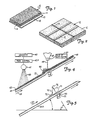
- Figure 1 illustrates a finished composite waterproofing sheet product 12, made according to the present invention and comprises a membrane 10 of material that is impervious to water, such as high density polyethylene, and a thickness or waterproofing layer of bentonite or sodium montmorillonite indicated at 11.
- the layer 11 is meant to indicate a finished thickness of bentonite made up of a number of layers, each having a thickness of an individual bentonite particle with interspersed adhesive layers, made into a sandwich type composite waterproofing sheet 10.
- an edge portion 13 of the membrane or sheet 10 may be left without the layer 11 of particles, as shown in Figure 2, so that the sheets or panels can be lapped.
- the lapped edge portion 13 in Figure 2 along a longitudinal edge, and if smaller panels such as 1.2 m (4ft.) by 1.2 m (4ft.) panels are used, an edge portion 14 of the membrane will be left uncoated along one end of the panel as well.
- the panels or long strips or sheets
- the composite waterproofing sheets are installed with the water impervious membrane facing outwardly to the elements.
- the composite structure comprises a flexible water impervious membrane in sheet form having a layer of particles, for waterproofing, preferably bentonite particles, on the surface at a desired depth.
- Adhesives that provide proper holding action are also important. While the prior art shows various adhesives that will work with bentonite, bentonite is highly reactive to many monovalant, divalant and trivalant materials. Bentonite also may form a permanent association with numerous other elements and compounds, and such products should be avoided in making the composite waterproofing sheets so that the bentonite particles do not react and lose their desirable property of swelling when contacted by water. When reactions do occur, or association of the bentonite particles with other elements occur, the waterproofing capabilities are degraded, because the bentonite material does not have the ability to swell and waterproof.
- Adhesive materials are available as emulsions with water, solutes, concentrates, hot melts and often in homo or copolymer status. Almost any adhesive originating from a solvent, emulsion with water, hot melt or water emulsified solid may be used, and the choice is determined by the ability to wet, its stickiness, the polar activity and the final adhesion performance. The choice is influenced by price, toxicity, availability, or environmental considerations as well. The addition of wetting agents, emulsifiers, dispersants and preservatives for latexes can cause deterioration of the bentonite's ability to waterproof or reseal, so use of products may be minimized.
- Adhesion to high density polyethylene has been difficult, and a common procedure to enhance adhesion is to chemically disturb the surface of the polyethylene or polymer membrane just prior to the application of the adhesive, for example by treating it with ozone. This brings in time limitations which means that the membrane has to be coated quite quickly because the molecules that are affected by the treatment migrate back to their original smooth alignment relatively fast.
- the total thickness of the layers of bentonite particles is built up to in the range of 3.18 mm (1/8 inch) to 6.35 mm (1/4 inch) thick, and thus a method of continuously achieving a permanent adhesion to the polyethylene membrane is required.
- the surface of the polyethylene preferably is roughened, and as shown herein, it can be done by stretching the polyethylene to microscopically "craze" the surface of the polyethylene.
- the amount and the direction of the tension applied to the membrane is determined by the thickness of the membrane. Generally, tensioning the membrane to about 207 KNm- 2 (30 Ibs per square inch) is acceptable for thicknesses of 0.051 mm to 0.508 mm (2 to 20 mils).
- the membrane used herein is most preferably in 'the range of 0.508 mm (20 mils), but the preferred range is 0.381 mm to 2.54 mm (15 to 100 mils) in thickness.
- tensioning can be done by passing the polyethylene membrane over rollers which apply a stretch between pinch drive rollers.
- the adhesive used must wet the polyethylene surface for good adhesion, and low surface tension solvent systems provide a suitable vehicle to carry the adhesive.
- Aliphatics, aldehydes, ketones, carbon/halide and ring compounds all have utilization.
- Common carriers/solvents include toluene, lower molecular weight alcohols, methyl ketone and water.
- the following products act as suitable adhesives:
- the adhesive solids should be present in concentrations from about 5 to 100% by weight, and are mixed with bentonite in ratios of between 3 and 50% by weight of the adhesive relative to the particles (bentonite).
- the method of prestretching the polyethylene for applying the adhesive is illustrated schematically, and is a conventional method for stretching sheets of materials.
- the structure shown therein can constitute the polyethylene supply of the main machine which will be discussed.
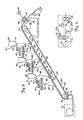
- a roll of polyethylene membrane material or other suitable sheet material is indicated at 20, and the membrane is passed through a pair of pinch rollers 21, which are driven from a motor 21A at a first speed and clamp the polyethylene membrane so it is driven at this set rate.
- the polyethylene is then run over suitable tensioning rollers indicated generally at 22 and 23 (more tensioning rollers may be used), and then the membrane is passed through a pair of pinch drive rollers 26.
- the drive rollers 26 are also driven by a suitable motor 26A, and tension can be applied to the membrane by driving the rollers 26 at a different (faster) lineal speed than the rollers 21.
- the membrane will be tensioned because of the differential in speed.
- Another way of stretching the membrane would be to run a section of sheet material between the first and second sets of pinch rollers, and then move the rollers, or guide rollers 22 and 23, in opposite directions (indicated by arrows) to stretch the membrane 10 a desired amount, and then subsequently run an additional length of material onto the stretching idler rollers.
- the method of tensioning or stretching the polyethylene membrane (or other membrane) can be used applying known principles, and thus the showing is done only schematically herein. Additionally, treated polyethylene can be obtained that has the ozone treatment previously mentioned.
- FIG 3 illustrates schematically the method of applying adhesive and particles to the water impervious membrane.
- the material supply indicated generally at 30, which can comprise a roll, if the membrane is treated, or the stretching rollers and drive shown in Figure 6, provides a continuous sheet of the membrane 10 that passes over a guide roller 31, and then is fed onto the top of conveyor belt assembly indicated generally at 32 having an endless belt 32A.
- the conveyor belt assembly is schematically represented as having a drive roller 33 at its upper end, and an idler roller 34 at its lower end over which the belt 32A is mounted.
- the conveyor belt 32A and thus the membrane sheet 10 are inclined in the range of 20° to 50° with respect to a horizontal plane.
- the conveyor belt incline is matched with a downwardly extending conveyor section 38 thay may be rollers or a conveyor belt and which is shown only partially, on which the membrane sheet 10 will run after the particles have been applied to form the composite waterproofing sheet 12.
- the downward incline is to insure that the membrane 10 will be carried upwardly by the conveyor belt 32A because there will be a downward component of loading tending to keep the membrane 10 moving upwardly on the incline. There will be some friction between the conveyor and the undersurface of the membrane as well. If needed, drive rollers can be utilized.
- the conveyor belt can be open mesh, a runner coated belt or any desired construction.
- the membrane sheet 10 has a surface that faces upwardly and as it is carried up the incline, the membrane 10 passes through a first particle application station indicated generally at 35, a second station indicated generally at 36, and a third station indicated generally at 37. More application stations are generally used, but the stations illustrated show the method.
- Each station 35, 36 and 37 includes an adhesive supply 40 feeding an adhesive through a feed control 40A to a spray bar 41 that extends transversely across the width of the membrane sheet 10. If the membrane is in the range of 1.2 m (4 feet) wide, the adhesive bar would be that long. Known adhesive spray bars can be utilized.
- the adhesive used can be selected from the group previously listed, and as shown by the dotted line representations at 42, the adhesive is sprayed in a thin layer onto the moving membrane in a first processing region indicated generally at 43.
- the coated membrane 10 moves upwardly a distance on the inclined conveyor, and a second portion of the staton 35, comprising a bentonite hopper 46 having a transversely extending feed section 47 of conventional design also controlled as to rate of feed with a conventional rate of feed control 49 applies a uniform, relatively thin line of bentonite particles indicated at 48 across the membrane.
- the bentonite particles drop onto the conveyor, immediately above or in the vicinity of a rotating beater bar 52 that is mounted in a suitable manner on bearings at opposite ends and is driven from a motor 53 to rotate at a desired speed.
- the beater bars 52 has two radial longitudinal extending lugs 54 on opposite sides thereof (diametrically opposed). Two positions of the lugs are shown in Figures 4 and 5, one in dotted lines.
- the lugs 54 strike the conveyor belt on its undersurface and vibrate it upwardly to bounce the bentonite particles upwardly from the belt and the membrane (at least particles that have not initially adhered to the layer of adhesive) and the loose particles then will tend to fall back into the region shown at 55 in Figure 3.
- a type of "standing wave" of individual particles is created because they will tend to fall back onto the membrane and be replaced by new particles bounced in the air by the beater bar.
- the particles which have touched the adhesive move upwardly with the membrane, but are locked in place.
- This low frequency, vertical vibrating action dislodges non-adhered bentonite particles, and insures that a totally adhered, uniform single particle thick layer is applied to the first adhesive layer in station 35.
- the second sprayer bar 41 applies a thin layer of adhesive in a region shown at 57, which would be applied on the upper surface of the first layer of bentonite particles, as well as flowing slightly in between any spaces in the bentonite particles forming the first layer.
- the rate of feed of adhesive can be controlled with feed control 40A.
- a second bentonite hopper 46 with a feed assembly 47 and rate of feed control 49 will apply another individual particle layer onto the first layer of particles and the second layer of adhesive applied in the region 57.
- the hopper 46 at the second station 36 is also immediately above a beater bar 52 that is driven from a motor 53 as well. This beater bar acts as before and forms a second standing wave or particles to cause a second, single particle thick layer of particles to form on top of the first layer of particles, so that now there are two layers of particles adhered to the upper surface of the membrane 10.
- the adhesive is applied in a section 60 of the membrane.
- a third layer of adhesive is applied in section 60 with a third spray bar 41, and when the applied thin layer of adhesive is moved up under the third station bentonite hopper 46, the feed of particles from the feed section 47 of the third station 37 falls down onto the new or fresh adhesive layer to form a third layer of particles on the membrane.
- the particles are deposited above a third beater bar 52 driven from a motor 53 to form a standing wave 55 at station 37, forming the uniform, single particle depth layer of material.
- the number of layers of particle material desired, to achieve the desired thickness determines the number of individual stations that are utilized. This process may be used for forming adhering layers of particles to membranes or sheets for various uses, such as single layer sandpaper or non-slip pads, as well as for waterproofing sheets.
- Figure 4 illustrates in greater detail the individual layers of particles indicated at 61, 62 and 63, which would be applied after the adhesive station in the region 60 of the membrane.
- the conveyor belt movement direction is indicated by the arrow 65, and it can be seen that the beater bar forms a standing wave section shown at 66 where the particles tend to make a loop, and the particles that are falling rearwardly will fall down onto the adhesive from the spray bar that applies the adhesive in the area 60 and to retain a single particle thick layer.
- the adhesive layer is controlled in thickness to accomplish this purpose.
- Figure 5 illustrates the forces and the amplitude of movement caused by the beater 54.
- the conveyor belt and membrane deflect upwardly as shown in dotted lines at 70, tending to throw or project the particles upwardly from the belt as shown by the arrow 71.
- the particles then fall under gravity generally downwardly, at the same time the conveyor belt and membrane are moving upwardly in the direction as indicated by the arrow 65, so that the adhesive coated particles indicated generally at 72, with the fresh layer of adhesive on top will collect the next layer of particles to form the uniform depth layers.
- the upward force vector is shown by the vertical arrow 71
- gravity is shown by the arrow 75
- the invididual particle indicated at 76 is falling in direction along the arrow 75 as a direction of return.
- a standing wave again is shown generally at 66 where the particles tend to loop over and adhere to the adhesive.
- the sequence is applying adhesive, and a uniform single particle thick layer across the surface of the membrane sheet of material (leaving an edge portion for the lap seam shown in Figure 2) and then applying a uniform layer of particles above a vibrator or beater, so that the particles adhere as the material is moved in an upwardly inclined plane. Additional layers are added at additional, individual stations positioned in sequence along the inclined membrane.
- Nonadhering particles are problems in an adhesive layer, and in the present device, non- adhering particles would act as a bond breaker, or separation with subsequent layers. Such condition (non-adhering particles) causes delamination and separation which leaves the waterproofing sheet unsuitable for use. It could not be transported, handled for installation, nor provide proper waterproofing qualities.
- the apparatus performs in situ testing of the particle 'bonds.
- the present process shown utilizes a minimum amount of adhesive, with a controlled ratio of adhesive to particles. Because a fresh layer of adhesive is applied at each station, dry areas are prevented and a uniform thickness is achieved. Particle size of bentonite can range up to 0.105 mm (150 mesh, using standard mesh sizes) for bentonite. The beater tends to cause the unattached particles to become airborne, and the loose particles will continue to be forced back into the adhesive to form the standing wave explained.
- the ratios of adhesive to particles is easily controlled by the size of the nozzles, pressure and the spray bar, as well as the rate of feed of the particles. 8.9 N to 53.4 N (two to 12 pounds) of adhesive to 178.0 N (40 pounds) of particles is a range that is generally satisfactory, and it should be pointed out that if too much adhesive is used, it will tend to flow downwardly and not be carried up the incline.
- the dry particles are kept airborne by the beaters, so that they will not pass through the station until they have lodged in adhesive and adhere in a desired layer.
- the particle size can be between 4 mm and 0.297 mm (5 and 150 mesh using standard U.S. standard mesh sizes). If desired, air entraining of particles (fluidizing) can be used for feeding the particles. Lowering the amplitude and frequency of the beater bar at the final station will cause the production of a dry particle coating over the entire layer, which would tend to have a little less adherence, but it would be an immediate physical state for packaging.
- the beater bars generally in the final station would have an amplitude of about 3.175 mm (1/8 of an inch) with a frequency of about 100 rpm (200 beats per minute). The amplitude of the "beat” is limited by the force of gravity, i.e. how fast does the conveyor belt resume its original position before being “hit” again by the rotating beater.
- the amplitude of the beater bar and the rotational velocity of the beater in relation to linear velocity of the conveyor belt is selected to be proper for the angle of inclination of the conveyor belt.
- an amplitude of the beater of a 3.175 mm (1/8 inch) rotating at 180 rpm when the velocity of the conveyor belt is approximately 0.127 ms- 1 (25 feet per minute) with an angle of incline of 30° results in the bentonite particles being knocked back about 50.8 mm (two inches) so that the standing wave develops in an area of the membrane about two inches behind the beater bar.
- the particles returning from the area of beating, plus the newly supplied particles provide the uniform coating that sticks to the adhesive.
- the coating or composite layer of bentonite preferably ranges between 35.9 and 47.9 Nm- 2 (.75 pound and one pound per square foot) for adequate waterproofing capabilities.
- the coating or composite layer of bentonite is built up to a weight of about one pound per square foot for adequate waterproofing characteristics for the composite waterproofing sheet 12.
- rollers 80, 80 are shown. These rollers are mounted on a frame 81 and driven with a motor 82 at a desired speed, synchronized with the membrane speed of movement.
- the rollers 80 extend across the composite sheet and compress the membrane layers of bentonite particles together to provide a uniform depth layer and to force the particles to be sealed in adhesive.
- Water soluble (misable) colorants may be added to the bentonite layer. When present, these colorants dissolve in the water and make a stain when wate leaks through any damage such as a rip or tear in the non-permeable membrane 10, thus clearly marking the size, location and origin of the leaking water.
- This capacity is especially valuable on horizontal surfaces such as roofs, decks, plazas, etc. This feature could not be used if the membrane were not impermeable to the passage of water.
- the mechanical components and conveyors may be suitable, commercially available components and thus the spray bars, hoppers and rollers are shown only schematically.
Landscapes
- Engineering & Computer Science (AREA)
- Structural Engineering (AREA)
- General Engineering & Computer Science (AREA)
- Civil Engineering (AREA)
- Environmental & Geological Engineering (AREA)
- Life Sciences & Earth Sciences (AREA)
- Mining & Mineral Resources (AREA)
- Architecture (AREA)
- General Life Sciences & Earth Sciences (AREA)
- Paleontology (AREA)
- Physics & Mathematics (AREA)
- Electromagnetism (AREA)
- Mechanical Engineering (AREA)
- Ocean & Marine Engineering (AREA)
- Hydrology & Water Resources (AREA)
- Laminated Bodies (AREA)
- Application Of Or Painting With Fluid Materials (AREA)
- Coating Apparatus (AREA)
- Synthetic Leather, Interior Materials Or Flexible Sheet Materials (AREA)
Claims (14)
Priority Applications (1)
| Application Number | Priority Date | Filing Date | Title |
|---|---|---|---|
| AT86907191T ATE60722T1 (de) | 1985-11-22 | 1986-11-20 | Wasserdamm. |
Applications Claiming Priority (2)
| Application Number | Priority Date | Filing Date | Title |
|---|---|---|---|
| US06/801,007 US4693923A (en) | 1985-11-22 | 1985-11-22 | Water barrier |
| US801007 | 1997-02-19 |
Publications (3)
| Publication Number | Publication Date |
|---|---|
| EP0246311A1 EP0246311A1 (de) | 1987-11-25 |
| EP0246311A4 EP0246311A4 (de) | 1988-04-18 |
| EP0246311B1 true EP0246311B1 (de) | 1991-02-06 |
Family
ID=25179945
Family Applications (1)
| Application Number | Title | Priority Date | Filing Date |
|---|---|---|---|
| EP19860907191 Expired - Lifetime EP0246311B1 (de) | 1985-11-22 | 1986-11-20 | Wasserdamm |
Country Status (7)
| Country | Link |
|---|---|
| US (1) | US4693923A (de) |
| EP (1) | EP0246311B1 (de) |
| JP (3) | JPS63501413A (de) |
| AU (1) | AU6732387A (de) |
| CA (1) | CA1260331A (de) |
| HK (1) | HK39494A (de) |
| WO (1) | WO1987003225A1 (de) |
Cited By (2)
| Publication number | Priority date | Publication date | Assignee | Title |
|---|---|---|---|---|
| EP0714965A1 (de) | 1994-12-02 | 1996-06-05 | BBZ INJEKTIONS- UND ABDICHTUNGSTECHNIK GmbH | Dichtungsmaterial aus Naturrohstoffen |
| US6537676B1 (en) | 1992-08-26 | 2003-03-25 | Rawell Group Holdings Limited | Waterproofing material and method of fabrication therefor |
Families Citing this family (51)
| Publication number | Priority date | Publication date | Assignee | Title |
|---|---|---|---|---|
| US5079088A (en) * | 1985-11-22 | 1992-01-07 | Paramount Technical Products, Inc. | Water barrier |
| FR2619584B1 (fr) * | 1987-08-17 | 1989-12-01 | Jacob Christian | Couvre-sol de proprete s'opposant a la vegetation des sols |
| US4837085A (en) * | 1987-12-15 | 1989-06-06 | Mcgroarty Bryan M | Joint leak stop membrane |
| WO1990014222A1 (en) * | 1989-05-18 | 1990-11-29 | Paramount Technical Products Inc. | Leakproofing for hazardous waste |
| US5091234A (en) * | 1989-06-30 | 1992-02-25 | Mcgroarty Bryan M | Composite water barrier sheet |
| US5112665A (en) * | 1990-02-15 | 1992-05-12 | American Colloid Company | Water barrier of water-swellable clay sandwiched between interconnected layers of flexible fabric |
| US4996812B1 (en) * | 1990-02-20 | 1999-11-02 | Carlisle Corp | Method of membrane application in roof construction |
| US5175965A (en) * | 1990-12-24 | 1993-01-05 | Sandra L. Miller | Method for forming sandpaper disks |
| US5158803A (en) * | 1991-06-17 | 1992-10-27 | William Haas | Emergency flat roof repair method |
| KR100248701B1 (ko) * | 1991-08-08 | 2000-03-15 | 맥그로아티 패트릭 제이. | 방수판 스트립 |
| US5226279A (en) * | 1992-03-09 | 1993-07-13 | Rendon Herrero Oswald | Sealing method for the treatment of portland cement concrete |
| FR2690688B1 (fr) * | 1992-04-30 | 1994-07-22 | Isoform | Procede de depot d'un revetement de latex sur une piece en elastomere et piece composite a base d'elastomere de silicone comportant un revetement de latex. |
| US5380552A (en) * | 1992-08-24 | 1995-01-10 | Minnesota Mining And Manufacturing Company | Method of improving adhesion between roofing granules and asphalt-based roofing materials |
| EP0658231B2 (de) * | 1992-08-26 | 2003-09-03 | Rawell Group Holdings Limited | Wasserabdichtungsbahn |
| WO1995027616A1 (en) * | 1994-04-07 | 1995-10-19 | Mcgroarty Bryan M | Resealable liner |
| FR2720764B1 (fr) * | 1994-06-01 | 1996-08-23 | Lefebre Entr Jean | Complexe bicouche d'étanchéité d'un site et procédé de mise en Óoeuvre d'un tel complexe d'étanchéité. |
| US5576065A (en) * | 1995-02-03 | 1996-11-19 | Poly Wall International, Inc. | Multilayered system for waterproofing rigid structural materials |
| US5663230A (en) * | 1995-02-15 | 1997-09-02 | Concrete Sealants, Inc. | Water stop composition and methods of preparing same |
| CA2242638A1 (en) * | 1995-10-24 | 1997-05-01 | Camelot Superabsorbents Limited | Absorbent articles |
| US5788413A (en) | 1996-03-28 | 1998-08-04 | I-Corp International, Inc. | Geocomposite membrane |
| US6025032A (en) | 1998-03-03 | 2000-02-15 | Poly Wall International, Inc. | Method and composition for waterproofing |
| US6224700B1 (en) | 1998-11-11 | 2001-05-01 | Mar-Flex Systems, Inc. | Methods for waterproofing architectural surfaces |
| US6426309B1 (en) | 1998-12-30 | 2002-07-30 | Owens Corning Fiberglas Technology, Inc. | Storm proof roofing material |
| US20040014385A1 (en) * | 1998-12-30 | 2004-01-22 | Greaves Gerald G. | Storm resistant roofing material |
| WO2000066514A1 (en) | 1999-05-04 | 2000-11-09 | Protective Coatings Technology, Inc. | Method and composition for waterproofing |
| US6197398B1 (en) * | 1999-11-22 | 2001-03-06 | Gse Lining Technology, Inc. | Earthen liner with clay seam cover |
| CA2337973A1 (en) * | 2000-03-22 | 2001-09-22 | Illinois Tool Works Inc. | Weather resistant anti-slip panels |
| US6742313B2 (en) * | 2001-03-15 | 2004-06-01 | R.S. Associates, Inc. | Non-cellular adhesive for composite roof structure |
| US20020110668A1 (en) * | 2001-02-15 | 2002-08-15 | 3M Innovative Properties Company | Method of forming seamless article covering and articles formed thereby |
| US6679018B2 (en) * | 2002-02-01 | 2004-01-20 | Chem Link, Inc. | Roofing system and method |
| GB2389560B (en) | 2002-06-12 | 2005-04-13 | Rawell Group Holdings Ltd | Waterproofing material |
| US20040059036A1 (en) * | 2002-09-23 | 2004-03-25 | Gaveske John H. | Method and composition for waterproofing |
| US20060009100A1 (en) * | 2004-07-08 | 2006-01-12 | Mcgroarty Bryan | Waterproofing membrane |
| JP2008539320A (ja) * | 2005-04-28 | 2008-11-13 | モノソル エルエルシー | 水溶性組成物及び構造体並びにこれらの製造方法及び使用方法 |
| USH2257H1 (en) * | 2005-09-28 | 2011-06-07 | The United States Of America As Represented By The Secretary Of The Navy | Microtags for detection and identification of materials |
| JP4644117B2 (ja) * | 2005-12-28 | 2011-03-02 | 花王株式会社 | 粉粒体散布方法及び装置 |
| DE502006003561D1 (de) * | 2006-12-19 | 2009-06-04 | Matthaei Bauunternehmen Gmbh & | Selbstdichtendes Abdichtungsmaterial zur Abdichtung von Bodenflächen |
| US10016954B2 (en) * | 2007-11-19 | 2018-07-10 | Amcol International Corporation | Self healing salt water barrier |
| US10012079B2 (en) * | 2007-11-19 | 2018-07-03 | Amcol International Corporation | Self healing salt water barrier |
| EP2177349A1 (de) * | 2008-10-15 | 2010-04-21 | Sika Technology AG | Wasserdichte Membran |
| WO2010088468A2 (en) * | 2009-01-30 | 2010-08-05 | Tegraseal Products, Llc | Water containment and exclusion products |
| US8318616B2 (en) * | 2009-08-19 | 2012-11-27 | Amcol International Corporation | Salt water swellable compositions and articles |
| JP5462645B2 (ja) * | 2010-01-25 | 2014-04-02 | トヨタホーム株式会社 | 防水シート |
| PL2505719T3 (pl) | 2011-03-31 | 2016-10-31 | Samoczynnie naprawiająca się bariera dla słonej wody | |
| CN102518151A (zh) * | 2011-11-26 | 2012-06-27 | 东南大学 | 一种适用于含多价阳离子矿物环境的土工衬垫及制备方法 |
| US20140044956A1 (en) * | 2012-08-10 | 2014-02-13 | Tegraseal Products, Llc | Hydrophilic rubber composition |
| CN106540868B (zh) * | 2016-12-12 | 2022-11-22 | 江西中材太阳能新材料有限公司 | 自动植砂设备及自动植砂系统 |
| EP3450520B1 (de) * | 2017-09-05 | 2022-01-19 | Sika Technology Ag | Klebstoffzusammensetzung und verwendung davon zur bereitstellung eines selbstheilenden geklebten dachsystems |
| EP3847320A1 (de) * | 2018-09-04 | 2021-07-14 | Sika Technology AG | Klebstoffzusammensetzung und ihre verwendung zur erkennung von leckagen in vollständig haftenden dachsystemen |
| JP7555324B2 (ja) * | 2021-11-08 | 2024-09-24 | 株式会社日立産機システム | 温度インジケータ製造システムおよび温度インジケータ製造方法 |
| US20230357083A1 (en) * | 2022-05-04 | 2023-11-09 | Johns Manville | Dual application of roofing granules to bituminous roofing material |
Family Cites Families (23)
| Publication number | Priority date | Publication date | Assignee | Title |
|---|---|---|---|---|
| US2603575A (en) * | 1949-11-17 | 1952-07-15 | Jr August F Schramm | Method of making a stiffened permeable resin coated fibrous sheet |
| US3186896A (en) * | 1962-05-09 | 1965-06-01 | American Colloid Co | Moisture impervious panel |
| US3497409A (en) * | 1966-02-01 | 1970-02-24 | American Colloid Co | Method of forming a moisture impervious panel |
| US3466827A (en) * | 1967-01-10 | 1969-09-16 | American Colloid Co | Moisture impervious deck construction |
| DE2006854A1 (en) * | 1970-02-14 | 1971-09-09 | Fa Josef Schmitter, 8725 Arnstein | Multi-layered thermoplastic packaging filmfo |
| US3676198A (en) * | 1970-05-11 | 1972-07-11 | Bryan M Mcgroarty | Method for waterproofing structures |
| US3949560A (en) * | 1973-02-07 | 1976-04-13 | American Colloid Company | Method and composition for preventing water contaminated with industrial waste from seeping through soil containing said water |
| US4021402A (en) * | 1974-05-23 | 1977-05-03 | American Colloid Company | Method and composition for preventing water contaminated with industrial waste seeping through soil containing said water |
| US4048373A (en) * | 1974-05-23 | 1977-09-13 | American Colloid Company | Water barrier panel |
| JPS5346612B2 (de) * | 1974-09-30 | 1978-12-15 | ||
| JPS5198120A (en) * | 1975-02-26 | 1976-08-28 | Bosuishiito oyobi gaishiitoomochiitakenzobutsunobosuikoho | |
| US4084382A (en) * | 1975-08-18 | 1978-04-18 | American Colloid Company | Method and composition for preventing water contaminated with industrial waste seeping through soil containing said water |
| PH13790A (en) * | 1975-10-28 | 1980-10-01 | American Colloid Co | Water barrier panel and method |
| US4070839A (en) * | 1976-09-09 | 1978-01-31 | American Colloid Company | Moisture impervious panel |
| US4126543A (en) * | 1977-02-14 | 1978-11-21 | American Colloid Company | Method and apparatus for screening particulate materials |
| US4139588A (en) * | 1977-05-25 | 1979-02-13 | American Colloid Company | Method of making a water barrier panel |
| US4209568A (en) * | 1978-09-18 | 1980-06-24 | American Colloid Company | Bentonite-gelled oil waterproofing composition |
| US4212691A (en) * | 1978-11-21 | 1980-07-15 | Congoleum Corporation | Methods and apparatus for making decorative inlaid types of resilient sheet materials and the like |
| JPS5824439A (ja) * | 1981-08-05 | 1983-02-14 | 平岡織染株式会社 | 非結露性防水シ−トの製造方法 |
| US4467015A (en) * | 1981-11-02 | 1984-08-21 | Clem Arthur G | Waterproofing structure |
| US4534926A (en) * | 1982-11-22 | 1985-08-13 | American Colloid Company | Uninhibited bentonite composition |
| US4581864A (en) * | 1983-05-26 | 1986-04-15 | Lidia Shvakhman | Waterproofing unit |
| DE3400079A1 (de) * | 1984-01-03 | 1985-07-11 | Röhm GmbH, 6100 Darmstadt | Wasserspreitendes kunststoffmaterial, verfahren zu seiner herstellung u. verwendung als verglasungs- und bedachungsmaterial |
-
1985
- 1985-11-22 US US06/801,007 patent/US4693923A/en not_active Expired - Lifetime
-
1986
- 1986-11-20 WO PCT/US1986/002472 patent/WO1987003225A1/en not_active Ceased
- 1986-11-20 EP EP19860907191 patent/EP0246311B1/de not_active Expired - Lifetime
- 1986-11-20 AU AU67323/87A patent/AU6732387A/en not_active Abandoned
- 1986-11-20 JP JP61506163A patent/JPS63501413A/ja active Pending
- 1986-11-21 CA CA000523582A patent/CA1260331A/en not_active Expired
-
1994
- 1994-04-28 HK HK39494A patent/HK39494A/en not_active IP Right Cessation
-
1996
- 1996-07-08 JP JP1996006488U patent/JP2568050Y2/ja not_active Expired - Lifetime
- 1996-08-07 JP JP1996007834U patent/JP2584238Y2/ja not_active Expired - Lifetime
Cited By (2)
| Publication number | Priority date | Publication date | Assignee | Title |
|---|---|---|---|---|
| US6537676B1 (en) | 1992-08-26 | 2003-03-25 | Rawell Group Holdings Limited | Waterproofing material and method of fabrication therefor |
| EP0714965A1 (de) | 1994-12-02 | 1996-06-05 | BBZ INJEKTIONS- UND ABDICHTUNGSTECHNIK GmbH | Dichtungsmaterial aus Naturrohstoffen |
Also Published As
| Publication number | Publication date |
|---|---|
| JP2568050Y2 (ja) | 1998-04-08 |
| JPH09304U (ja) | 1997-05-27 |
| US4693923A (en) | 1987-09-15 |
| EP0246311A4 (de) | 1988-04-18 |
| JP2584238Y2 (ja) | 1998-10-30 |
| HK39494A (en) | 1994-05-06 |
| JPS63501413A (ja) | 1988-06-02 |
| EP0246311A1 (de) | 1987-11-25 |
| AU6732387A (en) | 1987-07-01 |
| JPH0926U (ja) | 1997-01-17 |
| CA1260331A (en) | 1989-09-26 |
| WO1987003225A1 (en) | 1987-06-04 |
Similar Documents
| Publication | Publication Date | Title |
|---|---|---|
| CA1260331A (en) | Water barrier | |
| US5079088A (en) | Water barrier | |
| CA1174024A (en) | Method of waterproofing roofs and the like | |
| US10087634B2 (en) | Roofing systems and methods | |
| US4172830A (en) | Waterproofing structure and method of using same | |
| US9821532B2 (en) | Peel and stick waterproofing material | |
| US6878321B2 (en) | Method of manufacture of glass reinforced gypsum board and apparatus therefor | |
| US9404261B2 (en) | Roofing systems and methods | |
| EP1866497B1 (de) | Äussere verkleidung als witterungsschutz und herstellungsverfahren dafür | |
| US20040216396A1 (en) | Non-cellular adhesive for composite roof structure | |
| US20020110679A1 (en) | Storm proof roofing material | |
| US4910059A (en) | Tapered roofing membrane | |
| US4837085A (en) | Joint leak stop membrane | |
| EP3802123B1 (de) | Fischmundbeständige abdichtungsbahn | |
| EP1767697B1 (de) | Bodenmaterial, Verfahren für dessen Herstelllung und Verlegung | |
| US4503107A (en) | Construction barrier board | |
| EP1517784B1 (de) | Verfahren zur herstellung eines wasserdichtenden materials | |
| RU2112848C1 (ru) | Устройство кровли преимущественно из полимерного материала, армированного тканью | |
| JPH04296544A (ja) | 遮水シートの接合方法 | |
| JP2000008555A (ja) | エンボス付き防水シート及びその防水工法 |
Legal Events
| Date | Code | Title | Description |
|---|---|---|---|
| PUAI | Public reference made under article 153(3) epc to a published international application that has entered the european phase |
Free format text: ORIGINAL CODE: 0009012 |
|
| 17P | Request for examination filed |
Effective date: 19870722 |
|
| AK | Designated contracting states |
Kind code of ref document: A1 Designated state(s): AT BE CH DE FR GB LI |
|
| A4 | Supplementary search report drawn up and despatched |
Effective date: 19880418 |
|
| 17Q | First examination report despatched |
Effective date: 19890407 |
|
| GRAA | (expected) grant |
Free format text: ORIGINAL CODE: 0009210 |
|
| AK | Designated contracting states |
Kind code of ref document: B1 Designated state(s): AT BE CH DE FR GB LI |
|
| REF | Corresponds to: |
Ref document number: 60722 Country of ref document: AT Date of ref document: 19910215 Kind code of ref document: T |
|
| REF | Corresponds to: |
Ref document number: 3677504 Country of ref document: DE Date of ref document: 19910314 |
|
| ET | Fr: translation filed | ||
| PLBE | No opposition filed within time limit |
Free format text: ORIGINAL CODE: 0009261 |
|
| STAA | Information on the status of an ep patent application or granted ep patent |
Free format text: STATUS: NO OPPOSITION FILED WITHIN TIME LIMIT |
|
| 26N | No opposition filed | ||
| REG | Reference to a national code |
Ref country code: GB Ref legal event code: IF02 |
|
| PGFP | Annual fee paid to national office [announced via postgrant information from national office to epo] |
Ref country code: AT Payment date: 20051102 Year of fee payment: 20 |
|
| PGFP | Annual fee paid to national office [announced via postgrant information from national office to epo] |
Ref country code: GB Payment date: 20051116 Year of fee payment: 20 |
|
| PGFP | Annual fee paid to national office [announced via postgrant information from national office to epo] |
Ref country code: FR Payment date: 20051117 Year of fee payment: 20 |
|
| PGFP | Annual fee paid to national office [announced via postgrant information from national office to epo] |
Ref country code: CH Payment date: 20051125 Year of fee payment: 20 |
|
| PGFP | Annual fee paid to national office [announced via postgrant information from national office to epo] |
Ref country code: BE Payment date: 20051208 Year of fee payment: 20 |
|
| PGFP | Annual fee paid to national office [announced via postgrant information from national office to epo] |
Ref country code: DE Payment date: 20060102 Year of fee payment: 20 |
|
| PG25 | Lapsed in a contracting state [announced via postgrant information from national office to epo] |
Ref country code: GB Free format text: LAPSE BECAUSE OF EXPIRATION OF PROTECTION Effective date: 20061119 |
|
| REG | Reference to a national code |
Ref country code: GB Ref legal event code: PE20 |
|
| REG | Reference to a national code |
Ref country code: CH Ref legal event code: PL |
|
| BE20 | Be: patent expired |
Owner name: *MCGROARTY PATRICK J. Effective date: 20061120 Owner name: *MCGROARTY BRYAN M. Effective date: 20061120 |